Democrats Didn’t Conjure Up the Demand for MAGA Candidates
By Jamelle Bouie, Opinion Columnist – September 10, 2022
Credit…Adriana Zehbrauskas for The New York Times
In my column this week, I tackled some of the major objections to President Biden’s Philadelphia speech on MAGA Republicans and the threat they pose to democracy, including the view that it was too divisive.
Even if it was, most Americans land on Biden’s side of the argument — in a Reuters poll conducted just a few days after the speech, 58 percent of respondents, including a quarter of Republicans, said that Trump’s “Make America Great Again” movement is “threatening America’s democratic foundations.”
What I didn’t address was the charge that Biden, and Democrats in general, are acting in bad faith when they condemn Trump and his allies. If Democrats truly believe that MAGA Republicans are a threat to democracy, goes the argument, why are they spending tens of millions of dollars to elevate them in Republican primaries? My colleagues Ross Douthat and Bret Stephens both made a version of this point in their respectivecolumns this week.
They are keyed into something real: that it is a bit unsavory, if not outright hypocritical, for Democrats to spend huge sums to help nominate MAGA Republicans at the expense of their more moderate, pro-democracy colleagues while condemning those same candidates, and the movement they represent, as a threat to the constitutional order.
Where I part ways with my colleagues is in their conclusion that Democrats are therefore crying alligator tears when they condemn MAGA extremists. If the top priority is depriving the Republican Party of power and influence, then the most important thing for Democrats to do, right now, is win elections. And if the most Trump-aligned candidates tend to be the weakest challengers in a general election, then it is entirely consistent with the argument in Biden’s speech to want to elevate those candidates over more moderate alternatives.
At the end of the day, a more moderate Republican in Congress is still a vote for Kevin McCarthy as speaker of the House or Mitch McConnell as Senate majority leader. It is still a vote, in other words, for a coalition that includes MAGA Republicans.
I could leave it there, except that I think that this answer concedes too much to the premise. Implicit in the question is the factual claim that Democratic spending in Republican primaries is either responsible for — or a significant factor in — the success of MAGA candidates with Republican voters. Otherwise, why would Democrats spend the money and why would conservatives complain about the outcome?
I think it is true that Democratic spending has had an effect. But I think the more significant reason that Republican voters keep nominating MAGA candidates is that Republican voters like MAGA candidates. All you have to do is look at the results of the Republican primaries in question and ask if Democratic money really mattered that much.
Did Illinois Governor J.B. Pritzker, a Democrat, spend millions to give a boost to Darren Bailey, the Trumpiest candidate in the Republican gubernatorial primary? Yes. But Bailey led the Republican field before Pritzker’s intervention, swamping his opponents in an October 2021 poll. Democrats may have nudged some undecided voters into Bailey’s camp, but that alone does not explain how the hard-right Republican won more than 57 percent of the vote in a six-way primary. The more likely answer, given his early lead, is that Republican voters liked what Bailey was selling.
The same goes for Doug Mastriano in Pennsylvania, the pro-insurrection Republican candidate for governor. Democrats gave him a boost as well. But he led the Republican pack for much of the race and his final tally — nearly 44 percent of the vote in an eight-way contest — reflects his very real popularity with Republican voters in the state.
The other thing to consider is the actual content of Democratic ads on behalf of MAGA Republican candidates. The ad meant to support Mastriano, for example, simply stated his conservative views and emphasized his support for Trump. The ad said that Mastriano wanted to “outlaw abortion” and is “one of Donald Trump’s strongest supporters.” It also points out that Mastriano “wants to end vote by mail, and he led the fight to audit the 2020 election. If Mastriano wins, it’s a win for what Donald Trump stands for.”
It is not the Democratic Party’s fault that Republicans are attracted to this message, and nothing forced Republicans in Pennsylvania or Illinois (or Michigan or Arizona) to nominate the most MAGA candidates in the field. Republicans voters like Trump and they want Trumpist candidates, and where there’s demand, supply usually follows.
Which is to say that even with Democratic intervention in Republican primaries, the thrust of Biden’s story about the Republican Party still holds up. The party has been captured by extremists, and it’s up to the rest of us to ensure that it doesn’t win more power than it already has.
What I Wrote
My Friday column was on President Biden’s Philadelphia speech, why I think the objections to it are misguided, and what, if anything, was missing from his argument that the MAGA movement is a threat to American democracy.
To divide against a radical minority that would attack and undermine democratic self-government is to divide along the most inclusive lines possible. It is to do a version of what Franklin Roosevelt did when he condemned“organized money,” “economic royalists” and the “forces of selfishness and lust for power.”
‘Triple-dip’ La Niña is on the way. Here’s what it means for weather in the US
Doyle Rice, USA TODAY – September 9, 2022
La Niña just won’t go away.
Meteorologists say that for the third straight year, La Niña will persist throughout the winter in the Northern Hemisphere. This is the first “triple-dip” La Niña of the century, according to a recent update from the United Nations’ World Meteorological Organization.
This La Niña began in September 2020.
The La Niña climate pattern is a natural cycle marked by cooler-than-average ocean water in the central Pacific Ocean. It is one of the main drivers of weather in the United States and around the world, especially during late fall, winter and early spring.
It’s the opposite to the more well-known El Niño, which occurs when Pacific ocean water is warmer than average. While this would be the first “triple-dip” La Niña this century, it’s not unprecedented for the pattern to last more than nine months to a year, which is typical for a La Niña, according to ABC News.
A typical La Niña winter in the U.S. brings cold and snow to the Northwest and unusually dry conditions to most of the southern tier of the U.S., according to NOAA’s Climate Prediction Center. The Southeast and Mid-Atlantic also tend to see warmer-than-average temperatures during a La Niña winter.
Meanwhile, New England and the Upper Midwest into New York tend to see colder-than-average temperatures, the Weather Channel said.
Climate change also plays a role
However, the WMO said all naturally occurring climate events now take place in the context of human-induced climate change, which is increasing global temperatures, exacerbating extreme weather and climate, and impacting seasonal rainfall and temperature patterns.
“It is exceptional to have three consecutive years with a La Niña event,” said WMO Secretary-General Petteri Taalas in a news release. “Its cooling influence is temporarily slowing the rise in global temperatures – but it will not halt or reverse the long-term warming trend,” he added.
Where did the term La Niña come from?
Both La Niña and El Niño are Spanish language terms: La Niña means “little girl,” while El Niño means “little boy,” or “Christ child.” South American fishermen first noticed periods of unusually warm water in the Pacific Ocean in the 1600s, the National Oceanic and Atmospheric Administration said. The full name they used was “El Niño de Navidad” because El Niño typically peaks around December.
The entire natural climate cycle is officially known by climate scientists as El Niño – Southern Oscillation (ENSO), a see-saw dance of warmer and cooler seawater in the central Pacific Ocean.
During La Niña events, trade winds are even stronger than usual, pushing more warm water toward Asia, NOAA said. Off the west coast of the Americas, upwelling increases, bringing cold, nutrient-rich water to the surface.
Britain’s Queen Elizabeth II has died, ending a historic 70-year reign. She was 96.
The Queen died at Balmoral, her beloved palace in the Scottish Highlands, which was purchased by her great-great-grandfather Prince Albert for Queen Victoria in 1852. She was surrounded by her children and grand-children.
Prince Charles, her eldest son, succeeds her.
The Queen’s death comes just under 18 months and after that of her husband, Prince Philip, Duke of Edinburgh, who died on April 9, 2021.
Earlier this year, the Queen celebrated her Platinum Jubilee, which commemorated a record-breaking 70 years on the throne. In a rare personal statement to mark the occasion of her accession, she said: “It is a day that, even after 70 years, I still remember as much for the death of my father, King George VI, as for the start of my reign.”
Celebrations began on Feb. 6, which is the day she officially acceded to the throne, and carried on into June, when she appeared on the balcony of Buckingham Palace for the first day of a long Jubilee weekend, with the British public getting an extra public holiday to celebrate.
However, the monarch did not attend subsequent Jubilee events, including a concert in her honor featuring Adam Lambert and Queen, Lin-Manuel Miranda and Sir Elton John, after experiencing discomfort during the Trooping the Colour parade on the first day of the celebrations. She made a brief appearance on the Sunday at the conclusion of the festivities.
On 6 Sept., she officially appointed the U.K.’s latest Prime Minister, Liz Truss, in a ceremony at Balmoral. Traditionally a new Prime Minister is appointed at Buckingham Palace, in the capital, but the venue was changed due to the Queen’s “mobility problems,” the palace said in a statement. In photographs released of the event the Queen was shown using a walking stick but smiling as she shook Truss’s hand. The following day she was forced to cancel an audience with ministers after being advised to rest by her doctors.
The Queen, who acceded to the throne in 1952, was the world’s oldest reigning monarch. In 2015, she also became the longest-reigning British sovereign of all time, surpassing the previous record set by Queen Victoria.
She holds the record for the second-longest reigning monarch of all time after France’s Louis XIV, who was on the throne for 72 years.
During her reign, the Queen saw 15 British prime ministers serve under her, beginning with Winston Churchill, and met 13 of the last 14 U.S. presidents, from Harry S. Truman through to Joe Biden, as well as countless heads of state across the world. (The only U.S. president she did not meet was Lyndon Johnson.)
Princess Elizabeth was not expected to become a queen when she was born to the Duke and Duchess of York on April 21, 1926 in Mayfair, London. When her uncle, Edward VIII, abdicated in 1936 over his relationship with American divorcee Wallis Simpson, Elizabeth’s father was declared King George VI, moving the then 10-year-old princess into the direct line of succession. (Edward VIII’s abdication has been portrayed on screen in films including Oscar-winning “The King’s Speech,” starring Colin Firth and Helena Bonham Carter, and in Madonna’s biopic of Wallis Simpson, “W.E.”)
In 1947 Princess Elizabeth married Prince Philip, Duke of Edinburgh, with whom she had four children: Charles, Prince of Wales and Anne, Princess Royal, were both born before she acceded to the throne, followed almost ten years later by Prince Andrew, Duke of York and Prince Edward, Earl of Wessex, who were born while she was queen.
On Feb. 6, 1952, King George VI died suddenly at the age of 56 from a coronary thrombosis and Princess Elizabeth, then on a tour of Kenya, acceded to the throne, becoming Queen Elizabeth II. Her coronation in Westminster Abbey the following year was the first in British history to be televised.
While she continued to undertake her royal duties until the very end of her reign, in the last few years of her life she was restrained by her health, using a walking stick and occasionally, according to local reports, a wheelchair, although she was never seen publicly with the latter.
In February 2022, a statement from Buckingham Palace to royal reporters confirmed that the Queen had contracted COVID-19. “Her Majesty is experiencing mild cold like symptoms but expects to continue light duties at Windsor over the coming week,” said a statement from the palace. “She will continue to receive medical attention and will follow all the appropriate guidelines.” However, she appeared to make a full recovery.
The Queen became a cultural staple during her long and eventful reign. She was the most photographed woman in history – gracing the cover of Time magazine at age three, the first of several such appearances – and was depicted on the big screen, the small screen, the stage, in music, and in art.
She is the main subject of the Netflix original series “The Crown,” which follows the Queen from the 1940s to modern times and examines her relationship with the various prime ministers who led Her Majesty’s Government as well as other figures, both within the Royal Family and outside it. Over the show’s six seasons, each of which covers approximately a decade in her life, she has been portrayed by three different actors: Claire Foy, who won a Golden Globe for her portrayal, and Olivia Colman, who won both a Golden Globe and an Emmy, and Imelda Staunton, who will portray the queen in her 70s and 80s during the show’s fifth and sixth (also believed to be its final) season. Season 5 will premiere on Netflix in November 2022.
Helen Mirren also memorably played the British monarch in the 2006 film “The Queen,” written by “The Crown” creator Peter Morgan and directed by Stephen Frears. The film was set in the aftermath of Princess Diana’s death, a low point for the British royal family, and won Mirren a best actress Oscar for her performance. Mirren went on to play Elizabeth again in the West End and on Broadway, in the stage hit “The Audience.”
The monarch was also depicted in “Spencer,” played by Stella Gonet – the film stars Kirsten Stewart as her daughter-in-law Princess Diana – while the Queen’s early childhood was portrayed in Oscar-winning film “The King’s Speech.” The 2015 film “A Royal Night Out” offered a fictionalized glimpse of the night Elizabeth and her sister Princess Margaret were allowed secretly to slip out of Buckingham Palace to join the crowds celebrating V-E Day on the streets of London in 1945.
In 2016, the Queen was a character in “The BFG,” Steven Spielberg’s adaptation of the book by Roald Dahl and “The Naked Gun: From the Files of Police Squad!” also tackled the British monarch — literally. In the 1988 comedy, Leslie Nielsen’s character uses a running tackle to save the Queen from what he wrongly believes to be an assassination attempt. The actor who plays her in the film, Jeannette Charles, has made a career of royal impersonation, standing in as Elizabeth in about 20 movies and TV programs over a 40-year period.
In animated form, the Queen in her Cinderella-like royal coach survived an attempted robbery of her crown in the 2015 film “Minions” and a rear-ending by Homer Simpson in a 2003 episode of “The Simpsons” (titled “The Regina Monologues”). She wasn’t so lucky in a 2012 episode of “Family Guy,” in which a high-speed chase of her carriage ends in a royal fatality, and in 2007 an episode of “South Park” sparked outrage after it showed her dying by suicide on the throne. She also made an appearance in Gary Janetti’s short-lived animated comedy “The Prince,” which ran for one season on HBO Max.
In 2022, the Queen delighted viewers around the world by guest-starring in a video with Paddington Bear. In the skit, which was filmed at Windsor Castle and broadcast before the Platinum Jubilee concert, Paddington is invited to the Queen’s abode for tea where chaos ensues. At one point, the bear offers Her Majesty a marmalade sandwich fished out of his hat, as he tells her: “I always keep one for emergencies.” In response, the Queen replies, “So do I” and opens her handbag to pull out a marmalade sandwich of her own. The two-minute video quickly went viral, with the Queen’s great-grandchildren, Prince George and Princess Charlotte shown in the audience responding with joy to the clip.
The cameo echoed her 2012 appearance at the London Olympics when the Queen appeared in a pre-recorded video shown at the opening ceremony. In the clip, she greets Daniel Craig (in character as James Bond) at Buckingham Palace before he escorts her to a waiting helicopter. They’re shown flying over London towards the Olympic stadium before Craig and the Queen appear to jump out of the chopper with parachutes strapped to their back. As the video was being played in the stadium a real helicopter appeared in the sky and two figures – one clad in a regal peach dress – parachuted out. With perfect timing, the Queen then appeared in person at the ceremony in an identical dress before taking her seat in the stadium to the sound of wild cheers.
Despite her occasional cameos and innumerable public appearances, the Queen remained an enigma to her subjects, deliberately cultivating an air of majesty and mystery. She never gave a single interview during her lifetime and maintained an aloofness in an age of over-sharing and public emotion, even as the lives of her own children — and grandchildren — came to resemble a reality show, with lurid details of their relationships and scandalous antics regularly making headlines in the British tabloids.
All of which made her rare expressions of sentiment all the more meaningful although it also, on occasion, alienated her from the public. In 1992, during her annual televised Christmas Day speech, she memorably declared that year to be an “annus horribilis.” It had been a tumultuous 12 months during which three of her children separated from their spouses – Prince Charles from Diana, Prince Andrew from Sarah Ferguson and Princess Anne from her husband Mark Phillips – while Windsor Castle was badly damaged in a fire.
An even lower point for the monarchy came five years later, following Diana’s death in a car crash in Paris. During the outpouring of grief that followed, the Queen was accused of being cold and unfeeling and it took almost a decade for the royal family’s popularity to rebound.
But rebound it did, particularly the Queen’s, who generated an almost universal respect and gratitude around the world as she continued to fulfill her duties as head of state and national symbol into her tenth decade of life.
“When it comes to how to mark 70 years as your Queen, there is no guidebook to follow,” she said in a letter addressed to the British public in 2022. “It really is a first. But I have been humbled and deeply touched that so many people have taken to the streets to celebrate my Platinum Jubilee.”
“While I may not have attended every event in person, my heart has been with you all; and I remain committed to serving you to the best of my ability, supported by my family.”
Queen Elizabeth II is survived by her four children, eight grandchildren, and 12 great-grandchildren, the youngest of whom was born in 2021.
Careers and climate change have Americans on the move: Here are the top 10 states people are leaving (and where they are going)
Serah Louis – September 8, 2022
Careers and climate change have Americans on the move: Here are the top 10 states people are leaving (and where they are going)
Americans are packing their bags (and ordering a moving truck) and leaving behind their home states — and flocking to new lodgings in other parts of the country.
Moving company United Van Lines released its 45th Annual National Movers Study in January, which provides data on the number of people who joined or left each state last year.
While work remains the No. 1 reason for leaving, with almost a third of movers exiting their state to pursue a new job opportunity or transfer — it’s a significant decrease from 2015, when over 60% of Americans cited work as their primary reason.
The United Van Lines study found that about 32% of movers were motivated to live closer to their families, a new migration trend that’s been influenced in part by the COVID-19 pandemic. Fast forward to this year, a Forbes study found that nearly a third of Americans surveyed cited climate change and worsening weather conditions as a reason to move in 2022.
Here are the states where Americans are packing up and leaving, followed by the ones they’re driving that moving van to.
10. Nebraska
Outbound moves: 55.7%
Nebraska made it to the top 10 for states Americans were fleeing last year — KMTV reports the Cornhusker State loses around 2,000 residents a year due to “brain drain.”
College-educated adults are moving out of Nebraska for better jobs and pay, and looking at larger cities with more to offer, according to David Drozd, research coordinator at UNO’s Center for Public Affairs.
Nearly 42% of movers pointed to work opportunities as their primary reason for departing the state.
Some people also find the weather a nuisance. “Our winters are very cold … What is worse than the cold itself is the wind. 20 degrees with a strong wind from the west can chill you to the bone. When it gets into the single digits with a strong wind, it is hard to deal with. I have had to jump start batteries in that kind of weather, and it is not fun,” writes Keith Rockefeller on Quora.
9. Ohio
@christiemitchell1104 / Twenty20
Outbound moves: 56.3%
Ohio didn’t change spots from last year’s ranking, remaining one of the states with the largest outflows.
A new job or job transfer is the number one reason for Ohio’s outbound moves, but 28% of Buckeye movers say it was retirement that prompted them to relocate elsewhere.
The state might boast a relatively low cost of living, but some say the erratic weather can be an issue.
“110 degrees in the summer with 90% humidity. Then a couple weeks of autumn weather. I missed the changing foliage. Then straight into frigid winter. We got what they called a polar vortex. It was -10 degrees for six weeks. I had seven feet of snow in my drive. Then a couple weeks of spring weather, and right back into the brutal summer,” recounts Quora user Curtis Williams, who says he used to reside in Elkhorn, Blair and Tekamah.
8. Louisiana
Outbound moves: 56.5%
Residents in the Pelican State are eager to escape the sweltering heat and low income opportunities.
An overwhelming majority of movers pointed to work as their primary reason for getting out of Louisiana — more than 30 percentage points higher than the second biggest motivator (family). And nearly half of movers were under the age of 45.
“Everyone I know has left. Low pay and not many opportunities especially if you aren’t aiming for oil field,” writes cain261 on Reddit.
7. Massachusetts
@eric_urquhart / Twenty20
Outbound moves: 57.6%
The Bay State might be renowned for its top educational institutions and charming coastal towns, but it’s also one of the least affordable states to live in the U.S.
The median home value lies upwards of $545,000, according to Zillow, and it’s even worse in cities like Boston.
Jobs, family and retirement were the top three reasons for movers abandoning Massachusetts.
“Gentrification is going on hardcore and causing rents to skyrocket even more. Kinda runs counter to the whole collegiate environment, as it’s hard for students to find affordable places to live,” writes Thomas Griffin on Quora.
6. Michigan
Outbound moves: 57.7%
Michigan is widely considered the center of the American automotive industry, but more residents are packing their bags and driving out of the state than into it.
Although the desire to be closer to family was the primary motivation for almost half the inbound movers, a third of outbound movers said they exited the Great Lake State for jobs.
Michigan also has one of the highest average auto insurance rates in the nation and residents say driving in the colder months can get particularly treacherous.
“The weather is miserable six months of the year. If you’re into winter sports, roads so icy that you fear for your life every time you get behind the wheel every winter, and constant grey dreary skies, then Michigan winters might be fine for you,” says one anonymous Quora user.
5. California
@TonyTheTigersSon / Twenty20
Outbound moves: 59.3%
California’s home to Disneyland, Hollywood and Silicon Valley — what’s not to love? — but the Golden State can lack luster for those who can’t afford it.
California’s quite expensive to live in, with the highest gasoline taxes in the nation, according to the American Petroleum Institute.
About 35% of movers also said they left the state to be closer to their family.
Quora user and resident Andrew T. Post claims overpopulation is a major problem in the state. “Housing prices are sky high. There’s too little housing and too many people — and too many regulations on the building of new housing. Traffic is insane, even in non-major cities.”
4. Connecticut
Outbound moves: 60.1%
The Nutmeg State is burdened by high taxes and expensive housing, and its residents simply cannot afford to stay.
About a third of outbound movers cite retirement as their primary motivation for leaving the state. Unlike most other states, all of your retirement income — including Social Security — gets taxed in Connecticut.
Residents contend with high property taxes as well. Others take issue with the weather.
“Winters are long, cold and usually quite snowy. Night time starts at 4:00 or so in the afternoon in the depths of winter. Go to work with your headlights on, and come home with them on again,” says resident David Dill on Quora.
3. New York
@itgnet / Twenty20
Outbound moves: 63.1%
The Empire State underwent an exodus during the COVID-19 pandemic with residents fleeing cramped, overcrowded apartments for more open, greener spaces.
New York slid down by one spot in 2021, however it still made the top three for outbound moves.
The top reason for movers exiting New York last year was to be closer to one’s family (29.4%), closely followed by retirement (29%).
“Most of New York State’s population can be found in the New York City area and, frankly, there’s no more room … The other population centers in New York are suffering from a combination of urban sprawl and a hollow industrial base. Buffalo, for example, has been losing population since 1950 and the growth of the metro area hasn’t kept pace,” says Steven Haddock on Quora.
2. Illinois
Outbound moves: 67.2%
Unlike New York, the Prairie State has plenty of rolling hills and open plains — and yet Americans are still fleeing Illinois in droves.
About 3 in 10 outbound movers left Illinois to be closer to their family. Around 28% each cited either retirement or jobs.
The state lacks job opportunities and reached an all-time high for resignations in August last year during the Great Resignation. To make matters worse, Kiplinger named it the least tax-friendly state for middle-class families in 2021.
Others say the climate can be off-putting as well. “I just can’t deal with winter or the humidity very well anymore. It used to only be the winter, but as I get older the humidity affects me more and more. We have 11 years until retirement and then we are moving to a cheaper, more temperate area,” says Sloth_grl on Reddit.
1. New Jersey
@p__nutbutter83 / Twenty20
Outbound moves: 70.5%
The Garden State holds the dubious distinction of holding the highest percentage of outbound moves — for the fourth year in a row.
About a third of movers said retirement was their main reason for relocating elsewhere.
New Jersey has some of the highest property taxes in the nation and the median home value is around $430,000, according to Zillow.
“It’s overpopulated, over-regulated and overtaxed. People also tend to hate it because almost every approach to the state drops you right in the middle of an industrial wasteland, and if you drive through it you only see the massively crowded highways,” writes emperorko on Reddit.
So those are the states people are fleeing the fastest. But where are all those people moving to?
The National Movers Study also contains data on the states Americans are flocking to as they seek better prospects and a more comfortable life for their families.
Keep reading as we check out the top states people are moving to.
10 (tie). District of Columbia
@motherspreciousgems / Twenty20
Inbound moves: 59.1%
Washington, D.C. might not technically be a state — but United Van Lines still includes it on its list every year.
D.C. moved up five spots from the previous year’s ranking, and while it’s considered pretty pricey to live in, the job market’s thriving and you can expect higher-than-average income as well, according to the U.S. Census Bureau.
Redditor Gumburcules says D.C. also trumps other big cities you might normally compare it to.
“It’s so much quieter and more relaxed than NY. It’s much more compact and convenient than LA. The weather is miles better than Chicago, and you’re not stuck in the middle of the country, which makes travel and weekend getaways a million times better.”
10 (tie). Rhode Island
Inbound moves: 59.1%
America’s tiniest state has been steadily moving up the ranks of United Van Lines’ national movers list in recent years, jumping into the top 10 for inbound moves in 2021.
Nearly 36% of those entering Rhode Island said the jobs convinced them to relocate to the state.
That said, it’s also one of the costliest states to live in the U.S. and half of all inbound movers reported an income of $150,000 or more.
“It’s basically the Shire in LOTR, everyone knows everyone, people are generally friendly with each other but distrusting of strangers, and generally the people that live here never leave or want to leave,” says Redditor draqsko.
9. Idaho
@codykliu / Twenty20
Inbound moves: 60.4%
The Gem State wasn’t quite as prized in 2021 as it has been in previous years, plunging from first to ninth place.
Contrary to popular belief, Idaho isn’t all farmland and potatoes — its IT job market in particular has been flourishing and the state’s Department of Labor also reported strong population and job growth last year.
The low cost of living and abundance of outdoor recreational opportunities can make Idaho attractive to Americans seeking a more affordable lifestyle and open spaces as well.
“There’s a lot of positives especially if you’re the outdoors type. Huge swaths of wilderness in the state, desert in the south with more mountainous terrain and forests in the central and northern parts of the state. Even in Boise (where traffic can get ‘bad’), an hour of driving will get you into the wilderness,” says stormy370 on Reddit.
8. Oregon
Inbound moves: 60.5%
Lush forests and blue rivers delineate the Beaver State — however, its natural beauty wasn’t enough to stop it from slipping down the list.
Oregon took third place in United Van Lines’ list for 2021 and before that it held at No. 2 for three years in a row.
A sizable chunk of inbound movers (44%) said they chose Oregon for work-related reasons and that’s unsurprising considering the state’s thriving tech industry. A number of high-tech businesses are clustered around the Silicon Forest area around Portland.
That said, the state’s high cost of living and ballooning homeless population have become an issue for many.
7. Tennessee
@jazzze_phe / Twenty20
Inbound moves: 62%
Tennessee is home to more than just Graceland and fried chicken — plenty of Americans love the state for its low cost of living and affordable homes.
The Volunteer State has fairly low property taxes and won’t tax your Social Security benefits or income. Just be prepared to deal with sky-high sales taxes when you do your shopping.
The climate can be hit-or-miss for some people, as Larry Gwinn writes on Quora.
“If you hate winter, then Tennessee is a great state for you. Tennessee’s winter is mild and short. But, its summer is long and very humid.”
6. Alabama
Inbound moves: 62.1%
Sweet Home Alabama certainly lives up to much of the hype, ranking sixth place on United Van Lines’ list.
Residents in the Yellowhammer State benefit from extremely low property taxes and cheap home values.
However, Alabama’s job market was the top reason for both people moving out and into the state. The unemployment rate is fairly low, but median household income in the state is lower than the national median.
“Travel is easy and cheap in one of the most ecologically diverse states, meaning there is a ton to see and do in nature without spending much. Lots of diverse small/medium cities to visit … Alabama is also a sick hub for great weekend trips. Nashville, New Orleans, Atlanta are all reasonable to go to on a Friday after work and enjoy the weekend in,” says jsm2008 on Reddit.
5. Florida
@Hanni / Twenty20
Inbound moves: 62.3%
Florida’s got a little bit of everything for everyone, whether you’re hitting up the local beaches and theme parks or just looking for the ideal spot to settle down in your golden years.
Retirees adore the state (retirement was the top reason for almost 39% of inbound movers) for its excellent climate and recreational opportunities, as well as its tax-friendliness. There’s no state income tax, and the sales and property taxes are pretty average compared to the rest of the country.
It’s not all sunshine and rainbows in the Sunshine State, however, according to AdrianArmbruster on Reddit.
“It’s definitely not going to be all vaporwave aesthetics and Miami Beach sunsets all the time. Definitely don’t go expecting that. The primary industry being tourism both raises prices and depresses wages. Anyone thinking of coming here with a penny to their name may want to keep that in mind.”
3 (tie). West Virginia
Inbound moves: 63%
Those country roads are taking plenty of Americans into West Virginia — the state jumped up eight spots to make it to third place for inbound moves in 2021.
Close to half of those entering the Mountain State cited jobs as their main motivator, but a whopping 72% said they exited the state for the same reason.
West Virginia grapples with one of the worst poverty rates in the country, particularly with the decline of its coal industry.
However, Redditor OMothmanWhereArtThou says, “The cost of living in West Virginia is really low and it has so much natural beauty. If you’re an outdoorsy person, you can find a lot to get into. If you’re a fan of living near very few people, that can be easily achieved in WV.”
3 (tie). South Carolina
@speakboston / Twenty20
Inbound moves: 63.3%
South Carolina boasts a warm climate, friendly residents and outdoor attractions like Myrtle Beach and the salt marshes.
Like in 2020, the top reason for moving to the Palmetto State was retirement, and almost 70% of the new residents last year were 55 or older.
South Carolina is well known for its golf courses, beaches and historic buildings — and it’s pretty tax-friendly for retirees as well.
“There are plenty of gorgeous towns around: Beaufort, Hilton Head, Myrtle Beach and Charleston. I would even say that Charleston is perhaps the most underrated city in the U.S. I don’t think you can find that sort of wonderful, unique and well-preserved southern British colonial architecture anywhere else in the U.S.,” writes TheWalkingKing on Reddit.
2. South Dakota
Inbound moves: 68.8%
The Mount Rushmore State is clearly more than just the massive granite carvings it gets its nickname from — drawing almost 70% of its movers last year.
In fact, the desire to be closer to family was the main motivator for those relocating to South Dakota.
The cost of living is lower-than-average, plus the state has no income tax and low sales taxes.
“Sioux Falls is consistently rated one of the best places in the U.S. to live. It’s got a gorgeous parks system and lively local music scene. As to the rural parts of the state, it’s incredibly beautiful, basically the lyrics to ‘America the Beautiful’: beautiful, spacious skies; amber waves of grain; purple mountains majestically rising above a fruited plain,” writes nemo_sum on Reddit.
1. Vermont
@eric_urquhart / Twenty20
Inbound moves: 74.3%
Despite being one of the least populated states in the nation, Vermont ranks No. 1 for the highest percentage of inbound moves in 2021.
Over 43% of inbound movers cited the jobs as their main reason for moving. The state has one of the lowest unemployment rates in the U.S., however it’s also considered quite expensive to run a business there, so it’s not ideal for launching a startup.
Redditor luxorange recommends the Green Mountain State for its natural beauty and recreational opportunities.
“It’s a really outdoorsy state. People are all about being outside, hiking, kayaking, biking, skiing. No matter where you live here, it is beautiful. The seasons are fun, it’s almost always a pretty drive, and the air is clean (seriously underrated feature of VT, how good the air smells).”
Rising seas fueled by climate change to swamp $34B in US real estate in just 30 years, analysis finds
Dinah Voyles Pulver, USA TODAY – September 8, 2022
Higher high tides, supercharged by rising sea levels, could flood all or parts of an estimated $34 billion worth of real estate along the nation’s coasts within just 30 years, a new report concludes.
Within the span of a 30-year mortgage, as many as 64,000 buildings and roughly 637,000 properties along the ocean and its connecting waterways could be at least partially below the tidal boundary level, the nonprofit Climate Central stated in a report released Thursday morning.
Seas are forecast to rise from 8 inches to 23 inches along the nation’s coasts by 2050, with the higher increases along the northern Gulf Coast and mid-Atlantic. As the oceans rise, every inch of additional water is expected to move farther inland making flood events worse and putting more properties at risk.
Tax dollars flowing into local governments will sink as rising water claims homes and land, lowering property values and sending a ripple effect through communities, said Don Bain, an engineer and Climate Central senior adviser.
The analysis concluded such losses could triple by 2100 in counties connected to the sea, depending on whether the world can rein in warming temperatures
The nonprofit looked at tax assessment data for 328 counties throughout the U.S. and tidal level property boundaries and elevation. Here’s what its analysis found:
Underwater
More than 48,000 properties could be entirely below the high tide lines by 2050, mostly in Louisiana, Florida and Texas.
Nearly 300,000 buildings could be at least partially under water by 2100. The value of buildings and properties below the high water level could rise to $108 billion, not including some 90 counties where the nonprofit couldn’t get tax assessor data.
Parishes under pressure
Parishes in low-lying Louisiana – where sinking ground compounds the effects of rising sea levels – are forecast to feel the brunt of the impacts. The analysis shows some 8.7% of the state’s total land area could be below water level by 2050.
Thirteen parishes rank in the top 20 among all counties and parishes for the most acres potentially below water level by 2050. More than half of the land in six parishes could be below water level by then, including Terrebonne, LaFourche, St. Charles, St. Mary, St. Bernard and St. John the Baptist.
A scattering of counties in five other states also could feel bigger impacts.
New Jersey’s Hudson County, across the Hudson River from Manhattan, is among those, with more than 15% of its total acreage below the predicted higher water levels. It leads all counties in the nation with an estimated value of land and buildings at risk: more than $2.4 billion.
Also among the top 20 counties with the most acres predicted below water level by 2050 are:
Middlesex, along the Chesapeake Bay in Virginia
Monroe, home of the Florida Keys
Jefferson, Texas, on the northern Gulf coast at Beaumont
Dare, Tyrell and Currituck counties along North Carolina’s Outer Banks and Albemarle Sound
Among the counties with the greatest property values at stake are:
Galveston, Texas, $2.37 billion
Honolulu, Hawaii, $2.3 billion
Washington, DC, $1.4 billion
Miami-Dade, Florida, $1.3 billion
Losing land
As much as 4.4 million acres could fall below the shoreline boundaries that mark the line between private property and public land by 2050, a number the report estimated would double by 2100. The majority of that land in 2050 – 3.8 million acres – lies in just four states: Louisiana, Florida, North Carolina and Texas.
“Your land is going to be taken from you by the rising seas,” Bain said. “Nobody’s talking about that.”
The analysis used the relevant tidal boundary for each state, whether it’s the mean low water line, the mean high water line or the mean higher high water line, then calculated the land within each property that could fall below that boundary as seas rise.
They calculated the exposed tax-assessed value for properties that could be newly affected by higher water and multiplied the value of each property by the fraction forecast to be below the line. They used an entire building’s value when any of the building is at or below the line.
The loss of taxable value could greatly impact the budgets of many towns and counties, said A.R. Siders, an assistant professor in the University of Delaware’s Disaster Research Center. “If a town has no other income and is relying solely on property tax values, that town is not sustainable.”
Risky business
Climate Central is among numerous groups working to better define the nation’s climate risk.
The need for such information is huge as mortgage lenders, insurers and others try to discern what the future holds and what it means for business, said Bain, adding it’s important to balance sheets for governments, individuals and corporations.
“Climate change impacts are real,” said Mark Rupp with the Georgetown Climate Center at Georgetown University. “They are happening now, and they are affecting even the business world.
“How many mortgage lenders want to be lending for home mortgages in flood-prone areas, if they don’t think that they’re going to get paid back?”
Rupp also pointed to the number of insurance carriers who have pulled out of the market in Florida or become insolvent. He said it’s critical for local governments to get support from state and federal governments to plan and prepare in advance.
Inspire not frighten
The report’s conclusions aren’t meant to frighten or discourage people, Bain said. He hopes they give people information to influence outcomes and push officials at every level of government to begin working together now to adopt needed laws and regulations.
“I’s not too late to make course corrections,” Bain said. “Solving this problem is important because it’s a choice between better outcomes and really bad outcomes.”
It’s important to educate and inform people about what they’re facing so they can do the rest, Bain said. “I think we can have a bright and prosperous future but only if we put our minds and shoulders to it, and are well-informed and get after it.”
New War Losses Send Putin’s Stooges Into Frantic Meltdown
Allison Quinn – September 8, 2022
Anadolu Agency via Getty
As Ukrainians celebrated reclaiming a slew of territories, many Russian propagandists went into overdrive to cover the furthest thing they could from the war: the health of Queen Elizabeth II, who died on Thursday afternoon.
The sudden shift came after pro-Kremlin Telegram channels seemed to grow increasingly frantic in recent days as Ukraine launched a surprise counter-offensive in the Kharkiv region, apparently taking advantage of Russia’s reallocation of forces to strike them when they were least expecting it.
The refrain “there’s no panic” flooded social media channels operated by the most staunch supporters of Russia’s war, even as video emerged of Russian forces being captured, the Ukrainian flag being raised in newly retaken towns, and Russian-backed authorities apparently closing up shop in areas now encircled by Ukrainian troops.
The General Staff of the Ukrainian Armed Forces finally revealed the results of its ambitious counter-offensive on Thursday afternoon: more than 270 square miles of land reclaimed in the east and south of the country, and more than 20 villages in the Kharkiv region back under Ukrainian control.
Social media lit up with photos of Ukrainian soldiers proudly posing in front of signs in Shevchenkove, Borshchyvka, and Volokhiv Yar, areas where Russia’s military appeared to be confident they were in full control just a week earlier.
Russian propagandists appeared to melt into some kind of existential tug-of-war as the news trickled out, with one well-known Telegram channel, Novorossiya Z.O.V. Militia Reports, sharing videos of the Ukrainian flag raised above Balakliya before insisting it meant nothing, citing a local resident who said the Russians “left on their own,” and then posting a survey asking followers, “Is Queen Elizabeth still alive?”
Andrei Rudenko, a reporter for Russian state-run media who posts regular updates about the war, suggested perhaps a conspiracy was underway, asking if U.S. Secretary of State Antony Blinken flew into Kyiv on Thursday because the British queen died.
“Changes in global politics are possible …” he wrote.
Vladimir Rogov, one of the Russian proxy leaders in the Zaporizhzhia region, also appeared to suddenly shift focus, posting on Telegram a lengthy writeup of how, among other things, the queen’s death will temporarily paralyze public transport on the day of her funeral.
Tsargrad TV also joined in, declaring “London bridge is falling down” and posting a slew of reports on the queen’s dire health.
Even as many preferred to shift to the queen, however, some pro-Kremlin channels openly admitted to Russia’s recent defeats on the battlefield—and raged over what they described as Russians being abandoned.
“Millions of Russians from Kherson to Kupyansk are now not in the least bit sure that Russia is with them —forever,” read a post on the Zastavny Telegram channel acknowledging Russian losses.
“I am waiting for the correction of this tragic mistake,” the post read.
“And [Russian news outlets] RIA and Zvezda meanwhile are broadcasting about the British queen,” another channel complained.
Bridge collapses during ribbon-cutting ceremony in Congo
September 7, 2022
KINSHASA, Democratic Republic of Congo (Reuters) – Sharply-suited dignitaries gathered to inaugurate a footbridge in the Congolese capital on Monday only for the structure to collapse beneath their feet to the barely concealed delight of onlookers, video verified by Reuters showed.
Just as an organiser cut the ribbon at the ceremony in Kinshasa’s Mont-Ngafula district, the bridge buckled, both its handrails broke off, and the central section slumped into the stream a couple of metres below.
Spectators shouted in apparent glee as the VIPs struggled to get off the crumpled wreck. Nobody was reported to have been hurt in the incident.
One of the last people to climb free was a man in military fatigues and dark glasses who was clutching an unopened bottle of champagne, other footage shared widely on social media showed.
Into the zone of death: 4 days spent deep in Idaho’s remote Yellowstone backcountry
Clark Corbin – September 7, 2022
The ranger warned us before we attempted to enter the “zone of death.”
Millions of people visit Yellowstone National Park each year, but one of the least visited parts of the park, the so-called zone of death, lies in Idaho.
It’s rugged and remote, with no roads, a place where the trail grows faint and grizzly bears or cascading waterfalls could be just around the corner. Nobody lives there, and almost nobody camps there overnight. There are even rumors that you can get away with murder there.
Most of Yellowstone is located in Wyoming, but small portions extend into Montana and Idaho.
The narrow slice of Yellowstone in Idaho is situated in the roadless southwest corner of the park. It sees few human visitors because of how far it is from the main park roads and because it is overshadowed by the more popular, Instagram-friendly waterfalls, rivers and geothermal features located relatively close by in the Wyoming section of Yellowstone.
It is truly one of the last wild places in the American West.
“Other than a few changes, improvements in trails and some of the backcountry cabins, most of which were built in late teens and early ‘20s, most of the backcountry is just the same way people would have seen the park 150 years ago when the park was established,” Yellowstone backcountry ranger Michael Curtis told the Idaho Capital Sun. “That is what is pretty unique. You can go and get a sense of what people saw 150 years ago and experience it and know that it is largely unchanged.”
Another ranger warned us that the Idaho section of Yellowstone we planned to access off the Robinson Creek Trail saw so little traffic that the trail grew faint and overgrown and could be hard to follow. Rangers even had a hard time finding the Robinson Creek backcountry campsite when they traveled that way to clear trails and inspect backcountry sites earlier in the spring.
It sounded perfect.
So earlier this month, I set out with Boise journalist Heath Druzin, host of the Extremely American Podcast, to leave the crowds behind and backpack deep into Yellowstone’s backcountry. We hoped to see a side of Yellowstone that few tourists see, and we planned to finish our trip with one night in the Idaho section of Yellowstone.
We took the hard way, backpacking a total of 52 miles in just under 72 hours.
Idaho Capital Sun reporter Clark Corbin navigates a crossing of the Bechler River in Yellowstone National Park.
Day 1, Wyoming: A gushing geyser and a long slog over the Continental Divide
There were a lot of logistics that went into planning our hike, which we staged as a sort of thru-hike rather than an out-and-back or looped trip. We mapped out our route and applied for the required backcountry permit and campsites months in advance. We practiced Leave No trace principles, including packing in and packing out everything we needed and used, especially our trash. We stashed one vehicle at our finish line, the Bechler Ranger Station near the Wyoming-Idaho border, the night before we started backpacking.
We drove the other vehicle into the West Entrance of Yellowstone National Park at West Yellowstone, Montana, early on our first morning. We stopped at Old Faithful but quickly jumped back in the car when we learned it wasn’t predicted to erupt for more than an hour. A couple miles later, we left our remaining vehicle at the Lone Star Trailhead, shouldered our 35- to 40-pound packs, holstered our bear spray and began walking south, saying goodbye to roads and motorized vehicles.
We followed the Firehole River for the first couple of miles, swatting away the first of thousands of mosquitoes that would feast upon us for the remainder of the trip.
After 45 minutes, we reached the Lone Star Geyser and encountered a small crowd of about 20 hikers waiting with anticipation.
The Lone Star Geyser is a 12-foot cone that erupts about once every three hours, according to Yellowstone National Park. By comparison, Old Faithful erupts about every 75 to 90 minutes.
Lone Star is just far enough from the road and takes just long between eruptions that it doesn’t draw near the crowds of Old Faithful, which regularly attracts hundreds of people to its viewing platform.
Our trip was already starting strong.
“You’re just in time,” a child yelled out as Druzin and I approached and Lone Star Geyser began churning and splashing, belching a melange of steam, sulfur and hot water from its geothermal cone.
Within 15 minutes of our arrival, Lone Star was in full eruption, blasting scalding hot water more than 45 feet into the air.
After photos and a snack, it was time to hit the trail and begin climbing toward the Continental Divide. The Continental Divide stretches from Alaska down through Mexico and beyond, a crest following high mountain ranges that separates the waters that flow to the Pacific Ocean from the waters that flow to the Gulf of Mexico. The Continental Divide frequently crosses trails and roads through Yellowstone National Park and can be thought of as an invisible line, where raindrops falling on one side will eventually flow to the Pacific Ocean and raindrops falling on the other side will eventually flow to the Gulf of Mexico, as Annie Carlson, a research coordinator for the Yellowstone Center for Resources previously wrote in the Sun.
We hiked uphill through the hottest part of the day on one of the hottest days of the summer, moving slowly under heavy packs, seemingly inching forward up to an elevation of about 8,600 feet before the trail leveled off and then quickly turned downhill.
By the time I reached our destination and first backcountry campsite, Gregg Fork, I was exhausted and my shoulders burned with a searing pain.
Neither of us ate a full dinner, but just before dark we slung our heaviest pack high up a tree to lighten our loads and set out on another exploratory hike. The extra mission brought our total mileage for the day to 20 miles, but it also led us to confirm the location of one of the true highlights of the trip, a backcountry hot spring nestled deep in a geothermal zone.
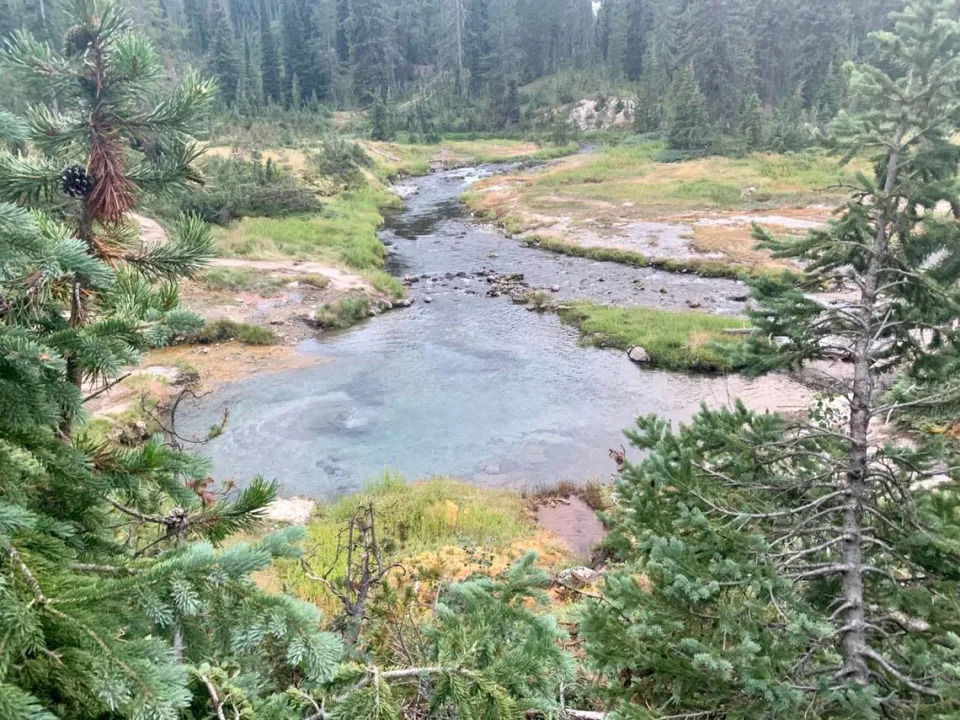
An influx of cold water from the connecting creek make it possible to enjoy a soak in Mr. Bubbles hot spring, which is located in Yellowstone National Park’s backcountry.
Day 2, Wyoming: A magical backcountry hot spring, big river crossings and an unrelenting thunderstorm
Even though the secret is out, there is no sign pointing the way to Mr. Bubbles hot springs, our first destination on our second day in Yellowstone’s backcountry.
At one point along the Bechler River Trail, there is a fork offering three different directions hikers can travel. A sign points to destinations in two different directions. Take the third option, an unsigned spur trail that looks like a spot to rest horses. Follow it for about half a mile and the steam from a geyser basin soon appears. Continue to follow the trail, stepping carefully over and across shallow pools and creeks of geothermal water until reaching Mr. Bubbles, a large swimming pool-sized hot spring where cold waters from a nearby creek mix with a bubbling geothermal feature that gives the hot spring its namesake.
Yellowstone prohibits bathing, soaking or swimming in water entirely of thermal origin, but the cold waters of the creek mixing with the hot geothermal water make it safe and legal to soak in Mr. Bubbles.
Our second day on the trail started off cloudy with much cooler temperatures and the threat of rain. We had fewer miles to cover, so we soaked lazily for about 90 minutes in Mr. Bubbles’ warm waters. As we waded waist-deep nearly up to the bubbling water at the center of the pool, we felt the ground at the bottom of the pool subtly rock and shift, almost as if a small earthquake was concentrated right under the hot spring.
As we soaked, steam rose from the much hotter nearby geothermal features and their orange prismatic pools. We felt as though we’d left civilization behind for the warm waters of an alien planet.
As tempting and relaxing as Mr. Bubbles was after a long first day in the backcountry, we knew we had to get moving. Our day’s agenda called for covering another 15 miles along The Bechler River Trail, a journey that we knew would include at least three river crossings.
We ended up getting a bonus river crossing.
The trail crosses rivers and creeks several times, but many of the crossings feature bridges, strategically placed logs that span the gaps or large stones arranged to enable a hiker to hop across and stay dry. Sometimes, there was no bridge, log or stone path, and we had to ford the river, wading across at what we hope is a relatively shallow spot.
The first crossing allowed us to ease into it. A footbridge over a modest creek had washed out. We took our boots off and slipped on river sandals and water shoes, respectively, unbuckled the straps on our packs for safety and waded gingerly across the 40-foot creek. It was barely knee-deep and not as cold as we were warned to expect following spring snowmelt and runoff.
We felt alive and rejuvenated as we crossed.
Our confidence continued to increase just as the weather turned bad and the river crossing became bigger and burlier. We navigated two more crossings of the Bechler River, crossing 60-foot sections of river where the water reached the top of our thighs.
Descending through the Bechler Canyon, thunderclaps began to boom and lighting flickered overhead as a cool rain started to fall. The canyon section of our hike was full of lush, leafy vegetation that absorbed all the rainwater and soaked us thoroughly as we hiked. We trudged through the unrelenting thunderstorm for almost four hours, quickly passing by scenic landmarks such as the 45-foot Iris Falls. With about five miles still to travel and lightning overhead, we lingered just long enough to snap a few photos of the waterfall and complain about how quickly our Gore-Tex boots became soaked and squishy.
Every hour we consulted our map, and every hour it seemed like we still had another three or four miles to go.
Finally, I smelled smoke and we came across a group of horses tied to a hitching post below some trees, just off the trail. Just around the corner we came across a camp of cowboys who were beginning a multi-day guided horseback trip through the Bechler Meadows.
“Lovely weather we’re having,” I called out in the most cheerful voice I could muster up.
“Care to join us and warm up for a bit?” one of the cowboys responded.
They had a huge, crackling fire roaring in their camp.
“Thanks! We’ll be right up,” Druzin said.
Standing beside the fire our pants and boots began to dry out and our spirits were buoyed. One of the men on the horseback trip identified himself as a Ukrainian minister, and told us of his unwavering belief in the goodness of people. When Russian forces invaded Ukraine in February, members of Russian churches immediately stepped up and donated hundreds of thousands of dollars to help Ukrainian people, the man said. No matter how bad things get, he told us, continue to have faith in people’s capacity to do good.
Sufficiently warm and full of a new optimism for life, we thanked our cowboy hosts, wished them luck on their adventure in Yellowstone and jumped back on the trail to finish the remainder of our day’s hike in the rain.
Our optimism continued unabated for about half an hour until we encountered the remaining members of the cowboy posse at our final river crossing of the day.
Starting out from the opposite river bank that we were standing on, two cowboys leading a team of pack animals crossed the river on horseback. Initially, the crossing looked smooth and easy, with the water never rising above the horses’ knees. But as they neared our side of the bank, the water became much deeper, rising above the horses’ knees and touching their bellies.
As soon as the first cowboy reached dry land, we exchanged greetings and he began to complain about being wet and cold.
“Not as wet as we’re about to be,” Druzin said, motioning to the river.
“You’re crossing here?” the cowboy said in disbelief.
All we could do was nod and say that our campsite was on the other side of the river. The cowboys left us behind, with the first cold, wet cowboy saying he would keep his ears open for any high-pitched screaming coming from this direction.
Great.
We were intimidated by the depth of the water and spent 20 minutes looking for a shallower spot to wade across. Druzin initially set out cautiously on a precarious log that was balanced a little too delicately over deeper, fast moving water. Druzin noticed the danger in time and backed slowly off the log.
With darkness about to settle in and our campsite, Lower Boundary Creek, situated on the far side of the river, we regrouped and headed back to the spot where the cold cowboys and their horses had just crossed. We hoisted our packs entirely over our head in an effort to keep our packs, tents, sleeping bags and remaining clothing dry and waded into the water. The water reached the top of our thighs and soaked our behinds, but it was calm and the riverbed wasn’t too slippery. Before we knew it, we had safely walked across.
It took a total of 16 miles to reach camp on our second day, and the mosquitoes set upon us immediately. I was cold and wet and knew my clothes and boots wouldn’t dry until the sun came out the next day. My sleeping pad was soaked and unusable for the night. My frustration and self pity didn’t subside until my second healthy pull off the whiskey in camp.
I perked up just before crawling into my tent, knowing that next day’s adventure would lead us into the zone of death.
What is the zone of death?
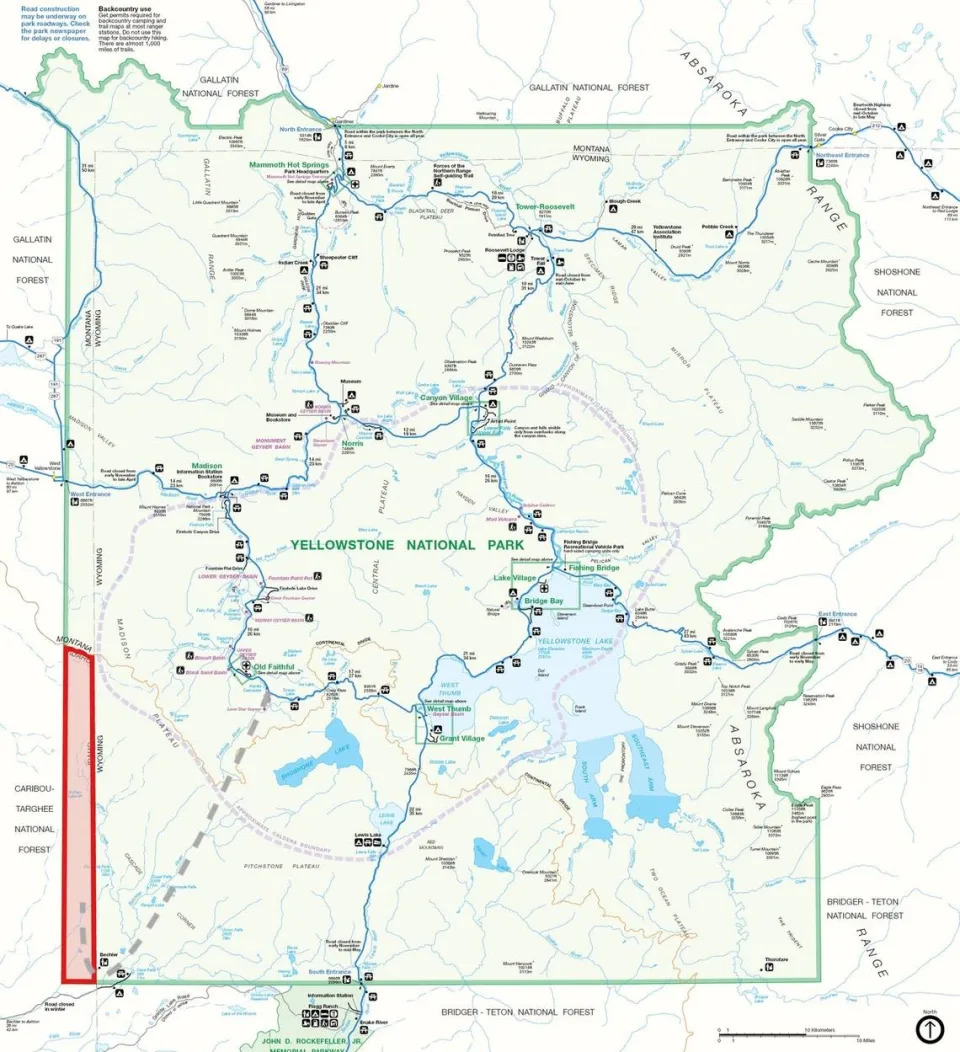
The zone of death (highlighted in red) is defined by the intersection of Yellowstone National Park (highlighted in green) with the state of Idaho, in the southwest corner of the park. The grey dotted line represents the approximate path followed for this article, starting south of Old Faithful, traveling toward the southwest. The trip covered 52 miles.
Michigan State University’s College of Law professor Brian C. Kalt wrote a 2005 research paper published in the Georgetown Law Journal called “The Perfect Crime,” which suggested Yellowstone’s zone of death might be a place “where one might commit felonies with impunity.” The idea behind the theory is that nobody lives in the roughly 50-mile section of Yellowstone that lies in Idaho. Therefore, prosecution for certain federal felonies could become tricky if a defendant evoked their Sixth Amendment right to be tried by a jury from the state and district where the crime occurred.
The Idaho Legislature even debated the issue and adopted House Joint Memorial 3, which calls on Congress to close the zone of death “loophole,” during the 2022 legislative session.
State Rep. Colin Nash, the Boise Democrat who sponsored House Joint Memorial 3, told the Sun last month that he has not heard any feedback or received a response from Idaho’s congressional delegation on the matter.
For their part, Yellowstone officials aren’t worried that there is a loophole to close.
“We don’t talk in theoretical terms,” Yellowstone spokeswoman Linda Veress told the Sun. “If a crime occurs there, we will treat it like a crime occurred anywhere else in the park.”
Veress and Curtis, the backcountry district ranger, said the United States government has exclusive jurisdiction in Yellowstone and the states don’t even get involved. Yellowstone has its own law enforcement rangers, and there is also an investigative services branch within the National Park Service that focuses on more complex crimes, Curtis said.
“All crimes that are either detected when we are out on patrol or get reported, we investigate through the law enforcement rangers assigned to the park,” Curtis said. “If they are felony-level cases, a lot of times those are investigated with the National Park Service.”
Once a potential crime is investigated, law enforcement rangers or agents with the investigative services branch of the National Park Service work with an assistant U.S. attorney. Curtis and Veress said they aren’t aware of any issues or concerns with the current practices.
Day 3, Idaho: Into the zone of death
After tearing down camp at Lower Boundary Creek and wiggling into my still-damp clothing and boots, we hit the Bechler Meadows Trail. We made a quick stop at the Bechler Ranger Station to switch reservations to the Little Robinson Creek backcountry site in the zone of death, hoping it would be easier to find than our original site the rangers warned us could be tricky to locate.
With the new permit in hand, we headed up Robinson Creek Trail, which also appears to be identified as the West Boundary Trail on some maps and trail signs.
It was immediately obvious we were stepping off the beaten path. Whereas the trail in the Bechler River and Bechler Meadows sections of Wyoming was clearly defined, cleared of debris and trodden with fresh footsteps, the Robinson Creek Trail was overgrown and lush. We had to engage in some bushwhacking and a series of little guessing games to continue to follow the trail.
If we didn’t have electronic and paper maps, the ranger’s warning and know for sure we were heading the right way, we would have turned around thinking we were about to get hopelessly lost or surprise some big animal.
“It was more of a suggestion than a trail,” Druzin said.
Few people visit the Idaho section of Yellowstone National Park.
There is no “welcome to Idaho” sign in this section of Yellowstone marking the entrance to the zone of death. Instead, we relied on GPS to figure out the boundary, deciding it was just before a large boulder situated just off the trail in a thick tangle of brush and vegetation.
We passed a huckleberry bush and ate handfuls of plump, purple huckleberries. At about that same spot, we encountered our first pile of soft, fresh bear scat.
We continued on, passing meadows the size of NFL stadiums and giant marshes covered in lily pads.
“It’s amazing,” Veress said. “People say the park is so crowded, but you don’t have to go far from the road to have solitude.”
We reached our campsite, Little Robinson Creek, by early afternoon on our third day in the Yellowstone backcountry. To avoid conflicts with bears and other wild critters, we hung all of our packs, trash and food high above the ground on trees and logs that had been specially arranged for storage at backcountry campsites.
The first thing we saw at Little Robinson Creek camp was a giant pile of soft, fresh bear scat located directly under the food storage poles.
Even though it looked like a ridiculous prank or a throwaway gag in a comedy movie, the bear scat was a fresh reminder that we were truly in the backcountry, visitors in this wild place.
“I don’t think this bear learned the lesson about not sh—— where you eat,” I joked to Druzin, partially to help alleviate my own anxiety.
Druzin grabbed his fly rod and fished for trout in Robinson Creek as I sat on the edge and let the water wash over my tired legs and feet.
We ate two dinners and finished even more whiskey that night.
I told Druzin that for as hard as different aspects of the first two days of the trip were, I didn’t want to leave Yellowstone.
This trip and this place were special.
We weren’t the only people to go to the zone of death. In fact, everybody who completes the Continental Divide Trail through-hike between Canada and Mexico (a journey that could take five months) enters the Idaho section of Yellowstone, rangers told me.
Later in the week we were there, a different crew on horseback had plans to travel through the Idaho section of Yellowstone, a ranger told us.
But for us, the whole time we were in the zone of death, we didn’t see another person. We were almost certainly the only people to sleep inside the zone of death the night we stayed and we may have been some of the only people to sleep in the Idaho section of Yellowstone National Park to that point in 2022. (The park was closed for about a week and a half in June following historic flooding and many of the river crossings outside of the zone of death that we forded on our journey are not passable until, generally, mid-July each year. A ranger at the Bechler Ranger Station told us very few people camp in the two Idaho campsites off Robinson Creek Trail, and she couldn’t remember offhand the last time someone stayed there.)
That last night in Yellowstone, I left the rainfly off my tent and stared up at the stars for a long, long time.
We were almost five miles from the Bechler Ranger Station, which meant we were almost five miles from the closest place that any other person could have conceivably been. We were even farther from any real roads or artificial lights.
Feeling that small in such a big wide open space put a smile on my face, and as my eyes grew heavy, shooting stars traced the night sky.
The next morning, we walked out of the zone of death in less than two hours without incident.
We shuttled ourselves back to the starting point of our hike, but not before stopping off for a greasy cheeseburger at the suggestion of a father from Clifton, Idaho, who was hiking with his wife and two children.
Even though we were two different people on two different journeys, I immediately felt at ease around the man and his family after he mentioned cheeseburgers and the reason he decided to go on his hike.
Years ago he started out on a simple day hike in the Bechler Meadows, where he said he encountered a sign showing that Old Faithful was about 30 miles away, just like I did. And just like I did, for years he dreamed about what lies beyond that sign — the possibilities and the adventures that would await in the Yellowstone backcountry.
Diet change may make biggest impact on reducing heart risk in people with hypertension
September 7, 2022
Research Highlights:
In a simulation study using the latest U.S. statistics for stage 1 hypertension, researchers found that lifestyle changes to reduce systolic blood pressure to below 130 mm Hg may prevent 26,000 heart attacks and strokes and reduce health care costs over the next ten years.
Among several lifestyle changes considered, such as diet, weight loss, physical activity, etc., the study found the largest impact on reducing cardiovascular events may come from adopting the Dietary Approaches to Stop Hypertension (DASH) diet.
Analysis found that widespread adoption of non-pharmacologic interventions in lower-risk U.S. adults with Stage 1 hypertension may prevent nearly 26,000 cardiovascular disease events, avoid 2,900 deaths and save about $1.6 billion in associated health care costs over ten years.
Embargoed until 6 a.m. PT/8 a.m. CT/9 a.m. ET Wednesday, Sept. 7, 2022
(NewMediaWire) – September 07, 2022 – SAN DIEGO Among several lifestyle changes that may reduce cardiovascular disease, adopting the DASH (Dietary Approaches to Stop Hypertension) diet may have the greatest impact for young and middle-aged adults with stage 1 hypertension, according to new research presented at the American Heart Association’s Hypertension Scientific Sessions 2022, held Sept. 7-10, 2022, in San Diego. The meeting is the premier scientific exchange focused on recent advances in basic and clinical research on high blood pressure and its relationship to cardiac and kidney disease, stroke, obesity and genetics.
According to the 2017 joint American Heart Association and American College of Cardiology High Blood Pressure Guideline, stage 1 hypertension is defined as having a systolic (top number) level of 130-139 mm Hg or having a diastolic (bottom number) measure of 80-89 mm Hg.
The researchers estimate widespread adoption of lifestyle changes, such as limiting heavy alcohol consumption and exercising regularly, may prevent thousands of deaths and save more than one billion dollars in health care costs over the next 10 years. Their analysis found that adoption of the DASH diet could have the greatest benefit, with an estimated 15,000 heart disease events prevented among men and 11,000 event among women.
The DASH eating plan is specifically designed to help manage blood pressure. The diet emphasizes foods including fruits, vegetables, lean meat sources, nut, seeds and grains and limiting consumption of red meat, sodium, sugars and sugar-sweetened beverages.
The research team estimated that 8.8 million U.S. adults, ages 35-64, have untreated stage 1 hypertension and would be recommended lifestyle changes, such as physical activity, sustained weight loss, moderating alcohol intake and adoption of the DASH diet.
In the absence of other health conditions, such as type 2 diabetes or kidney disease, and a predicted >(10%) 10-year CVD risk, people with stage 1 hypertension are considered at low risk for heart attack or stroke compared to people with stage 2 or higher hypertension. Stage 2 hypertension is defined as systolic measures of 140 mm Hg or higher, or diastolic measures of 90 mm Hg or higher. The recommendations for treatment for people with stage 1 hypertension is based primarily on lifestyle changes rather than medication.
“Nearly nine million young and middle-aged adults with untreated stage 1 hypertension represent a significant, impending burden for health care systems,” said Kendra D. Sims, Ph.D., M.P.H., a postdoctoral fellow at the University of California, San Francisco and co-lead researcher of this study. “Our results provide strong evidence that large-scale, healthy behavior modifications may prevent future heart disease, related complications and excess health care costs.”
To simulate heart disease and stroke events, mortality and health care costs between 2018 and 2027, the researchers applied evidence from published meta-analyses and trial data about the blood-pressure reducing effects of lifestyle changes: dietary changes, sustained weight loss, physical activity, smoking cessation and alcohol moderation. About half of the modeled population were women and 61% (5.5 million) had regular health care access.
The researchers found that making recommended lifestyle changes to control blood pressure to below 130 mm Hg systolic or 90 mm Hg diastolic may have substantial health and economic benefits. They estimated that lifestyle changes could:
Prevent 26,000 cardiovascular disease events, such as stroke, heart failure or heart attack;
Avoid 2,900 deaths; and
Save $1.6 billion in associated health care costs.
“Unfortunately, the availability and affordability of healthy food sources does not easily allow people to follow the DASH diet. Clinicians should consider whether their patients live in food deserts or places with limited walkability. Health counseling should include addressing these specific challenges to blood pressure control,” Sims said.
In May, the Association published a policy statement, Strengthening U.S. Food Policies and Programs to Promote Equity in Nutrition Security, which recommends expanding and improving U.S. nutrition policies and programs to ensure all American can access nutritious food. In 2020, the Association launched the National Hypertensive Control Initiative, a collaborative initiative with the U.S. Department of Health and Human Services that aims to improve blood pressure control among the most vulnerable populations, including racial and ethnic minorities.
“Members of many disadvantaged communities face barriers to healthy food and regular health care access,” Sims said. “This means they will not be able to benefit from a counseling from a doctor. Future research should investigate the big picture: social conditions granting people the time and resources to make healthy lifestyle choices. Only with this information can we develop policies for the prevention of heart disease, especially for vulnerable adults.”
Co-authors of the study are Pengxiao C. Wei, M.P.H.; Brandon K. Bellows, Pharm.D., M.S.; Joanne Penko, M.S., M.P.H.; Susan Hennessy, Ph.D.; Dhruv S. Kazi, M.D., M.S.; Ross Boylan, Ph.D.; Andrew E. Moran, M.D., M.S.; and Kirsten Bibbins-Domingo, Ph.D., M.D.
Note: Sims will present Projected Impact Of Non-pharmacologic Management Of Stage 1 Hypertension Among Lower-risk U.S. Adults at 11:15 a.m. PST on Saturday, Sept. 10. Presentation #137; Session 21D
Statements and conclusions of studies that are presented at the American Heart Association’s scientific meetings are solely those of the study authors and do not necessarily reflect the Association’s policy or position. The Association makes no representation or guarantee as to their accuracy or reliability. Abstracts presented at the Association’s scientific meetings are not peer-reviewed, rather, they are curated by independent review panels and are considered based on the potential to add to the diversity of scientific issues and views discussed at the meeting. The findings are considered preliminary until published as a full manuscript in a peer-reviewed scientific journal.
The Association receives funding primarily from individuals; foundations and corporations (including pharmaceutical, device manufacturers and other companies) also make donations and fund specific Association programs and events. The Association has strict policies to prevent these relationships from influencing the science content. Revenues from pharmaceutical and biotech companies, device manufacturers and health insurance providers and the Association’s overall financial information are available here.
Follow AHA/ASA news on Twitter @HeartNews #Hypertension22
About the American Heart Association
The American Heart Association is a relentless force for a world of longer, healthier lives. We are dedicated to ensuring equitable health in all communities. Through collaboration with numerous organizations, and powered by millions of volunteers, we fund innovative research, advocate for the public’s health and share lifesaving resources. The Dallas-based organization has been a leading source of health information for nearly a century. Connect with us on heart.org, Facebook, Twitter or by calling 1-800-AHA-USA1.
US Consumers See Home Prices Falling for First Time Since 2020
Alex Tanzi – September 7, 2022
(Bloomberg) — For the first time in two years, US consumers expect home prices to fall over the next 12 months.
An August survey by Fannie Mae found that respondents see a 0.4% decline in housing prices compared with the prior month’s expectations for a 1.9% increase.
Consumers also anticipate that rental price growth will slow, with year-ahead expectations dropping nearly two percentage points, the steepest slide in data back to 2010, according to the survey released Wednesday.
The Fannie Mae report found that the share of respondents who say home prices will go up in the next 12 months decreased to 33% from 39%, while the percentage who expect them to fall increased 3 percentage points to 33%.
“The share of consumers expecting home prices to go down over the next year increased substantially in August,” said Doug Duncan, chief economist at Fannie Mae. “We also observed a large decline in consumers reporting high home prices as the primary reason for it being a good time to sell a home, suggesting that expectations of slowing or declining home prices have begun to negatively affect selling sentiment.”
Potential buyers anticipating further price declines and sellers not keen on giving up their lower, fixed mortgage rate may contribute to a further cooling in home sales through the end of the year, Duncan said.
A separate survey conducted by the Mortgage Bankers Association found that the average effective rate on 30-year fixed mortgage increased to 6.17%, the highest since mid-June, from 6.01%.
The Fannie Mae survey found that half of consumers think it would be difficult for them to get a home mortgage today — the largest share since October 2014.