100 years after compact, Colorado River nearing crisis point

Associated Press

100 years after compact, Colorado River nearing crisis point

Chris Outsalt and Brittany Peterson – September 12, 2022

Alyssa Chubbuck, left, and Dan Bennett embrace while watching the sunset at Guano Point overlooking the Colorado River on the Hualapai reservation Monday, Aug. 15, 2022, in northwestern Arizona. In November 1922, seven land-owning white men brokered a deal to allocate water from the Colorado River, which winds through the West and ends in Mexico. During the past two decades, pressure has intensified on the river as the driest 22-year stretch in the past 1,200 years has gripped the southwestern U.S. (AP Photo/John Locher)
FILE - A formerly sunken boat sits upright into the air with its stern stuck in the mud along the shoreline of Lake Mead at the Lake Mead National Recreation Area, June 10, 2022, near Boulder City, Nev. In November 1922, seven land-owning white men brokered a deal to allocate water from the Colorado River, which winds through the West and ends in Mexico. During the past two decades, pressure has intensified on the river as the driest 22-year stretch in the past 1,200 years has gripped the southwestern U.S. (AP Photo/John Locher, File)
FILE – A formerly sunken boat sits upright into the air with its stern stuck in the mud along the shoreline of Lake Mead at the Lake Mead National Recreation Area, June 10, 2022, near Boulder City, Nev. In November 1922, seven land-owning white men brokered a deal to allocate water from the Colorado River, which winds through the West and ends in Mexico. During the past two decades, pressure has intensified on the river as the driest 22-year stretch in the past 1,200 years has gripped the southwestern U.S. (AP Photo/John Locher, File)
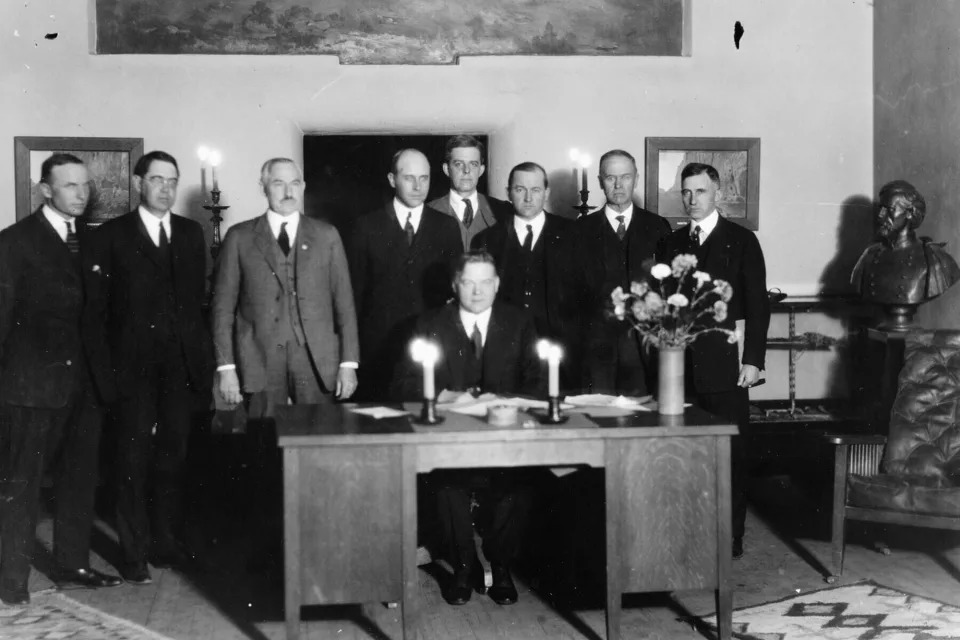
In this photo provided by the U.S. Bureau of Reclamation, Commerce Secretary Herbert Hoover presides over the signing of the Colorado River Compact in Santa Fe, N.M., on Nov. 24, 1922. Seven land-owning white men brokered a deal to allocate water from the Colorado River, which winds through the West and ends in Mexico. (U.S. Bureau of Reclamation via AP)
Garnett Querta carries a hose as he fills his water truck on the Hualapai reservation Monday, Aug. 15, 2022, near Peach Springs, Ariz. The divvying up between Colorado River Basin states never took into account Indigenous Peoples or many others, and from the start the calculation of who should get what amount of that water may never have been balanced. (AP Photo/John Locher)
A truck tire once in the water as part of a marina sits on dry ground as water levels have dropped near the Callville Bay Resort & Marina in the Lake Mead National Recreation Area, Tuesday, Aug. 30, 2022, near Boulder City, Nev. In November 1922, seven land-owning white men brokered a deal to allocate water from the Colorado River, which winds through the West and ends in Mexico. During the past two decades, pressure has intensified on the river as the driest 22-year stretch in the past 1,200 years has gripped the southwestern U.S. (AP Photo/John Locher)
Floating boat docks sit on dry ground as water levels have dropped near the Callville Bay Resort & Marina in the Lake Mead National Recreation Area, Tuesday, Aug. 30, 2022, near Boulder City, Nev. As water levels plummet, calls for reduced use have often been met with increased population growth. (AP Photo/John Locher)
Water flows along the All-American Canal Saturday, Aug. 13, 2022, near Winterhaven, Calif. In November 1922, seven land-owning white men brokered a deal to allocate water from the Colorado River, which winds through the West and ends in Mexico. During the past two decades, pressure has intensified on the river as the driest 22-year stretch in the past 1,200 years has gripped the southwestern U.S. (AP Photo/Gregory Bull)

DENVER (AP) — The intensifying crisis facing the Colorado River amounts to what is fundamentally a math problem.

The 40 million people who depend on the river to fill up a glass of water at the dinner table or wash their clothes or grow food across millions of acres use significantly more each year than actually flows through the banks of the Colorado.

In fact, first sliced up 100 years ago in a document known as the Colorado River Compact, the calculation of who gets what amount of that water may never have been balanced.

“The framers of the compact — and water leaders since then — have always either known or had access to the information that the allocations they were making were more than what the river could supply,” said Anne Castle, a senior fellow at the Getches-Wilkinson Center at the University of Colorado Law School.

EDITOR’S NOTE: This is part of a collaborative series on the Colorado River as the 100th anniversary of the historic Colorado River Compact approaches. The Associated Press, The Colorado Sun, The Albuquerque Journal, The Salt Lake Tribune, The Arizona Daily Star and The Nevada Independent are working together to explore the pressures on the river in 2022.

During the past two decades, however, the situation on the Colorado River has become significantly more unbalanced, more dire.

A drought scientists now believe is the driest 22-year stretch in the past 1,200 years has gripped the southwestern U.S., zapping flows in the river. What’s more, people continue to move to this part of the country. Arizona, Utah and Nevada all rank among the top 10 fastest growing states, according to U.S. Census data.

While Wyoming and New Mexico aren’t growing as quickly, residents watch as two key reservoirs — popular recreation destinations — are drawn down to prop up Lake Powell. Meanwhile, southern California’s Imperial Irrigation District uses more water than Arizona and Nevada combined, but stresses their essential role providing cattle feed and winter produce to the nation.

Until recently, water managers and politicians whose constituents rely on the river have avoided the most difficult questions about how to rebalance a system in which demand far outpaces supply. Instead, water managers have drained the country’s two largest reservoirs, Lake Mead and Lake Powell, faster than Mother Nature refills them.

In 2000, both reservoirs were about 95% full. Today, Mead and Powell are each about 27% full — once-healthy savings accounts now dangerously low.

The reservoirs are now so low that this summer Bureau of Reclamation Commissioner Camille Touton testified before the U.S. Senate Energy and Natural Resources Committee that between 2 million and 4 million acre-feet would need to be cut next year to prevent the system from reaching “critically low water levels,” threatening reservoir infrastructure and hydropower production.

The commissioner set an August deadline for the basin states to come up with options for potential water cuts. The Upper Basin states — Colorado, Utah, New Mexico and Wyoming — submitted a plan. The Lower Basin states — California, Arizona and Nevada — did not submit a combined plan.

The bureau threatened unilateral action in lieu of a basin-wide plan. When the 60-day deadline arrived, however, it did not announce any new water cuts. Instead, the bureau announced that predetermined water cuts for Arizona, Nevada and Mexico had kicked in and gave the states more time to come up with a basin-wide agreement.

STILL LEFT OUT

A week before Touton’s deadline, the representatives of 14 Native American tribes with water rights on the river sent the Bureau of Reclamation a letter expressing concern about being left out of the negotiating process.

“What is being discussed behind closed doors among the United States and the Basin States will likely have a direct impact on Basin Tribes’ water rights and other resources and we expect and demand that you protect our interests,” tribal representatives wrote.

Being left out of Colorado River talks is not a new problem for the tribes in the Colorado River Basin.

The initial compact was negotiated and signed on Nov. 24, 1922, by seven land-owning white men, who brokered the deal to benefit people who looked like them, said Jennifer Pitt of the National Audubon Society, who is working to restore rivers throughout the basin.

“They divided the water among themselves and their constituents without recognizing water needs for Mexico, the water needs of Native American tribes who were living in their midst and without recognizing the needs of the environment,” Pitt said.

Mexico, through which the tail of the Colorado meanders before trickling into the Pacific Ocean, secured its supply through a treaty in 1944. The treaty granted 1.5 million acre-feet on top of the original 15 million acre-feet that had already been divided, 7.5 million each for the Upper and Lower Basins.

Tribes, however, still don’t have full access to the Colorado River. Although the compact briefly noted that tribal rights predate all others, it lacked specificity, forcing individual tribes to negotiate settlements or file lawsuits to quantify those rights, many of which are still unresolved. It’s important to recognize the relationship between Native and non-Native people at that time, said Daryl Vigil, water administrator for the Jicarilla Apache Nation in New Mexico.

“In 1922, my tribe was subsistence living,” Vigil said. “The only way we could survive was through government rations on a piece of land that wasn’t our traditional homeland. That’s where we were at when the foundational law of the river was created.”

COMPETING INTERESTS

Agriculture uses the majority of the water on the river, around 70% or 80% depending on what organization is making the estimate. When it comes to the difficult question of how to reduce water use, farmers and ranchers are often looked to first.

Some pilot programs have focused on paying farmers to use less water, but unanswered questions remain about how to transfer the savings to Lake Powell for storage or how to create a program in a way that would not negatively impact a farmer’s water rights.

Antiquated state laws mean the amount of water that a water right gives someone access to can be decreased if not fully used.

That’s why the Camblin family ranch in Craig in northwest Colorado plans to flood irrigate once a decade, despite recently upgrading to an expensive, water-conserving pivot irrigation system. Nine years out of 10, they’ll receive payment from a conservation group in exchange for leaving the surplus water in the river. But in Colorado, the state revokes water rights after 10 years if they aren’t used.

Not only would losing that right mean they can’t access a backup water supply should their pivot system fail, but their property’s value would plummet, Mike Camblin explained. He runs a yearling cattle operation with his wife and daughter, and says an acre of land without water sells for $1,000, about a fifth of what it would sell for with a water right attached.

There are other ways to improve efficiency, but money is still often a barrier.

Wastewater recycling is growing across the region, albeit slowly, as it requires massive infrastructure overhauls. San Diego built a robust desalination plant to turn seawater to drinking water, and yet some agricultural users are trying to get out of their contract since the water is so expensive. Some cities are integrating natural wastewater filtration into their landscaping before the water flows back to the river. It’s all feasible, but is costly, and those costs often get passed directly to water users.

One of the biggest opportunities for water conservation is changing the way our landscapes look, said Lindsay Rogers, a water policy analyst at Western Resource Advocates, a nonprofit dedicated to protecting water and land in the West.

Converting a significant amount of outdoor landscaping to more drought-tolerant plants would require a combination of policies and incentives, Rogers explained. “Those are going to be really critical to closing our supply-demand gap.”

After years of incentive programs for residents, Las Vegas recently outlawed all nonfunctional grass by 2026, setting a blueprint for other Western communities. For years, the city has also paid residents to rip out their lawns.

In Denver, Denver Water supplies about 25% of the state’s population and uses about 2% of the water. The city has had mandatory restrictions in place for years, limiting home irrigation to three days per week.

This summer, in southern California, the Metropolitan Water District instituted an unprecedented one-day-a-week water restriction.

Still, regardless of the type of water use, more concessions must be made.

“The law of the river is not suited to what the river has become and what we see it increasingly becoming,” Audubon’s Pitt said. “It was built on the expectation of a larger water supply than we have.”

As Russians Retreat, Putin Is Criticized by Hawks Who Trumpeted His War

The New York Times

As Russians Retreat, Putin Is Criticized by Hawks Who Trumpeted His War

Anton Troianovski – September 11, 2022

Russian President Vladimir Putin chairs a Security Council meeting via videoconference in Moscow, Russia, Friday, Sept. 9, 2022. (Gavriil Grigorov, Sputnik, Kremlin Pool Photo via AP) (ASSOCIATED PRESS)

As Russian forces hastily retreated in northeastern Ukraine on Saturday in one of their most embarrassing setbacks of the war, President Vladimir Putin was at a park in Moscow, presiding over the grand opening of a Ferris wheel.

“It’s very important for people to be able to relax with friends and family,” Putin intoned.

The split-screen contrast was stunning, even for some of Putin’s loudest backers. And it underscored a growing rift between the Kremlin and the invasion’s most fervent cheerleaders. For the cheerleaders, Russia’s retreat appeared to confirm their worst fears: that senior Russian officials were so concerned with maintaining a business-as-usual atmosphere back home that they had failed to commit the necessary equipment and personnel to fight a long war against a determined enemy.

“You’re throwing a billion-ruble party,” one pro-Russian blogger wrote in a widely circulated post Saturday, referring to the Putin-led celebrations in Moscow commemorating the 875th anniversary of the city’s founding. “What is wrong with you? Not at the time of such a horrible failure.”

Even as Moscow celebrated, he wrote, the Russian army was fighting without enough night vision goggles, flack jackets, first-aid kits or drones. A few hundred miles away, Ukrainian forces retook the Russian military stronghold of Izium, continuing their rapid advance across the northeast and igniting a dramatic new phase in the war.

The outrage from Russian hawks Saturday showed that even as Putin had succeeded in eliminating just about all of the liberal and pro-democracy opposition in Russia’s domestic politics, he still faced the risk of discontent from the conservative end of the political spectrum. For the moment, there was little indication that these hawks would turn on Putin as a result of Ukraine’s seemingly successful counteroffensive, but analysts said that their increasing readiness to criticize the military leadership publicly pointed to simmering discontent within the Russian elite.

“Most of these people are in shock and did not think that this could happen,” Dmitri Kuznets, who analyzes the war for the Russian-language news outlet Meduza, said in a phone interview. “Most of them are, I think, genuinely angry.”

The Kremlin, as usual, tried to minimize the setbacks. The defense ministry described the retreat as a decision “to regroup” its troops, even though the ministry said a day earlier that it was moving to reinforce its defensive positions in the region. Authorities in Moscow carried on with their festive weekend, with fireworks and state television showing hundreds lined up to ride the new, 460-foot-tall Ferris wheel.

But online, Russia’s failures were in plain sight — underscoring the startling role that pro-Russian military bloggers on the social network Telegram have played in shaping the narrative of the war. While the Kremlin controls the television airwaves in Russia and has blocked access to Instagram and Facebook, Telegram remains freely accessible and is filled with posts and videos from supporters and opponents of the war alike.

The widely followed pro-war bloggers — some embedded with Russian troops near the front line — amplify the Kremlin’s false message that Russia is fighting “Nazis” and refer to Ukrainians in derogatory and dehumanizing ways. But they are also divulging far more detailed — and, analysts say, accurate — information about the battlefield than the Russian Defense Ministry is, which they say is underestimating the enemy and withholding bad news from the public.

One of the bloggers, Yuri Podolyaka, who is from Ukraine but moved to Сrimea following its annexation in 2014, told his 2.3 million Telegram followers Friday that if the military continued play down its battlefield setbacks, Russians would “cease to trust the Ministry of Defense and soon the government as a whole.”

It was the bloggers who first rang alarm bells publicly about a possible Ukrainian counteroffensive in the country’s northeast.

On Aug. 30, a Kremlin spokesperson held his regular conference call with journalists and repeated his mantra: The invasion of Ukraine was going “in accordance with the plans.”

The same day, several Russian bloggers were reporting on social media that something was very much not going according to plan. Ukraine was building up forces for a counterattack near the town of Balakliya, they said, and Russia did not appear in position to defend against it.

“Hello, hello, anybody home?” one asked. “Are we ready to fend off an attack in this direction?”

Days later, it became apparent that the answer was no. Ukrainian forces overran Russia’s thin defenses in Balakliya and other nearby towns in northeastern Ukraine. By this weekend, some analysts estimated that the territory retaken by Ukraine amounted to about 1,000 square miles, a potential turning point in what had become a war of attrition this summer.

“It’s time to punish the commanders who allowed these kinds of things,” Maksim Fomin, a pro-Russian blogger from eastern Ukraine, said in a video published Friday, claiming that Russian forces did not even try to resist as Ukraine’s military swept forward this week.

Some of the bloggers are embedded with military units and work for state-run or pro-Kremlin media outlets, preparing reports for television while providing more detail on their Telegram accounts. Others appear to operate more independently, relying on personal connections for access near the front line and adding their bank details to their Telegram posts to solicit donations.

Kuznets, a former Russian war correspondent himself, said that Russian military officials appeared to tolerate the presence of war bloggers despite their occasional criticism, in part because they agreed with the bloggers’ hawkish, imperialist views. And the bloggers play a crucial role in spreading the pro-Russian message on social media, where their audience includes both Russians and Ukrainians.

Among some bloggers, the anger over the Russian military’s mistakes reached a fever pitch Saturday. One called Russia’s retreat a “catastrophe,” while others said that it had left the residents who collaborated with Russian forces at the mercy of Ukrainian troops — potentially undermining the credibility of the occupying authorities all across the territory that Russia still holds.

And while the Kremlin still maintains that the invasion is merely a “special military operation,” several bloggers insisted Saturday that Russia was, in fact, fighting a full-fledged war — not just against Ukraine, but against a united West that is backing Kyiv.

The stunned fury reflects how some analysts believe many in the Russian elite view the war: a campaign rife with incompetence, conducted on the cheap, that can only be won if Putin mobilizes the nation onto a war footing and declares a draft.

“I am sure that they reflect the opinion of their sources and the people they know and work with,” Kuznets said. “I think the biggest group among these people believes that it is necessary to fight harder and carry out a mobilization.”

Both Western and Russian analysts said that Putin would need a draft to sharply expand the size of his invading force. But he appears determined to resist such a measure, which could shatter the passivity with which much of the Russian public has treated the war. In August, 48% of Russians told the independent pollster Levada that they were paying little or no attention to the events in Ukraine.

As a result, analysts say, Putin faces no good options. Escalating a war whose domestic support may turn out to be superficial could stir domestic unrest, while continuing retreats on the battlefield could spur a backlash from hawks who have bought into the Kremlin narrative that Russia is fighting “Nazis” for its very survival.

Ever since Russia retreated in April from its attempt to capture Kyiv, the capital of Ukraine, the Kremlin’s goals in the war have been unclear, disorienting Putin’s supporters, said Rob Lee, a military analyst at the Foreign Policy Research Institute.

“The Ukrainians’ war effort is obvious, it’s understandable, whereas on the Russian side, it was always a question of: What is Russia doing?” Lee said in a phone interview. “The goals aren’t clear, and how they achieve those goals isn’t clear. If you’re fighting a war and you’re not sure what the ultimate goal is, you’re going to be quite frustrated about that.”

Ukraine’s stunning counteroffensive in Kharkiv and Donbas

Yahoo! News

Ukraine’s stunning counteroffensive in Kharkiv and Donbas

Michael Weiss and James Rushton – September 10, 2022

Ukraine’s stunning counteroffensive in Kharkiv is the type of military action that will be written about and analyzed for decades, maybe centuries.

With rapid speed, the defenders have cut through Russian-occupied positions over the past four days, recapturing as many as 2,500 square kilometers of terrain, according to the Washington-based think tank the Institute for the Study of War, an area roughly equivalent to the combined area of the cities of New York and Los Angeles. Ukraine has also claimed to have killed upward of 1,000 Russian soldiers in as many days, although that figure cannot be independently verified.

But both Russian and Ukrainian sources are in rare agreement about a number of developments.

Two Ukrainian servicemen riding a BMP-2 infantry fighting vehicle along a road in the middle of agricultural land, with a blast in the distance.
Ukrainian servicemen riding a BMP-2 infantry fighting vehicle last week in the Donetsk region of eastern Ukraine. (Ammar Awad/Reuters)

Both acknowledge that the Russian occupiers have fled Izyum, a strategically important city that the Russian army had been using as its headquarters for operations in the area for months. Ukrainian troops have been visually confirmed to be in the center of Kupyansk, another city in Kharkiv, and Russian forces are said to be retreating from the third of it that they still hold. Kupyansk is a key railway hub and a strategically important location for the Russian army, at the intersection of several railway lines. Unlike NATO nations, Russia’s logistical model is based mainly on moving materiel by train, with motorized transport responsible only for a small distance, at the end of the journey.

The town of Balakliya has also been completely liberated, according to Ukraine’s Ministry of Defense, which posted a video of Colonel General Oleksandr Syrskyi, the commander of Ukrainian Land Forces, standing in the center of the town as soldiers raise Ukraine’s gold-and-blue flag. Other videos show emotional Ukrainian residents greeting their army in Balakliya.

Igor Konashenkov, the spokesman for Russia’s Ministry of Defense, confirmed Russian troops’ withdrawal from Balakliya and Izyum, describing what certainly looks like a rout as a decision to “regroup in order to boost efforts in the Donetsk area.”

Ukraine’s campaign has, remarkably, pressed beyond Kharkiv into occupied Donbas.

Ukrainians remove what's left after a Russian strike in Kramatorsk
Ukrainians remove what’s left after a Russian strike in Kramatorsk earlier this month. (Ammar Awad/Reuters)

Denis Pushilin, the head of the Russian proxy known as the Donetsk People’s Republic, recorded a video of himself fleeing the fighting by car and admitting that the situation around the city of Lyman in Donetsk was “difficult.” There are also unconfirmed reports of fighting around Lysychansk, a city in Luhansk that Russia captured at the beginning of July after weeks of heavy shelling. Ukrainian forces have advanced to the outskirts of Lysychansk, according to the oblast’s governor, Serhiy Haidai.

Taken as a whole, Ukraine’s offensive has decisively shown that it has the manpower, resolve and weapons to prosecute the next phase of a war that many analysts and politicians warned would devolve into a prolonged stalemate or war of attrition. And it comes at a time when Russia has threatened to “freeze” Europe by cutting off gas supplies for the coming winter, as cracks in European Union unity on sanctions have apparently widened. On Sept. 8, the United States announced another security package for Ukraine worth $675 million, much of it ammunition for weapons platforms that have already been provided, including the M142 High Mobility Artillery Rocket System (HIMARS).

Ukraine spent months telegraphing its intent to mount a major counteroffensive in the southern region of Kherson. That campaign got underway on Aug. 29and has made consistent but unspectacular progress. The Kharkiv operation, however, was totally unannounced — not even hinted at. “Basically, the Russians thinned all their troops out to protect Kherson,” said Dr. Mike Martin, a visiting fellow in the Department of War Studies at King’s College London. “The Ukrainians spotted this, fixed the Russians in Kherson, and kept a reserve that they used to strike through the Russian line east of Kharkiv, and then managed to capture their two main logistics hubs supplying the Russian effort in the northeast and east of the country.”

As a result, Russian frontlines are now collapsing. One video taken somewhere in Kharkiv and posted to Twitter shows retreating Russian soldiers riding on top of a T-72 tank as it runs into an advance party of Ukrainian special forces. The tank immediately starts shedding soldiers before it finally skids around a sharp bend and careens into a tree.

An excavator covers coffins containing one of 15 unidentified people killed by Russian forces amid Russia's ongoing assault on Ukraine
An excavator covers coffins containing one of 15 unidentified people killed by Russian forces amid Russia’s ongoing assault on Ukraine. (Vladislav Musienko/Reuters)

Pro-Russian Telegram channels, which in the past have resorted to denial or rationalization to account for Russian losses, are through coping. They are now in a state of panic or full of violent recriminations for what they see as the Kremlin’s incompetence, if not treachery. Ultranationalists are demanding a mobilization and a declaration of martial law in Russia. Some have even called for nuclear strikes on Western Ukraine to force a capitulation.

Russia’s military bloggers, meanwhile, are clear-eyed about what has transpired in less than a week — and unusually deferential to the enemy. As a British military strategist, Sir Lawrence Freedman, has noted, “At times, it can seem as if the bloggers (in sharp contrast to the propagandists) are talking up the Ukrainians to make their own troops look less bad.”

It is difficult to know where the Russians will decide to make their stand, given that they seem to have little in the way of an operational or strategic reserve and that the Ukrainians have broken through all their pre-prepared lines of defense. More critically, Western-supplied weaponry, particularly the HIMARS, has been pounding Russian ammunition and fuel depots and supply lines around Kharkiv, making any future effort to recapture lost land far more arduous. The Ukrainians have even been pushing up the HIMARS’ bigger, more heavily armored cousin, the M270 MLRS (Multiple Launch Rocket System), to positions close to the frontline, as the Ukrainian advance brings new targets into range.

Ukrainian servicemen fire from a BMP-1 infantry fighting vehicle during a training exercise.
Ukrainian servicemen fire from a BMP-1 infantry fighting vehicle as part of a training exercise not far from the frontlines of the war. (Gleb Garanich/Reuters)

The rapid withdrawal from the north and northeast at such short notice is likely to cause the Russians problems in other areas of occupied Ukraine. Russian propaganda is being torn down all across Kharkiv and collaborators are forming long queues to leave the area and enter Belgorod, the Russian oblast on the other side of the border.

Even Russian state journalists have taken notice of the evisceration. “Well, brothers and sisters. Have you become depressed? Have you screamed? Have you argued? Have you lost heart?” Andrey Medvedev, a television reporter, posted to Telegram.

“I understand, I agree, it’s been a very difficult day.”

Russian nationalists rage after stunning setback in Ukraine

Reuters

Russian nationalists rage after stunning setback in Ukraine

September 11, 2022

Armoured fighting vehicles abandoned by Russian soldiers are seen during a counteroffensive operation of the Ukrainian Armed Forces in Kharkiv region

LONDON (Reuters) – Russian nationalists called angrily on Sunday for President Vladimir Putin to make immediate changes to ensure ultimate victory in the Ukraine war, a day after Moscow was forced to abandon its main bastion in northeastern Ukraine.

The swift fall of Izium in Kharkiv province was Russia’s worst military defeat since its troops were forced back from the Ukrainian capital Kyiv in March.

As Russian forces abandoned town after town on Saturday, Putin was opening Europe’s largest ferris wheel in a Moscow park, while fireworks lit up the sky over Red Square to celebrate the city’s founding in 1147.

In an 11-minute-long voice message posted to the Telegram messaging app, Chechen leader Ramzan Kadyrov, a Putin ally whose troops have been at the forefront of the campaign in Ukraine, dismissed the loss of Izium, a critical supply hub.

But he conceded the campaign was not going to plan.

“If today or tomorrow changes are not made in the conduct of the special military operation, I will be forced to go to the country’s leadership to explain to them the situation on the ground,” said Kadyrov.

Moscow’s almost total silence on the defeat – or any explanation for what had taken place in northeastern Ukraine – provoked significant anger among some pro-war commentators and Russian nationalists on social media.

As the defeats unfolded, the Russian defence ministry on Friday posted video footage of what it said were troops being sent to the Kharkiv region.

On Sunday the defence ministry said Russian forces had struck Ukrainian positions in the region with airborne troops, missiles and artillery.

MOSCOW IS SILENT

Neither Putin, who is Russia’s supreme commander-in-chief of the armed forces, nor Defence Minister Sergei Shoigu had publicly commented on the defeat as of midday on Sunday.

“We take pride in Moscow, and love this city with its majestic antiquity and its modern and dynamic pace of life, the charm of its cosy parks, lanes and streets and abundance of business and cultural events,” Putin told Muscovites, according to a Kremlin transcript of his congratulatory message.

Putin, who has described his shock on being told as a KGB spy in East Germany that “Moscow is silent” as the Berlin Wall crumbled, said those who had fallen in the Ukraine operation had given their lives for Russia.

The defence ministry did not respond to a request for comment.

“They’re taking the piss,” wrote one prominent, pro-war military blogger on Telegram, who posts under the name of Rybar.

“Now is not the time to shut up and say nothing … this seriously hurts the cause.”

On Saturday the ministry announced a “regrouping” that would move troops away from Kharkiv to focus on the Donetsk region further in Ukraine’s east – a statement that drew further anger from many Russian military bloggers.

Some of the pro-Kremlin war correspondents and former and current servicemen who have amassed large followings on Telegram accused the ministry of minimising the defeat.

DEFEAT?

Igor Girkin, a nationalist militant and former FSB officer who helped launch a 2014 war in Ukraine’s eastern Donbas region, compared the collapse of one of the conflict’s principal front lines to the 1905 Battle of Mukden – a catastrophic defeat in the Russo-Japanese war which triggered Russia’s 1905 Revolution.

Ukraine has hailed its rapid advance, which saw thousands of Russian soldiers flee, leaving behind ammunition stockpiles and equipment, as a turning point in the 6-month-old war.

Girkin, who has been unsparing in his criticisms of the country’s top brass, dubbing defence minister Shoigu “the cardboard marshal”, has said repeatedly that Russia will be defeated in Ukraine if it doesn’t declare a nationwide mobilisation.

Nationalist anger at military failure is potentially a far greater problem for the Kremlin than pro-Western liberal criticism of Putin: opinion polls continue to show broad support for what Moscow calls the “special military operation”.

As the capital celebrated Moscow Day with street parties and concerts on Saturday, rumblings of disquiet even spread to Russia’s ordinarily subservient parliament.

Sergei Mironov, leader of the nominally opposition but Putin-loyal Just Russia party, said on Twitter that a firework display in honour of the holiday should be cancelled, in view of the military situation.

One message reposted on Telegram by the prominent war correspondent Semyon Pegov referred to the celebrations in Moscow as “blasphemous” and the refusal of Russian authorities to embark on full-scale war as “schizophrenic”.

“Either Russia will become itself through the birth of a new political elite … or it will cease to exist,” it read.

(Editing by Guy Faulconbridge and Catherine Evans)

For Trump’s Lawyers, Legal Exposure Comes With the Job

The New York Times

For Trump’s Lawyers, Legal Exposure Comes With the Job

Michael S. Schmidt and Luke Broadwater – September 11, 2022

A dark joke has begun circulating among lawyers following the many legal travails of former President Donald Trump: MAGA actually stands for “making attorneys get attorneys.”

Over six years and nine major investigations by Congress, the Justice Department and local prosecutors, as Trump has managed to avoid removal from the presidency and indictment, it has become clear that serving as one of his lawyers is a remarkably risky job — and one that can involve considerable legal exposure. Time after time, his attorneys have been asked to testify as witnesses to potential crimes — or evaluated as possible criminal conspirators themselves.

While the consequences his lawyers faced were extraordinary when Trump was in the White House, the dangers have only intensified since he left office and have become increasingly acute in recent weeks, as the former president has come under scrutiny in two different Justice Department investigations and has been forced yet again to find lawyers willing to represent him.

Last week, a Justice Department filing revealed that Trump’s lawyers had misled federal investigators about whether he had handed over to the Justice Department all the classified documents he took from the White House when he left office. That raised questions about whether the lawyers, M. Evan Corcoran and Christina Bobb, could be prosecuted themselves and might ultimately be forced to become witnesses against their client. (Bobb recently retained a lawyer, according to a person familiar with the situation.)

The revelation capped a summer in which a team of lawyers that had been advising Trump as he tried to overturn the 2020 election faced a range of repercussions across the country from federal investigators, local prosecutors, state bar associations and government accountability groups.

One of Trump’s highest-profile lawyers, Rudy Giuliani, was named as a target in a state criminal investigation in Georgia. Conservative lawyer John Eastman, who came up with what he conceded privately was an unlawful strategy to help Trump overturn the election, said he believed he was a target in that same investigation and declined to answer questions while being deposed before a grand jury. Giuliani and Eastman have also been named as subjects of interest in a flurry of federal grand jury subpoenas seeking evidence about attempts by Trump’s allies to create fake slates of electors to help keep him in office.

Two others who worked for Trump in the White House — White House counsel Pat A. Cipollone and his deputy Patrick F. Philbin — were subpoenaed to appear before a federal grand jury in Washington investigating the efforts to overturn the 2020 election, including the roles that Giuliani and Eastman had played in helping Trump.

Cipollone, Philbin and at least nine other lawyers who worked for Trump have testified before the congressional committee investigating the Jan. 6 attack. Earlier this year, Cipollone and Philbin also were interviewed by the FBI as part of its investigation into the classified documents investigation.

And 17 mostly lesser-known lawyers who represented Trump in battleground states as he tried to overturn the election are facing ethics complaints, putting them at risk of being disciplined or disbarred by bar associations or the courts.

Vigorously defending the client — even one known for unscrupulous behavior or accused of an egregious crime — is part of a lawyer’s basic job description. But attorneys are bound by a code of professional conduct that forbids them from crossing certain lines, including knowingly making false claims, filing frivolous lawsuits or motions, and doing anything to further a crime.

The adage for lawyers representing clients accused of criminality, said Fritz Scheller, a longtime Florida defense lawyer, is that at the end of the day, no matter how bad it may have been for the client, the lawyer still gets to walk out the front door of the courthouse without any personal legal issues.

“That bad day for the criminal defense attorney becomes his worst day when he leaves through the courthouse door used for defendants on their way to jail,” Scheller said.

Long before he became president, Trump viewed lawyers as tools to carry out whatever unsavory errand he required. As president, his disdain for institutional norms and demand for unswerving loyalty meant that Trump expected White House lawyers to act in his personal interest, whether or not doing so was within the bounds of the law or in the interest of the country.

He is also known for refusing to pay his lawyers for their work; last year, the Republican National Committee agreed to settle up to $1.6 million of Trump’s personal legal bills.

Six weeks after taking office, Trump made clear to his aides what he expected of his lawyers when he raged about Jeff Sessions, the attorney general, for recusing himself from the inquiry into whether Russia had meddled in the 2016 election.

“I don’t have a lawyer,” Trump said to aides in the Oval Office, including White House counsel Donald F. McGahn II. “Where’s my Roy Cohn?”

Trump was referring to the notorious New York fixer who had represented and mentored Trump in the 1970s when he was an up-and-coming real estate investor. Cohn, who was chief counsel to Sen. Joseph McCarthy during the 1954 Army-McCarthy hearings investigating suspected communists, was disbarred by a New York court in 1986 for unethical conduct.

Trump’s quest for such a lawyer fueled a destructive cycle: As his legal difficulties mounted, he hired more lawyers, who in turn faced problems for their work on his behalf, leading established lawyers concerned about their reputations to balk at representing him.

“There’s no way to adhere to your ethical integrity and keep your job,” Kimberly Wehle, a University of Baltimore law professor who has closely tracked the investigations into the Jan. 6, 2021, attack on the Capitol, said of the dilemma Trump’s lawyers have faced. “There’s just no way to not step into a mess.”

The personal ramifications of doing legal work for Trump became painfully apparent to lawyers around him four months into his administration when McGahn and several of his lieutenants — fearing they could be held responsible for Trump’s conduct — retained a high-powered Washington lawyer to represent them in an investigation into whether the president had obstructed justice.

Within two years, McGahn had racked up hundreds of thousands of dollars in legal bills, and prosecutors had turned him into a chief witness against Trump.

Around the same time, Trump’s longtime New York lawyer, Michael Cohen, began a three-year prison sentence for his role in paying off a woman in the final days of the 2016 presidential campaign to ensure she did not disclose an affair with Trump.

More recently, a long list of lawyers who have represented Trump have found themselves on the receiving end of ethics complaints and disciplinary action.

“Ultimately, we want to demonstrate to all the lawyers that the next time that Sidney Powell or Rudy Giuliani calls and says, ‘Hey, will you sign your name to this?’ they’ll say no because they’ll realize that there are professional consequences,” said Michael Teter, the director of the 65 Project, which has filed complaints against 40 lawyers who took part in suits challenging the 2020 results, including 17 last month.

Teter’s group has identified more than 110 lawyers across 26 states who agreed to participate in various plots by Trump and his allies as they sought to overturn the 2020 election. Thus far, at least 10 of them have been fined or sanctioned.

“This is part of a well-funded effort to attack every attorney who participated in any of the 2020 election challenges,” Eastman said in a statement in response to a bar complaint filed against him, adding that the goal of the 65 Project was to “shame them and make them toxic in their communities and their firms.”

The most serious repercussions have come for four lawyers who acted as ringleaders in the effort. Giuliani’s licenses to practice law in the District of Columbia and New York were suspended, while Powell has been sanctioned in Detroit and faces a disciplinary action brought by the state bar of Texas. Both are also facing separate defamation lawsuits by Dominion, a voting machine company that claims that the two acted recklessly in falsely asserting that Dominion machines had helped flip votes from Trump to Biden. The suits each seek more than $1 billion in damages.

Lin Wood is under investigation by the bar association in his home state of Georgia and was sanctioned in Michigan. Eastman, who has said he could also be a target of the Georgia inquiry, may face additional legal jeopardy; federal agents have seized his phone, and a federal judge said in March that he and Trump likely committed felonies while attempting to overturn the 2020 election.

Among the 40 lawyers whom Teter’s group has singled out for ethics complaints are James Bopp; Kenneth Chesebro; Sen. Ted Cruz, R-Texas; Joseph diGenova; Jenna Ellis; Boris Epshteyn; Cleta Mitchell; and William Olson.

The House investigation into Jan. 6 has also focused on potential wrongdoing by Trump’s lawyers, particularly their role in the scheme to put forward slates of pro-Trump electors in states won by Joe Biden.

Giuliani also faced a federal investigation in New York by prosecutors who are said to be looking into his dealings in Ukraine to help Trump dig up dirt on Biden’s son. As part of that investigation, federal agents seized cellphones and computers from Giuliani in April during searches of his apartment on Madison Avenue and his Park Avenue office in Manhattan. The investigation is unlikely to result in charges.

Powell’s nonprofit organization, Defending the Republic, which raised millions of dollars by spreading lies about election fraud, is under investigation by a federal grand jury in Washington, according to two people with direct knowledge of the inquiry.

Ellis was also accused of professional misconduct in an ethics complaint in Colorado by the bipartisan legal watchdog group the States United Democracy Center. It said that Ellis assisted Trump in an “unsuccessful and potentially criminal effort” to stave off his electoral defeat.

Some lawyers who worked for Trump have managed to emerge with their careers intact, including Emmet T. Flood, who took the lead at the White House dealing with the Russia investigation, and two other lawyers who represented the president around that time: Jane Raskin and Joanna C. Hendon.

Now two of them are among the lawyers being hired by Trump’s former attorneys to represent them as they deal with the fallout from their work for Trump.

Flood is now representing Cipollone, the former White House counsel, who is facing federal investigators’ questions about Trump’s conduct. And Raskin is helping to represent Ellis.

Visa, Mastercard, AmEx to start categorizing gun shop sales

Associated Press

Visa, Mastercard, AmEx to start categorizing gun shop sales

Ken Sweet- September 10, 2022

FILE – Visa credit cards are seen on Aug. 11, 2019, in New Orleans. Payment processor Visa Inc. said late Saturday, Sept. 10, 2022, that it plans to start separately categorizing sales at gun shops. (AP Photo/Jenny Kane, File) (ASSOCIATED PRESS)

NEW YORK (AP) — Payment processor Visa Inc. said Saturday that it plans to start separately categorizing sales at gun shops, a major win for gun control advocates who say it will help better track suspicious surges of gun sales that could be a prelude to a mass shooting.

But the decision by Visa, the world’s largest payment processor, will likely provoke the ire of gun rights advocates and gun lobbyists, who have argued that categorizing gun sales would unfairly flag an industry when most sales do not lead to mass shootings. It joins Mastercard and American Express, which also said they plan to move forward with categorizing gun shop sales.

Visa said it would adopt the International Organization for Standardization’s new merchant code for gun sales, which was announced on Friday. Until Friday, gun store sales were considered “general merchandise.”

“Following ISO’s decision to establish a new merchant category code, Visa will proceed with next steps, while ensuring we protect all legal commerce on the Visa network in accordance with our long-standing rules,” the payment processor said in a statement.

Visa’s adoption is significant as the largest payment network, and with Mastercard and AmeEx, will likely put pressure on the banks as the card issuers to adopt the standard as well. Visa acts as a middleman between merchants and banks, and it will be up to banks to decide whether they will allow sales at gun stores to happen on their issued cards.

Gun control advocates had gained significant wins on this front in recent weeks. New York City officials and pension funds had pressured the ISO and banks to adopt this code.

Two of the country’s largest public pension funds, in California and New York, have been pressing the country’s largest credit card firms to establish sales codes specifically for firearm-related sales that could flag suspicious purchases or more easily trace how guns and ammunition are sold.

Merchant category codes now exist for almost every kind of purchase, including those made at supermarkets, clothing stores, coffee shops and many other retailers.

“When you buy an airline ticket or pay for your groceries, your credit card company has a special code for those retailers. It’s just common sense that we have the same policies in place for gun and ammunition stores,” said New York City Mayor Eric Adams, a former police captain who blames the proliferation of guns for his city’s deadly violence.

The city’s comptroller, Brad Lander, said it made moral and financial sense as a tool to push back against gun violence.

“Unfortunately, the credit card companies have failed to support this simple, practical, potentially lifesaving tool. The time has come for them to do so,” Lander said recently, before Visa and others had adopted the move.

Lander is a trustee of the New York City Employees’ Retirement System, Teachers’ Retirement System and Board of Education Retirement System — which together own 667,200 shares in American Express valued at approximately $92.49 million; 1.1 million shares in MasterCard valued at approximately $347.59 million; and 1.85 million shares in Visa valued at approximately $363.86 million.

The pension funds and gun control advocates argue that creating a merchant category code for standalone firearm and ammunition stores could aid in the battle against gun violence. A week before the mass shooting at the Pulse Nightclub in Orlando, Florida, where 49 people died after a shooter opened fire in 2016, the assailant used credit cards to buy more than $26,000 worth of guns and ammunition, including purchases at a stand-alone gun retailer.

Gun rights advocates argue that tracking sales at gun stores would unfairly target legal gun purchases, since merchant codes just track the type of merchant where the credit or debit card is used, not the actual items purchased. A sale of a gun safe, worth thousands of dollars and an item considered part of responsible gun ownership, could be seen as a just a large purchase at a gun shop.

“The (industry’s) decision to create a firearm specific code is nothing more than a capitulation to anti-gun politicians and activists bent on eroding the rights of law-abiding Americans one transaction at a time,” said Lars Dalseide, a spokesman for the National Rifle Association.

Over the years, public pension funds have used their extensive investment portfolios to influence public policy and the market place.

The California teacher’s fund, the second largest pension fund in the country, has long taken aim on the gun industry. It has divested its holdings from gun manufacturers and has sought to persuade some retailers from selling guns.

Four years ago, the teacher’s fund made guns a key initiative. It called for background checks and called on retailers “monitor irregularities at the point of sale, to record all firearm sales, to audit firearms inventory on a regular basis, and to proactively assist law enforcement.”

The Olive Oil Capital of the World, Parched

The New York Times

The Olive Oil Capital of the World, Parched

David Segal and José Bautista – September 10, 2022

A variety of olive oils at a shop in the town of Úbeda, in Spain's olive oil producing province of Jaén, Aug. 26, 2022. (Emilio Parra Doiztua/The New York Times)
A variety of olive oils at a shop in the town of Úbeda, in Spain’s olive oil producing province of Jaén, Aug. 26, 2022. (Emilio Parra Doiztua/The New York Times)

EL MOLAR, Spain — The branch, plucked from one of thousands of trees in a densely packed olive grove in this village, has browning leaves and a few tiny, desiccated buds that are bunched near the end. To Agustín Bautista, the branch tells a story, and the story is about a harvest that is doomed.

Typically, those buds are green and healthy, and can produce 13,000 gallons of olive oil in a season. That is more than enough for Bautista, a 42-year-old with a booming voice and close-cropped red hair, to support his wife and two young kids. Starting in October, when olives are shaken from the trees and gathered in nets on the ground, he’ll be lucky to produce one-fifth of that amount.

“I’m going to lose money,” he said, in the resigned tone of a man squarely in the acceptance stage of grief. As he looked around the arid acres of his property, he summed up the reality facing Spain’s olive farmers: “No water, no future.”

Drought has ravaged dozens of crops throughout Europe: corn in Romania, rice in Italy, beans in Belgium, and beets and garlic in France. Among the hardest hit is the olive crop of Spain, which produces half of the world’s olive oil. Nearly half of Spain’s output comes from Jaén, a landlocked southern province of 5,200 square miles, about the size of Connecticut, that yields far more olive oil annually than all of Italy, according to the International Olive Council. It is often called the olive oil capital of the world.

Farmers and political leaders are now searching for answers to a pressing question: What happens to a one-crop economy when that crop is scorched by record-breaking temperatures?

This has never been much of a tourist destination, but those who come, mostly to see Moorish fortresses and Renaissance-style cathedrals, are treated to a landscape unlike any other. Sixty-seven million olive trees are planted on every hill and valley, alongside every highway and road, in every direction. It has been called the largest man-made forest.

Since the Romans began planting this forest centuries ago, olive trees have sustained thousands of farmers and itinerant workers here. The trees thrive in a Mediterranean climate and need a minimal amount of rain. But not this minimal. Europe is suffering through its worst drought in 500 years, says the European Drought Observatory, a service run by the European Commission’s Joint Research Center, and is experiencing heat waves so severe that the nearby city of Seville gave one of them a name — Zoe — the way hurricanes and tropical storms are named in the United States.

The morning that Bautista studied the withered olive tree branch, he was sweating in heat that was already headed above 100 degrees by 11 a.m. As he drove his Toyota pickup truck around the 5,000 trees that he cultivates in a grove beside this tiny village where he grew up, he was already ruing lost profits. He and other farmers expect that the olive crop of Jaén will be about 50% smaller than last year. Government estimates of lost income now stand at $1 billion.

“The situation is critical,” said Francisco Reyes Martínez, president of the Provincial Council of Jaén. “A lot of people here are going to struggle.”

The harvest is just the latest setback for the hundreds of villages that dot Jaén and have relied for decades on the olive crop. El Molar has one bar, one church, no restaurants and an official population tally of 237.

“I think the actual number is closer to 200,” said the village mayor, Misericordia Jareño. “Some people have died.”

There were 1,000 people here when she moved to El Molar as a girl of 10, back in 1963. The place did not have a single paved road, and homes lacked running drinking water. But it had a high school, its own cuisine — she urged a visitor to return for dinner and try her gachamiga, a dish of olive oil, garlic, salt, water and wheat flour — and a sense of community that has endured even as the place slowly emptied.

Many remaining residents are fourth- or fifth-generation farmers who can trace their holdings back more than 100 years. They have an attachment to the business that transcends facts and figures, tiptoes into romance and bursts with civic pride. Oil from here winds up in dozens of varieties sold around the world, many of which can be purchased online directly from local mills.

The landscape has inspired some of Spain’s greatest poets (Miguel Hernández, Antonio Machado), singers (Juanito Valderrama) and painters (Rafael Zabaleta). Now the groves are turning up on social media. One Jaén farmer who has 1.7 million followers on TikTok makes gargantuan sandwiches, all generously slathered with olive oil.

With a nudge from the local government, a nascent olive oil tourism industry, dubbed oleoturismo, is starting to grow. There are spas with olive oil treatments and specialty shops, like Panaderia Paniaceite, that sell dozens of varieties of olive oil. One almazara, as traditional mills are known, offers olive oil tastings like wine tastings at a vineyard. Visitors can also spend a day working and living as an olive farmer, meals included, for 27 euros (about $27).

“It was a surprise to us, the amount of interest there is in seeing how we produce olive oil,” said José Jiménez, co-owner of the mill, Oleícola San Francisco, in a village called Baeza. “We’ve already had 50,000 visitors from 78 countries.”

Tourism will never offset losses in the fields nor thwart a variety of tectonic shifts that go far beyond the weather. A harvest that once took tens of thousands of people, including a massive influx of seasonal migrant workers, now requires a fraction of manpower because so much of the work is now done by machines. Most notably, there is the vibradora, a hand-held, gasoline-powered device — it looks like a chain saw with a very long, thin snout — that shakes olives out of trees by clamping onto branches and rattling them.

A person armed with a vibradora can shake 1,500 kilograms (about 3,300 pounds) of olives to the ground in a day. Using the traditional slap-it-with-a-stick technique, the number is closer to 200 kilograms a day.

That is one reason El Molar has been shedding population; far fewer people are needed for the harvest. And those still toiling in the groves face higher costs, especially now that inflation is over 9% in the eurozone, raising the price of electricity, fuel, fertilizer and labor.

“The cost of producing olive oil is now two or three times as expensive as it was 10 years ago,” said Juan Carlos Hervás, a farmer and expert with the local branch of a farmers union. He laid out the math: A liter of extra-virgin olive oil, the highest grade, now fetches 3.90 euros, well above the 1.8 euros per liter that was the going rate before the pandemic. But the price of harvesting that liter has gone up by 2.40 euros.

“We’re losing money now,” Hervás said. “For the first time in many years we’re seeing a good price for olive oil, but our costs are going up and it hasn’t rained in three months.”

Without expensive irrigation systems to water trees, many are fruitless. During Bautista’s drive through the groves of El Molar, there was a clear dichotomy: Trees that were quenched from a nearby reservoir, using many miles of black tubing, looked healthy and green. Those that were not were brown and barren.

“Eight liters per hour, for eight hours, one night a week,” said Bautista, explaining how much each tree is watered. That water is expensive, and farmers here need to buy a share of a reservoir cooperative, created in 2001, to access it. Many decided long ago to save their money, betting that rain would do the job for free.

That bet has never looked more catastrophic, although the portents were evident 15 years ago. José Felguera, the secretary of Asolite, a nonprofit association of olive tree farmers, said that in the mid-aughts, he and colleagues met with climatologists from Galicia, Spain, to pose a question: Why was there less and less rain?

“We saw lot more airplanes flying overhead, so we thought it had something to do with planes,” said Felguera, sitting near a public swimming pool in Arquillos, the village where he lives. “The climate scientists said that the planes had nothing to do with it.”

Felguera, who grew up in Arquillos, remembers two or three snowfalls a year as a child and creeks that were frozen so solid during winter that a rock couldn’t break the ice. Now, winters are dry and short, which he says is even more damaging to olive trees than torrid summers.

“These are trees made for dry weather, and periods of drought have been around forever,” he said. “But now the droughts are stronger and longer.”

Subsidies from the European Union have been essential to the olive farmers in Jaén for years. Currently, the rate is roughly 690 euros a year per hectare, said Juan Vilar Hernández, an agricultural analyst and professor at the University of Jaén. Given that the average farmer owns 1.58 hectares — about 4 acres — the average subsidy is roughly 1,090 euros a year.

“If you removed subsidies, about 80% of the farmers in Jaén would lose money,” he said. The subsidy is set to decrease in coming years, which alarms many farmers. One long-term solution is for farms here to embrace “modern oliviculture,” which means packing more trees into the same physical footprint, and then using additional industrial equipment during the harvest.

For much of Jaén, however, that isn’t possible. Most of its groves are on sloping hills where expensive new machines like olive harvesters — essentially, massive $500,000 tractors that drive over 14-foot trees — can’t operate. Inevitably, Jaén is going to lag in productivity compared with groves in California, Chile, Australia and elsewhere, Hernández said. The province may always be synonymous with olive production, but in the future it will be a competition that the province can’t win.

“The average age of an olive farmer here is 60,” he said. “And their children are all moving to cities. So in 20 years, no one is going to live in these villages.”

Luis Planas, Spain’s agriculture minister, said in an interview that the country needed to adapt to new conditions. He outlined a number of steps the government has already taken to provide short-term relief, including tax breaks and an increase in employment benefits. The goal is to save and sustain more than an industry.

“If villages like El Molar disappear, Spain will lose a very important part of its identity,” he said. “If the olive grove disappears, that area will become a desert.”

One recent Friday evening, El Molar ignored the weather and the laws of market economies arrayed against it and gathered for its annual summer fiesta. It had the feel of a family reunion, and included more than a few Bautistas, including a reporter of this story, who is Agustín’s cousin. Not much happened before about 11 p.m., when a brass band with a drummer noisily marched up the main street, playing a kid’s song, “Soy una Taza.” Beer and tortillas were sold at a pop-up restaurant and bar while children caromed around a bouncy castle set up nearby.

Many gathered under white tents set up in the village square. A few recent college graduates were on hand and rhapsodized about growing up here.

“My childhood was beautiful,” said Mario Romero, who was celebrating his 25th birthday. “When I was young, my parents taught me how to work in the olive trees and how to love this way of life.”

He liked being in nature, repairing broken equipment and having a sense of self-sufficiency. But he studied to be a teacher, and there is no longer a school for children older than 11 in the village. Like a lot of his friends, he won’t settle in El Molar because it lacks any opportunities aside from olive farming. That said, it will always be a part of his life. His parents still own 600 olive trees, and he has no intention of selling even one when he inherits them.

“I’d like to buy more,” he said. He imagines having children someday, and even if they never want to farm for a living, he wants to teach them how it is done. “The way my parents taught me.”

About midnight, a DJ showed up and started playing dance music at a tinnitus-inducing volume. As if on cue, the wind picked up, napkins started swirling in the air and to everyone’s collective delight, it started to rain, lightly at first.

An elderly woman named María la de Ricardo walked by, smiling.

“It is not normal to have rain in August,” she said. “But I was praying for it, and God listened.”

By then, it started to pour and everyone scurried for cover to watch the deluge.

Russia gives up key northeast towns as Ukrainian forces advance

Reuters

Russia gives up key northeast towns as Ukrainian forces advance

Max Hunder and Vitalii Hnidyi – September 10, 2022

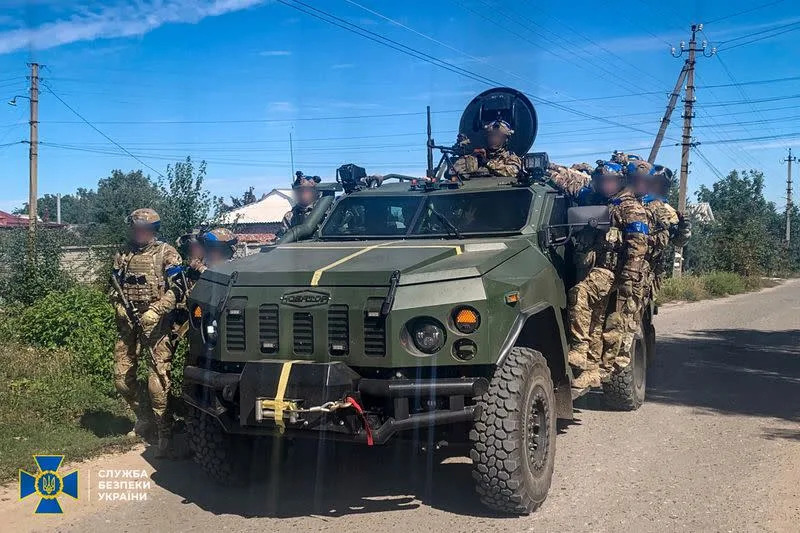
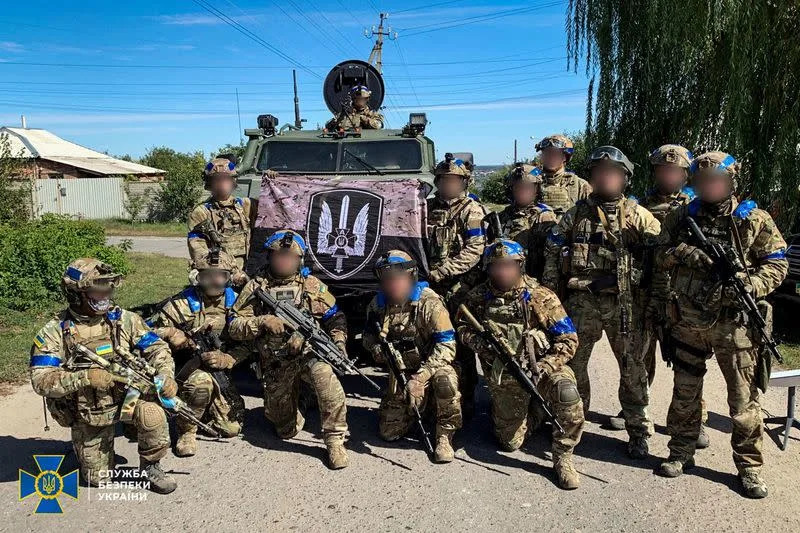
Service members of the State Security Service of Ukraine patrol of an area of the recently liberated town of Kupiansk
Service members of the State Security Service of Ukraine pose for a picture in the recently liberated town of Kupiansk
Ukrainian service member stands on a Russian national flag in unknown location in Eastern Ukraine
Ukrainian service members pose for in the recently liberated settlement of Vasylenkove in Kharkiv region
Service members pose for a picture with a Ukrainian national flag in the village of Vasylenkove, recently liberated by Ukrainian Armed Forces in Kharkiv region
Ukrainian firefighters put out a fire in a residential house after a Russian military strike in Kharkiv

KYIV/HRAKOVE, Ukraine (Reuters) -Moscow abandoned its main bastion in northeastern Ukraine on Saturday, in a sudden collapse of one of the war’s principal front lines after Ukrainian forces made a rapid advance.

The swift fall of Izium in Kharkiv province was Moscow’s worst defeat since its troops were forced back from the capital Kyiv in March. Ukraine hailed it as a turning point in the 6-month-old war, with thousands of Russian soldiers leaving behind ammunition stockpiles and equipment as they fled.

Russian forces used Izium as the logistics base for one of their main campaigns – a months-long assault from the north on the adjacent Donbas region comprised of Donetsk and Luhansk.

The state-run TASS news agency quoted Russia’s defence ministry as saying it had ordered troops to leave the vicinity and reinforce operations elsewhere in Donetsk.

The head of Russia’s administration in Kharkiv told residents to evacuate the province and flee to Russia to “save lives,” TASS reported. Witnesses described traffic jams of cars with people leaving Russian-held territory.

If the reported gains are held, it would be a serious blow for Russia, which Western intelligence services say has suffered huge casualties. It would also be a big boost for Ukraine, which is keen to show Western nations supplying it with weapons it deserves their continued support.

There is pressure on Kyiv to demonstrate progress before winter sets in, amid threats by Russian President Vladimir Putin to halt all energy shipments to Europe if Brussels goes ahead with a proposal to cap the price of Russian oil exports.

Ukraine’s Foreign Minister Dmytro Kuleba said in Kyiv that Ukrainian forces had demonstrated they were capable of defeating the Russian army with the weapons given to them.

“And so I reiterate: the more weapons we receive, the faster we will win, and the faster this war will end,” he said.

In his nightly video address on Saturday, President Volodymyr Zelenskiy said Ukraine’s armed forces had recovered around 2,000 square kilometres (770 square miles) of territory since its counter-offensive was launched earlier this month.

“The Russian army is claiming the title of fastest army in the world … keep running!” Andriy Yermak, Zelenskiy’s chief of staff, wrote on Twitter.

Ukrainian officials stopped short of confirming they had recaptured Izium, but Yermak earlier posted a photo of troops on its outskirts and tweeted an emoji of grapes. The city’s name means “raisin.”

The Russian withdrawal announcement came hours after Ukrainian troops captured the city of Kupiansk farther north, the sole railway hub supplying Russia’s entire front line across northeastern Ukraine. Ukrainian officials posted photos early on Saturday of their troops raising the country’s blue-and-yellow flag in front of Kupiansk’s city hall.

That left thousands of Russian troops abruptly cut off from supplies along a front that has seen some of the most intense battles of the war.

Igor Girkin, a former commander of pro-Russian forces in eastern Ukraine, called the Russian pullback “a major defeat” in remarks on Telegram.

MECHANISED ASSAULT

Ukraine has for weeks been talking up a big counteroffensive in the south, which also is under way though details are sparse.

Russia still occupies extensive territory in the Donbas and in the south near the Crimean Peninsula it seized in 2014.

Days ago, Kyiv’s forces burst through the front line in the northeast and have since recaptured dozens of towns and villages in a swift mechanised assault, surging forward dozens of kilometres (miles) a day.

Ukraine’s deputy defence minister, Hanna Malyar, sounded a cautionary note, urging people not to report prematurely that towns have been “taken” just because Ukrainian troops were sighted. Troops entered Balakliia a few days ago, she said, but it was only on Saturday that Ukraine established control in the city.

In Hrakove, one of dozens of villages recaptured in the Ukrainian advance, Reuters saw burnt-out vehicles bearing the “Z” symbol of Russia’s invasion. Boxes of ammunition were scattered along with rubbish at positions the Russians had abandoned in evident haste.

“Hello everyone, we are from Russia,” was spray-painted on a wall. Three bodies lay in white body bags in a yard.

The regional chief of police, Volodymyr Tymoshenko, said Ukrainian police moved in the previous day, and checked the identities of local residents who had lived under Russian occupation since the invasion’s second day.

“The first function is to provide help that they need. The next job is to document the crimes committed by Russian invaders on the territories which they temporarily occupied,” he said.

FIGHTING IS GETTING CLOSER’

A witness in Valuyki, a town in Russia’s Belgorod region near the border with Ukraine, told Reuters she saw families from Kupiansk eating and sleeping in their cars along roads.

“I was at the market today and saw a lot of people from Kupiansk. They say half of the city was taken by the Ukrainian army and Russia is retreating … the fighting is getting closer,” the witness said.

Belgorod governor Vyacheslav Gladkov said officials were giving food and medical aid to people queuing at a crossing into Russia. Senator Andrey Turchak, from the pro-Kremlin United Russia party, reported more than 400 vehicles at the frontier.

Russian rocket fire hit Kharkiv city on Saturday evening, killing at least one person and damaging several homes, part of a surge in shelling since Kyiv’s counter-offensive, Ukrainian officials said.

Reuters could not independently confirm the battlefield accounts.

“The advance is enormous. There are sporadic battles, but mostly the occupiers are fleeing,” Luhansk regional governor Serhiy Gaidai told Ukrainian television on Saturday.

(Reporting by Reuters reporters; Writing by Peter Graff, Andrew Heavens and Doina Chiacu; Editing by Cynthia Osterman and Daniel Wallis)

With more than 40 Trump lawyers singled out for ethics complaints and even more facing charges, legal experts joke MAGA now stands for ‘Making Attorneys Get Attorneys’

Insider

With more than 40 Trump lawyers singled out for ethics complaints and even more facing charges, legal experts joke MAGA now stands for ‘Making Attorneys Get Attorneys’

Katherine Tangalakis-Lippert – September 10, 2022

Trump at CPAC Texas
Former President Donald Trump speaks at the Conservative Political Action Conference on August 6, 2022 in Dallas, Texas.Brandon Bell/Getty Images

For lawyers working with former President Donald Trump, legal risk is considered an expected part of the job: More than 40 attorneys who worked to overturn the 2020 election on his behalf have been hit with ethics complaints.

The New York Times reported legal experts joke MAGA now stands for “Making Attorneys Get Attorneys,” based on the reputational risk of working with Trump.

“There’s no way to adhere to your ethical integrity and keep your job,” Kimberly Wehle, a University of Baltimore law professor who closely tracked investigations into the Jan. 6, 2021 attack on the Capitol, told The New York Times of the dilemma Mr. Trump’s lawyers face: “There’s just no way to not step into a mess.”

The 65 Project, a bipartisan effort to hold Trump-allied lawyers accountable for filing 65 lawsuits across swing states in an attempt to overturn legitimate 2020 election results, has filed more than 40 ethics complaints with their respective state bar associations against lawyers who participated in the scheme.

Among the complaints, including 17 filed last month, are ethical concerns raised against former Trump lawyers John EastmanCleta Mitchell, and Jenna Ellis.

On Jan 6, 2021, Eastman asked former Vice President Mike Pence’s legal counsel to break the law and halt proceedings to certify the 2020 election. He was still pitching ways to overturn the election by the time President Joe Biden took office.

Mitchell is currently leading a group of GOP poll workers to challenge results in the midterms. Ellis has been ordered to testify before the Fulton County, Georgia special grand jury investigating whether Trump and his associates tried to interfere in the 2020 elections.

Rudy Giuliani, Trump’s one-time personal lawyer, has also been named as a target in the Georgia investigation and his licenses to practice law in the District of Columbia and New York have been suspended over his election fraud claims.

Another former Trump lawyer, Sidney Powell, is under investigation for overseeing an effort to copy sensitive election data and coordinating a breach in Georgia election files.

Christina Bobb, a current Trump lawyer, is currently facing legal trouble after she signed a letter attesting that a “diligent search” had been conducted and all material that was in Mar-a-Lago at the time had been returned to the US government, per a court filing. Two months later, the FBI raided Trump’s Florida golf club and found 20 boxes worth of new material, including 11 sets that were marked as classified.

Michael Cohen, a former Trump lawyer sentenced to three years in prison in part over his role in arranging illegal hush-money payments to adult-film star Stormy Daniels to prevent her from speaking about her affair with Trump, has warned Trump’s current legal team to “lawyer up,” citing his own felony charges including tax evasion, campaign-finance violations, and bank fraud.

“Ultimately, we want to demonstrate to all the lawyers that the next time that Sidney Powell or Rudy Giuliani calls and says, ‘Hey, will you sign your name to this,’ they’ll say ‘no,’ because they’ll realize that there are professional consequences,” Michael Teter, director of the 65 Project, told The New York Times.

Moscow Officials Urge Putin to GTFO: ‘Everything Went Wrong’

Daily Beast

Moscow Officials Urge Putin to GTFO: ‘Everything Went Wrong’

Allison Quinn – September 10, 2022

Getty
Getty

More and more Russian officials are urging Vladimir Putin to get the hell out of the Kremlin as Moscow suffered another series of humiliating defeats in Ukraine this weekend.

Just one day after several municipal deputies in Putin’s hometown of St. Petersburg called on the State Duma to try the Russian leader for treason, their colleagues in Moscow joined in and demanded he step down because his views are “hopelessly outdated.”

The open letter to Putin from municipal deputies in the Russian capital’s Lomonosovsky district started out by seemingly trying to let him down gently, telling him he had “good reforms” in his first term and part of his second.

But then, “everything went wrong,” the deputies said.

“The rhetoric that you and your subordinates use has been riddled with intolerance and aggression for a long time, which in the end effectively threw our country back into the Cold War era. Russia has again begun to be feared and hated, we are once again threatening the whole world with nuclear weapons,” the letter read.

“We ask you to relieve yourself of your post due to the fact that your views and your governance model are hopelessly outdated and hinder the development of Russia and its human potential,” the deputies said in closing.

Though they made no mention of the war against Ukraine, their plea came as Putin’s deranged “special military operation” next door took a spectacular nosedive, with thousands of Russian forces fleeing as Ukraine’s military launched a series of surprise counter-offensives and reclaimed nearly 400 square miles of territory in a matter of days.

Putin Insists His War Against Ukraine Is Doing Great Things for Russia

Even as Russian defense officials sought to play down the mass surrender as nothing more than a strategic maneuver, it was clearly not perceived that way even by many of Putin’s most loyal cronies.

The same Russian propagandists who’d spent the first six months of the war thumping their chests about a supposedly “inevitable victory” suddenly changed their tune. Margarita Simonyan, the editor-in-chief of RT who’d repeatedly called for Moscow to mercilessly obliterate Ukraine, suddenly posted a sentimental screed on Twitter calling for unity between the two nations.

“In this situation, the best picture of the future is the overall picture of the past. Our shared past, recent. When everyone was together, when there was Victory Day, when there was a parade, when both Russian and Ukrainian were taught,” she wrote, waxing nostalgic over a time when “wonderful songs were sung both in one language and the other.”

Even the pro-Kremlin Telegram channels run by Russian military bloggers had a dramatic change of tune as Ukraine claimed new wins Saturday: They began to openly blast military leadership—and Putin personally—for the embarrassing failures.

“Stalin, as much of a vampire as he was, never stooped to this and said how we lost nothing and there are no problems,” wrote one pro-Kremlin blogger. “For him, those who cowardly run away and ‘withdraw troops’ were the alarmists.”