Why there’s no relief in sight for soaring oil and gas prices
Rick Newman, Senior Columnist – June 13, 2022
Everybody’s frustrated. If somebody could do something about it, it would be done. But oil and gasoline prices are on a tear that for the time being seems unstoppable.
U.S. gasoline prices have hit $5 per gallon for the first time ever, and Moody’s Analytics thinks they could hit $5.50 within a couple of weeks. There’s no mystery why. A confluence of forces, led by Russia’s invasion of Ukraine, has crimped oil supply and bumped up demand. There’s more that could go wrong, adding a “fear premium” to prices on top of the hike caused by market dynamics. It won’t last forever, but for now there’s no sign that new supply, reduced demand or an outbreak of stability will bring relief.
Four things are going wrong simultaneously for fossil-fuel purchasers. First are sanctions on Russia, the world’s third-largest oil producer. So far, sanctions have slightly reduced Russian oil sales, but Europe is phasing in an embargo, with plans to cut Russian oil purchases 90% by the end of the year. Russia will probably be able to sell some of that oil elsewhere, but exports will probably decline, reducing world supply and pushing prices upward. Since oil prices are set in a global market, no nation can insulate itself from the effect falling supply or rising demand has on prices.
China seems to be emerging from extreme COVID lockdowns that depressed economic activity, including energy consumption. As China’s economy picks back up, energy use will rise, putting upward pressure on prices. There was some hope a new deal with Iran over its nuclear weapons program would lead to the end of U.S. sanctions and more Iranian oil on the global market. But Iran seems to have scuttled negotiations, making a deal unlikely. Finally, President Biden and other leaders have already released large amounts of oil from national reserves, leaving little room for further releases.
Raoul LeBlanc, vice president of the energy practice at S&P Global, calls these four factors a “nightmare bull scenario” that could push oil prices higher still, enriching oil sellers while hammering purchasers.
“Current prices reflect the risk of that happening,” LeBlanc says. “Prices right now make sense in terms of the big drivers that could push prices higher.”
How much can consumers take? Moody’s Analytics thinks $5.50 gasoline in the United States could be the peak, with prices likely to decline steadily beginning in the second half of this year. But the research firm analyzed the likely impact on consumers and the U.S. economy if gas prices hit $6 and even $7. Surprisingly, neither scenario would induce a recession.
‘An outsize place in the mind of the U.S. consumer’
But the pain would be considerable, as any driver can imagine. In both scenarios, unprecedented gas prices would cut consumer spending on other things, and reduce overall GDP growth. But growth would still remain positive, and imbalances would eventually sort themselves out. Still, consumers might blow a gasket.
“Gasoline prices, with their illuminated roadside ubiquity, hold an outsize place in the mind of the U.S. consumer when it comes to inflation and their interpretation of the health of the economy,” Moody’s Analytics economists Matt Colyar and Ryan Sweet wrote on June 9.
President Biden is reportedly agonizing over sky-high energy prices that threaten to wreck his presidency. But it’s not a U.S.-centric problem, and there’s very little he can do. Biden, like many others, wants U.S. oil and gas producers to drill more. U.S. production is growing modestly and likely to hit a new record next year. But energy producers have been burned many times in boom and bust cycles, where prices rise, they drill more, then prices crash and they lose money.
Richard Thomas, 41, of Fontana, pays close attention to how many gallons of gas he is buying while filling up his nearly empty tank at the Chevron gas station, located at the intersection of Cesar. E. Chavez Ave. and Alameda Street in downtown Los Angeles. . (Mel Melcon / Los Angeles Times via Getty Images)
“High prices aren’t good for us,” Mike Wirth, CEO of Chevron, said during a June 7 event sponsored by the Center for Strategic and International Studies. “They never last. In our industry, demand always moves faster than supply. Incentives are there for the producers to produce. This is not always the most popular thing, but allow markets to work.”
That may sound disingenuous, given that Chevron is one of the oil majors booking huge profits right now. But many industry executives point out that U.S. energy firms overproduced for years leading up to the 2020 COVID recession, which turned into a bloodbath for the fossil fuel industry as demand collapsed and oil prices even went negative for a brief spell. That was a searing experience energy firms and their investors don’t want to repeat.
The best thing for oil and gasoline consumers would be an end to Russia’s barbaric invasion of Ukraine. Sanctions on Russia would likely remain, but some or most of the fear premium in oil prices would dissipate as worst-case scenarios improve. There’s no sign of a breakthrough in the war, but the United States and other nations sending Ukraine weapons and aid might speed up the timeline for helping defeat Russia on the battlefield if they want to end the oil price spike.
A less favorable solution would be a global recession, which some economists think is coming. Europe, heavily dependent on Russian energy, may be there already, and the U.S. economy is certainly cooling. Recessions bring commodity prices down because economic activity subsides and demand falls — exactly what oil drillers are watching out for. That might even be what Russia wants. Battles rage in markets, too.
Rick Newman is the author of four books, including “Rebounders: How Winners Pivot from Setback to Success.”
Near Lyman, Ukraine – Crossing the final checkpoint into a battle zone feels like a consecration.
The Ukrainian soldiers manning the last friendly post have a singular focus and intensity that’s lacking behind the lines. They wave us through solemnly, without smiles or chatter. We coast through the invisible barrier separating the “front” from the “rear,” then floor the gas and accelerate forward.
I’m in eastern Ukraine in late May, in a region called Donbas, where the war has become a whirlwind of carnage that is claiming the lives of as many as 100 Ukrainian soldiers a day. The casualties on the Russian side are almost certainly even higher, according to Ukrainian defense officials. I’ve heard conflicting reports about what is happening here, about whether the Ukrainian military is collapsing or the Russians are succeeding in breaking through the defender’s lines, cutting off thousands of soldiers. But it’s clear that Russia is inching forward, each day bringing it closer to its goal of annexing the provinces of Luhansk and Donetsk and cementing the region under Moscow’s rule.
Ukraine won’t stop fighting. But it is sacrificing thousands of its finest soldiers and still losing ground. It cannot win the war without game-changing foreign-military assistance: American heavy artillery, Danish anti-ship missiles, German air-defense systems — these are slowly making their way to the battlefield. But can the Ukrainian military hold out long enough for any of it to make a difference?
To truly understand what is going on — to get a sense of morale and see how the soldiers are holding up under Russian assault, I must descend into the inferno, and I need a guide. A Ukrainian paratrooper will lead the way.
I’ve called in favors with the commander of a reconnaissance company in an air-assault brigade, and he links me up with an officer whose elite scout unit is operating near intense fighting outside a town called Lyman, a senior lieutenant who goes by the nom de guerre “Mace.”
Mace is soft-spoken and cordial, lean and fit as an endurance athlete. His face is that of a young man, but the salt-and-pepper hair hidden beneath his field hat and his calm self-possession amid chaos reveal he is a seasoned veteran who saw his share of combat before the current invasion. He takes me to the front in a Škoda station wagon, roaring down country back roads at 100-plus miles an hour, blasting techno as the foliage whips past in a blur.
Mace knows that speed counts here, and he weaves in and out of the anti-tank barricades that are strewn along the roads, gunning the engine as soon as we clear the concrete blocks and berms of dirt. I’m glad he knows which roads are mined. As we careen down a hill toward a crossroads surrounded by a scattering of farmhouses, I see a Ukrainian Akatsiya self-propelled artillery gun dashing toward the T-intersection ahead of us. It looks like we will get there at the same time. I point out the vehicle to Mace wordlessly, and I’m gratified to hear the engine revving instantly.
We are of the same mind. The Akatsiya, alone and moving in the open, is a prime target for the Russians. Likely it’s been “shooting-and-scooting”: If they want to survive, the gun crew has to strike a balance between staying in position long enough to provide effective fire support to friendly ground forces, without lingering so long they get discovered by Russian drones.
The Russians are ceaselessly hunting Ukrainian heavy weapons, and their rockets, artillery, and missiles can strike anywhere here, at any time. The fields beside us are pockmarked with blast impacts, and the tails of dozens of dud rockets stick out of the earth as if planted by some mad farmer.
The intersection is a critical danger point: The Akatsiya must slow to nearly a stop to make the turn. If I was a Russian gunnery officer observing it via drone, that’s when I’d try to hit it. The equation “speed x time = distance” looms in my mind.
We fly through the intersection ahead of the Akatsiya, and its crew doesn’t spare us a glance. They’re intent on their own survival, and making the cover of the tree line.
My concern is not abstract.
In the same area only days later, a team of journalists from TheWashington Post is nearly killed when visiting a Ukrainian unit, artillery shells falling just yards from where they are standing. That they survive is pure luck.
Days before that, a French journalist is killed in an artillery strike while filming the evacuation of civilians fleeing the fighting in Severodonetsk, the focal point of the Russian assault.
It isn’t necessarily that one can make all of the right choices and thereby stay safe on a battlefield. Sometimes luck works against you when artillery shells are falling. But it is worse to be caught in some places than others.
When we are back in the trees I relax slightly, but Mace doesn’t slow down. He has a destination in mind.
TOUR OF DUTY – “Mace” is an elite soldier who has been fighting the Russians in the east for several years. “The problem isn’t that we don’t have enough people here,” he says. “The problem is that we don’t have enough well-trained people.” – Credit: Mac William Bishop
“This is hell on Earth,” Mace says quietly. We are watching as BM-21 Grad rockets rain down on Ukrainian positions near a village called Sviatohirsk. It’s impossible to see their individual effects amid the smoke and haze covering the densely forested hills. Standing in an observation post on high ground amid feathery grass and wild garlic, I give up on trying to count individual impacts and instead just count the salvos, timing each barrage. I witness as many as 480 rockets fired on a single position in less than a minute, followed by artillery.
Between my service in the U.S. Marines and over more than a decade as a foreign correspondent, I’ve been engaged in the professional study of organized human violence for 25 years. But I’ve never seen anything even close to this volume of artillery being unleashed.
Mace has chosen our ground well, as you’d expect from an officer in an elite reconnaissance unit. We’re in a fold of earth on a hill that gives us a clear view of the battle raging around Sviatohirsk — a quiet little village nestled among chalk hills, overlooked by a nearly 400-year-old monastery on the opposite side of the river. It lies to our left. We can also see the fighting around Lyman — a key railway junction — to our right.
What these two places have in common is they are on the Russian-occupied side of the winding Seversky Donets River, the main natural barrier to the enemy’s advance. There are tens of thousands of Russian soldiers with hundreds of tanks and armored vehicles attacking here, assaulting in a vast crescent surrounding Severodonetsk, one of the largest cities in Donbas that remained in Ukrainian hands before the invasion began in February.
Lyman is obscured by smoke from a forest fire that began amid the fighting. The white smoke of the burning trees is interlaced with dark columns rising from destroyed buildings or vehicles. The rumble of booms is almost continuous. The whump-whump-whump of artillery is punctuated by the scream of tactical ballistic missiles, and the salvos of rocket artillery make a distinctive pattering of successive concussions. Almost all of it is being fired by the Russians. The Ukrainian soldiers here have endured this maelstrom for weeks.
“Things usually start to really kick off around 3 p.m.,” Mace says. He describes what has become routine for his brigade of paratroopers: Russian scouts move forward to probe Ukrainian positions, then call in large-scale artillery strikes when they make contact. The artillery is followed by masses of armor supported by infantry. It’s classic “combined arms” warfare, and would have been as familiar to a soldier in World War II as it is to Mace.
“The biggest problem is the artillery,” Mace says. “The Russians just have so much.”
What about the long-range artillery being provided by the United States and others?
“It’s just starting to show up on the battlefield,” Mace says. But for now, “there’s just too much artillery. Too many tanks. We are fighting too hard.”
Will Severodonetsk need to be abandoned?
Smoke rises in the city of Severodonetsk during heavy fightings between Ukrainian and Russian troops at eastern Ukrainian region of Donbas on May 30, 2022, on the 96th day of the Russian invasion of Ukraine. – Credit: ARIS MESSINIS/AFP/Getty Images
“It’s possible,” he says. If it falls, it will be the biggest city taken by the enemy since Mariupol was lost in May, and will effectively mean that Russia controls the entire province of Luhansk, a primary goal of Putin’s invasion.
There’s a sudden pop as a cluster munition bursts over the battlefield, leaving behind a smattering of dark puffs as submunitions rain down on the village’s defenders. It’s followed by another seconds later.
The production and use of cluster munitions have been banned by an international treaty that went into effect in 2010, but that doesn’t mean very much: Neither the United States nor Russia — the world’s biggest arms dealers — have signed the accord. Neither has Ukraine. Cluster munitions spread submunitions — small explosives called bomblets — over a wide area, and are intended to kill or maim personnel and destroy vehicles and equipment. Many of the bomblets don’t explode as designed when they hit the ground. Those unexploded bomblets will be found for years afterward.
Sometimes children mistake them for toys.
“Their actions are not as haphazard as before,” Oleksandr Motuzianyk, the spokesman for Ukraine’s Defense Ministry, tells me back in Kyiv when I ask about changing Russian tactics. “They’re using combined arms and air support more effectively.”
The simple fact is that despite its missteps, Russia has taken a lot of land since the invasion started. Ukraine, lacking Russia’s deep reserves of manpower — however unskilled or untrained — cannot recapture it without superlative military technology. Meanwhile, the Russians are pushing ahead: Motuzianyk says their strategy is to encircle troops defending Severodonetsk.
The population of Severodonetsk was more than 100,000 before the invasion in February. Local officials and aid workers estimate that only 12,000 civilians remain, the rest having fled. The entire region has emptied, and daily life has ground to a halt.
The nearby city of Kramatorsk, which held 150,000 inhabitants before the war, is a ghost town. Only a few old people remain; a handful of shops open for a few hours in the daytime to provide food and groceries to the soldiers passing through and the few locals who still remain. A ballistic missile hit a train station there, crowded with refugees, killing 59 people in early April, and wounded more than 100, according to Ukrainian defense officials.
Slovyansk and Kramatorsk are just a few miles apart, and they have become staging areas for the Ukrainian military. They are under constant attack from Russian missiles and rockets: I am awoken throughout the night by resounding booms and constant air raids. One strike takes down the power grid and cellular networks for hours. Multiple strikes in both cities kill civilians, who refuse to leave their homes.
Kramatorsk – hit by a Russian cruise missile. – Credit: Mac William Bishop
“Do you hear that?” an old man calls to his neighbor, gardening in his yard, as a violent series of explosions echoes through the streets.
“Oh, it’s just thunder,” the gardening man replies. Nearby, a middle-aged woman is pleading with an elderly neighbor to leave. “Where will you go when the Russians get here?”
The Russians have a lot of ground to cover before they can make it as far as Kramatorsk, but the woman has a point.
“The enemy intends to get to the administrative border of Luhansk” with the current offensive, Motuzianyk says. “The enemy intends to take full control of the region.”
But, he adds, “the main tactic remains that of scorched earth.”
“Clearly the Russian leadership demanded changes to Russian tactics to achieve victories, and they are doing what they must to achieve that,” Motuzianyk says. “They are destroying communities and wiping us off the Earth without regard for civilians.”
At a small compound taken over by the airborne scouts, soldiers relax in the yard, grabbing whatever rest they can between missions. I’m standing beside a portly old soldier with a grandfatherly manner, enjoying the sunshine as cottony poplar seeds float densely through the air around us, lending an atmosphere of surreal tranquility as shells and rockets land in the surrounding hills.
The munitions strike so often that you begin to ignore anything that goes “boom,” and only react to things that go “crack,” indicating the explosive has landed unreasonably close.
Fighting here isn’t a new experience for many of the paratroopers, and they are quick to remind me that for them the war began in 2014, when Russia annexed Crimea and sent its soldiers into Donbas to support pro-Russian separatists. Most Ukrainians remain bitter about the relatively weak Western response to those actions, and it’s why they fear the West will once again buckle to Putin’s aggression.
Ukrainians from all walks of life have told me how concerned they are about a repeat of 2014, with the international community acceding to the Russian seizure of their land — despite the blood they are spilling to defend it.
“These guys shouldn’t have had to fight for eight years,” the old soldier grimaces in dismay as he watches the young paratroopers. “They should be at home making babies. But here we are, stuck in this shit.”
The commandeered building that the recon teams are using as their base is a hive of activity. There’s civilian cars and captured Russian trucks the paratroopers are trying to get back into service. Many of the vehicles sport bullet holes or other obvious battle damage.
These paratroopers receive intensive instruction — many have trained with U.S. Special Forces and other elite NATO units — and their experience is unmatched: they have been regularly rotating through Donbas since 2014. Mace suggests I speak to one of his most seasoned veterans, a hardcore fighter who has been operating in Donbas for eight years. He’s a rugged looking guy with a scratchy voice. I ask him what has changed now.
“One of the biggest problems is the drones,” says “Ostap,” the nom de guerre of the scout. “I hear Orlans [a type of Russian reconnaissance drone] all the time. But I almost never see them. They’re too small and too high. It’s next to impossible to shoot them down.”
But the defense ministry says that soldiers have shot Russian drones down in the hundreds, I say.
He shrugs. “I don’t know. I only believe what I see with my own eyes.”
A big part of the problem in defending this part of Donbas, Ostap believes, is that the people who have stayed behind — the people who haven’t fled — don’t really believe they are part of Ukraine. In his view, the civilians who remain are all separatist sympathizers. He says they help the Russians navigate backcountry roads that aren’t on the maps.
“Yeah, they’re all waiting for Russkiy mir,” Mace says, laughing when I ask his opinion about the locals. Russkiy mir, or “Russian world,” is the revanchist concept that Russia needs to restore its central role in the affairs of its neighbors, and its borders, to what they were at the height of the Soviet empire.
He asserts there have been instances of local collaborators getting caught providing information about Ukrainian troop movements or locations. Indeed, Slovyansk fell to Russian separatists in 2014: The retaking of the city by the Ukrainian military later that summer was the first major battle in Donbas.
“Almost everyone here is pro-Russian. But you can’t arrest people just for that,” Mace says. In any case, the police and the SBU —Ukraine’s internal security service — were doing what they could. “The SBU even arrested a couple of people in our brigade,” he says.
MOVING TARGET Ukrainian tanks often hide from Russian drones and air strikes in the trees. The numbers of troops greatly favor the Russians, according to a statement by President Zelensky. – Credit: Mac William Bishop
“We’re looking for bears,” Mace says. He means Ukrainian tanks. I’ve seen several T-80s obscured among the trees, hoping to stay hidden from Russian aircraft and drones. We round a corner and there’s one right in front of us, a squat hulking shape with the long barrel of its 125-mm cannon pointing down the road.
There’s a tank platoon in the dark forest here, holding in reserve on favorable terrain, lest the Russians succeed in crossing the river.
There’s been other signs of Ukrainian forces moving east to get in the fight. On the highway to Kramatorsk, we would pass periodic tank carriers loaded with armored vehicles or tanks, fuel trucks, and a few rarer sightings, like bridging equipment and a Buk anti-aircraft missile system that had only three of its four mounting points armed with missiles.
It doesn’t seem like a lot of equipment given the scale of the fighting. I don’t see any of the new artillery systems provided by the United States in its most recent aid package: There are also busloads of sleeping soldiers. Russians have concentrated their greatest resources here, according to President Zelensky. Mace doesn’t see being outnumbered as the biggest problem, however.
“The problem is that we don’t have enough well-trained people,” he says. “The Territorial Defense Forces [volunteers called up for the current crisis, often with minimal training and equipment] will go to their trenches, and as soon as they see an enemy tank, they fill the radio net with panicked chatter and then run away, abandoning their positions.”
He shakes his head grimly: “We need quality, not quantity. The opposite of the Russians.”
As we dash through the forest, we happen upon a Ukrainian unit using an intersection as a staging area, they gather in a small clearing next to a large oak tree. They’re in a mix of uniforms, some are even wearing articles of civilian clothing. Most of them are standing in front of a prisoner.
The prisoner is on his knees, blindfolded with his hands tied behind his back. He’s wearing the distinctive uniform of Russian infantry. Because of Mace’s dedication to fast driving, I don’t process what I’ve seen until we pass. “A Russian prisoner!” Even as the words leave my mouth, a single gunshot cracks out.
I whip around to look back over my shoulder at the scene through the rear window as we turn left, praying I am not witness to a war crime.
There is no evidence of widespread abuse of prisoners of war by Ukrainian forces, but there are several ongoing criminal investigations into isolated incidents in which Russian prisoners appear to have been tortured or even executed.
The military here has more than doubled since Russia’s invasion in late February. More than 700,000 Ukrainians are now under arms, and perhaps only one-third of those have received anything resembling professional military training. But there is no shortage of hatred on the battlefield. Only days before, I attended a Defense Ministry briefing, unveiling a series of online videos designed to ensure Ukrainian soldiers understood the laws of war.
“Sometimes we face skepticism, people say, ‘Well, the Russians don’t obey the rules of war. Why should we?’” said Col. Viacheslav Rachevskiy, the officer conducting the briefing. “But it is about being a civilized army.”
Ukraine can’t afford to let untrained soldiers jeopardize Western support, and it wants to highlight that it takes the issue seriously. The moral high road is as much an asset in this fight as any weapon system. Ukraine has worked to codify the laws of war into the Ukrainian criminal code, to bring the country in line with the generally accepted norms of international humanitarian law, according to Rachevskiy. “It’s the sign of a European, modern democratic army,” he said.
When I look back, the prisoner is still on his knees: He’s talking. He appears alive and unharmed. I don’t see anyone pointing a weapon at him. What did I hear? An accidental discharge? A celebratory gunshot? A mock execution? There is no way to know.
“Can we stop? Can I talk to him?”
Mace doesn’t look back, he makes the turn and accelerates. It’s hardly the first time the paratrooper has seen a Russian prisoner. “If he hears you speaking English, then he’ll spread tales of American puppet masters in these woods,” he says.
Besides, Mace explains, he doesn’t know who those soldiers are. They aren’t in his unit.
The last I see of the Russian, he is alive and on his knees, being interrogated in the field.
When “Sasha” gets in the car, he says he just doesn’t want to talk about anything. Sasha has been waiting outside the one grocery store in Kramatorsk that is still functioning: Its parking lot has become a local hot spot for soldiers to meet up for rides to and from the front. He tosses his bags in the back and squeezes into the rear seat of the Chinese-made sedan that will ferry me back to my own vehicle.
The big brooding soldier is unshaven, his fatigues filthy from combat, except for a field hat that is clearly brand new. The local driver who has been shuttling me around has agreed to bring the soldier to Dnipro: He has leave papers and is trying to get home to Mykolaiv, so that’ll take him about halfway. The fuel shortage is critical in eastern Ukraine for non-military traffic, so filling a civilian car with strangers headed roughly the same direction has become a common practice: There are Telegram channels where people offer and seek rides to and from every city.
Less than 30 minutes into the drive, Sasha opens up suddenly and unexpectedly. What he reveals is chilling, and indicative of how bad things have gotten in Donbas.
“I nearly beat to death one of the men in my unit,” he confides. “We were in trenches on the front lines. He was using his cellphone.”
Sasha breathes heavily.
“The Russians tracked his signal and located our position. He called his mom for 15 minutes, then his wife for 15 minutes … and then his girlfriend for almost two hours. They bombarded us all night. That’s why I beat him.”
Later, he tells us more about the front.
“We lost six men on our first patrol,” he says. “Six out of 10. They were all my friends.”
He breaks down and begins to cry.
Sasha eventually admits that he has been given leave to go to a hospital to seek therapy, for what soldiers a century ago would have called shell shock and what we now call PTSD. He has been given 10 days to recover from his battlefield trauma and return to his unit.
When we have a chance to talk alone, he shows me videos of his wedding in October. He tells me he is scared to talk to his family about his experiences. Sasha doesn’t want to return to combat. All he can think about are the soldiers who were killed on his first patrol.
“Those six men were my friends, they were my brothers, and I love them very much,” he says. “I can’t just leave them behind. I will always carry them with me.”
He looks down, overcome with emotion.
“What is in my heart is that I never wish to see Donbas again in the future. Nothing you do there makes any difference.”
Blame monopolies for today’s sky-high inflation, Boston Fed researchers say
Ben Winck – May 26, 2022
Grocery shopping in Rosemead, California on April 21, 2022.
Dwindling industrial competition has made the US’s inflation problem even worse, Fed researchers said.
A new paper found that increased concentration led firms to pass a greater share of cost shocks onto consumers.
Weaker competition also amplified the inflation impacts of the labor shortage and rising energy prices.
The decades-long decline of industry competition made today’s inflation crisis much worse than it needed to be, researchers at the Federal Reserve Bank of Boston said in a new paper.
The US’s industrial concentration problem isn’t anything new. The economy is at least 50% more concentrated now than it was in 2005, according to the Herfindahl-Hirschman Index, a commonly used measure of industry concentration. That means a smaller group of companies control the lion’s share of their respective sectors.
Companies typically pass higher input costs on to consumer prices. Yet that pass-through “becomes about 25 percentage points greater when there is an increase in concentration similar to the one observed since the beginning of this century,” Fed economists Falk Bräuning, José L. Fillat, and Gustavo Joaquim said. Put simply, dwindling industry competition leads to companies raising prices at a much faster pace.
The pass-through happens through a variety of channels, according to the paper. The rise in concentration over the past two decades has been an “amplifying factor” to cost shocks from supply shortages, energy price spikes, and the labor shortage, the team said.
All three trends have been rife in the US economy over the past several months. Lockdowns in China roiled the global supply chain in 2021, and rising coronavirus case counts in Beijing threaten to repeat that cycle. Russia’s invasion of Ukraine boosted energy prices around the world. And the labor market is the tightest it’s been in decades, with job openings at record highs and companies still struggling to find available workers.
Encouragingly, the above-trend price increases don’t last forever, the economists said. When companies face cost shocks, they tend to pass those on to consumers over the next four quarters before returning to a more typical inflation trend. The fastest inflation typically arrives one quarter after the cost shock, according to the study. The pace of price growth then slows over the next three quarters.
Still, the research details yet another dynamic that’s allowed US inflation to recently hit its highest level since the 1980s. While factors like the labor shortage and rising energy prices are practically guaranteed to lift inflation, companies represent a critical junction between higher input costs and higher prices paid by Americans. The Boston Fed’s research signals that, unless competition rebounds, the economy will be even more susceptible to inflationary shocks in the future.
Off-grid living beckons more than just hardy pioneer types. Here’s why it’s taking off.
Katherine Roth – June 12, 2022
The Solterre Concept House in Nova Scotia, an off-grid home featured in the book “Downsize, Living Large In a Small House” by Sheri Koones.
Living off-grid conjures images of survivalists in remote places and a rustic, “Little House on the Prairie” lifestyle with chores from morning to night.
Yet only a tiny fraction of people living off-grid do it like that, and fewer still live more than an hour from any town.
“Living off-grid doesn’t mean you don’t buy your groceries at a store or take your waste to the local dump,” says Gary Collins, who has lived off-grid, or mostly off-grid, for a decade. “It just means you are not connected to utility grids.”
He has published books on the subject, and leads online classes.
Although precise numbers of off-grid households are hard to come by, Collins estimates that only 1% of those living off-grid are in truly remote areas. Overall, the off-grid movement remains small. But it got a boost after the COVID-19 pandemic hit: City dwellers began to explore different ways of living.
Off-grid living unique to each person
More-frequent power outages, utility grids’ struggles and price hikes to handle the severe weather events brought on by climate change have added to interest.
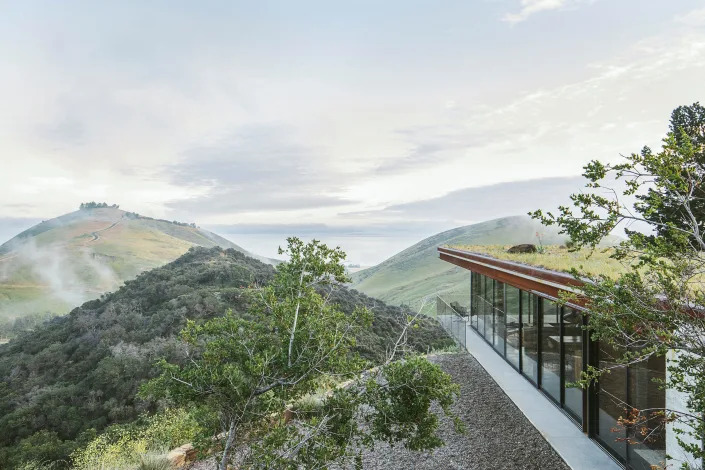
The view from an off-grid guest house in Hollister Ranch, Calif., one of the last remaining undeveloped coastal areas in California, located on a wildlife preserve. The Anacapa Architecture firm, in Santa Barbara, California, and Portland, Oregon, has designed several upscale off-grid homes in recent years, and has several more off-grid projects in the works.
There are also those who remain connected to the grid but try to power their homes independent of it. Author Sheri Koones, whose books about sustainable houses include “Prefabulous and Almost Off the Grid,” cites the rise in “net metering,” when your property’s renewable energy source – usually solar – is producing more energy than you use, and your local utility pays you for the excess.
Today, off-grid living encompasses everything from “dry camping” in RVs (with no electrical or water hookups) to swank Santa Barbara estates, from modest dwellings tucked just outside of towns to – yes – remote rustic cabins.
Mount Jefferson looms over off-grid homes at the Three Rivers Recreational Area in Lake Billy Chinook, Ore., on April 26, 2007. Everyone in this community lives “off the grid”, part of a growing number of homeowners now drawing all their power from solar, wind, propane and other sources.
“Everyone does it differently and everyone does it their own way, because it’s their own adventure,” Collins says.
Elegant designs for a modern feel
The Anacapa Architecture firm, in Santa Barbara, California, and Portland, Oregon, has built several upscale off-grid homes in recent years, and has several more off-grid projects in the works.
“There’s definitely an increase in traction for this kind of lifestyle, especially in the last two years,” says Jon Bang, marketing and PR coordinator for Anacapa Architecture. “There’s a desire to get more in tune with nature.”
The lifestyle that Anacapa homes aim for is one of modernist elegance, not roughing it. Bang says new technologies can ensure comfortable self-sufficiency.
Another image of an off-grid guest house in Hollister Ranch, Calif., designed by The Anacapa Architecture firm. A high level of sensitivity to environmental impacts was exercised throughout all phases of design and construction, the firm says.
Such homes also are carefully designed to take advantage of the site’s landscape features with an eye to sustainability. For example, one of the firm’s homes is built into a hillside and has a green roof.
For those without the means to hire architects, there are numerous recent books, blogs, YouTube videos and more dedicated to the subject.
“A lot of people are interested in it now,” Collins says. “They contact me after watching something on TV or on YouTube and I tell them, `If you learned everything you know on YouTube, you are never going to survive.'”
He makes regular grocery runs, but also grows some of his own food and hunts wild game. He has his own septic system and well. While his previous home was entirely off-grid, with solar panels and a wind turbine for power, his current home is hooked up to an electrical grid, mainly, he says, because the bills are too low to warrant the cost of solar panels.
The off-grid guest house in Hollister Ranch, Calif., designed by the Anacapa Architecture firm, has nearly 360-degree views of the Pacific Ocean.
What health and safety considerations factor into the off-grid lifestyle?
If you want to be totally self-sufficient, he says, it takes a lot of time and physical effort. You won’t have time to hold down a job. If you’re living in a remote location, you need to consider access to medical care, and whether you are mentally prepared for that much isolation.
“Your wood won’t cut itself. You’ll have to haul water,” he says, warning, “People die off-grid all the time, because of things like chain saw accidents. You have to be very careful and think everything through. No EMS will get to you in time.”
And depending on how it’s done, he says, off-grid living is not necessarily environmentally sustainable – not if you’re driving a fuel-guzzling truck and relying on a gas-powered generator, for example.
Still, improved alternative energy sources and construction techniques are making off-grid living more thinkable for more people, including those who don’t want to haul buckets of water from a well or live by candlelight.
Reynolds designed off-the-grid homes called Earthships, according to Earthship Visitor Center, using sustainable building practices, including the usage of discarded steel and tin cans for the foundation of homes.
Architect and experimental house builder Michael Reynolds who used a variety of recycled materials to complete his first experimental home near Taos in 1974. Owned by lawyer Steve Natelson, shown in the picture, the home had a lawn on the roof, a common feature of sustainable design today, but an unusual concept for homes at the time. This experimental lawn required daily attention because of the dry environment.Inspired by the problem of trash and the lack of affordable housing, Reynolds created the “can brick” out of discarded steel and tin cans.Architect and experimental house builder Michael Reynolds who lives near Taos, New Mexico, used tires, empty steel beer and soft drink cans as some of the materials used to build the structure, with a goal of building homes 20% cheaper than conventional methods at the time.Interior view of the all aluminum beer and soft drink can experimental house near Taos, New Mexico.This photo from June 1974 shows a well housing that architect and experimental house builder Michael Reynolds built from old tires that have been covered with plaster.
Iterations of these homes evolved over the next decade to incorporate passive solar and natural ventilation.
Reynolds’ legacy continues to be a presence in the region today through a fully off-the-grid community, using exclusively solar and wind power, northwest of Taos. The community sits on over 600 acres and includes more than 300 acres of shared land.
A Ukrainian sniper killed one of Putin’s most notorious mercenaries, say reports
Alia Shoaib – June 12, 2022
The square outside city hall in Kharkiv, Ukraine, after Russian shelling, March 1, 2022.SERGEY BOBOK/AFP via Getty Images A Ukrainian sniper killed one of Putin’s most notorious mercenaries, say reports
Vladimir Andonov, from the Wagner Group of Russian mercenaries, had also fought in Syria and Libya, say reports.
Andonov’s death appeared to be confirmed by Russian military sources.
Andonov was accused of shooting Ukrainian prisoners of war during fighting in the Donbas in 2014.
A notorious Russian mercenary accused of killing prisoners of war and civilians in Ukraine has been killed, according to reports.
Vladimir Andonov, 44, who has been dubbed “The Executioner,” was shot by a sniper near Kharkiv, Ukraine, on June 5, according to several Russian media outlets including the newspaper Moskovskij Komsomolets.
Zhambal-Zhamso Zhanaev, the head of Russia’s Trans-Baikal Territory in Buryatia, where Andonov lived, confirmed his death to the paper and said his body will be transported back to the region to be buried.
Andonov, who was known within Russia by his call sign Vakha or “the volunteer from Buryatia,” gained notoriety due to his role in Russia’s 2014 invasion of Ukraine and annexation of Crimea.
He is reported to have come to the Donbas in 2014 as a volunteer and was part of a unit that “liberated” the town of Logvinovo, where three Ukrainian prisoners of war were later found shot dead.
According to the website Peacemaker, which tracks Russian forces fighting in Ukraine, Andonov gave an interview about the mission in 2015 in which he boasted that “there were no survivors among the “dills,”‘ a Russian slur referring to Ukrainians.
He was known to be a mercenary of the Wagner Group, a Russian private military company with close ties to the Russian government that has been accused of committing war crimes and using brutal methods in Ukraine and other countries.
Following his time in the Donbas, he spent some years out of the public eye, during which he was widely rumored to have been deployed as part of Wagner units in Syria and Libya.
Last year, a survivor of a massacre in the town of Espia, Libya told the BBC that he believed he recognized Andonov as one of the attackers that shot his family dead.
Meanwhile, Ukrainian officials have claimed its forces destroyed a Wagner Group military base in the eastern Luhansk region, killing 22, Ukrainian news outlet Hromadske said.
Head of Luhansk regional military аdministration, Serhiy Haidai, shared a video of a burning building at a football stadium in Kadiivka which was the site used by the Wagner Group.
“The Armed Forces of Ukraine launched a well-aimed attack on it. Only one survived,” Haidai tweeted.
Mark Meadows Burned Papers After Talk About Tossing Election Results, Ex-Aide Says
Mary Papenfuss – June 12, 2022
Former White House chief of staff Mark Meadows destroyed documents after a meeting about overturning the results of the 2020 presidential election, a former aide said Sunday on CNN.
Alyssa Farah Griffin said a source with “first-hand knowledge” provided testimony to the House panel probing the insurrection that Meadows burned papers in his office after meeting with Rep. Scott Perry (R-Penn.) about challenging the election.
“I expect to see that come out in testimony” before the House committee investigating the insurrection, she added.
Another former Meadows aide, Cassidy Hutchinson, said she watched Meadows burn the documents in her account before House select committee investigators, Politico reported last month.
The meeting with Perry occurred an unspecified number of weeks after the election while Trump and supporters were desperately casting around for ways to change the vote, according to Politico.
Hutchinson also told the panel that Meadows was warned of possible violence on Jan. 6, 2021, but it was unclear what action, if any, he took in response.
Griffin may have been referring to Cassidy as her source with first-hand knowledge of the destruction of documents by Meadows. Hutchinson is expected to testify in the ongoing televised hearings held by the House panel.
Perry was pressuring Meadows to take action regarding the election, according to his emails to Meadows released by the House committee.
“Mark, just checking in as time continues to count down. 11 days to 1/6 and 25 days to inauguration. We gotta get going!” he wrote to Meadows late last year in one of the messages.
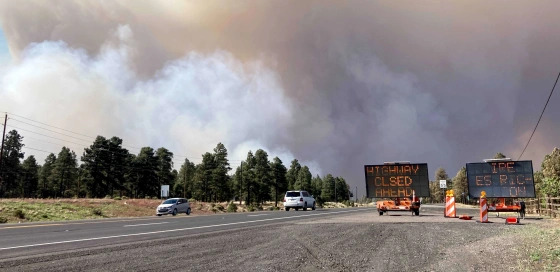
FLAGSTAFF, Ariz. (AP) — Evacuations are in effect in parts of northern Arizona as a wildfire about 6 miles (9 kilometers) north of Flagstaff steadily grew Sunday, authorities said.
Coconino National Forest officials said the Pipeline Fire was reported at 10:15 a.m. by a fire lookout and had burned approximately 4,000-5,000 acres by late Sunday, pushing about 15 miles (24 kilometers).
In connection with the fire, Forest Service law enforcement said they have arrested and charged a 57-year-old man with natural resource violations. The cause of the wildfire wasn’t immediately known.
Coconino County Sheriff’s officials said the Arizona Snowbowl ski resort and people living in the area of the west Schultz Pass Road must evacuate. People living in Doney Park and the area near Mt. Elden should be prepared.
Euelda King and her family evacuated their home for the second time this year because of wildfires. She hadn’t settled back in from a springtime blaze before leaving again Sunday, this time able to grab photographs and clothing she didn’t get earlier.
“Here we go again,” she said.
The family of 11 is planning to stay at the Navajo Nation casino, which is offering assistance to tribal members who evacuated.
The family was waiting in a parking lot ahead of road closure signs, watching smoke billow through the air and aircraft flying overhead.
“The winds are high, and I think they’re going to have a little bit of a battle with it,” King said.
Wind gusts were sweeping the smoke through Schultz Pass toward Doney Park and authorities said recreationists were being told to leave immediately, especially those in the Schultz Pass area.
The American Red Cross Arizona opened a shelter at Sinagua Middle School for residents who evacuated.
“With this thing going as fast as it is, it could get much closer, of course hoping it doesn’t,” King said.
Authorities said 13 engines, nine crews, six prevention patrol units, three bulldozers and one water tender were involved in the fighting the fire. An Incident Management Team is scheduled to arrive Monday.
The Arizona Department of Transportation has closed U.S. Route 89. The department said in a Twitter post that there is no estimated time to reopen the road.
Putin is ‘preparing to starve much of the developing world’ in order to win Russia’s war in Ukraine, Yale historian says
Kelsey Vlamis – June 12, 2022
Russian President Vladimir Putin speaks during his interview with the Russia-1 TV channel in the Bocharov Ruchei residence in the Black Sea resort of Sochi, Russia, Friday, June 3, 2022.Mikhail Klimentyev, Sputnik, Kremlin Pool Photo/Associated Press Putin is ‘preparing to starve much of the developing world’ in order to win Russia’s war in Ukraine, Yale historian says
Ukrainian officials have accused Russia of blocking millions of tons of grain exports.
Yale historian Timothy Snyder said Putin plans to starve places in Asia and Africa to win the war.
“When the food riots begin, and as starvation spreads, Russian propaganda will blame Ukraine,” he said.
Yale historian Timothy Snyder said Russian President Vladimir Putin plans to starve some countries as part of his efforts in Ukraine.
Snyder published a lengthy Twitter thread Saturday explaining how he believes Putin is using food insecurity to his advantage and called it the “latest chapter of hunger politics.”
“Russia has a hunger plan. Vladimir Putin is preparing to starve much of the developing world as the next stage in his war in Europe,” Snyder, a professor at Yale University and expert on authoritarianism, began, noting the importance of Ukraine’s food exports to the global food supply.
The area around the Black Sea, including Ukraine and Russia, has been referred to as the “world’s breadbasket” due to its fertile soil and high rates of grain production. Collectively, the two countries account for 30% of the global wheat exports while Ukraine produces about 12%.
“If the Russian blockade continues, tens of millions of tons of food will rot in silos, and tens of millions of people in Africa and Asia will starve,” Snyder said.
The historian said he believed Putin’s “hunger plan” had three main objectives. First, to cut off Ukraine’s exports in an attempt to destroy its statehood. Second, to create instability in Europe by producing refugees from areas that rely on Ukraine’s food, like North Africa and the Middle East.
Lastly, he said Putin wanted to use mass starvation as a “backdrop for a propaganda contest.”
“When the food riots begin, and as starvation spreads, Russian propaganda will blame Ukraine, and call for Russia’s territorial gains in Ukraine to be recognized, and for all sanctions to be lifted,” Snyder said.
The historian also said both Joseph Stalin, the leader of the Soviet Union, and Adolf Hitler had sought to control Ukraine’s food supply, but that Putin’s plan was “a new level of colonialism.”
“Russia is planning to starve Asians and Africans in order to win its war in Europe,” he said.
Kremlin crackdown on dissent targets the Russians protesting Ukraine war
Shira Pinson and Yuliya Talmazan – June 12, 2022
Swapping out price tags for antiwar leaflets, wearing green ribbons, flashing a copy of Leo Tolstoy’s “War and Peace.”
Those are things that can get ordinary Russians who don’t agree with the Kremlin’s invasion of Ukraine detained, fined or even jailed.
Since the start of Moscow’s incursion, media in Russia have been cautioned against calling it a “war,” and new draconian legislation has been put in place to stop people from “discrediting” the Russian army, punishable by up to 15 years in prison.
That has meant the few Russians who still dare speak up against the war have gotten inventive to escape arrest. But it’s far from guaranteed.- ADVERTISEMENT -https://s.yimg.com/rq/darla/4-10-1/html/r-sf-flx.html
Artist and musician Alexandra Skochilenko, from St. Petersburg, has been in detention for nearly two months after replacing several price tags at a local supermarket with small pieces of paper containing messages about the Russian army’s actions in Ukraine.
One of them read: “The Russian army bombed an art school in Mariupol. About 400 people hid in it from shelling.” Another said: “Putin has been lying to us from TV screens for 20 years. The result of this lie is our willingness to justify war and senseless deaths.”
Skochilenko’s lawyer, Yana Nepovinnova, told NBC News that Skochilenko’s act of protest was caught by a customer, who raised a complaint.
Alexandra Skochilenko has been in detention since her arrest in mid-April for replacing price tags with anti-war leaflets. (Courtesy Sofia Subbotina)
Skochilenko, 31, is now facing criminal charges of spreading “deliberately false information” about the Russian army and could face up to 10 years in prison, Nepovinnova said. Skochilenko has admitted to swapping the price tags, but she denies that she was spreading false information, according to her lawyer. Her detention has been extended until at least July 1.
“I feel like they came into our home and took my family away because of some price tags,” Sofia Subbotina, Skochilenko’s partner, said on the phone from St. Petersburg, sounding dejected. “Ten years is a monstrous term. They sentence people to less for murder.”
Nepovinnova said she fears Skochilenko’s case will be used to send a “clear message” to others who dare speak up that they will face the same fate.
“She is essentially behind bars for her words,” Nepovinnova said.
During the decades of Russian President Vladimir Putin’s crackdown on dissent, political protest in Russia has become nearly obliterated. Still, in the first days of the war, thousands of Russians took to the streets to voice their opposition. But that has largely fizzled out amid police violence, mass arrests and the Kremlin propaganda insisting most Russians support Moscow’s “special military operation” in Ukraine. What continues are the one-person protests of all shapes and forms to get one message across: There are people in Russia who do not agree with the war.
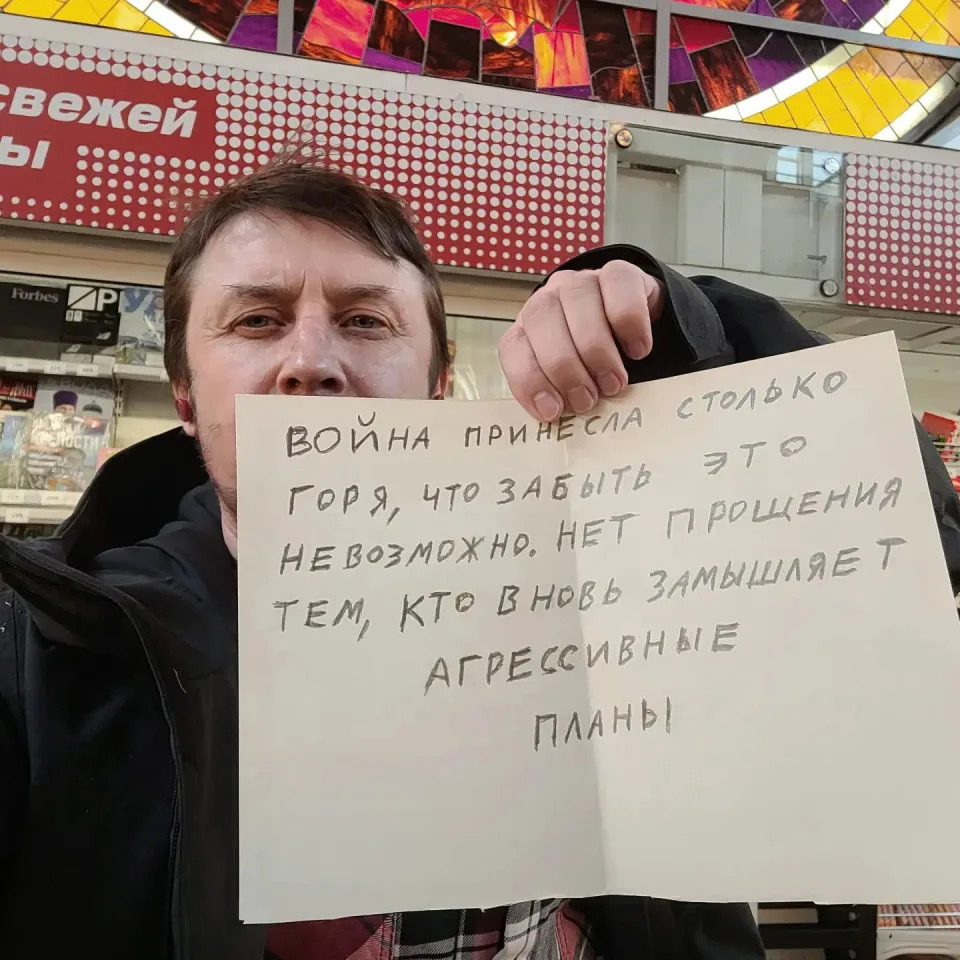
Another St. Petersburg resident, Artur Dmitriev, said he was detained in early April for holding up a sign that read: “The war has brought so much grief that it is impossible to forget. There is no forgiveness for those who are making aggressive plans again.”
Image: Artur Dmitriev (Artur Dmitriev)
This anti-war message was, in fact, an abbreviated direct quote from a speech made by Putin last year on the day Russia celebrates victory over Nazi Germany.
This made no difference to the authorities.
After spending 24 hours in detention, Dmitriev, 43, said he had a court hearing and was found guilty of “discrediting Russian armed forces,” according to the court papers he showed NBC News, under the newly enacted legislation. He said he was fined 30,000 rubles, or $520.
Holding up his court papers in a Zoom video, Dmitriev said his guilty verdict proves the absurdity of the system that detained and fined him for using Putin’s own words.
He said he even sent a snarky email to the president’s press office, asking the Russian leader to split the fine since they were now “accomplices.” The office responded but essentially ignored his request, Dmitriev said.
He admitted he was afraid throughout the ordeal and even more so now that he’s on law enforcement’s radar. But he said it’s important to speak up.
“It’s obvious where we are headed. It’s classical Orwell,” Dmitriev said. “If you are standing aside, you are only making it worse. But if you do this, you are letting people know that they are not alone.”
Making sure others don’t feel isolated is also close to Mikhail Podivilov’s heart.
Mikhail Podivilov at a protest near Moscow’s Lubyanka station in March. (Alexander Vorobyov)
That’s why the IT specialist stood with his bank card above his head at a Moscow metro station one evening in late March, hoping others would take notice, he said.
Written on his card was the word “Mir,” or “peace,” in Russian. (“Mir” is the name of a payment system used by Russian banks, and many bank cards feature it prominently.)
Within five minutes, he was being questioned by police, Podivilov, 22, said.
Speaking with NBC News via Zoom from his home in the suburban town of Ozyory in the Moscow region, Podivilov said the police officers wrangled with him for nearly an hour, trying to get him to move. He refused and all the while stood there with his card above his head, his feet and hands freezing on a chilly Moscow evening, Podivilov said. In the end, they let him go.
Podivilov said he was surprised to just walk away. But despite the fear of arrest, he said he does not have “a moral right to be afraid.”
“In Ukraine, that’s where people can be afraid,” Podivilov added, with no hesitation in his voice. “The maximum that can happen to me is I will get jailed.”
OVD-Info, an independent Russian organization that tracks political persecution and freedom of assembly violations, maintains a long tally of names and acts of Russians who have stood up against the war, including by displaying the blue-and-yellow colors of the Ukrainian flag, standing with a copy of Leo Tolstoy’s “War and Peace” in Red Square, holding up banners with nothing but eight asterisks (corresponding to the letters in the slogan “No to war” in Russian), and even wearing green ribbons, which have become a symbol of opposition to the war.
It estimated that as of early June, more than 16,000 people had been detained over anti-war protests. It said there are nearly 2,400 court cases underway for allegedly “discrediting” Russian armed forces under the newly enacted legislation, and that it’s aware of at least 170 suspects facing criminal charges related to speaking out against the war.
But for the millions of others who remain silent, the fear is too much to bear, said artist and activist Eugene, who said he did not feel safe revealing his last name.
Eugene, 31, offers an opportunity to those who want a chance to say something against the war to do so anonymously.
Since March 20, he has been running an Instagram account called Malenkiy Piket, or Little Protest in Russian. It’s meant to be a safe space where people can send in photos of small figurines, perhaps a representation of themselves, made out of plasticine or Legos, that are holding up peace messages. The figurines are discreetly placed around people’s towns and cities, or, if it feels too dangerous, in the safety of their homes.
The account’s feed is full of colorful photos of figurines, often dressed in Ukraine’s blue-and-yellow colors and placed against city monuments, benches, riverbanks or people’s kitchen tables, with signs reading, “No to war,” “Ukrainians forgive us,” and “Why?” Their might goes beyond their size, emblematic of how much space is left for freedom of expression in Russia.
For Eugene, it allows ordinary Russians who, over the decades of Putin’s rule, have lost the ability for political thinking to “exercise their political bodies,” he said, speaking via Zoom from his dimly lit St. Petersburg flat. Malenkiy Picket is like a training ground for what it’s like to still speak up when fear is omnipresent, he added.
Eugene said he knows he is risking his freedom by running an account that gives people a platform to speak up, even if it’s in the most discreet of ways.
“Some days I’m scared; others, I’m not,” he said.
Aware of the risks, he said he made sure Malenkiy Piket would keep running and posting, even if he was detained. He said he believes things in Russia are about to get a lot darker before they can get better, but he is not planning to give up fighting for freedom of expression and against the war.
“Even if tomorrow is the end of the world, I should still try to do something,” he said with a smile.
Shell Is Looking To Shake Up The Energy Game In Texas
Editor OilPrice.com – June 12, 2022
For years now, we have seen a growing divide between oil supermajors in Europe and the United States, as Big Oil has split into two factions on opposite sides of the Atlantic over what to do in response to climate change and increasing global calls for decarbonization. As climate activists grow louder and policymakers ramp up the pressure on the fossil fuels sector to clean up its act, European companies have rushed to diversify their portfolios and rebrand themselves as Big Energy. Meanwhile, in the U.S. Big Oil has stood its ground and doubled down on oil and gas, instead investing in schemes such as carbon capture, carbon offsetting, and biofuels.
The approach in the United States has been criticized as insufficient to meet global climate goals at best and greenwashing at worst. Environmentalists point out that strategies such as carbon capture and offsetting do not discourage the extraction of fossil fuels at a time when we should be doing everything we can to keep them in the ground. The Intergovernmental Panel on Climate Change, the leading global body reporting on the science of global warming, has said that avoiding the worst impacts of climate change will require “immediate and deep” cuts in emissions in all countries.
On the other side of the argument, Big Oil in the United States points to the massive potential economic fallout and decline in energy security and independence that may come with a swift transition to green energy. And what of the massive infrastructure costs and all of the jobs that will be displaced? As it stands, the U.S. is extremely reliant on the fossil fuels industry, and breaking that dependence will inevitably cause serious growing pains. A recent study found that “between 2015 and 2020, fossil fuels generated roughly $138 billion each year for US localities, states, tribes, and the federal government.” That’s a lot to lose.
But while Big Oil has been dragging its feet on the renewable revolution on this side of the pond, European supermajors have seen the writing on the wall, and have made enormous advances in the field of clean energy that threatens to bury any competition from the U.S. once renewables become the norm and oil and gas slowly but surely become overshadowed and then obsolete.
Already, Europe is moving into the United States and setting up shop, in none other than Texas, the oil and gas heartland. Shell announced this week that it will begin selling electricity generated from renewable sources directly to residents and businesses in the Lone Star State. In doing so, the company will increase consumer access to the state’s already abundant supply of wind and solar power, and offer them incentives to move over to their team. “It’s a significant, serious move but also not a surprise,” Michael Webber, a professor of mechanical engineering at the University of Texas at Austin, told the New York Times. “They can see the future as well as anyone, and they are not in denial about climate change.”
Shell’s play is one of the first in what is going to be a seriously competitive market to sell clean electricity to U.S. consumers, in what is going to be an exploding market with huge growth opportunities. The supermajor will likely be directly competing with Big Tech companies like Tesla, Google, and Apple, which have been at the forefront of the charge toward clean energy development in the U.S. “The irony is it should be coming from existing utilities, but generally speaking they have been very resistant,” said Amy Myers Jaffe, managing director at the Climate Policy Lab at the Tufts Fletcher School of Law and Diplomacy.
In fact, Shell noted that one of the reasons that it is prioritizing Texas as its first market is that “more than 26 million of the state’s nearly 29 million residents were served by a single grid operated by the Electric Reliability Council of Texas [ERCOT].” In fact, more opportunities to buy more energy outside of ERCOT can’t come fast enough, as Texas is staring down the barrel of potentially massive energy shortages during summer heat waves.
Climate advocates and skeptics alike can agree on one thing: becoming competitive with Europe will be essential to the future security of the United States economy. The U.S. energy sector has already lost valuable time investing in infrastructure and technology to stay relevant in a changing global energy sector. Oil prices may be high now, but fossil fuels are a fickle friend. On a long enough timeline, clean energy investing is a no-brainer. Just ask Shell.