Ukrainian aircraft destroy Russian company-tactical group
Valentyna Romanenko – June 15, 2022
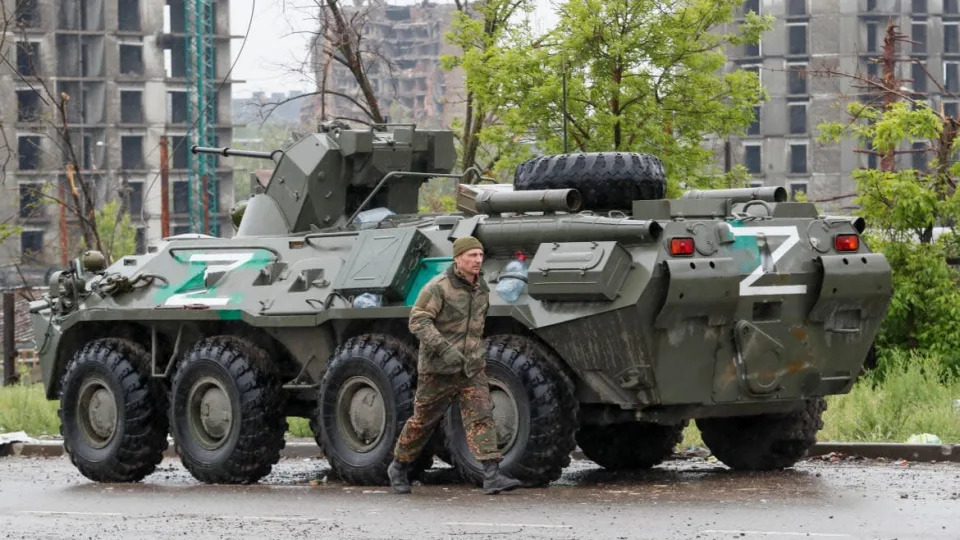
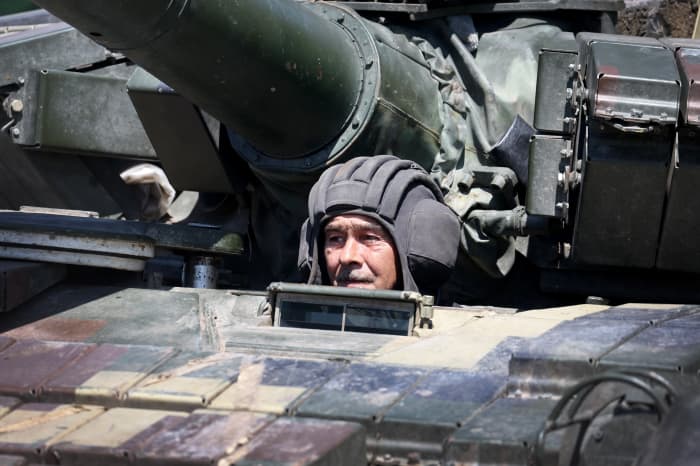
Over the course of the past 24 hours, Ukrainian assault and bomber jets have destroyed a Russian company-tactical group, and have inflicted losses on Russian military equipment and personnel.
Source: Air Force Command of the Armed Forces of Ukraine on Facebook
Details: On Tuesday, 14 June, Ukrainian Su-25 and Su-24 planes conducted several airstrikes on Russian positions, destroying a Russian company-tactical group and inflicting losses on the occupiers’ military equipment and personnel.
Also on 14 June, anti-aircraft missile units of the Air Force of the Armed Forces of Ukraine destroyed four cruise missiles that Russian forces had launched on Ukraine from the waters of the Black Sea.
Ukrainian anti-aircraft missile units also struck down two Russian unmanned aerial vehicles.
Ukrainian fighter jets are continuing to patrol Ukrainian airspace and are conducting operations to intercept Russian air targets, and to provide cover to the operations of assault and bomber aircraft of the Ukrainian Air Force.
Putin still wants a ‘significant portion’ of Ukraine or even the whole country, but Russia won’t be able to do it: Pentagon official
Natalie Musumeci and John Haltiwanger – June 15, 2022
Russian President Vladimir Putin at the Vostochny Cosmodrome in Amur Region, Russia, on April 12, 2022.Sputnik/Evgeny Biyatov/Kremlin via Reuters
Vladimir Putin likely still wants to take much or all of Ukraine, but won’t be able to, a US official said.
“I do not think he can achieve those objectives,” said Under Secretary of Defense for Policy Colin Kahl.
The “Ukrainians are holding tough” against Russia’s unprovoked invasion of the country, said Kahl.
Russian President Vladimir Putin likely still wants to control a “significant portion” of Ukraine or even capture the entire eastern European country — but he likely won’t succeed in that mission, according to a top Pentagon official.
“I still think he has designs on a significant portion of Ukraine, if not the whole country,” US Under Secretary of Defense for Policy Colin Kahl said on Tuesday, Reuters reported.
Kahl, while speaking at the Center for a New American Security’s National Security Conference, added, “That said, I do not think he can achieve those objectives,” according to the news outlet.
The US official said that Russian forces “may make tactical gains here and there” in the Kremlin’s months-long unprovoked war against Ukraine, but that the “Ukrainians are holding tough.”
“I do not think the Russians have the capacity to achieve those grandiose objectives,” Kahl explained.
“I think he envisioned some kind of a thunder run to Kyiv that would change the regime,” said Kahl, adding, “The Russians were badly defeated in the battle of Kyiv. They’ve also been pushed out of Kharkiv.”
Kahl said that the Russians have been making incremental gains in the south and east of Ukraine, but that the Ukrainians have remained “stalwart defenders.”
The UK’s Ministry of Defense said Wednesday that “it is highly unlikely that Russia anticipated such robust opposition or such slow, attritional conflict during its original planning for the invasion.”
Steven Pifer, who was US ambassador to Ukraine from 1998 to 2000, told Insider that Putin has made it clear that “he sees his mission as the recovery of Russian lands,” alluding to the Russian leader’s recent comparison of himself to Peter the Great. If Russia is able to conquer Ukraine’s eastern Donbas region, where the heaviest fighting is occurring at present and Russian forces are gradually making gains, “he might return to that objective” and “try to go for Kyiv and such.”
“Whether everybody in Moscow shares that ambition is a very different question. But then you also have to ask — does the Russian military have the wherewithal to make that kind of offensive operation?” Pifer said, adding, “There are a lot of Russian soldiers who are not particularly thrilled that they’re fighting in Ukraine. The Ukrainians are getting battered and may have some morale issues. But I think most Ukrainians still think that this is an existential fight and that if they lose their democracy is gone and their vision of what Ukraine would be as an independent state.”
Russia’s invasion of Ukraine entered its 112th day on Wednesday — and since the war began on February 24, thousands have been killed on both sides.
‘Moment of reckoning:’ Federal official warns of Colorado River water supply cuts
Ben Adler, Senior Editor – June 15, 2022
The Colorado River’s reservoirs have diminished to the point that significant cuts to the water supplied to the seven states that rely on it will be necessary next year, a federal official warned Tuesday.
Bureau of Reclamation Commissioner Camille Calimlim Touton told the Senate Energy and Natural Resources Committee maintaining “critical levels” at the largest reservoirs in the United States — Lake Mead and Lake Powell — will require large reductions in water deliveries.
“A warmer, drier West is what we are seeing today,” she said at a hearing. “And the challenges we are seeing today are unlike anything we have seen in our history.”
The relatively arid desert Southwest is viewed at 33,000 feet on May 19 near Moab, Utah. The Colorado River, flowing from Colorado’s Rocky Mountain through Utah, Arizona, Nevada and California is dependent on winter snowfall in the Rockies. (George Rose/Getty Images)
Colorado, New Mexico, Utah, Wyoming, Arizona, California, and Nevada all receive water from the Colorado River and next year will see a decrease of between 2 million and 4 million acre-feet of water due to the ongoing drought that has gripped most of the Western U.S. (An acre-foot is the amount of water needed to cover one acre of land in one-foot-deep water.) Current allotments of water from the Colorado range from 300,000 acre-feet for Nevada to 4.4 million acre-feet for California.
“What has been a slow-motion train wreck for 20 years is accelerating, and the moment of reckoning is near,” John Entsminger, general manager of the Southern Nevada Water Authority, told the Senate hearing. “We are 150 feet from 25 million Americans losing access to the Colorado River, and the rate of decline is accelerating.”
The West has been suffering through an acute drought since 2020, part of a megadrought that began in 2000. The last 20 years have been the driest two decades in the last 1,200 years. This year is so far the driest on record in California. Scientists attribute these conditions to climate change, which causes more water evaporation due to warmer temperatures.
“As a climate scientist, I’ve watched how climate change is making drought conditions increasingly worse — particularly in the western and central U.S.,” wrote Imtiaz Rangwala, research scientist in climate at the Cooperative Institute for Research in Environmental Sciences at the University of Colorado Boulder, in May. “The last two years have been more than 2 degrees Fahrenheit (1.1 Celsius) warmer than normal in these regions. Large swaths of the Southwest have been even hotter, with temperatures more than 3 F (1.7 C) higher.”
A thick white ring shows the dramatic decline of water levels at Lake Mead, the nation’s largest reservoir, which has reached its lowest water levels on record since it was created by damming the Colorado River in the 1930s, as growing demand for water and climate change shrink the Colorado River and endanger a water source millions of Americans depend on, near Boulder City, Nevada, April 16. (Caitlin Ochs/Reuters)
Western states have already been undertaking emergency measures to deal with the water scarcity. Seven months ago, California, Arizona and Nevada signed an agreement to take less water from Lake Mead, and six weeks ago the Department of Interior announced it is withholding some water from Lake Powell. Otherwise, DOI feared, the reservoir could drop so low that Glen Canyon Dam would not be able to generate electricity.
Last year, for the first time ever, the federal government declared a shortage on the river, which led to reductions in water deliveries to Arizona and Nevada. Some farmers in Arizona have had to leave some fields unplanted as a result.
Local governments and water utilities have been imposing restrictions on water usage. On June 1, the Metropolitan Water District of Southern California instituted limits on outdoor watering; typically it will be restricted to one or two days per week. But the water shortage persists.
“Despite those efforts and a previous deal among the states to share in the shortages, the two reservoirs stand at or near record-low levels,” the Los Angeles Times reported. “Lake Mead near Las Vegas has dropped to 28% of its full capacity, while Lake Powell on the Utah-Arizona border is now just 27% full.”
A formerly sunken boat rests on a now-dry section of lakebed at the drought-stricken Lake Mead on May 10, 2022 in the Lake Mead National Recreation Area, Nevada. (Mario Tama/Getty Images)
Touton told the Senate committee that her agency is negotiating with the seven states that depend on the Colorado River to develop a plan for apportioning the water supply reductions in the next two months. In all, nearly 40 million people rely on water from the river.
Sen. Martin Heinrich, D-N.M., attributed the gathering crisis to a lack of coordinated action to mitigate climate change.
“It’s frankly a direct result of the lack of action on climate that we have seen for more than 20 years,” Heinrich said.
US military veterans training Ukrainian frontline troops say NATO’s artillery and rocket launchers are essential for Ukraine to beat Russia
Cheryl Teh – June 15, 2022
Ukrainian soldiers man a howitzer during artillery drills in northeastern Ukraine’s Kharkiv Region.Vyacheslav Madiyevskyy/ Ukrinform/Future Publishing via Getty Images US military veterans training Ukrainian frontline troops say NATO’s artillery and rocket launchers are essential for Ukraine to beat Russia
US military veterans training Ukrainian soldiers said Ukraine needs NATO weapons to beat Russia.
They said Ukrainian forces might be overwhelmed without more modern, long-range weaponry.
“It’s a bit of a slugfest,” Martin Wetterauer, a Marine veteran, said of the war.
A group of US military veterans currently training Ukrainian soldiers said Ukraine needs more NATO weapons to win its war with Russia.
Officers in the Mozart Group told Newsweek that modern, long-range artillery would help Ukrainian forces fend off the Russian offensive.
“It’s a bit of a slugfest,” Martin Wetterauer, a Marine veteran and the Mozart Group’s chief operations officer, told Newsweek from the organization’s outpost in Zaporizhzhia.
Wetterauer told the outlet that the Ukrainians were under heavy fire from Russian artillery and said that NATO’s artillery systems and aircraft would be essential to help eliminate Russian defense lines in the Donbas region.
Steve K., an operations manager in the group who declined to give Newsweek his full name, agreed with Wetterauer and highlighted the US-made Multiple Launch Rocket System and the High Mobility Artillery Rocket System as being vital tools for the Ukrainian war effort.
“They need the artillery, they need rounds,” Steve K. told the outlet. “If we do not continue with that supply, they won’t be able to hold them back.”
Per Newsweek, Wetterauer added that the Ukrainians do not underestimate the Russians’ capabilities and expressed confidence in their chances of winning if they received the right equipment.
“If we can increase their skill set, then ultimately over time hopefully they’ll get better and more advanced weapon systems,” Wetterauer said, per the outlet. “With the fighting spirit that they have, there’s no doubt they will turn this war. It’s just going to take a while.”
More than 15,000 millionaires expected to leave Russia in 2022
Rupert Neate, Wealth correspondent –June 13, 2022
Photograph: Karim Sahib/AFP/Getty Images
More than 15,000 millionaires are expected to flee Russia this year, as wealthy citizens turn their back on Vladmir Putin’s regime after the invasion of Ukraine, according to an analysis of migration data.
About 15% of Russians with more than $1m (£820,000) in ready assets are expected to have emigrated to other countries by the end of 2022, according to projects based on migration data by Henley & Partners, a London-based firm that acts as matchmaker between the super-rich and countries selling their citizenships.
“Russia [is] haemorrhaging millionaires,” said Andrew Amoils, the head of research at New World Wealth, which compiled the data for Henley. “Affluent individuals have been emigrating from Russia in steadily rising numbers every year over the past decade, an early warning sign of the current problems the country is facing. Historically, major country collapses have usually been preceded by an acceleration in emigration of wealthy people, who are often the first to leave as they have the means to do so.”
Ukraine is projected to suffer the greatest loss of high net worth individuals (HNWIs) as a proportion of its population, with 2,800 millionaires (or 42% of all HNWIs in Ukraine) expected to have left the country by the end of the year.
The world’s wealthy have traditionally relocated to the US and the UK but Henley said the United Arab Emirates is expected to overtake them as the No 1 destination for millionaire emigrants. “UK has lost its wealth hub crown, and the US is fading fast as a magnet for the world’s wealthy, with the UAE expected to overtake it by attracting the largest net inflows of millionaires globally in 2022,” Henley said in its report, which is based on “systematically tracking international private wealth migration trends”.
About 4,000 HNWIs are expected to have moved to the UAE by the end of the year, ahead of Australia, which is expected to attract about 3,500, Singapore (2,800) and Israel (2,500).
Large numbers of millionaires are also expected to move to “the three Ms”: Malta, Mauritius and Monaco.
“Malta has been one of Europe’s great success stories of the past decade, not just in terms of millionaire migration but also in terms of overall wealth growth,” Amoils said. “It is currently one of the world’s fastest-growing markets, with US dollar wealth growth of 87% between 2011 and 2021. Its citizenship by naturalisation process has brought substantial new wealth to the island nation and has been credited with propelling Malta’s strong growth in multiple sectors including financial services, IT and real estate. Approximately 300 millionaires are expected to move to Malta in 2022.”
The Guardian reported last year that many wealthy people buying “golden passports” to Malta (and thereby the EU) often planned to spend little time in the country. At the time, Henley said it was “proud of the service that it has provided to Malta and its people”.
The Indian Ocean island nation Mauritius is described by Henley as a “wealth magnet” because of the creation of an international financial centre offering significant tax breaks. The country has no capital gains tax, no inheritance tax, and maximum tax rate of 3% of global companies.
According to the Africa Wealth Report 2022, Mauritius is now home to 4,800 HNWIs compared with 2,700 a decade ago. Approximately 150 millionaires are expected to move to Mauritius in 2022, mainly from South Africa and Europe.
Monaco has long attracted the world’s super-rich because it does not charge income tax, capital gains tax or property tax. Just under seven in 10 people living in Monaco are dollar millionaires.
The UK’s HNWI population is expected to decline by 1,500, taking the number of people with more than $1m in ready assets to 738,000. There are currently just over 15 million HNWIs in the world.
Russian Troops Sabotage Their Own Missile System to Sell as Scrap Metal, Says Ukrainian Intel
Allison Quinn – June 14, 2022
Reuters
Ukrainian authorities say they have uncovered an alleged new scheme from fed-up Russian troops angling to get out of the war: They’re apparently now sabotaging their own weapons and trying to sell the parts as scrap metal.
That’s according to the Main Intelligence Directorate of Ukraine’s Defense Ministry, which on Tuesday named and shamed the Russian forces they say failed spectacularly in a recent attempt to sell off parts of Russian missile systems in the Donetsk region.
“In order to avoid going to the frontline, the commanders of a squadron from the 933rd anti-aircraft missile regiment… decided to make their equipment unfit for active service,” the agency said in a statement. The troops “removed the control units from Tor-M2U [missile systems] and decided to sell them at a collection point for precious metals.”
The plan is said to have backfired when the troops demanded a higher payoff for the goods, prompting the local workers at the scrap metal point to alert law enforcement of the so-called Donetsk People’s Republic.
Ukrainian intelligence says the damaged Russian equipment was ultimately blamed on active fighting rather than sabotage, with the entrepreneurial troops sent back to the frontline despite their best efforts. They were identified as members of the 933rd Anti-Aircraft Missile Regiment of the 150th Motorized Rifle Division, part of the 8th Guards Combined Arms Army of the Southern Military District.
The intelligence arm of the Ukrainian Defense Ministry did not disclose how it learned of the apparent sabotage scheme. But the report adds to a long list of increasingly creative attempts by Russian troops to abandon the fight, from fake marriage to self-injury.
In response to the rock-bottom morale among troops, there have been reports of the Russian military sending in FSB officers and high-ranking brass to keep tabs on disloyal troops.
In audio of what Ukrainian intelligence described as an intercepted call released Tuesday, a man identified as a Russian soldier can be heard complaining to his wife about his struggles to bring those under his command in line.
After she tells him she heard about Ukrainian forces edging out Russian soldiers in several areas, the man responds that “it doesn’t matter” to him.
“My own fucking mules are driving me batshit crazy,” he said, before going on to tell her the situation with morale is worse than “critical” among his men.
“Well fucking shoot one of them demonstratively, and the others will maybe shut up,” she said.
The Western and Southwestern states are particularly parched — nearly three-quarters of the Western region is in a state of severe to exceptional drought.
“There are a lot of downstream effects when it comes to a drought like this,” Andrew Hoell, a co-lead on the NOAA Drought Task Force, told Yahoo Finance.
Hoell explained that drought isn’t just a matter of precipitation but can be exacerbated by the evaporative effects of higher temperatures and inadequate snowpack runoff in the winter.
“By the time it’s summertime,” he said, “that vegetation is really dry. And if you get a spark, and you get a series of unfortunate events in that regard, you then have wildfires. So when it comes to drought in the West, there are just a variety and a spectrum of effects that you can feel later on whether it’s water resources and fires and reduced agricultural yields. The effects are numerous.”
NOAA
Depleted water reservoirs and wildfire damage are already taking a toll on residents and businesses. The Hermits Peak Fire, which continues to blaze in New Mexico, has already scorched around 315,830 acres.
Meanwhile, states like California have instituted severe water restrictions, though water consumption has continued to rise. On an even grimmer note, low water levels at Lake Mead have threatened hydropower plants and exposed bodies once submerged in the reservoirs.
While conditions may ease slightly as the region enters its summer monsoon season, the outlook remains dry as the region navigates a historic, multi-decade megadrought.
A number of states including California, Colorado, New Mexico, Utah, Arizona, and tribal nations like the Navajo Nation have all declared drought states of emergency and allocated resources for managing the water crisis.
Nick Messing pull a kayaks down to the waters edge at Wahweap Marina at Lake Powell on April 6, 2022 in Page, Arizona when water levels at Lake Powell were at a historic low. (Photo by RJ Sangosti/MediaNews Group/The Denver Post via Getty Images)
Population growth
Since 2000, droughts have cost the U.S. around $160.8 billion, according to the NOAA. That figure jumps to $272 billion when accounting for destructive wildfires that are more prone in arid conditions.
With water already becoming more scarce, the increasing population in the West — and therefore demand for water — has inflamed the situation.
An Economic Innovation Group report using county-level population data found that the trend of people moving to water-starved states has only accelerated during the pandemic.
Inland California, the Mountain West, and eastern Texas saw the greatest growth, and overall, 10 of the top 15 counties for population growth were in the Western U.S: Maricopa County, Arizona (Phoenix), was ranked first, followed by Collin County, Texas, and Riverside County, California.
A graph showing the projected rise in population in drought-prone areas. (EIG)
“The map of these demographic shifts shows some familiar pre-pandemic trends and some new patterns,” the author stated. “Overall, the Sunbelt and the Mountain West continued to outshine the rest of the country. Remote rural counties in eastern Oregon and northern Idaho experienced robust population growth while every single county in Nevada gained population.”
Another EIG study found that an additional 20 million residents could move to drought-stricken counties by 2040. Water managers are already balancing razor-thin water budgets at current population levels.
“With reservoirs at record low levels throughout the West and the effects of sustained drought conditions increasingly being felt from agriculture to development, one of the most far-reaching questions in the United States over the coming decades is whether growth trends will ultimately collide with nature’s ability to sustain such a large influx of people,” Daniel Newman, the report’s author, wrote.
Fire and water
Doling out water supplies isn’t the only issue residents have to contend with.
Suburban neighborhoods sprawling out into more rural areas are creating a more substantial wild-urban interface at the same time as the wildfire season creeps earlier and longer.
In the last month, two Colorado Springs neighborhoods were evacuated due to fires, as were the owners of coastal California mansions caught in a blaze. For those unfortunate enough to sustain damage from fires, it can leave lasting financial scars in addition to physical and emotional ones.
The damage to a neighborhood is shown after a wind-driven wildfire burned through a canyon and into their neighborhood in Laguna Niguel, California, June 1, 2022. REUTERS/Mike Blake
“Most people in the Western United States are very underinsured because they base the amount of insurance coverage on the average cost to rebuild” despite higher property costs in some regions like Lake Tahoe, California, Christina Restaino of the University of Nevada Cooperative Extension said in a webinar.
According to Restaino, the current water crisis “underscores the need to prepare communities for wildfire, because when these large emergency incidents occur what we end up having to do is use a ton of water in an already water-scarce environment to suppress wildfires.”
There are some steps residents in high-risk areas can take to protect themselves, however.
“The No. 1 thing that people can do is to create a 5-foot ember-resistant zone around their house, so you don’t want to have anything combustible within five feet around your house,” she said. “Second-easiest thing, I would say, is to screen all of your vents.”
Of equal importance, “be prepared to evacuate,” Restaino stressed. “If you have medications that you take or important things you cannot leave home without, make sure you have backups of all those in an evacuation go-bag.”
A sign indicating extreme fire danger is pictured at Storrie Lake State Park as the Hermits Peak and Calf Canyon wildfires burn near Las Vegas, New Mexico, May 2, 2022. REUTERS/Kevin Mohatt
While the current period of intense drought may ease in months or years as it has in previous years, rising temperatures due to climate change mean that many will have to get used to living with these risks.
“If I had to guess — and if there is a silver lining here — if we’re to look at the next 10 years, will they necessarily be as bad as the last 10 years in terms of precipitation?” Hoell said. “I would say probably not.”
He added that the primary problem “is the climate has not shown any indication of warming temperatures slowing down. That right there is a problem in and of itself because it changes the amount of snow that you get during the wintertime, changes the amount of snow that then makes its way into reservoirs, thereby replenishing them. So we have these different factors that kind of commingled to bring together this hydrologic situation that is not ideal for us right now.”
Yellowstone floods wipe out roads, bridges, strand visitors
Amy Beth Hanson – June 13, 2022
HELENA, Mont. (AP) — Massive floodwaters ravaged Yellowstone National Park and nearby communities Monday, washing out roads and bridges, cutting off electricity and forcing visitors to evacuate parts of the iconic park at the height of summer tourist season.
All entrances to Yellowstone were closed due to the deluge, caused by heavy rains and melting snowpack, while park officials ushered tourists out of the most affected areas. There were no immediate reports of injuries.
Some of the worst damage happened in the northern part of the park and Yellowstone’s gateway communities in southern Montana. National Park Service photos of northern Yellowstone showed a landslide, a bridge washed out over a creek, and roads badly undercut by churning floodwaters of the Gardner and Lamar rivers.
There were no immediate reports of injuries, though dozens of stranded campers had to be rescued by raft in south-central Montana.
The flooding cut off road access to Gardiner, Montana, a town of about 900 people near the confluence of the Yellowstone and Gardner rivers, just outside Yellowstone’s busy North Entrance.
At a cabin in Gardiner, Parker Manning of Terra Haute, Indiana, got an up-close view of the water rising and the river bank sloughing off in the raging Yellowstone River floodwaters just outside his door.
“We started seeing entire trees floating down the river, debris,” Manning told The Associated Press. “Saw one crazy single kayaker coming down through, which was kind of insane.”
The Yellowstone River at Corwin Springs crested at 13.88 feet (4.2 meters) Monday, higher than the previous record of 11.5 feet (3.5 meters) set in 1918, according the the National Weather Service.
Floodwaters inundated a street in Red Lodge, a Montana town of 2,100 that’s a popular jumping-off point for a scenic, winding route into the Yellowstone high country. Twenty-five miles (40 kilometers) to the northeast, in Joliet, Kristan Apodaca wiped away tears as she stood across the street from a washed-out bridge, The Billings Gazette reported.
The log cabin that belonged to her grandmother, who died in March, flooded, as did the park where Apodaca’s husband proposed.
“I am sixth-generation. This is our home,” she said. “That bridge I literally drove yesterday. My mom drove it at 3 a.m. before it was washed out.”
Yellowstone officials were evacuating the northern part of the park, where roads may remain impassable for a substantial length of time, park Superintendent Cam Sholly said in a statement.
But the flooding affected the rest of the park, too, with park officials warning of yet higher flooding and potential problems with water supplies and wastewater systems at developed areas.
“We will not know timing of the park’s reopening until flood waters subside and we’re able to assess the damage throughout the park,” Sholly said in the statement.
The park’s gates will be closed at least through Wednesday, officials said. It is unclear how many visitors have been forced to leave the park.
The rains hit right as summer tourist season was ramping up. June, at the onset of an annual wave of over 3 million visitors that doesn’t abate until fall, is one of Yellowstone’s busiest months.
Remnants of winter — in the form of snow still melting off and rushing off the mountains — made for an especially bad time to get heavy rain.
Yellowstone got 2.5 inches (6 centimeters) of rain Saturday, Sunday and into Monday. The Beartooth Mountains northeast of Yellowstone got as much as 4 inches (10 centimeters), according to the National Weather Service.
“It’s a lot of rain, but the flooding wouldn’t have been anything like this if we didn’t have so much snow,” said Cory Mottice, meteorologist with the National Weather Service in Billings, Montana. “This is flooding that we’ve just never seen in our lifetimes before.”
The rain will likely abate while cooler temperatures lessen snowmelt in coming days, Mottice said.
In south-central Montana, flooding on the Stillwater River stranded 68 people at a campground. Stillwater County Emergency Services agencies and crews with the Stillwater Mine rescued people Monday from the Woodbine Campground by raft. Some roads in the area are closed due to flooding and residents have been evacuated.
“We will be assessing the loss of homes and structures when the waters recede,” the sheriff’s office said in a statement.
The flooding happened while other parts of the U.S. burned in hot and dry weather. More than 100 million Americans were being warned to stay indoors as a heat wave settles over states stretching through parts of the Gulf Coast to the Great Lakes and east to the Carolinas.
Scientists say climate change is responsible for more intense and more frequent extreme events such as storms, droughts, floods and wildfires, though single weather events usually cannot be directly linked to climate change without extensive study.
Associated Press writers Thomas Peipert in Denver and Mead Gruver in Fort Collins, Colorado, contributed to this report.
The Russian invasion of Ukraine accounts for more than a third of U.S. inflation, forecaster says
Steve Goldstein – June 13, 2022
A soldier maneuvers his tank on June 08, 2022 near Sloviansk, Ukraine. In recent weeks, Russia has concentrated its firepower on Ukraine’s Donbas region, where it has long backed two separatist regions at war with the Ukrainian government since 2014. SCOTT OLSON/GETTY IMAGES
The Russian invasion of Ukraine and the sanctions that it triggered is behind more than a third of the 40-year high inflation of 8.6%, according to analysis from a leading forecaster.
Mark Zandi, chief economist at Moody’s Analytics, says after decomposing the numbers, the Russian invasion represented 3.5% year-over-year growth, mostly through the direct of higher commodity prices. But, he added on a podcast by the firm that higher diesel prices causes food prices to be higher, and it’s also bleeding into things like airfares.
The COVID-19 pandemic, he said, represented 2% year-over-year growth, mostly through supply chains.
“The bulk of the supply chain constraint component on CPI is new and used vehicles, but it also includes bedding, furniture, children’s apparel, things that are really affected by the supply chains,” added Ryan Sweet, senior director at Moody’s Analytics.
The lack of affordable housing is further responsible for 0.6% year-over-year price growth, according to Moody’s calculations.
He said the American Rescue Plan, the stimulus plan that President Biden signed into law, had a negligible impact.
In all, Zandi says the typical American household is paying $460 per month more to buy the same goods and services that they would have at the same time last year.
Cris DeRitis, deputy chief economist, said the inflation readings may not have peaked. “But as we get past the summer, past the summer driving season, I think then you might to see some of that moderation,” he said. “It’s just a matter of time.”
Russia’s Oil Revenue Soars Despite Sanctions, Study Finds
Hiroko Tabuchi – June 13, 2022
Yang Mei Hu oil products tanker owned by COSCO Shipping gets moored at the crude oil terminal Kozmino on the shore of Nakhodka Bay near the port city of Nakhodka, Russia June 13, 2022. REUTERS/Tatiana Meel (Tatiana Meel / reuters)
Russia’s invasion of Ukraine triggered global condemnation and tough sanctions aimed at denting Moscow’s war chest. Yet Russia’s revenues from fossil fuels, by far its biggest export, soared to records in the first 100 days of its war on Ukraine, driven by a windfall from oil sales amid surging prices, a new analysis shows.
Russia earned what is very likely a record 93 billion euros in revenue from exports of oil, gas and coal in the first 100 days of the country’s invasion of Ukraine, according to data analyzed by the Center for Research on Energy and Clean Air, a research organization based in Helsinki. About two-thirds of those earnings, the equivalent of about $97 billion, came from oil, and most of the remainder from natural gas.
“The current rate of revenue is unprecedented, because prices are unprecedented, and export volumes are close to their highest levels on record,” said Lauri Myllyvirta, an analyst who led the center’s research.
Fossil fuel exports have been a key enabler of Russia’s military buildup. In 2021, revenue from oil and gas alone made up 45% of Russia’s federal budget, according to the International Energy Agency. The revenue from Russia’s fossil fuel exports exceeds what the country is spending on its war in Ukraine, the research center estimated, a sobering finding as momentum shifts in Russia’s favor as its forces focus on important regional targets amid a weapons shortage among Ukrainian soldiers.
Ukrainian officials again called on countries and firms to halt their trade with Russia completely.
“We’re asking the world to do everything possible in order to cut off Putin and his war machine from all possible financing, but it’s taking much too long,” Oleg Ustenko, an economic adviser to President Volodymyr Zelenskyy of Ukraine, said from Kyiv about President Vladimir Putin of Russia.
Ukraine has also been tracking Russia’s exports, and Ustenko described the research center’s numbers as seeming on the conservative side. Still, the underlying finding was the same, he said: Fossil fuels continue to fund Russia’s war.
“You can stop importing Russian caviar and Russian vodka, and that’s good, but definitely not enough. You need to stop importing Russian oil,” he said.
Though Russia’s fossil fuel exports have started to fall somewhat by volume, as more countries and companies shun trading with Moscow, surging prices have more than canceled out the effects of that decline. The research found Russia’s export prices for fossil fuels have been on average around 60% higher than last year, even accounting for the fact that Russian oil is fetching about 30% below international market prices.
Europe, particularly, has struggled to wean itself from Russian energy, even as many countries send military aid to Ukraine. The European Union made most progress on reducing its imports of natural gas from Russia, buying 23% less in the first 100 days of the invasion than the same period the previous year. Still, income at Gazprom, Russia’s state-owned gas giant, remained about twice as high as the year before, thanks to higher gas prices, the Center for Research on Energy and Clean Air found.
The EU also reduced its imports of Russian crude oil, which declined 18% in May. But that dip was made up by India and the United Arab Emirates, leading to no net change in Russia’s oil export volumes, the research showed. India has become a significant importer of Russian crude oil, buying 18% of the country’s exports over the 100-day period.
The United States has made a dent in Russia’s earnings, banning all Russian fossil fuel imports. Still, the United States is importing refined oil products from countries like the Netherlands and India that most likely contain Russian crude, a loophole for oil from Russia to make its way to the U.S.
Overall, China was the largest importer of Russian fossil fuels over the 100-day period, edging out Germany, Italy and the Netherlands. China imported the most oil; Japan was the top purchaser of Russian coal.
Stricter bans are coming. Late last month, the EU agreed to an embargo that will cover roughly three-quarters of Russian oil shipped to the region, though that will not be enforced for six months. Britain has said it will also phase out imports of Russian oil by year’s end. But Hungary, the Czech Republic and Slovakia, which receive Russian oil via pipelines, remain exempt. European and U.S.-owned ships also continue to transport Russian oil.
Europe is also speeding up its transition away from fossil fuels altogether. A new EU target aims to increase the region’s share of electricity from renewable forms of energy to 63% by 2030, up from a previous expected target of 55%.
U.S. Treasury Secretary Janet Yellen said last week that Washington was in talks with its European allies about forming a cartel that would set a cap on the price of Russian oil roughly equal to the price of production. That would trim Russia’s fossil fuel revenues while also keeping Russian oil flowing to global markets, stabilizing prices and fending off a global recession, she told the Senate Finance Committee.
Ustenko said he would welcome such a move as a temporary measure until full embargoes can be imposed. He also suggested that countries should take the difference between global prices and the capped price on Russian oil and pay it into a fund to aid Ukrainian reconstruction.
“Then we’ll be able to cut off Russians from much of their financing, and almost immediately,” he said.