14 Russian-owned luxury yachts were seized by Dutch authorities — 12 of them are still being built

Business Insider

14 Russian-owned luxury yachts were seized by Dutch authorities — 12 of them are still being built

Kate Duffy – April 6, 2022

Dry dock shipyard Port of Rotterdam, Netherlands.Geography Photos/Universal Images Group via Getty Images
14 Russian-owned luxury yachts were seized by Dutch authorities — 12 of them are still being built
  • 14 yachts were seized by Dutch authorities, the Netherlands’ government said on Wednesday.
  • 12 of the yachts were still being built, while two are undergoing maintenance, a minister said.
  • The vessels can’t be delivered, transferred or exported under sanctions, he added.

A total of 14 yachts were seized by Dutch customs authorities as part of sanctions against Russia, the government of the Netherlands said on Wednesday, Agence-France Presse (AFP) first reported.

Of the 14 vessels, 12 were still under construction across five shipyards in the Netherlands for Russian beneficiaries, foreign minister Wopke Hoekstra said in a 10-page letter to the Dutch parliament, translated into English by AFP.

The other two yachts were undergoing maintenance, the government said, per AFP.

“Given the current measures, these vessels cannot be delivered, transferred or exported for the moment,” Hoekstra said in the letter, cited in AFP.

The letter didn’t disclose who owns the yachts and said that authorities were investigating the matter further. The shipyards were made aware of the status of the yachts, Hoekstra added.

Hoekstra said in the letter that the people linked to the yachts weren’t on the EU sanctions lists but the government was looking into the possibility of one yacht having connections with a Russian oligarch who has been sanctioned by the union, AFP reported.

The government of the Netherlands didn’t immediately respond to Insider’s request for comment made outside of normal working hours.

No superyachts are anchored in the Netherlands but they are being built there, Hoekstra said in the letter.

Major ship manufacturers, such as Heesen and Oceanco, which have built superyachts owned by Russian oligarchs, come from the Netherlands. For example, the $120 million superyacht owned by Igor Sechin which was seized in France last month was made by Oceanco.

Heesen built the Galactica Super Nova owned by Vagit Alekperov, which lost tracking signals after leaving a port in Montenegro.

Hoekstra also said in the letter that the Netherlands had so far frozen 516 million euros in assets and 155 million euros in transactions.

Related: Robb Report

The Netherlands Stops 12 Superyachts From Leaving Its Shipyards—in Case They’re Owned by Russian Oligarchs

Michael Verdon – April 6, 2022

Officials in the Netherlands have decided to detain superyachts being built for wealthy Russians until they can verify the owners. Foreign Minister Wopke Hoekstra wrote in a letter to the Dutch parliament that the dozen yachts under construction—and two others that are being refitted—will not be allowed to leave the yards until it’s established that the owners are not on EU, UK and US sanctions lists.

“The situation is, at the moment, that in five yards there are 12 yachts under construction for so-called Russian ultimate beneficial owners,” Hoekstra wrote in the letter. “Because of the current export measures, these vessels should not be delivered.”

Today’s decision follows the seizure on Monday of a 254-foot yacht in Spain at the behest of the US government. The vessel, named Tango, is reportedly owned by Viktor Vekselberg, a close ally of Russian President Vladimir Putin.

Sailing Yacht A was one of the first yachts to be seized in Italy on March 13. - Credit: Courtesy CC BY-SA 4.0
Sailing Yacht A was one of the first yachts to be seized in Italy on March 13. – Credit: Courtesy CC BY-SA 4.0

Other oligarch-owned yachts have been seized in the UK, France and Italy. They include the 192-foot Phi, detained by UK authorities just hours before it was to leave London.

The $75-million superyacht Axioma was seized by authorities in Gibraltar. According to Reuters, the 236-foot yacht is owned by Dmitry Pumpyansky, chairman of TMK, Russia’s largest steel and pipe manufacturer. Pumpyansky was added to both the UK and EU sanctions lists earlier this month. On March 17, the 443-foot Crescent was prevented from leaving Spain. A police source told Reuters that Crescent is linked to Igor Sechin, the chief executive of Rosneft, Russia’s oil giant. A second yacht linked to Sechin, the Amore Vero, was seized earlier that month in France.

In the Netherlands, halting the construction of a dozen superyachts could have a significant impact on the maritime sector. Shipyards such as Feadship, Heesen, Damen Shipyards and Oceanco had combined sales of about $1.66 billion in 2020, according to Reuters.
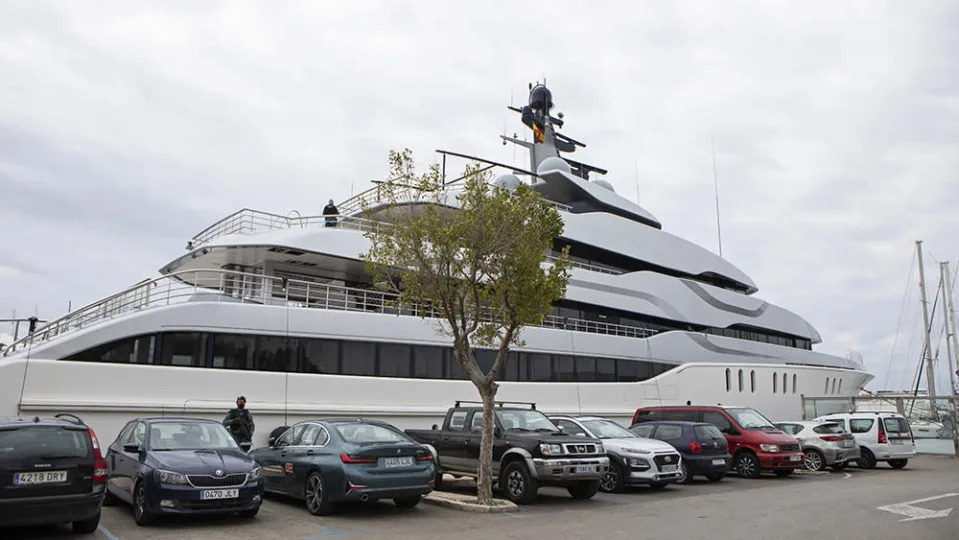
On Monday, the 254-foot yacht Tango was detained in Spain. - Credit: Courtesy Francisco Ubilla
On Monday, the 254-foot yacht Tango was detained in Spain. – Credit: Courtesy Francisco Ubilla

The Financieele Dagblad estimates that about $85 billion in Russian assets are based in the Netherlands, and about $50 billion of that belongs to Russians on the sanctions list. Superyacht experts have told Robb Report that about 10 percent of yachts over 100 feet currently under build, representing about 30 new builds, have Russian owners.

Dutch authorities did not name the 12 yachts or the five shipyards. Of the two yachts in the country for maintenance, one is thought to be owned by a Russian on the sanctions list.

Related: HuffPost

U.S. Seizes Oligarch’s $90 Million Yacht Amid Russian Sanctions

Mary Papenfuss – April 5, 2022

American authorities, working with Spanish officials, seized an oligarch’s yacht Monday amid sanctions against Russia’s elite over the Ukraine invasion.

“Today marks our task force’s first seizure of an asset belonging to a sanctioned individual with close ties to the Russian regime. It will not be the last,” Attorney General Merrick Garland said.

At the request of U.S. authorities, Spanish officials took possession of a 255-foot yacht known as the Tango in the port of Palma de Mallorca. It’s estimated to be worth at least $90 million.

The yacht is owned by Ukraine-born billionaire Viktor Vekselberg, who has close ties to Russian President Vladimir Putin and heads the Renova Group, a Russian conglomerate with interests in minerals, mining and tech, among several other sectors. Vekselberg, who once had homes in New York and Connecticut, was also questioned in the investigation into Russian interference in the 2016 American presidential election.
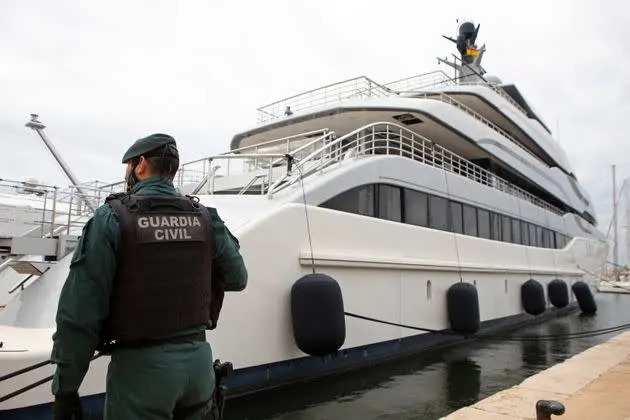
A Civil Guard stands by the yacht called the Tango in Palma de Mallorca, Spain on Monday. (Photo: Francisco Ubilla via Associated Press)

A Civil Guard stands by the yacht called the Tango in Palma de Mallorca, Spain on Monday. (Photo: Francisco Ubilla via Associated Press)

Justice Department officials obtained a warrant for the confiscation after arguing that the yacht should be forfeited for violating sanctions statutes. It’s the first U.S. seizure of an oligarch’s yacht since Garland and Treasury Secretary Janet Yellen created the Russian Elites, Proxies and Oligarchs task force to enforce sanctions over the Ukraine invasion.

“Together, with our international partners, we will do everything possible to hold accountable any individual whose criminal acts enable the Russian government to continue its unjust war,” Garland said.

Bucha killings: Man ‘survived executions by playing dead after being shot’

Yahoo! News

Bucha killings: Man ‘survived executions by playing dead after being shot’

Kate Buck – April 6, 2022

Ukraine releases video of weapons it says were left in Bucha

A man has revealed how he survived a shooting in the Ukrainian town of Bucha by playing dead after being shot.

The town just outside of Kyiv has become the scene for alleged war crimes, leading Boris Johnson to release a video message in Russian saying: “They are a stain on the honour of Russia itself.”

Russia has refuted claims of mass killings since the town was freed from their control on 31 March, with Russian foreign minister Sergei Lavrov claiming footage and images of bodies in the streets were “staged” and Ukrainians had used “fake dead bodies”.

However, satellite imagery of the area in the days before Bucha was freed shows at least nine bodies lying in the street for weeks, contradicting Russian claims.

Survivors are now telling their stories of life under Russian control, as they come to terms with what they saw.

Soldiers walk amid destroyed Russian tanks in Bucha, on the outskirts of Kyiv, Ukraine, Sunday, April 3, 2022. (AP Photo/Rodrigo Abd)
Soldiers walk amid destroyed Russian tanks in Bucha, on the outskirts of Kyiv. (AP)

One man, Vanya Skyba, was among eight men who came under Russian fire at a checkpoint on 5 March, before trying to take shelter in a nearby basement.

He told the Economist when they were found later that evening, they were asked if they were soldiers or had ever fought in Donbas.

“We said no, we were builders,” Skyba said.

“But they moved us to a base on Yablonska street 144. They made us take our clothes off, lie face down, and then they searched our telephones and bodies for symbols and tattoos.”

He said that to make an example and make the other men talk, one of the men was killed.

The brutal move worked, and one of the men admitted he was a part of Ukraine’s territorial defence.

For hours, Skyba said he and the rest of the men were beaten and tortured in an ordeal that only ended when an order was given to kill them.

Ukrainian President Volodymyr Zelenskyy examines the site of a recent battle in Bucha, close to Kyiv, Ukraine, Monday, Apr. 4, 2022. Russia is facing a fresh wave of condemnation after evidence emerged of what appeared to be deliberate killings of civilians in Ukraine. (AP Photo/Efrem Lukatsky)
Ukrainian president Volodymyr Zelenskyy examines the site of a recent battle in Bucha. (AP)
Un perro se pasea entre los restos de casas y vehículos militares rusos, el lunes 4 de abril de 2022, en Bucha, cerca de Kiev, Ucrania. (AP Foto/Efrem Lukatsky)
The town just outside of Kyiv has become the scene for alleged war crimes. (AP)

Skyba told the Economist he had only survived the shooting because he played dead after the bullet went through his side.

The accents and appearance of the Russian soldiers led to Skyba assuming they were from Buryatia, in eastern Siberia.

The order to kill was given by a man who had a standard Russian accent, Skyba said.

He added: “The Buryatis asked what they should do with us. The Russian answered that they should ‘yebashit’ us [‘f***ing do them in’]—but to do it away from the base.”

Skyba said the remaining men were taken the side of the building and shot, but he only survived after the bullet passed through his side.

He fell to the concrete floor and played dead, only fleeing to a nearby home when he could hear the soldiers were gone.

A Ukrainian soldier walks with children passing destroyed cars due to the war against Russia, in Bucha, on the outskirts of Kyiv, Ukraine, Monday, April 4, 2022. (AP Photo/Rodrigo Abd)
A Ukrainian soldier walks with children after the town was liberated. (AP)
Tanya Nedashkivs'ka, de 57 años, llora la muerte de su marido, asesinado en Bucha, en las afueras de Kiev, Ucrania, el lunes 4 de abril de 2022. (AP Foto/Rodrigo Abd)
Ukrainian foreign minister Dmytro Kuleba said on Monday the evidence of civilian killings from the town of Bucha are just the ‘tip of the iceberg’. (AP)

Another unit of Russian soldiers found him later, but believed his cover story that he owned the home and led him to a bomb shelter in the cellar of the same building where he had been shot.

Skyba stayed there for a few days with women and children before he was able to flee to Kyiv when humanitarian corridors opened.

Ukrainian foreign minister Dmytro Kuleba said on Monday the evidence of civilian killings from the town of Bucha are just the “tip of the iceberg” and show the need for tougher sanctions on Moscow.

Ukrainian authorities said on Sunday they were investigating possible war crimes by Russia after images from Bucha showed the bodies of civilians lying on the ground and makeshift graves.

“The horrors that we’ve seen in Bucha are just the tip of the iceberg of all the crimes (that) have been committed by the Russian Army,” Kuleba said at a press conference alongside UK foreign secretary Liz Truss.

“Half measures are not enough anymore. I demand most severe sanctions this week, this is the plea of the victims of the rapes and killings. If you have doubts about sanctions go to Bucha first.”

Russia’s failure to take down Kyiv was a defeat for the ages

Associated Press

Russia’s failure to take down Kyiv was a defeat for the ages

Robert Burns – April 5, 2022

FILE - Ukrainian soldiers celebrate at a check point in Bucha, in the outskirts of Kyiv, Ukraine, April 3, 2022. Kyiv was a Russian defeat for the ages. It started poorly for the invaders and went downhill from there. (AP Photo/Rodrigo Abd, File)
Ukrainian soldiers celebrate at a check point in Bucha, in the outskirts of Kyiv, Ukraine, April 3, 2022. Kyiv was a Russian defeat for the ages. It started poorly for the invaders and went downhill from there. (AP Photo/Rodrigo Abd, File)
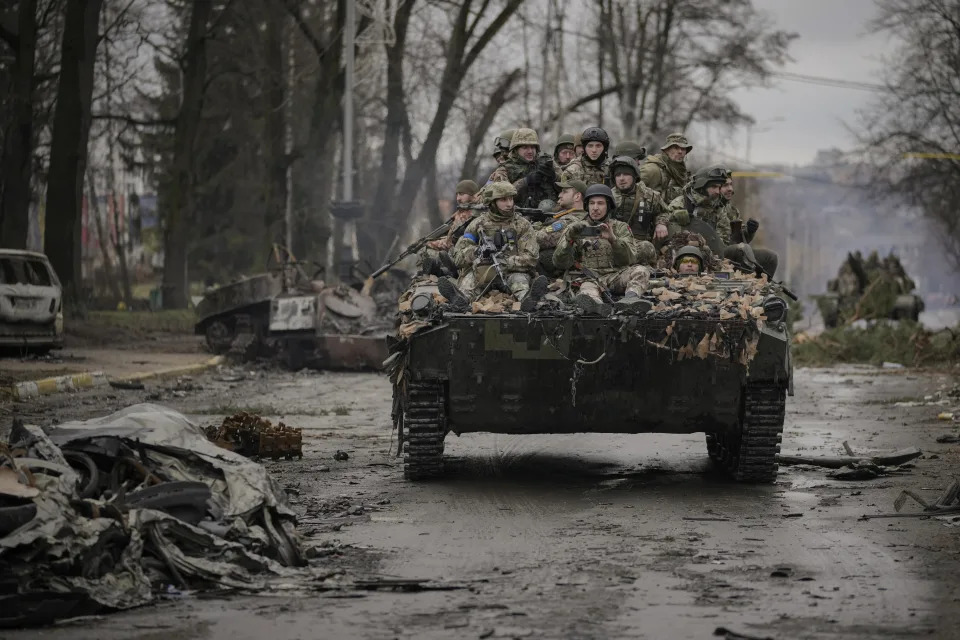
FILE - Ukrainian servicemen ride on a fighting vehicle outside Kyiv, Ukraine, April 2, 2022. Kyiv was a Russian defeat for the ages. It started poorly for the invaders and went downhill from there. (AP Photo/Vadim Ghirda, File)
Ukrainian servicemen ride on a fighting vehicle outside Kyiv, Ukraine, April 2, 2022. Kyiv was a Russian defeat for the ages. It started poorly for the invaders and went downhill from there. (AP Photo/Vadim Ghirda, File)
FILE - This photo shows a view of the city of Kyiv, Ukraine, Thursday, Feb. 24, 2022. Kyiv was a Russian defeat for the ages. It started poorly for the invaders and went downhill from there. (AP Photo/Emilio Morenatti, File)
This photo shows a view of the city of Kyiv, Ukraine, Thursday, Feb. 24, 2022. Kyiv was a Russian defeat for the ages. It started poorly for the invaders and went downhill from there. (AP Photo/Emilio Morenatti, File)
FILE - Soldiers walk amid destroyed Russian tanks in Bucha, on the outskirts of Kyiv, Ukraine, April 3, 2022. Kyiv was a Russian defeat for the ages. It started poorly for the invaders and went downhill from there. (AP Photo/Rodrigo Abd, File)
Soldiers walk amid destroyed Russian tanks in Bucha, on the outskirts of Kyiv, Ukraine, April 3, 2022. Kyiv was a Russian defeat for the ages. It started poorly for the invaders and went downhill from there. (AP Photo/Rodrigo Abd, File)

WASHINGTON (AP) — Kyiv was a Russian defeat for the ages. The fight started poorly for the invaders and went downhill from there.

When President Vladimir Putin launched his war on Feb. 24 after months of buildup on Ukraine’s borders, he sent hundreds of helicopter-borne commandos — the best of the best of Russia’s “spetsnaz” special forces soldiers — to assault and seize a lightly defended airfield on Kyiv’s doorstep.

Other Russian forces struck elsewhere across Ukraine, including toward the eastern city of Kharkiv as well as in the contested Donbas region and along the Black Sea coast. But as the seat of national power, Kyiv was the main prize. Thus the thrust by elite airborne forces in the war’s opening hours.

But Putin failed to achieve his goal of quickly crushing Ukraine’s outgunned and outnumbered army. The Russians were ill-prepared for Ukrainian resistance, proved incapable of adjusting to setbacks, failed to effectively combine air and land operations, misjudged Ukraine’s ability to defend its skies, and bungled basic military functions like planning and executing the movement of supplies.

“That’s a really bad combination if you want to conquer a country,” said Peter Mansoor, a retired Army colonel and professor of military history at Ohio State University.

For now at least, Putin’s forces have shifted away from Kyiv, to eastern Ukraine. Ultimately, the Russian leader may achieve some of his objectives. Yet his failure to seize Kyiv will be long remembered — for how it defied prewar expectations and exposed surprising weaknesses in a military thought to be one of the strongest in the world.

“It’s stunning,” said military historian Frederick Kagan of the Institute for the Study of War, who says he knows of no parallel to a major military power like Russia invading a country at the time of its choosing and failing so utterly.

On the first morning of the war, Russian Mi-8 assault helicopters soared south toward Kyiv on a mission to attack Hostomel airfield on the northwest outskirts of the capital. By capturing the airfield, also known as Antonov airport, the Russians planned to establish a base from which to fly in more troops and light armored vehicles within striking distance of the heart of the nation’s largest city.

It didn’t work that way. Several Russian helicopters were reported to be hit by missiles even before they got to Hostomel, and once settled in at the airfield they suffered heavy losses from artillery fire.

An effort to take control of a military airbase in Vasylkiv south of Kyiv also met stiff resistance and reportedly saw several Russian Il-76 heavy-lift transport planes carrying paratroopers downed by Ukrainian defenses.

Although the Russians eventually managed to control Hostomel airfield, the Ukrainians’ fierce resistance in the capital region forced a rethinking of an invasion plan that was based on an expectation the Ukrainians would quickly fold, the West would dither, and Russian forces would have an easy fight.

Air assault missions behind enemy lines, like the one executed at Hostomel, are risky and difficult, as the U.S. Army showed on March 24, 2003, when it sent more than 30 Apache attack helicopters into Iraq from Kuwait to strike an Iraqi Republican Guard division. On their way, the Apaches encountered small arms and anti-aircraft fire that downed one of the helos, damaged others and forced the mission to be aborted. Even so, the U.S. military recovered from that setback and soon captured Baghdad.

The fact that the Hostomel assault by the Russian 45th Guards Special Purpose Airborne Brigade faltered might not stand out in retrospect if the broader Russian effort had improved from that point. But it did not.

The Russians did make small and unsuccessful probes into the heart of Kyiv, and later they tried at great cost to encircle the capital by arcing farther west. Against enormous odds, the Ukrainians held their ground and fought back, stalling the Russians, and put to effective use a wide array of Western arms, including Javelin portable anti-tank weapons, shoulder-fired Stinger anti-aircraft missiles and much more.

Last week the Russians abandoned Hostomel airfield as part of a wholesale retreat into Belarus and Russia.

A sidelight of the battle for Kyiv was the widely reported saga of a Russian resupply convoy that stretched dozens of miles along a main roadway toward the capital. It initially seemed to be a worrisome sign for the Ukrainians, but they managed to attack elements of the convoy, which had limited off-road capability and thus eventually dispersed or otherwise became a non-factor in the fight.

“They never really provided a resupply of any value to Russian forces that were assembling around Kyiv, never really came to their aid,” said Pentagon spokesman John Kirby. “The Ukrainians put a stop to that convoy pretty quickly by being very nimble, knocking out bridges, hitting lead vehicles and stopping their movement.”

Mansoor says the Russians underestimated the number of troops they would need and showed “an astonishing inability” to perform basic military functions. They vastly misjudged what it would take to win the battle for Kyiv, he says.

“This was going to be hard even if the Russian army had proven itself to be competent,” he said. “It’s proven itself to be wholly incapable of conducting modern armored warfare.”

Putin was not the only one surprised by his army’s initial failures. U.S. and other Western officials had figured that if the invasion happened, Russia’s seemingly superior forces would slice through Ukraine’s army like a hot knife through butter. They might seize Kyiv in a few days and the whole country in a few weeks, although some analysts did question whether Putin appreciated how much Ukraine’s forces had gained from Western training that intensified after Putin’s 2014 seizure of Crimea and incursion into the Donbas.

On March 25, barely a month after the invasion began, the Russians declared they had achieved their goals in the Kyiv region and would shift focus to the separatist Donbas area in eastern Ukraine. Some suspected a Putin ploy to buy time without giving up his maximalist aims, but within days the Kyiv retreat was in full view.

Putin may yet manage to refocus his war effort on a narrower goal of expanding Russian control in the Donbas and perhaps securing a land corridor from the Donbas to the Crimean Peninsula. But his failure in Kyiv revealed weaknesses that suggest Russia is unlikely to try again soon to take down the national capital.

“I think they learned their lesson,” said Mansoor.

Putin is staking his political future on victory in Ukraine – and has little incentive to make peace

The Conversation

Putin is staking his political future on victory in Ukraine – and has little incentive to make peace

Monica Duffy Toft – April 5, 2022

Monica Duffy Toft: Professor of International Politics and Director of the Center for Strategic Studies at The Fletcher School of Law and Diplomacy, Tufts University.

<span class="caption">Peace talks with Russian President Vladimir Putin won't be easy.</span> <span class="attribution"><a class=
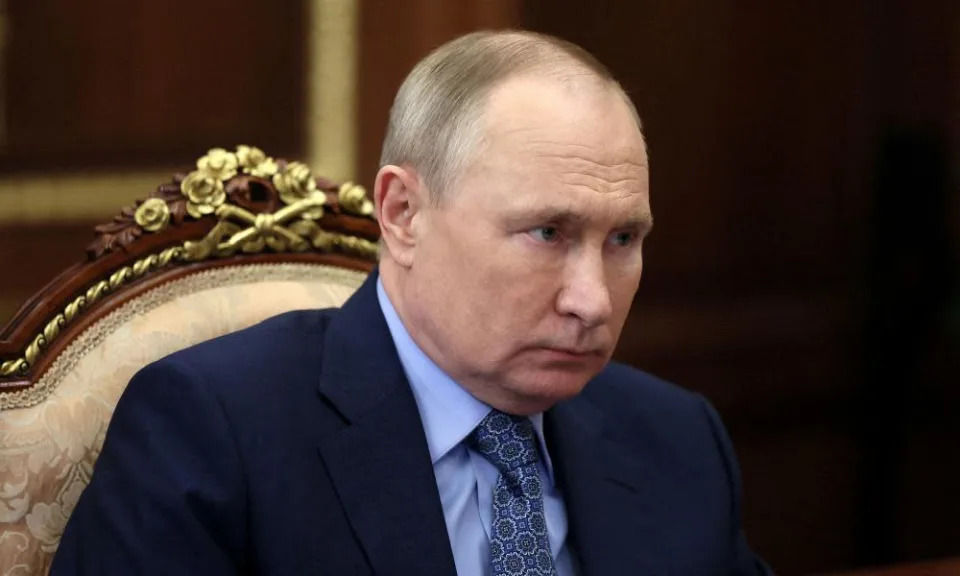
Peace talks with Russian President Vladimir Putin won’t be easy. 
Mikhail Klimentyev/SputnikAFP via Getty Images

Despite stop-and-start peace talks, a resolution to the brutal war in Ukraine appears distant.

Major cities in Ukraine are faltering. Civilians, including children, are dying of shrapnel and glass wounds, exposure and thirst.

At the same time, Ukraine’s resilience and a coordinated global response means the war is not ending as many expected before it began – with Russia’s swift victory.

As a scholar who has studied Soviet and post-Soviet politics for the past three decades, I see three big obstacles to any movement toward resolution.

Obstacles to peace

First, Putin seems to believe that the net benefits of his war in Ukraine will outweigh the costs. He recently moderated his aims once it became clear that his military was struggling to capture Kharkiv, Kyiv and other regional capitals, but he is still in the fight – which means he still thinks he has something to win.

Second, given the intelligence reports that he may have received faulty information, he might be hesitant to negotiate until he is confident that he actually knows what is going on.

Lastly, he seems to believe profoundly that NATO’s and the European Union’s potential acceptance of Ukraine as a member constitutes an existential threat to his tenure and his legacy.

In other words, as the rest of the world insists that Putin’s war in Ukraine is an act of aggression under international law, Putin continues to frame his “special military operation” as a legitimate defensive war – both in the sense of great power politics against growing Western influence and to protect the rights of Russians and Russian speakers in Ukraine’s Donbas region.

Putin and company feel the aggrieved party in this conflict and present it in this way to the Russian population.

Moreover, Putin seems to have domestic support on his side. A recent Levada poll shows that his approval rating has shot up from 71% in February to 83% since the invasion of Ukraine. What this means is that Putin may have time on his side so long as he can control the news and narrative about the war.

Will sanctions bite?

The West is relying on sanctions to force Putin to the negotiating table.

But sanctions take time to hurt. Given that its civilians are dying of thirst, exposure and malnutrition every day, time is a luxury Ukraine doesn’t have.

Sanctions are also indiscriminate. They affect leaders but also innocent civilians. And the harm lingers even after the target gives in, reinforcing the narrative that Russia is the victim here, being targeted by the West.

What’s more, Russia has powerful incentives to dig in and continue to fight.

First, the information war currently being waged in Ukraine, Russia and across the world now is just as critical to an acceptable long-term resolution as the physical war. War is many things, including a performance judged by a worldwide audience. If Russians learn the truth, Putin’s leadership could come into question just as Soviet leader Mikhail Gorbachev’s did after the withdrawal of Soviet troops from Afghanistan in 1989.

Putin’s actions suggest he is aware how important his control of information is to winning the war. This is why he has closed down independent mediafrightened off foreign journalists and restricted what Russians can read and see. His government has long prepared ordinary Russians for the outrage of foreigners and hurtful sanctions. So even in the absence of complete control of the narrative, this likely makes Russians skeptical of leaks that suggest Russia is conducting an illegal war in an illegal manner.

It’s true that Putin’s efforts to control the narrative will be difficult to maintain indefinitely. Images of burned-out residential apartment buildings, civilian casualities and refugees fleeing their homes are now seen globally every day. Moreover, as the Russian military continues to see increasing numbers of its members killed, the mothers and fathers, wives and husbands, daughters and sons of the fallen soldiers will demand to know whether their loved ones serving in Ukraine are safe.

The critical question now becomes whether Putin can finish his 20-year project to return Russia to a totalitarian past, with him as leader, or if the war will lead to his political demise.

At the heart of this all is not how Putin interacts with the West but his relationship with Russians. Outsiders tend to judge Putin and his motives by how his actions affect us. For him, his domestic audience is more important. In other words, so long as he can win the information war in Russia, his tenure and immense wealth will remain secure. How the West sees him is not a key concern.

Power of authoritarian rule

Putin has already been in power longer than any of his contemporary U.S. and NATO rivals. He is likely to stay in power by rigging elections and suppressing his opposition.

But in democracies, leaders change. With a change in leadership may come changes of policies more favorable to Putin. In two years, the United States, for example, may have a new president. Putin only has to hang on until January 2025 in the hope of more favorable treatment.

Throughout his two-decade tenure as Russia’s head of state, Putin has tied his personal leadership with Russia’s fate. I believe that means he is unlikely to accept a peace that doesn’t involve a guarantee of Russia’s right to intervene in the sovereign affairs of Ukraine. Settling for anything less than reconstituting Soviet “spheres of influence” would mean he would feel a loss of status on the international stage and likely lose considerable popularity at home, especially in light of the costs that Russian citizens have already paid and will likely to pay in the future.

But is this a price the West is willing to pay to avoid an expanding war in Europe?

This article is republished from The Conversation, a nonprofit news site dedicated to sharing ideas from academic experts. It was written by: Monica Duffy ToftTufts University.

Russia’s Latest Atrocity Unleashed Nitric Acid Cloud That Could Blind Ukrainians

Daily Beast

Russia’s Latest Atrocity Unleashed Nitric Acid Cloud That Could Blind Ukrainians

Allison Quinn – April 5, 2022

via Facebook
via Facebook

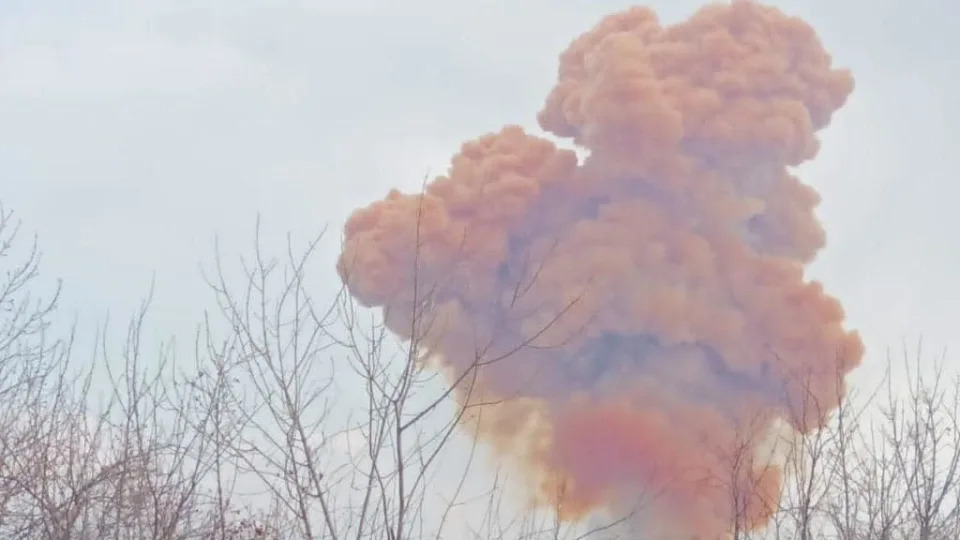
Russian forces on Tuesday reportedly struck a tank of nitric acid in Ukraine’s Luhansk region, sparking panicked warnings for residents to protect their faces and remain indoors.

Serhiy Gaidai, the head of the Luhansk regional administration, issued a video address warning residents the toxic fumes can cause “severe damage.”

“Prepare protective face masks soaked in soda solution. When applied locally to the eyes, nitric acid causes severe damage with extensive necrosis of the cornea and conjunctiva, leading to loss of vision,” he said, urging those living near Rubizhne to remain indoors and seal up their windows.

“This chemical is very toxic and we don’t know where the toxic cloud will go. We will be monitoring the air and waiting for rain,” he said.

The alarming warning came as Ukrainian President Volodymyr Zelensky prepared to address the United Nations Security Council on mounting evidence of Russian war crimes against Ukraine.

In comments to Ukrainian media, Zelensky vowed that Ukrainian authorities would create an “internal mechanism” to track down the Russian soldiers accused of committing war crimes against Ukrainian civilians, much like Israel’s Mossad hunted down Nazi fugitives across the globe.

“We will definitely deal with this,” he said, adding that “lists will be compiled” of all those Russians accused of executing and torturing Ukrainian civilians. “There are people who really want to find these criminals,” he said.

“Prosecutors of various nations will deal with all of these crimes… They see a great deal of evidence. And, unfortunately, the evidence will only keep coming—there will not be any less. There is still Izyum ahead, and many places where there is still no access [for Ukrainian authorities]—the occupied Melitopol, Berdyansk—we have no idea what happened there,” he said.

His comments came as the scale of Russian atrocities in the town of Bucha, a Kyiv suburb, left the world reeling, with hundreds of innocent residents found slain in the streets, some with signs of torture. Newly released satellite footage from the now-liberated town showed that the bodies of slaughtered civilians had littered the streets for weeks before Ukrainian forces reclaimed the territory from Russia, debunking Moscow’s shameless claim that Putin’s troops didn’t kill “a single civilian” there and that it must have been Ukrainian forces.

Russia’s Defense Ministry has claimed the executions were “staged” by Ukrainian psy-ops specialists, a claim that was echoed in a full-blown propaganda campaign on Russian state TV that said Western intelligence services were behind the killings.

In the face of those Russian denials on Tuesday, Ukrainian media released aerial video that purportedly captures Russian troops in Bucha firing directly at a man who was simply riding past them on a bicycle.

Ukrainian journalist Dmytro Komarov also shared footage from Bucha showing the aftermath of Russia’s attacks on Ukrainian evacuees. He said at least three vehicles of civilians were found shot up along an evacuation route, including a bus with a young couple inside and a vehicle where an elderly couple were slain.

Zelensky: Russia ‘will try to hide the traces of their crimes’

Yahoo! News

Zelensky: Russia ‘will try to hide the traces of their crimes’

Niamh Cavanagh, Producer – April 5, 2022

Ukrainian President Volodymyr Zelensky accused the Russian military of plotting to cover up the mass killing of his country’s civilians in a bid to “distort the facts.”

Speaking in an emotional address to the nation in the early hours of Tuesday morning, Zelensky warned that Kremlin-led forces were attempting to hide the atrocities that were committed in the areas still occupied by Moscow. His speech comes days after hundreds of Ukrainian civilians were reportedly found dead in Kyiv suburbs like Bucha in the aftermath of the recent withdrawal of Russian troops in the region.

In his 10-minute speech, Zelensky accused Russia of using the same propaganda tactics it used when a Malaysia Airlines passenger flight was shot down in 2014 over eastern Ukraine. An independent Dutch investigation found that Russian-backed rebels downed the plane with a surface-to-air missile, killing 298 people. Russia blamed the Ukrainian government for the tragedy.

Ukrainian President Volodymyr Zelensky.
Ukrainian President Volodymyr Zelensky speaks from Kyiv on Monday. (Ukrainian Presidential Press Office via AP)

“They used the same tactics when the occupiers shot down a Malaysian Boeing over Donbas,” Zelensky said. “They blamed Ukraine. They even came up with various conspiracy theories. They even went so far as to claim that the corpses were ‘thrown’ on board the plane before it crashed.”

Zelensky made his comments undoubtedly aware that the Russian government is already promoting implausible theories to explain the images and video of bodies littering the streets of Bucha. The Russian Defense Ministry suggested that some of the dead civilians were actually actors pretending to be dead, claiming that the video shows the bodies still moving. Independent media fact checkers and satellite images contradict Russia’s claims; the many journalists documenting the aftermath of the killings also undermine Russia’s case.

Ukrainian servicemen carry a dead body on a stretcher.
Ukrainian servicemen carry a dead body found in a basement in the city of Bucha, Ukraine, on Monday. (Marko Djurica/Reuters)

“We must also be aware that after the revealed mass killings of civilians in the Kyiv region, the occupiers may have a different attitude to their crimes in another part of our country where they came,” Zelensky said. “They are already launching a false campaign to conceal their guilt in the mass killings of civilians in Mariupol. They will do dozens of stage interviews, reedited recordings, and will kill people specifically to make it look like they were killed by someone else.”

He added: “Probably now the occupiers will try to hide the traces of their crimes. They did not do this in Bucha when they retreated. But in another area it is possible.”

Last week, the head of the U.N. Human Rights Monitoring Mission in Ukraine told Reuters that thousands of civilians may have died in the besieged port city of Mariupol since the Russian invasion began on Feb. 24. The estimate includes around 210 children. Russian forces have blockaded the city, which has spent weeks without access to food, water or electricity, and it may be some time before the full extent of the devastation there is known.

Ukrainian Foreign Minister Dmytro Kuleba tweeted on Monday that he had spoken to U.N. Secretary-General António Guterres and told him that Ukraine would “collect evidence and hold Russian war criminals to account.”

President Biden said Monday that Russian President Vladimir Putin should face a war crimes investigation for the deaths in Bucha.

Zelensky is due to address the U.N. Security Council on Tuesday. His office said he “will give all the evidence” to the international community.

Ukrainian President Volodymyr Zelensky walks with soldiers.
Zelensky, center, walks through Bucha on Monday. (Ronaldo Schemidy/AFP via Getty Images)

Czech Republic sends tanks, infantry fighting vehicles to Ukraine – source

Reuters

Czech Republic sends tanks, infantry fighting vehicles to Ukraine – source

April 5, 2022

PRAGUE (Reuters) -The Czech Republic has sent T-72 tanks and BVP-1 infantry fighting vehicles to Ukraine, a Czech defence source told Reuters on Tuesday, confirming a local media report.

Public broadcaster Czech Television initially reported the shipment, showing footage on Twitter of a train loaded with five tanks and five fighting vehicles. It said the shipment was a gift agreed with NATO allies.

The broadcaster said the information was confirmed by the head of the Czech lower house’s European Affairs Committee Ondrej Benesik, who told Reuters he received the information from his Christian Democrat Party’s expert on defence.

The source, from the Czech defense community, also confirmed that the tanks and fighting vehicles had been sent but declined to give any further details, citing security concerns.

Defence Minister Jana Cernochova told parliament she would not confirm or deny details of Czech aid to Ukraine.

“I will only assure you that the Czech Republic … is helping Ukraine as much as it can and will continue to help by (supplying) military equipment, both light and heavy,” Cernochova said.

A spokesperson for the Defence Ministry said the Czech Republic had sent military aid worth nearly 1 billion crowns ($45 million) to Ukraine since the beginning of the war on Feb. 24 but declined to give any further details.

The Czech vehicles are only the latest example of military equipment coming from the West. Germany on April 1 approved the delivery to Ukraine of several dozen infantry fighting vehicles (IFVs) amid criticism that Berlin has not been sending enough military aid to Kyiv.

NATO allies will discuss the delivery of more weapons to Ukraine when foreign ministers meet on Wednesday and Thursday, NATO Secretary-General Jens Stoltenberg said.

($1 = 22.1960 Czech crowns)

(Reporting by Robert Muller and Jan Lopatka; Editing by David Goodman and David Holmes)

Could Vladimir Putin be prosecuted for war crimes?

The Guardian

Explainer: could Vladimir Putin be prosecuted for war crimes?

David Smith in Washington – April 4, 2022

<span>Photograph: Sputnik/Reuters</span>
Photograph: Sputnik/Reuters

Joe Biden has called for the prosecution of Vladimir Putin for war crimes after the discovery in Bucha, Ukraine, of mass graves and bodies of bound civilians shot at close range. But bringing the Russian president to trial would be far from simple.

What are war crimes?

The international criminal court (ICC), the world’s first permanent war crimes tribunal, defines them as “grave breaches” of the Geneva Conventions, a set of humanitarian laws to be observed in war.

Jonathan Hafetz, an international criminal law and national security scholar at Seton Hall University School of Law, told the Reuters news agency that the execution of civilians as alleged in Bucha was a “quintessential war crime”.

Russia continues to deny culpability. Its defence ministry insisted on Sunday that “not a single civilian has faced any violent action by the Russian military”.

How can a case pointing to war crimes be built?

Jake Sullivan, the US national security adviser, told reporters on Monday that there were four main sources of evidence: information gathered by the US and its allies including from intelligence sources; Ukraine’s own efforts on the ground to develop the case and document forensics from the killings; material from international organisations including the UN and NGOs; and findings by global independent media with photos, interviews and documentation.

Related: ‘Leave no stone unturned’: how investigators gather evidence of war crimes in Ukraine

Can Putin be held personally responsible for his troops’ actions?

The prosecution could argue that Putin and his inner circle committed a war crime by directly ordering an illegal attack or knew crimes were being committed and failed to prevent them. This case may be hard to prove in isolation but if it fits a wider pattern across Ukraine, it becomes more compelling. The US had accused Russia of war crimes even before Bucha.

Philippe Sands, a professor at University College London, told the Associated Press: “You’ve got to prove that they knew or they could have known or should have known. There’s a real risk you end up with trials of mid-level people in three years and the main people responsible for this horror – Putin, Lavrov, the minister of defence, the intelligence folks, the military folks and the financiers who are supporting it – will get off the hook.”

Who would run such a trial?

The ICC opened 20 years ago to prosecute the perpetrators of genocide and crimes against humanity. But the US, China, Russia and Ukraine are not members of the court, which has been criticised for focusing too heavily on Africa and applying “selective justice”.

The ICC’s chief prosecutor, Karim Khan, said in February he had opened a war crimes investigation in response to Russia’s invasion of Ukraine. Although it is not a signatory, Ukraine previously approved an investigation dating back to 2013, which includes Russia’s annexation of Crimea.

The ICC will issue arrest warrants if prosecutors can show “reasonable grounds” to believe war crimes were committed. But there is little chance that Russia would comply and the ICC cannot try someone in absentia. The US’s unwillingness to join the court is also diplomatically awkward and likely to prompt cries of western hypocrisy.

Donald Trump once told the UN general assembly: “As far as America is concerned, the ICC has no jurisdiction, no legitimacy, and no authority.” His administration announced that the US would impose visa bans on ICC officials involved in the court’s potential investigation of Americans for alleged crimes in Afghanistan.

But Sullivan said on Monday: “The US has in the past been able to collaborate with the international criminal court in other contexts despite not being a signatory. But there’s a variety of reasons one might consider alternative venues as well.”

What are these “alternative venues”?

The UN seems an obvious starting point. But one problem with going through the UN security council is that Russia is a permanent member. “It would be difficult to imagine that they would not attempt to exercise their veto to block something,” Sullivan observed.

Related: ‘It’s a slam dunk’: Philippe Sands on the case against Putin for the crime of aggression

Another option might be a special tribunal organised by a group of countries. The Nuremberg tribunal was established by the US, Britain, France and the Soviet Union to hold Nazi leaders to account after the second world war.

Potential models for Ukraine could include the tribunals set up to prosecute war crimes committed during the Balkan wars in the early 1990s and the 1994 Rwanda genocide. Another example was the UN-backed special court for Sierra Leone, established in 2002 to bring to justice those responsible for atrocities perpetrated during the country’s country’s civil war in 1996.

What about a different charge?

It would be easier to prosecute Putin for the crime of aggression after he waged an unprovoked war against another sovereign country. The ICC does not have jurisdiction over Russia for the crime of aggression because Russia is not a signatory.

Last month dozens of prominent lawyers and politicians, including the Ukrainian foreign minister, Dmytro Kuleba, and the former British prime minister Gordon Brown, launched a campaign to create a special tribunal to try Russia for the crime of aggression in Ukraine.

How long would a prosecution take?

Probably many years. The international criminal tribunal for the former Yugoslavia indicted its first head of state, the then Yugoslav president, Slobodan Milošević, in 1999 and took him into custody in 2001. His trial began in 2002 and was under way when he died at the Hague in 2006.

Charles Taylor, the former president of Liberia, was found guilty of aiding and abetting war crimes and crimes against humanity for supporting rebels who carried out atrocities after four years of hearings at the special court for Sierra Leone in the Hague.

‘Nobody negotiated with Hitler,’ Polish PM says, berating France’s Macron over Putin talks

Reuters

‘Nobody negotiated with Hitler,’ Polish PM says, berating France’s Macron over Putin talks

April 4, 2022

FILE PHOTO: U.S. President Biden visits Poland

WARSAW (Reuters) – Poland on Monday berated French President Emmanuel Macron for negotiating with Russian leader Vladimir Putin, saying “nobody negotiated with Hitler”, amid an international outcry over killings of civilians during Russia’s invasion of Ukraine.

Ukraine on Sunday accused Russian forces of carrying out a “massacre” in Bucha and Western leaders reacted with outrage to images of bodies strewn across the streets of the town. Russia denies Ukraine’s accusation.

Poland has on many occasions called for harsher sanctions on Russia and supply more arms to Ukraine. It has also called for an international tribunal to investigate killings of civilians in Ukraine.

“Mr. President Macron, how many times have you negotiated with Putin, what have you achieved? Have you stopped any of the actions that have taken place?” Polish Prime Minister Mateusz Morawiecki said at a press conference on Monday.

“One should not negotiate with criminals, one should fight them…Nobody negotiated with Hitler. Would you negotiate with Hitler, Stalin, Pol Pot?” he added.

Macron’s office said in a response that it is important for President Putin to understand the demands of Western countries and the cost for Russia of disregarding them.

“From the onset, the president has used all available means to make Putin stop the war: massive sanctions, support to Ukraine, demands made directly to President Putin during their calls,” a French presidential official said.

Macron has spared no effort to mediate between Putin and Ukrainian President Volodymyr Zelenskiy, travelling to Moscow and Kyiv in early February and speaking to Putin 16 times since the start of the year in telephone conversations the Elysée says have been confrontational but offered an opportunity to keep a communication channel open and gauge Putin’s state of mind.

Elysée officials have in the past offered scathing readouts of the calls, saying Putin has appeared “paranoid” in these calls, has lied to the French leader and that Macron told him he made a serious mistake in invading Ukraine on Feb. 24.

Russia sent its forces into Ukraine on what Putin called a “special military operation” to demilitarise and “denazify” the country. Ukraine and the West say Putin launched an unprovoked war of aggression.

(Reporting by Pawel Florkiewicz in Warsaw and Michel Rose in Paris; Writing by Anna Koper and Michel Rose; Editing by Mark Heinrich)

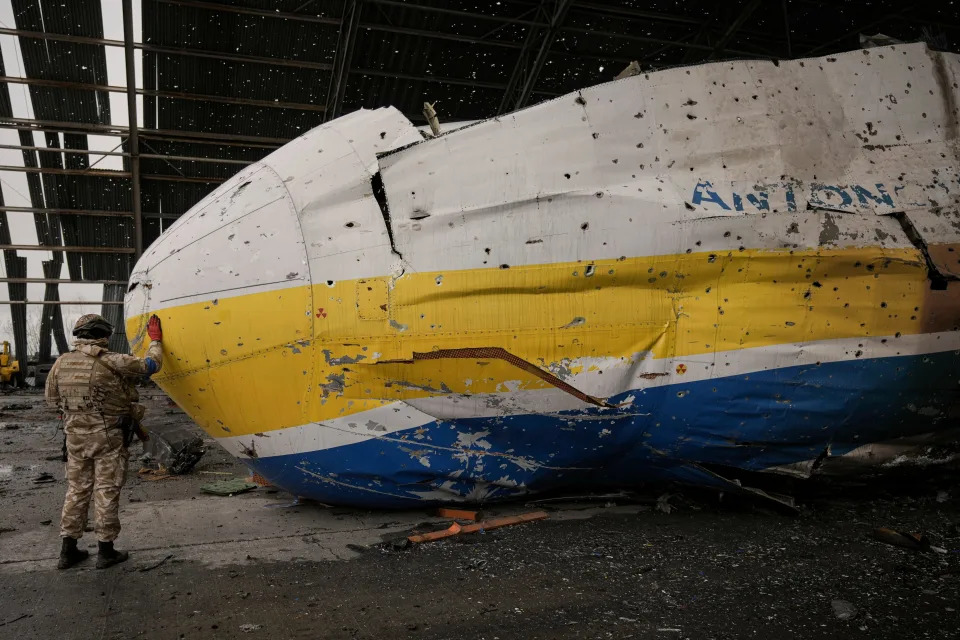
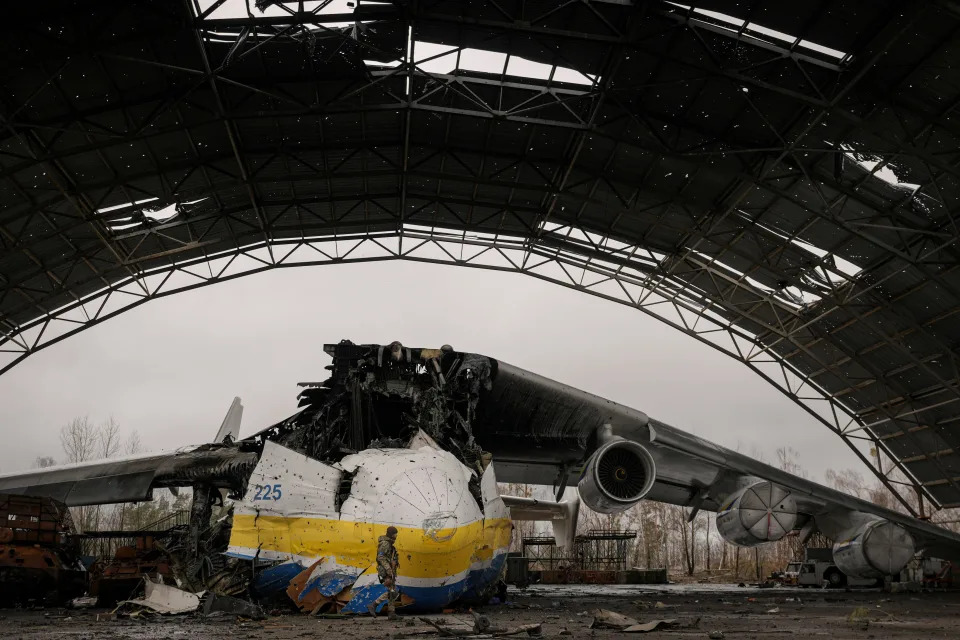
The world’s largest aircraft was destroyed in Ukraine. See what the wreckage looks like.

USA Today

The world’s largest aircraft was destroyed in Ukraine. See what the wreckage looks like.

Jordan Mendoza, USA TODAY – April 4, 2022

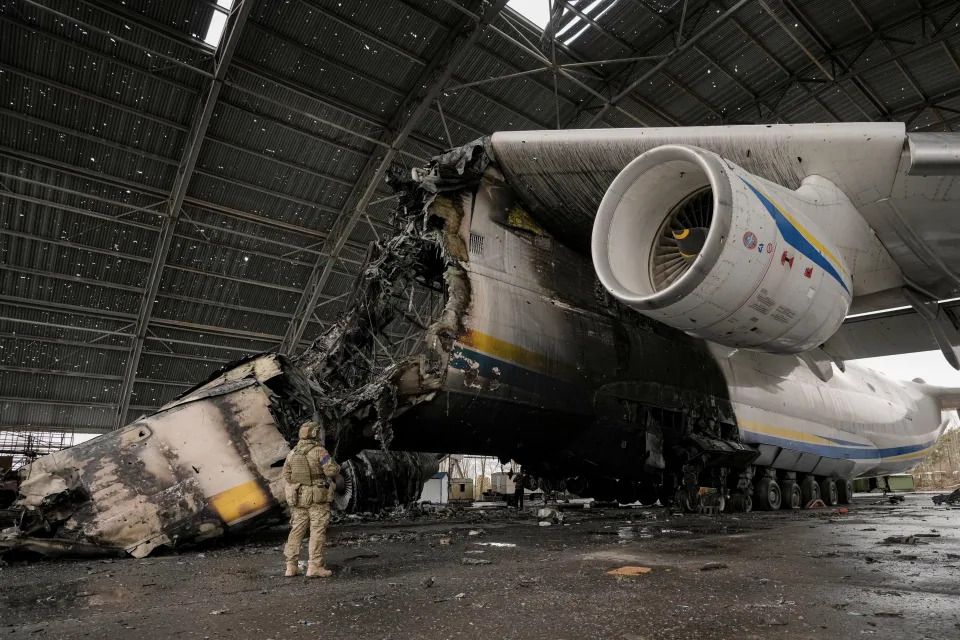
A Ukrainian serviceman walks by an Antonov An-225 Mriya aircraft.

In the early days of the Russian invasion of Ukraine, the Antonov An-225 “Mriya,” the largest aircraft in the world, was destroyed in a Russian attack on the Antonov Airport near the Ukrainian capital, Kyiv.

The plane, 275 feet long with a wingspan stretching 290 feet, could carry 550,000 pounds of cargo, according to the aircraft’s manufacturer, Antonov Co., which would also make it the world’s heaviest aircraft. In comparison, the Boeing 747-8, one of the largest commercial planes in use, is 250 feet long with a 224-foot wingspan.

In use since 1988, Mriya was recently used mainly to transport medical supplies during the COVID-19 pandemic.

The Ukrainian aerospace and defense company Ukroboronprom confirmed the wreckage in a Feb. 27 Facebook post, saying the plane was undergoing repairs at the airport, so it didn’t have time to flee before the attack, But the company said the plane “will definitely be restored,” estimating it would take more than five years and cost about $3 billion.

“The invaders destroyed the plane, but they will not be able to destroy our common dream. She will surely be reborn,” Ukroboronprom wrote.

As Ukrainian troops guarded the entrance to Antonov Airport to protect the runway, the wreckage of the Mriya could be seen underneath a hangar, pockmarked with holes from the February attack.

In depth: A look at the Ukrainian-made aircraft – the world’s largest – damaged in Russian attack

What is a no-fly zone?: In Ukraine, it risks starting a war with Russia, the US and NATO say

‘This guy is brutal’: Biden calls for war crimes trial for Putin for atrocities in Ukraine

A Ukrainian serviceman observes the Antonov An-225 Mriya aircraft.
A Ukrainian serviceman touches the nose of the destroyed Antonov An-225 Mriya aircraft.
Ukrainian servicemen stand next to the destroyed Antonov An-225 Mriya aircraft.
A Ukrainian serviceman walks past the Antonov An-225 aircraft.
Ukrainian servicemen walk by an Antonov An-225 Mriya aircraft.
Ukrainian servicemen shout patriotic slogans backdropped by the destroyed Antonov An-225 Mriya aircraft.
Ukrainian servicemen walk by the destroyed Antonov An-225 Mriya aircraft.

Contributing: Ella Lee, Karina Zaiets, George Petras, Javier Zarracina, USA TODAY; Associated Press