Video shows Ukraine ambushing Russian tank convoy featuring a thermobaric weapon, forcing a retreat
Mia Jankowicz – March 11, 2022
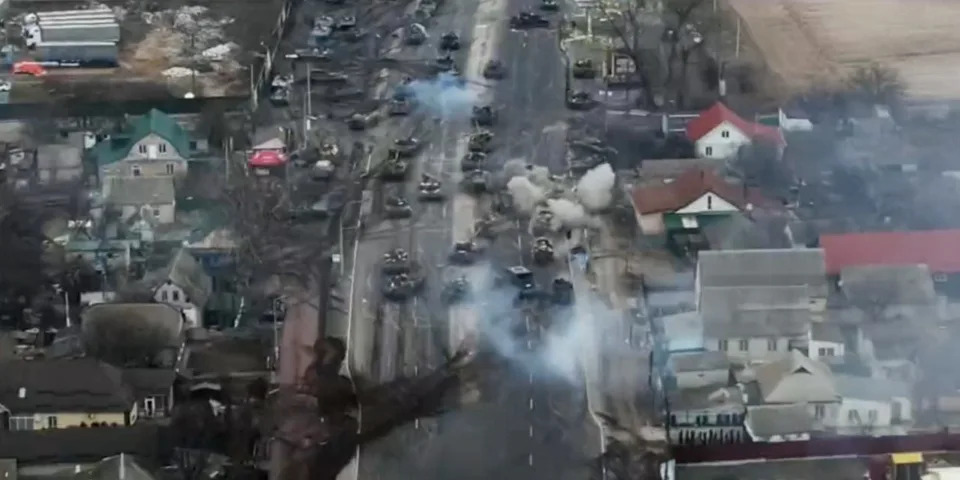
Footage released by Ukraine on March 10, 2022 showing a strike at the head of a column of Russian tanks in in Skybyn.Ukraine Defense Intelligence Agency
Ukraine released drone footage of an ambush on a Russian armored convoy near Kyiv Thursday.
At least 21 Russian military vehicles, including a thermobaric weapon, were caught in the attack.
The ambush forced a humiliating retreat, according to a Sky News analysis of the footage.
Ukraine’s Defense Intelligence Agency released a video on Thursday showing the destruction and retreat of a Russian column of tanks near Kyiv, in footage verified by several news agencies.
Ukraine claimed that the Russian regiment’s commander, Colonel Andrei Zakharov, was killed in the operation, though this has not been independently confirmed.
The 45-second edited montage of footage was filmed by drone and, according to the DIA, shows Russian tank movements in the suburb of Skybyn, around 20 miles from central Kyiv.
In the footage, two tanks — of indeterminate nationality — are seen approaching Skybyn, according to a Sky News analysis. The investigative collective Bellingcat also confirmed the location.
Video: New footage shows mass grave in Ukraine after Russian attacks
Scroll back up to restore default view.
Further shots show Russian tanks on the side of the road, per Sky News. They are later seen on fire.
This is intercut with footage of a long column of tanks heading south into the village. Among them is a vehicle Sky identified as a TOS-1A thermobaric rocket launcher.
Footage released by Ukrainian authorities on March 10, 2022 showing a seemingly destroyed Russian tanks on a road in Skybyn, near Kyiv.Ukraine Defense Intelligence Agency
In another shot, at least 21 Russian military vehicles, including tanks, armored personnel carriers and the TOS-1A, are seen in the village. Tread marks on the road indicate they have changed direction.
Footage released by Ukrainian authorities on March 10, 2022, showing chaos among Russian military vehicles in Skybyn, near Kyiv.Ukraine Defense Intelligence Agency
Two plumes of smoke and fire then mark Ukrainian strikes at either end of the column:
The TOS-1A then appears to fire at a target out of frame.
Footage released by Ukrainian authorities on March 10, 2022 showing a strike at the foot of a column of Russian tanks in in Skybyn, near Kyiv.Ukraine Defense Intelligence Agency
Footage released by Ukraine on March 10, 2022 showing a strike at the head of a column of Russian tanks in in Skybyn.Ukraine Defense Intelligence Agency
The video then shows everal other Russian vehicles being hit. Whilst still under fire the convoy is seen moving back north.
The footage is overlaid with audio said to be of a Russian officer reporting the attack, The Guardian reported.
Footage released by Ukrainian authorities on March 10, 2022 showing a Russian TOS-1A apparently firing in Skybyn, near Kyiv.Ukraine Defense Intelligence Agency
“Sixth regiment lost,” the officer says, per The Guardian. “I cannot report about the 6th regiment. I’m collecting data. Lots of losses. They waited for us. Head of the convoy got into the ambush. Regiment commander killed in action.”
Military experts speaking to the paper described the video as credible.
Ukraine has published a series of such videos as part of a public relations effort to keep international and local attention on apparent military successes against Russia.
The overall military picture remains bleak for Ukraine, however.
In briefings on Tuesday and Wednesday, a Pentagon official said that about 90 to 95% of Russian combat power remains intact, despite the widely-viewed examples of Ukrainian defense.
Authorities released similar aerial footage of strikes on military vehicles dated March 8, which was confirmed by Insider as being shot outside of the village of Borodyanka, on a key road to Kyiv.
A US official estimated Wednesday that Russian forces have sustained 5-6,000 losses since the war began, per CBS News.
Putin’s Paranoid, Isolated, and Trying to Bluff His Way Through
The Daily Beast – March 11, 2022
Photo Illustration by The Daily Beast/Getty
In a jam-packed new episode of The New Abormal, co-host Molly Jong-Fast rips into the “contingent of very stupid Republican congresspeople” who don’t want the U.S. aiding Ukraine before building a border wall here, which makes sense since “the country of Mexico is shelling Texas and they’re using cluster bombs and stud missiles—Oh wait… There is no war at our southern border, but no one has told Rep. Doug Collins.”
“This is part of a larger picture where the right is a little confused by the state of the world as it actually is, as opposed to how they had been describing it for the past six years or whatever, where Putin was a good guy and the kind of guy we should look up to. Now, they’re doing their best carnival contortionists to act to try and pretend like they never said all of that,” says co-host Andy Levy. While some Republicans have come around, Levy says, “others are not anti Putin, they’re anti–anti-Putin. They’ll do a lot of blaming America for this war…
“They keep saying, ‘This didn’t happen under President Trump. Well, no, because Trump was openly talking about pulling out of NATO and stuff like that. And if you’re Vladimir Putin, you don’t want to do anything to upset that. So you sit back and let Trump destroy NATO by himself and make things even easier for Putin,” says Levy. “But instead you get, ‘Well, this didn’t happen when he was president.’”
Plus, Melissa Moss of the 65 Project explains how that was “set up to protect democracy, by holding accountable lawyers who bring bogus lawsuits to overturn legitimate election results” to account, and breaks down the three sorts of lawyers her group is going after.
And The Atlantic’s Tom Nichols considers Putin:
“This guy is not a good strategist. He blunders into things… and bluffs his way out, or tries to murder his way out. I don’t know how this ends, if he were the strategist that everybody thinks he is, he would find an off-ramp.”
But since Putin is not the strategist people think he is, says Nichols, “I’m very worried about the reports that he’s gonna try and up the ante by using chemical weapons, because now he has a problem at home” with “thousands of people in jail” and millions of Russians looking at each other and saying (of him), ‘What the hell were you doing?’ while the Russian military apparently is having some serious morale trouble because they don’t want to kill their brothers and sisters. So in that circumstance, maybe he would try to create a false-flag chemical attack to say, ‘You see, now, now I’m fighting for the soul of Russia.’ I mean, he’s improvising. And when you have a paranoid, isolated, not very bright guy, improvising bad things can happen.”
ABC News’s Jonathan Karl accuses Tucker Carlson of ‘plagiarism of Vladimir Putin’
Stephen Proctor – March 11, 2022
ABC News chief Washington correspondent Jonathan Karl appeared Thursday on Deadline: White House, where he joined the growing chorus of people claiming Fox News opinion host Tucker Carlson is parroting Russian propaganda. Carlson has been accused of doing so multiple times in the past, this time coming the day after Carlson pushed the false Russian narrative that the U.S. military has secret bioweapons labs in Ukraine. Carlson opened his show Wednesday night propagating that exact message.
“He was giving credence to what the Russians are now saying, a really classic propaganda claim that the United States is manufacturing, or has been manufacturing chemical, biological weapons in Ukraine,” Karl said. “And Tucker Carlson used the segment to echo that claim, saying that he was at first skeptical about it, but now he’s convinced that there’s credence to it.”
Just an hour after Carlson’s segment aired, Fox News national security correspondent Jennifer Griffin appeared on Hannity where she contradicted what Carlson had said about the biolabs, stating the fact that they are neither secret, nor do they produce bioweapons.
On Thursday, Karl posted a tweet highlighting other pieces of Russian propaganda that Carlson has pushed.
“He says as just an aside that the United States encouraged Russia to invade Ukraine,” Karl said. “In what universe is that true? Only if you’re sitting in Moscow and watching Russian television because it’s exactly, again, what Vladimir Putin is saying.”
Karl went on to accuse Carlson of flat-out plagiarizing Putin.
“What is sort of inexplicable here is that what is being said is almost a plagiarism of Vladimir Putin,” Karl said. “It’s almost word for word what Vladimir Putin has been saying, not just now, but again, for several years, and what he has said in making the argument to justify what’s happening in Ukraine.”
And Karl wondered if Russia’s excuse for its deadly bombing of a Ukrainian maternity ward might be the next piece of Russian propaganda that Carlson pushes.
“Today, Russian propaganda is saying that that maternity ward that was bombed was somehow a military facility,” Karl said. “I mean, is that gonna be echoed next? It is inexplicable. I can’t explain it.”
Watch Fox News’s Jennifer Griffin contradict Tucker Carlson’s coverage of a Russian conspiracy: at Fox News, appeared on “Hannity” Wednesday,
China Has Tools to Help Russia’s Economy. None Are Big Enough to Save It.
Alexandra Stevenson and Keith Bradsher – March 11, 2022
A border crossing with Russia in Manzhouli, China, marked by two arches and divided on the Chinese side by a green wire fence that stretches for hundreds of miles, on Dec. 7, 2018. (Lam Yik Fei/The New York Times)
When the United States and its allies declared a financial war on Russia after its invasion of Ukraine, the world turned to see what China would do.
As a growing global power, one of the ways China has extended its influence is by establishing close financial ties with countries unwilling to follow rules dictated by the United States and other Western powers. Surely, the thinking went, China would do the same for Russia.
There is just one big problem: money. Specifically, China’s money.
To help Russia evade sanctions, China would have to offer a viable substitute to the American dollar. But Chinese money — the renminbi — is barely used outside of China. Only 3% of the world’s business is done using the redback. Even Russia and China conduct their trade mostly in U.S. dollars and euros.
What’s more, the risks of helping Russia avoid economic ruin may be greater for China than any possible reward. Much of China’s own economy depends on the U.S. dollar and the financial edifice that underpins it. Chinese companies are active around the globe, using the U.S. financial system to pay employees, buy materials and make investments. China is the world’s largest exporter, and is paid for its goods mainly in dollars.
Should Beijing run afoul of the sanctions against Russia, China’s own financial stability would be put at risk at a time when its leaders have emphasized caution. And besides, the few lifelines that Chinese leaders could feasibly offer Russia would not be strong enough to help the country survive a financial blackout from the United States and its allies.
It could facilitate cross-border transactions — allowing China to continue to sell to Moscow many of the goods it makes for the rest of the world. It could make investments in Russian energy firms on the cheap. It could let Russia’s central bank cash in some of the $140 billion it holds in Chinese bonds. Beijing could even set up a rogue bank to help move Russian money around like it has done for Iran and North Korea.
None of these measures would be enough to counterbalance the sanctions against Russia, which have included cutting off Russia’s biggest banks from the global financial system and a ban on oil and gas imports by the United States.
“China will not save the sinking boat of the Russian economy,” said Eswar Prasad, a Cornell University economist. But, he added, it could “perhaps allow it to float a little longer and sink a little more slowly.”
A deepening friendship between Xi Jinping, the leader of China, and President Vladimir Putin of Russia has helped bring the countries closer together than they have been since the 1950s, when Mao cooperated closely with Josef Stalin and then Nikita Khrushchev. The warming of diplomatic ties was built on a shared desire to put an end to what China and Russia see as America’s economic and geopolitical hegemony.
When Xi and Putin met on the eve of the Beijing Olympic Games, they declared that the bond between the two countries had “no limits.” Russia’s invasion of Ukraine, days after the Games ended, led the U.S. and other industrialized nations to impose waves of sanctions aimed at devastating the Russian economy.
China has repeatedly criticized the moves. Premier Li Keqiang did so again on Friday at his annual news conference, saying that, “Relevant sanctions will hurt the world’s economic recovery, it is in no one’s interest.”
But criticizing sanctions is one thing. Choosing to go against the global financial order and risk inviting sanctions at home is another. Beijing has already given some indication that it isn’t willing to do the latter. The Chinese-led Asian Infrastructure Investment Bank — an investment bank that Washington sees as a World Bank rival — last week said it would put its lending to Russia and Belarus on hold over the war in Ukraine. Some Chinese banks have cut back on the financing of Russian commodities.
“Chinese banks are trying to cut their exposure to Russia,” said Raymond Yeung of ANZ Bank. “You can tell that the theory of China offering a financial alternative to Russia remains questionable.”
China’s top banking regulator said last week that banks would not necessarily sever their ties with Russian counterparts. “We will not participate in such sanctions, and we continue to maintain normal economic and trade and financial exchanges with relevant parties,” said Guo Shuqing, the chairman of the China Banking and Insurance Regulatory Commission.
As sanctions are piled on, maintaining those economic ties will become harder without taking on more risk, and China’s options to help Russia are dwindling. Western countries have locked Russia out of the Swift financial messaging and payments system, effectively excluding Russian banks from international transactions.
China has been developing an alternative messaging service for financial institutions to communicate cross-border transactions. But that service operates on a tiny scale and relies partly on technology tangled up in sanctions.
After Visa and Mastercard stopped their operations in Russia, several Russian banks turned to China’s UnionPay, which offers payment options in some 180 countries. For China to offer its own payment processing, transactions must not be in dollars in order to avoid punishment.
Then there is the money that Russia has sitting in China. Through central bank reserves, government investments and a longstanding loan agreement, Russia can quickly raise in China the equivalent of more than $160 billion, or about 16 months’ worth of Russian sales of oil and natural gas to the European Union and the United States.
A large part of that money — around $140 billion — is tied up in bonds and denominated renminbi. The rest is tied up in agreements between the two countries’ central banks that commit each to short-term, interest-free loans worth $24 billion in case of an emergency.
A more diplomatically risky option would be for China to launder money for Russia through a small Chinese bank set up specifically to evade sanctions. This is what China National Petroleum Corp. did in 2009 when it bought a small bank in China’s northwestern province of Xinjiang and renamed it Bank of Kunlun. The bank helped Iran conduct hundreds of millions of dollars worth of transactions.
In a similar scenario, a Chinese oil company could pay a shell company and its corporate officers in China a very large “consulting fee” to trade oil on its behalf, instead of paying a Russian oil company directly for crude oil. Eventually, though, such an operation would likely be shut down. That is what happened with Bank of Kunlun after the U.S. Treasury sanctioned it in 2012.
In another scenario, Chinese companies with state backing could scoop up the West’s stakes in some of Russia’s biggest oil and gas companies. American and European giants like Shell and BP have announced that they will exit their joint ventures in Russia over the invasion, but there are not a lot of obvious buyers other than Chinese state-owned enterprises.
“You’ve got some of the most valuable energy companies in the world now trading at mere fractions of their real value,” said Taylor Loeb, an analyst at Trivium, a consulting firm. “Developed countries won’t touch these companies. That basically only leaves China. It might be really bad PR, but the price may just be too good.”
Even as Beijing contemplates just how far it is willing to go to maintain its “no limit” friendship with Russia, there is one harsh reality: The renminbi cannot save Russia’s own currency, the ruble. The ruble is plunging and has already erased much of the country’s wealth. The only way for Russia to shore it up? Buy U.S. dollars.
Russia makes claims of US-backed biological weapon plot at UN
Fears claims of plot to use birds to spread disease could be pretext for biological attack by Russia itself
Julian Borger, Jennifer Rankin and Martin Farrer – March 11, 2022
The UN building in New York. The security council met at the request of Russia to discuss Moscow’s unfounded claims. Photograph: Carlo Allegri/Reuters
Russia has accused Ukraine and the US at the UN security council of a plot to use migratory birds and bats to spread pathogens, raising alarm among other council members that the accusations could be intended to provide cover for future Russian use of biological weapons.
The Russian permanent representative to the UN, Vasily Nebenzya, delivered a lengthy account of the alleged biological weapons plot, and said the birds, bats and insects supposedly intended to spread disease would cross Ukraine’s western border.
“We call upon you to think about a very real biological danger to the people in European countries, which can result from an uncontrolled spread of bio agents from Ukraine,” Nebenzya said. “And if there is a such a scenario then all Europe will be covered.
“The risk of this is very real given the interests of the radical nationalist groups in Ukraine are showing towards the work with dangerous pathogens conducted together with the ministry of defence of the United States.”
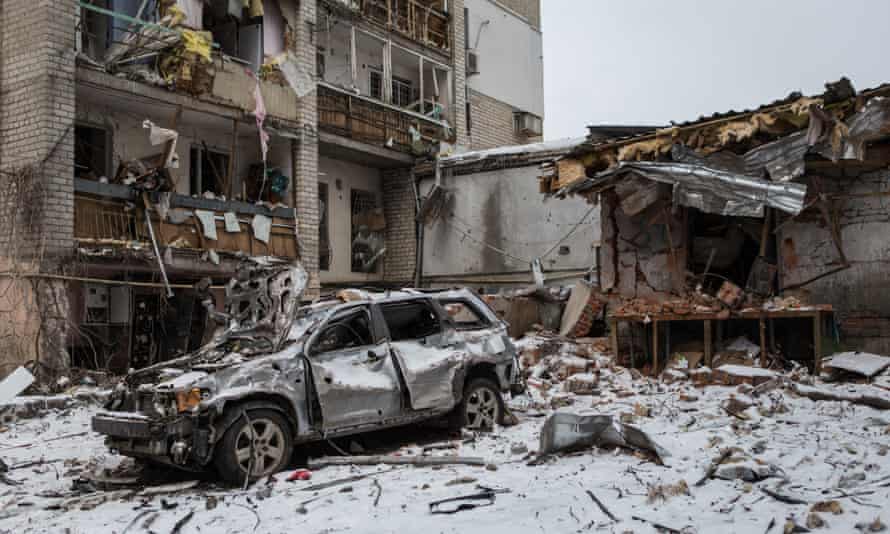
The remains of buildings and vehicles in Kharkiv as Russian attacks continue. Photograph: Anadolu Agency/Getty Images
The United Nations high representative for disarmament, Izumi Nakamitsu, said the UN was “not aware of any biological weapons programs” in Ukraine, and pointed out there was an official channel for governments to raise any concerns about violations of the biological and toxin weapons convention banning their use.
In response to Nebenzya’s claims, several member states on the security council warned that it could be a disinformation campaign ahead of a planned Russian attack inside Ukraine.
“The intent behind these lies seems clear and it is deeply troubling,” said Linda Thomas-Greenfield, the US ambassador to the UN. “We believe Russia could use chemical or biological agents for assassinations as part of a false flag incident or to support tactical military operations.”
Before the UN session, the Ukrainian president, Volodymyr Zelenskiy, expressed similar concerns.
“Allegedly, we are preparing a chemical attack,” Zelenskiy said in a video address on Thursday. “This makes me really worried, because we’ve been repeatedly convinced: if you want to know Russia’s plans, look at what Russia accuses others of.”
Russian forces have continued their advance into Ukraine, bombing cities in the west of the country, including Lviv, Lutsk and Ivano-Frankivsk.
Elsewhere, satellite photos appeared to show a massive convoy outside Kyiv had largely dispersed and redeployed. The US space technology company Maxar said its pictures showed armoured units had fanned out through towns and forests in the area, with artillery moved into potential firing positions.
In Moscow, Vladimir Putin announced 16,000 foreign “volunteers” from the Middle East were ready to fight with Russian-backed forces in eastern Ukraine to “help” the people living in the Donbas region. In a meeting with Russia’s defence minister, Sergei Shoigu, Putin also said western-made weapons including Javelin and Stinger missiles that were captured by the Russian army would be handed to Donbas forces.West’s weapons are seeing action in Ukraine – but it is unlikely to be enoughRead more
As heavy shelling continued across eastern Ukraine’s towns and cites, Ukrainian authorities reported Russia had killed more civilians than soldiers. Russian forces were also reported to have hit a psychiatric hospital near Izyum, a town in the Kharkiv region. The regional governor, Oleh Synegubov, called it a “war crime against civilians [and] genocide against the Ukrainian nation”. He said 330 people had been in the hospital at the time, including wheelchair users and people unable to move. The exact number of casualties is still to be established.
In the besieged port city of Mariupol conditions remain desperate, with people trapped inside indoor shelters with no heat, electricity and little or no food. More than 1,300 people had died in the 10-day siege, said Ukraine’s deputy prime minister Iryna Vereshchuk. “They [Russia] want to destroy the people of Mariupol. They want to make them starve. It’s a war crime,” she said.
The Associated Press spoke to an exhausted-looking resident as he pulled a cart loaded with bags down an empty street flanked by damaged buildings in the port city. “I don’t have a home any more. That’s why I’m moving,” Aleksander Ivanov said. “It doesn’t exist any more. It was hit, by a mortar.”
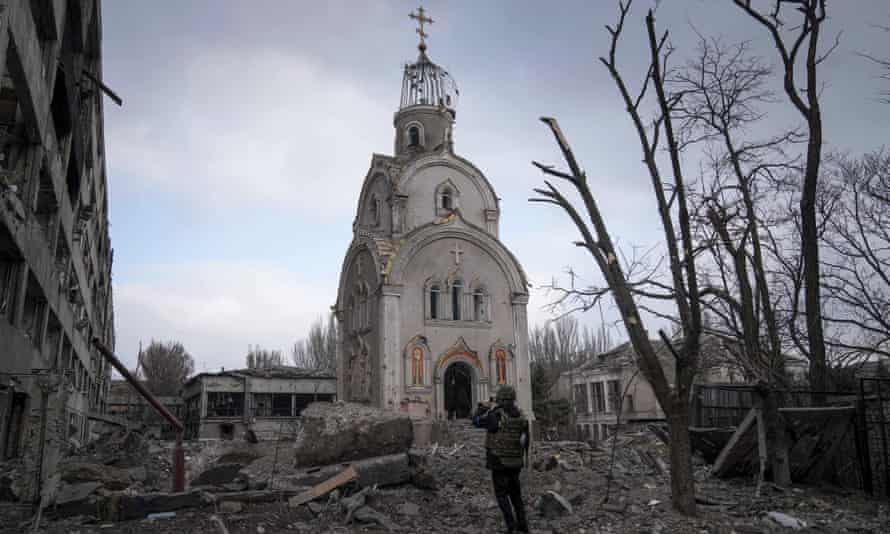
A member of the Ukrainian armed forces takes a photograph of a damaged church after shelling in Mariupol on Thursday. Photograph: Evgeniy Maloletka/AP
More than 400,000 people remain trapped in Mariupol, which is surrounded by Russian forces, and basic supplies are running out. About 200,000 are believed to want to leave amid continuous Russian bombardment but have not been able to do so despite the daily declaration of humanitarian corridors.
A UN spokesperson said there were credible reports of Russians using cluster munitions in populated areas. Cluster munitions, which scatter small bombs over a large area, are banned by more than 100 countries, including the UK, but not Russia, Ukraine or the US.
More than 2.5 million people have fled Ukraine and a further 2 million are internally displaced, UNHCR, the UN refugee agency, said on Friday. The grim toll for Ukrainian civilians comes amid growing fears that Russia could stage a chemical attack, as senior Russian officials recycled old conspiracy theories about alleged western-made biological weapons.
The head of the Russian military’s radiation, chemical and biological protection troops, Igor Kirillov, said on Thursday that US-backed labs in Kyiv, Kharkiv and Odesa were working on pathogens custom-designed to target Russians and other Slavs. According to Russian-state media, Kirillov alleged the US planned to exploit Ukraine’s “unique geographical position” by sending migratory birds carrying deadly diseases into Russia.
The Russian foreign minister, Sergei Lavrov, made a similar claim on Thursday, alleging that US-backed labs in Ukraine were working to “develop ethnically targeted biological weapons”. The director of the CIA, William Burns, told the US Senate intelligence committee that Russia could be laying the groundwork for a chemical or biological attack, which it would then blame on the US or Ukraine in a “false flag operation”.
“This is something, as all of you know very well, [that] is very much a part of Russia’s playbook,” he said. “They’ve used these weapons against their own citizens, they’ve at least encouraged the use in Syria and elsewhere, so it’s something we take very seriously.”
Carl von Clausewitz famously asserted that war is the continuation of politics by other means. The Russian invasion of Ukraine is the continuation of identity politics by other means.
I don’t know about you, but I’ve found the writings of conventional international relations experts to be not very helpful in understanding what this whole crisis is about. But I’ve found the writing of experts in social psychology to be enormously helpful.
That’s because Vladimir Putin is not a conventional great power politician. He’s fundamentally an identity entrepreneur. His singular achievement has been to help Russians to recover from a psychic trauma — the aftermath of the Soviet Union — and to give them a collective identity so they can feel that they matter, that their life has dignity.
The war in Ukraine is not primarily about land; it’s primarily about status. Putin invaded so Russians could feel they are a great nation once again and so Putin himself could feel that he’s a world historical figure along the lines of Peter the Great.
Maybe we should see this invasion as a rabid form of identity politics. Putin spent years stoking Russian resentments toward the West. He falsely claimed Russian-speakers are under widespread attack in Ukraine. He uses the tools of war in an attempt to make Russians take pride in their group identity.
The Soviet Union was a messed-up tyranny, but as Gulnaz Sharafutdinova writes in her book “The Red Mirror,” Soviet history and rhetoric gave Russians a sense that they were “living in a country that was in many ways unique and superior to the rest of the world.” People could derive a sense of personal significance from being part of this larger Soviet project.
The end of the Soviet Union could have been seen as a liberation, a chance to build a new and greater Russia. But Putin chose to see it as a catastrophic loss, one creating a feeling of helplessness and a shattered identity. Who are we now? Do we matter anymore?
Like identity politicians everywhere, Putin turned this identity crisis into a humiliation story. He covered over any incipient feelings of shame and inferiority by declaring: We are the innocent victims. They — America, the Westerners, the cool kids at Davos — did this to us. Like other identity politicians around the world, he promoted status resentment to soothe the wounds of trauma, the fears of inferiority.
In the first years of his reign, he rebuilt the Russian identity. He reclaimed parts of the Soviet legacy as something to be proud of. Mostly, his vision of Russian identity revolved around himself. By parading as a powerful figure on the world stage, Putin could make Russians feel proud and part of something big. Vyacheslav Volodin, then the Kremlin’s deputy chief of staff, captured the regime’s mentality in 2014: “There is no Russia today if there is no Putin.”
This grand strategy seemed to be fully vindicated that year with the successful invasion of Crimea. Having reclaimed this land, Russia could strut like a great power once again. More and more, Putin portrayed himself as not just a national leader but a civilizational leader, leading the forces of traditional morality against the moral depravity of the West.
But now it’s all spun out of control. Putin’s identity politics are so virulent because they are so narcissistic. Just as individual narcissists appear to be inflated egotists but are really insecure souls trying to cover their fragility, narcissistic nations and groups that parade their power are often actually haunted by fear of their own weakness. Narcissists crave recognition, but they can never get enough. Narcissists crave psychic security but act in self-destructive ways that ensure they are often under assault.
The Putin identity and Russian identity are currently inseparable. The billion ruble question is: How does a guy who has spent his life battling against feelings of shame and humiliation react as large parts of the world rightly shame and humiliate him? How does a guy who has spent his life trying to appear powerful and farseeing react as he increasingly appears weak and shortsighted?
I imagine that, at least for a time, Putin can revert to the familiar Russian “besieged fortress” narrative: The West is always out to get us. We always win in the end.
There have been hints that Putin might be willing to cut a deal with some sort of compromise and retreat from Ukraine, but that would be a shock. It would destroy the bloated and fragile personal and national identity that he has been building all these years. People tend not to compromise when their very identity is at stake.
My fear is that Putin knows only one way to deal with humiliation, which is by blaming others and lashing out. A couple of years ago my colleague Thomas L. Friedman wrote a prescient column about the politics of humiliation in which he quoted Nelson Mandela: “There is nobody more dangerous than one who has been humiliated.”
Putin brought this humiliation on himself and on his country. Speaking as one who deeply admires so much in Russian culture, I think it is a great crime that a nation with so many paths to dignity and greatness chose the path that leads so viciously to degradation.
The US Lost 1.3 Million Acres Of Farmland In 2021 – Here’s Why It Matters
Kevin Vandenboss – March 11, 2022
The latest Farm and Land in Farms report from the United States Department of Agriculture (USDA) shows the US lost 1.3 million acres of farmland in 2021. The total land in farms decreased from 896,600,000 acres in 2020 to 895,300,000 acres in 2021.
Farmland acreage has decreased by over 13.62 million acres since 2014, an average loss of over 1.9 million acres per year.
Why Farmland is Shrinking: Agricultural land being converted into new developments is one of the primary causes of the shrinking supply. Developers have been purchasing farmland to expand suburbs and meet the growing housing demand.
Farms producing low yields are often retired into the USDA’s Conservation Reserve Program. Farmers enrolled in this program agree to remove environmentally sensitive land from agricultural production for 10 to15 years in exchange for a yearly rental payment.
Why it Matters: The global food demand is increasing due to the growing population and rising incomes in developing countries. The United Nations estimates that crop production will have to increase by 60% by the year 2050 to feed the estimated 9.3 billion people living on the planet at that time.
Recent jumps in commodities prices are mainly an overreaction to the Russia-Ukraine conflict. The increasing food demand coupled with the shrinking supply of agricultural land will likely mean the costs of agricultural commodities will remain high well into the future.
An Overlooked Investment Option: While ETFs like Teucrium Wheat Fund ETV (ARCA: WEAT) have been getting the attention from retail investors, few realize the potential returns from investing directly into farmland.
Farmland values increased by 10% to 22% throughout many areas of the country in 2021 and higher crop prices could keep pushing farmland values higher.
Real estate investment trusts (REITs) that specialize in farmland, like Gladstone Land Corporation (NASDAQ: LAND) and Farmland Partners Inc (NYSE: FPI), are attracting a lot more attention from investors already.
However, these publicly traded REITs are still vulnerable to stock market volatility and may underperform in a bear market. Another option for accredited investors is a platform like FarmTogether or AcreTrader, which allows individuals to invest directly in farmland assets through the private market.
Russian regime change is needed for US corporations like Goldman Sachs to return, says Anthony Scaramucci
Phil Rosen – March 11, 2022
Russian President Vladimir Putin.MIKHAIL KLIMENTYEV/SPUTNIK/AFP via Getty Images
Big corporations won’t return to Russia while Putin is in charge, Anthony Scaramucci told CNBC on Friday.
“There’s no way back into the international community for President Putin,” Scaramucci said.
He anticipates a significant regime change in Russia, and says Putin will not be in power much longer.
A number of western businesses have fled Russia since the invasion of Ukraine, and anything short of regime change is unlikely to bring them back, according to SkyBridge Capital founder and former White House communications director Anthony Scaramucci.
On Thursday, Goldman Sachs became the first major Wall Street bank to cease operations in Russia, and the Big-Four accounting firms also all recently announced their departure.
“There’s no way back into the international community for President Putin,” Scaramucci told CNBC Friday. “It’s just ridiculously bad.”
As the West’s economic sanctions choke Russia’s economy, Scaramucci expects Putin to eventually negotiate a ceasefire that includes immunity for himself and his top generals.
Among the scores of corporations that have cut ties with Russia in recent weeks, most won’t return until there’s a sign of progress, he said.
“Until there’s a significant regime change [in Russia] and some positivity and softening of that militarism, I do not see anybody being able to go back,” Scaramucci said. He added that he doesn’t see a reason for Western leaders to ease sanctions even if Russia pulls out of Ukraine.
And while foreign businesses may eventually resume operations there, “they’re not going to go back anytime with President Putin in charge,” he said.
How Russia’s invasion of Ukraine affects ‘everything on the supply chain’: Analyst
Dani Romero – March 11, 2022
Economists and industry experts widely believe supply chain disruptions will continue to affect the U.S. economy as Russia’s invasion against Ukraine sent oil prices surging and suggested an unpredictable course for markets in the short term.
“To run everything on the supply chain — unfortunately, so much of it relies on oil,” Kona Haque, ED&F Man head of research, said on Yahoo Finance Live (video above). “It’s the reason why every time you see oil prices go up by 50%, a U.S. recession typically follows. It’s that impactful. It’s that entrenched in the economy. And obviously the U.S. clearly is very, very energy dependent … It will have a reverberating impact across the supply chain.”
Gas prices skyrocketed over the past month as Western sanctions against Russia bite: The U.S. national average, as of March 11, is $4.33 a gallon. California became the first state to see average gas price tick up to more than $5/gallon with states like Nevada, Hawaii, and Oregon not far behind, according to the latest data from AAA.https://flo.uri.sh/visualisation/8914950/embed?auto=1
High gas prices generally trickle into other parts of the economy: Haque noted that the cost of shipping “is going to go through the roof” because bunker fuel is used so often, and fuel is under pressure right now. Along with bunker fuel are oil and gas, which are considered “hugely important components” for fertilizers that are both currently experiencing shortages since Russia and Ukraine are major exporters of them.
“Basically, the impact that this war is going to have across the global economy is going to happen via the commodity transmission,” Haque said.
Men repair a gas pipeline outside a house which was damaged by shelling in Donetsk, eastern Ukraine, January 5, 2015. REUTERS/Igor Tkachenko
‘An inflationary impact’
Shipping companies like FedEx Express (FDX) announced last week they were hiking up their surcharge for many international parcel and freight shipments due to the disruptions among Russia and Ukraine.
Meanwhile in Europe, fertilizer makers, Yara International ASA (YARIY) and Borealis, also cut their output because of surging natural gas prices, adding more pressure for global food inflation.
A general view of a factory of Norwegian chemical company Yara International ASA, at Ambes near Bordeaux, south-western France August 6, 2020. (Photo by MEHDI FEDOUACH / AFP)
Last month, two of the top European shippers — Maersk and DSV — warned that freight costs would likely remain high into the year, offering no relief to customers who are also feeling the pinch at the pump and the grocery store.
“This whole supply chain is obviously going to have an inflationary impact within the U.S. economy, but globally, oh my gosh,” Haque said.
‘Enormous casualty count is one-third of total Russia lost occupying Afghanistan for a decade: reporter
Bob Brigham – March 10, 2022
Russian Federation President Vladimir Putin wearing a Sitka Gear camouflage. Sitka jackets are manufactured in Bozeman, Montana. Photo via the Kremlin.
Russia’s invasion of Ukraine looks even worse when reports of its fatalities are compared to the Soviet invasion of Afghanistan that is widely seen as hastening the collapse of the USSR.
“I was just reading up, looking back at the history of the Afghan war, the Soviet occupation of Afghanistan. 15,000 Soviet soldiers, Russian soldiers died in Afghanistan, Ari, during the course of ten years. U.S. estimates now think that about 5,000 Russian soldiers have died in Ukraine, in two weeks, and the amount of losses is enormous for the Russians,” she noted.
“The Soviet Union, ending a long silence about the exact number of its casualties in the war in Afghanistan, said today that 13,310 soldiers had been killed, 35,478 wounded and 311 are missing,” The Times noted. “The number of troops killed was slightly higher than the United States had estimated. Washington had put the number of Soviet casualties in the eight and a half years of war at 33,000 to 38,000, a third of them fatalities.”


 Scroll back up to restore default view.