9?723 missiles, part of Iskander-M missile complex, are seen during a demonstration at the International military-technical forum ARMY-2019 at Alabino range in Moscow Region, Russia June 25, 2019. REUTERS/Maxim Shemetov (Maxim Shemetov / reuters)
American intelligence officials have discovered that the barrage of ballistic missiles Russia has fired into Ukraine contain a surprise: decoys that trick air-defense radars and fool heat-seeking missiles.
The devices are each about 1 foot long, shaped like a dart and white with an orange tail, according to an American intelligence official. They are released by the Iskander-M short-range ballistic missiles that Russia is firing from mobile launchers across the border, the official said, when the missile senses that it has been targeted by air defense systems.
Each is packed with electronics and produces radio signals to jam or spoof enemy radars attempting to locate the Iskander-M, and contains a heat source to attract incoming missiles. The official, who was not authorized to speak publicly about intelligence matters, described the devices on the condition of anonymity.
The use of the decoys may help explain why Ukrainian air-defense weapons have had difficulty intercepting Russia’s Iskander missiles.
Powered by a solid-fuel rocket motor, the Iskander can reach targets more than 200 miles away, according to U.S. government documents. Each mobile launcher can fire two Iskanders before it must be reloaded.
Photographs of the dart-shaped munitions began circulating on social media two weeks ago. They had stumped experts and open-source intelligence analysts — many of whom mistook them for bomblets from cluster weapons based on their size and shape.
Richard Stevens, who spent 22 years in the British Army as an explosive ordnance disposal soldier and later worked as a civilian bomb technician for 10 years in southern Iraq, Africa and other regions, said he had been exposed “to plenty of Chinese and Russian munitions, but I had never seen this.”
Stevens posted photos of the munitions to a site for military and civilian bomb disposal experts that he started in 2011, and found that no one else seemed to have seen these mystery munitions before either.
“That Russia is using that size of weapon — the Iskander-M — and quite a few of them I believe, that’s why we’re seeing this now,” Stevens said. “It’s just that, post-conflict in the past 10 to 15 years, no one has had the opportunity to see this.”
The devices are similar to Cold War decoys called “penetration aids,” the intelligence official said, that have accompanied nuclear warheads since the 1970s and were designed to evade anti-missile systems and allow individual warheads to reach their targets. The incorporation of the devices into weapons such as the Iskander-M that have conventional warheads has not been previously documented in military arsenals.
“The minute people came up with missiles, people started trying to shoot them down, and the minute people started trying to shoot them down, people started thinking about penetration aids,” said Jeffrey Lewis, a professor of nonproliferation at the Middlebury Institute of International Studies in Monterey, California. “But we never see them because they’re highly secret — if you know how they work, you can counteract them.”
The use of the decoys may point to some level of carelessness or urgency by Russian military leadership, Lewis said, given that Russia knows they will inevitably be collected and studied by Western intelligence services so that NATO air defenses can be programmed to defeat the Iskander’s countermeasures.
And it is highly unlikely, he said, that the version of the Iskander that Russia has sold to other countries would contain these decoys.
“That suggests to me that the Russians place some value on keeping that technology close to home and that this war is important enough to them to give that up,” Lewis said. “They’re digging deep, and maybe they no longer care, but I would care if I were them.
“I think that there are some very excited people in the U.S. intelligence community right now.”
Ex-Black Ops Agent: This Is How Putin Could Meet His End
A. Craig Copetas – March 15, 2022
Photo Illustration by Elizabeth Brockway/The Daily Beast/Getty
Spooks from Langley to Kyiv are likely to be quietly untangling an espionage conundrum that dare not speak its name, according to a former senior intelligence agent who was once regularly involved in such discussions: “Could President Putin really be assassinated?”
“The operation is on every intelligence agency’s design table,” a veteran clandestine operative for France’s General Directorate for External Security (DGSE) told The Daily Beast. “I know this because I used to plan them.”
To be sure, killing Putin as a means of ending his war in Ukraine is a volatile topic to raise officially. It’s also diplomatically discourteous. “Oh, wouldn’t it be great if someone internally just took this guy out and eliminated him,” Florida Republican Senator Marco Rubio recently mused, hurriedly adding, “that’s not the official policy, obviously, of the United States, no one’s talking about the U.S. doing it.”
The retired DGSE agent—an elimination specialist whose attention to detail receives high praise from his fellow liquidators—said the most efficient method would be poison.
“The attempt will be from within the Kremlin. This is not an outside job,” he said.
This would certainly not be the first attempt to assassinate a sitting Russian leader. Back in 1866, the revolutionary nihilist Dmitry Karakozov tried and failed to murder Tsar Alexander II in St. Petersburg. He was executed for his effort.
Arguably the most curious effort merely resulted in a catastrophic change of menu at the only Chinese restaurant in Moscow. The year was 1952 and the Hotel Peking on Mayakovsky Square was nearing its completion to celebrate Sino-Soviet friendship. Although the hotel didn’t open until 1955, two years after the death of Joseph Stalin, Chinese Communist Party Chairman Mao Zedong sent a favorite chef to Moscow to open a restaurant just off the hotel’s lobby.
The story—endlessly told by the Peking’s staff and management during the nearly two years that I lived in one of the hotel’s apartments—had all the trappings of an espionage horror movie. The chef was not really a cook. He was an assassin sent to kill Stalin. But the KGB got to him first, slamming a kitchen cleaver into his head, and—according to hotel legend—leaving his ghost, ax-in-head, to haunt the hallways in search of Stalin.
How today’s spooks might be proposing to take out Putin—deniably, of course—is another mystery, but a stroll down memory lane in the assassination business inspires recollections of classics like the ice-ax, the roof-toss and, the favorite of Genovese crime family hitman Richard “the Iceman” Kulinski, a nasal spray bottle filled with cyanide.
“Russian intelligence is likely the only one left that deploys poison as a default,” says the Frenchman, citing a long roster of Russian potions used to eradicate Kremlin enemies from 1957 KGB defector Nikolai Khokhlov (coffee laced with thallium) to a 2004 assassination attempt on Ukrainian presidential candidate Viktor Yushchenko (dinner seasoned with dioxin).
Putin prefers poison. Polonium-210 triggered the 2006 death of Alexander Litvinenko and Novichok was responsible for the nearly fatal 2018 attack on former Russian spy Sergei Skripal in England. Back on home turf, Prince Felix Yussupov in 1916 allegedly took out the mad monk Grigori Rasputin with cyanide and a few bullets in the head; more recently, Putin’s people in 2020 attacked opposition leader Alexei Navalny with Novichok. Kremlin spokesman Dmitry Peskov at the time disagreed it was a “trend,” adding, “you’ll agree that in many countries in the world, everyday a lot of poisonings happen,” he said.
“All true,” says the DGSE agent, “but nobody does it better than the Russians.”
Yet poisoning Putin wouldn’t be an easy task. According to a source who works in the upper echelons of a Russian ministry, Putin in February allegedly sacked the some 1,000 people—from cooks to launderers to secretaries to bodyguards—who catered to his daily personal and professional needs, and replaced them with a new group of attendants.
“Putin is of course aware someone is coming after him,” says the Frenchman. “Killing Putin is not an easy task, but Putin knows it can be done, and that’s guaranteed to scare him.”
Scheduling is everything. Would-be assassins like to “gather information. Determine habits. Correlate all of Putin’s back-up options,” the covert operator adds, ticking the boxes. “Doubt Putin will travel far by vehicle. There’s no armored vehicle that can survive a few tons of explosives buried under the street.”
The former DGSE black-operations planner says any hit on Putin most likely will have someone in his inner circle, or a phantom just outside the perimeter, as the trigger man. “It will be an expensive job, a fortune,” he says. “In my experience, I’d wager an asset is already in place. There always is.”
Ukrainian Woman Documents What Her Family Cooks and Eats Inside Bomb Shelter amid Russia’s Invasion
Natasha Dado – March 15, 2022
Valeria Shashenok, a Ukrainian photographer, is documenting her family’s experience from inside a bomb shelter amid Russia’s invasion of the country.
Since the war, Shashenok has shared a series of videos on TikTok, which show how her family is coping while, she says, they are hunkered down in the shelter, which is located Chernihiv.
In one clip, Shashenok — who goes by the username @valerissh and has garnered over 800,000 followers — chronicles how she cooks pasta. In the clip, the 20-year-old is seen showing off a pan of noodles as she imagines “she is in Italy.” Another clip shows Shashenok’s mom preparing borscht — a sour soup common in Eastern Europe — on a small electric hot plate.
On TikTok, Valeria Shashenok has shared a glimpse at how her mother has prepared meals in their family’s bomb shelter in war-torn Chernihiv
TikTok–
In a video posted on March 11, Shashenok demonstrates how she and her family made coffee during a power outage at the shelter. With limited resources, Shashenok adds ground coffee beans and water to what, appears to be a heat-proof cup, before lighting the container with a blow torch, which instantly creates the coffee. “I’m shocked, but it works!” Shashenok wrote over the clip.
On TikTok, Valeria Shashenok has shared a glimpse at how her mother has prepared meals in their family’s bomb shelter in war-torn Chernihiv
TikTok
Her account also chronicles the damage done to Ukraine. In a different video shared on March 4, Shashenok leaves the bunker to retrieve some items from her home, and while on the way, she shares footage of the country’s destruction.
Despite the heartache of war, Shashenok manages to incorporate humor in her TikTok videos, joking in one clip that the bomb shelter is like a “5 star hotel” and the bathroom area is a “place for reading books!”
On TikTok, Valeria Shashenok has shared a glimpse at how her mother has prepared meals in their family’s bomb shelter in war-torn Chernihiv
TikTok
Speaking on her decision to document her experience, Shashenok told The Cut: “I want to show what’s happening in my country… I’m that person who always ragged on everything with humor. It’s the best way to show people the problem. I’m that person who always sees light in the dark, and it’s a nice way to do something for my country.”
Russia’s attack on Ukraine continues after their forces launched a large-scale invasion on Feb. 24 — the first major land conflict in Europe in decades. Details of the fighting change by the day, but hundreds of civilians have already been reported dead or wounded, including children. More than a million Ukrainians have also fled, the United Nations says.
With NATO forces massing in the region around Ukraine, various countries have also pledged aid or military support to the resistance. Ukrainian President Volodymyr Zelenskyy called for peace talks — so far unsuccessful — while urging his country to fight back.
Putin, 69, insists Ukraine has historic ties to Russia and he is acting in the best security interests of his country. Zelenskyy, 44, vowed not to bend. “Nobody is going to break us, we’re strong, we’re Ukrainians,” he told the European Union in a speech in the early days of the fighting, adding, “Life will win over death. And light will win over darkness.”
The Russian attack on Ukraine is an evolving story, with information changing quickly. Follow PEOPLE’s complete coverage of the war here, including stories from citizens on the ground and ways to help.
The superyachts (worth £680m) seized from oligarchs as sanctions hit Russians
Ross McGuinness – March 15, 2022
The superyacht Valerie, linked to Russian oligarch Sergei Chemezov, was seized at Barcelona Port in Spain this week. (Reuters)
As the Russian invasion in Ukraine continues, so too does the wave of economic sanctions against the nation’s oligarchs with links to president Vladimir Putin.
Here are the luxury vessels that have been take off the hands of Russian oligarchs since their country’s invasion of Ukraine began almost three weeks ago.
Sergei Chemezov – Valerie superyacht – £115m
The superyacht Valerie, belonging to Rostec chief Sergei Chemezov, was seized in Barcelona, Spain. (Reuters)Russian president Vladimir Putin and head of Rostec state conglomerate Sergei Chemezov in July last year. (Reuters)
A superyacht belonging to Sergei Chemezov was seized by Spanish authorities in Barcelona on Monday.
The boat, named Valerie, is estimated to be worth about £115m.
Chemezov is a former KGB officer with strong links to Russian president Vladimir Putin.
He is the chief executive of the Russian state-owned conglomerate Rostec, which comprises 700 businesses across the defence and civil sectors.
Chemezov was appointed to the role by Putin – the pair became friends when stationed in the old East Germany in the 1980s.
The Russian invasion of Ukraine. (PA)
The Valerie is 85m long and sails under the flag of Saint Vincent and the Grenadines. The vessel is registered to Chemezov’s stepdaughter, Anastasia Ignatova, through a British Virgin Islands company, according to a 2021 article published in the Pandora Papers information leak.
Chemezov was sanctioned by the EU and the US in 2014 and the UK in 2020 over Russia’s annexation of Crimea and was named in sanctions lists this month by the US and Australia.
Andrey Melnichenko – Sailing Yacht A – £450m
The Sailing Yacht A superyacht, owned by Russian billionaire Andrey Melnichenko, has been seized. (Getty Images)EU sanctions have been placed on Russian oligarch Andrei Melnichenko. (Reuters)
On Saturday, Italian police seized the superyacht Sailing Yacht A, owned by Russian billionaire Andrey Melnichenko, said to be close to Putin.
The 143m long yacht was seized at the northern port of Trieste.
Melnichenko owned major fertiliser producer EuroChem Group and coal company SUEK. The companies said in statements on Thursday that he had resigned as a member of the board in both companies and withdrawn as their beneficiary.
Watch: Drone footage shows superyacht under investigation for Putin linksScroll back up to restore default view.
A spokesperson for Melnichenko, Alex Andreev, said the billionaire industrialist has “no relation to the tragic events in Ukraine” and “no political affiliations”.
He was placed on the EU sanctions list on 9 March. He had attended a meeting between Putin and other oligarchs in February just before Russia’s invasion of Ukraine.
Alexei Mordashov – Lady M – £20m
An Italian Finance Police car is parked in front of the yacht Lady M, owned by Russian oligarch Alexei Mordashov, docked at Imperia’s harbor, on March 5, 2022. (AFP via Getty Images)Russian president Vladimir Putin with Severstal boss Alexei Mordashov in 2015. (Reuters)
The Lady M superyacht belonging to Russia’s richest man, Alexei Mordashov, was seized by Italian authorities earlier this month.
The 65m boat was seized at the northern Italian port of Imperia.
Mordashov is under EU sanctions following Russia’s invasion of Ukraine. The EU called him the “personal bank” of the senior officials who benefited from Russia’s annexation of Crimea in 2014.
He is the chairman of Severstal, Russia’s largest steel and mining company.
According to Forbes, he has a net worth of about £22bn.
Gennady Timchenko – Lena – £6m
The yacht Lena, belonging to Gennady Timchenko, an oligarch close to Russian president Vladimir Putin, was seized in the Italian port of Sanremo. (AFP via Getty Images)Russian president Vladimir Putin and oligarch Gennady Timchenko in 2017. (Reuters)
The 40m long superyacht Lena, belonging to billionaire Russian businessman Gennady Timchenko, was seized in the Italian port city of Sanremo earlier this month.
Timchenko was placed under EU sanctions and UK sanctions last month. He is a close friend of Putin, who gave him an oil export licence in 1991.
Igor Sechin – Amore Vero – £91m
The Amore Vero superyacht in La Ciotat, near Marseille, southern France, where it was seized from oligarch Igor Sechin. (AFP via Getty Images)Russian president Vladimir Putin meets Russia’s oil giant Rosneft chief Igor Sechin in 2020. (AFP via Getty Images)
Earlier this month, French authorities seized the 85m long Amore Vero superyacht belonging to Igor Sechin, a long-time confidante of Putin’s.
Nicknamed “Darth Vader”, Sechin served as Russia’s deputy prime minister from 2008 to 2012 and now runs the management board of oil company Rosneft.
The EU sanctioned Sechin last month and had his assets frozen. The UK has also imposed sanctions on Sechin.
Alex Finley, Yacht Watch columnist, author, and former CIA officer, joins Yahoo Finance Live to discuss the seizure of yachts owned by Russian oligarchs due to sanctions violations amid the Russia-Ukraine war.
Related:
Yahoo! Finance
Russian oligarch yacht troubles continue as White House promises: ‘That is just the beginning’
Ben Werschkul and Adriana Belmonte – March 18, 2022
Tracking the status of these incomprehensibly luxurious vessels has become a sport online, with experts including former CIA officer Alex Finley — who recently appeared on Yahoo Finance (video above) — providing updates. President Biden mentioned the yachts in his State of the Union (SOTU) address, and the topic has come up in the White House briefing room.
“Let me give you just a couple of examples of assets that have already been seized,” White House Press Secretary Jen Psaki said told reporters before diving into the details. Her summary included both the yachts and superyachts (which is most often defined as a vessel longer than 80 feet in length) now under Western control.
“That is just the beginning,” Psaki added, referencing a multinational task force the U.S. is involved in to hunt down the physical assets of sanctioned Russian companies and oligarchs. Treasury Secretary Janet Yellen and Attorney General Merrick Garland convened the U.S. wing of the task force for the first time this week.
The superyacht Crescent, has been detained by Spanish authorities and is docked at Marina Port Tarraco in Tarragona. (REUTERS/ Albert Gea)
Yacht seizures have happened alongside other newly confirmed actions, like the impounding of an $18 million resort linked to oligarch Alisher Usmanov in Sardinia. And while the U.S. is not in a position to seize the yachts directly — since the oligarchs are clearly avoiding U.S. waters — authorities are assisting European efforts to cut off assets.
Here’s a running tally of some of the watercraft that Western governments have taken control of — and others that are on move around the globe in search of friendlier waters — with internet sleuths like Finley hot on their tales.
The Lady M — linked to Alexei Mordashov
The White House confirmed that the 213-foot yacht was recently impounded in Italy.
According to a summary online, it was built in Wisconsin and finished in 2013. It requires a crew of 14 to operate and can accommodate up to 12 guests spread across six suites. One notable perk, according to the listing, is a beauty salon.
An Italian Finance Police car is parked in front of the yacht “Lady M”, linked to Russian oligarch Alexei Mordashov, earlier this month. (ANDREA BERNARDI/AFP via Getty Images)
This month’s seizure might be a blow to Mordashov, though he apparently has a second yacht that is reportedly still at large, according to Finley.
Gennady Timchenko founded a private investment group called the Volga Group and is reportedly a close friend of President Vladimir Putin. He was able to afford luxuries like the Lena after gaining a Russian oil export license.
A picture taken on March 5 shows the “Lena” in the port of San Remo. (ANDREA BERNARDI/AFP via Getty Images)
The “Sailing Yacht A” vessel is described online as “the ultimate embodiment of German superyachts built for the 22nd century” includes features like an underwater observation pod and the world’s tallest masts that top out 100 meters above the waterline.
The White House confirmed this week the boat had been seized in Italy.
A helicopter land on the sail-assisted motor yacht ‘Sailing Yacht A’ near Denmark in 2017. ‘Sailing Yacht A’ is the world’s largest sailing ship. (Keld Navntoft via REUTERS)
The Dilbar — linked to Alisher Usmanov
Usmanov is the 99th richest man in the world, according to Forbes, and his yacht is one of the largest in the world at 512 feet long and is reportedly valued around $600-$735 million.
The status of his superyacht is currently uncertain with reports that his entire crew has been fired because of the sanctions, leaving the vessel stuck in a port in Hamburg where it is undergoing repairs. The boat itself may or may not have been seized though it is at least being monitored closely by German authorities.
The Dilbar, a luxury yacht owned by Russian billionaire Alisher Usmanov, sails in the Bosphorus in Istanbul, Turkey May 29, 2019. Picture taken May 29, 2019. REUTERS/Yoruk Isik
Either way, the White House recently announced a host of sanctions on Usmanov, with the U.S. Treasury stating that “any transactions related to the yacht or aircraft, including things such as maintenance, the hiring of operating personnel, or payment of docking or landing fees, conducted with U.S. persons or in U.S. dollars, are prohibited.” (The sanctions also apply to Usmanov’s private jet, reportedly one of Russia’s largest privately-owned aircraft.)
A total of 9 yachts reportedly under Western detainment of sorts
The White House confirmed this week that two more yachts are now seized: former KGB officer Sergei Chemezov’s $140 million yacht (seized in Spain) and Igor Sechin’s 280 foot yacht (impounded in France).
According to Bloomberg, the Sechin’s yacht was confiscated “as it was preparing an urgent departure.”
The superyatch “Amore Vero” – which is said to be owned by Rosneft CEO Igor Sechin – at La Ciotat Port in France on March 4 (REUTERS/ Albert Gea)
Finley added three more yachts to the tally on Thursday, bringing the total up to nine that have been seized since the invasion began. She reports a boat called the Lady Anastasia — linked to Russian businessman Alexander Mikheev — has been detained after a Ukrainian crew member reportedly tried to sink it. She also says a boat called the Royal Romance — linked to Putin pal Viktor Medvedchuk — has been detained in Croatia.
A superyacht called the Crescent — the second boat linked to Igor Sechin — has been detained and Reuters photos show it docked in Spain.
“Congratulations, Igor!” Finley tweeted after a second asset of Sechin’s was apparently seized by the West.
Japanese, U.S. marines practice airborne assaults in sign of deepening cooperation
Tim Kelly – March 15, 2022
A member of the Japanese Self-Defense Force’s Amphibious Rapid Deployment Brigade takes a position while U.S. Marine Corps members get out of its MV-22 Osprey during a joint airborne landing exercise with the U.S. Marine Corps in GotembaA member of the Japanese Self-Defense Force’s Amphibious Rapid Deployment Brigade aims his gun as he takes a position during joint airborne landing exercises with the U.S.Marine Corps in GotembaMembers of the Japanese Self-Defense Force’s Amphibious Rapid Deployment Brigade take part in a joint airborne landing exercise with U.S. Marine Corps members, in GotembaU.S. Marine Corps members take part in a joint airborne landing exercise with the Japanese Self-Defense Force’s Amphibious Rapid Deployment Brigade, in Gotemba Mt.Fuji is seen while a member of the Japanese Self-Defense Force’s Amphibious Rapid Deployment Brigade takes a position during joint airborne landing exercises with U.S. marines in Gotemba
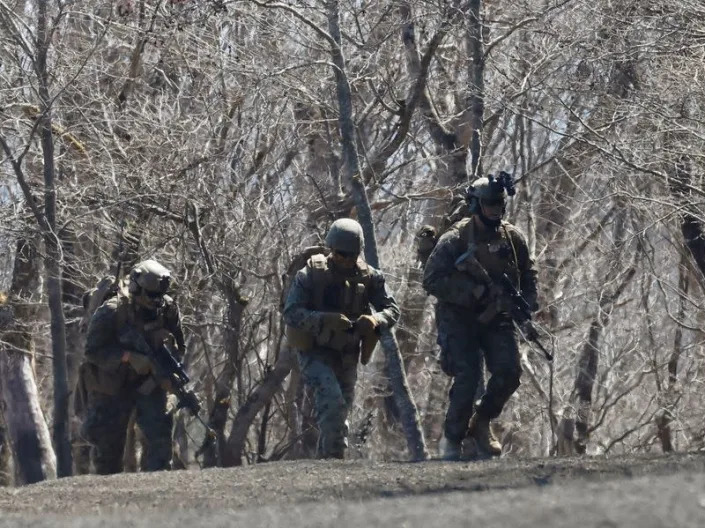
TOKYO (Reuters) – In a sign of deepening military cooperation between Japan and the United States, amphibious Japanese troops and U.S. Marines on Tuesday practised airborne landing assaults together for the first time.
Japan is revising a decade-old national security strategy this year in the face of China’s growing military assertiveness. The upgrade to defence policy guidelines is expected to call for the country to take a more active role alongside Washington in regional security.
The drills in the foothills of Mount Fuji on Tuesday involved 400 troops from Japan’s Amphibious Rapid Deployment Brigade (ARDB), and 600 U.S. marines, and is part of a three-week joint exercise to hone interoperability between the allies. Tilt-rotor Osprey troop carriers were used during the drills.
“The real significance from this training is that the Marines and the ARDB are doing serious combat training of a sort that would have been unthinkable a decade ago,” said Grant Newsham, a retired U.S. Marine Corps colonel who advised Japan as a liaison officer when it set up its amphibious force.
“It demonstrates a more solidly linked U.S. and Japan.”
Activated in 2018, the ARDB troops are Japan’s first marines since World War Two and were formed to reinforce its defence along its southwest islands at the edge of the East China Sea.
Trained to take back captured islands using helicopters, Ospreys and amphibious landing craft, the force of around 1,500 soldiers would likely be one of the first in action to counter any Chinese attack on Japan’s islands.
China, which is locked in a territorial dispute with Japan over uninhabited islands controlled by Tokyo in the East China Sea, routinely dispatches ships to assert its claims.
The joint drills also come as Russia’s invasion of Ukraine raises fresh security concerns in East Asia where China is putting pressure on Taiwan following its crackdown on Hong Kong. Japan also faces Russia’s forces operating from Far East bases that are increasingly cooperating with China’s military.
Moscow describes its military action in Ukraine as a “special operation”.
(Reporting by Tim Kelly; Editing by Karishma Singh)
Retired Lt. General: Russia May Face Trouble In Ukraine ‘Within The Next 10 Days’
Nick Visser – March 15, 2022
A former U.S. Army general predicted Monday that the Russian military could soon run out of the manpower and weaponry needed to continue its invasion of Ukraine.
Retired Lt. Gen. Ben Hodges, the former commander of U.S. Army forces in Europe, said recent moves by Russia to extend its campaign to western Ukraine and reports that the country had asked China for military supplies may mean the Kremlin is running out of steam.
“Russia’s decision to transition to a war of attrition, where they’re smashing cities, putting civilians on the road for fear of being murdered, they need three things to do this, and they don’t have those three things,” Hodges said on MSNBC’s “Meet the Press.” “They don’t have the time, they don’t have the manpower and I don’t think they have the ammunition.”
“Assuming that we, the West, not only continue but accelerate the delivery of the capabilities the Ukrainians need, I think within the next 10 days that Russia is going to culminate, which means they will not be able to continue the attack any further,” Hodges said. “So, it’s kind of a race, actually, if we give the Ukrainians enough so they can outlast Russia.”
Hodges added that there was a big caveat to his prediction, a nod to Putin’s unpredictability during the invasion.
“I’ve been wrong a lot,” he said. “I don’t have a crystal ball here.”
Bermuda Revokes Russian Aircraft Airworthiness, And Why It Matters
Bermuda has just suspended the airworthiness certificates of all Bermuda-registered jets in Russia. This might seem random given all the sanctions that Russia is facing, but this is more significant than you might think… sort of.
Ben Schlappig – March 13, 2022
Many Russian planes are registered in Bermuda
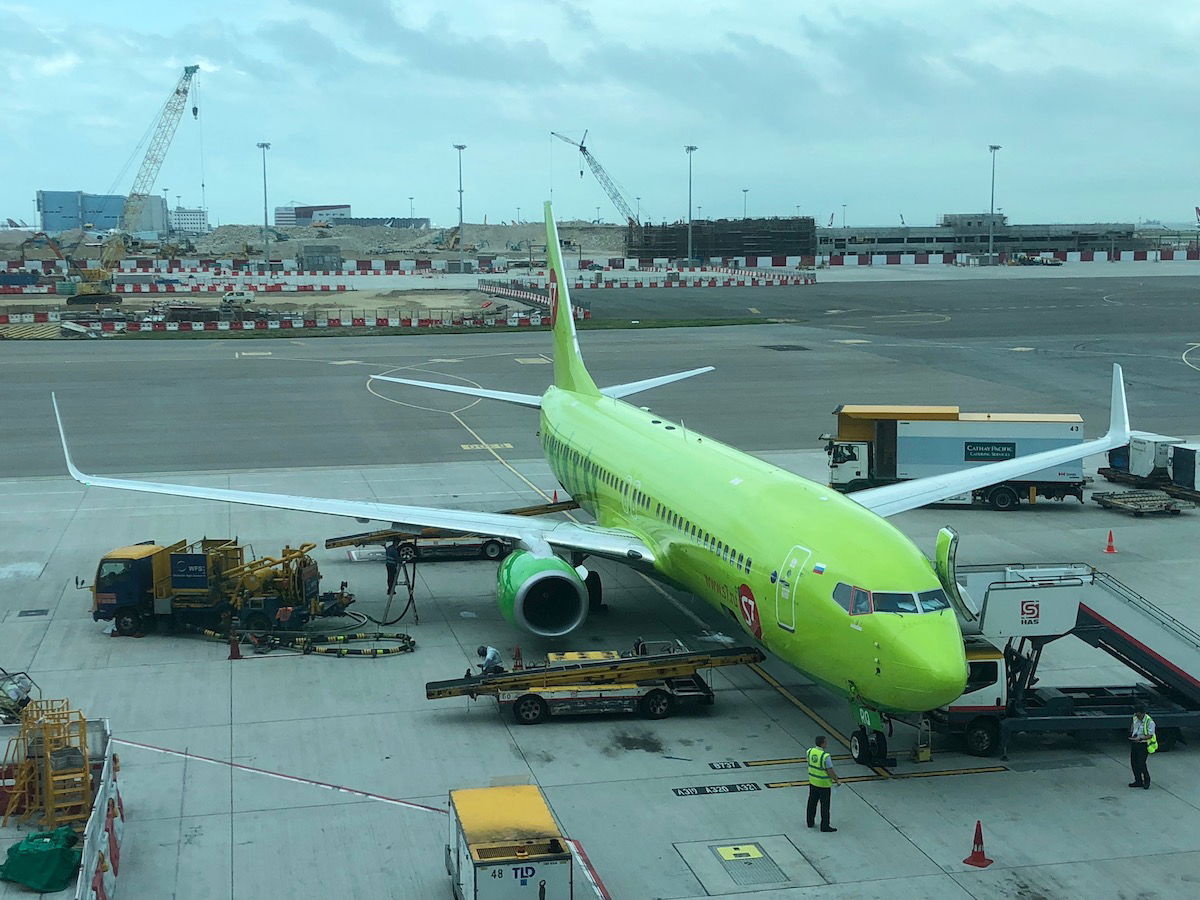
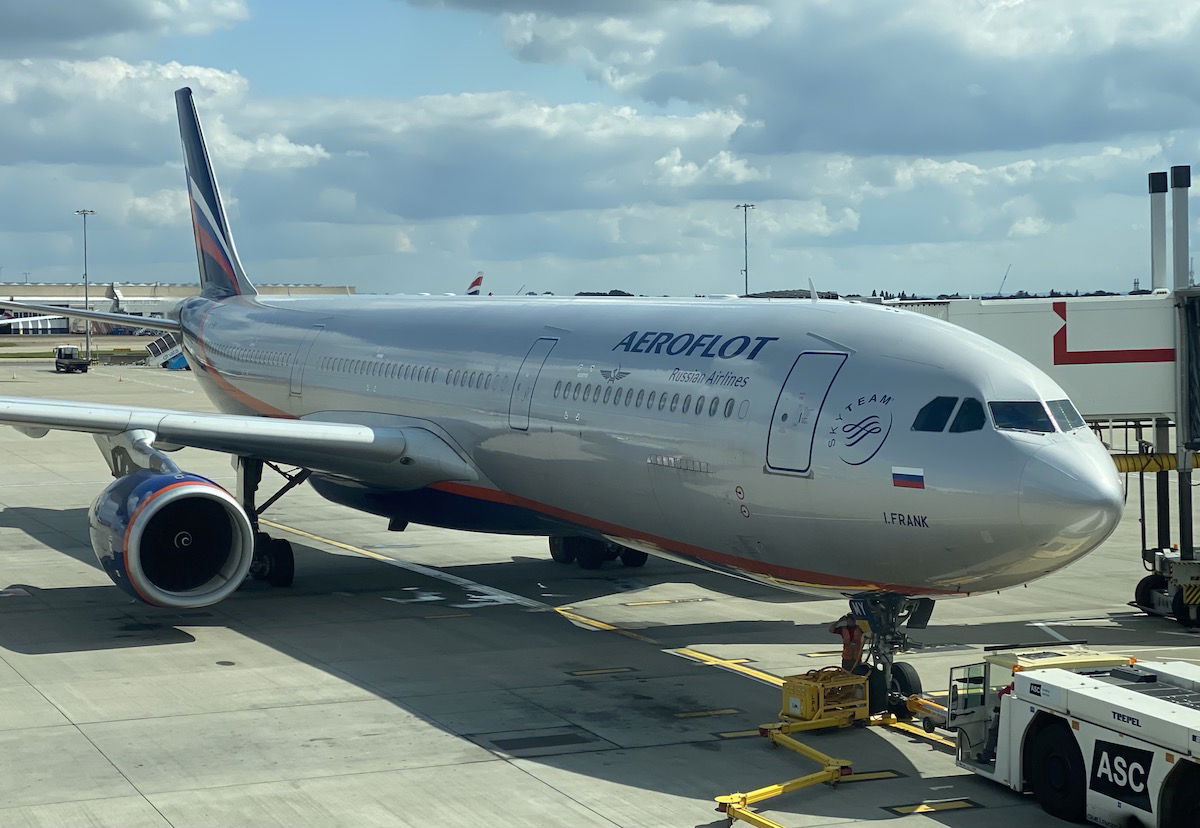
As of March 13, 2022, the Bermuda Civil Aviation Authority (BCAA) has provisionally suspended all certificates of airworthiness of Bermuda-registered aircraft operating in Russia. The reason this matters is because roughly half of the commercial jets in Russia are registered in Bermuda (including a majority of the planes that are leased).
International sanctions make it hard for Bermuda to maintain safety oversight of these Russian operated aircraft, meaning that Bermuda can no longer confidently verify that these aircraft are airworthy.
Why are so many planes flying in Russia registered in Bermuda? There are a few reasons, including lower import duties, better safety oversight, and easier and better insurance options. The process of trying to re-register aircraft in Russia is currently taking place, but that also has its complexities.
Hundreds of Russian jets are registered in Bermuda
Why this doesn’t matter all that much
Under normal circumstances, half of a country’s commercial aircraft losing their airworthiness certificates would be really significant. But at this point it probably doesn’t matter all that much:
Russian airlines have almost entirely suspended international flights, so demand for air travel is a fraction of what it once was; airlines don’t need all of their planes
With sanctions in place, hundreds of Russian jets are supposed to be seized, as lease agreements have been terminated; however, Russian airlines are refusing to return these jets, and repossessing them in Russia isn’t exactly easy right now
Many Russian planes are without insurance now, but even so, continue to fly
On the surface it’s significant that half of Russia’s commercial jets are officially no longer considered (legally) airworthy. Then again, Russian airlines are illegally refusing to return planes to leasing companies, so I’m not sure Russian airlines care much more here either?
Odds are that Russian airlines won’t care much about this
Bottom line
Aviation regulators from Bermuda have suspended the airworthiness certificates of the hundreds of jets registered in Russia. This move comes as the regulator can no longer confidently speak to the airworthiness of these planes.
While this would usually have major implications, Russia no longer cares about international laws, so this is likely all a moot point.
Russia is seizing Western-built airliners while sanctions block parts, maintenance, and support
Taylor Rains – March 14, 2022
Russian President Vladimir Putin chairs a meeting with members of the government via teleconference in Moscow, Thursday, March 10, 2022Mikhail Klimentyev, Sputnik, Kremlin Pool Photo via AP, File
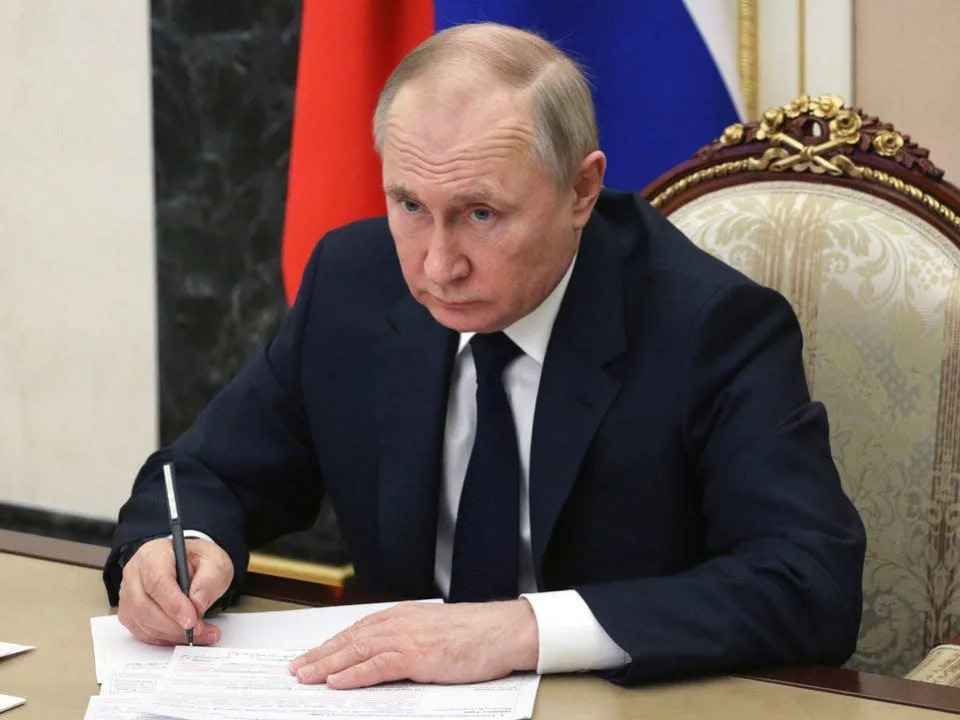
Russian President Vladimir Putin has signed a law authorizing the seizure of hundreds of Western-built aircraft operated by Russian airlines.
The planes are owned by aircraft lessors, which have canceled contracts following sanctions against Russia.
The seize could pose a risk to passengers because the planes may not receive proper maintenance repairs due to sanctions.
On Monday, Russian President Vladimir Putin signed a law that will allow Russian airlines to take control of hundreds of the Western-built planes leased from international firms, Russian news agency TASS reported, per The Wall Street Journal.
The battle between Russia and lessors has been ongoing since the invasion of Ukraine on February 24, with the EU forcing aircraft leasing companies to cancel their contracts with Russian airlines by March 28, meaning those foreign planes need to be returned to their owners.
However, Russian authorities and airlines have made the task difficult, including airspace closures and a ban on most international flights.
Meanwhile, European and US sanctions have cut Russian airlines off from planemakers Airbus and Boeing, which produced the bulk of the leased aircraft. That means the two Western companies cannot provide support in the form of maintenance, spare parts, or updates for the complex machines, which could pose a risk for passengers and airline staff, the Wall Street Journal noted.
As Boeing and Airbus are banned from shipping spare parts to Russia, this could force airlines to turn to risky alternatives, like buying uncertified supplies from China or “cannibalizing” parts from planes on the ground, including lessor jets.
According to aviation consultancy Ishka, $10 billion worth of planes is stranded in Russia.
“The lessors may end up having to take a writeoff,” Nick Cunningham, an analyst with Agency Partners, told Bloomberg.
Russia Facing ‘Outright Defeat’ And ‘Sudden’ Collapse In Ukraine, Author Says
Ed Mazza – March 13, 2022
Author and political scientist Francis Fukuyama said the Russian military is now facing the possibility of “outright defeat” in Ukraine.
And he’s warning Russian President Vladimir Putin that the end could be swift ― for both his military and his more than two-decade rule.
“The collapse of their position could be sudden and catastrophic, rather than happening slowly through a war of attrition,” Fukuyama wrote for the American Purpose website. “The army in the field will reach a point where it can neither be supplied nor withdrawn, and morale will vaporize.”
Fukuyama, author of 1992′s “The End of History and the Last Man,” blamed incompetent planning by Moscow, which anticipated that its forces would be welcomed in Ukraine.
“Russian soldiers were evidently carrying dress uniforms for their victory parade in Kyiv rather than extra ammo and rations,” wrote Fukuyama, who holds several positions at Stanford, including Olivier Nomellini Senior Fellow at the university’s Freeman Spogli Institute for International Studies.
Now, those soldiers are stuck outside of cities, facing both supply issues and constant attacks from Ukrainian forces.
If they’re defeated, he predicted, that would also spell the end of Putin.
“Putin will not survive the defeat of his army,” Fukuyama wrote. “He gets support because he is perceived to be a strongman; what does he have to offer once he demonstrates incompetence and is stripped of his coercive power?
220,000 Ukrainians have returned home in the last 2 weeks
Catherine Garcia, Night editor – March 14, 2022
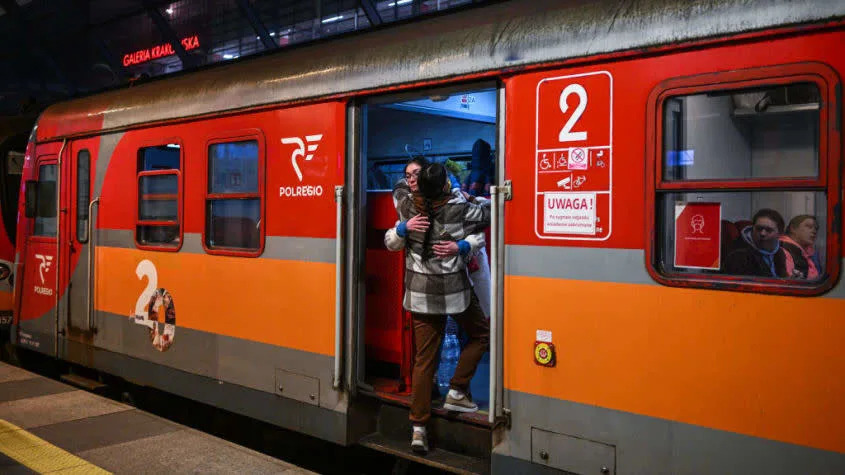
A train carrying Ukrainian refugees in Krakow. Omar Marques/Getty Images
In the last two weeks, 220,000 Ukrainians have made the trek home, the country’s border guard said — many were traveling when the Russian invasion began, others needed to tie up loose ends at their foreign jobs, some are returning to fight, and a few say it’s even harder to be a refugee than it is to be back in Ukraine.
On their journey last week from the Ukrainian town of Mykolaiv to Poznan, Poland, Zhanna Sinitsyna, her 30-year-old daughter Nadiia, and 12-year-old granddaughter Kira witnessed explosions and heard gunfire. Once in Poznan, the plan was to find work and send money to Mykolaiv, where Zhanna’s husband and 19-year-old son are part of efforts to defend the city.
They were unable to find an affordable place to stay in Poznan near areas with employment opportunities and quickly discovered they didn’t have enough money to purchase necessities. After just two days, Zhanna convinced Nadiia and Kira to return to Mykolaiv on Saturday, despite their concerns. “In my soul, Mykolaiv is my home,” Zhanna told The Washington Post. “And I need to be home.”
Oleksii Zvieriev is from the Kyiv suburb Brovary, and works as a truck driver, delivering goods across Europe. On the day Russia invaded, he decided that as soon as the job was over, he would go back to Ukraine and start fighting. Standing at a train station in Przemysl, Poland, on Saturday night, he told the Post he was keeping his word and heading home.
“It’s hard to talk about the emotions of going back into a war,” Zvieriev said. “I have friends sitting in basements telling me they’re hearing explosions all the time. I can’t stop worrying.” Two of his friends — one 40 years old, the other 25 — were killed shortly after picking up arms against Russia.






 Scroll back up to restore default view.