85,000 Children in Yemen May Have Died of Starvation
The aid organization Save the Children said the number was a conservative estimate of those under age 5 who may have died.
By Palko Karasz November 21, 2018
Children suffering from malnutrition at a Unicef-run mobile clinic in Aslam, Yemen, northwest of the capital, Sana. Credit: Tyler Hicks/The New York Times
The United States announced on Wednesday that peace talks to end the war in Yemen would begin next month in Sweden. The announcement came amid growing global pressure to stop the bombing campaigns by a Saudi-led coalition that have unleashed conditions amounting to possible war crimes, according to a United Nations report in August.
The announcement by Secretary of Defense Jim Mattis at the Pentagon came on the heels of a statement by the aid agency Save the Children on Wednesday that underscored the harrowing nature of the conflict: An estimated 85,000 children might have died of hunger since the bombings began in 2015.
Experts say Yemen has become the worst humanitarian crisis in the world, and 14 million people could soon be on the brink of starvation, according to the United Nations.
‘It’s entirely preventable’
“For every child killed by bombs and bullets, dozens are starving to death — and it’s entirely preventable,” Tamer Kirolos, Save the Children’s country director in Yemen, said in the statement. “Children who die in this way suffer immensely as their vital organ functions slow down and eventually stop.”
The statement said that 85,000 was a conservative estimate of how many children under the age of 5 had starved between April 2015, when Saudi Arabia began its air war, and this October.
In addition to the airstrikes, Saudi Arabia has imposed economic sanctions and blockades on Yemen, contributing to the deepening humanitarian crisis.
War in Yemen
New York Times reporters have examined the toll of Yemen’s war.
The Tragedy of Saudi Arabia’s War in Yemen.
This is the front line of Saudi Arabia’s invisible war Yemen Girl Who Turned World’s Eyes to Famine Is Dead
The price of food has doubled
David Beasley, the managing director of the World Food Program, visited Yemen last week and painted a dire portrait of the situation.
“What I have seen in Yemen this week is the stuff of nightmares, of horror, of deprivation, of misery. And we — all of humanity — have only ourselves to blame,” Mr. Beasley told the United Nations Security Council on Friday.
Since the spring, the price of basic food staples has doubled, Mr. Beasley added. “For a country that’s dependent on imports for the basic needs of life, this is disaster,” he said.
As the death toll from the military operation worsens, rebuilding the economy has emerged as a priority to prevent widespread famine.
“This is disaster,” said David Beasley, the managing director of the World Food Program.Credit: Tyler Hicks/The New York Times
The war blocks a gateway for aid
Saudi Arabia intervened in Yemen’s civil war in April 2015 to fight the Shiite rebels backed by its regional rival, Iran. But instead of a quick victory, the Saudi-led campaign evolved into a bloody stalemate. The bombardment, which relies heavily on arms and equipment from the United States, has torn the country asunder.
Because of fighting around the port of Hudaydah, a crucial gateway for aid efforts, humanitarian programs have been scaled back, the United Nations special envoy for Yemen, Martin Griffiths, told the Security Council on Friday.
Save the Children said it had been forced to reroute supplies for the north of the country through the southern port of Aden, with deliveries taking three weeks instead of one.
According to Stephen L. Anderson, country director for the World Food Program in Yemen, 8.4 million people are considered to be severely food insecure, one step from famine.
“Now, based on analysis and projections, that number could increase by 50 percent or so,” Mr. Anderson said in a phone interview on Wednesday. “Even if peace were to break out tomorrow, which is very unlikely, we’ve still got a massive humanitarian crisis on our hands,” he added.
Trump’s defense of the Saudis
President Trump has defended Saudi Arabia’s intervention in Yemen, blaming Iran for the conflict. Tehran, he said in a statement on Tuesday, was “responsible for a bloody proxy war against Saudi Arabia in Yemen,” while “Saudi Arabia would gladly withdraw from Yemen if the Iranians would agree to leave.”
In his embrace of Saudi Arabia, Mr. Trump has dismissed his own intelligence experts’ conclusion that the kingdom’s young de facto ruler, Prince Mohammed bin Salman, had ordered the killing of the dissident Jamal Khashoggi, fueled his “America First” agenda by touting a huge Saudi arms deal and doubled down on the need for the Saudis’ help in the Middle East to contain Iran.
On Wednesday, Mr. Trump praised the Saudis for a drop in oil prices, writing on Twitter: “Oil prices getting lower. Great! Like a big Tax Cut for America and the World. Enjoy! $54, was just $82. Thank you to Saudi Arabia, but let’s go lower!”
By largely absolving Prince Mohammed of any responsibility in the killing of Mr. Khashoggi — “Maybe he did and maybe he didn’t!” Mr. Trump said — he ignores a documented list of humanitarian disasters and rights abuses by the kingdom, and his pardoning of Saudi Arabia could embolden autocrats across the globe, analysts say.
This month, the United States said that it would end air refueling flights for the Saudi military campaign in Yemen and prepare sanctions against Saudis linked to the killing of Mr. Khashoggi. But those steps were seen as limited and in response to overwhelming international condemnation.
The United States Agency for International Development has said that the United States was providing more than $566 million in aid to manage the humanitarian crisis. In a fact sheet published Nov. 9, it pointed to the damage done to civilian infrastructure following the Saudi coalition’s deployment around the port city of Hudaydah.
Mr. Mattis did not specify a date for the peace talks for fear of coming out ahead of a United Nations announcement.
“It looks like that very, very early in December, up in Sweden,” he said in Washington. “We’ll see both the Houthi rebel side, and the U.N.-recognized government, President Hadi’s government, will be up there.”
Mr. Mattis added that the Saudi-led coalition had stopped its offensive around Hudaydah before the talks.
Greta Thunberg to Congress: ‘You’re not trying hard enough. Sorry’
The Swedish environmentalist was one of several who spoke at a Senate climate crisis task force
By Lauren Gambino September 17, 2019
Greta Thunberg attends a Senate climate change task force meeting in Washington DC. Photograph: Mark Wilson/Getty Images
At a meeting of the Senate climate crisis task force on Tuesday, lawmakers praised a group of young activists for their leadership, their gumption and their display of wisdom far beyond their years. They then asked the teens for advice on how Congress might combat one of the most urgent and politically contentious threats confronting world leaders: climate change.
Greta Thunberg, the 16-year-old Swedish activist who has galvanized young people across the world to strike for more action to combat the impact of global warming, politely reminded them that she was a student, not a scientist – or a senator.
“Please save your praise. We don’t want it,” she said. “Don’t invite us here to just tell us how inspiring we are without actually doing anything about it because it doesn’t lead to anything.
“If you want advice for what you should do, invite scientists, ask scientists for their expertise. We don’t want to be heard. We want the science to be heard.”
In remarks meant for Congress as a whole, she said: “I know you are trying but just not hard enough. Sorry.”
The audience laughed. Supporters broke into applause. Senator Ed Markey, the Massachusetts Democrat who co-sponsored the Green New Deal and leads the Senate task force, was perhaps surprised by her bluntness. But he smiled.
Seated at the table with the teens were some of the most sympathetic and vocal supporters of bold action on climate change in Congress. But facing a Republican-controlled Senate and a hostile White House, the prospect of enacting reforms at the scale and scope called for by activists – and many scientists – is bleak.
“We need your leadership,” he told Thunberg. “Young people are the army politically, which has arrived in the United States. You put a spotlight on this issue in a way that it has never been before. And that is creating a new X factor.”
Still, Markey vowed to try: “We hear you. We hear what you’re saying and we will redouble our efforts.”
Thunberg was one of several youth activists invited to address the task force during two days of action and speeches aimed at urging lawmakers to support “transformative climate action”. She was joined by activists from across the US and South America, part of a “multiracial, intergenerational” effort to combat climate change.
The meetings and speeches in Washington are intended to raise awareness ahead of a global climate strike on Friday in which students and workers will walk out of schools and offices to pressure their governments to act as world leaders gather in New York for the annual United Nations summit.
Nadia Nazar, co founder of Zero Hour, speaks to the media on 17 September in Washington DC. Photograph: Eric Baradat/AFP/Getty Images
“The generation of the Green New Deal will not only survive but we will thrive,” said Nadia Nazar, co-founder of the advocacy group Zero Hour, at a news conference earlier on Tuesday.
“We will no longer be known as the kids fighting the apocalypse. We will be known as the solution to the climate crisis.”
In the US, support for sweeping action on climate change is polarized. Many Republicans – among them Donald Trump – are still openly skeptical of the science behind global warming. Republican leaders have mocked Democrats for introducing a Green New Deal and have used the proposal as a cudgel against lawmakers and presidential candidates.
The Green New Deal is an ambitious 14-page resolution that calls for a “10-year national mobilization” that would eliminate the nation’s emissions in one decade. Scientists say limiting warming to 1.5C would require cutting man-made carbon levels by 45% by 2030 and reaching net zero around 2050.
Markey said their movement is shifting the political landscape. The senator pointed to the 2020 presidential debates as evidence of what has changed. Candidates are being asked about climate change and pushed to introduce plans to combat global warming. This is in stark contrast to 2016.
“What has happened? You have happened,” he told the activists. “You are giving this extra level of energy to the political process that is absolutely changing the dynamics of politics in the United States.”
The 2020 election, Markey said, will in many ways be a “referendum on climate change”.
Thunberg arrived in the US after crossing the Atlantic on a solar-powered yacht. She rose to international prominence after launching “Fridays for Future”: student-led strikes that have spread to 135 countries. She has been nominated for a Nobel Peace Prize.
On Monday, she met Barack Obama. The former president shared a photo from their meeting, in which he praised Thunberg as “one of our planet’s greatest advocates” and someone who is “unafraid to push for real action”.
Barack Obama: Just 16, @GretaThurnberg is already one of our planet’s greatest advocates. Recognizing that her generation will bear the brunt of climate change, she’s unafraid to push for real action. She embodies our vision at the @ObamaFoundation: A future shaped by young leaders like her.
Later on Tuesday, the group was scheduled to meet Senate minority leader Chuck Schumer and Alexandria Ocasio-Cortez, who is a co-sponsor of the Green New Deal in the House.
On Wednesday, Thunberg will deliver what has been billed as a “major address” to members of Congress.
As the crisis escalates…
… The Guardian is committed to keeping the story front and center daily, giving issues of environmental degradation, pollution and species extinction the prominence they deserve.
We’re urging other media organizations to make the same commitment and help focus public attention on this global emergency. In the runup to a major UN climate summit on September 23rd, The Guardian is joining forces with more than 250 news organizations from around the world as part of Covering Climate Now.
This is a groundbreaking initiative to increase nationwide media coverage of the climate emergency. We will be sharing a portion of our climate coverage with partners in the network, in the hope that news organizations without dedicated environment desks will have the opportunity to provide in-depth reporting on this issue. By increasing the reach of our climate coverage, our goal is to spark action from our leaders, inspire citizens, and point to systematic change.
But we need your ongoing support to keep delivering quality journalism on the climate crisis–and the many other critical issues we cover, from widespread inequality to the influence of big tech on our lives. At a time when factual information is a necessity, we believe that each of us, around the world, deserves access to accurate reporting with integrity at its heart.
Our editorial independence means we set our own agenda and voice our own opinions. Guardian journalism is free from commercial and political bias and not influenced by billionaire owners or shareholders. This means we can give a voice to those less heard, explore where others turn away, and rigorously challenge those in power.
Every reader contribution, big or small, is so valuable.
Crowdfunding Saves 2,000 Acres From Loggers in British Columbia
Olivia Rosane September 4, 2019
Princess Louisa Inlet on the British Columbia Coast.
A Canadian charity has successfully crowdfunded $3 million to save 800 hectares (approximately 1,977 acres) of wilderness from development. Instead, the property on British Columbia’s Princess Louisa Inlet will now be one of the first crowdfunded parks in the country, CBC News reported.
The BC Parks Foundation, the official charity partner of BC Parks, set out to raise the money when the property was put up for sale.
“There were a couple of offers for it to be logged, so a lot of people came to us and said, ‘Is there something you can do? Can we get together, can we try to protect this place?’ So we said yes,” BC Parks Foundation CEO Andy Day told Global News.
The group negotiated a price of $3 million, with an Aug. 28 deadline for raising the funds. They only barely made that deadline: The last of the money came in Aug. 27, according to CBC News. The purchase was finalized on Tuesday.
“You did it! Your love for British Columbia and beautiful places like Princess Louisa Inlet has done something miraculous,” the group wrote in a message to supporters.
Donations came from as far away as Germany and Japan, according to Global News. Many small donors contributed to meet the foundation’s goal.
“It was so many people who gave us $10 or $15 and said, ‘This is all I can do, but this is a wonderful thing that you’re doing,'” Day told CBC News.
Now that the money is raised, the group will work with the Sechelt Nation and the provincial government to finalize plans for the property. Its ultimate goal is to bundle it with other protected land in the area to create a 9,000 hectare (approximately 22,240 acre) park around the inlet.
Princes Louisa Inlet is the best example of a southern fjord in North America, according to the BC Parks Foundation. It is currently undeveloped and has no roads. It supports wildlife like grizzly bears, mountain goats, eagles, northern goshawks, threatened marbled murrelets, marine life and moss and lichen. The land purchased by the foundation covered three miles of waterfront on the inlet’s south side.
“It’s really a huge portion of the inlet and we’ll do our best to make sure that that area stays protected forever,” Day told CBC News.
Day said that crowdfunding campaigns to create parks were unusual, but could become an increasingly important conservation tool.
“I think hospital foundations and all the charities out there know that government can’t do everything,” he told Global News. “So the way that companies and private citizens and governments can come together around things to do great things, that’s the model of the future, and I think it’s a really beautiful model in the sense that it just allows more people to participate and be a part of something great.”
Meet William Perry Pendley, the new head of America's Bureau of Land Management. His mission, sell off America's public lands. All of them. #YEARSproject
While the British Parliament stands against Prime Minister Boris Johnson’s plan for a blundering no-deal brexit, and while millions of protesters stand up to Hong Cong’s embattled leader Carrie Lam’s heavy-handed extradition bill, America proves once again that it’s no longer # 1 at anything but maintaining the status quo. Regardless of our feckless republi-con congress’s subservience to trump’s every whim, his daily zigs and zags and his mind-boggling lack of competence, Democracy is alive and well in other parts of our universe.
The conservative members of Parliament who jumped ship to vote with the liberal democrats may no longer be satisfied unless Boris Johnson resigns. Anna Soubry, who left the Conservative Party because of the Brexit debacle a few months ago, explains: “having “bullied and blackmailed” as many M.P.s as he could into voting with him (Boris Johnson). “This is about our country,” Soubry told her colleagues. “It’s also about your own respect.”
Anti-Brexit protesters gather outside No. 10 Downing St. in opposition to British Prime Minister Boris Johnson’s decision to shut down Parliament. Photo by Hugo Philpott/UPI | License Photo
And the young Hong Cong protesters, who’ve been flexing their Democratic principles for the last 3 months, may not be satisfied with leader Lam’s half-hearted capitulations. They demand more from Lam and Beijing.
Yet our own leaders in the republican controlled senate refuse to budge. At the height of the hurricane season, they allow critical emergency funds diverted to pay for trump’s fanatical war on immigration and diversity. They ignore America’s overwhelming pleas for sensible gun laws. They turn a blind eye to trump’s onslaught against our environment. They cower and applaud when trump signs away America’s national treasures. They stand by while trump’s criminal enterprise enriches themselves at the taxpayers expense. And and they sit idle on more than a 100 bills passed by the democratic House attempting to actually legislate to solve America’s problems.
But the chinks in trump’s faithful armor are beginning to show in recent polls. Farmers battered by trump’s nonsensical trade war, no longer have their GPS locked in and tracking closely with trumps pathway to reelection. Miners no longer wish to waste their lives in a dying industry and might just opt for an alternative energy and employment. Many evangelicals are staying the course but their disciples are dwindling faster than proponents of high fructose corn syrup. Those old white faithful voters are dying off by the 10’s of thousands every month. And lets face it, America is just sick tired of trump’s nonstop bipolar drama. 2020 will not just be a repudiation of trump’s criminal operations, but a condemnation of the entire faux fiscally conservative, ult right, moral pretending republi-con party.
America has changed before their very lying eyes; it’s no longer majority white and christian. It’s strength is in it’s dissimilitude. We cheer on the hoards of women and children at our Southern border; the “huddled masses, yearning to breathe free,” because that’s what we stand for. Many of our friends and family are part of the LGBTQ community. We embrace all our neighbors, no matter their hues, and as our Constitution instructs, not any one religion, or maybe no religion, will govern us all.
Unless and until the republi-con senate finds it’s self respect and embraces it’s oath to country first, all of us must do everything we can to resist the destruction of our democratic ideals and institutions, until they’re voted out in 2020.
Pentagon takes money from Puerto Rico, European projects to fund Trump’s wall
By Paul Sonne and Seung Min Kim September 4, 2019
President Trump in the Oval Office on Tuesday. He declared a national emergency in February to build a border wall. (Jonathan Ernst/Reuters)
The Pentagon is defunding Hurricane Maria recovery projects at military installations in Puerto Rico and the U.S. Virgin Islands to pay for President Trump’s border wall, and is also taking money from construction projects across Europe designed to help allies deter Russia.
The details of the 127 military construction projects that stand to lose funding to pay $3.6 billion for fencing and barriers on the southern border with Mexico were made public late Wednesday by the Department of Defense.
The list includes projects across 23 U.S. states, three U.S. territories and 20 countries. The decisions about which projects to defund deal a particular blow to Puerto Rico, which stands to see more than $400 million worth of planned projects lose funding. Roughly $770 million of the funding will be taken from projects across allied European nations aimed at helping them deter a possible attack from Russia.
Officially, the Pentagon is saying that the affected projects are “deferred,” but in order for them to go ahead in the future, Congress must again fund them. The Republican-led Senate has agreed to do so in its annual defense policy bill, but the Democratic-led House refused in its version of the bill. The two sides will negotiate a possible compromise in conference, the period when the Senate and House make trades to meld two bills into one before seeking the president’s signature.
If Congress declines to fund the construction projects — or “backfill” them, in the Trump administration’s parlance — they will remain in limbo and effectively be defunded. If they are backfilled in the coming year’s budget, some could proceed without delay, because the Pentagon deliberately chose projects with contract award dates scheduled for future years. The department also chose projects that were already facing delays.
A senior defense official, speaking on the condition of anonymity at a Pentagon briefing because the department declined to hold the event on-the-record, said the Department of Defense is committed to proceeding with the projects and plans to work with Congress to replenish their funding. The official expressed confidence that the funding would be replenished but admitted it wasn’t guaranteed.
The list of projects ranges the gamut, from a space control facility at Peterson Air Force Base in Colorado; to weapons training ranges in Mississippi, Oregon, Oklahoma, Wisconsin and Alaska; to central heat and power plant boilers that need repairs at Eielson Air Force Base in Alaska. Also on the list is a $9 million plan to replace a working-dog treatment facility at Guantanamo Bay. Nine projects involve renovating and replacing schools for military children on bases in the United States and abroad.
The information about the projects comes a day after Defense Secretary Mark T. Esper formally approved a decision to divert the $3.6 billion to pay for 175 miles of barrier on the southern border with Mexico.
To do so, Esper relied on an obscure part of the U.S. code governing the military. Known as Section 2808, the law allows the defense secretary, during national emergencies requiring the use of the armed forces, to tap military construction funds without sign-off from Congress for projects necessary to support those troops. Esper deemed the border barriers necessary to support the troops Trump deployed to the border to help Customs and Border Protection with an influx of primarily Central American migrant families.
The Pentagon gained access to the authority after Trump declared a national emergency in mid-February, having failed to persuade Congress to provide more money for the project. The dispute led to the longest U.S. government shutdown in history, lasting 35 days in late 2018 and early 2019.
The Trump administration has also used a separate counterdrug law to access $2.5 billion for barrier construction from the Pentagon budget. It is also taking $601 million from the Treasury Department asset forfeiture fund for the barrier construction. On the campaign trail, Trump regularly said Mexico would pay for his border wall project.
Democrats have said Trump’s actions fly in the face of the Constitution, which gives the power of the purse to Congress and not the executive branch. They say his use of obscure laws to get around Congress’s sole authority to allocate money from the federal budget opens the door to subsequent presidents doing an end run around Congress when lawmakers refuse to fund their projects.
The $3.6 billion will pay to replace existing barriers or fences and construct new fence systems.
Some $1.16 billion of the funding will go to construct a second pedestrian fence system where the military’s Barry M. Goldwater Bombing Range abuts the border with Mexico and to replace vehicle barriers that separate the Cabeza Prieta National Wildlife Refuge from Mexico with pedestrian fencing. An additional $40 million will go toward replacing a 1.5-to-2-mile stretch of fencing along the bombing range.
An additional $1.27 billion will be spent on a new fence system for about 52 miles along the Rio Grande outside Laredo, Tex.
After months of protests, Hong Kong leader Carrie Lam withdraws controversial extradition bill
By James Griffiths, CNN September 4, 2019
Hong Kong (CNN)Hong Kong’s embattled leader Carrie Lam has finally fully withdrawn a controversial bill that allowed extradition to mainland China and sparked three months of dramatic protests in the financial hub.
The decision to cave in to one of protesters’ five core demands marked a dramatic U-turn for Lam, who for months has refused to withdraw the bill.
“We must find ways to address the discontent in society and look for solutions,” Lam said in a a video statement Wednesday evening. “After more than two months of social unrest, it is obvious to many that this discontentment extends far beyond the bill.”
But Lam refused to give ground on protesters’ four other demands, including greater democracy for the city and an independent commission into police conduct, saying all investigations would be carried out by the existing Independent Police Complaints Council (IPCC).
Carrie Lam’s four actions
1. Hong Kong government officially withdraws extradition bill
2. Two new members appointed to Independent Police Conduct Commission
3. More direct communication with the community
4. Calls for community leaders to “independently examine” problems in society.
Instead, she announced the addition of a former education bureau chief and former judge to the IPCC. Lam said the government’s priority now was to restore law and order to Hong Kong. “Let’s replace conflicts with conversations and let’s look for solutions,” she said.
Lam suspended the extradition bill in June after more than 1 million people marched against it, with protesters surrounding the city’s legislature on the day of its planned second reading.
That suspension did not satisfy protesters, who demanded the bill’s complete withdrawal — making it harder for the government to rush the law through at a later date. A withdrawn bill would need to go back to the beginning of the legislative process, whereas a suspended one could resume where it left off.
In recent weeks, protesters’ tactics have become increasingly violent as young people felt the government was refusing to consider their demands.
Pro-Beijing lawmaker Michael Tien said that Lam’s withdrawal may not stem their anger. “I believe the withdrawal of the bill … may be too late because this movement has become more than the bill,” he said.
Hong Kong protesters’ 5 demands
Fully withdraw the extradition bill
Set up an independent inquiry to probe police brutality
Withdraw the characterization of protests as “riots”
Release those arrested at protests
Implement universal suffrage in Hong Kong.
Activist Joshua Wong, who was last week arrested in a police sweep of activists and opposition politicians, wrote on Twitter: “Carrie Lam’s repeated failure in understanding the situation has made this announcement completely out of touch – She needs to address to ALL Five Demands: STOP PROSECUTION, STOP CALLING US RIOTERS, INDEPENDENT INQUIRY OF POLICE and FREE ELECTION!”
Initial response to Carrie Lam:
1. Too little and too late now — Carrie Lam’s response comes after 7 lives sacrificed, more than 1,200 protestors arrested, in which many are mistreated in police station.
Lam not resigning
Earlier this week, Lam denied that she had offered to resign over her handling of the crisis after a recording published Monday night of her at a meeting with business leaders was leaked to Reuters. On the tape, she can be heard saying she would have quit “if I have a choice.”
Speaking to reporters Tuesday, Lam said she had not “contemplated to discuss a resignation” with her mainland superiors.
In the recording, Lam can be heard saying the bill was “not something instructed, coerced by the central government.”
“If I have a choice, the first thing is to quit, having made a deep apology,” she said. “We were not sensitive enough to feel and grasp (the) huge degree of fear and anxiety amongst people of Hong Kong vis-à-vis the mainland of China.”
“For a chief executive to have caused this huge havoc to Hong Kong is unforgivable,” Lam added.
That may remain the view for many Hong Kongers even after the formal withdrawal of the bill. Many will be asking why it took three months of unprecedented unrest, violence and damage to the city’s economy for the government to upgrade the bill from “suspended” to “withdrawn,” despite repeatedly insisting that it had no future and would not be reintroduced.
Lam may be hoping that the move will put a lid on the protests ahead of October 1, when China will celebrate National Day and mark 70 years of the People’s Republic.
But whether this will be the case remains highly uncertain.
“The nature of the protest movement has transformed over the last 13 weeks,” said Adam Ni, a China researcher at Macquarie University in Sydney.
“She will have to take further steps, such as setting up an independent inquiry into police conduct. If she does not take further steps, then we can expect the protests to continue.”
Twenty-one Tory M.P.s turned against Prime Minister Boris Johnson on Tuesday in a vote to prevent a no-deal Brexit from the European Union. Photograph by Alberto Pezzali / AP
On Tuesday afternoon, hours before Prime Minister Boris Johnson lost a historic vote in Parliament—one that may bring down his government and force new elections in a matter of weeks—he was standing in the House of Commons, plying a cardboard imitation of Winston Churchill. Members of Parliament were trying to bring a bill to the floor which would keep Johnson from heedlessly crashing the United Kingdom out of the European Union without basic arrangements in place regarding travel and trade and a host of other issues. He complained that they wanted him to go to the E.U. and “beg,” “running up the white flag,” and that their anti-no-deal bill would undermine his proposals, even though there is no evidence that he has put any substantive proposals forward. He called the legislation “Jeremy Corbyn’s surrender bill,” a reference to the opposition Labour Party leader, even though it was also supported by many members of Johnson’s own Conservative Party, who, in doing so, were defying threats that they would be expelled from the Party and face losing their seats. “I will never surrender!” Johnson declared, as if the bravery were on his side, and not on theirs. The act was not convincing. Johnson was jeered and booed.
The United Kingdom, at the moment, seems almost leaderless. Johnson lost the vote on Tuesday by a margin of 328–301, with twenty-one Tory M.P.s—including Nicholas Soames, who is Churchill’s grandson, and the former Cabinet members Philip Hammond and Rory Stewart—voting against him. The vote was a procedural one, meant to allow M.P.s to take control of the Parliamentary agenda so that they can bring the legislation forestalling a no-deal Brexit to a vote on Wednesday. (The bill would do this by requiring the Prime Minister to ask the E.U. for an extension to the Brexit deadline—which is currently October 31st—if negotiations aren’t complete.) A moment after Tuesday’s vote tally was announced, Johnson rose to say that he will move to force a snap general election if he also loses the Wednesday vote. “I don’t want an election,” he said, even as he seemed to grasp at the prospect of effectively turning the complex debate on Brexit into a referendum on him.
Johnson’s announcement was accompanied by some confusion. Because of a 2011 law called the Fixed-Term Parliaments Act, a Prime Minister cannot simply order up an election whenever he or she likes. One way to get one is for the government to put forward an election bill, which Parliament must approve by a vote of two-thirds; this is the route that Johnson said he would take. But are the votes there? Corbyn has said that his Party wants a new election, but he has also said that he wants that to happen after the no-deal-blocking legislation has become law. It is not clear what would happen if the new-election bill comes first. Parliament may be headed for a game of legislative bumper cars.
Another way to get a new election is for the Prime Minister to lose a formal no-confidence vote and resign. And it’s not at all clear that, if the question were put to a test now, a majority of M.P.s would support Johnson’s leadership—which is the definition of confidence and the basis of a P.M.’s power. Earlier in the day on Tuesday, even as Johnson was speaking, a Tory M.P., Phillip Lee, walked away from the Conservative benches and sat down with the Liberal Democrats, indicating that he was switching parties. (“I wish my honorable friend all the best,” Johnson managed to say, before he was interrupted by the raucous reaction to Lee’s bench-switching.) Lee’s defection was enough, on paper, to deny Johnson a chance at a working majority in Parliament—which was already vanishingly slim and dependent on the votes of the Northern Irish Democratic Unionist Party. Lee, in a letter addressed to Johnson, which he posted on Twitter after his switch, said that Brexit had “sadly transformed this once great Party into something more akin to a narrow faction in which one’s Conservatism is measured by how recklessly one wants to leave the European Union.” Lee said that the Tories had “become infected by the twin diseases of English nationalism and populism.” One might add the self-satisfied dishonesty of Boris-ism to that diagnosis.
If Johnson does lose a confidence vote, there will be a lot of gamesmanship, because there are also questions about what would legally be required to happen next, particularly if no one else in Parliament—including Corbyn—has an obvious majority. And then there is the great uncertainty: If there is an election, who will win? (If the recent European Parliamentary elections are any indication, both major parties are vulnerable.) But Tuesday was the first real test for Johnson, and he failed it, despite, as Anna Soubry, who left the Conservative Party over Brexit a few months ago and is now the leader of the new Change U.K. Party, put it, having “bullied and blackmailed” as many M.P.s as he could into voting with him. “This is about our country,” Soubry told her colleagues. “It’s also about your own respect.”
That sense of respect has been sorely tried. Part of the reason for all the frenzied activity is that the Johnson government engineered a prorogation of Parliament, with the effect that, after this week, it will be suspended until October 14th, leaving little time for action ahead of the Brexit deadline. Various M.P.s and activists have already challenged the prorogation in court and, in the course of the litigation, the government has released documents indicating that Johnson approved the idea in mid-August—around the same time that his government put out a statement saying that “the claim that the government is considering proroguing parliament in September in order to stop MPs debating Brexit is entirely false.” During the debate on Tuesday, Joanna Cherry, a Scottish National Party M.P., asked Jacob Rees-Mogg, the Tory Leader of the Commons and a voluble Brexiteer, if he agreed that the statement had “misled M.P.s and the public.”
Rees-Mogg did not agree. “The most obvious understanding of the ordinary use of the English language, which normally the honorable lady is pretty good at, makes it quite clear that the two statements”—that is, that the government was and was not planning a prorogation—“are entirely compatible.” That rationale had to do with Johnson’s argument that prorogation was not meant, as the statement had put it, “to stop M.P.s debating Brexit” but rather to give the government time to focus on its agenda—a lie folded into a lie. Rees-Mogg heightened the effect of what another M.P., Dominic Grieve, called his “rather cheap sarcasm” by sprawling on the benches at one point in the debate, as though he were at a Roman banquet. Rees-Mogg is, if nothing else, an apt partner for his Prime Minister. The logic is fuzzy; the contempt is clear. That’s the Johnson way.
The labor movement has deep roots in Illinois — here’s why
Illinois is home to five of the most significant figures and events in the history of the nation’s labor movement, including the strike that led to the creation of Labor Day.
By Phil Luciano – Journal Star August 30, 2019
In this 1909 photo, Mother Jones and her army of striking Philadelphia textile workers start out on their descent on New York. The textile workers say they intend to show the people of the country their condition by marching through big cities. Pierce & Jones Photographers
The U.S. is celebrating the 125th anniversary of Labor Day as a national holiday on Monday.
Without Illinois, the holiday might not even exist.
From organizing unions to effecting labor laws, our state has played a vital historical role as a flashpoint — sometimes involving violence and danger — for workplace fairness. These are some of the key figures and events of that struggle.
Mother Jones
She lost her own family, so she adopted a new one: a huge one, lifting up the cause of labor.
In the process, Mother Jones became perhaps the greatest labor force in the history of Illinois.
An Irish immigrant and dressmaker, Mary Harris landed in Memphis, Tennessee, where she met and wed George Jones, a foundry worker and union supporter. They’d had four children by 1867, when an epidemic of yellow fever claimed the entire household, save Mary. The 30-year-old widow relocated to Chicago to start anew with a dress shop, but it was lost in the Great Chicago Fire of 1871.
She scraped to get by, sometimes sewing piecework for wealthy Chicago families. As she’d gaze out their picture windows, she gained a keen eye and soft heart for disenfranchised.
Mother Jones, born Mary Harris, an Irish immigrant whose labor-rights moxie won over Illinois workers. Provided by the Journal Star of Peoria
Jones gravitated to organizing with the Knights of Labor, then the United Mine Workers. Her labor-rights moxie quickly won over workers. She’d travel to help wherever the call — garment workers in Chicago, steelworkers in Pittsburgh, bottle washers in Milwaukee — railing against companies and corporations for fair wages and safe working conditions.
At the close of the 19th century, Illinois became a labor battleground, especially for downstate miners, drawing her attention. After she died in 1930, she was buried among the miners laid to rest at Union Miners Cemetery in Mount Olive. Her simple marker carries some uncharacteristically purple prose, in part extolling: “She gave her life to the world of labor, her blessed soul to heaven.”
It’s almost a shame she isn’t remembered there from one of her most telling quotes: “I’m not a humanitarian. I’m a hell raiser.”
The Haymarket Affair
With the explosion of a stick of dynamite, the Haymarket Affair became a key flashpoint of the U.S. labor movement.
By May 1886, Chicago had become a labor battleground, with pro-labor forces fighting for better working conditions and pay. The tug of war also included radical anarchists who wanted to overthrow capitalism, sparking fear among much of the public.
This 1886 engraving was the most widely reproduced image of the Haymarket Affair. It shows Methodist pastor Samuel Fielden speaking, the bomb exploding, and the riot beginning simultaneously. In reality, Fielden had finished speaking before the explosion. Harper’s Weekly
To advance the idea of an eight-hour workday, a labor rally was set for May 4 — a day after police fired upon on an angry mob of striking Chicago workers, killing two. The rally seemed peaceful, ending as a throng of police stepped through to disperse attendees. Then a stick of dynamite was hurled at the police, killing seven cops and one civilian. In return, officers started firing into the crowd, wounding dozens.
Eight men were arrested and convicted in connection with the bombing, though the thrower was never found. Still, four were hanged. At the gallows, one said, “The time will come when our silence will be more powerful than the voices you strangle today.”
His words proved prescient. Though a wave of xenophobia had swept the nation immediately after the bombing, public skepticism gradually grew over what increasingly seemed like a sham prosecution. Of the other four defendants, one committed suicide while the other three were sent to prison; however, they were later pardoned.
The martyrdom of the defendants fueled pro-labor forces, eventually leading to the eight-hour workday, along with the creation of International Workers’ Day on May 1.
The Pullman Strike
The Pullman Strike was the first national strike in American history, riveting the country to the burgeoning labor movement.
South of Chicago, the Pullman Co. not only built and leased passenger train cars but set up a company town of Pullman, allegedly as a model community. But during a recession in 1893, the company laid off workers and cut wages yet did not reduce rents.
This 1894 political cartoon depicts “the condition of laboring man at Pullman.” The employee is being squeezed by Pullman between high rent and low wages. Provided by the Journal Star of Peoria
Led by the American Railway Union, 4,000 Pullman workers went on strike May 22, 1894. Gradually, the strike grew nationally: By June 30, 125,000 workers on 29 railroads had walked off the job rather than handle Pullman cars. The strike shut down much of the nation’s freight and passenger traffic west of Detroit.
In early July, the federal government (leaning on antitrust and commerce laws) obtained a court injunction ordering ARU leaders from inciting workers to refuse to work. President Grover Cleveland sent federal troops into Chicago. As the city swarmed with more than 14,000 troops and policemen, 6,000 rioters destroyed hundreds of railcars on July 6. The next day, federal troops responded to an assault by firing into a mob, killing as many as 30 people.
Pullman strikers outside Arcade Building in Pullman, Chicago, in 1894. The Illinois National Guard can be seen guarding the building during the Pullman Railroad Strike. Provided by the Journal Star of Peoria
Public opinion, originally in favor of workers, switched to opposition as rail service languished. Federal troops were recalled on July 20, effectively ending the strikes. The company agreed to rehire strikers, as long as they sign a pledge to never join a union. But their rents were not reduced.
As a conciliatory gesture to the labor movement, President Cleveland and Congress created Labor Day.
The Herrin Massacre
In 1922, a nation recoiled in horror at gruesome strike violence in downstate Illinois.
That month, the United Mine Workers continued a nationwide strike. However, at the Southern Illinois Coal Co.’s strip mine near Herrin, workers kept working to pull coal from the earth but not ship it out.
In mid-June, however, the owner decided to violate the agreement and ship coal. When the union workers refused, he fired them and called in replacements from Chicago — 50 men unaware they had been hired as strikebreakers in an area where 90 percent of the workforce carried a union card.
On June 21, shots rang out at the mine, though accounts differ as to who pulled the trigger first. Regardless, soon one strikebreaker and two strikers were dead, with a third seriously wounded. Union men from the entire region thundered to the mine, en route grabbing guns and ammunition from shops.
Two photographs of damage from the coal miners strike at the Southern Illinois Coal Co. mine in Herrin, Illinois, during the Herrin Massacre.Provided by the Journal Star of Peoria
Realizing their outnumbered predicament, the strikebreakers agreed to stop work in exchange for safe passage out. On the morning of June 22, they came out of the mine, and union workers marched them toward town, along the way killing the mine’s one-legged superintendent.
After several miles of walking, the group reached a barbwire fence. Strikers lined up the scabs against the fence and told them to run for their lives. As they clawed to climb the fence, strikers opened fire, killing and wounding many.
The final death toll was 23. In the aftermath, prosecutors obtained 214 indictments. But when the first few resulted in acquittals by sympathetic local juries, the rest were dropped.
The nation reacted to the massacre with disgust. President Warren Harding characterized it as a “shocking crime, barbarity, butchery, rot and madness.”
The Cherry Mine Disaster
Though touted for modern safeguards, the St. Paul Coal Co. Mine sparked one of the worst disasters in mining history.
The mine, located in Cherry about 50 miles northeast of Peoria, was considered to be secure when it opened in 1905. But on Nov. 13, 1909, an electric outage prompted miners to light kerosene lanterns and torches to continue to pull coal from the deep mine.
Shortly after noon, embers from a wall lantern dropped below into a coal car filled with hay for mules. Flames spread to support timbers and quickly raced through the mine.
This postcard shows the ruins of the fan building (with the semicircular roof) as a result of the Cherry Mine Disaster.Provided by the Journal Star of Peoria
Of 490 miners, 200 men and boys managed to scramble out. Meanwhile, a large shaft fan was reversed in an attempt to blow out the fire but only succeeded in spreading the blaze. The mine’s two shafts were shut to smother the fire, but the tactic cut off oxygen to miners and allowed black damp (a suffocating mixture of carbon dioxide and nitrogen) to build up in the mine.
Twelve volunteers went down a shaft in a lift to attempt a rescue. All died.
Eight days after the ordeal began, 21 survivors were brought to the surface, though two later died. In the end, 259 men and boys died.
Several families lost two or more relatives. Among the dead were a father-son team, the Kralls, whose bodies were found locked in an embrace.
This 1909 photo shows mourners and coffins in the wake of the Cherry Mine Disaster. Provided by the Journal Star of Peoria
The disaster also claimed the lives of brothers John, Morrison, David and James Love, immigrants from Scotland. A surviving Love brother, William, later married the widow of one of the men who died while trying to rescue the trapped miners.
The Cherry Mine Disaster inspired a crackdown on child-labor laws and led to mine-safety rules that eventually paved the way to modern worker’s compensation laws.
This story is part of the Illinois Important Dates series, a collection of stories written by newspapers around the state, including the Chicago Sun-Times, and distributed by the Illinois Associated Press Media Editors Association and the Illinois Press Association.



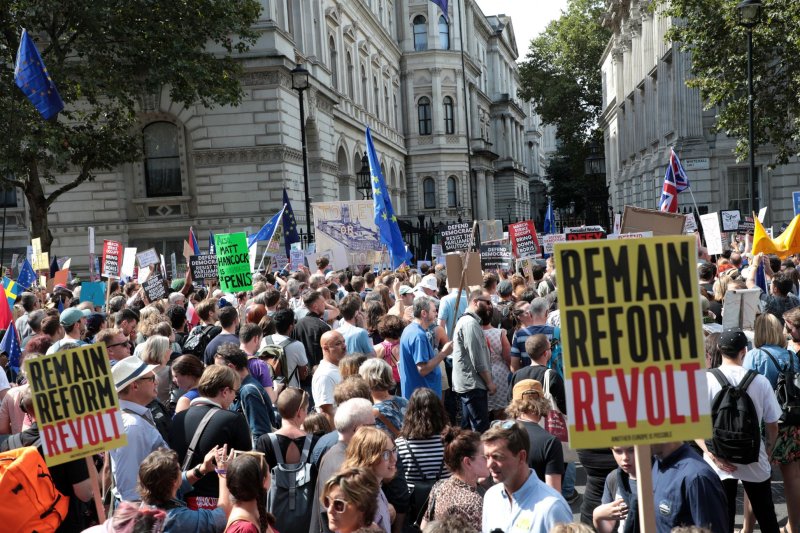 Anti-Brexit protesters gather outside No. 10 Downing St. in opposition to British Prime Minister Boris Johnson’s decision to shut down Parliament. Photo by Hugo Philpott/UPI |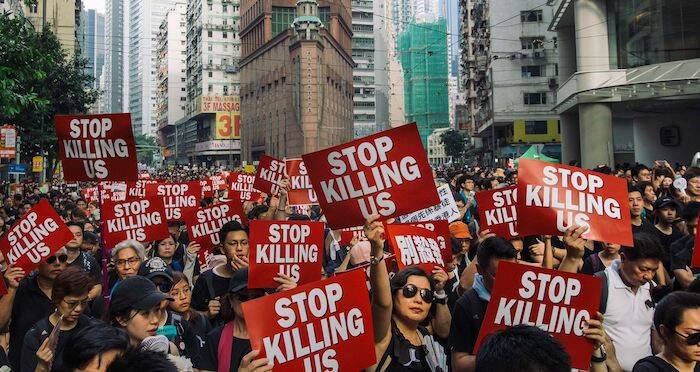




 Hong Kong (CNN)Hong Kong’s embattled leader Carrie Lam has finally fully withdrawn a controversial bill that allowed extradition to mainland China and sparked three months of dramatic protests in the financial hub.

/cdn.vox-cdn.com/uploads/chorus_image/image/65141354/Mother_Jones_1.0.jpg)
:format(webp):no_upscale()/cdn.vox-cdn.com/uploads/chorus_asset/file/19122527/Mother_Jones_Mug.jpg)
:format(webp):no_upscale()/cdn.vox-cdn.com/uploads/chorus_asset/file/19122540/Haymarket_2.jpg)
:format(webp):no_upscale()/cdn.vox-cdn.com/uploads/chorus_asset/file/19122562/Pullman_3.jpg)
:format(webp):no_upscale()/cdn.vox-cdn.com/uploads/chorus_asset/file/19122550/Pullman_1.jpg)
:format(webp):no_upscale()/cdn.vox-cdn.com/uploads/chorus_asset/file/19122572/Herrin_2.jpg)
:format(webp):no_upscale()/cdn.vox-cdn.com/uploads/chorus_asset/file/19122575/Cherry_3.jpg)
:format(webp):no_upscale()/cdn.vox-cdn.com/uploads/chorus_asset/file/19122573/Cherry_1.jpg)