Evangelicals See Trump Impeachment as an Attack on Their Values

Bloomberg – Politics

Evangelicals See Trump Impeachment as an Attack on Their Values

By Sahil Kapur                             
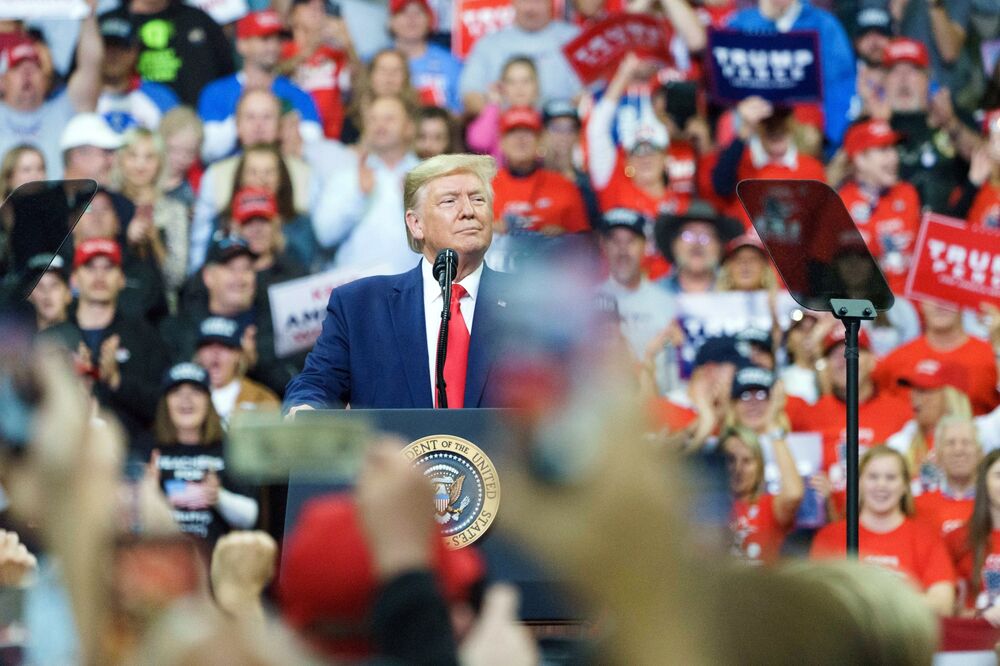
 

Donald Trump during a rally in Minneapolis on Oct. 10, 2019. 
Donald Trump during a rally in Minneapolis on Oct. 10, 2019. Photographer: Annabelle Marcovici/Bloomberg

While Donald Trump is the target of an impeachment inquiry on Capitol Hill, evangelical Christians who gathered across town were unfazed by his request of Ukraine to investigate political rival Joe Biden.

On Friday, a succession of speakers delivered paeans to Trump at the annual Values Voter Summit, which the president is set to headline on Saturday. Trump’s allies have drawn a warm embrace from a core Republican constituency that feels under siege from modern social changes such as same-sex marriage and mass immigration.

To these voters, Trump is a protector. Some of them are uncomfortable with his soliciting political help from Ukraine, but they’re willing to overlook it. The attacks on him are perceived as an indictment of their values, and they identify with him for lashing out at progressives.

“I see it as harassment, quite frankly,” Gail Sonatore of Middletown, New Jersey, said of the House Democrats’ impeachment inquiry. “I don’t think he’s done anything. I understand his tone — nobody likes that tone. But when you’re dealing with Marxists, what are you supposed to do? Just take it?”

She added: “Republicans have for a long time been called racist, fascist, sexist and greedy. And I think that’s why they support Donald Trump.”

Like many others at the conference, Sonatore said she has no problem with Trump asking Ukraine’s president to look into Biden. She said the former vice president should be investigated in the U.S., but was certain any inquiry would be thwarted because “the deep state is deep, and it is corrupt,” echoing a conspiracy theory common among Trump supporters that unelected career government employees are abusing their power to subvert the will of voters.

The staunch Trump allies explain why his job approval rating is unmoved despite Ukraine, holding steady around 40% in major national surveys. And his base hasn’t turned against him: In a new NPR/PBS Marist poll, 67% of white evangelicals said they approve of him. Among Republicans, 91% said they approve.

Sonatore said evangelicals’ concerns about the Supreme Court motivated many Trump skeptics to back him. They’re thrilled that he appointed Neil Gorsuch and Brett Kavanaugh, two justices who they believe share their objectives such as reversing the Roe v. Wade decision that affirmed abortion rights. These goals are within reach, and there may be more retirements from the court.

“There’s a good possibility that Roe v. Wade is going to be overturned,” she said.

The sky-high Republican approval is unlikely to be enough to get Trump re-elected if there’s an exodus of independent voters from his campaign in 2020.

A majority of Americans now supports the impeachment inquiry, according to many surveys, driven by a jump among Democrats and independents who already disapproved of the president but were skeptical about whether Congress should act to remove him. Now, many of these voters want lawmakers to take action. That notable shift has intensified the bunker mentality among many people at the Values Voter event.

Ray Teutsch, a retiree from Hempstead, Texas, said the impeachment inquiry has redoubled his support for Trump and caused him to donate more money to help re-elect him.

“Where I’m from, President Trump’s treasury is going up,” he said, calling Trump’s support “rock solid” in his community.

On Thursday evening, Trump spoke for 100 minutes at a rally in Minnesota — a state he lost by just 1.5 points in 2016 — and unleashed a torrent of attacks on his critics, drawing cheers and applause when he called the impeachment inquiry “a scam by the Democrats” who he said will lose to him again in the 2020 election.

Bill Chimiak of Signal Mountain, Tennessee, said it was “problematic” for Trump to ask a foreign leader to investigate a political rival, but that it doesn’t affect his support for the president because “I didn’t hire an angel — I hired someone that would represent the United States.”

He scoffed when asked about the impeachment inquiry, suggesting that the U.S. government should put former Democratic nominee Hillary Clinton in prison instead.

“Go after the easy criminals first,” he said. “Go after them, and then let’s talk about that.”

The lineup of speakers at the gathering, hosted by Family Research Council Action, includes many of the president’s defenders who are popular on the right — including Representative Mark Meadows of North Carolina, author Dana Loesch and activist Gary Bauer.

‘Leftist Barbarians’

On Friday, Bauer inveighed against “leftist social justice warriors,” mentioning activist and former National Football League player Colin Kaepernick, who knelt during the National Anthem to protest racial injustice. Bauer drew applause from the crowd as he lavished praise on Trump for “taking on those leftist barbarians.”

Some evangelical leaders highlighted comments by Democratic presidential candidate Beto O’Rourke at an LGBTQ forum hosted by CNN on Thursday, when he said that churches opposed to same-sex marriage should lose tax-exempt status.

“He’s going after your guns. Now he’s going after your God,” said Tony Perkins, the president of Family Research Council Action, who told the crowd that Trump’s priorities, by contrast, “are your priorities.”

Valerie Marken of Monument, Colorado, said the impeachment inquiry was “crazy” and that her support for Trump wouldn’t be affected by his request to ask Ukraine to investigate the Bidens.

“I think it’s fair game,” she said. “He’s the president.”

Will the Public End up Paying to Clean up the Fracking Boom?

Will the Public End up Paying to Clean up the Fracking Boom?

By Justin Mikulka         October 18, 2019

Pumpjacks

Increasingly, U.S. shale firms appear unable to pay back investors for the money borrowed to fuel the last decade of the fracking boom. In a similar vein, those companies also seem poised to stiff the public on cleanup costs for abandoned oil and gas wells once the producers have moved on.

It’s starting to become out of control, and we want to rein this in,” Bruce Hicks, Assistant Director of the North Dakota Oil and Gas Division, said in August about companies abandoning oil and gas wells. If North Dakota’s regulators, some of the most industry – friendly in the country, are sounding the alarm, then that doesn’t bode well for the rest of the nation.

In fact, officials in North Dakota are using Pennsylvania as an example of what they want to avoid when it comes to abandoned wells, and with good reason.

The first oil well drilled in America was in Pennsylvania in 1859, and the oil and gas industry has been drilling — and abandoning — wells there ever since. Pennsylvania’s Department of Environmental Protection (DEP) says that while it only has documentation of 8,000 orphaned and abandoned wells, it estimates the state actually has over a half million.

We anticipate as many as 560,000 are in existence that we just don’t know of yet,” DEP spokesperson Laura Fraley told StateImpact Pennsylvania.  “There’s no responsible party and so it’s on state government to pay to have those potential environmental and public health hazards remediated.”

According to StateImpact, “The state considers any well that doesn’t produce oil and gas for a calendar year to be an abandoned well.”

That first oil well drilled in Pennsylvania was 70 feet deep. Modern fracked wells, however, can be well over 10,000 feet in total length (most new fracked wells are drilled vertically to a depth where they turn horizontal to fracture the shale that contains the oil and gas). Because the longer the total length of the well, the more it costs to clean up, the funding required to properly clean up and cap wells has grown as drillers have continued to use new technologies to greatly extend well lengths.  Evidence from the federal government points to the potential for these costs being shifted to the tax-paying public.

The Government Accountability Office (GAO) released a report this September about the risks from insufficient bonds to reclaim wells on public lands. It said, “the bonds operators provide as insurance are often not enough to cover the costs of this cleanup.” The report cited a Bureau of Land Management (BLM) official’s estimate of $10 a foot for well cleanup costs.

StateImpact Pennsylvania noted that costs to reclaim a well could add up to $20,000, and DEP spokesperson Fraley said they could be “much, much higher.” The GAO report noted that “low-cost wells typically cost about $20,000 to reclaim, and high-cost wells typically cost about $145,000 to reclaim.”

In North Dakota, where state regulators have raised concerns about this growing problem, one of the top industry regulators, State Mineral Resources Director Lynn Helms, estimated that wells there cost $150,000 to plug and reclaim.

And this problem isn’t just in the U.S. Canada is facing a similar cleanup crisis.

Financial Bonding Requirements for well cleanup.

Legally, oil and gas companies are required to set aside money to pay for well cleanup costs, a process known as bonding. These requirements vary by state and for public lands, but in all cases, the amounts required are so small as to be practically irrelevant.

The GAO report reviewed the bonds held by the Bureau of Land Management for wells on public lands and found that the average bond per well in 2018 was worth $2,122.

The Western Organization of Resource Councils summarized bonding requirements by state, and none of them came even close to being adequate to cover estimated costs to deal with old wells. In North Dakota, a $50,000 bond is required for a well. But a $100,000 bond can cover up to 6 wells, which comes out to $16,667 per well — or approximately one tenth of the estimated cost to reclaim a well in that state.

North Dakota has a history of bending to oil and gas industry pressure when it comes to regulations. While North Dakota’s bonding rules fall far short of what’s needed to actually cover full cleanup costs, the reality on the ground is much worse. Regulators allow companies to “temporarily abandon” wells, which requires no action from companies for at least seven years. Wells can hold this “temporary status” for decades. And another practice in the state allows a company to sell old, under-performing wells to another company, passing along the liability but not the bonding funds.

By any measure, the amount of private money currently allocated in the U.S. to plug and reclaim oil and gas wells is a small fraction of the real costs. That means oil and gas wells — and the U.S. had one million active wells in 2017, and even more abandoned — will either be left to fail and potentially contaminate the surrounding water, air, and soil, or the public will have to pick up the tab. This represents just one of the many ways the public subsidizes the oil and gas industry.

A South Dakota Case Study.


South Dakota allows companies to post a $30,000 bond for as many wells as the company chooses to drill. Spyglass Cedar Creek is a Texas-based company that was operating in South Dakota and recently abandoned 40 wells, which the state has estimated will have a cleanup cost of $1.2 million.

However, there is a twist to this story. That $30,000 bond doesn’t really exist. The owners of the company had put $20,000 of it into a Certificate of Deposit. But when the state went looking for that money, the owners said they had cashed it in 2015 because, as reported by the Rapid City Journal,  “company officials did not remember what the money was for.”

Spyglass Cedar Creek does not have the money set aside that was required to clean up these wells, the state does not have recourse to get that money, and some of the wells are reportedly leaking. So, what can be done?

According to Doyle Karpen, member of the South Dakota Board of Minerals and Environment, the answer is for the taxpayers of that state to cover the cost.

I think the only way we can correct this is go to the Legislature and ask for money,” Karpen said earlier this year.

Following the Coal Industry Business Model.

What is starting to unfold with the oil and gas industry is very similar to what has already been playing out with the U.S. coal industry.

According to a Center for Public Integrity investigation,  more than 150 coal mines (and dozens of uranium mines) have been allowed to idle indefinitely, enabling their owners to avoid paying for the costs of cleanup.

In April, the Stanford Law Review published the paper, “Bankruptcy as Bailout: Coal Company Insolvency and the Erosion of Federal Law,” which notes that almost half the coal mined in the U.S. is done so by companies that have recently declared bankruptcy.

The paper notes how the bankruptcy process is used by coal companies to rid themselves of environmental cleanup liabilities and pension costs “in a manner that has eviscerated the regulatory schemes that gave rise to those obligations.”

Yet coal company executives often receive healthy bonuses, even as they are driving companies into bankruptcy.

This summer, Blackjewel famously failed to pay its coal miners, and even pulled funds out of their bank accounts, after the company suddenly declared bankruptcy in July. That prompted workers to sit on train tracks in Kentucky, blocking a $1 million shipment of coal, in a two-month protest.  And Blackjewel is poised to leave behind thousands of acres of mined land in Appalachia without adequate reclamation.

Privatize the Profits, Socialize the Losses. 

The mineral extraction business model in the U.S. is set up to maximize profits for executives, even as they lose investor money and bankrupt their companies. That is true of the coal industry and that is true of the shale oil and gas industry.

At the same time, the regulatory capture by these industries at both state and federal levels allows private companies to pass on environmental cleanup costs to the public, and the inadequate bonding system for oil and gas well reclamation represents just one more example.

The so-called fracking revolution in America has resulted in many new records: record amounts of U.S. oil and gas exported (to the detriment of a livable climate), new levels of human health impacts on surrounding communities, record numbers of industry-induced earthquakes, record amounts of flaring natural gas in oil and gas fields, and record-breaking depths and lengths of wells.

And the cleanup costs for the fracking boom are also poised to be staggering.

British Writer Pens The Best Description Of Trump I’ve Read

Michael Stevenson          March 8, 2019


Someone on Quora asked “Why do some British people not like Donald Trump?” Nate White, an articulate and witty writer from England wrote the following response:
A few things spring to mind.
Trump lacks certain qualities which the British traditionally esteem.
For instance, he has no class, no charm, no coolness, no credibility, no compassion, no wit, no warmth, no wisdom, no subtlety, no sensitivity, no self-awareness, no humility, no honour and no grace – all qualities, funnily enough, with which his predecessor Mr. Obama was generously blessed.
So for us, the stark contrast does rather throw Trump’s limitations into embarrassingly sharp relief.
Plus, we like a laugh. And while Trump may be laughable, he has never once said anything wry, witty or even faintly amusing – not once, ever.
I don’t say that rhetorically, I mean it quite literally: not once, not ever. And that fact is particularly disturbing to the British sensibility – for us, to lack humour is almost inhuman.
But with Trump, it’s a fact. He doesn’t even seem to understand what a joke is – his idea of a joke is a crass comment, an illiterate insult, a casual act of cruelty.
Trump is a troll. And like all trolls, he is never funny and he never laughs; he only crows or jeers.
And scarily, he doesn’t just talk in crude, witless insults – he actually thinks in them. His mind is a simple bot-like algorithm of petty prejudices and knee-jerk nastiness.
There is never any under-layer of irony, complexity, nuance or depth. It’s all surface.
Some Americans might see this as refreshingly upfront.
Well, we don’t. We see it as having no inner world, no soul.
And in Britain we traditionally side with David, not Goliath. All our heroes are plucky underdogs: Robin Hood, Dick Whittington, Oliver Twist.
Trump is neither plucky, nor an underdog. He is the exact opposite of that.
He’s not even a spoiled rich-boy, or a greedy fat-cat.
He’s more a fat white slug. A Jabba the Hutt of privilege.

This song about Donald Trump just won a BBC Folk Music Award as Best Song | Listen on The Hobbledehoy


And worse, he is that most unforgivable of all things to the British: a bully.
That is, except when he is among bullies; then he suddenly transforms into a snivelling sidekick instead.
There are unspoken rules to this stuff – the Queensberry rules of basic decency – and he breaks them all. He punches downwards – which a gentleman should, would, could never do – and every blow he aims is below the belt. He particularly likes to kick the vulnerable or voiceless – and he kicks them when they are down.
So the fact that a significant minority – perhaps a third – of Americans look at what he does, listen to what he says, and then think ‘Yeah, he seems like my kind of guy’ is a matter of some confusion and no little distress to British people, given that:
• Americans are supposed to be nicer than us, and mostly are.
• You don’t need a particularly keen eye for detail to spot a few flaws in the man.
This last point is what especially confuses and dismays British people, and many other people too; his faults seem pretty bloody hard to miss.
After all, it’s impossible to read a single tweet, or hear him speak a sentence or two, without staring deep into the abyss. He turns being artless into an art form; he is a Picasso of pettiness; a Shakespeare of shit. His faults are fractal: even his flaws have flaws, and so on ad infinitum.
God knows there have always been stupid people in the world, and plenty of nasty people too. But rarely has stupidity been so nasty, or nastiness so stupid.
He makes Nixon look trustworthy and George W look smart.
In fact, if Frankenstein decided to make a monster assembled entirely from human flaws – he would make a Trump.
And a remorseful Doctor Frankenstein would clutch out big clumpfuls of hair and scream in anguish:
‘My God… what… have… I… created?
If being a twat was a TV show, Trump would be the boxed set.

Lawrence O’Donnell goes viral with epic response to iconic Pelosi photo

Impeach Trump
Lawrence O’Donnell goes viral with epic response to iconic Pelosi photo
BREAKING: YES!! MSNBC’s Lawrence O’Donnell just went viral with an epic response to the iconic Pelosi photo. 🔥🔥🔥

Video by Occupy Democrats host Brian Tyler CohenSee Less

Lawrence O’Donnell goes viral with epic response to iconic Pelosi photo

BREAKING: YES!! MSNBC’s Lawrence O’Donnell just went viral with an epic response to the iconic Pelosi photo. 🔥🔥🔥Video by Occupy Democrats host Brian Tyler Cohen.

Posted by Impeach Trump on Thursday, October 17, 2019

My Husband’s Guilty !

Caught in Providence
My Husband’s Guilty
This couple has been happily married for 43 years, but the wife comes to court to throw her husband under the bus.

My Husband's Guilty

This couple has been happily married for 43 years, but the wife comes to court to throw her husband under the bus.

Posted by Caught In Providence on Friday, August 23, 2019

GIULIANI! (Here He Goes Again)

Randy Rainbow
GIULIANI! (Here He Goes Again) – Randy Rainbow Song Parody
***NEW VIDEO***… See More

GIULIANI! (Here He Goes Again) – Randy Rainbow Song Parody

***NEW VIDEO***🎶I've been list'ning to you and of crap you are full…🎶 🙄

Posted by Randy Rainbow on Thursday, October 17, 2019

Donald Trump Refers to Ethnic Cleansing as ‘Rough Love’

Esquire

Donald Trump Refers to Ethnic Cleansing as ‘Rough Love’ at Dallas Rally

The president called for Kurdish northern Syria to be “cleaned out.”

U.S. President Donald Trump at the White House

THE WASHINGTON POST/GETTY IMAGES


President Trump’s betrayal of Syrian Kurds became even more horrifying on Thursday, when he described their communities as needing to be “cleaned out” by invading Turkish forces.

“So you have a 22-mile strip,” said trump of a Kurdish region along Syria’s border with Turkey, “and for many, many years, Turkey, in all fairness, they’ve had a legitimate problem with it. They had terrorists, they had a lot of people in there they couldn’t have. They’ve suffered a lot of loss of lives also, and they had to have it cleaned out.”

The Kurds, one of the world’s largest stateless ethnic groups, have fought against U.S. ally Turkey for years in territorial disputes. These tensions made America’s partnership with Syrian Kurds in the battle against ISIS a precarious one—and Trump’s decision to pull the remaining U.S. troops from the region, clearing the way for a Turkish invasion, a terrible betrayal that provoked condemnation from both Congressional Democrats and Republicans.

Referring to Kurds living along Turkish border in Syria, Trump says of Turkey, “they had to have it cleaned out.

Trump’s remarks came in the wake of a U.S.-negotiated five-day pause in fighting between the Kurds and invading Turks. Turkish President Recep Tayyip Erdogan has said that his goal is to creating a “buffer zone” in Syria’s border region, and to relocate into it millions of Syrian refugees who are currently in Turkey. Around 300,000 Kurds could be displaced, sparking what human rights groups are calling a “humanitarian catastrophe.” And despite the agreed upon pause, violence continued over Thursday night, with Kurds accusing the Turkish military of violating the truce.

“You would have lost millions and millions of lives,” said Trump of the agreement. “They couldn’t get it without a little ‘rough love,’ as I called it.”

“One way to look at this is that President Erdogan and President Trump buried the hatchet – they buried right in the back of the Kurds,” said retired Admiral James Stavridis on NBC’s Today Friday. “This is approaching ethnic cleansing.”

Gabrielle Bruney is a writer and editor for Esquire, where she focuses on politics and culture.