Taking fish out of fish feed can make aquaculture a more sustainable food source
Pallab Sarker, Associate Research Professor of Environmental Studies, University of California, Santa Cruz
Farmed red tilapia, Thai Mueang, Thailand. Kittichai Boonpong/EyeEm via Getty Images
The big idea
Aquaculture, or fish farming, is the world’s fastest growing food production sector. But the key ingredients in commercial fish feed – fishmeal and fish oil – come from an unsustainable source: small fish, such as anchovies and herring, near the base of ocean food webs.
My colleagues and I have developed a high-performing, fish-free aquaculture feed that replaces these traditional ingredients with several types of microalgae – abundant single-celled organisms that form the very bottom of the food chain in fresh and saltwater ecosystems around the world. To test this approach, we developed our feed for Nile tilapia – the world’s second-most farmed fish, exceeded only by carp.
Our research showed that tilapia fed our fish-free diet grew significantly better, achieving 58% higher weight gain than tilapia fed conventional feed. The resulting cost per kilogram of tilapia raised on our feed was lower than for fish raised on conventional commercial feed. And our feed yielded a higher level of a key fatty acid that is important for human health, DHA omega-3, in the resulting tilapia fillets.
Infographic of marine food chain
Why it matters
About 19 million tons of wild fish – some 20% of the total quantity caught around the world – are rendered into fish meal and fish oil every year, even though 90% of these harvested fish are fit for human consumption. Analysts project that aquaculture feed demands for fish meal and fish oil could outstrip the supply of small forage fish, also known as prey or bait fish, by 2037. If this happens, it could have disastrous consequences for human food security and marine ecosystems.
Aquaculture feeds can also contain soy and corn ingredients from industrial farms on land that generate large amounts of water pollution. Fish can’t fully digest these ingredients, so they end up in aquaculture wastewater. Just like wastewater from cattle or poultry farms, effluent from fish farms can be a serious pollution source. What’s more, these crops could be used for direct human consumption.
Handful of pelletized fish feed made from microalgae.
For all of these reasons, developing fish-free fish feed is a key leverage point for reforming aquaculture so that it helps to conserve natural ecosystems instead of damaging them. Reducing pressure on forage fish will strengthen global marine fisheries. Our work also shows that it is possible to improve the human health benefits of eating farmed tilapia by manipulating the fishes’ diet.
How we do our work
We developed our fish-free feed formula in a series of experiments over six years. First, we evaluated how well fish could digest specific varieties of marine microalgae. Then we conducted separate experiments to see how well fish grew using these individual ingredients as replacements for either fish meal or fish oil.
For this feed we used two types of marine microalgae. One is a waste product left over after another type of omega-3 fatty acid, called EPA, has been extracted from the microalga for use in human nutritional supplements. This is the first proof of concept for a tilapia feed that eliminates fish meal and fish oil while improving growth metrics and the resulting nutritional quality of the fish.
Our feed is a substantial improvement over other commercially available feed products. There are some existing fish-free feeds that use soy, corn and other plant-based ingredients, but terrestrial vegetable oils within these feeds lack long chain omega-3 fatty acids. As a result, they produce fish fillets with lower nutritional value.
Microalgae ingredients don’t have this problem. Researchers have been experimenting with using microalgae to replace either fishmeal or fish oil in aquaculture feeds, but there haven’t yet been any fully fish-free microalgae blend feeds available in the market. We hope that ours will be the first.
The other major challenge in developing a commercially successful fish-free feed is achieving a competitive edge over conventional feed on cost and fish growth performance. Our research showed promising results for these factors as well.
Farm employee scoops fish feed into pond
What’s next
We currently have a patent pending for our formula and hope to work with the aquafeed industry, ingredient suppliers and sustainable aquaculture entrepreneurs to bring it to market. The major challenge will be achieving a consistent ingredient supply in order to produce large quantities on an industrial scale.
We’re also working now to develop fish-free feeds for other aquaculture species, including salmonids, a group that includes trout and salmon. Unlike tilapia, which eat a primarily vegetarian diet, these species are predators, so farming them accounts for most of the fishmeal and fish oil used in aquaculture feeds. Successfully replacing fishmeal and fish oil with microalgae in salmonid feed would be a major advance toward more sustainable aquaculture.
Pallab Sarker and other participants in the research described in this article have received funding from the U.S. Department of Agriculture; the Sherman Fairchild Professorship, Dean of the Faculty and Vranos family gift at Dartmouth College; the Dean of Social Sciences and Executive Vice Chancellor at the University of California Santa Cruz; and the National Sea Grant Aquaculture Federal Funding Opportunity.
(Bloomberg Opinion) — Anyone still clinging to the idea that Donald Trump is a crafty strategist who furthered his goals by corrupting everyone around him during an unspooled and vindictive presidency might want to consider, instead, that Trump himself was often gamed — at least when it comes to some of the signature policies that will define his administration. To be sure, Trump unleashed torrents of dangerous vitriol that made it safe for his party and supporters to embrace racial, economic and cultural divisions more openly and enthusiastically. And Trump’s stagecraft was certainly sui generis, tethered to outre mythmaking and serial fabulism. But apart from propagating a cult of personality, Trump’s performance art rarely revolved around policy debates or goals. It just revolved around him. On the policy frontier, where voters’ lives are shaped and institutions are remodeled, others were in charge. Those people most likely regarded Trump as a useful foil, someone easy to manipulate or outmaneuver if you had the stomach and patience for it. There are myriad examples, but for now let’s focus on Senate Majority Leader Mitch McConnell, Attorney General William Barr and Federal Reserve Chair Jerome Powell. Each of those men embodies some traits needed to turn Trump into a sock puppet — or to simply keep him out of the way. They could be wily (McConnell, Barr, Powell), craven (McConnell, Barr) or courageous (Powell), but needed at least one of those attributes to achieve their goals. History will also probably judge each of them in proportion to how much their particular vices or virtues drove policy and procedure.“ At the risk of tooting my own horn, look at the majority leaders since L.B.J. and find another one who was able to do something as consequential as this,” McConnell, a history buff, told the New York Times after he rammed Justice Amy Coney Barrett onto the Supreme Court in October. McConnell regards his conservative reshaping of the federal judiciary as his signature accomplishment, and his legacy goes well beyond the Supreme Court. He has pressed the Senate to confirm at least 229 federal court appointments during Trump’s presidency, and, for the first time in 40 years, hasn’t left a left a single vacancy on district and circuit courts — even if that has meant repopulating the judiciary with young, white men bearing threadbare resumes. Trump didn’t have a sophisticated, informed view of the judiciary before becoming president. But he let McConnell transform such traditionally liberal venues as the Ninth Circuit Court of Appeals because the senator sustained him in other ways. McConnell ran interference when Trump was impeached. He helped court Trump’s incendiary political base. He kept to the shadows when Trump attacked the Black Lives Matter movement. He remained silent when Trump savaged the integrity of the presidential election. McConnell, according to those close to him, held Trump in low regard but protected him anyway to feed his own political ambitions, further fuel his fundraising apparatus and go about dismantling the federal government. McConnell’s fealty and machinations came home to roost this year when Trump failed to effectively respond to the Covid-19 pandemic and the Senate was left so broken it appears unable to pass a second coronavirus relief package even though it has bipartisan support. It’s not clear yet whether McConnell, content to wield power for power’s sake alone, will pay any penalties for cuddling with Trump. But there’s no question that he has spun the president like a top the last several years whenever one of his own goals was in play. Then there’s Barr, who, when asked last year whether his ward-heeler’s advocacy for Trump has tainted his legacy and his reputation in the legal community, responded with trademark indifference: “I’m at the end of my career. … Everyone dies.” Barr has been a longstanding proponent of an unrestrained imperial presidency, and those views took root long before he encountered Trump. But he went out of his way to audition for his Justice Department job because he undoubtedly saw Trump as a useful vehicle for furthering those aims. Among other things, Barr helped Trump end-run Special Counsel Robert Mueller’s Russia investigation, gave Trump the latitude to misuse federal force on U.S. streets, helped protect White House advisers on the wrong side of the law, knee-capped federal prosecutors investigating matters close to Trump and helped give early credence to Trump’s claims that the presidential election was rigged before later reversing himself. Trump grew weary with Barr after the attorney general refused to rush a Justice Department probe of how law enforcement went about investigating the president, but Barr initiated the investigation to begin with because he shared Trump’s belief that the deep state was out to get him. Barr reportedly worked hard to make sure that a federal investigation into President-elect Joe Biden’s son, Hunter, was kept under wraps during the election, but one wonders, given Barr’s record, how the investigation was started in the first place. Trump harbored authoritarian designs well before he intersected with Barr, but it’s Barr who tried to build a throne for the president — and taught Trump how to go about it. Powell, inhabiting the wonky and cloistered confines of the Federal Reserve, is the brighter tale here. An articulate, compassionate and relatively soft-spoken member of Trumplandia, Powell runs a financially powerful institution that Trump has repeatedly tried to strong-arm during his presidency. “Who is our bigger enemy, Jay Powell or Chairman Xi?” Trump once asked. Powell endured all of this with great calm and confidence, managing to win plaudits as one of the best Fed leaders of the modern era. He’s also been directly responsible for helping the U.S. economy weather the Covid-19 pandemic. He’s well aware that the Federal Reserve Act is meant to protect his independence from the White House, and he’s demonstrated repeated bravery charting his own course despite Trump’s interference. Asked during a congressional hearing if he’d pack up and leave if Trump tried to fire him, Powell said three times that he wouldn’t. “The law clearly gives me a four-year term, and I intend to serve it,” he responded. Trump pressured Powell to adopt rate cuts that would stoke the economy in the short run, but Powell largely made such calls on the merits. He also became one of the strongest voices in the government for using federal powers to support the financial well-being of average workers and the lives and livelihoods of those bowled over by the pandemic. To get there, he essentially ignored Trump — and expanded the Fed’s mandate and mission along the way. Powell’s tenure is a reminder that Trump can’t corrupt people willy-nilly. They have to be primed for it beforehand. And bad things didn’t happen during Trump’s time in office because he landed in Washington with a fully realized plan. Bad outcomes took root because Trump was surrounded by bad actors, some of whom knew exactly how to play him.
Defeated, lying, narcissist ex-President Trump will make a perfect ‘Florida man’ | Opinion
Fabiola Santiago December 9, 2020
Step aside Congressman Matt Gaetz, Florida man personified, you’ve got real competition now.
The cast of ding-a-ling characters in the state is getting a major infusion of fresh specimens as a result of the 2020 election.
GOP-friendly Florida, the big loser, inherits the Trumps as residents.
The ex-president (feels good to say that, exhaling) will reside in stately Mar-a-Lago in Palm Beach and indications are that daughter Ivanka, husband Jared Kushner and their children have plans to head farther south.
It’s supposedly not only a move to be close to daddy.
CNN reported, quoting a source who works with the family, that the first daughter has big political ambitions — like a future run for the governorship of Florida, experience apparently not required although residency is, at least seven years.
President Donald Trump’s Mar-a-Lago resort in Palm Beach is now officially the president’s residence.
Trump show in Florida
So brace yourselves, Floridians: Here comes “The Trumps Take Over Florida,” a new reality show starring the defeated, lying, narcissist ex-president and his entitled children.
We might as well laugh, people.
What’s the alternative?
Besides the sunny weather, the soon-to-be former occupants of the White House are attracted by the friendly accommodations made to conspiracy theorists, coronavirus deniers, and those with a healthy appetite for good old-fashioned corruption.
Your show host: The Republican Party of Florida.
The plot has been laid out well into 2024.
Supporting characters — filming location, Miami — are still auditioning.
But they will surely include, according to Facebook friends in-the-know: Lolita Caravana leading the red car, flag-waving caravan on the Turnpike from Miami to Palm Beach for a weekend bash at Mar-a-Lago and Pepe Ota at Versailles haunting for commie sympathizers, or Democrats, or anyone with a camera willing to turn a clown into an “influencer.”
Democrats laughed at these characters in 2020, but they made Trump’s victory possible, if only in very special Floriduh, which annexed territory in Miami-Dade during the last four years.
They’ll be good for a few more laughs in 2021 and beyond.
Presiding over the made-for-TV show, master of ceremonies of the political revelry: Gov. Ron DeSantis, who has collected an impressive list of nicknames for his disastrous handling of the pandemic, the latest #DeathDeSantis, twice trending on Twitter this week.
He’s not funny at all, really, unless you count his campaign commercial using his small children, playing with toy blocks, to plug Trump’s wall — or his mask-less high-fiving Trump supporters at a Sanford rally then wiping his nose.
Come to think of it, DeSantis has outdone Gaetz, who cinched the No. 1 spot with his bizarre fixation on Congresswoman Alexandria Ocasio-Cortez.
Gaetz made his Bronx colleague a household name in Florida.
Then, he threatened Trump lawyer Michael Cohen, who was spilling the beans on the president, and made fun of the coronavirus by wearing a gas mask on Capitol Hill.
Full disclosure: I’m partial to Gaetz’s leading man role as “Florida man” incarnate since he pronounced my name perfectly on Fox News.
But moving forward, between DeSantis, Gaetz, and the ex-president alone, the Trump show scenes will just write themselves.
Last but not least, there’s immigrant “be best” Melania, who will hopefully be happier now that her first lady contract expires. Pandemic or not, with her living in the state, the paparazzi won’t be filing for unemployment in Florida’s tightwad system.
See, the Trumps could even be a boon to Florida, no need to hire expensive Pitbull to do a commercial.
Be positive, Florida
There’s a handy expression in Spanish that comes to mind: “al mal tiempo, buena cara.”
It advises to put on a brave face in stormy weather.
The hurricane looming is that we’re far from done with the Trumps in the Sunshine State — or his influence on the Republican Party, the lasting ill.
The really, really good news is that the rest of the country knew better.
The White House is safe.
Florida, getting its just desserts, inherits the clown.
A new study demonstrates the link between birds and happiness. TorriPhoto / Getty Images
A new study reveals that greater birdbiodiversity brings greater joy to people, according to recent findings from the German Center for Integrative Biodiversity Research. In fact, scientists concluded that conservation is just as important for human well-being as financial security.
The study, published in Ecological Economics, focused on European residents, and determined that happiness correlated with a specific number of bird species.
“According to our findings, the happiest Europeans are those who can experience numerous different bird species in their daily life, or who live in near-natural surroundings that are home to many species,” says lead author Joel Methorst, a doctoral researcher at the Senckenberg Biodiversity and Climate Research Center, the iDiv and the Goethe University in Frankfurt.
The authors calculated that being around fourteen additional bird species provided as much satisfaction as earning an additional $150 a month.
For the study, researchers used data from the 2012 “European Quality of Life Survey” to explore the connection between species diversity around homes, towns and cites, and how it relates to satisfaction. More than 26,000 adults from 26 European countries were surveyed.
According to the study authors, birds are some of the best indicators of biological diversity in any given area because they are usually seen or heard in their environments, especially in urban areas. However, more bird species were found near natural green spaces, forested areas and bodies of water.
In the U.S., birding has become a more common and accessible hobby during the pandemic.
Although not new, thousands of amateurs and expert birders participate in Audubon’s long-running annual Christmas Bird Count, a three-week activity to count birds in a specific area for the group’s data compilation.
“Nature conservation therefore not only ensures our material basis of life, but it also constitutes an investment in the well-being of us all,” says Methorst.
Trump Just Broke Through the Last Level of Neo-Fascism
Michael Tomasky December 10, 2020
Tasos Katopodis/Getty
Never mind his latest Twitter storm of complaints and threats. Or do mind them, because their very desperation proves that it’s dawning on the Undapper Don that his chances of staying in the White House much longer are, as the mayor of Munchkin City put it, morally, ethically, spiritually, physically, positively, absolutely, undeniably, and reliably dead. He’ll see for what will probably be the first time in his life that there’s no judge he can buy (including the one he assumed he was buying, who has at least shown herself to be above mob-style corruption; hey, we’ll take it), no fixer he can bribe, no idiot cousin he can put on the payroll to fix things.
For the first known time in 74 years, Trump morality has met normal morality, and normal morality has won.
Which raises the question: With his legal options all but exhausted (we’re waiting on this Texas case, which seems more insane than most of them), what will Trump do next? Perhaps more concerningly, what will his followers do? Until this week, Trump and they could keep entertaining the fiction that some brave soul would step forward and, within the parameters of “the system,” somehow fix this and save him.
I’ve been writing lately that Trump foes should see him as a figure of derision and take joy in mocking him, and I believe that. That kind of moral cleansing is mentally healthy and necessary, after what he’s done to our brains for four years. But in saying that I don’t mean to make light of the threat Trump and his backers pose. That threat is still terrifying, both over the next 40-plus days and further into the American future than I’d care to admit. We’d better be ready.
When they start writing histories of the Trump era, I think the one-line summary will be something like this: While some portion of his appeal was based on legitimate grievances of working-class people against elites, he awakened an authoritarian impulse among the citizenry that was far larger and more rabid, and more easily triggered, than most of us ever imagined.
That is, if you’d asked me back in, oh, 2013, when Donald Trump was still just the foolish corrupt narcissist most everybody knew he was, what portion of the American public would fall for neo-fascism, I’d have said 25 percent tops. But events have shown us that it’s more like 40. At least 35. That’s pretty frightening.
What do I mean by neo-fascism? It’s a fairly obvious set of criteria. Here are five essential ones, though there are others: blind loyalty to a leader who’s really more of a national father figure; belief that the leader is the state; belief that opposition to the leader is opposition to the state, and thus treason; conviction (instilled or ignited by the leader) that the source of the problems facing the good wholesome ethnic majority is some Other or collection of Others who must be ostracized if not banished; agreement that the rules and constraints of democratic order are sometimes useful and should be obeyed as long as one can obey them and win, because doing so confers a certain legitimacy, but if they have to be cast aside to hold power, then cast aside they must be. These principles animate every fascist regime in human history. They are at the heart of Trumpism, and they have drawn many more adherents than I’d have thought possible in this country.
Among advanced democracies, the United States is, if not unique in this regard, certainly more susceptible now than most. If a Trump came along in Denmark, say, would Denmark elect him? I doubt it. Ditto most European countries. Some would. Some have: Hungary, Poland, and Turkey. But I think most would not.
We, however, did. And now that that impulse has been awakened, putting it back to bed will be the work of a generation. Or two. The main thing that has to happen is that the system has to work well for enough working- and middle-class people again such that neo-fascism’s allures are diminished.
That means doing things that will help working-class people: a decent minimum wage, infrastructure, public investment in rural areas and small towns, and yes, the building of a greener economy that might be able to bring some new hope to places like my native West Virginia.
But the confounding irony of course is that the working-class people have been convinced that those things, or most of those things, are socialism, and so they don’t want them. Their voting patterns tell us they’d rather stay with a set of ideas and priorities that are frankly failing them. So the hope of changing this dynamic in the long term is slim. But we have to try.
And in the short term, by which I mean until Jan. 20? A lot of it depends on the father-leader. Given that we’ve already seen armed protesters surrounding a Michigan state official’s house, and the Arizona GOP suggest that its members should be ready to martyr themselves for Trump, it’s hard to say. One casual comment from the father-leader could set something off. Or he might not even have to say a thing. If people are willing to die for him, anything is possible.
Go back over my list above of the five criteria of neo-fascism with special focus on number five. That’s exactly where we are now.
Democratic trappings were of use to Trump as long as he was the winner as he was in 2016. But this time around, he lost. Then he tried everything he knew to try within the democratic system (the recounts); then he tried audacious and outrageous things that no one has ever tried before but still were not against any democratic law (pressuring Georgia Governor Brian Kemp, summoning those two Michigan legislators to the White House). None of it worked. So there are no more democratic options.
Which means other options might now be pursued. So yeah, be on your guard. And, uh, why did Trump replace all those people at the Pentagon anyway? Remember that? Could be nothing. But it could be… something. The one thing we know is that he has no conscience holding him back.
Pharma is having its best moment in years. What does it mean for Biden’s health care agenda?
By Dylan Scott
President-elect Joe Biden may have a difficult time reining in drug prices, given the drug industry’s renewed political clout during the Covid-19 pandemic. The Washington Post/Getty Images
Just as Joe Biden prepares to take over the presidency, the pharmaceutical industry is having its best political moment in years. Numerous Covid-19 vaccines are on the verge of approval, promising an (eventual) end to the pandemic that has upended every American’s life for the last nine months.
Reducing prescription drug costs has long been a top priority for voters. But given the prospect of a divided government, the other health care issues likely to dominate the Biden administration’s attention, and pharma’s renewed political clout, lobbyists and health care experts are skeptical there will be significant action to rein in drug costs over the next few years.
“Now that it’s looking like we’ll have successful vaccines, drug companies could come out of this pandemic as heroes that saved us from the evil virus,” Larry Levitt, executive vice president at the Kaiser Family Foundation, told me. “That will make it harder to demonize the pharmaceutical industry in a fight over drug pricing.”
There are two kinds of drug pricing problems. One is the actual list prices set by drug companies, which most patients and health systems don’t actually pay, but still set the top line from which various discounts and rebates are applied. (And for the uninsured, that is their price unless they get some kind of assistance.) List prices are more difficult to control, without the more aggressive kind of price-setting that pharma and many lawmakers would balk at. The other issue is out-of-pocket costs, or what patients must pay under their insurance plan. That may be easier to fix; it’s just a matter of finding the money to improve, for example, the Medicare drug benefit so patients have smaller obligations when they fill a prescription.
There could be an opportunity for incremental improvements through Congress. A bipartisan Senate bill would serve as an obvious template for a compromise, if the Senate remains in Republican hands and with Democrats holding onto the House.
As one health care lobbyist told me, lawmakers are cognizant that after years of fierce partisan divisions that have stymied even small-bore improvements to US health care, “the voting public needs to see points on the board.”
But any legislating could still be difficult, as even small coalitions in the House and the Senate can make it hard for bills to move forward, and pharma still wields tremendous influence within the US Capitol.
As for President-elect Biden’s regulatory agenda, he will have to decide how much to prioritize drug pricing alongside improving Obamacare and reversing some of Trump’s actions on Medicaid. Pharmaceuticals are one area where the Trump administration has been more creative, but they also have failed to actually put many of their proposals in place. Biden could, in theory, pick up and build on some of the Trump initiatives. But many experts are skeptical he will.
Health care activists are still pushing for big changes. The US public still wants drug affordability addressed. But the context of the debate has shifted. On top of the vaccine news, drug prices have not been rising as quickly as in previous years, and the headline-grabbing price gouging appears to have subsided from the days when Martin Shkreli was briefly the face of the industry.
Taken together, experts have lowered their expectations about significant reforms happening any time soon, even though many Americans are still struggling to afford the medications they need.
“I think now, you don’t have all those stories about insulin and Epipen, plus you have positive stories about vaccines and other drugs,” Walid Gellad, director of the Center for Pharmaceutical Policy and Prescribing at the University of Pittsburgh, says. “You don’t have as fertile an environment for more extreme drug measures.”
There could be targeted action in Congress if everybody gets on board
A bipartisan bill introduced last year by Sens. Chuck Grassley (R-IA) and Ron Wyden (D-OR) and passed out of the Senate Finance Committee could be the initial template for drug pricing legislation under the Biden administration. As the lobbyist told me, if Senate Republicans and Senate Democrats can agree on a plan, that will put intense pressure on the House to come to an agreement.
The bill would penalize drug companies for any price hikes that are higher than inflation, requiring them to pay rebates to the Medicare program to make up the difference. For patients, the Finance Committee’s legislation would also redesign Medicare Part D benefits and cap patients’ out-of-pocket obligations at no more than $3,100 a year (and many would pay far less than that). The Congressional Budget Office projected that the bill would save beneficiaries a combined $20 billion over 10 years.
Both of those provisions are shared in concept, if not in all the details, with the major drug pricing bill passed by House Democrats in 2019, indicating they would represent a common ground between the two chambers if Republicans retain control of the Senate.
The Senate Finance bill didn’t get past the committee stage, partly because Senate Majority Leader Mitch McConnell was unenthused and President Donald Trump did little to apply pressure on reticent Republicans. Biden could try to use his bully pulpit to get a deal done.
The legislation “just lacked the push from the president,” Gellad said. Under Biden, “I think you might actually see a push from the president.”
Other policies cracking down on anti-competitive practices by drug makers have earned support from lawmakers in both parties. For example, a bipartisan Senate bill from Grassley and Sen. Amy Klobuchar (D-MN) and a plan sponsored by a group of House Republicans would bar brand-name manufacturers from making “pay for delay” payments to generic drug companies. Those arrangements currently can push back the introduction of generic competitors — one of the main tools in the US health system for limiting drug prices after the monopolies granted to new drugs expire — for months or more.
But more direct negotiations between Medicare and drug companies, a popular campaign talking point for Biden and other Democrats, are likely off the table unless Democrats can win both Georgia Senate runoffs, and with them a narrow Senate majority. Republicans not named Donald Trump have never warmed to the idea.
The health care lobbyist told me that a deal agreed to by Biden, McConnell, and Senate Democrats should be able to get through the House, too, even if the left and right wings balk.
“Pelosi can’t say no. McCarthy can’t say no,” the lobbyist said. “They can bring enough of their guys.”
Biden will have to decide whether to press on with any of Trump’s executive actions
The Trump health department has been busy on drug prices. They’ve authorized drug importation from other countries and released a bevy of proposals to bring American drug prices more in line with other countries.
The trouble has been in their lack of follow-through, which means the Biden administration will largely be left to decide whether to pick up Trump’s policies and run with them or start from scratch on their own.
But if nothing else, Trump’s aggressive posture toward the pharma industry may give Biden more leeway to be ambitious during his own presidency.
“Despite the Trump Administration’s failure to implement its most ambitious drug pricing policy goals, the administration’s rhetoric has been successful in normalizing and making the case for these bold reforms,” Rachel Sachs, a law professor at Washington University in St. Louis, wrote in Health Affairs shortly after the election.
International reference pricing has been the calling card of Trump’s agenda, though his administration’s attempt to finalize it has been done in a legally shoddy, last-minute way that experts think leaves it vulnerable to the legal challenges already filed by the drug industry. In brief, under this “most favored nation” proposal, Medicare would not pay a higher price for drugs than other similarly wealthy countries do.
Sachs suggested in her article that Biden’s team could reevaluate the referencing pricing model, but refine it to make it less administratively complex. They could also shift the focus from automatic price controls to an independent review board that would take the foreign prices into account while setting its own recommended prices for Medicare.
Biden could also revisit the Obama administration’s plan to change how Medicare pays physicians for certain drugs, which was introduced too late to be fully implemented before Obama and Biden left office, Levitt said.
The federal government theoretically has expansive powers to try to curb drug prices. Progressives argue the federal government could use existing authorities to effectively revoke patents issued to drug makers if their medicines were developed through substantial public investment. It is an idea with a lot of purchase on the left and something even Biden’s newly announced nominee to lead the Department of Health and Human Services, Xavier Becerra, has sounded receptive to under certain circumstances.
Activists argue that the urgency of reducing drug costs for Americans has become only more apparent during the Covid-19 pandemic, even if pharmaceutical companies try to use their success with vaccines to their political advantage.
“If there is anything that this pandemic should have taught us, it’s that something should be done. We shouldn’t allow ourselves to think it’s not possible,” Dana Brown, who promotes drug pricing reform for the Democracy Collaborative, told me. “Can we literally afford the status quo? For me, the answer is no.”
Progressives will try to keep the pressure on Biden to go big. But there is a belief among savvy DC observers that drug pricing may be crowded out by other health care priorities. As Rob Smith, an analyst at the investment advisory firm Capital Alpha, wrote in a note in the days after the election: “We think drug pricing will fall to a third or fourth tier issue for the next administration.”
What Trade War? Trump Heartland Sees Record Farm Sales to China
Bloomberg News December 8, 2020
1 / 5
(Bloomberg) — Measured by the bushel, the U.S.-China relationship has never been stronger. Through the trade war and open hostilities at the highest political levels, pig farmers in China and crop farmers in the U.S. have become increasingly interdependent. Already America’s biggest customer of soybeans and sorghum, for this season China bought an unprecedented 11.2 million metric tons of corn, up nearly 1,300% compared with pre-trade-war purchases.
For the moment, both sides seem happy. The American imports have helped China feed its hog herd, which is recovering faster than expected after the African swine fever outbreak created a shortage of the country’s most staple protein. Meanwhile, U.S. farm profits are at a seven-year high, riding China’s demand and additional support from federal aid to agriculture.
China’s bought nearly 30 million metric tons of U.S. soybeans, the most for this point in the season since 1991 and 57% of America’s export sales. For sorghum, which is also a substitute for corn, China accounts for 80% of sales. Corn purchases, once negligible, rocketed to almost 30%.
But the deeper reliance is tenuous. As the trade war showed, that market can quickly evaporate, and experts warn that any number of geopolitical events – an incident in the South China Sea, for example, or further activity in Hong Kong – could end with another chill on Chinese imports.
“American agriculture has to be careful of putting too many eggs in the China basket,” said Tom Vilsack, who served as Agriculture Secretary from 2009 to 2017 and has emerged as a leading candidate for the position under President-elect Joe Biden. “I think the lesson that should be learned from the last couple of years is the need for American agriculture to continue to diversify so there’s always somewhere else the products can go, other than the storage bins.”
For now, purchases are so big that traders are even drawing parallels with the Soviet era’s “Great Grain Robbery,” another huge agricultural trade at a time of tensions between superpowers. Overall, the U.S. has nearly exhausted its export capacity.
“We are loading boats as fast as we can,” Gregg Doud, the U.S. Trade Representative’s chief negotiator for agriculture, said in an interview with Bloomberg at the end of October. “North of 95% of what can possibly be done in 2020 is already booked, and a huge chunk of that is soybeans to China.”
The farm belt, which voted overwhelmingly for the re-election of Donald Trump, is waiting to see how Biden will approach trade negotiations with China. Trump’s North American and Chinese trade deals, plus Covid-linked farm aid, have sustained the agricultural economy, said Jim Putnam, who grows corn and soy in Minnesota. “I was never a big Trump fan but he did get the Chinese attention with Phase 1,” he said. “I hope that the Biden administration can keep things going.”
Even if relations improve, China’s appetite for American crops reflects a combination of factors that won’t remain static: the strength of China’s post-Covid economy, the unanticipated consequences of the African swine fever recovery, and the limitations on the country’s own corn production.
When the disease killed roughly half the country’s herd after China first reported outbreaks in 2018, traders projected a five-year timeline for recovery. It’s been far faster. The herd is now at 80% of its pre-disease levels. But the industry has changed. Multi-story “hog hotels” and large industrial producers have replaced the backyard farms where pigs grew fat on table scraps. The more professional operations mean hogs are eating more corn, soybean meal and other feed grains. “Everybody focuses on soybean trade, but as the Chinese livestock industry is professionalizing their feeding practices, it means not only the soybean meal demand will grow, but it also means the corn demand grow as well too,” Greg Morris, president of Archer-Daniels-Midland Co.’s Ag Services and Oilseeds unit, said at a recent investment conference. Outgoing U.S. President Trump has taken credit for the deal that resolved the two-year long trade war and required China to increase purchases of agricultural goods by 52% from 2017. As of the end of October, China had met 71% of the $36.5 billion target based on exports through August and sales scheduled for import by Dec. 31, according to the USTR.
“The recent increase in grain exports to China, and tighter grain supply and demand has driven commodity prices higher,” Pat Bowe, chief executive officer of grain handler Andersons Inc., said Tuesday at the company’s investor day. “A demand-led rally is stronger than a supply shortage as it usually has lasting clock power.”
Agriculture Secretary Sonny Perdue, at a separate industry event Tuesday, credited the rally in crop prices to a functioning trade policy with China achieved by the Trump administration. Still, he added that while China may not reach the target for purchases, U.S. shipments are well on their way to showing a significant increase in the first quarter of 2021.Others are skeptical about the influence of the trade deal. “China doesn’t adhere to trade policies because they’d like to, it only happens when there is a need,” said Dan Basse, president of Chicago-based consulting firm AgResource. “I think China would have bought the same amount of grain relative to having a phase one agreement or not.” China has already bought so much corn from the U.S. and Ukraine, traditionally its biggest supplier, that imports this year exceeded for the first time the 7.2 million ton quota set by the World Trade Organization. The USDA’s Foreign Agriculture Services expects China’s purchases to triple to 22 million tons this season. Those are the projections that will inform U.S. farmers as they decide how to allocate their land for the 2021 growing season. Behind closed doors, American executives worry that they’re at a disadvantage. China closely guards the status of its reserves, and only its state-owned enterprises understand the full scale of the country’s demand. Typhoons in the northeast could have done serious damage to the country’s harvest or, as its agriculture minister said, this year could see a bumper crop. The amount of corn subject to lower tariffs is also opaque. Les Finemore, chief investment officer at commodity hedge fund Imbue, drew a parallel with what’s known as the Great Grain Robbery of the 1970s. Hiding a severe domestic crop failure, Soviets bought millions of tons of American wheat in a frenzied spree, driving global prices higher and heavily contributing to inflation in the U.S.
In China, the goal is self-sufficiency. President Xi Jinping visited a corn farm in Jilin in July, urging local authorities to protect the fertile soil in the region. If the country can improve its yield by 2.5% per year, it could meet domestic demand by 2029, according to Xu Weiping, a chief analyst with the agriculture ministry. The country is reallocating land from non-grain crops to corn. ChemChina also acquired Syngenta in 2017, and plans to use genetically modified crops and other technologies to help get the country to 90% self-sufficiency.
The Trump administration sought to add pressure on Beijing over its crackdown on dissent in Hong Kong, announcing sanctions Monday against 14 members of China’s National People’s Congress. Biden has said he expects to keep up pressure on Beijing over Hong Kong, but he’s unlikely to resort to unilateral sanctions to the extent that Trump has.
Even if the political relationship sours, China has been developing its global supply chain. As part of its Belt-and-Road Initiative, it has heavily invested in Brazil, the world’s top producer of soybeans, and in the Black Sea region. It has also developed its own commodity-trading powerhouse, with the acquisition of Noble Group’s agriculture arm and Dutch grain trader Nidera BV, now merged and renamed Cofco International Ltd.Despite the jumps in purchases, the scars of the trade war remain. Tariffs are still in place, a challenge the Biden administration will eventually have to deal with, said Joseph Glauber, a former USDA chief economist. The new president will also have to tackle issues such as intellectual property and business practices, which remain on the table.
Any sticking points over any of those issues could stress agricultural trade, as China’s tension with Australia is once again making clear. What began in 2018, when Canberra barred Huawei Technologies Co. from building its 5G network on national security concerns, has snowballed; this year, China moved to block imports of barley, wine, sugar, lobster, coal and copper ore.“ The issue has never really been about agricultural trade,” said Glauber. “The bigger issues have been outside of agriculture, and I think those are going to be the tough ones.”
North American farmers profit as consumers pressure food business to go green.
By Karl Plume and Rod Nickel December 3, 2020
CHICAGO/WINNIPEG, Manitoba (Reuters) – Beer made from rice grown with less water, rye planted in the off-season and the sale of carbon credits to tech firms are just a few of the changes North American farmers are making as the food industry strives to go green.
The changes are enabling some farmers to earn extra money from industry giants like Cargill, Nutrien and Anheuser-Busch. Consumers are pressuring food producers to support farms that use less water and fertilizer, reduce greenhouse gas emissions and use more natural techniques to maintain soil quality.
Investments in sustainability remain a tiny part of overall spending by the agriculture sector, which enjoyed healthy profits in 2020. They may help to head off more costly regulations down the road now that Democratic climate advocate Joe Biden was elected U.S. president.
Some companies, like farm retailer and fertilizer producer Nutrien , are also opening new revenue potential for farmers by monetizing the carbon their fields soak up. The companies say technology is improving measurement and tracking of carbon capture, although some environmental activists question the benefit of such programs and how sequestered greenhouse gas volumes can be verified.
Sustainable techniques farmers are adopting include refraining from tilling soil at times to preserve carbon. Some are adding an off-season cover crop of rye or grass to restore soil nutrients instead of applying heavy fertilizer loads over the winter that can contaminate local water supplies.
A study conducted by agriculture technology company Indigo Ag estimated that if U.S. corn, soy and wheat farmers employed no-till and cover crops on 15% of fields, they would generate an additional $600 million by reducing costs, bolstering soil productivity or selling carbon credits.
Indigo has a partnership with brewer Anheuser-Busch Inbev NV, which plans to buy 2.6 million bushels of rice this year grown with less water and nitrogen fertilizer than conventional rice. Anheuser-Busch said that is up from 2.2 million bushels last year and accounts for 10% of its U.S. rice supplies.
Bill Jones, the brewer’s manager of raw materials, said farmers voluntarily growing rice with a lower environmental impact along the sensitive Mississippi River would be less disruptive to supplies than having local authorities require such practices by legislating changes to water and nitrogen use.
“We look at supply chain security. I see this gaining traction,” he said, noting that Minnesota and other U.S. states and conservation districts worried about polluting the Mississippi are already introducing limits on how much manure farmers can spread on fields. Arkansas farmer Carson Stewart used the program for the first time this year, earmarking his entire 340-acre rice crop to Anheuser-Busch. Depending on milling quality, his rice may earn up to $1.50 a bushel more than conventional rice, a premium of about 27%, he said.
10 MILLION ACRE SHIFT
While companies expect Washington and Ottawa to grow more committed to funding and regulating sustainable farming, industry sources and activists said widespread adoption remains far off.
“They come with high up-front costs,” said Giana Amador, managing director at climate-focused NGO Carbon180. “We’re seeing a huge differentiation in quality among all these corporate commitments. “In September, privately held Cargill Inc. said it would help North American farmers shift 10 million acres to regenerative practices during the next 10 years by offering them financial support and training.
Pushed by demand for greener foods from food companies that buy its products, Cargill has already signed up 750 farmers to green programs, representing 300,000 acres, said Ryan Sirolli, Cargill’s director of row crop sustainability. With projects like one that pays Iowa farmers to leave soils untilled or to create field buffers to prevent fertilizer runoff, Cargill hopes to cut 30% of its supply chain greenhouse gas emissions over the next decade.
“We’ve done a lot to stop soil erosion. And we’ve had a reduction of 538 tons of CO2, which is the equivalent of taking 104 passenger cars off the road,” said Iowa farmer Lance Lillibridge, who estimates he will earn about $37 an acre in a Cargill pilot project this year.
Environmental groups and consumer activists are skeptical about such corporate sustainability pledges, noting that Cargill has not made good on its promise to eliminate deforestation from supply chains by 2020.
As more premium-paying buyers emerge, more farmers will be enticed into sustainable growing, said Devin Lammers, CEO of Gradable. The unit of input dealer Farmers Business Network matches farmers using sustainable practices with buyers such as Unilever, Tyson Foods and ethanol producer POET.
CARBON CREDITS
Some farmers are making money by verifying the amount of climate-warming emissions their fields soak up and selling carbon credits to polluting companies seeking to reduce their net emissions. Agribusiness companies call that a double win for farmers as their fields become healthier and they earn extra cash.
This week, Saskatchewan-based Nutrien said it was launching a sustainable agriculture program on 100,000 acres in the United States and Canada, with expansion planned later in South America and Australia.
Nutrien Chief Executive Chuck Magro estimated that farmers will earn an additional $50 per acre in profits under the program – $20 per acre for carbon credits and $30 per acre worth of higher crop yields.
The announcement followed Nutrien’s 2018 purchase of digital farming company Agrible, which helps farmers log reduced emissions and water use. Magro said in an interview that the aim is to enable farmers to use that data to sell carbon credits. He noted that previous efforts produced meagre returns that were not worth the effort for farmers who had to wade through hundreds of pages of documents.
Agriculture accounts for 3% of the global carbon credit market, but that looks to grow to 30% by 2050, Magro said. “We see carbon being the next big agricultural revolution,” he said.
Matt Coutts, chief investment officer of 100,000-acre Coutts Agro in Saskatchewan, plans to sell carbon credits through Nutrien for up to 10,000 acres per year of canola, lentils and spring wheat. He expects they could eventually generate at least C$75,000 in annual additional revenue. Ohio-based start-up Locus Agricultural Solutions helped Iowa farmer Kelly Garrett create 22,400 tonnes in carbon credits by verifying his fields locked in about 1.4 tonnes per acre from 2015 to 2019. Garrett received a check for 5,000 of those credits in November, after e-commerce platform Shopify bought them on the carbon trading marketplace Nori for $75,000.
“The ability to sell our carbon credits through the Nori system and help the rest of the world be more green is a wonderful benefit to our economy and our finances,” Garrett said.
Still, Nori noted that Microsoft Corp passed on a deal to buy most of Garrett’s remaining credits because they were not verified by on-farm soil tests. Nori deems individual soil tests too costly, and instead verifies its credits based on soil type, crops planted and other data, said Alexsandra Guerra, the company’s director of corporate development.
Microsoft declined to comment. Few North American farmers have gone through the vetting process Garrett underwent, which also limits supplies of the high-quality carbon credits that some buyers seek. Some critics say carbon saved from no-till farming can easily escape if the soil is tilled again. “Statements that soils can sequester all of our emissions and more are overstated … There’s no way we could make that shift fast enough to address the climate crisis,” said Tara Ritter, senior program associate with the Institute for Agriculture and Trade Policy. PAYING UP FRONT Despite those doubts, food companies are banking more on carbon capture and regenerative agriculture. General Mills offers farmers technical advice while other companies pay growers up front to adopt greener practices. PepsiCo, maker of Quaker Oats and Frito-Lay chips, pays farmers $10 an acre to plant cover crops over winter, which can reduce erosion and control weeds and insects.
This helps PepsiCo meet its sustainability targets and secure its food supply, said director of sustainable agriculture Margaret Henry. PepsiCo subsidized cover crops such as rye and radish last year across 50,000 Midwest acres and plans to grow the program further.
Henry pointed to an added benefit: Cover crops soak up excess moisture, making many fields ready for spring planting two weeks earlier than fields that lay fallow.” We want this to be a win win for the long term,” she said.
(Reporting by Karl Plume in Chicago and Rod Nickel in Winnipeg, Manitoba; Editing by Caroline Stauffer)
Young voters look to play key role in Georgia runoffs, Senate control
“As a voter in Georgia, I never felt more like my vote counted than this past election,” one college student said.
By Caitlin Fichtel, Emma Diede, Allison Mina Park and Allan Smith. December 5, 2020.
Juliet Eden, the Communications Director for the University of Georgia’s “Fair Fight” chapter volunteered to be a poll worker on Election Day. Courtesy Juliet Eden.
Katarina Flicker, an Emory University junior, took the entire fall semester off to organize for Georgia Democrats, helping register other students to vote.
And even though November’s election is over — with President-elect Joe Biden flipping the state blue for the first time since 1992 — Flicker isn’t finished. She’s now working closely with the Young Democrats of Emory to register even more people ahead of Georgia’s two high-stakes Senate runoff races, the outcome of which will determine which party controls the Senate.
During the general election, voters 18-29 made up 20 percent of the Georgia electorate, according to NBC News exit polls. As the Jan. 5 runoffs draw closer, young Georgians on both sides of the aisle are working to mobilize their peers to vote again — or for the first time in their lives.
“I think that teenage complacency is something that has been trendy,” Flicker, 20, said. “But seeing the way that my generation, in particular, has stood up and fought for what we believe in … that is how you make change.”
Katarina Flicker took her fall semester off to work as a field organizer for the Democratic Party of Georgia aiding in both virtual and in-person events, such as the canvassing and merchandise give away event seen here. Courtesy Katarina Flicker
Georgia natives Grace Hall, 20, and Juliet Eden, 21, are students at the University of Georgia in Athens. They serve as president and communications director, respectively, for the college’s “Fair Fight” chapter, the political action committee founded by Stacey Abrams aimed at mitigating voter suppression.
The organization’s primary goal ahead of the runoffs, they said, is to educate voters about the steps they must take in order to ensure their votes are counted, such as checking to make sure they have not been purged from voter rolls.
“I think the entire country is looking at Georgia right now,” Hall, a junior, said.
In a tight general election contest, none of the candidates in Georgia’s two Senate races reached the 50 percent threshold to win outright, sending both elections to a runoff in accordance with state law. Republican Sens. David Perdue and Kelly Loeffler face Democratic challengers Jon Ossoff and Raphael Warnock, respectively.
Eden, a senior, said that she has “never felt more like my vote counted than this past election because of how close things were.”
Madison Potts, a 21-year-old senior at Kennesaw State University and president of the school’s chapter of the NAACP, said she’s been working on helping get fellow students registered and providing them with information on how to acquire their absentee ballots if they are away from home.
Potts said she’s been involved in activism since she was 14, attending protests and encouraging other students to become more politically active. She said she’s noticed that “the energy, amongst young people especially, is bigger and better than ever before.”
“I know young people in Georgia have really decided this past election, and encouraging them to participate in this runoff and be sure to show up in ways we never have, it’s been easier than what it has been in previous years,” she said. “So I’m grateful for the new wave of energy around elections, around voter participation and activism.”
Of Georgia voters who are ages 18-29 in 2020, 56 percent voted for Biden while 43 percent voted for Trump, according to NBC News exit polling. Black voters made up 28 percent of Georgia voters under 30, and they voted 76 percent for Biden and 23 percent for Trump.
The Democratic Senate candidates are making a concerted effort to turn out the youngest voters — those who were not old enough to vote in November but will be eligible come January. According to The Civics Center, an organization dedicated to youth civic engagement, this applies to 23,000 Georgians.
During a virtual rally on Friday, Ossoff said the election is “going to come down to youth turnout, so I am calling on young people to make a plan to vote.”
“Make sure that you vote and make sure that everybody in your circle votes,” Warnock added.
Ossoff held a get-out-the-vote rally aimed at young voters and students in Cobb County on Thursday, not far from Kennesaw State University’s campus. At that event, Jonathan Alvarez, a 20-year-old student at Georgia State University, said in an interview that he “wasn’t really interested in politics” ahead of the 2016 election.
“But over the course of the past four years, I’ve seen the real shift that’s happened in the presidency, obviously in the White House,” he said. “And with how active [President Donald] Trump is on social media and on Twitter and things like that, it brings out more people to see what he’s saying in real time, which made, I feel like, a lot of my generation more interested in politics. Because when you open the front page of Twitter and you see your president talking, you’re always pretty much in the loop.”
But Alvarez has also been intrigued by a changing Georgia, once an afterthought for Democrats that in recent years has become one of the most hotly contested battlegrounds.
“Seeing in 2018 finally with how close Stacey Abrams was to winning, I was like, ‘Oh, wow, things really are changing in Georgia,” he said. “And so, it was just like, I’ve seen the baby steps and I’ve seen the giant leaps we’ve made.”
Jon Ossoff appears at a Zoom phone bank organized by the College Democrats of America.Courtesy Carter Yost.
While some young people are not old enough to vote in the runoffs, they are still working to make a difference, such as co-leader of the “Students for Ossoff and Warnock” organization Ishani Peddi, 17, from Peachtree, Georgia.
“It’s very fulfilling to realize that young people, and me as a young person, I’m able to actually make change and make a difference, and fight for issues that I care about by helping to elect these representatives and these elected officials that are actually going to put forth effective legislation, and bring about change in America,” she said.
This dedication to political activism spans across party lines, with youth activists signing up to volunteer for the upcoming Senate runoffs for both the Republican and Democratic candidates.
Gurtej Narang, 20, a junior at Georgia State University and the treasurer of the Georgia Association of College Republicans, said he believes it is important that the Senate remains in Republican hands now that Democrats will control both the White House and the House of Representatives. His organization is launching “get out the vote” initiatives and encouraging members to help make calls, ring doorbells, and distribute important information about the candidates to voters across the state.
Jaylan Scott, 20, is the executive vice president of the Young Democrats of Georgia, an organization working to register even more young voters in the state ahead of the runoffs.
“We really have to magnify how major this race is to the United States Senate, the weight of balances, they really depend on if we can get young people out to vote in Georgia,” he said.
Georgia State University senior Alexis Lopez, 21, plans to continue to work with campus organizations to encourage young voters to make sure their voices are heard after interning with Congresswoman-elect Nikema Williams’ campaign.
“We feel very passionate about making sure that our justice system is actually just and is making sure that we’re getting rid of the systemic racism that affects that system, and also making sure that we are creating a country that works for us and represents who we are,” she said.
Georgia native Caroline Hakes, a senior at the George Washington University, is volunteering and voting in the upcoming runoff races. Her work with the GW College Republicans has increased her political passion.
“It’s really easy to feel like your voice doesn’t matter when you are so young, there are a lot of people who say to sit back and let the grownups do it … I really think that people need to understand just how important it is to have a say in their government,” she said.
Caitlin Fichtel is a New York-based reporter for NBC News’ Social Newsgathering team.
Emma Diede is an intern with NBC News’ Social Newsgathering team.
Allison Mina Park is an intern with NBC News’ Social Newsgathering team. She previously interned with “Meet the Press.”
Arctic Ocean: climate change is flooding the remote north with light – and new species
Authors
Jorgen Berge, Vice Dean for Research, Arctic and Marine Biology, University of Tromsø
Carlos Duarte, Adjunct Professor of Marine Ecology, King Abdullah University of Science and Technology
Dorte Krause-Jensen, Professor, Marine Ecology, Aarhus University
Karen Filbee-Dexter, Research Fellow in Marine Ecology, Université Laval
Kimberly Howland, Research Scientist/Adjunct University Professor, Université du Québec à Rimouski (UQAR)
Philippe Archambault, Professor & Scientific Director of ArcticNet, Université Laval
Disclosure statement
Jørgen Berge receives funding from the Norwegian Research Council (300333).
Carlos Duarte receives funding from King Abdullah University of Science and Technology and the Independent Research Fund of Denmark.
Dorte Krause-Jensen receives funding from various governmental research funds, such as the Independent Research Fund, Denmark, and private research funds, including the Velux Foundations.
Karen Filbee-Dexter receives funding from ArcticNet, the Norwegian Blue Forest Network, the Australian Research Council, and the Norwegian Research Council (BlueConnect).
Kimberly Howland receives funding from Fisheries and Ocean Canada; Natural Resources Canada and Polar Knowledge Canada.
Philippe Archambault receives funding from ArcticNet.
A boat navigates at night next to large icebergs in eastern Greenland. (AP Photo/Felipe Dana)
At just over 14 million square kilometers, the Arctic Ocean is the smallest and shallowest of the world’s oceans. It is also the coldest. An expansive raft of sea ice floats near its center, expanding in the long, cold, dark winter, and contracting in the summer, as the Sun climbs higher in the sky.
Every year, usually in September, the sea ice cover shrinks to its lowest level. The tally in 2020 was a meagre 3.74 million square kilometers, the second-smallest measurement in 42 years, and roughly half of what it was in 1980. Each year, as the climate warms, the Arctic is holding onto less and less ice.
The effects of global warming are being felt around the world, but nowhere on Earth are they as dramatic as they are in the Arctic. The Arctic is warming two to three times faster than any other place on Earth, ushering in far-reaching changes to the Arctic Ocean, its ecosystems and the 4 million people who live in the Arctic.
We bring the expertise of academics to the public.
Some of them are unexpected. The warmer water is pulling some species further north, into higher latitudes. The thinner ice is carrying more people through the Arctic on cruise ships, cargo ships and research vessels. Ice and snow can almost entirely black out the water beneath it, but climate change is allowing more light to flood in.
Artificial light in the polar night
Light is very important in the Arctic. The algae which form the foundation of the Arctic Ocean’s food web convert sunlight into sugar and fat, feeding fish and, ultimately, whales, polar bears and humans.
At high latitudes in the Arctic during the depths of winter, the Sun stays below the horizon for 24 hours. This is called the polar night, and at the North Pole, the year is simply one day lasting six months, followed by one equally long night.
Researchers studying the effects of ice loss deployed moored observatories – anchored instruments with a buoy — in an Arctic fjord in the autumn of 2006, before the fjord froze. When sampling started in the spring of 2007, the moorings had been in place for almost six months, collecting data throughout the long and bitter polar night.
What they detected changed everything.
The polar night can last for weeks and even months in the high Arctic.Michael O. Snyder, Author provided
Life in the dark
At that time, scientists assumed the polar night was utterly uninteresting. A dead period in which life lies dormant and the ecosystem sinks into a dark and frigid standby mode. Not much was expected to come of these measurements, so researchers were surprised when the data showed that life doesn’t pause at all.
Arctic zooplankton — tiny microscopic animals that eat algae — take part in something called diel vertical migration beneath the ice and in the dead of the polar night. Sea creatures in all the oceans of the world do this, migrating to depth during the day to hide from potential predators in the dark, and surfacing at night to feed.
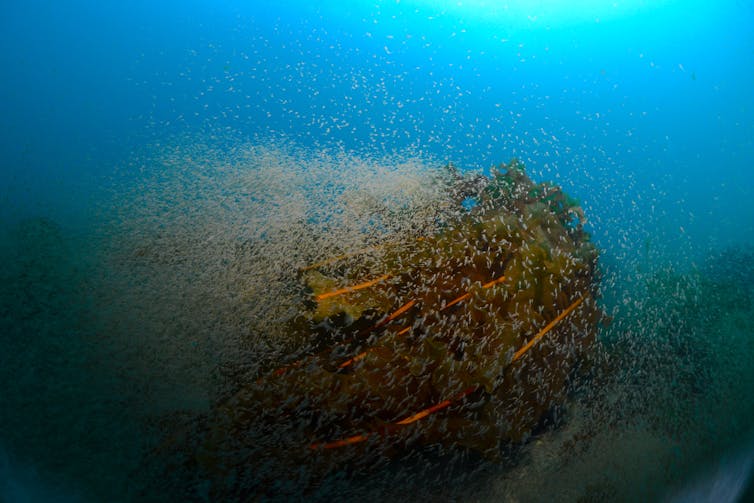
Organisms use light as a cue to do this, so they shouldn’t logically be able to during the polar night. We now understand the polar night to be a riot of ecological activity. The normal rhythms of daily life continue in the gloom. Clams open and close cyclically, seabirds hunt in almost total darkness, ghost shrimps and sea snails gather in kelp forests to reproduce, and deep-water species such as the helmet jellyfish surface when it’s dark enough to stay safe from predators.
For most of the organisms active during this period, the Moon, stars and aurora borealis likely give important cues that guide their behavior, especially in parts of the Arctic not covered by sea ice. But as the Arctic climate warms and human activities in the region ramp up, these natural light sources will in many places be invisible, crowded out by much stronger artificial light.
The northern lights dance in the sky over Tromsø, Norway. Muratart/Shutterstock
Artificial light
Almost a quarter of all land masses are exposed to scattered artificial light at night, as it’s reflected back to the ground from the atmosphere. Few truly dark places remain, and light from cities, coastlines, roads and ships is visible as far as outer space.
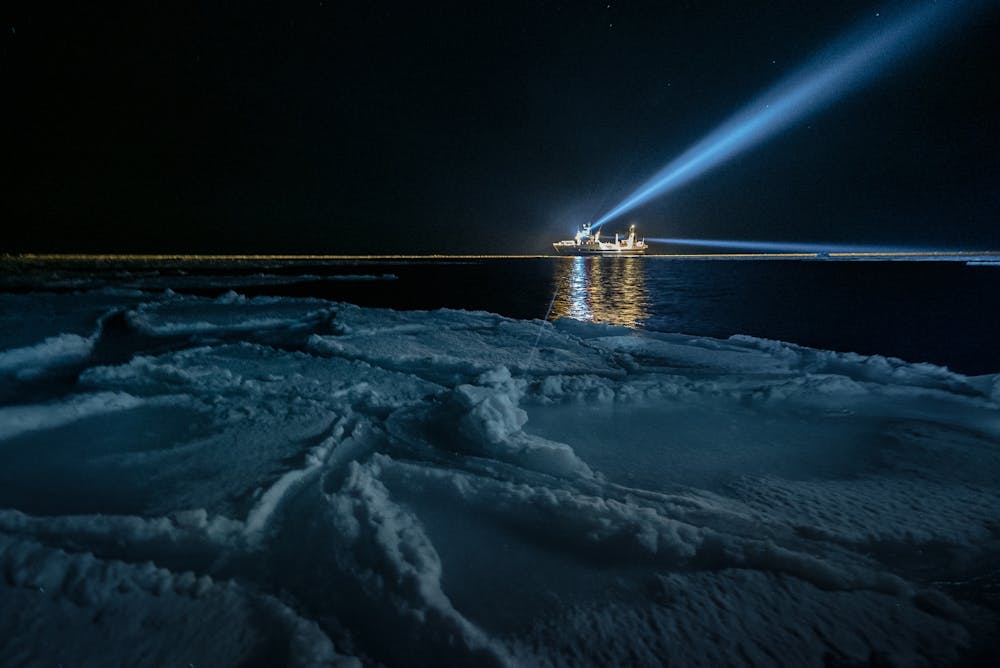
Even in sparsely populated areas of the Arctic, light pollution is noticeable. Shipping routes, oil and gas exploration and fisheries extend into the region as the sea ice retreats, drawing artificial light into the otherwise inky black polar night.
Creatures which have adapted to the polar night over millions of years are now suddenly exposed to artificial light.Michael O. Snyder, Author provided
No organisms have had the opportunity to properly adapt to these changes – evolution works on a much longer timescale. Meanwhile, the harmonic movements of the Earth, Moon and Sun have provided reliable cues to Arctic animals for millennia. Many biological events, such as migration, foraging and breeding are highly attuned to their gentle predictability.
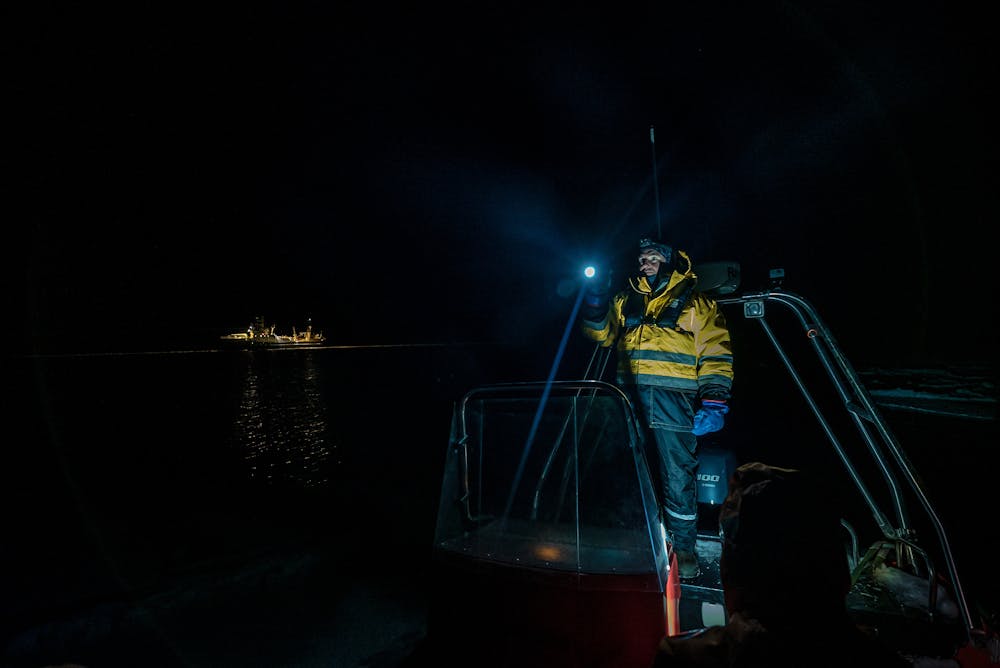
In a recent study carried out in the high Arctic archipelago of Svalbard, between mainland Norway and the north pole, the onboard lights of a research vessel were found to affect fish and zooplankton at least 200 metres down. Disturbed by the sudden intrusion of light, the creatures swirling beneath the surface reacted dramatically, with some swimming towards the beam, and others swimming violently away.
It’s difficult to predict the effect artificial light from ships newly navigating the ice-free Arctic will have on polar night ecosystems that have known darkness for longer than modern humans have existed. How the rapidly growing human presence in the Arctic will affect the ecosystem is concerning, but there are also unpleasant questions for researchers. If much of the information we’ve gathered about the Arctic came from scientists stationed on brightly lit boats, how “natural” is the state of the ecosystem we have reported?
Research in the Arctic could change considerably over the coming years to reduce light pollution.Michael O. Snyder, Author provided
Arctic marine science is about to enter a new era with autonomous and remotely operated platforms, capable of operating without any light, making measurements in complete darkness.
Underwater forests
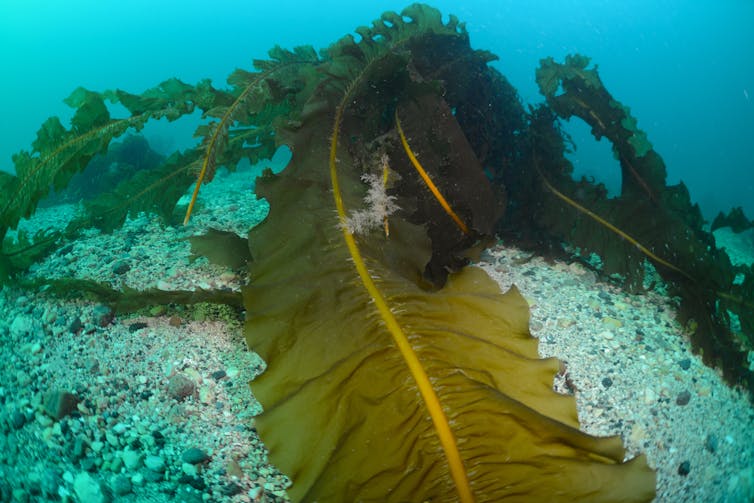
As sea ice retreats from the shores of Greenland, Norway, North America and Russia, periods with open water are getting longer, and more light is reaching the sea floor. Suddenly, coastal ecosystems that have been hidden under ice for 200,000 years are seeing the light of day. This could be very good news for marine plants like kelp – large brown seaweeds that thrive in cold water with enough light and nutrients.
Anchored to the sea floor and floating with the tide and currents, some species of kelp can grow up to 50 meters (175 feet) – about the same height as Nelson’s Column in Trafalgar Square, London. But kelp are typically excluded from the highest latitudes because of the shade cast by sea ice and its scouring effect on the seabed.
Badderlocks, or winged kelp, off the coast of Nunavut in the Canadian Arctic.Ignacio Garrido/ArcticKelp, Author provided
These lush underwater forests are set to grow and thrive as sea ice shrinks. Kelp are not a new arrival to the Arctic though. They were once part of the traditional Greenlandic diet, and polar researchers and explorers observed them along northern coasts more than a century ago.
Some species of kelp may have colonized Arctic coasts after the last ice age, or spread out from small pockets where they’d held on. But most kelp forests in the Arctic are smaller and more restricted to patches in deeper waters, compared to the vast swathes of seaweed that line coasts like California’s in the US.
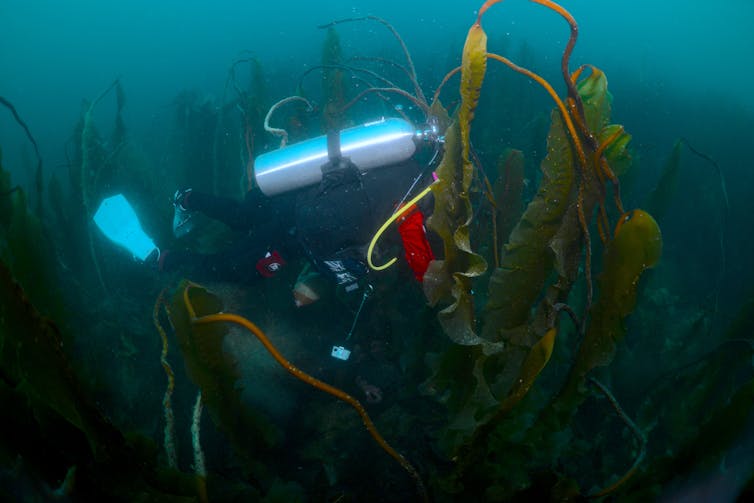
A diver explores a four-metre-high sugar kelp forest off Southampton Island, Canada.Ignacio Garrido/ArcticKelp, Author provided
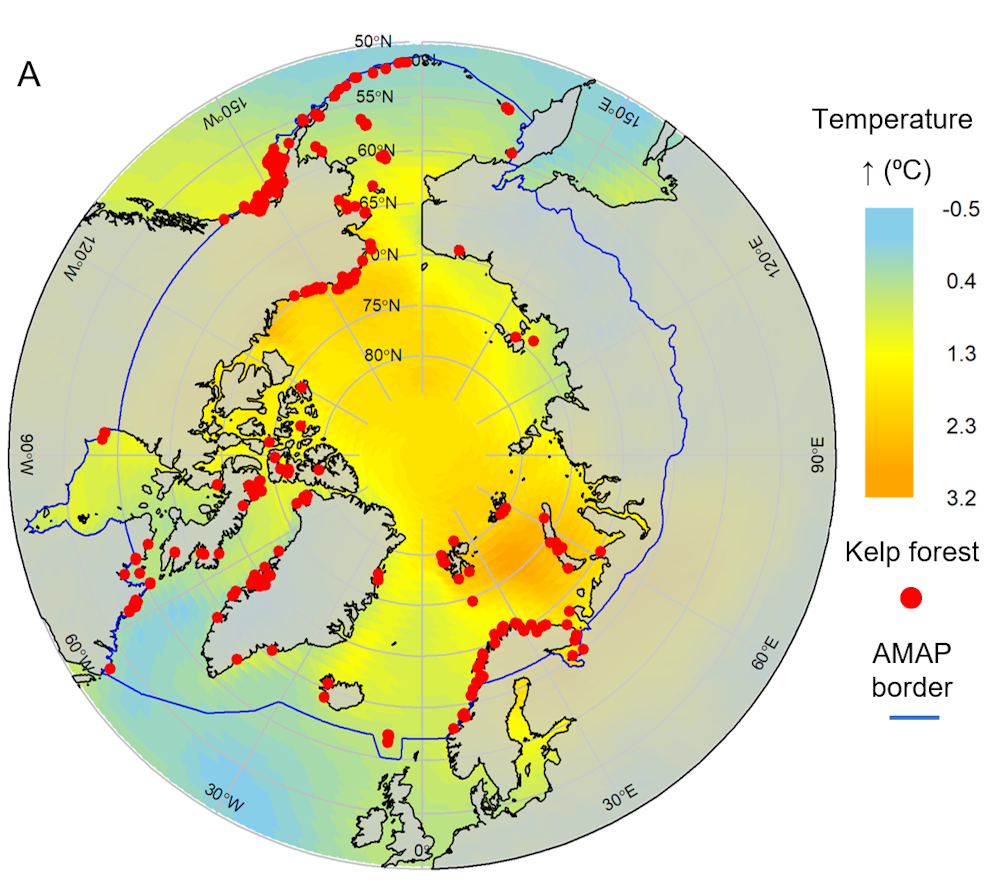
Recent evidence from Norway and Greenland shows kelp forests are already expanding and increasing their ranges poleward, and these ocean plants are expected to get bigger and grow faster as the Arctic warms, creating more nooks for species to live in and around. The full extent of Arctic kelp forests remains largely unseen and uncharted, but modelling can help determine how much they have shifted and grown in the Arctic since the 1950s.
Known locations of kelp forests and global trends in predicted average summer surface temperature increase over next two decades, according to IPCC models. Filbee-Dexter et al. (2018), Author provided
A new carbon sink
Although large seaweeds come in all shapes and sizes, many are remarkably similar to trees, with long, trunk-like but flexible bodies called stipes. The kelp forest canopy is filled with the flat blades like leaves, while holdfasts act like roots by anchoring the seaweed to rocks below.
Some types of Arctic kelp can grow over ten meters and form large and complex canopies suspended in the water column, with a shaded and protected understorey. Much like forests on land, these marine forests provide habitats, nursery areas and feeding grounds for many animals and fish, including cod, pollack, crabs, lobsters and sea urchins.
Kelp forests offer lots of nooks and crannies and surfaces to settle on, making them rich in wildlife.Ignacio Garrido/ArcticKelp, Author provided
Kelp are fast growers, storing carbon in their leathery tissue as they do. So what does their expansion in the Arctic mean for the global climate? Like restoring forests on land, growing underwater kelp forests can help to slow climate change by diverting carbon from the atmosphere.
Better yet, some kelp material breaks off and is swept out of shallow coastal waters and into the deep ocean where it’s effectively removed from the Earth’s carbon cycle. Expanding kelp forests along the Earth’s extensive Arctic coasts could become a growing carbon sink that captures the CO₂ humans emit and locks it away in the deep sea.
What’s happening with kelp in the Arctic is fairly unique – these ocean forests are embattled in most other parts of the world. Overall, the global extent of kelp forests is on a downward trend because of ocean heatwaves, pollution, warming temperatures, and outbreaks of grazers like sea urchins.
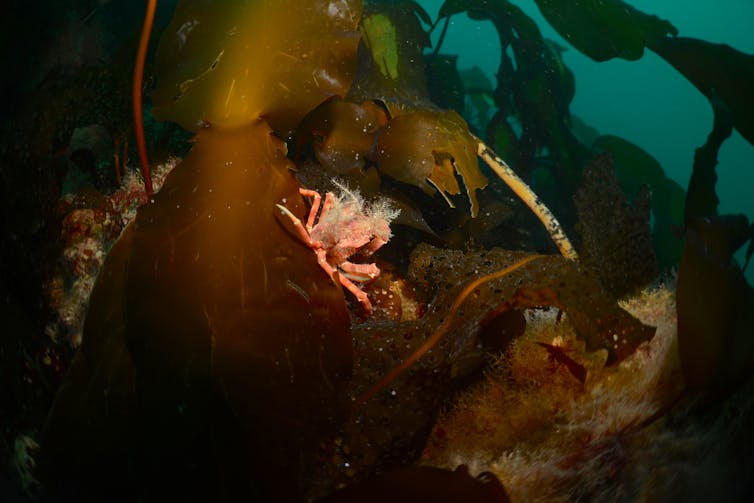
Unsurprisingly, it’s not all good news. Encroaching kelp forests could push out unique wildlife in the high Arctic. Algae living under the ice will have nowhere to go, and could disappear altogether. More temperate kelp species may replace endemic Arctic kelps such as Laminaria solidungula.
A crab finds refuge on Laminaria solidungula – the only kelp species endemic to the Arctic.Ignacio Garrido/ArcticKelp, Author provided
But kelp are just one set of species among many pushing further and deeper into the region as the ice melts.
Cruise ships, coast guard vessels, pleasure yachts, research icebreakers, cargo supply ships and rigid inflatable boats full of tourists also glide through the area. Unprecedented warming and declining sea ice has attracted new industries and other activities to the Arctic. Communities like Pond Inlet have seen marine traffic triple in the past two decades.
Passengers from a cruise ship arrive in Pond Inlet, Nunavut.Kimberly Howland, Author provided
These ships come to the Arctic from all over the world, carrying a host of aquatic hitchhikers picked up in Rotterdam, Hamburg, Dunkirk and elsewhere. These species — some too small to see with the naked eye — are hidden in the ballast water pumped into on-board tanks to stabilize the ship. They also stick to the hull and other outer surfaces, called “biofouling.”
Some survive the voyage to the Arctic and are released into the environment when the ballast water is discharged and cargo loaded. Those that maintain their hold on the outer surface may release eggs, sperm or larvae.
Many of these organisms are innocuous, but some may be invasive newcomers that can cause harm. Research in Canada and Norway has already shown non-native invasive species like bay and acorn barnacles can survive ship transits to the Arctic. This raises a risk for Arctic ecosystems given that invasive species are one of the top causes for extinctions worldwide.
Expanded routes
Concern about invasive species extends far beyond the community of Pond Inlet. Around 4 million people live in the Arctic, many of them along the coasts that provide nutrients and critical habitat for a wide array of animals, from Arctic char and ringed seals to polar bear, bowhead whales and millions of migratory birds.
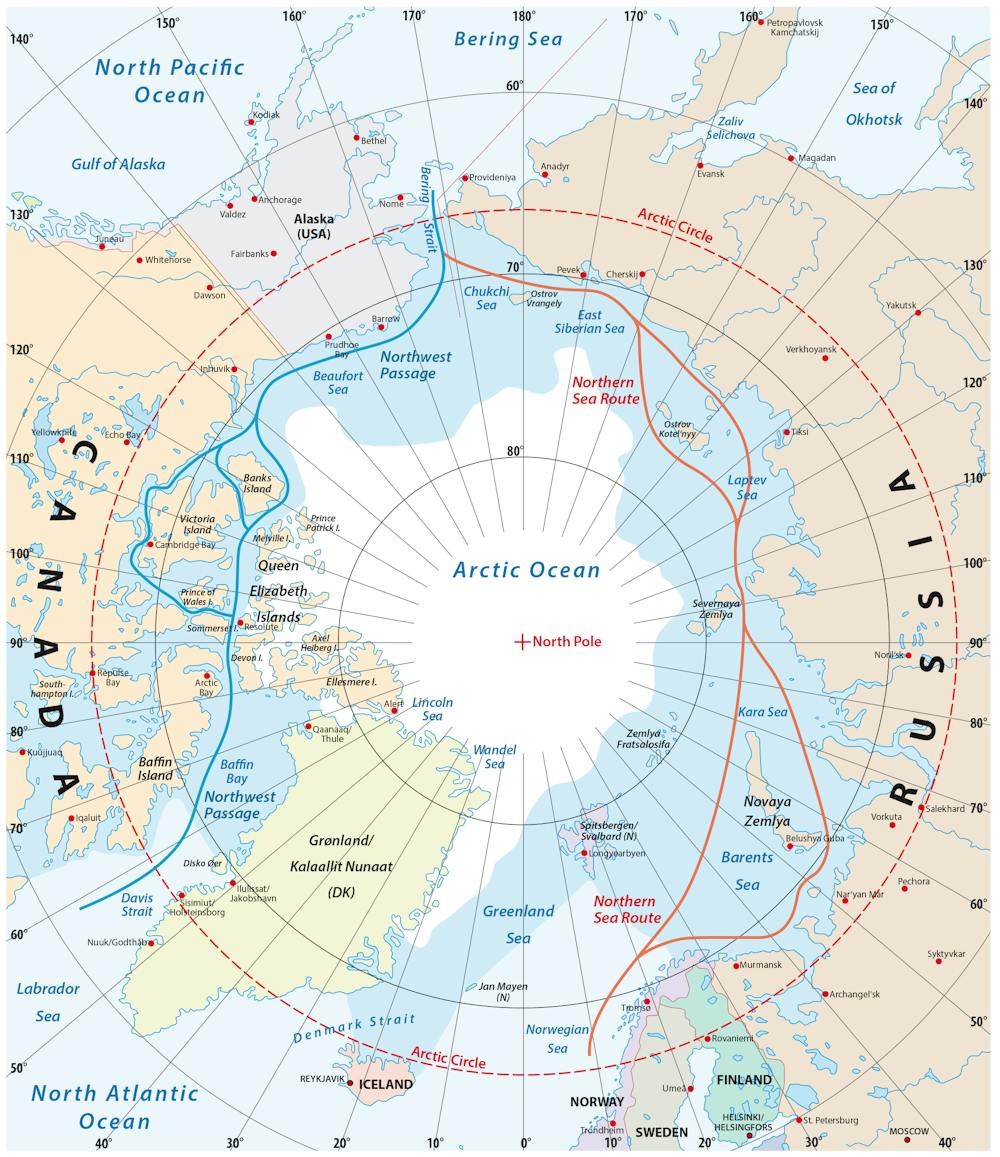
As the Arctic sea ice melts during the summer months, shipping routes are opening up along the Russian coast and through the Northwest Passage. Some say a trans-Arctic route might soon be navigable.Shutterstock
Prevention is the number one way to keep invasive species out of the Arctic. Most ships must treat their ballast water, using chemicals or other processes, and/or exchange it to limit the movement of harmful organisms to new locations. Guidelines also recommend ships use special coatings on the hulls and clean them regularly to prevent biofouling. But these prevention measures are not always reliable, and their efficacy in colder environments is poorly understood.
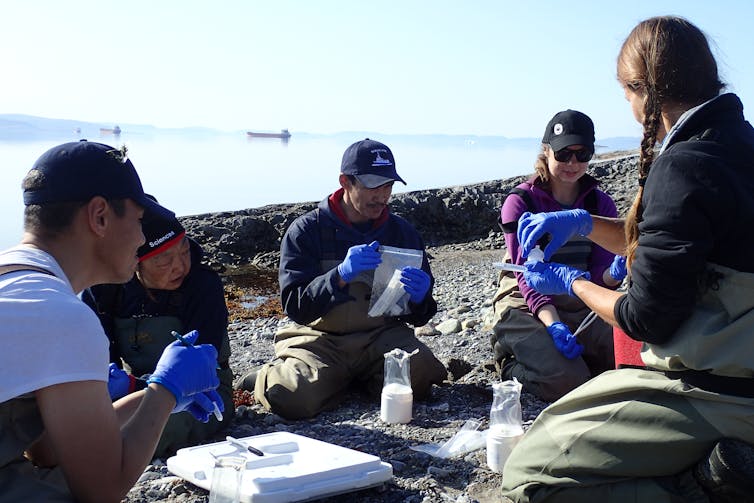
The next best approach is to detect invaders as soon as possible once they arrive, to improve chances for eradication or suppression. But early detection requires widespread monitoring, which can be challenging in the Arctic. Keeping an eye out for the arrival of a new species can be akin to searching for a needle in a haystack, but northern communities may offer a solution.
Researchers in Norway, Alaska and Canada have found a way to make that search easier by singling out species that have caused harm elsewhere and that could endure Arctic environmental conditions. Nearly two dozen potential invaders show a high chance for taking hold in Arctic Canada.
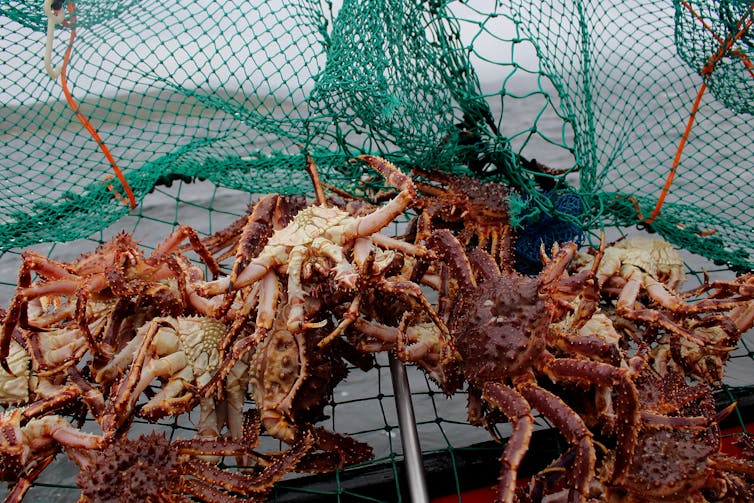
The red king crab was intentionally introduced to the Barents Sea in the 1960s, but is now spreading south along the Norwegian coast.Shutterstock
Among these is the cold-adapted red king crab, native to the Sea of Japan, Bering Sea and North Pacific. It was intentionally introduced to the Barents Sea in the 1960s to establish a fishery and is now spreading south along the Norwegian coast and in the White Sea. It is a large, voracious predator implicated in substantial declines of harvested shellfish, sea urchins and other larger, slow moving bottom species, with a high likelihood of surviving transport in ballast water.
Another is the common periwinkle, which ruthlessly grazes on lush aquatic plants in shoreline habitats, leaving behind bare or encrusted rock. It has also introduced a parasite on the east coast of North America that causes black spot disease in fishes, which stresses adult fishes and makes them unpalatable, kills juveniles and causes intestinal damage to birds and mammals that eat them.
Tracking genetic remnants
New species like these could affect the fish and mammals people hunt and eat, if they were to arrive in Pond Inlet. After just a few years of shipping, a handful of possibly non-native species have already been discovered, including the invasive red-gilled mudworm (Marenzellaria viridis), and a potentially invasive tube dwelling amphipod. Both are known to reach high densities, alter the characteristics of the seafloor sediment and compete with native species.
A cargo ship passes through Milne Inlet, Nunavut.Kimberly Howland, Author providedBaffinland, the company that runs the Mary River Mine, is seeking to double its annual output of iron ore. If the expansion proceeds, up to 176 ore carriers will pass through Milne Inlet during the open-water season.
Although the future of Arctic shipping remains uncertain, it’s an upward trend that needs to be watched. In Canada, researchers are working with Indigenous partners in communities with high shipping activity — including Churchill, Manitoba; Pond Inlet and Iqaluit in Nunavut; Salluit, Quebec and Nain, Newfoundland — to establish an invasive species monitoring network. One of the approaches includes collecting water and testing it for genetic remnants shed from scales, faeces, sperm and other biological material.
Members of the 2019 field team from Pond Inlet and Salluit filter eDNA from water samples collected from Milne Inlet.Christopher Mckindsey, Author provided
This environmental DNA (eDNA) is easy to collect and can help detect organisms that might otherwise be difficult to capture or are in low abundance. The technique has also improved baseline knowledge of coastal biodiversity in other areas of high shipping, a fundamental step in detecting future change.
Efforts are underway to expand the network across the Arctic as part of the Arctic Council’s Arctic Invasive Alien Species Strategy to reduce the spread of invasive species.
The Arctic is often called the frontline of the climate crisis, and because of its rapid rate of warming, the region is beset by invasions of all kinds, from new species to new shipping routes. These forces could entirely remake the ocean basin within the lifetimes of people alive today, from frozen, star-lit vistas, populated by unique communities of highly adapted organisms, to something quite different.
The Arctic is changing faster than scientists can document, yet there will be opportunities, such as growing carbon sinks, that could benefit the wildlife and people who live there. Not all changes to our warming world will be wholly negative. In the Arctic, as elsewhere, there are winners and losers.
A note from our editor’s mother
My daughter Beth leads the team of experienced editors working with experts to share fact-based journalism with readers like you. If you read this website, you know what good work they do. So please help them raise up the voices of scholars to drown out the loud voices shouting lies (she was never a shouter growing up). Thank you!


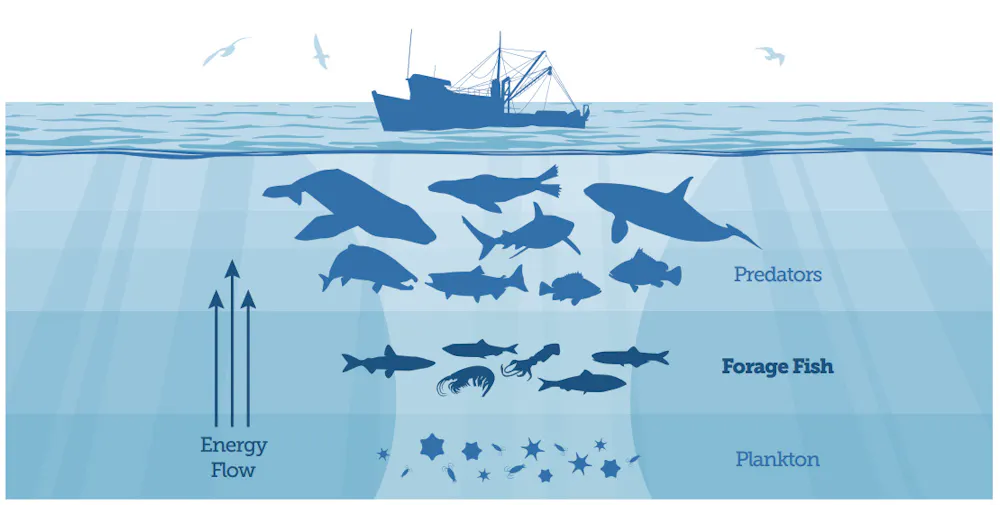

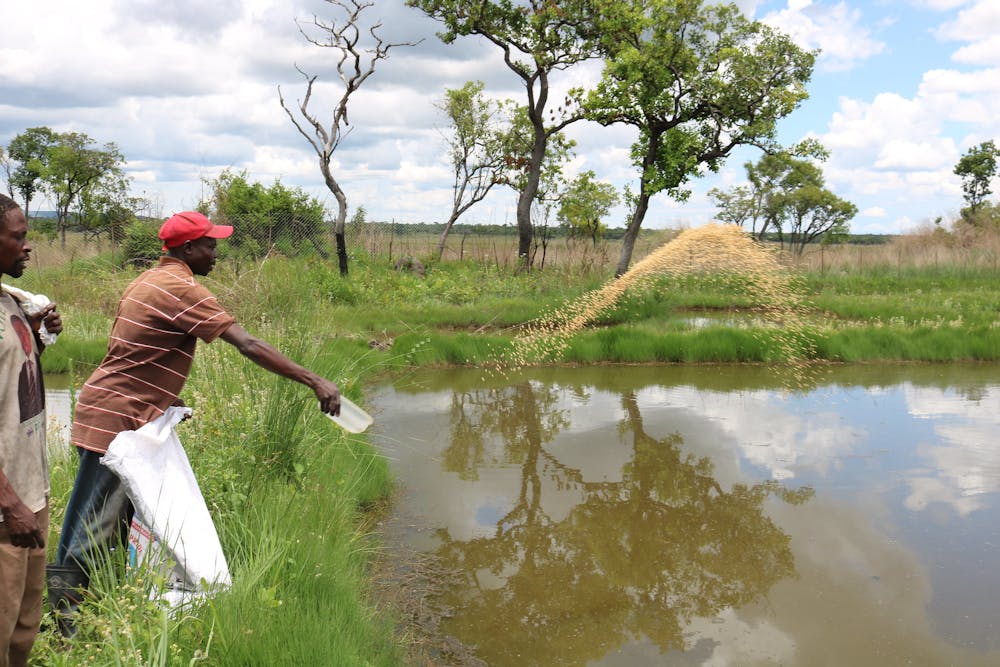


/cdn.vox-cdn.com/uploads/chorus_image/image/68473295/GettyImages_1229949744.0.jpg)










 A boat navigates at night next to large icebergs in eastern Greenland.