Organic farming must grow to reach green goals, EU says
Kate Abnett March 25, 2021
European Union flags flutter outside the European Commission headquarters in Brussels
BRUSSELS (Reuters) – The European Commission on Thursday said it would expand financial and policy support to help achieve a goal for a quarter of Europe’s farmland to be organic by 2030.
Agriculture produces roughly 10% of EU greenhouse gas emissions and is on the front line of climate change impacts, with record heat-waves and prolonged droughts reducing some European crop yields.
Organic farmland, which restricts chemical pesticides, synthetic fertilizers and genetically modified organisms, has expanded by more than 60% over the last decade in the European Union, to nearly 9% of the bloc’s agricultural area.
The Commission on Thursday outlined plans to speed up this expansion and stir demand for organic products, which it said would help the EU reach its goal to eliminate net emissions by 2050. Reaching a 25% organic share of farmland this decade would also protect bees and biodiversity, the Commission said.
Agriculture emits nitrous oxide from the use of artificial fertilizers, while livestock produces potent planet-warming methane.
By curbing fertilizers, organic farming can cut emissions, although it does not necessarily tackle emissions from livestock, and lower crop yields associated with organic farming can mean more land is required, denting potential emissions savings.
The EU will spend 49 million euros ($57.94 million) on promoting organic products this year, 27% of its total budget for promoting EU agricultural products at home and abroad.
The Commission said the EU’s farming subsidy program, which is being reformed, will offer farmers 38-58 billion euros over 2023-2027 for eco-schemes, including organic production.
Organic food and farming organization IFOAM welcomed the EU plan as “a new era for the transformation of our food systems”.
Farmers’ association Copa-Cogeca said in a statement further policies and product innovation would be needed to ensure organic farmers can fend off weeds and pests.
The EU is developing mandatory sustainability requirements for the public procurement of food, which could integrate organic products into school meals or public canteens.
Brussels said national measures, such as removing reduced tax rates on pesticides, could also make organic food less expensive relative to non-organic food.
($1 = 0.8457 euros)
(Reporting by Kate Abnett; editing by Barbara Lewis)
Do Your Vaccine Side Effects Predict How You’d React To COVID-19?
Seraphina Seow, On Assignment For HuffPost
People have had varying reactions to the COVID-19 shot, which experts say is normal. (Photo: aquaArts studio via Getty Images)
We’re more familiar now with the possible side effects from the COVID-19 vaccine interacting with our immune system. Experts stress post-shot issues like fatigue and fever mean the vaccine is working (as long as they aren’t indicative of an allergic reaction).
So, what does this mean for those of us who have no side effects?
We asked vaccine experts to give us the rundown on what side effects mean and whether their severity predicts how effective your immune response will be to the COVID-19 virus.
First, a recap on what causes COVID-19 vaccine side effects.
COVID-19 vaccine side effects are either a physical manifestation of your body’s immune response ― which is the case for most people ― or an allergic reaction, said Jesse Erasmus, acting assistant professor in the department of microbiology at the University of Washington School of Medicine.
Erasmus said the side effects you have from a shot typically depend on the type of vaccine technology that’s used to create the immunization (for example, messenger RNA, or mRNA, is the type of technology the Pfizer-BioNTech and Moderna shots use) and how those components interact with your immune system.
In terms of the coronavirus shots, “all the vaccines that are currently in emergency use authorization have very similar side effect profiles,” said Colleen Kelley, an associate professor of infectious diseases at Emory University School of Medicine and principal investigator for Moderna and Novavax Phase 3 vaccine clinical trials at the Ponce de Leon Center clinical research site in Atlanta.
Scroll back up to restore default view.
Kelley thinks the COVID-19 shot side effects mainly stem from the body responding to the spike protein the vaccine introduces to the immune system, which helps it recognize (and then fight off) the spike protein on the coronavirus should it enter the body.
When it comes to allergic reactions to the vaccine, which are rare, a hypothesis for mRNA vaccines is that people may be allergic to a component called polyethylene glycol, a common food additive, Erasmus said.
Why do some people have worse side effects than others?
Based on people’s experiences, it appears that some have worse reactions to the shot than others. But scientifically there aren’t any confirmed reasons for this yet.
“There aren’t really any distinguishing factors that would predispose one individual having more side effects versus the other,” said Richard Dang, a pharmacist and assistant professor of clinical pharmacy at the University of Southern California. “The only thing we’ve seen in the clinical data so far is that younger individuals seem to experience side effects at higher rates than older individuals, and we see that in the real world as well.”
There have been reported cases in which those who previously had the virus endured harsher side effects after they received their vaccines.
“Anecdotally, it does appear that people who may have had COVID-19 before their vaccine do tend to have those longer duration of symptoms,” Kelley added. “But we’re still gathering additional scientific data to really support this.”
Does the severity of side effects have anything to do with how well your body will fight COVID-19 if exposed?
Though it is a valid question, more studies need to be conducted to unpack what the severity of side effects actually mean, said Anna Wald, an infectious diseases physician and researcher in COVID-19 vaccine trials at the University of Washington’s School of Medicine.
But Erasmus, Kelley and Wald all say the effectiveness of the vaccine is unlikely to be determined by how severe your side effects are.
“Remember that most people have mild or no side effects in the clinical trials [for the mRNA vaccines], and yet the vaccine was still found to have 95% effectiveness at protecting them from illness,” Wald noted.
Make sure to rest and take fever reducers if your COVID-19 vaccine side effects are bothering you. (Photo: Westend61 via Getty Images)
Whether you develop mild or severe side effects, it’s important to know what to do.
Bottom line, the benefits of the vaccines outweigh the side effects. Getting the shot means protecting yourself against severe disease, hospitalization and death from COVID-19.
If you do encounter side effects, there are a few things you can do. At the time of the vaccination, ask the person vaccinating you who best to contact (and how) for follow-up care should you need it, Dang said. You should also wait 15 to 30 minutes at the vaccine site after you receive the shot to make sure you don’t have any severe allergic reactions.
Usually, if you’re experiencing the immune system-related side effects, like fatigue, headache or fever, Kelley said, you can take a pain or fever reducer, such as Tylenol, then take a nap if you’re able. Make sure to stay hydrated and take it easy when you’re feeling off as well.
These issues will likely resolve in one to four days at the most, Kelley said. Anything lasting longer warrants a check-in with your doctor or at the place where you received your vaccine. You should seek emergency care or call 911 if you’re having difficulty breathing or significant swelling.
You can also register and report some of your side effects on the Centers for Disease Control and Prevention’s V-safe program, Dang said. V-safe sends you daily, then weekly, text messages to see how you’re doing and if you’re experiencing any reactions. If you report severe reactions, it flags the CDC to check up on you further.
Remember that side effects are typically a very normal part of getting the COVID-19 vaccine ― and we’ll be in a lot better place on the other side of the shots.
Experts are still learning about COVID-19. The information in this story is what was known or available as of publication, but guidance can change as scientists discover more about the virus. Please check the Centers for Disease Control and Prevention for the most updated recommendations.
Matt Damon: Climate change will most impact ‘the poorest people’
NATO Secretary General Jens Stoltenberg on Tuesday called climate change a “crisis multiplier” that will exacerbate “droughts and flooding” and spur global migration, as the military alliance announced efforts to incorporate climate change mitigation into its mission.
In a new interview, Oscar-winning actor and water equity philanthropist Matt Damon said the link between climate change and water scarcity will deepen over the coming years and predominantly impact the world’s most impoverished communities.
When asked about the connection between climate change and water scarcity, Damon pointed to low-income people in developing countries. Currently, 2.2 billion people worldwide lack access to safe drinking water.
“Those are the people that we’re dealing with, those are the people that we’re trying to reach, and those are the people who are going to feel the effects of [climate change] more than anybody,” says Damon, who co-founded the nonprofit organization Water.org in 2009 and WaterEquity in 2017.
“It’s always going to fall to the poorest people on Earth to bear the brunt of these things more than anybody,” he adds. “That’s the connection.”
Climate observers expect water scarcity to worsen significantly over the coming decades. In the early to mid-2010s, 1.9 billion people, or 27% of the global population, lived in areas at risk of a severe water shortage, according to a United Nations report released last year. By 2050, that figure will increase to somewhere between 2.7 billion and 3.2 billion people.
“Water is the primary medium through which we will feel the effects of climate change,” The United Nations says on its website.
‘You’ve got to move to where the water is’
Water scarcity will also exacerbate global food insecurity, which last year worsened severely and caused “unprecedented” migration, the United Nations said in November. That trend will continue in the coming years as drought diminishes arable land and reduces crop yields, according to a report released two years ago by the nonpartisan Center for Strategic and International Studies.
Influencers with Andy Serwer: Matt Damon & Gary White
On an all new episode of Influencers, Andy Serwer sits down with Water.org co-founder and actor Matt Damon as well as Water.org co-founder Gary White to discuss World Water Day and the ongoing global water crisis.
“As we look at water stress, as we look at climate change, a lot of those people are going to be driven into poverty because of the tenuous access that they have to water now,” says Gary White, CEO and co-founder of both Water.org and WaterEquity.
“If you are not able to get water because of a drought that’s caused by climate change, you’ve got to move,” he adds. “You’ve got to move to where the water is.”
Damon and White spoke to Yahoo Finance Editor-in-Chief Andy Serwer in an episode of “Influencers with Andy Serwer,” a weekly interview series with leaders in business, politics, and entertainment.
Damon kicked off his water philanthropy with the launch of H2O Africa in 2006, while working on a documentary called “Running the Sahara,” which profiled three men who attempted to traverse the Sahara Desert.
At a Clinton Global Initiative meeting two years later, Damon met White, who nearly two decades earlier had founded WaterPartners International, an organization that sought to alleviate the water crisis in Latin America, Barron’s reported. The two began to discuss the possibility of a partnership and founded Water.org a year later.
Actor Matt Damon speaks with Yahoo Finance Editor-in-Chief Andy Serwer on “Influencers with Andy Serwer.”
Global climate migration is already underway and will increase dramatically over the rest of this century, according to an investigation released last year by The New York Times. Across Sub-Saharan Africa, South Asia, and Latin America, more than 140 million people will move within their countries’ borders due to climate change by 2050, the World Bank found.
Speaking with Yahoo Finance, White said that water scarcity plays a central role in migration that observers ultimately attribute to climate change.
“Water is the root of so much of what needs to happen for people to maintain their income and their lifestyle and their home,” White says.
“When we talk about climate refugees, we are talking about water refugees, most of the time,” he adds.
Viagra may help men to live longer and reduce their risk of heart disease, study finds
Kelsie Sandoval March 24, 2021
Viaframe/Insider
Male heart attack survivors who took Viagra had a low risk of having another heart attack.
The more frequent the Viagra doses, the more protection it offered against heart issues.
Avoid tobacco and get moving every day to prevent erectile dysfunction and heart issues.
Taking Viagra isn’t just good for your sex life – it may be linked to a longer lifespan in men.
A new study found that men who took the little blue pill after a heart attack lived for years after, without suffering further heart complications.
Viagra is used to treat erectile dysfunction (ED) or high blood pressure in the lungs by relaxing muscles and arteries so blood can flow better. For ED, that better blood flow in the penis helps men to have an erection.
In the study, researchers at the Karolinska Institute in Sweden sought to study how Viagra affected men with coronary artery disease, and compared the results to men taking another ED pill, alprostadil.
According to the study, published in the journal of the American College of Cardiology, Viagra worked better than alprostadil at extending lifespan and lowering the risk of another heart attack.
It was particularly effective when administered frequently.
The study had some limitations
The researchers gathered data from 16,548 Swedish men who had experienced both ED and a heart condition in the last six months. Of those, under 2,000 received alprostadil and the rest received Viagra.
The study was observational, meaning researchers did not control the experiment but rather gleaned trends from data.
A limitation to the comparison was that the majority of the men studied took Viagra.
If you have erectile dysfunction and coronary heart disease, talk to your doctor
ED, which affects a third of all men, can be an early sign of cardiovascular disease. The risk factors go hand in hand: physical inactivity, obesity, hypertension, and metabolic syndrome.
For both, the Mayo Clinic recommends avoiding tobacco and getting 30 to 60 minutes of daily physical activity.
John Oliver attends NRDC’s “Night of Comedy” Benefit on April 30, 2019 in New York City. Ilya S. Savenok / Getty Images for NRDC.
In his latest deep dive for Last Week Tonight, comedian John Oliver took on plastic pollution and, specifically, the myth that if we all just recycled enough, the problem would go away.
Instead, Oliver argued, this is a narrative that has been intentionally pushed by the plastics industry for decades. He cited the ionic 1970 Keep America Beautiful ad, which showed a Native American man (really an Italian American actor) crying as a hand tossed litter from a car window. Keep America Beautiful, Oliver pointed out, was partly funded by plastics-industry trade group SPI.
“Which might seem odd until you realize that the underlying message there is, ‘It’s up to you, the consumer, to stop pollution,'” Oliver said. “And that has been a major through line in the recycling movement, a movement often bankrolled by companies that wanted to drill home the message that it is your responsibility to deal with the environmental impact of their products.”
Oliver pointed out several problems with contemporary recycling programs. He cited the U.S. Environmental Protection Agency (EPA) statistic that only 8.7 percent of the plastics produced in the U.S. are actually recycled, and investigated why this is.
For one thing, most municipalities do not actually have the capacity to recycle most of the numbers inside the “chasing arrows” symbols on the back of plastic packaging. Numbers 1 and 2, representing PETE and HDPE, are more commonly recycled, but that leaves numbers 3 through 7, which include things like plastic bags and cups. We have the capacity to recycle less than five percent of these, Oliver said.
“Out of the seven numbers, only two are really much good, and that is a pretty bad ratio for a group of seven,” Oliver said.
In fact, it is cheaper for companies to produce virgin plastics than to recycle existing ones. Despite this, they have lobbied for the “chasing arrows” symbols to appear on their products, as well as for the existence of curbside recycling programs.
If anything needs to change in consumer behavior, it is in our willingness to believe this myth.
“Lies go down easier when you want them to be true,” Oliver said.
He even showed a clip of a recycling plant director who coined a new term for the consumer habit of putting non-recyclable items in the recycling bin: wish-cycling.
“Here’s an umbrella,” Martin Borque, the director, said, lifting the item out of the materials he had to sort. “I wish it was recyclable. It’s not.”
Removing these items causes extra work for recycling plants, and can even end up contaminating plastics that could otherwise be recycled and reused.
Oliver said that consumers shouldn’t stop recycling, though they should be sure to only blue-bin items their local plant can actually process. However, the major change needs to come from industry and policy, he said.
He spoke out in favor of Extended Producer Responsibility, or EPR, which puts the burden of dealing with waste back on the company that makes it. The U.S. is one of the only wealthy countries without an EPR law on the books, though legislators have been trying to change that with the Break Free from Plastic Pollution Act, which was introduced last year and is set to be introduced again in 2021.
“The real behavior change has to come from plastics manufacturers themselves,” Oliver concluded. “Without that, nothing significant is going to happen.”
Oliver’s segment won approval from activists working to pass EPR legislation in the U.S. The U.S. Public Interest Research Group thanked the TV host on Twitter for calling attention to the issue.
“Makers of single-use plastics shouldn’t escape the costs to our planet and public health,” the group wrote.
Experts Urge World Leaders to ‘Put Marine Ecosystems at the Heart of Climate Policy’
By Guest March 22, 2021
By Jessica Corbett, Common Dreams
As global weather experts warned Monday that the world’s oceans are “under threat like never before,” more than 3,000 scientists, politicians, and other public figures had endorsed an open letter urging national governments to “recognize the critical importance of our ocean and blue carbon in the fight against the climate emergency.”
Led by the Environmental Justice Foundation (EJF) and backed by 66 partner groups, the letter (pdf) calling on world leaders to “put marine ecosystems at the heart of climate policy” is now open to public signature and will be presented to governments before November’s United Nations Climate Change Conference (COP26) in Glasgow.
“Nature-based solutions like restoration and protection of marine habitats will both help us meet global de-carbonization goals and prevent the worst impacts of global heating while also protecting the lives and livelihoods of the three billion people who depend on marine biodiversity around the world,” said Steve Trent, executive director of the London-based EJF. “Our political leaders must recognize the urgency of the climate crisis and take truly bold, transformative action to reach a global zero carbon economy.”
“Our ocean gives us every second breath. It absorbs around a third of the CO2 we pump out, and has taken in over a nuclear bomb’s worth of heat every second for the past 150 years,” the letter says. “It underpins our climate system and keeps our planet habitable: It is the blue beating heart of our planet.”
“Yet, when it comes to inclusion in climate policies, marine habitats are often neglected. A healthy ocean, teeming with life, is a vital tool in the bid to tackle global heating: more than half of biological carbon capture is stored by marine wildlife,” the groups note, highlighting the power of mangrove forests, seagrass meadows, and the wildlife of the open sea.
“The COP26 climate talks and COP15 biodiversity talks this year will be the most important meetings for generations. They will set us on the road to either a sustainable future for humanity or conflict, suffering, and mass extinctions,” the letter continues, urging world leaders to take three specific actions:
Include specific, legally binding targets to protect and restore blue carbon environments in their updated Nationally Determined Contribution implementation plans;
Commit to the 30×30 ocean protection plan and designate 30% of the ocean as ecologically representative marine protected areas by 2030; and
Agree an international moratorium on deep sea mining to protect the deep sea from irreversible, large-scale harm.
The letter comes about a month after a U.N. report warned that Nationally Determined Contribution (NDC) pledges—or plans to reduce planet-heating emissions—that parties to the Paris climate agreement have unveiled so far ahead of COP26 are dramatically inadequate on the whole. As Common Dreamsreported, U.N. Secretary-General António Guterres called the findings “a red alert for our planet.”
Letter signatory Richard Unsworth, a marine scientist and co-founder of Project Seagrass, said Monday that “there is real hope: protection and restoration of habitats like seagrass meadows can be a key part of the solution in tackling climate change. But the missing piece has been the fundamental long-term support from the government.”
“If we’re going to fight climate change and face up to the associated problems of food security,” he said, “then we need to restore our oceans, and that involves real government support as part of a genuine green deal for the environment.”
Other signatories include including Pavel Kabat, Intergovernmental Panel on Climate Change (IPCC) assessment reports lead author and inaugural research director of the U.N. World Meteorological Organization (WMO); human rights barrister Baroness Helena Kennedy; University of Exeter marine conservation professor Brendan Godley; wildlife filmmaker Gordon Buchanan; actor Joanna Lumley; and politicians from the United Kingdom, Germany, Indonesia, Taiwan, and beyond.
British Green MP Caroline Lucas emphasized that policies and action reflecting the importance of marine ecosystems “to both people and planet” must be “additional to—and not instead of—decarbonization on land.”
Echoing recent messages from fellow youth climate campaigners across the globe, 13-year-old Finlay Pringle, another signatory, said that “talking and doing nothing is not acceptable anymore. We don’t want more empty promises from our politicians, we need them to face the climate emergency and take action now, rather than continuing to pass the responsibility on to future generations.”
The letter was released as the WMO prepared for World Meteorological Day, which on Tuesday will celebrate “the ocean, our climate, and weather” while raising awareness about scientific findings regarding growing threats, including a landmark IPCCreport on the world’s seas and frozen regions.
“Ocean heat is at record levels because of greenhouse gas emissions, and ocean acidification continues unabated. The impact of this will be felt for hundreds of years because the ocean has a long memory,” saidWMO Secretary-General Petteri Taalas in a statement Monday. “Ice is melting, with profound repercussions for the rest of the globe, through changing weather patterns and accelerating sea level rise.”
“In 2020, the annual Arctic sea ice minimum was among the lowest on record, exposing Polar communities to abnormal coastal flooding, and stakeholders such as shipping and fisheries, to sea ice hazards,” he added, also noting that “warm ocean temperatures helped fuel a record Atlantic hurricane season, and intense tropical cyclones in the Indian and South Pacific Oceans.”
This article originally appeared on Common Dreams. It has been republished under a Creative Commons Attribution-Share Alike 3.0 License.
John Oliver Shares Horrific Truths About Recycling Plastics
M. Arbeiter March 22, 2021
John Oliver. Purveyor of laughs, purveyor of doom. By now, you likely know the drill when you tune into Last Week Tonight. You’ll get some pretty horrifying information about a facet of our society you maybe haven’t paid too much attention to. But you’ll also get a few dozen jokes about funny-looking animals! So you take your medicine with a spoonful of sugar. This week’s episode, concerning the recyclability (or lack thereof) of plastics, provides all of the above.
We learn about the deeply convoluted nature of the recycling institution. John touches on how so few plastics are actually recycled. As you’ll learn in the above video, such a small percentage of plastic products are recycle-friendly. And that’s before the concern of recyclable plastics becoming contaminated or just tossed out. And that’s not even factoring how many of those recyclable plastics end up recycling into non-recyclable plastics. I told you it was convoluted!
Another interesting piece of John’s latest lesson involves the marketing of recycling. The video highlights how major corporations have long put the onus on the consumer alone to “save the environment.” Meanwhile, with so many non-recyclable plastics in production, it’s practically out of the everyday person’s hands to manage this issue whatsoever.
A man roots through a landfill. HBO
Of course, John closes out the segment with encouragement to keep recycling, albeit more mindfully. Following this, an appropriate castigation of the major corporations producing plastics; they’re the ones that need to change behavior in order to get the planet into better shape.
Some harrowing statistics in this video really drive this point home. Half the plastics ever produced have come into being since 2005; additionally, so much plastic litters the ocean, that by 2050, the mass of plastic should outnumber the mass of fish.
Yeah, harrowing! But John Oliver tosses in a talking blobfish and a demonic goat-man to make it all a bit more palatable.
John Oliver stares at a man wearing a goat head mask.
Footage Of Australia’s Massive Mouse Plague Will Haunt Your Nightmares
Ed Mazza, Overnight Editor
Parts of Australia are battling a “plague” of rodents.
Large rural portions of inland New South Wales and Queensland are being overrun by millions of mice, which have taken over farmland, homes, stores, hospitals and cars. They’re also eating everything in sight.
“You can imagine that every time you open a cupboard, every time you go to your pantry, there are mice present,” rodent expert Steve Henry told the wire service. “And they’re eating into your food containers, they’re fouling your clean linen in your linen cupboard, they’re running across your bed at night.”
They’re also leaving behind haunting videos and images:
At one farm, the mice ate through hundreds of thousands of dollars of hay bales, reducing them to mounds of dust in a matter of weeks.
“It’s a real kick in the guts,” farmer Rowena Macrae of Coonamble told Queensland Country Life. “It’s so very hard to watch.”
“They stink whether they are alive or dead, you can’t escape the smell sometimes,” Pip Goldsmith of Coonamble, who has trapped thousands of mice, told The Guardian Australia. “It’s oppressive, but we are resilient.”
Lisa Gore of Toowoomba told the newspaper that her 12-year-old son caught 183 in a single night.
“It’s like his job at the moment,” she said. “He is very proud of himself.”
Local reports said the mouse population continues to grow and efforts to poison the rodents had started to backfire as dead critters were turning up in water tanks. One homeowner in Elong Elong investigating a water blockage encountered a “revolting” smell, according to Australia’s ABC News.
“We always filter the water going into our house from the tanks so for us, personally, we feel we’ve covered our precautions so we didn’t notice anything with the taste,” Louise Hennessy told the news agency. “But the smell of the mice at the top of the tank was so disgusting.”
Public health authorities are now warning of the potential for bacteria in the water if dead mice remain in the tanks.
Authorities said a drop in temperature or a heavy rainfall could wipe out most of the mice at any time.
Women Are More Likely To Have COVID Vaccine Side Effects Than Men. Fun!
Asia Ewart March 22, 2021
A new study released by the Centers for Disease Control and Prevention (CDC) has concluded that women are more likely to experience side effects after receiving the COVID-19 vaccine. According to the “First Month of COVID-19 Vaccine Safety Monitoring” study published last month, 79% of reports of the more serious symptoms caused by the Pfizer and Moderna vaccines came from women.
The month long study followed the first 13,794,904 Americans who received the Pfizer and Moderna vaccines, noting how they reacted to the shots from December 14, 2020, to January 13, 2021. People reported symptoms using the vaccine adverse event reporting system, or VAERS, for the study; the VAERS system also monitored the vaccine’s effect on the body. During this time, the most frequent side effects reported were headache, fatigue, and dizziness, along with 62 cases of anaphylaxis. One hundred and thirteen total deaths were also reported by the study’s end, including 78 among long-term care facility residents taking part. By the end of the study, it was found the vaccine’s side effects were overwhelmingly reported by women. Only 62.1% of the actual study participants were women.
Experts have pointed to differences in immune systems between men and women as a reason why one sex reported more symptoms. “We see more autoimmune diseases in women than we do in men and we know the effects of pregnancy on the immune system can be significant,” David Wohl, MD, an infectious diseases physician at the University of North Carolina at Chapel Hill School of Medicine, told ABC7 on Saturday. He also explained that women are more likely to report their symptoms to a medical professional compared to men.
Microbiologist and immunologist Sabra Klein, PhD, who works at the Johns Hopkins Bloomberg School of Public Health, echoed the “sex difference” in how people are affected by vaccines in The New York Timesearlier this month, stating that it was “completely consistent with past reports of other vaccines.” She also noted that “there is value to preparing women that they may experience more adverse reactions. That is normal, and likely reflective of their immune system working.”
Since the study’s end, Johnson & Johnson’s COVID – 19 vaccine has been given approval for usage in the U.S., and AstraZeneca is applying for approval in April. Vaccine eligibility currently varies by state, but many frontline workers, public-facing government and other employees, and people over the age of 60 are among those being given priority. President Joe Biden announced earlier this month that all adults in the U.S. would be eligible to be vaccinated by May 1 in an effort to get the country largely back to “normal” by July 4.
What is the filibuster? A look at the Senate’s consequential quirk and debate on its future
Matthew Brown March 20, 2021
WASHINGTON – Democrats have unified control of Congress and the White House for the first time in a decade, an opportunity the party wants to use to enact an ambitious agenda of stronger labor laws, expanded health care and sweeping packages on infrastructure, climate change and voting rights.
The fate of that agenda – and any legislation passed in Congress – hinges on a rule of the Senate that requires 60 votes to end debate before a simple majority can pass any bill.
The filibuster, once an obscure procedure, has been increasingly used to stall priorities of the majority coalition, most notably on issues relating to race and civil rights. When senators have been at their most intransigent, majority parties have created filibuster exceptions for key areas of legislating, including for executive and judicial appointments.
Now, as a 50-50 Senate split puts the fate of Democrats’ priorities in the balance, many in the party call on the Senate to abolish the practice .
“The filibuster is still making a mockery of American democracy,” Sen. Dick Durbin, D-Ill., the second-highest-ranking Democrat in the Senate, said during a floor speech March 10.
“The filibuster is still being misused by some senators to block legislation urgently needed and supported by a strong majority of the American people,” he argued.
Joe Biden, a longtime senator before he was elected president, expressed openness to changing the practice, which allows senators to talk on the floor to delay legislation, often for hours.
“I don’t think that you have to eliminate the filibuster; you have to do it, what it used to be when I first got to the Senate back in the old days,” Biden said Wednesday during an interview with ABC News. “You had to stand up and command the floor, and you had to keep talking.”
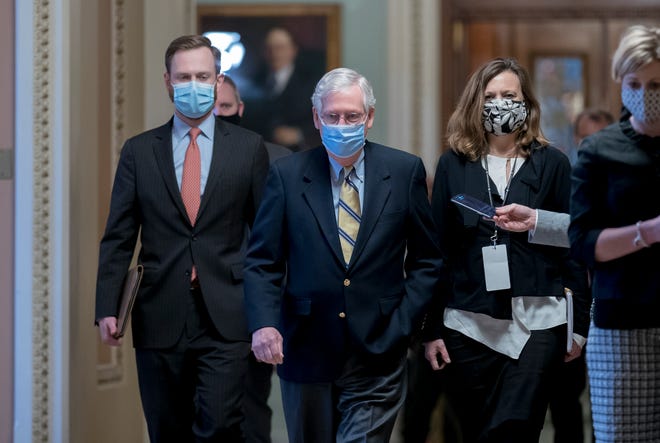
Defenders, including Sens. Joe Manchin, D-W.Va., and Kyrsten Sinema, D-Ariz., argued the supermajority rule requiring at least 60 votes to overcome a filibuster encourages bipartisan compromise and general decorum of the Senate. Republicans, including Senate Minority Leader Mitch McConnell, R-Ky., said the filibuster protects the rights of the minority party.
McConnell warned Tuesday that removing the filibuster would lead to a “completely scorched earth Senate,” cautioning that when Republicans again held the majority, they would pass an expansive conservative agenda, and Democrats would have little recourse to stop them.
“If I became skeptical of the filibuster, it’s because of your use of it,” Durbin told McConnell, saying the Kentucky Republican “can’t have it both ways. It can’t be a rare procedure and be a procedure that dominates the actual business of the Senate as this has done for so many years.”
Much of the modern debate about the filibuster centers on the merits of different governing philosophies, long-standing norms and cold political calculus. The origins of the supermajority threshold were much more accidental.
Realized as a quirk of Senate rules, it has since been entrenched through precedent. Here is how American politics reached this pivotal moment.
What is a filibuster?
A filibuster is a practice whereby any lawmaker can stall action by extending debate or using other tactics. Such strategies are as old as representative democracy – in 60 B.C., Cato the Younger effectively filibustered the Roman Senate.
The word “filibuster” has its origins in piracy. Dutch, French and Spanish all share words referring to “vribuyter,” “flibutier” and “filibustero,” or pirates who would plunder ships and colonies. The word was eventually imported into English as “flee-booter,” meaning a pirate who steals loot or “booty.”
By the 19th century, flee-booters had become “filibusters.” The word became an insult in Congress, where politicians accused lawmakers who held up legislation with a filibuster of effectively raiding the Senate.
The American filibuster is 215 years old
The filibuster as a legislative tool was accidentally created in 1806,when the Senate, at the urging of Vice President Aaron Burr a year before, eliminated the “previous question” motion, a rarely used rule that allowed the Senate to vote to move on from an issue being debated. That unexpectedly opened the door for senators to continue debate on a topic indefinitely – the filibuster.
It wasn’t regularly used until the mid-19th century, when senators used the tactic to stonewall debate over the limiting or abolition of slavery. There was no procedure to end a filibuster, so pro-slavery politicians such as Sen. John Calhoun of South Carolina stifled abolitionist and “free soil” measures against slavery’s expansion with impunity.
The filibuster was effectively limited only by Senate norms and the personal relationships between lawmakers until 1917, when the Senate enacted the cloture rule. The rule, passed to support the American war effort in World War I, allowed two-thirds of senators to end debate on a topic.
The filibuster was infrequently used and often overruled by the governing coalition. The exception during the 20th century was civil rights law. Southern senators supportive of the Jim Crow system of racial segregation and white supremacy used the filibuster to vehemently oppose any expansion of educational, economic or voting rights for Black Americans.
The longest filibuster in U.S. history was South Carolina Sen. Strom Thurmond’s filibuster of the Civil Rights Act of 1957; he spoke for 24 hours and 18 minutes in opposition. Thurmond and other Southern senators stalled the bill’s passage from March to June 1957.
Senators also filibustered the Civil Rights Act of 1964 for two months until 71 senators came together for a cloture vote.
The evolution of the modern filibuster
Recent decades have seen the filibuster’s influence over all types of legislation grow, causing frustrated majorities to create exceptions for when the practice can be used.
In 1975, the number of votes needed to invoke cloture was brought down to 60 votes. Later years brought minor limits on debate after a filibuster was ended.
The 1970s also saw the Senate adopt rules that allowed a senator to filibuster one topic while the chamber moved on to different business. The change, on top of the growing policy divisions between the two major parties and the increasing fragility of congressional majorities, caused the filibuster to be used for all types of Senate proceedings.
Starting in the 1990s, the filibuster progressively became a tool of the minority party to thwart the policy ambitions of the majority.
President Bill Clinton’s health care package was stalled by filibusters, frustrating the White House so much it debated ending the rule. During the George W. Bush administration, Democrats used the filibuster to stop judicial nominees they saw as too radical.
In 2013, after Republicans stonewalled any judicial nominee from President Barack Obama, the Democratic Senate eliminated the filibuster’s 60-vote threshold for the confirmation of lower court judges. Obama said the move was necessary to overcome “an unprecedented pattern of obstruction” from the opposition.
In 2017, Republicans expanded the judicial carve-out for the filibuster to include Supreme Court confirmations, clearing the way for Justice Neil Gorsuch to ascend to the high court.
The Senate has two ways to get around the modern filibuster: a “unanimous consent” motion and budget reconciliation. For a unanimous consent vote, all senators are asked if there are any objections to any debate on a given bill. If any senator objects, debate continues.
In budget reconciliation, a bill may be passed with a simple majority if all its provisions relate to the federal budget. This process was used to pass the American Rescue Plan, Democrats’ $1.9 trillion spending package to help people struggling during the coronavirus pandemic.
Future of the filibuster
At the start of 2021, McConnell pressured Senate Majority Leader Chuck Schumer, D-N.Y., to promise to protect the legislative filibuster before Republicans would approve the rules to govern the new Congress. McConnell did so by effectively filibustering the rules package.
Manchin and Sinema allayed McConnell’s concerns, when they promised they would not vote to abolish the supermajority threshold.
The episode summed up the current dynamic: Senior Democratic leaders see the rule as a stranglehold on their agenda, and governing in general. The pressure to pass at least some of the party’s top priorities pushes Democratic leaders to call for filibuster changes.
“There’s no way under the sun that in 2021 that we are going to allow the filibuster to be used to deny voting rights. That just ain’t gonna happen. That would be catastrophic,” Democratic Whip James Clyburn, D-S.C., said March 7, directly calling out Manchin and Sinema.
Moderates have been difficult to read on the issue. Manchin, who briefly expressed openness to changing the filibuster, quickly backtracked and emphasized he would “never” change the rule.
Some Democrats on Capitol Hill are biding their time, assuming Republicans will force the issue by not compromising on any of Biden’s policy priorities. “If the Republicans block S. 1, that will turn up the heat on taking away Mitch McConnell’s veto,” Sen. Elizabeth Warren, D- Mass., claimed, referring to the For the People voting rights bill.
Though the highly polarized Senate and anxious desire among many Democrats to fulfill their campaign promises point to a dim future for the filibuster, some senators have begun trying to pull the chamber back from the brink.
“It’s something the group of 20 of us, 10 Republicans and 10 Democrats, will discuss tomorrow and decide whether we take this up. Or whether instead, we focus on the minimum wage,” Sen. Mitt Romney, R-Utah, told Politico in his outline of a new centrist coalition trying to cooperate on bills.
Whatever senators conclude is the best path forward regarding the filibuster, the upper chamber has entered a political era reflective of the nation its lawmakers represent: closely divided, hyper-polarized and anxious about its future.