Bees, sheep, crops: Solar developers tout multiple benefits

Associated Press

Bees, sheep, crops: Solar developers tout multiple benefits

John Flesher, Tammy Webber November 4, 2021

Climate Solar Restoring the Landscape

Sheep graze at a solar farm at Cornell University in Ithaca, N.Y., Friday, Sept. 24, 2021. As panels spread across the landscape, the grounds around them can be used for native grasses and flowers that attract pollinators such as bees and butterflies. Some solar farms are being used to graze sheep.(AP Photo/Heather Ainsworth)

Sheep graze at a solar farm at Cornell University in Ithaca, N.Y., Friday, Sept. 24, 2021. As panels spread across the landscape, the grounds around them can be used for native grasses and flowers that attract pollinators such as bees and butterflies. Some solar farms are being used to graze sheep.(AP Photo/Heather Ainsworth)

Solar farms surround trees at Cornell University in Ithaca, N.Y., Friday, Sept. 24, 2021. As panels spread across the landscape, the grounds around them can be used for native grasses and flowers that attract pollinators such as bees and butterflies. Some solar farms are being used to graze sheep. (AP Photo/Heather Ainsworth)

Solar farms surround trees at Cornell University in Ithaca, N.Y., Friday, Sept. 24, 2021. As panels spread across the landscape, the grounds around them can be used for native grasses and flowers that attract pollinators such as bees and butterflies. Some solar farms are being used to graze sheep. (AP Photo/Heather Ainsworth)

Cornell University researcher Niko Kochendoerfer stands among sheep grazing at a solar farm at Cornell University in Ithaca, N.Y., Friday, Sept. 24, 2021. Kochendoerfer says initial data from her three-year study shows light grazing produces abundant bees and wildflowers, while keeping plants from shading panels. Some rare bee species are turning up. (AP Photo/Heather Ainsworth)

Cornell University researcher Niko Kochendoerfer stands among sheep grazing at a solar farm at Cornell University in Ithaca, N.Y., Friday, Sept. 24, 2021. Kochendoerfer says initial data from her three-year study shows light grazing produces abundant bees and wildflowers, while keeping plants from shading panels. Some rare bee species are turning up. (AP Photo/Heather Ainsworth)

Crops grow under solar panels at Jack's Solar Garden Sept. 14, 2021, in Longmont, Colo. As panels spread across the landscape, the grounds around them can be used for native grasses and flowers that attract pollinators such as bees and butterflies. (AP Photo/Brittany Peterson)

Crops grow under solar panels at Jack’s Solar Garden on Sept. 14, 2021, in Longmont, Colo. As panels spread across the landscape, the grounds around them can be used for native grasses and flowers that attract pollinators such as bees and butterflies.(AP Photo/Brittany Peterson)

Sheep graze and rest at a solar farm at Cornell University in Ithaca, N.Y., Friday, Sept. 24, 2021. As panels spread across the landscape, the grounds around them can be used for native grasses and flowers that attract pollinators such as bees and butterflies. Some solar farms are being used to graze sheep. (AP Photo/Heather Ainsworth)

Sheep graze and rest at a solar farm at Cornell University in Ithaca, N.Y., Friday, Sept. 24, 2021. As panels spread across the landscape, the grounds around them can be used for native grasses and flowers that attract pollinators such as bees and butterflies. Some solar farms are being used to graze sheep. (AP Photo/Heather Ainsworth)

MONTICELLO, Minnesota (AP) — Silflower was among native plants that blanketed the vast North American prairie until settlers developed farms and cities. Nowadays confined largely to roadsides and ditches, the long-stemmed cousin of the sunflower may be poised for a comeback, thanks to solar energy.

Researchers are growing silflower at nine solar installations in the Minneapolis area, testing its potential as an oilseed crop. The deep-rooted perennial also offers forage for livestock and desperately needed habitat for bees, butterflies and hummingbirds.

“We need a lot of plots spaced pretty far apart to measure silflower’s effects on pollinators,” said crop scientist Ebony Murrell of The Land Institute, a research nonprofit. “The solar industry is interested in restoring pollinator habitat. This seemed to be a good partnership.”- ADVERTISEMENT -https://s.yimg.com/rq/darla/4-10-1/html/r-sf-flx.html

Solar is a renewable energy source that can help wean the world off fossil fuels that produce greenhouse gases. But it also could benefit the environment and economy in ways not as well known.

As the industry grows, solar arrays will sprawl across millions of acres (hectares) — wasting farmland, critics say. But advocates see opportunities to diversify crop production and boost landowner income, while repairing ecological damage to ground plowed under or paved over.

“There’s lots of spaces where solar could be integrated with really innovative uses of land,” said Brendan O’Neill, a University of Michigan environmental scientist who’s monitoring how planting at a new 1,752-panel facility in Cadillac, Michigan, stores carbon.

Elsewhere, solar installations host sheep that reduce need for mowing. And researchers are experimenting with crop growing beneath solar panels, while examining other potential upsides: preventing soil erosion, and conserving and cleansing water.

LABS STUDY MIXED USES

The U.S. Department of Energy is funding a quest for best uses of lands around solar farms. The project, called InSPIRE, involves the National Renewable Energy Laboratory, Argonne National Laboratory and other partners conducting research at 25 sites nationwide.

The U.S. has about 2,500 solar operations on the electric grid, most generating one to five megawatts, according to the Energy Information Administration. A five-megawatt facility needs around 40 acres (16 hectares). While some occupy former industrial sites, larger installations often take space once used for row crops.

Depending on how quickly the nation switches to renewable electricity, up to 10 million acres (4 million hectares) could be needed for solar by 2050 — more than the combined area of Massachusetts and New Jersey, an analysis by Argonne found.

Solar developers and researchers hope projects with multiple land uses will ease pushback from rural residents who don’t want farmland taken out of production or consider solar panels a blight.

“We need healthy agricultural communities, but we also need renewable energy,” said Jordan Macknick, the renewable energy lab’s lead analyst for InSPIRE.

BUZZ AND FUZZ

At Cascadilla Community Solar Farm in upstate New York, sheep munch grasses among solar panels while bees and butterflies collect pollen from native flowers.

Cornell University researcher Niko Kochendoerfer says initial data from her three-year study shows light grazing produces abundant bees and wildflowers, while keeping plants from shading panels. Some rare bee species are turning up.

Farmers get $300 to $550 per acre yearly to graze sheep at solar sites, increasing farm income while sparing them the cost of renting or buying pasture, said Kochendoerfer, who owns about 400 sheep with her fiance, Lewis Fox. Grazing is less expensive than traditional site management, she said.

Fox has sheep at solar sites from southern Pennsylvania to Vermont.

“Certain times of the year … the sites will be like a butterfly house in a zoo — there’s just butterflies everywhere,” he said.

Sheep are feeding at solar installations in more than 20 states, said Lexie Hain, director of the American Solar Grazing Association and Fox’s business partner. It’s also happening in the United Kingdom, other parts of Europe, Uruguay and Australia.

VEGETABLES IN SOLAR SHADE

In Longmont, Colorado, Jack’s Solar Farm offers another example of solar meeting agriculture. Instead of wheat and hay as before, the farm’s 24 acres (about 10 hectares) host 3,276 panels, generating enough power for about 300 homes. Beneath them grow tomatoes, squash, kale and green beans.

Researchers are comparing vegetables grown under panels six or eight feet (about two to 2½ meters) off the ground with others in open sunlight. Results were mixed during the recently concluded initial season but shaded plants appeared to have a longer growing season.

“We don’t have to leave the soils underneath our solar panels across our country denuded or just left to weeds,” owner Byron Kominek said. “Elevating the panels a little bit more provides agricultural jobs as well as an opportunity to do more with the land.”

“Agrivoltaics,” or growing produce beneath panels, is especially promising in hot, arid regions, say experts who have planted cherry tomatoes and peppers beneath them at the University of Arizona’s Biosphere 2 laboratory.

Those crops usually match or exceed ones in a traditional environment, according to the team’s findings. With less direct sunlight, they lose less water to evaporation, reducing irrigation demand. And the plants keep panels cooler, boosting performance.

How widely such farming could happen remains to be seen, said Greg Barron-Gafford, a biogeography professor at Arizona. Large-scale agriculture requires mechanized planting and harvesting that might be difficult beneath panels.

“But the vast majority of farms across the country are small farms that are breaking even or losing money,” Barron-Gafford said, adding that leasing land for solar energy while still growing food could generate profits.

POLLINATOR HABITAT

While commercial prospects for agrivoltaics are unknown, scientists say it’s certain that solar grounds are ideal for native grasses and flowers that draw pollinators, many facing extinction.

A team led by Oregon State University researcher Maggie Graham reported this year that bees and other insects visit plants partly or totally shaded by panels. They also may pollinate crops in nearby fields, boosting yields.

Compared to farmland, solar sites planted with pollinator-friendly native vegetation would provide a three-fold increase in habitat quality for pollinators, a recent Argonne study concluded. Pollinator-friendly sites would have two-thirds more carbon storage potential, nearly one-fifth less water runoff and 95% less soil erosion than traditionally cultivated land, it said.

Some solar developers are resisting because plants for pollinators are more expensive than lawn used at many sites. But over time that’s offset by lower maintenance, said Reed Richerson, chief operating officer of U.S. Solar, a Minneapolis developer.

The popularity of saving bees and butterflies is attracting the likes of Walmart, which buys power from dozens of pollinator-friendly U.S. Solar installations.

More than a dozen states have standards or guidelines based on qualities such as ground cover density and diversity, and the amount of land involved.

“We wanted to avoid greenwashing — planting a little patch of clover and petunias and saying, ‘There’s my pollinator-friendly contribution,’” said Michael Noble, director of Minnesota-based Fresh Energy, which helped develop the standards.

Many more nature-based solar gardens are needed as global warming and species losses accelerate, said Rob Davis, spokesman for Connexus Energy.

Three years ago, he said, one of the Minnesota co-op’s solar projects risked rejection by a suburban planning commission until supporters brought up the pollinator benefits and their visual appeal.

“The technology of solar energy is unfamiliar and foreign,” Davis said. “But everyone understands what a meadow is.”

___

Tammy Webber reported from Fenton, Michigan. AP video journalist Brittany Peterson contributed from Longmont, Colorado.

You can’t be a Republican by today’s standards if you won’t go along with the ‘Big Lie’

Los Angeles Times

Granderson: You can’t be a Republican by today’s standards if you won’t go along with the ‘Big Lie’

LZ Granderson – November 3, 2021

FILE - In this May 12, 2021 file photo, Rep. Adam Kinzinger, R-Ill., speaks to the media at the Capitol in Washington. Kinzinger a critic of Donald Trump who is one of two Republicans on the panel investigating the deadly Capitol attack, announced Friday, Oct. 29, that he will not seek re-election next year. (AP Photo/Amanda Andrade-Rhoades, File)
Rep. Adam Kinzinger (R-Ill.), who voted to impeach Donald Trump, announced Friday that he will not seek reelection in 2022. (Amanda Andrade-Rhoades / Associated Press)

I first met Rep. Adam Kinzinger nearly 10 years ago at a time in which he was a rising star within the Republican Party. Not only was he in his early 30s and a natural on television, he went into the House with a good deal of gravitas, having served in the Air Force in both Operation Iraqi Freedom and Operation Enduring Freedom.

Over the years, we’ve discussed his views on social issues as well as his thoughts about President Obama’s military strategy. Sometimes I would agree with him, sometimes I would not. But regardless of whether we saw eye to eye on the topic, I always knew where he stood. That’s not to say Kinzinger didn’t play politics. You don’t get to serve six terms in Congress without your share of vague answers and long walks along the party line. But his core principles never changed — he is conservative on gun control, immigration and abortion.

He’s just no longer a Republican.

At least not by today’s standards.

Last week, he became the second Republican House member who voted to impeach President Trump to announce he was not seeking reelection in 2022. He joins Rep. Anthony Gonzalez (R-Ohio), a former college football and NFL star who also came into office with some cachet, only to see it evaporate as his party fell into Trumpism. In response to the Kinzinger news, Trump issued a statement that read in part: “2 down, 8 to go!”

It was like watching Thanos collect another infinity stone during “Avengers: Endgame.”

Consider this: The polling analysis website FiveThirtyEight has Kinzinger voting in support of Trump’s policies more than 90% of the time. He won the Republican primary in 2018 with 68% of the vote and went unopposed in the primary in 2020 and won the general election with more than 64% of the vote. Kinzinger even voted against the first impeachment in 2019. None of that seems to matter. He along with Gonzalez, Rep. Liz Cheney of Wyoming and a handful of others now find themselves out of favor with the party because they wouldn’t go along with Trump’s Big Lie.

Talk about what have you done for me lately.

“The Republican establishment now — whether it’s the [National Republican Congressional Committee], whether it’s Kevin McCarthy — have held onto Donald Trump,” Kinzinger said to ABC’s George Stephanopoulos on Sunday. “They have continued to breathe life into him, and so actually, it’s not really handing a win as much to Donald Trump as it is to the cancerous kind of lie and conspiracy — not just wing anymore — but mainstream argument of the Republican Party.”

Kinzinger was supported by the tea party insurgency that fueled the Republican landslide in the 2010 midterm election; it helped him defeat another Republican in the GOP primary in 2012. Those days of being a GOP darling are over.

“It’s not on Liz Cheney and I to save the Republican Party,” Kinzinger said. “It’s on the 190 Republicans who haven’t said a dang word about it, and they put their head in the sand and hope somebody else comes along and does something.”

Yeah, but what exactly?

There hasn’t been a consequential third-party candidate since Ross Perot received 19% of the popular vote in 1992. And while political analysts disproved the theory that Perot cost George H.W. Bush reelection, the truth remains that those 20 million votes Perot received did not go to Bush or Bill Clinton. Given the thin margin of victory in states such as Arizona and Georgia, how comfortable would Kinzinger be as a third-party candidate if his presence opens the door to a second Trump term?

And given Trump’s intense support among the GOP base — and continuing efforts by Republicans to sabotage voting laws — can anyone be sure that Trump won’t secure a second term, even without a third-party spoiler?

This is what makes Kinzinger’s departure so noteworthy. Over the course of one term, he went from rock star to GOP pariah all because he wouldn’t toss his core conservative values off a cliff.

In 2011, Kinzinger was listed on Time magazine’s “40 Under 40” list of future national leaders in American politics. Ten years later, Kinzinger is fulfilling that promise albeit not in the fashion he or the editors of the magazine imagined.

Kinzinger has said this is the end of his career in the House but not in politics. That could mean he’s eyeing a run for an Illinois Senate seat; both are currently held by Democrats. Sen. Richard J. Durbin will be close to 80 when he seeks reelection in 2026. But it’s doubtful Kinzinger will wait that long. Sen. Tammy Duckworth is up for reelection in 2022, but Kinzinger will have a hard time making it through the Republican primary with Trump still hanging over his shoulders.

Perhaps the governor’s office? Maybe president? Whatever Kinzinger decides to do next, one thing is crystal clear: Democrats won’t be his only opponents and facts won’t be much of an ally.

‘It was time to fight back’: My journey from the Republican Party, through grief, to advocacy

USA Today

‘It was time to fight back’: My journey from the Republican Party, through grief, to advocacy

Rachel Vindman – October 31, 2021

On Sept. 27, 2018, I was volunteering in my daughter’s second-grade classroom. My phone was buzzing with updates of Christine Blasey Ford’s testimony during Brett Kavanaugh’s confirmation hearing. I remember the day so clearly; after I finished at the school, I sat in my car and listened to a recording of her opening statement before the Senate Judiciary Committee.

I believed her, and yet my deep skepticism of the news media, my belief in our “system” and my conservative political identity left me searching for reasons to discount her testimony. Maybe she misremembered who had attacked her or the severity of the attack? I could not get her out of my mind. She had displayed such bravery and grace in the face of the ugly and vile attacks.

So began my journey away from the Republican Party.

Grieving and growing

The following month I read Max Boot’s “The Corrosion of Conservatism,” which I couldn’t get out of my head for months. The Trump administration continued to erode my faith in the strength of our American democracy. As a foreign policy expert, my husband did not follow domestic policies and politics like I did, so we didn’t discuss it much; he knew how I felt about President Donald Trump, but he had a job to do, and he has never been one to care about “palace intrigue” and gossip.

The following January, I attended a Women’s March for the first time. I felt like a fraud; Alex and I drove to Washington, D.C., together, and we parked in front of the White House as he went to work in the building while I attended the march. I was plagued with major imposter syndrome!

Rachel Vindman is a wife, mom, podcast host, writer and activist.
Rachel Vindman is a wife, mom, podcast host, writer and activist.

Then, a mere 13 months after Ford’s testimony, it was my family in the eye of the storm, weathering ugly and vile attacks and withering criticism from the president and some lawmakers as my husband, Lt. Col. Alexander Vindman, testified during Trump’s first impeachment.

As I sat awake in the early hours of Oct. 29, 2019, I realized something. I didn’t leave the Republican Party. It left me.

Alexander Vindman: The White House staffer who sparked Trump’s 1st impeachment, tells his story

The first days and months after Alex’s testimonies were acutely uncertain and scary. It reminded me of my mother’s cancer diagnosis or my very high-risk pregnancy with our surviving daughter; at first your head spins as you process the news, then you learn to live in the storm despite being terrified. There is no other choice because children must be fed, bills must be paid and life needs to be lived. So you figure out how to put one foot in front of the other. It’s the story of women since time immemorial.

This period lasted for almost a year. Only in looking back at it now can I see how awful it was; we were going through the stages of grief and we could only speak to very close family and advisers. Thankfully we had each other, but the isolation took a heavy toll. A few weeks into my husband’s retirement in the summer of 2020, I heard about another journalist – one I have followed for a long time – whose life and family were being threatened. That was my moment. I remember where I was when I heard the story and I made the decision right there: I would no longer be silent.

"The first days and months after Alex’s testimonies were acutely uncertain and scary," writes Rachel Vindman.
“The first days and months after Alex’s testimonies were acutely uncertain and scary,” writes Rachel Vindman.

It was time to fight back, publicly and in a way that honored and reflected what my family and those close to me had endured. It was important to me to speak out in ways that were a genuine reflection of who I am in real life. I want my family and close friends to see me on TV or read something I wrote and think, “Yes, that’s Rachel.”

So I proudly joined a movement of women who were using their voices and talents to fight for the things that mattered most to them. I began to engage and found more ways to promote democracy, amplify women’s voices and ensure my voice is heard in my local community as well as on a national level.

The best me for this season of my life

It is hard to articulate the sense of freedom and empowerment I experienced once I began speaking out and working on causes and issues that are important to me. Every week on my podcast, “The Suburban Women Problem,” we speak to every day women who are making a difference in their communities, and every week I am inspired. For me, a huge part of telling their stories is talking about the good and the bad: what motivates us and how we came to this work while also discussing the difficult parts. Like so many others, I have guilt over adding more responsibilities and activities to my already full calendar – if you’re reading this and you’re waiting on me for a response to an email or something else I owe you, know you are not alone.

Rachel and Alex Vindman in their Virginia home.

I have lost friends due to my activism. There are even those who supported us during the impeachment saga but have since distanced themselves because they do not understand why I refuse to return to my “regular” life. To them I simply say this is the most authentic version of Rachel Vindman for this season of my life. I don’t know how long this moment will last, but I am committed to doing all I can do now.

More than two decades ago, I was hiking near the Sea of Galilee. The main part of the hike was through a river bed that was filled with softball-size rocks that were impossible to stand on so my companions and I were forced to constantly move forward or we would lose our balance and fall. I tried to stop once, and I fell. I still have the scar as a reminder that I must keep moving forward. The scenery and companions change throughout the years, but our goal should remain the same. Keep moving forward.

Rachel Vindman is a wife, mom, podcast host, writer and activist.

Climate change reshaped Earth with extreme weather this year

Associated Press

Climate change reshaped Earth with extreme weather this year

Seth Borenstein October 30, 2021

A train passes a railroad crossing surrounded by floodwaters from rain and melting snow in Nidderau near Frankfurt, Germany, Wednesday, Feb. 3, 2021. (AP Photo/Michael Probst)
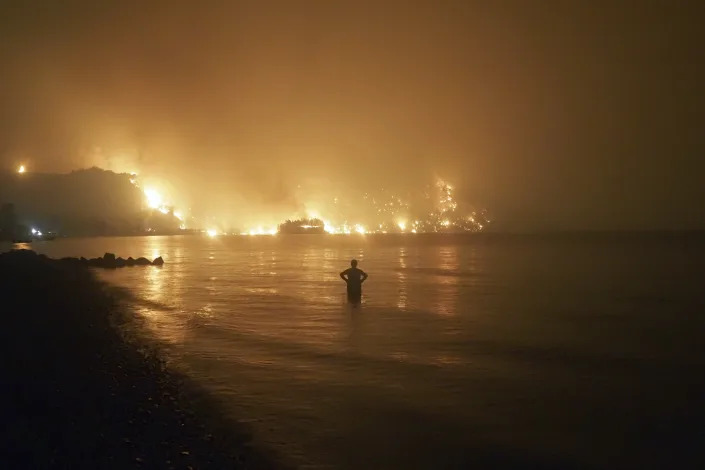
A man watches as wildfires approach Kochyli beach near Limni village on the island of Evia, about north of Athens, Greece on Aug. 6, 2021. (AP Photo/Thodoris Nikolaou)
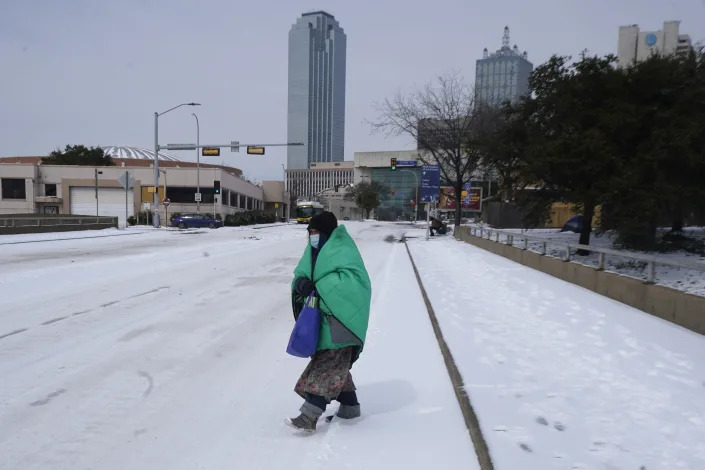
A woman wrapped in a blanket crosses the street near downtown Dallas, Tuesday, Feb. 16, 2021. Temperatures dropped into the single digits as snow shut down air travel and grocery stores. (AP Photo/LM Otero)
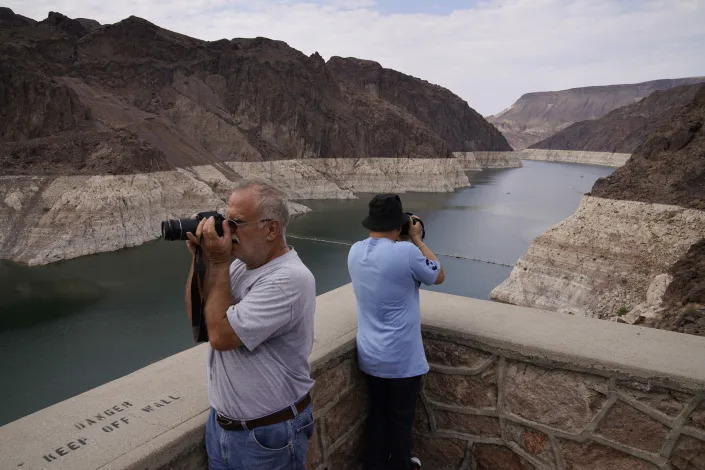
People take pictures of Lake Mead near Hoover Dam at the Lake Mead National Recreation Area, Friday, Aug. 13, 2021, in Arizona. The bathtub ring of light minerals shows the high water mark of the reservoir which has fallen to record lows. (AP Photo/John Locher)
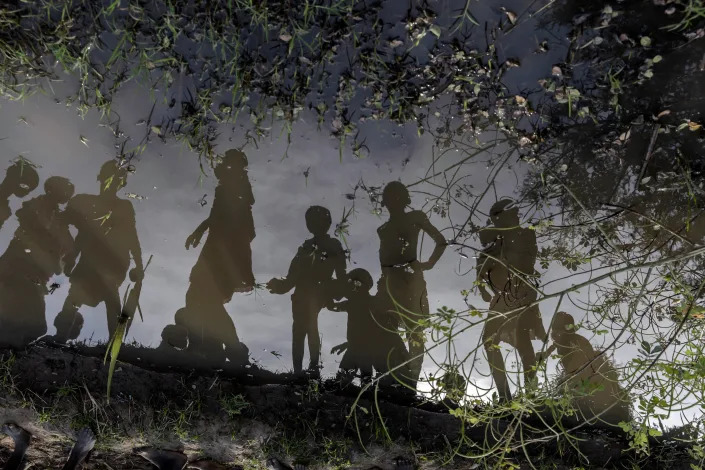
Children standing on a small mud dyke are reflected in the stagnant water, in Langic, Northern Bahr el Ghazal State, South Sudan, Wednesday, Oct. 20, 2021. This is the third straight year of extreme flooding in South Sudan, further imperiling livelihoods in the world's youngest country. A five-year civil war, hunger and corruption have all challenged the nation. Now climate change, which the United Nations has blamed on the flooding, is impossible to ignore. (AP Photo/Adrienne Surprenant)
Children standing on a small mud dyke are reflected in the stagnant water, in Langic, Northern Bahr el Ghazal State, South Sudan, Wednesday, Oct. 20, 2021. This is the third straight year of extreme flooding in South Sudan, further imperiling livelihoods in the world’s youngest country. A five-year civil war, hunger and corruption have all challenged the nation. Now climate change, which the United Nations has blamed on the flooding, is impossible to ignore. (AP Photo/Adrienne Surprenant)
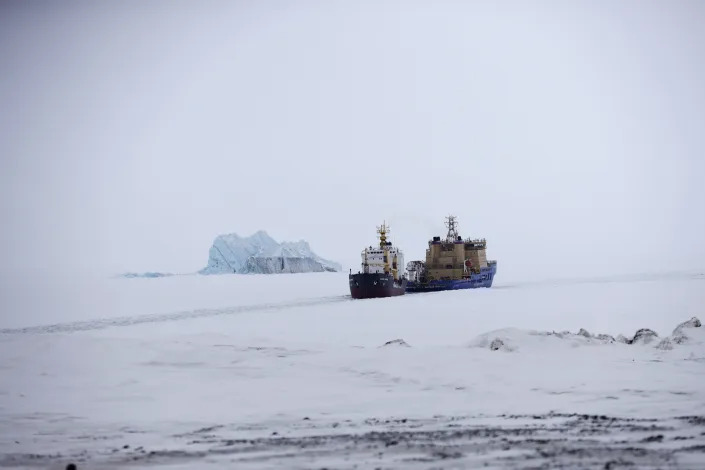
An Icebreaker making the path for a cargo ship with an iceberg in the background near a port on the Alexandra Land island near Nagurskoye, Russia, Monday, May 17, 2021. (AP Photo/Alexander Zemlianichenko)
People walk on salt flats in Badwater Basin, Sunday, July 11, 2021, in Death Valley National Park, Calif. Death Valley, in southeastern California's Mojave Desert, reached 128 degrees Fahrenheit (53 Celsius) a day earlier, according to the National Weather Service's reading at Furnace Creek. The shockingly high temperature was actually lower than the previous day, when the location reached 130 F (54 C). (AP Photo/John Locher)
People walk on salt flats in Badwater Basin, Sunday, July 11, 2021, in Death Valley National Park, Calif. Death Valley, in southeastern California’s Mojave Desert, reached 128 degrees Fahrenheit (53 Celsius) a day earlier, according to the National Weather Service’s reading at Furnace Creek. The shockingly high temperature was actually lower than the previous day, when the location reached 130 F (54 C). (AP Photo/John Locher)
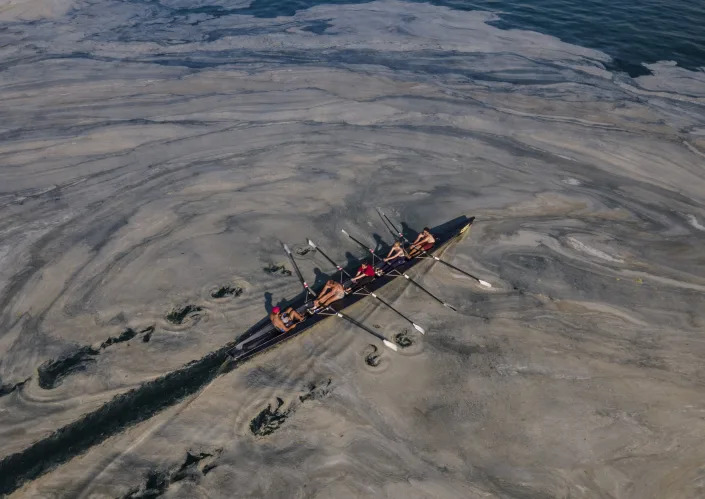
People ride a canoe through "sea snot" in Turkey's Marmara Sea by the Caddebostan shore, on the Asian side of Istanbul, Tuesday, June 8, 2021. Sea snot is a huge mass of marine mucilage, a thick, slimy substance made up of compounds released by marine organisms. (AP Photo/Kemal Aslan)
People ride a canoe through “sea snot” in Turkey’s Marmara Sea by the Caddebostan shore, on the Asian side of Istanbul, Tuesday, June 8, 2021. Sea snot is a huge mass of marine mucilage, a thick, slimy substance made up of compounds released by marine organisms. (AP Photo/Kemal Aslan)
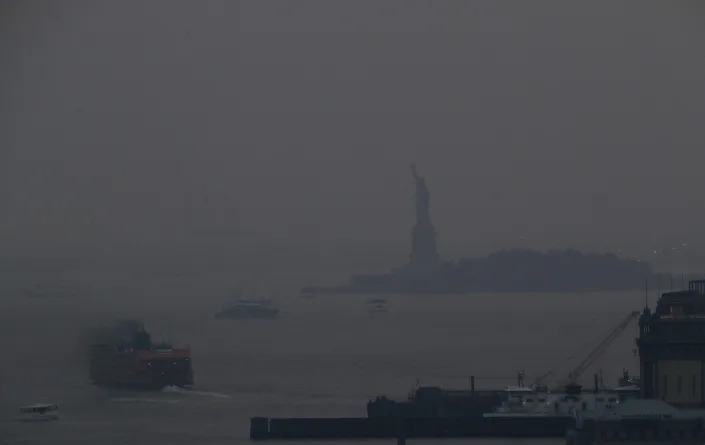
The Staten Island Ferry departs from the Manhattan terminal through a haze of smoke with the Statue of Liberty barely visible, Tuesday, July 20, 2021, in New York. Wildfires in the American West, including one in Oregon created hazy skies as far away as New York. (AP Photo/Julie Jacobson)
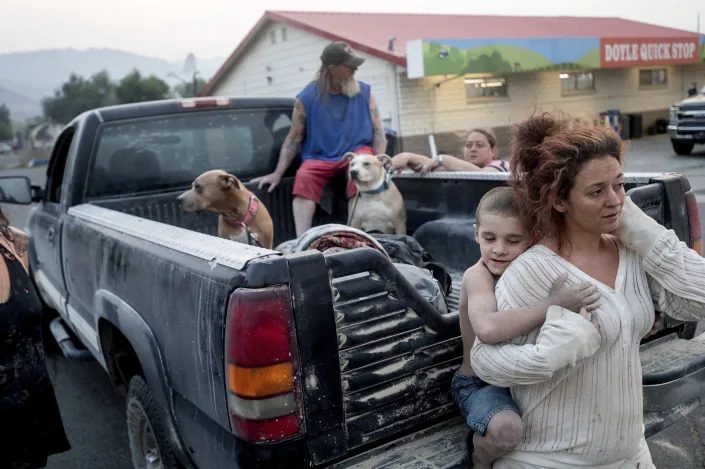
Destiney Barnard holds Raymond William Goetchius while stranded at a gas station near the Dixie Fire on Tuesday, Aug. 17, 2021, in Doyle, Calif. Barnard was helping Goetchius and his family evacuate from Susanville when her car broke down. (AP Photo/Noah Berger)
Birds fly over a man taking photos of the exposed riverbed of the Old Parana River, a tributary of the Parana River during a drought in Rosario, Argentina, Thursday, July 29, 2021. Parana River Basin and its related aquifers provide potable water to close to 40 million people in South America, and according to environmentalists the falling water levels of the river are due to climate change, diminishing rainfall, deforestation and the advance of agriculture. (AP Photo/Victor Caivano)
The Dixie Fire burns down a hillside towards Diamond Mountain Rd. near Taylorsville in Plumas County, Calif., on Friday, Aug. 13, 2021. (AP Photo/Noah Berger)
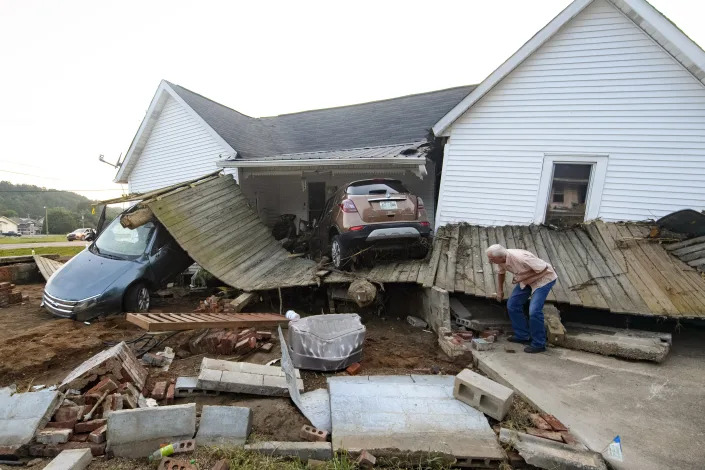
Ernest Hollis looks for items at his granddaughter's house that was devastated by floodwaters, Monday, Aug. 23, 2021, in Waverly, Tenn. Heavy rains caused flooding in Middle Tennessee days ago and have resulted in multiple deaths, and missing people as homes and rural roads were also washed away. (AP Photo/John Amis)
Ernest Hollis looks for items at his granddaughter’s house that was devastated by floodwaters, Monday, Aug. 23, 2021, in Waverly, Tenn. Heavy rains caused flooding in Middle Tennessee days ago and have resulted in multiple deaths, and missing people as homes and rural roads were also washed away. (AP Photo/John Amis)
Bare trees stand in a destroyed forest near the Kemerkoy Power Plant, a coal-fueled power plant, in Milas, Mugla in southwest Turkey, Thursday, Aug. 5, 2021. A wildfire reached the compound of a coal-fueled power plant in southwest Turkey and forced evacuations by boats and cars. (AP Photo)
Keeping cool in record setting temperatures, Beau Jess and daughter River, 3, reach for falling water as they play at the Splash Pad in Haller Park on Monday, June 28, 2021, in Arlington, Wash. (Andy Bronson/The Herald via AP)
A house is surrounded by flood waters in Londonderry on the outskirts of Sydney, Australia, Tuesday, March 23, 2021. Hundreds of people have been rescued from floodwaters that have isolated dozens of towns in Australia's most populous state of New South Wales and forced thousands to evacuate their homes as record rain continues to inundate the countries east coast. (AP Photo/Mark Baker)
A house is surrounded by flood waters in Londonderry on the outskirts of Sydney, Australia, Tuesday, March 23, 2021. Hundreds of people have been rescued from floodwaters that have isolated dozens of towns in Australia’s most populous state of New South Wales and forced thousands to evacuate their homes as record rain continues to inundate the countries east coast. (AP Photo/Mark Baker)
A woman throws away rubbish in the center of Bad Neuenahr-Ahrweiler, Germany, Monday July 19, 2021. More than 180 people died when heavy rainfall turned tiny streams into raging torrents across parts of western Germany and Belgium. (AP Photo/Bram Janssen)
Boats languish over the last pools of water available on the Payagua stream that reaches the Paraguay river amid a historic drought that is affecting its levels, in Chaco-i, Paraguay, Monday, Sept. 20, 2021. (AP Photo/Jorge Saenz)
Ice coats a cave in the Eagle Glacier on Sunday, Feb. 14, 2021, in Juneau, Alaska. The glacier is remote, and one way to access it involves a 5.5 mile hike on a rugged trail to a public use cabin followed by lake crossings. (AP Photo/Becky Bohrer)
Residents walk along a dirt road in the Urus del Lago Poopo indigenous community, which sits along the salt-crusted former shoreline of Lake Poopo, in Punaca, Bolivia, Monday, May 24, 2021. Bolivia's second-largest lake dried up about five years ago, victim of shrinking glaciers, water diversions for farming and contamination. (AP Photo/Juan Karita)
Residents walk along a dirt road in the Urus del Lago Poopo indigenous community, which sits along the salt-crusted former shoreline of Lake Poopo, in Punaca, Bolivia, Monday, May 24, 2021. Bolivia’s second-largest lake dried up about five years ago, victim of shrinking glaciers, water diversions for farming and contamination. (AP Photo/Juan Karita)
A man carries goods on his bicycle as he walks out of the Yubei Agricultural and Aquatic Products World in Xinxiang in central China's Henan Province on July 26, 2021. (AP Photo/Dake Kang)
A man carries goods on his bicycle as he walks out of the Yubei Agricultural and Aquatic Products World in Xinxiang in central China’s Henan Province on July 26, 2021. (AP Photo/Dake Kang)
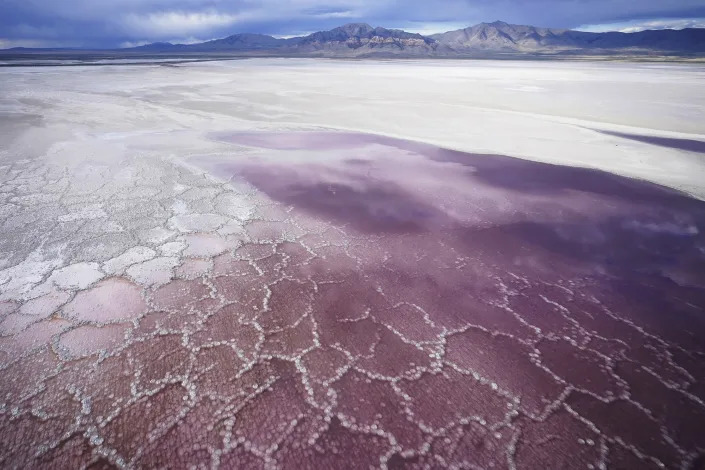
Pink water washes over a salt crust on May 4, 2021, along the receding edge of the Great Salt Lake. The lake has been shrinking for years, and a drought gripping the American West could make this year the worst yet. (AP Photo/Rick Bowmer)
A woman is carried through a flooded street in Angleur, Province of Liege, Belgium, July 16, 2021. Severe flooding in Germany and Belgium has turned streams and streets into raging torrents that have swept away cars and caused houses to collapse. (AP Photo/Valentin Bianchi)
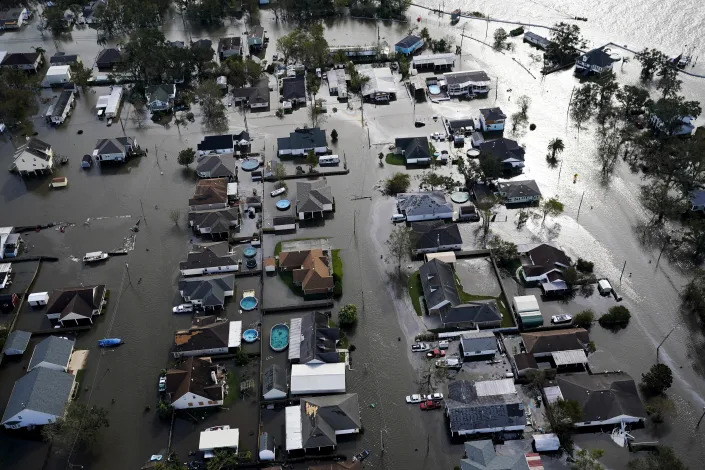
Homes are flooded in the aftermath of Hurricane Ida, Monday, Aug. 30, 2021, in Jean Lafitte, La. (AP Photo/David J. Phillip)
A kayaker fishes in Lake Oroville as water levels remain low due to continuing drought conditions in Oroville, Calif., Aug. 22, 2021. (AP Photo/Ethan Swope)
A child cools off with the water to the fountain during a heatwave in Pamplona, northern Spain, Aug. 13, 2021. Stifling heat gripped much of Spain and Southern Europe. (AP Photo/Alvaro Barrientos)
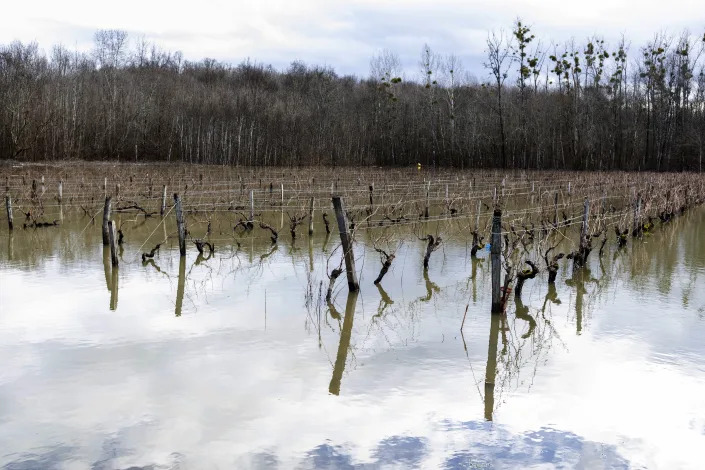
Floodwaters submerge vineyards near Cognac, southwestern France, Sunday, Feb. 7, 2021. Scientists say damaging frost that caused significant economic loss to France's central wine-growing region this year was made more likely by climate change. (AP Photo/Yohan Bonnet)
Floodwaters submerge vineyards near Cognac, southwestern France, Sunday, Feb. 7, 2021. Scientists say damaging frost that caused significant economic loss to France’s central wine-growing region this year was made more likely by climate change. (AP Photo/Yohan Bonnet)
People travel through a torrential downpour caused from the remnants of Hurricane Ida, near Columbus Circle on Sept. 1, 2021. As weather becomes more extreme and unpredictable caused by climate change, transit officials say that more needs to be done to prepare the East Coast's vital transit systems. (AP Photo/Craig Ruttle)
People travel through a torrential downpour caused from the remnants of Hurricane Ida, near Columbus Circle on Sept. 1, 2021. As weather becomes more extreme and unpredictable caused by climate change, transit officials say that more needs to be done to prepare the East Coast’s vital transit systems. (AP Photo/Craig Ruttle)

Fires raged. Rivers flooded. Ice melted. Droughts baked. Storms brewed. Temperatures soared. And people died.

Climate change in 2021 reshaped life on planet Earth through extreme weather.

World leaders are gathering in Scotland to try to accelerate the fight to curb climate change. So far, it’s not working, as the world keeps getting hotter and its weather more extreme, scientists and government officials say. They don’t have to point far back in time or far off for examples.

There have been deadly floods in Belgium, Germany, China and Tennessee. Fire blazed in parts of the U.S. West, Greece and even the Arctic.

Heat waves proved deadly and unprecedented, pushing temperatures in the Northwest and even reaching 116 degrees Fahrenheit (47 degrees Celsius) in Portland, Oregon, a city known for its mild climate. Hurricane Ida paralyzed New York City with record-breaking, deadly rain.

“These events would have been impossible without human-caused climate change,” U.N. Secretary-General Antonio Guterres said.

In just the United States, there have been 18 weather or climate disasters this year with losses exceeding $1 billion a year, according to the National Oceanic and Atmospheric Administration. Those 18 disasters caused 538 deaths and nearly $105 billion in damage. In the 1980s, the average year only saw three such disasters.

A report from AIR Worldwide, a global risk modeling firm, estimates that now each year extreme weather is costing $320 billion around the world, with only about one-third of it insured.

“We now have five times the number of recorded weather disasters than we had in 1970, and they are seven times more costly,” Guterres said, speaking about global totals. “Even the most developed countries have become vulnerable.”

Environment | Health – Happiness | Labor and Working | Politics and American Democracy | Sustainable World -Farm Environmental | Today's News? | Veterans – Patriotism

tarbabys blog hacked !

John Hanno October 30, 2021

Dear tarbabys blog readers:

The Tarbaby’s Blog was hacked about 6 weeks ago. Our webhost IONOS has been trying to correct the problems, but have still been unable to fix the posting issues, so please be patient. I’m way behind in posting and will try to catch up in the next few weeks.

Whether posting and debating about the coronavirus and public health, the environment and the catastrophic consequences of global warming and climate change, the threats to America’s Democratic institutions, politics, voter suppression and intimidation, Veterans advocacy, fair labor practices or a long list of vital social and economic issues, truth tellers become a target for those who would like to silence public debate and speaking truth to power. We will not be silenced. Please stay tuned.

Climate migration doesn’t have to be a crisis

Yahoo News 360

Climate migration doesn’t have to be a crisis

Mike Bebernes, Senior Editor October 25, 2021

“The 360” shows you diverse perspectives on the day’s top stories and debates.  What is COP26 and how will it affect the future of climate change? Glasgow, Scotland called COP26. 

What’s happening

The Biden administration on Wednesday released a report that predicts climate change will force “tens of millions” of people around the world to be displaced in the next few decades. The report echoes the findings of a number of previous studies that suggest worsening climate impacts — sudden disasters like fires and storms, plus more gradual problems like rising seas and drought — could displace as many as 200 million people before 2050.

Climate change affects the whole world, but the citizens of certain low-income countries everywhere from Central America to sub-Saharan Africa are especially vulnerable to climate-related displacement. Beyond the harm of millions of people being forced from their homes, climate migration could threaten the stability of resource-strained countries and increase the risk of conflict between nations, according to a separate national security assessment released this week.

While estimates paint a particularly dire picture of the future, some of the effects of climate displacement are already being felt around the world. The United Nations estimates that an average of 21.5 million people worldwide are displaced by sudden disasters every year. Droughts and storms in Central America are believed to be one of many reasons for an influx of migrants heading to the U.S.-Mexico border in recent years. The Syrian civil war, which has created a devastating humanitarian crisis and displaced more than 13 million people over the past 10 years, has been partially attributed to a drought that forced rural farmers to flood into urban areas.

Why there’s debate

As worrying as some forecasts of the future are, a range of experts say that with the right preparation and investment, climate migration can be managed to limit suffering and prevent countries from falling into chaos.

A key step, most experts argue, is for rich countries like the U.S. to do everything within their power to prevent people from being forced to migrate in the first place. That starts with limiting greenhouse gas emissions that cause global warming. Doing so would reduce the potential severity of storms, droughts and other factors that drive people from their homes. Rich countries also need to offer aid to poorer countries to adapt to climate change — for example, helping low-income countries build infrastructure to handle higher sea levels and stronger storm surges and dealing with major population shifts within their borders, since most climate migrants relocate to new areas of their home countries.

Many also argue the U.S. will need to update its immigration system to prepare for the unique challenges of managing climate migration. Some immigrant rights activists say climate displacement should be added to the list of reasons a person can qualify for refugee status. That’s controversial on both the left and the right. There’s broad agreement among experts, though, that a more permissive immigration system — with less focus on aggressive border enforcement and more pathways to enter the country legally — could not only prevent unnecessary suffering, but also create benefits for the U.S. economy.

What’s next

Climate migration is expected to be one of many important issues discussed by world leaders at the upcoming U.N. Climate Change Conference in Glasgow, Scotland. Representatives from nearly 200 countries will meet over the course of two weeks in hopes of reaching an agreement on an emissions reduction strategy to avert the worst potential impacts of climate change.

Perspectives

Strict immigration enforcement isn’t the answer

“States that have grown addicted and accustomed to solving problems with walls and weapons are acting to news of climate-linked mobility by trying to repel people, hoping to insulate themselves. … Not only will this cause ever more human suffering, it will fail on its own terms.” — Todd Miller, Independent

Fear-inducing rhetoric about the threat of climate migration must end

“When most people think of ‘climate’ and ‘immigration,’ they think at the global scale — which can be scary. The idea that a changing, increasingly inhospitable climate will drive mass migration is frightening. … But migration is, and has always been, a form of adaptation — and it can be a major benefit to receiving communities.” — Claire Elise Thompson, Grist

Immigration laws need to be updated to recognize climate displacement

“A lack of lawful migration opportunities forces many of those moving for climate-related reasons to do so without authorisation and at risk of exploitation and abuse. But solutions are within our grasp.” — Tamara Wood and Edwin Abuya, Thomson Reuters Foundation

With the right planning, climate migrants can help the U.S. thrive

“Migration can bring great opportunity not just to migrants but also to the places they go. As the United States and other parts of the global North face a demographic decline, for instance, an injection of new people into an aging work force could be to everyone’s benefit.” — Abrahm Lustgarten, New York Times

The U.S. must provide extensive support for vulnerable countries

“The best deterrent to migration is hope. We must provide the leadership that allows the people

in our own hemisphere the chance to survive and prosper at home.” — Cecilia Muñoz, The Hill

Climate shouldn’t be treated as the only reason people leave their homes

“In general, illegal border crossings can be traced to any number of factors: job opportunities, drug trafficking, political shifts, and, yes, climate change. There’s nothing wrong with bringing attention to these issues by examining them in print. But to solve a problem, you have to properly define it first. We can and should address the border crisis and climate change at the same time. But conflating the two only makes that task more difficult.” — Sean-Michael Pigeon, National Review

Limiting climate change will reduce the need for climate migration in the first place

“The most useful thing that the developed countries of the West can do to help endangered societies elsewhere is to rapidly limit our own carbon emissions — for if we fail to do so and temperatures rise uncontrollably, then weak states around the world will assuredly fail.” — Anatol Lieven, Foreign Policy

We should start helping people relocate before their situation becomes desperate

“Real change — like relocating entire neighborhoods and communities out of harm’s way — would be far better handled not in times of crisis, when the displaced must weigh complex decisions in the midst of chaos and loss, but before a crisis hits.” — Alexandra Tempus, New York Times

Climate migrants can be an enormous asset if given the right opportunities

“The easier we make it for the young to move to places where they can contribute productively, such as by building more sustainable housing and irrigation systems, the better our odds during the turbulent decades ahead.” — Parag Khanna, National Geographic

Is there a topic you’d like to see covered in “The 360”? Send your suggestions to the360@yahoonews.com.

Photo illustration: Yahoo News; photos: Joe Raedle/Getty Images

Comparing January 6 to a terrorist attack, former lawmakers – including Republicans – say Congress must investigate Trump’s role

Business Insider

Comparing January 6 to a terrorist attack, former lawmakers – including Republicans – say Congress must investigate Trump’s role

Charles Davis – October 29, 2021

Trump mob Capitol attackers fight with police
Violent Trump supporters try to break through a police barrier at the Capitol on January 6, 2021. Photo by /John Minchillo/ AP
  • The legal brief, filed in federal court in Washington, DC, is signed by 22 Republicans.
  • It argues Congress has a right to see Trump’s presidential records related to January 6.
  • The documents are being sought by the Select Committee to Investigate the January 6th Attack on the United States Capitol.

Former President Donald Trump’s campaign to undermine confidence in the 2020 election unfolded “like a fever dream in James Madison’s restless imagination,” testing American democracy like no other previous US president, argues a legal brief filed this week by a bipartisan group of 66 retired members of Congress.

The filing, first reported by The Washington Post, comes as part of a lawsuit initiated by Trump that seeks to block congressional investigators from obtaining White House documents that could expose the former president’s role in the January 6 insurrection. Trump’s lawyers have argued such documents are protected by “executive privilege” and outside of Congress’ legislative mandate.

But the former lawmakers, including 22 Republicans, say that argument does not hold up – and that the extraordinary nature of the US Capitol riot, not a request for presidential records, is the actual threat to the US Constitution and the separation of powers.

“The once unimaginable problem here, of course, is that a sitting president and his aides personally orchestrated a multifaceted assault on the peaceful transition of presidential power,” the brief states, “and neither Congress nor the public more broadly yet knows the full range of means deployed or considered and discarded.”

What is publicly known, however, is that “Trump played an outsized – and likely central – role in orchestrating the events that led to the January 6th attack,” the lawmakers argue, likening it to a thwarted terrorist plot.

“If traitors bent on disrupting and damaging our government were to meticulously plan and nearly succeed in flying a jumbo jet into the White House, we would not expect Congress to implement stronger safeguards without the opportunity to investigate the attackers,” the brief states.

Tom Coleman, a former Republican member of Congress from Missouri, told the Post that it was vital that Trump’s lawsuit be defeated. “If Congress fails to win this case,” he said, “then you might as well pack up Congress and let them go home because this is fundamental to our checks and balances and the rule of law in this country.”

Virginia Beach confronts inescapable costs of rising seas

Associated Press

Virginia Beach confronts inescapable costs of rising seas

Ben Finley – October 29, 2021

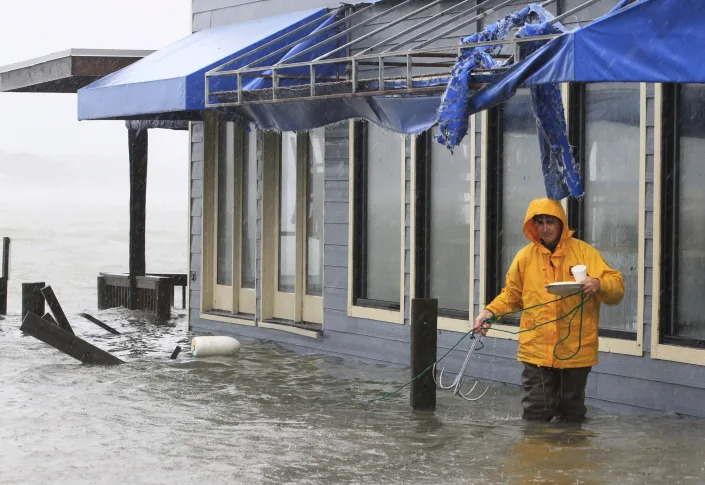
FILE - A worker retrieves a grappling hook on the dock next to Bubba's restaurant on the water in Virginia Beach, Va., Monday, Oct. 29, 2012. Voters in Virginia Beach will consider whether to vote for a $500 million bond on election day that would be used for protection against flooding from rising seas and intensifying hurricanes.(AP Photo/Steve Helber)
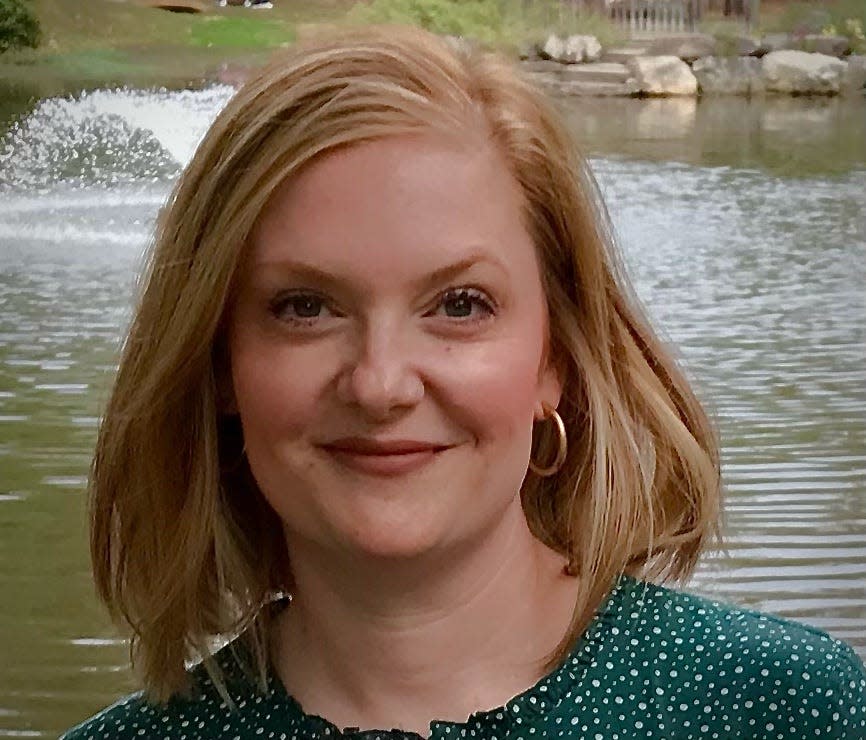
Virginia Wasserberg stands in a Virginia Beach, Va. park near the site of a proposed pumping station that would help protect the city against flooding on Thursday, Oct. 21, 2021. The city has asked voters to approve a $568 million bond issue what would pay for various flood protections as the city faces rising sea levels. (AP Photo/Ben Finley).

FILE – A worker retrieves a grappling hook on the dock next to Bubba’s restaurant on the water in Virginia Beach, Va., Monday, Oct. 29, 2012. Voters in Virginia Beach will consider whether to vote for a $500 million bond on election day that would be used for protection against flooding from rising seas and intensifying hurricanes.(AP Photo/Steve Helber)More4 min read

VIRGINIA BEACH, Va. (AP) — Voters in the sprawling coastal city of Virginia Beach will decide whether to approve one of the larger municipal bonds in the U.S. that would be used to protect against rising seas and intensifying hurricanes.

If it passes Tuesday, the $568 million would fund anything from elevating roads to closing a 100-acre (40-hectare) city golf course to collect stormwater.

If it fails, economists say the city could lose billions of dollars in the next half-century as recurrent flooding inundates roads, businesses and homes.

The referendum underscores the mounting costs of adapting to climate change for U.S. cities. But it will also be a measure of Americans’ willingness to approve such bonds as more communities seek funding.

“I’m not confident that it will pass,” said Virginia Wasserberg, whose Virginia Beach home was among 1,400 houses and businesses flooded by heavy rains from the remnants of Hurricane Matthew in 2016.

Wasserberg, 41, is a conservative Republican who home-schools her children and supports the bond. She’s campaigned for more flood protections ever since her neighborhood’s drainage systems were overwhelmed by weeks of rain that culminated with Matthew.

Homes that are miles from the city’s beaches on the Atlantic Ocean and Chesapeake Bay were inundated for the first time. Wasserberg said she and her family fled to the second floor and called 911 — only to be told that responders couldn’t reach them.

“I like to say it took a disaster to wake me up,” Wasserberg said.

Voter approval is far from guaranteed in this city of nearly half a million people, which some political observers say can lean libertarian. If the bond passes, property taxes would rise by $115 to $171 a year for a home of median assessed value, city officials say.

The need for money to protect communities against climate change is growing across the globe, particularly in the world’s poorest countries. It will be an area of discussion at an upcoming UN Climate Change Conference, which starts Sunday in Glasgow.

In the U.S., 26% of ZIP codes are “highly exposed to floods,” according to Moody’s ESG Solutions, which tracks climate risks and sustainable finance.

“As climate change becomes a greater threat, more governments will focus on climate adaptation and resilience projects,” said Matt Kuchtyak, the group’s vice president of outreach & research.

Several cities have already approved significant bonds. For instance, Miami residents voted in 2017 to fund a $400 million bond, nearly half of which would pay for such things as storm drain upgrades and sea walls.

San Francisco voters passed a $425 million bond to pay for the first phase of strengthening a sea wall that protects against earthquakes and rising oceans. The same year, Houston-area voters supported $2.5 billion in bonds for flood-control projects in the wake of Hurricane Harvey.

Bonds could emerge as the principal vehicle for funding, said Richard Wiles, executive director of the Center for Climate Integrity, which argues that oil companies should cover such costs because of fossil fuels’ link to climate change.

“None of these cities has hundreds of millions of dollars hanging around,” Wiles said, adding that Virginia Beach has proposed one of the biggest bonds.

The city could prove to be an interesting testing ground.

A 2021 telephone survey of 400 residents found that just over half were willing to pay more in taxes for flood-protection projects, according to a report by Old Dominion University. But half also agreed that people who do not experience flooding on their properties should not have to pay for such projects.

And yet, the land in Virginia Beach is sinking and the seas are rising at an alarming rate. Since 1960, sea levels have risen by nearly a foot (0.3 meter). And they’re likely to rise by 1.5 feet to 3 feet (0.5 to 1 meter) over the next half-century.

Much of Virginia Beach sits on low coastal plains. Water can drain slowly into tidal rivers and tributaries, sometimes with nowhere to go during heavy rains and high tides.

The bond-funded projects could help the city avoid up to $8 billion in losses to flooding as well as associated economic impacts in the coming decades, according to the Old Dominion University report. The losses are equivalent to about a quarter of Virginia Beach’s gross domestic product — or its total output of goods and services.

“As flooding becomes more prevalent, insurers will raise premiums, refuse coverage and at some point exit Virginia Beach entirely,” economics professor Robert McNab said. “Businesses will have more difficulty in moving goods to market and, of course, residents will have more problems moving around the region.”

John Moss, a city councilman who’s been a large force behind the referendum, said Virginia Beach could still complete the flood-protection projects if the referendum fails. But he said it would take 25 years instead of about a decade.

And even if the bond passes, the projects will make up about a third of what’s needed overall protect to against 1.5 feet of sea-level rise, Moss said.

“It’s a big ask,” Moss said of the bond. “But the threat is real.”

These Aren’t Justices. They’re Used Car Salesmen, and They’re Coming for Your Abortion Rights.

Daily Beast

These Aren’t Justices. They’re Used Car Salesmen, and They’re Coming for Your Abortion Rights.

Erin Gloria Ryan October 25, 2021

Photo Illustration by Kristen Hazzard/The Daily Beast/Getty

One of the oldest sales tricks in the book is the one where the salesperson presents the potential buyer with an extremely crappy option first, and follows that up with an only moderately crappy second option. The potential buyer, dazzled by the jump in quality between options one and two, won’t scrutinize option two as much, because it’s so much better than option one. This has been employed by slimy realtors, wedding planners, and used car salesmen.

And now, we’ve reached the point in the American experiment where the Supreme Court’s new conservative majority has resorted to a cheap sales tactic in an attempt to rehabilitate its image. Lower the customer’s expectations enough, conventional wisdom goes, and they’ll thank you for ripping them off.

This week, the court agreed to hear a legal challenge to SB8, the Texas law that bans abortion once a “fetal heart rate” is detected—usually around the sixth week of gestation, which is actually around three weeks after the implantation of a fertilized egg in the wall of a uterus, or a little over a week after a missed menstrual period in a person with a predictable schedule. The law empowers any ol’ Yosemite Sam to enforce said ban by filing a lawsuit against anybody who “aids or abets” an abortion. This means doctors, receptionists, advocates, and even Uber drivers who bring a patient to a clinic could be on the hook.

Texas Passes Bill That Would Create Anti-Abortion Vigilantes

The high court agreed to hear the Biden administration’s challenge to the law on Nov. 1, on an expedited schedule. Legal observers predict that the court will toss the law out. I—and many wary pro-choicers—predict that after tossing the law out, the media will fawn over the court’s newfound social moderation, and the Susan Collinses of the world will crow that they were right, the hysterical feminists were wrong, and the Supreme Court was never going to toss abortion rights on—as Mike Pence would say—“the ash-heap of history.”

The following month SCOTUS will hear oral arguments in the case of Dobbs vs. Jackson Women’s Health, testing the constitutionality of a Mississippi law that directly confronts Roe v. Wade by banning abortion after 15 weeks’ gestation. Roe established in 1973 that the government has no right to interfere with abortion access prior to fetal viability—around 24.5 weeks’ gestation (a full-term pregnancy takes 40 weeks). Dobbs is the direct challenge to Roe that conservative activists have had a hard-on for since Reagan.

This Case Will Mark the Beginning of the End for Roe v. Wade

John Roberts, Samuel Alito, Clarence Thomas, Neil Gorsuch, Brett Kavanaugh, and Amy Coney Barrett do not look like or live like the people whose rights they are about to strip. None of them are women of childbearing age. None of them are poor. Five of those six are Roman Catholic. Five of them are men. Five are white. None of them are from Texas or Mississippi. They would not be on the court in the first place had they not impressed conservative advocacy groups like the Federalist Society with their fringe bona fides that put their beliefs in opposition to the supermajority of American voters who believe that Roe v. Wade should not be overturned, and that access to abortion should be preserved.

Without the smokescreen of SB8, it would have been more difficult for the court’s conservative majority to pass off their inevitable favorable ruling in Dobbs as anything less than a wildly undemocratic ruling by a judicial body that has gone irretrievably off the rails. But thanks to SB8, we’re going to get a taste of “See, America? We could have done Option 1 (overturn Roe as hard as we possibly can!) but instead we did Option 2! (overturn Roe, but less hard).” As though the rights of women to choose whether or not they want to go through childbirth were a used car.

Tossing SB8 is a distraction. It is less than the least I previously believed the Supreme Court could do in its desperate quest to re-establish public trust and a sense of nonpartisan legitimacy. SB8 is an objectively crazy law. If the court were to uphold it, and by extension grant that it is a-OK for states to enact laws that allow ordinary citizens to enforce unconstitutional mandates, there’s nothing but small-time, cable hit-hungry legislators’ nonexistent capacity to feel shame stopping a free-for-all across the country. California’s Democratic supermajority could pass a law that would pay citizens tens of thousands of dollars to turn in people who “aid or abet” the sale or trade of any firearms. Conservative strongholds like Idaho could empower citizens to sue people who facilitate same-sex weddings.

But Mississippi’s 15-week ban is inhumane and patriarchal as well. Almost all abortions occur at or before 12 weeks, because most women who are pregnant and don’t want to be would like to end the pregnancy as soon as they possibly can, plus the procedure is less costly and complicated if it is performed early. But banning abortions after 15 weeks is a particularly cruel move considering that many serious birth defects can’t be detected before then. Fifteen weeks is less than halfway through pregnancy, and months before fetal viability. Unless the state of Mississippi plans on covering the cost of expensive early genetic testing for every pregnant person, a 15-week ban will force some women to carry and eventually give birth to wanted but nonviable pregnancies, unless they can afford to travel out of state.

If somebody showed up at your home and declared that they were going to beat you up and burn your house to the ground, and then had a change of heart and decided instead to merely burn your house to the ground, it would be—at the very least—tacky of them to expect gratitude in response. Hallmark does not make Thank You (For Doing The Second Worst Possible Thing) cards.

Similarly, the Supreme Court upholding Mississippi’s law while striking Texas’ does not cure the court of its partisan blight. This transparent sales tactic approach is designed to trick the American people into accepting the unacceptable.

Guilt, grief and anxiety as young people fear for climate’s future

Reuters

Guilt, grief and anxiety as young people fear for climate’s future

Natalie Thomas, Barbara Lewis, Jonathan Shenfield October 22, 2021

FILE PHOTO: Environmental campaigners march ahead of the COP26 climate summit, in London

Environmental campaigners march ahead of the COP26 climate summit, in London.

FILE PHOTO: Global Climate Strike of the movement Fridays for Future, in Berlin

Global Climate Strike of the movement Fridays for Future, in Berlin

FILE PHOTO: Ice sculptures of children by Sand in Your Eye at New Brighton Beach

Ice sculptures of children by Sand in Your Eye at New Brighton Beach

LONDON (Reuters) – Overwhelmed, sad, guilty are some of the emotions young people say they feel when they think of climate change and their concerns world leaders will fail to tackle it.

Broadly referred to as climate anxiety, research has stacked up to measure its prevalence ahead of the U.N. talks in Glasgow, which begin at the end of the month to thrash out how to put the 2015 Paris Agreement on curbing climate change into effect.- ADVERTISEMENT -https://s.yimg.com/rq/darla/4-6-0/html/r-sf-flx.html

One of the biggest studies to date, funded by Avaaz, an online campaign network, and led by Britain’s University of Bath, surveyed 10,000 young people aged 16-25 years in 10 countries. It published its results in September.

It found around three quarters of those surveyed considered the future frightening, while a lack of action by governments and industry left 45% experiencing climate anxiety and distress that affected their daily lives and functioning.

Elouise Mayall, an ecology student at Britain’s University of East Anglia and member of the UK Youth Climate Coalition, told Reuters she had felt guilty and overwhelmed.

“What I’d be left with is maybe the sense of shame, like, ‘how dare you still want lovely things when the world is ending and you don’t even know if you’re going to have a safe world to grow old in’.”

She spoke of conflicting emotions.

“You might have sadness, there might be fear, there might be a kind of overwhelm,” she said. “And maybe even sometimes a quite like wild optimism.”

Caroline Hickman, a psychotherapist and lecturer at the University of Bath and one of the co-authors of the research published in September, is working to help young people manage climate-related emotions.

“They’re growing up with the grief and the fear and the anxiety about the future,” she told Reuters.

“SENSE OF MEANING”

London-based psychiatrist Alastair Santhouse sees climate change, as well as COVID-19, as potentially adding to the burden, especially for those pre-disposed to anxiety.

For now, climate anxiety alone does not normally require psychiatric help. Painful as it is, it can be positive, provided it does not get out of control.

“Some anxiety about climate change is motivating. It’s just a question of how much anxiety is motivating and how much is unacceptable,” said Santhouse, author of a book that tackles how health services struggle to cope with complex mental issues.

“The worry is that as climate change sets in, there will be a more clear cut mental health impact,” he added.

Among some of the world’s communities that are already the most vulnerable, extreme weather events can also cause problems such as post traumatic stress disorder.

Leading climate campaigner Greta Thunberg, 18, has experienced severe climate anxiety.

“It’s a quite natural response, because, as you see, as the world is today, that no one seems to care about what’s happening, I think it’s only human to feel that way,” she said.

For now, however, she is hopeful because she is doing everything she possibly can.

“When you take action, you also get a sense of meaning that something is happening. If you want to get rid of that anxiety, you can take action against it,” she said.

(Reporting by Barbara Lewis; Editing by Alison Williams)