Medicaid: Texans are bearing the cost of keeping the working class out of the statehouse

Quartz – Worked Out

Texans are bearing the cost of keeping the working class out of the statehouse

The inside of the Texas House of Representative
Who gets to decide about whom?

By Annalisa Merelli, Senior reporter –  November 29, 2021

In March, members of the Texas House of Representatives presented a proposal to expand Medicaid benefits. The bill, signed by 67 Democrats and nine Republicans, had enough votes to pass. It would have set Texas on the path to join the majority of US states (38 so far) that have expanded their populations’ eligibility for Medicaid—which provides healthcare insurance to low-income groups—since it became a possibility under the Affordable Care Act (ACA).

In Texas, Medicaid is only available to those whose income is 17% of the federal poverty line, or $3,700 a year for a family with two children. In most of the country, the threshold is $30,300 (138% of the federal poverty line). As a result, the state leads the country in uninsured rates. More than 18% of the population, or 5 million Texans, lacks health insurance—double the national rate. The situation was worsened by the pandemic, as people lost healthcare coverage in layoffs, making Medicaid expansion all the more relevant. At the same time, new federal incentives made it less burdensome than ever for the state.

Yet the bill was never brought to the House floor, as the Republican leadership opposed it based on two main arguments. The first was that the expansion isn’t financially sustainable in the long run. The second was ideological: Opponents of the expansion think it promotes dependency on government support while taking resources away from children and others in need, to the benefits of individuals who don’t deserve the help.

The uninsured Texans, known as the “working poor,” include about 1.4 million hourly or low-wage workers. These people, disproportionately Hispanic (61% of the uninsured) tend to have low levels of education (48% of the uninsured don’t have a high school degree), and earn less than $35,000 a year despite typically working full-time, often in jobs such as construction or the service industry.

They are, in other words, part of the working class—a group to which precisely zero Texas legislators belong.

Would the path of the Medicaid expansion—or at least the motivations to deny it—be different if more of the elected officials had direct experience in low-wage, working-class jobs? It’s likely, according to research by Nicholas Carnes, a political scientist at the Sanford School of Public Policy at Duke University, who has been studying whether being part of the working class has an impact on legislator voting behavior.

There are no working-class legislators  in Texas

The Texas legislature isn’t very representative of the state. Out of its 181 members—150 representatives and 31 senators—just three (1.7%) are Asian, 18 (10%) are Black, and 43 (23%) are Hispanic, even though nearly 60% of Texans are non-white. Women are underrepresented too, making up just over a quarter of the legislature. The lack of diversity is especially striking among Republican legislators: Out of 101, 98 are white, and 88 male.

Yet those gaps are much less significant than the gulf between Texans in working-class jobs and the lawmakers representing them. More than 7 million Texans, or 59% of the workforce, hold jobs Carnes classifies as working-class—such as in construction, the service industry, or in clerical roles—and 83% don’t hold a college degree. But according to data compiled by Carnes and Eric Hansen of Loyola University Chicago, there are no legislators who fit either of these characteristics.

Conversely, 31% of legislators in the statehouse are lawyers, while lawyers make up only 0.4% of the working population of Texas.

Representation matters when it comes to social policies, as it increases the likelihood that bills benefiting a represented group will be considered.“Most Americans sort of feel like the government is out of touch with them.”

This kind of closeness between people’s identities and experiences and their voting records gets at the core of a longstanding debate over just how representative a representative democracy really is. “Most Americans sort of feel like the government is out of touch with them, but there’s an opportunity for them to feel more empowered when there are more people in office who look like them,” says Brian Schaffner, a professor of civic studies at Tufts University.

For example, “[w]hen there are more women in legislatures, it’s not necessarily that the women vote more liberally on women’s issues than a male Democrat would. But what happens is that more bills get introduced that focus on issues that are particularly important to women,” Schaffner says.

Similarly, lower representation of women and minorities clears the path for bills that work against their interests. The actions of Texas’s legislature are consistent with these findings. The most restrictive anti-abortion law in the US (and one of the most restrictive in the world) was passed by a male-majority legislature, as were measures that restrict access to voting, particularly for minorities. These kinds of laws have an easier time being imposed by a legislative body where whites are disproportionately represented, especially in the majority party (Republicans, in the case of Texas).

Carnes’s research suggests a similar phenomenon is at play when it comes to economic policy. By studying the composition of legislatures and the voting records, he found votes on economic and social programs, including healthcare coverage, are predicted by one indicator more than all others: the job the legislator held when they were elected to office.

What would the working class do?

According to Carnes’ findings, elected officials who hold working-class positions (pdf) tend to be more worker-friendly and progressive on domestic policy issues, such as social safety-net programs or tax policy. The nature of the legislator’s job, he found, was even more predictive than income, or education level—although many working-class people have lower education levels.

“Even within the same party, politicians who come from sort of different economic circumstances often behave differently,” he says.

The same pattern can be found in confidential surveys of politicians that record not their public actions and statements, but personal positions, Carnes says. Legislators with working-class backgrounds, for instance, are relatively more likely to favor liberal economic policies, than other legislators.

“To me, that really reinforces this idea that this really is about who they are, and their background, and how that influences their outlook on the world,” Carnes says.“People from working-class jobs almost never become politicians.”

So when there are no working-class people in a legislature—as is the case in Texas—there are fewer chances of lawmakers passing, or even introducing, proposals such as Medicaid expansion, and a greater chance lawmakers don’t believe the potential recipients of government support are worthy of it.

When elected officials share the identities of the people they represent—what political scientists refer to as “descriptive representation”—it usually reflects the lowering of systemic barriers and encourages trust in democratic institutions. But an excessive focus on descriptive representation also can reveal a distrust for the concept of representative democracy, which doesn’t require that elected officials match the makeup of the electorate—only that they be chosen by the voters.

“Most of the people [who support descriptive representation] are friendly with the idea that direct democracy would be ideal, and representative democracy is kind of like the second-best,” says Alin Fumurescu, a professor of political science at the University of Houston who researches self-identification in politics. “However, another school of thought says that representative democracy is actually better than direct democracy because the legislators  are supposed to refine—so to speak—the interest of the general population, and they are much better equipped educationally.”

Voters may in fact prefer to choose a more educated, elite class of people to debate the issues of the day on their behalf. But the problem in places like Texas is that choice is almost never available because people from poorer economic backgrounds rarely even get the opportunity to run for office.

“People from working-class jobs almost never become politicians,” says Carnes. “And so you do see decision-making tilt towards the kinds of policies that more affluent people and white-collar professionals want, and away from the sort of bread-and-butter domestic economic reforms that tend to be more popular with lower-income and working-class people.”

What are the barriers to working-class representation?

The lack of working-class lawmakers in the Texas legislature is systemic in nature, and begins with the very design of the job.

“The most important barrier is that the job doesn’t pay a living wage,” says Joseph McCartin, director of Georgetown University’s Kalmanovitz Initiative for Labor and the Working Poor. Despite serving the second-largest population of any state, and having a job that demands about two-thirds of a full-time position, members of the Texas legislature are among the lowest-paid politicians in the country.

The legislature is part-time, and the base salary is $600 a month, to which a per-diem allowance of $221 is added when the lawmaker is in Austin or on official business. The salary was last updated in 1975, and the allowance was raised in 2019.

“It’s a legislature set up beautifully for people who are either lawyers or small-business people or people who work for corporations that are willing to give them time away from their work,” says McCartin.Running for office “is just out of reach.”

Someone with a working-class job without other sources of income wouldn’t be able to afford to reduce their work hours, let alone quit a job with benefits, for such a small salary. High earners, particularly ones who can work independently, can make up for being underpaid as lawmakers with their other income.

“In a lot of working-class jobs in Texas, where people are working from very early in the morning to very late in the evening, they sometimes have to have two jobs in order to cover their expenses,” says Juan Belmán Guerrero, a community organizer from Texas who serves as the program manager for the Kalmanovitz Initiative.

Belmán Guerrero, who occasionally worked alongside his father in construction, says too many working-class jobs don’t pay enough to allow potential candidates to run for office, much less serve. That doesn’t mean people in this demographic don’t have the skills, or will, to run.

“There’s plenty of people who I think would be great at this job and who would run for that position if it was accessible to them,” says Belmán Guerrero. He points to the local leadership on display during a historic winter freeze and power outage that killed hundreds of Texans and left millions without electricity or heat in early 2021. “[Y]ou saw a lot of leaders in our community mobilized real quick to find housing supply and food, find warm places for individuals. And you have all these great leaders who I think would do an amazing job,” Belmán Guerrero says. But running for office “is just out of reach for many of them.”

Working-class Texans—who often have inflexible schedules and little to no paid leave—lack the time, let alone the money, which would be needed to put up a campaign.

The Texas legislature’s exclusion of the working class was by design

In a state like Texas, says Georgetown’s McCartin, the exclusion of the working-class is by design and a byproduct of the state’s history. “When the legislature was created, Texas was a place where only white people could vote…and where landowners and developers had inordinate power, and the legislature was set up to be responsive to where that power was,” he says.

In order to reflect changes that the state—and the country—underwent in the past 60 years, the system should allow members of all economic classes to run for office, not just in theory but in practice. Establishing the job of representative as a full-time role, with full-time pay, would be an essential first step, McCartin says.

Carnes’s research suggests raising the salary doesn’t necessarily solve the issue of working-class representation—better pay makes the job more attractive to wealthier candidates,  too—but McCartin argues that it’s a necessary, if not sufficient, reform.

The majority of state legislatures in the US are part-time, although all of the states with populations comparable to Texas’s—California, Michigan, New York, and Pennsylvania—have full-time, well-paid staff. Across the US, the labor movement has been pushing to change state offices to full-time positions, with higher pay, but it’s not easy in Texas. The state constitution dictates the amount of time the legislature works (140 days every other year), and the salary of legislators. Salaries can be adjusted by the Texas Ethics Commission and approved by voters, but a constitutional amendment would be necessary to turn the legislature into a full-time job.

Organized efforts to elect working-class legislators, typically supported by unions, have been successful in states with strong labor movements, such as Massachusetts. But so long as Texas continues to have a part-time, underpaid legislature, there are slim chances that much progress will be made—including for expanding necessary services such as Medicaid.

“It’s one of the most important yet least talked about things, that working people don’t really see themselves reflected in the leadership of their government,” McCartin says “And when people don’t see government leaders who…have experienced some of the same things that they are experiencing, people lose faith in democratically elected officials, and that weakens democracy.”


Americans increasingly say they don’t plan to have kids

MarketWatch

Americans increasingly say they don’t plan to have kids — this is the No. 1 reason why

By Meera Jagannathan Novemeber 27, 2021 

The U.S. birth rate in 2020 hit another record low
Economists previously told MarketWatch that pandemic-era economic uncertainty likely helped drive the latest decline in the U.S. birth rate. ISTOCK/SDI PRODUCTIONS

Child-free U.S. adults are increasingly likely to say parenthood isn’t in the cards for them, a new report says.

Asked the question, “Thinking about the future, how likely is it that you will have children someday?,” 44% of adults younger than 50 without children answered either “not too likely” or “not at all likely,” according to a Pew Research Center survey conducted in October and released this month. That proportion is up from 37% in a similar 2018 survey.

The reason provided by the majority (56%) of adults without kids who don’t plan to have them: They simply don’t want kids.

Among the remaining respondents who said there was “some other reason,” open-ended responses included medical reasons (19%), economic or financial reasons (17%), no partner (15%), their or their partner’s age (10%), the state of the world (9%), climate change or the environment (5%), and their partner not wanting kids (2%).

The report analyzed responses from 3,866 U.S. adults under 50, both parents and non-parents, who took part in Pew’s American Trends Panel survey.

“Among parents and non-parents alike, men and women are equally likely to say they will probably not have kids (or more kids) in the future,” the report said. “Perhaps not surprisingly, adults in their 40s are far more likely than younger ones to say they are unlikely to have children or to have more children in the future.”

Birth rates in the U.S. have steadily declined since the 2008 recession, and the birth rate in 2020 hit another record low, falling 4% from the previous year. Economists told MarketWatch in July that pandemic-related economic uncertainty likely helped drive the latest decline, and said businesses would need to lean on immigrants for labor should the birthrate remain low.

Meanwhile, MarketWatch columnist Mark Hulbert writes that some early indicators suggest the country could actually be due for a baby boom.

Earlier surveys conducted during the first year of the pandemic found the public-health and economic crisis had prompted at least some people to reassess their fertility preferences. 

One Morning Consult survey of 572 millennials without children in September 2020 found that 15% said they were less interested in having kids because of the pandemic and 17% said they would further delay having kids, while 7% said the pandemic had made them more interested in having kids. A top reason cited by millennial non-parents was the expense of raising children — perhaps unsurprising given that many millennials have now weathered two recessions in their adult lives.

And a Guttmacher Institute survey of more than 2,000 adult women under 50 conducted in the spring of 2020 found that more than four in 10 said the pandemic had made them change their plans about when to have kids or how many kids to have, with one-third overall saying they wanted to get pregnant later or have fewer children because of COVID-19. 

“Pandemic-related worries about finances and job stability, as well as general unease about the future, may be shifting how women feel about having children,” that study said.

Being a parent is indeed expensive: Research shows even women with employer-based health insurance can pay thousands of bucks out of pocket for maternity care, for example. The pandemic has also shone a harsh spotlight on many families’ lack of access to affordable child care, alongside a long-simmering care-worker shortage that has only worsened.

A roughly $2 trillion climate and social-spending bill backed by President Joe Biden — which, among other provisions, would create universal preschool and provide four weeks of paid family and medical leave — passed the House on Friday largely along party lines. It is expected to undergo changes in the evenly divided Senate, particularly given objections that Sen. Joe Manchin, a moderate Democrat from West Virginia, has expressed to the paid-leave proposal.

Column: Socking Trump’s enablers where it counts — in their wallets

Los Angeles Times

Column: Socking Trump’s enablers where it counts — in their wallets

Mark Z. Barabak November 26, 2021

Former President Donald Trump speaks during his Save America rally in Perry, Ga., on Saturday, Sept. 25, 2021. (AP Photo/Ben Gray)
Former President Trump and his enablers continue to push the “Big Lie” of rampant voter fraud. (Associated Press)

As the holiday season begins, let’s raise a glass, a drumstick, a latke — or all three! — to a magistrate judge in Colorado by the name of N. Reid Neureiter.

Earlier this week, Neureiter ordered two attorneys to pay nearly $190,000 to the defendants they targeted in a meritless and irresponsible lawsuit claiming fraud in the November 2020 election — a wholly above-board exercise that resulted in the clear-cut and irrefutable defeat of the nation’s 45th president.

Here’s hoping the action by the U.S. district court judge sets a precedent that spreads widely through the land, as former President Trump and his enablers continue to push the “Big Lie” of rampant voter fraud and seek to undermine the legitimacy of the current chief executive.

It’s one thing to market that mendacity to fleece donors, salve the former president’s velveteen ego or build an audience on Fox News, OAN or other Trumpaganda media outlets. Things are different in a court of law, and must be.

Attorneys Gary D. Fielder and Ernest John Walker filed suit in Denver in December 2020, supposedly on behalf of 160 million American voters, alleging a vast conspiracy to steal the 2020 election. They accused, among others, Facebook founder Mark Zuckerberg and the company Dominion Voting Systems, a manufacturer of voting equipment and a favorite target of the tin-foil hat crowd. The attorneys asked for $160 billion in damages, and why not?

The case was — surprise! — dismissed in April, but Neureiter wasn’t finished with the litigious duo. He hauled the attorneys up for a hearing last summer to consider possible sanctions. He asked if it occurred to the co-counsel — Walker, a former government lawyer; Fielder, a onetime local prosecutor — that they were being used by Trump to spread his self-serving propaganda?

Neureiter observed, per the Washington Post, that Trump’s own attorney general, William Barr, and the Cybersecurity and Infrastructure Security Agency were among the many election overseers that found no evidence whatever of widespread fraud or voting-machine tampering. That, Neureiter told the attorneys, should have been a “red light” or “at least a flashing yellow light” that more investigation was merited before they filed their fatuous lawsuit.

But Fielder said the two had a “good faith” belief the election was stolen by Joe Biden and fellow Democrats, based on theories put forth by various other attorneys and Trump allies, including MyPillow Chief Executive and fabulist Mike Lindell.

“These are serious allegations,” Fielder said, “made by serious people.”

(While they were at it, Fielder and his co-counsel might have consulted the works of Dr. Seuss, who had some interesting and authoritative things to say about Lorax and Sneetches, which would have held just as much water and benefit to their case.)

Neureiter issued a stinging rebuke in his ruling Monday, ordering Fielder and Walker to pay various sums to Facebook (since rebranded as Meta), Dominion Voting Systems and others.

“I believe that rather than a legitimate use of the legal system to seek redress for redressable grievances, this lawsuit has been used to manipulate gullible members of the public and foment public unrest,” the judge wrote. “To that extent, this lawsuit has been an abuse of the legal system and an interference with the machinery of government. For all these reasons, I feel that a significant sanctions award is merited.”

Fielder responded with a statement calling the judge’s decision “unfathomable” and noted that Neureiter’s dismissal of the underlying case has been appealed.

“We are not going to stop fighting for the rights of the people to vote in free and fair presidential elections,” Fielder said. “This is the cross to die on.”

How chivalrous.

For the record, numerous state and federal judges, including some put on the bench by Trump, have dismissed more than 50 groundless lawsuits challenging the election and its outcome. (Apart from the deceit involved, there is also the matter of clogging a badly overburdened court system with such obviously frivolous and time-wasting lawsuits. Some civil litigants wait years to see the inside of a courtroom.)

In August, a federal judge in Michigan sanctioned Sidney Powell, Lin Wood and other Trump attorneys for filing one of those many specious lawsuits. In addition to imposing legal fees, the judge ordered them to take classes on election law and urged their bar associations to investigate whether the lawyers should be suspended or disbarred.

Earlier in the summer, New York’s highest court temporarily suspended Rudolph W. Giuliani’s law license for his role peddling the former president’s prevarications.

But Giuliani and other Trump acolytes have shown repeatedly they care not about things like truthfulness, integrity, personal dignity and whatever remains of their soiled reputations.

For that reason it’s worth toasting Neureiter’s decision to slap a price tag on the spread of Trump’s Big Lie. Maybe dollars and cents will prove a deterrent.

Cheers.

Americans increasingly say they don’t plan to have kids — this is the No. 1 reason why

Americans increasingly say they don’t plan to have kids — this is the No. 1 reason why

Meera Jagannathan November 23, 2021

The U.S. birth rate in 2020 hit another record low
Economists previously told MarketWatch that pandemic-era economic uncertainty likely helped drive the latest decline in the U.S. birth rate. ISTOCK/SDI PRODUCTIONS

Child-free U.S. adults are increasingly likely to say parenthood isn’t in the cards for them, a new report says.

Asked the question, “Thinking about the future, how likely is it that you will have children someday?,” 44% of adults younger than 50 without children answered either “not too likely” or “not at all likely,” according to a Pew Research Center survey conducted in October and released this month. That proportion is up from 37% in a similar 2018 survey.

The reason provided by the majority (56%) of adults without kids who don’t plan to have them: They simply don’t want kids.

Among the remaining respondents who said there was “some other reason,” open-ended responses included medical reasons (19%), economic or financial reasons (17%), no partner (15%), their or their partner’s age (10%), the state of the world (9%), climate change or the environment (5%), and their partner not wanting kids (2%).

The report analyzed responses from 3,866 U.S. adults under 50, both parents and non-parents, who took part in Pew’s American Trends Panel survey.

“Among parents and non-parents alike, men and women are equally likely to say they will probably not have kids (or more kids) in the future,” the report said. “Perhaps not surprisingly, adults in their 40s are far more likely than younger ones to say they are unlikely to have children or to have more children in the future.”

Birth rates in the U.S. have steadily declined since the 2008 recession, and the birth rate in 2020 hit another record low, falling 4% from the previous year. Economists told MarketWatch in July that pandemic-related economic uncertainty likely helped drive the latest decline, and said businesses would need to lean on immigrants for labor should the birthrate remain low.

Meanwhile, MarketWatch columnist Mark Hulbert writes that some early indicators suggest the country could actually be due for a baby boom.

Earlier surveys conducted during the first year of the pandemic found the public-health and economic crisis had prompted at least some people to reassess their fertility preferences. 

One Morning Consult survey of 572 millennials without children in September 2020 found that 15% said they were less interested in having kids because of the pandemic and 17% said they would further delay having kids, while 7% said the pandemic had made them more interested in having kids. A top reason cited by millennial non-parents was the expense of raising children — perhaps unsurprising given that many millennials have now weathered two recessions in their adult lives.

And a Guttmacher Institute survey of more than 2,000 adult women under 50 conducted in the spring of 2020 found that more than four in 10 said the pandemic had made them change their plans about when to have kids or how many kids to have, with one-third overall saying they wanted to get pregnant later or have fewer children because of COVID-19. 

“Pandemic-related worries about finances and job stability, as well as general unease about the future, may be shifting how women feel about having children,” that study said.

Being a parent is indeed expensive: Research shows even women with employer-based health insurance can pay thousands of bucks out of pocket for maternity care, for example. The pandemic has also shone a harsh spotlight on many families’ lack of access to affordable child care, alongside a long-simmering care-worker shortage that has only worsened.

A roughly $2 trillion climate and social-spending bill backed by President Joe Biden — which, among other provisions, would create universal preschool and provide four weeks of paid family and medical leave — passed the House on Friday largely along party lines. It is expected to undergo changes in the evenly divided Senate, particularly given objections that Sen. Joe Manchin, a moderate Democrat from West Virginia, has expressed to the paid-leave proposal.

‘The next great casualty of climate change’ could be global fishing stocks

Yahoo! News

‘The next great casualty of climate change’ could be global fishing stocks

David Knowles, Senior Editor November 23, 2021

In a year that has seen the disastrous effects of climate change unfold with frightening speed — from drought and famine to heat domes, wildfires and deadly flash flooding — another potential catastrophe has come into view: depleted oxygen levels in the world’s oceans and lakes that threaten marine life. 

“As ocean and atmospheric scientists focus on climate, we believe that oceanic oxygen levels are the next big casualty of global warming,” researchers Julie Pullen and Nathalie Goodkin wrote in an opinion piece published Tuesday in Scientific American. 

In part due to the effects of rising global temperatures, growing portions of the oceans have lost “10-40 percent of their oxygen,” and that figure is forecast to continue growing due to climate change. Rising water temperatures and depleted oxygen, which pollution and nutrient runoff also make worse, have been blamed for mass die-offs of fish this year in states like Florida, California, Oregon, Montana, Louisiana, Virginia, Pennsylvania, Missouri, Washington, Idaho, Delaware and Minnesota. While climate change is not the only cause for the fish kills, it is, researchers say, a contributing factor. 

“As the amount of CO2 increases in the atmosphere, not only does it warm air by trapping radiation, it warms water. The interplay between oceans and the atmosphere is complex and interwoven, but simply, oceans have taken up about 90 percent of the excess heat created by climate change,” the authors wrote.

Thousands of dead fish float in the Boca Ciega Bay located near the mouth of Madeira Beach in Madeira Beach, Fla., in July. Red tide, which is formed by a type of bacteria, has killed several tons of marine life in Florida so far this year.
Thousands of dead fish float in Boca Ciega Bay in Florida in July. (Octavio Jones/Getty Images)

When a heat dome covered much of the Pacific Northwest this summer, rising temperatures in streams and rivers resulted in mass die-offs of salmon and trout. An estimated 1 billion marine animals along the coast of Canada were also killed as a result of that heat wave. 

That grim reality has brought the urgency of global warming home for even conservative residents of his home state, Sen. Jeff Merkley, D-Ore., told Yahoo News earlier this month at the U.N. Climate Change Conference in Glasgow, Scotland. 

“Fifteen years ago in rural parts of the state, people would say, ‘Oh, this is just some Ivy League invention,'” Merkley said. Today those same constituents, many of whom are fishermen, understand that “the trout streams were warmer and smaller, and it affects them.” 

Climate change, Pullen and Goodkin wrote, is upsetting the delicate balance that helps provide abundant marine life. 

“Bodies of water can absorb CO2 and O2, but only to a temperature-dependent limit. Gas solubility decreases with warming temperatures; that is, warmer water holds less oxygen. This decrease in oxygen content, coupled with a large-scale die-off of oxygen-generating phytoplankton resulting not just from climate change, but from plastic pollution and industrial run-off, compromises ecosystems, asphyxiating marine life and leading to further die-offs,” they wrote. 

With roughly 3 billion people worldwide who depend on fishing to make their living, sustaining oxygen levels in the world’s oceans and lakes is certain to be just one more challenge in the era of climate change. 

“Roughly 40 percent of the world depends on the ocean for their livelihoods. If we do not stop marine life from oxygen-starvation, we propagate a further travesty on ourselves,” the authors wrote. 

The Oil And Gas Industry Is Facing A $3.3 Trillion Stranded Asset Nightmare

Oilprice.com

The Oil And Gas Industry Is Facing A $3.3 Trillion Stranded Asset Nightmare

Editor OilPrice.com – November 23, 2021

The largest international oil and gas firms wrote down assets worth $150 billion last year when prices crashed with the demand slump in the pandemic. Despite the fact that this year’s oil prices are now nearly double compared to the 2020 average, the energy industry faces additional impairments in the coming years and decades, this time due to the investor pressure to slash emissions and start accounting for changes to energy demand in the transition to low-carbon sources.

All industries are under pressure to realign their accounting and financing practices to climate change-related risks, but none more so than the large companies in the energy sector whose core business continues to be oil, gas, and coal.

The increased scrutiny and pressure on companies from investors and society, as well as uncertainties over long-term demand for fossil fuels, could leave assets, currently estimated to be worth trillions of U.S. dollars, stranded in the future.

Recent studies have suggested that more than half of oil and gas reserves should remain in the ground if the world is to limit global warming to 1.5 degrees Celsius above pre-industrial levels by 2050.

Carbon prices and additional regulations to limit carbon emissions could make a greater number of fossil fuel assets—especially coal—unprofitable as governments, especially in developed nations, press for net-zero emission economies by 2050.

Businesses are waiting for details on carbon markets and carbon emission rules and, potentially, carbon taxes, before re-evaluating their assets, analysts tell The Wall Street Journal.

“Carbon charges are likely to come, and they will transform the upstream sector, affecting both asset values and the industry’s economics,” WoodMac analysts said earlier this year.

With carbon taxes and prices, more reserves and operations of energy companies, not only in the upstream sector, could be left as “stranded assets.”

Energy Firms Face Trillions Of Stranded Assets By 2050

In its World Energy Transitions Outlook: 1.5°C Pathway report from June 2021, the International Renewable Energy Agency (IRENA) reiterated its estimates from two years ago that I

“Delaying action could cause this value to rise to an alarming USD 6.5 trillion by 2050 – almost double. Planning in advance also supports a just transition, assisting in the reallocation and creation of jobs and services,” according to IRENA.

Last year, the biggest oil and gas firms in North America and Europe alone wrote down over $150 billion off the value of their assets, the highest since at least 2010 and representing around 10 percent of the companies’ combined market capitalizations, an analysis by The Wall Street Journal showed in December. The reassessment of oil and gas assets was so widespread that even ExxonMobil—which until last year hadn’t really adjusted the value of its assets in many years—warned of massive write-downs of between $17 billion and $20 billion after-tax in Q4 in its gas assets in the United States, Canada, and Argentina, due to the pandemic and its effect on the industry. TotalEnergies even used “stranded assets” in qualifying Canadian oil sands projects Fort Hills and Surmont as such.

While the write-downs last year were the direct result of the collapse in prices leading to the reduced value of assets, future impairments would likely be driven by climate-related risks, analysts and think tanks say.

Not all assets will pass the scrutiny to be resilient and profitable in a world that will still need oil and gas but aims to significantly limit energy-related emissions.

Long-Term Stranded Assets Risk

If the world’s 60 largest listed oil and gas companies continue with a business-as-usual approach, more than $1 trillion of such business-as-usual investment is at risk, including $480 billion in shale/tight oil projects and $240 billion in deepwater projects, financial think tank Carbon Tracker said in a report in September.

“Companies and investors must prepare for a world of lower long-term fossil fuel prices and a smaller oil and gas industry, and recognise now the risk of stranded assets that this creates,” Mike Coffin, Carbon Tracker Head of Oil, Gas and Mining and report co-author, said.

According to a recent study of researchers from the University College London, nearly 60 percent of both oil and fossil methane gas and almost 90 percent of coal must remain in the ground by 2050 in order to keep global warming below 1.5 degrees Celsius. The findings, published in Nature in September, are based on a 50-percent probability of limiting warming to 1.5 degrees Celsius this century. This would mean that reaching this target would require an even more rapid decline in production and more fossil fuels left in the ground, UCL researchers say.

Still, the world will need oil and gas for decades to come. Yet, the pressure to account for climate-related risk to assets could bring about billions of asset impairments in the energy industry every year and leave trillions worth of fossil fuel assets stranded.

“Just a few years ago, few within the oil and gas industry would even countenance ideas of climate risk, peak demand, stranded assets, liquidation business models and so on. Today, companies are building strategies around these ideas,” Luke Parker, vice president, corporate analysis, at Wood Mackenzie said last year, commenting on the massive write-downs at Shell and BP.

“Demand might still grow from here, and many companies are still chasing a share of that growth. But make no mistake, the corporate landscape is changing, and the majors are changing with it.”

By Tsvetana Paraskova for Oilprice.com

A breakdown of poverty in America is a mirror to the nation’s reality

The Hill

A breakdown of poverty in America is a mirror to the nation’s reality

By Joseph Chamie, Opinion Contributor November 17, 2021

A breakdown of poverty in America is a mirror to the nation's reality

America’s poverty level — despite the country’s enormous wealth, vast resources and human talent — is one of the highest among developed countries.

Dozens of OECD countries have substantially lower poverty levels than America. Some countries, including France, Ireland, Germany, the Netherlands, Sweden and Switzerland, have poverty levels that are less than half the U.S. level. 

Among America’s population of 333 million are 724 billionaires and about 37 million people living below the federal poverty level, or 11 percent in 2020. Before COVID-19 and the associated economic fallout, America’s poverty rate in 2019 was slightly less, 10 percent. However, after taking into account government aid, a revised adjusted estimate of the 2020 poverty rate is close to 9 percent, the lowest level since official estimates were first released in 1959.

While the names, wealth, professions, backgrounds, personalities, etc. of the richest billionaire men and women in America are widely known and often highlighted in the popular media, comparatively little is publicized regarding who are the poorest Americans and their incomes.

The magnitude of America’s income differentials can be appreciated by the fact that the wealth of the richest billionaire in the country is close to 14 million times greater than the federal poverty level for an individual American in 2021, i.e., $177 billion versus $12,880.

Such income differentials provide a backdrop to the politically divisive and vital issue of extremely wealthy Americans, in particular billionaires, not paying their fair share of taxes. Recently ProPublica reported that while the median American household earning about $68,000 per year paid 14 percent in federal taxes each year, the 25 richest Americans (by Forbes’ tally) paid a “true tax rate” of 3.4 percent on wealth growth of $401 billion between 2014 and 2018. 

America’s poverty levels vary inversely by age. Poverty among children is considerably higher than among the elderly population aged 65 and over, 16 percent versus 9 percent. The poverty level for young children under 5 years is even higher at 18 percent. The rate for those in the working ages 18 to 64 years falls in between at 12 percent.

The current poverty rate of 9 percent among the elderly is one-quarter of the level in 1959. Despite America’s elderly population quadrupling in size since the 1950s, the number of aged persons living in poverty has remained virtually the same, around 5 million, due to declining elderly poverty rates. The elderly’s comparatively low poverty rate is largely due to their long-standing safety net programs, particularly Social Security and Medicare. 

In contrast to the elderly, the children’s poverty rate remains relatively high, although it declined somewhat since the 1990s. The children’s poverty rate half a century ago, however, was similar to current levels, i.e., 15 percent in 1970 versus 16 percent in 2020. Again, among developed countries, America’s poverty rate for children is among the highest. 

Furthermore, the poverty rates for young children under 5 years are considerably higher in many of America’s large cities. For example, young children’s poverty rates in Cleveland, Detroit, Atlanta and New Orleans are 46 percent, 43 percent, 35 percent and 33 percent, respectively. Also, some large U.S. cities have no less than one-quarter of their resident populations living below the poverty level.  

Poverty levels also vary greatly across America’s major social/ethnic groups. The highest poverty rates are those of American Indians and Blacks, 23 percent and 21 percent, respectively. The next highest group consists of Hispanics at 17 percent, followed by lows of 8 percent for Asians and whites.

Also importantly, poverty rates vary considerably by educational attainment. The proportions of adults living in poverty range from a high of 25 percent for those with no high school diploma to a low of 4 percent for those with a bachelor’s degree or higher. Having a high school diploma places the poverty level at 13 percent.  

The states having the highest poverty percentages are located largely in the south, including Mississippi at 20 percent, Louisiana and New Mexico at 19 percent, and West Virginia at 18 percent. In contrast, many of the lowest state poverty rates are in the northeast, including New Hampshire, Maryland and Connecticut, with poverty levels at 8 percent, 9 percent and 10 percent, respectively. 

Recently, poverty is estimated to have declined following the $1.9 trillion American Rescue Plan. Extended unemployment benefits, stimulus payments to individuals, increased food stamp benefits and expansion of the Child Tax Credit payments to households with children are believed to have reduced child poverty and lifted more than 8 million people above the poverty line.  

Over the past 70 years, the United States has made notable achievements with its anti-poverty programs, particularly for elderly Americans. However, poverty in America remains high relative to most other developed countries.  

In particular, the poverty rate for young children, unfortunately, continues to be stubbornly high. Children who have grown up in poverty in America are more likely to report lower employment incomes and experience worse health outcomes. The proposed expanded child tax credits are considered an important contribution to lowering the poverty level among young children.  

Another consequential path to reducing America’s poverty is through education. Ensuring that every child has options for early childhood education, completes high school and has opportunities for further education and training contributes enormously to reducing poverty levels, especially for those currently struggling at low socioeconomic levels. 

America has taken important steps in the past to address poverty. Despite those efforts, the U.S. poverty level remains relatively high. Current efforts need to be strengthened for America to achieve poverty levels consistent with its wealth, resources and goals.  

To do otherwise only contributes to limiting America’s progress. As said about America’s future by a person elected to be president four times, “The test of our progress is not whether we add more to the abundance of those who have much; it is whether we provide enough for those who have too little.”  

Joseph Chamie is a consulting demographer, a former director of the United Nations Population Division and author of numerous publications on population issues, including his recent book, “Births, Deaths, Migrations and Other Important Population Matters.”

Something more insidious than pythons is coming for Florida’s wildlife and it’s terrifying

Palm Beach Daily News

Something more insidious than pythons is coming for Florida’s wildlife and it’s terrifying

Kimberly Miller, Palm Beach Post – November 22, 2021

The Argentine black and white tegu is multiplying and mobilizing in the backwoods and backyards of the Sunshine State — a creature more ominous than pythons because of its cold hardiness and indiscriminate palate.

Wildlife officials have warned for years about the tegu’s expansion in South Florida’s amenable subtropical climate, but now the unusually brainy reptile is colonizing as far north as St. Lucie County with an appetite for everything from gopher tortoise babies to bananas.

Next month, the Florida Fish and Wildlife Conservation Commission is meeting with federal officials, landowners and university researchers to discuss curtailing the St. Lucie population and getting ahead of the tegu problem overall.

But it’s a race they may already be losing.

‘A very dramatic looking critter’: Researchers remove suspected chameleon ranch in Palm Beach County one lizard at a time

Which Florida animals are the most dangerous? Interacting with these creatures can turn deadly

In 2019, 1,425 tegus were removed from the wild — more than double the number trapped in 2015.

“It doesn’t seem like we’ve learned a lesson from our experience with pythons,” said University of Florida wildlife professor Frank Mazzotti, who leads the Croc Docs research team. “If you wait until you see the impact an animal is having, it’s too late.”

Annual Tegu Removals

UF circulated an updated fact sheet on the tegu invasion in Florida this month, raising another red flag that “additional resources are critical to address the tegu problem on a larger scale.”

Released and escaped pets as well as unscrupulous dealers are responsible for seeding the tegu spread, Mazzotti said. One of his key concerns is the tegu’s appetite for eggs, whether it be sea turtle, crocodile, alligator, gopher tortoise or bird.

Invasive pythons slither north in Florida Everglades: May mean snake ‘population is expanding’

‘Chicken of the Glades’: Florida officials propose culling invasive python population by eating them

An analysis of the stomach content of 124 tegus included frogs, toads, lizards, snakes, turtles and small mammals. Threatened gopher tortoise hatchlings were found in the gut of five tegus from Central Florida.

Tegus will eat anything and everything

“This is the first critter I’ve ever worked with that eats everything, truly everything,” Mazzotti said. “Because they can live in many more places and eat everything, there is not going to be a whole lot to stop them.”

Mazzotti said his research team was stunned in 2019 when it asked for community help identifying Nile monitor lizards in Palm Beach County and half of the photos that were sent in were of tegus.

“Palm Beach County surprised the hell out of us,” he said.

The invasive species tracking website EDDMaps lists 43 tegu sightings in Palm Beach County back to 2009. The most recent report was made in May when city of West Palm Beach employee found a tegu in the parking lot of Grassy Waters Preserve.

That’s compared to 6,008 reports in Miami-Dade County and 245 in Charlotte County. Both counties have known breeding populations.

Tegus have also been reported in four Georgia counties.

Florida manatee ‘escapes’: Famous Florida manatee Chessie missing again after ditching tracker for fourth time

In case you missed it: How ‘happy coral’ is thriving in a trashy, polluted port thrashed by cruise ships

“Research and risk assessments conducted show that tegus have a high potential to become the next Burmese python in Florida,” said Larry Williams, Florida ecological services state supervisor for USGS.

Tegus have sharp teeth and can grow to 4 1/2 feet long

Tegus raised from hatchlings are considered household pets by some reptile fans. They can be housetrained and “like to be hugged,” Mazzotti said.

They also have sharp teeth and claws and can grow to a length of 4 1/2 feet.

An invasive black-and-white tegu.

While there is no tegu management plan in Florida, FWC approved licensing changes in February that target 16 non-native reptiles, including tegus. The changes require tegu owners to have their animals microchipped with ownership information and registered through a free permitting process.

Also, beginning this past April, no new pet tegus can be acquired in Florida, but current pets can live with their owners until they die. Tegus cannot be imported into Florida but are not listed federally as “injurious” wildlife, meaning they can be legally brought into other states where allowed.

Florida pythons: Snake hunters catch 95% of pythons they see. Help sought to kill the ones that are hiding

And record-breaking pythons: Staggering 18-foot, 9-inch python caught in Everglades breaks state record

It wasn’t until 2019 that state and federal officials began writing a python management plan. That was nearly two decades after pythons were first reported as having an established population in Everglades National Park. In 2012, U.S. Fish and Wildlife listed them as an injurious species, prohibiting importation and shipment.

A management plan outlines a species history, ecological and economic impacts, range, methods of control and how different agencies will work together.

Mazzotti said plans are valuable for getting all the agencies on the same page.

“It’s not that we don’t know what to do, it’s that we don’t have the resources,” he said. “We have to stop waiting for something terrible to happen for us to respond.”

Kimberly Miller is a veteran journalist for The Palm Beach Post, part of the USA Today Network of Florida. She covers weather, climate and the environment and has a certificate in Weather Forecasting from Penn State. Contact Kim at kmiller@pbpost.com

How the chemicals industry’s pollution slipped under the radar

The Guardian

How the chemicals industry’s pollution slipped under the radar

XiaoZhi Lim – November 22, 2021

It’s one of the biggest industries in the world, consumes more than 10% of fossil fuels produced globally and emits an estimated 3.3 gigatons of greenhouse gas emissions a year, more than India’s annual emissions – yet the chemicals sector has largely slipped under the radar when it comes to climate.

Related: The shipping industry faces a climate crisis reckoning – will it decarbonize?

This sprawling industry produces a huge range of products, many of which support other industries – pesticides for agriculture, acids for mining, lubricants for machinery, ingredients in cleaning agents, cosmetics and pharmaceuticals and plastics.

While the industry has an important role to play in moving to low-carbon economies – providing coatings for solar panels, lightweight plastics to reduce vehicles’ energy consumption and insulating materials for buildings – it’s also hugely carbon intensive and predicted to become more so. Oil companies have been betting on chemicals as a way to remain profitable as the world pledges to turn away from fossil fuel energy. The International Energy Agency predicted that petrochemicals could account for 60% of oil demand in the next decade.

They’ve become a bit of an untouchable sector for many politicians

Jan-Justus Andreas

The chemicals sector is the largest industrial user of oil and gas but it has the third-largest carbon footprint – behind steel and cement – because only about half of the fossil fuels that the industry consumes are burned for their energy. The rest is used as feedstock for products such as plastics with the emissions released only when these products reach the end of their lives, for example, when waste plastic packaging or an old mattress is incinerated.

Lowering the industry’s emissions is possible but technically daunting. Plus this large, complex industry, which supports millions of jobs worldwide, has significant political and economic clout. “They’ve become a bit of an untouchable sector for many politicians,” said Jan-Justus Andreas, who leads industrial policy at the Norwegian environmental non-profit Bellona Europa.

Yet the chemicals industry is finding itself increasingly under scrutiny – both from nations that need to meet ambitious emissions reduction targets and from researchers, scientists and campaigners calling on the industry to cut its polluting products.

Moving away from dirty energy

One way to lower emissions is to focus on chemical plants – improving efficiency and switching to low-carbon energy.

Most of the industry’s direct carbon dioxide emissions come from burning fossil fuels to power chemical transformations, many of which take place at high temperatures and pressures. These emissions could be significantly reduced if the industry moves away from dirtier fuels such as coal.

If renewable wind or solar energy is available, certain chemical processes that are already driven by electricity, such as the production of chlorine used to make other materials such as PVC pipes or solvents like chloroform, could immediately become low carbon. And chemists continue to look for ways to power traditionally heat-driven chemical transformations with electricity instead – such as the process of converting nitrogen to ammonia, mostly used for fertilizer, which requires temperatures of about 500C (932F).

Wind turbines on Ince Salt Marshes near to chemical and manufacturing plants on the River Mersey estuary.
Wind turbines on Ince Salt Marshes near chemical and manufacturing plants on the River Mersey estuary. Chemists are working to use renewable energy to drive some industrial chemical processes. Photograph: Christopher Furlong/Getty Images

While chemical companies are counting on efficiency improvements and investing in renewable energy to meet their climate goals, many chemical products themselves cannot be decarbonized because they are made of carbon, said Martin Scheringer, an environmental chemist at the public research university ETH Zurich.

Removing fossil fuels from the raw materials used to create carbon-based chemicals and materials is crucial, said Jonatan Kleimark of the non-profit ChemSec. Kleimark likens products made from fossil fuels – such as clothes, toys and paints – to a carbon debt, because the carbon embedded within them will only be emitted in the future. “The longer we wait to change, the larger debt we will build, and that will be very hard to do something about if we don’t start,” Kleimark said.

Related: Are clothes made from recycled materials really more sustainable?

To stop adding to this debt, chemicals and materials could be made with sources of carbon that are already above ground, such as plants. Bioplastics – made with plant materials such as sugar, corn or seaweed – are booming, for example, as companies and scientists try to remove fossil fuels from plastic production.

Another idea is to turn waste products into raw materials for the chemical industry. Chemists have been using agricultural waste or waste plastics – even the ultimate waste material, carbon dioxide – as feedstocks. A Berlin-based startup, Made of Air, is attempting to create plastics from wood waste, while an Icelandic company, Carbon Recycling International, turns captured carbon dioxide emissions into methanol, used in fuels and for making other chemicals such as formaldehyde.

‘Why don’t you deal with someone else first?’

But all these ideas – especially those involving a shift in feedstocks – are very hard to implement.

Technologies to turn agricultural or plastic waste into new chemicals are still unproven on a large scale and using carbon dioxide as a raw material will require vast amounts of zero-carbon energy.

Manufacturers making products with plants rather than fossil fuels need to ensure that they do not create new problems through deforestation, destroying wildlife habitat, raising food prices or increasing the use of water or pesticides. Biomass resources also tend to be more spread out, whereas traditionally, chemical plants stay close to where fossil fuel resources are easily accessible.

“With renewable feedstocks, you will need to reestablish new supply chains,” said Zhanyun Wang, a senior scientists at ETH Zurich. In addition to delivering a steady stream of renewable raw materials to chemical plants, the new supply chains would need to be competitive with well-established ones making products from fossil fuels at low prices, Wang said.

The clean power infrastructure requirements alone are tremendous. Electrifying Europe’s chemicals sector would require 4,900 terawatts of renewable electricity, according to an estimate by the European Chemical Industry Council, almost double the total amount of electricity Europe generated in 2019.

“If you are a lobbyist for the chemical sector, showing those numbers helps you to put your head down again and say, ‘Look, firstly I’m too important and valuable, and secondly, it’s really, really difficult to deal with me, so why don’t you deal with someone else first,’” Andreas said.

Currently, that someone else refers to the cement and steel industries, said Andreas. The internal competition between the three industries to avoid scrutiny is unhelpful, he said, because they could benefit from developing an industrial strategy together.

The exhaust gases from steel and cement plants could serve as valuable feedstocks for chemical plants. All three industries need large-scale renewable electricity or carbon capture facilities, which require significant investment. The financial risks involved in building these new facilities could be mitigated, Andreas said, if the new facilities serve multiple operations instead of a single steel mill or fertilizer plant.

Governments could also help build the necessary infrastructure or help companies gain access to renewable feedstocks, said Rebecca Dell, who directs the industry program at the San Francisco-based ClimateWorks Foundation.

But with less than 30 years to 2050, time is short. If there are no delays, typically, it takes about seven years for companies to get a new process up and running, Dell said. “We have to move a lot faster.”

Simplifying products

One important, but neglected, lever for cutting emissions from the chemical sector is to simply use and produce fewer chemicals. “That would lead very directly to a reduction in CO2 emissions and also reduce the toxification of humans and the environment,” Scheringer said.

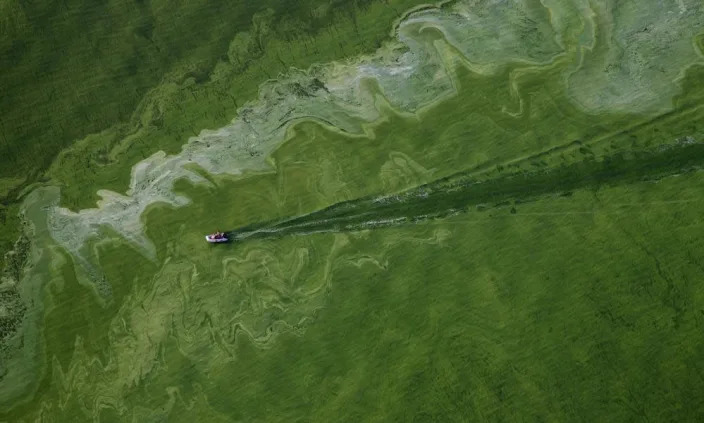
The overuse of materials such as plastics, fertilizers and other synthetic chemicals has caused devastating effects on ecosystems and human health. Plastic debris chokes waterways and wildlife, fertilizer-laden runoff from fields can cause algal blooms and create dead zones in coastal areas.

An algae bloom on Lake Erie near Toledo, Ohio. The causes of these blooms vary but they are increasingly being linked to fertilizer runoff.
An algae bloom on Lake Erie near Toledo, Ohio. The causes of these blooms vary but they are increasingly being linked to fertilizer runoff. Photograph: Aurora Photos/Alamy

These impacts have led policymakers and consumers to cut back – for instance, many cities and countries now have prohibitions on some single-use plastics. “It’s an attempt to reduce plastic itself as a pollutant in the landscape, more than concerns about greenhouse gases, but we can make simultaneous progress on more than one front,” said Dell.

Studies have also found that being more precise about applying fertilizer could save farmers money and keep greenhouse gases out of the atmosphere.

It is less straightforward to cut back on some of the chemicals that are used to make consumer products, but Scheringer, Wang and others have proposed a way to start. Alarmed by the dangers of some cancer-causing PFAS, also known as “forever chemicals”, researchers have suggested eliminating PFAS from their “nice-to-have” applications – such as nonstick cookware, long-lasting mascara, or water-repellent surfer shorts that don’t need the level of high performance that “forever chemicals” confer.

Related: ‘Forever chemicals’: the hidden threat from the toxic PFAS on your shelf

The researchers recommend that “forever chemicals” be used only in really important products, such as protective gear or medical devices that save lives. The same philosophy could be applied to identify and eliminate other chemicals that have been unnecessarily formulated in products, such as adding antimicrobials to soaps that can already kill germs.

Simplifying the chemical ingredients in products has an added benefit: they are easier to take apart or recycle when they are no longer useful. Wang points to the example of carbon black, the chemical used as a pigment in food takeout boxes. The pigment serves no technical function other than providing colour and it is used because food looks more appealing set against a black background, Wang said. But the pigment also means the takeout boxes are invisible to devices that use light to sort plastics at sorting facilities, making them impossible to recycle.

The chemical sector is producing more than consumers need, Wang said: “The business model is driven by how many chemicals you sell, it’s not necessarily driven by the added societal value of the chemical.”

But the “enormous demand” for products is also a big driver – and perhaps harder to address, said Kleimark. “We’re standing in front of a really, really big challenge because there we cannot rely on technologies, but on changing the way we do things today.”

An industry’s waste was used to fertilize farm fields in SC. Now wells are polluted

The State

An industry’s waste was used to fertilize farm fields in SC. Now wells are polluted

Sammy Fretwell – November 19, 2021

Travis Long

Eleven years after moving to rural Darlington County, Kim Weatherford learned that dangerous chemicals had seeped into the drinking water her family depends on.

She was stunned. How could such a thing occur in a pastoral, out-of-the-way place like that? Weatherford asked

“It just doesn’t seem right that this could have even happened,’’ she said. “I don’t want to get sick.’’

Weatherford is among dozens of eastern South Carolina residents whose wells have been contaminated by an emerging class of chemicals, found in an industrial plant’s sludge that landowners spread on fields for years to fertilize crops.

The contamination is serious enough that state and federal regulators are urging families with highly polluted wells not to drink the water unless they install devices to filter out the contaminants. The contamination is from per- and poly-fluoroalkyl substances, or PFAs, a growing source of water pollution nationally.

So far, 46 wells in the areahave been found with PFA compounds in the water, even as regulators test more wells to determine the extent of the contamination, according to the S.C. Department of Health and Environmental Control. Of that, 23 wells have levels that exceed a federally recommended safety limit, agency officials said Thursday night.

Pollution from PFAs is an increasing concern across the country because the chemicals, which few people had heard of 20 years ago, do not break down quickly in the environment and are considered highly toxic. These toxins have had a variety of industrial uses, ranging from inclusion in Teflon to firefighting foam.

PFAs are suspected of causing cancer, kidney problems, development disabilities in children, and other ailments. Those exposed to the chemicals over a period of years are considered most at risk of developing health problems. Problems have popped up in recent years in some South Carolina communities, including at least two mobile home parks with wells suspected of being polluted by Shaw Air Force Base in Sumter County. Among the PFAs of most concern are PFOS and PFOA.

State and federal agencies have tied the source of contamination Weatherford is dealing with to an abandoned industrial plant that used waste sludge to fertilize farm fields in three eastern South Carolina counties: Darlington, Chesterfield and Marlboro.

The Galey and Lord factory, a textile dying and finishing plant that opened in the mid 1960s, supplied some of the sludge from 1993 to 2013, according to the U.S. Environmental Protection Agency. PFAs were commonly used in the textile industry as fabric finishing additives.

“The source of the contamination is suspected of being connected to the land farming of the (wastewater) sludges from the former Galey and Lord textile mills,’’ the EPA said in a document posted on its website.

All told, 304 agricultural fields totaling nearly 10,000 acres received treated sludge from the Galey and Lord plant, the agency said. One area with groundwater contamination is at Journey’s End Road in Darlington County. The fields where the sludge was applied were owned by entities other than Galey and Lord, DHEC said.

The EPA and DHEC are still trying to determine how much of the sludge contained PFAs and related compounds.

The Galey and Lord facility operated for decades, employing thousands of local residents, but shut down in 2016 after pollution was discovered on the property. The company had a 2013 cleanup agreement with DHEC, but didn’t complete the work as required, records show.

Now, the EPA has proposed making the abandoned Galey and Lord location a federal Superfund site for cleanup. Superfund sites are among the most polluted places in the country and often are cleaned up at taxpayer expense because the owners can’t — or won’t — do the work.

Already, the EPA has conducted emergency Superfund work in the area, installing filters in homes with PFA-tainted wells. The efforts have cost the EPA at least $250,000, but that does not include all of the work the agency has done so far, said Bryan Vasser, an EPA official involved in the cleanup effort.

In addition to efforts to protect drinking water, the EPA also removed 2,400 abandoned containers and 100,000 gallons of flammable liquids and other waste last year from the Galey and Lord site in the Society Hill community. In addition, the agency hauled away 53,000 pounds of solid waste, some of it flammable and corrosive, an EPA fact sheet says.

Not only is drinking water tainted, but so are rivers and creeks nearby.

Wetlands along Cedar Creek and the Great Pee Dee River were found to be polluted with two types of PFAs — known as PFOA and PFOS — as well as arsenic, chromium, copper, lead and manganese, all of which are toxic. The same poisonous materials were found in wastewater treatment basins at the industrial site, according to the federal environmental agency.

The Great Pee Dee River and Cedar Creek next to and downstream of the Galey and Lord site “are impacted by the facility, posing human health and ecological risks,’’ the EPA says on its website.

Efforts to locate a representative of Galey and Lord were unsuccessful.

Officials with the non-profit S.C. Environmental Law Project said the PFAs-contamination in drinking water is a particular concern for the state.

South Carolina has no specific statewide limits on PFA-pollution in drinking water. Federal oversight needs strengthening, the law project says.

“It is extremely alarming to me,’’ said Ben Cunningham, an attorney with the law project who is helping Weatherford, the Darlington County property owner. “It’s another example of how flawed the drinking water issue is in South Carolina and how we have a lot of work to do to provide everybody with good drinking water.’’

Dave Hargett, an environmental consultant from Greenville who is familiar with PFAs, said the discovery that waste sludge may have polluted drinking water wells is “a big deal.”

Some people didn’t realize in the past that sludge could produce toxins like PFAs, he said. Sludge from Galey and Lord was applied on farm fields for about a decade, with DHEC’s approval, records show.

Waste sludge “had, to a farmer, beneficial reuse value, with nutrients they could put on their ag fields,’’ Hargett said. “But they didn’t know they were getting all this crap with it.’’

In response to questions from The State, DHEC spokeswoman Laura Renwick said the agency didn’t require testing for PFOAs or PFOS when sludge was applied to the landscape in the past “because these compounds had not yet been identified as compounds of concern..’’

Weatherford, 53, lives across the street from an agricultural field she suspects of using the tainted sludge. It’s a scenic spot that was an attraction when she and her family moved from Clarendon County to Darlington County in 2010 after building their new house..

Weatherford, who lives with her husband and 21-year-old son, said they are now buying bottled water to drink and brush their teeth with.

But Weatherford wonders whether PFAs were in her drinking water long before they were discovered this past summer by DHEC. She worries that it may affect her family’s health. PFAs are known as “forever chemicals’’ because they don’t break down quickly in the environment.

“It is very scary,’’ she said. “I worry about my husband, myself, my mother-in-law. Most of my worry comes for my child.’’

Test results obtained by The State show that DHEC’s water testing found contamination in the Weatherford’s well at 120 parts per trillion. The recommended federal limit is 70 parts per trillion. The water in her in-laws nearby home contained levels of PFAs that were even higher, Weatherford said.

For now, the EPA has offered to put a filter on her well to get rid of the PFAs in the water, but she declined because it will become expensive to operate. And it’s not a long-term solution to the water pollution, she and others say.

The late Sen. Hugh Leatherman, in one of his last official acts before he died this month, asked a local utility to help the Weatherfords.

“Although the Environmental Protection Agency has offered to install a filtration system in the Weatherford home, it is not a long-term solution,’’ Leatherman wrote in an Oct. 14 letter to the Darlington County Water and Sewer Authority. “Ms. Weatherford and her neighbors would greatly prefer to have access’’ to the public water system.

“I would very much appreciate anything that your agency can do to provide safe drinking water for Ms. Weatherford and her neighbors.’’

Weatherford said she and her family will have to deal with the problem they’ve been handed.

She’s angry that tighter controls were not placed on the sludge spread on farm fields in her community. Galey and Lord had a history of polluting the environment, according to a 2013 news story in The State about companies that repeatedly break environmental laws.

Regulators “have known for so long they have been breaking environmental laws,’’ she said. “And here it is 2021, and we are out of luck because the company is out of business. How did they let this go this far?”