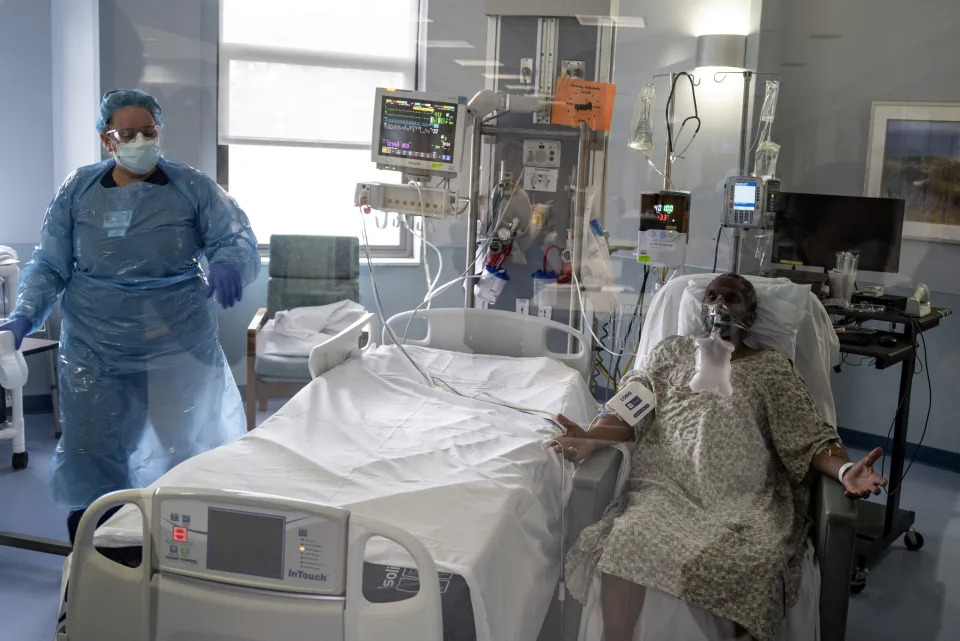
Inside an ICU, a depleted staff struggles to keep going

Washington Post

Inside an ICU, a depleted staff struggles to keep going

Rachel Chason, The Washington Post January 24, 2022

Angie Wheeler had bonded with her patient, and now his body was failing. The nurse tried not to let him see the concern in her eyes.

It was only the day before that he had told her about his job, his wife and children. Now, the intensive care unit’s head doctor told Wheeler, he needed to be placed on a ventilator. She donned her protective gear and headed in.

Nearly two years into the coronavirus pandemic, Wheeler, 65, knew what to say:

“You’re going to go to sleep, OK? You won’t remember any of this.”

“I’m trusting you to take care of me,” he told her.

The words hurt. Why, Wheeler couldn’t help but think, hadn’t he just gotten vaccinated?

Like hospitals across the country, Luminis Health Doctors Community Hospital is facing a two-pronged crisis in this surge, with thin staffing and more covid-19 patients than ever before. Employees who remain have no choice but to shoulder bigger burdens. Among the heaviest, they say, is the emotional weight of so much preventable death.

About 70% of patients admitted to the hospital are unvaccinated, as are more than 90% of those who die there.

Doctors calling into a peer support line, created by Philadelphia-area psychiatrist Mona Masood at the beginning of the pandemic, now frequently lament the erosion of trust that misinformation about coronavirus vaccines has caused between patients and doctors, Masood said.

“This idea that we are all in this together,” she said, “has really broken down.”

During this surge, calls to the Physician Support Line have roughly doubled.

“Everyone in the hospital dealt with lack of PPE, a lack of testing, health-care narratives rooted in political nonsense . . . on top of all the death,” said Kanak Patel, the ICU doctor who told Wheeler that day that the patient needed to be intubated.

“You put any workforce through that,” he added, “and it’s not going to be whole. And we’re far from whole right now.”

When Wheeler turned 65, some of her family members urged her to retire, worried about her safety.

But she never considered quitting, even when the virus was new and she was often scared. Health-care workers nationwide were leaving the profession in droves.

Last March, a Washington Post-Kaiser Family Foundation poll found that 3 in 10 health-care workers were considering quitting. More than than half of those who remained were burned out, with 6 in 10 saying stress from the pandemic had harmed their mental health. And that was before the devastation brought by the delta and omicron variants.

Instead of quitting, though, Wheeler doubled down, picking up extra shifts to help with nursing shortages. It hasn’t been easy.

When she needs a break at work, she stares at the row of orchids that she cares for in a windowsill just outside the ICU, buoyed by the sight of their beauty. When she gets in her car at the end of days that stretch more than 13 hours, she turns off the radio and reflects, asking herself what went right, and if she could have done anything better.

She struggles with the mix of emotions she feels when she learns a patient is unvaccinated, frustrated by what it means for them and for the overburdened health-care system. Still, as she has over the course of four decades in nursing, she has resolved to treat all her patients like she would family.

So she rushed to her patient’s room when she heard a “code blue” called in the hospital, two days after he was placed on a ventilator. He had died.

“I kind of feel like I failed him,” she said.

“But I also wanted to say, ‘If you’d only gotten the vaccine. I wish you had gotten the vaccine. We wouldn’t be here.’ “

Deneen Richmond, the community hospital’s president, likens the rapid increase in patient volume the facility has seen to “an explosion.”

The number of covid-19 patients that staff members at Doctors Community Hospital are seeing – from about eight a day before Thanksgiving to more than 80 – dwarfs the approximately 50 covid-19 patients the hospital treated per day during the same period last January.

At the same time, about 20% of open positions are now unfilled, with a vacancy rate of 30% for bedside nurses. At points this month, as many as 60 staff members have been out sick.

The emergency room and main floor of the hospital have been hit harder in this wave, driven by the highly contagious but less severe omicron variant, than in previous ones. But the ICU, too, has remained busy. And the concentrated death that staff members continue to see worries Richmond.

“Obviously, people die in hospitals all the time,” she said. “But it’s been two years of seeing more death than probably most health-care workers would have seen in their careers.”

The hospital took the unprecedented step in this surge of declaring a crisis.

Last year, it raised its minimum wage for all staff members to $17 per hour. It offered new benefits and brought in counselors and chaplains for emotional support. And, as hospitals nationwide have done, it hired dozens of agency nurses, who travel across the country and are typically paid higher salaries.

The number of patients being treated dipped in the past two weeks, mirroring state and national trends. Still, Richmond worries, especially when she thinks about the future.

“I think about it sometimes like a rubber band,” she said earlier this month. “How much can we really stretch a very thin staff in the situation that we’re in? . . . We are stretching and stretching and stretching. But we all know at some point that the rubber band, you know, pops.”

As staff members completed their rounds on a recent morning in the ICU, doctors and nurses delivered updates in mostly flat tones. The news, for the most part, was grim.

One covid-19 patient on a ventilator had nearly coded the day before. Another, whose teenage daughter had pleaded with staff members to do everything they could to help her dad get better, had basically lost all brain capacity.

“As much as I want to be able to fix him,” physician Bobby Mathew said, “I don’t think there’s a way.”

When they got to the window outside Steven Byrd’s room, the mood lightened. Patel, the director of critical care medicine, flashed him a peace sign. The chatty grandfather gave the doctors and nurse a huge wave.

“This is the greatest staff,” he shouted at them through the thick glass.

Staff smiled through their masks as they talked through the history of the unvaccinated man, who had made big progress – now eating and sitting up on his own – since he was admitted with covid-19 the week before. Everyone was hoping for his success. The team needed a win.

Just seven months ago, they were celebrating multiple days with no covid-19 patients, marveling at the efficacy of coronavirus vaccines and hoping the end was in sight. It wasn’t long before delta hit and the ICU again began to fill. Weary employees exchanged looks of disbelief. Not again, they thought.

Now, when Patel looks at the ICU, there are more contract nurses and fewer people who have known the hospital, and the community, for years. The team is mostly consumed by getting through the day, Patel said, making sure that patients continue to receive good care.

“We’ve gotten to the point that it’s beyond conversation,” he said. “We’ve had them all already.”

Still, he said, patients like Byrd give them hope.

He’d been too worried, Byrd told Patel, about what was in the vaccines to get immunized. And even though he still isn’t entirely sure, he told Patel he planned to get vaccinated – and encourage his grandchildren to do the same.

“As soon I am able, trust and believe,” he told the doctor. “I will be the first to have it.”

“No judgments,” Patel replied, “we’re gonna get you through.”

The Washington Post’s Emily Guskin contributed to this report.

Video Embed Code

Video: http://www.washingtonpost.com/video/topics/coronavirus/health-care-workers-battle-burnout-as-omicron-surges-it-just-rips-your-heart-apart/2022/01/21/da1d0812-e482-43d3-ae2d-812df92c06c4_video.html(REF:sheftewl/The Washington Post)

Embed code:https://www.washingtonpost.com/video/c/embed/da1d0812-e482-43d3-ae2d-812df92c06c4?ptvads=block&playthrough=false

Salt River Project, Navajo Nation partner on new solar power facility in Arizona

The Daily Times

Salt River Project, Navajo Nation partner on new solar power facility in Arizona

Noel Lyn Smith, Farmington Daily Times January 24, 2022

Noel Lyn Smith covers the Navajo Nation for The Daily Times.

FARMINGTON — A Phoenix-based public power utility and the Navajo Nation have extended the contract for the utility to continue receiving electric power from a solar power facility outside of Kayenta, Arizona through March 2038.

Officials from Salt River Project, Navajo Tribal Utility Authority and the Navajo Nation government signed the contract on Jan. 20 in Phoenix.

In addition, the parties signed an agreement to build a new solar facility in Cameron, Arizona in the Western Agency of the Navajo Nation.

This facility would produce 200 megawatts of energy and would go into operation by the end of next year.- ADVERTISEMENT -https://s.yimg.com/rq/darla/4-10-1/html/r-sf-flx.html

More: Bill calling for helium development in Northern Agency moves to Navajo Nation Council

Leaders from the Navajo Nation join officials from the Navajo Tribal Utility Authority and Salt River Project for a ceremony to sign agreements on Jan. 20 in Phoenix.

Officials touted the new site as supporting renewable energy development on the Navajo Nation.

In separate news releases, Salt River Project and the tribal president’s office stated that the Cameron project will generate approximately $11 million for the land lease as well as $32 million in transmission operations over the next 25 years.

It will also bring approximately $15 million in tax revenue and provide between 300-400 jobs during construction with up to 90% going to tribal members.

“This collaboration with the Navajo Nation on the Kayenta Solar generation facility supports the Navajo community’s transition from a coal-based economy and has provided a valuable resource to SRP’s growing renewable energy portfolio,” Salt River Project General Manager and CEO Mike Hummel said in the releases. “In addition, we are extremely honored to work alongside NTUA to continue to work together on future projects including Cameron Solar.”

Towers and power lines at the Kayenta Solar Project facility are shown during a tour on July 6, 2017 in Kayenta, Arizona.

NTUA is a tribal enterprise. It has been operating the solar energy facility near Kayenta – known as Kayenta I – since May 2017.

Together with its partnering site, Kayenta II, generates enough energy to power 36,000 homes on the tribal land, according to the news releases.

“The NTUA renewable energy development goal is multifaceted which includes helping to generate a new Navajo Nation economy, creating new jobs, keeping electric and utility rates stable and using excess proceeds to connect homes to the electric grid,” NTUA General Manager Walter Haase said in the news releases.

Automated solar panel arrays convert sunlight to electricity on July 6, 2017 at the Kayenta Solar Project facility in Kayenta, Arizona.

OPINION: Cyber Ninjas’ connection to Big Lie runs far, deep and dangerous

Herald – Tribune

OPINION: Cyber Ninjas’ connection to Big Lie runs far, deep and dangerous

Chris Anderson, Sarasota Herald-Tribune January 25, 2022

The presiding government body in Windham, New Hampshire is the Board of Selectmen, and their meetings are so mind-numbingly dull even the gavel no longer goes.

A drainage study one week, a boat ramp debate the next. Who can take it? Finally, on April 19, things kicked up a notch. That’s when the ninja from Sarasota slinked in and sat down.

Wearing a cutout of Donald Trump’s face, Marc DiMaggio of Punta Gorda has his photo taken with Lisa Rudolph during a July 3 rally for former President Donald Trump at the Sarasota Fairgrounds.

Indeed, the mysterious Doug Logan, CEO of Cyber Ninjas, emerged from the shadows to denounce the evil forces of election fraud, and by attending this particular meeting, he revealed his connections to some of the most dangerous conspiracy-spewing people in the country, including the King Spewer himself.

It was the craziest thing, how this meeting came to be. After a Democratic candidate in a New Hampshire state House race lost in November by 24 votes, she demanded a recount. To the surprise of all, the recount added 300 votes to her Republican opponents while she lost 99.

Wildest meeting of presidency: Tying Sarasota’s Cyber Ninjas to Donald Trump’s White House

Flynn and QAnon: Michael Flynn’s curious ties to Cyber Ninjas, QAnon and the Ellenton post office

Republican New Hampshire Gov. Chris Sununu signed a bill in April authorizing an audit of the voting machines, and see? Right there! Voter fraud! There’s your proof! And if it’s here, in a town so small Cory Lewandowski is the most famous resident, you know it’s everywhere, and maybe Joe Biden isn’t really President after all.

Donald Trump, upon hearing the big news, cranked up the fertilizer spreader to 10 and pushed it across conservative America’s dying lawn.

“Congratulations to the great patriots of Windham, New Hampshire for their incredible fight to seek out the truth on the massive voter fraud in New Hampshire and in the 2020 presidential election,” Trump said.

Former President Donald Trump speaks at the Sarasota Fairgrounds on July 3. Trump talked about MAGA and the accomplishments of his administration.

That secured it all right, fraud. So all they needed now was an auditor, which was the hot topic at the April 19 meeting, and you should have seen who streamed out of the clown car ready to take on the job.

First, there was Logan, whose Sarasota computer security company was already in charge of a ballot “audit” in Arizona. Groups tied to Michael Flynn, Sidney Powell and former Overstock.com CEO Patrick Byrne are funding Logan’s Arizona project with nearly $6 million of privately-raised money that has caught the interest of the state of Florida.

Michael Flynn, former President Donald Trump’s first national security adviser, speaks at a rally at the DeSoto Square Mall in Bradenton.

Now, no one seems to know much about Logan and the company he runs from a P.O. Box on Fruitville Rd. Even top Democrats in the House Oversight Committee are concerned about his lack of experience in election audits and are investigating.

The minutes from the New Hampshire meeting, however, prove that maybe Logan wasn’t so inexperienced after all.

In his pitch to the board, Logan said he also has done forensic work in Michigan (we’ll get to that later) and Georgia, where Trump pressured the Republican Secretary of State to “find more votes.”

A conspiracy nut named Col. Phil Waldron also threw his tinfoil hat into the ring in New Hampshire, and he backed up Logan, claiming he had done work with him in Arizona, Michigan and Georgia.

According to the New York Times, Waldron believes that China invested money in Dominion voting machines and owns access to its data and files. He also claims that servers in the United Kingdom, Germany and Spain helped manipulate the presidential election in favor of Biden.

Waldron told the board he was at the meeting on behalf of Russ Ramsland, who owns a company called Allied Special Operations Group in Texas. Ramsland, according to the Washington Post, has been screaming to conservative lawmakers since 2018 that voting machines are unreliable. No one ever listened. Until Trump.

Ramsland has had some interesting theories too. For example, he publicly claimed the 2019 Kentucky gubernatorial race was rigged by voting machines using “Venezuelan election-stealing software controlled by a George Soros operative, and that votes were sent to a CIA-funded database in Spain where they were changed and sent back to the United States,” according to a lawsuit.

The meeting grew even wackier when a local from Windham stood up and claimed to have thousands of emails from people across New Hampshire who wanted Jovan Pulitzer to run the audit. Pulitzer is more than just the man who unsuccessfully searched for the Ark of the Covenant. He also invented something called a “CueCat,” which was essentially a barcode reader for computers about as useless as a paperweight. Time magazine ranked it as the fifth-worst invention of all time. Fourth was Agent Orange.

Pulitzer now claims to have invented a barcode scanner that can be used to detect bamboo shoots in ballots, which reportedly is what was being used in the Arizona audit to determine if they came from China. Logan and Pulitzer have been working together in Arizona, reports have said.

A local resident at the New Hampshire meeting actually suggested that Waldron, Logan and Pulitzer work together on the audit, and he would pay for it.

Oh, if only that’s all there was.

On Jan. 18, Michael Flynn (an Englewood resident and admitted liar to the FBI), Powell (Flynn’s former attorney who helped him secure a Trump pardon) and Byrne (the former Overstock.com CEO who resigned from a billion-dollar company after having an affair with a Russian spy), showed up unannounced at the White House and somehow met with Trump. Axios called it the wildest meeting of Trump’s presidency.

Byrne, according to a lawsuit, argued that “guys with big guns and badges” should confiscate all Dominion voting machines across the country, to which a senior White House official in the room replied: “What are you, 3 years old?”

Even Trump couldn’t handle Byrne’s infantile outlandishness and cast him aside. Hurt, but undeterred, he turned his gaze to Michigan. Rudy Giuliani saw it too.

Rudy Giuliani, President Donald Trump’s personal lawyer, addresses a news conference at Republican National Committee headquarters in Washington on Nov. 19. While Trump’s mission to subvert the election has so far failed at every turn, it has nevertheless exposed deep cracks in the edifice of American democracy and opened the way for future disruption and perhaps disaster.

Antrim County is in the northern part of the state, and election night tabulations showed Biden as the surprise winner in the county. That was wrong. A human mistake was to blame, the error was quickly fixed, and Trump was certified as the winner by a large margin. No problem.

Still, a lawsuit was filed claiming the Dominion voting machines were faulty. This was another chance to prove if fraud existed here, it existed everywhere, and they pounced on it.

Giuliani even went on TV and stated 19 Michigan precincts recorded more votes than there were voters. Proof! Right there! Just one tiny problem. Giuliani relied on an affidavit from Ramsland, who mistakenly used data from 19 precincts in Minnesota, not Michigan. Ramsland had the wrong state.

And take a guess who was listed as witnesses in the Michigan election fraud lawsuit? Ramsland, Waldron, and Doug Logan, Sarasota’s resident ninja.

From the failed lawsuit in Michigan, it was on to Arizona. Maricopa County, to be exact. Republicans in the state Senate originally entered into a contract with Ramsland’s company, according to a report, but it fell through and somehow Logan signed one on March 30 for $150,000.

What no one knew at the time was that Flynn, Powell and Byrne — through various groups — made sure Logan had nearly $6 million more to work with.

Flynn, Powell and Byrne are now being sued by Dominion for over $1 billion apiece for spreading misinformation about their machines, and in Byrne’s lawsuit, it said:

“Having fooled tens of millions of people with the Ramsland report in Michigan, Byrne and his collaborators set out to repeat their strategy in Arizona: Find someone with zero experience in election security who has already committed themselves to the preconceived notion the election was stolen, and pay them to manufacture evidence to support that conclusion.

“Byrne and his collaborators found exactly what they were looking for in Doug Logan.”

Former President Donald Trump speaks at the Sarasota Fairgrounds on July 3.

And while Logan did secure the contract in Arizona, he was not as fortunate in New Hampshire. That particular job went to a man named Mark Lindeman, who is co-director of something called Verified Voting.

It didn’t take long for people to call for his removal, either. The reason? He wrote a letter to Karen Fann, President of the Arizona Senate, saying he was “disturbed” by the presence of Cyber Ninjas in her state.

As for the vote discrepancies in Windham, well, maybe that’s better left forgotten. Turns out, folds in the absentee ballots were the cause, not fraud. Because some folds went through the name of the Democrat on the ballot, either the Democrat vote didn’t count or it counted in favor of the Republican.

If you didn’t know better, you’d swear it was the work of a ninja.

Contact columnist Chris Anderson at chris.anderson@heraldtribune.com. Please support local journalism by purchasing a local subscription.

D.C. Is a Donut. There Is No Center in Washington Politics

Daily Beast

D.C. Is a Donut. There Is No Center in Washington Politics

David Rothkopf January 23, 2022

Illustration by Elizabeth Brockway/The Daily Beast

“Blame the left” is Washington’s latest craze.

It would not be surprising if it were just coming from the GOP. But scapegoating progressives is now an increasingly popular sport among Washington-based pundits—and even some Democratic Party strategists—trying to identify who or what to blame for President Joe Biden’s low poll numbers and the myriad struggles of his first year in office.

Unfortunately, these analyses are based on several fallacies. First, Biden’s poll numbers after one year in office, while undoubtedly sagging, are still substantially ahead of Donald Trump’s.

Next is the obvious but somehow underrated truism that poll numbers after one year in office are fairly meaningless. Comparisons to prior decades—when partisan politics weren’t nearly as divisive—are also not particularly useful.

Biden’s poll numbers cannot be attributed to any specific action he has or has not taken. In fact, it is highly likely that a combination of factors beyond his control—such as the emergence of a highly contagious and vaccine-resistant strain of COVID-19, and the GOP campaign to reject essential public health measures—has had more of an impact on his numbers than anything for which Biden is personally responsible.

Dems Can’t Afford to Form a Circular Firing Squad on Voting Rights

President Biden’s achievements, in fact, outweigh his struggles. On his watch, more than 6.5 million new jobs were added to the economy. Over 200 million Americans got vaccinated. The $1.9 trillion American Rescue Package lifted half of America’s poorest children out of poverty. The $1.2 trillion infrastructure bill was passed with bipartisan support. Biden appointed more judges than any previous president and ended America’s longest war. He’s brought a semblance of stability back to the White House after four years of chaos, irrationality, and corruption.

Yes, the president’s Build Back Better (BBB) spending bill and voting rights reform have stalled. But there is no reason to define Biden solely in the areas where he has faced opposition, especially given the very slim congressional majorities he inherited.

Furthermore, the argument that Biden’s legislative agenda has been co-opted by progressives at the expense of the support of centrists is based on a fallacy.

Nearly everything Biden has done in his first year has been supported by either all the Senate’s Democrats, or all but one or two of them. Does this mean that 48 out of 50 senators are “far-left” and that Biden needs to tailor his policies to suit the other two? And does it mean that the president should be adjusting his policies in a futile attempt to win the votes of so-called “centrist” Republicans who have voted as a bloc of opposition on nearly everything Biden has sent them?

When it comes to elections—and the politics of the nation as a whole—there is, of course, a center.

Look at polling. Look at the “progressive” ideas discussed or supported by Biden—from protecting the climate to providing child care, from better health care to fairer taxation, from gun control to voting rights, from a woman’s right to choose to education reform—they are all supported by a substantial majority of Americans.

Biden is not advancing a “left” agenda, he is fighting for a majoritarian agenda, for goals sought by the vast majority of us that would, in turn, benefit the vast majority of us.

But the grim reality is that D.C. is a donut. There is no “center” in Washington politics. There are two parties and a tiny handful of people caught between them. The only way for Biden to win legislatively in the nation’s capital is for Democrats to win bigger majorities this November.

The problem is that D.C. politics are increasingly unresponsive to the majority of Americans. The system protects and super-empowers a right-leaning minority. Legislators represent states or congressional districts that either lean toward extremes or are gerrymandered to behave that way.

Some ideas associated with progressive causes haven’t been great for Democrats. Defunding the police is one such idea. This was not a good framing of the need for police reform. It may have done some damage, electorally. But it’s not an idea endorsed in any way by Biden, his administration, or Democratic leadership.

However, many of Biden’s biggest triumphs were seeded by the progressives, and thus should be praised as essential to his success. Conversely, many of the things opposed by the GOP—as well as the centrist Democratic Sens. Joe Manchin and Kyrsten Sinema—actually transcend politics. Ensuring the right to vote or combating the climate crisis or granting families and working mothers protections every other developed country in the world gives them are all broadly popular with Americans, and not at all “leftist” initiatives.

Democrats Can Salvage Biden’s Presidency With These Three Simple Moves

But advancing those policies does not require a more centrist president. What’s needed is fewer Republicans and their “centrist” allies in the House and Senate. That will mean embracing Democratic candidates who share the values and goals that are in tune with their states and districts. Once you’re outside of D.C., one size definitely does not fit all in politics. In some states that will mean candidates that are more centrist, though it just as likely could mean turning out more of the left-leaning Democratic base.

Of all the national leaders in the Democratic Party, the reality is that there is one who is best positioned to lead the campaign to achieve that kind of success in November. It just so happens to be the one whom Democrats chose as their candidate for president in 2020 and who, by virtue of his broad national appeal and his commitment to a majoritarian agenda, won by eight million votes.

The 3rd Leading Global Cause of Death Is Likely Not What You Think, New Study Reveals

Science -Alert…..The Lancet

The 3rd Leading Global Cause of Death Is Likely Not What You Think, New Study Reveals

Jacinta Bowler – January 24, 2022

This image has an empty alt attribute; its file name is AgarPlateCoveredInBacteriaWithStripInTheMiddle_600.jpg

Antibiotic sensitivity plate of MRSA showing sensitivity to Vancomycin. (Rodolfo Parulan Jr./Getty Images)HEALTH

Antibiotic resistance is often seen as a ‘future problem’, but newly published data have revealed it’s affecting far, far more lives than you might imagine.

In fact, the new estimates show that in 2019, there were 4.95 million deaths associated with bacterial antimicrobial resistance, making it the third leading cause of death worldwide.

Drugs that kill bacteria are undeniably one of humanity’s greatest discoveries. Since Alexander Fleming discovered antibacterial activity in the fungi Penicillium all the way back in 1928, we no longer have to worry about death from rose bush scratches or gonorrhea. In the decades following, antibiotics have saved millions and millions of lives worldwide.

But bacteria have been developing resistance to antibiotics long before we started using them, as they’re a naturally evolved biological weapon for warfare between microbes. Continually using the same antibiotics over and over provides bacteria with the opportunity to adapt to them even faster, leading to an increasing number of infections no longer responding to traditional (or even last-resort) antibiotics.

Unfortunately, the more bacterial species don’t respond to antibiotics, the more patients will succumb to resistant infections – and researchers are sounding the alarm that we’re now annually losing more people to antimicrobial resistance than to HIV/AIDS or malaria.

“These new data reveal the true scale of antimicrobial resistance worldwide, and are a clear signal that we must act now to combat the threat,” says University of Washington health economist Chris Murray, who co-authored the new research.

“Previous estimates had predicted 10 million annual deaths from antimicrobial resistance by 2050, but we now know for certain that we are already far closer to that figure than we thought. We need to leverage this data to course-correct action and drive innovation if we want to stay ahead in the race against antimicrobial resistance.”

The researchers analyzed data on 23 different bacterial species (including E. coli, S. pneumoniae and S. aureus) and 88 microbe-drug combinations from 204 countries. This ended up covering 471 million records of infection, which they then used to create statistical models to estimate the scale of antimicrobial resistance.

The team explored two counterfactual scenarios. In the first, all drug-resistant infections were replaced with no infections, which the team explained is the number of deaths associated with antimicrobial resistance.

In the second scenario, they replaced all drug-resistant infections with drug-susceptible infections, leading to an estimation of deaths directly caused by antimicrobial resistance.

The team concluded that in 2019, 4.95 million deaths were associated with drug-resistant bacterial infections, of which 1.27 million deaths were directly caused by antimicrobial resistance – a huge burden in all areas of the world, but particularly impacting low- and middle-income countries.

""Rate of deaths attributable to and associated with bacterial antimicrobial resistance in 2019. (Antimicrobial Resistance Collaborators, The Lancet, 2022)

These calculations suggested that only stroke and heart disease caused more deaths than antimicrobial resistance that year.

The authors note that, to their knowledge, this is the first time such a global estimate has been carried out at all. Because there are gaps in data from some parts of the world, and serious difficulties in carrying out the surveillance of antimicrobial resistance, there are some limitations to their modelling. But the conclusion is clear: we have a major global health problem.

“The threat of antimicrobial resistance has long been signaled. And the steps needed to tackle antimicrobial resistance – boosting public awareness, better surveillance, improved diagnostics, more rational use of antibiotics, access to clean water and sanitation, embracing One Health, and investments in new antimicrobials and vaccines – have been consistently recommended. But action has been episodic and uneven, resulting in global inequities in antimicrobial resistance,” The Lancet editors add in an editorial accompanying the research.

“Innovation has been extremely slow. Vaccines are available for only one of the six leading pathogens described in the study. The clinical pipeline for antibiotics is too small to tackle the increasing emergence and spread of antimicrobial resistance.”

The authors of both the editorial and the original study urge leaders to move antimicrobial resistance higher up on their agendas. Without urgent action, they caution, we’ll be seeing even higher levels of preventable deaths in the years to come.

The research has been published in The Lancet.

‘We’re in trouble:’ U.S. envoy urges faster action on climate goals

Reuters

‘We’re in trouble:’ U.S. envoy urges faster action on climate goals

Valerie Volcovici January 24, 2022

WASHINGTON (Reuters) – The world is “not on a good track” to meet a global goal to avoid the worst impacts of climate change and must intensify efforts to move away from fossil fuels this decade, John Kerry, the U.S. special envoy on climate change, said on Monday.

“We’re in trouble. I hope everyone understands that,” Kerry told an event called Building Momentum to UN COP27 hosted by the U.S. Chamber of Commerce and officials from Egypt, the host of the next UN climate summit.

Kerry told the event he is concerned about the recent uptick in the use of coal globally and about plans to build new coal plants without carbon capture technology.

In November, Egypt will host the next UN climate summit, known as COP27, in Sharm el-Sheikh where the government will look to showcase its own work to phase out coal https://www.reuters.com/world/middle-east/innovative-financing-can-help-unlock-promises-egypts-cop27-minister-2021-12-02 in power generation, improve management of waste water, and launch construction of public transportation projects.

Egyptian Foreign Minister Sameh Hassan Shoukry said as the host of the UN climate summit, Egypt aims to be a voice for mobilizing climate finance to support developing nations and transferring clean energy technology to African nations who are among those hurt most by climate change.

“We will be listening to the needs and priorities of Africa and other developing countries who have suffered greatly from the negative effects of climate change,” said Shoukry, who will be the president of COP27.

Environment Minister Yasmine Fouad said Egypt’s goal is to generate 42% of its electricity from renewable energy sources.

Kerry said actions countries have taken do not meet the severity of the problem, even though “a huge amount of good” came out of the COP26 summit in Glasgow last November, including concluding the “rule book” for executing the Paris Climate Agreement.

The UK COP26 president, Alok Sharma, also raised concern about the road ahead from Glasgow in a separate speech on Monday, saying that countries are struggling to find ways to deliver on the promises they made in Scotland.

He cited the struggles facing the United States, where President Joe Biden has struggled to get through a multi-billion dollar spending bill that is needed to carry out his administration’s climate pledges.

Kerry did not address the uncertain fate of the congressional bill and focused on other countries.

He said the recent uptick in coal use over the last year and plans by countries to continue building coal plants will worsen global warming and urged countries to change course.

“Most countries have the ability to deploy very significant additional amounts of renewables and they’re not choosing to do that,” he said, adding that sticking with coal or planning to build out natural gas infrastructure would lock in decades of additional greenhouse gas emissions.

Many Chamber of Commerce members support building more natural gas-fired power plants while the country transitions to renewables, and Kerry told the group he “is for gas” but only if it includes carbon capture technology.

“If it’s abated – terrific. If you can capture 100% (of the carbon and methane emissions} and it makes it affordable – that’s wonderful. But we’re not doing that,” he said.

(Reporting by Valerie Volcovici; Editing by Marguerita Choy and David Gregorio)

Aaron Rodgers Rips Joe Biden And ‘Fake White House’ In Anti-Vax Rant

tarbabys: But just what exactly would Mr. Rogers do if “he” had the responsibility to keep American’s safe and keep them from dying? (10,000 last week alone) Maybe give them bleach like trump proposed? Aaron Rogers Should Stick to Playing Football !

HuffPost

Ron Dicker, HuffPost January 24, 2022

Green Bay Packers quarterback Aaron Rodgers blasted President Joe Biden and his “fake White House” in an anti-vaccine rant that also seemed to question the 2020 election result.

“When the president of the United States says, ‘This is a pandemic of the unvaccinated,’ it’s because him and his constituents, which — I don’t know how there are any if you watch any of his attempts at public speaking — but I guess he got 81 million votes,” the NFL star told ESPN before his season ended in a playoff loss to the San Francisco 49ers on Saturday.

“But when you say stuff like that, and then you have the CDC, which — how do you even trust them — but then they come out and talk about 75% of the COVID deaths have at least four comorbidities,” he continued. “And you still have this fake White House set saying that this is the pandemic of the unvaccinated. That’s not helping the conversation.”

A dejected Aaron Rodgers walks off the field after the Packers lost to the 49ers in a playoff game on Saturday. (Photo: Patrick McDermott via Getty Images)

Off the field, Rodgers seemed on a roll last year. He announced his engagement to “Big Little Lies” star Shailene Woodley and had a 10-episode run as guest-host of “Jeopardy!”

But he fumbled on the vaccine. After lying to reporters about his vaccination status, he caught COVID-19. And in December, when President Joe Biden encountered a woman wearing a Packers jacket during a visit to tornado-ravaged Kentucky, he urged her to tell Rodgers to get the vaccine.

Rodgers’ remarks to ESPN suggest he’s still holding a grudge. And he missed the mark in his complaint about the Centers for Disease Control and Prevention.

The CDC statistic he mentioned focused on the rare deaths of people who are vaccinated and had nothing to do with coronavirus fatalities in general. The CDC study noted that among 1.2 million fully vaccinated people, 36 died after contracting COVID-19 ― and 28 of those had at least four risk factors.

Rodgers has spread misleading and false information before about the vaccine, and he’s proudly noted that he sought medical advice from podcast comedian Joe Rogan, who also has spread misinformation.

Pro-Trump death threats prompt bills in 3 states to protect election workers

Reuters

Pro-Trump death threats prompt bills in 3 states to protect election workers

Peter Eisler January 24, 2022

  (Reuters) – In Vermont, lawmakers are considering bills to make it easier to prosecute people who threaten election officials. In Maine, proposed legislation would stiffen penalties for such intimidation. In Washington, state senators voted this month to make threatening election workers a felony. 

  The measures follow a Reuters series of investigative reports documenting a nationwide wave of threats and harassment against election administrators by Donald Trump supporters who embrace the former president’s false voting-fraud claims. Sponsors and supporters of the legislation in all three states cited Reuters reporting as an impetus for proposing tougher enforcement. 

  Washington state Senator David Frockt, a Seattle Democrat, said the reports “gave us more evidence” to build support for legislation to hold accountable those who threaten election officials. 

  In Maine, a bill authored by Democratic state Representative Bruce White would enhance penalties for anyone who “intentionally interferes by force, violence or intimidation” with election administration. Secretary of State Shenna Bellows cited the Reuters reporting in testimony supporting the bill. 

  “This is unacceptable,” she said, noting that two municipal clerks in Maine were threatened with violence. 

Video: Texas man arrested over alleged threats to election officials

Texas man arrested over alleged threats to Georgia election officials

Chad Christopher Stark was arrested and charged for allegedly posting death threats toward election and government officials in Georgia.

  In all, Reuters documented more than 850 threats and hostile messages https://graphics.reuters.com/USA-ELECTION/THREATS/mopanwmlkva to U.S. election officials and workers. Nearly all the communications echoed Trump’s baseless claims that he lost the 2020 election because of fraud. More than 100 of the threats could meet the federal threshold for criminal prosecution, according to law professors and attorneys who reviewed them. 

  Prosecutions in such cases have been rare https://www.reuters.com/investigates/special-report/usa-election-threats-law-enforcement. But on Friday, a U.S. Department of Justice task force on election threats announced its first indictment https://www.reuters.com/world/us/us-charges-texas-man-threatening-georgia-government-officials-2022-01-21, charging a Texas man for posting online threats against three officials in Georgia https://www.reuters.com/article/us-usa-election-threats-georgia-exclusiv-idCAKBN2IP0VZ. An assistant attorney general said the case is among “dozens” being investigated by the task force, which was formed shortly after Reuters in June published the first in the series https://www.reuters.com/investigates/special-report/usa-trump-georgia-threats of reports on election-related threats. 

  In Vermont, menacing voicemails to Secretary of State Jim Condos and his staff – and a decision by police and prosecutors not to seek charges – spurred lawmakers to reconsider state laws that enshrine some of America’s oldest and strongest free-speech protections. Two measures introduced this month would make it easier to charge suspects for criminal threats and toughen penalties when they target public officials. 

  An unidentified man left a first round of hostile messages for Condos’ office shortly after the 2020 election. Then, last fall, the same man left voicemails threatening Condos and his staff, along with two Reuters journalists who had interviewed the man about his earlier threats. 

  “Justice is coming,” the man warned in an October message. “All you dirty c‑‑‑suckers are about to get f‑‑‑ing popped. I f‑‑‑ing guarantee it.” 

  Condos said in an interview that he expected the threatener would face no consequences under state law. Police and prosecutors already had reviewed the caller’s earlier messages and decided they were protected speech. 

  Frustrated, Condos wrote to a half-dozen lawmakers, urging them to consider legislation to align state law more closely with federal statutes and to set a clearer standard for prosecution. 

  “These voicemails do cross the line,” Condos wrote in an October 27 email to lawmakers, which was reviewed by Reuters. 

  Federal officials considered the threats serious enough to investigate. After Reuters asked Vermont officials about the October threat, the Federal Bureau of Investigation began an inquiry into the matter, according to two local law enforcement officials. 

  Condos said the email reflected his concern that the intimidation could escalate to violence. “It also was recognizing the world we are in,” he said, “and understanding we had to do something.” 

  Public calls for stronger legislation in Vermont emerged after Reuters published the October threats in a Nov. 9 story https://www.reuters.com/investigates/special-report/usa-election-threats along with details of the caller’s earlier messages. State authorities declined to pursue the case, saying the anonymous calls amounted to protected speech and were “essentially untraceable.” Reuters journalists, however, were able to contact and interview the man, who admitted to making the threats but declined to identify himself. He said he believed he had done nothing wrong. 

  The week after the Reuters report, Vermont Governor Phil Scott, a Republican, and state Senator Richard Sears, a Democrat, told reporters https://www.benningtonbanner.com/local-news/scott-will-consider-legislation-to-protect-election-workers/article_a4f7a134-4672-11ec-b04c-67156aea69cf.html that they would consider changes to state laws governing criminal threats. 

  Newspaper editorials also urged new legislation. “This case makes it clear that Vermont law needs to change,” the Manchester Journal said in a Nov. 11 editorial https://www.manchesterjournal.com/opinion/editorials/our-opinion-protecting-election-workers-protects-the-democracy/article_0d50e134-7aad-5c63-a00a-979ec69a4b6a.html, referring to the threats reported by Reuters against Condos and his staff. 

  THREATS VS. FREE SPEECH 

  The bills in Vermont and other states wouldn’t alter the free-speech protections guaranteed under the U.S. Constitution to all Americans. Advocates for the Vermont legislation say the intent is to bring state laws in line with federal standards, which make it easier to prosecute threats of violence. 

  The Vermont bills would sharpen the definition of a criminal threat and remove several hurdles to prosecution, including a requirement that a threat must target a specific individual and an additional burden of proving the suspect has the means and ability to carry out any threatened violence. Another measure would impose stiffer sentences for threats to public officials. 

  “This is about not tying our hands” with statutes that are “too narrow or unduly restrictive,” says Rory Thibault, a state’s attorney who advised lawmakers in crafting the legislation. 

  Striking that balance is delicate in Vermont, which codified its expansive free-speech protections nearly 250 years ago, more than a decade before the U.S. Constitution. 

  In 1777, the independent Vermont Republic enacted a constitution that guaranteed “a right to freedom of speech, and of writing and publishing their sentiments” – language that remains in the state’s constitution today. In 1798, one of the state’s first members of Congress, Matthew Lyon, was re-elected while jailed under the Sedition Act for criticism of President John Adams, whom Lyon had described as having “an unbounded thirst for ridiculous pomp.” 

  When state lawmakers tried several years ago to make it easier to prosecute criminal threats, the legislation died amid concerns that it might infringe on speech rights. But Vermont, like much of America, has wrestled recently with violent anti-government sentiment, white nationalism and political extremism, straining its free-speech tradition. 

  In 2018, Vermont’s Supreme Court overturned the conviction of a Ku Klux Klan member on two counts of disturbing the peace. The defendant had placed pro-Klan flyers on the cars of two women, one Black and one Hispanic. The court ruled the flyers constituted protected speech under Vermont law. 

  Last year, the town of Bennington paid $137,500 to a Black state legislator and apologized publicly for a police failure to sufficiently respond to racial harassment against her by a self-described white nationalist. The legislator, Kiah Morris, resigned in 2018. 

  So far, the criminal-threats legislation has not drawn significant public opposition, although proponents expect that might change once hearings begin. The American Civil Liberties Union of Vermont said it is monitoring the bills but has not taken a position. 

  Sears, who is also Judiciary Committee Chairman, plans hearings on the legislation this month. Passing the legislation wouldn’t ensure that people threatening public officials will go to jail, said Sears, who sponsored one of the bills. “But we know that if we don’t make these changes, there’s no chance anything will happen.” 

  (Reporting by Peter Eisler; additional reporting by Jason Szep and Linda So; editing by Jason Szep and Brian Thevenot) 

More People Are Choosing Not to Have Kids Because of Climate Change

GH

More People Are Choosing Not to Have Kids Because of Climate Change

Lizz Schumer January 24, 2022

Photo credit: Annie Otzen - Getty Images


“Hearst Magazines and Yahoo may earn commission or revenue on some items through the links below.”

Growing up, having kids someday felt like a foregone conclusion. My family and I never really talked about it; everyone just assumed I’d follow suit. As I got older, most of my friends started pairing off and starting families, and shortly before we got married, my husband Nick’s brother and sister-in-law did, too.

After we tied the knot, Nick bought two books on deciding when to have kids, placing them prominently on the coffee table in our newly-purchased home. But something shifted for me around that time. When the decision felt mostly theoretical, I looked at kids the same way I did any other milestone: just another box I was expected to check along the path toward adulthood. But once it became a real possibility, I began to take stock of my place in the world and my responsibility to it.

As Nick and I talked about it, what we realized tipped our personal scales in the opposite direction of we expected. I’ve always been pretty ambivalent about kids, whereas Nick dotes on his nieces and used to think he’d give them cousins someday. On the one hand, children would add another dimension to our little family. On the other, it felt pretty complete already.

Plus, I’ve always been a worrier, with my anxious brain given to fixating on the worst-case scenario. As a kid, my worries were fairly pedestrian: my house could burn down, my parents could die or I might. As an adult, the scope of my concern has expanded to include not just the well-being of my own loved ones, but everyone inhabiting our rapidly warming planet. As we discussed having kids, Nick and I looked around at our overcrowded world and didn’t see a compelling argument to add to the population. Even more so, we worried about the kind of world they’d inherit, which will almost certainly look far different than the one we grew up in.

It’s human nature to try to address large-scale problems with individual measures. For example, when we were kids, Smokey Bear taught us that “only you can prevent forest fires,” so I always make sure my own campfires are doused, even as the planet continues to burn. I recycle, carry reusable bags, take public transportation and shop as sustainably as possible — controlling what I can quells my climate anxiety somewhat, but, at the risk of sounding overly pessimistic, I’m afraid it’s all probably too little, too late.

The American Psychological Association defines climate anxiety as “a chronic fear of environmental doom” and Psychology Today calls it “an understandable reaction to one’s growing awareness of climate change and the global problems that result from damage to the ecosystem.” In contrast to generalized anxiety disorder, which can stem from many sources or none at all, climate anxiety is specific: It’s a fixation on the warming planet and all the myriad disasters that come with it. While symptoms vary from person to person, they may include insomnia, panic attacks, obsessive thinking and loss of appetite.

For me, it’s a gathering dread as hurricane season grows longer and more intense, a pit of despair in my gut that yawns wider with every second the doomsday clock ticks down and a sense of foreboding that tells me bringing a child into this world would doom them to an existence that looks more like Mad Max: Fury Road than Sesame Street.

For many people like me, composting and driving a Prius no longer feels like enough. A 2018 Gallup analysis reported that 70% of adults aged 18-34 said they worried about global warming, compared to 56% of adults aged 55 or older. A recent BBC survey of people ages 8-16 found that nearly three-quarters reported being deeply worried about the state of the planet.

A 2018 survey conducted by Morning Consult for The New York Times found 33% of the 20- to 45-year-old people surveyed cited climate change as a reason they had or expected to have fewer children than they might have wanted in different circumstances, and a newly published study in The Lancet revealed that, in a global poll of 10,000 people aged 16-25, 39% are hesitant to have children because of their climate anxiety.

It’s far from the only rationale, of course. Financial insecurity, lack of paid family leave or affordable childcare and both domestic and global political instability all feature prominently on the list of concerns. Then there’s the COVID-19 pandemic. As white people, the fact that my partner and I are just now realizing that the world might not be safe for our future children is a privilege in and of itself. For people of color, the decision to bring kids into the world has been a fraught one for centuries. “It can feel overwhelming, to be honest,” says Jade Sasser, Ph.D., associate professor of gender and sexuality studies at UC Riverside and author of On Infertile Ground: Population Control and Women’s Rights in the Era of Climate Change, “Layering crisis on top of crisis can just feel like too much.”

The question also isn’t new for concerned citizens who have been working on the front lines of the issue for years. Climate activist and sociologist Meghan Kallman and climate justice activist Josephine Ferorelli started Conceivable Future to build awareness of the threat climate change poses to reproductive justice and demanding an end to U.S. fossil fuel subsidies, as well as to provide a space for people to talk about how climate change is impacting their lives.

Canadian student Emma Lim also started a No Future, No Children pledge two years ago when she was 18, resolving not to have children until her government takes the climate crisis seriously. “Until our government begins to act like the grown-ups they’re supposed to be, we will make uncomfortably grown-up decisions of our own and refuse to carry on as though all is fine,” she wrote. More than 2,300 young people signed on.

“[Young people] want to be hopeful about the future and about their prospects of having families because families serve as buffers against all of these devastating social problems in the world,” says Sasser, who is also conducting research into how young people, primarily BIPOC, feel about the climate crisis and their reproductive options. “But they’re also experiencing a sense of terror and a really deep sense of sadness. And pre-grieving, just knowing that if they did have children, they wouldn’t be bringing them into the same kind of world that they’ve grown up in.”

When deciding whether to start our own brood, Nick and I thought about that, too. We grew up with snowy winters and mild summers, camping trips in our National Parks, playing outside until the streetlights came on. But even over the past few years, rampant wildfires and increasingly intense hurricanes and other natural disasters have threatened not only our natural playgrounds but lives and air quality across the country. Will one or two more people make a measurable difference? Maybe, maybe not. But to us, it felt cruel to subject a child to what feels like a worsening world.

But as Ferorelli also points out, none of these decisions are made in a vacuum. No one can tell another person the right choice to make, because none of us are living in each other’s circumstances. That’s part of what makes the decision of whether or not to reproduce in a changing world so hard.

“People’s worries tend to fall along the spectrum of what climate harm a child will do to the world and what kind of harm the world will do to a kid,” says Kallman. “But it’s more fruitful to have a systemic critique than be consumed by guilt.”

A 2017 study published in Environmental Research by Canadian climate scientists found that having one fewer child is the greatest impact an individual can have on reducing greenhouse gas emissions. That’s closely followed by eating a vegetarian diet, avoiding air travel and relying on public transportation instead of your own car. But many activists argue that individual decisions are only a small piece of the puzzle, and that a meaningful climate strategy must focus on holding elected officials accountable for making systemic change.

The problem is, it’s impossible to measure the joy that having kids can bring to a family, or to predict exactly what that child’s life will be like a few decades down the road. But feeling like we’re doing something to address the climate catastrophe has real value, too. “When we take responsibility for the environmental consequences of our daily actions, we feel like we are in control,” writes Jason Mark in an expansive Sierra Club op-ed. “And when you’re in control of your own life, perhaps then you’ll feel more empowered to take control of — or at least play a role in — larger political systems.”

Climate change is also impossible to untangle from other social issues related to raising a family. “We want to make the world safer for everyone,” says Kallman. “The right to control the pacing of your children, the health of your communities and a comprehensive view of what makes up a community that’s free of domestic violence, has access to safe food, safe schools, where police violence is not a threat.” By banding together to hold elected officials accountable, we can all make meaningful change that goes beyond our own doorsteps.

Having kids is an intensely personal decision, and no one should feel ashamed or guilty for choosing to do so, or not. I don’t know if Nick and I have made (or will make) the right decisions about the composition of our family. I don’t think there is a “right” one, period. But no matter how mired we are in the issues and our responses to them, it’s important not to become blind to the beauty of being alive in this world and the communities that we’re working with to save it.

“There’s a cultural association with having kids and optimism, and not having them with nihilism, but that’s not accurate,” says Ferorelli. “There’s an immense amount of joy and freedom and privilege in both.”

Get-rich-quick schemes spread covid – 19 lies with help from the GOP and Sinema

Get-rich-quick schemes spread covid – 19 lies with help from the GOP and Sinema

SemDem for Community Contributors Team – January 24, 2022 

WASHINGTON, DC - JULY 28:  U.S. Sen. Rob Portman (R-OH) (L) and Sen. Kyrsten Sinema (D-AZ) (2nd L) answer questions from members of the press as Sen. Susan Collins (R-ME) looks on during a news conference after a procedural vote for the bipartisan infrastructure framework at Dirksen Senate Office Building July 28, 2021 on Capitol Hill in Washington, DC. The Senate has advanced the bipartisan infrastructure framework with the vote of 67-32. (Photo by Alex Wong/Getty Images)
Sens. Rob Portman (R-OH), Kyrsten Sinema (D-AZ), and Susan Collins (R-ME)

Tonya Ferguson gave a presentation to the Reno County, Kansas, commissioners on how essential oils—which she just happened to sell—can help fight COVID-19. “I like to use an immune support, which is like putting my body in a bubble. It’s a powerful tool to combat viral and bacterial threats,” she says on the video. She claimed to have “protocols” to either protect from or treat people suffering from the virus. One of the commissioners tried to shut her down for advertising her snake oil, and that’s when the video got interesting.

Newly elected Republican Commissioner Mark Steffen spoke up. “This is not an advertisement! I asked her to come to talk about other options to help people be prepared to take care of themselves, so no, this is not an advertisement!” He really got fired up at the end of the lady’s speech, where he insisted that her voice was needed because “traditional, modern medicine has failed us” and that Democrats were taking away hydroxychloroquine.” Steffen was roundly mocked in the local press, but this being a right-wing state, he was also rewarded by being elected to the Kansas state senate a few weeks afterward.  

I shouldn’t need to say this, but there is zero link between essential oils and COVID-19. In fact, the lady was a distributor for a shady multi-level marketing (MLM) company called doTERRA that was formally warned by the FTC last April to stop making ridiculous claims about COVID-19 treatment.

But this article isn’t about Republican medical quackery, as we’ve seen enough. I was more interested in how these companies are still operating. Sadly, I’ve learned a lot more about MLMs than I care to, and I discovered that far from being curtailed, they have strong Republican allies who are trying to make it easier than ever to exploit people. They also have one strong ally in my least favorite Democratic senator, Kyrsten Sinema.

I’m sure I’m not alone in being cornered into hearing a sales pitch from a family member, friend, or long-lost acquaintance who has fallen into one of these schemes. Some of the pitches are bonkers. Not long ago, I unfriended a right-leaning colleague on social media over this. Besides realizing that I was constantly rebutting ridiculous anti-vaxxer nonsense, the final straw was when she started pitching ionized water machines—for thousands of dollars.

She explained in her posts that the machines use electrodes to give you more alkaline than what’s in normal tap water, which, according to her, “hydrates cells.” This, by the way, is apparently the perfect defense for COVID-19 and several types of cancer. Also, the liquid’s hydrogen atoms are somehow split off and rearranged, and more oxygen is added—or something. (I replied if that was even possible, it wouldn’t be H2O.) As with other “alternate” COVID-19 preventative treatments, this one was discovered, and somehow, completely ignored by all the top scientists in every nation researching the novel coronavirus.

Except it wasn’t. Ionized treated water is simply utter nonsense.

My former friend was involved in an MLM, sometimes called pyramid selling, which is a controversial marketing strategy that has the following hallmarks:

  • There is an upfront charge. (This is almost always a red flag. If you are going to make millions, why do they need your $200 bucks?)
  • The revenue comes from a non-salaried workforce, and profit from a pyramid-shaped commission system.
  • They sell products you can’t get in regular stores, and normally require participants to buy in bulk.
  • They typically require participants to sign up for expensive training and support programs.
  • They always seem to be on the hunt for new members to recruit.

The last one is a big one because money is much easier to get from recruiting members than by selling products. MLMs have a lot of explanations of how they aren’t pyramid schemes, but the biggest difference is this: MLMs are legal, and pyramid schemes aren’t. Unfortunately, during the economic collapse that followed the advent of the pandemic, MLM growth exploded.

boss.png
The “Hey Girl” cold message. The majority of people in MLMs are women. Suburban woman are a key target demographic.

The Direct Selling Association (DSA), a trade/lobbying group that pushes MLMs, reported that 51 of their member companies surveyed reported that COVID-19 had a “positive” impact on their revenue.

Previous recessions have always been boons for MLMs. During the last Great Recession of 2008, MLMs added over three million people to their ranks. It makes sense. When there are thousands of people out of work, who wouldn’t be lured with the promise of easy, big money that can be made from the safety of your own home?

DES MOINES, IOWA - OCTOBER 09: Former President Donald Trump speaks to supporters during a rally at the Iowa State Fairgrounds on October 09, 2021 in Des Moines, Iowa. This is Trump's first rally in Iowa since the 2020 election.  (Photo by Scott Olson/Getty Images)
Official spokesperson for the ACN MLM. Trump’s own MLM, called the Trump Network, sold urine tests and vitamins of questionable quality before going bankrupt.

In reality, MLM stories are horrifying: stories like Apollo Rodriquez, who was scammed out of tens of thousands by an MLM, in this case one called American Communications Network (ACN), are all too common. (Although he really should have known better based on who this company paid $1.3 million to be their spokesperson.) ACN was sued by multiple MLM sellers who lost thousands.

Unfortunately, MLM participants are far more likely to lose money than make money. In fact, according to research at the Federal Trade Commission, a whopping 99% of recruited sellers wind up losing money in an MLM venture.

If you want a good, funny analysis on how MLMs work, how utterly ridiculous they can be, and how they take your money, John Oliver did a much better job than I ever could:https://www.youtube.com/embed/s6MwGeOm8iI?enablejsapi=1

People like Tonya Ferguson, or my former colleague, are likely making ridiculous claims about how essential oils or alkaline water can fight COVID-19 because they are desperate to move product. My ire, however, is directed at people who have no excuse. There are right-wing politicians who are not only MLM supporters, but directly work for them.

Georgia state Rep. David Clark, who infamously got expelled from a legislative session for refusing to get COVID tested, claims that the health supplement company he’s a distributor for, NeoLife, can “boost your immune system.” Then there is “Trump in Heels,” Amanda Chase. She has the distinction of being the first Virginia state senator censured in 35 years for supporting the Capitol insurrection. She is also a representative for Shakeology. A spokesperson for Chase told a Daily Beast reporter that her MLM-based supplements can prevent contraction of the coronavirus.

As disgusting as these claims are, I’m much more angry with those in office who use legislative power to protect these companies from any scrutiny and help make it easy for them to lie. The MLM’s lobby, the DSA, has been extraordinarily successful in keeping federal regulators away from investigating these companies. It has also been successful in pushing to avoid defining the explicit difference between a legal MLM and an illegal pyramid scheme.  

The ad hoc chairman of a watchdog group called International Coalition of Consumer Advocates, Robert Fitzpatrick, has called the purveyors of MLMs the “Pyramid Lobby.” They not only target and almost exclusively donate to Republicans, MLMs are a large part of the conservative infrastructure. In fact, the man who built the powerful MLM company called Amway, Rich DeVos, has been credited with building the modern Republican Party as we know it. Rich DeVos, father-in-law of the infamous Trump Education Secretary Betsy DeVos, was one of the biggest financiers of GOP candidates and right-wing causes for decades.

ORLANDO, FL - FEBRUARY 24:  A general exterior view of fans entering the arena during the BBVA Rising Stars Challenge part of the 2012 NBA All-Star Weekend at Amway Center on February 24, 2012 in Orlando, Florida.  NOTE TO USER: User expressly acknowledges and agrees that, by downloading and or using this photograph, User is consenting to the terms and conditions of the Getty Images License Agreement.  (Photo by Ronald Martinez/Getty Images)
Amway, started by Rich DeVos, built an arena in Orlando. Trump kicked off his 2020 campaign here, and used it again at a sparsely attended event with Bill O’Reilly.

This makes sense. After all, Rich DeVos was the epitome of the wealthy Republican. He had real contempt for social and federal institutions that helped the poor while holding the Ayn Randian view that wealthy people deserve to be selfish. After all, poor people are poor because of their own fate, right? Never mind the fact that he helped bleed desperate people dry.

DeVos pitched snake oil to the sick, such as Magna Bloc Theraputic Magnets to relieve pain or phony nutrition and weight loss products, and sold get-rich-quick schemes to desperate people. He asked Amway distributors to imagine that they could be worth billions like him, knowing full well that most Amway operators lose money.  

In 2015, the DSA organized an entire caucus in Congress with the help of Reps. Marsha Blackburn of Tennessee and Marc Veasey of Texas. The Direct Selling Congressional Caucus (DSCC) was created.

Fitzpatrick wrote to each inaugural member about the legal, securities, and regulatory controversies that MLMs were involved in at the time in order to dissuade the inaugural members from joining. He believed that it was deceptive to use the term “direct selling,” which is different from how an MLM is structured. Regretfully, he failed in his effort. In fact, the caucus was not only formed, but it has grown and is now bipartisan.

Fitzpatrick’s fears were realized. The caucus has continuously pushed bills to make things as easy as possible for MLMs. The MLMs have already proven successful in getting a much looser set of regulations to help people with their own “business opportunities.” For one thing, for most sales businesses in the United States, you are required to disclose whether you have been sued for lying about your business, whether the money you promise your sales people will make are based on accurate statistics, and whether there are penalties for quitting (which shouldn’t ever be a thing). Yet if you are in an MLM, these legal standards don’t apply. Yet that apparently isn’t enough congressional support for the MLMs.

Members of this caucus have pushed bills to make it even easier for MLMs to exploit people. Republican Rep. Tom Graves of Georgia sponsored a bill to ease restrictions for multi-level marketing companies that have bad histories with exploitation. Rep. John Moolenaar, a Michigan Republican, pushed an amendment to that bill to loosen the definition of the term “pyramid promotion scheme,” as well as limit funding for enforcement actions outside this new definition. It was co-sponsored by several members of the MLM caucus.

Senator Kyrsten Sinema (R), D-AZ, departs from the US Capitol in Washington, DC, on October 28, 2021. - US President Joe Biden announced a "historic" framework Thursday for spending $3 trillion on America's social safety net and crumbling infrastructure, but his claim to be on the cusp of a major political victory had yet to get full backing from Democrats. Two conservative Democratic senators who have held up the social spending component, calling it too expensive, Joe Manchin and Kyrsten Sinema, sounded positive but did not commit to supporting Biden's framework. (Photo by MANDEL NGAN / AFP) (Photo by MANDEL NGAN/AFP via Getty Images)
Arizona Sen. Kyrsten Sinema

On the Senate side, the MLM’s biggest advocate is without question Kyrsten Sinema. This is dangerous, because Sinema has shown over and over again that she can be plied with money to help with her decisions on blocking big Democratic priorities.

Pharmaceutical PACs have funneled more money to her than they did for her entire six-year congressional career to kill drug reform. She has opposed the Build Back Better bill, which would fund expansion of Medicare for vision, dental, and hearing, because she’s been raking in cash from GOP billionaires who don’t want any rollback of their tax breaks.

Yet another big Democratic priority is the labor bill, called the Protecting the Right to Organize (PRO) Act, which passed the House in March. Joe Manchin has already signed off on it. The bill offers protections for workers and gives at least some standards so companies can’t so easily identify everyone as an independent contractor. MLMs want this bill killed and targeted Sinema, who seemed happy to sell out rather cheaply:

The political action committee associated with Alticor, the parent entity of the health, home and beauty company Amway, gave $2,500 to the Arizona Democrat in late June, as did the PAC for Isagenix, an Arizona-based business that sells nutrition, wellness and personal care products.

Nu Skin Enterprises, another personal care and beauty company, gave $2,500 that month, as did USANA Health Sciences, which sells similar products. In April, Richard Raymond Rogers, the executive chair of Mary Kay, a Texas-based cosmetics company, gave $2,500 to Sinema.

Herbalife, which also sells nutritional supplements, gave $2,500 in July. All are affiliated with the Direct Selling Association, a trade group that promotes multilevel marketing.

Sinema is the only senator that Isagenix and Nu Skin have donated to, and the only Democrat that USANA Health Sciences has provided payment for services rendered. Isagenix even hosted Sinema for a virtual town hall. Granted, these are small donations compared to the Pharma PACS, but that’s likely because the bill has so far been successfully stalled. The DSA has met dozens of times with legislators demanding changes to the PRO act. At the very least, they can count on Sinema to demand significant changes protecting them.

MLMs are not going away anytime soon. Norway, which always tops the lists for best economy because of their people-centric policies, simply bans any company where 50% or more of its revenues are derived from recruiting participants into the company. Although that would be ideal for adoption in this country and mostly solve the problem, that would be too easy. The fact is that there is too much money to be made by the wrong kind of people, and they have powerful friends in Congress.  

At the very least, legislators might take a cue from the six states that do regulate MLMs and do at least something for those that are getting bled by their MLM employers:

  1. Require that MLM companies explicitly permit their agents to cancel their agreements and to agree to repurchase inventories at not less than 90% of the original transfer price
  2. Prohibit inducements under which the agent is told that he or she will earn a specific amount of money
  3. Prohibit the purchase of a minimum inventory
  4. Prohibit operations under which agents are only paid for recruiting others

I would add that it makes sense to have real financial penalties for those companies that break these rules. In the meantime, if you see someone falling for one of these scams, there are plenty of resources on the internet about particular companies. For a long time, most people who left MLMs because of failure (which is the reason most people left) didn’t want to talk about it. The mindset that is ingrained in the participants is that it is their fault if they fail, and others were just humiliated because they dragged their friends and family into the MLM.

varney.png
Stuart Varney promoting Dan Lok

However, there are now tons of videos online and support groups that people can see before they join. I will admit I can’t stop watching the videos of people who record what goes on in some of these seminars. Many seem more like cults than businesses. Legitimate businesses don’t try to deceive people about their products or potential sales, nor do the legitimate businesses need to use emotional manipulation, guilt, shame, and fear to keep people from leaving despite the fact that they are losing money.

One of the influencers I couldn’t stop watching was a guy who featured victims of Dan Lok, who told stories that were so cultish and off the wall I couldn’t believe them. (The first two minutes gives you a good taste.)  Yet it didn’t surprise me at all that Dan Lok was also featured as some sort of guru on Stuart Varney’s show on Fox Business.

At the very least, all of us should try to do what we can to help someone if they are considering joining one of these kinds of businesses. If not for the obvious moral reasons, then do it for our social media feeds. I don’t think I can take another pitch in my DMs.