GOP senators attended a presentation claiming foreign interference in the election and how to seize voting machines: report
Sarah K. Burris – February 03, 2022
Rep. Kevin Cramer (R-ND). Image via Gage Skidmore/Creative Commons.
Sen. Kevin Cramer (R-ND) revealed that Republican senators attended a meeting on Jan. 4, 2021, that pitched a plot to seize electronic voting machines. The meeting presentation also included false claims that there was foreign interference in the 2020 election.
The Washington Post revealed in an extensive report that President Donald Trump’s allies attempted to use NSA data to prove a stolen election. But buried in the piece was Sen. Cramer outing Trump and his allies for yet another attempt to pressure elected GOP members into handing him the election.
“Cramer and Sen. Cynthia M. Lummis (R-WY) joined some two dozen others crammed into a ground-floor hotel conference room to discuss election fraud allegations, according to Cramer and an aide to Lummis,” the Post reported. “Participants recalled that [Sen. Ron] Johnson (R-WI) also attended, via videoconference. The details of the meeting, which took place two days before the attack on the U.S. Capitol, have not been previously reported. The meeting was similar to a briefing held in a congressional office building the next day for members of the House.”
The presenters offered “some of the most fantastical claims” about the 2020 election, Cramer told the Post. It included the claim “that the 2020 vote had been influenced by foreign powers and that proper investigation required gaining access to voting machines around the country.
“They wanted to get the machines,” Cramer recalled. He told the Post that the presentation included claims of election meddling by China and Venezuela. He explained that there were a “lot of theories but not a lot of evidence.”
MyPillow CEO Mike Lindell told the crowd that they needed Republicans to delay the election certification so they could probe the results in key states.
“We were hoping that the senators would give it 10 more days to give it back to the states,” Lindell admitted to the Post. “We were in an anomaly in history. We still are.”
The meeting was just another piece of a long-running campaign by Trump and his allies to convince officials to step in to hand him the election. The relentless, weeks-long efforts came from “high-level U.S. officials,” the report said.
Self-proclaimed technical consultants and intelligence experts flooded officials with phone calls and meetings in a kind of coordinated pressure campaign. They largely focused on the House, because Trump has more loyal supporters, but they still needed at least one Senator to object. They got what they needed when Sen. Josh Hawley (R-MO) told Senate Leader Mitch McConnell (R-KY) that he would defy orders not to challenge the election.
Cramer said that there were several who reached out with what they claimed was “evidence,” attempting to persuade him.
“I didn’t know any of them,” he said. “I had never met them before in my life.”
Each of those “experts” attending pushed to get the voting machines for their own investigation.
“The whole point was getting a message to the president and the vice president on what they should be doing to stop the certification,” Cramer said, noting that the arguments weren’t compelling.
“Honestly, I was not impressed by these people,” Cramer confessed. He said he attended the meeting because his friend Mike Lindell asked. He also brought along his wife.
Johnson also confirmed that he attended the meeting remotely, saying he had a hearing about the election and wanted to “continue to gather information.”
Both Cramer and Johnson ultimately voted to certify the election on Jan. 6.
House Speaker Rusty Bowers didn’t just kill a bill to veto our vote. He stoned the thing
Laurie Roberts, Arizona Republic – February 3, 2022
Speaker Russell “Rusty” Bowers during the opening day of the 2022 Arizona legislative session at the State House of Representatives in Phoenix on Jan. 10, 2022.
House Speaker Rusty Bowers has once again saved Republicans from themselves.
You remember that ridiculous bill to allow the Arizona Legislature to toss out our vote if our leaders don’t like the election results? The one that would kill the state’s wildly popular early voting program used by nearly 90% of voters? That would require that all ballots – all three or four million of them – be counted by hand within 24 hours of an election?
Well, Bowers on Tuesday assigned House Bill 2596 to committee.
In fact, he assigned it to every one of the House’s standing committees – all 12 of them, reports the Arizona Capitol Times’ Nathan Brown.
No one assigns bills to 12 committees
You assign a bill to one committee if you want it to pass. You assign it two committees or three even if you want to roughen up the road a bit.
You assign it to 12?
There’s a message in there from Bowers to Rep. John Fillmore, the Apache Junction Republican who dreamed up this abomination. And to his 15 far-right fellow legislators who co-sponsored the bill, including none other than Rep. Mark Fiinchem, who is hoping to be Arizona’s next secretary of state.
As a longtime Capitol reporter, Arizona Mirror’s Jeremy Duda, put it:
“I’ve never seen a speaker or Senate president kneecap a bill as aggressively as this,” he tweeted. “Triple-assignments? Sure. Been there. But this is Bowers killing the bill, chopping it up, setting the pieces on fire, then digging up the ashes and throwing them into the ocean.”
Bowers has kept up the fight since 2020
Bowers has been one of the few Republicans at the Capitol who declined to give in to the collective psychosis that has infected some of the baser portions of his political base – including a depressingly large percentage of the Legisalture – since Donald Trump lost the 2020 election.
He refused early on to entertain schemes by Finchem and others to overturn the election results or call into question the integrity of the vote absent actual facts.
“As a conservative Republican, I don’t like the results of the presidential election,” this Mesa Republican said in December 2020. “I voted for President Trump and worked hard to reelect him. But I cannot and will not entertain a suggestion that we violate current law to change the outcome of a certified election.”
While Senate President Karen Fann, R-Prescott, was bowing to Team Trump and the Senate’s cuckoo squad by hiring an unqualified Trump supporter to conduct what she called an “independent” audit of the election, Bowers took a pass.
Trump and his lawyer, Rudy Giuliani, called Bowers in November 2020 to regale him about the many ways in which the election was stolen and to suggest that the Legislature choose its own electors.
One horrible voting bill down, 69 to go
Bowers told them to get lost.
“You are giving me nothing but conjecture and asking me to break my oath and commit to doing something I cannot do because I swore I wouldn’t,” he said, recounting the phone call to The Arizona Republic. “I will follow the Constitution.”
For standing on principle, Bowers was targeted by the Arizona Patriot Party for recall and Trump supporters cruised his neighborhood, using a loudspeakers to call him a pedophile.
Since then, his fellow Republcian legislators have introduced no fewer than 70 bills to “reform” our elections, the worst of them being Fillmore’s scheme to essentially take away our vote.
Now Bowers has made an unmistakable statement without saying a word.
Twelve committees?
12?
RIP, HB 2596. And good riddance.
One down, and 69 more to go.
Btw, who co-sponsored HB 2596?
Here is a list of Republican legislators who signed on as co-sponsors to Rep. Fillmore’s bill:
Reps. Brenda Barton of Payson, Leo Biasiucci of Lake Havasu City, Walter Blackman of Snowflake, Judy Burges of Skull Valley, Neal Carter of Queen Creek,
Joseph Chaplik of Scottsdale, David Cook of Globe, Lupe Diaz of Benson, Mark Finchem of Oro Valley, Jake Hoffman of Mesa, Teresa Martinez of Casa Grande, Jacqueline Parker of Mesa and Beverly Pingerelli of Peoria. Also Sens. David Gowan of Sierra Vista and Vince Leach of Saddlebrooke.
These are the people who wanted to give the Legislature the right to throw out your vote.
‘I am doing the devils work’ — Staff at Dem firm revolt over work for Sinema
Hailey Fuchs – February 3, 2022
Sen. Krysten Sinema, D-Ariz., speaks during a Senate Homeland Security and Governmental Affairs Committee confirmation hearing for Shalanda Young, President Joe Biden’s nominee for Director of the Office of Management and Budget (OMB), Tuesday, Feb. 1, 2022, in Washington. (Bonnie Cash/Bloomberg via AP) (ASSOCIATED PRESS)
Since the beginning of 2020, Arizona Sen. Kyrsten Sinema’s reelection campaign has paid the Democratic consulting firm Authentic nearly a half million dollars for digital work and list acquisition.
Inside the firm, staffers have revolted over the contract, expressing shock and agitation that a company that professes fidelity to a set of progressive values has worked alongside a lawmaker many believe are standing in the way of progress on those values.
“I am doing the devils work,” said one employee at Authentic of the work done for Sinema, according to internal union messages reviewed by POLITICO. “I feel sick about it tbh,” chimed another.
Faced with pushback from employees, management at Authentic, one of the Democratic Party’s more prominent firms, defended itself by saying their work for Sinema was important for maintaining a Democratic Senate majority, according to those messages. But the situation grew dire enough that employees, who are unionized, were told they could be removed from the Sinema account if they felt uncomfortable with it, per the union’s contract.
“The Authentic Union views Sen. Sinema’s recent actions to block voting rights legislation as an affront to their company’s values, which they’re proud of and committed to upholding,” Taylor Billings, organizing director of the Campaign Workers Guild, which represents Authentic’s union, said in a statement to POLITICO.
The revolt inside Authentic underscores the degree to which Sinema has found herself in the crosshairs of her own party during the Biden years. The Arizona Democrat has rankled some of the biggest powers in Democratic circles with her refusal to back key components of the president’s agenda, most recently a reform to Senate rules to allow elections reform legislation to pass by a simple majority vote. Top women’s groups have suggested they might withdraw their support if her position remained the same. One-time donors have threatened to back a primary challenger. Even Sinema’s own digital firm has struggled with keeping her as a client.
A spokesperson for Sinema declined to comment on the situation at Authentic and instead noted that the senator supports voting rights legislation but not eliminating the filibuster to achieve it. Authentic did not return requests for comment.
Started in 2018, Authentic’s clients have included the presidential campaigns for Joe Biden and Kamala Harris. Other names touted by the firm include California Gov. Gavin Newsom, New Jersey Sen. Cory Booker, Montana Sen. Jon Tester, Boston Mayor Michelle Wu and New York Rep. Hakeem Jeffries. The firm has also done work for groups that have been stymied by Sinema’s opposition. One of them, Patients for Affordable Drugs, has advocated for the administration’s drug pricing agenda, which Sinema pushed successfully to slim down. Another client is Voto Latino, a grassroots group that recently announced a six-figure ad buy for the 2024 primary season as part of a new campaign called “¡Adios, Sinema!”
Internal union correspondences obtained by POLITICO reveal a base of workers at Authentic sparring with its management over its business with Sinema. Employees broached the topic of the firm’s contract after the senator’s vote against raising the minimum wage to $15-an-hour, during which she offered an infamous thumbs down with an accompanying curtsy, according to a person with knowledge of the discussions. Leadership at Authentic responded by making it clear that the firm did not have plans to end the contract, the person said.
A Sinema spokesperson maintained that she did, in fact, support raising the minimum wage but opposed waiving a procedural hurdle preventing it from being included in last spring’s Covid-relief bill. She was one of eight Senate Democrats to vote that way.
In mid-January of this year — as the Senate was ramping up its consideration of voting rights legislation — an Authentic employee complained once again about the firm’s contract with Sinema. “What’s the point of us supporting a client who is the antithesis of what we claim to stand for,” the employee wrote in internal correspondence, which was shared with POLITICO on the grounds that the identity of the senders would not be exposed.
“Ugh, not a good look. I feel like we have clients who would consider leaving us if they realize we work for her…” said the same employee, who also expressed fears about being passed over for a promotion if they were to say no to working on Sinema’s account. The employee also complained that the senator’s actions were effectively “letting Jim Crow 2.0 become a reality” and questioned whether the senator would reconsider if “literally no one in democratic politics wants to work with her anymore.”
“For me, the bigger question is how long until we become known as the team behind KS and it impacts all of our reputations regardless if we worked on the account,” said another member of Authentic’s staff.
Yet another employee said that “it doesn’t seem like anyone is comfortable working on her account at this point.” Employees contemplated sending a formal letter and spoke of convening over Zoom, but it was unclear whether a letter was ever sent.
Leadership at Authentic has maintained that it would not end its work on behalf of the senator. At one point, Sinema’s team offered to meet with the firm’s CEO Mike Nellis along with three employees who worked on the account to discuss the senator’s vote. The employees declined the meeting. One said the question was not about whether the Senator was aligned with their values but about how the firm responds. Another said the situation was more about where the firm stands than about the Senator.
Since the beginning of 2020, Authentic has brought in $476,776.35 from Sinema’s campaign for list acquisition along with digital and fundraising consulting. The firm was paid $44,500 in the last quarter of 2021, according to a filing with the Federal Election Commission. Authentic’s website still lists Sinema as a client.
Despite the money being spent on digital consulting, Sinema’s Senate campaign has struggled with grassroots donors. Even as her total fundraising hauls jumped year-to-year, her haul from donors that gave $200 or less in a given cycle shrunk between 2020 and 2021. Just over 2 percent of her nearly $1.6 million raised last quarter came from those grassroots donors.
How Putin Could Slam His Head and Tumble Into an Accidental War
Dennis Murphy – February 3, 2022
Photo Illustration by Thomas Levinson/The Daily Beast/Getty
As President Joe Biden approves the additional deployment of U.S. military personnel to Eastern Europe, the world is obsessing over one question: Does Vladimir Putin actually intend to invade Ukraine?
The conversation in the media and among experts is dominated by figuring out what the hell the Russian president really wants. But the sad truth of the matter is that—at this point—what he wants may not matter.
The past few months have seen a complicated and dangerous dance of escalation and counter-escalation between Russia and NATO. Of the two, NATO has consistently offered off-ramps for the prospect of war. Britain, Germany, France, and the United States have continued their efforts to de-escalate the situation in Ukraine. At the same time, NATO has remained firm on what it will and will not give up. President Biden will not allow Russia to permanently alter the security architecture of Europe.
Russia, for its part, has talked a good game. Moscow has repeatedly stressed that it does not want war. Perhaps it doesn’t. But if that is the case, then Russia’s own actions have threatened to make the situation impossible, and rather suggested the contrary. Russia will not invade, unless it is provoked. Putin has loudly declared that the West is escalating the situation in Ukraine and that NATO must pay careful attention to Russia’s red lines. Dire warnings of a “complete rupture” persist, but is that really possible? Some, of course, have suggested that if Russia wants war, then it would have gone to war already. That may be some cold comfort to a few people, but it is almost certainly misplaced.
Ukraine’s stubborn refusal to retaliate and instead focus on shoring up its defenses and appeals to NATO are no doubt frustrating Moscow. If it wanted to start a war, Ukraine has proven a good defensive actor. If Russia wanted to strike a grand bargain, then an aggressive Ukrainian response would have been useful to them. It might have even granted them additional leverage in negotiations. Either way, Moscow’s actions have largely been fruitless. NATO will not surrender Ukraine’s territorial sovereignty. Likewise, if Russia wanted to make Ukraine’s security situation unstable enough to make its ascension to NATO impossible, NATO has not been obliging.
This places Russia in a quandary. Every step Putin made signaled to the world that Russia is willing to solve the Ukraine issue by force if it doesn’t get what it wants. Though Russia may still claim to be open to diplomatic efforts, it is unlikely that the U.S. or EU will accommodate Russia’s claimed red lines. It could be that Putin still believes there’s a play he could make. so perhaps he may seek some soft commitment from Germany or France about NATO expansion. That too is unlikely to succeed.
This leads to a truly impossible, and undesirable situation. Putin may not have wanted war, but he has deliberately escalated the crisis in order to have his demands be treated with a greater degree of seriousness. If NATO will not back down under current conditions, then Russia will be forced to decide between a handful of options.
The first is to neither back down, nor to escalate. A neutral, do-nothing option. It may be pursued in the short term, but Putin will eventually have to go in one direction or the other.
Though unlikely, it is not impossible that Russia may choose to de-escalate in Ukraine. Unfortunately, it would require some symbol of concession from NATO. Otherwise, Putin has placed too much of his legitimacy on confronting NATO expansion. If he fails to succeed in his aims, then that would do considerable damage to him at home. In other words, backing down will harm Putin. That places him into a lose-lose situation.
That leaves the last option: escalation. If Russia wants war, it will pursue this option. But even if Russia does not want war, it may still choose to escalate if it believes that it might grant Russia some additional leverage in negotiations with NATO.
Russia could try another attempt to provoke an incident. There may be increased naval or air exercises that either walk the line, or outright violate, Ukrainian spaces. Or it could take a more indirect approach, such as another cyber-attack. The precise method they use is not that important, only that Russia could pursue escalatory action in the hope that NATO will blink and perhaps quietly back down from some of its Ukrainian commitments.
And when that fails, Russia will be even closer to stumbling into war.
With every escalation, more uncertainty is introduced to the Ukraine situation. If Russia sends in part of its navy to Ukraine’s territorial waters, what will the NATO ships in the Black Sea do? If they do nothing, that means Russia is poised to get away with more aggressive action in the future. If they attempt to stop them, then a shooting war breaks out at sea. The same principle holds in the air.
It may be tempting for NATO to pursue some zone of exclusion in Ukrainian airspace, but in order for that defense to be credible, NATO needs to be authorized to shoot down Russian jets. That alone would be a cause for war.
In the dance of escalation and counter escalation, Putin may have misjudged what he can get away with. A move he may choose in order to gain more leverage may, instead, be the spark that ignites a new European conflict.
Sometimes intent doesn’t matter. Even something as terrible as war can happen by accident.
Missouri parent who tried to ban books for being too sexually explicit faces molestation charges
Walter Einenkel, Daily Kos Staff – February 03, 2022
Ryan Utterback presenting the case to ban books for being too sexually explicit for young adults on Oct. 26, 2021.
A Missouri father who supported the banning of books—and even assisted in a book-banning presentation in front of a school board this past October—has been accused of a “felony charge of second-degree child molestation and a misdemeanor charge of fourth-degree domestic assault,” according to KMBC 9. Ryan Utterback, 29, faces a separate case that includes the “misdemeanor charge of furnishing pornographic material or attempting to furnish to a minor.”
The allegations against Utterback are pretty gnarly, and come just a couple of months after he held blown-up pages from the award-winning graphic novel Fun Home: A Family Tragicomic that depicts author Alison Bechdel’s childhood growing up secretly lesbian, and her strained relationship with her father (and her discovery, shortly before his death, that he was secretly gay). Utterback stood by while Northland Parent Association president Jay Richmond spoke in front of the Northern Kansas City District Board of Education on Oct. 26, 2021. Reading excerpts from a series of LGBTQ-positive books, Richmond demanded to know why the school board was “promoting” these allegedly sexually explicit LGBTQ stories in school libraries.
According to the allegations against Utterback, while he was doing this he was also maybe not protecting the children he was around—from him. The Kansas City Star reports that back on Christmas 2020, at a family event, Utterback allegedly laid down and fondled a 12-year-old girl, then sat up and “grabbed her and rubbed her body against his.”
In another incident, Utterback and a 14-year-old girl went to get tacos together. At some point during the ride to get food, Utterback reportedly stuck his finger inside of a hole in the girl’s jeans and began rubbing her skin. The Star says the report against Utterback quotes the court documents saying “it felt uncomfortable and that she didn’t like it at all.”
The final “probable cause statement” alleges that his girlfriend’s daughter says Utterback frequently showed her pornographic videos on his phone, starting when she was 4 years old. The Courier Tribune puts her age at 6 years old now, so these allegations go back a couple of years.
On one occasion, Utterback showed her videos of him and her mom “naked having sex,” the probable cause statement said.
The Courier Tribune adds that the first of the pronographic video allegations seem to have been made in August of 2021:
“(The child) further stated that while Utterback was at (the victim’s) house, he would be sitting on the toilet going to the bathroom and he would call (the child) into the bathroom to get him items from within the bathroom,” reads the probable cause statement in that case. “While (the child) was in the bathroom with Utterback, (the child) was shown videos of individuals engaged in sex acts by Utterback from his phone.”
Kansas City LGBTQ advocate Justice Horn, who attended the school board meeting where Utterback and Richmond spoke, told NBC News, “The moral of this story is that book bans do not protect children. Moreover, the people pushing book bans are not protecting children, and every lawmaker should take note.”
Utterback is due in court on March 10.
You can watch Utterback and his fellow aghast parent present their reasons why certain books need to be banned at around the 19-minute mark in the video below.https://www.youtube.com/embed/nSbIljoCjoc?enablejsapi=1
You can watch some of the students responses to book banning, a month later, below.https://www.youtube.com/embed/I8hGg2lVHNI?enablejsapi=1
Take The Hint, John Roberts — It’s Time For You To Retire, Too
John F. Harris – February 3, 2022
Andrew Harnik/AP Photo
“Judges are like umpires,” John Roberts famously said at his confirmation hearing as Chief Justice. “Umpires don’t make the rules, they apply them … They make sure everybody plays by the rules, but it is a limited role. Nobody ever went to a ball game to see the umpire.”
The analogy is vivid and folksy — and even more starkly at odds with reality today than when Roberts invoked it back in 2005.
One way to hear Roberts’ pious words is as a gesture of respect. He knows the truth is more complicated. But he’s describing an ideal that right-thinking people should honor in theory, and judges and justices should strive at least to approximate in practice.
Another way to hear the words is as a gesture of contempt. Roberts is asking his audience to join him in a cynical exercise of make-believe. It is designed to preserve the fraudulent mystique of the high court as detached and apolitical when anyone can see from a surfeit of narrowly decided cases that justices are fully immersed in questions of politics and power.
The first interpretation is more fair to Roberts, with a tenure as chief justice in which he has valiantly tried to protect the reputation and independence of the court.
There is one sure way, however, that Roberts could prove he deserves the benefit of the doubt: He could join Justice Stephen Breyer in announcing his retirement at the end of the court’s term this summer.
This surprising act would be most likely to advance what the Chief Justice says he wants — a revival of public faith in the Court’s institutional legitimacy, and that its rulings flow from something other than the personal agendas of individual justices or the partisan machinations that placed them in their jobs.
Unlike with Breyer, there is no swirl of speculation that a Roberts retirement is imminent — nor any public pressure campaign designed to make him surrender to the wishes of the party that originally put him in office. There is no reason to suppose that Roberts is interested in career counseling from a columnist.
Still, Roberts’ own words suggest a powerful logic to the chief justice imposing term limits on himself. If he believes justices are like umpires, his own retirement would be the best example — a rebuke to glaring counter-examples all around him. His fellow justices plainly don’t believe they are detached arbiters of law. That is why they try to time their retirements (as Breyer did), or hope for a delay in their deaths (as Ruth Bader Ginsburg failed to achieve) so that their successors can be selected by a president of the right political persuasion.
Most of all, Roberts knows that Senate Minority Leader Mitch McConnell does not remotely believe that the high court is apolitical. He deserves credit, perhaps, for having the courage of his power-over-principle convictions: He has already signaled he is likely to lead his party in blocking any further Supreme Court nominations for the balance of Biden’s term in the plausible event Republicans regain a Senate majority in this fall’s elections.
As Roberts surely recognizes, what McConnell is contemplating in the future — just like what he has done already in the past — is in its own way a form of court-packing. It is no different in effect than it would be if Democrats used their majority to increase the size of the Court in order to install several sympathetic nominees. Already the Court has two justices, Neil Gorsuch and Amy Coney Barrett, who are there principally because of McConnell’s willingness to defy precedent — to tolerate extended vacancies to block nominees he doesn’t like or to race the clock to swiftly advance nominees he does like. While Roberts sermonizes about the majesty of the law and the austere detachment of the judiciary, it is entirely reasonable for skeptics to believe that the fate of important constitutional questions is controlled by random twists of fate and purposeful political gamesmanship. It is increasingly unreasonable to believe the opposite.
For this reason, there are at least three reasons Roberts might consider hanging up his robes this year, each blending idealistic and practical considerations.
First, the chief justice can probably trust Biden more than whoever comes after. Despite their presumed differences on judicial philosophy, Roberts must perceive that he and Biden are more committed to the cause of institutional legitimacy for the court than either McConnell or the 2024 Republican nominee (which as of today is mostly likely either Trump or someone who shares Trump’s contempt for institutional independence).
Second, he could make an eloquent statement on behalf of orderly institutional governance. Perhaps, at age 67, Roberts is thinking: Hey, I could easily stay in this job for another twenty years — until I get really infirm or die. That is indeed normal practice at the Court, just as it is increasingly normal for the geriatric class to cling to power in Congress. But it is not normal in most important fields of American life. Any CEO or university president or editor who is in her or his late sixties and has held office for 17 years would now be thinking about stepping down — or being forced to think about it by a responsible governing board. Already, Roberts has served nearly the length that many would-be reformers recommend for Supreme Court term limits (18 years in one recent proposal). Just because the Constitution allows justices to stay parked in their jobs until deep in old age does not mean it is desirable for them to make that choice. This trend also contributes to cults of personality — such as those that built up on the left around Ginsburg and on the right around Antonin Scalia — that are entirely at odds with Roberts’ notion of self-disciplined, self-effacing umpires of the law.
Third, Roberts’ apparent self-conception as an apolitical defender of the law and its highest institution is about to get much harder, in potentially untenable ways. Increasingly, Roberts does not seem to be concerned merely with calling balls and strikes in the fashion of an umpire. Instead, he understandably seems to view himself as more like a baseball commissioner trying to protect the sport itself during a time of crisis. This was the widespread interpretation of what Roberts was doing in the Obama years, when he seemed to be shifting some of his own views — widening the strike zone, if you will — in order to uphold the Affordable Care Act and avoid the eruption of controversy that would have followed if a conservative majority had struck it down. Many people are wondering whether this same instinct will be at play as the court this year reexamines the constitutional right to abortion granted in 1973 by Roe v. Wade. The Chief Justice’s exquisite maneuvers call to mind a juggler frantically trying to prevent a plate from crashing to the floor, or the Dutch boy with his finger in the dike. It’s all very admirable — yet also at odds with the notion that justices are simply interpreting the law without regard to politics.
Perhaps Roberts has such deft fingers that he really will manage to save the dike and turn back the tide of ideological forces threatening to swamp the High Court. In that case, let him stay in his job another 17 years and fully earn the cult-of-personality status he says he doesn’t want. Until then, though, people are entitled to roll their eyes during John Roberts’ sermons about the purity of the judicial branch.
COVID boosters are the secret to getting back to normal. Why are Americans so resistant to them?
Andrew Romano and Alexander Nazaryan – February 3, 2022
WASHINGTON — On Tuesday, Denmark lifted all of its remaining coronavirus restrictions — a moment that millions of Americans have been longing for, especially as the Omicron wave that began in December appears to be subsiding.
Denmark is an enticing vision of what could be. So is the U.K., where coronavirus safety measures were dispensed with in mid-January. But neither the president nor his top public health officials have been eager to signal an end to the emergency phase of the pandemic by lifting any remaining federal restrictions or softening safety recommendations (such as in-school masking).
The reason is simple, the challenge intractable: The fast-moving Omicron variant is still causing more than 2,500 U.S. deaths a day — and not nearly enough vulnerable Americans have received their booster shots to prevent the next serious variant from taking a similarly tragic toll.
Customers at a fish market in Copenhagen on Feb. 1, as Denmark became the first EU country to lift coronavirus restrictions. (Liselotte Sabroe/Ritzau Scanpix/AFP via Getty Images)
So far, despite an endless supply of shots and months of easy access, barely a quarter of the U.S. population (27 percent) has received a booster — less than half the Danish (61 percent) or British (55 percent) rate.
Even among Americans who’ve already received their initial vaccine doses and are eligible for another, nearly 50 percent have yet to get a booster, which offers much greater protection against serious or critical COVID-19 illness than what continues to count for full vaccination (two doses of the mRNA vaccines manufactured by Pfizer or Moderna, or a single Johnson & Johnson shot).
A new CDC study of the Omicron surge in Los Angeles found that while vaccinated people were 5.3 times less likely to end up in the hospital than the unvaccinated, boosted people were 23 times less likely to do so, meaning that boosters afforded four times more protection against hospitalization than a first-series vaccination alone.
The result is practically unique to America, where vaccination rates are solid but booster rates are low: “A pandemic of the unboosted,” as Dr. Peter Hotez, an infectious-disease expert at Baylor College of Medicine, recently told the Financial Times.
Since Dec. 1, when health officials announced the first Omicron case in the U.S., the share of Americans who have been killed by the coronavirus is “at least 63 percent higher” than in any other large, wealthy nation, according to a New York Times analysis published earlier this week.
Candles from a vigil in Lafayette Park in Washington, D.C., for nurses who died during the COVID-19 pandemic. (Brendan Smialowski/AFP via Getty Images)
“The only large European countries to exceed America’s COVID death rates this winter have been Russia, Ukraine, Poland, Greece and the Czech Republic, poorer nations where the best COVID treatments are relatively scarce,” the Times reported.
Experts say fading vaccine protection — along with higher numbers of unvaccinated and overweight residents — is a major reason why.
“What if there was a way to prevent 99% of Covid deaths and 96% hospitalizations, safety was validated in billions of people, it was free, and there was an unlimited supply?” Dr. Eric Topol, founder and director of the Scripps Research Translational Institute, tweeted Wednesday.
“There is. 3 shots,” he continued. “But tens of millions of Americans won’t go for it. And the US outcomes reflect that.”
Why is America so bad at boosters? The country’s initial vaccination effort was more or less successful, with 74.2 percent of all adults — and 88.4 percent of seniors — now considered “fully” inoculated, according to the Centers for Disease Control and Prevention.
But its subsequent booster effort has been hampered by regulatory disagreement, confusing public health messaging and the spread of misinformation, not to mention two new waves of the coronavirus since the fall, when the booster effort was just beginning.
“The White House COVID-19 team was correct back in August 2021 when they said that most Americans would need boosters and that the effort would begin in September,” Dr. Leana Wen, a former Baltimore public health commissioner, told Yahoo News. “But then the messaging became very convoluted from the CDC. The American public generally understood this back-and-forth to mean that boosters were a nice-to-have luxury instead of essential.”
A health care worker gives a dose of the Pfizer-BioNTech vaccine to a person at a vaccination site in Los Angeles. (Shannon Stapleton/Reuters)
The contrast with peer countries is stark. In a Twitter thread explaining Denmark’s decision, political scientist Michael Bang Petersen, who advises the Danish government and leads the country’s largest study of pandemic behavior, rattled off several key differences with the U.S. that have allowed his homeland to return to normal first.
But one data point in particular stood out. “Sixty-one percent of the [Danish] population,” Petersen wrote, has “received a booster vaccine.”
In Europe, that figure is hardly an outlier. More than half of Germans, Italians and Belgians have received an additional dose, and France, Spain, Canada and the Netherlands will soon clear the 50 percent mark themselves.
Yet Americans trail far behind — and that, more than anything else, is what’s holding the U.S. back from declaring an end to its own state of emergency, experts say. Some of the U.S. states with the lowest booster rates have already returned to something approaching normal, while more cautious blue states continue to wait, even as booster uptake remains anemic nationwide.
The disparity is startling, and the conclusion obvious. “The percent of people who are currently hospitalized due to COVID-19 are disproportionately unvaccinated and disproportionately not boosted,” CDC Director Rochelle Walensky said on Wednesday during a White House pandemic response team briefing to explain why the U.S. has been slower than its European counterparts in returning to normal.
She shared a statistic from a hospital surveillance network: Only 8 percent of people age 65 and over who were hospitalized for COVID-19 had been boosted. “We really do have to look to our hospitalization rates, and our death rates, to look to when it’s time to lift some of these mitigation efforts,” Walensky said.
Respiratory therapist Nirali Patel works with a COVID-19 patient in the ICU at Rush University Medical Center in Chicago. (Scott Olson/Getty Images)
Once Omicron materialized and started to spread even faster than Delta due to its superior ability to sidestep our immune defenses, this effect became more pronounced. According to several major studies summarized by Topol, two waned vaccine doses now reduce the chances of an Omicron infection by just 25 percent compared with no vaccine doses — while reducing the chances of hospitalization and death due to Omicron by just under 60 percent.
A booster, on the other hand, is twice as effective as two shots against infection (50 percent) and almost completely effective against hospitalization (90 percent) and death (95 percent), even after three months.
Clearly, booster shots are the surest way of keeping vulnerable people out of hospitals. And keeping people out of hospitals, in turn, is the surest way to return to normal, as Walensky said on Wednesday.
Yet the U.S. has botched its booster rollout. Although America got off to a much faster start than Europe in the initial drive to vaccinate its population, Europe caught up by August.
Right around that time, regulators at the CDC and Food and Drug Administration entered an acrimonious debate over whether boosters were even necessary. Some top FDA experts argued that a first series offered sufficient protection even against the Delta strain for most people and that the U.S. should focus instead on getting first shots to unvaccinated populations abroad.
Two officials at the FDA even resigned over what they saw as Biden’s own advocacy for boosters, which they and others regarded as political interference of the kind his administration had vowed to avoid.
President Biden at a COVID-19 response team meeting at the White House. (Demetrius Freeman/Washington Post via Getty Images)
The legitimate scientific debate over boosters was joined with a rising Republican resistance to vaccines. The issue became so politicized that former President Donald Trump was criticized by some conservatives for admitting that he had received a booster shot and urging his supporters to take the same step.
Meanwhile, Gov. Ron DeSantis of Florida, a favorite of the Republican base, has studiously avoided saying anything about his own booster status, in what many have described as an effort to harness surging anti-vaccine sentiment within the GOP.
By the time boosters were broadly approved, many Americans had absorbed the message that they were optional — even overkill. Then Omicron surged, and vaccine appointments were suddenly hard to come by.
Some Americans started to voice concerns about when inoculations would end, or if they would end at all. Israel has been experimenting with a fourth shot, with results suggesting a marginal benefit. In the end, many Americans seem to have resigned themselves to simply contracting the coronavirus, concluding that natural immunity will suffice in place of getting boosted.
But whatever the causes of America’s booster deficit, the cost is now being measured in lives. According to a Financial Times analysis published Monday, 30 percent of U.S. seniors had gone six months since receiving a second dose as of Dec. 20 — when Omicron was taking off — compared with just 7 percent in Denmark. As a result of this weaker coverage among those most susceptible to serious disease — another 12 percent of U.S. seniors remain entirely unvaccinated — the FT calculated that the U.S. was twice as exposed to COVID hospitalization as Denmark during the Omicron wave.
People waiting to receive COVID-19 vaccine shots at a Los Angeles vaccination site. (Shannon Stapleton/Reuters)
Ultimately, the paper concluded, “the number of COVID patients in US hospitals on January 19 would have peaked at 91,000 instead of 161,000 if the US had the same rates of vaccine coverage in each age-group as Denmark” — and far fewer Americans would have died.
“As flummoxed as I am by folks remaining unvaxxed, I’m even more surprised by millions who’ve failed to get boosted,” Dr. Bob Wachter, chair of the Department of Medicine at the University of California, San Francisco, tweeted Tuesday, noting that the benefits of boosters “are unmistakable.”
Expanding booster coverage among those who’ve already initiated the vaccination process will be a quicker and easier way to limit America’s exposure to future variants than somehow persuading hard-core vaccine holdouts to get their first jab. But until that happens, returning to normal will remain far riskier in the U.S. than in a country like Denmark or the U.K.
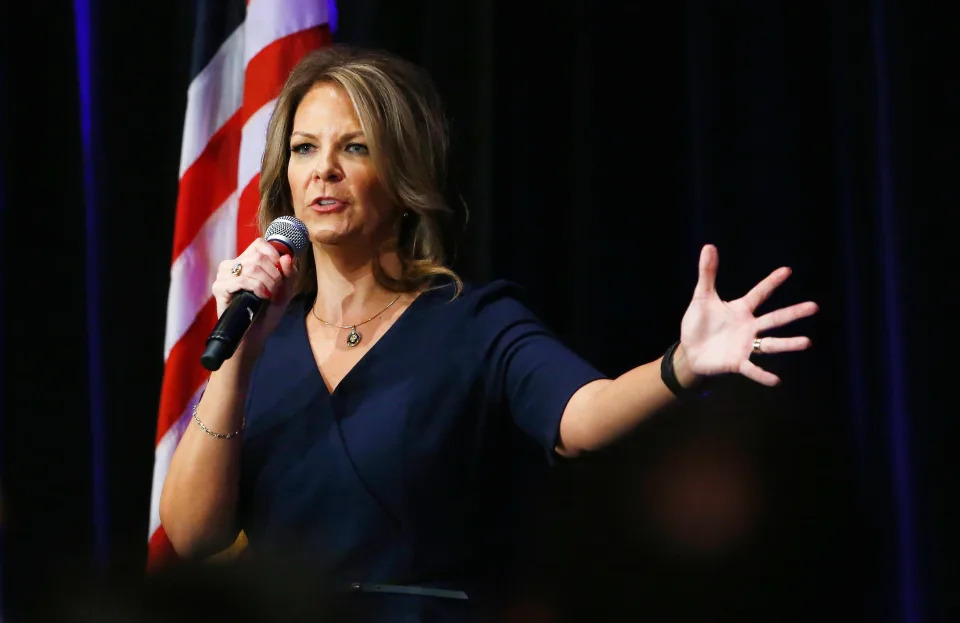
Arizona GOP Chair Kelli Ward, spouse, sue to block Jan. 6 panel from accessing phone records
Chelsey Cox, USA TODAY – February 2, 2022
WASHINGTON — Arizona GOP Chair Kelli Ward and her husband, Michael Ward, filed a suit Tuesday against the Jan. 6 House select committee for subpoenaing the couple’s phone records.
The lawsuit has been assigned to U.S. District Court Judge Susan Brnovich, wife of Arizona Attorney General Mark Brnovich, a Senate candidate and ally of former President Donald Trump.
The phone records were subpoenaed from T-Mobile and the Ward’s company, Mole Medical Services P.C., in January, according to court records. Data were requested from Nov. 1, 2020, through Jan. 31, 2021 – a period that starts on the eve of the 2020 presidential election and ends weeks after the insurrection on the U.S. Capitol.
T-Mobile indicated it would turn over records to the committee by Feb. 4 unless the Wards filed suit.
In the suit, the couple argued the subpoenas violate patient-physician privilege. The Wards are osteopathic doctors who talk to their patients over the phone.
“Disclosing the phone records and metadata from the Phone Number would provide the PHI of an unknown but quantifiable number of individuals seeking medical treatment from the Plaintiffs to the Committee and potentially to the public at large,” an attorney representing the couple wrote. “Therefore, the enforcement of the Subpoena must be enjoined until and unless limitations are put in place to protect the PHI of the Plaintiffs’ patients.”
Kelli Ward was among the most prominent GOP leaders who backed Trump’s claims of election fraud after the 2020 presidential election. She filed a lawsuit seeking to have a judge void President Joe Biden’s 10,457-vote win in Arizona with the Maricopa County Superior Court soon after Election Day, according to The Arizona Republic.
The Wards, who were designated pro-Trump electors had the former president won Arizona, also joined a lawsuit against former Vice President Mike Pence in December 2020 to pressure the former vice president to challenge the election results ahead of Jan. 6, Politico reported.
Adam Kinzinger calls Josh Hawley ‘one of the worst human beings’ and a ‘con artist’ after the senator urges Biden to block Ukraine from joining NATO
Brent D. Griffiths,John Haltiwanger,Bryan Metzger – February 2, 2022
Adam Kinzinger calls Josh Hawley ‘one of the worst human beings’ and a ‘con artist’ after the senator urges Biden to block Ukraine from joining NATO
Adam Kinzinger renewed his criticism of Josh Hawley, this time over how the US should handle the Russian-Ukraine crisis.
“I hate to be so personal, but Hawley is one of the worst human beings,” Kinzinger wrote on Twitter.
Hawley urged Biden to abandon any support for Ukraine joining NATO.
Rep. Adam Kinzinger blasted Sen. Josh Hawley on Wednesday after the senator criticized President Joe Biden for ordering troops to Europe as Russia ramps up its preparations for a potential new invasion of Ukraine, while calling on the White House to block Ukraine from joining the NATO alliance.
“I hate to be so personal, but Hawley is one of the worst human beings, and a self egrandizing [sic] con artist,” Kinzinger wrote on Twitter. “When Trump goes down I certainly hope this evil will be laid [sic] in the open for all to see, and be ashamed of.”
Insider caught up with Hawley on Wednesday and showed him Kinzinger’s tweet, which he was seeing for the first time.
“And what prompts this outburst?” Hawley asked. Informed that Kinzinger seemed to be taking issue with Hawley’s stance on Ukraine’s NATO membership, he laughed. “Weird,” he said.
Responding to Hawley’s comments in a tweet, Kinzinger said, “It is weird. We are in weird times. Like having a Senator more interested in pleasing Tucker and playing to worst instincts than leading. Denying Jan 6th truth despite fomenting it, among other things.”
This isn’t the first time Kinzinger has attacked Hawley. Kinzinger, a member of the House’s January 6 committee and one of the 10 Republicans who voted to impeach Trump for inciting the insurrection, previously torched the senator for bragging about his role in leading the effort to object to the certification of the 2020 presidential election.
Hawley’s position on Ukraine, which was first reported by Axios, mirrors that of Fox News Host Tucker Carlson and other conservative commentators who have questioned whether it’s in America’s interest to firmly align NATO behind Ukraine.
“Such a deployment can only detract from the US military’s ability to ready and modernize forces to deter China in the Indo-Pacific,” Hawley, who is from Missouri and who is widely viewed as a potential presidential candidate, wrote in a letter to Secretary of State Antony Blinken.
Hawley says that US support for Ukraine’s eventual admission into NATO, a policy President George W. Bush’s administration set in motion, is not strong enough “to justify committing the United States to go to war with Russia over Ukraine’s fate.”
“We should urgently deliver to Ukraine assistance it needs to defend itself against Russia’s military buildup and other threats,” Hawley writes.
The US has provided Ukraine with roughly $2.7 billion in security assistance since 2014 — the year that Russia invaded Ukraine and annexed Crimea — including $650 million in the past year. Russia has also supported rebels in a war against Ukrainian forces since 2014.
The Biden administration has warned Russia it will face severe economic sanctions if it invades Ukraine. The Pentagon on Wednesday also announced that Biden formally approved the deployment of US troops to NATO member countries in Eastern Europe to serve as a signal of Washington’s support for the alliance. But Biden has ruled out sending troops into Ukraine to defend it against Russia, given it’s not a NATO member.
GOP Rep Slams Sen. Josh Hawley As ‘One Of The Worst Human Beings’
David Moye – February 2, 2022
Rep. Adam Kinzinger (Ill.) has apparently had enough of Missouri Sen. Josh Hawley ― and doesn’t care who knows what he thinks of his fellow Republican.
Spoiler alert: It’s not very nice.
On Wednesday, Hawley criticized President Joe Biden’s decision to order troops to Europe as Russia increases its military presence on its border with Ukraine. At the same time, the senator asked the White House to drop U.S. support for Ukraine joining NATO, according to The Hill.
Kinzinger wasn’t impressed by Hawley’s suggestion that America not support its ally, especially considering that he serves on the Jan. 6 select committee, while Hawley was seen raising his fist in solidarity towards a crowd of Donald Trump supporters ahead of the U.S. Capitol attack on Jan. 6.
And he didn’t mince words, calling Hawley “one of the worst human beings,” and “a self aggrandizing con artist” in a fiery tweet, adding, ”When Trump goes down I certainly hope this evil will be laid in the open for all to see, and be ashamed of.”
Kinzinger got some support for the tweet, but many conservatives mocked his misspellings and suggested his tweet was actually an endorsement of Hawley.
“And what prompts this outburst?” Hawley asked, before adding, “Weird.”
Kinzinger agreed via Twitter that “we are in weird times,” and said the proof is a Senator like Hawley who seems “more interested in pleasing Tucker [Carlson, of Fox News] and playing to worst instincts than leading. Denying Jan 6th truth despite fomenting it, among other things.”