Ukrainian Forces Are Using Their Home-Turf Knowledge to Stymie Russia, Top U.S. General Says
Helene Cooper – March 3, 2022
Ukrainian soldiers in a tank exercise in the Donetsk Oblast of Ukraine, Feb. 17, 2022. (Tyler Hicks/The New York Times)
STUTTGART, Germany — The Ukrainian military is conducting a hugely effective and “mobile” defense, using its innate knowledge of its home turf to stymie Russian forces on multiple fronts, Gen. Mark Milley, the top military adviser to President Joe Biden, said early Thursday.
Although the strategic city of Kherson fell to Russia on Wednesday, officials said that Ukrainian forces were mounting battles up and down the Russian lines with what they described as a resourcefulness and creativity that could trip up Russian troops for weeks or months to come.
Milley, chair of the Joint Chiefs of Staff, said the tactics employed by Ukrainian troops included using mobile weapons systems to bedevil the Russians wherever they could. Ukraine’s troops, he said, are “fighting with extraordinary skill and courage against Russian forces.”
In standing up to an invading country that dwarfs their own and demonstrating their willingness to die to protect it, “fighting Ukrainian people have become the eyes and ears of the world,” Milley said.
The public comments, made to reporters traveling with him to meet with European officials at NATO, were Milley’s first since President Vladimir Putin of Russia began his brutal efforts to seize Ukraine and topple the democratically elected government of President Volodymyr Zelenskyy.
Milley met with NATO’s secretary-general, Jens Stoltenberg, in Brussels before traveling to Stuttgart to confer with U.S. European Command.
Stoltenberg said the Ukrainian military, which has been backed in recent days with arms shipments from NATO countries, was “performing better and putting up more resistance than most experts expected, and surely more than Russia expected.”
Here Are the Russian Oligarch Super-yachts That Have Been Seized
Jack Holmes – March 3, 2022
Photo credit: NICOLAS TUCAT – Getty Images
For years, many in the West lamented Russia’s system of kleptocratic oligarchy while Western governments happily welcomed in the oligarchs and their gobs of cash. New York City is home to a flock of “ghost buildings,” where elites from Russia—and beyond—have pied-a-terres that are seldom lit up at night because nobody is ever there. Entire neighborhoods in London were oligarched over the years, along with one of the city’s flagship soccer teams, Chelsea, when Roman Abramovich bought the club in 2003. But that all began to change, slowly, in 2014, as Russia engaged in naked aggression towards Ukraine. And now, with Vladimir Putin’s campaign of violent terror against that country, it’s all begun to come apart.
The headline-grabber in the sweeping sanctions regime imposed on Russia’s elite class is the ritual seizing of the yachts. Rich people of every national origin love a big boat, but one could make the case the Russian bigwigs love a boat most of all. And some of these things are, in addition to a gross exhibition of resource-hoarding, fairly impressive feats of engineering and design. So here’s a list of the oligarch superyachts that have changed hands since Putin truly crossed the line.
CNBC reports many oligarchs have begun moving their yachts to the Maldives and elsewhere in an attempt to shield them from European Union sanctions. We’ll update this if any others see new ownership.
Al Raya, Alisher Usmanov
Photo credit: Anadolu Agency – Getty Images
Formerly known as Dilbar, this thing is reportedly 512 feet long and weighs 15,917 tons, making it the world’s largest motor yacht by weight. Forbestells us it usually hosts a crew of 96 people. It has two helipads, a beauty salon, a gym, and 12 suites, along with the largest swimming pool ever put on a boat at 82 feet. A custom job, it reportedly took German shipbuilder Lürssen 52 months to build. Usmanov paid $600 million for it. Forbes reports that German authorities seized the vessel from a shipyard in Hamburg, where it was undergoing some renovations. Tough luck for Usmanov, an Uzbek-born mining magnate who’s held stakes in telecom companies and Facebook. He’s also got extensive real-estate holdings, and was once a major shareholder in London’s Arsenal Football Club, adversary to fellow oligarch Abramovich’s Chelsea.
Amore Vero, (allegedly) Igor Sechin
Photo credit: NICOLAS TUCAT – Getty Images
Reuters reports French authorities are the captain now of this 280-foot vessel, the name of which translates to “True Love” from Italian. The crew was reportedly preparing a hasty departure from La Ciotat, a town near Marseille in the Cote d’Azur, when French customs officers took over management. This one also has a beauty salon and a gym, and France24 reports it hosts a swimming pool that turns into a helipad. The French say that the yacht is owned by a holding company in which Igor Sechin is a the main shareholder. Sechin has been the CEO of Rosneft, the Russian state oil firm, since 2012, and is one of Putin’s closest friends and advisors.
Photos: Ukraine’s civilian forces grow as more enlist in the fight against Russia
Marco Storel – March 4, 2022
Editor’s note: Graphic content
Yevghen Zbormyrsky, 49, runs in front of his burning home after it was shelled in the city of Irpin, Ukraine, outside the country’s capital of Kyiv, on Friday, March 4.Aris Messinis/AFP via Getty Images
The wide-scale incursion began on Thursday, Feb. 24. Ukraine’s military has claimed that Russia has faced steep casualties as a result of fierce fighting; the Russian Defense Ministry acknowledged Wednesday, March 2, that 498 Russian troops had been killed and another 1,597 injured in the “special military operation.”
Oksana is hugged by her son, Dmytro, during a funeral for her husband, Volodymyr Nezhenets, in the city of Kyiv, Ukraine, on Friday, March 4. A small group of reservists buried their comrade after Nezhenets was one of three killed on Saturday, Feb. 26, in an ambush Ukrainian authorities say was caused by Russian “saboteurs.”Emilio Morenatti/AP
Since Russia’s invasion of Ukraine began, an estimated 1 million have fled to neighboring E.U. states, according to the United Nations. Tens of thousands have also enlisted in the military in the week since Russia’s invasion began. Ukraine’s defense ministry reported Thursday, March 3, that they’d get help from roughly 16,000 military volunteers, too.
Russian and Ukrainian leaders held cease-fire negotiations on Monday, Feb. 28, but they ended with no breakthrough to end the fighting. A second round of talks Thursday, March 3, ended with an agreement to hold a third round “very soon.”
The head of Russia’s delegation said the countries had agreed to establish humanitarian corridors for the evacuation of civilians and agreed on the “possibility” of a temporary ceasefire during humanitarian operations.
U.S. officials had said for weeks that a Russian invasion of Ukraine was imminent, a warning that Russia, in turn, dismissed as scaremongering. U.S. President Joe Biden warned of a “catastrophic loss of life and human suffering.”Sponsor Message
The U.S. has joined international partners in levying heavy new sanctions against Russia’s military and economy in the days since the invasion began. President Biden has said that Russian President Vladimir Putin and his country would bear the costs of the attack.
A bus is riddled with holes from a machine gun after an ambush in Kyiv, Ukraine, on Friday, March 4. Emilio Morenatti/AP
Ukrainian artillerymen keep position in the Luhansk region on Wednesday, March 2. Anatolii Stepanov/AFP via Getty Images
Ukrainian President Volodymyr Zelensky gestures as he speaks during a press conference in Kyiv on March 3, 2022. Ukraine President Volodymyr Zelensky called on the West on March 3, 2022, to increase military aid to Ukraine, saying Russia would advance on the rest of Europe otherwise. “If you do not have the power to close the skies, then give me planes!” Zelensky said at a press conference. Sergei Supinsky/AFP via Getty Images
A child learns how to use an AK-47 assault rifle during a self-defense course for civilians in the outskirts of Lviv, in western Ukraine, on Friday, March 4. Daniel Leal/AFP via Getty Images
People remove personal belongings from a burning house after being shelled in the city of Irpin, Ukraine, outside the country’s capital of Kyiv, on Friday, March 4. Aris Messinis/AFP via Getty Images
Women and children try to get onto a train bound for Lviv, Ukraine, at Kyiv’s train station Thursday, March 3. Ukrainian men have been conscripted to fight in the war while hundreds of thousands of women and children flee the country to seek refuge in neighboring nations that are members of the EU. Emilio Morenatti/AP
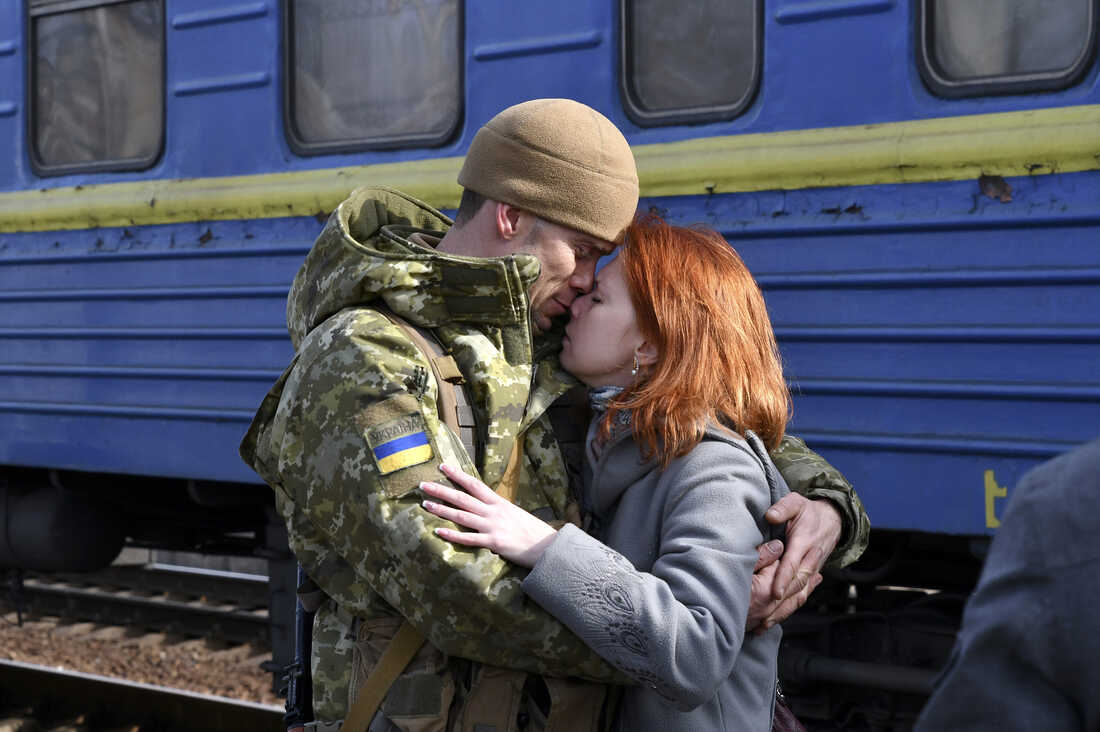
Stanislav, 40, says goodbye to his son, David, 2, and his wife, Anna, 35, on a train to Lviv, Ukraine, at Kyiv’s train station Thursday, March 3. Stanislav was staying to fight while his family was leaving the country to seek refuge in a neighboring country. Emilio Morenatti/AP
A newborn baby is seen in the bomb shelter of a maternity hospital Tuesday, March 2, in Kyiv, Ukraine. Chris McGrath/Getty Images
A woman sits in a tent as people take shelter in a subway station turned into a bomb shelter Wednesday, March 2, in Kyiv, Ukraine. Chris McGrath/Getty Images
Members of a territorial defense unit prepare to deploy to various parts of the city on Tuesday, March 2, in Kyiv, Ukraine. Chris McGrath/Getty Images
A Ukrainian serviceman walks past as fire and smoke rises over a damaged logistics center after being shelled Thursday, March 3, in Kyiv, Ukraine. Efrem Lukatsky/AP
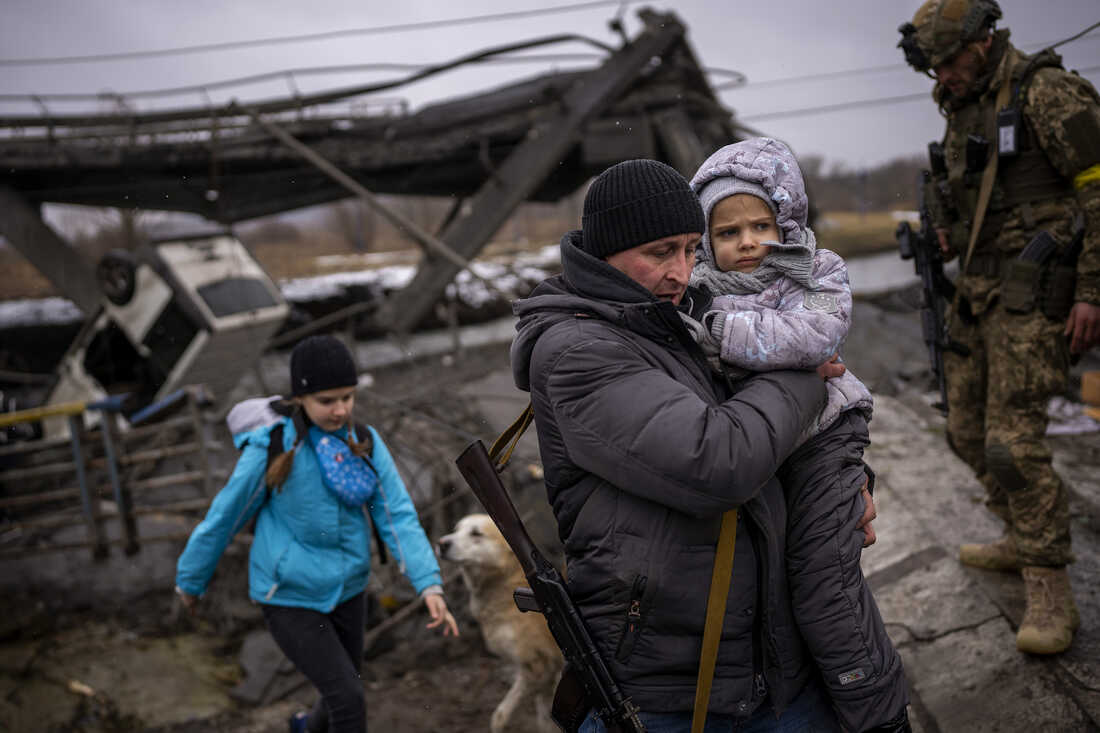
Local militiaman Valery, 37, carries a child as he helps a fleeing family across a bridge destroyed by artillery on the outskirts Kyiv, Ukraine, on Wednesday, March 2. Emilio Morenatti/AP
A boy uses a tablet sitting in a metro car at an underground station being used as bomb shelter in Kyiv, Ukraine, on Wednesday, March 2. On the seventh day of fighting in Ukraine, Russia claimed to control the southern port city of Kherson, street battles raged in Ukraine’s second-largest city, Kharkiv, and Kyiv braced for an expected assault by a nearby convoy of Russian forces. Genya Savilov/AFP via Getty Images
A woman cries as she leaves a house damaged by a Russian airstrike, according to locals, in Gorenka, Ukraine, just outside the country’s capital of Kyiv on Wednesday, March 2. Vadim Ghirda/AP
A group of women and a boy walk to the train station as they try to leave Kyiv, Ukraine, on Wednesday, March 2. Emilio Morenatti/AP
A blast is seen engulfing a TV tower in Kyiv, Ukraine, amid Russia’s continuing invasion Tuesday, March 1. Carlos Barria/Reuters
An armed man stands by the remains of a Russian military vehicle in Bucha, Ukraine, close to the nation’s capital of Kyiv, on Tuesday, March 1. Serhii Nuzhnenko/AP
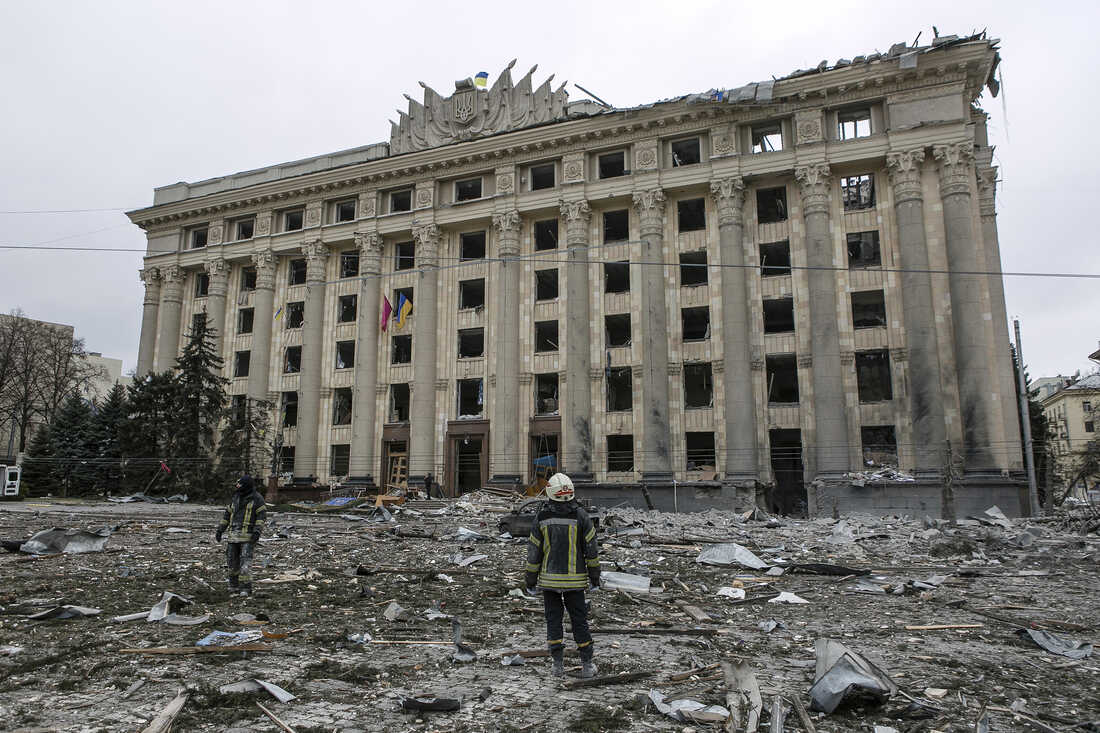
A member of the Ukrainian Emergency Service surveys damage to Kharkiv’s City Hall in the city’s central square following shelling Tuesday, March 1. Russian strikes pounded the square in the country’s second-largest city — in addition to other civilian sites Tuesday — in what the country’s president condemned as a blatant campaign of terror by Moscow. Pavel Dorogoy/AP
Members of a Ukrainian civil defense unit pass new assault rifles to the opposite side of a blown up bridge on Kyiv’s northern front on Tuesday, March 1. Satellite photos showed a Russian convoy stretching for about 40 miles and advancing slowly toward the capital Tuesday. Aris Messinis/AFP via Getty Images
A girl draws at a table set up in the bomb shelter at the Okhmadet Children’s Hospital in Kyiv, on Tuesday, March 1. Chris McGrath/Getty Images
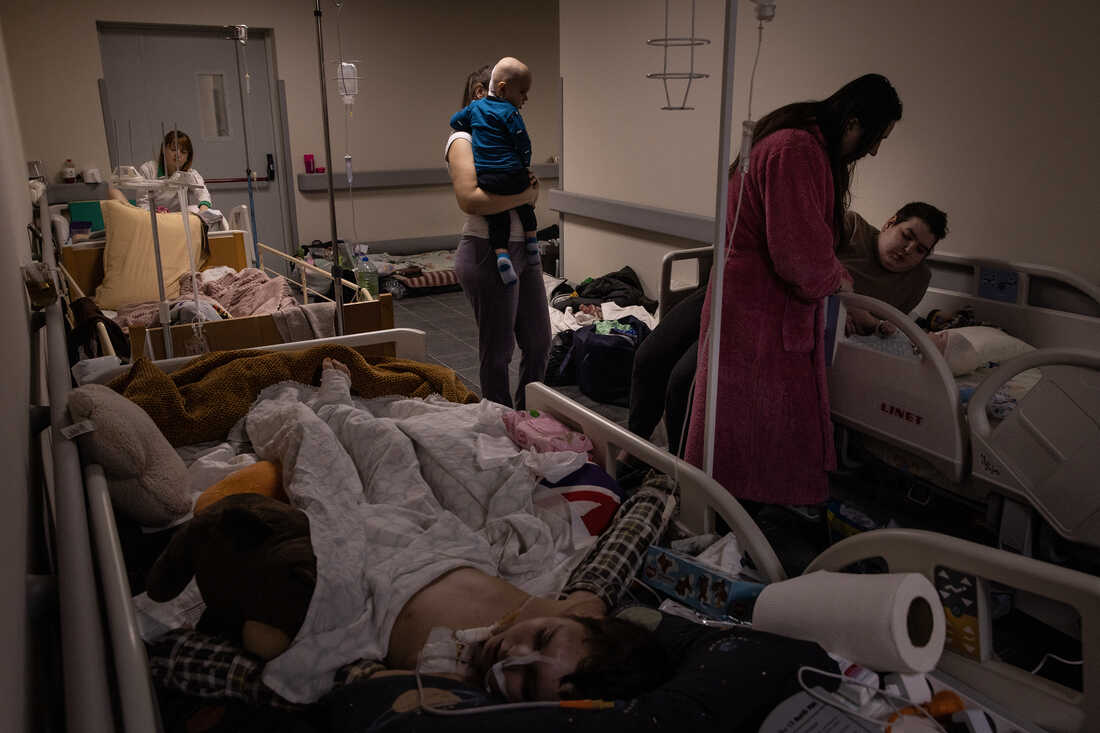
Mothers tend to their children undergoing cancer treatments on Saturday, Feb. 28, in the bomb shelter of the oncology ward at Okhmatdyt Children’s Hospital in Kyiv, Ukraine. Chris McGrath/Getty Images
German citizen Boris carries his baby Josephine to a train evacuating residents to western regions of Ukraine on Monday, Feb. 28, in Kyiv, Ukraine. Josephine was born two days ago from a Ukrainian surogate mother in Kyiv. Boris and his wife, Margarete, said they were registered on the German embassy’s evacuation list. Pierre Crom/Getty Images
Ukrainian volunteers sort donated clothes for later distribution to the local population in Lviv, western Ukraine, on Wednesday, March 2. Bernat Armangue/AP
A man looks at the gutted remains of Russian military vehicles on a road in the town of Bucha, close to the capital Kyiv, Ukraine, Tuesday, March 1, 2022. Serhii Nuzhnenko/AP
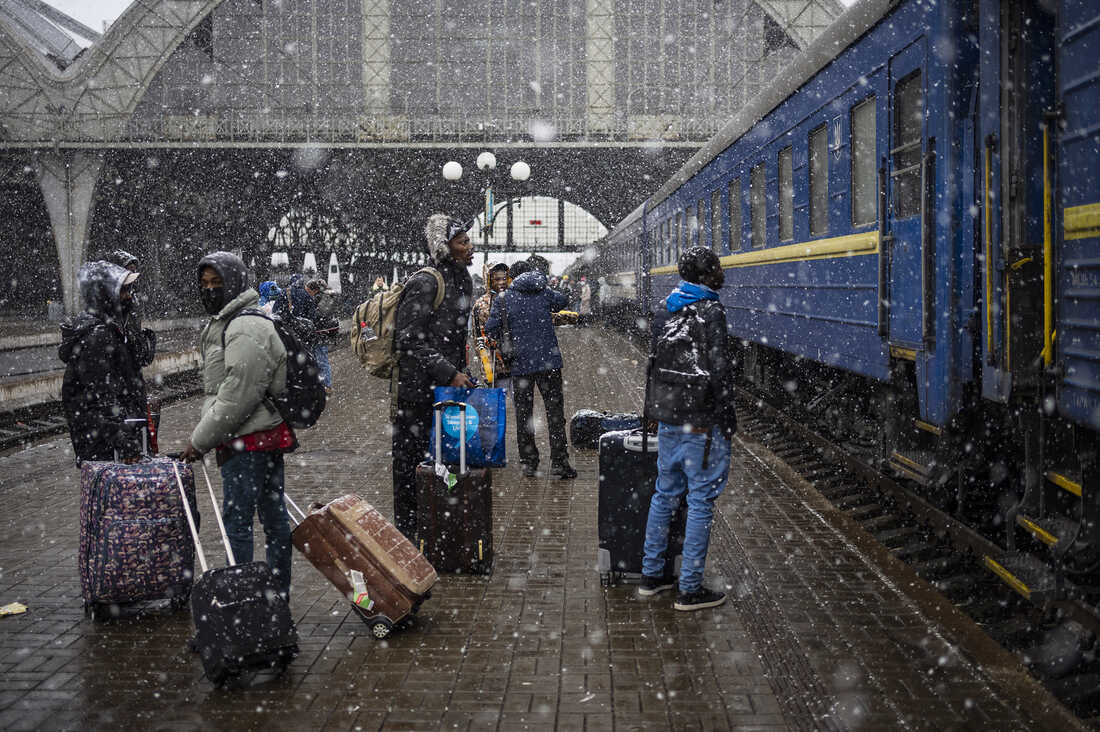
Nigerian students in Ukraine wait at the platform in Lviv’s railway station on Sunday, Feb. 27. Thousands of people massed at Lviv’s main train station on Sunday, attempting to board trains to leave Ukraine. Bernat Armangue/AP
A couple embraces before the woman boards a train leaving for western Ukraine, at the railway station in Kramatorsk, eastern Ukraine, on Sunday. The U.N. refugee agency says nearly 120,000 people have so far fled Ukraine into neighboring countries in the wake of the Russian invasion. Andriy Andriyenko/AP
Transfer three A-10 aircraft squadrons to Ukraine now
Everett Pyatt – March 3, 2022
Tech. Sgt. Gregory Brook
“Give us the tools, and we will finish the job,“ spoke U.K. Prime Minister Winston Churchill in February 1941. Following this powerful speech, U.S. President Franklin Roosevelt proposed and Congress approved the lend-lease program. This provided the U.K. equipment and access to United States production capacity. This action was essential to stopping the Nazi advances.
Congress is acting in a supportive manner, but details are important. Russia must face a military defeat to enforce sanctions. The history of sanctions supports the conclusion that they do not change policy, but rather make conduct of business far more difficult while imposing distress on the economy as shown in Iraq, Iran, North Korea and others.
Sanctions must be accompanied by military success.
Zelenskyy has requested weapons and support in line with Churchill’s philosophy. Ukrainian soldiers have proved their courage and bravery. There is one more step that could be decisive: the transfer of three squadrons of A-10 aircraft to the Ukrainian Air Force.
This aircraft and its gun system were designed to counter an armored assault in Europe. They proved effective in Desert Storm’s target-rich environment, quite similar to the current advancing Russian force. They also became the infantry’s friend in close-air support missions.
The United States Air Force has deployment packages ready to go. The whole transfer to the Ukrainian Air Force could be completed in days after congressional authorization.
Firepower is needed to defeat the coming onslaught of armored forces. Other weapons are necessary for ground forces, but air power will be decisive. The A-10 has proven this ability and was designed for this purpose.
Zelenskyy asked NATO for air support. This request was declined by NATO. That is an appropriate decision since Russia has not attacked NATO.
However, that decision leaves each country an opportunity to decide based on its own moral compass. Many, including the United States, have decided to provide and have already supplied lethal aid necessary to slow the Russian advance. Some effects are notable, but military analysts agree that the long-term outlook for Ukraine’s survival is not good. One predicts a continuing resistance war for decades.
Zelenskyy is right in requesting air power support. It is necessary to slow or stop the oncoming juggernaut of Russian armored forces. The United States has the most effective weapon for this role — the U.S. Air Force’s A-10 aircraft. It is available since the service wants to retire most of the 30-year-old fleet. The airplane was designed to operate in Europe from ill-prepared facilities. Pilot retraining is minimal. All that is needed is painting Ukrainian insignia and delivering the aircraft. This could be done in days.
Each day is critical to slowing the momentum of Russia’s invading force. It is time to implement the United States’ moral compass and add the A-10 to the list of weapons already scheduled. Failure to add defensive capability to current Ukraine forces, while sanctions develop, weakens the potential impact of sanctions. They are complementary actions.
Everett Pyatt is a former assistant secretary of the U.S. Navy for shipbuilding and logistics.
Russian troops are struggling without food and fuel, a Ukrainian colonel told The Wall Street Journal.
It comes as the US and UK say the 40-mile-long Russian military convoy bearing down on Kyiv is stalled.
UK intelligence said it was “delayed by staunch Ukrainian resistance, mechanical breakdown and congestion.”
The 40-mile-long Russian military convoy bearing down on Ukraine’s capital city appears to have been stalled for days, and a Ukrainian colonel said Russian troops were running low on supplies and morale.
The Ukrainian colonel told The Wall Street Journal: “The Russians thought they could break through and be in Kyiv in a couple of days. They didn’t realize that we have learned how to wage war in the past eight years.”
“Now they sit there, hungry, without fuel, demoralized, and we just come in every little while and pop them off. And every day, we are pushing them back.”
The remarks come as the US and UK said the military convoy, which was spotted in Sunday satellite images apparently approaching Kyiv, had made little progress.
The UK Ministry of Defence said on Thursday the convoy was about 30 kilometers (19 miles) from Kyiv’s center and struggling with issues including resistance from Ukrainians. Since last week’s invasion, ordinary Ukrainians have been taking up arms to fend off Russian forces.
“The main body of the large Russian column advancing on Kyiv remains over 30km from the centre of the city having been delayed by staunch Ukrainian resistance, mechanical breakdown and congestion. The column has made little discernible progress in over three days,” it said.
A senior US defense official also told reporters on Wednesday: “We believe that the convoy is stalled.”
NPR reported that the convoy includes tanks, armored vehicles, artillery and supplies.
Civilians participate in a Kyiv Territorial Defence unit training session on January 29, 2022.Photo by Chris McGrath/Getty Images
A senior US defense official told reporters on Tuesday that some of the Russian forces in Ukraine were “literally out of gas” and are “having problems feeding their troops,” Insider’s Abbie Shull reported.
It is not clear if the official was talking about the convoy near Kyiv, or other Russian operations in Ukraine.
The official said that Russians “face greater resistance than they thought, that they have experienced fuel and logistics challenges.”
But the official warned that Russia may have decided to pause its operations as “they are possibly regrouping, rethinking, reevaluating.”
Volunteers cross Polish border into Ukraine to fight Russian forces
Markus Schreiber, Konstantin Shukhnov, Corky Siemaszko – March 3, 2022
Markus SchreiberImage: (Sean Gallup / Getty Images)Sean GallupImage: (Visar Kryeziu / AP)Visar KryeziuImage: Women and children fleeing war in Ukraine cross the border into Poland at Medyka on March 3, 2022. (Sean Gallup / Getty Images)Sean GallupImage: A father hugs his daughter as the family reunite after fleeing conflict in Ukraine, at the Medyka border crossing, in Poland on Feb. 27, 2022. (Visar Kryeziu / AP)Visar Kryeziu
MEDYKA, POLAND — While busloads of Ukrainian refugees streamed across the border Thursday into Poland, small groups of determined-looking men were heading in the opposite direction to fight the Russians.
Most appeared to be Ukrainian émigrés in their 20s and 30s, but some could also be heard speaking other languages. Many of the men had black tactical boots hanging from their duffle bags.
And judging by the license plates of the cars dropping them off at the crossing in this Polish border town, they had come from as far away as Italy and Germany.
Among those heading east into Ukraine was a man with a military bearing from Great Britain who identified himself only as Ian and said he was 62.
“I’m going to fight,” Ian told NBC News correspondent Jay Gray.
Image: (Sean Gallup / Getty Images)
Then Ian walked up to the Ukrainian border guards, who looked him over, checked his papers and sent him to the left to join the other hard-eyed men waiting for a bus bound for the battle against the Russians.
Ian and the others were answering the call that embattled Ukrainian President Volodymyr Zelenskyy posted on his website Sunday for “friends of peace and democracy” to join their new brigade, the International Legion of Territorial Defense of Ukraine, and help them fight the Russians.
“This is the beginning of a war against Europe, against European structures, against democracy, against basic human rights, against a global order of law, rules and peaceful coexistence,” his statement said.
Zelenskyy said Thursday that some 16,000 foreigners have already joined the brigade, a number NBC News could not immediately confirm.
The Ukrainian leader’s appeal harkened back to the 1930s when the embattled Spanish government called for international volunteers to help fight in the civil war against Gen. Francisco Franco and the fascists, a struggle Ernest Hemingway immortalized in “For Whom the Bell Tolls.”
In France, the Ukrainian Embassy has been actively recruiting former soldiers to join the fight, and it set up a Facebook page with information and paperwork they would need to fill out, The New York Times reported.
More than 1 million Ukrainians, mostly women and children, have fled in the eight days since the Russians invaded their country, and the pace at which civilians have been crossing the border into Poland has been accelerating as the fighting has grown fiercer.
Image: (Visar Kryeziu / AP)
An army of Polish volunteers backed by relief workers from other countries has set up refugee aid centers in nearby cities, like Przemysl, an ancient city of some 61,000 people.
From there, Ukrainian refugees have been bused to major Polish cities like Warsaw, Krakow and Gdansk, as well as to Germany, Austria and even Denmark.
Image: Women and children fleeing war in Ukraine cross the border into Poland at Medyka on March 3, 2022. (Sean Gallup / Getty Images)
In recent days, the border crossing at Medyka has been the scene of emotional reunions as émigré Ukrainians reunited with loved ones who had traveled for days to get there.
There have been outbursts of anger from Ukrainians frustrated by the bureaucracy on both sides of the border. And there have been allegations of racism lodged by Africans and Asians who had been living in Ukraine and who say their escape was delayed by Ukrainian border guards.
But on Thursday, the evacuation appeared to be going smoothly.
Image: A father hugs his daughter as the family reunite after fleeing conflict in Ukraine, at the Medyka border crossing, in Poland on Feb. 27, 2022. (Visar Kryeziu / AP)
Rather than marching across the border, most of the escapees boarded buses provided by Poland’s national fire department on the Ukrainian side.
Waiting on the Polish side was a couple who gave their names as Jim and Alyona and said they had driven to Medyka from Belgium.
Alyona, who’s Ukrainian, was waiting to collect her sister, who had been traveling by train for several days from the city of Dnipro.
Visibly distraught, Alyona said she had heard from her sister, who was still at least three to five hours away from Medyka.
“I will wait here all night if I have to,” Alyona said.
Konstantin Shukhnov reported from Medyka, Poland, and Corky Siemaszko from New York City.
Fearing martial law or conscription, some Russians try to flee abroad
March 3, 2022
MOSCOW (Reuters) – As Russian troops slowly advanced on Ukraine’s capital Kyiv on Thursday, some people back in Moscow were attempting to flee to destinations abroad that have not banned flights from Russia, stomaching soaring prices in the rush to escape.
The Kremlin dismissed speculation that Russian authorities plan to introduce martial law following the invasion of Ukraine, which Moscow calls a “special operation”, or that they will stop men of fighting age leaving Russia, but some did not want to risk staying.
One Russian man, who moved back to Moscow from western Europe around a year ago, said he had bought a flight to Istanbul for the weekend, adding that living in Moscow may no longer be possible.
“I’m afraid that mobilisation will be introduced tomorrow and I won’t be able to fly out,” said the 29-year-old, requesting anonymity like others cited in this article.
Related video: Ukraine invites Russian moms to collect captured sons
Hennadiy Maksak, executive director of “Ukrainian Prism,” discusses the information war Ukraine is fighting against Russia, and explains their effort to reach the relatives of Russian soldiers who have been captured by Ukrainian forces.
“In my worst nightmares I couldn’t have dreamt of such hell when I was coming back a year ago.”
Another man, aged 38, said he had managed to buy an expensive ticket to fly to the Middle East at the weekend.
“I don’t want to fight in this war. We’ve heard lots of rumours and I don’t trust the Kremlin when it says they aren’t true,” he said.
Russia’s invasion of Ukraine entered its second week on Thursday with Ukrainian cities surrounded and under bombardment. Hundreds of Russian soldiers and Ukrainian civilians have been killed and Russia has been plunged into an isolation never before experienced by an economy of such size.
FEARING ARREST
The cost of plane tickets has leapt since Russia closed its airspace to airlines from the European Union and many other countries in a tit-for-tat response to sanctions imposed by the West, severely limiting Russians’ ability to travel.
The unprecedented Western sanctions on Moscow have already sent prices rising and started hitting the lives of ordinary Russians, while those who protest have been swiftly arrested.
Some 7,669 people have been detained at anti-war protests since the invasion began on Feb. 24, according to the OVD-Info protest-monitoring group.
After giving her cat to her family to look after, a 29-year-old woman flew to Israel on Sunday before prices rose even further, worried that things in Moscow can only get worse.
“I am ashamed that I haven’t stayed in Russia, that I am not fighting to the end, not protesting in the streets,” she said.
“But if you go out against the war, they arrest you, and there is this law on state treason.”
Russia’s state prosecutor’s office on Feb. 27 issued a reminder that anyone providing financial or other assistance to a foreign state or international organisation aimed against Russia’s security could be convicted of treason and face a maximum sentence of 20 years.
VISA PROBLEMS
Others faced bureaucratic hurdles. Russians require visas to enter most European countries, and a modest queue had formed at the Italian visa application centre in Moscow, which was still accepting requests by appointment only, with the nearest available slots over a week away.
“I will make an appointment for March 11, although what may happen in the near future is scary and uncertain,” said one 40-year-old Russian woman.
“I want to have a visa ready. I think they will let me in with a PCR test (against COVID) and then I’ll sort something out,” she added.
Russia’s Sputnik V vaccine has not been approved by the EU, meaning many Russians without a shot recognised in the West may be denied entry on health grounds.
It was not just Russians trying to flee. A Filipino woman who works as a nanny in Moscow was also applying for a visa.
“I desperately want to get a visa, I’m scared here,” she said.
(Reporting by Reuters in Moscow; Editing by Gareth Jones)
Russia’s financial “fortress” falters under the West’s sanctions
Kate Marino – March 3, 2022
Re-created from the Atlantic Council’s GeoEconomics Center; Chart: Axios Visuals; Does not include gold held domestically. *This value also encompasses smaller financial institutions. The status of these reserves is unclear.
Russia spent seven years building a financial “fortress” that could help it withstand the impact of sanctions imposed by the West — and the keystone was $630 billion in central bank foreign exchange reserves.
Driving the news: Presumably, Russia didn’t expect the G7 nations to go so far as to freeze those reserves, which they did this week — a move nearly unprecedented in scope.
Why it matters: That fortress isn’t so strong after all if Russia can’t use its billions to support its war efforts and fund domestic spending.
The G7 has locked up nearly $400 billion of that money, according to estimates by the Atlantic Council’s GeoEconomics Center.
Backstory: Since March 2014, Russia has cut its foreign assets held in the U.S. and Europe, while increasing those in China and Japan, as well as its domestic gold holdings, the FT reports.
The big question: How will China handle Russia’s yuan assets? China’s not expected to freeze them — but faces a dilemma in how to aid its strategic partner, Russia, without running afoul of Western sanctions, Bloomberg writes.
‘Hedgehogs’ v tanks, as Kyiv braces for Russian onslaught
Aleksandar Vasovic – March 3, 2022
Russia’s invasion of Ukraine continues in Kyiv
KYIV (Reuters) – As Russian troops closed in on Ukraine’s capital Kyiv on Thursday, a muddy construction site in a local neighborhood was teeming with workers and welders of the KAN real estate developer.
Instead of homes and offices, they were making giant, metal anti-tank barricades known as “hedgehogs”, and smaller spiked barriers aimed at stopping wheeled vehicles.
After Russia invaded Ukraine on Feb 24, KAN, a large local property company, reinvented itself to help the defenses of the city of 3.4 million people.
Zakhar, a foreman, picked up the phone and started calling the company’s construction workers who had remained in Kyiv. Almost everyone volunteered to stay and contribute, he said.
“We build things. We do not know how to fight, but we knew we could be useful,” Zakhar said. A few metres away sparks flew as builders cut through and welded together large metal beams.
It is another example of how Ukrainian civilians are supporting regular troops as they try to repel Russia’s advance, including through civil defence units and independent militia that have formed across the country.
Russia says its actions in Ukraine are a “special operation” not designed to occupy territory but to destroy its neighbour’s military capabilities and capture what it calls dangerous nationalists.
Ukraine’s military is dwarfed by that of its powerful neighbour, but resistance in the first week of the conflict has slowed Russia’s progress, particularly in urban areas.
Russia has captured one Ukrainian city so far – the southern Dnipro River port of Kherson – and has bombarded others with increasing intensity, including Kyiv and the country’s second city Kharkiv.
A giant column of Russian armour has stalled as it approaches Kyiv from the north, delayed by resistance, mechanical failures and congestion, according to the British defence ministry.
Hundreds of thousands of people have fled the violence and crossed into neighbouring countries. Men of fighting age are prevented from leaving Ukraine.
‘WE WILL THROW SPEARS’
On Feb. 25, Kyiv’s mayor and boxing champion, Vitali Klitschko, said the city “has gone into the defensive phase.”
Heavy equipment was brought in to build concrete checkpoints, blocking positions and bunkers inside the city and along all major roads and in the suburbs.
At KAN, workers cut long pieces of girder using blow torches and angle grinders, welding them together into triangular barriers used to bolster fortifications and slow the movement of tanks and tracked armoured personnel carriers.
Oleksandr Bodyuk, the company’s deputy director, said workers were also using reinforcing bars and girders salvaged from construction sites to produce spiked, movable defences against wheeled vehicles, including trucks.
So far the makeshift factory, which started operating this week, has produced 110 large hedgehogs, including 40 in the fist 12 hours, Bodyuk said, adding that the company runs other similar sites in the city.
“We have demands from many places for these types of blocking devices, we deliver them wherever they are needed in the area … subcontractors and friends are providing transportation for the products and the material,” he said.
Andriy Kryschenko, Kyiv’s deputy mayor who was wearing military fatigues, said many similar firms and workshops had adapted to produce hedgehogs, concrete barriers and other defences.
He added that tens of thousands of people in Kyiv had received weapons and many more were waiting at enlistment and recruitment offices. The city hall was also supporting Territorial Defence units and troops at the frontline, Kryschenko said.
At the construction site, Serhiy Serdyuk, a grizzled welder in his 50s, said workers were ready to take up weapons and join the fight.
“If we have to, when the materials run out, we will make spears and we will throw those spears at them.”
(Reporting by Aleksandar Vasovic; Editing by Mike Collett-White)
Democrat wants Biden to defy Putin by staging a Berlin-like airlift to save Kyiv
Michael Isikoff and Daniel Klaidman – March 4, 2022
WASHINGTON — The United States should start planning for a Berlin airlift-style operation to save the people of Kyiv from Russian encirclement and start considering the deployment of NATO troops to western Ukraine, said Rep. Tom Malinowski, D-N.J., a member of the House Foreign Affairs Committee and a former assistant secretary of state for human rights under former President Barack Obama.
“We are going to have to face some tough choices in the coming weeks,” Malinowski said in an interview on the Yahoo News “Skullduggery” podcast. “We need to be bold. It’s a new world.” Malinowski acknowledged that such actions would be “very, very risky,” especially the introduction of NATO troops — a move that could lead to a direct confrontation with the Russian military. And yet, Malinowski said, the alternative might well be Russian troops on the border of Poland, Romania and Hungary as well as “the complete elimination of the Ukrainian state.”
What follows is an edited transcript of Malinowski’s conversation with “Skullduggery” hosts Michael Isikoff and Daniel Klaidman.
Michael Isikoff: So we have all been watching in horror the savagery of the Russian attack on Ukraine. The question at this juncture — after the bombing of the nuclear reactor, the use of cluster bombs targeting civilians — are we doing enough to stop Vladimir Putin?
Tom Malinowski: I don’t know if he can be stopped. I know that he can be made to lose, I know that we can ensure that, as terrible as this is, he and his regime and what he stands for come out of this defeated and that the United States and our allies come out stronger and more united. I had a list for the Biden administration of a whole bunch of things I wanted them to do two weeks ago, one week ago. They’ve done most of those things. … But we are also going to have to face some tough choices in the coming weeks. There are some decisions we haven’t made yet that Putin might force us to make as this gets worse and worse.
Daniel Klaidman: So what are some of those tough choices?
Malinowski: Imagine Kyiv is totally surrounded in the coming days and weeks. Right now, we’re getting supplies in and out, food, ammunition, everything else. But if it’s completely blockaded, do we launch something like the [1948] Berlin airlift, where American military aircraft are flying in supplies to the people who are defending that city? It would be consistent with Biden’s policy. It wouldn’t be shooting at the Russians, it would be daring them to shoot at us, though, and of course it would be very, very risky.
Klaidman: Why wouldn’t they shoot at us under those circumstances, if they have Kyiv surrounded and they’re trying to cut off supplies going into the city and we start flying them in?
Malinowski: They didn’t shoot at us when we were flying stuff into Berlin because that would have been starting the war. … The rules of the road between the United States and Russia set during the Cold War are that we can fight each other with proxies but we don’t fight each other directly because that would trigger potentially a catastrophic, potentially nuclear war. … I think we need to be bold. If you look at the history of the Berlin airlift, it was successful in a practical sense. It got food to people in Berlin who needed it, but it was also a huge moral and psychological victory for the United States in the Cold War.
Klaidman: Do you know if the Biden administration is actively considering that?
Malinowski: I think they’re aware that we may face this kind of circumstance. I raised it in a hearing at the Foreign Affairs Committee a couple days ago with Deputy Secretary of State Wendy Sherman. … We need to be bold. It’s a new world.
Rep. Tom Malinowski, D-N.J,, at a Foreign Affairs Committee hearing in September 2020. (Stefani Reynolds/Pool via Reuters)
Isikoff: Is Putin a rational actor at this point?
Malinowski: If you’d asked me a few years ago, maybe even a few months ago, I would have said that the man is evil, but rational. Ruthless, but not disconnected from reality. I’m having second thoughts about that [laughs] right now because he seems to have deceived himself about what Ukraine has become over the last 10 years, how united the people of Ukraine are in believing in their own national identity and independence and European path, how even the Russian speaking population of Ukraine hates the idea of this Russian aggression and, of course, how fiercely Ukrainians would resist a Russian invasion. He seems to have believed his propaganda in this case, with disastrous consequences for himself and for his country.
Isikoff: So if he’s not a rational actor, how does that change the calculus about what we do?
Malinowski: He certainly wants us to believe right now that he’s capable of anything and he wants us, with that possibility in mind, to hesitate in taking certain steps to protect Ukraine. And I think it would be irresponsible for us not to take into account the possibility that he might do incredibly dangerous things. And yet, at the same time, I don’t think he starts a nuclear war over humanitarian aid deliveries or even deliveries of ammunition.
Klaidman: You said that this is a new world. For Americans who may say, “Well, this is happening half a world away from me, it doesn’t really affect my life,” what would you tell them?
Malinowski: When Hitler seized part of Czechoslovakia in 1938, it was a small country half a world away, it didn’t affect any of our lives, but I think we understand today that it opened a Pandora’s box — that once you establish that big countries can swallow up small countries, that aggressive dictatorships can change borders with tanks, then all hell breaks loose in the world. Every single border in the world is artificial. And once borders are up for grabs, once borders can be erased by whoever has the power to do it, we’re back in the world that led to the Second World War.
Russian President Vladimir Putin in Moscow on Wednesday. (Mikhail Klimentyev/Sputnik/Kremlin via Reuters
Isikoff: You were recently in Ukraine, shortly before the invasion, and you met with President Zelensky. As you have watched events unfold over the last 10 days, have you been surprised by the way the Russians have gone in and the strength of the Ukrainian resistance led by Zelensky?
Malinowski: I’m impressed. I’m inspired. I’m not surprised. Every Ukrainian I spoke to when we were in Kyiv a month ago said they would fight and it didn’t seem like false bravado to me. It felt very real. They are motivated. They’re protecting their homes. They’re protecting their freedom. They’re protecting their families. I’m not surprised that the Russians are disorganized and demoralized. When Putin lies to his generals, his generals have to lie to their officers and the officers have to lie to their frontline troops. No one was in a position to tell those Russian soldiers that they were going to a foreign country that would resist them and fight for every single inch.
Isikoff: Is that just really bad intelligence by the Russians to not know the ferocity of the resistance they would face or they were just afraid to tell the truth to Vladimir Putin?
Malinowski: It’s just a lie. It’s what happens when you have a government that is based on lies. There’s no process in the Kremlin where the dictator gets intelligence briefings from people who tell him what he doesn’t want to hear. This is a one-man dictatorship. And, by the way, Russia’s not had a one-man dictatorship since Stalin.
Klaidman: How concerned were you about the attack on the nuclear plant?
Malinowski: It seems to me they could have destroyed it fairly easily with an artillery barrage. So maybe it was a deliberate attempt to terrorize us and the Ukrainians by getting close to the plant.
Isikoff: If Putin is in fact as you say the most powerful dictator in Russia since Stalin, it does raise the question, can he be deposed?
Malinowski: Putin’s behavior is driven by the knowledge that he can be deposed. This is why he fears Ukraine because Ukraine is the country closest to Russia in history and culture and geography where the people did depose a corrupt and authoritarian leader. He hates the example that the Ukrainians set for the Russian people. This is why he wants to crush the place. So he’s paranoid about it. But it is incredibly hard.
Klaidman: If Russia succeeds in taking over the country, then the war against a sovereign nation might be over. But an insurgency will just be starting. What role should the U.S. play in that effort? Should we be training insurgents on the ground in Ukraine or is that too dangerous for us?
Malinowski: So two things here. No. 1, the Russians may be able to, probably will be able to defeat the Ukrainian army in the cities that they’re attacking, but there’s no way that they can hold and govern these places. They may have had the fantasy of installing a puppet government in Kyiv, but who the heck is gonna follow that government? Who — civil servants aren’t going to go into their offices. There’s no police or military force in Ukraine that can enforce the orders of such a government. So that means the Russians will have to stay in force, and if they stay in force, they will be targets because they’re hated overwhelmingly by pretty much everybody there.
Now, what do we do about it? One of the big question marks right now is what happens to western Ukraine. The assumption of the Western policymakers was that at the beginning of this was that the worst-case scenario was Putin takes Kyiv and Kharkiv and southern Ukraine, but that he was not going to even try to go as far as Western Ukraine, the city of Lviv [near] the Polish border. Because this is the most Western-oriented, nationalistic, non-Russian-speaking part of the country. I think all bets are off right now. I think he, Putin, right now wants to take the whole damn thing. … And if he is planning to go for it, I think it does raise more serious questions about a Western military intervention. A no-fly zone would require the United States to shoot at Russians from the get-go. But would we consider, for example, preemptively with NATO allies putting a force in western Ukraine, drawing a line and saying, “You’re not crossing that line. We’re gonna have a divided Ukraine like East and West Germany, North and South Korea during the Cold War.”
Journalists visit the site of a rocket attack launched by Russian invaders that hit the Vasylkiv Professional College in northern Ukraine. (Ukrinform/Future Publishing via Getty Images)
Isikoff: Are you urging such a course right now?
Malinowski: I think it’s something we have to be thinking about.
Isikoff: To put in U.S. military troops on the ground in western Ukraine to deter the Russians?
Malinowski: I think we do need to at least think through the potential risks and benefits of having a NATO force, not necessarily U.S. troops, but obviously it would have to be guaranteed if we did this by U.S. air power in that portion of Ukraine.
Klaidman: So that’s an area where the Russians currently are not present at all, so there would be no risk of a shooting war?
Malinowski: Imagine they do take Kyiv and even Odessa. They’re going to be battered. They’re not going to be in much of a position to take on a Western military or any military after that. All they will have is the nuclear option. And of course that’s the scary part. Would they initiate such a war under those circumstances is the question that policy makers would have to ask.
Isikoff: That seems like a pretty big risk to take if we’re talking about whether the Russians might initiate a nuclear war.
Malinowski: It is perhaps a very big risk. On the other hand, the alternative might be the Russian army on the Polish border, on the Romanian border, on the Hungarian border, the complete elimination of the Ukrainian state.