Logistics: The hidden challenge for Putin’s military

Yahoo! News

Logistics: The hidden challenge for Putin’s military

Niamh Cavanagh, Producer – March 10, 2022

As Russia’s war in Ukraine enters its third week, it has become increasingly clear that logistics — especially transportation and supply lines — are contributing to Vladimir Putin’s stalled advances.

Behind every army, there is a vast network of supply lines. Each day may require hundreds of thousands of pounds of food alone, not to mention water, ammunition, medical gear and other supplies. And then there’s oil to power the tanks and trucks, which are instrumental in bringing troops as well as more supplies to the frontlines.

None of that is easy in Ukraine in March, when the ground starts to thaw from winter.

“There were already numerous episodes when Russian tanks and other equipment drove into the fields and got stuck,” Ukrainian military analyst Mykola Beleskov told Agence France-Presse. “So the soldiers had to leave the equipment and go on foot. The situation will worsen as the weather warms up and the rains start, it’ll just chain them to the ground.”

A column of Russian military vehicles.
Russian military vehicles near the village of Oktyabrsky, near the Russian-Ukrainian border, on Feb. 26. (Anton Vergun/Tass via Zuma Press)

Rasputitsa, also known as “General Mud” or “Marshal Mud,” is known by military historians for defeating some of the most defiant armies. During Napoleon’s invasion of Russia in 1812, French soldiers were unable to effectively retreat on muddy rural roads. More than a century later, during World War II, Adolf Hitler’s tanks and trucks sputtered in waist-deep mud while attempting to advance to Moscow. Dartmouth College professor Jason Lyall tweeted that rasputitsa is one of the “the Four Horsemen of the Ukrainian Army,” along with portable antitank and surface-to-air missiles.

“A lot of the infrastructure in Ukraine, particularly the roads and some of the more rural areas, are not Western roads,” Alyssa Demus, a senior policy analyst at the the global policy think tank RAND Corporation, said.

A German tank stuck in the mud.
A German tank stuck in the mud during the invasion into Russia in 1942. (AP)

“So they’re either dirt roads, or they’re incredibly potholed. It’s important to remind people that when we’re talking about moving heavy infrastructure or heavy machinery over these sorts of long distances, a tank could destroy a well-built western road depending on its weight, tread, and other factors,” she said. “So when you come to a Ukrainian road, that might not necessarily be very flat; it could prove even more challenging for the Russian military.”

Accordingly, the Russian military tends to rely extensively on rail lines, sometimes over massive distances; it is over 5,500 miles to go from Vladivostok in Siberia to St. Petersburg in Russia’s west. And as Ukraine was once part of the Soviet Union, both countries share the same rail gauges, something they do not share with their Western counterparts on the continent.

Russian tanks take part in drills.
Russian tanks take part in drills at a firing range in the Rostov region of southern Russia in January. (AP)

“To those who are in Western Europe this may sound insignificant, but as someone who has been stuck on the Ukrainian-Polish border, where they literally lift the train up and move it to a new gauge rail, it is actually not an insignificant issue,” Demus told Yahoo News. “And so that is sort of helpful on the Russian side of the logistics piece.”

But Demus said that in order to have access to the rail lines in Ukraine, Russian forces would also need to pin down territorial control of major cities. “In order to actually be able to move things via rail, you have to have access to that rail, and with the sort of protracted fighting in and around the Ukrainian-Russian borders, [Russia] won’t necessarily have access to those rail points to bring forces and equipment,” she said.

An armed man near a barricade.
An armed man near a barricade during an air raid alarm in Maidan Square in Kyiv on March 1. (Vadim Ghirda/AP)

And Russia has to navigate these logistics hurdles while battling the surprisingly fierce Ukrainian army on its own turf. Ukrainian soldiers and the armed civilian population are targeting supply trucks and other resources behind the frontlines of the war. “Very real human stories are tied to what seems like strategic moves on a chessboard,” Demus said.

Perhaps the clearest example of Russia’s challenge is the massive military convoy on a path toward the Ukrainian capital, Kyiv — seen on satellite imagery stretching over 40 miles long — that has been inexplicably unmoving for more than a week.

“The large Russian column north west of Kyiv has made little progress in over a week and is suffering continued losses,” the British Defense Ministry said Thursday.

Speaking to the BBC on Tuesday, British Defense Secretary Ben Wallace said Putin’s forces were “getting more desperate” due to the lack of advancement. “Russia has still not been making its advances. It’s day 13,” he said. “That northern column that we have often talked about is still pretty much stuck, I mean really stuck, so that’s not advancing.”

A satellite view of a Russian armored equipment and ground forces.
A satellite view of a Russian convoy in Ivankiv, Ukraine, on Feb. 27. (©2022 Maxar Technologies/DigitalGlobe/Getty Images)

But it’s not just Ukrainian mud that presents a challenge for Russian military logistics. A severe cold snap could soon stall the Kremlin’s forces as temperatures plunge significantly below freezing.

Analysts told the British newspaper the Times that this could make the invasion harder for the Russians, especially the soldiers in the stalled convoy, which may now consist in part of “40-tonne iron freezers.” Similarly, former British Maj. Kevin Price told the Times: “Minus 20 degrees Celsius will degrade the Russian force, there is no question. It will improve cross-country mobility because there will be less mud, but the Russians are not ready for Arctic conditions.”

He added: “It’s not a decisive factor, but it is a very unwelcome development for Russian commanders.”

‘I got along’: Trump avoids criticizing Putin

Politico

‘I got along’: Trump avoids criticizing Putin

Myah Ward – March 10, 2022

Alexander Zemlianichenko, File/AP Photo

Former President Donald Trump on Thursday was given several chances during a Fox News Interview to reject autocrats and walk back his praise for President Vladimir Putin of Russia but didn’t.

Fox’s Sean Hannity set Trump up multiple times during the 30-minute exchange to criticize Putin, but the former president didn’t go along. He instead touted his relationships with Putin, the North Korean leader Kim Jong Un and President Xi Jinping of China.

Trump came under fire last month for describing Putin’s invasion of Ukraine as “genius” and “savvy,” keeping in line with his tendency to speak favorably of the Russian leader. Even House Minority Leader Kevin McCarthy, a Trump ally, broke with the former president this week, saying there was nothing “savvy or genius” about Putin. McCarthy went on to say that Putin was “evil,” condemning a war that has already left hundreds of civilians dead in Ukraine.

Hannity not once, but twice, brought up the blowback to Trump’s comments.

“I think you also recognize he’s evil, do you not?” the Fox host said.

Trump again didn’t go that far, but Hannity gave it another try.

“Let me go back to the issue of the criticism, because I’ve known you well over 25 years,” he said. “And when you got criticized for saying that Vladimir Putin is smart, we’ve had many conversations, and you’ve often quoted to me Sun Tzu, ‘The Art of War’: Keep your friends close and your enemies closer. Is that how you viewed Vladimir? Did you view Vladimir Putin and people like President Xi and Kim Jong Un and the Iranian mullahs as enemies that you needed to keep close?”

Trump, in response, didn’t call his former counterparts enemies.

“I got along with these people. I got along with them well,” he said. “That doesn’t mean they are good people. It doesn’t mean anything other than the fact that I understood them and perhaps they understood me — maybe they understood me even better. That’s OK, because they knew there would be a big penalty.”

Hannity pressed yet again, telling the former president he wanted to understand his thinking, while also trying to put words into Trump’s mouth.

“The thinking is, we got along but you knew that they were looking out for their interests at all times,” Hannity said, with the former president interjecting, “One-hundred percent.”

The Fox News host continued: “And you understood that they were capable of evil things.”

“Putin is for Russia, and you see what happened,” Trump responded. “And that is all because they didn’t respect our leader. Look, there was nobody, and Putin will tell you this — if he was telling the truth, and I am sure he has told it to all of his inner sanctum — nobody was tougher on Russia than me.”

Captured Russian soldiers: We will be ‘dead’ if we are sent back home

The Telegraph

Captured Russian soldiers: We will be ‘dead’ if we are sent back home

James Kilner – March 10, 2022

A captured Russian soldier cries while speaking to his mother. Prisoners of war fear they will be killed if they return to their homeland

Russian soldiers captured by Ukrainian forces have said they will be “dead” if they return home, where they will be regarded as failures and killed.

Captured troops – who have been filmed in breach of the Geneva Convention – have begged not to be sent back to Russia, fearing they will be shot by their own people.

One soldier, speaking at a press conference in Kyiv, said that he had been told by his parents that a funeral had already been prepared for him.

The soldier, deployed with Russia’s 2nd Motor Rifle Division, said: “In Russia, we are already considered dead. I was given the opportunity to call my parents and they told me that a funeral for me had already been arranged.

“If we are exchanged, then we will be shot by our own people.”

Ukraine has been using captured soldiers as part of its campaign to undermine the morale of the Russian army.

It is also designed to show the Russians that their military has bombed Russian-speaking cities and killed civilians since Vladimir Putin, the Russian president, launched his invasion on February 24.

The Kremlin has banned descriptions of the invasion as a “war” and instead framed it as a “special operation” to save pro-Russian separatists in Ukraine from Nazis. It has also threatened to sentence anybody who criticises the war to 15 years in prison.

Part of the Ukrainian strategy has been to treat Russian soldiers with relative kindness, to contrast how the Russian army’s officers treat their own men.

Most of the captured Russian soldiers, looking exhausted and bewildered, have said that they had no idea that they were going to war. They also appeared short of food and equipment. Many said that they were conscripts and just wanted to go home. Some have been videoed crying on the phone while speaking to their mothers in Russia.

Up until Wednesday evening, the Kremlin insisted that it had only deployed professional soldiers to Ukraine. On Wednesday, after sustained pressure, Russia’s defence ministry admitted that it had used conscripts in Ukraine.

But, while the tactic of filming demoralised Russian conscripts has been praised as effective, the International Committee of the Red Cross has said that it breaks the Geneva Convention.

In a statement, a spokesman for the International Red Cross said: “The law states they must be protected. This includes from acts of violence, intimidation and ill-treatment.

“They also must be treated with dignity and not exposed to public curiosity – like circulating images on social media.”

Ex-Trump national security advisor John Bolton says ‘Putin saw Trump doing a lot of his work for him,’ so he chose not to invade Ukraine

Business Insider

Ex-Trump national security advisor John Bolton says ‘Putin saw Trump doing a lot of his work for him,’ so he chose not to invade Ukraine

Oma Seddiq – March 9, 2022

  • Former national security advisor John Bolton said “Putin saw Trump doing a lot of his work for him.”
  • Trump considered withdrawing the US from NATO while he was president.
  • Bolton said it’s one of the reasons that Putin did not invade Ukraine during Trump’s time in office.

John Bolton, who served as President Donald Trump’s national security advisor, on Wednesday said that Russian President Vladimir Putin didn’t invade Ukraine while Trump was in office because “Putin saw Trump doing a lot of his work for him.”

Bolton pointed to Trump’s outspoken criticism of the North Atlantic Treaty Organization, the military and diplomatic alliance established in the wake of World War II.

“I think one of the reasons that Putin did not move during Trump’s term in office was he saw the president’s hostility of NATO. It was widely reported in American media,” Bolton said during an interview with SiriusXM’s Julie Mason. “And to Putin’s mind, it’s a binary proposition: a weaker NATO is a stronger Russia.”

Video: People worldwide are protesting Russia’s invasion of Ukraine

From Germany to Thailand, people are protesting Russia’s invasion of Ukraine

Protesters around the world, from Germany to Thailand, are hitting the streets to demonstrate against Russia’s invasion of Ukraine.

Bolton went on, “Putin saw Trump doing a lot of his work for him, and thought, maybe in a second term, Trump would make good on his desire to get out of NATO, and then it would just ease Putin’s path just that much more.”

Trump undermined NATO during his time in office. In 2018, he privately discussed withdrawing the United States from the alliance, raising concerns among national security officials.

Bolton, in remarks during a virtual event with The Washington Post on Friday, said that he believes Trump would have withdrawn from NATO if he had won a second term.

“I thought he put his foot over it, but at least he didn’t withdraw then,” Bolton said. “In a second Trump term, I think he may well have withdrawn from NATO. And I think Putin was waiting for that.”

Bolton also told Vice last week that he doesn’t think the former president would have stopped Putin if the Russian leader had invaded Ukraine while Trump was in office. His comments come as Trump has repeatedly said that Putin would never have invaded Ukraine had he been president and has criticized President Joe Biden over the US response to Russia.

Bolton served as Trump’s national security advisor from 2018 to 2019, when Trump ousted him after the two repeatedly butted heads. Upon leaving the administration, he criticized Trump in his 2020 memoir and detailed several explosive claims about the former president, including that he wanted to “give personal favors to dictators he liked.”

McDonald’s didn’t just close 850 restaurants in Russia – it froze a whole 30-year investment

The Washington Post

McDonald’s didn’t just close 850 restaurants in Russia – it froze a whole 30-year investment

Tim Carman – March 9, 2022

MOSCOW, RUSSIA – 2022/03/09: The logo of the McDonald’s fast food chain seen on the roof of the restaurant. (Photo by Alexander Sayganov/SOPA Images/LightRocket via Getty Images) (SOPA Images via Getty Images)

On its Instagram account, McDonald’s Russia doesn’t peddle celebrity menu collaborations, clever cultural memes or corporate-branded swag, as does its counterpart in the United States. Mickey D’s in Russia takes a different approach to cultivating customer relationships: It gives them video walking tours of Moscow and St. Petersburg, inviting locals to better appreciate the architecture of the cities they call home.

The tour guide will, with his preferred McCafe drink in hand, traverse the snow-covered streets of the city to point out, say, the St. Petersburg Mutual Credit Society building, the first building specifically constructed in Russia for a commercial bank. “The building resembles the palace buildings of the Renaissance era,” according to a translation of the video post.

The relationship McDonald’s has with its Russian customers is unusual: It is part hustler, part history professor, part corporate benefactor, part Stuart Smalley. “Let’s write to each other sincere wishes and congratulations for the coming year in the comments and go into 2022 with a great mood,” reads a translated Instagram post from Dec. 30.

Nearly two weeks after Russian troops invaded Ukraine, and after activists and investors pressed the company, McDonald’s announced Tuesday that it would temporarily close 850 restaurants in Russia. In the announcement, Chris Kempczinski, chief executive of McDonald’s, said, “Our values mean we cannot ignore the needless human suffering unfolding in Ukraine.” He also acknowledged the tight relationship that the chain has developed with Russians in the 32 years since the Golden Arches opened its first restaurant in 1990, when the country was still under Soviet control.

“In Russia, we employ 62,000 people who have poured their heart and soul into our McDonald’s brand to serve their communities,” Kempczinski said in an email to employees and franchisees. “We work with hundreds of local, Russian suppliers and partners who produce the food for our menu and support our brand. And we serve millions of Russian customers each day who count on McDonald’s.

“In the thirty-plus years that McDonald’s has operated in Russia, we’ve become an essential part of the 850 communities in which we operate.”

But McDonald’s was also in a unique position to cut its ties, however temporarily. Unlike many fast-food chains whose international units are operated by franchisees, McDonald’s owns 84% of its restaurants in Russia. As an industry expert told The Washington Post, McDonald’s made a seismic corporate shift with its decision to place humanitarian concerns above shareholder profits. According to a corporate filing, McDonald’s restaurants in Ukraine and Russian accounted for 9% of the company’s 2021 revenue, because the chain owns so many of the outlets.

The price of McDonald’s shares has been steadily dropping since the Russian invasion began on Feb. 24.

But in making its decision, McDonald’s also had to do something more than forgo profits: It had to sever ties with communities that it has served for decades – and with supply chains that it had created, virtually out of thin air. In a matter of days, an unprovoked war wiped out, for an unknown period of time, what it took McDonald’s more than 30 years to build.

When the first McDonald’s opened in 1990 on Moscow’s Pushkin Square, a short walk from the Kremlin, the debut was seen for what it was: The free-market system poking its camel’s nose under the Iron Curtain.

Because of politics and endless red tape (one person later claimed that opening a single McDonald’s in Russia required 200 signatures from local officials), it took George Cohon, president of McDonald’s Restaurants of Canada, 14 years to launch the first fast-food joint in the former Soviet Union. He made sure to do it right. He built the largest McDonald’s at that time – a 23,680-square-foot restaurant, with 27 registers and seating for 700 customers on multiple levels.

From the start, the McDonald’s in Moscow accepted rubles, which made the fast-food interloper even more attractive to everyday Russians. “A shrewd strategy that is expected to attract local customers, who have grown increasingly impatient at seeing quality products on sale for foreign currency only,” a Time magazine reporter wrote in a February 1990 article.

Wrote a New York Times reporter at the time: “Usually Muscovites can merely salivate outside several richly stocked groceries and restaurants newly opened for Westerners, exclusive marts that want none of the internationally valueless rubles and so bear the sign: ‘For hard currencies only.'”

Tends of thousands of people showed up on opening day, including politicians and celebrities, even though a meal (burger, fries and drink) cost about 5.5 rubles back then. “The equivalent of half a day’s wages for the average worker,” the Moscow Times noted in a 30-year retrospective on the first McDonald’s. Russians waited in long lines – a routine quite familiar to them – to get their first taste of a “Big Mak.” The store sold “34,000 burgers on its first day – smashing the burger chain’s previous first-day record of 9,100,” the Moscow Times reported.

But McDonald’s did more than open restaurants in Russia. The company built an infrastructure to provide products and ingredients to the chain’s growing number of storefronts. The move was both practical and necessary if McDonald’s wanted to maintain its standards: For starters, the ruble was difficult to convert into foreign currency, so it made sense for McDonald’s to invest its earned money inside the country. But Russia was also famous for shortages. So the company decided to build a plant outside Moscow to process beef, produce sauces and test for quality control.

McDonald’s brought in agronomists to help Russian farmers grow nonnative potatoes. The company introduced bakers from Canada, the United States and Europe to develop baking systems for the chain. Executives flew in meat experts to help Russian ranchers raise their cattle. By 1999, between 75 and 80% of the company’s raw materials “were being sourced from more than 100 local producers in Russia,” according to a 2010 report by the IBS Center for Management Research.

McDonald’s, the report added, “made significant contributions to the development of Russia’s foodservice and processing industries, agriculture, and business practices.”

But the chain also helped push Russian culture into the convenience era. It introduced not only McDonald’s iconic foods to the country but also breakfast menus and even the drive-through. “Initially, people bought the food from the drive-thru windows, then parked their cars around the store and went inside the restaurants to eat whatever they bought,” according to the 2010 IBS report.

As in every country where McDonald’s opens restaurants, the chain didn’t just shove its Western offerings down Russia’s gullet. It worked to cater to local palates. In the late 1990s, when Russia’s economy was hit with hyperinflation, McDonald’s tried to attract customers by adding Russian dishes to the menu, including “cabbage salads, burgers with pork patties, chicken and mushroom soups, all of which were sourced locally,” according to a 2008 case study.

McDonald’s also introduced items apparently not available in stores outside Russia, including bone-in chicken wings, McShrimp and even a McWrap wannabe stuffed with those fried shrimp. But even the regular menu items seemed to be a cut above the same versions elsewhere: In 2019, a reporter with Business Insider ordered a Big Mac from the original McDonald’s that opened in Moscow and compared it to one available in New York City.

“The Russian Big Mac seemed to have the same ingredients as its American counterpart – two beef patties, American cheese, lettuce, onions, pickles, and the signature Big Mac sauce – but it just tasted better,” Katie Warren wrote.

Given this history, it should come as no surprise that Russians flocked to McDonald’s in the hours before the company pulled the plug on the 850 restaurants. As they did in 1990 with the first location, Russians again were standing in long lines for a taste of a Big Mak. This time, they were even waiting in their cars at the drive-through.

On Wednesday, many hours after Kempczinski had already made his announcement, the Instagram account for McDonald’s Russia finally posted the news.

“Dear friends!” the translated post begins. “It’s very difficult for us to report this news, but due to the current situation, McDonald’s has to temporarily suspend all businesses in our network.”

The company, careful to maintain the relationships it has developed, made a point to say it will continue to pay its Russian employees through this period.

Invading Russian troops ‘will be dog food’ insists defiant Ukrainian general

Yahoo! News

Invading Russian troops ‘will be dog food’ insists defiant Ukrainian general

Andy Wells, Freelance Writer – March 10, 2022

Service members of pro-Russian troops in uniforms without insignia drive an armoured vehicle in the separatist-controlled settlement of Rybinskoye during Ukraine-Russia conflict in the Donetsk region, Ukraine March 5, 2022. REUTERS/Alexander Ermochenko
Service members of pro-Russian troops drive an armoured vehicle in the separatist-controlled settlement of Rybinskoye in the Donetsk region, Ukraine. (Reuters)

As the war in Ukraine rages on, a defiant Ukrainian General has sent out a stark warning to Russian troops entering the country.

Vladimir Putin’s soldiers in Mykolaiv, a key staging post for control of the Black Sea, have been met with fierce resistance, putting an early end to Russia’s attempt at advancing.

General Dmytro Marchenko, of Ukraine’s Armed Forces, has now told The Times that Ukrainian resistance is not phased by Russian soldiers continuing with their bombardment.

He said: “It’s unpleasant to say this but their corpses are food for stray dogs.

“We’re not able to retrieve them because of continuing Russian fire in those areas.”

A view shows a residential building damaged by shelling, amid the Russian invasion of Ukraine, in Mykolayiv, Ukraine, in this handout picture released March 7, 2022.  Press service of the State Emergency Service of Ukraine/Handout via REUTERS ATTENTION EDITORS - THIS IMAGE HAS BEEN SUPPLIED BY A THIRD PARTY.
A residential building damaged by shelling, amid the Russian invasion of Ukraine, in Mykolayiv, Ukraine. (State Emergency Service of Ukraine/Reuters)

Marchenko insisted that Ukrainian troops “won’t shoot any Russian soldiers who give up” but warned: “The rest of them will become dog food.”

While troops have been forced to a retreat in Mykolaiv, Vladimir Putin continues his deadly onslaught in other parts of the country – including striking at maternity hospital in the besieged port city of Mariupol.

Ukrainian president Volodymyr Zelenskyy condemned the strike as an “atrocity” and reiterated his call to Western nations to impose a no-fly zone.

Watch: Mykolaiv mayor gives update on his besieged city https://s.yimg.com/rx/vrm/builds/40459743/xdomain-vpaid.html?id=3

Boris Johnson described the attach as “depraved” and said the UK was considering more support for Ukraine to defend itself against airstrikes.

Mariupol deputy mayor Sergei Orlov said this morning that at least three people had been killed in the strike, including a six-year-old child.

Around 17 people were reportedly injured in the strike against the hospital, where the vast majority of patients are pregnant women – many of whom were in labour.

A person is carried out after the destruction of Mariupol children's hospital as Russia's invasion of Ukraine continues, in Mariupol, Ukraine, March 9, 2022 in this still image from a handout video obtained by Reuters. Ukraine Military/Handout via REUTERS    THIS IMAGE HAS BEEN SUPPLIED BY A THIRD PARTY.
A person is carried out after the destruction of Mariupol children’s hospital in Mariupol, Ukraine. (Reuters)
A car burns after the destruction of Mariupol children's hospital as Russia's invasion of Ukraine continues, in Mariupol, Ukraine, March 9, 2022 in this still image from a handout video obtained by Reuters. Ukraine Military/Handout via REUTERS    THIS IMAGE HAS BEEN SUPPLIED BY A THIRD PARTY.
A car burns after the destruction of Mariupol children’s hospital, in Mariupol, Ukraine. (Reuters)

Defence minister James Heappey accused Russia of committing a war crime by striking the hospital, telling BBC Breakfast this morning: “We ask ourselves the question how did this happen? Was it an indiscriminate use of artillery or missiles into a built-up area, or was a hospital explicitly targeted?

“Both are equally despicable, both, as the Ukrainians have pointed out, would amount to a war crime.”

Pressed on whether he thinks the attack constitutes a war crime, he replied: “Yes, if you deliberately target a piece of civilian infrastructure like a hospital, yes.

KYIV, UKRAINE - MARCH 8, 2022 - President of Ukraine Volodymyr Zelenskyy addresses the House of Commons of the UK, Kyiv, capital of Ukraine. The photo is courtesy of the Office of the President of Ukraine. (Photo credit should read UKRINFORM/ Ukrinform/Future Publishing via Getty Images)
President of Ukraine Volodymyr Zelenskyy condemned the strike on a maternity hospital in Mariupol as an ‘atrocity’. (Getty)

“If you use indiscriminate artillery into an urban area without due regard for the reality, you could hit a protected site like a hospital, then that too in my view is.”

President Zelenskyy posted footage online showing the damage from what he said was a “direct strike” on the hospital, with windows blown out and debris strewn through the corridors.

In a call on Wednesday evening, Johnson joined Zelenskyy in condemning the strike, noting that this, together with reports Russian forces had failed to respect ceasefire agreements, was “yet further evidence that Putin was acting with careless disregard for international humanitarian law”, Downing Street said.

More Russian troops were killed in Ukraine in 2 weeks than U.S. troops in entire Iraq War, U.S. estimates

The Week

More Russian troops were killed in Ukraine in 2 weeks than U.S. troops in entire Iraq War, U.S. estimates

Peter Weber, Senior editor – March 10, 2022

Dead Russian soldier in Ukraine
Dead Russian soldier in Ukraine Anastasia Vlasova/Getty Images

Russian forces continue to make inroads in southern Ukraine, but few military experts seem to think the war is going very well for Russia. The invading army has suffered “very, very significant casualties,” a U.S. official told CBS News on Wednesday, putting the U.S. estimate at between 5,000 and 6,000 Russian troops killed in action. That’s comparable to losses in World War II battles, the U.S. official said. It’s also, as Fox News’ Jacqui Heinrich notes, “more than the number of Americans killed during the Iraq War.”

The U.S. estimate is about halfway between the 500 Russian casualties Moscow claims and the 12,000 Russian deaths claimed by Ukraine. The U.S. intelligence estimate also puts Ukraine’s casualties at 2,000 to 4,000 killed troops plus hundreds or thousands of slain civilians.

Ukrainian forces continue to destroy a stalled 40-mile-long Russian military convoy north of Kyiv, and the “unexpected effectiveness” of Ukraine’s air defenses has curtailed Russian air activity, Britain’s Ministry of Defense said early Thursday, in its latest public intelligence assessment. And as Russian casualties mount, including among conscripted troops, Russian President Vladimir Putin “will be forced to draw from across the Russian Armed Forces and other sources to replace his losses.”

Putin planned his “disastrous” Ukraine war “in high secrecy in order to avoid leaks,” and his risk-reward analysis was skewed by a lack contingency planning from his tiny circle of generals, misplaced optimism in Russia’s sanctions-proofing, and the surprisingly “deplorable state of Russian expertise on Ukraine,” Russia expert Alexander Gabuev at the Carnegie Moscow Center tweeted Wednesday. The result is “a tragedy for Ukraine, and a catastrophe for Russia.”

“Putin truly believed people would greet (Russians) with flowers. Instead, they were met with Molotov cocktails,” Ukrainian diplomat Volodomyr Shalkivskyi said at Australia’s National Press Club on Thursday. “Russian soldiers going into Ukraine did not have extra ammo or food in their packs. They did however have a parade uniform for a Russian victory parade through Kyiv,” he added. “You cannot win a war against a free people determined to fight for their freedom. There is no way we will give up.”

Satellite images show a large Russian military convoy deployed near a Ukrainian airport northwest of Kyiv

Business Insider

Satellite images show a large Russian military convoy deployed near a Ukrainian airport northwest of Kyiv

Lauren Frias – March 10, 2022

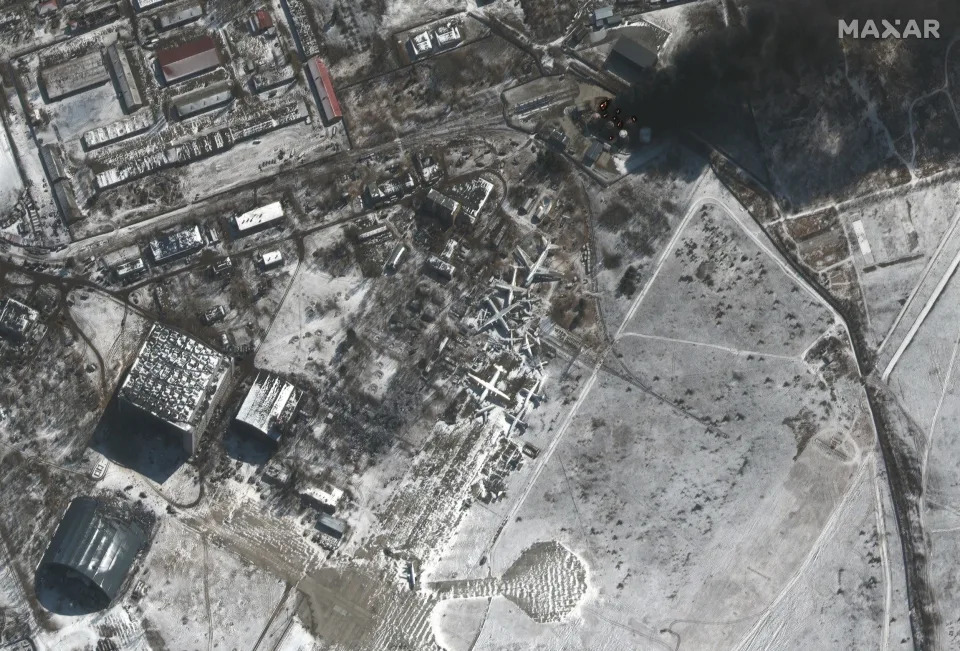
Troops and military vehicles deployed in Ozera, northeast of Antonov Airport.
Troops and military vehicles deployed in Ozera, northeast of Antonov Airport.Maxar Technologies
  • A Russian military convoy was seen deployed in towns north of Kyiv, satellite images show.
  • The convoy was spotted near the Antonov Airport in Hostomel, Ukraine, which is 54 kilometers, or 33 miles, northwest of the capital.
  • The deployment points to Russian efforts to move further into Ukraine amid its ongoing assault on the country.

Satellite images show a Russian military convoy driving through a town near a Ukrainian airport north of Kyiv.

The convoy was spotted near the Antonov Airport in Hostomel, Ukraine, which is 54 kilometers, or 33 miles, northwest of the capital.

The images taken by Maxar Technologies point to a Russian effort to expand its presence throughout Ukraine outside of Kyiv amid its ongoing assault on the country.

“On this morning’s imagery (collected at 11:37 AM local time on March 10th), the large Russian military convoy that was last seen northwest of Kyiv near Antonov Airport has largely dispersed and redeployed,” Maxar reported.

“Armored units are seen maneuvering in and through the surrounding towns close to the airport, elements of the convoy further north have repositioned and are deployed in forests/along tree lines near Lubyanka with towed artillery howitzers in firing positions nearby,” according to an email from the space technology company.

Other images captured fuel storage tanks on fire near the airport on fire and military equipment deployed around the airport itself.

Fuel storage tanks on fire and military equipment deployed around Antonov Airport.
Fuel storage tanks on fire and military equipment deployed around Antonov Airport.Maxar Technologies
Fuel storage tanks on fire and military equipment deployed around Antonov Airport.
Fuel storage tanks on fire and military equipment deployed around Antonov Airport.Maxar Technologies

CIA director: Putin’s “propaganda bubble” is failing in Ukraine

Axios

CIA director: Putin’s “propaganda bubble” is failing in Ukraine

Zachary Basu – March 10, 2022

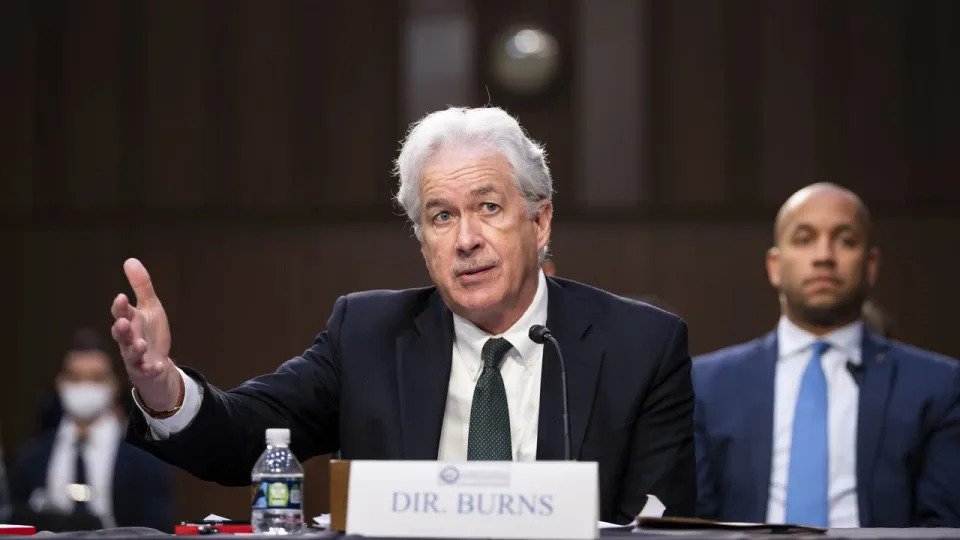
CIA Director Bill Burns testified Thursday that he believes Vladimir Putin is “losing the information war” in Ukraine, undermining the Russian leader’s ability to rally support at home and abroad for his war of aggression.

Why it matters: Putin has spent two decades building a “propaganda bubble” and laundering disinformation through state media, Burns said. That’s why the U.S. has adopted the novel approach of attempting to preemptively debunk Russia’s narratives about Ukraine, blunting the impact of “false flag” operations that succeeded in the past.

Driving the news: The Biden administration has in recent days warned that Russia may attempt to use chemical or biological weapons in Ukraine, after Kremlin-controlled media began propagating stories about dangerous bioweapons labs in Ukraine allegedly funded by the U.S.

  • The U.S. government has rejected these claims as complete fabrications and suggested that Russia may use them as “false pretexts in an attempt to justify its own horrific actions in Ukraine.”
  • Exploiting disinformation around chemical weapons has long been part of Putin’s “playbook,” Burns said, pointing to Russia’s poisoning of former double agent Sergei Skripal in 2017 and opposition leader Alexei Navalny in 2020.
  • Russia has also sought to cover up the Assad regime’s use of chemical weapons in Syria.

What they’re saying: “I am convinced that our efforts at selective declassification, to preempt those kind of false flag narratives and the creation of false narratives, have been so important,” testified Burns, a former veteran career diplomat and U.S. ambassador to Russia, to the Senate Intelligence Committee.

  • “In all the years I spent as a career diplomat, I saw too many instances in which we lost information wars with the Russians,” he continued.
  • “In this case, I think we have had a great deal of effect disrupting their tactics and their calculations and demonstrating to the entire world that this is premeditated and unprovoked aggression built on a body of lies and false narratives. So this is one information war that I think Putin is losing.”

The big picture: Even as Putin has “intensified his domination of state-run media” and “strangulation of independent media,” Burns suggested Russia is struggling to fully control the narrative at home.

  • “There are lots of Russians who have VPN accounts, who have access to YouTube to this day, who have access to information, and I don’t believe he can wall off indefinitely Russians from the truth,” Burns testified.
  • The bombing of a maternity ward and children’s hospital in Mariupol on Wednesday is one particularly potent example, as Russia has scrambled to rationalize the brutality of an attack that has triggered outrage all over the world.

Zoom in: Some Russian officials have claimed that the hospital was occupied by a neo-Nazi militia, and that no civilians were targeted.

  • Others have said the airstrike was “staged” by Ukraine.
  • The Russian embassy in London suggested on Twitter that a wounded pregnant woman photographed at the site of the bombing was a crisis actor — prompting the platform to remove the post for violating its rules on “denial of violent events.”

The bottom line: “The realities of killed and wounded coming home in increasing numbers, the realities of the economic consequences for ordinary Russians … the realities of the horrific scenes of hospitals and schools being bombed next door in Ukraine — I don’t think he can bottle up the truth indefinitely,” Burns said.

Even Russian State TV Is Pleading With Putin to Stop the War

Daily Beast

Even Russian State TV Is Pleading With Putin to Stop the War

Julia Davis – March 10, 2022

MIKHAIL KLIMENTYEV
MIKHAIL KLIMENTYEV

There is a notable mood shift in Russia, as darkness sets over its economy and the invasion of Ukraine hits major problems. While the beginning of President Vladimir Putin’s full-scale war against Ukraine was greeted with cheers, clapping, and demands of Champagne in the studio, the reality sobered up even the most pro-Kremlin pundits and experts on Russian state television.

The ugly truth about Russia’s invasion of Ukraine is slipping through the cracks, despite the government’s authoritarian attempts to control the narrative.

The Kremlin-controlled state media is doing its best to flip the situation upside down, blaming the victims of Russia’s aggression for all of the casualties. On Wednesday’s edition of the state TV show The Evening With Vladimir Soloviev, the host claimed the fallout of Russia’s bombing of a maternity hospital this week was “fake” with no one there to be injured, despite photos of pregnant women being carried away from the blast that killed at least one child. A guest on 60 Minutes last Saturday even claimed Ukrainians “are firing on each other and blaming us.”

On Thursday, Russia’s Foreign Minister Sergei Lavrov claimed that Russia never attacked Ukraine and repeated the same lies as Soloviev about the total absence of patients in the maternity ward and children’s hospital bombed by Russia.

Putin’s most trusted propagandists are becoming ever more desperate to distort or deny the evidence of the atrocities because the truth is finding its way past the roadblocks erected by the Kremlin. Russian citizens are not pleased either with the war, nor with the financial price they have to pay for their leader’s ill-conceived military conquests.

Even the infamous show run by Soloviev—who was recently sanctioned as an accomplice of Putin by the European Union—became dominated by predictions of Russian doom and gloom. Andrey Sidorov, deputy dean of world politics at Moscow State University, cautioned: “For our country, this period won’t be easy. It will be very difficult. It might be even more difficult than it was for the Soviet Union from 1945 until the 1960s… We’re more integrated into the global economy than the Soviet Union, we’re more dependent on imports—and the main part is that the Cold War is the war of the minds, first and foremost. Unfortunately, the Soviet Union had a consolidating idea on which its system was built. Unlike the Soviet Union, Russia has nothing like that to offer.”

State TV pundit Karen Shakhnazarov pointed out: “The war in Ukraine paints a frightening picture, it has a very oppressive influence on our society. Ukraine, whichever way you see it, is something with which Russia has thousands of human links. The suffering of one group of innocents does not compensate for the suffering of other innocent people… I don’t see the probability of denazification of such an enormous country. We would need to bring in 1.5 million soldiers to control all of it. At the same time, I don’t see any political power that would consolidate the Ukrainian society in a pro-Russian direction… Those who talked of their mass attraction to Russia obviously didn’t see things the way they are. The most important thing in this scenario is to stop our military action. Others will say that sanctions will remain. Yes, they will remain, but in my opinion discontinuing the active phase of a military operation is very important.”

Resorting to the traditional propaganda tropes prevalent in Russian state media, Shakhnazarov accused the United States of starting the war—and trying to prolong it indefinitely. He speculated: “What are they achieving by prolonging the war? First of all, public opinion within Russia is changing. People are shocked by the masses of refugees, the humanitarian catastrophe, people start to imagine themselves in their place. It’s starting to affect them. To say that the Nazis are doing that is not quite convincing, strictly speaking… On top of that, economic sanctions will start to affect them, and seriously. There will probably be scarcity. A lot of products we don’t produce, even the simplest ones. There’ll be unemployment. They really thought through these sanctions, they’re hitting us with real continuity. It’s a well-planned operation… Yes, this is a war of the United States with Russia… These sanctions are hitting us very precisely.

“This threatens the change of public opinion in Russia, the destabilization of our power structures… with the possibility of a full destabilization of the country and a civil war. This apocalyptic scenario is based on the script written by the Americans. They benefit through us dragging out the military operation. We need to end it somehow. If we achieved the demilitarization and freed the Donbas, that is sufficient… I have a hard time imagining taking cities such as Kyiv. I can’t imagine how that would look. If this picture starts to transform into an absolute humanitarian disaster, even our close allies like China and India will be forced to distance themselves from us. This public opinion, with which they’re saturating the entire world, can play out badly for us… Ending this operation will stabilize things within the country.”

The host frowned at the apparent departure from the officially approved line of thinking and deferred to the commander-in-chief. However, the next expert agreed with Shakhnazarov. Semyon Bagdasarov, a Russian Middle East expert, grimly said: “We didn’t even feel the impact of the sanctions just yet… We need to be ready for total isolation. I’m not panicking, just calling things by their proper name.”

Soloviev angrily sniped: “Gotcha. We should just lay down and die.”

Bagdasarov continued: “Now about Ukraine. I agree with Karen. We had prior experiences of bringing in our troops, destroying the military infrastructure and leaving. I think that our army fulfilled their task of demilitarization of the country by destroying most of their military installations… To restore their military they will need at least 10 years… Let Ukrainians do this denazification on their own. We can’t do it for them… As for their neutrality, yes, we should squeeze it out of them, and that’s it. We don’t need to stay there longer than necessary… Do we need to get into another Afghanistan, but even worse? There are more people and they’re more advanced in their handling of weapons. We don’t need that. Enough already… As for the sanctions, the world has never seen such massive sanctions.”

Dmitry Abzalov, director of the Center for Strategic Communications, pointed out that even though energy prices will go up for most of the West, it won’t do much to ease the pain for the Russians: “We’ll still be the ones taking the terminal hit, and an incomparable one, even though other countries will also suffer some losses. We’ll all be going to hell together—except for maybe China—but going to hell together with the French or Germans won’t make our people feel any better.” Abzalov argued that after taking additional territories in Eastern Ukraine, Russia should get out of Dodge, believing that all Western companies that temporarily paused their operations in Russia would then rush to come back. “It’s about toxicity, not just sanctions… It will go away once the situation stabilizes.”

Prior to the invasion of Ukraine, state TV experts predicted that Russia could overtake it in a matter of minutes or a few days. Stunned by the fierce resistance on the part of Ukrainians, Soloviev described them as “the army that is second in Europe, after ours, and which has been prepared for eight years and armed with everything you can imagine.”

Soloviev added: “This is a frightening war that is being waged against us by America.”

To lighten the mood in the studio, the host resorted to one of the favorite pastimes of many Kremlin propagandists: playing yet another Fox News clip of Tucker Carlson and his frequent guest Ret. Col. Doug Macgregor. In the translated video, Macgregor predicted Russia’s easy military victories over Ukraine and its total invincibility to Western sanctions. Soloviev sighed and smiled: “He’s a lot more optimistic than my previous experts in the studio.”