Germany intercepted conversations of Russian soldiers discussing Bucha killings, contradicting Kremlin claims of a hoax, report says
Sophia Ankel – April 7, 2022
Russian troops talked about killing civilians in Bucha over the radio, Der Spiegel found.
The radio transmissions were obtained by German intelligence and presented in parliament Wednesday.
They contradict Russian claims that the atrocities found in the Ukrainian town were staged.
Germany intercepted radio transmissions of Russian soldiers discussing the killings of civilians in the town of Bucha, contradicting Russian propaganda claims of a hoax, according to a report by Der Spiegel.
The radio transmissions were obtained by the Bundesnachrichtendienst, Germany’s foreign intelligence service, and presented to parliament on Wednesday, Der Spiegel reported.
In one of the recordings, a Russian soldier could be heard describing how he shot someone off their bicycle, Der Spiegel reported.
It is unclear what day the radio messages were sent and where the Russian troops were at the time.
Footage and images of people killed, with some on the street, in Bucha emerged earlier this week after Russian forces left the town.
On Tuesday, The New York Times published independently verified aerial footage that shows a Russian armored vehicle shooting at a civilian on a bicycle in Bucha. It is unclear whether the person in the video was the same as the one referred to in the radio messages.
The audio recordings also suggest that the Russian mercenary military, the Wagner Group, played a key role in the atrocities in Bucha, Der Spiegel reported.
It is not entirely clear who runs or finances the Wagner Group, but the US and European Union have linked Yevgeny Prigozhin, an oligarch and ally of Russian President Vladimir Putin, to the organization.
The group has been tied to Russian separatists in the pro-Kremlin Donbas region since 2014, as well as accused of committing war crimes and human-rights abuses in Syria in 2015.
On Tuesday, the Russian state-run news agency RIA Novosti ran an opinion column that speculated the killings were a ploy by Western nations to impose further sanctions on Russia.
The Ministry of Defense of Ukraine tweeted the Spiegel report on Thursday, writing: “Radio intercepts by the German Intelligence, show that the massacre of civilians in Bucha was not accidental or actions of rogue soldiers.”
Their digging up of dirt earned them the label “undesirable organization.” This suggests they are exposing uncomfortable truths. It means their investigative team is now working in exile. Roman Badanin, editor of the journal “Proekt” has a contract at Stanford University for the year. There are worse places to find yourself stuck far from home. But Badanin can’t go home, or he says, he’ll get thrown in jail. Between obligations at Stanford and working on exposes about the Russian government, he says he is “crowdfunding” like crazy to keep his scattered team of reporters afloat.
“Proekt’s latest investigation found that Russian President Putin is possibly quite sick–at least quite concerned about his health and perhaps pre-occupied with aging. A detail from the report that jumps out is that a thyroid cancer specialist allegedly made 35 trips to see the Russian president, spending 166 days with him, over a recent four-year period. And this doctor is not the only one traveling to Putin’s retreats away from the Kremlin and during periods when he has mysteriously been out of public view for relatively lengthy periods.
“Russian propaganda creates the image of a 100 percent healthy sport-addicted president. And all of a sudden we discovered that he’s literally encircled by doctors,” Roman Badanin told Fox News. “In total, we have 60 doctors who traveled with him on different occasions every time, for example, when he travels to Sochi (Putin’s preferred Black Sea resort) they travel. On the same route, on the same dates. So again, after the investigation was published, we received some, of course unofficial, confirmation that at least we were right in saying that Putin is really worried about his health.” Badanin and colleagues went about their investigation by finding contracts of these doctors who are affiliated with a public hospital and matching some of their travels to those of Putin–for example, when he went to his Sochi retreat. The contracts would show these doctors to be staying in a hotel near Putin’s place. Rather surprisingly the paper trail is public. Tracking movement this way had them employing a similar technique to what opposition leader Alexei Navalny and the Bellingcat investigative unit used to track down Navalny’s stalkers and poisoners.
Russian President Vladimir Putin enters the hall to address Tokyo 2020 Paralympic medalists. Mikhail Svetlov/Getty Images
Among the other doctors apparently in the president’s orbit–an expert in resuscitation, someone who has reportedly penned a manual about dealing with acute illnesses, injuries and poisonings, and also neurologists. Badanin says the thyroid cancer specialist’s alleged relationship with Putin does not necessarily mean the president has cancer, or that cancer. The only thing certain is that the particular doctor, Yevgeny Selivanov, got his PhD in thyroid cancer according to Badanin. He may focus on other areas now. There have long been rumors about Putin’s health. Each time he disappears from sight, tongues wag. His suddenly smooth faced appearance sparked speculation about botox use some years back. Recent puffiness, some say, suggests he is on heavy medication and that has led to all sorts of theories about what could be ailing him.
Another angle of the “Proekt” story is Putin’s supposed fascination with alternative medicine. “Sometime during his second term, Putin decided to live forever and to rule forever, because one day he realized that his health is the priority number one. Among other things, he tried untraditional medicine,” Badanin said. “We found that he was really interested in so-called blood baths done in the Altai region. They take baths with the boiled blood of the deer actually. And we know for sure Putin at least once tried these baths.” Badanin said he spoke to someone who did the same treatment on the same day. And he explained the blood is drained from the young, soft, sprouting antlers of deer.
Russian President Vladimir Putin toasts during reception for military servicemen who took part in Syrian campaign, at Grand Kremlin Palace on December 28, 2017 in Moscow. Photo by Mikhail Svetlov/Getty Images
There have clearly been a few sport injuries along the way and Badanin says Putin suffers from back problems as a result. But the Kremlin will attest to the Russian President’s good health. And will no doubt dismiss the deer blood baths as the fakest of fake news. It is hard to imagine someone who sits so far away from visitors at his now famous long table plunking himself in a tub of animal blood. But Badanin insists he’s got the scoop on good sourcing and apparently much of the Russian elite, starting with the Defense Minister, Sergei Shoigu, have taken the plunge.
Badanin does admit that in the context of the past, Putin on the eve of turning 70, has outdone those who came before him. “He’s way healthier than all the predecessors of him, including Yeltsin, who resigned at the same age, or Brezhnev, who was almost ousted at the same age, and Andropov even died when he was 70,” Badanin says. “But again, he’s ruling for 23 years. I believe that this time affected him a lot. It’s not an easy task to run such a huge country for 23 years. And of course, I believe he has a lot of psychological and health issues.”
UK Officials Say Russian Troops Are Running Low On Supplies, Morale
Kate Nicholson – April 7, 2022
Russian troops are struggling with supply lines and ebbing morale, according to the latest assessment of the Ukrainian war from British intelligence.
In a Twitter post shared Thursday morning, the ministry of defense explained how the Russians have shifted their lines of attack.
It wrote: “Progressing offensive operations in eastern Ukraine is the main focus of Russian military forces.
“Russian artillery and air strikes continue along the Donbas line of control.”
The Donbas region is in eastern Ukraine, and encapsulates Donetsk and Luhansk — areas partially occupied by pro-Russian rebels since the annexation of Crimea back in 2014.
This renewed focus on the east comes after troops withdrew from the Kyiv region — leading to the discovery of the Bucha massacre.
Russian invasion of Ukraine (Photo: PA GraphicsPress Association Images)
Russian invasion of Ukraine (Photo: PA GraphicsPress Association Images)
The U.K. officials also pointed out that Russian forces are trying to impact Ukrainian supplies.
“Russian strikes against infrastructure targets within the Ukrainian interior are likely intended to degrade the ability of the Ukrainian military to resupply and increase pressure on the Ukrainian government.”
However, the intelligence suggests that actually it is the Russians who are facing supply shortages – along with a lack of morale among its dwindling workforce.
The ministry of defense tweeted: “Despite refocusing forces and logistics capabilities to support operations in the Donbas, Russian forces are likely to continue facing morale issues and shortages of supplies and personnel.”
Russian losses are certainly high. At the end of last month, NATO estimated that up to 40,000 soldiers had been killed, wounded, captured or missing in action. This number is expected to have increased in April as Ukrainians managed to push the Russians out of various cities, including Kyiv and Kharkiv.
Pentagon Press Secretary John Kirby went even further than the ministry of defense, and expressed his belief that the Ukrainian troops can win the war this week.
He told reporters on Wednesday: “Mr Putin has achieved exactly zero of his objectives inside Ukraine.
“He didn’t take Kyiv. He didn’t topple the government. He didn’t remove Ukraine as a nation state.
“And, he’s really only taken control of a small number of population centers and even those weren’t the ones he was really going after.”
He pointed out even Mariupol has not been taken – “the proof is literally in the outcomes you are seeing every day.”
Yet, a previous update from the Ministry of Defense, posted on Wednesday, explained that Ukrainians are still suffering, significantly, despite their various successes.
For instance, Mariupol, the coastal city in the east of Ukraine, is now under siege as the Russians attempt to cut off their links to the outside world.
“The humanitarian situation in the city [of Mariupol] is worsening,” officials explained.
“Most of the 160,000 remaining residents have no light, communication, medicine, heat or water.
“Russian forces have prevented humanitarian access, likely to pressure defenders to surrender.”
Russia Is Recruiting Mercenaries and Syrians to Ukraine, Western Officials Say
Eric Schmitt, Julian E. Barnes and Helene Cooper – April 7, 2022
A smashed Russian respirator lies discarded on the ground in Bucha, a suburb of Kyiv, Ukraine, on Monday, April 4, 2022. (Daniel Berehulak/The New York Times)
WASHINGTON — As Russian troops retreat from northern Ukraine and focus operations on the country’s east and south, the Kremlin is struggling to scrape together enough combat-ready reinforcements to conduct a new phase of the war, according to American and other Western military and intelligence officials.
Moscow initially sent 75% of its main ground combat forces into the war in February, Pentagon officials said. But much of that army of more than 150,000 troops is now a spent force, after suffering logistics problems, flagging morale and devastating casualties inflicted by stiffer-than-expected Ukrainian resistance, military and intelligence officials say.
There are relatively few fresh Russian troops to fill the breach. Russia has withdrawn the forces — as many as 40,000 soldiers — it had arrayed around Kyiv and Chernihiv, two cities in the north, to rearm and resupply in Russia and neighboring Belarus before most likely repositioning them in eastern Ukraine in the next few weeks, U.S. officials say.
The Kremlin is also rushing to the east a mix of Russian mercenaries, Syrian fighters, new conscripts and regular Russian army troops from Georgia and easternmost Russia.
Whether this weakened but still very lethal Russian force can overcome its blunders of the first six weeks of combat and accomplish a narrower set of war aims in a smaller swath of the country remains an open question, senior U.S. officials and analysts said.
“Russia still has forces available to outnumber Ukraine’s, and Russia is now concentrating its military power on fewer lines of attack, but this does not mean that Russia will succeed in the east,” Jake Sullivan, President Joe Biden’s national security adviser, said Monday.
“The next stage of this conflict may very well be protracted,” Sullivan said. He added that Russia would probably send “tens of thousands of soldiers to the front line in Ukraine’s east,” and continue to rain rockets, missiles and mortars on Kyiv, Odesa, Kharkiv, Lviv and other cities.
U.S. officials have based their assessments on satellite imagery, electronic intercepts, Ukrainian battlefield reports and other information, and those intelligence estimates have been backed up by independent analysts examining commercially available information.
Earlier U.S. intelligence assessments of the Russian government’s intent to attack Ukraine proved accurate, although some lawmakers said spy agencies overestimated the Russian military’s ability to advance quickly.
As the invasion faltered, U.S. and European officials have highlighted the Russian military’s errors and logistical problems, although they have cautioned that Moscow’s ability to regroup should not be underestimated.
The Ukrainian military has managed to reclaim territory around Kyiv and Chernihiv, attacking the Russians as they retreat; thwarted a ground attack against Odesa in the south and held on in Mariupol, the battered and besieged city on the Black Sea. Ukraine is now receiving T-72 battle tanks, infantry fighting vehicles and other heavy weapons — in addition to Javelin antitank and Stinger anti-aircraft missiles — from the West.
Anticipating this next major phase of the war in the east, the Pentagon announced late Tuesday that it was sending $100 million worth of Javelin anti-tank missiles — roughly several hundred missiles from Pentagon stocks — to Ukraine, where the weapon has been very effective in destroying Russian tanks and other armored vehicles.
U.S. and European officials believe that the Russian military’s shift in focus is aimed at correcting some of the mistakes that have led to its failure to overcome a Ukrainian army that is far stronger and savvier than Moscow initially assessed.
But the officials said it remained to be seen how effective Russia would be in building up its forces to renew its attack. And there are early signs that pulling Russian troops and mercenaries from Georgia, Syria and Libya could complicate the Kremlin’s priorities in those countries.
Some officials say Russia will try to go in with more heavy artillery. By focusing its forces in smaller geographic area, and moving them closer to supply routes into Russia, Western intelligence officials said, Russia hopes to avoid the logistics problems its troops suffered in their failed attack on Kyiv.
Other European intelligence officials predicted it would take Russian forces one to two weeks to regroup and refocus before they could press a major offensive in eastern Ukraine, where Russian-backed separatists have been fighting for eight years. Western officials said that President Vladimir Putin of Russia was desperate for some kind of win by May 9, when Russia traditionally celebrates the end of World War II with a big Victory Day parade in Red Square.
“What we are seeing now is that the Kremlin is trying to achieve some kind of success on the ground to pretend there is a victory for its domestic audience by the 9th of May,” said Mikk Marran, the director general of the Estonian Foreign Intelligence Service.
Putin would like to consolidate control of the Donetsk and Luhansk regions of eastern Ukraine, and establish a land bridge to the Crimean Peninsula by early May, a senior Western intelligence official said.
Russia has already moved air assets to the east in preparation for the renewed attack on the heart of the Ukrainian military, and has increased aerial bombardment in that area in recent days, a European diplomat and other officials said.
“It’s a particularly dangerous scenario for the Ukrainians now, at least on paper,” said Alexander Vindman, an expert on Ukraine who became the chief witness in President Donald Trump’s first impeachment trial. “In reality, the Russians haven’t performed superbly well. Whether they could actually bring to bear their armor, their infantry, their artillery and air power in a concerted way to destroy larger Ukrainian formations is yet to be seen.”
Russian troops have been fighting in groups of a few hundred soldiers, rather than in the bigger and more effective formations of thousands of soldiers used in the past.
“We haven’t seen any indication that they have the ability to adapt,” said Mick Mulroy, a former senior Pentagon official and retired CIA officer.
The number of Russian losses in the war so far remains unknown, although Western intelligence agencies estimate 7,000 to 10,000 killed and 20,000 to 30,000 wounded. Thousands more have been captured or are missing in action.
The Russian military, the Western and European officials said, has learned at least one major lesson from its failures: the need to concentrate forces, rather than spread them out.
But Moscow is trying to find additional forces, according to intelligence officials.
Russia’s best forces, its two airborne divisions and the First Guards Tank army, have suffered significant casualties and an erosion of combat power, and the military has scoured its army looking for reinforcements.
The British Defense Ministry and the Institute for the Study of War, a Washington think tank that analyzes the Ukraine war, both reported Tuesday that the Russian troops withdrawing from Kyiv and Chernihiv would not be fit for redeployment soon.
“The Russians have no ability to rebuild their destroyed vehicles and weapon systems because of foreign components, which they can no longer get,” said Maj. Gen. Michael S. Repass, a former commander of U.S. Special Operations forces in Europe who has been involved with Ukrainian defense matters since 2016.
Russian forces arriving from Abkhazia and South Ossetia, two secessionist statelets that broke away from Georgia during the 1990s and then expanded in 2008, have been conducting peacekeeping duties and are not combat ready, Repass said.
Russia’s problems finding additional troops are in large measure why it has invited Syrian fighters, Chechens and Russian mercenaries to serve as reinforcements. But these additional forces number in the hundreds, not thousands, European intelligence officials said.
The Chechen force, one of the European intelligence officials said, is “clearly used to sow fear.” The Chechen units are not better fighters and have suffered high losses. But they have been used in urban combat situations and for “the dirtiest kind of work,” the official said.
Russian mercenaries with combat experience in Syria and Libya are gearing up to assume an increasingly active role in a phase of the war that Moscow now says is its top priority: fighting in the country’s east.
The number of mercenaries deployed to Ukraine from the Wagner Group, a private military force with ties to Putin, is expected to more than triple to at least 1,000 from the early days of the invasion, a senior U.S. official said.
Wagner is also relocating artillery, air defenses and radar that it had used in Libya to Ukraine, the official said.
Moving mercenaries will “backfire because these are units that can’t be incorporated into the regular army, and we know that they are brutal violators of human rights which will only turn Ukrainian and world opinion further against Russia,” said Evelyn N. Farkas, the top Pentagon official for Russia and Ukraine during the Obama administration.
Hundreds of Syrian fighters could also be heading to Ukraine, in what would effectively return a favor to Moscow for its helping President Bashar Assad crush rebels in an 11-year civil war.
A contingent of at least 300 Syrian soldiers has already arrived in Russia for training, but it was unclear if or when they would be sent to Ukraine, officials said.
“They are bringing in fighters known for brutality in the hopes of breaking the Ukrainian will to fight,” said Kori Schake, the director of foreign and defense policy studies at the American Enterprise Institute. But, she added, any military gains there for Russia will depend on the willingness of the foreign fighters to fight.
“One of the difficult things about putting together a coalition of disparate interests is that it can be hard to make them an effective fighting force,” she said.
Finally, Putin recently signed a decree calling up 134,000 conscripts. It will take months to train the recruits, although Moscow could opt to rush them straight to the front lines with little or no instruction, officials said.
“Russia is short on troops and is looking to get manpower where they can,” said Michael Kofman, the director of Russian studies at CNA, a research institute in Arlington, Virginia. “They are not well placed for a prolonged war against Ukraine.”
Zelenskyy says situation in Borodyanka is much worse than in Bucha
Holly Williams – April 7, 2022
Following outrage over horrific images of civilians killed in the city of Bucha, Ukrainian President Volodymyr Zelenskyy said the situation in neighboring Borodyanka is even worse. Investigators say they found 26 bodies amongst the rubble in Borodyanka on Thursday.
Vadim Shandrenko is among those looking for the remains of friends and family. His friend, Volodymyr, was at home inside a now collapsed apartment building when it was hit by Russian airstrikes. Shandrenko told CBS News the Russian soldiers wouldn’t let him search.
Locals told CBS News the Russians also blew up a bridge as they retreated from the city.
In the nearby village of Termakhivka, locals told CBS News that Russian soldiers looted everything from clothing and silverware to refrigerators and washing machines.
Mykola Oleksienko, the head of the village, said the Russians raided the village’s clinic, leaving it wrecked.
Termakhivka is about 30 miles from the Chernobyl nuclear site, where Russian troops have also pulled out. Ukraine says the Russians dug trenches in one of the most contaminated parts of the exclusion zone, exposing themselves to significant doses of radiation.
A Kremlin spokesman admitted Thursday that Russia has lost a significant number of troops in Ukraine, calling it a “huge tragedy,” but did not say how many had been killed.
Brian P. Klein is the founder of RidgePoint Global, a strategic advisory firm, and a former U.S. diplomat.
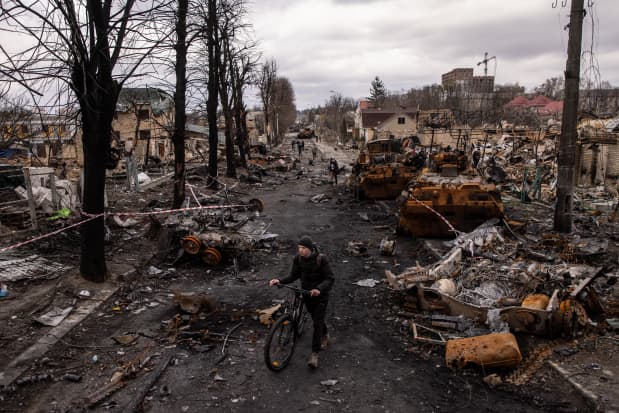
A man pushes his bike through debris and destroyed Russian military vehicles on a street on April 6, 2022 in Bucha, Ukraine.Chris McGrath/Getty Images
Europe is once again the victim of war. Terrible images from the Ukrainian town Bucha show just how far Moscow is willing to go to instill fear and reclaim the ghost of a failed empire.
All this raises the specter of a new Cold War, pitting rival nuclear powers against each other in clearly defined, diametrically opposed camps. But the situation is far more complicated and dangerous. The world is instead shattering into regional and ideological blocs that have little reference to the Iron Curtain and the global competition of capitalism versus communism.
The fight is now between empire builders who seek to overthrow the nation-state system, and those who want to defend it.
Putin aims to redraw the map of Europe. If he destroys Ukraine as an independent country, then every border would be up for grabs where similarly-minded dictators seek to expand their illiberal power.
President Joe Biden has framed Russia’s invasion and other global threats as “a battle between the utility of democracies in the 21st century and autocracies.” This doesn’t fully capture the scope of the fragmentation. Democratically elected presidents such as Brazil’s Jair Bolsonaro and India’s Narendra Modi refused to condemn Putin’s invasion. Autocratic regimes including Saudi Arabia and Afghanistan voted in the UN General Assembly to condemn Russia’s actions.
Nuclear-armed countries have so far avoided direct confrontation, but Putin is testing these informal restraints. He appears ready to challenge Europe and the U.S. with the use of chemical, biological, or even tactical nuclear weapons in Ukraine. The lack of clear red lines that have kept the peace for so long makes this situation even more dangerous.
As Gen. Mark Milley, chairman of the Joint Chiefs of Staff, said in recent testimony to the House Armed Services Committee, “we are entering a world that is becoming more unstable and the potential for significant international conflict between great powers is increasing, not decreasing.” U.S. foreign policy needs to appeal to countries focusing on the freedoms that the nation state-system supports, versus the alternative—subjugation to empire builders.
Putin’s rhetoric has its obvious weaknesses, couched in the absurdist claims of “denazifying” Ukraine. That doesn’t resonate with the vast majority of Europeans. He has become a cultural supremacist with no unifying call-to-arms that would attract others to his cause.
Even where Putin finds a friendly ear, as with Hungary’s Russian-friendly leader Viktor Orban, his message carries only so far. Hungarians remember Soviet tanks overrunning their country in 1956.
Russia’s only main supporter has been China, but this relationship has little echo of the closeness of the Cold War. Putin and Xi Jinping agreed to a “friendship without limits” just before the invasion. It will hold so long as it remains useful to Beijing.
There are already signs of strain. China’s state media has mirrored Russian propaganda, blaming the U.S. for the conflict and claiming the Bucha massacre was staged. China also voted against stripping Russia of its Human Rights Council seat at U.N. today. And yet, China abstained rather than voting against an earlier U.N. resolution condemning Putin’s invasion. Its unwavering support for Putin’s rhetoric has also changed slightly. “The reports and pictures of the deaths of civilians in the town of Bucha are very disturbing,” Foreign Ministry spokesman Zhao Lijian acknowledged Wednesday.
The price of international isolation increases substantially for China the longer and more obscene Putin’s war becomes. These ties will likely fray if China’s already weakening economy is materially threatened by sanctions for its support of Putin. Chinese state-owned refiners, for example, have stopped pursuing new Russian oil contracts.
Other countries are unlikely to ally themselves exclusively with a Russia-China bloc as both have expansionist plans that, if fully realized, would aim to control subservient client states. India, which remained stoutly nonaligned throughout the Cold War, refused to join this loose alliance despite March visits from Russian Foreign Minister Sergei Lavrov and Chinese Foreign Minister Wang Yi.
Much of Asia is also wary of Beijing’s intent to expand its influence throughout the region and is unlikely to follow its lead on Russia. Traditionally neutral Singapore has not only condemned Putin’s invasion, but also imposed financial and trade sanctions. Communist Vietnam and a democratic Philippines are loosely aligned to counter China’s militarization and self-proclaimed sovereignty over the South China Sea. Japan has taken the lead in organizing a meeting of both foreign and defense ministers from India and the Philippines to counter China’s naval expansion.
Stopping Putin’s attempt to eliminate Ukraine says to other empire builders around the world that violating the rules-based, nation-state system has severe consequences.
There is no stalemate, with spheres of influence behind Iron Curtains marking a new Cold War. Extremists want to throw the world into more chaos and violence, something that the free world can’t let happen.
Guest commentaries like this one are written by authors outside the Barron’s and MarketWatch newsroom. They reflect the perspective and opinions of the authors. Submit commentary proposals and other feedback to ideas@barrons.com.
Milley Says Ukrainians Using Land Mines ‘Effectively,’ Reopening Debate About Controversial Weapons
Rebecca Kheel – April 7, 2022
Chairman of the Joint Chiefs Gen. Mark Milley argued Thursday that land mines have been critical for Ukrainian forces’ success against Russian armored vehicles.
Milley’s comments at a Senate Armed Services Committee hearing come as the Biden administration is reviewing the U.S. land mine policy after former President Donald Trump expanded the U.S. military’s use of the controversial weapons in 2020.
“Land mines are being effectively used by the Ukrainian forces to shape the avenues of approach by Russian armored forces, which puts them into engagement areas and makes them vulnerable to the 60,000 anti-tank weapons systems that we’re providing to the Ukrainians,” Milley said. “That’s one of the reasons why you see column after column of Russian vehicles that are destroyed.”
U.S. forces have fallen victim to land mines in the past, including those made in the United States. About 90% of the mines and booby traps used against U.S. troops in the Vietnam War were U.S.-made or built by enemy forces using captured American parts, according to Army research reported on by The New York Times.
More than 160 countries have signed onto a 1997 treaty banning the use, stockpiling, production and transfer of anti-personnel land mines. The United States is not one of them, nor is Russia.
Land mines have long been decried by human rights organizations because they are often left behind after a conflict, indiscriminately killing and maiming civilians who stumble upon them long after a war has ended.
A watchdog organization called Landmine Monitor estimates at least 7,073 people were killed or injured by land mines in 2020 alone.
Russia has also been accused of employing land mines in its attacks against civilians during the Ukraine war, including its newly developed POM-3 that uses sensors to detect when someone walks nearby rather than the traditional way to trip a land mine of stepping on it.
In 2014, then-President Barack Obama issued an executive order intended to reduce civilian harm that prohibited the U.S. military from using land mines anywhere other than the Korean peninsula. That particular use — protecting South Korea from an invasion by the north — has long been the top reason cited by military planners for their objection to signing on to a land mine ban.
But in January 2020, Trump rescinded Obama’s order, arguing the restriction could place service members at “a severe disadvantage during a conflict against our adversaries.”
During the presidential campaign, then-candidate Joe Biden vowed to “promptly” reverse Trump’s move. But more than a year into his presidency, Biden’s administration is still reviewing the policy.
In his comments Thursday, Milley called land mines an “important” weapon to help “shape enemy operations.”
But he also nodded to the concerns about their harm to civilians, saying the United States is working to develop land mines that could deactivate themselves at the end of a war.
“The reason we’re developing a newer one is so they time out and they don’t present harm after the conclusion of hostilities,” Milley said. “And they would self-detonate or self-destroy or become inert at the end of hostilities.”
Prospect of Finland, Sweden joining NATO discussed at NATO meeting -U.S. official
Daphne Psaledakis – April 7, 2022
U.S. Secretary of State Blinken departs Brussels Airport for Washington
BRUSSELS (Reuters) -The prospect of Finland and Sweden joining NATO was part of the discussion between foreign ministers from the military alliance in Brussels this week, a senior U.S. State Department official said on Thursday.
“Obviously this is going to be those countries’ choices to make,” said the official, briefing reporters on the condition of anonymity.
“The alliance’s open door remains open and there was discussion about that potential candidacy,” the official said.
Russia’s invasion of Ukraine, which it says aims among other things to degrade Ukraine’s military potential and prevent it becoming a bridgehead for a NATO attack, has prompted the two Nordic countries to consider joining the U.S.-led alliance.
Since the invasion began on Feb. 24 public opinion polls commissioned by Finnish media outlets have shown a swift U-turn with the majority of Finns now favoring joining NATO.
Finnish foreign minister Pekka Haavisto told reporters earlier that Finland will clarify next steps in the coming weeks regarding a possible decision to seek NATO membership.
Kremlin spokesperson Dmitry Peskov has said that if Finland and Sweden joined NATO then Russia would have to “rebalance the situation” with its own measures.
(Reporting by Daphne Psaledakis; Writing by Humeyra Pamuk; Editing by Franklin Paul and Grant McCool)
Drones, phones and satellite technology are exposing the truth about Russia’s war in Ukraine in near real-time
Nic Robertson, CNN – April 7, 2022
(CNN) Russia’s lies may be catching up with it faster than it ever imagined.
The war in Ukraine is defying President Vladimir Putin’s expectations at every turn, not only with Russia’s failure to capture Kyiv as planned but with the war crimes his soldiers are alleged to have committed in Bucha, a city close the capital, exposed for the world to see.
Throughout history, wars have been won by forces turning new technologies to their advantage. The 1415 victory of English King Henry V over the French at the Battle of Agincourt came courtesy of his archers and their newly developed longbows, raining arrows over a range the French could not match.
A satellite image of a mass grave in Bucha, Ukraine. The war in Ukraine may see another historic first, with technology cutting through the fog of war, exposing the aggressors’ lies and accelerating efforts to bring about their defeat.
Satellite images of murdered civilians that match videos, recorded weeks later, of bodies at the roadside are providing compelling evidence of Russian war crimes, convincing Western leaders to ramp up sanctions on Russia and accelerate weapons supplies for Ukraine.
How this will affect the final outcome of the war is unclear. But what is evident at a time when Ukraine is urgently seeking any additional leverage as Russian forces regroup for a new offensive, is that Russia’s actions in Bucha are strengthening Ukraine’s hand.
While battlefield satellite imagery has been available to governments for decades and was instrumental in pinpointing war crimes during the Bosnian civil war in the 1990s — notably locating a mass grave of many of the 7,000 Bosnian Muslims slaughtered in the town of Srebrenica in 1995 — it has never been so immediately available in the public domain as now.
Ukrainian President Volodymyr Zelensky, speaking to the United Nations Security Council on April 5, 2022
Putin and his battlefield commanders appear not to care or not to have grasped the fact that orders and actions now leave an indelible record beyond their control that could come back to haunt them.
They will be aware that in many past conflicts — even as recent as the Syrian civil war — leaders like Bashar al Assad escaped conviction and have even been rehabilitated, despite vast troves of incriminating documents spirited from government offices and police stations.
But this is not the only lesson to which Putin should pay attention. Following the bloody breakup of Yugoslavia and the Bosnian civil war, the war crimes tribunal in the Hague used political and military leaders’ own words to help convict them.
When the International Criminal Tribunal for the former Yugoslavia (ICTY) put Bosnian Serb President Radovan Karadzic on trial, it had video of him looking over Sarajevo, condemning the civilians below to artillery and mortar fire.A woman walks next to a destroyed Russian armor vehicle in Bucha on April 5.
His military partner in war crimes there, General Ratko Mladic, also saw his words come back to help convict him, as video showed him on the outskirts of Srebrenica directing the filtering of civilians, many of whom would shortly be slaughtered by his soldiers, following his orders.
That type of link may be harder to pin on Putin, but his 20-page thesis published last summer on why Ukraine is not a country, and his TV comments on why Russia should invade, will, if previous war crime courts are a precedent, count against him as author and director of the war.
If Putin were to come to trial, his unravelling may turn out to have begun with his inability to understand his army’s weaknesses and Ukraine’s strengths. Failure to fulfil his first major objective, the capture of Kyiv, forced his troops to retreat, leaving their tide of terror exposed.
They did what they have done so many times before, in Syria, in Chechnya, in Georgia: committed awful abuses. And Putin and his officials did what they have done so many time before: lied to cover their crimes.
Russian defense officials claimed photos and videos that emerged on April 2, showing murdered civilians — shot in the head, some with their hands and legs bound — were fake, saying their troops left before the killings occurred. “The troops left the city on March 30,” the defense ministry said in a statement. ” Where was the footage for four days? Their absence only confirms the fake.
“They were very clear about the date. Foreign Minister Sergey Lavrov, one of Putin’s most seasoned spin masters, doubled down on the clumsy cover-up, insisting “Russian forces left the Bucha town area as early as the 30th of March.
But publicly available satellite images from space-tech company Maxar, taken March 18 while Russian troops were in control, showed the civilians lying dead at the road side in exactly the same locations as Ukrainian forces discovered them when they re-entered the town in early April. And drone video shot before March 10 showed a cyclist being shot and killed by Russian troops. Ukrainian forces found his body weeks later, exactly where he fell.
In the months prior to Russia’s invasion and the days since Maxar’s images appeared, tracking Russian forces and their destruction, the public’s understanding of the battlefield has been revolutionized. Coupled with the near-ubiquitous use of smartphone cameras, geolocation technology and sophisticated drones, Putin faces the possible reckoning he escaped in previous conflicts.
Ukrainian President Volodymyr Zelensky wants more cameras, and wider access, to let the public see for themselves: “This is what we are interested in, maximum access for journalists, maximum cooperation with international institutions, enrolment of the International Criminal Court, complete truth and full accountability,” he said in a video address on Monday.
Ukraine’s enigmatic leader has realized it’s not just high-tech, tank-busting weapons like Javelins and NLAWs, or surface-to-air missiles like Stingers and Starstreaks, that could turn the tide in the war. It’s truth, and the tools — satellites, drones and smartphones — to deliver it.
Unparalleled in any modern war, technology could hand the underdog this surprising advantage, undermining the lies of an oversized aggressor. Zelensky was at pains for the United Nations to understand this when he spoke to them Tuesday: “It is 2022 now. We have conclusive evidence. There are satellite images. And we can conduct full and transparent investigations.” Like Henry V in 1415, Zelensky knows an advantage when he sees it. While satellite imagery may not be as game-changing as a six-foot yew branch and a length of hemp string, if he can use it cleverly, he may force Putin to talks much sooner than the Russian President would like.
The Trump Organization used to borrow from major banks. Now look who’s lending it money.
Gretchen Morgenson – April 7, 2022
Donald Trump used to bank with the big guns. Now he’s borrowing from Axos Financial, an obscure, internet-only institution based in San Diego and Las Vegas.
In mid-February, Axos refinanced a $100 million Trump Tower mortgage due in September, a New York City Finance Department document shows. The new loan was made just days after The Trump Organization’s auditor resigned, saying that 10 years of the company’s financial statements could not be relied upon.
In lending to The Trump Organization, Axos is stepping up when other banks have balked. But this is not unheard-of for Axos. An examination of legal filings, internal documents and land records shows Axos has a history of handling atypical loans.
Axos has teamed up with nonbank lenders on loans to small businesses that carried cripplingly high double- and triple-digit effective annual interest rates, loan documents show. The bank has also specialized in loans to foreign nationals, internal documents and its website state, and has offered a type of loan that allows borrowers who paid cash for a property to turn around and instantly take money out. Such loans may pose money laundering risks, banking analysts say.
The bank has also been sued by two former employees who say they were wrongfully fired after they raised questions about its practices. On March 21, Jennifer Brear Brinker, hired in 2018 to review the bank’s loan portfolios for its Governance, Risk Management and Compliance Department, filed suit against Axos in federal court in California.
Brinker accused the bank of intentionally understaffing its compliance department “in an effort to conceal its failure to comply with federal banking regulations” and contends she was terminated in January 2021 while completing a report highlighting deficiencies at Axos including “significant issues in the bank’s anti-money laundering practices.”
A spokesman for Axos, who asked not to be identified, said the bank disputes Brinker’s allegations “and her perception of the underlying factual circumstances.” Axos intends to defend against the lawsuit vigorously, the spokesman added.
A lawyer representing Brinker declined to comment further on her case but said they both look forward to proving her claims in court.
Later this month, Axos is scheduled to face a former internal auditor in a wrongful termination case in California federal court. That auditor, Charles Matthew Erhart, 35, was fired by Axos after he raised concerns about its practices, his 2015 lawsuit says. Among other practices alleged by Erhart — Axos allegedly failed to advise regulators of substantial and risky loans to dubious borrowers, did not disclose to regulators that it had received grand jury and other subpoenas, improperly denied that it held documents responsive to a Securities and Exchange Commission subpoena and instructed employees not to communicate with regulatory officials.
The bank’s spokesman said it denies every one of Erhart’s allegations. “All were investigated, both internally by Axos’s audit committee and independent counsel, and externally by government regulators and outside auditors,” the statement said. “None of the investigations or audits found any merit in Erhart’s allegations.”
‘Cash-recapture loans’
Axos was founded in 2000 as Bank of Internet USA, or BofI, a digital enterprise with no brick-and-mortar branches; it changed its name to Axos in 2018. Its shares trade on the New York Stock Exchange.
With $15.5 billion in assets at the end of 2021, Axos is a relatively small, federally chartered savings institution. J.P. Morgan Chase, by comparison, holds over $3 trillion in assets. Some $12.6 billion of Axos’ assets are loans, including residential mortgages and loans on commercial real estate and multi-family dwellings, SEC filings show.
Axos is overseen by Gregory Garrabrants, a lawyer, former Goldman Sachs banker and McKinsey & Co. consultant. Before joining Axos in October 2007, Garrabrants was an executive at Indymac, a huge California savings & loan that collapsed in July 2008 under a mountain of toxic mortgages, according to bank regulators. Indymac was one of the nation’s biggest bank failures, costing the FDIC fund more than $10 billion, a government investigator estimated.
Axos has been a fast grower and has turned in a torrid stock performance in recent years. In 2018, Garrabrants earned $27 million, just 10 percent less than the $30 million received by Jamie Dimon, the chief executive of JPMorgan Chase.
In lending to the Trump Organization, Axos is forging ties with a borrower that has proved troublesome for other banks over the years, with multiple bankruptcies more than a decade ago and many lawsuits.
Axos declined to comment about the terms of the loan and the Trump Organization’s spokeswoman did not respond to an email seeking comment from NBC News. But Eric Trump told CNN in a statement that “Trump Tower is one of the most iconic properties in the world and sits on arguably the most prestigious corner in all of New York. We have incredibly low debt, have a tremendous amount of cash and have an extremely profitable company. We had no problem refinancing.”
In September, Forbes valued the commercial office and retail space backing the $100 million Trump Tower mortgage Axos refinanced at $285 million; Gucci is a retail tenant on the ground floor, paying an estimated $24 million a year.
Gucci Flagship Store Extends Lease In Trump Tower (John Smith / VIEWpress via Getty Images)
The $100 million Trump Tower mortgage represents a large loan for a bank the size of Axos. As a savings association, Axos is subject to limits on loans to one borrower based on a measure of its capital. On June 30, 2021, that limit was $203.8 million, the bank’s filings show, and its largest outstanding loan balance was $145 million.
For fiscal year 2021, Axos held $3.2 billion in commercial real estate loans, or 27.5 percent of its total loans. Most were on properties in California, its regulatory filings show. The new Trump Tower financing increases Axos’ lending in New York state by almost 30 percent, based on its December 2021 holdings.
Axos held $4.4 billion in single-family mortgages in 2021 or 38 percent of its loans held for investment.
In her lawsuit, former employee Brinker alleged that in 2020 Axos tried to conceal problems with home loans made to borrowers by A & D Mortgage, a Hollywood, Fla.-based nonbank mortgage lender financed by Axos. The bank failed to tell its board or its investors the loans had become problems, Brinker alleged. A&D Mortgage was funded by an Axos credit line for five years, from April 2016 to April 2021, Uniform Commercial Code filings show.
A&D would sell the mortgages it had underwritten using Axos’s line of credit into a pool of loans packaged and issued by a related entity known as Imperial Fund Capital Partners. But when Covid struck, investors refused to buy the security and the loans remained as collateral backing Axos’s credit line for longer than the 60 days the bank’s policy allowed, according to Brinker’s lawsuit.
A&D Mortgage is headed by Maksim Slyusarchuk, according to Florida corporate records, who described himself in a 2013 lawsuit he filed in Miami-Dade County as “an international businessman with experience in the Russian markets and in international finance.”
Slyusarchuk also owns 50 percent of Imperial Fund Capital, an SEC registered investment adviser with $316 million under management; it pools mortgages into securities and sells them to investors. One of its units, Imperial Fund II LLC, is financed by Sovcombank, a UCC filing shows, Russia’s ninth largest bank. Sovcombank was sanctioned by the U.S. Treasury on Feb. 24.
Neither A&D Mortgage, Imperial Fund nor Slyusarchuk responded to an email message seeking comment.
On its website, Axos says it has extensive experience in mortgage lending to “nonresident aliens” and offers loans of up to $20 million accompanied by 50 percent down payments. A 2014 investor presentation noted that the bank specialized in lending to Chinese nationals, for example, who do not have tax returns that they can present to document their financial standing.
Axos has also made loans to Russian nationals; asked about the risk of such lending given the Ukraine invasion, the Axos spokesman said they represent a fraction of 1 percent of Axos’ loans. “All such loans were done at low loan-to-value ratios and are well secured,” he added.
The 2014 Axos investor presentation also shows the bank offered so-called cash recapture loans, made to individuals paying cash in full for a property who want “to recoup some of their investment.” The bank required no waiting period to cash out, the presentation noted, but said the source of the initial purchase funds “must be sourced/seasoned.” Bank analysts say such loans may raise the risk of money laundering.
The Axos spokesman said the bank conducts “a full, know-your-customer investigation” of each cash-recapture loan applicant. The loans are “subject to strict underwriting and program qualification parameters,” he said, “designed to ensure full compliance with Anti-Money Laundering and Bank Secrecy Act laws and all other legal or regulatory requirements.”
Axos has also teamed up with some aggressive non-bank lenders charging sky-high interest rates to small business borrowers, NBC News has previously reported. The bank conducted some of these arrangements through its unit in Nevada, a state with no interest rate limits, allowing downstream lenders to evade state usury caps on loans they made to borrowers operating in more restrictive jurisdictions. Predatory lending experts call these arrangements “rent-a-bank schemes,” and they were permitted under a Trump-era banking rule. Last year, President Joe Biden signed a resolution rescinding the rule.
Axos disputed that this business involved “rent-a-banks” and said its operation was “a bank sponsorship program, operated so as to be fully compliant with legal and regulatory requirements, through which it entered into agreements with several third-party service providers.” All but one of these programs have been wound down, the spokesman added.
Joint interest agreement
In recent years, Axos has aggressively pursued anonymous bloggers who posted critical analyses of the bank’s activities on investing websites, court documents show. In 2017, Axos joined forces with top executives at MiMedx Group, a formerly high-flying maker of skin grafts, to identify anonymous critics of the companies. Axos and MiMedx entered into a “joint interest agreement” to investigate the critics, court documents and internal emails show.
Two of the top MiMedx executives with whom Axos pursued the joint interest agreement — former chief executive Parker Petit and former COO William Taylor — were convicted of fraud in 2021 and sentenced to jail in a case unrelated to Axos. Much of what had been alleged about MiMedx by the critics it targeted turned out to be accurate, the criminal case showed.
A spokeswoman for MiMedx said the company does not comment on legal matters but noted that its “senior leadership team and board of directors are entirely new since 2019.”
Regarding its arrangement with the convicted former MiMedx executives, the Axos spokesman said that when it struck the agreement with Petit and Taylor, Axos needed to communicate with MiMedx about the activities of investors who had bet against both companies and publicized those bets. He added that “the truth of allegations against MiMedx was unknown and the company and its executives appeared to enjoy a favorable reputation.”
The Erhart case
Later this month, the 2015 wrongful termination case filed by Erhart, the former Axos auditor, is scheduled to go to trial. Erhart‘s lawyer, Carol Gillam, declined to comment on the case.
Erhart began working at Bank of Internet, as Axos was known at the time, in Sept. 2013, documents show. Previously an examiner at the Financial Industry Regulatory Authority, he’d led an examination that identified a broker who allegedly stole $4.2 million from his customers, his lawyer said.
A native of rural Kansas who put himself through the University of Kansas working on an assembly line and a road construction crew, Erhart began identifying problems soon after he was hired at Axos, according to his complaint. He says he expressed concerns about concentration risk at the bank, for example, noting to superiors that just nine of its customers accounted for 40 percent of its total deposits. Erhart alleges that he was advised by his boss’s superior not to put that information in an email.
Some of Erhart’s allegations about Axos’s practices had to do with the Bank Secrecy Act, which aims to curtail and detect money laundering and loans to what banking regulators call “politically exposed persons.” They are people who, because of their public positions or relationships, “may present a risk higher than other customers by having access to funds that may be the proceeds of corruption or other illicit activity.”
Banks are supposed to collect information about customers’ risk profiles to monitor and determine whether a client’s banking activities are suspicious. Erhart contended in his lawsuit the bank made material alterations of “numerous reports” required under the Bank Secrecy Act’s quality control rules and did not disclose substantial loans to criminals and politically exposed persons. In early 2015, Erhart’s complaint says, he uncovered information about borrowers who exposed the bank to reputation risk, including “very high level foreign officials from major oil-producing countries and war zones.” He did not identify specific borrowers in the complaint.
In March 2015, Erhart turned over bank records to Axos’s main regulator, the Treasury Department’s Office of the Comptroller of the Currency, his complaint said. He emailed the information he had compiled to his mother for safekeeping. He was fired in June 2015.
The OCC has not taken regulatory action against the bank. Erhart now works as a partner at a cryptocurrency consulting firm.
“In the years since Erhart first made his allegations,” the bank’s spokesman said, “Axos has suffered no adverse business event, no restatement, no spike in reserves, no loss of a major contract, no material weakness disclosure, no earnings miss. Independent auditors and government regulators — all with full knowledge of all Erhart’s allegations — have consistently issued clean audit opinions, passed examinations, and granted further regulatory approvals for more than seven full years.”
Asked to supply copies of the clean audit opinions and examinations, Axos declined, saying they are confidential.
The company did supply a copy of a 2017 letter from the Securities and Exchange Commission saying it had closed an investigation into Axos and did not intend to recommend an enforcement action against the bank. Still, the SEC said its letter “must in no way be construed as indicating that the party has been exonerated or that no action may ultimately result from the staff’s investigation.”
In a separate civil case in 2017, Garrabrants sued Erhart alleging that he had stolen his confidential information. The bank also sued Erhart’s mother in Kansas, to whom the former auditor had sent information about the bank’s activities for backup. Axos settled the case against Erhart’s mother; it declined to state the terms.
Garrabrants’ case against Erhart went to trial last fall. The jury found that Erhart had violated California law “in connection with theft of Garrabrants’ personal, confidential, and financial information,” the bank’s spokesman said.
Gillam, Erhart’s lawyer, provided a statement on this suit. “The documents Mr. Erhart accessed that related to Mr. Garrabrants were in bank files he found in the course of doing his work as an internal auditor,” she said. “They were only used to support Mr. Erhart’s allegations of wrongdoing that he presented to the bank’s principal regulator, the Office of the Comptroller of the Currency.”
The jury “rejected Garrabrants’ claim of intentional infliction of emotional distress and awarded him $1,500 on an invasion of privacy claim,” Gillam added. On an anti-hacking allegation, the jury awarded $1 to Garrabrants, an amount he had requested.
Erhart is appealing that verdict, Gillam said.
In late February, Axos also entered into a settlement agreement with a Houston Municipal pension fund that had sued the bank in 2015. That matter, which became a class action, alleged securities fraud largely based on Erhart’s allegations.
The terms of the settlement have not yet been made public. When asked why the bank was settling now, its spokesman said: “While Axos continues to believe that it would have prevailed at trial, this settlement allows Axos to avoid the distraction and continued expense of litigation.”





 A satellite image of a mass grave in Bucha, Ukraine. The war in Ukraine may see another historic first, with technology cutting through the fog of war, exposing the aggressors’ lies and accelerating efforts to bring about their defeat.
 Ukrainian President Volodymyr Zelensky, speaking to the United Nations Security Council on April 5, 2022
 A woman walks next to a destroyed Russian armor vehicle in Bucha on April 5.


