Tapped Calls Expose Russia’s Heinous Treatment of Own Dead Troops

Daily Beast

Tapped Calls Expose Russia’s Heinous Treatment of Own Dead Troops

Shannon Vavra – May 2, 2022

Russian authorities are transporting the dead bodies of Russia’s fallen soldiers from Ukraine back to Russia in “small batches” in the dead of night in an attempt to conceal just how many Russian troops are dying in Ukraine, according to intelligence shared by the Security Service of Ukraine (SBU).

The intelligence—intercepted calls between Russian troops the SBU said it picked up in the Zaporozhye region—suggests that Russia is also transporting the corpses back to Russia in small groups in order to avoid suspicion that Russia’s invasion is sustaining massive losses or faltering in Ukraine, the SBU said.

“They are bringing them in small packs, so that people don’t freak out,” one of the callers said.

But the process is delaying the transport of the dead, forcing the parents and families of the troops to grieve over “half-decomposed cargo of 200” that are sometimes unrecognizable by the time they arrive, the SBU said.

The two soldiers allegedly caught on the call mention that the body of one of their dead comrades, Makeyevich, was in the process of getting transported back for approximately six days, and that his wife was getting worried.

‘There Is Such Fuckery Going on Here’: Russian Soldiers ‘Revolting’ as They Get Stiffed on Ukraine Payouts

“Did you send Makeyevich?”

“They brought him today, according to preliminary information,” one of the callers said. “They are supposed to identify him today.”

Many Russian troops and their families weren’t even aware they were headed into war in the last several months, a step that has likely left families already in the dark about the fate of their family members serving in the military as Russia has invaded Ukraine.

The Daily Beast has not independently verified the intercept or its claims.

But it wouldn’t be Russia’s first rodeo running sketchy operations to cover up war losses back home. Russia has long sought to cover up casualties of its service members. During the war in Afghanistan in the 1980s, Russia had its dead soldiers transported back to Russia in the middle of the night. When Russia invaded Ukraine in 2014, families of Russian troops killed there were forced to sign non-disclosure agreements to avoid discussing how the soldiers died, according to a Kavkazsky Uzel report.

Putin Finally Cops to Dead Russian Troops in Ukraine

In other cases, the Russian government claimed soldiers that are suspected to have died in Ukraine were actually killed during training, or that they entered Ukraine in a volunteer capacity. In still more cases, Russian solders’ dead bodies were delivered to their families with simple notes stating they succumbed to their injuries, but without details about where or why they were injured.

The invasion in Ukraine now seems no different. Just in recent weeks Moscow has shared Russian casualty numbers that U.S. authorities say vastly undershoot the reality of the human toll of Putin’s war.

Russia’s casualties in the war in Ukraine continue to mount. Russia has so far lost 23,800 troops, with the greatest losses in recent days in Izyum, according to an analysis the General Staff of the Armed Services of Ukraine shared Monday. Ukrainian forces claimed in recent hours they had destroyed Russia’s command center in Izyum, along with a Russian general, Gen. Andrei Simonov.

Push to arm Ukraine putting strain on US weapons stockpile

Associated Press

Push to arm Ukraine putting strain on US weapons stockpile

Ben Fox, Aamer Madhani, Jay Reeves and Dan Huff – May 2, 2022

WASHINGTON (AP) — The planes take off almost daily from Dover Air Force Base in Delaware — hulking C-17s loaded up with Javelins, Stingers, howitzers and other material being hustled to Eastern Europe to resupply Ukraine’s military in its fight against Russia.

The game-changing impact of those arms is exactly what President Joe Biden hopes to spotlight as he visits a Lockheed Martin plant in Alabama on Tuesday that builds the portable Javelin anti-tank weapons that have played a crucial role in Ukraine.

But Biden’s visit is also drawing attention to a growing concern as the war drags on: Can the U.S. sustain the cadence of shipping vast amounts of arms to Ukraine while maintaining the healthy stockpile it may need if a new conflict erupts with North Korea, Iran or elsewhere?

The U.S. already has provided about 7,000 Javelins, including some that were delivered during the Trump administration, about one-third of its stockpile, to Ukraine, according to an analysis by Mark Cancian, a senior adviser with the Center for Strategic and International Studies international security program. The Biden administration says it has committed to sending about 5,500 to Ukraine since the Russian invasion more than two months ago.

Analysts also estimate that the United States has sent about one-quarter of its stockpile of shoulder-fired Stinger missiles to Ukraine. Raytheon Technologies CEO Greg Hayes told investors last week during a quarterly call that his company, which makes the weapons system, wouldn’t be able to ramp up production until next year due to parts shortages.

“Could this be a problem? The short answer is, ‘Probably, yes,’” said Cancian, a retired Marine colonel and former government specialist on Pentagon budget strategy, war funding and procurement.

He said that Stingers and Javelins were where “we’re seeing the most significant inventory issues,” and production of both weapons systems has been limited in recent years.

The Russian invasion offers the U.S. and European defense industry a big opportunity to bolster profits as lawmakers from Washington to Warsaw are primed to increase defense spending in response to Russian aggression. Defense contractors, however, face the same supply chain and labor shortage challenges that other manufacturers are facing, along with some others that are specific to the industry.

Military spending by the U.S. and around the world was rising even before Russia’s Feb. 24 invasion. Biden’s proposed 2023 budget sought $773 billion for the Pentagon, an annual increase of about 4%.

Globally, total military spending rose 0.7% to more than $2 trillion for the first time in 2021, according to an April report from the Stockholm International Peace Research Institute. Russia ranked fifth, as its spending on weapons increased ahead of its invasion of Ukraine.

The war will mean increased sales for some defense contractors, including Raytheon, which makes the Stinger missiles Ukrainian troops have used to knock out Russian aircraft. The company is also part of a joint venture with Lockheed Martin that makes the Javelins.

Biden will visit Lockheed Martin’s facility in Troy, Ala., which has the capacity to manufacture about 2,100 Javelins per year. The trip comes as he presses Congress to quickly approve his request for an additional $33 billion in security and economic assistance for Kyiv, Western allies and restocking weapons the U.S. has sent to those countries.

Senate Majority Leader Chuck Schumer, D-N.Y., said Monday he hoped quick bipartisan agreement on the security package could be reached so the Senate could begin considering it “as early as next week.”

The president is expected to use his remarks to highlight the importance of the Javelins and other U.S. weaponry in helping Ukraine’s military put up a vigorous fight as he makes the case to keep security and economic assistance flowing.

A White House official, who was not authorized to comment publicly and requested anonymity, said the Pentagon is working with defense contractors “to evaluate the health of weapons systems’ production lines and examine bottlenecks in every component and step of the manufacturing process.” The administration is also considering a range of options, if needed, to boost production of both Javelins and Stingers, the official said.

Pentagon press secretary John Kirby said Monday that America’s military readiness is not dependent on one system, such as the Javelin. He said that every time the Pentagon develops a package of weapons to send to Ukraine, the chairman of the Joint Chiefs of Staff and the department assesses the broader impact.

“It’s not about counting say Javelins and being able to say that when you reach a certain level then all your readiness is gone,” Kirby said. “The Javelin is an anti-armor capability, so we judge it all as a conglomerate of what’s our ability to meet this particular mission set, realizing that a Javelin isn’t the only capability you have against armor.”

Cancian, the former government specialist on defense budget strategy, said the fact that Stingers and Javelins were not included in the most recent tranche of weapons the Biden administration announced it was sending to Ukraine could be a sign that Pentagon officials are mindful about inventory as they conduct contingency planning for other possible conflicts.

“There’s no question that whatever war plan they’re looking at there is risk associated with the depleting levels of Stingers and Javelins, and I’m sure that they’re having that discussion at the Pentagon,” he said.

The U.S. military effort to move weaponry to Eastern Europe for Ukraine’s fight has been Herculean. From Dover Air Base in Delaware, U.S. airmen have carried out nearly 70 missions to deliver some 7 million pounds of Javelins, Stingers, 155mm howitzers, helmets and other essentials to Eastern Europe since February. Col. Matt Husemann, commander of the 436th Airlift Wing, described the mission as a “whole of government approach that’s delivering hope.”

“It is awesome,” said Husemann, after providing AP with a recent tour of the airlift operation.

The lightweight but lethal Javelin has helped the Ukrainians inflict major damage on Russia’s larger and better-equipped military. As a result, the weapon has gained almost mythic regard, celebrated with a Javelin song and images of Mary Magdalene carrying a Javelin becoming a meme in Ukraine.

Lockheed Martin CEO James Taiclet said in a recent CNBC interview that demand for the Javelin and other weapon systems would increase broadly over time because of the Russian invasion. He said the company was working “to get our supply chain ramped up.”

“We have the ability to meet current production demands, are investing in increased capacity and are exploring ways to further increase production as needed,” Lockheed Martin said in a statement.

Pentagon officials recently sat down with some of the leading defense contractors, including Lockheed Martin, Raytheon, Boeing, General Dynamics, BAE Systems and Northrop Grumman to discuss efforts to ramp up production.

The big defense contractors face some serious challenges.

Raytheon, for example, can’t simply crank out Stingers to replace the 1,400 that the U.S. sent to Ukraine. Hayes, the Raytheon CEO, said in a recent conference call with analysts that the company has only limited supplies of components to make the missile. Only one undisclosed country has been buying them in recent years, and the Pentagon hasn’t bought any new ones in nearly 20 years.

Sanctions further complicate the picture. Companies must find new sources of important raw materials such as titanium, a crucial component in aerospace manufacturing that is produced in Russia.

Concerns about the Stinger stockpile have been raised by House Armed Services Committee chairman Rep. Adam Smith, D-Wash., and the top Republican on the committee, Rep. Mike Rogers of Alabama. The two in March wrote to Defense Secretary Lloyd Austin and Chairman of the Joint Chiefs of Staff Mark Milley, describing the stockpile issue as one of “urgency.”

Rogers said he remains concerned that the matter hasn’t been properly addressed.

“I’ve been asking the DoD for almost two months for a plan to replenish our Stinger stockpile as well as our Javelin launch units,” Rogers said. “I worry that without a readily available replacement or fully active production lines, we could leave Ukraine and our NATO allies in a vulnerable position.”

Reeves reported from Birmingham, Ala., and Huff from Dover Air Force Base, Delaware. Associated Press writers Lolita C. Baldor and Alan Fram in Washington contributed to this report.

Russian troops stole $5M worth of farm vehicles from a John Deere dealership, which remotely locked the thieves out of the equipment

Insider

Russian troops stole $5M worth of farm vehicles from a John Deere dealership, which remotely locked the thieves out of the equipment

Katherine Tangalakis – May 2, 2022

HUMNYSKA, UKRAINE - MARCH 26: Farmer Morda Vasyl drives a tractor pulling a planter with sugar beet seeds on the Zahidnyi Bug Farm on March 26, 2022 in Humnyska, Ukraine. With more than 150,000 square miles of agricultural land, Ukraine has been called the "breadbasket" of Europe, and is a major exporter of wheat, barley, sugar beets and other grains and sunflower oil. Russia's invasion of Ukraine has disrupted its farming industry in manifold ways, most acutely in the south east of the country, delaying seed deliveries and creating shortages of fuel, fertilizer and other supplies. (Photo by Joe Raedle/Getty Images)
Farmer Morda Vasyl drives a tractor pulling a planter with sugar beet seeds on the Zahidnyi Bug Farm on March 26, 2022 in Humnyska, Ukraine. 
  • Russian troops stole nearly $5 million worth of farm equipment from a John Deere dealership in Melitopol.
  • The stolen equipment was located by remote GPS and locked, preventing it from being used. 
  • “When the invaders drove the stolen harvesters to Chechnya, they realized that they could not even turn them on,” a source told CNN.

Russian troops occupying the Ukrainian city of Melitopol stole nearly $5 million of farm vehicles from a John Deere dealership and shipped some of them more than 700 miles to Chechnya, CNN reported, only to find they had been rendered useless by a remote-locking system that prevented the thieves from turning the equipment on. 

Two compound harvesters, valued at $300,000 each, as well as 27 other tractors, seeders, and additional pieces of equipment were stolen from the dealership. But the remote access technology of the equipment, which allows for GPS tracking and some of the vehicles to be remotely operated, prevented them from being used. 

“When the invaders drove the stolen harvesters to Chechnya, they realized that they could not even turn them on, because the harvesters were locked remotely,” a source familiar with the incident told CNN.

While the equipment could still be scrapped and sold for parts by Russian troops, the source said it is currently lying idle on a farm near Grozny. 

Melitopol – a city in the country’s southeast – has been under Russian occupation since early March. Other recent reports from the area have said invading troops looted a museum of gold artifacts and stole hundreds of thousands of tons of grain from the region. 

Death in Ukraine’s Kharkiv is everywhere, rarely explained

Associated Press

Death in Ukraine’s Kharkiv is everywhere, rarely explained

Felipe Dana – May 2, 2022

The bodies of unidentified men, believed to be Russian soldiers, arranged in a Z, a symbol of the Russian invasion, lie near a village recently retaken by Ukrainian forces on the outskirts of Kharkiv, Ukraine, Monday, May 2, 2022. The outskirts of Kharkiv have the feel of an open-air morgue, where the dead lie unclaimed and unexplained, sometimes for weeks on end, as Ukrainian and Russian forces fight for control of slivers of land. (AP Photo/Felipe Dana)
ASSOCIATED PRESS
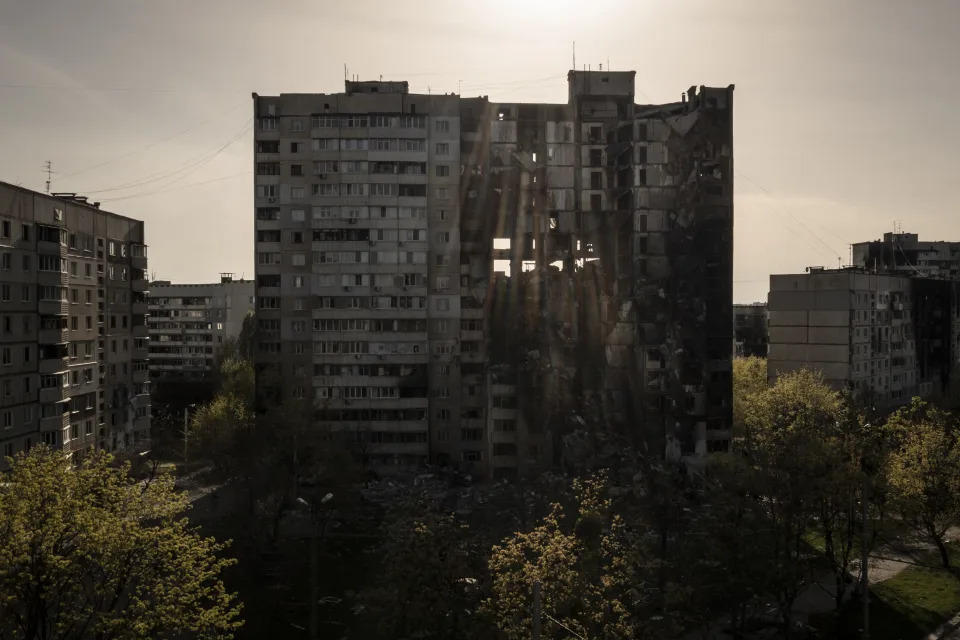
FILE - A building heavily damaged by multiple Russian bombardments stands near a frontline in Kharkiv, Ukraine, Monday, April 25, 2022. Ukraine's second-largest city, has been under sustained Russian attack since the beginning of the war in late February. (AP Photo/Felipe Dana, File)
FILE – A building heavily damaged by multiple Russian bombardments stands near a frontline in Kharkiv, Ukraine, Monday, April 25, 2022. Ukraine’s second-largest city, has been under sustained Russian attack since the beginning of the war in late February. (AP Photo/Felipe Dana, File)
ASSOCIATED PRESS
FILE - The body of a man killed during a Russian bombardment lies on a street in a residential neighborhood in Kharkiv, Ukraine, Tuesday, April 19, 2022. (AP Photo/Felipe Dana, File)
FILE – The body of a man killed during a Russian bombardment lies on a street in a residential neighborhood in Kharkiv, Ukraine, Tuesday, April 19, 2022. (AP Photo/Felipe Dana, File)
ASSOCIATED PRESS
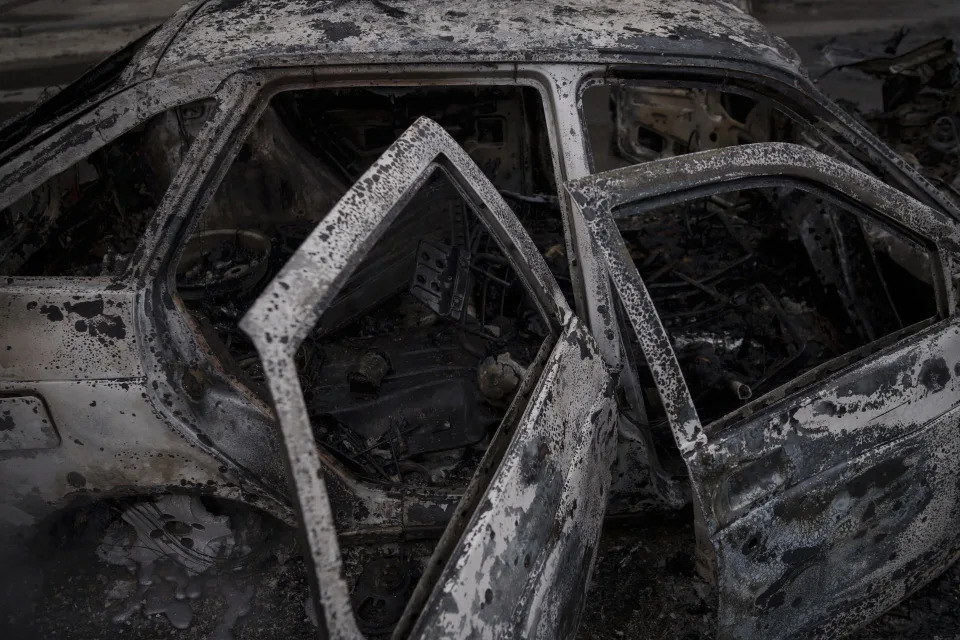
A charred car contains the remains of two people after Russian bombardment in Kharkiv, Ukraine, Thursday, April 21, 2022. Ukraine's second-largest city, has been under sustained Russian attack since the beginning of the war in late February. (AP Photo/Felipe Dana)
A charred car contains the remains of two people after Russian bombardment in Kharkiv, Ukraine, Thursday, April 21, 2022. Ukraine’s second-largest city, has been under sustained Russian attack since the beginning of the war in late February. (AP Photo/Felipe Dana)
ASSOCIATED PRESS
FILE - The body of a civilian lies in an apartment as Russian bombardments continue in a village recently retaken by Ukrainian forces near Kharkiv, Ukraine, Saturday, April 30, 2022. (AP Photo/Felipe Dana, File)
FILE – The body of a civilian lies in an apartment as Russian bombardments continue in a village recently retaken by Ukrainian forces near Kharkiv, Ukraine, Saturday, April 30, 2022. (AP Photo/Felipe Dana, File)
ASSOCIATED PRESS

KHARKIV, Ukraine (AP) — The outskirts of Kharkiv have the feel of an open-air morgue, where the dead lie unclaimed and unexplained, sometimes for weeks on end, as Ukrainian and Russian forces fight for control of slivers of land.

There is the charred body of a man, unidentifiable, propped on an anti-tank barrier made of crossed I-beams outside a town that has been under the control of both sides in recent days. There are the dead soldiers, apparently Russian, four of them arranged in a Z like the military symbol found on Russian armored vehicles, visible to the Russian drones that continuously buzz overhead. The door to an apartment opens to three bodies inside.

Precisely how any of this happened will likely never be known.

Kharkiv, Ukraine’s second-largest city, has been under sustained Russian attack since the beginning of the war in late February. With the Russian offensive intensifying in the east, the Russian onslaught has grown fiercer.

Considered a strategic and industrial prize, territory on the eastern city’s outskirts has gone back and forth between Russian and Ukrainian forces for weeks now as the fighting shifts from village to village. Many, but by no means all, of Kharkiv’s 1 million residents have fled.

Associated Press journalists saw the bodies formed into a Z, wearing the white arm bands commonly used by Russian soldiers, and with some Russian medical kits alongside them. They were found on a front line where fighting had been taking place for days. They, along with the burned man, were taken to a morgue on Monday. There was no explanation for the Z formation — a symbol of the Russian invasion — nor the burned body propped on the barrier. Either could be considered a war crime, for disrespecting the dignity of the dead.

Next will come the investigation into their identities, maybe an attempt to notify family.

But even that is hard to untangle. The body of a man with Ukrainian insignia turned out to have the identity papers of a Russian soldier. The apartment where the three bodies were found had been badly shelled, but it wasn’t clear what killed them.

Shelling and airstrikes are a daily threat everywhere here, to everyone. And, as long as that remains true, death can come at anytime, without anyone around to answer why.

It was a rare glimpse into the death and atrocities of the war. Getting a full picture of the unfolding battle in eastern Ukraine has been difficult because airstrikes and artillery barrages have made it extremely dangerous for journalists to move around. Russia has severely restricted reporting in the combat zone; Ukraine’s government has imposed fewer limits, mostly on how quickly material can be published or about military installations.

In Washington on Monday, a senior U.S. defense official said Ukrainian forces had over the last 48 hours succeeded in pushing Russian forces further away from Kharkiv, even as it came under Russian aerial bombardment. The Russians have now been pushed some 40 kilometers (25 miles) to the east of the city, further into the Donbas region, said the official, speaking on condition of anonymity to discuss the U.S. military assessment.

According to the Red Cross, mutilating dead bodies in international armed conflicts is covered by the war crime of “committing outrages upon personal dignity” under the Statute of the International Criminal Court, which according to the Elements of Crimes also applies to dead persons.

Associated Press Pentagon Writer Lolita Baldor in Washington contributed to this report.
War in Ukraine: First civilians evacuated from Azovstal steel plant in Mariupol

Yahoo! News

War in Ukraine: First civilians evacuated from Azovstal steel plant in Mariupol

Dylan Stableford, Senior Writer – May 2, 2022

Evacuation efforts are underway for hundreds of Ukrainian civilians who have been sheltering for months inside the Azovstal steel plant in the besieged city of Mariupol, officials said Monday.

The giant factory has become a symbol of Ukrainian resistance — and a key target of relentless Russian bombardment since the war started in February. Approximately 1,000 civilians have been sheltering in the tunnel complex underneath the plant, Ukrainian military officials say.

Last week, Ukrainian forces said that Russian troops had bombed a field hospital in the plant, and about 600 people, including civilians, were wounded in the attack.

A steel plant employee evacuated from Mariupol hugs her son in Bezimenne, Ukraine, on Sunday.
A steel plant employee evacuated from Mariupol hugs her son in Bezimenne, Ukraine, on Sunday. (Alexander Ermochenko/Reuters)

Ukrainian President Volodymyr Zelensky said that more than 100 civilians from the plant were expected to arrive in the nearby city of Zaporizhzhia on Monday.

“Today, for the first time in all the days of the war, this vitally needed green corridor has started working,” Zelensky said.

Previous attempts to open safe corridors out of the strategic port city have failed, with Ukrainian officials accusing Russian forces of shelling agreed-upon evacuation routes.

Video posted online Sunday showed Ukrainian forces helping women and children climb over a steep pile of rubble at the steel plant. They then boarded a bus, part of a United Nations-backed convoy organized to assist in the civilian evacuation.

A woman is seen being assisted during an evacuation of the Azovstal plant, in a still image from a video released by the Ukrainian military on Sunday.
A woman is seen being assisted during an evacuation of the Azovstal plant, in a still image from a video released by the Ukrainian military on Sunday. (David Arakhamia/Azov Regiment/Handout via Reuters)
Ukrainian forces walk with civilians during an evacuation of the Azovstal steel plant.
Ukrainian forces walk with civilians during an evacuation of the Azovstal plant. (David Arakhamia/Azov Regiment/Handout via Reuters)

According to Reuters, Russian forces resumed shelling the plant after the convoy of buses departed.

Hundreds of civilians who remain trapped in the Azovstal complex are said to be running out of water, food and medicine.

“The situation has become a sign of a real humanitarian catastrophe,” Ukrainian Deputy Prime Minister Iryna Vereshchuk said.

According to the U.N. Office of the High Commissioner for Human Rights, at least 2,899 civilians have been killed in Ukraine since Feb. 24, when Russia’s invasion began. But the agency believes the actual death toll is probably much higher.

The mayor of Mariupol has estimated that more than 20,000 civilians have been killed in his city alone. A Russian blockade has choked off food, water and other supplies from the once bustling seaport occupying a strategic position between the Russian mainland and the Crimean Peninsula, which Russia seized from Ukraine in 2014. The city is now reduced to rubble.

Ukraine formally closes seaports captured by Russia

Reuters

Ukraine formally closes seaports captured by Russia

May 2, 2022

FILE PHOTO: A view shows a port in Mariupol

KYIV (Reuters) – Ukraine has formally closed its four Black and Azov sea ports, which Russian forces have captured, the Ukrainian agriculture ministry said on Monday.

The Azov Sea ports of Mariupol, Berdiansk and Skadovsk and the Black Sea port of Kherson were closed “until the restoration of control”, the ministry said in a statement.

“The adoption of this measure is caused by the impossibility of servicing ships and passengers, carrying out cargo, transport and other related economic activities, ensuring the appropriate level of safety of navigation,” it said.

All Ukrainian seaports have suspended their activity as a result of the Russian invasion in late February. Russian forces captured some ports and blockaded others.

Ukrainian President Volodymyr Zelenskiy said on Monday Ukraine could lose tens of millions of tonnes of grain due to Russia’s control of Black Sea shipping, triggering a food crisis that will affect Europe, Asia and Africa.

“Russia does not let ships come in or go out, it is controlling the Black Sea,” Zelenskiy told the Australian news programme 60 Minutes.

“Russia wants to completely block our country’s economy.”

Russia calls its intervention in Ukraine a “special operation” to disarm Ukraine and protect it from fascists. Ukraine and the West say the fascist allegation is baseless and that the war is an unprovoked act of aggression.

Ukraine, a major agricultural producer, used to export most of its goods by sea but has been forced to switch to export by train via its western border or via its small Danube river ports.

The ministry said last week Ukraine’s grain exports had reached 45.709 million tonnes in the 2021/22, July-June season.

It said the volume included 763,000 tonnes exported in April but gave no comparative figures. Senior agriculture officials said this month that Ukraine exported up 300,000 tonnes of grain in March.

(Reporting by Pavel Polityuk; Editing by Robert Birsel)

Russian attacks on Ukraine grain network a move to cut competition- German minister

Reuters

Russian attacks on Ukraine grain network a move to cut competition- German minister

May 2, 2022

FILE PHOTO: A dockyard worker watches as barley grain is poured into a ship in Nikolaev

HAMBURG (Reuters) – Russian attacks on Ukraine’s grain infrastructure look like attempts to reduce the competition in Russia’s export markets, German Agriculture Minister Cem Oezdemir was reported as saying on Monday.

Ukraine could lose tens of millions of tonnes of grain due to Russia’s blockade of its Black Sea ports, triggering a food crisis that will hit Europe, Asia and Africa, President Volodymyr Zelenskiy said on Monday.

“We are repeatedly receiving reports about targeted Russian attacks on grain silos, fertilizer stores, farming areas and infrastructure,” Oezdemir was quoted as telling the Redaktionsnetzwerk Deutschland, a cooperation network of German regional newspapers.

Russia denies targeting civilian areas.

The suspicion is growing that Russian President Vladimir Putin is seeking “in the long term to remove Ukraine as a competitor”, Oezdemir was quoted as saying.

Russia and Ukraine are traditionally major competitors in global grains markets. Global wheat prices have risen about 40% since Russia’s Feb. 24 invasion of Ukraine cut supplies available on world markets from the Black Sea.

According to International Grains Council data, Ukraine was the world’s fourth-largest grain exporter in the 2020/21 season, selling 44.7 million tonnes abroad. The volume of exports has fallen sharply since the Russian invasion.

“With the increasing hunger in the world, Russia is seeking to build up pressure,” Oezdemir told the network. “At the same time, the massive increase in market prices is coming in handy for Russia because this brings new money into the country.”

Oezdemir said he would raise the question of how Ukraine could be helped to boost its grain exports at a meeting of G7 agriculture ministers in mid-May.

“We must seek alternative transport methods,” he said. “Railway transport could be a method of exporting more grain, although with much effort and with limited capacity.”

Germany would seek to give assistance, he added.

Ukraine has been gradually expanding grain exports using land transport to the European Union. But the different rail track widths in Ukraine and the EU mean Ukrainian trains cannot automatically operate on the European rail network.

Moscow calls its actions a “special military operation” to disarm Ukraine and rid it of anti-Russian nationalism fomented by the West. Ukraine and the West say Russia launched an unprovoked war of aggression that threatens to spiral into a much wider conflict.

(Reporting by Michael Hogan, editing by Nick Macfie)

Ukraine morning briefing: Five developments as Russia loses 65 per cent of ground combat strength

The Telegraph

Ukraine morning briefing: Five developments as Russia loses 65 per cent of ground combat strength

Our Foreign Staff – May 1, 2022

Civilians who left the area near Azovstal steel plant in Mariupol - REUTERS/Alexander Ermochenko
Civilians who left the area near Azovstal steel plant in Mariupol – REUTERS/Alexander Ermochenko

Good morning. More than a quarter of the 120 battalion units Russia committed to Ukraine have now been rendered “combat ineffective”, said the Ministry of Defence.

The losses represent approximately 65 per cent of Russia’s entire ground combat strength and include elite units.

“Some of Russia’s most elite units, including the VDV Airborne Forces, have suffered the highest levels of attrition. It will probably take years for Russia to reconstitute these forces.”

Meanwhile, the first evacuees evacuated from the ruined Azovstal steelworks in Mariupol were due to arrive in the Ukrainian-controlled city of Zaporizhzhia on Monday morning, said President Volodymyr Zelensky, after the UN confirmed a “safe passage operation” was in progress.

Ukrainian Deputy Prime Minister Iryna Vereshchuk said hundreds of civilians remain trapped in the steelworks in a situation that has “become a sign of a real humanitarian catastrophe”, as food, water and medicine becomes scarce.

Here’s what happened overnight.

1. Pelosi and other US lawmakers visit Kyiv with “Weapons, weapons and weapons.” in mind

Nancy Pelosi visited Kyiv on Saturday as the most senior American lawmaker to travel to Ukraine since Russia launched its invasion.

Accompanying her was Rep. Jason Crow, a US Army veteran and a member of the House intelligence and armed services committees, who said he was there with three things in mind: “Weapons, weapons and weapons.”

Ms Pelosi visit came just days after Russia launched rockets at the capital during a visit by UN Secretary-General Antonio Guterres.

RZESZOW, POLAND - MAY 01: Nancy Pelosi holds a press conference next to US members of congress after a visit to Kyiv in Rzeszow, Poland on May 01, 2022. (Photo by Stringer/Anadolu Agency via Getty Images) - Anadolu Agency
RZESZOW, POLAND – MAY 01: Nancy Pelosi holds a press conference next to US members of congress after a visit to Kyiv in Rzeszow, Poland on May 01, 2022. (Photo by Stringer/Anadolu Agency via Getty Images) – Anadolu Agency
2. Russian forces fire on Azovstal steel plant, CNN reports

Russian forces fired on the Azovstal steel plant in Mariupol again on Sunday night, breaking a ceasefire that has allowed around 100 people to be evacuated.

Speaking on local television, a Ukrainian soldier said the Russians were using “all kinds of weapons” to attack the steel plant, CNN reported.

The alleged attack followed the much-anticipated rescue of civilians from the besieged steelworks, where the last pocket of resistance remains in the city.

About 100 civilians were evacuated to safety on Sunday with further evacuations planned for Monday.

It is unclear whether the renewed attacks will hinder these plans, said CNN.

3. Russia strikes US weapons at airfield near Odesa, defence ministry says

Russia’s defence ministry said on Sunday it had struck at weapons supplied to Ukraine by the United States and European countries and destroyed a runway at a military airfield near the Ukrainian city of Odesa.

The ministry said it used high-precision Onyx missiles to strike the airfield, after Ukraine accused Russia of knocking out a newly-constructed runway at the main airport of Odesa.

Odesa regional governor Maksym Marchenko said Russia had used a Bastion missile, launched from Crimea.

The reports could not be independently verified.

4. Jill Biden to meet with Ukrainian refugees during visit to Romania and Slovakia

First lady Jill Biden will visit Romania and Slovakia from May 5-9 to meet with US service members and embassy personnel, displaced Ukrainian parents and children, humanitarian aid workers, and teachers, her office said on Monday

On Sunday, celebrated as Mother’s Day in the United States, Biden will meet with Ukrainian mothers and children who have been forced to flee their homes because of Russia’s war against Ukraine, her office said.

The wife of President Joe Biden will meet with U.S. military service members at Mihail Kogalniceau Airbase in Romania on May 6, before heading to Bucharest to meet with Romanian government officials, U.S. embassy staff, humanitarian aid workers, and teachers working with displaced Ukrainian children.

The trip also includes stops in the Slovakian cities of Bratislava, Kosice and Vysne Nemecke, where Biden will meet with government officials, refugees and aid workers, her office said.

First lady Jill Biden attends the annual White House Correspondents' Association dinner, Saturday, April 30, 2022, in Washington. (AP Photo/Patrick Semansky) - Patrick Semansky /AP
First lady Jill Biden attends the annual White House Correspondents’ Association dinner, Saturday, April 30, 2022, in Washington. (AP Photo/Patrick Semansky) – Patrick Semansky /AP
5. Russia swerves to avoid default

Russia may have averted default as it announced it had made several overdue payments in dollars on its overseas bonds, shifting the market’s focus to upcoming payments and whether it would stave off a historic default.

Russia’s $40 billion in international bonds and the chance of a default have become the focus of global financial markets since it was hit with sanctions from the United States and its allies after its invasion of Ukraine in late February.

Dubbed a “special military operation” by Russia, the invasion has turned Russia into a pariah, including in financial markets, and has entangled its ability to pay its debts.

The chance of default dramatically increased in early April when the United States stopped the Russian government from using frozen reserves to pay some $650 million to its bondholders.

Russian rouble banknotes - REUTERS/Kacper Pempel//File Photo
Russian rouble banknotes – REUTERS/Kacper Pempel//File Photo

A Russian general who commanded electronic warfare units was killed in a strike that killed 100 soldiers, top Ukraine official says

Business Insider

A Russian general who commanded electronic warfare units was killed in a strike that killed 100 soldiers, top Ukraine official says

Alia Shoaib – May 1, 2022

Ukrainian soldiers stand on an armoured personnel carrier (APC), not far from the front-line with Russian troops, in Izyum district, Kharkiv region on April 18, 2022.
Ukrainian soldiers stand on an armoured personnel carrier (APC), not far from the front-line with Russian troops, in Izyum district, Kharkiv region on April 18, 2022.Anatolii Stepanov/AFP via Getty Images
  • Another Russian general has been killed in Ukraine, authorities claim.
  • Maj. Gen. Andrei Simonov was reportedly killed in an attack on a Russian command post near the city of Izyum.
  • The general, who commanded electric warfare units, was among 100 Russian servicemen killed.

Russia has lost another general in Vladimir Putin’s invasion of Ukraine, according to top Ukrainian officials, The Kyiv Post has reported

Maj. Gen. Andrei Simonov was killed near the city of Izyum in the Kharkiv region, which is currently occupied by Russian forces, Ukrainian authorities said.

The Ukrainian military attacked a field command post of the Russian 2nd Army on Saturday, striking more than 30 Russian armored vehicles, including tanks, according to the paper.

Footage posted on social media appears to show the command post being bombarded by rockets, said the Kyiv Post.

The general was among 100 Russian soldiers killed in the attack, President Zellenskyy’s military adviser Oleksiy Arestovych said, according to The Kyiv Post. Arestovych said well-placed army sources had confirmed the death of Maj. Gen. Simonov in a YouTube interview, per the Mail Online.

The claims by the Ukrainian authorities have not been independently verified.

Russia has not as of yet confirmed the death of Maj. Gen. Simonov.

Simonov was a senior commander of electronic warfare, Ukrainian government advisor Anton Gerashchenko said on his Telegram account.

His death would make him the tenth Russian general to die in Ukraine, according to a count by The Kyiv Post.

Russia has suffered heavy losses since it began its invasion of Ukraine on February 24, losing many of its top generals and commanders.

NATO estimates that Russia has lost up to 15,000 troops during the war, while Ukraine claims to have killed nearly 20,000.

Russia has put its official death toll in Ukraine at 1,351, which was last updated on March 25.

Pelosi pledges U.S. support on visit to Ukraine; civilians evacuated from Mariupol

Reuters

Pelosi pledges U.S. support on visit to Ukraine; civilians evacuated from Mariupol

April 30, 2022

KYIV/BEZIMENNE, Ukraine (Reuters) -Around 100 Ukrainian civilians were evacuated from the ruined Azovstal steelworks in the city of Mariupol on Sunday, Ukrainian President Volodymyr Zelenskiy said, after the United Nations confirmed a “safe passage operation” was in progress there.

The strategic port city on the Azov Sea has endured the most destructive siege of the war with Russia – now in its third month – with Pope Francis, in an implicit criticism of Moscow, telling thousands of people in St Peter’s Square on Sunday it had been “barbarously bombarded”.

“For the first time, we had two days of a ceasefire on this territory, and we managed to take out more than 100 civilians – women, children,” Zelenskiy said in a nightly video address.

The first evacuees would arrive in the Ukrainian-controlled city of Zaporizhzhia on Monday morning, he said, adding that he hoped conditions would continue that allowed for more people to be evacuated.

With fighting stretching along a broad front in southern and eastern Ukraine, U.S. House of Representatives Speaker Nancy Pelosi pledged continued U.S. support for Ukraine “until victory is won” after she met Zelenskiy in an unannounced visit to Kyiv.

Russia’s military has turned its focus to Ukraine’s south and east after failing to capture Kyiv in the early weeks of a war that has flattened cities, killed thousands of civilians and forced more than 5 million to flee the country.

In Mariupol, Moscow declared victory on April 21 even as hundreds of holdout Ukrainian troops and civilians took shelter in the Azovstal steelworks, a vast Soviet-era complex with a network of bunkers and tunnels, where they have been trapped with little food, water or medicine.

Negotiations to evacuate the civilians had repeatedly broken down in recent weeks, with Russia and Ukraine blaming each other.

But on Sunday, more than 50 civilians arrived at a temporary accommodation centre after escaping from Mariupol, a Reuters photographer said.

The civilians arrived on buses in a convoy with U.N. and Russian military vehicles at the Russian-held village of Bezimenne, around 30 km (18 miles) east of Mariupol, where a row of light blue tents had been set up.

One of the evacuees, Natalia Usmanova, 37, said she had been so terrified as Russian bombs rained down on the plant sprinkling her with concrete dust that she felt her heart would stop.

“When the bunker started to shake, I was hysterical. My husband can vouch for that. I was so worried the bunker would cave in,” she told Reuters in Bezimenne.

A spokesperson for the U.N. Office for the Coordination of Humanitarian Affairs said a “safe passage operation” had started on Saturday and was being coordinated with the International Committee of the Red Cross, Russia and Ukraine.

He said no further details could be released so as not to jeopardise the safety of evacuees and the convoy.

Denys Shleha, commander of Ukraine’s 12th National guard brigade, speaking to television on Sunday from the Azovstal plant, said several hundred civilians remained in bunkers there, including about 20 children, and that one or two additional evacuation efforts of similar scale would be needed.

Russia’s defence ministry said 80 civilians had been evacuated from the plant.

A plan to evacuate civilians from areas of the devastated city outside the steelworks had been postponed to Monday morning, Mariupol’s city council said.

U.S. ‘STANDS WITH UKRAINE’

Footage posted by Zelenskiy on Twitter on Sunday showed him, flanked by an armed escort and dressed in military fatigues, greeting a U.S. congressional delegation led by Pelosi outside his presidential office the previous day.

“We stand with Ukraine until victory is won. And we stand with our NATO allies in supporting Ukraine,” Pelosi, the highest ranking U.S. official to visit Ukraine since Russia invaded on Feb. 24, said on Sunday at a press briefing in Poland.

Zelenskiy praised as substantive four hours of talks with Pelosi focused on U.S. weapons deliveries, adding he was grateful to all of Ukraine’s partners who visit Kyiv at such a difficult time.

U.S. Senate Democratic leader Chuck Schumer said in New York he would add provisions to a $33 billion Ukraine aid package to allow the United States to seize Russian oligarchs’ assets and send money from their sale directly to Kyiv.

President Joe Biden asked Congress to approve the aid package on Thursday in what would mark a dramatic escalation of U.S. funding for Ukraine.

Biden spoke with Pelosi on Sunday about her trip, a White House official said without elaborating.

Moscow calls its actions a “special military operation” to disarm Ukraine and rid it of anti-Russian nationalism fomented by the West. Ukraine and the West say Russia launched an unprovoked war of aggression.

Russia’s Foreign Minister Sergei Lavrov said Moscow was not demanding that Zelenskiy “give himself up” as a condition for peace.

“We are demanding that he issue an order to release civilians and stop resistance. Our aim does not include regime change in Ukraine,” Lavrov said in a media interview published on his ministry’s website.

EASTERN PUSH

In the east, Moscow is pushing for complete control of the Donbas region, where Russian-backed separatists already controlled parts of Luhansk and Donetsk provinces before the invasion.

On Sunday, Kharkiv region governor Oleh Synehubov warned residents in the north and east of the city of Kharkiv to remain in their shelters due to heavy Russian shelling. Reuters could not immediately verify reports of shelling in the area.

Serhiy Gaidai, governor of the Luhansk region, in a social media post, urged people to evacuate while it was still possible.

Ukraine’s military said Russian forces were fighting to push north from Kherson to the cities of Mykolayiv and Kryvyi Rih, and Zelenskiy said Russian troops continued to launch strikes on residential areas and had destroyed grain storage depots.

“This will only build up the toxic attitude to the Russian state and increase the numbers of those working to isolate Russia,” Zelenskiy said.

(Reporting by Hamuda Hassan and Jorge Silva in Dobropillia, Ukraine, and Natalia Zinets in Kyiv; Additional reporting by Reuters journalists; Writing by Clarence Fernandez, Frances Kerry, Alex Richardson and Michael Martina; Editing by David Goodman, Alexandra Hudson, Angus MacSwan, Daniel Wallis and Diane Craft)