Putin has become a problem. The main indicator of Russia’s defeat

The New Voice of Ukraine

Putin has become a problem. The main indicator of Russia’s defeat

May 6, 2022

A process that began on April 24 during Ukrainian President Volodymyr Zelensky’s historic meeting with the head of the U.S. State Department Antony Blinken and U.S. Secretary of Defense Lloyd Austin in Kyiv continued throughout the last week.

It included a meeting in the U.S. Ramstein airbase of the defense ministers of the 40 most industrial powers in the world. They, in fact, entered into a military alliance in support of Ukraine. The West has finally clearly formulated its goals.

Read also: Soviet identity is gone forever, but Putin doesn’t get it

When asked what the purpose of the war was, Austin replied: “The purpose of the war for the United States is the victory of Ukraine. Restoration of its territorial integrity, and that Russia, as a result of the war, is weakened to the degree that it can’t do the kinds of things that it has done in invading Ukraine.”

That is, the West has already formulated a program not only for the victory of Ukraine in the war but also for the post-war structure. This is a common practice after world wars, but in essence, this is not a Russo-Ukrainian war, this is a world war that the insane dictator Putin declared against the entire West and the free world. After the world war, the victorious powers form a new world order. And now Ukraine will be the main victorious power in this process.

During these two months of the war, the Americans spent a long time hesitating, they were cautious. But, in the end, with its heroic resistance, Ukraine, as it were, pushed them back into the arena of world politics, which they were almost about to leave. After such a reputational disaster as Afghanistan, the dictators of the world were sure that two more blows needed to be struck — to conquer Ukraine and Taiwan. Then the West and the United States would be completely discredited, and entirely different orders would reign in the world.

However, the heroic resistance of Ukraine has prevented this scenario. The free world has gone on the attack, and the West has overcome its fear of nuclear blackmail, which Putin has used quite effectively for himself for 15 years. He constantly threatened to use tactical nuclear weapons in the war with NATO, hoping that NATO would get scared and retreat in horror. He was dealt an answer.

Read also: Amnesty International says Russian invaders must face justice for war crimes in Kyiv Oblast

Chairman of the Joint Chiefs of Staff Mark Milley called General Valery Gerasimov and made it clear to him, to tell his boss that they will not retreat, they will not capitulate, but on the contrary, they will retaliate with a nuclear strike. So don’t even think about resorting to nuclear weapons. U.S. Under Secretary of State for Political Affairs Victoria Nuland was even more straightforward. The West got rid of this fear of nuclear blackmail, and clearly defined its program — victory over Putin’s fascist Russia.

If we consider the significant events of recent days, then the indicator of the largest political defeat of Russia was the position of Israel. Which, in response to Sergei Lavrov’s anti-Semitic attacks is taking a tougher stand in the face of Russia.

It is removing restrictions on the transfer of military technology and assistance to Ukraine. Many did not notice, but Israel participated in the meeting in Ramstein. This is very important. Israel has technology that the Americans cannot provide.

In turn, China, although it continues a cold war with the United States, is not going to rush to the aid of the Russian Federation. It primarily protects its own interests. What is happening suits Beijing — weakening, isolated from the West, from all modern technologies, financial resources, Russia is rapidly becoming easy prey.

No one in China, not one of the 1.5 billion Chinese who are taught from school textbooks, forgets what vast territories of Siberia and the Far East are inherent Chinese territories, torn away from it by the tsarist government in the 19th century. And it is waiting for the return of these territories — as they like to say in Moscow — to their native, not Russian, but Chinese harbor.

Watching all this, powerful people in the Kremlin are becoming a danger for Putin. Influential people outside the Kremlin do not pose a danger for him. The soldiers included. Let’s not delude ourselves: they are not liberals, but the same Russian imperialists, they would not mind snatching off some piece of Ukraine. But even before the start of the war, retired generals warned Putin that the occupation of Ukraine was a fool’s errand. And everything that is happening confirms it.

Now Putin has become the main problem of the Russian authorities and the mafia group that is in power. He is destroying the country, which is a source of food for them, where they had it made.

I think they are now considering very seriously the question of the possible removal of Putin from power. And each new success of Ukraine at the front (and these successes will sharply increase in two weeks, when the most modern weapons in the world will arrive in full), pushes them to this decision. It’s inevitable.

Some say they are even worse than Putin. But it is not a question of who is good or bad. The question is who will sign the surrender. There is such a thing as military logic, and the victory of Ukraine is unavoidable. Putin only hinders them in this process.

And do not forget about the goals of the war, which are declared by the entire world community — to weaken Russia so that it will never be able to repeat this aggression again. Therefore, after the war, both Ukraine and the rest of the world will not rely on good or bad Russian leaders. They will create conditions so that no leaders, good or bad, can ever commit aggression against neighboring countries from the territory of the Russian Federation.

‘If I panic it will be worse.’ In Donbas, weary civilians try to cope.

The Christian Science Monitor

‘If I panic it will be worse.’ In Donbas, weary civilians try to cope.

Scott Peterson – May 6, 2022

The well-worn Ukrainian settlement a few miles west of Kramatorsk is in the direct line of a Russian troop advance. But Anna Lunina – with her three youngest children playing around her – is determined to remain composed.

As an explosion sounds just over the horizon, her daughter Yulia, 9, reacts by throwing up her arms in mock not-again exasperation, a single braid of black hair bouncing as she glances up to the sky with a look of trepidation that seems more real.

“This is the guys saying, ‘Hello.’ It can start at 5 a.m. and go all day,” says Ms. Lunina, of the “noisy” shelling that has increased here and all along the arc of the Donbas front lines in eastern Ukraine, as Russian forces bid to encircle this industrial heartland.

“I try to be calm and not panic,” says the lanky mother of five in a “Star Wars” T-shirt, as her youngest son, Ruslan, 5, demands a hug. “They cry, but if I panic it will be worse.”

Three more booms reverberate loudly across the budding greenery of the early spring landscape, where rutted mud roads have finally dried.

“This is quiet – they are just starting,” mutters Ms. Lunina. “When the windows shake or the doors open, then we go to the bunker.”

Ukrainians in the Donbas are used to conflict, and have weathered war since 2014, when Russian-backed separatists seized portions of Luhansk and Donetsk. But the Russian invasion of Ukraine that began 72 days ago is of a different magnitude, and is redefining the lives of those few who remain here.

From church faithful, who distribute food and organize evacuations, to police officers registering an uptick in murders – and even ordinary citizens just trying to cope with panic and paranoia – all describe communities under extraordinary and increasing pressure.

“No safe place”

For these Donbas residents, the April 8 Russian attack on the Kramatorsk railway station, when it was heaving with several thousand would-be evacuees, was a shared and galvanizing event. Russian cluster munitions killed some 59 civilians, replacing any lingering sense of invincibility with a new and harrowing vulnerability.

“We understood that there is no safe place at all,” says Evhen Pavenko, an official of the Ark of Salvation Pentecostal church, which is housed in a Soviet-era theater near the train station, and has become a humanitarian aid hub and bomb shelter.

In his wallet, Mr. Pavenko carries a sharp piece of shrapnel the size of a fingertip, one that burst from the Russian cluster munition. It reminds him of why he saw so many dead Ukrainians on the train platform that day.

“It’s really hard to gather people to evacuate now, because everyone is hesitating,” he says.

At the station, he points out the blast pattern of one impact on the train platform, near where cloth flowers in the Ukrainian national colors of blue and yellow are tied to a rail, amid several children’s toys.

“I’m very surprised I was not traumatized in my soul,” says Mr. Pavenko. “There were many, many dead here.”

Hard times, at night

Among the casualties that day was Maryna, a 30-something mother trying to flee the Donbas with her two daughters. Yulia, 8, was untouched but traumatized by the explosions, and could not speak for hours afterward. Katya, 12, was severely wounded but survived, because a man threw himself on top of her before he died himself.

“He saved Katya,” says the girls’ grandmother, Nina Lialko, speaking in the town of Druzhkivka, south of Kramatorsk. The English teacher is distraught as she describes Katya’s multiple surgeries.

“After the death of my daughter, I am not afraid of anything,” says Ms. Lialko. She was the only person at Maryna’s funeral, and won’t leave the Donbas now. “It is very difficult, especially at night, alone, and I feel awful,” she says.

Dasha Serokurova says those moments at night were also the most difficult moments for her mother, who finally last week boarded a dawn evacuation van from Druzhkivka.

“From the very beginning, she was very anxious,” says Ms. Serokurova, wiping away tears as she waved goodbye to her mother. “With every air raid siren she would go to the shelter, which made her more nervous.”

The exodus of 70% to 80% of the prewar population has given these sandbagged and boarded-up Donbas cities the feel of ghost towns, adding to the sense of isolation for those who stay.

Members of the Protestant Church of Good Hope, who organize evacuations from Druzhkivka, say they used to do larger, daily runs of evacuees to the Kramatorsk rail station, until it was targeted.

They have replaced fear with faith, as risks increase. Several took part in rescue efforts at Kramatorsk, and have been thanked for providing aid and even coffins.

“We are believers, people of faith,” says Olena Severyna. “We trust God. We pray every day that, with God’s will, there won’t be a hair that falls from our head.”

“Of course we are afraid and nervous, but we are trying to concentrate on our work,” says her husband, Serhii Severyn.

Pro-Russian sentiment

Adding to the pressure has been continued, local pro-Russian sentiment, despite evident Russian military brutalities on front lines across Ukraine.

“They watch Russian TV, and believe that Ukrainians are attacking themselves,” says Petro Serhiievsky, who works for the Druzhkivka City Council. “Russian propaganda is very, very powerful” in the Donbas, as in Russia, he says.

“I am very surprised. There are still people here who do not feel anything, are not empathetic,” says Mr. Serhiievsky. In one example, during Easter, he says several pro-Russian residents broke curfew, set up a table outside, and drank noisily. They only stopped when soldiers came and shot into the air.

Yet Mr. Severyn says he knows how the anti-Ukraine propaganda works, after living in Russia in 2012. “They used to show the Ukrainian government and activists as fascists, so it has been a decade,” he says of Russia’s self-declared “denazification” mission in Ukraine.

The result of the increased pressure in these towns is plain to see, according to police in Druzhkivka. Burglaries are up, and there have been two homicides in the past two weeks – one of a man who refused to hand over his car for an evacuation. He was killed with a hammer.

“Usually we have one murder a year,” says the head of the police station, who gave the name Dmytro. The police also caught an infiltrator whose tracking of Ukrainian troop movements led to a Russian attempt to strike a military convoy.

“We are trying to encourage people to leave,” says Dmytro. A “precise hit” on the power station that day, he says, which knocked out electricity for hours and played havoc with phone signals, is a sign that “it is not as safe as it was.”

The rising tide of uncertainty is raising levels of fear. At a food distribution in Kramatorsk, for example, where dozens of people wait outside an apartment block to receive potatoes, tinned food, and other staples from a church charity, a woman in a blue puffer jacket sidles up to a visitor with a camera and asks that photos not be taken.

“These photos can be used by Russians to target this place,” says the woman, who gave the name Nadiya. “A lot of people posted on social media the evacuations at the Kramatorsk train station, which assisted the attack.

“I don’t want to be targeted. This is no use to your job, or to us,” says the woman, her gray hair pulled back by a large purple hair clip. An air raid siren starts its wail.

“I wasn’t at the railway station, but I was very close. I’m very scared after that,” says Nadiya. “People are different now. I can tell even by the people standing here: People who had anxiety before, it’s increased a lot.”

Puppies to play with

Among those carrying their food from that distribution point up the sidewalk is the family of Anna Lunina. The day of the railway bombing, they were waiting for a bus that would have delivered them to a stop across the street from the blast – but by chance it was delayed.

Now they are at home, listening to jet fighters overhead, and trying to determine if the explosions are getting closer. Last week, a neighbor buried a soldier son.

Children Yulia and Maksym, 8, take the steps down into the concrete cellar out back – built with the Stalin-era house in 1944 as winter storage for vegetables. It now doubles as the family shelter: Plywood on tires form three beds, and there is some food, jugs of water, and even a homemade antenna for a small TV screen.

Yulia complains that most of her friends have left, so “there is no one to play with.”

But there are three new puppies, which arrived soon after the start of the Russian invasion, and have wartime names: Bullet, Powder, and Hurricane – the latter for a multiple rocket system.

When were they born? Ms. Lunina jokes, “Probably at the first explosion.”

Reporting for this story was supported by Oleksandr Naselenko.

How Ukraine equalizes the battlefield

The Christian Science Monitor

How Ukraine equalizes the battlefield

The Monitor’s Editorial Board – May 6, 2022

On May 9, Moscow will again celebrate Victory Day, marking the 1945 defeat of Nazi Germany, but this year’s military display in Red Square will be more subdued than in past years. One reason is that the invasion of Ukraine has not gone well. Ten weeks into the war, the Kremlin may be wondering why some 200,000 Russian soldiers and better armaments have not defeated a much smaller enemy.

A big reason is that Russia’s superior numbers are no match for the superior motives of Ukrainian fighters. Not only are Ukrainians defending their country’s sovereignty and know their terrain well; they are more certain than Russian soldiers that they reflect the qualities of their society, such as equality-based rule of law.

While both nations have compulsory military service, far more of Russia’s troops are drafted, many of them unwilling conscripts in a war they barely understand. Bribery to evade the draft is common in Russia. In Ukraine’s army, forced conscription has been rare during the war because of a rush of volunteer fighters. The country’s democratic reforms have reduced corruption in the military and allowed commanders to grant more freedom for officers to act on their own. Valeriy Zaluzhnyy, the commander in chief of the Ukrainian armed forces, tells officers to “turn your face to the people, to your subordinates.”

The ability of Ukraine’s soldiers to collaborate and improvise comes out of the country’s young democracy. As President Volodymyr Zelenskyy told The Economist last month, “It’s not about who has more weapons or more money or gas or oil, et cetera. And that’s why we have to have agency. That’s what I understood, the first thing that I understood, that we the people have [agency]. People are leaders.”

If history is any guide, Ukraine will win this war. In their 2002 book, scholars Dan Reiter and Allan C. Stam looked at wars since 1815 and found that democracies won more than three-quarters of them. One reason: An emphasis on individual liberties and rights results in better leadership in warfare. So far, Ukraine’s battlefield victories fit the book.

Ex-spies and diplomats say the Biden administration needs to ‘shut-up’ after NYT report about US intelligence helping Ukraine kill Russian generals

Business Insider

Ex-spies and diplomats say the Biden administration needs to ‘shut-up’ after NYT report about US intelligence helping Ukraine kill Russian generals

John Haltiwanger – May 6, 2022

Putin Shoigu Gerasimov
Russian President Vladimir Putin with Russian Defense Minister Sergei Shoigu and Gen. Valery Gerasimov, Chief of the Russian military’s General Staff, September 13, 2021.Kremlin Press Office / Handout/Anadolu Agency via Getty Images
  • Ex-US officials said the Biden administration needs to “shut-up” about intelligence sharing with Ukraine.
  • This came after a NYT report said US intel was helping Ukraine kill Russian generals.
  • A veteran diplomat said discussing intelligence used for targeting would bolster Putin’s propaganda about Russia being a victim.

Former US officials and diplomats in recent days have sharply criticized the Biden administration over a New York Times report based on conversations with senior officials that said US intelligence was helping Ukraine kill Russian generals.

“Shut up about it,” John Sipher, a former CIA officer who served in Russia, said in a tweet on the Times report.

Michael McFaul, a former US ambassador to Russia, in a tweet responding to Sipher said, “Exactly. No one should be talking to press about such things.”

Striking a similar tone, former US diplomat Aaron David Miller tweeted that the “whole shift in tone” following Secretary of State Antony Blinken and Defense Secretary Lloyd Austin’s visit to Ukraine is “worrisome.”

“Weakening Russia; winning; and now stories @NYT about killing Russian generals. Why can’t we just shut up?” Miller said.

The intel-sharing reports by the NYT and NBC News suggested, without specifying, that the US shared intelligence so precise — such as high-resolution images or transmissions made by radars or radios — that the Ukrainian military could use it to plan strikes. The NYT reported that the “White House finds some value in warning Russia that Ukraine has the weight of the United States and NATO behind it,” but the Pentagon insisted that it doesn’t provide the location of Russian generals to Ukraine and has no role in Ukrainian decisions about where to strike.

After a trip to Kyiv last month, Austin told reporters, “We want to see Russia weakened to the degree that it can’t do the kinds of things that it has done in invading Ukraine.”

Austin’s frank comments came a few weeks after President Joe Biden was accused of calling for regime change in Russia after he said Russian President Vladimir Putin “cannot remain in power.” The White House scrambled to clarify the Biden’s remarks, stating, “The president’s point was that Putin cannot be allowed to exercise power over his neighbors or the region. He was not discussing Putin’s power in Russia or regime change.”

Following up on Austin’s comments, a National Security Council spokesperson in a statement to CNN said, “We want Ukraine to win,” adding, “One of our goals has been to limit Russia’s ability to do something like this again, as Secretary Austin said. That’s why we are arming the Ukrainians.”

The Russian warship "Moskva" ("Moscow"), a Slava class guided missile cruiser, off the Black Sea shore in 2014.
The Russian warship “Moskva” (“Moscow”), a Slava class guided missile cruiser, off the Black Sea shore in 2014.Darko Vojinovic/Associated Press

On the heels of the bombshell Times story, a separate report from NBC News said that US intelligence also helped Ukraine sink the Moskva — a guided missile cruiser and the flagship of Russia’s Black Sea fleet.

Richard Haass, a veteran diplomat and president of the Council on Foreign Relations, in a tweet responding to reports on the Moskva said he couldn’t “fathom why US officials are discussing US helping Ukraine sink Russian ships or kill its generals.”

Haass warned that “this bolsters Putin’s narrative that Russia is a victim” while distracting “attention from the reality of Russian aggression and its incompetence vs Ukraine.”

The Biden administration has forcefully pushed back on the notion it has explicitly provided intelligence to Ukraine for the purpose of taking out specific people or targets.

National Security Council spokesperson Adrienne Watson on Wednesday said the Times report was framed in an “irresponsible” way.

“The United States provides battlefield intelligence to help the Ukrainians defend their country. We do not provide intelligence with the intent to kill Russian generals,” Watson added.

Similarly, Pentagon spokesperson John Kirby on Thursday said the US doesn’t “provide intelligence on the location of senior military leaders on the battlefield or participate in the targeting decisions of the Ukrainian military.”

Kirby in a statement said the US didn’t provide Ukraine “specific targeting information for the Moskva,” per NBC.

“We were not involved in the Ukrainians’ decision to strike the ship or in the operation they carried out,” Kirby went on to say, adding, “We had no prior knowledge of Ukraine’s intent to target the ship. The Ukrainians have their own intelligence capabilities to track and target Russian naval vessels, as they did in this case.”

The Biden administration said the reports on US intel sharing were a result of leaks. “Leaks like this and stories like this, they’re unhelpful to the effort to help Ukraine defend itself,” Kirby told CNN on Friday morning.

—Brianna Keilar (@brikeilarcnn) May 6, 2022

Meanwhile, Kremlin spokesperson Dmitry Peskov seemed to brush off the reports on US intelligence sharing with Ukraine.

The Russian military is “well aware that the United States, Great Britain and NATO as a whole are constantly transmitting intelligence and other parameters to the Ukrainian armed forces,” Peskov told reporters on Thursday, Reuters reported.

Peskov said that the intelligence sharing, combined with the weapons the West is giving Ukraine, doesn’t “contribute to the quick completion” of Russia’s war. But he added that it also won’t hinder Russia’s ability to achieve its goals in Ukraine.

Contrary to Peskov’s claims, which were in line with Moscow’s rosy propaganda on the war, the Russian military has struggled to make any significant gains in Ukraine since Putin ordered the invasion in late February. Russia is estimated to have lost up to 15,000 troops. After failing to take Kyiv, Russia has turned its attention to the eastern Donbas region.

Putin’s Private Army Accused of Raping New Moms on Maternity Ward

Daily Beast

Putin’s Private Army Accused of Raping New Moms on Maternity Ward

Philip Obaji Jr. – May 6, 2022

Photo Illustration by Luis G. Rendon/The Daily Beast/Getty/Security Service of Ukraine

ABUJA, Nigeria—Russian mercenaries from the notoriously brutal Wagner Group, which some have called Vladimir Putin’s “private army,” allegedly raped women admitted to a maternity ward in a hospital in the Central African Republic (CAR), according to military officials who spoke to The Daily Beast.

On the night of April 10, three Russian mercenaries from the Wagner Group, which is also active in Ukraine right now, allegedly staged the attacks at a hospital in the Henri Izamo military camp in the capital Bangui.

Officials, who are stationed in CAR’s military headquarters but keep an eye on the activities of so-called Russian “military instructors,” told The Daily Beast that the men forced themselves on women—a couple of whom had just given birth—who were receiving treatment in the infirmary’s maternity ward.

“[The military headquarters] received a report last month from the [hospital] center detailing how three Russian instructors stormed the maternity ward and began to sexually assault women on admission,” one of the officials told The Daily Beast on the condition of anonymity, as he wasn’t authorized to speak to the press.

Many of the mercenaries operating in Africa under Wagner—a private military company run by Yevgeny Prigozhin, one of President Putin’s closest associates—were withdrawn to help fight the war in Ukraine—as first reported by The Daily Beast—but there are still plenty in operation on the continent.

Notorious Russian Mercenaries Pulled Out of Africa Ready for Ukraine

“Among the victims, the military was informed, are two mothers who had just given birth to babies and health workers on duty,” said the official, who added that the military “is convinced that the report is genuine.”

Another official in CAR’s military headquarters with knowledge of the operations of Wagner mercenaries in the restive African nation told The Daily Beast that it was the third time the military had received a report about Russian mercenaries invading the maternity ward of the infirmary and sexually assaulting women.

On all three occasions, according to the official, investigators found the allegations to be “genuine,” but taking action against the mercenaries was almost impossible as officers are “scared of angering the Russians.”

A human rights campaigner who has spoken to a victim of a previous rape at the Henri Izamo military camp informed The Daily Beast that the Russian mercenaries who assaulted her when she was receiving treatment at the infirmary sometime last year arrived late at night, dragged her out of her bed, and began to rape her on the floor.

“She was so sick and was sleeping when the Russians arrived,” said Cédric Niamathé, a Bangui-based human rights activist who helps connect victims of various abuses to human rights lawyers. “All she could remember was opening her eyes and seeing a naked white soldier, who had covered her mouth with his hand, on top of her, raping her.”

A couple of regional publications—quoting eyewitnesses—have given accounts of how the most recent incident occurred.

HumAngle, a West and Central Africa focused news site headquartered in Nigeria, quoted a gendarme who was on duty on that day as saying that the Russians arrived at the infirmary’s maternity ward “with pistols and whisky in their hands” and met the two women who had just given birth, as well as some other female health workers, in the room.

“They started indecently touching the women and signaling for sex from the two women who had just put to bed,” said the gendarme. He also alleged that the Russians tried to rape the nurse on duty who had confronted them saying the women had just given birth and still had blood on them. “She struggled to free herself [and] ran to the labour room,” he reportedly said.

“As this was going on,” said the gendarme, a “nurse aide who happened to be an adjudant-chef (Chief Warrant Officer) and who was still in the maternity tried to beg the Russians to be human but they turned on her and sexually abused her one after the other.”

Corbeau News Centrafrique, one of CAR’s well-known independent news outlets, which spoke to an eyewitness, reported that the sexual assault on the nurse aide lasted for hours, with each mercenary allegedly taking turns to abuse her. The news outlet also reported that one of the women who had just given birth said her ordeal was painful and humiliating.

Victims of rape hardly ever get justice in CAR. Over four years ago, Human Rights Watch documented 305 cases of rape and sexual slavery carried out against women and girls by members of armed groups between early 2013 and mid-2017. Of the 296 victims interviewed, only 11 of the 296 women interviewed said they made an attempt to file a criminal complaint. No members of armed groups was ever arrested or tried for committing sexual violence, according to the organization. Instead, the number of victims continued to grow.

In 2020, the Gender-Based Violence Information Management System—a monitoring system maintained by humanitarian partners including UNFPA—recorded 2,281 cases of sexual violence. More than a third of those brutalities were committed by members of armed groups.

As for those women reported to have been raped at the Henri Izamo military camp by Wagner mercenaries, there would be no surprise if justice isn’t served. Even those with the power to either take action or recommend that action be taken are unconvinced that anyone will be punished.

“Disciplining a Russian instructor who has committed a crime is not what the military can confidently act on,” a senior CAR military official told The Daily Beast privately. “Only the president can decide on how to deal with the Russians.”

Russian soldiers accused of raping women, men and children in Ukraine

Yahoo! News

Russian soldiers accused of raping women, men and children in Ukraine

Garin Flowers, National Reporter and Producer – May 6, 2022

Amid the devastation wrought by Russia’s invasion of Ukraine, accusations are emerging that Russian soldiers are raping and sexually assaulting women and girls, according to multiple authorities.

This week Ukraine and United Nations officials addressed new information that men and boys are also reporting rape by Russian soldiers.

“I have received reports, not yet verified … about sexual violence cases [involving] men and boys in Ukraine,” said Pramila Patten, United Nations special representative on sexual violence in conflict, at a press conference Tuesday in Kyiv.

She continued: “It’s hard for women and girls to report [rape] because of stigma amongst other reasons, but it’s often even harder for men and boys to report … we have to create that safe space for all victims to report cases of sexual violence.”

U.N. Special Representative on Sexual Violence in Conflict Pramila Patten and Deputy Prime Minister for European and Euro-Atlantic Integration of Ukraine Olha Stefanishyna stand together at a podium.
Pramila Patten, U.N. special representative on sexual violence in conflict, and Olha Stefanishyna, deputy Ukrainian prime minister for European and Euro-Atlantic integration, at a joint briefing in Kyiv on Tuesday. (Ukrinform/Shutterstock)

In some grim testimonies, victims have reported being assaulted at gunpoint, gang-raped or forced to be watched by their loved ones as the assault occurred.

Oleksandra Matviichuk, a Kyiv-based human rights lawyer and head of the Ukrainian Center for Civil Liberties, spoke to Yahoo News about the allegations of rampant sexual violence, including rape, inflicted upon Ukrainian civilians by Russian forces. She said she’s heard stories of rape from Ukrainian officials and from her own sources with the Euromaidan SOS civic initiative, which was created following the 2013 peaceful demonstrations and violent crackdown that eventually led to the ouster of former Russian-backed Ukraine President Viktor Yanukovych.

“Three days ago, one of our lawyers contacted me and [asked me] whether we have some special instruction for how to take testimonies from a man who was raped because he faced with this in his practice, and he wants to be prepared how to speak with people who suffered from sexual violence, and I provide these guidelines,” she told Yahoo News in a Zoom interview on Thursday.

Oleksandra Matviichuk in a Zoom call.
Oleksandra Matviichuk, a Kyiv-based human rights lawyer and head of the Ukrainian Center for Civil Liberties. (Yahoo News)

Mounting evidence is supporting reports of horrible crimes allegedly being committed by Russian soldiers.

Lyudmyla Denisova, Ukraine’s ombudsman for human rights, said she has documented around two dozen cases of women and teens raped in Bucha, a Kyiv suburb that Russian troops withdrew from.

“About 25 girls and women aged 14 to 24 were systematically raped during the occupation in the basement of one house in Bucha. Nine of them are pregnant,” she said, according to a BBC report.

Noting that they receive reports on support help lines and on the Telegram app, she added: “A 25-year-old woman called to tell us her 16-year-old sister was raped in the street in front of her. She said they were screaming ‘This will happen to every Nazi prostitute’ as they raped her sister.”

Several tanks travel along a road.
Pro-Russian troops drive tanks near the southern port city of Mariupol, Ukraine, on April 17. (Alexander Ermochenko/Reuters)

Denisova told another terrifying story out of Bucha on her Facebook page. On April 8 she posted, “A boy, 11, raped in front of his mom’s eyes – she was tied to a chair to watch.” This is one of many updates she gives daily about children raped, stripped from their parents or killed.

Russia has denied the allegations of rape by its soldiers. Kremlin spokesman Dmitry Peskov said “it’s a lie” when asked about sexual crimes in Bucha.

Matviichuk described the difficulty of investigating this “very specific crime” of rape due to the ongoing conflict, lack of proper infrastructure, victims being stuck in occupied territories, and a reluctance on the part of victims to share their stories. She said they work with and refer sexual violence victims to the right organizations and try to supply them with the best information possible.

“Sexual violence is the most hidden crime … and survivors from sexual violence very often [don’t] report to police, even after liberation of territory, and don’t want to speak with human rights defenders about this horrible experience,” she said.

“In this memo, we put the contact of medical and psychological assist initiatives who can provide assistance in [a] confidential way,” without having to report to the authorities, Matviichuk said, “which is extremely important and has to be a priority first to provide assistance.” She added that if victims do want to provide testimony, it’s best for them to have all of this information.

Ukraine Prosecutor General Iryna Venediktova, flanked by several men, speaks at a news briefing.
Ukraine Prosecutor General Iryna Venediktova at a news briefing in Irpin, Ukraine, on Tuesday. (Valentyn Ogirenko/Reuters)

In Ukraine, some authorities and experts allege Russian soldiers are using rape in a number of ways — as a scare tactic, as a way to occupy an area and as an act of genocide. As much as rape is an atrocity at the hands of an individual, it could have a different impact in times of war.

Ukraine Prosecutor General Iryna Venediktova said authorities are collecting information on war crimes, including rape and torture, by Russian forces. According to Reuters, when asked about rape as a Russian strategy in the war, she said, “I am sure actually that it was a strategy.

“This is, of course, to scare civil society … to do everything to capitulate.”

Matviichuk added: “My estimation, as a human rights lawyer, sexual violence is used by Russian soldiers as a part of terror in order to quickly obtain and save the control over their occupied area.”

The Ocean’s Biggest Garbage Pile Is Full of Floating Life

The New York Times

The Ocean’s Biggest Garbage Pile Is Full of Floating Life

Annie Roth – May 6, 2022

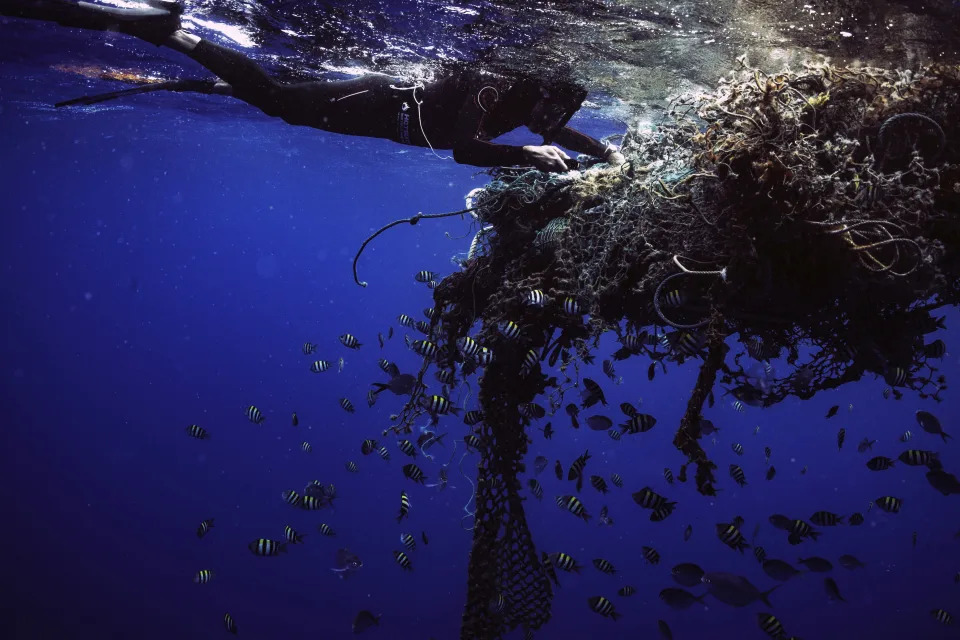
Scientists aboard a ship supporting Ben Lecomte's swim through the garbage patch sampled the water along the way, finding high concentrations of neuston, or organisms living at the water's surface. (Ben Lecomte via The New York Times)
Scientists aboard a ship supporting Ben Lecomte’s swim through the garbage patch sampled the water along the way, finding high concentrations of neuston, or organisms living at the water’s surface. (Ben Lecomte via The New York Times)

In 2019, French swimmer Benoit Lecomte swam more than 300 nautical miles through the Great Pacific Garbage Patch to raise awareness about marine plastic pollution.

As he swam, he was often surprised to find that he was not alone.

“Every time I saw plastic debris floating, there was life all around it,” Lecomte said.

The patch was less a garbage island than a garbage soup of plastic bottles, fishing nets, tires and toothbrushes. And floating at its surface were blue dragon nudibranchs, Portuguese man-o-wars and other small surface-dwelling animals, which are collectively known as neuston.

Scientists aboard the ship supporting Lecomte’s swim systematically sampled the patch’s surface waters. The team found that there were much higher concentrations of neuston within the patch than outside it. In some parts of the patch, there were nearly as many neuston as pieces of plastic.

“I had this hypothesis that gyres concentrate life and plastic in similar ways, but it was still really surprising to see just how much we found out there,” said Rebecca Helm, an assistant professor at the University of North Carolina and co-author of the study. “The density was really staggering. To see them in that concentration was like, wow.”

The findings were posted last month on bioRxiv and have not yet been subjected to peer review. But if they hold up, Helm and other scientists say, it may complicate efforts by conservationists to remove the immense and ever-growing amount of plastic in the patch.

The world’s oceans contain five gyres, large systems of circular currents powered by global wind patterns and forces created by Earth’s rotation. They act like enormous whirlpools, so anything floating within one will eventually be pulled into its center. For nearly a century, floating plastic waste has been pouring into the gyres, creating an assortment of garbage patches. The largest, the Great Pacific Patch, is halfway between Hawaii and California and contains at least 79,000 tons of plastic, according to the Ocean Cleanup Foundation. All that trash turns out to be a great foothold for living things.

Helm and her colleagues pulled many individual creatures out of the sea with their nets: by-the-wind sailors, free-floating hydrozoans that travel on ocean breezes; blue buttons, quarter-sized cousins of the jellyfish; and violet sea-snails, which build “rafts” to stay afloat by trapping air bubbles in a soaplike mucus they secrete from a gland in their foot. They also found potential evidence that these creatures may be reproducing within the patch.

“I wasn’t surprised,” said Andre Boustany, a researcher with the Monterey Bay Aquarium in California. “We know this place is an aggregation area for drifting plastics, so why would it not be an aggregation area for these drifting animals as well?”

Little is known about neuston, especially those found far from land in the heart of ocean gyres.

“They are very difficult to study because they occur in the open ocean and you cannot collect them unless you go on marine expeditions, which cost a lot of money,” said Lanna Cheng, a research scientist at the University of California, San Diego.

Because so little is known about the life history and ecology of these creatures, this study, though severely limited in size and scope, offers valuable insights to scientists.

But Helm said there is another implication of the study: Organizations working to remove plastic waste from the patch may also need to consider what the study means for their efforts.

There are several nonprofit organizations working to remove floating plastic from the Great Pacific Patch. The largest, the Ocean Cleanup Foundation in the Netherlands, developed a net specifically to collect and concentrate marine debris as it is pulled across the sea’s surface by winds and currents. Once the net is full, a ship takes its contents to land for proper disposal.

Helm and other scientists warn that such nets threaten sea life, including neuston. Although adjustments to the net’s design have been made to reduce bycatch, Helm believes any large-scale removal of plastic from the patch could pose a threat to its neuston inhabitants.

“When it comes to figuring out what to do about the plastic that’s already in the ocean, I think we need to be really careful,” she said. The results of her study “really emphasize the need to study the open ocean before we try to manipulate it, modify it, clean it up or extract minerals from it.”

Laurent Lebreton, an oceanographer with the Ocean Cleanup Foundation, disagreed with Helm.

“It’s too early to reach any conclusions on how we should react to that study,” he said. “You have to take into account the effects of plastic pollution on other species. We are collecting several tons of plastic every week with our system — plastic that is affecting the environment.”

Plastic in the ocean poses a threat to marine life, killing more than 1 million seabirds every year, as well as more than 100,000 marine mammals, according to UNESCO. Everything from fish to whales can become entangled, and animals often mistake it for food and end up starving to death with stomachs full of plastic.

Ocean plastics that do not end up asphyxiating an albatross or entangling an elephant seal eventually break down into microplastics, which penetrate every branch of the food web and are nearly impossible to remove from the environment.

One thing everyone agrees on is that we need to stop the flow of plastic into the ocean.

“We need to turn off the tap,” Lecomte said.

My Great-Grandpa Killed My Great-Grandma Giving Her An Abortion On Their Kitchen Table

HuffPost – Personal

My Great-Grandpa Killed My Great-Grandma Giving Her An Abortion On Their Kitchen Table

“Come say goodbye to your mother,” he told my grandmother as he brought her and her siblings into the kitchen, where their mother lay dying.

By Linda Black – May 6, 2022

"The room, table, and her mother’s lower half were awash with her blood. This is the only memory my grandmother had of her mother."
“The room, table, and her mother’s lower half were awash with her blood. This is the only memory my grandmother had of her mother.”

In 1919, my 7-year-old grandmother was startled awake in the early hours by her father. “Come say goodbye to your mother,” he told her. He brought her and her siblings into the kitchen, where their mother lay dying on the kitchen table. The room, table, and her mother’s lower half were awash with her blood. This is the only memory my grandmother had of her mother. Any positive memories were shocked from her system in that moment.

My grandmother’s father killed her mother performing an illegal abortion. He was never charged with a crime. After the death of his wife, he kept his younger daughter and his young boys with him. He sent my grandmother to work as a farmhand for a relative. To him, the abortion was a necessary risk. They already had too many kids.

In 1919, it was illegal in many states to provide information about birth control or abortion. My great-grandmother had no choice when it came to having sex with her husband; it was considered marital duty. That gave her no say in being pregnant. Her lack of choice killed her.

By her own account, my grandmother never felt loved after the death of her mother. The relatives who raised her treated her like the help. My grandmother married the first man to take an interest in her (my grandfather was a lovely man). She was 16. He was older and living with his parents. Until the death of her husband’s mother, my grandmother was treated as a servant in his house.

Her siblings fared little better. The younger brothers were regularly beaten by their father, and my great-aunt (the younger sister) was molested by their father. My great-aunt eventually married a man like her father. He abused her from the time of their marriage until the day of her death. The brothers disappeared. For decades my grandmother had no idea what had happened to her brothers. She didn’t find them until they were in their 60s.

My great-grandmother has a host of great-granddaughters and great-great-granddaughters. At least two of us have had legal abortions. I was barely 18, just starting college. The abortion was not harrowing; being pregnant was. I could not wait to be relieved of that burden. On the drive home after, I kept sighing with relief and saying, “Thank God that’s over.” Since that day, I have used two forms of birth control without fail (yes, even during marriage).

My adult child has never had sex without contraceptives. Currently, my child is wild with fear after the leak of a draft Supreme Court opinion indicating a plan to overturn Roe. Their health and life is too complicated to successfully manage a pregnancy or a child. This gentle soul is in a state of panic on behalf of all fertile people with uteruses. In speaking with my offspring, I had to promise that if Roe is overturned, I would form a pipeline to help people make their way to a country where abortion is legal. My kid can’t sleep for worrying about those who will fall through the cracks — those who will die due to unsafe abortions. My child knows the story of my great-grandmother.

I have never rested easy knowing a group of elderly and middle-aged men could make decisions stripping me of my rights. At the state and federal level, governmental representatives are mostly white, mostly male, and most have some financial privilege. They are mostly people who will never need an abortion. Some number of these men, when it was prudent to their futures, have paid women to get abortions on the quiet. They have paid for their daughters’ abortions. Men with power have been doing this in the United States almost since its inception. Still, they work to see Roe overturned.

“In speaking with my offspring, I had to promise that if Roe is overturned, I would form a pipeline to help people make their way to a country where abortion is legal. My kid can’t sleep for worrying about those who will fall through the cracks — those who will die due to unsafe abortions. My child knows the story of my great-grandmother.”

It is abundantly clear that the anti-abortion folks do not care about babies or people with uteruses. If they did, people with uteruses would have access to excellent health care and birth control. Our government would ensure that every member of every family was well fed and healthy. Children in foster care would be given well-vetted places to live. The system would provide the help parents need to appropriately support and love their children, thus returning kids safely to their parents when possible. Foster parents would be given enough money to raise these children. Foster kids would be aided into adulthood with significant job training or college. It would be less expensive to adopt foster children into loving homes. Childcare would be available as a matter of course. All people with uteruses would have access to paid maternity leave. Sick leave would not be limited in any job.

The top-level corporate executives (usually male) would not make 1,000 times more money than their employees. (In 2018, Walmart’s chief executive officer made over $23 million; his average full-time employee, often a woman, earned just under $22,000.) The lives of people with uteruses and children pale when compared to this alternate reality.

In the early 20th century, women and children were legally the property of men. So, we might understand why they had so few rights. What confuses me is this: Why do women and people with uteruses have little support and tenuous control over their own bodies today?

Turning back time will not give anti-abortion folks comfort. It will ruin lives, families, and result in shocking deaths of women and those with uteruses. In 2022, no one should die on a table covered in their own blood from a botched illegal abortion like my great-grandmother did.

As a teen, Linda Black was the fourth runner-up in a Miss Teen-Kentucky beauty pageant. Her first job was at Wendy’s. As an adult, Linda earned a B.A. and a Ph.D., working for over 30 years as a college professor. She now works in the administrative side of higher education. Her current favorite film is “Gaslight.” Her current favorite book is “Skeleton Woman Buys the Ticket.” She is bossed around by an adult child, a delightful dog, and a slightly sinister cat.

MORE FROM HUFFPOST PERSONAL…

My 11-Year-Old Patient Was Pregnant. Here’s What I Want You To Know About Being ‘Pro-Life. ‘I’m An Abortion Nurse. These Stories Might Shock You, But They’re All Too Real. I Wish I’d Had A ‘Late-Term Abortion’ Instead Of Having My Daughter

War rumors bewilder Moldova’s pro-Russian separatist enclave

Reuters

War rumors bewilder Moldova’s pro-Russian separatist enclave

Peter Graff – May 6, 2022

The coat of arms of Transdniestria is depicted on a banner in central Tiraspol
Flags of Moldova's breakaway region of Transdniestria and Russia flutter in central Tiraspol
Flags of Moldova’s breakaway region of Transdniestria and Russia flutter in central Tiraspol

RYBNITSA, Transdniestria, Moldova (Reuters) -“Of course we’re afraid,” said pensioner Marina Martalog, walking across a long bridge over the Dniestr River to her home in Transdniestria, a pro-Russian breakaway sliver of Moldova along the border with Ukraine. “Who isn’t afraid of war?”

Alongside her, the bridge was choked with cars and trucks, backed up across the entire 400 metre span because of extra checks from Transdniestria’s separatist authorities, who have announced a state of emergency after what they say was a week of terrorist attacks aimed at drawing the region into the Ukraine war next door.

Reported shootings and explosions have turned the territory of Transdniestria – long an anomaly on the post-Soviet map rarely noticed by the outside world – into the subject of international speculation that the Ukraine war could spill over frontiers.

Transdniestria’s separatist authorities blame Ukraine for attacking their territory to provoke war with Russian troops based in the enclave. Since last week, they say attackers shot up their security agency headquarters, blew up two radio masts, and sent a number of drones across the frontier from Ukraine armed with explosives.

“The situation is alarming because Transdniestria has suffered terrorist attacks,” Vitaly Ignatiev, foreign minister of the separatist administration, told Reuters this week in an interview by video link from his office in Tiraspol, the region’s capital.

“Honestly, I don’t see any reason why the Ukrainian side would use such methods against Transdniestria. Transdniestria does not threaten Ukraine,” he said. “I have said several times we are an absolutely peaceful state.”

Ukrainian government officials have repeatedly denied any blame for the incidents in Transdniestria, saying they believed Russia was staging false-flag attacks to provoke war. Moscow, too, has denied blame, while saying it was concerned that Kyiv was trying to escalate.

Moldova’s pro-Western President Maia Sandu blamed the unrest on “pro-war factions” among the separatists.

Reuters has been unable to independently verify who is behind the attacks.

For Martalog and some other residents of Rybnitsa, a factory town on the left bank of a wide and gentle stretch of the Dniestr River, there was only an ominous sense of bewilderment. Around half a dozen residents interviewed by Reuters said they did not know what to believe.

“We leave the apartment, come home. Everyone sees the same thing: what they show on the television,” said Martalog, returning to Rybnitsa after a visit with family on the Moldovan-held side. “Who knows?”

The separatists who control the area say they have cancelled all foreign journalist accreditations under the state of emergency they imposed last week in the wake of the attacks.

Reuters was granted permission to enter the region, provided no interviews were conducted or pictures taken during the visit. For this story, a reporter walked through Rybnitsa, observing the town, before exiting separatist territory and speaking with some of the many residents crossing the bridge.

ALL QUIET

Apart from the extra traffic on the bridge itself, there was little sign of an emergency. There were no checks at all on the other, Moldovan-held side of the bridge, where a single policeman sat in a booth.

“You see? It’s all peaceful,” said Andrei Duca, a Rybnitsa resident walking with his pre-school son on his shoulders across the bridge for a day-trip to the smaller, tidier town of Rezina controlled by Moldovan authorities on the right bank.

“If the situation were serious, they’d have shut the border altogether. There would be speedboats zooming up and down the river. You see? It’s all quiet,” he said.

A small contingent of about 1,200 Russian soldiers has remained in Transdniestria since the breakup of the Soviet Union, guarding a huge weapons dump at the town of Cobasna, a short drive from Rybnitsa on the Ukrainian frontier.

Last month, a Russian general said one of Moscow’s war aims was to seize a swathe of southern Ukrainian territory to link up with Transdniestria. The remarks drew a formal protest from the Moldovan government.

Inside separatist-held Rybnitsa, a fruit and veg market of covered stalls was humming, with fresh seasonal strawberries and mounds of fragrant tomatoes on sale. Shelves were full at a big, busy supermarket nearby.

It was a sunny, clear day. Upriver, faint smoke could be seen above a huge cement factory, one of the many heavy industrial enterprises that have thrived in Transdniestria thanks to heavily subsidised Russian gas. Kayakers were paddling in the river by the quay on the separatist side.

At a bus stop on the Moldovan side, Diana Blanari sat with a baby on her lap and a young daughter by her side.

“Of course you feel it, the people over there in Rybnitsa, they are afraid to suddenly be dragged into it. What with – where all the weapons are in Cobasna,” she said.

But she smiled and so did her daughter.

“I think it will be alright. We don’t believe in rumours,” she said.

(Reporting by Peter Graff, Editing by Rosalba O’Brien and Gareth Jones)

A Russian soldier who was in Bucha during the executions was identified because he spray-painted his Instagram handle in a civilian’s home

Business Insider

A Russian soldier who was in Bucha during the executions was identified because he spray-painted his Instagram handle in a civilian’s home

Kelsey Vlamis – May 5, 2022

Burned Russian tanks litter Vokzalna Street in Bucha, where a column of Russian military vehicles making their way toward Kyiv was destroyed by Ukrainian forces; Bucha, Ukraine, April 4, 2022.Erin Trieb for Insider
A Russian soldier who was in Bucha during the executions was identified because he spray-painted his Instagram handle in a civilian’s home

Reports of atrocities committed in Bucha, Ukraine, spiked demands for a war crimes investigation.

A new Reuters report identifies soldiers and military units that were in Bucha before the retreat.

One soldier was identified because his social media handle, Wolf_68, was spray-painted inside a home.

A Russian soldier in Bucha while atrocities were committed left behind a straightforward clue into his identity: his Instagram handle, spray-painted on a wall inside a Ukrainian civilian’s home.

Reporters from Reuters spent weeks in Bucha, Ukraine, after Russian forces completed their retreat from the areas around Kyiv last month. They discovered the handle “Wolf_68” inside a home that a Bucha resident said had been occupied by a group of Russian soldiers.

Kirill Kryuchkov was identified using the handle, which the outlet said he used variations of on his social media accounts. Kryuchkov, who is from Pskov, Russia, posted videos on Instagram that showed Russian soldiers in a bar drinking beer and smoking hookah on April 19.

Two people who knew Kryuchkov confirmed his military unit to Reuters and another confirmed he was in Ukraine. Kryuchkov did not respond to a message from the outlet requesting comment.

When Reuters contacted a friend of Kryuchkov, Vitaly Shcherbakov, he said: “You can write: ‘Fuck the Ukies’.”

Reports of atrocities and potential war crimes poured out of Bucha after the Kyiv retreat, including the killing and rape of civilians as well as mass graves. Calls for an international investigation into Russia’s war in Ukraine grew along with the alleged perpetrators.

Reuters published its report on Thursday with new details about what happened in Bucha based on interviews with nearly 100 residents, documents left behind by Russian forces, and photo and video evidence.

The outlet identified specific soldiers and military units that were in Bucha, linking some to specific acts of violence against unarmed civilians.

Russia has dismissed reports about atrocities committed in Bucha, claiming the accounts are fake.