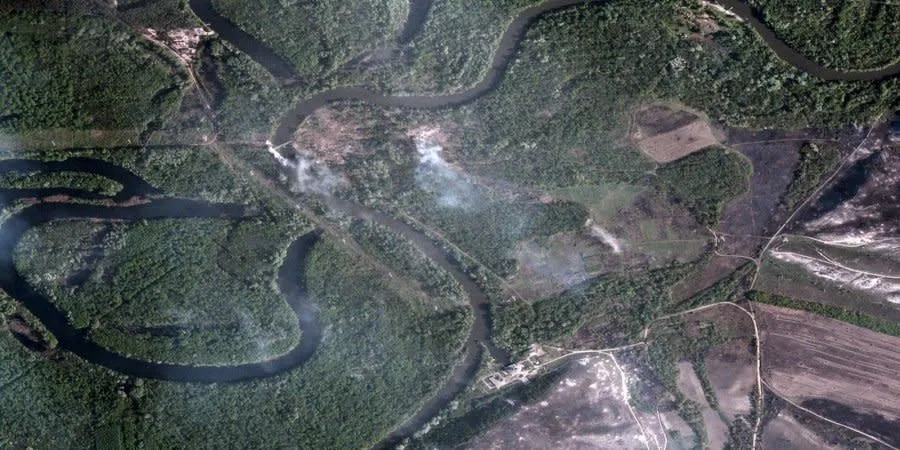
CNN noted that satellite images collected by geospatial intelligence firm BlackSky shows a Russian pontoon bridge crossing the river on May 10 shortly after a Ukrainian artillery barrage hit the surrounding area.
Smoke can be seen rising from the western shore of the Siverskyi Donets River at one end of the bridge. The eastern bank features craters and smoke, including around Russian military vehicles that crossed over.
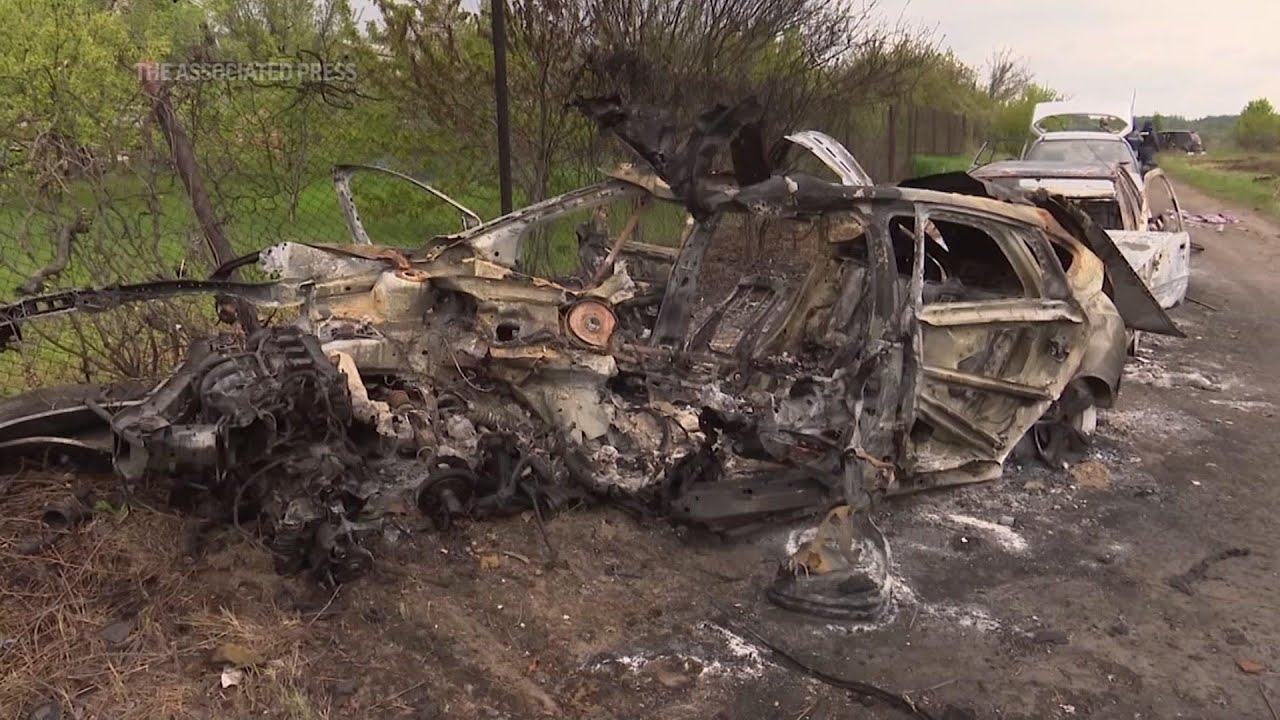
In addition, according to grainy drone video circulating on social media, which has geolocated and authenticated by CNN, shows the aftermath of the strikes, where a Russian pontoon bridge can be seen half-sunk into the river.
Additional photos circulating on social media, also taken by drone, show that the Russians tried to erect a second pontoon bridge across the river. That bridge too was blown up by Ukrainians forces, in addition to a number of military vehicles.
Ukraine’s Defense Ministry on Twitter also posted photos of the two pontoon bridges destroyed near Bilohorivka.
On May 10, Luhansk regional governor, Serhiy Haidai, announced that the Ukrainian troops had destroyed pontoon bridge crossings that Russian invaders had built across the Siverskyi Donets River near Bilohorivka, while the village was being cleared of Russian troops.
Russian troops are also trying to hold the line on the right bank of the Siverskyi Donets River, preparing for an offensive in the directions of Kurakhove and Novopavlivka.
Fleeing Russian soldiers left behind key military documents that indicated Putin had plans to seize all of Ukraine, officials said
Sophia Ankel – May 12, 2022
A Ukrainian firefighter walking in rubble in the northeastern city of Trostyanets, Ukraine, on March 29.Fadel Senna/AFP via Getty Images Fleeing Russian soldiers left behind key military documents that indicated Putin had plans to seize all of Ukraine, officials said
Ukrainian troops found Russian military documents in Sumy Oblast, officials said on Telegram.
The abandoned military documents suggested that Putin had plans to seize all of Ukraine.
Russian troops retreated from Kyiv in early April and have since focused on taking eastern Ukraine.
Fleeing Russian soldiers left behind key military documents that indicated Russian President Vladimir Putin had plans to seize all of Ukraine, the director of Ukraine’s State Bureau of Investigation said in a Telegram statement on Wednesday.
Ukrainian forces discovered the documents while searching through the northeastern town of Trostyanets in Sumy Oblast, the statement said.
Trostyanets, located about 230 miles from the capital, Kyiv, was liberated by Ukrainian troops in late March after a monthlong Russian occupation, The New York Times reported.
Investigators found “important documents of soldiers of the Russian Federation’s Armed Forces that give a clear understanding that Russia was preparing to seize all the territory of Ukraine,” Oleksiy Sukhachev, the director of Ukraine’s State Bureau of Investigation, said in the statement.
“All this information will be studied,” the statement continued.
Insider has not seen the documents and has not been able to independently verify the claims.
Sukhachev said Ukrainian officials had inspected over 2,000 hectares of the destroyed town since its liberation.
Aside from the documents, soldiers also found that more than 300 residential buildings had been permanently damaged, Sukhachev said. A number of unexploded shells and bombs had also been found, he added.
The Russian military papers appeared to confirm earlier assessments by Western officials that Putin had plans to swiftly take all of Ukraine, but failed to do so.
Russian troops — who expected to seize Kyiv within days — retreated from the capital in early April and refocused their offensive in Ukraine’s eastern region.
Russia threatens to retaliate as Finland seeks NATO membership
May 12, 2022
STORY: Finland must join the NATO military alliance “without delay”, the country’s president and prime minister confirmed on Thursday (May 12).
In a major policy shift for the country – triggered by Russia’s invasion of Ukraine.
Moscow said the move was “definitely” a threat and that it was ready to respond.
Having long warned Finland of consequences should it choose to join NATO, the Kremlin added that the expansion of the military bloc would not make Europe or the world more stable.
But Finland’s neighbor Sweden is also close to a decision on asking to join NATO after decades of following a neutral path.
The announcement represents a huge setback for Russia, which had partly attempted to justify its invasion of Ukraine as a means to protect itself from NATO’s eastwards expansion.
The Finnish parliament will debate the announcement on Monday (May 16).
Foreign minister Pekka Haaviston told EU lawmakers the move would improve security in the Baltic Sea region.
“Russia’s invasion of Ukraine has altered the European and Finnish security environment. However, Finland is not facing an immediate military threat.”
Kremlin spokesman Dmitry Peskov told reporters that Russia wanted to avoid a direct a clash with NATO.
But that Moscow was prepared to make a “decisive response” to anyone that tried to hinder Russia’s “special military operation” in Ukraine.
Finland shares an 810 mile border with Russia that would more than double the current frontier between the U.S.-led alliance and Russia.
And put NATO guards a few hours’ drive from the northern outskirts of St Petersburg.
Finland has gradually stepped up its cooperation with the North Atlantic Treaty Organization since Russia annexed Crimea in 2014.
But it had resisted joining NATO in order to maintain friendly relations with its eastern neighbor – until Russia’s invasion of Ukraine in February .
Ahead of Thursday’s joint statement Finnish President Sauli Niinisto said its move to join NATO deomstrated that Russia’s actions had backed it into a corner.
“If that would be the case, if we join, my response would be that you caused this. Look at the mirror.”
Ukraine shuts off Russian pipeline amid talk of annexation
By Elena Becatoros and Jon Gambrell – May 11, 2022
Volunteers exhume the bodies of civilians killed by Russian shelling in the village of Stepaky, close to Kharkiv, Ukraine, (AP Photo/Andrii Marienko)
ZAPORIZHZHIA, Ukraine (AP) — Ukraine shut down a pipeline Wednesday that carries Russian natural gas to homes and industries in Western Europe, while a Kremlin-installed official in a southern region seized by Russian troops said the area will ask Moscow to annex it.
The immediate effect of the energy cutoff is likely to be limited, in part because Russia can divert the gas to another pipeline and because Europe relies on a variety of suppliers. But it marked the first time since the start of the war that Ukraine disrupted the flow westward of one of Moscow’s most lucrative exports.
Meanwhile, the talk of annexation in Kherson — and Russia’s apparent willingness to consider such a request — raised the possibility that the Kremlin will seek to break off another piece of Ukraine as it tries to salvage an invasion gone awry. Russia annexed Ukraine’s Crimean Peninsula in 2014.
“The city of Kherson is Russia,” Kirill Stremousov, deputy head of the Kherson regional administration installed by Moscow, told Russia’s RIA Novosti news agency. He said regional officials want Russian President Vladimir Putin to make Kherson a “proper region” of Russia.
Kremlin spokesman Dmitry Peskov said that it would be “up to the residents of the Kherson region” to make such a request, and that any move to annex territory would would have to be closely evaluated by experts to make sure its legal basis is “absolutely clear.”
Russia has repeatedly used annexation or recognition of breakaway republics as tactics in recent years to gain pieces of fellow former Soviet republics Ukraine and Georgia. Russia annexed Crimea in 2014 after holding a referendum on the peninsula over whether it wanted to become part of Russia.
Kherson, a Black Sea port of roughly 300,000, provides access to fresh water for neighboring Crimea and is seen a gateway to wider Russian control over southern Ukraine. It was captured early in the war, becoming Ukraine’s first major city to fall.
Ukrainian presidential adviser Mykhailo Podolyak mocked the notion of its annexation, tweeting: “The invaders may ask to join even Mars or Jupiter. The Ukrainian army will liberate Kherson, no matter what games with words they play.”
On the energy front, Ukraine’s natural gas pipeline operator said it moved to stop the flow of Russian gas through a compressor station in part of eastern Ukraine controlled by Moscow-backed separatists because enemy forces were interfering with the station’s operation and siphoning off gas.
The hub handles about one-third of Russian gas passing through Ukraine to Western Europe. But analysts said much of the gas can be redirected through another pipeline from Russia that crosses Ukraine, and preliminary data suggested that was already happening.
In any case, Europe also gets natural gas from other pipelines and other countries.
“We’re losing a few percent in overall European gas supply, when you consider imports and domestic production as well,” said Tom Marzec-Manser, head of gas analytics at ICIS market intelligence firm. “So this is not a huge cutoff to gas supplies” for Europe.
Still, European gas futures seesawed on the news, meaning consumers may face higher energy bills at a time of already rising prices.
It was not clear if Russia would take any immediate hit, since it has long-term contracts and other ways of transporting gas.
But the cutoff highlights the broader risk to gas supplies from the war.
“Yesterday’s decision is a small preview of what might happen if gas installations are hit by live fire and face the risk of extended downtimes,” said gas analyst Zongqiang Luo at Rystad Energy.
On the battlefield, Ukrainian officials said a Russian rocket attack targeted an area around Zaporizhzhia, destroying unspecified infrastructure. There were no immediate reports of casualties. The southeastern city has been a refuge for civilians fleeing the Russian siege in the devastated port city of Mariupol.
Russian troops continued to pound the steel plant that is the last bastion of Ukrainian resistance in Mariupol, its defenders said. The Azov Regiment said on social media that Russian forces carried out 38 airstrikes in the previous 24 hours on the grounds of the Azovstal steelworks.
The plant, with its network of tunnels and bunkers, has sheltered hundreds of Ukrainian troops and civilians during a months-long siege. Scores of civilians were evacuated in recent days, but Ukrainian officials said some may still be trapped there.
In his nightly address Tuesday, President Volodymyr Zelenskyy suggested Ukraine’s military is gradually pushing Russian troops away from Kharkiv, the country’s second-largest city and a key to Russia’s offensive in the Donbas, the eastern industrial region that the Kremlin has said is its main objective.
Zelenskyy said his troops drove Russian forces out of four villages near Kharkiv, in the country’s northeast.
Ukraine is also targeting Russian air defenses and resupply vessels on Snake Island in the Black Sea in an effort to disrupt Moscow’s efforts to expand its control over the coastline, according to the British Ministry of Defense.
The ministry said Russian resupply vessels have minimum protection since the Russian Navy retreated to Crimea following the sinking of the flagship of its Black Sea fleet.
Separately, Ukraine said it shot down a cruise missile targeting the Black Sea port city of Odesa on Wednesday.
The gas cutoff came as Western powers have been looking to ratchet up economic pressure on Moscow and bolster Ukraine’s defenders. The U.S. House approved a $40 billion Ukraine aid package Tuesday. Senate approval appeared certain.
Still, there is growing fear that the fighting in Ukraine may remain a source of continental and global instability for months or even years.
U.S. officials and NATO have expressed concern that Russia may be digging in for a protracted conflict as the war grinds into its third month with little sign of a decisive military victory for either side and no resolution in sight.
The alliance is also waiting to see whether Sweden and Finland, two neighbors of Russia, announce plans to join NATO, a move the Kremlin would see as an affront.
Gambrell reported from Lviv, Ukraine. Yesica Fisch in Bakhmut, David Keyton in Kyiv, Yuras Karmanau in Lviv, Mstyslav Chernov in Kharkiv, Lolita C. Baldor in Washington, Kelvin Chan in London and AP’s worldwide staff contributed.
Ministry of Foreign Affairs warns other countries that grain from Russia could have been stolen in Ukraine
Kateryna Tyschenko – May 11, 2022
The Ministry of Foreign Affairs of Ukraine has warned consumer countries that consignments of grain sold by Russia could contain grain stolen in Ukraine.
Source: Ministry of Foreign Affairs comment on Russia’s attempts to sell stolen Ukrainian grain from the temporarily occupied territories of Ukraine on the international market
Quote: “The Ministry of Foreign Affairs of Ukraine categorically condemns the actions of the Russian Federation in disposing of grain that has been illegally expropriated from Ukrainian farmers. The Russian occupiers are seizing Ukrainian grain and sending it to Russia for domestic consumption or trying to sell it on international markets.
The theft of food resources from the territory of an independent sovereign state constitutes looting.
The Ministry of Foreign Affairs of Ukraine has warned consumer countries that consignments of grain sold by Russia may contain stolen grain obtained as a result of looting by the Russian occupying authorities. We believe that any country that knowingly buys stolen grain is an accomplice to this crime.”
Details: According to the Ukrainian government, the occupiers have already stolen at least 400,000-500,000 tonnes of grain worth over US$100 million. Almost all of the ships which leave Sevastopol loaded with grain are transporting stolen Ukrainian products, the Foreign Ministry said.
Russia’s theft of Ukrainian grain is confirmed by numerous testimonies by Ukrainian farmers and documentary evidence:
An order issued by the so-called “Berdiansk City Hall” (No. 10-p dated 7 May 2022) on the seizure of wheat and barley from a private company.
A press release from the Legislative Assembly of Krasnoyarsk Krai in the Russian Federation (No. 379 (13593) dated 27 April 2022) on the decision of the Committee on Rural Affairs and Agricultural Policy to expropriate crops from farmers in Kherson Oblast, which is temporarily occupied by Russian armed forces. In the document, the chairman of the committee, Vladislav Zyryanov, also voiced the Russian authorities’ intention to extend this policy to other regions of Ukraine.
Proposals by Russia’s Ministry of Agriculture to postpone the introduction of the federal state information system for tracking the origin of grain and grain products for one year.
The Ministry of Foreign Affairs stressed that the criminal seizure, export and use of Ukrainian grain by Russia violates the basic principles of the Food and Agriculture Organization of the United Nations (FAO) – to promote food security and end hunger.
“This policy of the aggressor state calls into question whether its membership in the FAO and other international organisations is appropriate. We demand that Russia stop the theft of grain, unblock Ukrainian ports, restore freedom of navigation, and allow the passage of merchant ships”, the statement said.
The Ministry of Foreign Affairs also called on the international community to strengthen economic sanctions to stop Russia’s armed aggression against Ukraine and prevent a humanitarian catastrophe and deterioration of the global food security situation.
Previously: Russia is stealing and exporting hundreds of thousands of tonnes of grain from Kherson, Zaporizhzhia, Luhansk and Donetsk Oblasts.
On 10 May the Main Intelligence Directorate of Ukraine’s Ministry of Defense said that grain stolen from Ukraine was already in the Mediterranean, most likely destined for Syria.
Russian ships carrying stolen Ukrainian grains are likely headed to Syria, Kyiv says
Brian Evans – May 11, 2022
Ukraine exported more than $140 million of wheat to the US before the pandemic, with latest disruptions adding to price woes.AP
Stolen Ukrainian grains on Russian-flagged ships are likely headed to Syria, Kyiv said.
Ukraine predicted the grain will then be distributed to the broader Middle East.
Egypt has already turned away two Russian vessels this week carrying Ukraine’s wheat.
Russian-flagged ships carrying stolen Ukrainian grains are likely headed to Syria before the cargoes then move on to other destinations in the Middle East, the government in Kyiv said.
In social media posts, Ministry of Defense intelligence officials also said Russia is moving seeds and grain to Crimea, which is the Ukrainian territory annexed by the Kremlin in 2014.
Egypt in the past week has already turned away two Russian vessels with stolen Ukrainian wheat, Ukraine’s chargé d’affaires in Egypt told The Wall Street Journal.
The moves mark an escalation in Russia’s campaign to cripple vital sectors of Ukraine’s economy. Russia has blockaded Black Sea ports, a crucial avenue for Ukraine to import agricultural supplies and to export its farm products. Ukraine exported $28 billion worth of food in 2021, and the sector makes up 10% of Kyiv’s total gross domestic product.
The European Union took steps on Tuesday to help redirect Ukrainian exports by land to skirt the Russian blockade, according to Bloomberg.
But only so much can be transported by rail, for example, limiting potential food exports to 1.1 million tons of grain per month, which is far below the 25 million tons that Ukraine needs to release.
‘It’s as Tall as a Person’: Russians Reveal Their Secret Dump of Dead Soldiers in Donetsk
Allison Quinn – May 10, 2022
Russian authorities in Ukraine’s occupied city of Donetsk are tossing the bodies of their dead soldiers in a secret dump “by the thousands” and charging their loved ones money to find them.
That’s according to a new audio recording released by Ukraine’s Security Service on Tuesday, which is purportedly an intercepted telephone conversation between two Russians discussing how one of their missing friends was finally found.
In the two-and-a-half minute recording, an unidentified man tells his female relative that the fate of “Inna’s brother” is finally known after he went missing a month ago.
“It’s better that you don’t hear this,” the man says at first, reluctant to spill all the grim details.
After more urging, he finally explains that the unidentified dead man’s “sister went to Donetsk, and there, basically, roughly speaking, is a dump.”
“They just toss them there. And then later it’s easier to make as if they disappeared without a trace. It’s easier for them to pretend they are just missing, and that’s it,” he said, noting that “there are thousands.”
“There’s nowhere left to place them. It’s a dump. I’m telling you in plain Russian—a dump. It’s as tall as a person,” he said, adding that the site is “fenced off, sealed, they don’t let anyone in.”
According to him, the only reason local authorities at the dump site let the woman find her brother was because she paid “good money.”
Watch: Wiretaps appear catch Russian soldiers sabotaging their own equipment
Wiretaps appear catch Russian soldiers sabotaging their own equipment
Russian soldiers have been sharing tips with one another about how to deliberately damage their own equipment in Ukraine, according to recordings of alleged phone calls that the Security Service of Ukraine intercepted.
After that, he said, “they rearranged it until she found [the body.]”
“It’s not a morgue, it’s a dump.… They are bringing [bodies] by the thousands,” he said, calling it a “shitshow.”
No further details were provided by Ukrainian intelligence on the exact location of the makeshift morgue, and it was not immediately clear if the man heard in the audio was a Russian soldier himself, though Ukrainian authorities described him as an “invader.”
The disturbing intercept comes after Al Jazeera on Monday released footage of refrigerated train cars holding the unclaimed bodies of Russian troops killed in Ukraine. Inside, there appeared to be human-size bodies stacked on top of each other in white bags. Ukrainian authorities said Moscow has refused to take the bodies back home, apparently to keep the lid on the sky-high death toll.
While Russia has claimed only 1,300 of its troops have died in its “special military operation” to rescue Russian-speakers in Ukraine (by bombing predominantly Russian-speaking areas), Ukraine’s military has put the death toll at about 26,000.
Quote: “Their bodies are stacked in makeshift dumping grounds where there’s so much ‘Cargo 200’ [military code for dead soldiers] that the mountains of corpses are two metres high.”
This is evidenced by the latest phone conversations between the invaders intercepted by the Ukrainian security service.
“It’s not a morgue, it’s a dump. It’s massive, it’s… not a field, not a landfill site… Fenced off, cordoned off, no one’s allowed in. Anyway, that’s where they’re brought, thousands of them. A dump the height of a man…” an invader tells his wife from the “Donetsk People’s Republic”.
Details: According to him, the dump is just outside occupied Donetsk. Guards there are earning insane amounts of money helping relatives of the dead to find their remains.
The soldier whose conversation was intercepted found out about it because a woman he knew had gone there to look for her brother’s body. The Security Service of Ukraine urges parents, wives and relatives of occupying troops to do all they can to stop their loved ones from going to this war and ending up rotting in a landfill site in the open air.
STORY: Ukrainian soldiers inspected the wreckage of a Russian tank in the village of Rubizhne, recently recaptured from the invaders.
Kyiv said on Tuesday its forces had successfully pushed Russian troops out of several towns near the city of Kharkiv, part of a counter-offensive that Ukraine hopes could change the course of the war.
One soldier here boasted his team could keep delivering these sorts of results.
“The weapons are helping is a lot, the anti-tank ones. I wish the state would supply us with them more frequently. We use the weapons exclusively for specific targets. As you can see we have results. If there are weapons we will have more results.”
Kyiv’s counter-offensive here could be consequential: Ukrainian forces are moving into striking distance of the supply lines supporting Russia’s main attack force in the south, where Moscow has focused on encircling and capturing the Donbass region.
Ukrainian forces have so far mostly held out.
Despite these setbacks, Russian President Vladimir has showed no signs of calling off or limiting what he’s termed a ‘special military operation.’
U.S. Director of National Intelligence Avril Haines said on Tuesday she believes Russia still plans for a long war.
“We assess President Putin is preparing for a prolonged conflict in Ukraine during which he still intends to achieve goals beyond the Donbas. [Edit] The uncertain nature of the battle, which is developing into a war of attrition, combined with the reality that Putin faces a mismatch between his ambitions and Russia’s current conventional military capabilities, likely means the next few months could see us moving along a more unpredictable and potentially “
Demonstrating Moscow’s reach, Russian missiles destroyed a shopping center and depot in the port city of Odesa.
The Ukrainian military said one person was killed and five were injured.
In Mariupol, Russian forces again pummeled the Azovstal steelworks on Tuesday, trying to capture the last bastion of Ukrainian resistance in the ruined city.
Scores of civilians have been evacuated from the steelworks in recent days, but an aide to Mariupol’s mayor said at least 100 still remained inside.
Ukraine says tens of thousands of people have died under two months of Russian siege and bombardment.
Top U.S. Spy Spills on Putin’s ‘Drastic’ Secret Plan to Win War
Shannon Vavra – May 10, 2022
Getty
The U.S. intelligence community has assessed that Russian President Vladimir Putin is prepared to dig his heels in over the war in Ukraine and let it drag on for some time—and along the way, Putin might resort to extreme measures to ensure Russia wins in the end, top U.S. spies warned Tuesday.
The next steps Putin might take include escalating domestic measures that could contribute to the war effort, such as instituting martial law, the U.S. Director of National Intelligence (DNI) Avril Haines warned in a Tuesday briefing.
“The uncertain nature of the battle… combined with the reality that Putin faces a mismatch between his ambitions and Russia’s current conventional military capabilities likely means the next few months could [be] more unpredictable and potentially escalatory,” DNI Haines told senators. “The current trend increases the likelihood that President Putin will turn to more drastic means, including imposing martial law, reorienting industrial production, or potentially escalatory military actions to free up the resources needed to achieve his objectives as the conflict drags on.”
The assessment, which Haines delivered to lawmakers on Capitol Hill Tuesday, comes as Russia’s war in Ukraine enters its 76th day. Russian forces have turned their attention to taking Eastern Ukraine in recent weeks after failing to take the capital, Kyiv, in the early days of the war due to a series of logistical and planning issues.
And as the Russian military has shifted its attention to the Donbas, or eastern portions of Ukraine, the fighting is beginning to reach somewhat of a “stalemate,” the Defense Intelligence Agency (DIA) Director, Scott Berrier, said Tuesday.
“I would characterize it as the Russians aren’t winning, and the Ukrainians aren’t winning, and we’re at a bit of a stalemate here,” Berrier said.
Putin doesn’t view the Donbas as the final stand in Ukraine, though, Haines warned, suggesting that more carnage might be on the way. Putin views it as just a “temporary” focus so that the Russian military can “regain the initiative,” Haines said.
“We are not confident that the fight in the Donbas will effectively end the war,” Haines said. “We assess President Putin is preparing for prolonged conflict in Ukraine during which he still intends to achieve goals beyond the Donbas.”
The assessment that Putin might escalate comes a day after Victory Day in Russia, when Russians celebrate the victory in World War II—a day U.S. and Ukrainian officials alike had warned Putin would seize on to mobilize more troops for the war. Victory Day came and went without any public mobilization, however.
But Russians are starting to see signs that Putin might be secretly putting in the legwork to pull in more resources to make the war effort function beyond the near term, just as Haines is warning Putin has his sights set on doubling down. Moscow Metro employees have been threatened in recent days that they might be sent to the war in a possible mobilization “if there are not enough soldiers to be sent to the ‘special operation,’” one of the employees’ wives told the Coalition for Conscientious Objection to Military Service in Russia and Verstka.media, using the term Russia has been using to describe the war in Ukraine.
“At a meeting in the metro depot… all men were ordered to undergo an extraordinary medical examination for subsequent possible sending to the war in Ukraine,” she said, adding that if they disobeyed they were told they could be fired or face criminal accusations. “It was precisely and clearly stated that the leadership is obliged to allocate a certain number of people for possible sending to the war.”
The Daily Beast has not independently verified the claims.
Russia has already lost tens of thousands of troops in the invasion and for weeks has been looking for alternative sources of manpower. Russia’s been looking to Syria for more fighters, the Wall Street Journal reported, and Russia’s defense minister has said Russia is recruiting 16,000 people from the Middle East to fight in Ukraine, too.
Members of Congress have been questioning the U.S. intelligence community for weeks now about whether the Kremlin has tapped into mercenaries working for a private Russian contractor known as the Wagner Group.
Haines confirmed Tuesday the Russian government has indeed pulled Wagner in for operations in Ukraine. “We do see Wagner being used in … Ukraine. We see that,” Haines said. “Russia deployed them effectively in Ukraine.”
The U.S. intelligence community’s assessment that Putin intends the war to last for some time could spell disaster ahead. Putin could become more likely to make a miscalculation and resort to using nuclear weapons, Haines warned.
Putin would only “authorize the use of nuclear weapons if he perceived an existential threat to the Russian state,” she said, adding that “with tensions this high there is always an enhanced potential for miscalculation—unintended escalation.”
“There is not… an imminent potential for Putin to use nuclear weapons,” Haines clarified.