“When the enemy tried to construct a pontoon crossing and conduct a forced crossing of the river on the eastern axis, the artillery of 80th Separate Air Assault Brigade once again dealt a heavy blow to the enemy, destroying pontoons and thwarting nine attempts to cross,” the statement reads.
Reportedly, the paratroopers destroyed at least 73 units of equipment, including:
“By ruining the enemy’s plan to cross the river for a further offensive, the paratroopers destroyed an entire battalion-tactical group of invaders,” the press center added.
Russia is attempting to ford the Siverskyi Donets river in order to push their assault further into Ukrainian territory in Donbas.
Ukraine’s spy chief claims a coup to overthrow Putin is underway
Niamh Cavanagh, Producer – May 14, 2022
LONDON — Ukraine’s head of military intelligence claimed he believes that a coup to remove Russian President Vladimir Putin was already underway in Russia — and said he thinks the war is likely to be over by the end of the year.
Speaking to Sky News in an article published Saturday, Maj. Gen. Kyrylo Budanov said he was “optimistic” about Russia’s defeat, suggesting that the loss would lead to Putin being removed from power.
“It will eventually lead to the change of leadership of the Russian Federation,” Budanov said. “This process has already been launched.”
When asked if a “coup” was underway, he told Sky News: “Yes. … They are moving in this way, and it is impossible to stop it.”
Russian President Vladimir Putin after Russia’s Victory Day parade on Monday. (Sputnik/Mikhail Metzel/Pool via Reuters)
According to Sky News, Budanov doubled down after it was suggested that he was spreading propaganda. “It’s my job, it’s my work — if not me, who will know this?” he said.
Meanwhile, Gordon B. Davis Jr., former deputy assistant secretary-general of NATO’s defense investment division, told Sky News in another interview that he doesn’t “think we’re likely to see a coup in the near future.”
“It’s tough to talk about the credibility of such a likelihood,” he said. “I don’t put a lot of credence right now into the rumors.”
Budanov added in his interview that since Russia’s invasion of Ukraine on Feb. 24, Russian forces’ military tactics have not changed, despite their shift in focus to eastern Ukraine.
“The breaking point will be in the second part of August,” he said. “Most of the active combat actions will have finished by the end of this year. As a result, we will renew Ukrainian power in all our territories that we have lost, including Donbas and the Crimea.”
Sky News noted that the major general’s prediction that Russia would invade this year — at a time when other officials were skeptical — had been correct.
During the interview, Budanov also claimed that Putin is currently in “a very bad psychological and physical condition, and he is very sick.” In recent years, there has been considerable speculation about Putin’s alleged ill-health.
On Saturday, New Lines Magazine reported that an oligarch close to Putin had claimed the Kremlin leader is “very ill with blood cancer.” In a recording obtained by the publication, an unidentified oligarch was heard allegedly discussing Putin’s health. He went on to complain that Putin had gone “crazy” and claimed that the Russian president had had surgery on his back linked to his cancer, just before Russia’s invasion of Ukraine in February.
Ukrainian servicemen load bodies of Russian soldiers onto refrigerated rail cars in Kyiv.
Ukrainian servicemen load bodies of Russian soldiers onto refrigerated rail cars in Kyiv.
(Reuters) – Ukrainian military authorities loaded the bodies of Russian soldiers collected after fighting in the Kyiv and Chernihiv regions onto refrigerated rail cars on Friday.
Volodymr Lyamzin, the head of Ukraine’s civil-military cooperation, said his country was acting in accordance with international law and was ready to return the bodies to Russia.
“According to the norms of international humanitarian law, and Ukraine is strictly following them, after the active phase of the conflict is over, sides have to return the bodies of the military of another country.
“Ukraine is ready to return the bodies to the aggressor,” he said.
Lyamzin said there were several refrigerator trains stationed in different regions across Ukraine where the bodies of Russian soldiers were being kept.
Several hundred bodies were being stored at a facility on the outskirts of Kyiv filmed by Reuters.
“In this refrigerator train several hundred bodies of Russian occupiers are kept. Most of them was brought from the Kyiv region, there are some from Chernihiv region, and from some other regions too,” Lyamzin said.
Moscow calls its invasion of Ukraine a “special military operation” to demilitarize a neighbour threatening its security. Ukraine denies posing a threat and says Russia is waging a war of aggression that has killed thousands of civilians, uprooted millions of others and destroyed cities and towns since the conflict began in late February.
(Reporting by Sergiy Karazy; Writing by Mark Porter; editing by Grant McCool)
In Sevastopol Bay is the minimum number of ships of the Black Sea Fleet
As of May 10, the Mediterranean Sea remains an operational area for the same group of vessels that was stationed there as of February 7.
Therefore, there have been no substantial changes in that region so far. This group includes 13 ships and 5 complementary vessels of four Russian military fleets, including 9 rocket launcher ships.
This situation occurred after Turkey, a NATO member, passed a decision on February 27 to ban any military vessels from moving between the Black Sea and the Mediterranean Sea. The ban includes ships of NATO countries that are not the Black Sea actors.
At the end of 2021 and at the beginning of 2022, Russia relocated 20 military vessels from the Mediterranean area to the Black Sea, including 14 ships subordinated to its Black Sea Military Fleet, 3 subordinated to Northern Military Fleet and 3 from the Baltic Sea Military Fleet.
What was happening in February is this: Russia’s Black Sea Military Fleet managed to relocate a large number of vessels to the Black Sea operational area a couple of weeks before the invasion of Ukraine was launched. For that purpose, Russian Federation used the assets of its Northern, Baltic, and Pacific fleet groups.
Besides that, Russia relocated 7 marine infantry vessels from the Mediterranean, including 6 big ones, that were previously components of Northern and Baltic fleet groups.
Overall, as of February 24, Russia had as many as 13 major marine infantry ships in the Black Sea. However, one of them needed repairs. After March 24, when Ukraine’s Armed Forces destroyed one of them and damaged another two, only 9 of those ships are left.
Because Russia has a shortage of major military vessels able to support marine infantry assaults with shelling, it is unable to conduct a major offensive operation in the Odesa region. Still, a minor local “adventure” with the participation of marines is still possible – in the Dniester area, for example.
As of today, the Black Sea operational area also hosts two rocket launcher frigates and three corvettes, each of which are equipped 8 rockets – so that’s 40 rockets overall. None of these ships has any stores of rockets for further use, so they would need to go back to base to renew their supplies.
In addition, Russia has 4 submarines there at their disposal, with 4 rockets each. All in all, Russia is able to use as many as 56 rockets in a major attack.
After the elimination of the Moskva cruiser, Russia’s potential for shelling Ukraine with cruise missiles hasn’t changed much. Moskva had as many as 16 of those missiles, whose purpose was to targeting land structures. However, Kalibr rockets, deployed on other Russian military vessels, can be used for both purposes – shelling land-based targets, or destroying Ukrainian ships.
So what was the purpose of eliminating the Moskva cruiser? The reason is because it was a flagship for anti-aircraft and anti-missile defense systems.
It hosed 64 S300 rockets – that’s a very impressive shield for protection from the air. Now, when Russia doesn’t have that shield at all in the Black Sea, it has to keep its own military vessels further from the coast. At the same time, the Russian Federation is trying to engage its submarines, so they would have more action. They are able to launch their rockets while being submerged as deeply as 30-40 meters below sea level.
The Crimean peninsula, annexed by the Russian Federation in 2014, has its Kerch bridge, which is actively used for furthering hostilities against Ukraine. It will be used for such a purpose until its destroyed.
The Kerch bridge is a strategic asset. Why? Let’s compare. How much time do you need to transfer a tank brigade (that’s several trains with 50 carriages each) via a railroad bridge? And how many days do you need to do that using a ferry that is able to take only as few as 10 carriages in a single trip?
The Neptun missile is the only thing we have to damage the Kerch bridge. It can be operated from a distance of 280-300 kilometers. To hit the target, we would need to launch the missile from, say, the Zaporizhzhya region, from the frontline there, while it is still not too unrealistic. This is the way it is now.
But if we had better missiles that could be launched from a longer distance, that’s a totally different thing.
Ukraine morning briefing: Five developments as Kyiv intelligence chief says war will be over by Christmas
Our Foreign Staff – May 13, 2022
A Ukrainian policeman inside a school sport hall where Russian soldiers were believed to have been based in the village of Vilkhivka, near Kharkiv – GETTY IMAGES
The European Union has announced plans to give Ukraine an additional 500 million euros (£425 million) to buy heavy weapons.
Ukraine’s Defence Minister Oleksii Reznikov welcomed the pledge but admitted his country was entering “new, long-term phase of the war.”
1. Ukraine intelligence chief: war will be over by Christmas
The head of Ukraine’s military intelligence has claimed that the war will be over by Christmas and Vladimir Putin could soon be removed from power in a coup.
Major General Kyrylo Budanov has told Sky News that the war is going so well that it will reach a turning point by the middle of August.
Gen Budanov, who correctly predicted earlier this year that Russia would invade, also claimed that Putin is in a “very bad psychological and physical condition and he is very sick”.
He said the war would “lead to the change of leadership of the Russian Federation” and claimed the “process has already been launched and they are moving into that way”.
When asked if a coup was underway, he responded: “Yes. They are moving in this way and it is impossible to stop it.”
2. Georgian region holds vote on joining Russia
The leader of the breakaway Georgian region of South Ossetia has announced that a referendum will be held in July on joining Russia.
Russia has exercised effective control over the region since fighting a brief war with Georgia in 2008. Russia and a handful of other countries recognise South Ossetia as an independent state, but most of the world still considers it to be part of Georgia.
South Ossetian leader Anatoly Bibilov with Putin in 2019 – REUTERS
“We did it!” South Ossetian leader Anatoly Bibilov wrote on Telegram on Friday in announcing that he had signed a decree setting the referendum for July 17.
“In legalese, we fulfilled yet another important legal requirement,” he said. “And in normal language, we took a life-changing step – we are going home, we are going to Russia.”
About a month into Russia’s war with Ukraine, Mr Bibilov said South Ossetia would take the legal steps necessary to join Russia.
3. Negotiations underway for evacuations from Azovstal
Volodymyr Zelensky said on Friday night that talks with Russia on getting wounded defenders out of the Azovstal plant in Mariupol were very complex, adding Kyiv was using influential intermediaries.
Russian forces have been constantly bombarding the steelworks in the southern port of Mariupol, the last bastion of hundreds of Ukrainian defenders in a city almost completely controlled by Russia after more than two months of a siege.
Kyiv has insisted there is no military solution to the stand-off and proposes evacuating 38 of the most severely wounded defenders. If Moscow allows them out, Ukraine says it will release a number of Russian prisoners of war.
“At the moment very complex negotiations are underway on the next phase of the evacuation mission – the removal of the badly wounded, medics. We are talking about a large number of people,” Mr Zelensky said in a late night address.
4. US and Russia hold high level talks for first time since invasion
Sergei Shoigu, Russia’s defence minister, spoke with Lloyd Austin, the US secretary of defence on Friday after months of refusing direct contact with his American counterpart.
The call, initiated by Mr Austin, marked the highest level American contact with a Russian official since the invasion in late February. Over the past few months, Pentagon officials have repeatedly said that Russian leaders have declined to take calls from Mr Austin and Gen Mark Milley, the chairman of the Joint Chiefs of Staff.
A senior US defence official said that while Mr Austin believes the hour-long conversation with Mr Shoigu was important in the effort to keep lines of communication open, it did not resolve any “acute issues” or lead to any change in Russian policy.
5. Europe could cap gas prices
The European Commission wants to waive EU competition rules to allow governments to cap prices for consumers in the event of a complete outage of Russian gas supplies, German newspaper Welt am Sonntag reported on Saturday, citing a commission document on “short-term energy market interventions”.
According to the document, European Union member states should be allowed to regulate consumer prices for a transitional period to protect them from spiking even before an acute shortage, Welt reported.
“The financing of this intervention requires significant sums,” the newspaper quoted the document as saying.
In March, the EU warned that seeking to cap wholesale gas prices would cause problems and undermine efforts to shift to green energy.
The European Commission is due to unveil a detailed plan this month to quit Russian fossil fuels by 2027, in response to the invasion of Ukraine by Russia, which supplies 40 per cent of EU gas.
Michigan profs push ‘pee for peonies’ urine diversion plan
Mike Householder – May 13, 2022
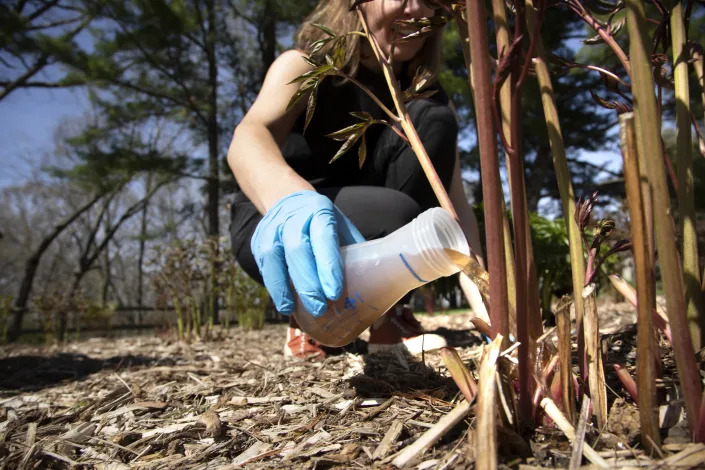
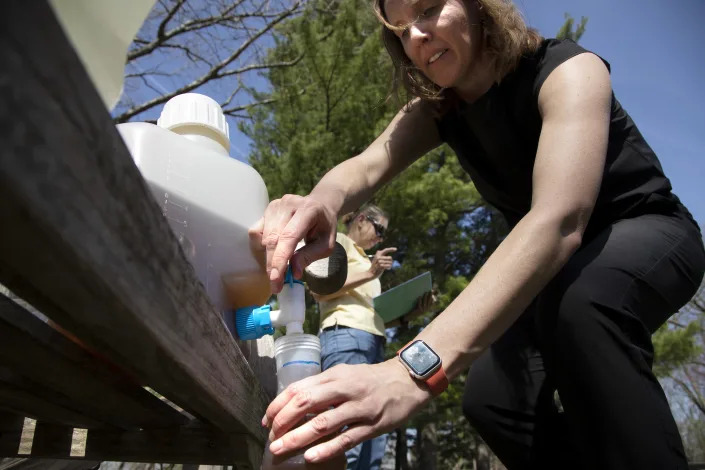
University of Michigan civil and environmental engineering professor Krista Wigginton applies human urine derived fertilizer to beds of peonies at Nichols Arboretum in Ann Arbor. The “pee-cycling” effort is part of University of Michigan research that promotes human urine-based fertilizer as beneficial to the plants and to the environment. (Marcin Szczepanski/Lead Multimedia Storyteller, Michigan Engineering via AP)University of Michigan civil and environmental engineering professors Nancy Love, and Krista Wigginton, right, apply human urine derived fertilizer to beds of peonies at Nichols Arboretum in Ann Arbor. The “pee-cycling” effort is part of University of Michigan research that promotes human urine-based fertilizer as beneficial to the plants and to the environment. (Marcin Szczepanski/Lead Multimedia Storyteller, Michigan Engineering via AP)University of Michigan civil and environmental engineering professors Nancy Love, right, and Krista Wigginton apply human urine derived fertilizer to beds of peonies at Nichols Arboretum in Ann Arbor. The “pee-cycling” effort is part of University of Michigan research that promotes human urine-based fertilizer as beneficial to the plants and to the environment. (Marcin Szczepanski/Lead Multimedia Storyteller, Michigan Engineering via AP)University of Michigan civil and environmental engineering professor Krista Wigginton applies human urine derived fertilizer to beds of peonies at Nichols Arboretum in Ann Arbor. The “pee-cycling” effort is part of University of Michigan research that promotes human urine-based fertilizer as beneficial to the plants and to the environment. (Marcin Szczepanski/Lead Multimedia Storyteller, Michigan Engineering via AP)
ANN ARBOR, Mich. (AP) — A pair of University of Michigan researchers are putting the “pee” in peony.
Rather, they’re putting pee ON peonies.
Environmental engineering professors Nancy Love and Krista Wigginton are regular visitors to the Ann Arbor school’s Nichols Arboretum, where they have been applying urine-based fertilizer to the heirloom peony beds ahead of the flowers’ annual spring bloom.
It’s all part of an effort to educate the public about their research showing that applying fertilizer derived from nutrient-rich urine could have environmental and economic benefits.
“At first, we thought people might be hesitant. You know, this might be weird. But we’ve really experienced very little of that attitude,” Wigginton said. “In general, people think it’s funny at first, but then they understand why we’re doing it and they support it.”
Love is co-author of a study published in the Environmental Science & Technology journal that found urine diversion and recycling led to significant reductions in greenhouse gas emissions and energy.
Urine contains essential nutrients such as nitrogen, potassium and phosphorus and has been used as a crop fertilizer for thousands of years.
Love said collecting human urine and using it to create renewable fertilizers — as part of what she calls the “circular economy of nutrients” — will lead to greater environmental sustainability.
Think of it not so much as recycling, but “pee-cycling,” Wigginton said.
“We were looking for terms that would catch on but get the idea across, and ‘pee-cycling’ seems to be one that stuck,” she said.
As part of a $3 million grant from the National Science Foundation awarded in 2016, Love and Wigginton have not only been testing advanced urine-treatment methods, but also investigating people’s attitudes about the use of urine-derived fertilizers.
That is what brought them to the much-loved campus Peony Garden, which contains more than 270 historic cultivated varieties from the 19th and early 20th centuries representing American, Canadian and European peonies of the era. The garden holds nearly 800 peonies when filled and up to 10,000 flowers at peak bloom.
Love and Wigginton plan to spend weekends in May and June chatting up visitors. One important lesson they learned is about the precision of language.
“We have used the term, ‘pee on the peonies.’ And then it grabs people’s attention and then we can talk to them about nutrient flows and nutrient efficiency in our communities and how to be more sustainable,” Love said. “It turns out some people thought that that was permission to drop their drawers and pee on the peonies.
“So, this year, we’re going to use ‘pee for the peonies’ and hope that we don’t have that confusion.”
The urine-derived fertilizer the researchers are using these days originated in Vermont. But if all goes according to plan, they’ll be doling out some locally sourced fertilizer next year.
A split-bowl toilet in a campus engineering building is designed to send solid waste to a treatment plant while routing urine to a holding tank downstairs. Urine diverted from the toilet and urinal were to be treated and eventually used to create fertilizers, but the COVID-19 pandemic forced the school to shut down the collection efforts.
In the meantime, the facility is undergoing an upgrade to its freeze concentrator and adding a new, more energy-efficient pasteurizer, both developed by the Vermont-based Rich Earth Institute.
“The whole idea is cycling within a community, so moving toward that we want to take urine from this community and apply it within this community,” Wigginton said.
“We do not intend to be martyrs”: fighter from Azovstal addressing Ukrainians
Alyona Mazurenko – May 13, 2022
Defender of Ukraine from the Azov Regiment, Davyd Khimik, called on citizens to continue informational work. He has said that Ukrainian fighters are full of courage and are holding the line, but they dream of seeing relatives, starting their own families and eating normally.
Quote: “While there was no mobile service, I played over all my life in my head, reminiscing about my childhood, places where I have been, different situations that stuck in my memory. Everything emerged before my eyes like in a movie.”
“I often hear guys saying that when they leave, they will get married and have children. Probably, these are the main plans of all those who have not yet had time to do this.”
“Guys who already have wives and children cry and smile simultaneously when they get a chance to see a video with their children.”
“It is interesting to watch, these are feelings that are impossible to convey – you feel the flow of life. I’ve always been a person sitting in the corner and watching everyone from the sidelines.”
“We are still full of courage and hold the line, we hold theline of defence for the whole country.”
“The enemy is trying to seize Azovstal every day, – bombing with aircraft, artillery (with everything they’ve got), but even in the most terrible conditions we fight back and they, like cowardly dogs, flee from their positions.”
“We do not intend to be martyrs, we are fighting for our lives as well, and we are waiting for support.”
Details: Davyd Khimik also thanked Ukrainians who are trying to help the defenders with information: “Keep on doing what you do. Support us with information. Shout to everyone about us. You are great.”
Quote: “I want my friends to see their children again and smell the scent of their wives.”
“And I just want the usual – a sandwich with a big piece of boiled sausage and ryazhenka with dried apricots by ‘Prostokvashino.’ Everything will be fine, we will definitely get back.”
The Ministry for Reintegration of the Temporarily Occupied Territories of Ukraine states that negotiations are underway, with Turkey, the UN and the ICRC serving as mediators, on the evacuation of military personnel from Azovstal. Critically injured personnel will be evacuated on a first priority basis.
Ukraine wants a document to be signed elaborating how exactly the evacuation from Azovstal will be handled. Preparations for signing such a document are underway.
The Ukrainian team is currently negotiating with regard to only 38 seriously wounded (incapacitated) fighters. If it succeeds in exchanging these 38, ‘we will take the next step.”
Russian aggressors have ruled out the possibility of extracting Ukrainian servicemen from Mariupol by sea to a neutral state. They have also said that they now have free rein, since all civilians have left the territory of Mariupol’s Azovstal plant.
Turkey made an offer to Russia that it would relocate Ukrainian troops from Mariupol and guarantee that they would not return to the frontline again until the end of the war, but would remain in Turkey.
On 11 May, the Deputy Prime Minister announced that the Ukrainian side had offered to exchange the severely wounded Ukrainian servicemen who remained at Azovstal for captured Russian servicemen.
Vereshchuk also explained that, as of now, it is impossible to lift the blockade of Azovstal by military means.
Ukrainian volunteer fighters use a Russian tank nicknamed ‘Bunny’ against Russian forces
Lauren Frias – May 13, 2022
This photograph taken on May 13, 2022, shows a damaged tank on a road near the Vilkhivka village east of Kharkiv, amid Russian invasion of Ukraine.Sergey Bobok/AFP via Getty Images Ukrainian volunteer fighters use a Russian tank nicknamed ‘Bunny’ against Russian forces
Ukrainian fighters used a captured tank nicknamed “Bunny” against its previous owners, the Russians.
The T-80 tank has destroyed dozens of Russian vehicles and several tanks in the past several weeks.
On May 9, Ukraine mocked Moscow’s “Victory Day” with a parade featuring captured Russian tanks.
Ukrainian volunteer forces have been using a captured T-80 tank nicknamed “Bunny” against the machine’s previous owners — the Russian army.
The tank was built two years ago and, up until March of this year, was controlled by Russian forces, according to CNN’s Sam Kiley, who met with the volunteer fighters in Ukraine.
A Ukrainian soldier identified solely as Alex, a former software engineer who used to live in the country’s second-largest city of Kharkiv, said he was on a sniper mission when he discovered the abandoned tank in a field in March — just eight days into the unprovoked Russian invasion of Ukraine, Kiley reported.
“This is like my personal tank. I am [the] tank commander and tank owner,” Alex told Kiley in an interview, adding that the “slightly modernized” tank features an auto-loader and can “shoot more advanced, better rounds,” including guided missiles.
In March, “Bunny” destroyed two dozen Russian military vehicles and several tanks, Kiley told CNN.
Ukrainian and Western officials said earlier this week that Russian forces appear to be withdrawing from the Kharkiv region, The New York Times reported. It was a significant setback for the Russian army since its retreat from Kyiv in early April. UK defense officials cited Russia’s “inability to capture key Ukrainian cities” and “heavy losses” as the reason behind the withdrawal.
Earlier this week, Ukraine mocked Russia’s annual “Victory Day” military celebration in Moscow by hosting their own “parade” featuring captured Russian tanks, “ruining the holiday for the occupiers,” the Ukrainian Defense Ministry wrote in a tweet.
Russian President Vladimir Putin delivered an address during the Russian “Victory Day” celebration on Monday, calling Ukraine and its leaders “Nazis” but did not mention a declaration of war following warnings from Western officials.
“The West was preparing for the invasion of Russia. NATO was creating tensions at the borders. They did not want to listen to Russia. They had other plans,” Putin said in his Victory Day speech. “You are fighting for the motherland, for its future, so that no one forgets the lessons of World War II, so that there is no place in the world for executioners, punishers, and Nazis.”
Millions of people could die in a global food crisis unless Putin stops blockading Black Sea ports, UN food boss warns
Sophia Ankel – May 13, 2022
Ukrainian soldier patrols aboard military boat called “Dondass” moored in Mariupol, Sea of Azov port. SEGA VOLSKII/AFP via Getty Images Millions of people could die in a global food crisis unless Putin stops blockading Black Sea ports, UN food boss warns
Russia has either blocked or attacked most of Ukraine’s seaports.
A UN official told CNN Thursday that “millions” will die if Russia doesn’t open Black Sea ports.
Ukraine is one of the world’s top agricultural exporters, providing around 12% of the world’s grain.
The head of the United Nations World Food Program pleaded with Russia’s President Vladimir Putin to open the Black Sea ports before “millions” of people die of hunger, CNN reported.
“Millions of people around the world will die because these ports are being blocked,” David Beasley said at a conference Thursday, per CNN.
When asked what he would say directly to Putin, Beasley said: “If you have any heart at all for the rest of the world, regardless of how you feel about Ukraine, you need to open up those ports.”
Beasley said that the Ukrainian city of Odesa and other ports needed to be operational within the next 60 days to prevent a global food crisis, CNN reported.
“World leaders have got to put pressure on Russia in such a way that we can have absolute neutrality to move supplies in and out of Odesa,” he said.
Russia has blocked hundreds of ships containing Ukrainian grain exports in the Black Sea and Sea of Azov since the start of its invasion of Ukraine on February 24.
The city of Odesa — which has the largest Ukrainian seaport — has also come under regular Russian bombardment, The Guardian reported.
Ukrainian President Volodymyr Zelenskyy on Monday urged the international community to immediately take measures to end the Russian blockade.
“Without our agricultural exports, dozens of countries in different parts of the world are already on the brink of food shortages,” Zelenskyy told reporters after a visit from European Council President Charles Michel, The Times reported.
“And over time, the situation can become downright terrible … This is a direct consequence of Russian aggression, which can be overcome only together — by all Europeans, by the whole free world,” he added.
Ukraine is one of the world’s top agricultural exporters. It exports more than 12% of the world’s wheat and almost half of its sunflower oil, The Times reported.