‘Our Commander Is Leaving With Us’: Putin’s Troops Openly Plot to Ditch ‘Stupid’ War

Daily Beast

‘Our Commander Is Leaving With Us’: Putin’s Troops Openly Plot to Ditch ‘Stupid’ War

Allison Quinn – May 19, 2022

Reuters
Reuters

Russian soldiers are apparently so sick of Vladimir Putin’s “stupid” war in Ukraine that they are now openly plotting with their own commanders to go AWOL.

The Ukrainian Defense Ministry’s Main Intelligence Directorate released a recording on Thursday that is said to show precisely that happening, with a soldier heard in a purportedly intercepted phone call detailing the plan.

The soldier, identified by Ukrainian intelligence as one of many men “mobilized” by authorities in occupied Donetsk, complains that he and others in his battalion are so under-equipped that even the Chechen forces fighting alongside them mock them as “meat.”

“Everyone who is here … I’m telling you … everyone is planning to take off on the 26th,” the purported soldier says.

“Isn’t that stupid?” says the other man, apparently a relative back home.

“Isn’t it stupid that we’re here?” the unnamed soldier shoots back.

He goes on to explain that the troops have decided to abscond “on the basis of the fact that they put us on the front with absolutely nothing.”

Russia Uses Ukraine’s Azovstal POWs in Demented New Propaganda Plot

“I want to tell you even more,” he says, adding that a “battalion commander is leaving with us and even a staff colonel.”

“They don’t provide us with any [equipment],” he says, adding that the rifles given to snipers are “from 1945.”

Other units “look at them and go, ‘Holy shit, what would you need those for?’ They laugh at us. You know what they call us? Blessed. We ask, ‘Why blessed?’ They say because we are walking around with no equipment, no helmets, without anything. … The Chechens call us meat.”

“It’s not desertion, because we shouldn’t be on this territory… We crossed the border as 200s,” he says, using a Russian military term for those killed in battle. “We’re not actually here. So if they say I’m a deserter, fuck off, I’m not here. Prove otherwise.”

Other Russian soldiers are said to have taken equally drastic measures to get themselves out of the war. Ukrainian intelligence has released several recordings in recent days that purportedly show Russian soldiers resorting to injuring themselves in an effort to get pulled from the war.

On Thursday, Ukraine’s Security Service released another recording said to reveal that trend. In the purportedly intercepted call between two Russian soldiers, one of the men tells his friend that fighting is getting more and more intense by the day, and despite daily fatalities, the military leadership is not providing backup.

“Take someone else’s weapon, a Ukrainian one, and shoot yourself in the legs,” his friend advises.

Russian corpses and munitions litter Kharkiv’s suburbs weeks after troops pushed out

NBC News

Russian corpses and munitions litter Kharkiv’s suburbs weeks after troops pushed out

Mo Abbas, Matt Bradley and Yelyzaveta Kovtun – May 19, 2022

MALAYA ROHAN, Ukraine — When the wind blows a certain way, the unmistakable stench of death wafts over the ruins of Christina Suslova’s house.

That’s because the body of a Russian soldier is rotting in a basement next door. He was apparently killed during a string of Ukrainian military offensives in recent weeks that have pushed Moscow’s forces away from Kharkiv, Ukraine’s second-largest city.

“They looted, they destroyed everything. Look inside, there’s nothing,” Suslova, 16, said, standing outside her wrecked home in the village of Malaya Rohan, some 13 miles east of central Kharkiv.

Ukrainians living in and around the city are only now beginning to count the cost of the destruction wrought by weeks of Russian shelling and occupation.

Malaya Rohan still looks — and smells — like a war zone, despite being liberated from occupation several weeks ago.

Malaya Rohan after Russian occupation and battles with Ukrainian forces to reclaim the village. (Mo Abbas  / NBC News)
Malaya Rohan after Russian occupation and battles with Ukrainian forces to reclaim the village. (Mo Abbas / NBC News)

A crate of Russian munitions  in Suslova’s front yard appeared to be the only thing not smashed or broken. Villagers said there were other Russian corpses in the area.

A stray dog trotted by with a bone, the origins of which were unclear.

A few doors down from Suslova’s house, Sergey Ous, a security guard, and his family painstakingly sifted through the rubble of their home, clearing the debris brick by brick. A flattened car sat atop the wreckage, possibly crushed and pushed aside by a Russian tank.

“I’m in shock. It took me eight years to build this house, and I’ve only lived in it for two years,” Ous, 45, said.

Sergey Ous, at right, stands outside his heavily damaged home in the village of Malaya Rohan, near Kharkiv. (Mo Abbas / NBC News)

In a perverse approximation of suburbia, armored vehicles sat in the driveways of some the houses down the street, the well-appointed homes apparently used by Russian troops as a base.

It’s hard to tell what damage was caused by Russian occupation and what was caused by Ukrainian shelling to end it.

Villagers blame the Russians.

“We didn’t ask them to come. We didn’t know they’d do such things. We didn’t want them here,” said Suslova’s grandmother Viktorivna Vasylyeva, 56, gesticulating angrily.

Erratic tank tracks and collision damage to vehicles and buildings may point to a desperate Russian scramble to escape. Their turrets blown off, the tanks’ gutted shells now dot the village.

A downed Russian helicopter, its “Z” marking still visible on the tail piece, lies in a field near Ludmila Terekh’s home. The 79-year-old grandmother said she blamed Russians occupying the house next to hers for attracting the shelling that caved in her roof.

“We were brothers and neighbors before, we fought in the Second World War together. I don’t know why they came,” Vasylyeva said, crying and motioning with her hands wildly.

“I worked all my life for that house and all my family lived there — my kids, my grandkids. Now I don’t know what to do,” she added.

Low-flying Ukrainian military helicopters buzzed by her home, making multiple passes.

A downed Russian helicopter in a field in the village of Malaya Rohan, near Kharkiv. (Mo Abbas / NBC News)

The dull thud and crunch of Russian shelling could still be heard in the distance, but now Moscow’s troops are too far from central Kharkiv to easily threaten the city.

Their retreat came too late for Kira Seroshtan, 15, who was lying in a hospital bed in Kharkiv Regional Hospital.

She had been walking with two friends in a Kharkiv park on April 15 before seeing a white flash.

“I turned to look at my friends. One was wounded in the chest and the other got shrapnel in the eye and in the head. I started to scream for help,” Seroshtan said.

The friend with the head injuries was killed while the other friend survived. Shrapnel tore through Kira’s abdomen and legs.

She lifted her hospital blanket to reveal ugly green stitching across her body where shrapnel had been removed and where she had had a colostomy operation.

Despite the life-changing injuries, Seroshtan was still smiling and cheerful.

Kira Seroshtan holds a piece of metal removed from her body after she was struck by shrapnel following Russian shelling of Kharkiv. (Mo Abbas / NBC News)

“Now I’ve been here one month, I realize I can’t postpone things, I can’t wait. It’s now a new phase of my life,” she said.

“I’m alive and it’s a miracle.”

She took out a piece of gauze from a drawer by her bed and carefully unwrapped a piece of the metal that had been removed from her body.

“I’ll keep it with me, and every year on April 15 I’ll take it out and look at it,” Seroshtan said.

“That day will be like my second birthday.”

Pentagon says Russia’s attempts to hit Western weapons flowing into Ukraine having ‘no impact’

The Week

Pentagon says Russia’s attempts to hit Western weapons flowing into Ukraine having ‘no impact’

Peter Weber, Senior editor – May 5, 2022

Ukraine electrical substation hit by Russian strike
Ukraine electrical substation hit by Russian strike Omar Marques/Anadolu Agency/Getty Images

Russia is concentrating most of its military efforts in Ukraine on trying to capture territory in the east and south of the country, but it continues to strike cities and towns across Ukraine. And on Tuesday and Wednesday those strikes targeted electrical substations, railroad facilities, and other infrastructure in western and central Ukraine.

The Russian Defense Ministry said the attacks on the rail infrastructure are meant to disrupt the delivery of Western weapons — Defense Minister Sergei Shoigu griped that the U.S. and its allies are “stuffing Ukraine with weapons.” A senior Pentagon official said Wednesday that despite Russia’s efforts, “there’s been no impact to our ability to continue flows into Ukraine. We’ve seen no indications that any of this Western aid has been impeded or even struck.”

“There’s no indication at all that there’s a Russian impediment to the flow” of U.S. arms to Ukraine, the Pentagon official said. “Our focus is on getting it to them. Their focus is on getting it into the fight and using it. And that’s happening.” Ukraine has 81 of 90 promised U.S. howitzers, and “we know that they are using some of those howitzers in the fight,” the official said, “but I think I’m just going to demur” on the specific number.

The flow of weapons into Ukraine “continues every single day,” and they “are getting into Ukrainian hands,” Pentagon spokesman John Kirby said later Wednesday. “We’re not going to talk about the ways in which materials getting inside Ukraine,” but “there are lots of ways to do that” and “those ways change over time.”

Ukraine and Russia both rely on the rail systems to transport military personnel and supplies, the Pentagon official said, but the Russian strikes on critical infrastructure out west have had “no appreciable impact” on Ukraine’s ability to replenish its forces. Overall, Russia’s “ability to target with precision has been less than advertised throughout this entire war,” Kirby added. “They are not good at precision strikes.”

Russia’s strikes on “non-military targets” also show its “willingness to target civilian infrastructure in an attempt to weaken Ukrainian resolve” and damage its economy, Britain’s Ministry of Defense said. These missile strikes on our cities “will get proper answers,” Ukrainian President Volodymyr Zelensky vowed Wednesday night. “Both legal and quite practical — on the battlefield.”

A clip showing Putin twitching his foot set off new speculation after claims he is seriously ill

Insider

A clip showing Putin twitching his foot set off new speculation after claims he is seriously ill

Tom Porter – May 17, 2022

Putin
Russian President Vladimir Putin, right, and Tajik President Emomali Rahmon at the Kremlin on May 16, 2022.Mikhail Klimentyev, Sputnik, Kremlin Pool Photo via AP
  • Video showing Vladimir Putin twitching his foot set off new speculation about his health.
  • The secretive leader’s condition is under scrutiny after Ukraine claimed he is seriously ill.
  • Some believe illness could make him more reckless in the war in Ukraine and confronting the West.

A clip showing Vladimir Putin twitching his leg in a meeting in Moscow with Tajikistan President Emomali Rahmon set off a new flurry of online speculation about the Russian president’s health Monday.

In the meeting, where the leaders discussed security issues in central Asia, Putin appears to jerk his foot several times. MailOnline published a version of the video:

The evidence is slight, but was seized upon amid tensions with the West over Russia’s invasion of Ukraine, and conjectures over Putin’s physical and mental health. Clips from recent meetings where Putin was seen gripping a table or awkwardly moving his leg have also fuelled speculation that he may be seriously ill.

Experts have weighed in with more credible information, with former British spy Christopher Steele on Sunday claiming that Russian sources had informed him that Putin was fatally ill.

A Ukrainian intelligence chief in an interview with Sky News over the weekend also claimed that Putin is in “very bad psychological and physical condition and he is very sick”, and rejected the suggestion he was making the claims as part of Ukraine’s information war with Russia.

A Russian oligarch also said, in a recently-released secret recording, that he had been informed by Kremlin sources that Putin had blood cancer.

No evidence has emerged to substantiate these claims.

From action man, to rumors of failing health
Russian Prime Minister Vladimir Putin rides a horse during his vacation outside the town of Kyzyl in Southern Siberia on August 3, 2009.
Russian Prime Minister Vladimir Putin rides a horse during his vacation outside the town of Kyzyl in Southern Siberia on August 3, 2009.Alexsey Druginyn/AFP via Getty Images

In his first decade in power, Putin sought to portray himself as a vigorous action man, riding a horse bare-chested, piloting a light aircraft, and vanquishing opponents on the hockey pitch in propaganda stunts.

But the Russian leader, who is approaching 70, now casts a very different figure in his public appearances.

Putin holds meetings with foreign leaders across a vast table, and has appeared bloated and agitated when pictured with top Kremlin officials and allies.

Respected Russian investigative outlet Proekt, in a recent article detailed Putin’s health problem during his presidency.

It claimed the Kremlin closely controls what footage is released of Putin to cover any abnormalities and obscure times that he is absent from public life for medical treatment. It said he suffers back problems, and may have been treated for thyroid illness.

In recent weeks, there has been speculation that Putin’s jerky movements and bloated appearance indicate he may have Parkinson’s, though experts on the disease expressed skepticism towards that claim in comments to German broadcaster Deutsche Welle.

Mark Galeotti, one of the UK’s leading experts on Russia’s security services, in a recent article for The Spectator cautioned against some of the wilder speculation about Putin’s health, that he said was indicative of wishful thinking.

“The idea of Putin succumbing to some malady is, like that other topic of over-heated speculation, the palace coup, often a hope for some quick, magic answer to the West’s problems,” he wrote.

“Yet beware magical thinking. The prevailing medical opinions appear to be that whatever Putin may have, it is not likely to lead to imminent death or incapacitation. It may well be that he is ill enough to be more reckless and less concerned about the long-term risks, but not so ill to quickly be out of the picture.”

Hundreds of Ukrainians defending Azovstal plant surrender to uncertain fate

Reuters

UPDATE 4-Hundreds of Ukrainians defending Azovstal plant surrender to uncertain fate

May 17, 2022

* Reuters witness: seven buses carry out fighters

* Some not wounded – Reuters witness

* Azov regiment fighters surrender at Azovstal

* Unclear what will happen to the fighters (Adds arrival at prison in Olenivka, criminal investigation)

MARIUPOL, Ukraine, May 17 (Reuters) – Hundreds of Ukrainian fighters surrendered to an uncertain fate on Tuesday after weeks holed up in the bunkers and tunnels below Mariupol’s Azovstal steel works as the most devastating siege of Russia’s war in Ukraine drew to a close.

Russian forces pummelled Mariupol, a major port on the Sea of Azov between Russia and Crimea, with artillery for weeks. After the urban warfare that followed, the city is a wasteland.

Civilians and Ukrainian fighters had hunkered down in Azovstal, a vast Soviet-era plant founded under Josef Stalin and designed with a maze of bunkers and tunnels to withstand nuclear attack.

Russia’s defence ministry said 265 fighters had surrendered, including 51 who were seriously wounded and would be treated at Novoazovsk in the Russian-backed breakaway Donetsk region.

Five buses took wounded fighters there early on Tuesday, and in the evening a Reuters witness saw seven more, escorted by armoured vehicles. They brought other Azovstal fighters to a newly reopened prison in Olenivka near the regional capital Donetsk.

The occupants were not visibly wounded. One bore a prominent tattoo on his neck featuring a Ukrainian national trident symbol.

Ukraine’s military command had said in the early hours that it was ending the mission to defend the plant, led by the Azov Regiment, which had previously insisted it would not surrender and appealed to Kyiv to organise an extraction.

“Because Mariupol drew in the Russian Federation’s forces for 82 days, the operation to seize the east and south (of Ukraine) was held up. It changed the course of the war,” Ukrainian presidential adviser Mykhailo Podolyak said.

It was unclear what would happen to the fighters.

Moscow has depicted the Azov Regiment as one of the main perpetrators of the alleged radical anti-Russian nationalism or even Nazism from which it says it needs to protect Ukraine’s Russian-speakers.

Kremlin spokesperson Dmitry Peskov said President Vladimir Putin had guaranteed that the fighters who surrendered would be treated “in accordance with international standards”.

ACCUSATIONS

Ukrainian Deputy Defence Minister Hanna Malyar said in a video that “an exchange procedure will take place for their return home”.

But Vyacheslav Volodin, speaker of the State Duma, Russia’s lower house, said: “Nazi criminals should not be exchanged.”

The TASS news agency said Russian federal investigators would question the soldiers as part of a probe into what Moscow calls “Ukrainian regime crimes”.

And Russian deputy ambassador to the United Nations Dmitry Polyansky said there had been no deal, tweeting: “I didn’t know English has so many ways to express a single message: the #Azovnazis have unconditionally surrendered.”

Civilians evacuated earlier had spoken of desperate conditions in the bunkers, and some fighters had endured horrific battle injuries with minimal medical assistance.

The Azov Regiment was formed in 2014 as an extreme right-wing volunteer militia to fight Russian-backed separatists who had taken control of parts of the Donbas – the largely Russian-speaking industrial heartland of eastern Ukraine where Russia says it wants to end Ukrainian rule.

The regiment denies being fascist, racist or neo-Nazi, and Ukraine says it has been reformed away from its radical nationalist origins to be integrated into the National Guard.

Kyiv also denies that Russian speakers have been persecuted in Ukraine, and says the allegation that it has a fascist agenda, repeated daily on Russian media, is a baseless pretext for a Russian war of aggression.

Russia’s Prosecutor General’s office asked the Supreme Court to class the regiment as a “terrorist organisation”, Interfax news agency reported, citing the Ministry of Justice website.

Lawmaker Leonid Slutsky, one of Russia’s negotiators in talks with Ukraine, called the evacuated combatants “animals in human form” and said they should receive the death penalty.

“They do not deserve to live after the monstrous crimes against humanity that they have committed and that are committed continuously against our prisoners,” he said.

(Reporting by Reuters; Writing by Guy Faulconbridge and Kevin Liffey; editing by Grant McCool)

Terror-stricken Russians anticipate the delivery of foreign arms to the Armed Forces of Ukraine

Ukrayinska Pravda

Terror-stricken Russians anticipate the delivery of foreign arms to the Armed Forces of Ukraine – conversation intercepted by the Security Service of Ukraine

Iryna Balachuk – May 17, 2022

The Security Service of Ukraine has published another intercepted conversation between Russian soldiers. In that conversation, the aggressors express their envy that Ukrainians have Bayraktars (medium-altitude long-range unmanned combat aerial vehicles), and they are terror-stricken at the prospect of the delivery of foreign weapons to the Armed Forces of Ukraine.

Source: Security Service of Ukraine on Telegram

Quote from a Russian soldier fighting in Zaporizhzhia: “I wish we had the f*cking drones, like their Bayraktars. The situation would be f*cking awesome. They [Bayraktars] don’t work in the daytime, they work at night. The birds take off, get our coordinates and we’re f*cked.”

Details: He [the Russian soldier] himself ridicules talk about Russia’s “glory”, since Russia “itself stirred up this special operation” but didn’t arm its soldiers properly. At present, according to the aggressor, they [Russian soldiers] are forced to beg for everything from their sponsors – farmers and children collect money for quadcopters (drones with four rotors) for Russian soldiers.

The invaders are also following with alarm news of new deliveries of foreign weapons for the Armed Forces of Ukraine. They are particularly frightened by reports that “the Poles have delivered 2,000 – or 200 – tanks to Ukraine.”

The Security Service of Ukraine has pointed out that Ukraine has news of “new guns and lend-lease”, so that the aggressors will have “a lot of discoveries – not only in the news but also on the battlefield.”

With help of Lviv-born doctor, KC hospital, nonprofit partner to ship supplies to Ukraine

The Kansas City Star

With help of Lviv-born doctor, KC hospital, nonprofit partner to ship supplies to Ukraine

Anna Spoerre – May 17, 2022

Anna Grodzinsky watched anxiously from Kansas City when the Russian invasion of Ukraine began. Her aunt and 96-year-old grandmother were hunkered down in their central Lviv home.

Many sleepless nights followed as Grodzinsky, a cardiologist at Saint Luke’s Mid America Heart Institute, watched how war affected access to fresh food, affordable medications and preventative healthcare services in the country where she was born.

It’s why she’s volunteering Saturday with Project C.U.R.E., a non-profit partnered with Saint Luke’s Health System, to send more advanced medical supplies to the people of Ukraine.

“They’re obviously scared. They’re concerned. They can’t wait for things to normalize,” she said. “But they are not optimistic that that will happen anytime soon. So they’re trying to move on pragmatically.”

When war broke out, Grodzinsky sent her grandmother small items like arthritis cream.

With Project C.U.R.E. she’ll help send more than 200 kits donated by the hospital and packed with medical supplies such as dressings, syringes and wound care materials all valued at more than $200,000.

Grodzinsky was born in the western Ukrainian city of Lviv. She emigrated with her parents to the United States in 1990 at the age of six.

They landed in Columbia as refugees where a community organization based out of the University of Missouri helped support her family’s resettlement. Her father became a nurse and her mother completed a master’s in health administration at Mizzou before they relocated to Kansas City in 1997.

Grodzinsky has been back to Ukraine four times since she was a child, most recently in April 2019, when Volodymyr Zelensky was elected president of Ukraine. Her quiet hometown city of Lviv was gaining ground as a tourist destination in eastern Europe.

“At that time, the Ukraine was becoming a bit more Western-leaning, it was becoming a bit more tech savvy, and there were advances that we saw as positives,” she said.

When Russian forces invaded on February 24, she held her breath as the city was turned upside down.

Grodzinsky, whose research includes helping pregnant patients with heart conditions, watched as women in labor ran for cover as bombs tore through Ukrainian hospitals.

She followed news coverage as one of the bombs that struck Lviv landed just a mile from the apartment where she was born and read a New York Times story about a gravely ill boy named Arthur who was fleeing to the border with his mother. He shares a name with Grodzinsky’s own son.

“It hits a nerve when you see the area where you were born under attack,” she said. “I just can’t.”

Grodzinsky got to work fundraising in preparation for a drawn-out crisis both for those fleeing and those staying. She also took in a family friend who fled Lviv.

She said it’s been incredible to see her colleagues contribute monetarily to support not only her immediate family there, which is “extremely touching,” but also the greater refugee crisis at large. She’s written thank yous to everyone she knows who’s lent support. They total 35 so far.

It’s a sign that while Ukrainian lives have been in limbo for nearly three months, fatigue from those eager to help in Kansas City hasn’t set in.

“I’m hopeful that it’s a sign of much-needed solidarity,” Grodzinsky said, later adding: “It’s important for us to do all we can to support Ukraine’s independence and sovereignty, because it’s such an important channel and such an important buffer.”

Saint Luke’s Health System partnered with Project C.U.R.E. to provide more than 200 kits donated by the hospital and packed with medical supplies such as dressings, syringes and wound care materials all valued at more than $200,000 to send to Ukraine.
How to help Project C.U.R.E

Project C.U.R.E. is a nonprofit that ships medical supplies and equipment to more than 135 developing countries around the world, said Kristin Robinson, Executive Director for the Kansas City location.

The organization has worked in Ukraine with partners for more than a decade. Since the war began, those partners have helped shi Project C.U.R.E.’s shipments to Poland, before crossing the border into Ukraine.

The Kansas City distribution location, which opened in June 2020, is always in need of volunteers to help prepare shipments out of their KC warehouse facility, Robinson said.

“People feel like they want to do something but they don’t know what they can do that makes a difference,” Robinson said. “And so we love just being an option to to really make a difference on the ground.”

She said they’re excited Grodzinsky will be among those lending a hand.

Those interested in volunteering can sign up through projectcure.org/about/location/kansas-city/.

De-Arching: McDonald’s to sell Russia business, exit country

Associated Press

De-Arching: McDonald’s to sell Russia business, exit country

David Koenig and Ann Durbin – May 16, 2022

FILE - McDonald's restaurant is seen in the center of Dmitrov, a Russian town 75 km., (47 miles) north from Moscow, Russia, on Dec. 6, 2014. McDonald’s says it's started the process of selling its Russian business, which includes 850 restaurants that employ 62,000 people. The fast food giant pointed to the humanitarian crisis caused by the war, saying holding on to its business in Russia “is no longer tenable, nor is it consistent with McDonald’s values.” The Chicago-based company had temporarily closed its stores in Russia but was still paying employees. (AP Photo/FILE)
McDonald’s restaurant is seen in the center of Dmitrov, a Russian town 75 km., (47 miles) north from Moscow, Russia, on Dec. 6, 2014. McDonald’s says it’s started the process of selling its Russian business, which includes 850 restaurants that employ 62,000 people. The fast food giant pointed to the humanitarian crisis caused by the war, saying holding on to its business in Russia “is no longer tenable, nor is it consistent with McDonald’s values.” The Chicago-based company had temporarily closed its stores in Russia but was still paying employees. (AP Photo/FILE)
ASSOCIATED PRESS
FILE - The oldest of Moscow's McDonald's outlets, which was opened on Jan. 31, 1990, is closed on Aug. 21, 2014. McDonald’s says it's started the process of selling its Russian business, which includes 850 restaurants that employ 62,000 people. The fast food giant pointed to the humanitarian crisis caused by the war, saying holding on to its business in Russia “is no longer tenable, nor is it consistent with McDonald’s values.” The Chicago-based company had temporarily closed its stores in Russia but was still paying employees. (AP Photo/FILE)
The oldest of Moscow’s McDonald’s outlets, which was opened on Jan. 31, 1990, is closed on Aug. 21, 2014. McDonald’s says it’s started the process of selling its Russian business, which includes 850 restaurants that employ 62,000 people. The fast food giant pointed to the humanitarian crisis caused by the war, saying holding on to its business in Russia “is no longer tenable, nor is it consistent with McDonald’s values.” The Chicago-based company had temporarily closed its stores in Russia but was still paying employees. (AP Photo/FILE)
ASSOCIATED PRESS

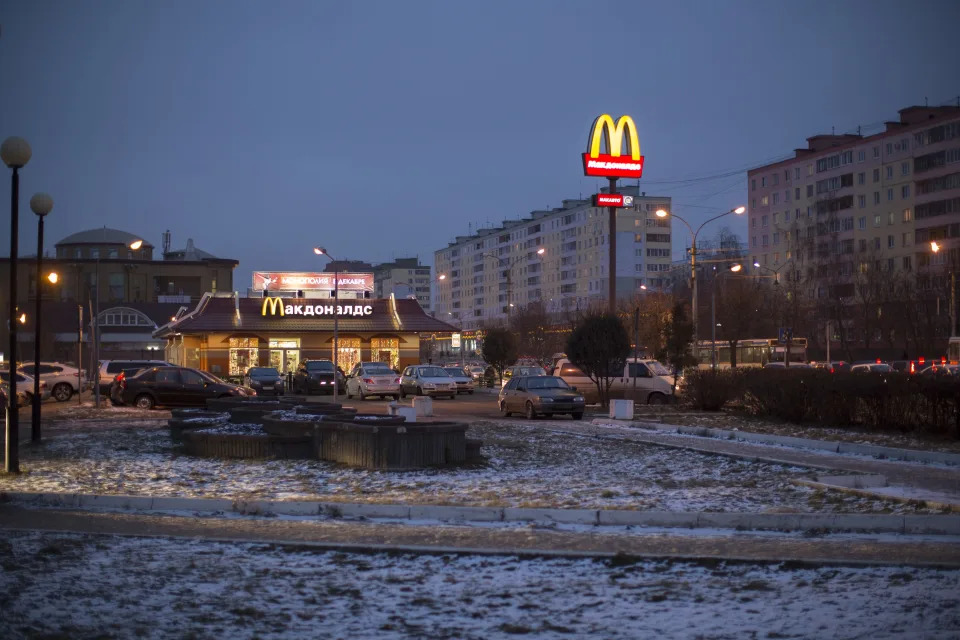
McDonald’s is closing its doors in Russia, ending an era of optimism and increasing the country’s isolation over its war in Ukraine.

The Chicago burger giant confirmed Monday that it is selling its 850 restaurants in Russia. McDonald’s said it will seek a buyer who will employ its 62,000 workers in Russia, and will continue to pay those workers until the deal closes.

“Some might argue that providing access to food and continuing to employ tens of thousands of ordinary citizens, is surely the right thing to do,” McDonald’s President and CEO Chris Kempczinski said in a letter to employees. “But it is impossible to ignore the humanitarian crisis caused by the war in Ukraine.”

McDonald’s said it’s the first time the company has ever “de-arched,” or exited a major market. It plans to start removing golden arches and other symbols and signs with the company’s name. McDonald’s said it will also will keep its trademarks in Russia and take steps to enforce them if necessary.

McDonald’s said in early March that it was temporarily closing its stores in Russia but would continue to pay its employees. It was a costly decision. Late last month, the company said it was losing $55 million each month due to the restaurant closures. It also lost $100 million worth of inventory.

McDonald’s has also closed 108 restaurants in Ukraine and continues to pay its employees there.

Western companies have wrestled with extricating themselves from Russia, enduring the hit to their bottom lines from pausing or closing operations in the face of sanctions. Others have stayed in Russia at least partially, with some facing blowback.

French carmaker Renault said Monday that it would sell its majority stake in Russian car company Avtovaz and a factory in Moscow to the state — the first major nationalization of a foreign business since the war began.

Maxim Sytch, a professor of management and organizations at the University of Michigan’s Ross School of Business, said McDonald’s and others also face pressure from customers, employees and investors over their Russian operations.

“The era where companies could avoid taking a stance is over,” Sytch said. “People want to be associated with companies that do the right thing. There’s much more to business __ and life __ than maximizing profit margins.”

McDonald’s first restaurant in Russia opened in the middle of Moscow more than three decades ago, shortly after the fall of the Berlin Wall. It was a powerful symbol of the easing of Cold War tensions between the United States and Soviet Union, which would collapse in 1991.

Now, the company’s exit is proving symbolic of a new era, analysts say. Sytch, who lived in Russia when McDonald’s entered the market and remembers the excitement surrounding the opening, said the closing signifies a reversal to the Soviet era of isolation.

“It’s really painful to see the many years of gains on the democratic front being wiped out with this atrocious war in Ukraine,” he said.

Kempczinski left open the possibility that McDonald’s could someday return to the Russian market.

“It’s impossible to predict what the future may hold, but I choose to end my message with the same spirit that brought McDonald’s to Russia in the first place: hope,” he wrote in his employee letter. “Thus, let us not end by saying, ‘goodbye.’ Instead, let us say as they do in Russian: Until we meet again.”

McDonald’s owns 84% of its restaurants in Russia; the rest are operated by franchisees. Because it won’t license its brand, the sale price likely won’t be close to the value of the business before the invasion, said Neil Saunders, managing director of GlobalData, a corporate analytics company.

McDonald’s said it expects to record a charge against earnings of between $1.2 billion and $1.4 billion over leaving Russia.

McDonald’s has more than 39,000 locations across more than 100 countries. Most are owned by franchisees — only about 5% are owned and operated by the company.

McDonald’s said exiting Russia will not change its forecast of adding a net 1,300 restaurants this year, which will contribute about 1.5% to companywide sales growth.

Last month, McDonald’s Corp. reported that it earned $1.1 billion in the first quarter, down from more than $1.5 billion a year earlier. Revenue was nearly $5.7 billion.

In afternoon trading, shares of McDonald’s shed 21 cents to $244.83.

McDonald’s is quitting Russia after 32 years in the country

Business Insider

McDonald’s is quitting Russia after 32 years in the country, citing the ‘humanitarian crisis’ caused by the Ukraine war

Kate Duffy and Grace Dean – May 16, 2022

A McDonald’s restaurant in Tver, Russia.FotograFFF/Shutterstock
McDonald’s is quitting Russia after 32 years in the country, citing the ‘humanitarian crisis’ caused by the Ukraine war

McDonald’s said Monday it’s quitting Russia after more than 30 years in the country.

The fast-food giant paused operations in Russia in March, shortly after the Ukraine invasion began.

McDonald’s said it would sell to a local buyer and “de-arch” all its restaurants in Russia.

McDonald’s announced Monday it’s quitting Russia after 32 years in the country because its business there is “no longer tenable.”

The fast food giant said: “The humanitarian crisis caused by the war in Ukraine, and the precipitating unpredictable operating environment, have led McDonald’s to conclude that continued ownership of the business in Russia is no longer tenable, nor is it consistent with McDonald’s values.”

McDonald’s opened its first restaurant in Russia in 1990, in Moscow. For many Russians, the opening of a McDonald’s restaurant — synonymous with capitalism and American culture — symbolized the impending collapse of the Soviet Union.

McDonald’s said Monday it will sell its Russian business to a local buyer and will “de-arch” all its restaurants in the country, meaning that the company’s name, branding, menu, and logo can’t be used.

Today, most McDonald’s restaurants in Russia are company-operated, but more than 100 are owned by franchisees, and some have refused to close. It’s a similar story with other Western fast-food chains, including Burger King, which said the operator of its 800 Russian restaurants “refused” to close them.

McDonald’s CEO Chris Kempczinski said Monday: “We have a long history of establishing deep, local roots wherever the arches shine. We’re exceptionally proud of the 62,000 employees who work in our restaurants, along with the hundreds of Russian suppliers who support our business, and our local franchisees. Their dedication and loyalty to McDonald’s make today’s announcement extremely difficult.”

He added: “However, we have a commitment to our global community and must remain steadfast in our values. And our commitment to our values means that we can no longer keep the arches shining there.”

McDonald’s said it expected to record a non-cash charge of between $1.2 billion and $1.4 billion as a result of its Russia exit. It reaffirmed its prior 2022 financial outlook.

Russia invaded Ukraine on February 24 and on March 8, McDonald’s announced it was temporarily closing restaurants and pausing operations in Russia.

The company said Monday it had initiated the process to sell its Russian operations and was “pursuing the sale of its entire portfolio of McDonald’s restaurants in Russia to a local buyer.”

The company added it was “seeking to ensure the employees of McDonald’s Russia continue to be paid until the close of any transaction” and that “employees have future employment with any potential buyer.”

In a message to Russian franchisees, seen by The New York Times, Kempczinski said leaving the country was “a complicated issue that’s without precedent and with profound consequences.”

McDonald’s said in April it had lost around $100 million in wasted inventory after shutting its restaurants in Russia and Ukraine.

Russian news outlet RIA Novosti previously reported that a number of McDonald’s restaurants that were owned by franchisees remained open despite the Ukraine war.

IKEA to Start Selling Solar Panels in California Stores

EcoWatch – Renewable Energy

IKEA to Start Selling Solar Panels in California Stores

Olivia Rosane, EcoWatch – May 16, 2022

Ikea San Diego

The Ikea at San Diego’s Mission Valley. Dünzl / ullstein bild / Getty Images

Swedish furniture-giant IKEA wants to bring the power of the sun into U.S. homes.

The company announced on May 12 that it was partnering with residential solar provider SunPower to make “home solar solutions” available to its U.S. customers. 

“At IKEA, we’re passionate about helping our customers live a more sustainable life at home,” IKEA U.S. CEO and Chief Sustainability Officer Javier Quiñones said in a press release.  “We’re proud to collaborate with SunPower to bring this service to the U.S. and enable our customers to make individual choices aimed at reducing their overall climate footprint.”

The name of the new initiative is Home Solar, and the program will first launch in certain California markets in the fall of 2022. The program will enable IKEA Family customer loyalty program members to purchase solar energy infrastructure for their homes through SunPower that allow them to both generate and store clean energy.

“The launch of Home Solar with IKEA will allow more people to take greater control of their energy needs, and our goal is to offer the clean energy service at additional IKEA locations in the future,” Quiñones said. 

The new program builds on IKEA’s broader sustainability initiatives both in the U.S. and abroad. The company has pledged to model a circular economy and be climate positive by 2030. It has already pledged to phase out plastic packaging by 2028. Further, it exceeded its goal of generating more renewable energy than it uses by 2020, according to Fast Company. It invested in two solar farms in the U.S. and a wind farm in Romania and also installed solar panels on nearly 90 percent of its stores worldwide and 90 percent of its U.S. stores.

It is also not new to offering home solar: It sells solar panels in 11 non-U.S. markets including the UK, according to Insider. Last year, it also launched a program in Sweden that allowed homeowners to purchase renewable energy from wind and solar parks and track their energy usage via an app, as Reuters reported at the time. IKEA Sweden head of sustainability Jonas Carlehed said he hoped that both the renewable energy program and residential solar panels would be available to all of its markets eventually. 

“IKEA wants to build the biggest renewable energy movement together with co-workers, customers and partners around the world, to help tackle climate change together,” the company said in a statement reported by Reuters.

IKEA’s partner in bringing home solar to the U.S. is the California-based SunPower, The Hill reported. The company has been in the solar business for more than 35 years, according to the press release. 

“We are thrilled to deliver exceptional solar products to IKEA customers through a unique and simplified buying experience,” SunPower CEO Peter Faricy said in the press release. “Together with IKEA, we can help introduce the incredible benefits of solar to more people and deliver on our shared value of making a positive impact on the planet.”

While IKEA has made efforts to become more environmentally friendly as a company, it has still faced criticism for generating both climate and air pollution by shipping goods to the U.S.