Lithuania now fully independent of Russian energy

Euractiv

Lithuania now fully independent of Russian energy

 By Giedre Peseckyte, Euractiv – May 23, 2022

Nord Pool, a pan-European power exchange, decided to stop trading Russian electricity from its only importer in the Baltic States Inter RAO, meaning Lithuania no longer imports Russian energy supplies such as oil, electricity, and natural gas. [Shutterstock/PX Media.

Lithuania on Sunday dropped Russian energy imports including oil, natural gas and electricity, making it completely free of Russian energy supplies.

Nord Pool, a pan-European power exchange, decided to stop trading Russian electricity from its only importer in the Baltic States Inter RAO, meaning Lithuania no longer imports Russian energy supplies such as oil, electricity, and natural gas.

“Not only it is an extremely important milestone for Lithuania in its journey towards energy independence, but it is also an expression of our solidarity with Ukraine. We must stop financing the Russian war machine,” said Energy Minister Dainius Kreivys.

Lithuania will achieve full energy independence when it successfully implements synchronisation, meets its electricity needs through local green energy production and becomes an electricity exporter, Kreivys also stressed.

For liquefied natural gas, the terminal in Klaipėda has received cargoes from the US. At the same time, local power generation and imports from EU countries through existing interconnections with Sweden, Poland and Latvia cover the country’s electricity needs. Meanwhile, Orlen Lietuva, the only oil importer in Lithuania, refused to import Russian crude oil more than a month ago.

Commenting on Lithuania’s decision to stop imports of Russian fossils and electricity, Ukrainian Energy Minister German Galushchenko tweeted on Sunday (22 May) that it is “a crucial milestone towards energy independence, a great sign of dignity, and a motivating example for the rest of Europe.”

“Ukraine is ready to support you [Lithuania] with our carbon-free electricity,” he added.


After 3 months of war, life in Russia has profoundly changed

Associated Press

After 3 months of war, life in Russia has profoundly changed

The Associated Press – May 23, 2022

When Vladimir Putin announced the invasion of Ukraine, war seemed far away from Russian territory. Yet within days the conflict came home — not with cruise missiles and mortars but in the form of unprecedented and unexpectedly extensive volleys of sanctions by Western governments and economic punishment by corporations.

Three months after the Feb. 24 invasion, many ordinary Russians are reeling from those blows to their livelihoods and emotions. Moscow’s vast shopping malls have turned into eerie expanses of shuttered storefronts once occupied by Western retailers.

McDonald’s — whose opening in Russia in 1990 was a cultural phenomenon, a shiny modern convenience coming to a dreary country ground down by limited choices — pulled out of Russia entirely in response to its invasion of Ukraine. IKEA, the epitome of affordable modern comforts, suspended operations. Tens of thousands of once-secure jobs are now suddenly in question in a very short time.

Major industrial players including oil giants BP and Shell and automaker Renault walked away, despite their huge investments in Russia. Shell has estimated it will lose about $5 billion by trying to unload its Russian assets.

While the multinationals were leaving, thousands of Russians who had the economic means to do so were also fleeing, frightened by harsh new government moves connected to the war that they saw as a plunge into full totalitarianism. Some young men may have also fled in fear that the Kremlin would impose a mandatory draft to feed its war machine.

But fleeing had become much harder than it once was — the European Union’s 27 nations, along with the United States and Canada had banned flights to and from Russia. The Estonian capital of Tallinn, once an easy long-weekend destination 90 minutes by air from Moscow, suddenly took at least 12 hours to reach on a route through Istanbul.

Even vicarious travel via the Internet and social media has narrowed for Russians. Russia in March banned Facebook and Instagram — although that can be circumvented by using VPNs — and shut access to foreign media websites, including the BBC, the U.S. government-funded Voice of America and Radio Free Europe/Radio Liberty and the German broadcaster Deutsche Welle.

After Russian authorities passed a law calling for up to 15 years’ imprisonment for stories that include “fake news” about the war, many significant independent news media shut down or suspended operations. Those included the Ekho Moskvy radio station and Novaya Gazeta, the newspaper whose editor Dmitry Muratov shared the most recent Nobel Peace Prize.

The psychological cost of the repressions, restrictions and shrinking opportunities could be high on ordinary Russians, although difficult to measure. Although some public opinion polls in Russia suggest support for the Ukraine war is strong, the results are likely skewed by respondents who stay silent, wary of expressing their genuine views.

Andrei Kolesnikov of the Carnegie Moscow Center wrote in a commentary that Russian society right now is gripped by an “aggressive submission” and that the degradation of social ties could accelerate.

“The discussion gets broader and broader. You can call your compatriot — a fellow citizen, but one who happens to have a different opinion — a “traitor” and consider them an inferior kind of person. You can, like the most senior state officials, speculate freely and quite calmly on the prospects of nuclear war. (That’s) something that was certainly never permitted in Soviet times during Pax Atomica, when the two sides understood that the ensuing damage was completely unthinkable,” he wrote.

“Now that understanding is waning, and that is yet another sign of the anthropological disaster Russia is facing,” he said.

The economic consequences have yet to fully play out.

In the early days of the war, the Russian ruble lost half its value. But government efforts to shore it up have actually raised its value to higher than its level before the invasion.

But in terms of economic activity, “that’s a completely different story,” said Chris Weafer, a veteran Russia economy analyst at Macro-Advisory.

“We see deterioration in the economy now across a broad range of sectors. Companies are warning that they’re running out of inventories of spare parts. A lot of companies put their workers on part time work and others are warning to them they have to shut down entirely. So there’s a real fear that unemployment will rise during the summer months, that there will be a big drop in consumption and retail sales and investment,” he told The Associated Press.

The comparatively strong ruble, however heartening it may seem, also poses problems for the national budget, Weafer said.

“They receive their revenue effectively in its foreign currency from the exporters and their payments are in rubles. So the stronger the ruble, then it means the less money that they actually have to spend,” he said. “(That) also makes Russian exporters less competitive, because they’re more expensive on the world stage.”

If the war drags on, more companies could exit Russia. Weafer suggested that those companies who have only suspended operations might resume them if a cease-fire and peace deal for Ukraine are reached, but he said the window for this could be closing.

“If you walk around shopping malls in Moscow, you can see that many of the fashion stores, Western business groups, have simply pulled down the shutters. Their shelves are still full, the lights are still on. They’re simply just not open. So they haven’t pulled out yet. They’re waiting to see what happens next,” he explained.

Those companies will soon be pressed to resolve the limbo that their Russian businesses are in, Weafer said.

“We are now getting to the stage where companies are starting to run out of time, or maybe run out of patience,” he said.

‘Ashamed’ of war, Russian diplomat resigns; Russian POW sentenced to life for killing civilian: Live updates

USA Today

‘Ashamed’ of war, Russian diplomat resigns; Russian POW sentenced to life for killing civilian: Live updates

John Bacon, Kim Hjelmgaard, Tom Vanden Brook, Jordan Mendoza and

Jorge L. Ortiz, USA TODAY – May 23, 2022

A veteran Russian diplomat to the U.N. Office at Geneva resigned his post Monday, saying he is “ashamed” of his country’s invasion of Ukraine.

Boris Bondarev, 41, confirmed his resignation in a letter delivered Monday at the Russian diplomatic mission blasting the “aggressive war unleashed” by President Vladimir Putin.

“For twenty years of my diplomatic career I have seen different turns of our foreign policy, but never have I been so ashamed of my country as on Feb. 24 of this year,” he wrote, referencing the date the invasion began.

Bondarev, who has recently worked on Russia’s role in the Conference on Disarmament in Geneva, told the Associated Press he is concerned about Moscow’s response to his letter and that he has no plans to leave Switzerland. His letter and statement take aim at Russian oligarchs who have grown rich under the Putin regime.

“Those who conceived this war want only one thing – to remain in power forever, live in pompous tasteless palaces, sail on yachts comparable in tonnage and cost to the entire Russian navy, enjoying unlimited power and complete impunity,” Bondarev wrote. “To achieve that they are willing to sacrifice as many lives as it takes.”

U.N. Watch executive director Hillel Neuer called on other Russian diplomats worldwide to follow Bondarev’s “moral example” and resign.

“Boris Bondarev is a hero,” Neuer said.

Latest developments:

►The Russian economy is “withstanding the blow” of international sanctions well, even though it “is not easy,” President Vladimir Putin said.

►Army Gen. Mark Milley, chairman of the Joint Chiefs of Staff, said the Pentagon remains committed to avoiding escalating the war with Russia. A call last week with his Russian counterpart was “purposeful and worthwhile,” Milley said.

►Russia has forcibly deported more than 1.4 million Ukrainian citizens, including 240,000 children, to the Russian Federation, said Liudmyla Denisova, Ukrainian Parliament Commissioner for Human Rights.

►Russian forces are stepping up their bombardment of the Donbas area. Donetsk Gov. Pavlo Kyrylenko said heavy fighting was continuing near Luhansk and that the front line was under continuous shelling. Of 1.6 million people who lived in the region before the invasion, there are “not more than 320,000 people” remaining, he said.

►Starbucks is closing its 130 stores in Russia and no will longer have a brand presence there. The company said it will continue to pay its nearly 2,000 Russian employees for six months and help them transition to new jobs.

West pledges sophisticated weaponry to aid Ukraine’s fight

Western allies have promised new, sophisticated weaponry to support Ukraine as it resists Russia’s invasion, Defense Secretary Lloyd Austin said Monday. Denmark will send Harpoon anti-ship missile systems to help Ukraine defend its Black Sea coastline, Austin said. The missiles will pose a significant threat to Russian ships in the event of an attack on the key port city of Odesa, or an amphibious landing by Russian forces on the Ukrainian coast, he said.

In all, 20 countries pledged military aid to Ukraine at a meeting of allies Monday morning, Austin said. Italy, Greece, Norway and Poland have agreed to send artillery cannons and ammunition, which have been in demand as the war rages in eastern Ukraine.

There have been “serious exchanges of artillery fires over the last several weeks,” Austin said.

Zelenskyy says war will decide ‘if brute force will rule the world’

Countries, large cities and even large companies can stake out a section of Ukraine to lead rebuilding after the war, President Volodymyr Zelensky said in a video speech to global business and political leaders gathered at the World Economic Forum in Davos, Switzerland. Zelenskyy said the world had reached a “turning point” on freedom.

“This is really the moment when it is decided if brute force will rule the world,” he said. “If so, there is no need for further meetings in Davos.”

Zelensky also urged international corporations to shun Russia and set up shop in Ukraine.

“Set a precedent so that your brands will not be associated with war crimes,” Zelensky said through an interpreter.

Russian POW sentenced to life in prison for killing Ukrainian civilian

The first trial of a Russian soldier for war crimes in Ukraine since the invasion concluded Monday with Sgt. Vadim Shishimarin, a 21-year-old from Siberia, sentenced to life in prison for premeditated murder and violating international laws for war.

Shishimarin, a captured Russian tank-unit sergeant, fatally shot Oleksandr Shelipov, a 62-year-old civilian, in the head in late February. Shishimarin had pleaded guilty, but his defense had argued he was carrying out a direct order that he initially disobeyed.

Last week Shishimarin had asked Shelipov’s widow, Kateryna, for forgiveness. She said she wanted a life sentence to be handed down, but also that she would be willing to see Shishimarin returned to Russia in an exchange for Ukrainian fighters who surrendered to Russian forces at the Azovstal steel plant in Mariupol.

During the trial the three-judge panel heard that Shishimarin was ordered to kill the man so he wouldn’t be able to report them to Ukrainian military authorities. Shishimarin fired his Kalashnikov rifle at the victim through the open window of a car.

“I was nervous about what was going on. I didn’t want to kill,” Shishimarin said at the hearing in Ukraine’s capital Kyiv. Judge Serhiy Ahafonov said he did not consider the defendant’s remorse sincere.

Swedish PM cites ‘positive’ call with Erdogan over NATO membership

Negotiations with Turkey on Sweden’s membership to NATO will take more time, but a recent phone call with Turkish President Recep Tayyip Erdogan was “good and positive,” the Swedish prime minister said Monday. Magdalena Andersson told Swedish official news agency TT she was looking forward to the upcoming negotiations with Ankara. Edrogan has taken issue with Sweden and Finland, citing their alleged support for the banned Kurdistan Workers’ Party, or PKK and other groups that Turkey views as terrorists. Andersson said Sweden was one of the first countries that classified the PKK as terrorists.

Sweden and Finland formally applied to join NATO last week – a decision spurred by Russia’s war on Ukraine. Unanimous consent of all NATO members is required for new members. Erdogan has made few references to Finland amid reports that most of Turkey’s grievances are directed at Sweden, which has a large community of Kurdish exiles.

Russian casualty rate high – and rising, British assessment says

In the first three months of its “special military operation,” Russia has likely suffered a similar death toll to that experienced by the Soviet Union during its entire nine-year war in Afghanistan, the British Defense Ministry said in its latest assessment of the war in Ukraine. About 15,000 Russians died in the Afghan war that ended in 1989.

“Poor low-level tactics, limited air cover, a lack of flexibility, and a command approach which is prepared to reinforce failure and repeat mistakes has led to this high casualty rate (in Ukraine), which continues to rise in the Donbas offensive,” the assessment says.

The Russian public has, in the past, “proven sensitive to casualties suffered during wars of choice,” the assessment says. As the death toll rises and the human cost becomes more apparent, public dissatisfaction with the war and a willingness to voice it may grow, it says.

Fighters who surrendered at steel mill to face ‘international tribunal’

The head of the self-proclaimed Donetsk People’s Republic in eastern Ukraine says almost 2,500 fighters from the Azovstal steel mill captured by the Russian forces will face “international tribunal” there. Denis Pushilin was quoted by the Interfax news agency as saying that “at the moment the charter for the tribunal is being worked out.”

Family members of the fighters taken prisoner at the mill have pleaded for them to be given rights as prisoners of war and eventually returned to Ukraine.

Ex-Defense Secretary: Russia unlikely to use nuclear weapons

Even with the war in Ukraine going much worse than expected for Russia, the probability of Russian President Vladimir Putin deploying a nuclear weapon is “low but not zero,” former U.S. Secretary of Defense and CIA Director Robert Gates said Sunday. Speaking on CBS’s “Face the Nation with Margaret Brennan,” Gates said Russia’s use of a tactical weapon would prompt a strong response from the West.

“The other thing that I hope somebody around Putin is reminding him is that, in that part of the world, and particularly in eastern Ukraine, the winds tend to blow from the west,” Gates said. “If you set off a tactical nuclear weapon in eastern Ukraine, the radiation is going to go into Russia.”

Gates, who served as defense secretary under Republican President George W. Bush and Democratic President Barack Obama from 2006-2011, said the Biden administration should have started arming Ukraine for a conflict with the Russians months earlier. But he gives President Joe Biden high marks for rallying the U.S. allies and assembling a coalition to confront Russia, resisting calls for a no-fly zone – which would require deeper intervention – and for refusing to bite on Putin’s nuclear threats.

Gates pointed out that sanctions from the West and failures on the battlefield have dealt a major blow to Russia and its global standing. “Putin will remain a pariah,” Gates said: “He has put Russia really behind the eight ball economically, militarily, and because now people are going to look at the Russian military and say, ‘You know, this was supposed to be this fantastic military. Well, they give a good parade, but in actual combat, not so hot.'”

Biden, Harris on Russia’s banned list, but not Trump

Russia has permanently barred nearly 1,000 Americans from entering the country in response to the United States’ support of Ukraine in the war, and the list includes numerous elected leaders but conspicuously leaves out a prominent one – former President Donald Trump.

President Joe Biden, Vice President Kamala Harris, Secretary of State Antony Blinken, Senate Majority Leader Chuck Schumer, House Speaker Nancy Pelosi and House Minority Leader Kevin McCarthy were among the 963 banned by Russia, a largely symbolic gesture.

Recent living former presidents like Barack Obama and George W. Bush were not on the banned list, but Trump’s name stands out as he has frequently been accused of being too cozy with Russian President Vladimir Putin. Two days before the Feb. 24 invasion, Trump referred to Putin’s strategy toward Ukraine as “genius” and “savvy.”

Ukraine says it destroyed a Russian mortar carrier after a pro-Kremlin journalist accidentally exposed its location

Business Insider

Ukraine says it destroyed a Russian mortar carrier after a pro-Kremlin journalist accidentally exposed its location

Matthew Loh – May 23, 2022

One of Russia’s “Tyulpan” self-propelled heavy mortars was destroyed after its location was revealed, Ukraine says.Leonid Faerberg/SOPA Images/LightRocket via Getty Images
Ukraine says it destroyed a Russian mortar carrier after a pro-Kremlin journalist accidentally exposed its location
  • A pro-Kremlin journalist’s report exposed the location of a Russian mortar carrier, Ukraine said.
  • Ukrainian forces later destroyed the vehicle and thanked the Russian reporter “for the tip.”
  • Russian journalist Alexander Kots rejected the suggestion that his coverage compromised the vehicle.

A pro-Kremlin journalist’s report on the military capabilities of a Russian mortar carrier inadvertently exposed the vehicle’s location to Ukrainian forces and led to its destruction, Ukraine’s Center for Strategic Communication said.

“Thank you to Russian propagandists for the tip,” StratCom UA tweeted on Sunday, along with a video that appeared to show the mortar carrier being blown up.

The Ukrainian government agency said its forces had lured the vehicle out of its position before it was destroyed.

StratCom UA also said on Facebook that this was the first time this class of mortar carrier — the SAU 2C4 “Tyulpan” — had been taken out in the war.

However, the Russian journalist who made the initial report, Alexander “Sasha” Kots, has rejected the idea that his video coverage led to the artillery vehicle’s destruction.

“Let’s observe informational hygiene and ignore such literary defecations, covering our noses in disgust,” Kots wrote on his Telegram channel in response to the Ukrainian claims.

Kots wrote that Ukraine’s footage of the “Tyulpan” getting destroyed shows a different area from where he and his crew filmed the vehicle, and that the mortar carrier had left the location before his team departed.

His report featured clips of a “Tyulpan” firing rounds near the Ukrainian city of Severodonetsk in the Donbas region. Kots wrote in his caption that Ukrainian forces were being “hammered” by the mortar carrier, and said in his video that it was being used by Russian-backed separatists to destroy a bridge.

Kots works for the Russian outlet Komsomolskaya Pravda, which often repeats the Kremlin’s war rhetoric — such as the baseless claim that Ukraine’s leadership has been infiltrated by Nazis scheming against Russia.

At Mariupol cemetery, a grieving mother ponders war’s human toll

Reuters

At Mariupol cemetery, a grieving mother ponders war’s human toll

May 23, 2022

A woman visits her son’s grave at a cemetery outside Mariupol

(Reuters) – At a cemetery outside Mariupol, a Ukrainian city captured by Russia last week after a destructive three-month siege, a grief-stricken mother sobs inconsolably.

Natalya lost her only son, Vladimir Voloshin, on March 26 when shrapnel smashed into his skull and chest in the fight for the city. He was 28.

Wearing a headscarf to hold back her flowing white curls, the 57-year-old nurse said Vladimir had recently graduated from a local naval academy. What seemed like a promising career was upended overnight when Ukraine announced a general mobilisation to counter the Russian invasion.

“He had been supposed to set sail in February,” Natalya said on Sunday between sobs at the cemetery in Staryi Krym, just north of Mariupol, where her son was laid to rest.

“But then the war started. For no reason at all.”

Russia sent thousands of troops into Ukraine on Feb. 24, saying it had to counter a military threat and rid Ukraine of nationalists threatening Russian speakers – claims dismissed by Kyiv and Western countries as false pretexts for a land grab.

Mariupol, a once bustling port city on the Sea of Azov in southeastern Ukraine quickly became a Russian target. After a siege that Ukraine says killed tens of thousands, it has now succumbed to occupation and lies in ruins.

Treading through long rows of fresh graves and makeshift wooden crosses, Natalya said many of Mariupol’s dead had no one left to honour their memory.

“Who will bury them? Who will put up a plaque?” she asked. “They have no family.”

Coup against Putin would be triggered if one of his top officials refused to carry out a nuclear strike

Business Insider

Coup against Putin would be triggered if one of his top officials refused to carry out a nuclear strike, Bellingcat expert say

Matthew Loh – May 23, 2022

Russian President Vladimir Putin attends Orthodox Easter mass in Moscow, Russia, on April 24, 2022.Contributor/Getty Images
Coup against Putin would be triggered if one of his top officials refused to carry out a nuclear strike, Bellingcat expert says

  • Putin would face a coup if he orders a nuclear strike and is disobeyed, a Bellingcat expert said.
  • Defying his command would signal insubordination that may lead to “the death of Putin,” he said.
  • Some leading Russian officials already believe Putin is losing his grip on power, the expert said.

Russian President Vladimir Putin would face a coup if one of his top officials ever disobeyed an order to launch a nuclear strike, according to Bellingcat’s lead Russia investigator Christo Grozev.

The coup would take place if just one of the “five hands” needed for a Russian nuclear launch defied Putin, Grozev told Radio Liberty, per the Metro news outlet.

“Because after the refusal to comply with the order of the king, everything will go down very quickly,” he said, the outlet reported.

According to Metro, Grozev said Putin may be under pressure from some in his inner circle to escalate the invasion of Ukraine via the mass mobilization of troops or even a nuclear strike.

However, the Russian leader must first “be sure everyone along the chain will carry out this order” before he considers sanctioning such a launch, Grozev said, the outlet reported.

Per Metro, the investigator said that if one person in the chain of command refused to comply, it would be a “signal of insubordination” that could bring about the “death of Putin.”

“So until he is sure that everyone will comply, he will not give this order,” Grozev added, per the outlet.

It seems likely that leading officials won’t follow through with such a command because they believe Putin is losing authority quickly and won’t stay in power for three more months, the investigator said, per Metro.

To launch a nuclear strike, a decision would need to be made by the Russian president, who always has a small briefcase (or “Cheget”) by his side that links him to the country’s nuclear forces, Reuters reported citing a 2020 nuclear policy document.

While the briefcase doesn’t have a launch button, it relays the order to Russia’s central military command, per the outlet.

Even if Putin decided to launch such an attack, at least two other lead officials would also be needed to follow through with his command.

According to several intelligence reports, a nuclear strike can only be carried out if Russia’s defence minister and chief of the general staff — positions currently by Sergei Shoigu and Valery Gerasimov, respectively — also authorize the launch with their own codes and “Cheget” briefcases.

Russian Defence Minister Sergei Shoigu (R) and chief of the general staff Valery Gerasimov attend a meeting with Russian President in Moscow on February 27, 2022.
Russian Defence Minister Sergei Shoigu (right) and Chief of the General Staff Valery Gerasimov attend a meeting in Moscow on February 27, 2022.ALEXEY NIKOLSKY/SPUTNIK/AFP via Getty Images

According to the Arms Control Association, Russia claims it has an inventory of 6,257 nuclear warheads, compared with the 5,500 estimated warheads in the US.

Last week, Ukraine’s military intelligence chief said that a coup against Putin is underway and that the Russian leader is battling cancer. Western intelligence agencies have not publicly verified the claims.

A man was “leaking” information to the Russians about the positions of the Armed Forces and the National Guard in Bakhmut

Ukrayinska Pravda

A man was “leaking” information to the Russians about the positions of the Armed Forces and the National Guard in Bakhmut

Roman Petrenko – May 23, 2022

The Prosecutor General’s Office announced that a resident of Bakhmut Donetsk region, had been exposed for treason. The man had been marking the positions of Ukrainian defenders.

Source: Prosecutor General’s Office of Ukraine

Details: According to the investigation, it was in May that the citizen agreed to help the aggressors.

The man had been transferring information on the location and movement of personnel and equipment of the Ukrainian Armed Forces to an agent of the Russian law enforcement agency via the internet, as well as filming the location of National Guard personnel in Bakhmut.

In addition, he had been putting marks on electronic maps and had been informing the invaders about the missiles hitting the city’s civilian infrastructure buildings.

Currently, the man is under arrest without bail.

Reminder: As a result of the Russian airstrike on Bakhmut in the Donetsk region on 17 May, 5 civilians were killed, including a two-year-old child, and 4 residents were injured.

On 19 May, the Russian armed forces made another airstrike on Bakhmut, shelling a five-story building, a private house and an office building.

CBS News poll: More Americans label GOP extreme, but Democratic Party as weak

CBS News

CBS News poll: More Americans label GOP extreme, but Democratic Party as weak

Jennifer De Pinto, Fred Backus, and Kabir Khanna – May 22, 2022

With midterm primaries helping set the direction for the Democratic and Republican parties, most Americans, including many of the parties’ own voters, aren’t terribly happy with the parties or what they’re talking about. Given that Sunday’s CBS News poll finds most aren’t happy with the direction of the country either, the major political parties aren’t providing much solace.

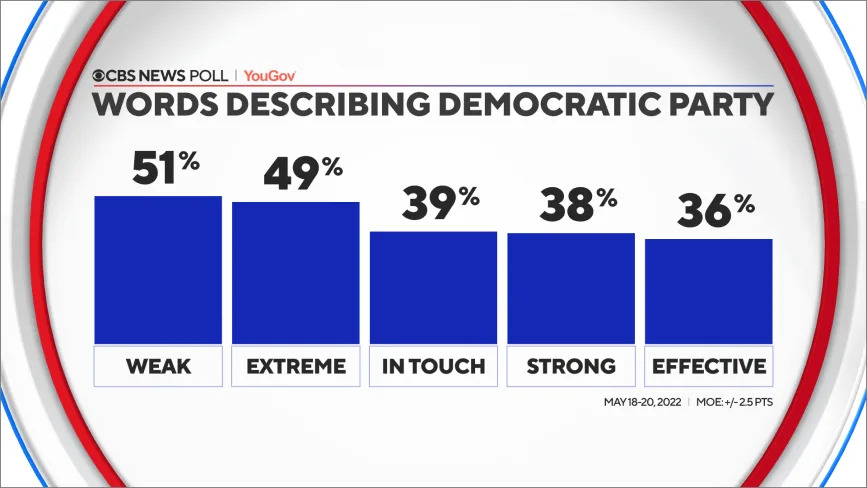
For starters, the Democratic Party — which controls Congress and the presidency — is not seen by a majority as either “effective” or “in touch,” which are, no doubt, important measures for a party in power. The Democratic Party is more apt to be described as “weak,” a label applied by a slight majority of Americans, than it is “strong.”

The Republican Party, for its part, is described by a slight majority as “extreme,” a term Americans apply to the GOP more so than to Democrats, though neither really escapes the label. Independents are more likely to call the GOP extreme. The GOP is described as “strong” more often than as “weak,” but it is also described by Americans more often as “hateful” than as “caring” — by double digits.

Primaries tend to find candidates arguing over matters that appeal to their bases, but as different as each side’s campaigns are, there is something voters of each side share: a desire for candidates to focus on inflation. Perhaps that’s no surprise, given how large it looms for most Americans.

Among Democrats, who also want a focus on taxing the wealthy and racial justice, many also want their candidates to focus on protecting abortion rights. In fact, especially among those who care a lot about the potential overturning of Roe v. Wade — almost all say they want the party’s nominees to focus on abortion rights.

Republicans want their nominees to focus on stopping illegal immigration and talk about traditional values. Illegal immigration is especially a priority among self-described conservative Republicans.

A majority of independents also want the Democrats to focus on abortion rights.

And there’s an asymmetry on abortion focus between the parties: even more Democrats want their candidates to focus on supporting abortion rights than Republicans want their candidates to talk about opposing it.

But despite being in power during a time of inflation, Democrats don’t cede that much ground to Republicans on who’s trusted to deal with it. It’s 51% of Americans who trust the GOP, not much more than the 49% who trust the Democrats on inflation. It’s the same nearly even gap on the economy. And that may be because the parties’ candidates aren’t talking about it enough.

Democrats have an advantage being trusted on abortion and coronavirus.

The Trump factor

Within the Republican rank-and-file, there’s a divide over how much they want to hear about loyalty to former President Donald Trump, some of which we’re seeing play out in the primaries right now. A slight majority of Republicans do want their candidates to focus on showing loyalty to Trump, but nearly half don’t. Related to this, four in 10 Republicans want the nominees focused on the 2020 election, but most don’t.

Who is fighting for whom?

We also see such dramatic differences in which people Americans think the parties support — or don’t. The overall picture reminds us of how much Americans see the parties dividing them, not only on policy, but by demographic groups.

Americans overall are more likely to see the Republican Party as fighting for White people than for Black people — by more than two to one. In fact, more say the Republican Party fights against the interests of Black Americans than is neutral toward them. It’s similarly true for views of the Republican Party’s approach to Hispanic people, with more feeling it works against them, rather than for them, and by more than two to one, against LGBTQ people than for them. Americans do think the GOP fights more for people of faith than do Democrats.

Conversely, they see the Democratic Party as fighting for Black and Hispanic Americans more so than for White Americans.

Americans are more likely to believe the GOP fights more against the interests of women than for women, and women overall describe things this way.

Men, meanwhile, are much more likely to think the Democrats fight more for women than for men, but a majority of men think the Republican Party fights for them (and more so than for women).

Echoing some of these perceptions are big differences in how partisans within the parties approach the country’s racial diversity — and each group’s partisans tend to think they’re not being treated fairly.

Big majorities of Democrats think immigrants make America better in the long run; a majority of Republicans say they make America worse.

Republicans are more likely to say White Americans suffer “a lot” of discrimination than they are to say Black Americans do.

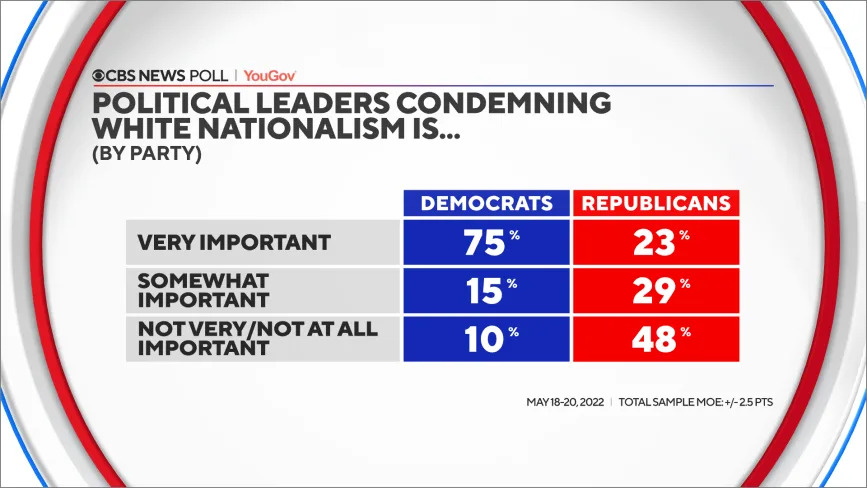
Democrats see quite the opposite. And Democrats are more likely to say it’s very important for political leaders to condemn White nationalism.

Republicans tend to see America’s changing diversity as neither good nor bad, but those who take a position tend to say bad. Democrats (whose ranks are made up of more people of color) say it’s a good thing.

This CBS News/YouGov survey was conducted with a nationally representative sample of 2,041 U.S. adult residents interviewed between May 18-20, 2022. The sample was weighted according to gender, age, race, and education based on the U.S. Census American Community Survey and Current Population Survey, as well as to 2020 presidential vote. The margin of error is ±2.5 points.

‘Solid symbol of United States strength’: USS Nimitz introduced an enduring era

Pensacola News Journal

‘Solid symbol of United States strength’: USS Nimitz introduced an enduring era

Hill Goodspeed – May 22, 2022

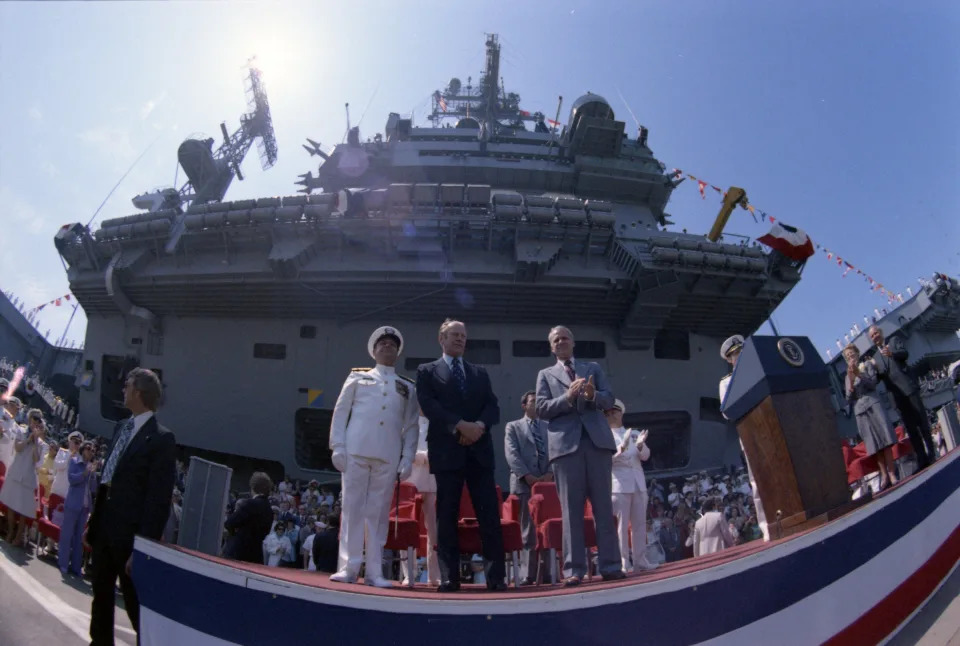
The scene in Norfolk, Virginia, on May 4, 1975, awakened memories of earlier ceremonies in the historic place where many Navy ships embarked upon their service on the Seven Seas. Historic aircraft carriers under the overall command of an admiral whose namesake ship entered service that day. Amidst pageantry that included a 21-gun salute, colorful flags fluttering in the breeze and martial music, President Gerald R. Ford marked the commissioning of the USS Nimitz (CVN 68), the world’s second nuclear-powered aircraft carrier.

President Gerald R. Ford and other dignitaries are pictured during the commissioning ceremony for USS Nimitz on May 3, 1975.

“I see this great ship as a double symbol of today’s challenging times. She is first of all a symbol of the United States, of our immense resources in materials and skilled manpower, of our inexhaustible energy, of the inventive and productive genius of our free, competitive economic system, and of our massive but controlled military strength,” said the president, who during World War II sailed as a crewman on board an aircraft carrier in Fleet Admiral Chester W. Nimitz’s Pacific Fleet. “Wherever the United States Ship Nimitz shows her flag, she will be seen as we see her now, a solid symbol of United States strength, United States resolve — made in America and manned by Americans. She is a movable part and parcel of our country, a self-contained city at sea plying the international waters of the world in defense of our national interests. Whether her mission is one of defense, diplomacy or humanity, the Nimitz will command awe and admiration from some, caution and circumspection from others, and respect from all.”

President Ford’s words were prophetic and still ring true today for not only Nimitz, but also the nine Nimitz-class carriers that have followed her down the ways, the last being USS George H.W. Bush (CVN 77), which was commissioned in 2009. Though the Gerald R. Ford-class carriers, the lead ship of which was commissioned in 2017, represent the Navy’s newest flattops, the ships of the Nimitz class will remain a vital component of the Navy’s arsenal.

With the final decommissioning of USS Enterprise (CVN 65) on Feb. 3, 2017, Nimitz became the oldest active aircraft carrier in the U.S. Navy. In today’s digital world, it is humorous to read a newspaper account from 1975 lauding the technology on board the ship, where her first commanding officer, Capt. Bryan Compton, could address the crew on color television, which also boasted three channels for viewing by off-duty sailors and Marines. That she now operates with sophisticated 21st century technology speaks to the soundness of the Nimitz-class design, the lead ship having adapted to the times in her 47th year of service.

USS Langley: Pensacola welcomes Navy’s first aircraft carrier with ‘open arms’ in 1920s

Pearl Harbor attack: 80 years later, threads of attack reflect fabric of our national story

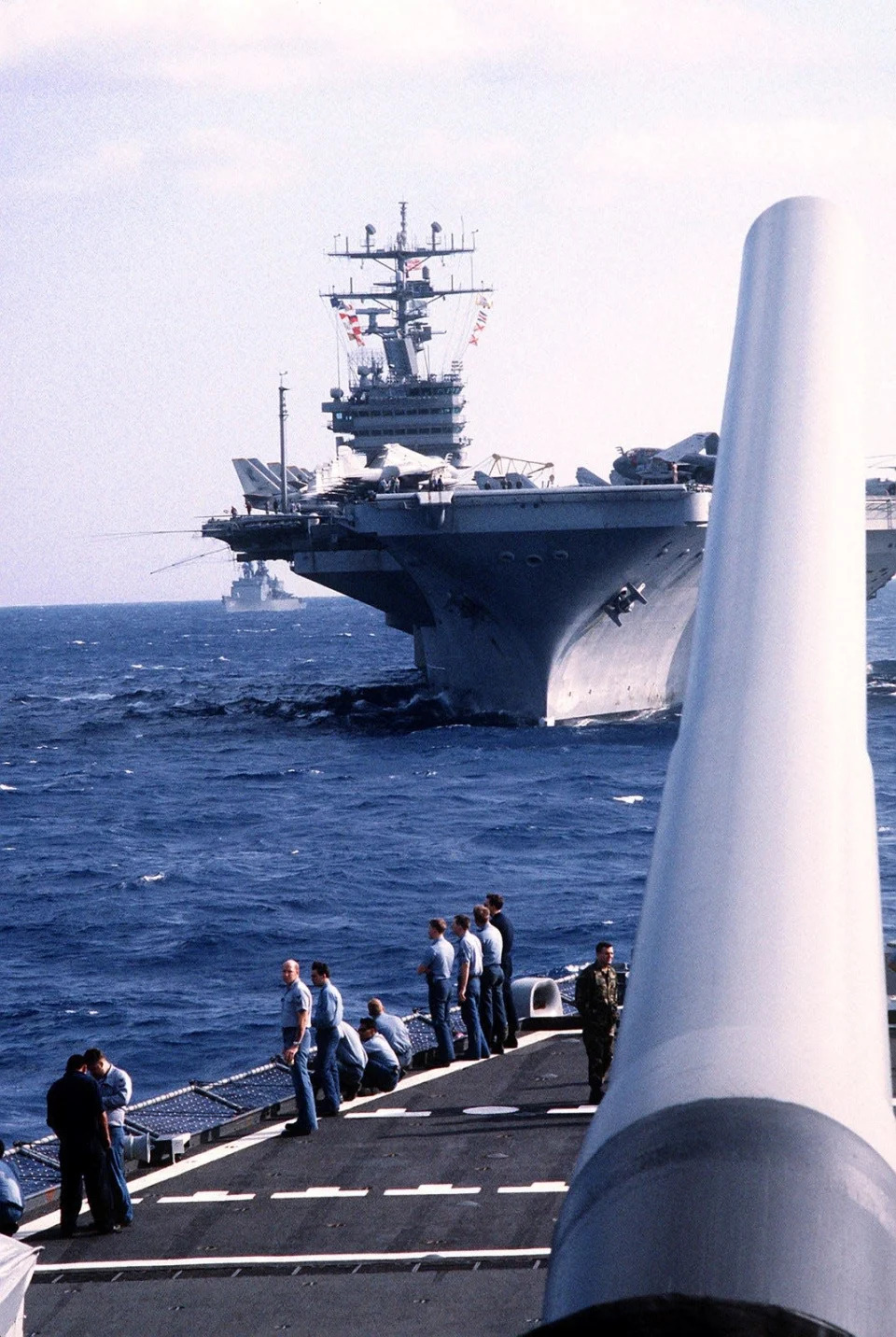
The USS Nimitz operates in company with the battleship USS Missouri in 1987.

After a brief shakedown cruise in the Caribbean and North Atlantic following her commissioning, Nimitz deployed to the Mediterranean in July 1976 with the guided-missile cruisers USS South Carolina (CGN 37) and USS California (CGN 36), marking the first time in a decade that nuclear-powered ships deployed to the Mediterranean. In 1979, the carrier played a starring role on the silver screen, the ship’s spaces transformed into a Hollywood set for the filming of “The Final Countdown” starring Kirk Douglas and Martin Sheen. The plot involved Nimitz and her crew going back in time to the eve of the Pearl Harbor attack and the decision on whether to alter the course of history. The film provided a number of crewmen the opportunity to speak lines and featured aerial sequences showing VF-84 Jolly Rogers F-14 Tomcats with their colorful skull and crossbones tail markings.

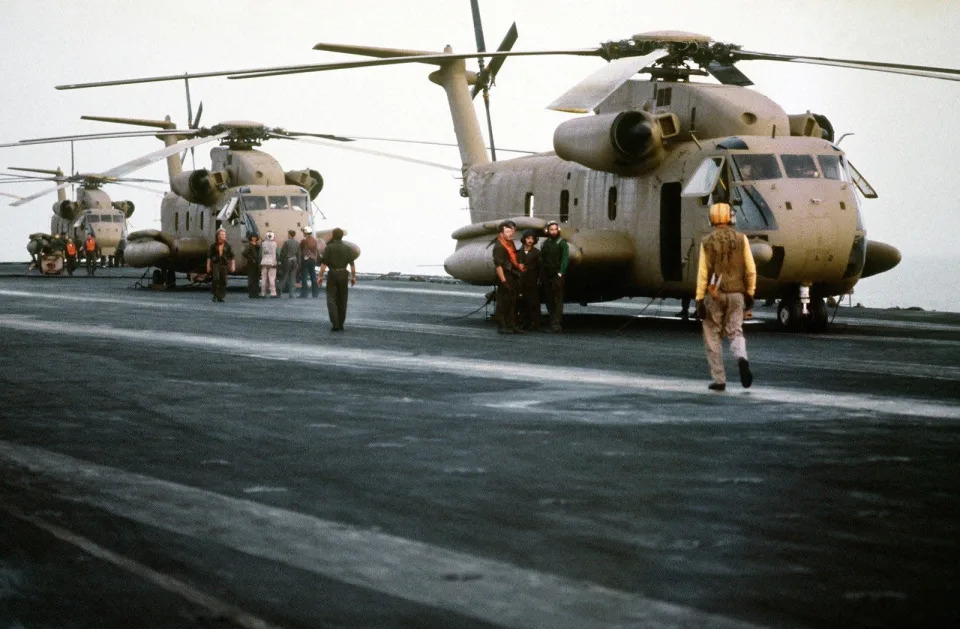
It did not take long for the nation’s newest flattop to also assume a leading role on the real world stage. In 1980, while underway in the Indian Ocean during a deployment marked by 144 consecutive days at sea, RH-53 Sea Stallion helicopters launched from the ship to take part in Operation Evening Light (also known as Operation Eagle Claw). The attempted rescue of 52 American hostages held in Tehran ended in tragedy at a landing site in the Iranian desert. The following year, while Nimitz conducted exercises in the Gulf of Sidra near Libyan dictator Muammar Gaddafi’s “Line of Death,” two of her embarked F-14 Tomcats of the VF-41 Black Aces shot down a pair of Libyan Su-22 Fitters after the enemy aircraft fired upon them.

RH-53 Sea Stallion helicopters are pictured on the flight deck of the USS Nimitz prior to the attempted rescue of the Iran hostages.

Shifting to her new homeport of Naval Station Bremerton, Washington, in 1987, Nimitz spent the ensuing years participating in Operations Earnest Will, protecting the shipping lanes in the Persian Gulf and flying combat air patrols as part of Operation Southern Watch. In the Far East, she provided U.S. Navy presence off Taiwan during a volatile standoff between that nation and China in 1995. In 1997 to 1998, she completed an around-the-world cruise, concluding it at Norfolk, the place of her birth, where she entered the yard for refueling and overhaul.

She emerged in June 2001, and just weeks after the 9/11 terrorist attacks put to sea and set course for her new homeport at NAS North Island. California. In March 2003, she deployed for the first time to the Fifth Fleet Area of Responsibility and launched air strikes in support of Operation Iraqi Freedom. The cruise marked the first deployments of both the F/A-18F Super Hornet and E-2C Hawkeye 2000, with Nimitz also becoming the first aircraft carrier to deploy with an air wing containing two Super Hornet squadrons.

In 2005, the carrier commemorated 30 years of service, film crews spending the entire deployment on board for the PBS documentary “Carrier,” which provided an intimate look at life aboard the ship. Amidst deployments supporting operations in Iraq and Afghanistan, Nimitz shifted her homeport to Everett, Washington, and helped evaluate the future of carrier aviation as the platform for the first carrier landings of the F-35C Lightning II Joint Strike Fighter. The carrier’s 2017 deployment included combat operations against ISIS in Iraq and Syria, followed by a period in overhaul.

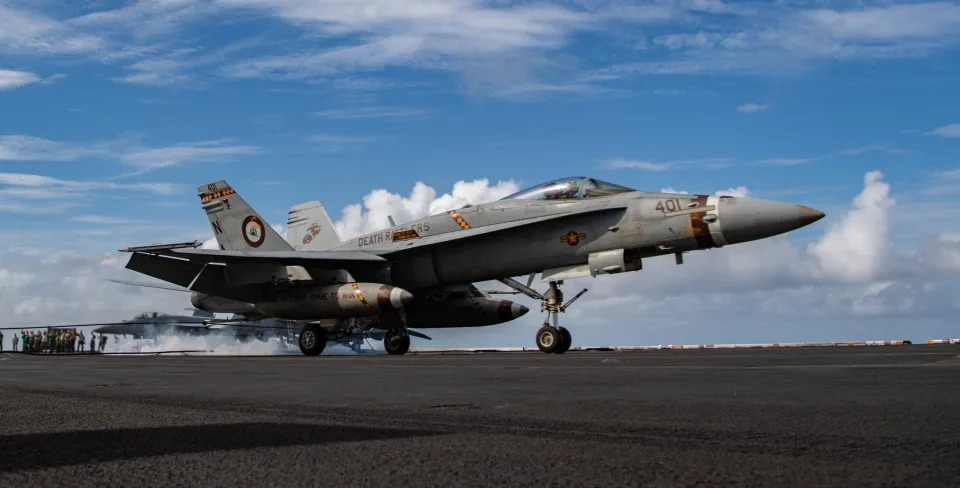
An F/A-18C Hornet from the VMFA-323 "Death Rattlers" makes an arrested landing on the flight deck of the USS Nimitz in 2021.
An F/A-18C Hornet from the VMFA-323 “Death Rattlers” makes an arrested landing on the flight deck of the USS Nimitz in 2021.

A testament to the ship’s longevity occurred during her most recent deployment in the shadow of COVID-19, an 11-month cruise in which the carrier and embarked Carrier Air Wing (CVW) 17 conducted over 35,345 flight hours and 14,141 traps. Among the latter was a landing by an F/A-18C Hornet assigned to the Marine Fighter Attack Squadron (VMFA) 323 Death Rattlers. It marked the final time that the venerable aircraft, which equipped the famed Blue Angels from 1986 through 2020, deployed on board an aircraft carrier. When Nimitz entered service in 1975, the Hornet had yet to make its first flight.

In a message to the personnel of the U.S. Pacific Fleet on Sept. 2, 1945, Fleet Admiral Nimitz wrote about what they owed to those who made the ultimate sacrifice during World War II.

“To them we have a solemn obligation … to insure that their sacrifice will help to make this a better and safer world in which to live,” he stated. “It will also be necessary to maintain our national strength at a level which will discourage future acts of aggression aimed at the destruction of our way of life.”

The number of times Nimitz will leave the shores of the United States are numbered, her decommissioning slated for 2025, a half century after President Ford so eloquently captured in words what she represented. In that time, she has more that met the obligations her namesake outlined in 1945, and the class of carriers that followed her will carry that torch for many decades to come.

Hill Goodspeed is the historian for the National Naval Aviation Museum and a columnist for the News Journal. 

Russia’s Ukraine invasion ‘makes no sense,’ according to a leading historian

Business Insider

Russia’s Ukraine invasion ‘makes no sense,’ according to a leading historian who once angered Putin by asking him about energy

Ryan Hogg – May 22, 2022

Russian President Vladimir Putin chairs a meeting with members of the Security Council via teleconference call at the Novo-Ogaryovo state residence outside Moscow, Russia, on May 20, 2022. AP
Russia’s Ukraine invasion ‘makes no sense,’ according to a leading historian who once angered Putin by asking him about energy

Daniel Yergin is a leading energy historian and vice-chairman of S&P Global.

He said Russia’s days as an energy superpower were “waning,” and called the invasion “irrational.”

Yergin said he’d once angered Putin by asking about shale energy at a conference in 2013.

A leading energy historian, who claims to have enraged Vladimir Putin by asking him about shale energy, has said Russia overestimated the West’s reliance on its oil and gas when it invaded Ukraine.

In an interview with the New York Times, Daniel Yergin called the invasion “irrational,” adding: “One of Putin’s many miscalculations was his assumption that, because of Europe’s dependence on Russian energy, it would protest but stand aside, as it did with Crimea.

“It has had just the opposite effect. Europe wants to get out of that dependence as fast as it can.”

Yergin, who is vice-chairman of S&P Global, told the Times Putin was “like a CEO when he talks about energy markets,” and that he had timed the invasion to when those markets were at their tightest, as supply chains unwound after the COVID-19 pandemic.

He said the invasion heralded “a new uncertain era,” adding: “As we talk, the risks are going up.”

European countries are trying to reduce its dependence on Russian energy, which makes up 45% of its gas imports. The EU has drafted a plan to wean itself off Russian fossil fuels by 2027, while the US banned imports of Russian oil, gas and coal.

In a separate interview on Friday, Yergin told Bloomberg’s “What Goes Up” podcast that he asked the first question of Putin after the Russian president had spoken at the St. Petersburg International Economic Forum in 2013.

The historian said he asked about shale gas and Putin “started shouting at me saying, ‘shale is barbaric!'”

“He knew that US shale was a threat to him in two ways: one, because US natural gas would compete with natural gas in Europe, and secondly, because this would really augment the US’s position in the world and give it a kind of flexibility it didn’t have when it was importing 60% of its oil,” Yergin told the podcast.

He added that growing American shale oil and gas production had reduced the country’s dependence on Russian energy, which “had a much bigger impact on geopolitics than people recognize.”

Yergin said on the podcast that “Russia’s door to the West is closed,” and that it would be forced to pivot toward China as Europe moves away from Russian energy.