Mark Meadows Burned Papers After Talk About Tossing Election Results, Ex-Aide Says
Mary Papenfuss – June 12, 2022
Former White House chief of staff Mark Meadows destroyed documents after a meeting about overturning the results of the 2020 presidential election, a former aide said Sunday on CNN.
Alyssa Farah Griffin said a source with “first-hand knowledge” provided testimony to the House panel probing the insurrection that Meadows burned papers in his office after meeting with Rep. Scott Perry (R-Penn.) about challenging the election.
“I expect to see that come out in testimony” before the House committee investigating the insurrection, she added.
Another former Meadows aide, Cassidy Hutchinson, said she watched Meadows burn the documents in her account before House select committee investigators, Politico reported last month.
The meeting with Perry occurred an unspecified number of weeks after the election while Trump and supporters were desperately casting around for ways to change the vote, according to Politico.
Hutchinson also told the panel that Meadows was warned of possible violence on Jan. 6, 2021, but it was unclear what action, if any, he took in response.
Griffin may have been referring to Cassidy as her source with first-hand knowledge of the destruction of documents by Meadows. Hutchinson is expected to testify in the ongoing televised hearings held by the House panel.
Perry was pressuring Meadows to take action regarding the election, according to his emails to Meadows released by the House committee.
“Mark, just checking in as time continues to count down. 11 days to 1/6 and 25 days to inauguration. We gotta get going!” he wrote to Meadows late last year in one of the messages.
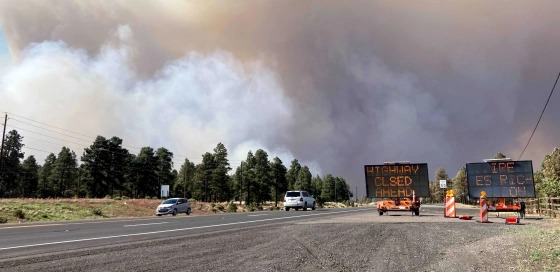
FLAGSTAFF, Ariz. (AP) — Evacuations are in effect in parts of northern Arizona as a wildfire about 6 miles (9 kilometers) north of Flagstaff steadily grew Sunday, authorities said.
Coconino National Forest officials said the Pipeline Fire was reported at 10:15 a.m. by a fire lookout and had burned approximately 4,000-5,000 acres by late Sunday, pushing about 15 miles (24 kilometers).
In connection with the fire, Forest Service law enforcement said they have arrested and charged a 57-year-old man with natural resource violations. The cause of the wildfire wasn’t immediately known.
Coconino County Sheriff’s officials said the Arizona Snowbowl ski resort and people living in the area of the west Schultz Pass Road must evacuate. People living in Doney Park and the area near Mt. Elden should be prepared.
Euelda King and her family evacuated their home for the second time this year because of wildfires. She hadn’t settled back in from a springtime blaze before leaving again Sunday, this time able to grab photographs and clothing she didn’t get earlier.
“Here we go again,” she said.
The family of 11 is planning to stay at the Navajo Nation casino, which is offering assistance to tribal members who evacuated.
The family was waiting in a parking lot ahead of road closure signs, watching smoke billow through the air and aircraft flying overhead.
“The winds are high, and I think they’re going to have a little bit of a battle with it,” King said.
Wind gusts were sweeping the smoke through Schultz Pass toward Doney Park and authorities said recreationists were being told to leave immediately, especially those in the Schultz Pass area.
The American Red Cross Arizona opened a shelter at Sinagua Middle School for residents who evacuated.
“With this thing going as fast as it is, it could get much closer, of course hoping it doesn’t,” King said.
Authorities said 13 engines, nine crews, six prevention patrol units, three bulldozers and one water tender were involved in the fighting the fire. An Incident Management Team is scheduled to arrive Monday.
The Arizona Department of Transportation has closed U.S. Route 89. The department said in a Twitter post that there is no estimated time to reopen the road.
Putin is ‘preparing to starve much of the developing world’ in order to win Russia’s war in Ukraine, Yale historian says
Kelsey Vlamis – June 12, 2022
Russian President Vladimir Putin speaks during his interview with the Russia-1 TV channel in the Bocharov Ruchei residence in the Black Sea resort of Sochi, Russia, Friday, June 3, 2022.Mikhail Klimentyev, Sputnik, Kremlin Pool Photo/Associated Press Putin is ‘preparing to starve much of the developing world’ in order to win Russia’s war in Ukraine, Yale historian says
Ukrainian officials have accused Russia of blocking millions of tons of grain exports.
Yale historian Timothy Snyder said Putin plans to starve places in Asia and Africa to win the war.
“When the food riots begin, and as starvation spreads, Russian propaganda will blame Ukraine,” he said.
Yale historian Timothy Snyder said Russian President Vladimir Putin plans to starve some countries as part of his efforts in Ukraine.
Snyder published a lengthy Twitter thread Saturday explaining how he believes Putin is using food insecurity to his advantage and called it the “latest chapter of hunger politics.”
“Russia has a hunger plan. Vladimir Putin is preparing to starve much of the developing world as the next stage in his war in Europe,” Snyder, a professor at Yale University and expert on authoritarianism, began, noting the importance of Ukraine’s food exports to the global food supply.
The area around the Black Sea, including Ukraine and Russia, has been referred to as the “world’s breadbasket” due to its fertile soil and high rates of grain production. Collectively, the two countries account for 30% of the global wheat exports while Ukraine produces about 12%.
“If the Russian blockade continues, tens of millions of tons of food will rot in silos, and tens of millions of people in Africa and Asia will starve,” Snyder said.
The historian said he believed Putin’s “hunger plan” had three main objectives. First, to cut off Ukraine’s exports in an attempt to destroy its statehood. Second, to create instability in Europe by producing refugees from areas that rely on Ukraine’s food, like North Africa and the Middle East.
Lastly, he said Putin wanted to use mass starvation as a “backdrop for a propaganda contest.”
“When the food riots begin, and as starvation spreads, Russian propaganda will blame Ukraine, and call for Russia’s territorial gains in Ukraine to be recognized, and for all sanctions to be lifted,” Snyder said.
The historian also said both Joseph Stalin, the leader of the Soviet Union, and Adolf Hitler had sought to control Ukraine’s food supply, but that Putin’s plan was “a new level of colonialism.”
“Russia is planning to starve Asians and Africans in order to win its war in Europe,” he said.
Kremlin crackdown on dissent targets the Russians protesting Ukraine war
Shira Pinson and Yuliya Talmazan – June 12, 2022
Swapping out price tags for antiwar leaflets, wearing green ribbons, flashing a copy of Leo Tolstoy’s “War and Peace.”
Those are things that can get ordinary Russians who don’t agree with the Kremlin’s invasion of Ukraine detained, fined or even jailed.
Since the start of Moscow’s incursion, media in Russia have been cautioned against calling it a “war,” and new draconian legislation has been put in place to stop people from “discrediting” the Russian army, punishable by up to 15 years in prison.
That has meant the few Russians who still dare speak up against the war have gotten inventive to escape arrest. But it’s far from guaranteed.- ADVERTISEMENT -https://s.yimg.com/rq/darla/4-10-1/html/r-sf-flx.html
Artist and musician Alexandra Skochilenko, from St. Petersburg, has been in detention for nearly two months after replacing several price tags at a local supermarket with small pieces of paper containing messages about the Russian army’s actions in Ukraine.
One of them read: “The Russian army bombed an art school in Mariupol. About 400 people hid in it from shelling.” Another said: “Putin has been lying to us from TV screens for 20 years. The result of this lie is our willingness to justify war and senseless deaths.”
Skochilenko’s lawyer, Yana Nepovinnova, told NBC News that Skochilenko’s act of protest was caught by a customer, who raised a complaint.
Alexandra Skochilenko has been in detention since her arrest in mid-April for replacing price tags with anti-war leaflets. (Courtesy Sofia Subbotina)
Skochilenko, 31, is now facing criminal charges of spreading “deliberately false information” about the Russian army and could face up to 10 years in prison, Nepovinnova said. Skochilenko has admitted to swapping the price tags, but she denies that she was spreading false information, according to her lawyer. Her detention has been extended until at least July 1.
“I feel like they came into our home and took my family away because of some price tags,” Sofia Subbotina, Skochilenko’s partner, said on the phone from St. Petersburg, sounding dejected. “Ten years is a monstrous term. They sentence people to less for murder.”
Nepovinnova said she fears Skochilenko’s case will be used to send a “clear message” to others who dare speak up that they will face the same fate.
“She is essentially behind bars for her words,” Nepovinnova said.
During the decades of Russian President Vladimir Putin’s crackdown on dissent, political protest in Russia has become nearly obliterated. Still, in the first days of the war, thousands of Russians took to the streets to voice their opposition. But that has largely fizzled out amid police violence, mass arrests and the Kremlin propaganda insisting most Russians support Moscow’s “special military operation” in Ukraine. What continues are the one-person protests of all shapes and forms to get one message across: There are people in Russia who do not agree with the war.
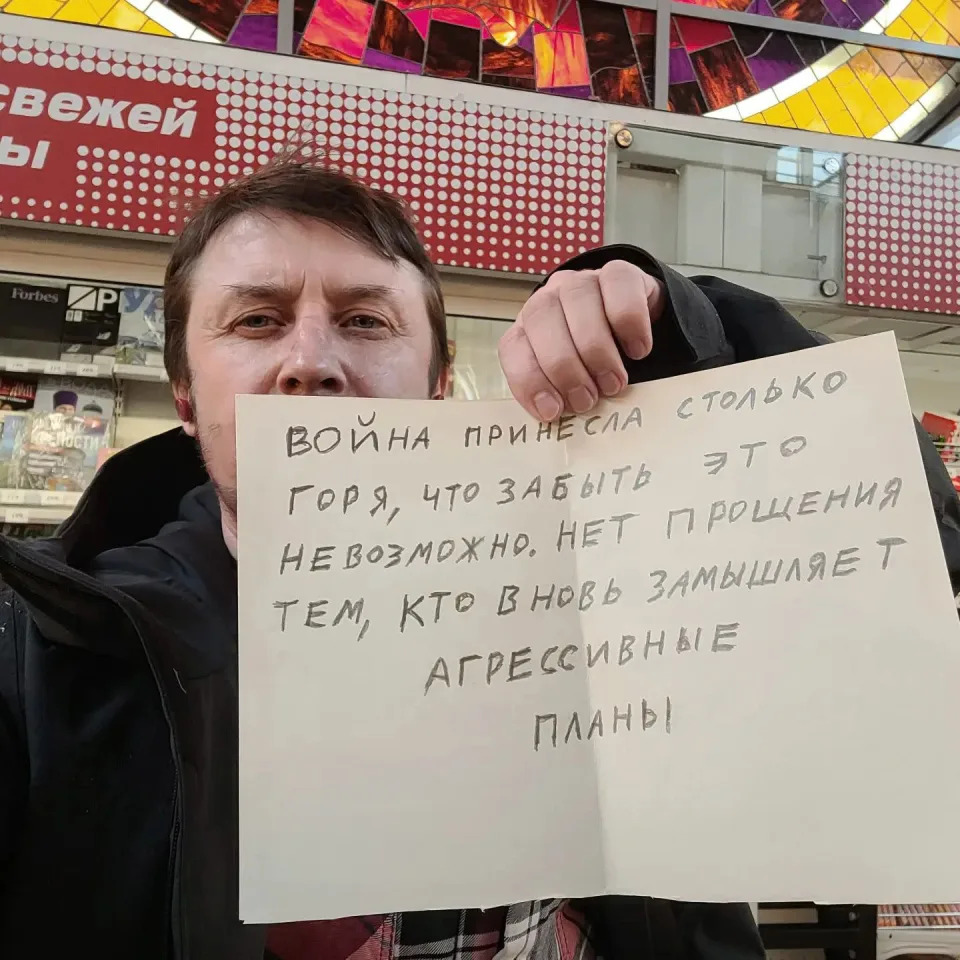
Another St. Petersburg resident, Artur Dmitriev, said he was detained in early April for holding up a sign that read: “The war has brought so much grief that it is impossible to forget. There is no forgiveness for those who are making aggressive plans again.”
Image: Artur Dmitriev (Artur Dmitriev)
This anti-war message was, in fact, an abbreviated direct quote from a speech made by Putin last year on the day Russia celebrates victory over Nazi Germany.
This made no difference to the authorities.
After spending 24 hours in detention, Dmitriev, 43, said he had a court hearing and was found guilty of “discrediting Russian armed forces,” according to the court papers he showed NBC News, under the newly enacted legislation. He said he was fined 30,000 rubles, or $520.
Holding up his court papers in a Zoom video, Dmitriev said his guilty verdict proves the absurdity of the system that detained and fined him for using Putin’s own words.
He said he even sent a snarky email to the president’s press office, asking the Russian leader to split the fine since they were now “accomplices.” The office responded but essentially ignored his request, Dmitriev said.
He admitted he was afraid throughout the ordeal and even more so now that he’s on law enforcement’s radar. But he said it’s important to speak up.
“It’s obvious where we are headed. It’s classical Orwell,” Dmitriev said. “If you are standing aside, you are only making it worse. But if you do this, you are letting people know that they are not alone.”
Making sure others don’t feel isolated is also close to Mikhail Podivilov’s heart.
Mikhail Podivilov at a protest near Moscow’s Lubyanka station in March. (Alexander Vorobyov)
That’s why the IT specialist stood with his bank card above his head at a Moscow metro station one evening in late March, hoping others would take notice, he said.
Written on his card was the word “Mir,” or “peace,” in Russian. (“Mir” is the name of a payment system used by Russian banks, and many bank cards feature it prominently.)
Within five minutes, he was being questioned by police, Podivilov, 22, said.
Speaking with NBC News via Zoom from his home in the suburban town of Ozyory in the Moscow region, Podivilov said the police officers wrangled with him for nearly an hour, trying to get him to move. He refused and all the while stood there with his card above his head, his feet and hands freezing on a chilly Moscow evening, Podivilov said. In the end, they let him go.
Podivilov said he was surprised to just walk away. But despite the fear of arrest, he said he does not have “a moral right to be afraid.”
“In Ukraine, that’s where people can be afraid,” Podivilov added, with no hesitation in his voice. “The maximum that can happen to me is I will get jailed.”
OVD-Info, an independent Russian organization that tracks political persecution and freedom of assembly violations, maintains a long tally of names and acts of Russians who have stood up against the war, including by displaying the blue-and-yellow colors of the Ukrainian flag, standing with a copy of Leo Tolstoy’s “War and Peace” in Red Square, holding up banners with nothing but eight asterisks (corresponding to the letters in the slogan “No to war” in Russian), and even wearing green ribbons, which have become a symbol of opposition to the war.
It estimated that as of early June, more than 16,000 people had been detained over anti-war protests. It said there are nearly 2,400 court cases underway for allegedly “discrediting” Russian armed forces under the newly enacted legislation, and that it’s aware of at least 170 suspects facing criminal charges related to speaking out against the war.
But for the millions of others who remain silent, the fear is too much to bear, said artist and activist Eugene, who said he did not feel safe revealing his last name.
Eugene, 31, offers an opportunity to those who want a chance to say something against the war to do so anonymously.
Since March 20, he has been running an Instagram account called Malenkiy Piket, or Little Protest in Russian. It’s meant to be a safe space where people can send in photos of small figurines, perhaps a representation of themselves, made out of plasticine or Legos, that are holding up peace messages. The figurines are discreetly placed around people’s towns and cities, or, if it feels too dangerous, in the safety of their homes.
The account’s feed is full of colorful photos of figurines, often dressed in Ukraine’s blue-and-yellow colors and placed against city monuments, benches, riverbanks or people’s kitchen tables, with signs reading, “No to war,” “Ukrainians forgive us,” and “Why?” Their might goes beyond their size, emblematic of how much space is left for freedom of expression in Russia.
For Eugene, it allows ordinary Russians who, over the decades of Putin’s rule, have lost the ability for political thinking to “exercise their political bodies,” he said, speaking via Zoom from his dimly lit St. Petersburg flat. Malenkiy Picket is like a training ground for what it’s like to still speak up when fear is omnipresent, he added.
Eugene said he knows he is risking his freedom by running an account that gives people a platform to speak up, even if it’s in the most discreet of ways.
“Some days I’m scared; others, I’m not,” he said.
Aware of the risks, he said he made sure Malenkiy Piket would keep running and posting, even if he was detained. He said he believes things in Russia are about to get a lot darker before they can get better, but he is not planning to give up fighting for freedom of expression and against the war.
“Even if tomorrow is the end of the world, I should still try to do something,” he said with a smile.
Shell Is Looking To Shake Up The Energy Game In Texas
Editor OilPrice.com – June 12, 2022
For years now, we have seen a growing divide between oil supermajors in Europe and the United States, as Big Oil has split into two factions on opposite sides of the Atlantic over what to do in response to climate change and increasing global calls for decarbonization. As climate activists grow louder and policymakers ramp up the pressure on the fossil fuels sector to clean up its act, European companies have rushed to diversify their portfolios and rebrand themselves as Big Energy. Meanwhile, in the U.S. Big Oil has stood its ground and doubled down on oil and gas, instead investing in schemes such as carbon capture, carbon offsetting, and biofuels.
The approach in the United States has been criticized as insufficient to meet global climate goals at best and greenwashing at worst. Environmentalists point out that strategies such as carbon capture and offsetting do not discourage the extraction of fossil fuels at a time when we should be doing everything we can to keep them in the ground. The Intergovernmental Panel on Climate Change, the leading global body reporting on the science of global warming, has said that avoiding the worst impacts of climate change will require “immediate and deep” cuts in emissions in all countries.
On the other side of the argument, Big Oil in the United States points to the massive potential economic fallout and decline in energy security and independence that may come with a swift transition to green energy. And what of the massive infrastructure costs and all of the jobs that will be displaced? As it stands, the U.S. is extremely reliant on the fossil fuels industry, and breaking that dependence will inevitably cause serious growing pains. A recent study found that “between 2015 and 2020, fossil fuels generated roughly $138 billion each year for US localities, states, tribes, and the federal government.” That’s a lot to lose.
But while Big Oil has been dragging its feet on the renewable revolution on this side of the pond, European supermajors have seen the writing on the wall, and have made enormous advances in the field of clean energy that threatens to bury any competition from the U.S. once renewables become the norm and oil and gas slowly but surely become overshadowed and then obsolete.
Already, Europe is moving into the United States and setting up shop, in none other than Texas, the oil and gas heartland. Shell announced this week that it will begin selling electricity generated from renewable sources directly to residents and businesses in the Lone Star State. In doing so, the company will increase consumer access to the state’s already abundant supply of wind and solar power, and offer them incentives to move over to their team. “It’s a significant, serious move but also not a surprise,” Michael Webber, a professor of mechanical engineering at the University of Texas at Austin, told the New York Times. “They can see the future as well as anyone, and they are not in denial about climate change.”
Shell’s play is one of the first in what is going to be a seriously competitive market to sell clean electricity to U.S. consumers, in what is going to be an exploding market with huge growth opportunities. The supermajor will likely be directly competing with Big Tech companies like Tesla, Google, and Apple, which have been at the forefront of the charge toward clean energy development in the U.S. “The irony is it should be coming from existing utilities, but generally speaking they have been very resistant,” said Amy Myers Jaffe, managing director at the Climate Policy Lab at the Tufts Fletcher School of Law and Diplomacy.
In fact, Shell noted that one of the reasons that it is prioritizing Texas as its first market is that “more than 26 million of the state’s nearly 29 million residents were served by a single grid operated by the Electric Reliability Council of Texas [ERCOT].” In fact, more opportunities to buy more energy outside of ERCOT can’t come fast enough, as Texas is staring down the barrel of potentially massive energy shortages during summer heat waves.
Climate advocates and skeptics alike can agree on one thing: becoming competitive with Europe will be essential to the future security of the United States economy. The U.S. energy sector has already lost valuable time investing in infrastructure and technology to stay relevant in a changing global energy sector. Oil prices may be high now, but fossil fuels are a fickle friend. On a long enough timeline, clean energy investing is a no-brainer. Just ask Shell.
I took a CO2 detector on a flight: It showed me when I was most likely exposed to COVID
Trevor Hughes, USA TODAY – June 12, 2022
DENVER — On seat 10D, my eyes flicker between my fellow passengers crammed in the aisle and the carbon dioxide detector balanced on my knee.
I can’t help but shudder a little every time someone coughs or sneezes as they board, and the numbers on the detector climb steadily, from about 800 parts per million to more than 1,600 ppm.
Experts say that the level of carbon dioxide in indoor air is an easy proxy for potential COIVD-19 exposure, and now that masks are voluntary on planes and international arrivals no longer have to test, I wanted to see what my potential risk was.
Outdoor air typically has less than 400 ppm of carbon dioxide, and although the levels of CO2 on my plane never reach anything near what’s considered even mildly unhealthy, the numbers suggest I’m being exposed to coronavirus. I can’t help but touch my mask for reassurance.
USA TODAY reporter Trevor Hughes on a United Express flight to Dulles International Airport on April 18, 2022.
I’m wearing a mask on this flight to visit my elderly parents in Vermont. The last time I visited, I was on one of the last mandatory masked flights, and I’ve taken several flights since then, sometimes masked, sometimes not.
Nationally, about 300 people a day are dying from COVID still. While rapid tests are now widely available, they only measure whether you’re infected. There’s no way to know about the people around you – especially when many people don’t seem to care whether they’re infected or not, or what the consequences could be for my parents or other at-risk communities.
That’s where the CO2 detector comes in. I bought a $140 KOPUO tester from Amazon, which an expert later tells me is one of the cheapest but still accurate detectors. Cheaper ones use a different measuring system that can be inaccurate if there’s a lot of hand sanitizer being used around it.
Why measure CO2?
An area with high CO2 levels may put you at higher risk for infection, while a space with low CO2 levels can be considered safer, says University of Colorado-Boulder Prof. Jose-Luis Jimenez.
Jimenez is an expert on how particles and gases move around a room, and he’s tested lots of inexpensive CO2 detectors and found that many are remarkably accurate compared to laboratory-grade equipment.
“It’s the only thing that we have found that approximates having this information,” Jimenez said. “It’s not perfect, because everyone exhales carbon dioxide, but not every who exhales has COVID.”
Jimenez and his colleagues found that in a library, if an influx of people makes CO2 levels double from 800 ppm to 1,600, COVID transmission risk triples. And if CO2 levels in a gym drop from 2,800 ppm to 1,000, the risk of COVID-19 transmission drops 75%.
There are of course caveats to his models, particularly when it comes to masks, airplanes and HEPA filters. HEPA stands for “high-efficiency particulate air” and most large airplanes made by Boeing and Airbus have them installed. HEPA filters are effective at removing dust, pollen, bacteria and virus particles from the air, but they don’t remove carbon dioxide because it’s a dissolved gas with far smaller molecules.
Multiple studies conducted by the federal government, airlines, aircraft manufacturers and other researchers have concluded air travel poses a relatively low risk of COIVD infection, in large part because the HEPA filters remove virus particles. But that’s only relevant when the aircraft is pumping air through the filters. Airbus says its systems completely replace cabin air every 2-3 minutes while flying.
Measuring CO2 levels on my flight, at the airport
My measurements show CO2 levels skyrocketed during boarding of my Airbus A319 headed to Vermont, but remained virtually unchanged on my flight back to Denver. That indicates the pilot or ground crew were doing something different at boarding that kept the air fresher, even though both flights were similarly full and I was seated in almost the same place on both directions.
United Airlines did not respond to a request for comment on its specific policies but sent a statement saying, in part, “There is always fresh air on the aircraft. The primary HEPA benefits are when airborne, because significant outdoor air is circulated through the cabin and jet bridge on the ground anyway.”
In the Denver International Airport terminal, the CO2 levels remained relatively consistent at about 800 ppm, and I felt comfortable removing my mask to wolf down some McDonald’s hash browns. The levels hit about 1,000 ppm on the airport train to the concourse, but sitting at the gate I was actually more concerned with how few men had washed their hands after using the restroom. That thought also made me shudder.
Aboard the plane, CO2 levels hit 1,520 ppm when flight attendants closed the boarding door, rose to about 1,800 when the pilot appeared to turn on a different ventilation system, dropped to about 1,600 as we taxied to the runway, and then jumped back to 1,900 as we approached the end of the runway for takeoff.
The levels began dropping immediately as the engines spooled up, and then leveled off around 1,200 as the seatbelt sign came off at 28,000 feet.
Watching the monitor, the levels rose back up to 1,550 as the flight attendants (one masked, one not) distributed cookies and then stayed at about that level until we landed. After getting off the plane in Burlington, the CO2 level was about 1,000 in the terminal, and I finally removed by mask.
Risk assessment
Returning home on Monday, the CO2 in the airport was about 400 ppm, which is the same level it was outside. The Burlington airport is far smaller than Denver’s, and fewer people were wearing masks, including me. The CO2 levels for the return flight topped out at about 1,000 ppm as the boarding door closed, and it dropped to about 850 at takeoff and remained there until we touched down in Denver.
Riding the train back from the concourse to the terminal, the CO2 level touched 650, significantly lower than my outbound ride. Given those lower levels, I felt reassured that leaving my mask off was a safe bet.
Jimenez said my behavior follows what’s known as a “budget of risk” – by using data, I adjusted my responses. Jimenez said he still wears N-95 masks on planes and tries to eat beforehand if it’s a short flight, but otherwise has to take it off when eating onboard. He said carrying around a CO2 detector has helped him make informed decisions about possible COVID exposure.
“We are all being forced to do that,” he said of the constant decisions about risk. “We don’t want to live like monks.”
For me, the detector is an easy form of reassurance about my relative risks: Indoor areas with high levels of CO2 will prompt me to wear a mask, while areas with lower levels mean I can skip it.
Going forward, the proof will be in the pudding, as my parents like to say. And in this case, it means yet another negative COVID-19 test result upon my return to Denver.
US Defense Secretary Lloyd Austin says the Russian invasion of Ukraine is a ‘preview of a possible world of chaos and turmoil’
John L. Dorman – June 11, 2022
US Defense Secretary Lloyd Austin speaks during a plenary session at the 19th International Institute for Strategic Studies (IISS) Shangri-la Dialogue in Singapore on June 11, 2022.AP Photo/Danial Hakim
Austin rejected Russia’s invasion of Ukraine during his speech at the Shangri-La Dialogue in Singapore.
“It’s a preview of a possible world of chaos and turmoil that none of us would want to live in,” he said.
Zelensky also spoke at the summit, stating that “the future rules of this world are being decided” in Ukraine.
US Defense Secretary Lloyd Austin while speaking in Singapore on Saturday articulated that the Russian invasion of Ukraine was a “preview of a possible world of chaos and turmoil.”
While speaking at the annual Shangri-La Dialogue, Austin remarked on the potential repercussions of the deadly invasion, which was launched by Russian President Vladimir Putin in February and has been widely condemned by an array of global leaders, notably those from NATO member countries.
“Russia’s invasion of Ukraine is what happens when oppressors trample the rules that protect us all. It’s what happens when big powers decide that their imperial appetites matter more than the rights of their peaceful neighbors. And it’s a preview of a possible world of chaos and turmoil that none of us would want to live in,” he said at the major Asian defense summit.
He added: “So we understand what we could lose. We see the dangers of disorder.”
The Pentagon chief then spoke of the importance of the “rules-based international order,” highlighting how Australia, Japan, New Zealand, and South Korea all helped Ukraine in the aftermath of the invasion, while also noting the critical contributions from India, Singapore, Thailand, and Vietnam.
Ukrainian President Volodymyr Zelensky also gave an address to the summit on Saturday — with his speech was conducted virtually — where he emphasized that the global order was being tested in his country.
“I am grateful for your support … but this support is not only for Ukraine, but for you as well,” Zelensky said, per Reuters. “It is on the battlefields of Ukraine that the future rules of this world are being decided along with the boundaries of the possible.”
Since Moscow launched its invasion of Ukraine, an alliance of leaders — including US President Joe Biden — have continued to appropriate money for arms necessary for the Ukrainian military to fight back against invading forces.
The first few weeks of the war featured critical errors on the part of the Russian military, with the country suffering major losses among its members on the ground and utilizing inadequate equipment.
Russia has recalibrated and in recent weeks has focused its actions largely in eastern Ukraine — largely in the Donbas region, which have included intense battles in the city of Severodonetsk.
Ukraine has pleaded for longer-range weapons from the West in order to counter the weaponry being used by Russia.
Vadym Skibitsky, the deputy head of Ukraine’s military intelligence, recently told The Guardian that the battle against Russia is “an artillery war now” and said his forces were currently “losing in terms of artillery.”
On Friday, Austin also met with his Chinese counterpart, Gen. Wei Fenghe, the minister of national defense, where he emphasized that the US did not “seek confrontation or conflict” as it pertains to Taiwan.
Since entering the White House last year, Biden has had several foreign policy rifts with China, largely as it relates to the United States’ stance of “strategic ambiguity” regarding Taiwan, which the Chinese government considers a breakaway province.
Members of white nationalist group charged with planning riot at Idaho pride event
Joseph Ax – June 11, 2022
Group of men arrested after they were found in the rear of a U Haul van in Coeur d’Alene
(Reuters) – Police in northwest Idaho arrested more than two dozen members of a white nationalist group on Saturday and charged them with planning to stage a riot near a LGBTQ pride event, authorities said.
Lee White, police chief in the city of Coeur D’Alene, told reporters 31 members of Patriot Front face misdemeanor charges of conspiracy to riot and additional charges could come later.
A local resident spotted the men, wearing white masks and carrying shields, getting into a U-Haul truck and called police, telling the emergency dispatcher it “looked like a little army,” according to White. Police pulled the truck over about 10 minutes after the call.
Video taken at the scene of the arrest and posted online showed about 20 men kneeling next to the truck with their hands bound, wearing similar khaki pants, blue shirts, white masks and baseball caps.
Police recovered at least one smoke grenade and documents that included an “operations plan” from the truck, as well as shields and shin guards, all of which made their intentions clear, White said.
“They came to riot downtown,” he said.
The men come from at least 11 states, White said, including Texas, Colorado and Virginia.
Patriot Front formed in the aftermath of the 2017 white nationalist “Unite the Right” rally in Charlottesville, Virginia, when it broke off from another extremist organization, Vanguard America, according to the Southern Poverty Law Center, which tracks hate groups.
(Reporting by Joseph Ax; Editing by Daniel Wallis)
But as the high court prepares to decide another major climate case in the coming days and resolve a controversy over water pollution this fall, the mood among environmental groups is more gloomy – and the sense of foreboding, experts say, is likely justified.
That’s not only because the Supreme Court is more conservative than it has been in decades – and perhaps more willing to reconsider precedent – but also because environmental rules are caught up in a broader fight over whether federal agencies may regulate businesses without explicit approval from Congress.
The answer to that question will have sweeping implications for President Joe Biden’s administration beyond the Environmental Protection Agency if Republicans capture control of Congress this year. Presidents of both parties often turn to agency regulations when they’re unable to move their agenda through Congress – even though those policies frequently run into trouble in court.
“Environmentalists are holding their breath to see just how bad it will be,” said Robert Percival, director of the environmental law program at the University of Maryland. “It seems likely that they’re going to be making major cutbacks in the EPA’s authority.”
Power plant emissions
In one of the most significant climate cases to reach the high court in years, the justices will soon decide whether the EPA may regulate carbon emissions from power plants. Nineteen states, led by West Virginia, challenged climate regulations approved by the Obama administration and later abandoned by President Donald Trump.
The decision will land as scientists and international groups issue dire warnings about the Earth’s changing climate. A United Nations report in April found that without significant and immediate emission reductions, limiting global warming to 1.5 degrees Celsius – a threshold that risks more severe effects – would be “beyond reach.”
As the Supreme Court prepares to decide a major climate case in the coming days and resolve a controversy over water pollution this fall, the mood among environmental groups is more gloomy.
In the eviction case, the Trump and Biden administrations relied on a 1944 public health law that lets officials “make and enforce such regulations” as they deem “necessary to prevent the…spread of communicable diseases.” But the law, the court said, doesn’t say anything specifically about halting evictions during a pandemic.
“It strains credulity to believe” Congress meant to give the Centers for Disease Control and Prevention “the sweeping authority” it used to impose the moratorium, a majority of the court ruled in August. “We expect Congress to speak clearly when authorizing an agency to exercise powers of ‘vast economic and political significance.'”
President Barack Obama’s EPA required states to reduce emissions by shifting power plants away from coal. The Supreme Court blocked enforcement of those rules in 2016 and Trump repealed them a year later, prompting a new round of lawsuits. While the court’s three liberal justices signaled support for the EPA during oral arguments in February, the court’s six-member conservative bloc was harder to read.
One of the issues the justices debated then was the “major questions doctrine,” the principle that Congress can delegate some decisions to agencies but not those that involve “vast” economic or political matters. One sticky issue with that doctrine is that there’s no clear definition of “vast significance.” Those who oppose the doctrine say that if a law is vague then Congress intended to give agencies wide deference to interpret it.
Another case the high court will take up later this year deals with the 1972 Clean Water Act which requires Americans to obtain a permit before putting certain pollutants into the “waters of the United States.” The law doesn’t define exactly what that term means.
In one of the most significant climate cases to reach the high court in years, the justices will soon decide whether the EPA may regulate carbon emissions from power plants.
The couple told the court last year that the agency’s interpretation was “emblematic of all that has gone wrong with the implementation of the Clean Water Act.” Their lot, they said, doesn’t include a stream, river, or lake – the kind of navigable waterways usually covered by the federal requirements.
But the Biden administration countered in court filings that EPA’s designation was made eight years before the family bought the property and that the couple dumped nearly 2,000 cubic yards of gravel and sand to fill the wetlands anyway. The wetlands are adjacent to water that eventually feeds into Priest Lake, the government concluded.
‘Pushing the boundaries of their powers’
Legal experts point to several factors they say explain why complicated questions about agency power pop up so often in environmental cases. Some of it has to do with how the legal system works broadly as it weighs the impact of laws and regulations.
One of the challenges environmentalists face in federal court is demonstrating the cost of not protecting the environment. It’s easier for industries to quantify the expense of updating a power plant to reduce emissions, for instance, than it is to tally up the costs that climate change may impose on an entire society.
“Because we all bear the costs of pollution, the benefits of regulation are often spread broadly, while the costs of reducing pollution are concentrated where they belong – on polluters,” said Sambhav Sankar, senior vice president of programs at Earthjustice, an environmental law group.
And while there’s often an economic incentive for industries to challenge environmental regulations, there’s not always a similarly powerful force to support those rules.
“So that means that this is always a target for pro-industry conservatives,” Sankar said. “And when these cases show up in court, the court sometimes struggles to appreciate the value of regulation to society as a whole.”
Adam White, a senior fellow at the right-leaning American Enterprise Institute, said the agencies themselves also have a role to play. Administrations may decide that getting legislation through Congress is impossible and so turn to regulations instead. Lawmakers may not be compelled to take a difficult vote if they think the administration is going to act on its own. And agencies, sometimes, may just overstep their authority.
“The agencies with a lot of political wind in their sails have a kind of emergency mentality that they need to do as much as they can as fast as they can,” said White, who is also the co-director of the Center for the Study of the Administrative State at George Mason University. “They end up pushing the boundaries of their powers.”
Another problem with deferring to agencies, White argued, is that their leadership changes every time a new president is sworn into office.
The upside to that, he said, is that presidential elections “have consequences.”
“But the downside is that every four or eight years you get a total overhaul in regulatory policy,” White said. “At some point, everybody – the courts, the private sector, all of us – we can look at this and say, ‘That’s no way to run a country.'”
Obama warns the Ukraine war is ‘far from over’ and the ‘costs will continue to mount’
Jake Epstein and John Haltiwanger – June 10, 2022
Former US President Barack Obama speaks during the Copenhagen Democracy Summit at The Royal Danish Playhouse (Skuespilhuset) in Copenhagen, on June 10. 2022.Photo by PHILIP DAVALI/Ritzau Scanpix/AFP via Getty Images Obama warns the Ukraine war is ‘far from over’ and the ‘costs will continue to mount’
Former US President Obama warned that Russia’s war in Ukraine is “far from over.”
Speaking at the Copenhagen Democracy Summit on Friday, he said the costs will “continue to mount.”
According to Ukrainian officials, hundreds of troops on both sides are dying every day.
Former US President Barack Obama on Friday cautioned that Russia’s ongoing war against Ukraine will not end anytime soon and warned it will have far-reaching consequences.
“Make no mistake, this war is far from over. The costs will continue to mount,” Obama said during a speech at the Copenhagen Democracy Summit on Friday, adding that the trajectory of the war remains unpredictable and urged the world to remain “strong, steadfast and sustained” in its support until the conflict ends.
Obama praised the fierce resistance of Ukrainian forces and civilians against the aggression of Russian troops, citing their “courage” as a reason that President Vladimir Putin has been unable to achieve his desired strategic objectives within the eastern European country.
“They’ve united to defend not just their sovereignty, but their democratic identity,” he said. “Their actions have rallied much of the world behind the values of self-determination and human dignity — it’s inspiring.”
The war, Obama said, has turned Russia into an international pariah — cutting the country off from resources and forcing its “best and brightest” to leave.
Obama’s warning, however, underscores the current status of the 15-week-long war, which has become a slow-moving, scorched-earth, and bloody campaign in Ukraine’s eastern Donbas region.
Ukraine said earlier this week that over 40,000 civilians have been killed or injured since the February 24 invasion — a figure much higher than the latest United Nations tally of roughly 9,500 casualties.
The UN, however, has warned in all its casualty reports that it “believes that the actual figures are considerably higher, as the receipt of information from some locations where intense hostilities have been going on has been delayed and many reports are still pending corroboration.”
Meanwhile, on the battlefield, officials have said both Ukraine and Russia are losing hundreds of troops each day.
The Ukraine war has also prompted the largest refugee crisis in Europe since World War II. Well over seven million people have fled across Ukraine’s border since the war began, according to the UN refugee agency, and there are close to five million Ukrainian refugees across Europe.
There are also concerns that the war will catalyze a global food crisis, given Ukraine is a major exporter of wheat, sunflower oil, and corn. Russia’s blockade on Ukraine’s Black Sea ports is threatening the food supplies of countries around the world, particularly in Africa and the Middle East.
The roots of the war in Ukraine can be traced back to 2014, when Obama was still in the White House. That year, Russia invaded Ukraine and annexed Crimea. The Kremlin in 2014 also began supporting rebels in a war against Ukrainian forces in the Donbas. By the time Putin ordered a full-scale invasion of Ukraine in late February, roughly one-third of the Donbas was controlled by the Kremlin-backed rebels.
Russia’s aggression toward Ukraine in 2014 led to historic tensions between Moscow and Washington, which have been on the rise ever since.
The Obama administration slapped sanctions on Russia over the 2014 annexation of Crimea, but they didn’t go nearly as far as more recent economic penalties imposed on Russia by the Biden administration and European countries in response to the broader invasion of Ukraine this year.
Ukrainian President Volodymyr Zelenskyy has criticized the West over its response to the annexation of Crimea, suggesting it paved the way for the wider war.
“If the world had punished Russia for what it did in 2014, there would be none of the horrors of this invasion of Ukraine in 2022,” Zelenskyy said in late March. “We need to fix these terrible mistakes now.”