Russia is using rape as a weapon of war in Ukraine. Here’s what can be done about it.
Carli Pierson, USA TODAY – July 13, 2022
Warning: This column contains graphic descriptions of sexual violence against women, men and children.
“This is how an 11 year old boy sees the world after having been raped by #Russia soldier in front of his mother.” That was the caption above a photograph of chaotic swirls of black marker on a white background painted by a Ukrainian child tweeted by that country’s lawmaker Lesia Vasylenko.
As Russian dictator Vladimir Putin continues the onslaught of Ukraine, and this week, as Bosnian Muslims remember the massacre at Srebrenica 27 years after it happened, the unlearned lessons from the horrors of Balkan war scream out at us: “What can we do better?”
The answer isn’t as elusive as it might seem. In fact, it has been proposed by international criminal law and human rights experts for years.
‘Sexual violence can be used strategically as a method of warfare’
Bosnian refugees carry bags of relief aid near the besieged town of Srebrenica in 1993.
Catherine Dunmore specializes in international criminal law, human rights law and sexual and gender-based violence. She has served on legal teams that have investigated and prosecuted war crimes, including conflict-related sexual violence.
I reached out about her work investigating sexual violence as a war crime. She said, “The vast majority of victims of conflict-related sexual violence are women and girls, although it’s also perpetrated against men, boys and the LGBTIQ+ community in many settings.”
“Sexual violence” Dunmore said, “can be used strategically as a method of warfare, for instance as a deliberate tactic to undermine the opposition or strike fear in civilian populations.”
She also pointed out that sexual violence can be committed by any party to the conflict, including humanitarian actors.
What is Russia doing in Ukraine?
►Over the past five months of conflict, Russia has carried out repeated, deadly assaults on civilian targets, including a shopping mall and apartment buildings.
►On July 5, High Commissioner Michelle Bachelet reported that her team had “verified 28 cases of conflict-related sexual violence, including cases of rape, gang rape, torture, forced public stripping, and threats of sexual violence. The majority of cases were committed in areas controlled by Russian armed forces, but there were also cases committed in government-controlled areas.”
An independent investigative organization
While investigators inside and outside Ukraine work to collect evidence of war crimes with the hope of eventually prosecuting those crimes, additional options have long been proposed.
A protest in front of the Russian Embassy in Bucharest, Romania, on May 16, 2022.
Helic explained, “If we had a body that is funded, in existence, that has forensic trauma and medical experts already available to be deployed or to be approached by the investigators in Ukraine, we would have by now had an opportunity to collect this evidence, either from the internally displaced people or from the people who have crossed the border.”
The knowledge of a swift, efficient and powerful investigative body charged with the full U.N. authority might also serve as a deterrent to potential war criminals. For instance, fighters would be on notice that it would be much harder to get away with the evidence of their crimes, including the so-called silent ones like rape. Perhaps they would think twice before joining in on the criminal sadism.
We’ve known for decades what we need to do – it’s about time we call on world leaders to make it happen.
Carli Pierson, a New York licensed attorney, is an opinion writer with USA TODAY and a member of the USA TODAY Editorial Board.
North Carolina House Speaker Timothy Moore (R) is suing a voter named Rebecca Harper as part of a dispute over a federal electoral map drawn by the state’s Republican-controlled legislature. According to The Carolina Journal, the case will test a legal theory known as the “independent state legislature doctrine,” which asserts that “only the state legislature has the power to regulate federal elections, without interference from state courts.”
Article I, Section 4 of the U.S. Constitution states that the “Times, Places, and Manner of holding Elections for Senators and Representatives, shall be prescribed in each State by the Legislature thereof.” Proponents of the “independent state legislature doctrine” argue that this clause gives state legislatures the power to draw congressional districts, set rules for federal elections, and appoint presidential electors, and that state courts have no power to interfere — even if the legislature blatantly violates the state constitution.
Which, in this case, it totally did. The North Carolina Supreme Court ruled in February that the proposed map, which would have guaranteed Republicans easy wins in 10 of the state’s 14 districts, was “unconstitutional beyond a reasonable doubt under the … North Carolina Constitution.”
The situation in North Carolina is not so clear-cut, however. Robert Barnes noted in The Washington Post that the state’s General Assembly passed a law two decades ago empowering state courts to review electoral maps and even create their own “interim districting plan[s].” Moore’s lawyers must therefore prove that the legislature violated the U.S. Constitution by abdicating its own authority over redistricting.
The U.S. Supreme Court rejected the case in March but agreed on June 30 to hear it. Justices Clarence Thomas, Samuel Alito, Neil Gorsuch, and Brett Kavanaugh have all signaled their openness to Moore’s argument. The Washington Post‘s editorial board suggests that Chief Justice John Roberts — who three years ago left open the possibility that state courts could override partisan gerrymanders — is now “poised” to side with Moore as well. The board considers Justice Amy Coney Barrett “a possible swing vote.” All three of the court’s liberals are expected to reject the independent state legislature doctrine.
The case will be heard during the term beginning in October 2022, with a decision expected in the summer of 2023 — just in time to upend the 2024 elections.
What about the Electoral College?
In January, Ryan Cooper wrote for The Week that the state of Wisconsin “effectively exists under one-party rule.” Democrats can still win statewide elections — say, for governor or U.S. Senate — but state legislative districts are hopelessly gerrymandered in favor of Republicans. If the Supreme Court sides with Moore, GOP-controlled legislatures in states like Wisconsin would have full authority to rig not only their own states’ legislative elections, but elections to the U.S. House of Representatives as well.
And it might not stop there. Article II, Section 1 of the U.S. Constitution empowers each state to “appoint, in such Manner as the Legislature thereof may direct, a Number of Electors” equal to that state’s number of senators and representatives. The clause doesn’t say anything about the popular vote. This means, in theory, that state legislators can appoint whoever they want to the Electoral College. If SCOTUS side with Moore next summer on the question of federal redistricting, they’re likely to apply the same reasoning to presidential elections. This interpretation was floated by conservative justices — including Thomas — during the Bush v. Gore (2000) case that handed George W. Bush the presidency.
The Electoral Count Act of 1887 stipulates that each state’s slate of electors must be certified by the governor of that state. In states like Wisconsin— which has a Democratic governor — this law could prevent the Republican-led legislature from handing the state’s electoral votes to a losing Republican candidate.
But wait — if the independent state legislature doctrine is correct, then the governor has no right to usurp the legislature’s constitutionally granted powers. That provision of the Electoral Count Act (ECA) would be struck down.
This idea “is quickly becoming dogma among Republican legal apparatchiks,” Cooper wrote. Convincing Republican-controlled states won by President Biden to submit alternate slates of Republican electors was a key part of Trump lawyer John Eastman’s strategy to overturn the 2020 presidential election. His plan also rested on the assumption that the ECA is “likely unconstitutional.”
What’s the worst-case scenario?
Zach Praiss of the nonprofit Accountable Tech and progressive talk show host Thom Hartmann have laid out similar nightmare scenarios that could arise if SCOTUS rules in Moore’s favor.
Hartmann imagines a 2024 presidential contest between Biden and Florida Gov. Ron DeSantis in which Biden wins the popular vote in Georgia, North Carolina, Wisconsin, Michigan, Pennsylvania, and Arizona. The GOP-controlled legislatures of these six states then decide to disregard the will of the voters and award their 88 electoral votes to DeSantis, making him the winner and president-elect.
Republicans control both legislative houses in 29 states, plus the unicameral legislature of Nebraska, and they might soon gain the power to gerrymander themselves into a permanent majority. Those states control 306 electoral votes, more than enough to elect a president.
“It is difficult … to see the desire to put sole control of election rules in the hands of a partisan legislative body as anything more than a power grab,” argued Christine Adams in The Washington Post. Laurence H. Tribe and Dennis Aftergut were even blunter in the Los Angeles Times: “Adopting the independent state legislature theory would amount to right-wing justices making up law to create an outcome of one-party rule.”
This Is Putin’s Precious Key to Invading More Countries
Shannon Vavra – July 12, 2022
MIKHAIL METZEL/Sputnik/AFP via Getty Images
While Russian President Vladimir Putin tries to redraw the boundaries of Europe, a pair of lawmakers on Capitol Hill in Washington, D.C., are trying to scrap his playbook before he can take it even further.
Sen. Jeanne Shaheen (D-NH), the chair of the Senate Foreign Relations Subcommittee on Europe and Regional Security Cooperation, and Sen. Mitt Romney (R-UT), who serves on the same committee, are introducing legislation later Tuesday in an attempt to conjure up ways to further box Putin in.
The concerns rumbling through the halls of Congress center on whether the United States has done enough to prepare for and deter Russian aggression in the Black Sea region, so that Putin doesn’t end up feeling empowered to strike out further beyond Ukraine.
“As Putin continues his war in Ukraine, the United States must be prepared to address the challenges he’s created in the immediate and long term for European and U.S. security,” Shaheen told The Daily Beast. “That is precisely what our legislation seeks to do by looking at a critical geopolitical region: the Black Sea.”
Putin has long been interested in leveraging Russia’s access to the Black Sea to course through other sovereign nations and obliterate their borders. Russia invaded Georgia, which borders the sea, in 2008 and annexed Crimea in 2014. Russia has been attacking Ukraine since 2014, re-invading again this year. But Sens. Shaheen and Romney are banking on the idea that if the United States pays more attention to the Black Sea region and makes a concerted effort to shore up security concerns there, the United States might have a shot at stymying Putin’s progress on his imperialistic crusade through Europe.
Focusing on the Black Sea region is necessary to cut Putin off at the source, Shaheen told The Daily Beast.
“Control over access to the Black Sea is fundamental to his delusional dream of building a Russian empire and the United States cannot allow that to happen,” she said.
The legislation from Shaheen and Romney, which is also backed by Sens. Chris Coons (D-DE), Thom Tillis (R-NC), Ben Cardin (D-MD), and Roger Wicker (R-MS), would require the administration to develop an interagency strategy to increase military assistance with NATO and the European Union and increase security assistance to Black Sea countries.
The Biden administration must step up and pump out a strategy before it’s too late to prevent another Russian campaign, Romney told The Daily Beast.
“The Black Sea has become increasingly critical as Vladimir Putin continues to wage his unprovoked war in Ukraine, and it has become clear that the United States must have both a strategy and presence in the region,” Romney said. “Our legislation aims to accomplish this by requiring the Biden administration to develop a strategy to strengthen coordination between the U.S., NATO, and partners in the Black Sea in an effort to increase security, support economic prosperity, and promote democracy.”
Already, world leaders from around the globe have raised concerns that Putin isn’t interested in just going after Ukraine. Ukrainian President Zelensky warned just last month that Putin will not stop with his country.
Putin’s allies have hinted themselves at grander scenarios beyond Ukraine in which Putin takes on more far-flung battles to fulfill his imperialistic fantasies. Russia’s lower house speaker warned last week that the United States ought to remember that Russia gave the United States Alaska in the 1800s and that Moscow could seek to take it back. Others have suggested Putin could go head to head with Poland, the United States, or the U.K.
If the United States and allies had stepped up and developed a weightier strategy in the Black Sea region years ago, we might not be facing a Russian war in Ukraine now, according to Ian Brzezinski, the former Deputy Assistant Secretary of Defense for Europe and NATO Policy.
”A more assertive policy is long overdue. The failure of the United States and NATO allies to having a more robust defense of its interests in the Black Sea has actually provoked Russia and prompted Putin to be more aggressive,” Brzezinski told The Daily Beast. “He sees that as a sign of weakness and opportunity to fulfill his revanchist territorial ambitions.”
The pier in Ukraine’s Black Sea city of Odessa on Feb. 21.OLEKSANDR GIMANOV/AFP via Getty Images
“We learn from Ukraine alone that the failure of a robust response to aggression just invites further aggression by Putin,” Brzezinski added.
It’s not just about the prospect of future Russian attacks. Putin’s already leveraging the Black Sea to his advantage, holding hostage grain and wheat exports through Ukraine’s Black Sea ports, which could cause famine in Somalia, Kenya, Ethiopia, and beyond, as the International Rescue Committee has warned.
The United States hasn’t had a comprehensive strategy towards the Black Sea region, and Russia’s aggression shows we need to step it up, Bill Taylor, former U.S. Ambassador to Ukraine, told The Daily Beast.
“There’s a political strategy that all needs to be put together. We haven’t had that in a coherent form, and we need it,” Taylor said.
Russia’s blockade of Ukrainian ports shows just how impactful a better policy in the Black Sea region might be in helping to rein Putin in, Shaheen said.
“We are already seeing the fallout from Putin’s action toward that end by suffocating key ports in Ukraine that have spurred a global food crisis,” Shaheen told The Daily Beast. “His belligerence toward Ukraine today is reaping global consequences, which is why strategic action is crucial to thwart those efforts. “
The proposed legislation would touch on more than just military action. It would require the administration to develop a report on democracy, security, and economic initiatives in the region and new policy options for a more assertive engagement there.
The strategy would include plans to increase NATO capabilities in the region, including land and air forces, and military assistance specifically to Ukraine, Romania, Bulgaria, and Georgia. The strategy would also include schemes to improve coordination with NATO forces, better intelligence operations and systems to track Russian ops in the region, and help defending against hybrid warfare—including plans to support more independent media to counter Russian influence operations.
The National Security Council and other departments would be tasked with providing a plan for speeding up transitions away from legacy Russian military equipment, according to the draft bill text. The legislation would also kick off an assessment of establishing a multinational three-star headquarters on the Black Sea to coordinate all military activities.
It would also require a breakdown of plans on reducing the region’s dependence on energy from Russia, an issue that’s been left unresolved for years and which has been a key flashpoint in the diplomacy surrounding Russia’s invasion of Ukraine in recent months.
The Pentagon is already picking up what Shaheen and Romney are putting down. Gen. Mark Milley, the Chairman of the Joint Chiefs of Staff, said in April the steps the Pentagon is taking in the region now must be focused on two main objectives: “to assure allies and deter any adversary—specifically Russia.”
U.S. Secretary of Defense Lloyd Austin noted while testifying on Capitol Hill in April that Putin’s decision to wage war in Ukraine has forever altered the geopolitics of the region.
“This unlawful and unprovoked aggression by Putin has had the effect of changing the security architecture in the region for some time to come,” Austin said.
‘Fatigued’: Republicans eyeing 2024 reluctant to support Trump election lie amid Jan. 6 hearings
Tom LoBianco, Reporter – July 12, 2022
WASHINGTON — For the past six years, backing up Donald Trump on his wildest claims became a veritable art form among ambitious Republicans, but through the run of the Jan. 6 House committee hearings, those same Republicans now eyeing the White House in 2024 have been remarkably quiet about the attack on the Capitol.
On the first anniversary of Jan. 6, 2021, top-tier 2024 contender Ron DeSantis blasted commemorations of the attack as a “smear on Trump supporters.” But in the middle of the hearings last month, instead of repeating Trump’s election lies or conspiracy theories about voter fraud, the Republican Florida governor dismissed talk of Jan. 6 outright, saying it was a “loser” as an issue with voters.
Cassidy Hutchinson, a top aide to former White House chief of staff Mark Meadows, at a hearing of the House Jan. 6 select committee on June 28. (Jabin Botsford/Washington Post via Getty Images)
When former Trump White House aide Cassidy Hutchinson captivated Washington and the country with her testimony that Trump had attempted to wave through rioters carrying military-style weapons past Secret Service security screens and then march with them down Pennsylvania Avenue to join the insurrection, typically outspoken Republicans like Sen. Ted Cruz skipped weighing in all together.
Instead, Cruz launched into a Twitter battle with Elmo of “Sesame Street” over coronavirus vaccines for children, which generated plenty of coverage for the possible 2024 contender. A person familiar with Cruz’s thinking said the Texas senator hasn’t been watching the Jan. 6 hearings and, like other Republican senators, considers the House hearings a “clown show.”
And former Vice President Mike Pence, who was the subject of an entire committee hearing last month headlined by his own top aides, has avoided almost all talk of Jan. 6 — much less any defense of Trump.
The reasons are myriad — Republicans are tired of carrying water for Trump, he’s burned too many bridges, he doesn’t command the power he used to, GOP voters aren’t engaged by Trump’s election lies — but they all land at the same conclusion: This is Trump’s fight alone, according to interviews with more than a half dozen Republican strategists, campaign workers and veteran staffers keeping tabs on the pre-campaign for the party’s nomination in 2024.
“They’re fatigued,” said one former Trump aide. “They feel like, ‘Hey, I don’t agree with everything that happened in the election, I don’t agree with X, Y, Z. But I don’t want to have to relitigate your issues every day.’”
Former President Donald Trump in Las Vegas on July 8. (Bridget Bennett/Getty Images)
For more than a month now, the select committee investigating Trump’s effort to hold onto power, culminating in the Jan. 6 attack on the Capitol, has dominated headlines. And Trump, without the White House or Twitter, has been relegated to sending “truths” from his beleaguered social media company to reporters to stem the deluge of stunning revelations.
A small coterie of House Republicans, led by Jim Jordan and Jim Banks, whom House Speaker Nancy Pelosi refused to seat on the committee, have pushed back on select items from the panel.
But the glaring absence of Trump supporters at the hearings has led to the former president lambasting House Minority Leader Kevin McCarthy for abandoning the committee after fighting with Pelosi over it.
“Unfortunately, a bad decision was made. This committee — it was a bad decision not to have representation on this committee,” Trump told a right-wing radio host last month, shortly after the hearings started.
Most of the Republican Party apparatus has instead been hammering away at the issues they see resonating with their voters — inflation, the rise of China as a global threat, social issues like transgender women participating in female sports and other hot-button topics.
At the same time, Trump’s standing as the de facto frontrunner for the nomination in 2024 has continued to slip, while others like DeSantis are seeing their stock go up. A University of New Hampshire poll released last month showed the Florida governor overtaking Trump in that early-voting state. And a Yahoo/YouGov poll released at the end of June found DeSantis coming within 9 percentage points of ousting Trump as the party favorite for 2024.
Florida Gov. Ron DeSantis at a press conference. (Paul Hennessy/SOPA Images/LightRocket via Getty Images)
And as his standing has dropped throughout the past few months, Trump has been telling Republican operatives who meet with him that he wants to launch a third bid for the White House this summer. One of his advisers noted that Trump had said he planned to announce on July 4, but Independence Day came and went without an announcement.
“It’s the most selfish, f***ed-up thing he can do. He’s got to change the channel, because it’s all bad for him,” one veteran Republican strategist said.
And it’s the years of those games that have caused Republicans to sour on supporting Trump.
“I’ve got two words for you: Mo Brooks,” said another Republican strategist. The Alabama congressman helped Trump attempt to overthrow the 2020 election and was subpoenaed by the House committee as a result, yet Trump still withdrew his endorsement of Brooks for the Senate because Brooks was trailing in the polls.
“He’s broken his word too many times to too many people,” the veteran strategist said. “If you defend him, you look like a lunatic. If you look like a lunatic, he cuts ties.”
The World Population Prospects 2022 report, released on Monday by the U.N.’s Department of Economic and Social Affairs Population Division, outlined what countries around the world should expect in the coming years.
The global population is expected to reach 8 billion by Nov. 15, the U.N. predicts, but it won’t stop there. The population could be around 8.5 billion by 2030, 9.7 billion in 2050 and 10.4 billion in 2100, meaning Earth could have a 31% increase in human population by the end of the century.
The estimated population growth comes as the world’s average fertility rate continues to decline. In 2020, the global population growth rate fell below 1% for the first time since 1950. Currently, it’s at 2.3 births per woman, down from the average five births per woman in 1950. By 2050, it’s expected to slightly fall to 2.1 births per woman.
Still, factors such as the rise of life expectancy are reasons why the global population continues to rise.
“Globally, life expectancy reached 72.8 years in 2019, an increase of almost 9 years since 1990. Further reductions in mortality are projected to result in an average longevity of around 77.2 years globally in 2050,” the report reads.
“Two-thirds of the projected increase in global population through 2050 will be driven by the momentum of past growth that is embedded in the youthful age structure of the current population. Such growth would occur even if childbearing in today’s high-fertility countries were to fall immediately to around two births per woman.”
People ages 65 and older are expected to account for 16% of the human population by 2050, up from 10% in 2022. Men currently make up 50.3% of the population, but by 2050, there are expected to be just as many women as men.
Indians crowd a market selling marigold flowers early morning on Diwali, the Hindu festival of lights, in Mumbai, India, Sunday, Oct. 30, 2016. India is projected to be the most populated country in the world by the end of 2023, the United Nations said.
World’s most populated country soon won’t be China
China has long been the most populous country, but that isn’t expected to last long, with India projected to be the world’s most populous country in 2023. Each country currently has a population over 1.4 billion people, accounting for over 35% of the global population, but China’s population is expected to start declining as early as next year.
By 2050, India is projected to have 1.6 billion people, while China is projected to have 1.3 billion people.
India is just one of eight countries – including the Philippines, the Democratic Republic of the Congo, Egypt, Ethiopia, Nigeria, Pakistan and the United Republic of Tanzania – expected to see major population growth by 2050. The increase in several sub-Saharan countries is expected to result in the population doubling in the area.
On the other side of the population spectrum, 61 countries are expected to have a population decrease of at least 1%. Of that list, Bulgaria, Latvia, Lithuania, Serbia and Ukraine are projected to lose at least 20% of their population.
What about the United States’ population?
North America is projected by the U.N. to reach its peak population in the late-2030s and then start declining “due to sustained low levels of fertility.” But that won’t affect the population of the U.S.
The U.S. population is currently 337 million people and it is projected to be at 375 million people in 2050, still making it the third most populous country in the world, behind India and China.
Brett Kavanaugh’s Right to Dine Shall Not Be Infringed
Jack Holmes – July 8, 2022
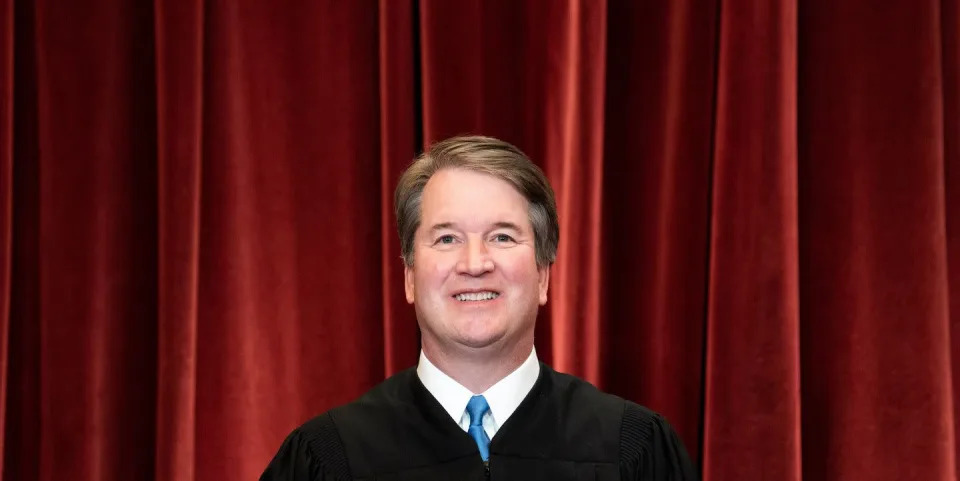
Brett Kavanaugh was nominated to become a member of our nine-person SuperCongress by a president who took office despite earning the votes of millions fewer Americans than his opponent did. That president never enjoyed the support of a majority of citizens and got spanked in the popular vote by an even larger margin—7 million—in the next election. He then tried to overthrow the government to stay in power. Only one of the five other right-wing justices was nominated by a president who took office having secured the support of a majority of actual Americans.
Photo credit: Pool – Getty Images
Brett Kavanaugh was then confirmed by 50 senators who represented just 44 percent of the American population. The 48 senators who voted “nay” represented tens of millions more citizens. Kavanaugh secured the crucial 50th vote of Senator Susan Collins based on her publicly stated belief that he considered Roe v. Wade to be “settled legal precedent.” In the public hearings into the question of his confirmation, where he testified under oath, Kavanaugh said this:
Senator, I said that it is settled as a precedent of the Supreme Court, entitled the respect under principles of stare decisis. And one of the important things to keep in mind about Roe v. Wade is that it has been reaffirmed many times over the past 45 years, as you know, and most prominently, most importantly, reaffirmed in Planned Parenthood v. Casey in 1992.
And as you well recall, senator, I know when that case came up, the Supreme Court did not just reaffirm it in passing. The court specifically went through all the factors of stare decisis in considering whether to overrule it, and the joint opinion of Justice Kennedy, Justice O’Connor and Justice Souter, at great length went through those factors.
And then, a couple of weeks ago, Kavanaugh voted with the five other Republicans on the Court to overrule Roe v. Wade and Planned Parenthood v. Casey.
If you have a problem with any of this—unelected judges selected by presidents who got fewer votes and confirmed by senators who represent a minority of citizens making policy without regard for legal precedent or their own previous statements under oath—you don’t seem to have much recourse.
You can’t vote the superlegislators out. It is unreasonable to expect any will be impeached thanks to the entrenched advantages that allow Republicans outsize control of the Senate. Even the House of Representatives is dangerously skewed, thanks to gerrymandered redistricting maps and the hyperpolarization they help to generate. The reason Senate Republican leader Mitch McConnell and others worked so hard to seize control of the judiciary was precisely because so many other institutions have ceased to function properly. Even if you do succeed in electing representatives to make policy through the legislature—after this same Court savaged the Voting Rights Act and unleashed an avalanche of money in our elections—the courts can throw out whatever they choose.
Photo credit: Bill Clark – Getty Images
You cannot protest at the steps of the Supreme Court, as they’ve walled that shit off. You can’t protest at the justices’ houses, and there’s some merit to the idea that private residences—where spouses and children are in the mix—should be off-limits. (Of course, in the case of Clarence Thomas, his spouse has very much been in the mix.) But you can’t protest in neutral public venues, either, even if you’re on a city street outside a restaurant. We learned that this weekend, when Mr. Kavanaugh was disturbed during a meal at a Washington, D.C. steakhouse, as reported by the Beltway encyclical known as Politico Playbook:
On Wednesday night, D.C. protesters targeting the conservative Supreme Court justices who signed onto the Dobbs decision overturning the constitutional right to abortion got a tip that Justice BRETT KAVANAUGH was dining at Morton’s downtown D.C. location. Protesters soon showed up out front, called the manager to tell him to kick Kavanaugh out and later tweeted that the justice was forced to exit through the rear of the restaurant.
We have returned, inevitably, to Red-Henghazi. Do public figures who make the rules we all have to live by get to do whatever they want at all times without any social repercussions? Do they have some right to privacy in public spaces, despite choosing to wield huge power over others in a democratic republic? Morton’s seems to think so.
“Honorable Supreme Court Justice Kavanaugh and all of our other patrons at the restaurant were unduly harassed by unruly protestors while eating dinner at our Morton’s restaurant. Politics, regardless of your side or views, should not trample the freedom at play of the right to congregate and eat dinner. There is a time and place for everything. Disturbing the dinner of all of our customers was an act of selfishness and void of decency.”
The right to eat dinner shall not be infringed. (Particularly by the Unduly Unruly.) Which, according to Politico‘s Daniel Lippman, it was not.
While the court had no official comment on Kavanaugh’s behalf and a person familiar with the situation said he did not hear or see the protesters and ate a full meal but left before dessert, Morton’s was outraged about the incident.
The right to tiramisu shall not be infringed. Seriously, though, at this point we’re talking about what appears to be a complete non-incident. He went out the back because he heard secondhand there were some folks out front?
But even if the honorable justice had to hear the urban rabble outside—described by Politico as “D.C. protestors”—tell him to fuck himself while he chowed down on a ribeye, what exactly is the problem here? The protesters are exercising their rights to speech and “peaceably to assemble, and to petition the Government for a redress of grievances.” Kavanaugh and the others may fashion themselves as blind arbiters of the law, but in reality they are agents of state power, representing the Government. And they have generated some grievances.
Meanwhile, we’re hearing about Brett the Honorable’s right to dine, what we can only assume is an unenumerated one under the Ninth Amendment. It also sounds more than somewhat related to the right to privacy—also rooted in the Ninth—which undergirded Roe and Casey before these six luminaries threw those decisions out. Justice Clarence Thomas has signaled they’re interested in going after the right to privacy itself with a so-called reconsiderationof Griswold v. Connecticut, a move that would go way beyond contraception. Although the prospect of this Republican Court empowering states controlled by their ideological allies to restrict women’s access to the pill in the Year of Our Lord 2022 does have a particular resonance.
And if that happens, you can expect the same bullshit routine from these same people. The work of working the refs is never done, and the self-victimization will never stop. This is the same impulse undergirding much of the Cancel Culture debate: while social-media mobs and a lack of due process are real problems, many of the fiercest Free Speech Warriors actually see free speech as their right to say whatever they want without getting criticized or made fun of. Similarly, these right-wing superlegislators believe they should be able to nakedly advance the policy priorities of the conservative movement by reverse-engineering decisions to meet preordained conclusions, all the while battering the lives of powerless people, without ever getting called an asshole while they drink a $300 bottle of wine. There are consequences for behaving badly in public office, at least until these people are finished savaging the foundations of this democratic republic. Or until the Democratic Party finds the stones to nix the Senate filibuster, expand the Supreme Court, reform the judiciary, and restore the people’s means of translating their will into the law we all are bound to live by.
Sophie Kasakove and Robert Gebeloff – July 7, 2022
A street with a new apartment complex under construction in in the East Nashville neighborhood of Nashville, Tenn., on May 11, 2022. (September Dawn Bottoms/The New York Times)
NASHVILLE, Tenn. — When Ashley Broadnax thinks of the East Nashville, Tennessee, neighborhood she grew up in during the ’90s, the images that rush in have a modest, middle-class tinge.
After school, she and other neighborhood children bought snacks at the corner store and threw balls on the street as their parents returned home, some in uniform from blue-collar work, others from jobs as teachers or office workers. Neighbors chatted on porches and lawns of unassuming single-story homes. There were some poor families and a few wealthy ones, but more than one-third of her neighbors made between $40,000 and $75,000 in today’s dollars — enough to live comfortably.
But by 2020, the income distribution had tilted so that half the families made $100,000 or more, census data shows. All across the neighborhood, the modest houses of Broadnax’s youth have been replaced by high-end townhomes known informally as “tall skinnies” that tower over the remaining older homes.
So when it was Broadnax’s turn to pay the rent, using her middle-income salary as an educator, the cost was out of reach.
Like many other Americans, Nashville residents are increasingly being buffeted by economic tides that push them into neighborhoods that are either much richer or much poorer than the regional norm, a New York Times analysis has found. A smaller share of families are living in middle-class neighborhoods, places where incomes are typically within 25% of the regional median.
In Nashville, the share of families living in middle-class neighborhoods dropped by 15 percentage points between 1990 and 2020. But the portion of families in wealthy ones jumped by 11 points, and the segment living in poor neighborhoods grew by 4 points.
In some ways, the pattern reflects how wealthy Americans are choosing to live near other wealthy people, and how poorer Americans are struggling to get by.
But the pattern also indicates a broader trend of income inequality in the economy, as the population of families making more than $100,000 has grown much faster than other groups, even after adjusting for inflation, and the number of families earning less than $40,000 has increased at twice the rate as families in the middle.
Broadnax has become part of a great chase nationally for affordable housing. High rents in the city initially sent her to the more affordable Antioch neighborhood in 2011. But home prices nearly doubled there since 2018, so buying a home meant moving farther out to a suburban community called La Vergne.
“The same people that’s working in their city can’t afford to live in their city,” Broadnax said about Nashville.
Nationally, only half of American families living in metropolitan areas can say that their neighborhood income level is within 25% of the regional median. A generation ago, 62% of families lived in these middle-income neighborhoods.
“People are getting pushed out, and that is breaking up some historically sort of working-class neighborhoods,” said Marybeth Shinn, a Vanderbilt University professor who studies homelessness and social exclusion. “You gradually convert a neighborhood from a pretty modest kind of neighborhood that a lot of people could live in to one where only people that have a little more means are able to live in.”
That evolution has mixed consequences for people seeing their neighborhoods change.
When Jim Polk bought his home in East Nashville in 1979, the community left some amenities to be desired. The park near his house was rundown, and the neighborhood had few sidewalks or streetlights.
As the firefighters, nurses and local government employees in the neighborhood were replaced by tech workers, engineers and lawyers, Polk mourned the loss of their old, familiar neighborhood where his four daughters had learned to accept people of diverse backgrounds.
“So many families have moved out over time,” said Polk, who worked for decades as a community education coordinator for the city public schools. “It didn’t remind them of the place they used to live, and it was so expensive to stay.”
But Polk and his wife were able to keep up with the property tax increases on their city pensions, and they could not ignore the improvements to the neighborhood: New sidewalks and streetlights were installed, and the long-neglected park was cleaned up. When his church was destroyed by a tornado in 2020, his new neighbors had the resources to help the congregation buy a new building.
Even more significant has been the rapid price appreciation of homes in the neighborhood.Polk bought his home for $36,000. A home just across the street sold for more than $1.5 million in February, according to Zillow.
“There have been improvements in services available to the people living in the neighborhood,” he said. “But who gets to participate?”
Experts say the changes in housing patterns represent a form of economic segregation, as Americans are less likely to live in neighborhoods with people from other socioeconomic classes. Economic segregation exacerbates the problems often associated with income inequality. There are what researchers call “neighborhood effects,” with studies finding that poor children have better odds of climbing the socioeconomic ladder if they grow up outside of concentrated poverty.
And wealthy neighborhoods tend to command a disproportionate share of resources, such as better schools, more parks and greater access to health professionals.
This economic segregation not only “concentrates low-income families in high poverty neighborhoods, but it concentrates affluent families in affluent neighborhoods, where they can engage in a kind of opportunity hoarding,” said Sean F. Reardon, a sociologist at Stanford University. He and another sociologist, Kendra Bischoff of Cornell University, have written several papers on economic segregation.
Consider Durham, North Carolina.
Since 1990, a surge of wealth and investment has poured into the city’s downtown. At the same time, the percentage of families living in lower-income neighborhoods has doubled.
Turquoise LeJeune Parker, an elementary school technology instructor, said the split reality of rich and poor neighborhoods did her low-income students no good. Describing what she saw as the prevailing mindset of people flocking to prosperous parts of town, she said, “We won’t push for resources for our schools, we won’t push for any of that because ‘I’ve got what I need on my side of the city, so I’m good.’ ”
To some degree, economic segregation has gone hand in hand with the hollowing out of the middle class in general.
At the same time, local governments across the country have done little to maintain or expand affordable housing, instead investing in attracting highly paid workers, which drives up prices and displaces lower-income residents.
And exclusionary zoning laws often prevent denser, lower-cost housing from being built in high-end enclaves — Tennessee has even barred cities from putting zoning laws into place that would protect affordability. Property taxes on many homes have spiked, pushing longtime residents to sell to investors.
But whatever the cause, similar trends can be seen across the country.
In the Boston metropolitan area, middle class neighborhoods have shifted in both directions. In the 1990s and 2000s, many fell behind economically. In the past decade, because of widespread gentrification in the city, many modest neighborhoods have been transformed into much wealthier ones.
A generation ago, Seattle’s tech industry was starting to boom, but the area also was a major manufacturing hub, and 7 out of 10 families lived in middle-class neighborhoods. Today, only 5 out of 10 do. Nearly one-third live in wealthy enclaves.
In the Midwest, the share of families living in middle-class neighborhoods fell by 13 percentage points in Columbus, Ohio, since 1990, by 12 in Chicago, and by nine in Indianapolis.
And in Orlando, nearly 70% of area residents lived in “average” neighborhoods in 1990, according to census data. In 2020, the same was true for just 46%.
That leaves a lot of people feeling like they’re on the outside looking in.
Michael Street is a union electrician who moved from Nashville to Goodlettsville, Tennessee, about 25 minutes away. He said he spent his days driving around Nashville, working on houses that have all been rehabbed, rebuilt or rendered unrecognizable in neighborhoods he can no longer afford.
“Either you’re poor, or you’re rich,” he said. “Middle class is kind of phasing out. Either you have a lot of money, or you’re just barely getting by.”
—
Methodology
To measure the growing level of economic segregation in the U.S., the Times used census data to compare the median family income of every census tract with the median for the surrounding metropolitan area for the years 1990, 2000, 2010 and 2020. The analysis counted how many families lived in middle-class tracts, where the median family income was within 25% of the regional median, and how many lived in tracts where the income level was 25% or more above or below the regional median. All figures were inflation-adjusted to 2020 values.
Source data and maps were from socialexplorer.com and nhgis.org.
SCOTUS Justices ‘Prayed With’ Her — Then Cited Her Bosses to End Roe
Kara Voght and Tim Dickinson – July6, 2022
Reverend Rob Schenck (C) from Faith and – Credit: Jewel Samad/AFP/Getty Images
At an evangelical victory party in front of the Supreme Court to celebrate the downfall of Roe v. Wade last week, a prominent Capitol Hill religious leader was caught on a hot mic making a bombshell claim: that she prays with sitting justices inside the high court. “We’re the only people who do that,” Peggy Nienaber said.
This disclosure was a serious matter on its own terms, but it also suggested a major conflict of interest. Nienaber’s ministry’s umbrella organization, Liberty Counsel, frequently brings lawsuits before the Supreme Court. In fact, the conservative majority in Dobbs v. Jackson Women’s Health, which ended nearly 50 years of federal abortion rights, cited an amicus brief authored by Liberty Counsel in its ruling.
In other words: Sitting Supreme Court justices have prayed together with evangelical leaders whose bosses were bringing cases and arguments before the high court.
Nienaber is Liberty Counsel’s executive director of DC Ministry, as well as the vice president of Faith & Liberty, whose ministry offices sit directly behind the Supreme Court. She spoke to a livestreamer who goes by Connie IRL, seemingly unaware she was being recorded. “You actually pray with the Supreme Court justices?” the livestreamer asked. “I do,” Nienaber said. “They will pray with us, those that like us to pray with them.” She did not specify which justices prayed with her, but added with a chortle, “Some of them don’t!” The livestreamer then asked if Nienaber ministered to the justices in their homes or at her office. Neither, she said. “We actually go in there.”
Nienaber intended her comments, broadcast on YouTube, to be “totally off the record,” she says in the clip. That’s likely because such an arrangement presents a problem for the Orlando-based Liberty Counsel, which not only weighed in on the Dobbs case as a friend of the court, but also litigated and won a 9-0 Supreme Court victory this May in a case centered on the public display of a religious flag.
The Supreme Court did not respond to a request for comment. Liberty Counsel’s founder, Mat Staver, strenuously denied that the in-person ministering to justices that Nienaber bragged about exists. “It’s entirely untrue,” Staver tells Rolling Stone. “There is just no way that has happened.” He adds: “She has prayer meetings for them, not with them.” Asked if he had an explanation for Nienaber’s direct comments to the contrary, Staver says, “I don’t.”
But the founder of the ministry, who surrendered its operations to Liberty Counsel in 2018, tells Rolling Stone that he hosted prayer sessions with conservative justices in their chambers from the late-1990s through when he left the group in the mid-2010s. Rob Schenck, who launched the ministry under the name Faith and Action in the Nation’s Capital, described how the organization forged ministry relationships with Samuel Alito, Clarence Thomas, and the late Antonin Scalia, saying he would pray with them inside the high court. Nienaber was Schenk’s close associate in that era, and continued with the ministry after it came under the umbrella of Liberty Counsel.
Louis Virelli is a professor at Stetson University College of Law who wrote a book about Supreme Court recusals. He’s blunt in his assessment: “Praying with a group that filed an amicus brief with a court,” he says, “is a problem.”
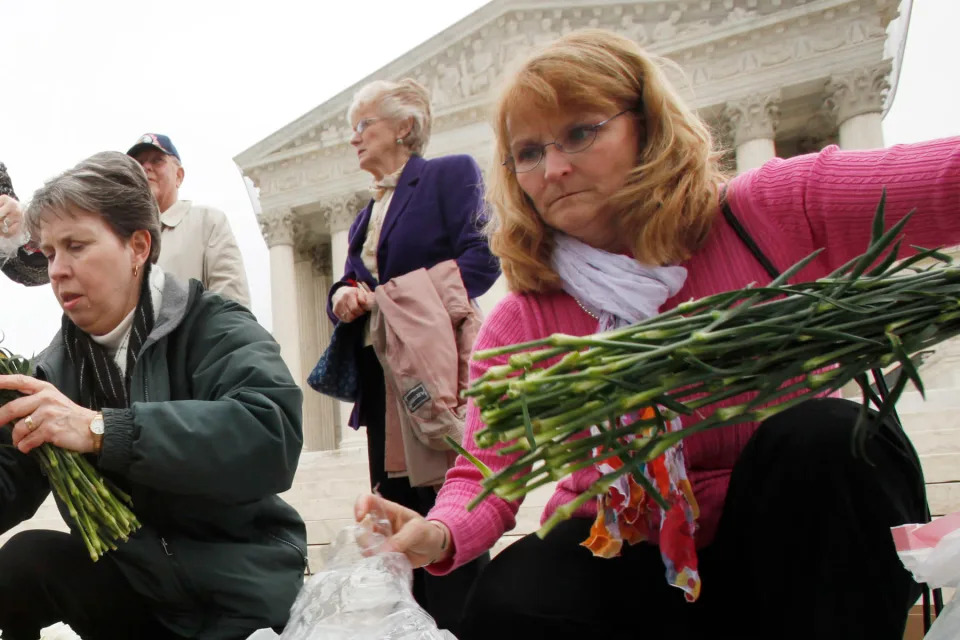
Peggy Nienaber, right, at an event outside the Supreme Court led by Christian faith organizations on the eve of the Supreme Court arguments on President Obama’s health care legislation in 2012. – Credit: Jacquelyn Martin/AP Images
In the shadow of the high court, across the street from its chambers, sits a cluster of unassuming row houses known only to the initiated as “Ministry Row.” The strip is host to evangelical political groups that have spent the past several decades pushing Beltway conservatives to embrace the religious right’s political causes — and, most of all, reverse Roe v. Wade. The street view offers few clues as to what transpires behind the painted brick facades, save for a granite slab inscribed with the Ten Commandments planted in the grassy patch before a modest cream-colored Victorian with maroon trim.
The home serves as Faith & Liberty’s headquarters. The Ten Commandments statue had been placed there by Schenck, an evangelical minister famous for orchestrating high-profile anti-abortion stunts, such as shoving an aborted fetus in a plastic container into the face of former President Bill Clinton during the 1992 campaign. Schenck had opened the ministry in the 1990s as Faith and Action in the Nation’s Capital, a nonprofit dedicated to ending federal abortion rights. The organization operated on a “utopian ‘trickle-up’ theory” of influence: building access “higher and higher up within the government, until we got to the top, my ultimate target — members of Congress, U.S. senators, cabinet secretaries, Supreme Court justices — even presidents,” Schenck wrote in his 2018 autobiography.
The group established a strong foothold in both chambers of Congress and, eventually, the White House. But Faith and Action ultimately directed its energies toward the judicial branch. “There were no pro-life groups directly approaching the judges and justices, who shaped abortion law simply by their precedent-setting decisions,” Schenck wrote. “We knew we were stuck with members of the federal bench — they were appointed for life — so why not convert them while in office?” (Schenck has since reversed course: He is now a fierce critic of evangelical politicking and says Liberty Counsel assumed Faith and Action’s operations in 2018. He says he has no knowledge of the group’s inner workings after he left.)
At first, the high court regarded Faith and Action and its peer organizations as nuisances, according to Schenck. “Justice Thomas would say to me, ‘You know those groups outside? Are they crazy or are they good people?’” Schenck recalls in an interview with Rolling Stone. When Schenck first began his approach in 1994, prayer activities on the Supreme Court’s property was considered an act of demonstration, and therefore illegal. Eventually, Justices Alito, Scalia, and Thomas would embrace Schenck, he says, and pray with him in various corners of the high court’s grounds — including, occasionally, in their chambers. (Chief Justice John Roberts, meanwhile, remained more guarded and skeptical of such groups’ influence.)
To pray with the justices was to perform a sort of “spiritual conditioning,” Schenck explains. “The intention all along was to embolden the conservative justices by loaning them a kind of spiritual moral support — to give them an assurance that not only was there a large number of people behind them, but in fact, there was divine support for very strong and unapologetic opinions from them.” Prayer is a powerful communication tool in the evangelical tradition: The speaker assumes the mantle of the divine, and to disagree with an offered prayer is akin to sin. “It’s just not common to interrupt or challenge a prayer,” Schenck explains. “That’s not something a devout Supreme Court justice would ever consider doing.” That was true even for the devout Catholic justices, such as Scalia, who joined the evangelical Faith and Action members in prayer, Schenck says.
Sometimes the prayers would be general; other times, on specific subjects, such as ending abortion, according to Schenck. He says Faith and Action took assiduous care to avoid speaking blatantly about cases in the Supreme Court’s pipeline, discussing the political agenda only in broad strokes. Even so, under the time period Schenck describes, prayers with the justices occurred as Faith and Action signed onto several amicus briefs for landmark SCOTUS cases such as Gonzales v. Planned Parenthood, which ultimately upheld the Partial-Birth Abortion Ban Act of 2003.
Schenck walked away from his life on the Hill after receiving a late-career doctorate on the teachings of Dietrich Bonhoeffer, the German pastor who questioned the collaborative relationship between Adolf Hitler and 1930s German evangelicals. He drew parallels between the Republican Party and American evangelicalism, concerned that he’d weaponized worship to fuel a hate-filled agenda. No longer an anti-abortion activist, Schenck views his past efforts with regret. “Prayer is a positive exercise, until it’s politicized — and too many prayers that I and my colleagues offered in the presence of the justices were political prayers,” he explains. He also believes the work “contributed to the internal moral and ethical corruption of the justices at the court,” he says.
“I was sure, while we were doing it, it would be a positive contribution to our public life,” Schenck says. “It didn’t have the effect I thought it would. In some ways, it set the stage for the reversal of Roe, which I now think of as a social catastrophe.
When Liberty Counsel absorbed Faith and Action in 2018, Peggy Nienaber, who had worked alongside Schenck since at least 2005, continued with the group. In a July 2021 conversation with Staver, Liberty Counsel’s founder, Nienaber described the group’s new incarnation as similar to Faith and Action’s mission. It’s “the ministry right here on Capitol Hill,” she said, devoted to “changing the hearts and minds of not only our elected officials, but the staffers all the way down.” Nienaber highlighted Faith & Liberty’s proximity to the court by pointing to the window of the conference room where the justices decide their cases. ”When you’re sitting in that conference room, you cannot miss those Ten Commandments,” she said. (Faith & Liberty sits so close to the Supreme Court, in fact, that it has been included in the “buffer zone” surrounding the high court, shut off to protesters and the public. There’s irony here, given that Liberty Counsel has for decades litigated to abolish buffer zones near abortion clinics.)
“There’s a lot of things that Faith & Liberty does — and that you do — that obviously we can’t put in an email, can’t put in a newsletter, can’t put in a press release,” Staver said to Nienaber during their chat, “because it’s private relationships that are spiritually transformative.” Nienaber’s social media accounts show her hobnobbing with high-profile Republicans such as Sen. Lindsay Graham (R-S.C.) and former Vice President Mike Pence. She hung close to the confirmation of Justice Brett Kavanaugh in 2018: She posted photographs from inside the Senate Judiciary Committee’s hearing room, as well as a screenshot of her invitation to Kavanaugh’s swearing-in ceremony.
Nienaber told Rolling Stone, “I do not socialize with the justices.” Yet she has posed for photos with Justices Kavanaugh and Thomas, calling the latter a “friend” in a Facebook post, praising him for “passing by our ministry center to attend church and always taking time to say hello.”
In addition to her proximity to conservative power players, Nienaber has championed the plaintiffs who have brought right-wing religious causes before the Supreme Court. Ahead of oral arguments, she prayed with Joe Kennedy, the football coach who recently succeeded in his suit to allow prayer during football games. Liberty Counsel also filed an amicus brief in that case, calling on the court to rule that the school district “engaged in viewpoint discrimination against Coach Kennedy’s private speech.”
Nienaber was recorded telling the livestreamer that she prayed with Supreme Court justices on June 27, the Monday after the high court issued the Dobbs ruling. She was at a celebration she helped organize with Sean Feucht, a prominent Christian-worship musician. Nienaber identifies herself only as “Peggy” in the footage, but she references the ministry she runs behind the court and its 850-pound replica of the Ten Commandments. For most of the interview, Nienaber is not on camera. But when the video pans on her briefly, she can be seen wearing the same dress and necklace she has on in a selfie with Feucht posted to Faith & Liberty’s website.
Last week, Rolling Stone spoke to Patty Bills, the director of constituency affairs at Faith & Liberty. Bills did not want to discuss Faith & Liberty’s ministry practices, citing privacy concerns. Bills would not, however, deny that Faith & Liberty ministers to Supreme Court justices. “I never said we didn’t — I just said we provide privacy,” she said.
Staver, in denying that members of Faith & Liberty prayed with Supreme Court justices, says that such prayers would have been inappropriate, especially given Liberty Counsel’s litigation efforts. “That’s why we wouldn’t do that,” he says. “And especially on cases that are pending before the Supreme Court, we would make a very clear firewall. We just would never do something like that.”
In a written statement to Rolling Stone, Nienaber says of her hot-mic comments: “I do not recall making such a statement. I listened to the livestream, and I did not hear such a statement.” She adds that Covid restrictions have limited public access to the Supreme Court: “The public has not been allowed access, and I am no different.” When she has had access to public areas of the court, she says, “I will generally silently pray for the justices, their staff, and the Court.”
But after this story was published, Nienaber acknowledged her remarks and conceded she has prayed personally with Supreme Court justices. Despite speaking in the present tense on the livestream, Nienaber asserted, “My comment was referring to past history and not practice of the past several years.” Nienaber added: “During most of the history up to early 2020, I met with many people who wanted or needed prayer. Since early 2020, access to the Supreme Court has been restricted due to COVID. It has been many years since I prayed with a Justice.”
Liberty Counsel was founded in 1989 by Staver. The organization is an uncommon hybrid of religious ministry and legal practice, dedicated to “advancing religious freedom, the sanctity of human life and the family through strategic litigation.” Staver is the organization’s senior pastor as well as its top litigator. This mix of law and religion is central to Staver’s career; he previously served as dean of the law school at Liberty University, founded by the televangelist Jerry Falwell.
Staver has argued numerous cases in front of the Supreme Court. He started in 1994 in a case that struck a blow against protest-limiting buffer zones near abortion clinics. In the court’s most recent term, Staver argued and won a 9-0 judgment in Shurtleff v. Boston, a case in which the court ruled a Christian flag couldn’t be excluded from a public flagpole that displayed a rotating assortment of secular flags.
Staver also wrote an amicus brief in the Dobbs case that purports to tie abortion and birth control to eugenics. Calling Roe “the low watermark in this Court’s history,” it argued that Dobbs was ”an ideal vehicle for the Court to finally overrule Roe v. Wade and its progeny, which have constitutionalized eugenic abortions as a fundamental right.”
In the Dobbs majority opinion written by Justice Alito, he cited this brief to impugn the motives of pro-abortion-rights advocates, arguing that “some such supporters have been motivated by a desire to suppress the size of the African American population,” adding, “it is beyond dispute that Roe has had that demographic effect,” because “a highly disproportionate percentage of aborted fetuses are Black.”
When Roe v. Wade was reversed, Staver was triumphant: “I have dedicated my life to defend life and overturn the bloody decisions of Roe v. Wade and Planned Parenthood v. Casey,” he wrote. “This global earthquake will impact the world.”
Prayer unto itself in no way presents a conflict of interest for the justices, says Russell Wheeler, a visiting fellow of governance studies at the Brookings Institution, not even with a group like Faith & Liberty that has business before the court. Justices are allowed to visit there with whomever they’d like in their private chambers, and have socialized with interested parties throughout the court’s history. President Franklin Delano Roosevelt, for example, routinely played cards with the high court’s magistrates, and Scalia went duck hunting with former Vice President Dick Cheney. What would amount to an ethical concern would be if they’re discussing those cases as they pray — “or if the prayer sessions would influence how justices rule in a particular case,” says Adam Winkler, a Supreme Court expert at the University of California Los Angeles.
But even among legal experts troubled by the court’s ties, they acknowledge there are few remedies to address ethical conflicts. A federal statute governs when judges and justices should step away from cases, but the Constitution leaves questions of partiality to the justices themselves. Their general unwillingness to step aside isn’t necessarily a bad thing, Virelli, the Stetson law professor, says: When justices recuse themselves from a case, no one replaces them, a scenario that can create more problems than it solves. “The court changes shape,” he explains. “That makes the decision to recuse difficult.”
That the justices are their own keepers in regard to those rules creates complications, however, says Steve Vladeck, a constitutional-law expert at the University of Texas Law School. The relationship between Faith & Liberty and Liberty Counsel, as described by Rolling Stone, “could make a reasonable observer worry about the appearance of partiality,” he says. But the concerns the scenario raised shouldn’t be about recusal. “What that really reveals is how problematic it is that there isn’t an objective mechanism to resolve these sorts of questions.”
For Winkler, the greater concern is not prayers, but the “religious-themed” decisions he’s seen come down from the high court this term, pointing to not only the Roe reversal but also opinions that permit unchecked free exercise of First Amendment rights. “The problematic aspect isn’t whether they’re praying,” Winkler says, “but that several justices seem committed to reading their religion into the Constitution.”
Putin’s Big Turning Point in the War Could Finally Be Here
Shannon Vavra – July 6, 2022
Russian forces took a key region in eastern Ukraine over the weekend, thanks in part to Moscow stepping up its coordination and war planning, according to a British intelligence assessment released on Tuesday.
This change in Russian forces’ approach to fighting in Eastern Ukraine could be the early signs of a brand new—and worrying—phase in Russia’s devastating war in Ukraine.
While Ukrainian officials first denied that they had lost Lysychansk, one of the last strongholds in Eastern Ukraine’s Luhansk, Ukrainian forces confirmed Sunday they withdrew from the area. Russian forces took over Sunday and Russian President Vladimir Putin declared victory on Monday.
Russia’s success in Luhansk wasn’t an accident. While Russian forces have been bogged down by previous missteps in the war for months, Russian forces are getting better at executing their war plans and operating across teams. Putin has likely achieved effective coordination between two major fighting groups in the Donbas, according to the intelligence assessment.
“Unlike in previous phases of the war, Russia has probably achieved reasonably effective coordination between at least two Groupings of Forces, the Central Grouping likely commanded by General-Colonel Alexandr Lapin and the Southern Grouping probably under the recently appointed General Sergei Surovikin,” the assessment states.
That’s a world of difference from the previous four months of war, during which Russian forces haven’t coordinated well, have faltered in their logistics and planning, and have been actively trying to sabotage their own attack plans rather than fight like a well-oiled machine.
It’s a particularly alarming development given that Russia likely won’t stop in Luhansk. The current U.S. assessment is that Russia still maintains plans to take all of Ukraine, not just eastern Ukrainian territories, a U.S. ambassador told The Daily Beast.
And in the coming days, Russian forces could be turning their attention to other territories in the east of Ukraine, including in neighboring Donetsk.
Putin urged Russian forces to continue through the region “as has happened in Luhansk” and said they “must carry out their tasks according to previously approved plans.”
Watch: Russia fires rockets at Ukraine mall with over 1,000 inside
Russia fires rockets at Ukraine mall with over 1,000 inside
On Monday, Russia fired a series of rockets at a crowded shopping center in Kremenchuk, Ukraine. The assault raised concerns that Russian President Vladimir Putin is stepping up its attacks on civilian structures regardless of the loss of life.
Already, Russian forces are focusing on Siversk, Fedorivka, and Bakhmut in the Donetsk region, according to the Ukrainian General Staff. In just the last several days Russian forces have also been focused on attacking multiple cities and regions shelling the Donetsk region, as well as Dnipropetrovsk and the regions of Mykolaiv, Sumy, Kharkiv, Zaporizhzhia, Kherson, Chernihiv, and Khmelnytskyi, according to the regional military administrations.
“In the Bakhmut direction, the enemy shelled our troops with mortars, barrel and rocket artillery in the areas of Kodema, Pokrovske, Zaytseve, Zalizne and Novoselivka settlements,” the General Staff of the Armed Forces of Ukraine said Tuesday.
This doesn’t mean Russia is going to coast toward victory, though, according to Michael Kofman, the Russia Studies Program research program director at CNA, a national security research organization.
“This is a critical time for the Ukrainian military because these are the few months during which they’re very low on artillery ammo, they’re trying to transition to Western systems. They don’t have many of them yet, or they don’t have them fully deployed and they’re still training up on them,” Kofman told The Daily Beast. “This current phase is mostly one for Ukraine of survival and trying to take back what territory they can on the battlefield. What people have not really seen what Ukraine might be able to do with a somewhat recapitalized military and the benefit of Western weapons.”
And although Russia could be on the verge of taking even more of the Donbas, the win in Luhansk could serve a purpose all by itself that has nothing to do with taking more territory: Putin now has a message he can blast out domestically about successes in the so-called “special military operation,” which he claimed Russia was undertaking to help eastern Ukraine, including Luhansk.
“Russia’s relatively rapid capture of Lysychansk extends its control across virtually all of the territory of Luhansk Oblast, allowing it to claim substantive progress against the policy objective it presented as the immediate purpose of the war, namely ‘liberating’ the Donbas,” the U.K. Ministry of Defense said Tuesday.
Already, Putin met with military leadership to celebrate a “major victory,” and awarded Major General Esedulla Abachev and Colonel General Alexander Lapin with “Hero of Russia” awards for taking Luhansk.
For Russia and Ukraine, the battle for Luhansk is not the end, Kofman said.
“The battle for Severodonetsk and Lysychansk may be over but we are currently in what is essentially the buildup to what will eventually be the battle for Sloviansk and Kramatorsk, and the big question is whether or not the Russian military can take those cities,” Kofman said.
Putin has ordered an operational pause for Russian forces in the region, according to the Institute for the Study of War, and Ukrainian officials said they doubted the Luhansk win meant Russia was on track to win the war.
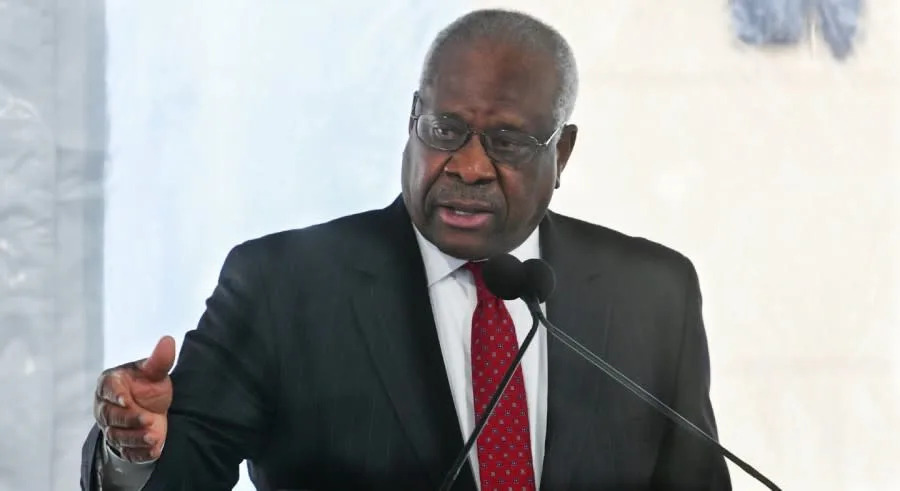
The petition description cited Thomas’s vote to overturn Roe v. Wade as reasoning for his removal.
“Supreme Court Justice Clarence Thomas—who sided with the majority on overturning Roe—made it clear what’s next: to overturn high court rulings that establish gay rights and contraception rights,” the petition read.
The description also mentioned Thomas’s wife, Ginni Thomas, and her role in encouraging members of the Trump administration to continue to challenge the 2020 election results.
The Supreme Court earlier this year rejected a request by former President Trump to prevent the release of documents related to the Jan. 6 Capitol riot. Thomas was the only justice to dissent on the matter.
“He has shown he cannot be an impartial justice and is more concerned with covering up his wife’s coup attempts than the health of the Supreme Court.”
“He must resign — or Congress must immediately investigate and impeach,” the petition concluded.
The petition garnered more than 1.1 million signatures and urges Congress to either investigate or impeach Thomas for his actions.
The MoveOn petition follows a similar one created by George Washington University students last week in an effort to remove Thomas from his teaching position with the Washington, D.C., university.
The student-led petition came after the high court’s decision to overturn Roe v. Wade, a landmark 1973 ruling that determined a woman’s right to abortion was constitutional.
In a school-wide letter, GWU officials said they don’t have plans to remove Thomas as an adjunct instructor in their law school, stating that he did not violate the school’s policy on academic freedom.
“Just as we affirm our commitment to academic freedom, we affirm the right of all members of our community to voice their opinions and contribute to the critical discussion that is foundational to our academic mission,” school officials wrote in their letter.