Democrat who lost to George Santos calls on him to resign following NYT report
Dylan Stableford, Senior Writer – December 20, 2022
Rep.-elect George Santos, R-N.Y., speaks at the Republican Jewish Coalition’s annual leadership meeting in Las Vegas on Nov. 19, 2022. (Photo by Wade Vandervort/AFP via Getty Images)
The Democrat who lost to GOP Rep.-elect George Santos in the race to represent New York’s Third Congressional District is calling on Santos to resign after the New York Times published a bombshell investigation suggesting that he fabricated key parts of his résumé during the campaign.
“The reality is Santos flat-out lied to the voters of NY-03,” Robert Zimmerman, who lost to Santos by 8 points in last month’s midterm elections, said in a statement late Monday. “He’s violated the public trust in order to win office and does not deserve to represent Long Island and Queens.
“Santos’ failure to answer any of the questions about these allegations demonstrates why he is unfit for public office and should resign,” Zimmerman added. “It demonstrates why there must be a House Ethics Committee, Federal Elections Commission, and U.S. Attorney investigation immediately.”
Democrat Robert Zimmerman concedes to Republican George Santos in Great Neck, N.Y., on Nov. 8. (William Perlman/Newsday RM via Getty Images)
The Times report published on Monday found that Santos may have misled voters about his college graduation, his criminal and employment history, his family-owned business, his animal rescue charity and his relationship with four victims of the 2016 Pulse nightclub shooting in Orlando, Fla.
In a statement, Joseph Murray, an attorney for Santos, said that his client “represents the kind of progress that the Left is so threatened by — a gay, Latino, immigrant and Republican who won a Biden district in overwhelming fashion by showing everyday voters that there is a better option than the broken promises and failed policies of the Democratic Party.”
“After four years in the public eye, and on the verge of being sworn in as a member of the Republican-led 118th Congress, the New York Times launches this shotgun blast of attacks,” Murray continued. “It is no surprise that Congressman-elect Santos has enemies at the New York Times who are attempting to smear his good name with these defamatory allegations.”
The statement — which ended with a quote erroneously attributed to Winston Churchill — did not directly address the allegations that appeared in the story in the Times.
George Santos, R-N.Y., at a conference in Las Vegas last month. (Wade Vandervort/AFP via Getty Images)
If Santos were to resign, a special election would be called to fill his seat.
The revelations in the Times article also raise questions about why neither the Zimmerman campaign nor the Democratic Party, which lost control of the House of Representatives in the midterms, were unable to uncover the apparent holes in Santos’s biography before the election.
“This story is not a shock,” Zimmerman said, insisting that his campaign “worked to raise many of these issues” uncovered by the Times.
New York state Democratic Party Chair Jay Jacobs defended the Zimmerman campaign, telling CNN, “It’s unfair to blame the campaign for opposition research work that it did because the resources of a campaign are not as significant as a paper like the New York Times.”
“The important thing is to focus on George Santos,” Jacobs added. “He’s got a lot of explaining to do.”
Thinking About Trying the Zone Diet? Here’s Everything You Need to Know Before You Hop on Board
Nicole Pajer – December 20, 2022
From what you can and can’t eat on it to what the benefits entail, we’ve got you covered.
Among the diet plans that have been trending in recent years is the Zone Diet, right up there with keto and Whole30. This way of eating is generated towards reducing inflammation, slowing down aging, and keeping you properly satiated in between meals. And the lifestyle has been said to help with weight loss, body fat, improving mental clarity and overall wellness. We went straight to the source and asked Zone Diet Creator Dr. Barry Sears to answer some of the most frequently asked questions about the Zone Diet. Want to go deeper? Check out his latest book, The Resolution Zone, which gives readers an overview on how to help reverse the damage done by past inflammation and promote the ability of the body to repair.
Below, you’ll find everything you need to know about what the zone diet actually is, how it works, benefits, how to make it easier, and more.
What Is the Zone Diet?
The Zone Diet is an anti-inflammatory diet created by Dr. Sears, a dietary hormone response expert, in 1998. It involves structuring your meals to include a specific balance of carbohydrates, protein and fats, and can be combined with many other traditional dietary programs. The Zone Diet is considered a long-term eating plan, not a quick-fix diet.
“It’s going back to the original Greek root of the word diet, which means way of life,” Sears says.
According to Sears, this specific way of eating is geared at keeping inflammation “in a zone” that’s not too high, but not too low. Sears explains that we need some level of inflammation to be able to fight off microbiome invasions and to allow any physical injuries sustained heal. But if we have too much, it begins to attack our body. “So keeping inflammation in that zone is really the key toward treating chronic disease,” he adds.
How Does the Zone Diet Work?
All you need to do the diet, per Sears, is “one hand, one eye, and one watch.” The first step is to visually balance your plate: one-third should contain a lean protein (no larger than the palm of your hand); two-thirds should be colorful fruits and vegetables (good carbs). Then, add add a dash of heart-healthy monounsaturated fat—ideally olive oil, “because it’s rich in polyphenols (antioxidant-rich micronutrients) that basically will add to the polyphenol mix of the diet,” Sears says. “It’s that simple!”
If you like tracking your foods in an app like MyFitnessPal that calculates nutrients, here are the numbers you are looking for: 40% of your calories coming from carbohydrates, a.k.a fruits and vegetables, 30% coming from protein and 30% from fat.
“At one meal, if you have 25 grams of protein, about half of that should be fat, monounsaturated fat, maybe 12 grams and maybe about 30 to 35 grams of carbohydrates, primarily non-starchy vegetables,” Sears says.
If you’re using carbohydrates as your fruits and vegetables, with the emphasis on vegetables, the number of calories you’re consuming is very low. “Those meals should be about the 400 calories, but there are very large meals in terms of size,” he says.
Sears says that the trendy concept of intermittent fasting is essentially a bookkeeping way of trying to reduce calories. But by doing the Zone Diet, you end up automatically reducing calories by balancing your plate “because it’s the hormones that those proteins and carbohydrates generate that keep you satiated so you aren’t hungry. And if you aren’t hungry, you eat less calories. If you eat less calories, you live longer,” Sears explains.
How Do I know If the Zone Diet Is Working for Me?
You look at your watch. “If you have no hunger five hours later, that meal was a hormonal winner for you,” says Sears.
What Are the benefits of the Zone Diet?
Reduction in inflammation
“Why is that important? That’s the driver of chronic disease,” he says.
Longevity
“There was a recent study that demonstrated that if you eat 10 servings of fruits and vegetables per day—that’s two kilograms of raw fruits and vegetables—that your likelihood of death decreases by about 31% decrease. Your likelihood of getting dying from cardiovascular disease decreases by 25% and dying of stroke also decreases by about 25%,” he says, adding that this is due to the polyphenols found inside these foods.
“Even though it’s a calorie-restricted program, it’s virtually impossible to eat all the food because on the Zone program, you’re eating about 10 servings of fruits and vegetables per day. That’s a lot of fruit. That’s a lot of vegetables. And so what your consuming for the average female is about maybe 1,200 calories per day and 1,500 for the average male,” he says. What you’re looking to do with your meals, says Sears, is to say, ‘I’m controlling the hormones so I can maintain enough adequate protein coming in so I can maintain my muscle mass. But basically balancing that protein with the right type of carbohydrates. So I don’t overproduce the hormone insulin.”
All These Numbers Sound Complicated. Any tips to Make the Zone Diet Easier?
The secret, Sears says, is finding the low-fat protein, fruits, and vegetables that you like to eat, and learning how to balance that plate. Then put together about 10 different meals, which you can rotate around. “People rarely eat more than 10 different meals at home. They’ll eat two different breakfasts, three different lunches and five different dinners. And if they go out to eat they might go to the same restaurants over and over again eating the same meals,” he says. So you don’t have to drive yourself crazy trying to perfect hundreds of recipes to make at home.
What Foods Can You Eat On the Zone Diet?
Remembering that the proper balance is key, here are some good Zone Diet foods:
Tomatoes
Kale
Spinach
Arugula
Celery
Broccoli
Cauliflower
Carrots
Brussels sprouts
Cucumbers
Green Beans
Eggplant
Zucchini
Squash
Onions
Chicken
Shrimp
Tuna
Tofu
Eggs
Turkey
Salmon
Apples
Oranges
Avocados
Nuts
Olive oil
What Foods Should You Limit On the Zone Diet?
High-glycemic carbohydrates. “They enter the bloodstream very quickly as glucose. And then will basically pump up insulin,” he says. “In terms of what we call ‘whole grains,’ whole grains are whole because they contain polyphenols. But the rate of entry of the carbohydrates in the blood is no different than a piece of Wonder bread,” he adds. So Sears says to keep the amount of starches that you eat to a maximum of around one serving per day. “We want about eight servings of vegetables, two servings of fruit, one at most and and ideally zero of the grains and starches.”
What Are Some Zone Diet Meals?
Breakfast
Greek yogurt with some almonds as a healthy fat source. Another option is slow-cooked oatmeal and an egg white omelet. “You’re balancing protein to carbohydrate and then add some guacamole to the top of the egg white omelet.” Both of these should keep you full for five hours.
Lunch
A chicken Caesar salad. “You get the 25 grams of protein with the chicken breast and the salad. But the salad doesn’t have carbohydrates. So with that, you’d have another two to three servings of vegetables on the side.”
Dinner
Think three servings of non-starchy vegetables, things like broccoli, artichokes, asparagus, cauliflowers. And then for protein, salmon or chicken.
Yes. Both groups eat a lot of fruits and vegetables. So, according to Sears, 2/3 of their plate is already completed. Vegetarians can add in eggs and dairy products for their protein sources and vegans can opt for a soybean protein product.
No.This way of eating doesn’t place its focus on fruits and vegetables, Sears says, which he deems as being key for gut health. He also says people following a Ketogenic diet plan need to make sure that they are getting enough beneficial bacteria-feeding fiber, which can be tough to do. A Mediterranean diet is good pairing with the Zone diet.
What Can You Eat At a Restaurant On the Zone Diet?
If you’re big on eating out, have a restaurant modify a dish until it works for you on this plan. People tend to go to the same 5 to 10 restaurants on repeat, which is a benefit to those doing this program. “They might have a menu with hundreds of meals, but you eat the same one every time. So you keep telling them to adjust the meal, take off some of the grains and starches, add some more vegetables until you find what’s the right meal for you at that restaurant.” Then you can keep including that into your weekly repertoire.
Why do some people get Alzheimer’s and others don’t? How a new UM tool checks your risk
Michelle Marchante – December 20, 2022
Why do some people develop Alzheimer’s disease and others don’t? What makes one person’s brain healthier than another’s? And what can be done to improve, or at least slow, a brain’s deterioration?
Researchers at the University of Miami Miller School of Medicine have developed a new tool they say will help fill in the blanks.
The Brain Health Platform provides a snapshot of how healthy a patient’s brain is and how much risk the patient has of developing Alzheimer’s and related disorders. Using the collected data, doctors will be able to create a personalized care plan to help reduce the disease’s onset, said Dr. James Galvin, the director of UM’s Comprehensive Center for Brain Health and the senior author on the paper, which was recently published in the Journal of Alzheimer’s disease.
“I think we spend way too much time talking about disease and disability and death — that’s what doctors always do,” Galvin said. “I think we need to spend more time talking about health and vitality and capabilities. And so we can change the tone of the conversation to prevention, instead of reaction.”
Alzheimer’s is the most common cause of dementia. The disease affects about one in nine people 65 and older, according to the Alzheimer’s Association. Younger people can also get Alzheimer’s, although that’s less common.
Certain factors, such as age, genetics and family history can increase a person’s risk of Alzheimer’s. There’s also growing evidence that healthy behaviors, such as getting enough sleep, not smoking and staying active can reduce a person’s cognitive decline.
“It’s one thing to say, physical activity is good for you, and mental activity is good for you, and using your brain is good for you. But if you don’t know how to measure these things, then how can you study them?” Galvin said.
“I jokingly say, this is how I spent my pandemic — we spent a lot of time trying to think about how we could measure these things,” he said. “So we created scales and we validated these scales. And then we realized that these scales were telling us really important pieces of information.”
The Alzheimer’s Association says the disease ”begins 20 years or more before the onset of symptoms.” This makes it difficult to effectively treat and prevent Alzheimer’s, though it also “implies that there is a substantial window of time in which we can intervene in the progression of the disease,” according to the association.
No cure exists yet for Alzheimer’s, although treatments can help with symptoms. One of the challenges doctors face is identifying at-risk people before the prevention window closes. That’s what led UM researchers to create the Brain Health Platform.
In the study, researchers evaluated 230 participants: 71 healthy controls; 71 with mild cognitive impairment and 88 with diagnosed dementia. The team found that participants with abnormal scores on the platform had a greater than 95% probability of being impaired. The platforms results will make it easier for doctors to assess a patient’s brain health and decide on a treatment plan.
Dr. James Galvin, the director of UM’s Comprehensive Center for Brain Health, examines a patient.
How does new UM tool identify Alzheimer’s risk?
The screening tool is already being used by UHealth patients and research participants at the Comprehensive Center for Brain Health, and relies on the following assessments to determine someone’s brain health and future risk:
▪ Resilience index, which tells doctors how “well we built our brain over the course of our lifetime.” It looks at lifestyle, such as your diet, exercise and the type of cognitive and leisure activities you do.
▪ The vulnerability index considers risk factors that can be found in medical records, such as age, sex, race, ethnicity and education, and conditions such as diabetes, heart disease or depression.
▪ TheNumber-Symbol Coding Task uses numbers and symbols to test a patient’s “executive functions” such as problem-solving and decision-making.
Dr. James Galvin, the director of UM’s Comprehensive Center for Brain Health, examines a patient.
Once the 15- to 20-minute assessment is completed, doctors can look at the results to rate a person’s brain health and determine if it’s a healthy brain, a healthy brain with some risks or a brain that is deteriorating. Then the doctor can create a treatment plan. Sometimes, it might not even involve medicine.
Instead, patients might get an exercise routine or a diet change prescribed. A patient that reads books, for example, might get told to join a book club to increase their brain stimulation by adding a social activity, Galvin said. It’s more of a “healthy body, healthy mind, healthy spirit leads to a healthy brain approach.”
“This doesn’t take away from taking medicines when you need medicines. But this is a way of empowering people to take charge of their health, and giving them actionable data, that they can have a personalized care plan that’s built for them,” Galvin said.
“It’s not a one size fits all approach,” he said. “It’s a plan that fits me as an individual. And that’s going to make it much more likely to be adhered to.”
What’s the coldest spot on Earth? NASA has pinpointed it — and the nights are deadly
Mark Price – December 19, 2022
NASA image
If you think a little cold air and snow might bolster your holiday spirits, NASA says it knows the perfect destination for frigid Christmas and New Year’s celebrations.
“Looking for the coldest place to spend the holiday season?” the space agency asked in a Facebook post.
“You won’t find anyone else there, but the coldest place we’ve found on Earth (with the help of NASA Earth satellites) is a high ridge on the East Antarctic Plateau.”
Just be sure to bundle up. Temperatures on the ridge “can drop to 135 degrees (Fahrenheit) below zero” on winter nights, NASA says.
NASA first reported finding the planet’s coldest spot in 2013, and the plateau has continued to hold the dubious honor every year since.
The National Snow and Ice Data Center concluded the East Antarctic Plateau was the coldest place in the world after analyzing 32 years of data from several satellites, NASA says. The hollows on the plateau are considered the coldest spots.
“Near a high ridge that runs from Dome Arugs to Dome Fuji, the scientists found clusters of pockets that have plummeted to record low temperatures dozens of times,” officials reported. “The lowest temperature the satellites detected – minus 136° F (minus 93.2° C), on Aug. 10, 2010.”
Scientists attribute the plateau’s dangerous temperatures to a combination of air that is “stationary for extended periods, while continuing to radiate more heat away into space.”
However, the plateau is not “the coldest permanently inhabited place on Earth,” experts say. That’s located in northeast Siberia, “where temperatures dropped to a bone-chilling 90 degrees below zero F (minus 67.8° C) in the towns of Verkhoyansk (in 1892) and Oimekon (in 1933).”
NASA first reported finding the planet’s coldest spot in 2013, and the plateau has continued to hold the dubious honor every year since.
The National Snow and Ice Data Center concluded the East Antarctic Plateau was the coldest place in the world after analyzing 32 years of data from several satellites, NASA says. The hollows on the plateau are considered the coldest spots.
“Near a high ridge that runs from Dome Arugs to Dome Fuji, the scientists found clusters of pockets that have plummeted to record low temperatures dozens of times,” officials reported. “The lowest temperature the satellites detected – minus 136° F (minus 93.2° C), on Aug. 10, 2010.”
Scientists attribute the plateau’s dangerous temperatures to a combination of air that is “stationary for extended periods, while continuing to radiate more heat away into space.”
However, the plateau is not “the coldest permanently inhabited place on Earth,” experts say. That’s located in northeast Siberia, “where temperatures dropped to a bone-chilling 90 degrees below zero F (minus 67.8° C) in the towns of Verkhoyansk (in 1892) and Oimekon (in 1933).”
‘It could happen tomorrow’: Experts know disaster upon disaster looms for West Coast
Joel Shannon, USA TODAY – December 19, 2022
It’s the elevators that worry earthquake engineering expert Keith Porter the most.
Scientists say a massive quake could strike the San Francisco Bay Area at any moment. And when it does, the city can expect to be slammed with a force equal to hundreds of atomic bombs.
To escape, the survivors of the initial quake will need the help of firefighters with specialized training and tools.
But their rescuers won’t come – at least not right away. Firefighters will be battling infernos that could outnumber the region’s fire engines.
Brown pelicans fly in front of the San Francisco skyline Aug 17, 2018.
Running water will be in short supply. Cellphone service may not work at all. The aftershocks will keep coming.
And the electricity could remain off for weeks.
“That means people are dead in those elevators,” Porter said.
‘Problems on the horizon’
The situation Porter described comes from his work on the HayWired Scenario, a detailed look at the cascading calamities that will occur when a major earthquake strikes the Bay Area’s Hayward Fault, including the possibility of widespread power outages that will strand elevators.
The disaster remains theoretical for now. But the United States Geological Survey estimates a 51% chance that a quake as big as the one described in HayWired will occur in the region within three decades.
It’s one of several West Coast disasters so likely that researchers have prepared painstakingly detailed scenarios in an attempt to ready themselves.
The experts who worked on the projects are highly confident the West Coast could at any moment face disasters with the destructive power to kill hundreds or thousands of people and forever change the lives of millions more. They also say there’s more that can be done to keep individuals – and society – safer.
“We’re trying to have an earthquake without having one,” Anne Wein told USA TODAY. Wein is a USGS researcher who co-leads the HayWired earthquake scenario and has worked on several other similar projects.
Such disaster scenarios are massive undertakings that bring together experts from various fields who otherwise would have little reason to work together – seismologists, engineers, emergency responders and social scientists.
That’s important because “it’s difficult to make new relationships in a crisis,” Wein said.
Similar projects aimed at simulating a future disaster have turned out to be hauntingly accurate.
The Hurricane Pam scenario foretold many of the devastating consequences of a major hurricane striking New Orleans well before Hurricane Katrina hit the city.
More recently, in 2017, the authors of “The SPARS Pandemic” called their disaster scenario “futuristic.” But now the project now reads like a prophecy of COVID-19. Johns Hopkins University even issued a statement saying the 89-page document was not intended as a prediction of COVID-19.
“The SPARS Pandemic” imagined a future where a deadly novel coronavirus spread around the world, often without symptoms, as disinformation and vaccine hesitancy constantly confounded experts’ efforts to keep people safe.
The “SPARS scenario, which is fiction, was meant to give public health communicators a leg up … Think through problems on the horizon,” author Monica Schoch-Spana told USA TODAY.
At the time that SPARS was written, a global pandemic was thought of in much the same way experts currently describe the HayWired earthquake: an imminent catastrophe that could arrive at any time.
‘It could happen tomorrow’
Disaster scenario researchers each have their own way of describing how likely the apocalyptic futures they foresee are.
“The probability (of) this earthquake is 100%, if you give me enough time,” seismologist Lucy Jones will often say.
Earthquakes occurring along major faults are a certainty, but scientists can’t predict exactly when earthquakes will happen – the underground forces that create them are too random and chaotic. But researchers know a lot about what will happen once the earth begins to shake.
Earthquakes like HayWired are “worth planning for,” Porter said. Because “it could happen tomorrow.”
“We don’t know when,” Porter said. But “it will happen.”
Wein says we’re “overdue for preparedness.” You might say we’re also overdue for a major West Coast disaster.
The kind of earthquake described in HayWired historically occurs every 100-220 years. And it’s been more than 153 years since the last one.
Farther south in California, it’s difficult to pin down exactly how at risk Los Angeles is for The Big One – the infamous theoretical earthquake along the San Andreas fault that will devastate the city. But a massive magnitude 7.5 earthquake has about a 1 in 3 chance of striking the Los Angeles area in the next 30 years, the United States Geological Survey estimates.
Another scenario warns that a stretch of coast in Oregon and Washington state is capable of producing an earthquake much more powerful than the ones California is bracing for. Parts of coastline would suddenly drop 6 feet, shattering critical bridges, destroying undersea communication cables and producing a tsunami.
It too “could happen at any time,” the scenario says.
Earthquake scenarios often focus on major coastal cities, but West Coast residents farther inland also have yet another disaster to brace for.
“Megastorms are California’s other Big One,” the ARkStorm scenario says. It warns of a statewide flood that will cause more than a million evacuations and devastate California’s agriculture.
Massive storms that dump rain on California for weeks on end historically happen every few hundred years. The last one hit around the time of the Civil War, when weeks of rain turned portions of the state “into an inland sea.”
‘Decades to rebuild’
Whether the next disaster to strike the West Coast is a flood, an earthquake or something else, scenario experts warn that the impacts will reverberate for years or longer.
“It takes decades to rebuild,” Wein said. “You have to think about a decade at least.”
A major West Coast earthquake isn’t just damaged buildings and cracked roads.
It’s weeks or months without running water in areas with millions of people. It’s mass migrations away from ruined communities. It’s thousands of uninhabitable homes.
Depending on the scenario, thousands of people are expected to die. Hundreds of thousands more could be left without shelter. And those impacts will be a disproportionately felt.
California already has a housing and homelessness crisis, and Nnenia Campbell said the next disaster is set to magnify inequalities. Campbell is the deputy director of the William Averette Anderson Fund, which works to mitigate disasters for minority communities.
Campbell doesn’t talk about “natural disasters” because there’s nothing natural about the way a major earthquake will harm vulnerable communities more than wealthy ones.
Human decisions such as redlining have led to many of the inequities in our society, she said. But humans can make decisions that will help make the response to the next disaster more equitable.
Many of those choices need to be made by local leaders and emergency management planners. Investing in infrastructure programs that will make homes in minority communities less vulnerable to earthquakes. Understanding how important a library is to unhoused people. Making sure all schools are built to withstand a disaster. Keeping public spaces open, even during an emergency.
But individuals can make a difference as well, Campbell said. You can complete training that will prepare you to help your community in the event of an emergency. Or you can join a mutual aid network, a group where community members work together to help each other.
Community support is a common theme among disaster experts: One of the best ways to prepare is to know and care about your neighbors.
If everyone only looks out for themselves in the next disaster, “we are going to have social breakdown,” Jones said.
What you can do
Experts acknowledge you’ll want to make sure you and your family are safe before being able to help others. Fortunately, many disaster preparedness precautions are inexpensive and will help in a wide range of emergency situations.
Be prepared to have your access to electricity or water cut off for days or weeks.
For electricity, you’ll at least want a flashlight and a way to charge your phone.
While cell service will be jammed immediately after a major earthquake, communications will likely slowly come back online faster than other services, Wein said. (And when trying to use your phone, text – don’t call. In a disaster, text messages are more reliable and strain cell networks less.)
To power your phone, you can cheaply buy a combination weather radio, flashlight and hand-crank charger to keep your cell running even without power for days.
A cash reserve is good to have, too, Jones said. You’ll want to be able to buy things, even if your credit card doesn’t work for a time.
Preparing for earthquakes specifically is important along the West Coast, too, experts said. Simple things like securing bookshelves can save lives. Downloading an early warning app can give you precious moments to protect yourself in the event of a big quake. Buying earthquake insurance can protect homeowners. And taking part in a yearly drill can help remind you about other easy steps you can take to prepare.
There’s even more you could do to ready yourself for a catastrophe, but many disaster experts are hesitant to rely on individuals’ ability to prepare themselves.
Just as health experts have begged Americans to use masks and vaccines to help keep others safe during the pandemic, disaster scenario experts believe community members will need to look out for one another when the next disaster strikes.
Telling people to prepare as if “nobody is coming to help you” is a self-fulfilling prophesy, Jones said.
For now, policymakers hold the real power in how prepared society will be for the next disaster. And there are many problems to fix, according to Porter, including upgrading city plumbing, because many aging and brittle water pipes will shatter in a major earthquake, cutting off water to communities for weeks or months.
Why is AMLO one of the world’s most popular politicians? We took a road trip through Mexico to find out
By Kate Linthicum and Photography by Gary Coronado December 19, 2022
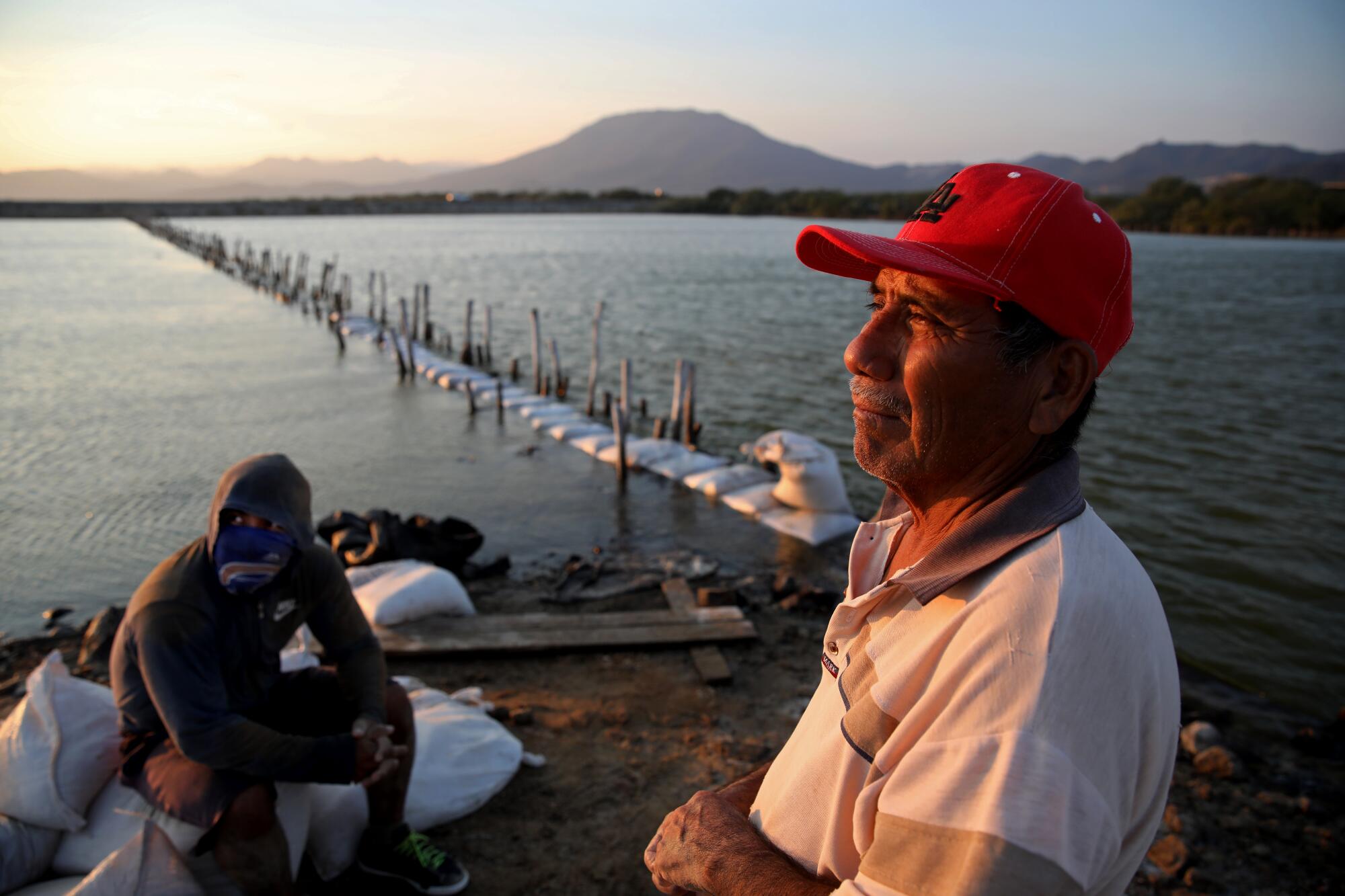
Mateo Martinez Mendoza, 27, prepares salt evaporation ponds in Salinas del Marques, Oaxaca, where he and his father are generational salt field miners. Salt evaporation ponds are artificial basins designed to extract salt from the seawater. (Gary Coronado / Los Angeles Times)
SAYULA DE ALEMAN, Mexico —
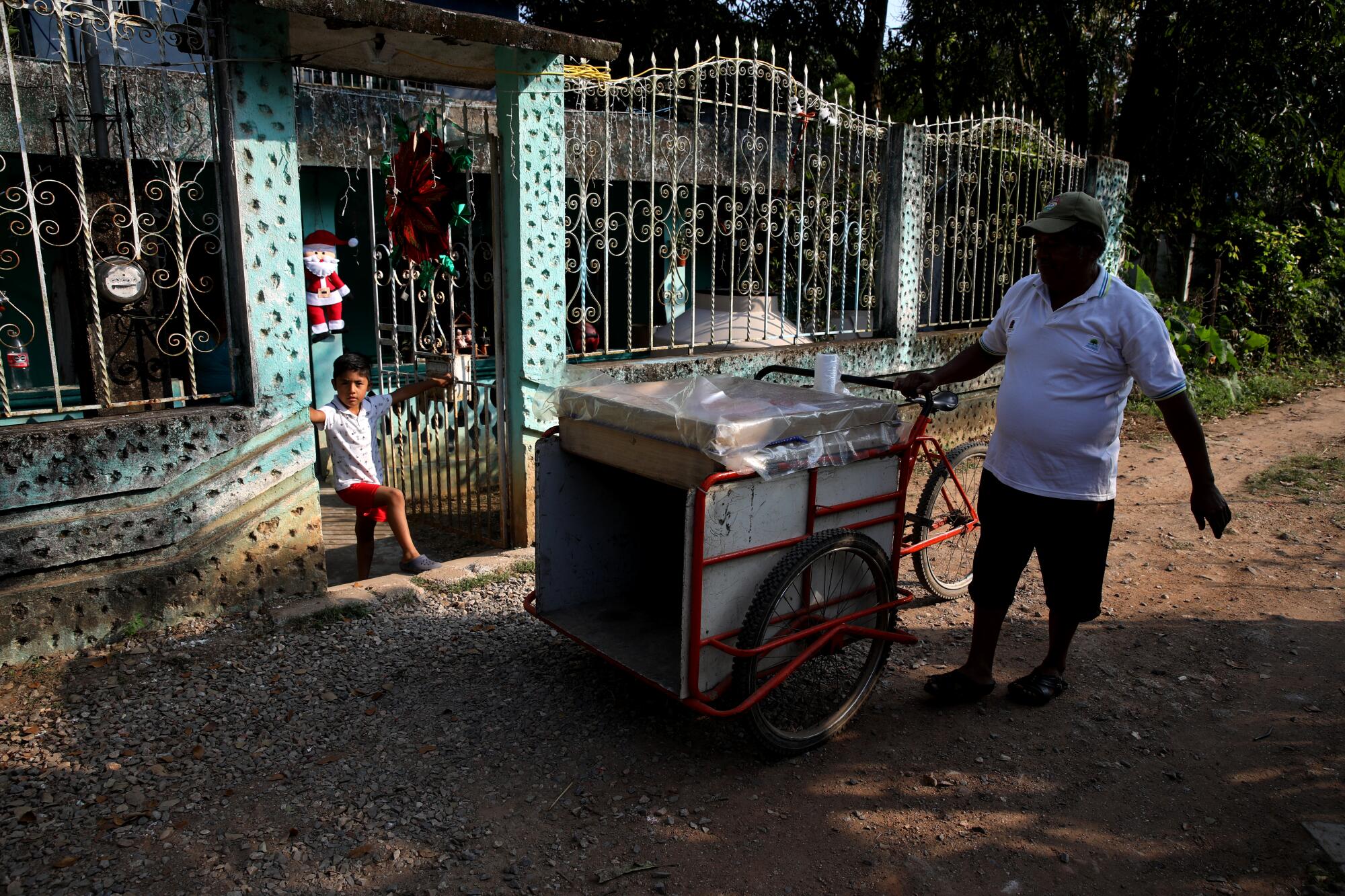
From the roadside stand in this muggy stretch of southern Mexico where Carmelo Morrugares sells coconuts for a living, the 45-year-old father of three says he can see his country changing for the better.
There’s his pay, which has doubled from $5 to $10 daily thanks to a series of minimum-wage hikes. And there are the hefty welfare payments that his elderly father and student daughter now receive from the government.
Then there’s the highway itself, repaved amid a boom of fresh investment across the impoverished south.
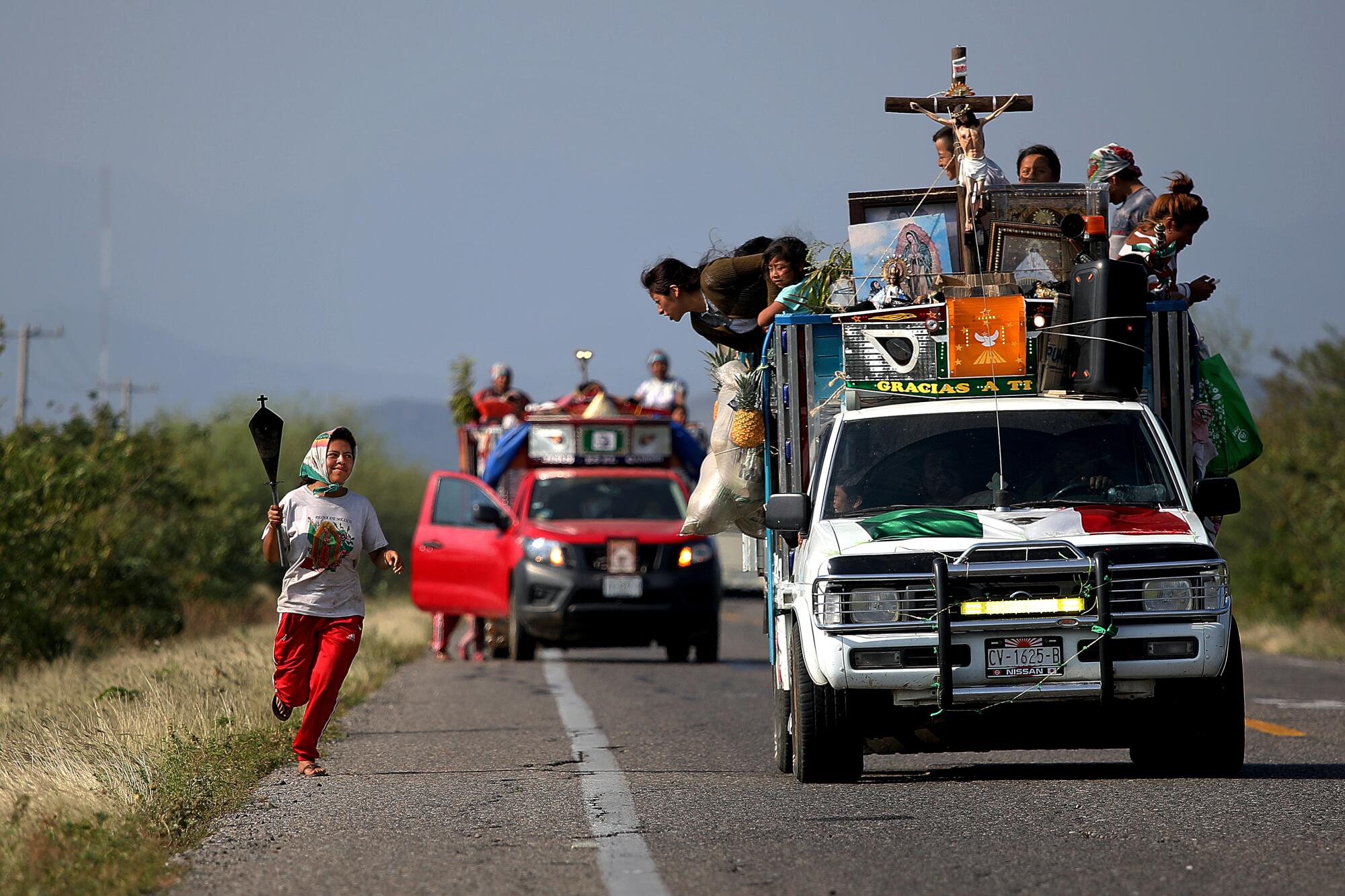
“He’s a visionary,” said Morrugares, who cheered on the president recently as he zipped past the coconut stand on his way to promote a refurbished train line that will pass through this region. That the famously frugal López Obrador traversed the dense tropical forest by car instead of helicopter said it all.
“Presidents before would just fly over,” Morrugares said. “We’ve never had a leader so close to the people.”
That sort of praise isn’t something you hear much in Mexico’s wealthier enclaves, where criticism of López Obrador has reached a fever pitch. Detractors, tens of thousands of whom marched in Mexico City last month, hate everything about the president: his moralizing tone and his ill-fitting suits, his disregard for democratic norms and his embrace of the military, his hypersensitivity to critique and his insistence that every problem can be blamed on a single enemy — the rich.
But as they pen newspaper columns and fire off tweets insisting that Mexico has never been worse off, his critics are speaking largely to themselves.
López Obrador is one of the most popular leaders on Earth.
He won in a landslide four years ago vowing to finally put the “poor first” in a country that he said had been hijacked by a corrupt and conservative elite. And despite a stagnating economy, staggering levels of violence and growing evidence that his efforts to reduce inequality have failed, his approval rating still tops 60%.
To better grasp the breadth of that support, The Times traveled this month across the Isthmus of Tehuantepec, a 140-mile wide strip of land that spans two states — Veracruz and Oaxaca — and stretches from the Pacific Ocean to the Gulf of Mexico.
Here in the hinterlands, far from cosmopolitan Mexico City and the thriving industrial hubs in the north, it quickly becomes clear why AMLO, as he is widely known, is so beloved.
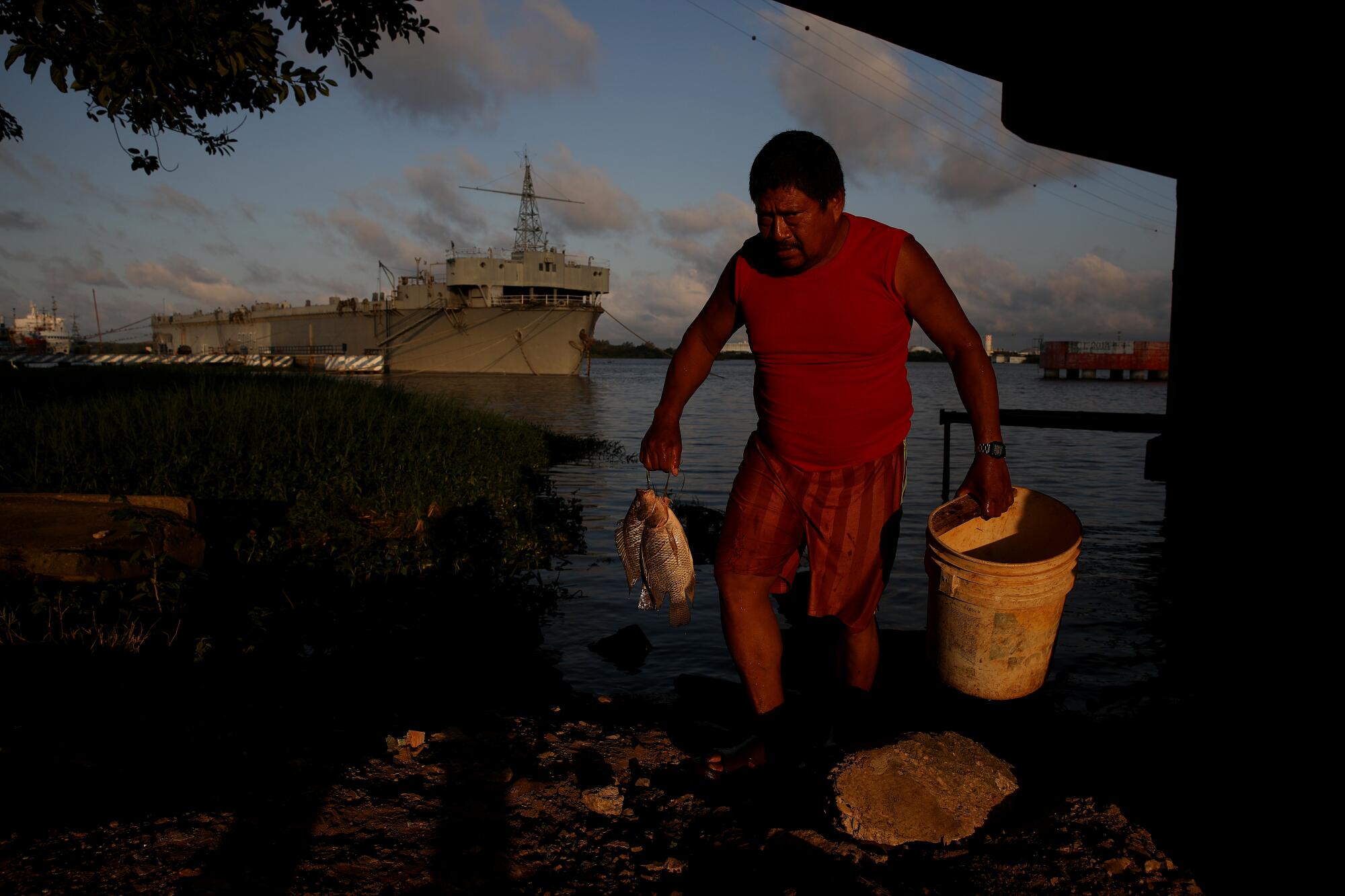
As the sun sank over the Pacific near the Oaxacan port city of Salina Cruz, 63-year-old Carlos Estrada hurried to finish work in the salt mine where he has labored since he was 15.
Wearing a brace to support his back, he heaved 110-pound bags of dirt onto the shoulders of his son, who was building a shallow basin used to isolate salt from seawater.
Estrada always assumed he would work until he died, like his father and grandfather before him. As one of almost 60% of Mexicans toiling in the informal economy, he is not eligible for a pension.
But López Obrador has vastly expanded the nation’s welfare system, giving cash transfers to 10 million older Mexicans along with millions of students, young workers and people with disabilities.
When Estrada turns 65, he’ll receive $300 every two months, enough to allow him to retire. “If God wills it and I’m still alive then, I will really enjoy it,” he said.
If there is one López Obrador policy that has pumped up his popularity, it is these direct payments. In Oaxaca, nearly every household is benefiting from at least one of the entitlement programs.
At the same time, electric bills and gas prices have fallen here in the south thanks to new government subsidies.
The president’s critics write-off such programs as a cynical play for votes. Many economists say inequality hasn’t improved, in part because López Obrador has cut other anti-poverty initiatives.
But Estrada says he can see a difference.
He and his family used to eat meat only once every two months. Now, they eat it every two weeks.
“The president,” Estrada said, “is really good people.”
Out on the water, hulking oil tankers bobbed on the waves in the fading light — another reason that López Obrador is appreciated here.
State oil producer Petroleos Mexicanos, long one of the only sources of decent jobs in the south, has struggled for decades and until recently seemed on the verge of collapse as the energy sector began to open to foreign investment and renewable sources like wind and solar.
Rejecting those reforms, the president has funneled billions into Pemex, keeping it on life support even as its production of crude has plummeted and it has become the most indebted oil producer in the world.
Environmental activists have decried his embrace of fossil fuels, including the construction of a $12-billion oil refinery in nearby Tabasco. Top U.S. and Canadian officials say his nationalist policies violate regional free trade agreements.
The thousands of Pemex employees who work in and around Salina Cruz have a different view.
“If Pemex disappeared, it would turn this into a city of slaves where everybody makes minimum wage,” said Teresa Marin, 60, who retired from the company five years ago with a pension that has afforded her a middle-class life: a silver SUV, lunch dates with friends, and even a recent vacation to Colombia.
She greeted López Obrador with a homemade poster the last time he came to town. She was struck by his humility when he stopped on the side of the road for a snack of gorditas and atole, a traditional corn drink.
While previous leaders resided in Mexico’s elegant presidential palace and traveled the world on private jets, López Obrador lives in a small apartment inside his downtown office and flies commercial — always in coach. He speaks directly to the nation for two hours at a televised news conference each weekday morning, expounding on history and world events, ranting against his “racist and classist” political opponents and otherwise setting the agenda for the day.
It doesn’t hurt that he was born in a dusty village in the nearby state of Tabasco, and that his father was an oil worker, Marin said.
“He’s not an elite,” she said. “We can identify with him.”
Twelve miles inland, on the outskirts of a town called Santo Domingo Tehuantepec, another signature López Obrador project is taking shape.
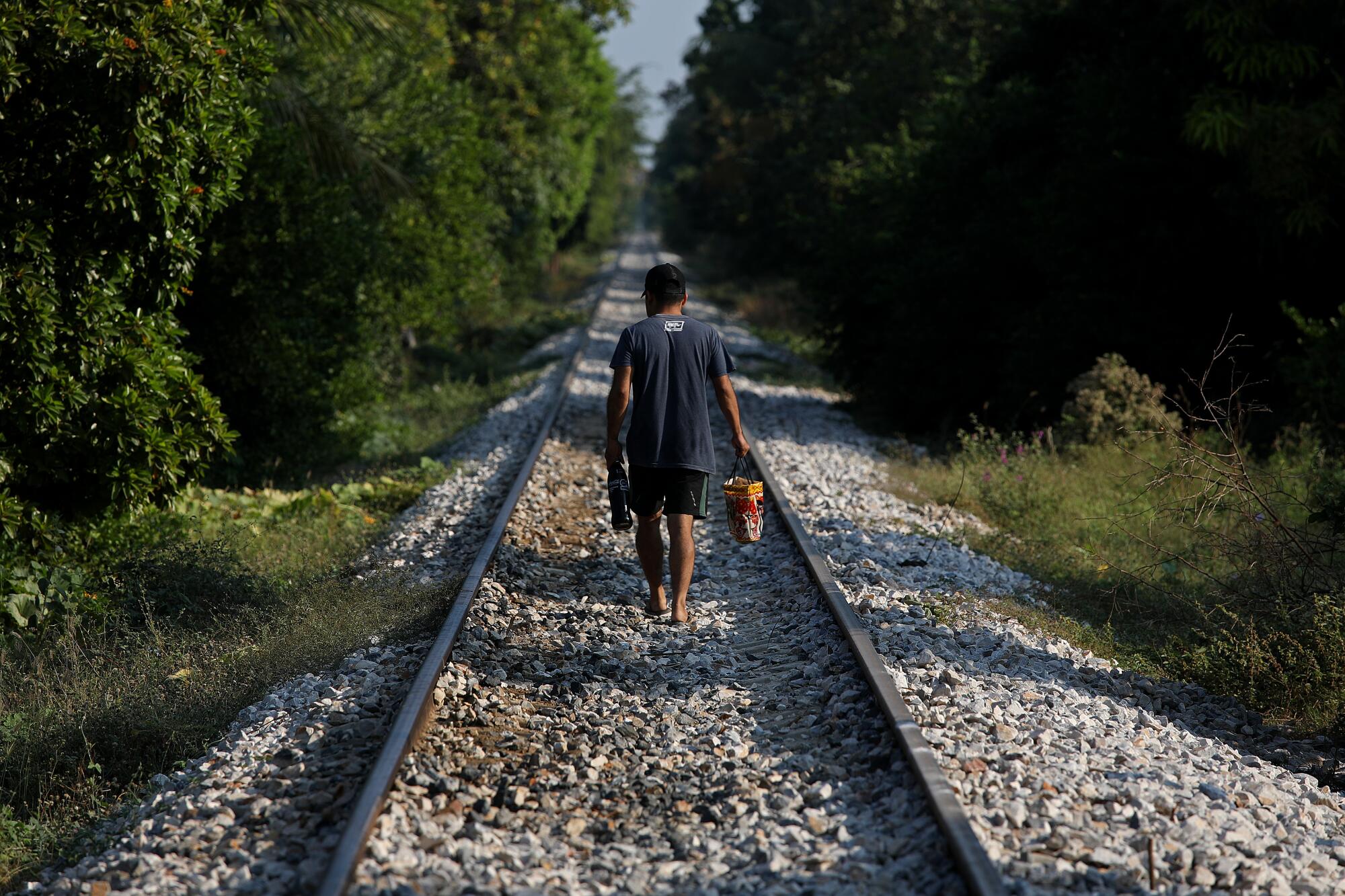
On a recent morning, workers were laying fresh tracks on the train route that will cross the isthmus, carrying cargo from the Pacific to the Gulf. Officials are planning several industrial parks along the route in hopes of making the isthmus an alternative to the Panama Canal.
Like another project López Obrador has launched in the south, a tourist train through the Yucatan peninsula, this one has been plagued by concerns about graft and environmental destruction and has angered homeowners who are being forced to relocate.
But for Heriberta Sosa, a 44-year-old who runs a small paper store near the tracks, the relocation of some of her neighbors is worth it to bring an engine of development that might allow her children to stay in Oaxaca instead of seeking work elsewhere. She and her husband spent years being paid under the table in factories and restaurants in South Carolina to save enough money to open a business here.
“This is going to benefit the whole isthmus,” she said. “Some of us are going to have to pay.”
On a windswept hill 80 miles north, 77-year-old Maurilio Galeana Alejo stood quietly before his son Amadeo’s grave.
Amadeo left this village, Boca del Monte, in the 1990s.
The North American Free Trade Agreement had just taken effect, eliminating most tariffs across the continent and bringing hundreds of new factories to central and northern Mexico.
The ranks of Mexican billionaires expanded rapidly. But for small farmers like Galeana, the trade deal was devastating. How could his homegrown corn compete with imports from U.S. agribusinesses, many of which received subsidies from the U.S. government?
“There was nothing to eat here,” Galeana said. So at 15 his son migrated to the United States.
Amadeo returned nearly three decades later in a casket. He had died of cancer while working in Wisconsin.
Galeana was angry that he had missed knowing his son as an adult. He was angry about generations of Mexican leaders that he said had “screwed over” the rural poor.
As a rule, he was suspicious of politicians, but López Obrador, he said grudgingly, seemed different.
“Neo-liberalism failed,” the president has repeatedly declared, a not so contentious conclusion in a country where people work longer hours than almost anywhere in the world yet 40% can’t afford basic food.
While López Obrador has continued many of the same free-market policies of his predecessors, he has also focused new programs in the regions that he says were most left behind globalization. “We’re doing justice for south and southeast Mexico,” he says.
Some of his programs are aimed specifically at people like Galeana, including one called Sembrando Vida that pays farmers to plant trees.
It has been mired in scandal, with environmentalists claiming that it is in fact fueling deforestation because farmers must have cleared plots of land to be eligible to join. Still, Galeana sees it as a positive sign.
“We’re less screwed up than we were before,” he said as he cleared off the headstone ahead of a ceremony to commemorate the anniversary of his son’s death. “This government is giving us more.”
As the highway winds into Veracruz state, the dry hills of Oaxaca give way to dense forest. The Gulf lies ahead.
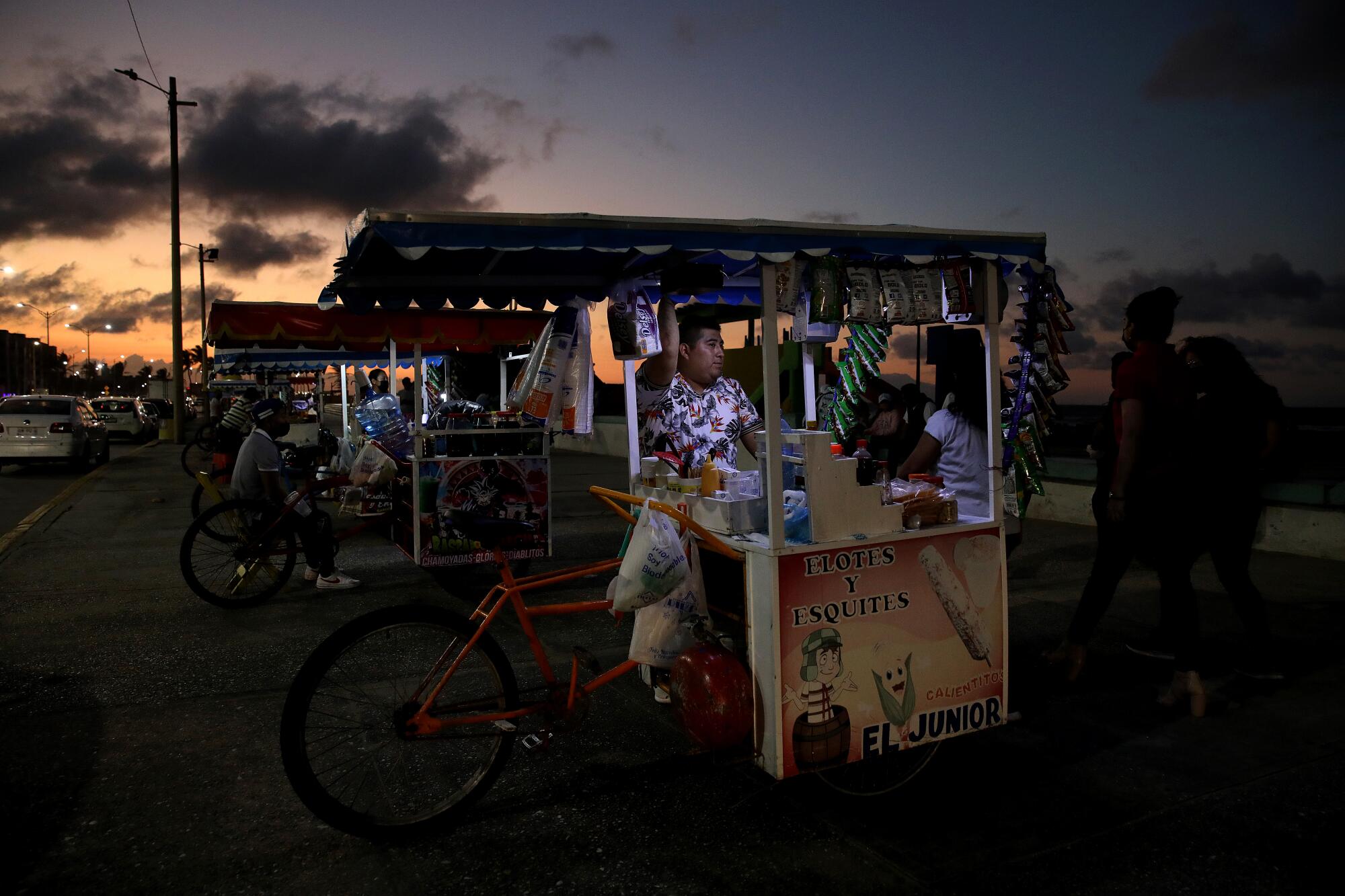
In the city of Coatzacoalcos, the malecon that stretches along the water used to be filled with bars and nightlife, the beaches crowded with tourists. But the economy shriveled as cartels took over and gang violence — including a 2019 arson attack that killed 31 people in a club — scared away visitors. Much of the malecon is abandoned now except for squatters and stray dogs.
Much of the country is in a similar purgatory — strangled by criminal groups that are often interlocked with local politics and demand extortion payments from local businesses.
López Obrador promised to bring peace to Mexico. His main strategy to reduce violence — doubling the number of federal troops deployed across the country — has had little impact here. Coatzacoalcos remains one of Mexico’s deadliest cities.
Polls show that most Mexicans are very worried about the violence. They are also concerned about the economy, which was battered by the COVID pandemic and has been slow to recover. Economists say that López Obrador deserves part of the blame because — apart from his pet projects — he has embraced a policy of austerity.
Yet there he is, his silver hair, tanned skin and white smile emblazoned everywhere across this region, on billboards, murals and posters hung proudly outside of homes.
Jeremy Morales, 21, and Enrique Castañeda, 22, debated why on a recent afternoon as they strolled along the mostly deserted beach on a break in between exams at a nearby university.
“It’s the money,” said Castañeda. “Everybody knows somebody who has been helped.”
“But that’s not the way to move the country forward,” Morales said. “You won’t get rid of poverty by just giving away cash.”
“At least he’s not stealing it,” Castañeda said. “We’re so used to leaders who are so bad.”
“It’s true,” Morales said, laughing. He paused. “I guess it doesn’t take much to make us thankful.”
Cecilia Sanchez in The Times’ Mexico City bureau contributed to this report.
McCarthy’s race for speaker risks upending House on Day One
Lisa Mascaro – December 17, 2022
House Minority Leader Kevin McCarthy, R-Calif., walks to the chamber for final votes as the House wraps up its work for the week, at the Capitol in Washington, Dec. 2, 2022. (AP Photo/J. Scott Applewhite, File)Nancy Pelosi of California takes the gavel from House Minority Leader Kevin McCarthy, R-Calif., after being elected House Speaker at the Capitol in Washington, Jan. 3, 2019. (AP Photo/Carolyn Kaster, File)
WASHINGTON (AP) — In his quest to rise to House speaker, Kevin McCarthy is charging straight into history — potentially becoming the first nominee in 100 years unable to win the job on a first-round floor vote.
The increasingly real prospect of a messy floor fight over the speaker’s gavel on Day One of the new Congress on Jan. 3 is worrying House Republicans, who are bracing for the spectacle. They have been meeting endlessly in private at the Capitol trying to resolve the standoff.
Taking hold of a perilously slim 222-seat Republican majority in the 435-member House and facing handful of defectors, McCarthy is working furiously to reach the 218-vote threshold typically needed to become speaker.
“The fear is, that if we stumble out of the gate,” said Rep. Jim Banks, R-Ind., a McCarthy ally, then the voters who sent the Republicans to Washington “will revolt over that and they will feel let down.”
Not since the disputed election of 1923 has a candidate for House speaker faced the public scrutiny of convening a new session of Congress only to have it descend into political chaos, with one vote after another, until a new speaker is chosen. At that time, it eventually took a grueling nine ballots to secure the gavel.
McCarthy, a Republican from Bakersfield, California, who was first elected in 2006 and who remains allied with Donald Trump, has signaled he is willing to go as long as it takes in a floor vote to secure the speaker’s job he has wanted for years. The former president has endorsed McCarthy, and is said to be making calls on McCarthy’s behalf. McCarthy has given no indication he would step aside, as he did in 2015 when it was clear he did not have the support.
But McCarthy also is acknowledging the holdouts won’t budge. “It’s all in jeopardy,” McCarthy said Friday in an interview with conservative Hugh Hewitt.
The dilemma reflects not just McCarthy’s uncertain stature among his peers, but also the shifting political norms in Congress as party leaders who once wielded immense power — the names of Cannon, Rayburn and now Pelosi adorn House meeting rooms and office buildings — are seeing it slip away in the 21st century.
Rank-and-file lawmakers have become political stars on their own terms, able to shape their brands on social media and raise their own money for campaigns. House members are less reliant than they once were on the party leaders to dole out favors in exchange for support.
The test for McCarthy, if he is able to shore up the votes on Jan. 3 or in the days that follow, will be whether he emerges a weakened speaker, forced to pay an enormous price for the gavel, or whether the potentially brutal power struggle emboldens his new leadership.
“Does he want to go down as the first speaker candidate in 100 years to go to the floor and have to essentially, you know, give up?” said Jeffrey A. Jenkins, a professor at the University of Southern California and co-author of “Fighting for the Speakership.”
“But if he pulls this rabbit out of the hat, you know, maybe he actually has more of the right stuff.”
Republicans met in private this past week for another lengthy session as McCarthy’s detractors, largely a handful of conservative stalwarts from the Freedom Caucus, demand changes to House rules that would diminish the power of the speaker’s office.
The Freedom Caucus members and others want assurances they will be able to help draft legislation from the ground up and have opportunities to amend bills during the floor debates. They want enforcement of the 72-hour rule that requires bills to be presented for review before voting.
Outgoing Speaker Nancy Pelosi, D-Calif., and the past two Republican speakers, John Boehner and Paul Ryan, faced similar challenges, but they were able to rely on the currency of their position to hand out favors, negotiate deals and otherwise win over opponents to keep them in line — for a time. Boehner and Ryan ended up retiring early.
But the central demand by McCarthy’s opponents’ could go too far: They want to reinstate a House rule that allows any single lawmaker to file a motion to “vacate the chair,” essentially allowing a floor vote to boot the speaker from office.
The early leaders of the Freedom Caucus, under Mark Meadows, the former North Carolina congressman turned Trump’s chief of staff, wielded the little-used procedure as a threat over Boehner, and later, over Ryan.
It wasn’t until Pelosi seized the gavel the second time, in 2019, that House Democrats voted to do away with the rule and require a majority vote of the caucus to mount a floor vote challenge to the speaker.
Rep. Chip Roy, R-Texas, said the 200-year-old rule was good enough for Thomas Jefferson, so it’s one he would like to see in place.
“We’re still a long way from fixing this institution the way it needs to be fixed,” Roy told reporters Thursday at the Capitol.
What’s unclear for McCarthy is even if he gives in to the various demands being made by the conservatives, whether that will be enough for them drop their opposition to his leadership.
Several House Republicans said they do not believe McCarthy will ever be able to overcome the detractors.
“I don’t believe he’s going to get to 218 votes,” said Rep. Bob Good, R-Va., among the holdouts. “And so I look forward to when that recognition sets in and, for the good of the country, for the good of the Congress, he steps aside, and we can consider other candidates.”
The opposition to McCarthy has promoted a counteroffensive from other groups of House Republicans who are becoming more vocal in their support of the GOP leader — and more concerned about the fallout if the start of the new Congress descends into an internal party fight.
Rep. David Joyce, R-Ohio, who leads the Republican Governance Group, was wearing an “O.K.” button on his lapel — meaning, “Only Kevin,” he explained.
Some have suggested that the opponents to McCarthy could simply vote “present,” lowering the threshold for reaching a majority — a tactic Pelosi and Boehner both used to win with fewer than 218 votes.
While some have suggested threatening the detractors with removal from their committee assignments or other retribution, Rep. Dusty Johnson, R-S.D., a leader of another conservative governance caucus, said: “Anybody who thinks that the holdouts are going to be bullied into compliance doesn’t understand how this town works.”
Retiring Rep. Fred Upton, R-Mich., who recalled that then-Republican Speaker Newt Gingrich of Georgia dropped out of the race in 1998 when he didn’t have the votes, cautioned McCarthy against backing down.
“My advice to Kevin is, you got to go to the finish line,” Upton said. “You can’t fold the cards. You got to make these folks vote — and vote.”
Russia is destroying Ukraine’s economy, raising costs for U.S. and allies
Jeff Stein and David L. Stern, The Washington Post – December 15, 2022
KYIV, Ukraine – Two months of relentless missile and drone attacks by Russia have decimated Ukraine’s critical infrastructure and blown a hole in projections for the country’s war-ravaged economy.
Before those strikes, Kyiv expected to need at least $55 billion in foreign assistance next year to meet basic expenses – more than the country’s entire annual prewar spending.
Now, with its energy systems severely battered, and more Russian attacks likely, some officials believe Ukraine could end up needing another $2 billion a month, and political leaders have begun trying to brace Western supporters for such worst-case scenarios.
“What do you do when you can’t heat your house, you can’t run your shops, factories or plants, and your economy is not working?” said Oleg Ustenko, an economic adviser to President Volodymyr Zelensky. “We are going to be requiring more financial assistance, and Putin is doing this to destroy unity among allies.”
At a closed-door meeting last week at the National Bank of Ukraine, which now has a military checkpoint just outside its headquarters, central bank officials pondered what might happen if Russia’s attacks intensify. People could flee Ukraine in droves, taking their money with them, potentially crashing the national currency as they seek to exchange their Ukrainian hryvnia for euros or dollars.
The Ukrainian government could be left without international reserves to pay for critical imports and unable to meet its foreign debt obligations – a doomsday scenario known as a balance-of-payments crisis.
One dire scenario predicted that Ukraine’s economy could contract by another 5 percent next year, on top of the 33 percent contraction this year, according to a person familiar with the bankers’ report who spoke on the condition of anonymity because it was not public.
Ukrainian Prime Minister Denys Shmyhal, at an international donor conference in Paris on Tuesday, said the contraction next year could reach 9 percent depending on the severity of continued Russian attacks.
As Russian President Vladimir Putin persists with his 10-month-old war, Ukraine’s survival hinges as much on outside economic aid as on donated weapons, and Putin now seems intent on making such help so costly that Kyiv’s Western backers give up.
Before the infrastructure attacks began on Oct. 10, Ukrainian officials were optimistic that Western financial aid would allow them to close most, if not all, of their enormous budget gap in 2023.
The European Union and United States collectively have pledged to send more than $30 billion to Ukraine next year, though not all of that money is formally approved. On Thursday, the E.U.’s 27 heads of state and government, meeting in Brussels, agreed to provide 18 billion euros, or just over $19 billion, in loans to Ukraine next year.
Some aid promised for this year was slow to materialize, forcing Kyiv to print money and devalue its currency to ensure its economy remained competitive, contributing to a spike in inflation of more than 20 percent.
But this help, even if it does come through, is intended only to keep the country afloat day-to-day. It doesn’t remotely begin to address the hundreds of billions in damage wrought by the war.
Russia’s invasion has destroyed hospitals, ports, fields, bridges and other parts of the country’s critical infrastructure. Agricultural exports have been decimated, despite an international accord to maintain some grain shipments. Huge swaths of Ukrainian industry are now in occupied territory. As much as one-third of the country’s forests have been destroyed.
In September, United Nations officials estimated that nearly 18 million Ukrainians needed humanitarian aid. With the country on the brink of a financial cliff, some advisers to Zelensky in recent weeks weighed asking Western governments to finance direct cash payments to Ukrainian citizens, according to two people familiar with the internal talks.
Now, with energy systems decimated, Kyiv and its partners face a head-splitting challenge. Key pillars of the economy – coal mining, industrial manufacturing, information technology – cannot function without electricity or internet service. The World Bank has warned that poverty could explode tenfold. Unemployment, already close to 30 percent, is likely to climb further.
“In case of full blackouts for longer periods, we will definitely need to get more resources to avoid humanitarian catastrophe,” Sergiy Nikolaychuk, Ukraine’s deputy central bank governor, who attended last week’s meeting, said in an interview.
The dire assessments reflect something Ukrainian officials and their Western supporters do not like to admit aloud: The Kremlin has made Ukraine’s economy a pivotal theater of the war – one in which Moscow is arguably having far more success than on the front lines, where its troops have struggled.
“How does an economy function at all – while supporting the war effort – with this level of damage to civilian infrastructure? I don’t think we’ve ever seen this,” said Simon Johnson, an economist at MIT who is in communication with Ukrainian officials. “I can’t think of any economy that’s ever tried to do this.”
Blackouts take up roughly half the workday. Valentyn Nyzkovolosov, co-owner of the Salt and Pepper catering service in Kyiv, and his partner, Andrii Boyarskyy, have their staff arrive at 5 a.m. – as early as possible under the wartime curfew in Kyiv. When the power goes out after sunset – before 4 p.m. these days – employees work with flashlights.
When Washington Post journalists arrived at Nyzkovolosov’s business recently, there was no electricity. Moments later, air raid sirens sounded and Salt and Pepper’s staff descended into a cramped cellar that serves as a bomb shelter. “This is the best example of the conditions that we work under,” Nyzkovolosov said. During a previous alert, a few weeks earlier, explosions were heard nearby, employees said.
Ukrainians are adamant that Russia’s missile attacks will not break their fighting spirit. But businesses and workers are struggling to adapt. For many, it is impossible to function without electricity.
Mining and manufacturing – which make up roughly one-fifth of Ukraine’s economy – are among the hardest-hit sectors. Two of the country’s biggest steel plants, located in the industrial southeast, shut down last month because of blackouts. Dozens of coal miners had to be rescued after a power failure trapped them underground.
“For large industrial and metallurgical plants, these blackouts are very dangerous,” said Dennis Sakva, an energy analyst at Dragon Capital, a Ukrainian investment firm, which recently downgraded its economic forecast for 2023 to a 6 percent contraction in economic output from 5 percent growth.
“If you’re in the middle of a technical complicated process with high temperatures and have a power outage, it can cause all sorts of problems,” Sakya said.
Ongoing internet outages could also wreak financial havoc. Information technology, for example, has emerged as a pillar of Ukraine’s economy, and was the only sector to have grown over the past year, said Mykhailo Fedorov, a vice prime minister who oversees digital transformation.
Yet due mainly to the recent attacks, the internet connectivity rate is down to 35 percent of its prewar level. Ukrainians are importing Starlink terminals for internet via satellite, but there are unlikely to be enough to manage widespread outages. And the internet disruptions impair not just the IT sector but basic public and private financial services, such as pension payments, mobile banking, tax collection and digital sales.
The biggest economic threat, however, is not a loss of connectivity but a loss of people. A lack of heat and water service during winter could set off a mass population exodus. Kyiv has already warned residents to be prepared to leave if its heat goes offline amid freezing temperatures. In that scenario, the city would have no choice but to cut off water to prevent pipes from freezing and rupturing.
In the southern cities of Mykolaiv and Kherson, authorities are urging citizens to evacuate, warning of a lack of critical services during winter. European countries are already sheltering millions of war refugees, and experts warn of a new crisis.
“You need to have a place to evacuate so many people,” Sakva, the Dragon analyst, said. “When the number of affected residents is in millions or the tens of millions, that’s a very hard question. I’m not sure anyone has a clear answer to it.”
Ukrainian Finance Minister Sergii Marchenko was already in the midst of asking Treasury Secretary Janet L. Yellen for billions in aid when he first alerted her to Russia’s bombing of infrastructure.
At the time, on Oct. 16, it appeared that the United States and Europe could help stave off an economic disaster in Ukraine. The Biden administration was helping to close a significant portion of Ukraine’s budget deficit. The E.U., while behind on pledges, was also providing aid.
Dominated by oligarchs and perennially in need of bailouts, Ukraine was a financial mess long before Russia’s invasion. Full-blown war sent its economy into a tailspin.
After Ukraine halted Russia’s assault on Kyiv last spring, the immediate emergency stabilized. By summer, Western officials had even started talking about forcing Russia to pay for postwar reconstruction, which the World Bank estimated would cost $350 billion. Ukrainian officials talked up a modern-day “Marshall Plan” that would also forge closer economic ties to the West.
When he met Yellen in October, Marchenko warned that the energy attacks could unravel previous calculations, but he had no idea how bad things would get. “Even at that week, we couldn’t estimate how far Russia could reach to destroy our energy infrastructure,” Marchenko recalled in an interview at the Finance Ministry on Monday, shortly after he and his team took cover in a parking lot amid another air raid siren.
The Zelensky and Biden administrations were already on edge about the rhetoric from U.S. Republicans who won a slim majority in the House, including the potential future speaker, Kevin McCarthy (R-Calif.), who warned that there would be no “blank check” for Ukraine.
As the humanitarian needs grow, Ukrainian economic officials have sounded out Western officials about the potential for an income support program to provide roughly $50 per person per month – at a cost of $12 billion over six months, one person familiar with the matter said.
They found a cool reception, however, from Western officials who were already wary of appearing to support too much aid for Ukraine, the person said.
After the energy attacks, some experts argue the West may be doing too little, not too much.
“We’re already giving them just enough to avoid hyperinflation,” said Jacob Kirkegaard, a senior fellow at the German Marshall Fund of the United States. “But there’s clearly a risk of a more serious economic contraction, and the only way to stop that will be to provide more financial assistance.” But, Kierkegaard added, “I don’t know if the will is there.”
Russia launches another major missile attack on Ukraine
Hanna Arhirova, Vasilisa Stepanenko, Jamey Keaten – December 16, 2022
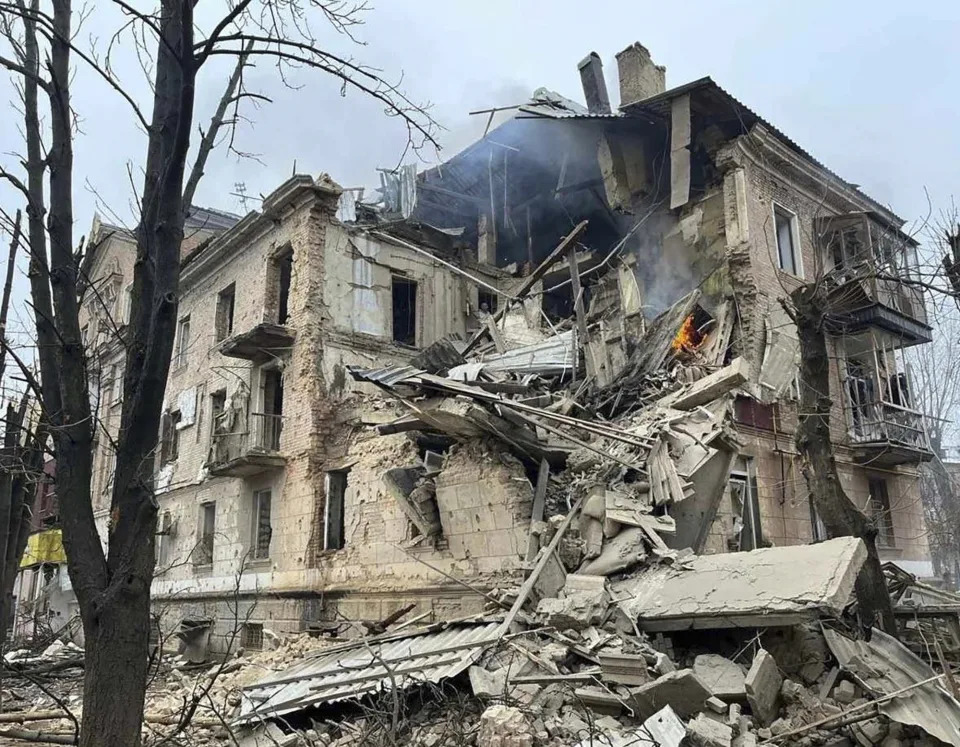
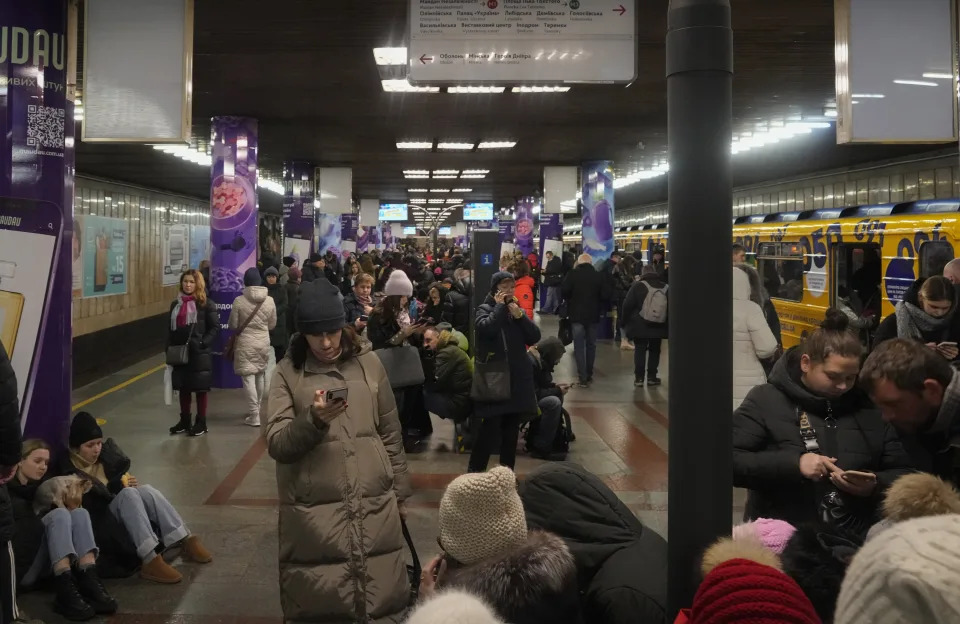
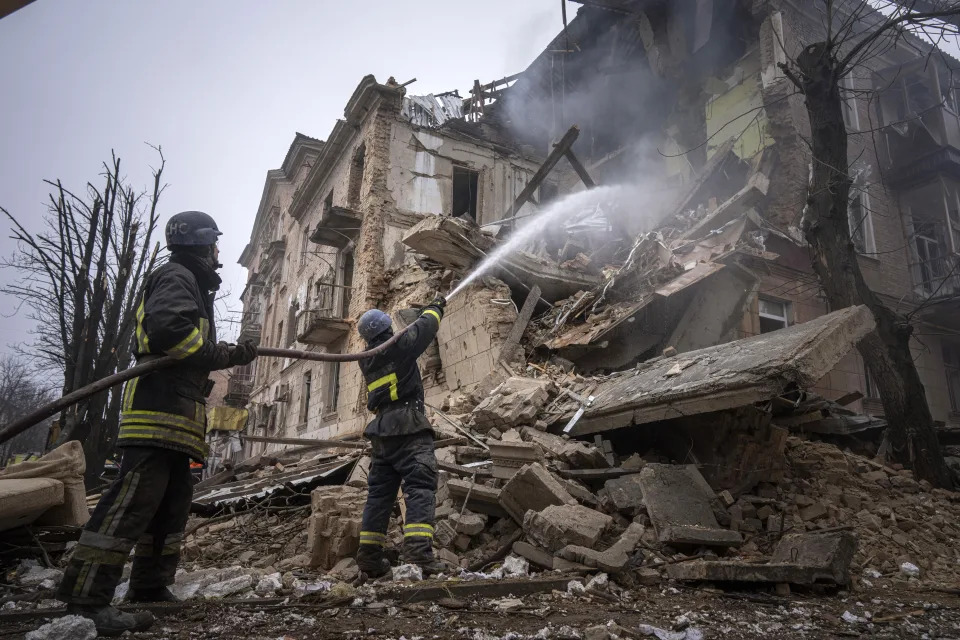
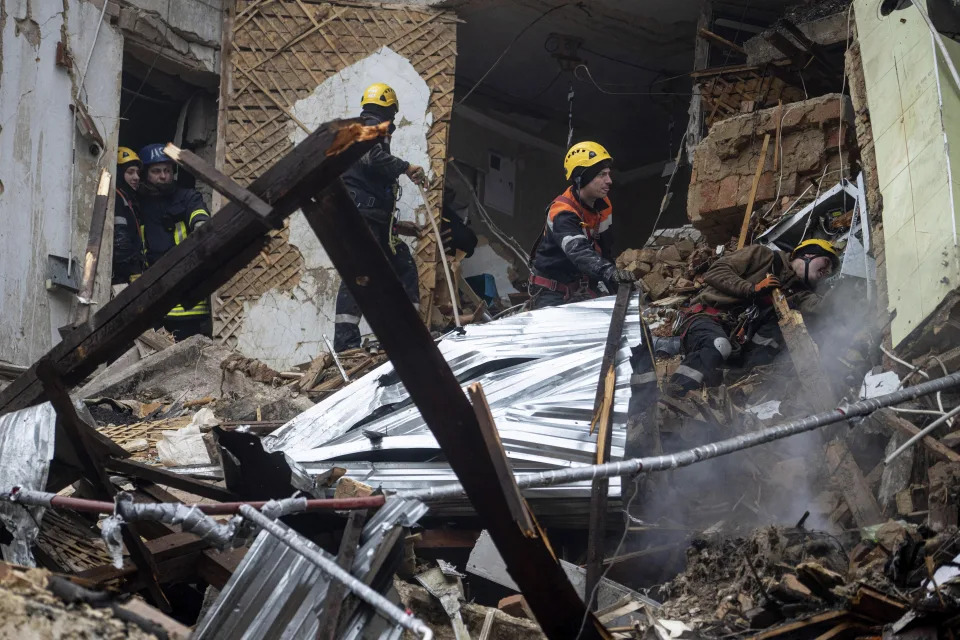
A woman cries in front of the building which was destroyed by a Russian attack in Kryvyi Rih, Ukraine, Friday, Dec. 16, 2022. Russian forces launched at least 60 missiles across Ukraine on Friday, officials said, reporting explosions in at least four cities, including Kyiv. At least two people were killed by a strike on a residential building in central Ukraine, where a hunt was on for survivors. (AP Photo/Evgeniy MaloletkaDebris of an apartment building damaged in a Russian rocket attack in Kryvyi Rih, Ukraine, Friday, Dec. 16, 2022. Russian forces launched at least 60 missile strikes across Ukraine on Friday, officials said, reporting explosions in at least four cities. At least two people were killed when a residential building was hit in central Ukraine, while electricity and water services were interrupted in the two largest cities, Kyiv and Kharkiv. (Ukrainian Emergency Service via AP Photo) People rest in the subway station, being used as a bomb shelter during a rocket attack in Kyiv, Ukraine, Friday, Dec. 16, 2022. Ukrainian authorities reported explosions in at least three cities Friday, saying Russia has launched a major missile attack on energy facilities and infrastructure. Kyiv Mayor Vitali Klitschko reported explosions in at least four districts, urging residents to go to shelters. (AP Photo/Efrem Lukatsky)Ukrainian State Emergency Service firefighters work to extinguish a fire at the building which was destroyed by a Russian attack in Kryvyi Rih, Ukraine, Friday, Dec. 16, 2022. Russian forces launched at least 60 missiles across Ukraine on Friday, officials said, reporting explosions in at least four cities, including Kyiv. At least two people were killed by a strike on a residential building in central Ukraine, where a hunt was on for survivors. (AP Photo/Evgeniy Maloletka)Ukrainian State Emergency Service firefighters work at the building which was destroyed by a Russian attack in Kryvyi Rih, Ukraine, Friday, Dec. 16, 2022. Russian forces launched at least 60 missiles across Ukraine on Friday, officials said, reporting explosions in at least four cities, including Kyiv. At least two people were killed by a strike on a residential building in central Ukraine, where a hunt was on for survivors. (AP Photo/Evgeniy Maloletka)
KYIV, Ukraine (AP) — Ukraine’s capital came under one of the biggest attacks of the war on Friday as Russia’s invading forces fired dozens of missiles across the country, triggering widespread power outages, Ukrainian officials said.
Gunfire from air defense systems and thudding explosions combined with the wail of air-raid sirens as the barrage targeted critical infrastructure in cities including Kyiv, Kharkiv, Kryvyi Rih and Zaporhizhzhia. The head of the Ukrainian armed forces said they intercepted 60 of 76 missiles launched.
“My beautiful sunshine. What am I going to do without you?” wailed Svytlana Andreychuk in the arms of Red Cross staffers. Her sister Olha was one of three people killed when a missile slammed into a four-story apartment building in Kryvyi Rih.
“She was so cheerful in life. She was a beauty. She helped everybody. She gave advice to everybody. How I love you so,” said Andreychuk.
In Kyiv, city council member Ksenia Semenova said 60% of residents were without power Friday evening, and 70% without water. The subway system was out of service and unlikely to be back in operation Saturday, she said.
Russian strikes on electricity and water systems have occurred intermittently since mid-October, increasing the suffering of the population as winter approaches. But the Ukrainian military has reported increasing success in shooting down incoming rockets and explosive drones.
Friday’s attacks took place after the United States this week agreed to give a Patriot missile battery to Ukraine to boost the country’s defense. Russia’s Foreign Ministry warned Thursday that the sophisticated system and any crews accompanying it would be a legitimate target for the Russian military.
The U.S. also pledged last month to send $53 million in energy-related equipment to help Ukraine withstand the attacks on its infrastructure. John Kirby, spokesman for the White House National Security Council, said Friday that the first tranche of that aid had arrived in the country.
More than half the Russian missiles fired Friday targeted Ukraine’s capital. The city administration said Kyiv withstood “one of the biggest rocket attacks” it has faced since Russia invaded Ukraine nearly 10 months ago. Ukrainian air defense shot down 37 of about 40 missiles that entered the city’s airspace, and one person was injured, it said.
Ukraine’s air force said Russian forces fired cruise missiles from the Admiral Makarov frigate in the Black Sea, while Kh-22 cruise missiles were fired from long-range Tu-22M3 bombers over the Sea of Azov, and tactical aircraft-fired guided missiles.
In Kryvyi Rih, President Volodymyr Zelenskyy’s hometown in central Ukraine, the apartment building hit by a missile had a gaping hole in its upper floors. Along with the three people killed, at least 13 were taken to the hospital, said Igor Karelin, deputy head of the city’s emergency services.
Rescue teams with sniffer dogs searched through the debris for a missing mother and her 18-month-old child.
Also at Kryvyi Rih, nearly 600 miners were stuck underground because of the missile strikes, but were later rescued, Mayor Oleksandr Vilkul said on state TV.
He said “several energy infrastructure facilities were completely destroyed.”
State-owned grid operator Ukrenergo wrote on Facebook that Friday’s attack was “the ninth wave of missile strikes on energy facilities,” and because of the repeated damage, “the restoration of power supply may take longer than before.”
Analysts have said Russian strikes targeting energy infrastructure are part of an attempt to freeze Ukrainians into submission after battlefield losses by Russian forces. Experts say that has only strengthened the resolve of Ukrainians to resist Russia’s invasion, while Moscow tries to buy time for a possible offensive in coming months after the current battlefield stalemate.
Kharkiv regional governor Oleh Syniehubov reported three strikes Friday on critical infrastructure in that city, Ukraine’s second-largest. By evening, about 55% of the city had its electricity restored.
The southeastern city of Zaporizhzhia and its surrounding region were hit by 21 rockets, city council secretary Anatoly Kurtev said. There were no initial reports of injuries.
And Kyiv Mayor Vitali Klitschko reported explosions in at least four districts there. Many residents were sheltering deep underground in subway tunnels.
At the site of one attempted strike in Kyiv, military commanders told The Associated Press that the city’s territorial defense mobile group had shot down a cruise missile with a machine gun. It wasn’t immediately clear whether other Ukrainian fire may have contributed to downing the rocket.
“Almost impossible to hit a missile with a machine gun, but it was done,” said a commander who asked to be identified only by the call sign “Hera” for security reasons.
Ukrzaliznytsia, the national railway operator, said power was out in a number of stations in the eastern and central Kharkiv, Kirovohrad, Donetsk and Dnipropetrovsk regions. But trains continued to run after electric power was switched to backup, steam-engine power.
In neighboring Moldova, the state-owned energy company reported disruptions to its electricity network and warned of a “high risk” of power outages. Moldova — whose Soviet-era systems remain interconnected with Ukraine’s — has already suffered two massive blackouts in recent months as Russia attacked Ukraine’s energy grid.
“Grateful for the work of Ukraine’s air defense amid more escalatory Russian attacks this morning on civilian infrastructure in Kyiv and around the country,” the U.S. ambassador in Kyiv, Bridget Brink, wrote on Twitter.
Kyiv warns of long cuts after Russian missiles batter grid
Dmytro Gorshkov – December 16, 2022
A barrage of deadly Russian strikes battered Ukraine’s grid on Friday, worsening dire conditions for Ukrainians across the winter-worn country by knocking out water and electricity services in several regions.
The national energy provider warned Ukrainians already braving near freezing temperatures that it could take longer to restore electricity after dozens of Russian missiles targeted key infrastructure sites in the north, south and centre of the country.
“Priority will be given to critical infrastructure: hospitals, water supply facilities, heat supply facilities, sewage treatment plants,” Ukrenergo said in a statement Friday.
Residents of the capital wrapped in winter coats crammed into underground metro stations after air raid sirens rang out early Friday: the ninth wave of Russian aerial bombardments since October.
“I woke up, I saw a rocket in the sky,” Kyiv resident 25-year-old Lada Korovai said. “I saw it and understood that I have to go to the tube.”
“We live in this situation. It’s a war, it’s real war,” she told AFP.
The onslaught is the latest brought by Russian forces to target what Moscow says are military-linked facilities. The air assaults follow a series of embarrassing battlefield defeats for Russia.
– ‘Biggest’ missile attack of invasion –
Ukraine’s second largest city Kharkiv, near the border with Russia, was left without electricity, its mayor said. Oleg Synegubov, head of Kharkiv’s regional adminstration, said later they planned to have power restored by midnight.
The central cities of Poltava and Kremenchuk were also without power and regional officials in Kryvyi Rig, where Ukraine President Volodymyr Zelensky was born, said the airstrikes had hit a residential building.
“A 64-year-old woman and a young couple died. Their little son still remains under the rubble of the house,” the region’s governor Valentyn Reznichenko said, adding that 13 more were injured.
Oleksandr Starukh, head of the frontline Zaporizhzhia region, which houses Europe’s largest nuclear power plant, said more than a dozen Russian missiles had targeted territory under Ukrainian control.
Kyiv meanwhile “withstood one of the biggest missile attacks since the beginning of the full-scale invasion. About 40 missiles were recorded in the capital’s airspace,” regional authorities said in a statement.
Air-defence forces had shot down 37 of them, they added.
Kyiv Mayor Vitali Klitschko said the water supply had been disrupted and that the metro had stopped running so people could shelter underground.
“Due to damage to the power system and emergency power outages, subway trains will not run until the end of the day today,” city officials later announced.
The Kyiv metro is a vital resource for the capital, which had a pre-war population of three million. It has been used as a city-wide bomb shelter since the Russian invasion.
– ‘Survive winter’ –
About half of Ukraine’s energy grid has been damaged in sustained attacks and the national provider warned Friday of emergency blackouts because of the “massive” wave of Russian attacks.
In Ukrainian-held Bakhmut — an eastern city at the epicentre of the war — some residents received wood stoves distributed by volunteers, AFP journalists said.
Bakhmut resident, 85-year-old Oleksandra was braving the cold to collect medication at a nearby pharmacy in the Donetsk region city.
“I’ll survive winter. I’ll just walk more to get warm,” the old woman told AFP.
In the south, fresh Russian shelling in Kherson, recently recaptured by Ukraine, killed one person and wounded three more.
Kherson has been subjected to persistent Russian shelling since Moscow’s forces retreated in November and power was cut in the city earlier this week.
The UN humanitarian coordinator for Ukraine, Denise Brown, said a woman working as a paramedic for the Ukrainian Red Cross had been killed by Thursday’s strikes on Kherson.
Russian attacks overall killed 14 on Thursday, the deputy head of the Ukrainian presidency Kyrylo Tymoshenko said.
In the Russian-controlled region of Lugansk in eastern Ukraine, Moscow-installed officials said shelling from Kyiv’s forces had killed eight and wounded 23.
– Putin to visit Belarus –
“The enemy is conducting barbaric shelling of cities and districts of the republic,” the Russian-installed leader of Lugansk Leonid Pasechnik said on social media.
Moscow has said the strikes on Ukrainian infrastructure are a response to an explosion on the Kerch bridge connecting the Russian mainland to the Crimean peninsula annexed by Moscow in 2014.
The Kremlin has said it holds Kyiv ultimately responsible for the humanitarian impact of the strikes for refusing to capitulate to Russian negotiation terms.
But Ukrainian defence officials said this week that its forces had shot down a swarm of more than a dozen Iranian-made attack drones launched at Kyiv, a sign that Western-supplied systems are having an impact.
Separately on Friday, Russian President Vladimir Putin announced he will visit Belarus next week for talks with his counterpart and ally Alexander Lukashenko.
Minsk said the pair would hold one-on-one talks as well as wider negotiations with their ministers on “Belarusian-Russian integration”.