In Bones of Crows, Grace Dove found healing among the heaviness
Prince George, B.C., actor says she got into the craft to share hard stories
CBC News – June 10, 2023
Starring as Aline Spears, Grace Dove in Bones of Crows plays a Cree woman who navigates her trauma from the residential school system. (TIFF)
After a decade in the acting industry, Grace Dove knows why she chose this field.
“I really believe I became an actor and a storyteller to share hard stories,” she told CBC’s Eli Glasner.
Dove stars as Aline Spears in Bones of Crows, a film written and directed by Marie Clements.
The film follows a Cree woman’s journey from her childhood to old age as she navigates trauma from her time in the residential school system. WATCH | Grace Dove talks about handling difficult subject matter:
Bones of Crows star Grace Dove says she became an actor ‘to share hard stories’
Dove says both heaviness and healing were involved in making the upcoming film and mini-series that deals with intergenerational trauma and residential schools.
As with any role, there’s research involved.
“I have to do the homework. I have to study about World War II. I have to study about code talking,” Dove said. “I have to study about even being a Cree Indigenous person. I’m Secwépemc, so that brings so much to learn about.”
And an actor, she says there’s something from within that she must also bring to the role.
“I have to bring a piece of me,” she said. “Especially when it comes to Indigenous representation, when it comes to Indigenous films, this is my story. This is my family story. So there is so much heaviness to it.”
“But also it’s so healing, and I think that every role I do, it really brings out what I need to almost let go.”
Dove says she gave a piece of herself to her character, Aline Spears, in the film. (CBC)
She says Bones of Crows is another way to address a subject where some may want to look away.
“I think there’s a time and place for films about love, a rom-com. And we will see that,” she said. “I hope for more of that, that we have more light Indigenous cinema, but … we can’t do that yet until the truth is out there.”
Expanded series
Bones of Crows will also be a five-part limited series on CBC and APTN beginning Sept. 20. The story will expand on the feature film, with a broader focus on Spears’ relatives over the span of 100 years.
“I think the most important message that I took away is, what happens to you and how you deal with those adversities is going to last for, we say seven generations,” Dove said.
“It really shows the impact generation by generation and I think that’s what the series is really going to delve into.”
Dove grew up in Prince George, B.C. She says Bones of Crows can help educate young people and anyone else about the traumas that Indigenous people still face today. (Matt Sayles/ABC)
The breadth of the project meant a large cast, many of whom came to the production with lengthy resumes.
“We’ve had so many Indigenous creatives fighting for us to be here, for me to be here, and so it’s just constantly passing the torch and getting better every time,” she said.
Dove had a breakthrough role in the 2015 film The Revenant, playing the wife of Leonardo DiCaprio’s character Hugh Glass. DiCaprio is starring in the upcoming Killers of The Flower Moon, from director Martin Scorcese, which centres around the Osage Nation in Oklahoma.
She says she was in the running to be cast in that film and met Scorcese.
“I think it would be weird if me and Leo got married again, especially, you know when it happens eventually in real life as well,” she joked.
Lessons for the audience
There’s a practical lesson Dove wants viewers to take from Bones of Crows.
“I hope that audiences can walk away and think about their actions, and think about the way that they treat people. Because the way that you treat someone today might affect their family for generations,” she said.
“It just comes back to human kindness, and seeing people for real people.”
ABOUT THE AUTHOR
Joseph Pugh is a writer with the Entertainment department at CBC News. Prior to joining CBC he worked with the news department at CHLY, Nanaimo’s Community radio station, and taught math at Toronto’s Urban International School. He can be reached at joseph.pugh@cbc.ca
Putin asserts Ukrainian counteroffensive has begun, while drones strike within Russia
Jamey Keaten and Joanna Kozlowska – June 9, 2023
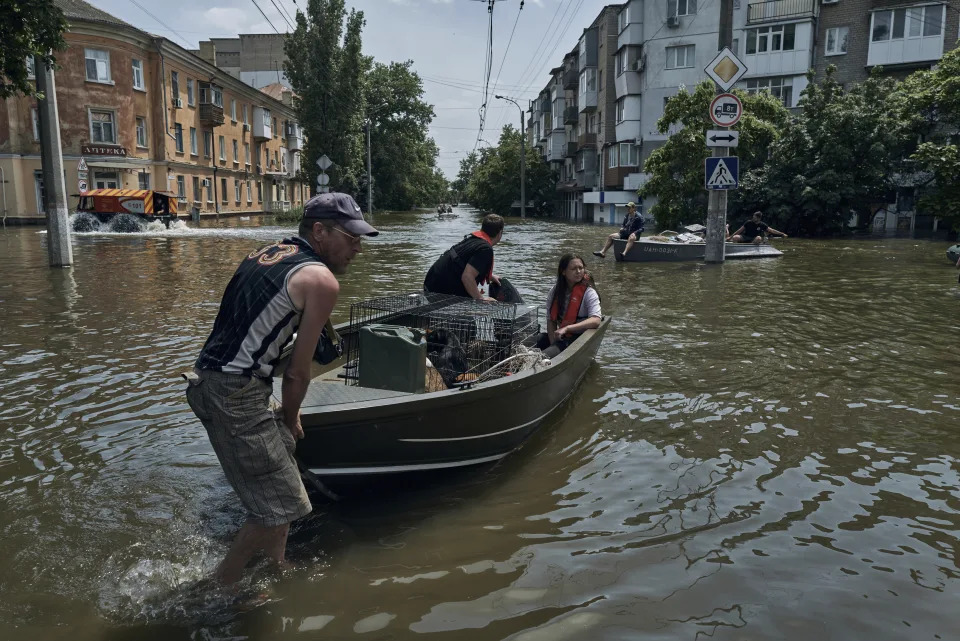
Broken windows and traces of fire are seen after a drone fell at a residential building in Voronezh, Russia, Friday, June 9, 2023. A Russian regional governor says three people were lightly wounded after a drone crashed into a residential building in central Voronezh, a city in southwestern Russia near the border with Ukraine. (Ara Kilanyants/Kommersant Publishing House via AP)People with pets are evacuated on a boat from a flooded neighbourhood in Kherson, Ukraine, Thursday, June 8, 2023. Floodwaters from a collapsed dam kept rising in southern Ukraine on Thursday, forcing hundreds of people to flee their homes in a major emergency operation that brought a dramatic new dimension to the war with Russia, now in its 16th month. (AP Photo/Libkos)Emergency workers evacuate an elderly resident from a flooded neighbourhood in Kherson, Ukraine, Thursday, June 8, 2023. Floodwaters from a collapsed dam kept rising in southern Ukraine on Thursday, forcing hundreds of people to flee their homes in a major emergency operation that brought a dramatic new dimension to the war with Russia, now in its 16th month. (AP Photo/Libkos)
KYIV, Ukraine (AP) — Russian President Vladimir Putin asserted Friday that Ukrainian troops have started a long-expected counteroffensive and were suffering “significant” losses. His comments came just hours after a string of drone strikes inside Russian territory.
It was Putin’s latest effort to shape the gut-wrenching narrative of the invasion he ordered more than 15 months ago, sparking widespread international condemnation and reviving Cold War-style tensions.
The conflict entered a complex new phase this week with the rupture of a Dnieper River dam that sent floodwaters gushing through a large swath of the front in southern Ukraine. Tens of thousands of civilians already facing the misery of regular shelling fled for higher ground on both sides of the swollen and sprawling waterway.
Kyiv has played down talk of a counteroffensive, reasoning that the less said about its military moves the better. Speaking after he visited flood zones on Thursday, Ukrainian President Volodymyr Zelenskyy said he was in touch with Ukrainian forces “in all the hottest areas” and praised an unspecified ”result” from their efforts.
Putin said Russian forces have the upper hand.
“We can clearly say the offensive has started, as indicated by the Ukrainian army’s use of strategic reserves,” Putin told reporters in Sochi, where he was meeting with heads of other states in the Eurasian Economic Union. “But the Ukrainian troops haven’t achieved their stated tasks in a single area of fighting.”
Kyiv has not specified whether reservists have been mobilized to the front, but its Western allies have poured firepower, defensive systems, and other military assets and advice into Ukraine, raising the stakes for the expected counteroffensive.
“We are seeing that the Ukrainian regime’s troops are suffering significant losses,” Putin said, without providing details. “It’s known that the offensive side suffers losses of 3 to 1 — it’s sort of classic — but in this case, the losses significantly exceed that classic level.”
On Friday, Ukrainian Deputy Defense Minister Hanna Maliar said Russia was on the defensive in the southeastern Zaporizhzhia province, though the epicenter of fighting remained in the east, particularly in the Donetsk region. She described “heavy battles” in Lyman, Bakhmut, Avdiivka and Marinka.
Valerii Shershen, a spokesperson for Ukraine’s armed forces in Zaporizhzhia, told Radio Liberty that they were searching for weaknesses in Russia’s defense, which Moscow was trying to strengthen by deploying mines, constructing fortifications and regrouping.
Earlier, regional authorities in southwest Russia near the Ukrainian border reported the latest flurry of drone strikes. The strikes have exposed the vulnerabilities of Moscow’s air defense systems.
The regional governor of Voronezh, Alexander Gusev, said on the Telegram app that a drone crashed into a high-rise apartment building in the city of the same name, injuring three residents who were hit by shards of glass. Russian state media published photos of windows blown out and damage to the facade.
Gusev said the drone was targeting a nearby airbase but veered off course after its signal was jammed. The city lies some 250 kilometers (155 miles) north of Ukraine’s Luhansk region, most of which is occupied by Russia.
Separately, Gov. Vyacheslav Gladkov of the neighboring Belgorod region, which also borders Ukraine, said air defenses had shot down two unspecified targets overnight. An apartment building and private homes were damaged, he said, without saying by what. He also said a drone fell on the roof of an office building in the city of Belgorod. It failed to detonate but caught fire on impact, causing “insignificant damage,” he wrote.
The leader of a third region of Russia, Kursk Gov. Roman Starovoit, said a drone crashed to the ground outside an oil depot and near water reservoirs in the local capital, causing no casualties or damage.
Ukrainian authorities have generally denied any role in attacks inside Russia. Such drone strikes — there was even one near the Kremlin — along with cross-border raids into southwestern Russia have brought the war home to Russians.
In Ukraine, the governor of the Kherson region, Oleksandr Prokudin, said Friday that water levels had decreased by about 20 centimeters (8 inches) overnight on the western bank of the Dnieper, which was inundated starting Tuesday after the breach of the Nova Kakhovka dam upstream.
Officials on both sides indicated that about 20 people have died in the flooding. The United Nations’ humanitarian coordinator in Ukraine, Denise Brown, visited the flood-hit town of Bilozerka on Friday, U.N. spokesman Stephane Dujarric said.
“Ms. Brown said that although initial estimates indicate that 17,000 people are being impacted in the areas controlled by Ukraine alone, it is important to understand that the crisis has not stopped and continues to evolve rapidly,” Dujarric said.
Kyiv accused Russia of blowing up the dam and its hydropower plant, which Russian forces controlled, while Moscow said Ukraine bombarded it.
The Norwegian earthquake center NORSAR said Friday that a seismological station in neighboring Romania recorded tremors in the vicinity of the dam at 2:54 a.m. Tuesday, around the time Zelenskyy said the breach occurred.
“What we can see from our data is that there was an explosion in the area of the dam as the same time as the dam broke,” NORSAR head of research Volker Oye told The Associated Press.
The Norwegian center is part of a global monitoring system that helps verify compliance with the Comprehensive Nuclear Test Ban Treaty.
Experts predicted the consequences of the dam’s collapse would last for months. Continued fighting in the region was bound to slow recovery efforts.
Viktor Vitovetskyi, a representative of Ukraine’s Emergency Service, said 46 municipalities in the Kherson region have flooded, 14 of them along the Russian-occupied eastern bank of the river.
Even as efforts were underway to rescue civilians and supply them with fresh water and other services, he said Russian shelling over the last day killed two civilians and injured 17 in the region.
Kozlowska reported from London. Jon Gambrell in Kyiv; Hanna Arhirova in Warsaw, Poland; Edit M. Lederer at the United Nations; and David Keyton in Stockholm, Sweden, contributed to this report.
Trump: I have been indicted in classified documents case
Possible charges could include a violation of the Espionage Act.
David Knowles, Senior Editor – June 8, 2023
Donald Trump at a campaign event in Waco, Texas, March 25. (Evan Vucci/AP)
Former President Donald Trump announced on Thursday evening that his attorneys had been informed that he had been indicted by the federal government for alleged crimes stemming from his handling of classified documents after leaving the White House in early 2021.
“The corrupt Biden Administration has informed my attorneys that I have been Indicted, seemingly over the Boxes Hoax,” Trump wrote on his social media website, Truth Social, adding, “I have been summoned to appear at the Federal Courthouse in Miami on Tuesday, at 3 PM. I never thought it possible that such a thing could happen to a former President of the United States.”
Reuters, ABC News and the Associated Press confirmed that Trump had been indicted on seven criminal counts in relation to his handling of the documents, his second indictment in as many months. The National Archives and the FBI sought to retrieve the classified documents before issuing a subpoena last spring for their return.
Possible Espionage Act charge
Among the charges that will be made public Tuesday, Trump will be accused of violating the Espionage Act, according to reporting from the New York Times. The act prohibits the unauthorized possession of national defense-related documents and makes special mention of those that are “willfully retained” despite government efforts to retain them. If convicted on that charge alone, Trump, 76, could face a sentence of 10 years behind bars.
Justice Department stays mum
Attorney General Merrick Garland. (Nathan Howard/AP)
The Justice Department did not issue a statement about the latest indictment or the specific charges it would contain, the AP reported. Two people familiar with the case but who are not authorized to speak publicly about it, confirmed to the outlet that prosecutors had contacted Trump’s lawyers on Thursday to inform them of the indictment.
President Biden at the White House on Thursday. (Manuel Balce Ceneta/AP)
While Trump sought to frame the indictments as politically motivated, President Biden was asked Thursday why Americans should have faith that the Justice Department was acting in accordance with the law.
“Because you’ll notice I have never once, not one single time, suggested to the Justice Department what they should do or not do, relative to bringing a charge or not bringing a charge. I’m honest,” Biden responded.
What Trump’s GOP rivals have said about another possible indictment
Prior to the indictment, some of Trump’s Republican rivals for the GOP presidential nomination weighed in on the possibility of a second round of criminal charges against the former president.
Trump’sformer vice president, Mike Pence, who announced his own presidential candidacy on Wednesday, said in an interview that he hoped that the DOJ would not indict Trump.
“I would hope the Department of Justice did not move forward. Not because I know the facts, but simply because I think after years where we’ve seen a politicization of the Justice Department is to undermine confidence in equal treatment of the law,” Pence said on the campaign trail in Iowa.
But Pence issued somewhat contradictory statements on a possible Trump indictment, stating that “no one’s above the law.”
Former New Jersey Gov. Chris Christie said he would wait to see what the charges against Trump consisted of, but made clear that Trump had himself to blame if he was charged for his mishandling of the documents.
“The problem with all of this is that it’s self-inflicted. In the end, I don’t know that the government even knew that Joe Biden had those documents or not,” Christie, a former U.S. attorney, told Fox News, drawing a distinction between a Justice Department investigation into classified documents found at Biden’s home. “They did know Donald Trump did and in fact asked voluntarily for them for over a year and a quarter and got them back in dribs and drabs.”
Former Arkansas Gov. Asa Hutchinson was more succinct, saying Trump should “step aside” if indicted in the documents case.
Sen. Tim Scott, R-S.C., said the DOJ was guilty of weaponizing its investigation and that the “the determining factor for the 2024 election should be the voters,” ABC News reported.
Will the indictment hurt Trump?
Former President Donald Trump at ta campaign event in Des Moines, Iowa, June 1. (Charlie Neibergall/AP)
While an April Yahoo News/YouGov poll taken after Trump’s first indictment in New York on charges stemming form his alleged hush money payment to porn star Stormy Daniels show that Trump had solidified his support among Republican voters, it remains to be seen how a second indictment will play out with his party.
Trump wasted little time in using the news of his latest indictment to try to boost his standing.
“This is indeed a DARK DAY for the United States of America. We are a Country in serious and rapid Decline, but together we will Make America Great Again!” he wrote on Truth Social.
His campaign also jumped into action, seeking to fundraise off the latest news.
One Doctor Used an ‘Elimination Diet’ To Shed Stubborn Pounds and Boost Energy — Here’s How
Allison Nemetz – June 7, 2023
Do your best efforts to get healthier usually end with disappointment, low energy and weight gain? You’re not alone, says popular TikTok doctor Emi Hosoda, MD, who once experienced similar results. “I even went on a 1,200-calorie vegan diet and didn’t take off a single pound,” the Seattle-based internist recalls. At first, she blamed stress and aging. Then a colleague made an offhand comment: “You shouldn’t be so overweight. There must be something wrong with your gut.” Intrigued, Dr. Hosoda turned attention to her belly, eventually going back to school to learn more. She discovered that inflammation in the GI tract can cause hidden thyroid issues, and with the right tests, confirmed this was her problem. Fortunately, she notes that simple steps including adopting an elimination diet (cutting out thyroid-slowing foods) “were life-changing” for weight loss and vitality. Now, she’s sharing her tips and insights on the elimination diet along with her recommended meal plan for best results.
The Factors That Cause Thyroid Issues
You might be wondering what your GI tract has to do with your thyroid, a.k.a. the little gland in your neck that controls metabolism. Turns out, a key reason the thyroid slows down is that the body mistakenly attacks it — and Dr. Hosoda explains these autoimmune attacks “are very often triggered in our gut.”
Here’s the main way it happens: Little by little, things like stress hormones, antibiotics, and irritants in food damage the thin gut lining; if it gets bad enough, tiny tears form and microscopic food particles escape. While scientists don’t fully understand why, this can cause the immune system to malfunction and begin targeting healthy cells and tissue as they would a virus or toxin. And since the thyroid is delicate, Dr. Hosoda notes it’s prone to getting roughed up so much that it becomes sluggish and diseased.
So does your thyroid need help? Symptoms like fatigue, stubborn weight gain, brain fog, and frequent GI issues hint that the answer is yes. Be sure to talk to your doctor; you may need prescription meds to protect your well-being. But most experts agree that Dr. Hosoda’s basic style of eating can benefit virtually everyone. In fact, research shows it can help prevent future issues and even offer significant relief to folks already diagnosed with a slow thyroid.
To be fair, Dr. Hosoda says the perfect gut-soothing diet will be a little different for each of us. If you have access to a functional medicine expert, you can get high-tech tests and a personalized list of foods to avoid. Not an option? No problem! Making changes to your diet is a low-tech approach that gets pretty amazing results too.
The Best Eating Habits To Boost Thyroid Function
The gist of an elimination diet, or autoimmune protocol, is to give your body a break from foods that often cause inflammation and thyroid attacks, “like grains, dairy, sugar, artificial colors and flavors, and any highly processed food,” Dr. Hosoda says. At the same time, you’ll aim to get plenty of nutrients proven to help relieve inflammation and repair damage — especially antioxidants from produce (organic if possible, to avoid pesticide residue), amino acids from high-quality protein, and omega-3s from good fat.
As you narrow down what you eat and pay more attention to your body, you may notice a seemingly healthy food causes bloating or tummy trouble. Remove that item from your diet too. After you give your system time to rejuvenate, you can add things back one at a time and reincorporate any that don’t trigger reactions. “I used to have trouble with coconut, but now that my gut has healed, I can handle it again,” Dr. Hosoda shares. “The key is to find things that are damaging for you and replace them with things that are healing.”
Bonus: “As your gut heals, it becomes better able to absorb nutrients essential for making thyroid hormones, like magnesium and selenium,” Dr. Hosoda notes. A healthy gut also absorbs more minerals like chromium that are key to preventing inflammatory blood-sugar spikes.
For Dr. Hosoda, blood tests showed a significant drop in markers of autoimmune attacks. “I felt energized and better right away. And then the weight started coming off pretty quickly, about 2 to 4 pounds every week or so,” she adds. “If you take steps and don’t get better, a hidden infection or other issues can be at play. Don’t struggle alone. Keep looking until you find a doctor who helps you.”
Dr. Hosoda’s Elimination Diet Meal Plan for Thyroid Health
To try Dr. Hosoda’s way of eating, use a free app like MyFitnessPal to keep portions healthy and enjoy lots of nonstarchy veggies, protein, and good fats. Include a little low-sugar fruit and grain-free starch like sweet potato, beans, and quinoa into your daily diet. Choose organic or grass-fed ingredients if possible. Also, avoid sugar, dairy, grains, and processed food. Below, you can find three easy meal ideas if you’re following the elimination diet plan:
Breakfast: Halve and slightly hollow baked sweet potatoes. Brush with olive oil and then add raw eggs. Bake at 375 degrees Fahrenheit until the eggs reach your preferred level of doneness, 10 to 15 minutes.
Lunch: Dress up a large bowl of spring greens with grilled chicken, fresh berries, nuts, spring onion, and a drizzle of olive oil vinaigrette.
Dinner: On a sheet pan, top salmon and veggies with olive oil and seasoning. Bake at 375 degrees Fahrenheit until the fish flakes, 15 to 20 minutes.
Large body of misinformation is fueling American gun violence
Tom Gabor and Fred Guttenberg – June 7, 2023
Slogans like “Guns don’t kill, people do” and “The only thing that stops a bad guy with a gun is a good guy with a gun” reflect the decades-long campaign by the gun lobby and its allies to convince Americans that owning guns makes them safer. This campaign, based on a large body of misinformation, has made America a far more dangerous place. Our book American Carnage identifies and debunks close to 40 core myths that have led many Americans to mistakenly believe that carrying a gun and keeping one in the home will protect them rather than expose them to an elevated risk of harm.
Much of this misinformation stems from the radicalization of the gun lobby, beginning in the 1970s. Since then, the gun industry and gun rights organizations have made it their priority to convince Americans that an armed citizenry is the most effective way to shield ourselves from violence. This campaign has included stoking the public’s fear of crime, funding dubious scholarship by gun-friendly researchers, and shutting down federal funding of research showing that guns in the home put occupants at an elevated risk.
‘I still hate LIV:’ Rory McIlroy tries to find hope in humiliation of PGA Tour-LIV merger
Rory McIlroy, surprised by the PGA Tour-LIV merger, tried to reconcile frustration and humiliation on Wednesday.
Jay Busbee, Senior writer – June 7, 2023
Rory McIlroy tries to deal with the fallout of Tuesday’s seismic news. (Vaughn Ridley/Getty Images)
Rory McIlroy has known abject humiliation in his golf career. He stood alone in the pines alongside Augusta National’s 10th hole in 2011 as his Masters lead evaporated. He could only watch as Cam Smith blazed past him in 2022 at St. Andrews in an Open Championship that was McIlroy’s for the taking. Never has McIlroy been humiliated like he was Tuesday.
After a year and a half of caping for the PGA Tour and commissioner Jay Monahan, a year and a half of serving as the point of the spear, McIlroy had to just sit and watch as the PGA Tour cut a deal with the opposition. The PGA Tour and the Saudi Public Investment Fund have agreed to join forces in a new, as-yet-unspecified endeavor, and McIlroy was as surprised as the rest of the golf world.
Speaking on Wednesday morning before the RBC Canadian Open, McIlroy walked through both the sequence of events Tuesday and his overall perspective on the seismic, permanent changes that flipped golf on its head.
“It’s hard for me not to sit up here and feel somewhat like a sacrificial lamb,” McIlroy said. He was notified at 6:30 a.m. of the impending merger, just a few hours before it became public news.
McIlroy tried to find some daylight between the PIF, which already bankrolls multiple tournaments, companies and endeavors in which McIlroy is involved, and LIV Golf, the upstart tour that’s spent more time beefing in public with McIlroy and others than actually playing tournaments.
“I’ve come to terms with [the PIF],” McIlroy said. “I see what’s happened in other sports, I see what’s happened in other businesses, and honestly I’ve just resigned myself to the fact that this is what’s going to happen.”
McIlroy also sided with Monahan, at least to the extent that he appreciates the structure of the new endeavor as it was announced. “Whether you like it or not, the PIF were going to keep spending the money in golf. At least the PGA Tour now controls how that money is spent,” he said. “If you’re thinking about one of the biggest sovereign wealth funds in the world, would you rather have them as a partner or an enemy? At the end of the day, money talks and you would rather have them as a partner.”
As for LIV itself, there was no gray area, no equivocation.
“I still hate LIV. I hate them,” McIlroy said. “I hope it goes away.”
McIlroy’s resigned acceptance of the PIF’s incursion didn’t include acceptance of the LIV defectors. He wasn’t quite ready to extend them any courtesies. “There still has to be consequences to actions,” he said. “The people that left the PGA Tour irreparably harmed this Tour, started litigation against it. We can’t just welcome them back in. Like, that’s not going to happen. And I think that was the one thing that Jay was trying to get across yesterday is like, guys, we’re not just going to bring these guys back in and pretend like nothing’s happened. That is not going to happen.”
Still, above and beyond who makes up a given tournament field, there’s an inevitability grinding away here. Sounding like a man watching a tidal wave approach, McIlroy acknowledged the reality of the situation while holding out a faint, perhaps irrational, hope that maybe everything would work out.
“It’s very hard to keep up with people that have more money than anyone else,” McIlroy said. “And if they’re going to put that money into the game of golf, then why don’t we partner with them and make sure that it’s done in the right way?”
McIlroy has spent a lifetime staying loyal to the PGA Tour. But loyalty doesn’t fill bank accounts. McIlroy is, by nature, an optimist. But even the PGA Tour’s strongest, most eloquent defender is struggling to rationalize Tuesday’s events as anything more than a money grab, loyalty be damned.
Before you fight over the word ‘woke,’ learn its history. It will blow you away.
Phil Boas, Arizona Republic – June 7, 2023
Poster of Leadbelly at the Rusty Nail in Wilmington.
Someday when the cultural moment that many have called “The Great Awokening” is finally, mercifully, over, Americans of all races should fight to give African Americans their word back.
Less than 10 years ago, “woke” was a word so deeply layered with history and meaning it could evoke years of pain suffered by descendants of slaves coming of age in Jim Crow America.
You don’t have to be African American, however, to feel its history. The word woke is seminal to our larger culture in ways most of us have never understood.
It’s one of the great words in American English and it should be preserved in its purest form.
At the moment it is being hijacked by politics – first by white liberals, then by white conservatives.
A battle over ‘woke’ in the Republican Party primary
This week the word “woke” is igniting a family spat within the 2024 Republican primary for president, pitting Donald Trump against his former apprentice, Ron DeSantis.
DeSantis, the Florida governor, uses the word frequently to describe an ideology steeped in identity politics that has taken over our universities, media, large corporations, medicine, arts, entertainment and sports.
Trump argues he doesn’t use the word. “I don’t like the term ‘woke’ because I hear, ‘Woke, woke, woke.’ It’s just a term they use, half the people can’t even define it, they don’t know what it is.”
There’s a good chance none of us would know the word today had the Library of Congress not set out in the 1930s to preserve American folk music in the South.
That project took library archivists to Louisiana where they discovered a little-known African American blues singer named Huddie William Ledbetter or “Lead Belly.”
The archivists recorded on aluminum discs Lead Belly and his 12-string guitar, preserving what would become some of the great Blues standards such as “Cotton Fields,” “Goodnight, Irene” and “Rock Island Line.”
‘Woke’ emerges with a song about race and suffering
In Lead Belly’s song “The Scottsboro Boys,” the nine African-American young men falsely accused of raping two white women in Alabama, he admonishes his listeners to, “Best stay woke!”
As Huddie Ledbetter used “woke,” it meant that when you’re a Black person travelling through a deeply racist state such as Alabama, you need to know what you’re dealing with – a highly refined form of evil.
Ledbetter would know. He travelled the byways of Louisiana, Alabama and Texas singing his songs and confronting white bigotry and its violence against Black people.
In a way that history has of surprising us, Lead Belly would become essential to white culture in America and Great Britain. All white people reading this and learning the name Huddie Ledbetter for the first time, should know that they have likely felt his influence, far more than they could have imagined.
Lead Belly influences Rock ‘n Roll’s greatest band
Donovan became “the king” of the U.K. “skiffle craze” and eventually inspired new skiffle groups across England, such as Liverpool’s The Quarrymen, then led by an aspiring singer-songwriter named John Lennon.
By 1960, the group would evolve into The Beatles, and its lead guitarist, George Harrison, would one day tell an interviewer, “If there was no Lead Belly, there would have been no Lonnie Donegan; no Lonnie Donegan, no Beatles. Therefore, no Lead Belly, no Beatles,” as recounted by Smithsonian Magazine.
Lead Belly was inspiring many musical forms of that day. Those same early recordings that preserved his music and the word “woke,” found their way into the imagination of another young artist of some note.
“Somebody – somebody I’d never seen before – handed me a Lead Belly record with the song ‘Cottonfields’ on it,” recalled Bob Dylan in his 2017 lecture to the Noble (Prize) Foundation. “That record changed my life right then and there. Transported me into a world I’d never known.
“It was like an explosion went off. Like I’d been walking in darkness and all of the sudden the darkness was illuminated. It was like somebody laid hands on me. I must have played that record a hundred times.”
The biggest names in many genres sing his songs
By the end of the century, Led Belly’s influence on American popular music was its own constellation of stars. Artists covering his songs included Gene Autry, Frank Sinatra, Nat King Cole, Tom Jones, Harry Belafonte, Elvis Presley, Johnny Cash, The Beach Boys, Creedence Clearwater Revival, Aerosmith, Lead Zeppelin, Tom Petty, The Grateful Dead.
When Beat Generation author William S. Burroughs wrote, “These new rock ‘n roll kids should just throw away their guitars and listen to something with real soul, like Lead Belly,” a young musician in Seattle named Kurt Cobain took up his challenge.
Years later, he recalled on an MTV stage: “I’d never heard about Lead Belly before so I bought a couple of records, and now he turns out to be my absolute favorite of all time in music. I absolutely love it more than any rock’n’roll I ever heard.”
Our chattering classes, and I include myself among them, have been poor caretakers of the word “woke.”
When this battle over wokeness is finally over, it would do us well to give the word back.
And while we’re at it, maybe we could make the name Huddie Ledbetter, one of America’s most important songwriters, as easily recognizable as say, Ringo Starr.
Phil Boas is an editorial columnist with The Arizona Republic. Email him at phil.boas@arizonarepublic.com.
This article originally appeared on Arizona Republic:
Tens of thousands of extra patients to get access to wonder obesity jab Wegovy
Daniel Martin – June 6, 2023
Patients with additional support have been able to lose as much as 15 per cent of their total body weight on Wegovy – vitapix/E+
Tens of thousands of extra people will get access to a new wonder obesity drug after Rishi Sunak called for it to be made available outside hospitals.
The Prime Minister launched a pilot study to see whether the drug Wegovy could be prescribed by GPs – allowing far more to take advantage.
Earlier this year, the National Institute for Health and Care Excellence (NICE) decided that obese people with heart conditions should be able to receive the drug Wegovy free on the NHS.
The drug has been proven to help adults living with obesity lose more than 15 per cent of their body weight when prescribed alongside diet, physical activity and behavioural support.
But at the moment, NICE says the drug can only be made available in specialist weight management centres based in hospitals – reaching just 35,000 people. If it could be made available outside hospitals it could reach tens of thousands more, Downing Street said.
Mr Sunak has therefore ordered a £40 million pilot to test how the drugs could be made available outside hospitals – including through GP prescriptions.
But there are supply issues with the drugs. The company making Wegovy has said that unprecedented demand means that large quantities may not be available for months.
The Prime Minister said: “Obesity puts huge pressure on the NHS.
“Using the latest drugs to support people to lose weight will be a game-changer by helping to tackle dangerous obesity-related health conditions such as high blood pressure, diabetes and cancer – reducing pressure on hospitals, supporting people to live healthier and longer lives, and helping to deliver on my priority to cut NHS waiting lists.”
There is evidence from clinical trials that, when prescribed alongside diet, physical activity and behavioural support, people taking a weight-loss drug can lose up to 15 per cent of their body weight after one year. Taking them alongside diet, physical activity and behavioural support can help people lose weight within the first month of treatment.
Obesity is one of the leading causes of severe health conditions such as cardiovascular disease, diabetes and cancer, and it costs the NHS £6.5 billion a year. There were more than one million admissions to NHS hospitals in 2019/2020 where obesity was a factor.
NICE advises that Wegovy should only be available via specialist weight management services, which are largely hospital based. This would mean only around 35,000 people would have access to Wegovy, when tens of thousands more could be eligible.
The £40m pilot will explore how approved drugs can be made safely available to more people by expanding specialist weight management services outside of hospital settings.
This includes looking at how GPs could safely prescribe these drugs and how the NHS can provide support in the community or digitally – contributing to the Government’s wider ambition to reduce pressure on hospitals and give people access to the care they need where it is most convenient for them.
Obesity and cancer
Steve Barclay, the Health Secretary said: “Obesity costs the NHS around £6.5bn a year and is the second biggest cause of cancer.
“This next generation of obesity drugs have the potential to help people lose significant amounts of weight, when prescribed with exercise, diet and behavioural support.
“Tackling obesity will help to reduce pressure on the NHS and cut waiting times, one of the Government’s five priorities, and this pilot will help people live longer, healthier lives.”
Professor Sir Stephen Powis, the NHS medical director, said: “Tackling obesity is a key part of the NHS Long Term Plan – it can have devastating consequences for the nation’s health, leading to serious health conditions and some common cancers as well as resulting in significant pressure on NHS services.
“Pharmaceutical treatments offer a new way of helping people with obesity gain a healthier weight and this new pilot will help determine if these medicines can be used safely and effectively in non-hospital settings as well as a range of other interventions we have in place.
“NHS England is already working to implement recommendations from NICE to make this new class of treatment available to patients through established specialist weight management services, subject to negotiating a secure long-term supply of the products at prices that represent value for money taxpayers.”
Related
Yahoo! Life
What is Wegovy? The Hollywood weight loss drug which could soon be offered by GPs
Marie Claire Dorking, Contributor, Yahoo Life UK – June 7, 2023
Watch: £40m pilot scheme launched to increase access to weight-loss drugs and cut NHS waiting lists
The PM made the comments while announcing a £40 million pilot scheme to increase access to specialist weight management services in a bid to combat obesity.
The government wants to tackle the health problems and £6.5 billion cost to the NHS of obesity by making it easier to access weight-loss treatments through GPs.
The National Institute for Health and Care Excellence (Nice) gave approval for the use of appetite suppressant Wegovy earlier this year, but said it should only be available through specialist services which are largely hospital-based.
But the government is keen to explore how approved drugs can be made available to more people by looking at how GPs could safely prescribe the drugs.
Access to Wegovy on the NHS for weight loss could soon be improved. (Getty Images)
Wegovy, or semaglutide, is usually prescribed as a type 2 diabetes medication that blunts appetite.
It has the same ingredient as Ozempic, which has been causing a stir recently having said to be used by celebrities to manage their weight.
But experts have warned that there could be some side effects to using the drug as an aid to weight loss, without medical supervision, with Dr Amir Khan previously appearing on both GMB and Lorraine to issue some advice.https://flo.uri.sh/visualisation/14034102/embed?auto=1
Here’s everything you need to know about Wegovy or Ozempic in 11 points.
What is Ozempic? Ozempic, Ryblesus and Wegovy are all brand names for a compound called semaglutide. The drug is typically used as a diabetes medication, can be prescribed in various doses and can be in the form of a weekly injection – administered in the stomach, thigh or arm – or a daily oral tablet.
The drug reportedly reduces appetite. “It is a hormone that our guts naturally produce,” explained Dr Amir Khan on ITV’s Lorraine. “It sends messages up to the pancreas to start producing insulin. But one of the side effects is it slows down the movement of food in the gut so you stay fuller for longer and you don’t have much of an appetite. That means you eat less which results in weight loss.”
The drug is rumoured to be secretly used by many Hollywood stars. At the Critics Choice Awards earlier this year Chelsea Handler hinted that many celebrities were taking the injectable. “Like when celebrities joke they lost weight by drinking water, but really it’s because everyone’s on Ozempic,” she joked. “Even my housekeeper’s on Ozempic.”
Searches on social media also link the Kardashians with the drug. But despite Kim Kardashian never confirming her use of Ozempic and her sister, Khloe, issuing a statement denying that she’d used it, it continues to clock up hashtags.
Semaglutide is the official name for Ozempic, which is typically a medication for type 2 diabetes. (Getty Images)
Other celebrities have openly admitted using the drug as a weight loss aid including Elon Musk, who told Twitter he’d tried it. The Tesla founder said the once-weekly injectable was his secret weapon for being “down 30lbs”. Jeremy Clarkson also recently discussed using the drug in a bid to lose weight and help prevent type 2 diabetes.
It’s causing quite the buzz online. Thanks to its reputation as the weight loss drug du jour, Ozempic is quickly clocking up views and shares on social media. On TikTok the hashtag #ozempic already has 1.1 billion views and counting, while Instagram is littered with users sharing their “Ozempic journey” to weight loss.
The drug was hailed a potential ‘game changer’ during an official UK study. It first started causing a buzz in the UK as a weight management tool after a University College London study, published in The New England Journal of Medicine, found just over a third (35%) of people who took it for obesity lost more than a fifth of their total body weight.
GPs could soon prescribe weight loss drug Wegovy. (Getty Images)
Ozempic does come with risks. Dr Amir Khan warned that side effects of the medication could include “nausea, vomiting, feeling bloated, diarrhoea, but in some, more serious, cases it can cause inflammation of the pancreas, that’s pancreatitis.”
He added it can also cause gall bladder problems. “It can even cause kidney failure,” he said, “so really it should only be available on prescription. I do prescribe it to my patients living with type 2 diabetes, but it’s very carefully monitored. It is not just given online.”
Eating disorder charities also have concerns. “Weight-loss medications like semaglutide can be extremely attractive to people with eating disorders as they appear to provide quick results,” Tom Quinn, Beat’s director of external affairs, explains.
“However, these medications can be very dangerous as they can worsen harmful thoughts and behaviours for those unwell, or contribute to an eating disorder developing for someone who is already vulnerable.”
Doctors say weight loss medications aren’t a magic cure. The NHS advises speaking to your GP for advice about losing weight safely “by eating a healthy, balanced diet and doing regular physical activity”.
They can also let you know about other useful services, such as local weight loss groups (either provided by the NHS or your local council, as well as private clubs that you pay for) and “exercise on prescription” (where you’re referred to a local active health team for sessions with a qualified trainer).
Weight-loss drugs pilot to begin in UK amid uncertainty over Wegovy launch
Ludwig Burger and Maggie Fick – June 6, 2023
FILE PHOTO: Illustrations of Wegovy injector pens in Chicago
(Reuters) – Britain plans to launch a pilot programme exploring how new weekly weight-loss shots such as Novo Nordisk’s Wegovy can be given to obese patients by general practitioners even as the drug’s market launch remains unclear.
The government’s announcement on the 40-million-pound ($50 million) pilot programme comes after drug cost-effectiveness watchdog NICE in March recommended the use of Wegovy in adults with at least one weight-related condition and a body mass index of 35, but only within the National Health Service’s (NHS) specialist weight management scheme.
The timing of Wegovy’s launch in Britain – which would be only the fourth country to use it – is uncertain, however, after Novo last month rationed starter doses to secure supply to U.S. patients already on the regimen, after it was overwhelmed by demand there.
British Prime Minister Rishi Sunak said on Wednesday the pilot and fighting obesity-related diseases could reduce pressure on hospitals.
It would also support “people to live healthier and longer lives, and helping to deliver on my priority to cut NHS waiting lists”.
The NHS endured a tough winter in England in particular, with waiting lists hitting record highs and staff striking for higher pay amid double-digit inflation.
Obesity is one of the leading causes of severe health conditions such as cardiovascular disease, diabetes and cancer, and costs the NHS 6.5 billion pounds a year.
The government said that NICE, short for the National Institute for Health and Care Excellence, was also considering potential use of Eli Lilly’s Mounjaro, also known as tirzepatide, currently licensed to treat diabetes but expected to win approval to treat obesity as well.
The two-year pilot will be launched after the new weight loss drugs are available in the UK, it said.
DELAYS
Novo’s inability to keep up with U.S. demand for Wegovy has effectively delayed the launch in Britain and elsewhere in Europe. It has also had to overcome production problems at a contract manufacturer.
A company spokesperson would not comment on any commitment to supply the programme, but said there had been preliminary discussion on the role of treating obesity as part of the UK government’s ambition to bring people back into the workforce.
Eli Lilly said that its Mounjaro drug could be part of the solution, once approved.
The British government said that only 35,000 people would have access to Wegovy under the specialist hospital services, but tens of thousands more could be eligible.
Phil McEwan, CEO of health economics consultancy Heor Ltd in Cardiff, who advises Novo on market access, said the need for specialist services would have been a major bottleneck.
“You have to be referred to specialist care and that’s not the easiest thing to do. The challenge will be to access reimbursement,” he said.
Keen interest in the treatment is already showing elsewhere. One of Britain’s largest pharmacy chains, Superdrug, said its remote prescriptions service was anticipating significant demand.
“Superdrug Online Doctor has seen five time anticipated levels of registration,” a spokesperson told Reuters in April, declining to give numbers.
Outside the U.S., Wegovy has only been launched in Denmark and Norway but major medical insurance schemes there will not pay for it, saying the health benefits would not justify the extra budgeting.
Britain’s move is likely to heat up a debate about whether a drug is the right answer to the growing public health problem of obesity or whether there are other ways to encourage healthier lifestyles.
Duane Mellor, a dietitian and senior lecturer at Aston University’s medical school, said drugs like Wegovy were a tool, not the solution.
“It’s a political decision to say the government is doing something to tackle health issues linked to obesity … we need to be much braver and bolder in looking at root causes around access to health care and about making healthy food enjoyable.”
Simon Cork, a senior lecturer in physiology at Anglia Ruskin University, said obesity had been shown to be “incredibly difficult” to manage through diet and exercise alone and that Wegovy and similar drugs offered a step change.
“Hence the excitement from the general public and why the UK government seems to be pushing to make the drug available widely,” he said.
Wegovy works by mimicking a hormone called glucagon-like peptide-1 (GLP-1) that triggers the feeling of fullness in the body after eating.
Trials showed it leads to an average weight loss of around 15%, alongside changes to diet and exercise.
($1 = 0.8051 pounds)
(Reporting by Ludwig Burger in Frankfurt, Maggie Fick in London, additional reporting by Anusha S in Bengaluru and Helen Reid and Alistair Smout in London; editing by Lincoln Feast, Mark Potter and Jane Merriman)
Teens are spending less time than ever with friends
Daniel de Visé – June 7, 2023
America’s teenagers are seeing a lot less of one another.
The share of high school seniors who gathered with friends in person “almost every day” dropped from 44 percent in 2010 to 32 percent in 2022, according to Monitoring the Future, a national survey of adolescents. Social outings for the typical eighth grader dwindled from about 2 1/2 a week in 2000 to 1 1/2 in 2021.
The nation’s teens have traded face time for Facetime. Adolescents are spending less time gathering in shopping malls, movie theaters and rec rooms, and more time connecting on Instagram, TikTok and Discord.
Some researchers see the retreat from social gatherings as key to explaining the wave of adolescent ennui that is sweeping the nation. Numerous studies have tracked rising rates of loneliness among adolescents before, during and since the COVID-19 pandemic. Last month, Surgeon General Vivek Murthy declared a national loneliness epidemic. And loneliness presages depression and other mental health maladies, which are also growing more prevalent among teens.
“Teens are spending a lot more time communicating with each other electronically and a lot less time hanging out with each other face to face,” said Jean Twenge, a professor of psychology at San Diego State University and author of “Generations,” a new book about generational differences.
“Going to the mall has gone down. Driving in the car for fun has gone down. Going to the movies has gone down,” she said. “We’re talking about kids who are spending five, six, seven hours a day on social media.”
Twenge sees a connection between the decline of adolescent gatherings and the rise of teenage loneliness.
About half of the nation’s high-school seniors met up with friends almost daily in the 1970s, when researchers at the University of Michigan began tracking their outings in the Monitoring the Future study.
In the decades since, a gradually shrinking share of teens has reported regular meetups with friends. The steepest decline commenced around 2010, just as smartphones and social media were taking hold. U.S. smartphone ownership reached 50 percent in 2012.
The loneliness epidemic arrived around the same time. A landmark 2021 study found that levels of adolescent loneliness nearly doubled between 2012 and 2018. Prior to 2012, researchers had spotted no loneliness trend.
Twenge believes the timing of the two trends, falling face time and rising loneliness, is no mere coincidence.
“If it’s not smartphones and social media that have caused the rise in teen depression, what is it?” she said. Twenge was the lead author of the 2021 study, published in the Journal of Adolescence.
Today’s teenagers may be spending more time in front of screens than any prior generation.
The average teen spent eight hours and 39 minutes on daily screen time for entertainment in 2021, up from six hours and 40 minutes in 2015, according to Common Sense Media, publisher of a closely watched Common Sense Census.
To put those numbers into perspective: An entire household watched eight hours and 55 minutes of daily television, on average, in 2009-10, the historic peak of television consumption. But researchers caution against comparing the two.
“Screen time can be so many different things,” said Amanda Lenhart, head of research at Common Sense. “There’s all sorts of ways in which these platforms can be both good for kids and bad for kids.”
Nearly half of the nation’s teens now say they are online “almost constantly,” according to Pew Research. More than half say they are effectively addicted to social media and would have a hard time giving it up.
The surgeon general, among others, has linked social media to rising depression and anxiety in teenagers.
Loneliness deepened at the height of the pandemic. Three years later, the epidemic shows few signs of abating. New survey data from the Harvard Graduate School of Education, collected in December, shows 21 percent of teens report being lonely much or all of the time.
“I think social media has been a really significant factor in this decline,” said Richard Weissbourd, a senior lecturer at the Harvard education school.
Weissbourd and other researchers agree with Twenge that face-to-face relationships play a large role in adolescent development.
“Friendships and relationships are very important in adolescence,” said Adam Hoffman, an assistant professor of psychology at Cornell University. Social media “can really only supplement, and cannot replace, in-person relationships. We need to have both of these.”
Both he and Weissbourd stress, however, that social media is only one of several societal forces that have afflicted the mental health of adolescents and young adults in recent years.
“Teens rank achievement pressure really high in terms of negatively influencing their mental health,” Weissbourd said. Adolescents and their families report heightened financial stress. Teens in the 2020s fret about climate change and political strife.
Causes of adolescent loneliness vary by race, class and culture.
“What’s going on with low-income kids in rural areas or low-income kids in areas of concentrated poverty is really different from what’s going on with affluent kids in suburbs,” Weissbourd said.
Social media itself is, psychologically speaking, a mixed bag.
The social maelstrom of Instagram drives some teens into depression. For other young people, social media can bring connection. Nonbinary and transgender teens, for example, have reported joy and empowerment in discovering people like themselves through social media.
“I’m thinking about a gay kid in Montana, and he’s completely on his own, and he doesn’t really know anyone he can talk to,” Hoffman said. “But he’s developed a community online, and he’s got connections with gay kids all over the country.”
Other research suggests teens may ultimately be better off with a social media life than without one.
One 2022 study found that teens reported lower self-esteem when their Internet access was poor or nonexistent. The survey also found that adolescent self-esteem suffered when parents wielded strict control over screen time.
“There’s such strong rhetoric out there about the harms associated with these screens, but to be honest, the data is so weak,” said Keith Hampton, a professor of media and information at Michigan State University and co-author of the study.
“All the data supports the notion that adolescents who spend more time using social media spend more time in person with their friends,” he said.
Twenge agrees with that point. But she also notes that teens are spending less overall face time with their friends today than before the social media era.
As a group of friends migrates from mall gatherings to Instagram, Twenge explains, its most sociable member may spend more time than the others in both in-person and virtual get-togethers. But the group still winds up spending less face time together, in the end.
“There’s a big difference between being in the same place with someone and interacting with someone electronically,” she said. “When you’re in the same room with someone in real time, you’re having a conversation, you can see the look on their face, you can touch each other, and all of these things are important for teens.”
U.S. eyes Russia in destruction of Ukraine’s Kakhovka dam
Preliminary U.S. intelligence suggests Russia blew a major piece of Ukrainian critical infrastructure.
Michael Weiss and James Rushton – June 6, 2023
The U.S. government “has intelligence that is leaning toward Russia as the culprit” behind the destruction of Ukraine’s Kakhovka dam and hydroelectric power plant in the early hours of June 6, according to a report by NBC News.
The dam across the Dnipro River, one of the country’s major waterways, was all but gone in video and satellite footage that has emerged over the last 18 hours. The Kakhovka Reservoir has been emptying into the river all day, causing catastrophic flooding downstream in the Ukrainian region of Kherson. Water from the reservoir is also used by the Zaporizhzhia nuclear power plant to cool its reactors. According to the International Atomic Energy Agency, there is at present no immediate nuclear safety risk at the plant.
Widespread flooding
A local resident makes her way through a flooded road after the walls of the Kakhovka dam collapsed overnight. (Evgeniy Maloletka/AP)
Upward of 40,000 people are now in danger due to floodwaters, according to the Ukrainian government. As many as 70 towns along the Dnipro are at risk, President Volodymyr Zelensky said on Tuesday.
Footage from Kherson showed rooftops floating down the river and other homes half submerged, and flood waters are expected to peak by Wednesday. Tragically, most of the animals at a zoo in the settlement of Nova Kakhovka, which is under Russian occupation, have drowned, according to the zoo’s management.
Even as rescue work continued, noise from Russian artillery could be heard nearby, a grim reminder that a mass ecological disaster is occurring amid the backdrop of war.
Timing of the dam incident
An aerial view of the damage at the Kakhovka dam in southern Ukraine. (Planet Labs PBC via AP)
Ukrainian analysts have linked the alleged Russian dam destruction to the much anticipated Ukrainian counteroffensive, which may already be in progress. “In the course of the Kharkiv counteroffensive operation, the Russians destroyed the dam over Oskil reservoir,” Mykola Bielieskov, a research fellow at National Institute for Strategic Studies, a government-funded think tank, told Yahoo News, referring to the Ukrainian military’s recapture of thousands of square miles of terrain in September. “So there is precedent here.”
“Although one reason might be to impede the Ukrainian offensive, the Russians also have established an historical pattern of destroying infrastructure in areas they do not control — such as Kyiv — and areas they must leave behind when retreating, signaling that, if they cannot control it, no one else will be allowed to possess it,” said Dr. Alex Crowther, a retired U.S. Army colonel and strategist. “In short, the Russians did this for spite.”
The Ukrainian government was itself quick to blame Russian occupiers for blowing up the dam, originally built by the Soviets in 1956. Oleksii Danilov, chairman of Ukraine’s National Security Council, attributed the sabotage to Russia’s 205th Motorized Rifle Brigade, suggesting Kyiv was in possession of specific intelligence confirming that claim. In October 2022, a Telegram channel, purportedly belonging to a member of the 205th, outlined plans to mine and undermine the structure, with instructions for local residents in the event of “dam failure.”
Eyewitnesses have also come forward, describing hearing loud bangs at the dam they say indicate the use of large explosives.
‘An outrageous act’
Tetiana, a resident of Kherson, inside her damaged house after the Kakhovka dam was blown up overnight. (Evgeniy Maloletka/AP)
Ukraine’s Western partners wasted little time placing blame on Russian forces.
“The destruction of the Kakhovka dam today puts thousands of civilians at risk and causes severe environmental damage,” NATO Secretary-General Jens Stoltenberg tweeted hours after the dam was destroyed. “This is an outrageous act, which demonstrates once again the brutality of Russia’s war in Ukraine.”
Josep Borrell, the high representative of the European Union for Foreign Affairs and Security Policy, described the catastrophe as “a new dimension of Russian atrocities.” Michael Carpenter, the U.S. ambassador to the Organization for Security and Co-operation in Europe, commented: “The destruction of the Nova Kakhovka dam is an outrageous act of environmental destruction that imperils the lives and livelihoods of hundreds of thousands of Ukrainians, as well as the natural environment.”
How will the West respond?
The House of Culture in Kherson is partially submerged after the nearby dam was attacked. (Alexey Konovalov/TASS/Handout via Reuters)
Previous large-scale Russian attacks on Ukrainian infrastructure have almost always led to significant increases in weapon systems from Western allies.
Most recently, after Russia began its campaign of aerial bombardment of Ukrainian power stations and energy plants in October 2022, the U.S. and other Western nations responded by sending their most advanced air defense systems, such as the Patriot platform, to Kyiv.
The Russian response, meanwhile, started with an unequivocal denial that anything untoward had happened to the Kakhovka dam, then segued into accusations that Ukraine destroyed its own critical infrastructure. Vladimir Putin’s spokesman, Dmitry Peskov, claimed without evidence that Kyiv was behind this act of apparent sabotage and that it would result in “very severe consequences” for local residents and the environment. Meanwhile, Russia’s Investigative Committee — tantamount to the FBI — said it had launched a criminal investigation.
Meanwhile, the Russia-appointed governor of Kherson Oblast, Vladimir Saldo, gave a surreal interview, filmed against the backdrop of Nova Kakhovka, visibly underwater. “Everything is fine in Nova Kakhovka,” he said. “People go about their daily business like any day.”