A shadowy club in California recently associated with Clarence Thomas is being sued for multiple labor violations. Here’s what the secret retreat is known for.
Hannah Getahun – July 2, 2023
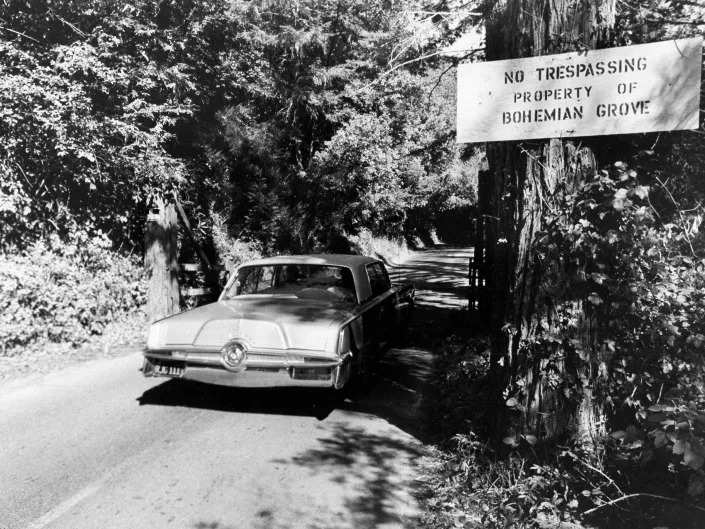
In this July 29, 1971 file photo is the roadway into the exclusive Bohemian Grove, a quiet encampment 80 miles north of San Francisco in Monte Rio, Calif.Sal Veder/AP Photo
Former workers, known as valets, are suing an elite men’s club for alleged labor violations.
The lawsuit claims they were forced to work over 15 hours daily without breaks.
The Bohemian Club has been associated with right-wing political figures, including Clarence Thomas.
The Bohemian Club, an all-men’s private society in California that counts former presidents among its members, faces a class action lawsuit from servers for alleged labor violations.
The exclusive club occasionally pops up in the news, primarily for its association with elite and wealthy men. Most recently, a ProPublica report detailing Justice Clarence Thomas’ relationship with Harlan Crow mentioned the club.
Former valets who used to work at Monastery Camp in Monte Rio, California, which they described as one of the “most prestigious and well-known camps at Bohemian Grove,” filed the complaint on June 5.
The valets, who attended to wealthy guests during summer camp, claim in the complaint that workers were required to work over 15 hours a day with no breaks or meal periods while only receiving pay for 8 hours a day. The suit alleges that club management “continually worked together to come up with methods to avoid paying payroll taxes and overtime.”
The suit names Bohemian Club treasurer William Dawson as someone who directly asked employees to “falsify payroll records.” It also claims that valets were asked to hide when the owner of the payroll company Pomella LLC, also named as a defendant in the suit, came to inspect the Grove. The suit alleges that the payroll company was also aware of the falsified timesheets.
The lawsuit also alleges that valets working at around 100 other camps plaintiffs say are associated with the club are run by captains that have engaged in similar labor violations. The lawsuit says that Bohemian Club may seek to distance itself from these camps during litigation, but asserts that these affiliate camps are a joint venture of the main club and that members pay the club to access these sites.
In a statement to the Press Democrat, Sam Singer, a communications representative for the club, said that the club “has always valued and respected its employees, and that includes our commitment to full compliance with all applicable wage and hour laws and regulations.”
“We believe these three individuals know full well they did not work for the Club and that this lawsuit is a transparent attempt to drag the Club into their individual circumstances,” Singer told the Press Democrat. “The Club will vigorously defend itself in this action, as it would in any other meritless lawsuit.”
The Bohemian Club, which has thousands of members and has been associated with Republican presidents like Ronald Reagan, Richard Nixon, and George HW Bush, has been hosting the summer camp for over 150 years and describes itself as a club of “gentlemen who are connected professionally with Literature, Art, Music, or the Drama.”
The club, full of elite men often tight-lipped about its members and events, has garnered the interest of conspiracy theorists, left-leaning protestors, and interested onlookers. Although there is still much to learn about the club, one ritual was uncovered by InfoWars host Alex Jones, who snuck into the Bohemian Grove summer camp to film a strange ritual that consisted of robed members burning a coffin effigy — named “Care” — in front of a 40-foot owl statue.
According to previous investigative reports, the Grove also hosts various social activities, like plays and comedy shows featuring men portraying female characters. The club is also known for hosting “Lakeside Talks,” where members, often those of the political elite, speak about policy ideas.
The Bohemian Club and a lawyer for the plaintiffs did not immediately respond to Insider’s request for comment.
Why is America not the lawless, gun-free, socialist wasteland Republicans warned us about?
Rex Huppke, USA TODAY – July 2, 2023
Last I checked, there are approximately 3,756 Republicans running for the GOP presidential nomination, and the vast majority of them – particularly the Donalds Trump and the Rons DeSantis of the world – want voters to know they should be terrified.
Terrified of what, you ask? Oh, I dunno. Socialism. Marxism. “Radical” teachers. Mickey Mouse. Drag queens. “Others.” Pretty much everything, it seems. All the fears. (I’d add spiders to that list, but that’s just me, a liberal scaredy cat.)
Fearmongering is a tried-and-true Republican Party tradition and with the 2024 election cycle about to kick into full gear, it’s mongering season.
Republican fearmongering, and some questions about why fears are never realized
So I have a suggestion for GOP voters, from the MAGA loyalists to the (three remaining) moderates to everyone in between. The first GOP presidential debate will be Aug. 23 in Milwaukee. At that event, you should demand answers to the following fear-related questions:
Why is “her” – the Hillary Clinton character in the “Lock her up!” chant – not locked up? Former President Donald Trump was supposed to do that, yet “her” walks free.
President Donald Trump and Hillary Clinton during a debate in 2016.
Why haven’t we been literally invaded by umpteen South American migrant caravans?
Where is the country-destroying migrant surge that was supposed to come after Title 42 ended?
Why aren’t there violent MS-13 gang members on every street corner?
Why haven’t drag shows turned all Americans into drag queens?
Years of fear, with so few results – it’s almost as if they’re manipulating voters
Why are America’s big cities not actually dystopian hellscapes?
Why is the murder rate declining when we’ve been told repeatedly that crime is spiraling out of control?
How come our children are able to watch Disney movies without turning gay?
Why are Americans still allowed to speak English?
Why are we still able to hold dear all the things we hold dear?
I was specifically promised widespread socialism. What the heck?
Why has nobody come to confiscate our guns? We have actual buckets filled with guns in the basement and bullets everywhere and not a single damn Democrat has come to rip them from our hands, cold and dead or otherwise.
Why has virtually everything a Republican candidate or Fox News talking head ever said to instill fear in our hearts wound up being either total nonsense or, at best, an almost bizarre overexaggeration of a relatively minor issue?
Why has America not been transformed into a socialist wasteland?
Why, for the last time, do we still have all of our guns?
You deserve answers to these questions, my Republican friends. Because often, in this big and confusing world of ours, there are inescapable signs that suggest you’re being lied to.
Learning to spot them is an important life skill. Off you go.
While Midwestern dry spells aren’t unusual, the current lack of rain is compounding existing problems with dry soils and streams, experts say, potentially raising the cost of cattle feed and ultimately the price Americans pay for beef.
“These are fairly serious drought conditions we’re seeing right now,” said Dennis Todey, the director of the USDA Midwest Climate Hub in Ames in Iowa. “It’s not a major national issue yet, but it can become a larger issue if things don’t turn around soon.”
Farmer Jose Esquivel prepares to feed his livestock on June 14, 2023 in Quemado, Texas. Ranchers and farmers have begun shrinking cattle herds due to drought and high costs in the region. The shrinkage threatens steep climbs in prices for the supply of beef.
What is happening with the Midwestern drought?
Many states are reporting drought conditions, ranging from “abnormally dry” to “exceptional drought.” Those states include Nebraska, Kansas, Missouri, Iowa and further east to Indiana and Ohio. Missouri Gov. Michael Parson has issued an executive order to help his state manage the dry conditions.
“The Midwest and east-central Great Plains saw mostly worsening conditions and widespread crop stress and low streamflows after another week of mostly dry weather,” the federal government’s U.S. Drought Monitor warned Thursday. “Heavy rains in parts of Ohio and Kentucky led to some improvements in ongoing short-term drought. Otherwise, much of the region saw conditions stay the same or worsen this week…”
Drought at this time of year can be troublesome because it can stunt the growth of corn and grass, which are used primarily as food for cattle. Few Midwestern farmers irrigate their crops, and so they depend heavily on spring and early summer rains to provide water at this critical time.
Federal officials also noted reports of drought problems for vineyards, soybean growers and strawberry farmers.
The ground is already drier than it otherwise would be, thanks to a dry fall. So the moisture that does fall soaks deeper into the soil, which absorbs it like a sponge.
“It’s a bit of a bigger problem because some of this area has had on and off drought for several years now, so we have so very dry ground water conditions,” Todey said.
How does drought affect food prices?
A poor corn crop would help drive up feed prices, which in turn are passed along to consumers via the price they pay for beef at the supermarket. But corn and grass aren’t the only feed, and soybean crops so far are doing generally OK, Todey said.
The federal government’s January cattle survey showed the number of cattle at feedlots was down 4% over 2022.
Prices paid to beef producers have been rising steadily since mid-2020, and recently hit levels not seen since 2015. Consumer prices for beef have risen from $9.12 a pound for uncooked steak in May 2021 to $10.22 in May 2023, reflecting a 12% increase, according to federal statistics.
Some liberal politicians, including Vermont’s Sen. Bernie Sanders, have criticized meatpacking companies, saying that they are raising prices beyond what’s necessary to cover the higher costs paid to producers.
What happened to all the snow from this winter?
While most of the West saw historic snowfall — from Colorado to Utah, Nevada and California — the Midwest and East had mild winters with less snow. Because the vast majority of that snow fell west of the Continental Divide, levels in Lake Powell and Lake Mead are rising significantly, and drought conditions across the Southwest have generally eased.
How does climate change play into this?
It’s important to remember the difference between weather and climate: Weather is what happens on any given day, while climate reflects the patterns over years or decades.
While Midwest temperatures are generally cooler in December than August, climate change means temperatures in both months are likely to be warmer on average than they used to be. The average December temperature in the Midwest rose between 2.5 and 3 degrees over the last century, according to National Weather Service records.
Similar warming temperatures are altering heat and precipitation patterns across the country, climate scientists say. For the Midwest, scientists predict higher average temperatures of 5-10 degrees by the end of the century and more frequent heavy precipitation events in the winter but fewer spring and summer rains.
Smoke will keep pouring into the US as long as fires are burning in Canada. Here’s why they aren’t being put out
Alaa Elassar – July 1, 2023
Another wave of wildfire smoke has drifted into the US, dimming blue summer skies and igniting troubling concerns regarding the increasing frequency of fires, and what they have to do with climate change.
More than 100 million people are under air quality alerts from Wisconsin to Vermont and down to North Carolina as smoke from Canadian wildfires continues to waft south, though conditions are expected to improve slowly into the holiday weekend.
Air quality on both sides of the border has been affected as more than 500 active wildfires raging across Canada. Some fires are so out of control officials have no choice but to leave them burning.
Meanwhile, at least 10 countries have deployed their own firefighters to assist Canada with putting out the ones threatening communities whose residents have scrambled to evacuate.
Scientists continue to reiterate warnings the effects of climate change have arrived, emphasizing wildfires and the plumes of toxic smoke generated by them will become more frequent.
As plumes of smoke billow out of Canada’s forests, some may be wondering why many of the fires are being allowed to burn unchecked.
Here’s why:
Some of the fires are in extremely remote areas
While every Canadian province responds to the fires in their regions differently, they all have common guidelines emphasizing the importance of prioritizing which fires to fight and which to leave alone.
Massive fires burning in remote areas – like some of those currently burning in northwestern Quebec – are often too out of control to do anything about.
“If you have limited resources, and you have a lot of fires, what you do is you protect human life and property first,” Robert Gray, a Canadian wildland fire ecologist, told CNN. “You protect people, infrastructure, watersheds, so there’s a prioritization system.”
He added, “If you’ve got these fires that are burning way out in the back forty, and they’re not threatening anything immediately, then you’re going to have to let them do their thing.”
While the thought of massive fires burning through millions of hectares of forestland might sound unfathomable, it isn’t entirely new.
“There’s always been fires Canadian fire managers don’t fight. It’s expensive to do so, ecologically undesirable, and kind of just messing with nature,” said Daniel Perrakis, a fire scientist with the Canadian Forest Service.
“The smoke is a problem but even if we wanted to do something about it, it wouldn’t really be clear how to do so. You’re talking about huge areas where there’s no road access, no communities in some cases.”
Of the 522 fires currently burning, 262 are listed as out of control across Canada, including British Columbia, Alberta, Ontario and Quebec.
Along with remoteness and distance from people, terrain is another factor. Some of the fires are being allowed to burn simply because they are too treacherous for firefighters to even attempt to tackle.
“These fires are so big that you really can’t put people anywhere near them, the winds kick up, they move very fast, they can start out ahead of you and they can trap crews,” Gray said.
There are not enough resources to fight all the fires
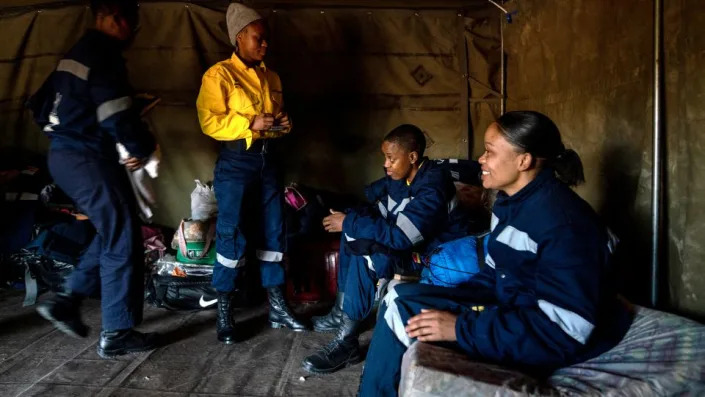
Firefighters from at least 10 countries, including the US, Mexico, Costa Rica, Chile, Spain, Australia, New Zealand, South Africa, South Korea, and France, have been deployed to assist with the Canadian wildfires since the first week of June.
Firefighters from South Africa are among the crews working in Alberta, Canada, to help with ongoing fire suppression efforts. – Shiraaz Mohamed/AFP/Getty Images
“Canada doesn’t have a lot of firefighting resources,” Gray said. “Individual provinces have their own contracting crews, but they have brought in thousands of folks from outside the country to help.”
One factor contributing to the lack of resources, evident in the current fight against the out of control fires, is funding, Gray acknowledged.
“They don’t typically appropriate a lot of money upfront for firefighting,” he continued. “But once the fires break out, the governments can certainly find all the money necessary to suppress them.”
“International groups keep saying, you need to shift the focus to upfront mitigation and prevention so you’re spending less money on response and recovery,” he added. “It’s ridiculous. We spend billions of dollars once the fire breaks out, but we don’t invest the money upfront to mitigate the fires from happening in the first place.”
Not enough prevention tactics to decrease the number of fires
More work needs to be done to reduce the opportunity for future wildfires, which may someday end in catastrophic tragedy.
One of the most effective fire prevention tactics is through prescribed burns, which are fires set intentionally as part of a forest management plan to reduce the risk of more serious and damaging blazes.
“We don’t do anywhere near enough prescribed burning in BC,” Gray said. “Right now we’re burning about 10,000 hectares a year. The state of New Jersey burns more than we do here at BC.”
Prescribed burns have been an important cultural and environmental tradition in Indigenous communities, who for thousands of years set low-intensity fires to rid the land of wildfire fuel like debris, scrub, undergrowth and certain grasses. Such fuel ignites easily, allowing for more intense flames, which are harder to fight.
The intentional burning practices can increase the forests’ resiliency and decrease the likelihood of future wildfires.
Perrakis echoed Gray’s sentiments: “It would be very useful to have maybe 10 times or 20 times more prescribed burning than what we’re doing presently.”
Since prescribed burns come with liability issues and pose a risk of ending in accidental unmanageable fires if not done correctly and at the right time, this will require more funding from the government and proper training.
“We would be removing the fuel from the fire before there’s even a fire,” Perrakis said. “It wouldn’t be used all across the Canadian countryside, but very strategically around communities and other values and will be in line with the local ecosystem.”
Along with prescribed burns, other tactics, like large scale thinning, need to be ramped up, Gray said.
“We need large scale thinning in these forest types that don’t produce a lot of dimension lumber, so there’s a lot of small trees and we need to come to do something with them,” he added. “We can ship them into the bioeconomy, produce bioenergy markets, engineering, wood products; there’s a lot of things we can do with low value wood, and that’s a lot of what’s out there burning up right now.”
The ecosystem depends on fires, and climate change is making them worse
Fires have always served a vital ecological purpose on Earth, essential for many ecosystems. They restore soil nutrients, helping germinate plants and remove decaying matter. Without fires, overgrown foliage like grasses and shrubs can prime the landscape for worse flare-ups, particularly during extreme drought and heat waves.
Most of Canada is covered by boreal forest, the world’s largest and most intact biome. The ecosystem with trees like spruce, pine, and fir makes up about one-third of all forests on the planet.
But it is a fire dependent ecosystem, meaning the species in the forest have evolved in the presence of fire, and fire “is an essential process for conserving biodiversity,” according to the Nature Conservancy.
“We have records as far back as the 1700s and 1800s of yellow sky and black sky and smoky sky days.” he added. “It’s the natural cycle of the boreal forest. There really isn’t much Canadian fire management agencies can do, even if they wanted to.”
While natural fires in the system have always been present and are usually caused by natural elements like lightning, climate change is making them more frequent, increasingly unmanageable, and a lot more difficult to prevent.
One year ago, after enduring a record-breaking temperature of 121 degrees, the British Columbia village of Lytton was leveled by a wildfire, drawing stark attention to the effects of climate change.
Heat-trapping emissions have led to hotter and drier conditions, and wildfires now burn longer and are becoming hotter in places where they have always occurred; meanwhile, fires are also igniting and spreading in unexpected places.
“We know that the weather is the most important ingredient of fire behavior, and climate and weather are linked,” Perrakis said.
Another issue is the increase in the wildfires are caused by climate change, and are simultaneously making climate change worse.
“Things are changing due to climate change, and that’s catching everyone somewhat by surprise, even though we’ve been talking about it for decades,” Perrakis said. “It takes a big season like this one for everyone to really wake up to what climate change looks like. It’s pretty undeniable.”
As Canadians near the fires evacuate while firefighters try to save their homes and communities, other, bigger fires burn freely with no way to control them, and people in the US will continue breathing in unhealthy smoke.
It all begs the question: When will it end?
“People should probably get used to it, because it’s not something that has come out of nowhere,” Perrakis said. “Climate change is undeniable, and now it’s time to think about the future, 10 or 20 years down the line, and what needs to be done.”
Idaho Republican Party’s rule changes have a precedent: The Soviet Politburo | Opinion
The Editorial Board – June 30, 2023
Ryan Suppe
Imagine Rep. Jane Smith voted against a bill to censor public libraries.
Returning home to her rural Idaho district, she is ordered to appear before the Central Committee, where Party officials pepper her with questions. Her answers are unimportant.
The Central Committee announces the decision it made weeks ago: Smith will be cast out, the fact that she won the support of 70% of voters in the last election notwithstanding.
Because the requirement for wielding power is not loyalty to the people who elected you, but loyalty to the party bosses.
This isn’t a scene from the Soviet bloc. It’s the Idaho Republican Party’s immediate plan for running politics in the Gem State under the guidance of Premier Dorothy Moon, a plan it moved at its summer meeting in Challis to begin implementing with a series of rules.
As Melissa Davlin of Idaho Public Television reported, the party passed resolutions that include allowing central committees to summon, censure and even revoke the right of lawmakers to run as Republicans; revoking the voting privileges of the Young Republicans, College Republicans and Republican Women; supporting a constitutional amendment to allow the party to control the primary; and issuing a vote of no confidence in Gov. Brad Little and a number of Republican House members for failing to support library censorship.
The organizing logic is simple: Whatever power there is, it ought to belong to the Party.
Whatever power these ideologically extreme and power-hungry Party bosses successfully take, it will come at the expense of Idaho voters.
Because policy positions favored by huge numbers of Republican voters in Idaho are formally verboten under the Idaho GOP’s official platform.
If a Republican lawmaker doesn’t sign on to a proposal to revoke your right to cast a ballot in U.S. Senate elections, they’ve violated the GOP platform, which requires support for revoking the 17th Amendment.
If they support the continued existence of some number of grizzly bears or wolves in Idaho, they’ve arguably violated it as well.
Or if they don’t support a return to the gold standard.
Or if they don’t support the repeal of Medicaid expansion.
Or if they don’t support nullifying the U.S. Supreme Court decision recognizing marriage equality.
Or if they support the right of a child who was raped by a family member to have an abortion, or if they think that such an abortion should be handled in some way other than with a murder charge.
For these and countless other examples of crimethink, the people’s elected officials could be hauled in and stripped of their right to call themselves Republicans by a bunch of people that most Idaho Republican voters have never heard of, much less voted for.
With Idaho’s most powerful party fully hijacked, the open primary initiative seems to be the best bet for keeping the political process under popular control, precisely because it would diminish the political relevance of parties. It would allow everyone to weigh in on which candidates will face off in the general election, regardless of party, and it would allow voters to rank general election candidates in order of preference, so they wouldn’t have to worry they’re throwing their votes away if a third-party candidate is their first choice.
None of this would help people the extremist Party has termed RINOs or secret liberals or any of that nonsense. Conservatives would do well with an open primary and ranked-choice voting system because Idaho is full of conservative voters.
Those elected under such a system would know that it was the people, not the Party bosses, who put them in office. They would know it is the people, not the Party bosses, to whom they answer for their record.
Statesman editorials are the unsigned opinion of the Idaho Statesman’s editorial board. Board members are opinion editor Scott McIntosh, opinion writer Bryan Clark, editor Chadd Cripe, newsroom editors Dana Oland and Jim Keyser, and community member Mary Rohlfing.
Putin says he hopes Prigozhin and his Wagner mercenaries ‘didn’t steal much’ of the billions Russia spent on them
Ryan Pickrell – June 28, 2023
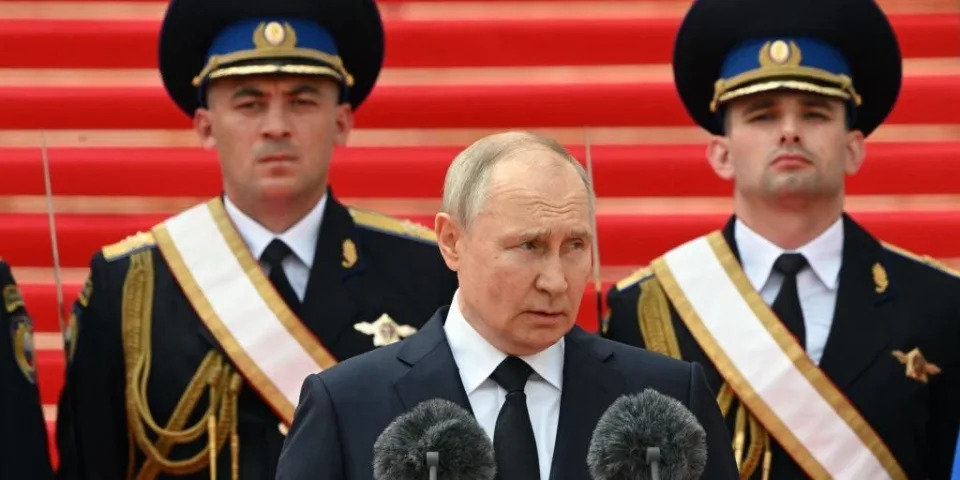
Russian President Vladimir Putin addresses troops from the defence ministry, National Guard, FSB security service and interior ministry gathered on the Sobornaya (Cathedral) Square from the porch of the the Palace of the Facets on the grounds of the Kremlin in central Moscow on June 27, 2023.SERGEI GUNEYEV/SPUTNIK/AFP via Getty ImagesMore
Putin revealed on Tuesday Russia spent billions on Yevgeny Prigozhin and his mercenaries.
He then said that he hopes “no one stole anything — or, let’s say, didn’t steal much.”
Putin’s comment seems to suggest some theft is expected, highlighting the state of corruption in Russia.
After Russian President Vladimir Putin said Tuesday Moscow spent billions on Yevgeny Prigozhin and his Wagner mercenaries, he quipped he hopes they “didn’t steal much” in a telling comment on the corruption running rampant in Russia, as well as potential plans for Prigozhin.
In a meeting just days after Prigozhin called off his rebellion against the Russian Ministry of Defense and his march on Moscow, Putin said that Russia had fully financed Wagner operations between May 2022 and May 2023.
During much of that time, Wagner’s paramilitary forces were engaged in costly, high-intensity warfare in Ukraine, particularly in Bakhmut, while the group’s leader publicly feuded with the defense ministry, specifically the defense minister, Sergei Shoigu, and Valery Gerasimov, chief of the general staff and head of war operations in Ukraine.
On Tuesday, Putin revealed the Russian government spent 86 billion rubles, or roughly $1 billion, on support for Wagner, The New York Times reported, and the Concord catering company founded by Prigozhin, who has been nicknamed “Putin’s Chef,” received roughly 80 billion rubles for supply contracts with the Russian military.
He then hinted at potential consequences for those who may have run off with the money, at least above certain limits. Though he didn’t call out his long-time ally Prigozhin by name, there are indications he could pursue him and others for corruption.
“I hope that in the course of this work, no one stole anything — or, let’s say, didn’t steal much,” the Russian president said, according to a translation from The Times. “But we will certainly get to the bottom of this.”
Corruption is recognized as a serious problem in Russia, where opposition figures with anti-corruption agendas have been jailed for speaking out about illicit operations running all the way to the top. Such was the case for Alexei Navalny, an imprisoned critic of the Kremlin and Putin.
And, in an almost Soviet tradition, it extends beyond just politics into the military as well.
A former Russian air force lieutenant who later worked as an analyst for state media before leaving the country over the war in Ukraine told The New York Times last year, just a few months into the war in Ukraine, “it is impossible to imagine the scale of lies inside the military.”
The man described Russian commanders faking military exercises and then pocketing funds and contractors delivering sub-par systems to skim cash from dedicated budget allocations.
The veteran of the Russian military, Gleb Irisov, told The Times that he saw air defense systems that couldn’t even shoot down small drones, military vehicles that would break down after only a couple of years, and parts on fighter jets that would troublingly melt at supersonic speeds.
“The quality of military production is very low because of the race to steal money,” he said, describing a tradition of problematic rot in the Russian ranks and defense industry.
There is more to Putin’s comments than an acknowledgement of the corruption.
His statement Tuesday on financing for Wagner suggests that the private military company’s employees once celebrated as heroes after their Pyrrhic victory in Bakhmut may still be facing punishment beyond what the Russian leader initially let on.
The full consequences of Prigozhin and Wagner’s revolt remain to be seen.
The Most Nutritious Fish for Your Diet Aren’t the Ones You’d Expect, According to Harvard
Stacey Ritzen – June 28, 2023
The American Heart Association says that adding fish high in omega-3 fatty acids to your diet twice per week can lead to better cardiovascular health, lowering the risk of heart disease and stroke. But while tuna and salmon come to mind for most people as sources of omega-3s, experts are now saying that the most nutrient-rich seafood comes from smaller fish and bivalves such as clams and mussels.
Christopher Golden, professor of nutrition and planetary health at the Harvard T.H. Chan School of Public Health, told MSNBC that incorporating smaller fish and bivalves to your seafood diet can help boost not just your intake of omega-3 fatty acids, but also micronutrients including zinc, iron, and vitamin B12 that many people are deficient in.
Another perk to eating smaller fish is that because you’re often consuming the entire fish—skin and bones included—they are also rich in calcium and vitamin D.
“Of all of the different equestrial and aquatic-based foods, small fish are the best source of nutrients for these types of things on a per-weight basis,” Golden explained. “So, although they are underutilized, they’re really good at delivering those sorts of nutrients.”
As such, Golden recommends eating “lower on the seafood chain,” with herring, mackerel, sardines, anchovies, clams, oysters, mussels, and scallops providing the biggest bang for your nutritional buck.
Experts have long-touted the health benefits of smaller fish including sardines, herring, and mackerel. However, another advantage is that these fish are less likely to have higher levels of mercury found in larger fish.
“Eating the smaller fish, you’re more likely to have a lesser mercury load than some of the larger carnivorous fish,” Golden continued. “Bivalves from healthy waters and small fish is really the direction to go.”
Many smaller fish and bivalves also come canned, which makes them convenient for pantry storage and less expensive than fresh fish. Of course, you’ll want to stick to fish like sardines which are packed in water or olive oil and avoid salt-cured canned fish such as anchovies, which are high in sodium and can actually raise blood pressure.
“You can’t go wrong with sardines,” registered dietitian Julia Zumpano likewise told Cleveland Clinic a few years back. “They’re a wonderful source of omega-3 fatty acids, they’re caught in the wild and they’re cheap.”
A mutiny in photos: Inside Russian mercenary group’s march toward Moscow
Yevgeny Prigozhin, leader of the Wagner Group mercenary army, said he turned around to avoid “shedding Russian blood.”
Dylan Stableford, Senior Writer – June 27, 2023
Fighters of the Wagner Group mercenary army stand on a tank in the city of Rostov-on-Don, Russia, on Saturday. (Stringer/Reuters)
Russian President Vladimir Putin appears for now to have survived what many saw as a coup attempt, striking a deal with Yevgeny Prigozhin, the leader of the Wagner Group mercenary army, which had advanced to the outskirts of Moscow over the weekend.
Prigozhin agreed to call off his drive toward the Russian capital, withdraw forces from the captured city of Rostov-on-Don and leave Russia for Belarus.
But the dramatic show of force left Putin considerably weakened on the world stage, triggering speculation that the episode marked the end of his iron grip on Russia.
Here’s how the weekend unfolded — in photos
Wagner Group fighters in Rostov-on-Don on Saturday. (Stringer/Reuters)
The Wagner Group’s band of mercenaries, which had been fighting for Russia in its war on Ukraine, crossed into southern Russia and seized a military outpost in Rostov-on-Don without a fight.
A Wagner Group fighter in Rostov-on-Don on Saturday. (Stringer/Reuters)
Prigozhin then led his soldiers toward Moscow on a “march for justice“ to remove what he labeled as Russia’s incompetent and corrupt senior military leadership after an alleged strike on a Wagner military camp killed 30 of his fighters.
Military vehicles operated by the Wagner Group in Voronezh, Russia, along the M-4 highway — which links Moscow to the country’s southern cities — as smoke from a burning fuel tank at an oil depot rises in the background. (Stringer/Reuters)Wagner Group fighters during a stop on the highway in Voronezh, Russia, on Saturday. (Stringer/Reuters)The Wagner convoy drives in Voronezh toward Moscow on Saturday. (Stringer/Reuters)
Putin vowed to strike back hard, denouncing Prigozhin’s rebellion as an “armed mutiny” that would be met with a “harsh” response from regular Russian troops.
Russian President Vladimir Putin gives a televised address in Moscow on Saturday. (Sputnik/Gavriil Grigorov/Kremlin via Reuters)
“Any actions that split our nation are essentially a betrayal of our people, of our comrades-in-arms who are now fighting at the frontline,” Putin said in remarks on Saturday morning from the Kremlin, invoking the bloody legacy of the Bolshevik revolution of 1917. “This is a knife in the back of our country and our people.”
Hours later, Prigozhin announced that the column of troops would halt its advance on Moscow in a deal apparently brokered by Belarusian President Alexander Lukashenko, a key Putin ally.
Wagner Group fighters pull out of Southern Military District headquarters in Rostov-on-Don on Saturday night. (Alexander Ermochenko/Reuters)
Prigozhin said his goal was to avoid “shedding Russian blood,” but he did not say if the Kremlin agreed to his demand for replacing Russia’s military leadership.
Wagner Group leader Yevgeny Prigozhin leaves Southern Military District headquarters in Rostov-on-Don on Saturday night. (Alexander Ermochenko/Reuters)Prigozhin, seated in the back of an SUV, leaves Southern Military District headquarters. (Alexander Ermochenko/Reuters)Russian police cars during the Wagner Group’s pullout from Rostov-on-Don on Saturday. (Stringer/Reuters)
On Monday, Russian Defense Minister Sergei Shoigu made his first public appearance since the short-lived mutiny, inspecting troops in Ukraine in a video aimed at projecting a sense of order. But the questions swirling around Moscow continue to mount.
Russian Defense Minister Sergei Shoigu and Col. Gen. Yevgeny Nikiforov talk on board an aircraft at an unknown location on Monday as they visit Russian troops involved in the Russia-Ukraine conflict. (Russian Defense Ministry/Handout via Reuters)
NATO Secretary-General Jens Stoltenberg called the events “yet another demonstration of the big strategic mistake that President Putin made with his illegal annexation of Crimea and the war against Ukraine.”
“I think what we’re seeing in Russia over the last days demonstrates the fragility of the [Putin] regime,” Stoltenberg said Monday. “And, of course, it is a demonstration of weakness.”
A Russian police officer guards the closed Red Square in Moscow on Saturday. (Maxim Shemetov/Reuters)
Wildfire smoke puts Chicago among cities with worst air quality in the world
It’s the latest in a series of smoke invasions from Canada this month.
Ian Livingston – June 27, 2023
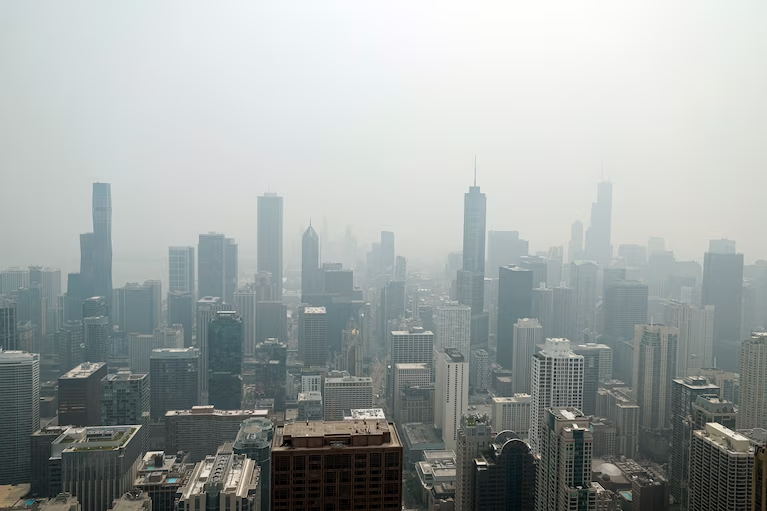
Chicago’s skyline is draped in heavy smoke from the Canadian wildfires on Tuesday. (Kamil Krzaczynski/AFP/Getty Images)
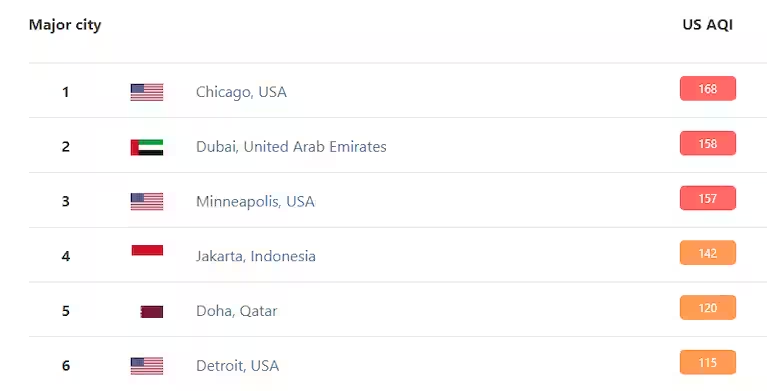
A new round of dense smoke has invaded the United States, specifically the Great Lakes region, as wildfires munch through forests across Quebec and Ontario, with more than 3.7 million acres scorched over the last week in those provinces alone. Throughout Tuesday, Chicago air quality ranked as the worst in the world among major cities.
Minneapolis and Detroit joined Chicago among the 10 worst, all dealing with conditions no better than Code Red. Air quality was even worse in other locations, such as Waukesha, Wis., west of Milwaukee, where the more severe Code Maroon was reached. Grand Rapids, Mich. — which through Tuesday has been between Red and Maroon, at Code Purple — is among places from eastern Iowa through Michigan and into Ontario that have endured air in this bout that is very unhealthy or worse.
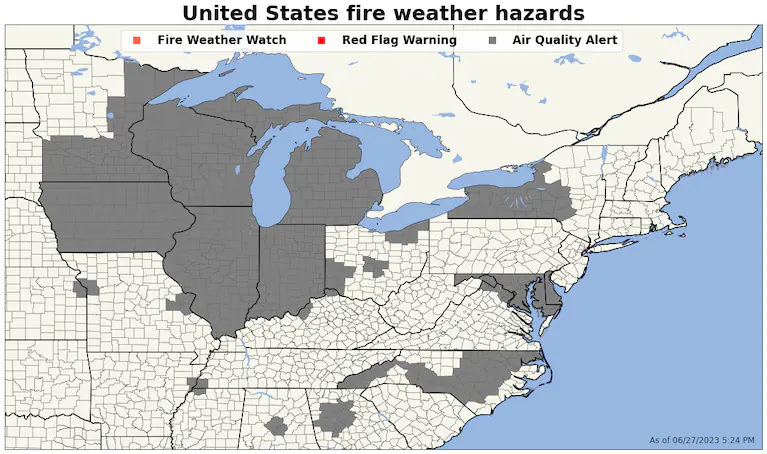
Air quality alerts will be in effect into Wednesday or Thursday from Minnesota and Iowa through most of the Midwest, the Great Lakes region, and into parts of the Northeast, Mid-Atlantic and the Carolinas.
The Air Quality Index (AQI) moves to Code Orange (unhealthy for sensitive groups) at a reading of 101. Code Red (unhealthy for everyone) starts at 151. Once reaching 201, it’s Code Purple (very unhealthy), and finally a Code Maroon (hazardous) begins at 301.
Wildfire smoke’s primary pollutant is often referred to as PM2.5. These are fine particles from burned organic matter less than or equal to 2.5 microns in diameter — a microscopic soot.
The latest on the Canadian wildfires and smoke
Haze obscures the skyline in Cedar Rapids, Iowa, on Tuesday, June 27, 2023. (Nick Rohlman/The Gazette via AP)
A thick pall of smoke was draped from Quebec and Ontario to the southwest, toward parts of the Midwest and Great Lakes region, and began moving into the Ohio Valley and points east in the early evening. The worst of it late Tuesday was centered over Lake Michigan and surrounding states. A particularly thick patch of smoke was approaching Chicago from the north late afternoon.
In Michigan and surrounding areas, it was a mix of smoke and low clouds.
Smoke is visible in this satellite image Tuesday morning. (Colorado State/CIRA)
Air quality values as severe as Code Purple have been recorded in Iowa, Wisconsin, Michigan, Illinois and northern Indiana so far, with an hourly AQI near Milwaukee of 312 and climbing, according to an Environmental Protection Agency monitor late afternoon. The Canadian city of Sault Ste. Marie, on the international border of Michigan, reached an AQI reading Monday night as high as 353, which is Code Maroon. The city was under Code Purple for much of Tuesday.
Many more locations, from eastern Minnesota to the western slopes of the Appalachians, were seeing Code Red conditions. The thickest of the smoke plume had advanced as far east as Cincinnati and Akron, Ohio.
In Chicago, the National Weather Service wrote that “low visibility due to wildfire smoke will continue today. Consider limiting prolonged outdoor activities.”
Visibility in the city was down to two miles, with smoke reported from Chicago O’Hare International Airport. The Weather Service expected visibility of one to three miles across the region for much of Tuesday.
“You can literally smell the smoke in the air today in Chicago from the Canadian wildfires,” wrote a Twitter user.
Into Wednesday, smoke should keep slowly moving east and somewhat south. It should remain in the lower Great Lakes and push into the Midwest or Ohio Valley region. Some of the smoke was beginning to spill over into the Appalachians late Tuesday.
Many such days
The number of days at Code Orange or worse as a result of wildfire smoke continues to increase in the northeastern United States, though that number is comparatively low when examined against areas immediately surrounding the fires in Canada.
Many of these days also saw spikes beyond Code Orange.
U.S. cities among the worst air quality in the world Tuesday morning. (IQAir)
This month but before the current wave, much of western Wisconsin — in the thick again — had already recorded four or five 24-hour readings at Code Orange or higher. It’s a similar story in and around Detroit, with five Code Orange days in the city and up to seven or eight in nearby locations.
Wildfire smoke, air quality and your health
(Photo by AFP PHOTO / Nova Scotia Government) (Handout/AFP/Getty Images)
More than a dozen days at Code Orange or worse have been tallied in June across the hardest-hit spots north of the border, in Ontario and Quebec, especially north and northwest of Ottawa.
The number of bad air quality days may soon increase in the Northeast, as well. The Washington, D.C., region has had two bad air days this month, both Code Red. Much of Pennsylvania and New Jersey and parts of Southern New England have piled up three such days, with a few locations at four or five.
While AQI values in this plume are somewhat lower than they were earlier in the month — when hourly AQI values soared toward 400 in the Northeast — any values of Code Red or above are concerning for the general public.
Smoke’s future travel plans
This round of smoke, like the one June 7-8 that smothered the Northeast, is moving into circulation via a crawling low-pressure area that’s now over the eastern Great Lakes.
In general, winds blow from the east to the north of the low pressure center, pushing smoke westward from the source, before winds out of the north and northwest behind the center push smoke south. As the low pressure inches east, so does the area of smoke it is carrying along with it.
Over the next several days, the low should track through the Mid-Atlantic and offshore along the East Coast. This trajectory is expected to bringsmoke eastward.
Code Red is now in the forecast Wednesday for Buffalo, Pittsburgh, Cleveland and Columbus, Ohio, on the eastern side of the thickest plume. Code Orange is forecast for Syracuse, N.Y., Baltimore, Washington and Raleigh, N.C.
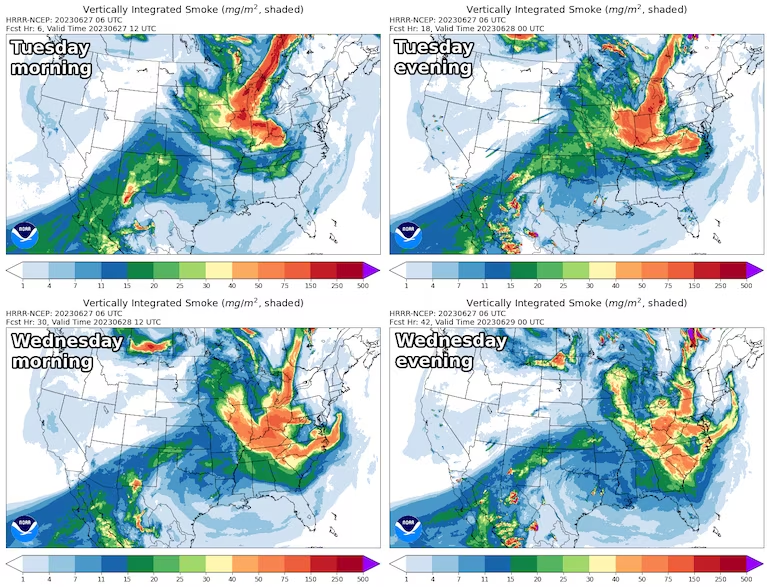
Smoke forecast through Wednesday, from the HRRR weather model. (NOAA)
Higher-level smoke will likely cover a larger area from the northern and central Plains, through the Midwest and Great Lakes region, then through the Mid-Atlantic and as far south as Georgia on Wednesday.
The potential for smoky skies could last into the weekend, although it will probably drop in intensity as the pattern shifts slightly.
Top Doc: “Drinking Too Much Plain Water Can Harm Your Health” — Here’s What to Drink Instead to Have More Energy + Lose Weight
Lisa Maxbauer – June 27, 2023
Just about every doctor and nutrition expert on the planet recommends drinking water. It also seems to be the one thing that every non-expert — from the keto meat eater to leafy-green plant eater — agrees on. And it makes sense, considering that our bodies are made up of roughly 60% water. Still, most of us aren’t sipping enough of the right kind of fluids to optimize our bodily functions. And we’re tired, groggy, constipated and dragging around a few too many pounds as a result.
Indeed, when it comes to women in midlife and older, dehydration has reached epidemic proportions. As many as 95% of women over age 40 are dehydrated, asserts Howard Murad, MD, author of The Water Secret. “As we age, stress, poor diet and environmental toxins damage the body’s cell membranes, weakening their ability to hold water,” he explains. “This damage leads to subclinical dehydration and the exhaustion, headaches, brain fog, mysterious cravings and weight gain that follow.”
But as important as drinking water is to our health, proper hydration can be surprisingly elusive—especially as we get older. As our cell membranes become less able to conduct water into our cells, it takes a special kind of water to attain a true state of hydration. That’s where “electrolyte water” comes in.
What is electrolyte water?
Electrolyte water most commonly includes, well, electrolytes — minerals that carry an electrical charge when dissolved in water to help revitalize the cells in the body and optimize their overall function — like sodium, potassium and magnesium. In fact, electrolyte water is becoming so popular that manufacturers are producing versions in hundreds of flavors and variations — and they’re flying off store shelves.
The Image Party/Shutterstock
What is liquid IV?
One brand of electrolyte powder that has made an unusually large splash is Liquid IV. The name elicits an image of getting a quick infusion of health-boosting nutrients, much like people get intravenously at the hospital, without any painful needles or pokes. Touted as a “hydration multiplier,” this powdered mineral mix comes in individual packets — also called “sticks” — that can be added to bottles or glasses of water.
Each packet promises to deliver hydration two times faster and more effectively than plain water alone. Tests have also shown these packets hold three times more electrolytes than the traditional sports drinks of our youth like Gatorade. Another of electrolyte mix sticks brand popular among keto enthusiasts is LMNT.
These types of ready-made mineral mixes get a thumbs up from hydration experts. “An electrolyte drink mix made without added sugars would be the first thing I’d recommend to help people hydrate effectively and quickly,” asserts Dana Cohen, MD, author of Quench. Her advice: “Start salting your water, not your food.”
Why we need electrolyte water
Electrolytes play a number of crucial roles inside the human body. These nutrients help nerves transmit electrical impulses and support muscle function, preventing muscle cramps and fatigue. Electrolytes also help the body maintain a healthy pH balance and support the kidneys in their crucial role of filtering fluid and toxins.
Nutrition expert Ann Louise Gittleman, PhD,NY Times bestselling author of over 35 books, including The New Fat Flush Plan, explains, “Minerals are the spark plugs of life and adding electrolytes to water is a perfect hydration solution.”
“When we talk about dehydration, we’re often not only losing water, but also electrolytes like sodium and potassium, which are critical for bodily and cellular functions,” explains Dr. Cohen. “In order to properly replenish what we lose through sweat, we need not only to replace water but to replace electrolytes” as happens when drinking an electrolyte water like Liquid IV.
And it’s not just people who exercise who benefit from electrolytes. The body uses up minerals for countless other reasons — like to process alcohol or sugar that we’ve consumed, or when we’re sick or undergoing a medical treatment, when pregnant or breastfeeding or even traveling or stressed.
Electrolyte water versus plain water
“Drinking too much plain water can flush out vital nutrients and electrolytes from our cells and tissues, actually harming our health and limiting our body’s ability to perform,” explains Dr. Cohen. Researchers have found that our cells have a hard time absorbing plain water to undo chronic, low-level dehydration like the kind we may experience every day and not realize.
In fact, when we lack sodium, potassium and magnesium — as many of us do — we’re dehydrated on a cellular level. And by the time we experience noticeable symptoms like thirst or weaknesses, we’ve already been dehydrated for a while. James DiNicolantonio, Pharm.D., author of The Obesity Fix, agrees with Dr. Cohen, saying, “True hydration is replenishing water, plus lost minerals.”
How electrolyte water helps with weight loss
Replacing the body’s minerals by drinking electrolyte water, like Liquid IV, has another perk: It can control cravings. Research shows that when our body is lacking water or minerals, we feel an extra urge to overeat. Dr. DiNicolantonio says, “We seek out food, like a bag of salty chips, to obtain the salt our body demands.”
Dr. Cohen asserts, “Most of the time, when we feel hungry, we’re actually dehydrated.” But that hunger leads us to reach for food, rather than ultra-hydrating liquids, so we lose the ability to sense what true thirst feels like in the body. And this malfunction seems to only worsen over time. Dr. Cohen explains, “After a lifetime of learning to ignore our thirst, the mechanism goes numb.”
When we replace minerals, however, and achieve true hydration, it leads to effortless slimming. The proof: When people in a University of California-Irvine study added electrolytes to their diet, they shed 56 pounds in 6 weeks.
Actress Donna Mills, 82, legendary star of the television show “Knots Landing,” is a fan of electrolyte powers. She told us, “More and more, I’ve become aware of the importance of drinking water for overall health. I try to drink at least two large bottles of water a day. Playing tennis helps — after every couple of games, I go to the side and drink. Exercise reminds me to drink. I like to put lemon wedges or electrolyte powder in the water.”
How to make an electrolyte water even better than Liquid IV
To achieve the deep hydration only possible with mineral-infused water, you can try Liquid IV packets for yourself buy on Amazon ($24.66 for 16 servings) or you can create your own electrolyte mix to add to water at home. For a time-tested recipe, we turned to health and weight-loss guru Jorge Cruise, bestselling author of more than 20 books. For more than 20 years Cruise has been helping women control their cravings and achieve proper hydration. His secret weapon is his homemade recipe for Zero Hunger Water. Follow this recipe to make this DIY electrolyte mix in bulk.
Ingredients:
1/4 tsp. salt (like Redmond Real Salt (buy on Amazon, $10.84)
Combine all the ingredients in an empty water bottle and mix well. Add 16 oz. of filtered water and shake. Sip throughout the day to quell cravings, refilling as needed. Each bottle contains roughly 500 mg. of sodium, 500 mg. of glycine, 200 mg. of potassium and 60 mg. of magnesium. For optional flavor, add 1 packet of TRUE orange, grapefruit or lime crystalized flavoring and sweeten with stevia or monk fruit to taste. You can also add this mix to other beverages such as iced tea or mocktails.
Cruise recommends drinking around 32 ounces of electrolyte water every two hours. As always, women with high blood pressure should consult their doctor before changing their sodium intake.
While three electrolytes — sodium, potassium, and magnesium — in this recipe are familiar to most of us, one thing on the list may sound new: the amino acid glycine. “Glycine improves the absorption of sodium, so it strengthens the hydration abilities of electrolyte water to turn off false hunger,” says Dr. DiNicolantonio. That’s why Cruise has added glycine to his slimming Zero Hunger Water recipe. Cruise finds, “Glycine makes electrolyte water three times more powerful in giving people radical hunger control.”
Real-world proof of the slimming power of electrolyte water
Cruise is amazed by the slimming results he’s seen in his clients who use this electrolyte water recipe. “I think of it as the over-50 fat cure,” says Cruise, who routinely witnesses clients lose up to 2 pounds a day following his hydration advice. In fact, Sandy Rosser, 60, of Fayetteville, N.C, lost 95 pounds with Cruise’s electrolyte water. She shares, “Calorie counting never addressed the root of my problem, which was mineral deficiency!”
Cruise sums it up, saying, “If you’re always craving carbs, sweets or salty snacks, it’s actually ‘false hunger’ triggered by an electrolyte imbalance.”
For more information, listen to Jorge Cruise’s “Zero Hunger Guy” podcast and sign up for his free Zero Hunger Water Club and receive support at ZeroHungerWater.com.






 Haze obscures the skyline in Cedar Rapids, Iowa, on Tuesday, June 27, 2023. (Nick Rohlman/The Gazette via AP)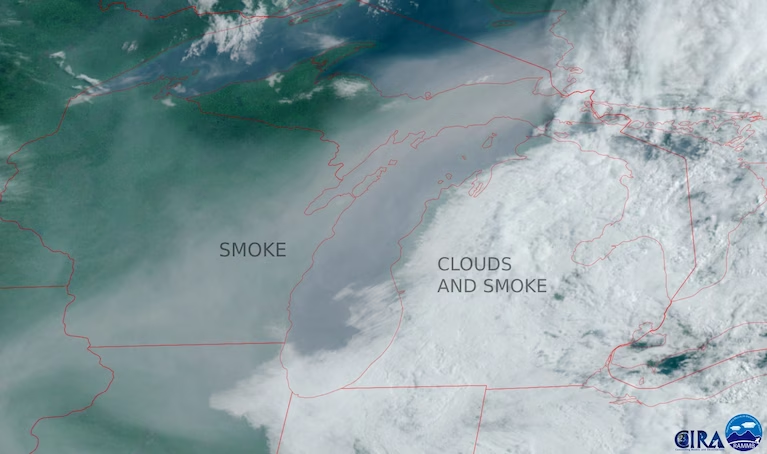
 (Photo by AFP PHOTO / Nova Scotia Government) (Handout/AFP/Getty Images)