Al Franken blasts Supreme Court: It’s ‘illegitimate’
Julia Mueller – May 1, 2023
Al Franken blasts Supreme Court: It’s ‘illegitimate’
“The court is a very divisive entity now, institution right now. And the Supreme Court, to me, is illegitimate,” Franken said on “The Al Franken Podcast” in conversation with The Washington Post’s Dan Balz.
Former Sen. Al Franken (D-Minn.) is calling the Supreme Court “illegitimate” and Chief Justice John Roberts a “villain,” citing a number of controversies surrounding the nation’s highest court.
Franked resigned from the Senate in 2017 amid sexual harassment allegations.
“The way they didn’t take up [Obama nominee Merrick] Garland and on saying, ‘It’s an election year,’ and then they, of course, put in Coney Barrett like eight days before the election. Then, of course, Dobbs and abortion.”
Balz said the court has “lost credibility” and has become “seen increasingly as one more partisan institution,” though he noted Roberts has tried to counter that perception.
“I think the Chief Justice is actually much more culpable for this division than people think,” Franken said, referencing some of Roberts’s decisions. “I think Roberts is much more the villain in this than people give him credit for.”
Polling has indicated a decline in Americans’ trust that the Supreme Court, with its nine lifetime-appointment Justices, is nonpartisan.
Franken’s comments also come amid new scrutiny over the Supreme Court’s ethics standards after reporting from ProPublica found Justice Clarence Thomas failed to disclose a series of luxury trips he’d taken, paid for by Republican donor Harlan Crow, and revelations that the same Texas billionaire had paid for the home Thomas’s mother was living in.
Trump Lawyer Joe Tacopina’s Terrible Cross-Examination Gets Even Worse
Mitchell Epner – May 1, 2023
Michael M Santiago/GettyImages
During more than a full day of cross-examination of E. Jean Carroll, Joe Tacopina, Donald Trump’s lead trial lawyer, gave an object lesson on how NOT to conduct a cross-examination in federal court.
The first day of cross-examination was bad. Day two was even worse. If a juror believed E. Jean Carroll’s direct testimony that she was raped by Donald Trump, Tacopina gave that juror precious little reason to reconsider that conclusion.
Before court even started Monday morning, Tacopina filed an 18-page motion for a mistrial, contending that Judge Lewis Kaplan–who is overseeing the case–had violated Trump’s rights by repeatedly ruling against Tacopina pre-trial and during the first day of cross-examination.- ADVERTISEMENT -https://s.yimg.com/rq/darla/4-11-1/html/r-sf-flx.html
Tacopina acted as if Judge Kaplan was a batter who had dug in too closely to home plate, and he could use the motion as a “brush back” pitch to get Judge Kaplan to give Tacopina more leeway. The motion literally asked Judge Kaplan to either declare a mistrial or reverse virtually all of his evidentiary rulings.
This motion never had a chance of success. At best, it was performative–designed to give Tacopina the chance to demonstrate to Trump that he was trying his best to get Judge Kaplan to reverse himself. If Tacopina actually believed that the motion had any prospect for success, he is not nearly as formidable a trial attorney as I thought he was.
Predictably, Judge Kaplan ruled against the motion with a single word: “Denied.” During the rest of the day’s proceedings, Judge Kaplan made comments that underscored that he was not amused by the motion.
But that was just the beginning of the blunders.
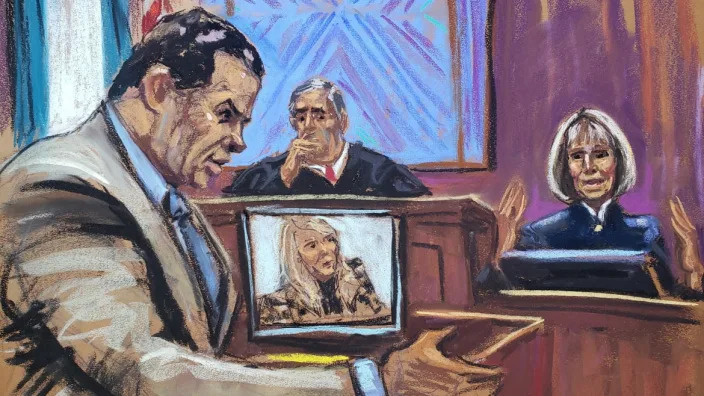
Joe Tacopina, lawyer of former U.S. President Donald Trump, questions former Elle magazine advice columnist E. Jean Carroll before U.S. District Judge Lewis Kaplan.Jane Rosenberg/Reuters
Tacopina Violated Cardinal Rules Of Cross-Examination
One of the central rules of cross-examination is to never reinforce the testimony that the witness provided during direct testimony. This is difficult, because it is a challenge to remind the jurors of the testimony that the attorney intends to discredit without recapitulating that testimony.
The best cross-examination usually avoids this problem by using this formulation: “When you said [prior testimony] on direct examination, that was not the truth, was it?” The witness will either defend the prior testimony or appear confused. Good cross-examination will then lay out, in simple and direct assertions (phrased as questions), why the prior testimony had to be false.
Tacopina did precisely the opposite. He spent minutes at a time giving Carroll the opportunity to repeat her direct testimony. When he then tried to debunk it, he rarely had anything of substance to convince the jury that she must have been lying. Rather, he repeatedly just tried to get Carroll to admit that her testimony was “incredible” or “extraordinary”. Once she admitted that she found it amazing that she went from bantering with Trump to being a rape victim in the course of a couple of minutes, he had no place left to go.
Tacopina also forgot the cardinal rule to never ask a question where you don’t know the answer.
Anyone who watches an episode of Law & Order (more on that shortly) knows that an attorney should never ask a question on cross-examination where they do not already know the answer (and have the evidence to control the witness).
Tacopina, however, repeatedly asked questions where it was clear he had no idea what the answer would be. During the first day of cross-examination, he jousted with Carroll about a SNL skit that she had written, which he clearly knew nothing about. On Monday, he did more of the same, asking about a text message to “Carol Martin” (who will testify for Carroll), when the text exchange was actually with “Carol Martin’s daughter Courtney”. Even after he was corrected, Tacopina repeated his assertion that the message was to Carol Martin.
Q: OK. This, in fact, was a text message that you had sent to Carol Martin, correct, and then to pass on to her daughter?
A: No.
Q: This was directed to her daughter?
A: Yes. I wrote directly to her daughter.
Q: So, with that adjustment in my question, that this was sent to Ms. Martin’s daughter, what you wrote was true?
A: Yes.
Tacopina Lost Control
Another rule for strong cross-examination is to never lose control of the courtroom. A good attorney will command the attention of the jury, using the witness as a prop who can only say “yes” when the attorney finishes a leading question with only one possible answer.
Instead, Tacopina ceded control to a video, playing an entire segment (over 10 minutes) of a CNN interview where Carroll talked to Anderson Cooper about being raped by Trump. Tacopina’s client, Trump, has repeatedly stated that he believes that anyone who watches the segment would conclude that Carroll must be lying. Instead, Tacopina gave the jury the opportunity to see Carroll once again cogently describe being sexually assaulted by Trump. While the video was playing, Tacopina was literally reduced to being an observer.
During my more than 25 years as a trial attorney, I have appeared before Judge Kaplan several times. He does not suffer fools gladly. During Monday’s cross-examination, Judge Kaplan frequently treated Tacopina as a fool who did not know the basics of the rules of evidence. He sustained several objections to lines of questions, just as Tacopina thought he was about to score points.
Virtually every time that Tacopina tried to use snide comments or repetition to undercut Carroll’s credibility, Judge Kaplan sustained objections or simply told Tacopina to “move along.”
In the courtroom, jurors typically look to the judge for guidance on how to regard the proceedings. When Judge Kaplan showed such disdain for Tacopina’s blustering and preening, he gave the jurors permission to disregard Tacopina’s questions as improper.
Tacopina Had A Few Scattered Successes
Tacopina had about five minutes of strong cross-examination. The problem was that it was hidden in about eight hours of ineffective questioning. His best questions were when he used Carroll’s own words (either from deposition or televised interviews) to rebut some of her direct testimony. For example, Carroll testified on direct that the rape by Donald Trump was the reason that she never had sex again.
Tacopina got Carroll to admit that she had previously stated during a podcast: “Well, after the episode in Bergdorf’s, I never had sex again, but I think it wasn’t because of him. I think it was I just didn’t have the luck to meet that person who would be desirous again. I think maybe in that dressing room my desire for desire was killed, but I think if I had met somebody, had the good luck to meet somebody, I think I would have been revived again. I think the desire would have boiled up again. I just think I’ve been unlucky.”
Had Tacopina limited himself to similar excerpts, I believe that he would have had a much greater impact in undercutting Carroll’s credibility.
Re-Direct of Carroll Brought Home Her Central Allegation
One of the fundamental trial rules is that after cross-examination, the witness’ attorney has the opportunity to “rehabilitate” the witness through re-direct. Carroll’s attorney, Michael Ferrera, did a spectacular job. He gave Carroll the opportunity to directly address the insinuation on cross-examination that she had conjured up a rape allegation against Trump on the basis of an episode of Law & Order SVU that included a rape at Bergdorf Goodman.
Carroll testified that she never saw that episode or had never heard of it until she received an email (after she filed suit) telling her about it, and that she still did not know what happened in that episode.
More importantly, Carroll had the opportunity to again clearly state that Trump had raped her. She again testified that she could still feel the pain from when Trump sexually assaulted her. Her testimony was unshaken, even after two days of cross-examination.
A good cross-examination takes less than 30 minutes. The cross-examiner makes a few powerful points, which the witness cannot deny and re-direct cannot rehabilitate. By that standard, Tacopina conducted a very poor cross-examination. Whatever credibility the jurors thought Carroll had after she finished her direct testimony, they likely still believe that she has now.
They Refused to Fight for Russia. The Law Did Not Treat Them Kindly.
Neil MacFarquhar – April 30, 2023
Pedestrians walk past a patriotic mural dedicated to victory in World War II, in Moscow, Feb. 17, 2023. (Nanna Heitmann/The New York Times)
An officer in the Federal Guard Service, which is responsible for protecting Russian President Vladimir Putin, decided last fall to avoid fighting in Ukraine by sneaking across the southern border into Kazakhstan.
The officer, Maj. Mikhail Zhilin, disguised himself as a mushroom picker, wearing camouflage and carrying a couple of small bottles of cognac so that he could douse himself and then act drunk and disoriented if he encountered the Russian border patrol.
In the dark, the lean, fit major navigated across the forested frontier without incident, but he was arrested on the other side.
“Freedom is not given to people that easily,” he told his wife, Ekaterina Zhilina, months later, after Kazakhstan rejected his bid for political asylum and handed him back to Russia to face trial for desertion.
“He had these romantic notions when he first began his military-academic studies,” Zhilina said in a recent interview, describing perceptions drawn from Russian literature about the honor and pride inherent in defending your homeland. “But everything soured when the war started.”
Zhilin is among the hundreds of Russian men who faced criminal charges for becoming war refuseniks since Moscow’s full-scale invasion of Ukraine last year. Some dodge the draft, while those already serving desert or refuse orders to redeploy on the bloody, chaotic battlefields of Ukraine.
In 2022, 1,121 people were convicted of evading mandatory military conscription, according to statistics from Russia’s Supreme Court, compared with an average of around 600 in more recent years. Before the war, a vast majority were fined, not imprisoned. Russia recently passed a measure making it much harder to avoid a draft summons.
In addition, criminal cases have been initiated against more than 1,000 soldiers, mostly for abandoning their units, according to a broad court survey by Mediazona, an independent Russian news outlet. Anticipating the problem in September, when several hundred thousand civilians were mobilized, Russia toughened the penalties for being AWOL.
The maximum sentence was doubled to 10 years for what is euphemistically called “Leaving for Sochi.” (SOCH is the Russian acronym for AWOL, but the expression is a play on the name of Sochi, a Black Sea getaway for the country’s elite and site of the 2014 Winter Olympics.) Refusing an order to participate in combat carries a sentence of three to 10 years.
That has not stopped Russian men from going to unusual lengths to avoid fighting. One officer said he took a bullet in the leg as part of a pact among several soldiers to shoot one another and then claim that they were wounded in a firefight. Hailed as a hero for various battlefield events, it took him six months to recover, at which point he decided to flee.
The Kremlin has shrouded in secrecy an increasing amount of information about the military, including new statistics about crimes involving military service, so the numbers are undoubtedly higher than what is available. But the number of AWOL cases accelerated after the general mobilization, according to Mediazona. Many criminal cases involve soldiers who refused orders to enter battle, leading to confrontations with their commanders, according to several lawyers who defend soldiers.
One lawyer, Dmitri Kovalenko, was retained by the families of more than 10 soldiers who said they were thrown into pits, called “zindans,” near the front line after refusing to fight. “People realize that they are not ready — that their commanders are not ready, that they have to go in blind, not knowing where or why,” he said.
Intimidation is the first response of commanders, he said, so treatment can be harsh. Two soldiers whom he defended were locked into a container last summer without food or water, he said. At one point, about 300 conscripts who refused to fight last year were held in a basement in eastern Ukraine, where they were threatened, called “pigs,” not fed and not allowed to go to the toilet or to bathe, according to Astra, an independent news outlet, and other Russian news media organizations, quoting relatives. The Wagner mercenary group has threatened to execute its refuseniks, and there have been scattered reports of them being shot.
In theory, Russian law allows for conscientious objectors performing alternative service, but it is rarely granted. Sometimes those charged with refusing to fight are given suspended sentences, which means they can be redeployed.
The officer who was shot in the leg by his colleague had pursued a military career since he was 9 and a cadet, he said, but he wanted it to be over the minute he was ordered into Ukraine. He ended up staying about three months, appalled by the very idea of the war as well as by the terrible state of the Russian military.
Soldiers were not provided basic items like underwear, he said, and few knew how to navigate and got themselves killed.
“There are no saints on either side,” said the officer, who spoke on the condition that he not be named, nor his location published, out of concern that Russia might seek his extradition. “The locals were actively partisan. I shot back. I didn’t want to die.”
After he recovered, and the military ordered him back to Ukraine, he decided to run.
“I’m ready to die for Russia, but I don’t want to fight, to risk my life for the criminals who sit in the government,” said the officer, who is now on a wanted list in Russia.
Another Russian, a member of the Sakha ethnic group concentrated in the Siberian region of Yakutia, also deserted. Five days among the drunken, newly mobilized soldiers at an army camp convinced him to leave.
The man, who also insisted on anonymity, was fired from his construction job so that he could go fight. Packed onto an airplane, the draftees discovered their destination for training by looking at their phones when they landed. Most soldiers drank constantly, he said in an interview. One night in another barracks, he said, a soldier stabbed another to death.
The conscript said that the racist attitude of his Russian officers when he did his military service a decade earlier had soured him on the military — they called him “reindeer herder” because of his ethnic Siberian background. He said he was subjected to similar comments as soon as he mobilized. Things deteriorated further after he tried to bribe his lieutenant to leave. The officer mocked him openly as a coward.
His mother flew in to extract him, directing a taxi to a hole in the base’s fence. After he fled the country and was charged with desertion, he faced fierce criticism from home, he said, with authorities saying that he had disgraced the Sakha people. Even a close friend threatened to beat him up.
Some Russian courts still publicize military cases to create a chilling deterrent to potential deserters. In the spring, for example, a court announced that a sailor who had gone AWOL twice had been sentenced to nine years in a prison colony.
The Krasnoyarsk Garrison Military Court released a photograph and a statement in December showing dozens of soldiers crowding a courtroom to watch an AWOL case. The sentence was pronounced before that audience “for preventive purposes,” the statement said.
In the Belgorod region near the Ukrainian border, two soldiers were detained on a parade ground in November and charged with refusing to obey a deployment order. They were called out of the ranks, handcuffed and thrown into a paddy wagon in front of their unit, all shown on a video posted on the Telegram messaging app. Earlier this month, both were sentenced to three years in prison, according to Russian news media reports.
Well before the war, Zhilin, 36, the soldier who left for Kazakhstan, had become disenchanted with the very administration he was assigned to protect. An engineer, he worked in the Siberian city of Novosibirsk for the presidential security service, supervising the Kremlin’s communications lines with the eastern parts of Russia.
The assassination of Russian opposition leader Boris Nemtsov in 2015 and the poisoning of Alexei Navalny in 2020 had drawn his attention, his wife said. He started following political news more closely.
He weighed quitting, but decided he could endure the two years until he received a pension. Then came the war. “‘It is one thing to suppress human rights,’” his wife quoted him as saying, “‘it is quite another to kill people.’”
In the fall, before the mobilization, he had visited the cemetery where his mother is buried. He found 30 new graves of riot police officers who had fought in the war. The ribbon on one small wreath said just “Daddy.”
Two colleagues had already died in Ukraine, and he wondered if his son, 11, and daughter, 8, might one day make a similar wreath. When the mobilization was announced, he quickly decided to leave the country.
Since his security clearance gave him access to state secrets, leaving was prohibited. He decided to cross on foot while his family drove into Kazakhstan legally.
But the plan went awry. Lacking a cell signal, he could not find their car. He was arrested after stumbling upon a Kazakh border officer. He requested political asylum, but in December, he was deported.
In March, he was sentenced to 6 1/2 years in a penal colony and stripped of his rank.
Right after he was deported, his wife, fearing that she and the children would also be sent back, sought and received political asylum in France.
So far, her husband has not been mistreated, she said. The couple, although bitter toward Kazakh authorities, consider the sentence a far better alternative than dying in Ukraine.
“Mikhail wrote me that he feels morally freer than he was,” she said, adding that he told her, “‘I guess you have to pay a certain price for the freedom to think and to say what you want.’”
A law school named after the late Antonin Scalia is a haven for conservative Supreme Court justices to enjoy lavish treatment, New York Times reports
Hannah Getahun – April 30, 2023
AP
Antonin Scalia Law School at the Virginia-based George Mason University was renamed in 2016.
The renaming was part of a plan to help its reputation by getting closer to the Supreme Court.
Justices were given notable benefits to teach there, emails obtained by The New York Times reveal.
A conservative law school looking to rebrand into a powerhouse institution buttered up conservative Supreme Court Justices with excessive benefits and good pay, documents obtained by The New York Times show.
Because justices are legally allowed to make money outside of the court in limited ways, including through teaching opportunities, Antonin Scalia Law School at George Mason University, which was renamed after the late judge in 2016, offered justices Neil Gorsuch and Clarence Thomas teaching roles in remote locations like Iceland and Italy, as well as salaries sometimes upwards of $30,000 for two weeks of teaching, the NYT reported.
According to the NYT, the judges were treated well, with lodging and trip planning arranged by the school. University officials told Gorsuch in 2017, before a teaching trip to Italy, that he would only be required to teach in the mornings, leaving the rest of the day to explore the country, according to the emails obtained by the Times. Upon hearing this news, Gorsuch replied, “Fantastico!”
Even liberal justices were enamored by the treatment, according to the Times, with Justice Elena Kagan, who once spoke at the university, saying the law school “seems like a really good place to be.”
Amanda Frost, a law professor at the University of Virginia, spoke with the NYT and described the teaching jobs as appearing to be “all-expenses-paid vacations, with a little teaching thrown in.”
The law school began its relationships with the court following a renaming ceremony — planned by the school’s dean and Republican megadonor Leonard Leo — in 2017, where multiple justices attended and spoke. According to internal emails from university leadership, these relationships were explicitly made to help build the school’s reputation.
“Establishing and building a strong relationship with Justice Gorsuch during his first full term on the bench could be a game-changing opportunity for Scalia Law, as it looks to accelerate its already meteoric rise to the top rank of law schools in the United States,” one email from the university law school read, according to the NYT.
The law school’s staff, many of whom worked directly with the justices, often filed amicus briefs with the court, and court staff helped to handle school duties — despite not being allowed to do so — revealing how the justices’ jobs frequently entwined with their outside work at Scalia Law.
This desire to keep Supreme Court leadership on their roster even superseded scandals the judges faced. Following the sexual misconduct allegations Brett Kavanaugh faced right before he was appointed, Butler assured the justice protests from students against the soon-to-be law professor on campus had nothing to do with the law school, according to the NYT.
A new report from Insider’s Mattathias Schwartz found that the wife of Chief Justice John Roberts made millions as a legal recruiter for law firms, according to a whistleblower who worked with him.
Despite this extra scrutiny over conflicts of interest, legal experts told Insider there isn’t much that can be done to hold justices accountable.
The Antonin Scalia Law School and a spokesperson for the Supreme Court did not immediately respond to Insider’s request for comment.
Here’s everybody with stricter ethics rules than the Supreme Court
Rick Newman, Senior Columnist – April 27, 2023
Ponder this: Most journalists at mainstream news organizations face far tougher ethical rules than the nine Supreme Court justices who decide monumental issues that directly affect the lives of millions of Americans.
The Associated Press’s rule on gifts allows its journalists to accept nominal offerings worth no more than $25 from anybody who could plausibly be the source of subject or a news story—even if it’s a personal friend. Most news organizations follow the AP guidelines or have a similar code.
There are no such rules at the Supreme Court. A troubling exposé by ProPublica recently revealed that Justice Clarence Thomas has accepted numerous lavish gifts from real-estate magnate Harlan Crow, including an Indonesian yachting trip worth as much as half-a-million dollars. Thomas also sold real-estate to Crow in what looks like a sweetheart deal for the jurist. Thomas’s fellow conservative, Justice Neil Gorsuch, also profited from a property deal with a wealthy friend, as if there’s some secret real-estate agency that only serves nine exalted judges, allowing them to avoid the vicissitudes of the normal market.
FILE – Members of the Supreme Court sit for a new group portrait following the addition of Associate Justice Ketanji Brown Jackson, at the Supreme Court building in Washington, Oct. 7, 2022. Bottom row, from left, Associate Justice Sonia Sotomayor, Associate Justice Clarence Thomas, Chief Justice of the United States John Roberts, Associate Justice Samuel Alito, and Associate Justice Elena Kagan. Top row, from left, Associate Justice Amy Coney Barrett, Associate Justice Neil Gorsuch, Associate Justice Brett Kavanaugh, and Associate Justice Ketanji Brown Jackson. (AP Photo/J. Scott Applewhite, File)
Thousands of US businesses and most of the federal government follow ethics guidelines meant to sustain trust in those organizations, protect their integrity, and prevent self-dealing. Nobody pretends those guidelines are perfect. People cheat. Businesses play dirty. Bosses cover up wrongdoing. But a basic code of ethics protects against legal liability and bolsters morale at most organizations in the country.
“Most companies take the code of ethics seriously,” says Rue Dooley, a knowledge adviser at the Society for Human Resource Management. “It’s a good way to regulate certain behaviors. It’s about building trust, sustaining credibility with vendors, clients, customers, patients, and stockholders.”
The executive branch of the federal government has an exhaustive set of rules governing what’s permissible, covering gifts, outside income, investments, property, financial disclosures, conflicts of interest and many other things. There’s a whole agency, the Office of Government Ethics, whose job is to oversee and enforce ethics rules in the executive branch.
The House of Representatives has a detailed code of ethics, with any gift valued at more than $250 requiring approval of the House Ethics Committee. In the Senate, the limit on gifts is $50. Both codes clarify what counts as a “personal friendship,” including possible conflicts of interest. The federal judiciary has its own code of ethics, with the same $50 gift limit as the Senate.
The Supreme Court, by contrast, is uniquely unbound by any behavioral rules. With the court under fire, Chief Justice John Roberts published an unusual note on April 25 outlining what he called the “foundational ethics principles” the justices follow. “The Justices … consult a wide variety of authorities to address specific ethical issues,” he wrote. These include guidelines for other judges and federal employees, various laws, scholarly articles, disciplinary decisions and advice from colleagues.
There are a couple of problems with Roberts’s reasoning, however. First, there is no single document or set of documents that represents the court’s code of ethics. If you go looking for it, you won’t find it. That’s an obvious recipe for confusion. Justice Thomas responded to the ProPublica exposé saying that years earlier, he “sought guidance from my colleagues and others in the judiciary and was advised that this sort of personal hospitality from close personal friends … was not reportable.” This would never fly in an organization with a formal policy and a process for approving or disapproving gifts.
That gets to another problem with the court: There’s no ethics enforcement mechanism. In virtually every other organization, somebody has the power to rule yes or no on a dodgy ethics question. In Congress, it’s the ethics committees. In the rest of the federal judiciary, there’s a chief judge or some other authority. At companies, bosses leading up to the CEO decide what’s acceptable, and they’re accountable if something goes wrong. At the Supreme Court, the chief justice has no such authority over any other justice. Justices are literally answerable to nobody. Roberts acknowledged this in his April 25 memo, pointing out that the organization that oversees other federal courts does not have jurisdiction over the Supreme Court.
Thomas claims that his rich buddy Harlan Crow is a “close personal friend who did not have business before the court,” at the time Thomas went on all-expense-paid luxury trips with him. A proper ethics inquiry would likely shred this defense. Crow is a politically active conservative who, along with his wife, has donated nearly $15 million to candidates and causes during the last 30 years. Almost all of that went to Republicans. During that time the court has heard numerous cases Republicans took a position on, such as three challenges to the Affordable Care Act, several matters involving former President Donald Trump, and the current legal challenge to President Biden’s effort to forgive student debt. Saying a major Republican donor has no interest in Supreme Court outcomes is either woefully naïve or completely disingenuous.
The Roberts defense is “wholly insufficient,” says Gabe Roth, executive director of Fix the Court, a nonprofit that advocates for more judicial accountability. “The Supreme Court should agree, or Congress should require them, to follow all the same rules on gifts, travel, and personal hospitality that Congress has to follow.”
A new bill in Congress would do just that. The Supreme Court Code of Conduct Act would require the court to adopt a formal set of ethics rules, appoint somebody to enforce them and publish an annual report on any violations or complaints about questionable activity by the justices. Prospects are dim, however, since Republicans who control the House are generally opposed. For the foreseeable future, the Supreme Court will govern itself and enjoy fewer strictures than most of the Americans it supposedly serves.
Disney sues Florida’s DeSantis for ‘weaponizing’ government
Dawn Chmielewski and Lisa Richwine – April 26, 2023
FILE PHOTO: Walt Disney World Resort in Orlando
(Reuters) -Walt Disney Co sued Florida Republican Governor Ron DeSantis on Wednesday, asking a court to overturn state efforts to control Disney World and intensifying a battle between a global entertainment giant and a likely White House contender.
In its lawsuit, Disney accused DeSantis and his supporters of illegally using the state government to punish a company for voicing an opinion that should be protected by free-speech rights.
The skirmish began last year after Disney criticized a Florida measure banning classroom discussion of sexuality and gender identity with younger children. DeSantis repeatedly attacked “woke Disney” in public remarks.
Florida lawmakers passed legislation that ended Disney’s virtual autonomy in central Florida where the Disney World theme parks attract millions of visitors each year.
In the action filed in federal court in Tallahassee, Disney said it aimed to protect Disney World’s employees, guests and developers from “retaliation for expressing a political viewpoint unpopular with certain State officials.”
“Disney now is forced to defend itself against a State weaponizing its power to inflict political punishment,” the company said.
Last year, Disney’s then-chief executive, Bob Chapek, said the company opposed a bill formally known as the Parental Rights in Education Act. Critics called it the “Don’t say gay” law.
Disney’s lawsuit alleges that a newly formed DeSantis-appointed tourist board violated the company’s contract rights, and did so without just compensation or due process. The company is asking the court to declare Florida’s legislative action unlawful.
DeSantis has argued that Disney, which employs roughly 75,000 people in Florida, had been enjoying unfair advantages for decades.
“We are unaware of any legal right that a company has to operate its own government or maintain special privileges,” DeSantis spokesman Jeremy Redfern said Wednesday on Twitter.
The governor is currently traveling in Asia on a four-country trade mission.
Disney shares fell 1.4% to close at $96.61 on the New York Stock Exchange on Wednesday.
POLITICAL RISK
DeSantis’ clash with Disney has been a centerpiece of his speeches as he toured the United States ahead of his expected presidential bid. But as the battle has intensified, it has brought mounting political risk.
Former President Donald Trump, the favorite for the Republican nomination, has slammed DeSantis’ stance, saying on social media that the governor “is being destroyed by Disney” and warning that the company would reduce its investments in Florida.
Carlos Curbelo, a former U.S. Republican congressman from Miami, said DeSantis’ attacks on Disney “made sense for a time.”
“Now it’s coming across as petty and personal,” Curbelo said. “Disney clearly detects that the governor is in a weaker position today and is going on offense for the first time in this conflict.”
Before DeSantis appointees took over a state board that oversees Disney World, the company pushed through changes to the special tax district agreement that limit the board’s action for decades.
Florida’s new oversight body on Wednesday said Disney’s plans for potential expansion of Disney World did not comply with state law, and declared that agreement void.
The Central Florida Tourism Oversight Board unanimously supported an attorney’s findings of legal flaws in the developers’ agreement Disney reached in February with a previous board, including a lack of proper public notice.
“What they created is an absolute legal mess,” said board Chairman Martin Garcia. “It will not work.”
Disney announced its lawsuit minutes later.
The tussle could boost DeSantis’ support among U.S. Republican voters, a Reuters/Ipsos poll found, but also hurt him among the wider electorate.
Seventy-three percent of respondents – including 82% of Democrats and 63% of Republicans – said they were less likely to support a political candidate who backs laws designed to punish a company for its political or cultural stances.
The judge that will oversee Disney’s case against DeSantis, U.S. District Judge Mark Walker, has struck down several laws that defined the governor’s conservative political agenda, including statutes that sought to limit the speech of college professors, curtailed protests and restricted voting access.
(Reporting by Dawn Chmielewski and Lisa Richwine in Los Angeles; Additional reporting by James Oliphant in Washington; Editing by Sonali Paul, David Gaffen and Matthew Lewis)
Disney v. DeSantis judge called Florida governor’s law ‘dystopian’
Tom Hals – April 26, 2023
WILMINGTON, Delaware (Reuters) -When attorneys for Florida Governor Ron DeSantis appear in court to defend against Walt Disney Co’s lawsuit that accuses the Republican official of weaponizing state government, they will see a familiar face, if not always a welcome one.
U.S. District Judge Mark Walker in Tallahassee has struck down several laws that defined DeSantis’ conservative political agenda, including statutes that sought to limit the speech of college professors, curtailed protests and restricted voting access.
Walker was nominated to the federal court by former President Barack Obama, a Democrat.
Disney sued DeSantis on Wednesday to block a state law that created an oversight board that Disney said will interfere with billions of dollars of planned development.
The feud between the global entertainment giant and a likely candidate for the 2024 presidential election started last year, when Disney criticized a law signed by DeSantis that banned classroom instruction on gender identity and sexual orientation for younger children.
Disney alleges a law that imposed an oversight board was punishment for voicing opposition to DeSantis’ classroom instruction law known as the Parental Rights in Education Act.
The company called the state’s actions “particularly offensive here due to the clear retaliatory and punitive intent.”
The gender-education statute, derided by critics as the “Don’t Say Gay” law, survived challenges in federal court before a different judge.
Free speech has been central to several rulings by Walker against DeSantis, although the judge has also at times sided with the governor.
Walker blocked the Individual Freedom Act or Stop Woke Act, which limited the speech of college professors, calling it “positively dystopian” in an opinion that began with a quote from George Orwell’s anti-totalitarian novel “1984.”
In 2021, Walker blocked the Combating Public Disorder Act, which DeSantis signed into law after the 2020 protests over the murder of George Floyd, a Black man, at the hands of police.
Walker ruled the law’s expansion of the definition of “riot” infringed on protesters’ right to free speech.
The judge last year enjoined a law signed by DeSantis that banned ballot drop boxes and prevented groups from offering food and water to voters waiting in long lines, causes championed by Democrats as a way to support voter turnout.
The judge also sided with plaintiffs in a second lawsuit challenging a different aspect of the Stop Woke Act, which defined as “unlawful employment practices” workplace training around issues of race and sex.
Walker said Florida had become a place where the First Amendment allowed, rather than prevented, the state to limit speech. Or as he put it, “in the popular television series Stranger Things, the ‘upside down’ describes a parallel dimension containing a distorted version of our world. Recently, Florida has seemed like a First Amendment upside down.”
The judge has also ruled with DeSantis and declined to block the execution of a death row inmate and dismissed some claims against the governor over the Individual Freedom Act.
(Reporting by Tom Hals in Wilmington, DelawareAdditional reporting by Lisa Richwine in Los AngelesEditing by Amy Stevens and Matthew Lewis)
Supreme Court on ethics issues: Not broken, no fix needed
Jessica Greskow – April 26, 2023
Chief Justice of the United States John Roberts arrives before President Joe Biden delivers the State of the Union address to a joint session of Congress at the Capitol, Feb. 7, 2023, in Washington. Roberts has declined a request from the Senate Judiciary Committee to testify at a hearing on ethical standards at the court, instead providing the panel with a statement of ethics reaffirmed by the court’s justices. (AP Photo/Jacquelyn Martin, Pool)The Supreme Court is seen on Friday, April 21, 2023, in Washington. While the court’s six conservatives and three liberals have been deeply divided on some of the most contentious issues of the day including abortion, gun rights and the place of religion in public life, they seem united on this particular principle: on ethics they will set their own rules and police themselves. (AP Photo/Alex Brandon, File)Sen. Dick Durbin, D-Ill., speaks with reporters about reproductive rights for U.S. veterans, on Capitol Hill, Wednesday, April 19, 2023, in Washington. Durbin, the Democratic chairman of the Senate Judiciary, has invited Supreme Court Justice John Roberts to testify next month at a hearing on ethics standards. (AP Photo/Alex Brandon, File)
WASHINGTON (AP) — The Supreme Court is speaking with one voice in response to recent criticism of the justices’ ethical practices: No need to fix what isn’t broken.
The justices’ response on Tuesday struck some critics and ethics experts as tone deaf at a time of heightened attention on the justices’ travel and private business transactions. That comes against the backdrop of a historic dip in public approval as measured by opinion polls.
Deeply divided on some of the most contentious issues of the day — including abortion, gun rights and the place of religion in public life — the court’s six conservatives and three liberals seem united on this particular principle: on ethics they will set their own rules and police themselves.
Charles Geyh, an Indiana University law professor and legal ethics expert, said everything the justices detailed Tuesday evening about ethics was essentially outlined in Chief Justice John Roberts’ annual year-end report from 2011, more than a decade ago.
“They’re basically saying … What we’ve been doing is just fine. Let’s just re-say it for those of you at the back…That just strikes me as, you know, pretty empty,” Geyh said.
The most recent stories about the questionable ethics practices of justices began earlier this month. First came a ProPublica investigation that revealed that Thomas has for more than two decades accepted luxury trips nearly every year from Republican megadonor Harlan Crow without reporting them on financial disclosure forms. Thomas responded by issuing a statement saying that he was not required to disclose the trips.
A week later, ProPublica revealed in a new story that Crow had purchased three properties belonging to Thomas and his family, a transaction worth more than $100,000 that Thomas never disclosed. Politico reported more recently that when Justice Neil Gorsuch sold property he co-owned shortly after becoming a justice, he disclosed the sale but omitted that the property was purchased by a person whose firm frequently has cases before the high court.
And earlier this year, there were stories about the legal recruiting career of Chief Justice John Roberts’ wife and whether it raised ethical concerns that she was paid large sums for placing lawyers at firms that appear before the court.
The series of revelations has provoked outcry and calls for reform particularly from Democrats. On Wednesday, Republican Sen. Lisa Murkowski of Alaska and Sen. Angus King, the independent from Maine, announced legislation that would require the Supreme Court to create a code of conduct and appoint an official to oversee potential conflicts and public complaints. Next week, the Senate Judiciary Committee will hold a hearing on Supreme Court ethics reform.
“The time has come for a new public conversation on ways to restore confidence in the Court’s ethical standards. I invite you to join it,” wrote Sen. Richard Durbin, D-Ill., in a letter.
Roberts declined in his own letter made public Tuesday evening. He wrote that testimony by previous holders of his office before Congress is “exceedingly rare, as one might expect in light or separation of powers concerns and the importance of preserving judicial independence.”
To his letter, however, Roberts attached a “Statement on Ethics Principles and Practices” signed by all nine justices describing the ethical rules they follow about travel, gifts and outside income. “This statement aims to provide new clarity to the bar and to the public on how the Justices address certain recurring issues, and also seeks to dispel some common misconceptions,” the statement read.
But ethics experts and other court observers said the statement that followed and ran just over two pages was nothing new, just “the rehashing of things we already knew and found insufficient,” said Gabe Roth of the watchdog group Fix the Court in a statement.
The statement signed by the justices essentially said that they consult a wide variety of sources to address ethical issues, decide for themselves when a conflict requires that they step away from a case and file the same annual financial disclosure reports as other judges.
The justices have previously resisted calls to write a formal code of conduct.
Kathleen Clark, a legal ethics professor at Washington University in St. Louis, said in her view the problem is that the justices “have not been subjected to basic accountability that just about everybody else in the federal government has to comply with.”
What was striking to her about the statement, she said, was “a failure to grapple with the fundamental problem of lack of accountability.” The justices “seem to be utterly clueless about the problem they have … They’re in a bubble apparently. They don’t see what a big problem they have with the lack of accountability,” she said.
Trump allies who stole from border wall donors sentenced to prison
Lauren Sforza – April 26, 2023
Two founders of an online fundraising scheme to help former President Trump build a border wall were sentenced to prison Wednesday for participating in a fraud scheme that stole hundreds of thousands of dollars from donors.
Brain Kolfage and Andrew Badolato were sentenced for their alleged involvement in the scheme, which siphoned the money from hundreds of thousands of people that donated to their “We Build the Wall” campaign. The campaign promised the donors that their funds would go toward the construction of a wall at the border with Mexico, which is part of Trump’s core platform.
The fundraising campaign raised more than $25,000,000 from thousands of donors, with Kolfage promising that “100% of the funds raised … will be used in the execution of our mission and purpose,” according to court documents. The court documents said this was false, alleging that Kolfage alone took more than $350,000 for personal funds.
Kolfage was sentenced to 51 months in prison, and Badolato was sentenced to 36 months in prison, according to a press release from the Southern District of New York U.S. attorney’s office. Kolfage and Badolato both pleaded guilty to one count of conspiracy to commit wire fraud, with Kolfage also pleading guilty to tax and wire fraud charges.
“Brian Kolfage and Andrew Badolato abused the trust of donors to We Build the Wall and stole hundreds of thousands of dollars in donations to line their own pockets,” U.S. Attorney Damian Williams said in a statement. “The defendants have now been held accountable for their criminal conduct.”
District Judge Analisa Torres also said at the sentencing that “the fraud perpetrated by Mr. Kolfage and Mr. Badolato went well beyond defrauding individual donors. They hurt us all,” the release stated.
Kolfage was ordered to three years of supervised release and to forfeit $17,872,106, as well as to pay restitution of $2,877,414, in addition to the prison sentence. Badolato was ordered to three years of supervised release and to forfeit $1,414,368 and pay restitution in the same amount.
Trump’s former top political adviser Steve Bannon was also allegedly involved in the scheme, but the case was halted after the former president pardoned him. He will likely stand trial for his alleged involvement in the scheme in November 2023.
The third co-founder, Timothy Shea, will have his sentencing on June 13 after being convicted of conspiracy to commit wire fraud, conspiracy to commit money laundering and obstruction of justice.
First Republic handed out billions in ultra-low-rate mortgages to the wealthy. It backfired horribly.
Matt Turner – April 25, 2023
Lucas Jackson/Reuters
First Republic is teetering, with the stock down 93% in 2023 and the bank exploring strategic options.
The bank won wealthy clients with the offer of jumbo mortgage loans that required no principal payments for a decade.
The bank is now reversing course as it fights for survival.
First Republic is racing to strengthen itself.
The bank said Monday that it will cut as much as 25% of staff, and is pursuing strategic options after revealing that deposits plunged by more than $100 billion in the first three months of the year.
That sent the stock as much as 48% lower on the day, with First Republic now down 93% for the year to date. Gillian Tan and Matthew Monks at Bloomberg subsequently reported that the bank is exploring an asset sale in the range of $50 billion to $100 billion.
First Republic first moved into focus back in the March banking crisis that claimed Silicon Valley Bank, Signature Bank, and Silvergate.
Like SVB and Signature, a large percentage of First Republic deposits were not insured by the FDIC, making it especially susceptible to deposit flight. Like SVB, First Republic had seen deposits boom in the low-rate pandemic era. And like SVB, First Republic has been sitting on large unrealized losses, as the value of the bonds it’s marked as being held-to-maturity has dropped as rates have gone up.
One of the causes of First Republic’s troubles is a strategy to woo rich clients with huge mortgages that offer sweet terms, as detailed in this story from Noah Buhayar, Jennifer Surane, Max Reyes, and Ann Choi at Bloomberg.
In particular, First Republic would offer interest-only mortgages, where the borrower didn’t have to pay back any principal for the first decade of the loan. In 2020 and 2021, it extended close to $20 billion of these loans in San Francisco, Los Angeles, and New York alone, per Bloomberg’s analysis.
Many of these loans went to ultra wealthy types in finance, tech, and media. For example, one of the most senior executives at Goldman Sachs took out an $11.2 million mortgage with First Republic with no principal payments in the first 10 years and an interest rate below 3%, per Bloomberg.
The quality of these loans isn’t in question, as the borrowers are extremely safe bets.
But the loans are worth a lot less now than when First Republic wrote these deals, with the average mortgage rate on a thirty-year fixed rate loan now at around 6.3%. (Bond prices go down as interest rates go up, and vice versa.)
Wealthy clients can easily move their deposits away from First Republic while keeping their mortgage with the firm, which creates a liquidity challenge.
And these loans are hard to sell to other lenders, given Fannie Mae and Freddie Mac are limited to only purchasing mortgages up to just over $1 million. Should they successfully sell, it would also create a hole in First Republic’s balance sheet. The bank would be forced to recognize the current value of these loans, and what are currently unrealized losses could suddenly wipe out the bank’s capital.
First Republic is now backtracking from this strategy, saying it will focus on writing loans that are guaranteed by Fannie and Freddie.
More immediately, the bank is trying to find a way to convince buyers to take on some of its assets, including finding ways to sweeten the deal with equity-like instruments so buyers pay a higher price for the loans, according to Tan and Monks at Bloomberg.
The coming days will show whether First Republic was successful.