Sheriff’s Dept. program to track presence of flesh-eating street drug in Los Angeles

Los Angeles Times

Sheriff’s Dept. program to track presence of flesh-eating street drug in Los Angeles

Keri Blakinger – May 10, 2023
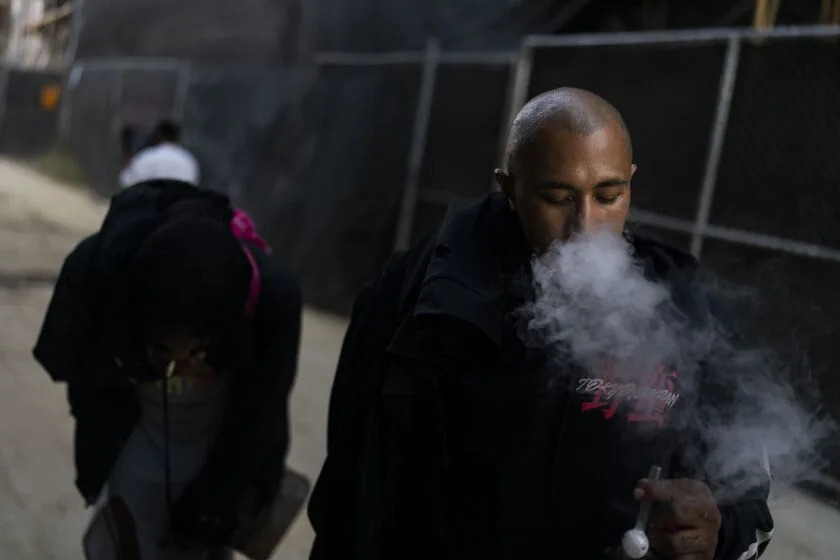
Armando Rivera, 33, smokes fentanyl mixed with methamphetamine in an alley in Los Angeles, Thursday, Aug.18, 2022. Use of fentanyl, a powerful synthetic opioid that is cheap to produce and is often sold as is or laced in other drugs, has exploded. Because it's 50 times more potent than heroin, even a small dose can be fatal. It has quickly become the deadliest drug in the nation, according to the Drug Enforcement Administration. (AP Photo/Jae C. Hong)
A man smokes fentanyl mixed with methamphetamine in an alley in Los Angeles in August. “In the greater Los Angeles area we are seeing xylazine as an additive within fake fentanyl pills,” said Nicole Nishida, spokesperson for the Los Angeles Field Division of the U.S. Drug Enforcement Administration. (Jae C. Hong / AP)

Amid troubling signs that a dangerous sedative known as “tranq” has spread even further into the local street drug supply, the Los Angeles County Sheriff’s Department has launched a pilot program to better document the drug’s presence.

Xylazine is an animal tranquilizer that began appearing several years ago in illicit pills and powders on the East Coast. It’s been linked to deaths across the country and can cause human tissue to rot, leaving users with grisly wounds that sometimes lead to amputations.

In early March, county health officials initially said they weren’t sure whether the deadly adulterant had begun appearing on the streets of Los Angeles. Weeks later, the Times learned that the Sheriff’s Department crime lab had been detecting signs of xylazine in drug samples for at least four years — but they’d never told the health department or the public.

At the time, department officials said that was because, despite its harms, xylazine is not illegal, so formally tracking it was beyond the scope of their work.

Now, though, the pilot program could help change that.

Starting in mid-April, crime lab analysts began making note of any preliminary signs of xylazine they spotted while testing samples of confiscated drugs. In the past, even when lab workers noticed test results that seemed to show the presence of xylazine, they didn’t typically make any note of it. Instead, they treated it like any other legal substances commonly used as additives in illegal drugs.

“There are a bunch of different additives — like vitamin C, which comes up a lot — that we don’t write down,” said Capt. Ernest Bille, who oversees the department’s Scientific Services Bureau. “The mission, given the volume of the caseload that we have, is to figure out: Is this a controlled substance or not?”

Over the course of a month-long trial run, officials hope to get a better sense of how often they typically see presumptive positives for xylazine. If the number is relatively low, they’ll keep tracking for another month, Bille said. If it’s high, they’ll begin figuring out standards for doing additional confirmatory tests in the future — just as they would for illegal drugs.

“This is going to be very unique for us, because I’m asking them to track a non-controlled substance,” Bille said.

The move to track the dangerous sedative — spurred in part by conversations with UCLA researchers who study illicit drugs — comes as federal data shows an uptick in the drug’s presence across the county and in Southern California.

“In the greater Los Angeles area we are seeing xylazine as an additive within fake fentanyl pills,” said Nicole Nishida, spokesperson for the Los Angeles Field Division of the U.S. Drug Enforcement Administration. “While the numbers are relatively low in our community compared to elsewhere in the United States, the presence of xylazine is now becoming more frequent and the trend is concerning.”

Federal data show that about 23% of fentanyl powder and 7% fentanyl pills seized last year contained xylazine. Nishida said those figures were around 3% and 8% for the greater Los Angeles region over that same period.

Pieces of fentanyl in the palm of a hand.
A drug user in Los Angeles holds pieces of fentanyl in August. Federal data show that about 23% of fentanyl powder and 7% fentanyl pills seized last year contained xylazine. Those figures were around 3% and 8% for the greater Los Angeles region over that same period. (Jae C. Hong / AP)

But those numbers might be less telling for Angelenos than they first appear: The Los Angeles Field Division’s region is so broad that it includes most of Southern California as well as Nevada, Hawaii and the territories of Guam and Saipan.

It’s not clear whether the xylazine samples were concentrated in one part of that region, and officials did not provide data more specific to Los Angeles County.

So far, law enforcement efforts to quantify and document the presence of xylazine in Los Angeles street drugs have been relatively limited — though, aside from the DEA figures, there are a growing number of signs of its presence.

An early public indication of the drug came in February, when a county health official confirmed to The Times that one man — a 25-year-old in El Monte — had trace levels of xylazine in his body when he died in December 2021. But the drug was present in such small amounts that the county medical examiner listed “combined effects of ethanol and fentanyl” as the cause of death.

Then in March, the county’s Department of Public Health issued a news release warning Angelenos that the sedative was “increasingly present within illicit drugs in California” and that it was now “likely present” in Los Angeles.

The news release mentioned the 2021 death and several others elsewhere in the state. However, although it said that xylazine had been detected in samples in cities to the north and to the south, it said nothing about whether there had been similar finds locally.

Then last month — a few weeks after the Sheriff’s Department admitted seeing signs of xylazine for at least four years — the UCLA researchers studying local street drugs confirmed finding the sedative in a sample of black tar heroin.

“It’s just another indication that it’s here in L.A.,” said Chelsea Shover, an epidemiologist and health services researcher at UCLA. “And it’s really important for people who use drugs to know that.”

One of the reasons xylazine is regarded as a particularly dangerous additive in street drugs is that, since it is not an opioid, the overdose-reversal medication naloxone is not effective on it.

Still, Shover said, if you believe that someone you know has overdosed on xylazine, the best course of action is to give them naloxone and call 911. Typically, xylazine is mixed with fentanyl to extend the drug’s high, so naloxone may still be effective.

“If you give someone naloxone but they’re still sedated, that’s a clue it could be xylazine,” Shover said. “Then call 911 for medical attention — but if you can’t do that, try to keep them comfortable and safe while they are sedated.”

For people who are using drugs but want to minimize the risk of ingesting xylazine, Shover said, there are now xylazine test strips available online.

Louisiana Republicans Kill Rape, Incest Exceptions to Abortion Ban After Unhinged Hearing

Jezebel

Louisiana Republicans Kill Rape, Incest Exceptions to Abortion Ban After Unhinged Hearing

Lorena O’Neil – May 10, 2023

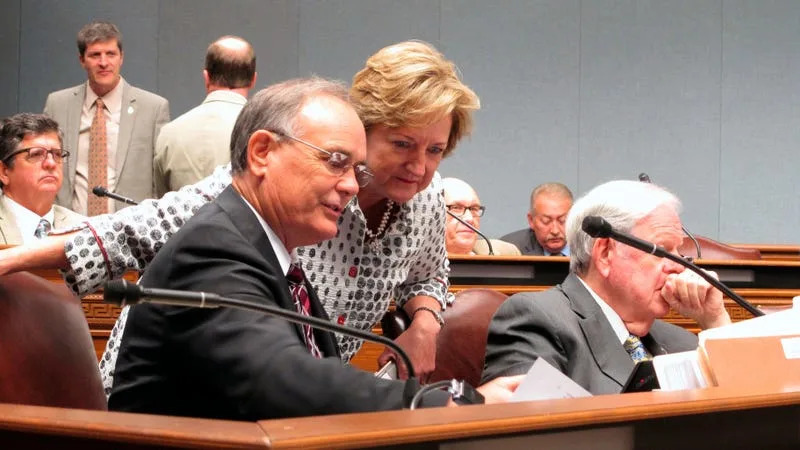
Photo:  Melinda Deslatte (AP)
Photo: Melinda Deslatte (AP)

After a truly eyebrow-raising hearing on Wednesday, Louisiana’s House criminal justice committee voted against adding rape and incest exceptions to the state’s abortion ban, one of the strictest in the country.

Pastor John Raymond of Slidell, La., testified against the bill, saying that an abortion in the case of rape would make it so there are two victims instead of one–a talking point parroted by anti-abortion activists throughout the discussion. Women will “clamor to put old boyfriends behind bars in order to dispense with the inconvenience of giving birth,” he said.

Raymond, mind you, currently faces numerous criminal charges for cruelty to juveniles, including multiple allegations of physically abusing a 4-year-old, once allegedly holding him upside down by the ankle and whipping his butt. The pastor has also been accused of taping three 13-year-old boys’ mouths shut after they refused to stop talking in class.

The rest of the hearing was equally disheartening. Democrat Delisha Boyd, who introduced the bill to add rape and incest exceptions, revealed that she was the product of rape after her mother was sexually assaulted when she was 15. “My mother never recovered,” said Boyd, adding that her mother died just before she was 28 years old.

Republicans, of course, were unmoved by this argument. Anti-abortion activist Debbie Melvin said abortion “can be like a second rape.”

“A baby is the only beautiful thing that can come from rape,” she said.

Most rape survivors who testified supported Boyd’s bill. One survivor wept as she said that if she hadn’t been able to have an abortion she may have died by suicide. Morgan Lamandre, the president and CEO of Sexual Trauma Awareness and Response (STAR), said that she used to be vice president of the anti-abortion club at her high school, but changed her mind after working with sexual assault survivors. She pointed out that forcing a person to carry a rapist’s baby is only further traumatizing them.

“By forcing survivors to give birth, you are forcing them to forever be connected to their rapist,” Lamandre said. “In Louisiana, men are allowed to choose the mother of their children regardless of what the mother wants.”

The House Criminal Justice Committee then killed the bill in a 10-5 vote. All of the Republicans on the committee voted against adding the exception. One Republican representative, Tony Bacala, said he was voting against it because its author, Rep. Boyd, is the product of rape, and she turned out to be a good person.

We’re living in hell.

‘It Was Really Bad’: Ex-Trump White House Press Secretary Details Harassment

HuffPost

‘It Was Really Bad’: Ex-Trump White House Press Secretary Details Harassment

Ed Mazza – May 10, 2023

Stephanie Grisham, who served as White House press secretary under Donald Trump, said she witnessed the then-president’s sexual harassment firsthand.

She told CNN that she had to try to protect one staffer in particular who Trump would request accompany him on trips.

“He one time had one of my other deputies bring her back so that they could look at her ass, is what he said to him,” Grisham said. “I sat down and talked to her at one point, asked her if she was uncomfortable. I tried everything I could to ensure she was never alone with him.”

Grisham said she spoke to various chiefs of staff, including Mark Meadows, about Trump’s behavior.

“I think, at the end of the day, what could they do other than go in there and say, ‘This isn’t good, Sir’?” she said. “Donald Trump will do what Donald Trump wants to do.”

Grisham’s comments came hours after a civil jury found the former president liable for sexual abuse and defamation in a lawsuit brought by writer E. Jean Carroll.

Grisham said Trump would often comment on people’s looks and speculate about cosmetic surgery.

“But with this one staffer, it was really bad, to the point that I was extremely uncomfortable,” she said, adding that all senior White House staffers at the time knew about the situation.

“I did everything I could to keep her off of trips actually, and to stay with her if she was with him alone because I was really nervous about what could happen,” Grisham added.

She did not name the staffer. Grisham has recounted the details before, including in her book.

Critics slammed Grisham for failing to take stronger action and for writing a book about it afterward.

“I frankly see no redeeming quality in this woman or any of the Trump accomplices who now want to clear their names and want to make a buck,” CNN political commentator Ana Navarro said earlier.

What new Florida immigration law means for employers, hospitals and workforce

Pensacola News Journal

What new Florida immigration law means for employers, hospitals and workforce

Brandon Girod, Pensacola News Journal – May 10, 2023

Standing at a podium with a sign reading “Biden’s Border Crisis,” Florida Gov. Ron DeSantis signed a new state immigration law Wednesday that critics say is cruel as it imposes tough penalties and new restrictions on people living in the state illegally.

The measure, approved last week by the Florida Legislature, has been condemned by critics as cruel and potentially leading to law enforcement profiling. It’s considered among the toughest steps taken by any state to deter immigrants without legal permission.

“We have to stop this nonsense, this is not good for our country,” DeSantis said, adding “this is no way to run a government.”

But immigrant advocates said Florida’s approach targets a community already struggling to survive with new criminal penalties and restrictions. Immigrants living in Florida, legally and illegally, represent a huge share of the state’s workforce, leaders added.

Susan Pai, a Florida immigration lawyer based in Jacksonville, broke the new law down, highlighting some of the bill’s biggest impacts.

Strengthening employment requirements

Several sections of the bill outline strengthened employment requirements, including:

  • Employers are required to verify a new employee’s employment eligibility within three business days after the first day the new employee begins working for pay.
  • Private employers with 25 or more employees must use the federal E-Verify system to verify a new employee’s employment eligibility starting on July 1.
  • Public agencies are also required to use the E-Verify system to verify a new employee’s employment eligibility.
  • Employers cannot continue to employ an unauthorized alien after obtaining knowledge that a person is or has entered the county illegally.
  • It is unlawful for any person to knowingly employ, hire, recruit or refer, either for herself or himself or on behalf of another, for private or public employment within the state, a “foreign national” who is not authorized to work in the U.S.
  • An unauthorized immigrant can not obtain a license to practice law in Florida after Oct. 31, 2028, repealing a 2014 law that allowed immigrants living in the country illegally to practice law in the state.

Violating the new law could result in a series of escalating penalties that could lead to the state suspending or revoking all licenses to operate their business.

The Farmworkers Association of Florida, a grassroots nonprofit that advocates for social and environmental justice with farmworkers, estimates that there are about 300,000 farm workers in Florida who live in the state illegally, making up about 60% of the state’s farm workers.

Losing those jobs could have a significant impact on Florida’s agriculture industry, and Pai says she imagines it’s a similar situation among roofers, landscapers and others.

“I’ve been getting a lot of calls from people asking me if they should leave the state,” she said. “The undocumented community is very scared to even show up for work.”

Pai also stressed that Section 12 makes it a crime to even refer someone for employment within the state, and underlined that the law applies to people who lawfully entered the country on visitor and student visas but are not authorized to work.

‘What are we going to do?’ Two migrants share fears for the future in Florida crackdown

Hospitals must ask patients about their legal status

Section 5 states that any hospital that accepts Medicaid must include a provision on its patient admission or registration forms for the patient or the patient’s representative to indicate whether the patient is a United States citizen, lawfully present in the United States, or not lawfully present in the United States.

Hospitals would then need to turn the cumulative data over to the governor and the Florida Legislature quarterly and annually, and they would then have to quantify how much it costs to provide medical assistance to people not living in the country legally. The identity of patients would not be included in this data.

Pai says this law conflicts with health care professionals’ oaths to patients because it dissuades people in need of health care from seeking it out if they are in the country illegally.

“It’s going to prevent people from either bringing theirselves in for medical care or even their children,” Pai said. “They’re not going to know that they don’t have to answer the question. Once they’re asked the question, they believe they have to give up their undocumented status.”

People foregoing preventative health care to hide their status could end up costing Florida more money down the road when untreated medical issues become an emergency.

“Ultimately, their condition may worsen and the cost to Florida may actually be more than if they were just given the care in the first place.”

Out-of-state driver’s license issued to ‘unauthorized immigrants’ no longer valid

Driver’s licenses and permits issued by other states exclusively to people living in the country illegally will no longer be recognized in Florida.

The National Conference of State Legislatures says there are 19 states and the District of Columbia that issue these licenses to people living in the country illegally, and Pai says this bill could “open the flood gates” of racial profiling and increase the danger for drivers across the state.

Illegal immigration in Florida: A by-the-numbers look at a surge

“If you have an undocumented alien who can get a valid license, they can drive legally, they can buy insurance. They’re not going to flee the scene of an accident because they have a valid license. It just makes things more dangerous for everybody,” said Pai.

The law also bars counties and municipalities from providing funds to people, entities or organizations to issue identification documents to individuals who don’t provide proof of lawful presence in the county.

Transporting a person living in the country illegally across state lines is a third-degree felony

The law now makes it a third-degree felony for anyone who knowingly or who reasonably should know that they are transporting immigrants who entered the country illegally into Florida. Transporting a minor is a second-degree felony.

A previous iteration of the bill included transportation within the state, but was cut after critics pointed out that the bill could make transporting a family member who entered the country illegally to the hospital, their job or to school a felony.

Juvenile DNA database

Section 18 would force arrested adults and even juveniles with an immigration detainer (an “immigration hold”) to provide their DNA to the state.

DeSantis’ presidential bid: Florida Gov. Ron DeSantis poised to make presidential bid, Florida could be his blueprint

SB 1718 expands FDLE’s mission to include immigration matters

The most sweeping sections of the bill outlines the expansion of the Florida Department of Law Enforcement’s mission to include immigration matters.

Section 13 states “FDLE, with respect to counter-terrorism efforts, responses to acts of terrorism within or affecting this state, coordinating with and providing assistance to the Federal Government in the enforcement of federal immigration laws, responses to immigration enforcement incidents within or affecting this state, and other matters related to the domestic security of Florida as it relates to terrorism and immigration.”

Sections 14 through 17 expand several Florida anti-terrorism laws to include immigration law enforcement, which Pai says is a “very smart way” to skate around having to create state-specific immigration crimes that are not also federal crimes.

Pai says this “huge” expansion of power is ultimately going to “dilute” anti-terrorism resources in the state.

“There’s no appropriation that goes along with this huge expansion of power to the Florida Department of Law Enforcement and other law enforcement agencies and organizations in the state of Florida who are charged with anti-terrorism and now immigration enforcement incidents within or effecting the state,” she said.

Appropriates $12M from Florida’s General Revenue Fund to migrant transportation program

Section 21 appropriates $12 million from the General Revenue Fund, which is funded by taxpayer dollars, to be used for DeSantis’ “unauthorized alien transport program.” The same program that made headlines when DeSantis flew about 50 Venezuelan migrants in two charter planes from Texas to Martha’s Vineyard, Massachusetts.

The Division of Emergency Management selected three companies to execute Gov. Ron DeSantis’ controversial migrant relocation program.

A “notice of intent award” issued on Monday named ARS Global Emergency Management, GardaWorld Federal Services and Vertol Systems Company, Inc., which was the company that carried out last year’s migrant flights to Martha’s Vineyard.

The division had posted a request for proposals at the end of of March, after getting control of the program and $10 million to carry it out through special session legislation. During the regular session, which concluded last week, lawmakers approved $12 million more for the program.

But the taxpayer cost will be more than that, as the program has already generated multiple legal challenges. Florida has paid two law firms more than $640,000 in legal fees for DeSantis’ relocation of nearly 50 Venezuelan migrants from San Antonia, Texas, to Martha’s Vineyard.

The companies selected, according to the request for proposals, must “provide ground and air transportation and other related services… to assist in the voluntary relocation of Inspected Unauthorized Aliens that have agreed to be relocated from Florida, or another state, to a location within the United States.”

The related services include research and planning, ensuring those relocated have provided voluntary consent, and arranging social support at the destination.

How many US mass shootings have there been in 2023?

BBC News

How many US mass shootings have there been in 2023?

May 9, 2023

Gun sale in Virginia
Data shows gun ownership in the US has grown over the last several years

Gun violence is a fixture in American life – but the issue is a highly political one, pitting gun control advocates against people who are fiercely protective of their right to bear arms.

We’ve looked into some of the numbers behind firearms in the US.

Mass shootings on the rise

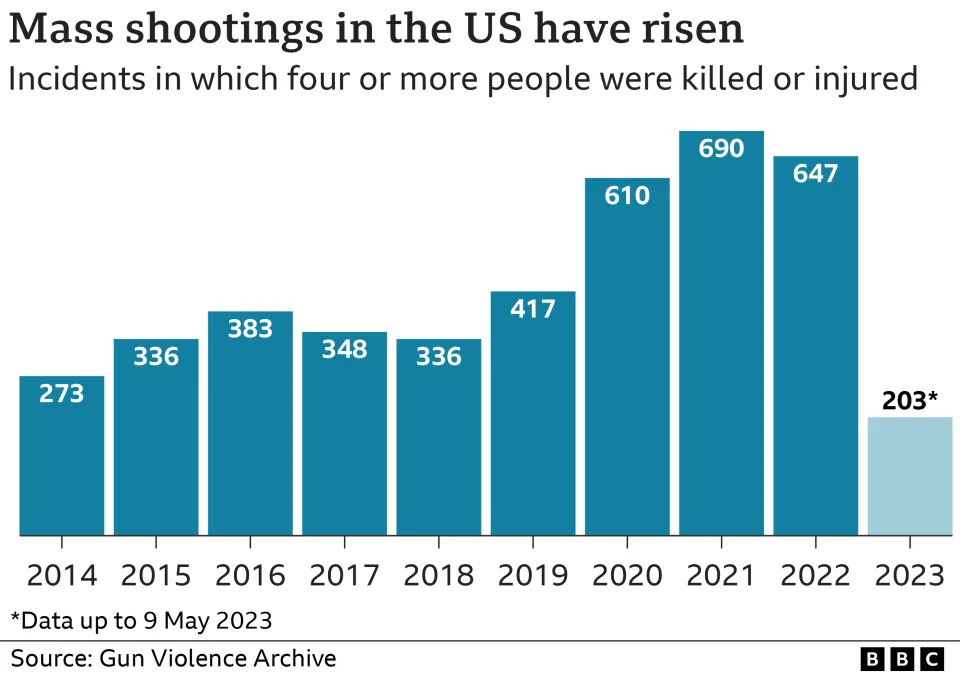
There have been more than 200 mass shootings across the US so far this year, according to the Gun Violence Archive, which defines a mass shooting as an incident in which four or more people are injured or killed. Their figures include shootings that happen in homes and in public places.

There have been two in Texas in the last week – five killed at a home in Cleveland, north of Houston, and eight dead at a shopping mall in Allen, near Dallas.

In each of the last three years, there have been more than 600 mass shootings, almost two a day on average.

The deadliest such attack, in Las Vegas in 2017, killed more than 50 people and left 500 wounded. The vast majority of mass shootings, however, leave fewer than 10 people dead.

Graphic showing year by year mass shootings
How do US gun deaths break down?

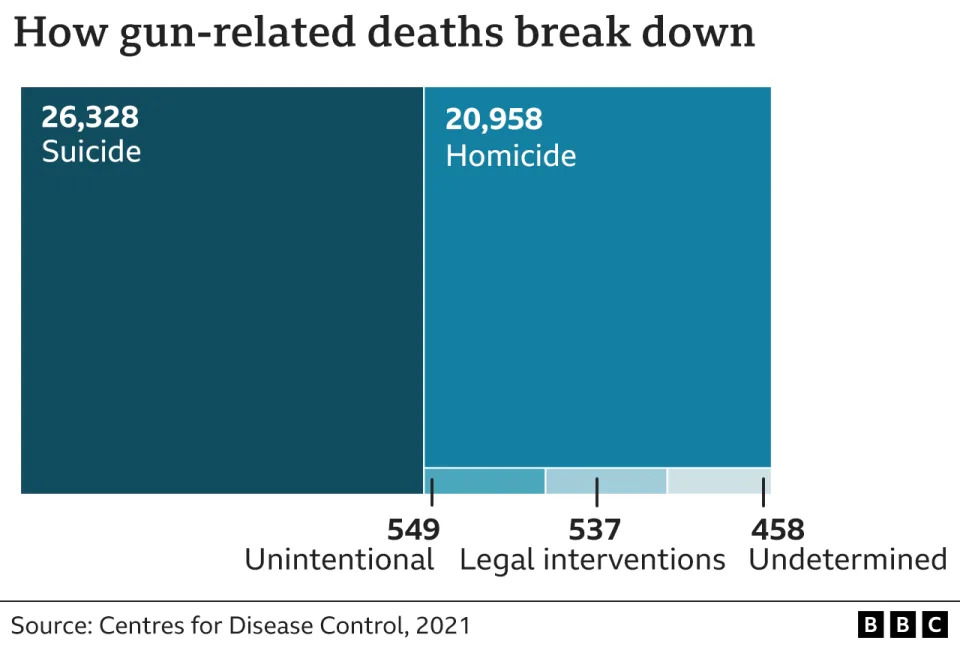
48,830 people died from gun-related injuries in the US during 2021, according to the latest data from the US Centers for Disease Control and Prevention (CDC).

That’s nearly an 8% increase from 2020, which was a record-breaking year for firearm deaths.

While mass shootings and gun murders (homicides) generally garner much media attention, more than half of the total in 2021 were suicides.

Chart showing a breakdown of gun-related deaths in the US

That year, more than 20,000 of the deaths were homicides, according to the CDC.

Data shows more than 50 people are killed each day by a firearm in the US.

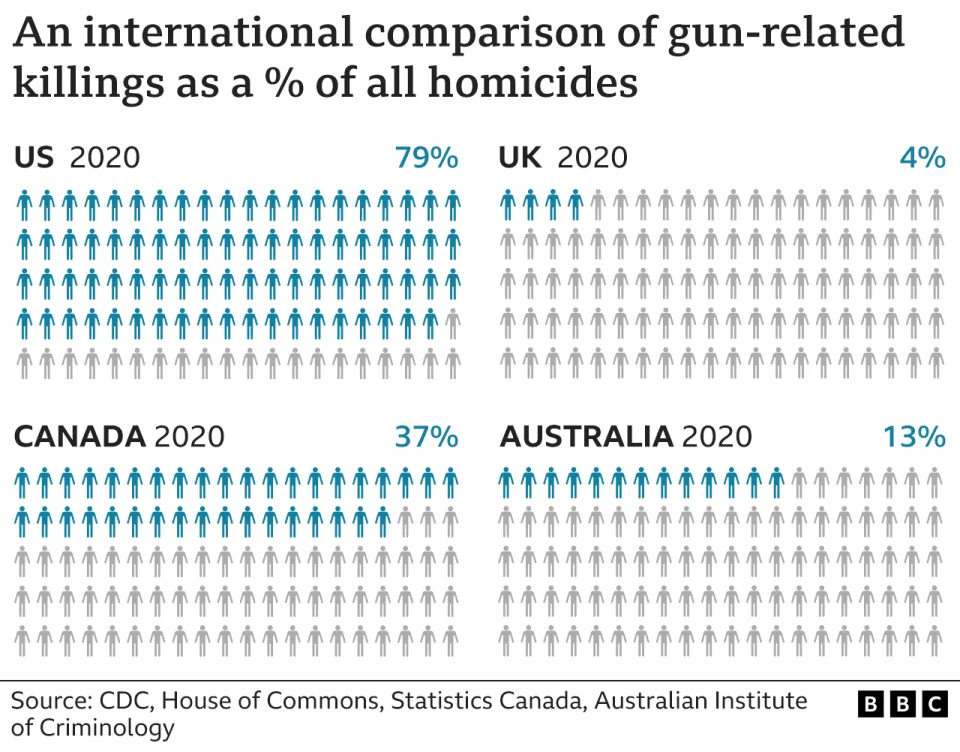
That’s a significantly larger proportion of homicides than is the case in Canada, Australia, England and Wales, and many other countries.

Graphic showing an international comparison of gun-related killings as a percentage of all homicides in each country. The US leads with nearly 79% of all homicides occurring with guns.
How many guns are there in the US?

While calculating the number of guns in private hands around the world is difficult, the latest figures from the Small Arms Survey – a Swiss-based research project – estimated that there were 390 million guns in circulation in the US in 2018.

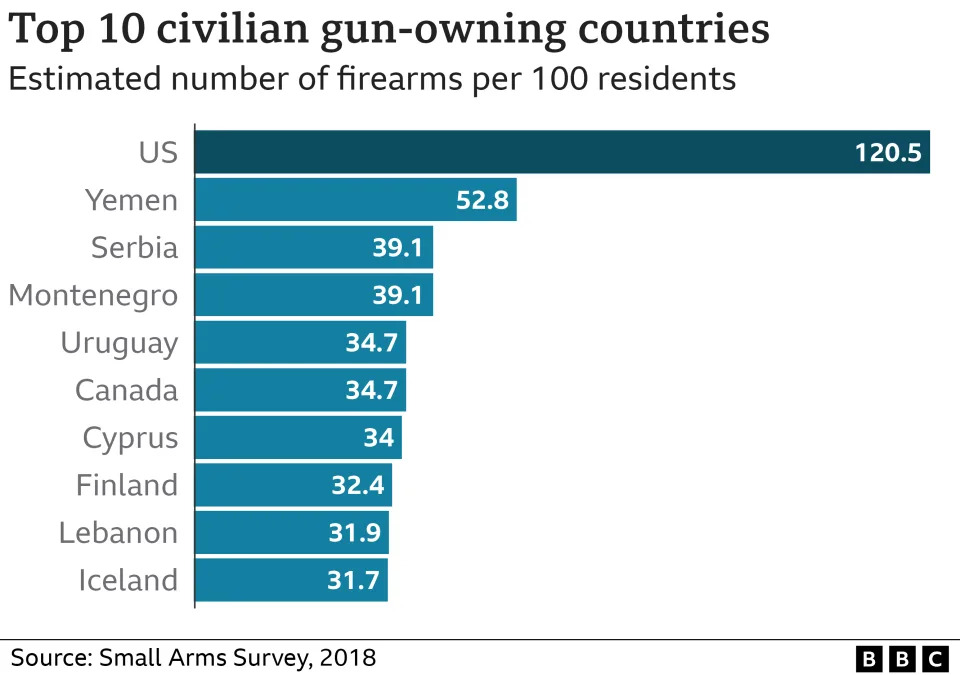
The US ratio of 120.5 firearms per 100 residents, up from 88 per 100 in 2011, far surpasses that of other countries around the world.

Chart showing civilian gun ownership around the world

More recent data out of the US suggests that gun ownership grew significantly over the last few years. A study, published by the Annals of Internal Medicine in February, found that 7.5 million US adults became new gun owners between January 2019 and April 2021.

This, in turn, exposed 11 million people to firearms in their homes, including 5 million children. About half of new gun owners in that time period were women, while 40% were either black or Hispanic.

Who supports gun control?

A majority of Americans are in favour of gun control.

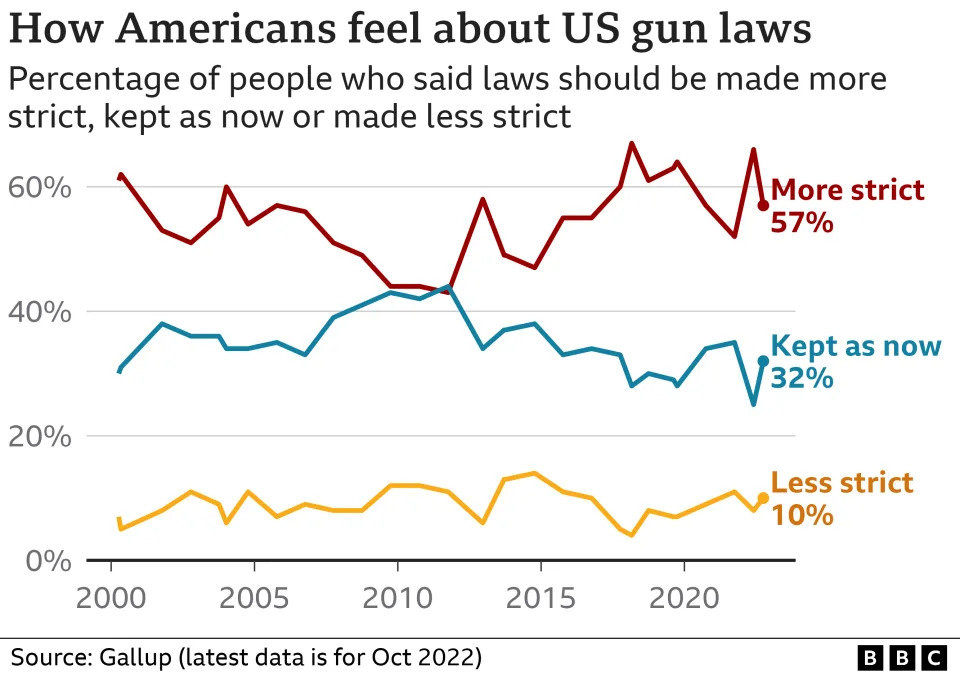
57% of Americans surveyed said they wanted stricter gun laws – although this fell last year – according to polling by Gallup.

32% said the laws should remain the same, while 10% of people surveyed said they should be “made less strict”.

Gun control opinion
Gun control opinion

The issue is extremely divisive, falling largely along party lines.

“Democrats are nearly unanimous in their support for stricter gun laws,” another Gallup study noted, with nearly 91% in favour of stricter gun laws.

Only 24% Republicans, on the other hand, agreed with the same statement, along with 45% of Independent voters.

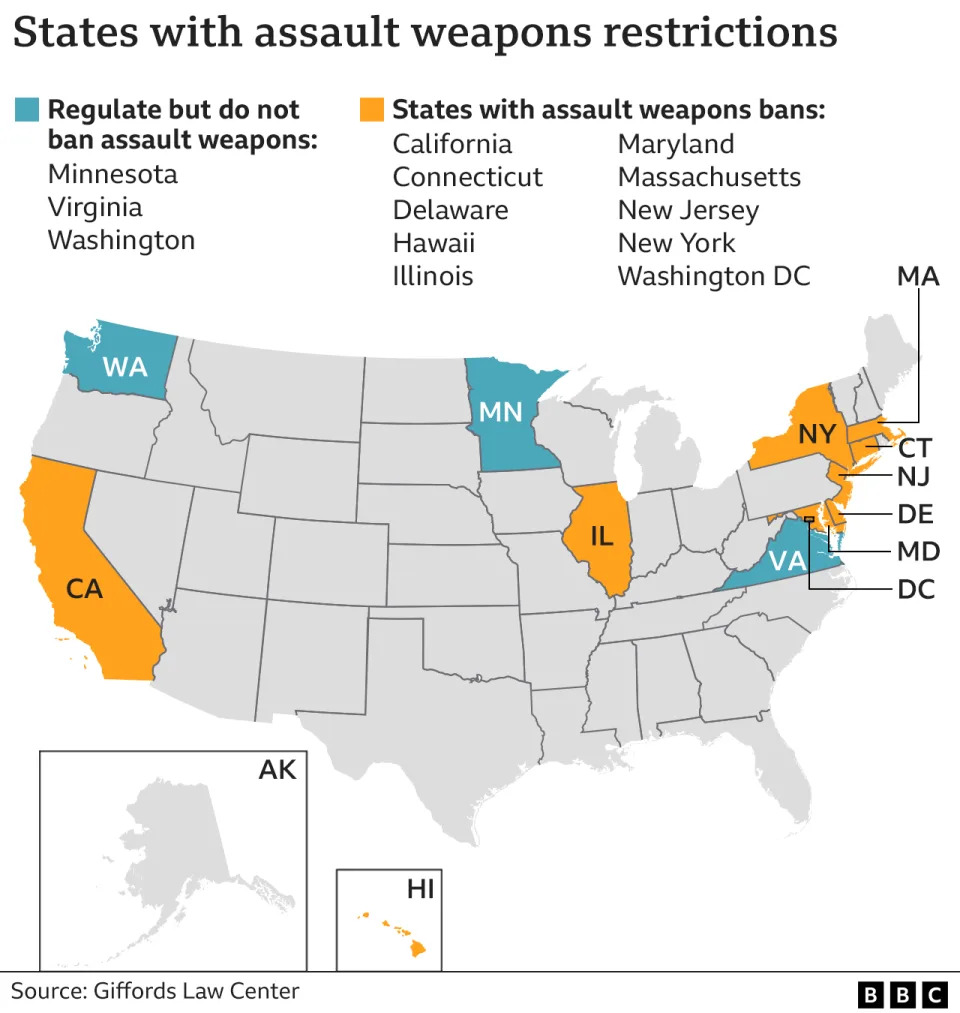
Some states have taken steps to ban or strictly regulate ownership of assault weapons. Laws vary by state but California, for example, has banned ownership of assault weapons with limited exceptions.

Map showing states with assault weapon bans - California, Connecticut, Delaware, Hawaii, Illinois, Maryland, Massachusetts, New Jersey, New York & Washington DC, and those with restrictions Minnesota, Virginia and Washington, March 2023
Map showing states with assault weapon bans – California, Connecticut, Delaware, Hawaii, Illinois, Maryland, Massachusetts, New Jersey, New York & Washington DC, and those with restrictions Minnesota, Virginia and Washington, March 2023

Some controls are widely supported by people across the political divide – such as restrictions governing the sale of guns to people who are mentally ill or on “watch” lists.

Who opposes gun control?

Despite years of financial woes and internal strife, the National Rifle Association (NRA) remains the most powerful gun lobby in the United States, with a substantial budget to influence members of Congress on gun policy.

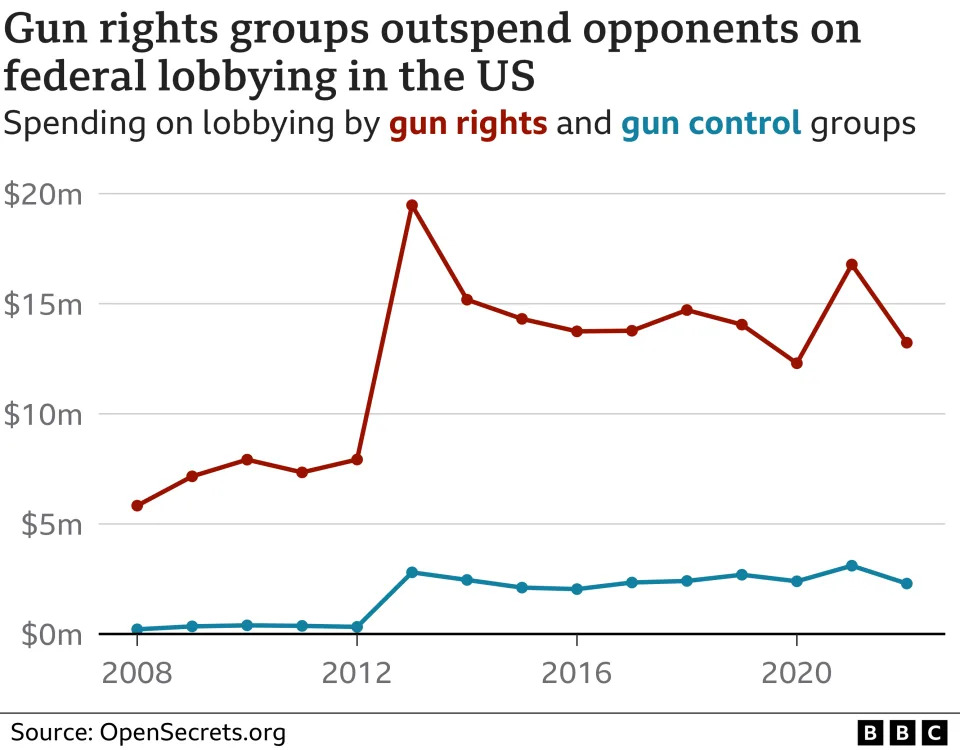
Over the last several election cycles, it, and other organisations, have consistently spent more on pro-gun rights messaging than their rivals in the gun control lobby.

A line chart showing the amount spent per year by gun rights groups and gun control groups on federal lobbying in the US from 2008 to 2022. Gun rights groups have consistently spent more than double what gun control groups have. Gun rights spending peaked in 2013 at just under $20m - gun control groups spent just under $3m in the same year. In 2022, gun rights groups spent $13m, while their opponents spent $2.3m.
A line chart showing the amount spent per year by gun rights groups and gun control groups on federal lobbying in the US from 2008 to 2022. Gun rights groups have consistently spent more than double what gun control groups have. Gun rights spending peaked in 2013 at just under $20m – gun control groups spent just under $3m in the same year. In 2022, gun rights groups spent $13m, while their opponents spent $2.3m.

A number of states have also gone as far as to largely eliminate restrictions on who can carry a gun. In June 2021, for example, Texas Governor Greg Abbott signed into law a “permitless carry bill” that allows the state’s residents to carry handguns without a licence or training.

Similarly, in April last year Georgia became the 25th in the nation to eliminate the need for a permit to conceal or openly carry a firearm. The law means any citizen of that state has the right to carry a firearm without a licence or a permit.

The law was backed by the NRA, and leaders within the organization called the move “a monumental moment for the Second Amendment”.

Why are mass shootings rare in other countries despite high levels of gun ownership?

The Week

Why are mass shootings rare in other countries despite high levels of gun ownership?

Justin Klawans, Staff writer – May 9, 2023

Guns.
Guns. Illustrated | Gettyimages

There is no question the United States has a ton of guns — more than anywhere else in the world by far. There are an estimated 352 million guns in private circulation in the U.S., according to data collected by The Trace, and some other studies cited by the outlet suggest the number is even higher.

It comes as no surprise, then, that the U.S. leads the world in mass shootings. There have already been over 180 of these incidents in 2023 alone, The New York Times reports. Many mass shootings occur in schools; since the Columbine High School shooting in 1999, more than 352,000 students have experienced gun violence in the classroom, according to The Washington Post.

While the United States leads the world in number of firearms, it’s hardly the only country where gun ownership is high. Yet in most other countries, mass shootings are rare, if not unheard of, mainly due to gun laws being significantly stricter than they are in the U.S. Between 2009 and 2015, there were just 19 mass shootings in all of Europe, research shows. School shootings are even rarer, and World Population Review reports that every country besides the U.S. has had less than 10 of them in 2023. These are five nations that have high numbers of firearms but little trouble with shootings.

Finland

There are an estimated 1.5 million licensed firearms in Finland, the country’s interior ministry reports, in a nation of just 5.6 million. This high rate of gun ownership is due to an activity widely seen in Finland (and many other nations): hunting. Finns “have hunted and fished for food for thousands of years,” Slate reports, and “hunting remains a popular weekend, or even after-work, activity.” Finland’s large area provides ample space for the hunting industry to flourish.

Despite this, Finland has had less than five documented cases of mass shootings. This is because, like most of the Nordic countries, Finland has highly regulated gun control laws. Following a school shooting in 2007, Finnish Parliament raised the minimum age to purchase a gun from 15 to 18, and the prospective buyer must fill out a detailed application to receive a handling license. The interior ministry has also implemented “changes to the provisions on the storage of firearms, component parts of firearms, and cartridges,” as well as additional legislation to ensure guns remain safely locked away when not in use.

Switzerland

Like Finland, hunting is a part of life in Switzerland, which may be why the Alpine country has approximately 2 million privately owned guns, Insider reports, in a country of just 8.7 million people. Despite this staggeringly high rate of gun ownership, though, there has not been a mass shooting in Switzerland in more than 20 years.

Insider notes that the U.S.’ National Rifle Association often points to Switzerland as an example of gun laws not being necessary, because they claim the Swiss have limited legislation on firearms. But this is simply not true. Firearms in Switzerland are highly controlled and regulated, according to the official Swiss Confederacy portal. Semi-automatic rifles with large magazines are banned, and people who want to purchase handguns or smaller magazine semi-automatic rifles must undergo a permitting process and send their weapon’s information to the government.

Canada

Canada’s vast northern lands make it another ample country for hunting, which contributes to the 7.1 million firearms in private hands, according to the Canadian government, in a nation of 39 million people. This statistic lies in a similar range with comparable Western nations, the government notes, except the United States.

The country has had a few recent mass shootings, including one in 2020. Despite this, instances of mass violence remain very rare, Reutersreports. This is because Canada has some of the harshest regulations against assault rifles in the world, and the nation’s public safety arm notes Canada “has prohibited over 1,500 models of assault-style firearms and certain components of some newly prohibited firearms.” Many of these weapons became newly prohibited following the 2020 mass shooting, and there are also limits in the Canadian criminal code placing restrictions on the number of rounds in rifles, handguns and shotguns.

New Zealand

New Zealand also has a lot of guns — 1.5 million in a country of just 5.1 million people — but unlike the United States, New Zealand took legislative action after a tragedy.

Following a 2019 mass shooting in Christchurch that killed 51 people, then-Prime Minister Jacinda Ardern implemented a series of sweeping reforms to the country’s already strict gun laws. Ardern announced these reforms just one week after the shooting, Time reports, and the new laws were pushed through parliament almost immediately. The laws included creating a firearms registry and placing a complete ban on AR-15s and other assault rifles. New Zealand also created a gun buyback program to try and get weapons off the streets. By the end of the program, Kiwis had turned in more than 50,000 guns, NPR reports, greatly slashing the number of firearms on the streets of New Zealand.

Australia

Like their neighbors to the southeast, Australia also has a high rate of gun ownership, and the University of Syndey notes there are about 3.5 million registered firearms in the nation of 26.4 million. However, the university also reports that the “proportion of Australian households with a firearm has fallen by 75% in recent decades.”

This drop was similarly spurned by just a single tragedy: the 1996 Port Arthur massacre in Tasmania. Thirty-five people died in the worst mass shooting in Australian history, and the country’s conservative government enacted similar new restrictions on guns. This includes a national gun registry, and Time notes that firearm license applications must prove the prospective owner has “a ‘genuine need’ to own weapons.” The Aussies also implemented a gun buyback program after Port Arthur, and Vox reports the country confiscated 650,000 weapons. There have been almost no mass shootings in Australia since then.

Putin may not outrun the warrant for his arrest – history shows that several leaders on the run eventually face charges in court

The Conversation

Putin may not outrun the warrant for his arrest – history shows that several leaders on the run eventually face charges in court

Aaron Fichtelberg, Associate Professor of Sociology and Criminal Justice, University of Delaware – May 9, 2023

Russian President Vladimir Putin is shown in Moscow in March 2022, shortly after Russia invaded Ukraine. <a href=
Russian President Vladimir Putin is shown in Moscow in March 2022, shortly after Russia invaded Ukraine. Mikhaul Klimentyev/Sputnik/AFP via Getty Images

The Russian government, U.S. President Joe Biden and mainstream Western media are among the observers who all responded to Russian President Vladimir Putin’s arrest warrant for war crimes with a shrug.

In March 2023, the International Criminal Court announced the warrant for Putin and his commissioner for children’s rights, Maria Lvova-Belova, because they allegedly directed the abduction of Ukrainian children. The court says that these charges amount to war crimes.

While Biden said the arrest warrant was “justified,” he also noted that the International Criminal Court “is not recognized by us either.”

The skeptics have a point – the ICC, based in the Hague, Netherlands, does not have its own police force to execute its orders and must rely on other countries’ police to arrest the people it indicts.

Indeed, there are a number of barriers potentially preventing Putin’s arrest.

One is that Russia, like the United States, is not a member of the court – so as long as Putin does not set foot in a country that is a member of the court, he is safe from arrest. Putin also remains popular within Russia and is unlikely to soon be overthrown and turned over by his successor.

But it still would be rash to assume that Putin is safe from the court’s grasp.

am a scholar of criminal justice who specializes in international courts and the creativity that prosecutors show in catching their targets, often under very difficult political circumstances.

History shows that it would require a little bit of good luck for prosecutors – and a few bad decisions by Putin – for the Russian autocrat to end up in handcuffs. But it’s far from impossible.

The ICC’s arrest warrant for Vladimir Putin is seen in a news release in March 2023. <a href=
The ICC’s arrest warrant for Vladimir Putin is seen in a news release in March 2023. Jonathan Raa/NurPhoto via Getty Images
How international courts work

A group of 60 countries established the International Criminal Court in 2002 to prosecute people who commit the worst crimes, including genocide and wartime sexual violence, that violate international law. The court is part of a long line of international criminal tribunals going back to the military tribunal the U.S. and allies set up to prosecute Nazis at the end of World War II, as part of the Nuremberg Trials.

There are other international criminal courts that prosecute war crimes, but the ICC is the largest and arguably most influential, since 123 member countries fund the court and abide by its rulings.

Since its inception, the ICC has issued 38 arrest warrants, arrested 21 people, convicted 10 and acquitted four. Other suspects, like Putin, remain at large or have had their charges dropped.

Yet there are a number of options for prosecuting war crimes outside of the ICC that have been used in the past.

There are also other, smaller tribunals similar to the ICC that countries have helped set up to focus on specific conflicts. In other cases, individual countries can use their own courts to prosecute international criminals who have evaded arrest abroad.

In the case of the Ukraine war, Ukrainian President Volodymyr Zelenskyy has called for a new international tribunal to prosecute war crimes committed by Russia during the conflict. Others have argued that Putin could be prosecuted in a Ukrainian court specifically designed for this purpose.

Former Liberian President Charles Taylor appears in court in July 2006 in the Netherlands. <a href=
Former Liberian President Charles Taylor appears in court in July 2006 in the Netherlands. Rob Keeris/AFP via Getty Images
Lessons for Putin

There have been several long but ultimately successful efforts to arrest fallen political leaders and mass murderers.

For example, Charles Taylor, the former president of Liberia who helped instigate a civil war in neighboring Sierra Leone in the 1990s, is now serving a 50-year prison sentence in the United Kingdom.

Prosecutors from an international tribunal set up in Sierra Leone announced Taylor’s indictment when he was in Ghana in 2002, forcing him to quickly flee a political conference and head home for safety. But Taylor then fell from power in 2003, in the midst of a rebel insurgency. He then fled to Nigeria.

Eventually, Nigerian authorities arrested Taylor and handed him back to Liberia, which quickly passed him off to Sierra Leone for trial in 2006. He was then convicted in 2012.

Slobodan Milošević, the late president of Yugoslavia, was indicted by an international tribunal that addressed the Balkans wars – along with two of his cronies, Ratko Mladić and Radovan Karadžić –- for crimes committed against civilians during the wars in the 1990s.

They, too, initially evaded jurisdiction – Milošević initially remained in power, while Mladić and Karadžić went into hiding. Serbian authorities ultimately handed Milošević over to the International Criminal Court in 2001, months after he stepped down from his post in 2000. Serbian police arrested Mladić and Karadžić about a decade later.

All three faced trial in the Hague. Milošević died while on trial in 2006. Mladić and Karadžić are now serving life sentences.

And in Finland, former Sierra Leone rebel group leader Gibril Massaquoi is facing trial for war crimes he committed during Sierra Leone’s civil war from 1991 to 2002.

Prosecutors at a Sierra Leone tribunal granted Massaquoi immunity in 2009 in exchange for his testimony against other rebels. He then relocated to Finland under a witness protection program.

But that did not stop Finnish prosecutors, who arrested Massaquoi in March 2020. His trial is currently under appeal in Finnish court system following Massaquoi’s acquittal by a lower Finish court in 2022.

Even without prosecution, life won’t be good

There are people such as Omar Al-Bashir, the former president of Sudan, who have so far avoided extradition to an international court. The ICC issued an arrest warrant for Al-Bashir in 2009 for allegedly committing genocide in the Darfur region of Sudan. Al-Bashir remains in Sudan and has continued to avoid the ICC’s arrest warrant. But with the current civil war in Sudan, the warring powers may yet conclude that they’re better off with Al-Bashir in the Hague and away from Sudan.

But even if Putin isn’t prosecuted, his life will probably get much more difficult as a result of the arrest warrant.

When the late Chilean dictator Augusto Pinochet left office in 1998, he declared himself “Senator for Life,” ensuring under Chilean law that he would never be prosecuted for the tortures, killings and disappearances of leftist political opponents that took place on his watch.

But while Pinochet was receiving care for a back injury in London, a Spanish judge requested his extradition to Spain, and he was arrested by British police in 1998.

After over a year of legal limbo, the British government declared that Pinochet was mentally unfit for extradition and returned him to Chile. By then, he was a very diminished man and the target of many lawsuits before his death in 2006.

Putin may ultimately elude prosecution, but not the effects of the charges against him.

History shows that prosecutors are willing to wait for years for their targets to either fall from power or make that crucial mistake that exposes them to arrest, such as a medical emergency abroad or a visit to a country that is willing to cooperate with international prosecutors.

Read more:

Aaron Fichtelberg does not work for, consult, own shares in or receive funding from any company or organization that would benefit from this article, and has disclosed no relevant affiliations beyond their academic appointment.

‘Raise the age’ gun bill passes Texas committee after months of advocacy by Uvalde families

USA Today

‘Raise the age’ gun bill passes Texas committee after months of advocacy by Uvalde families

 Niki Griswold, USA TODAY NETWORK – May 9, 2023

In a shocking and last-minute turn of events in Texas, a bill that would raise the minimum age to purchase AR-15 style semiautomatic rifles from 18 to 21 passed out of a House committee Monday, advancing the measure hours before a key deadline.

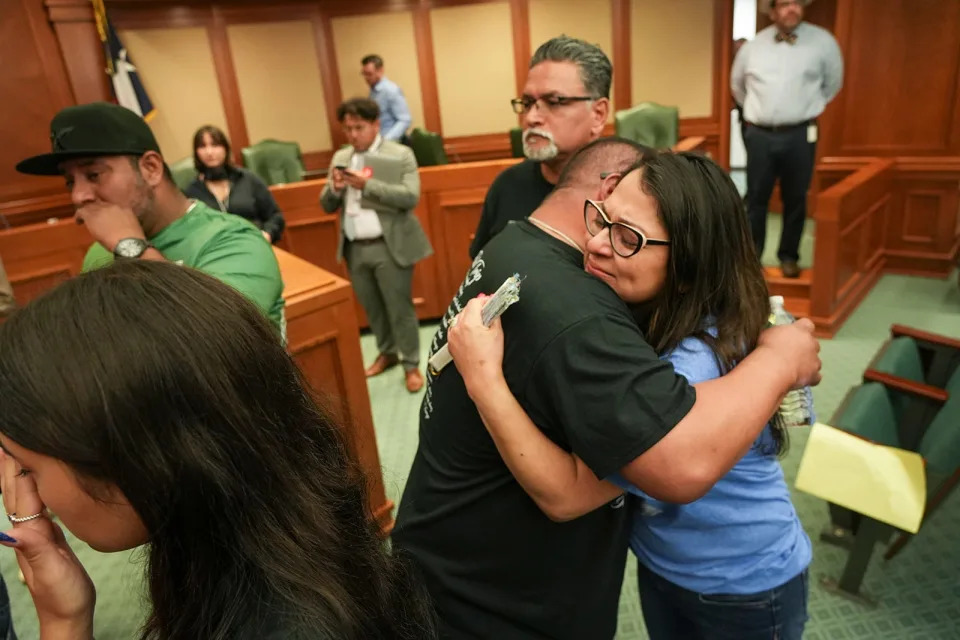
Several Uvalde victims’ relatives burst into sobs and cheers in the Capitol hearing room when two Republicans joined all the Democrats on the committee to advance the bill by an 8-5 vote.

“I’m feeling very overwhelmed, very emotional,” Kimberly Garcia said through tears after the committee vote. Her 10-year-old daughter, Amerie Jo Garza, was one of the 19 fourth graders and two teachers killed at Robb Elementary School in Uvalde on May 24, 2022.

“I was super worried, but I feel like my daughter did this, and I feel like she’s making a difference, and I’m proud of her. I hate that it’s come down to this, but I know that she’s always with me, and I know that I’m not going to let anyone ever forget her,” Garcia said.

Uvalde victims’ relatives have been advocating for lawmakers to pass House Bill 2744 for months, coming to the Capitol nearly every week during the legislative session to demand its passage and even waiting more than 13 hours to testify in support of the bill in a committee hearing in April.

Their unrelenting push for lawmakers to pass gun control legislation has been an uphill battle in a Republican-dominated Legislature that has loosened gun restrictions in recent sessions. Monday’s vote, however, was a significant victory for the families.

As recently as 10 a.m. Monday, Rio Grande City Republican Rep. Ryan Guillen, who chairs the committee where the bill was pending, had said he was not planning to bring the bill up for a vote because he didn’t believe it had the votes to pass in the full House.

But by 11 a.m., after an emotional protest and news conference by the Uvalde families and gun control activists Monday, Guillen changed course.

The Uvalde gunman purchased his AR-15 style semi-automatic rifle legally just days after his 18th birthday, having unsuccessfully tried to acquire one before he was legally old enough to do so under state law.

While Monday’s progress was a major, and unexpected, step forward, the future of the bill remains uncertain. Texas House Speaker Dade Phelan previously said he would be willing to let a debate on the bill play out on the House floor but cautioned that he doesn’t believe it has the votes to pass the House.

Gov. Greg Abbott has said he believes the measure to be unconstitutional. A spokesperson for the speaker’s office declined to comment on the bill’s progress Monday, and a representative for the governor did not immediately return a request for comment.

Family members of Uvalde victims Julissa Rizo and Javier Cazarez hug after the House Select Committee on Community Safety votes HB2744 out of committee at the Texas Capitol Monday, May 8, 2023. HB2744 would raise the age to purchase assault weapons.

A Refugee From Another Time Gets an Eviction Notice

The New York Times

A Refugee From Another Time Gets an Eviction Notice

Dan Barry – May 8, 2023

William Mackiw
William Mackiw

NEW YORK — The travails of many can be lucrative for a few. Take the old Stewart Hotel in Manhattan, which is being used as temporary housing for some of the tens of thousands of migrants who have come north to New York in search of sanctuary.

The city is paying a $200 nightly rate for 611 rooms in the nearly century-old hotel. This comes to roughly $6,000 a month for each room, or about $3.66 million a month for the hotel’s owners.

While they collect favorable rates for their fully booked hotel, the owners are also suing to evict the wisp of a man paying $865 a month for Room 1810: William Mackiw, who has lived there for so long that no one knows when he first appeared. It has been decades.

At some point, he moved in with the rent-stabilized room’s tenant, his aunt Louise. At some point, she died. Again, it has been decades.

And he just kept paying the modest rent with what he earned as a waiter in restaurants of casual fare. Your Howard Johnson’s. Your Beefsteak Charlie’s. Month after month, year after year.

Mackiw, 82 and retired, lives among the relics of a solitary life rooted in the past. Piles of old movies on VHS and DVD. Threadbare shirts hanging above the discolored bathtub. A broken TV. A dust-covered rotary phone. Four pairs of black shoes gathered on the floor like a flock of crows.

Within his confined world, the tight boundaries of which include a church and a market, he lived mostly unseen. Until a few months ago, that is, when someone knocked on his door and handed him a document. Its message:

“Time for you to leave,” Mackiw recalled.

In 10 days.

With that, the economic, societal and geopolitical pressures of the larger world combined to upend his tiny speck of it, and not for the first time. Mackiw was also an immigrant refugee, once. He needed sanctuary then, and may soon need it again.

In November 1949, the General C.C. Ballou, a reconfigured Army transport ship whose amenities included a children’s playroom, departed the German port of Bremerhaven. Aboard were 1,265 of the many millions of Europeans displaced by the upheaval of World War II.

According to records kept by the Center for Migration Studies of New York, the passengers included Celestyn and Sofia Mackiw and their two sons, Zygfryd, 12, and Wilhelm, 9. The Ukrainian family had most recently been living in a displacement camp in Aschaffenburg, Germany, where the uprooted, persecuted and traumatized received food, clothing and medical care.

Asked why his family left Europe, Mackiw said, simply, “Because of the war.” His failing memory recalls only flashes of his disrupted boyhood: being terrified by the bombs; bringing food to Jews harbored by his mother; living in camps.

Once in the United States, the Mackiws settled into a walk-up building in an East Village neighborhood sometimes called Little Ukraine. He remembers his mother as “an incredible woman” and his father as a daring window cleaner who “didn’t bother with the belts.”

The family later moved to Orchard Street on the Lower East Side. Mackiw attended the city’s Machine and Metal Trades High School, became an American citizen in 1959 and held a series of blue-collar jobs before waiting on tables full time.

“I worked in the restaurants,” he said.

Among them was Joe Franklin’s Memory Lane, a Theater District hangout for entertainers either well known or yet to be discovered. They all gravitated toward Franklin, a longtime radio and television host known for his command of entertainment history.

“The King of Nostalgia,” proclaimed his business cards, one of which sits amid the Room 1810 clutter. He died in 2015.

As Franklin held court with the likes of Soupy Sales and “Professor” Irwin Corey — you should look them up — his waiter of choice was Mackiw.

“Joe specifically sat in the section where William would be serving,” recalled Arnold Wachtel, a Joe Franklin’s customer who once ran Times Square gift and novelty shops such as the Fun Emporium and the Funny Store. “They used to reminisce about old movies and swap copies of movies on videos and DVDs.”

At shift’s end, the diminutive waiter would place a hat on his bald head and go back to the Stewart at Seventh Avenue and 31st Street, back to Room 1810.

The 31-story hotel opened in 1929 as the Hotel Governor Clinton — a lesser version of its grand neighbor, the Hotel Pennsylvania — and experienced the typical ups, downs and changes of the hospitality industry. But some aspects seemed permanent, from the art deco touches in the lobby to a few tenants in the rooms above.

Specifics are murky, but a few decades ago, perhaps as early as the 1970s, a retired seamstress named Louise Hirschfeld moved into 1810, a one-room apartment with a bathroom and kitchenette. She was a sister of Mackiw’s mother, Sofia.

The date of Mackiw’s arrival has been lost in the Manhattan blur of time. He slept on the couch while his aunt slept in the bed. Then she left for France, where her son and grandchildren lived and where she died at 81. In 1995.

Mackiw continued to pay the monthly rent with cash or a money order, and to collect receipts bearing the name of his dead aunt. When he wasn’t lingering in the lobby, shopping for food on Ninth Avenue or praying at St. Francis of Assisi Church around the corner, he was in his room, watching movies from the extensive Mackiw collection.

These portals of escape are scattered by the dozens on the floor. “King Kong.” “Broken Arrow.” “It Came From Outer Space.” “To Have and Have Not.” And his favorite: “Gone With the Wind.”

His routine did not change as time passed, as the city evolved, as the hotel came under new ownership. In 2016, the building was bought by a limited liability corporation whose partners declined through their lawyer last week to identify themselves. City records identify two of them as Isaac Chetrit, who with his brother, Eli, owns the AB & Sons investment group, and Ray Yadidi, who with his brother, Jack, owns the Sioni Group real estate firm.

The first threat to Mackiw’s insular world came early last year, when the owners informed the half-dozen permanent residents that they would be providing relocation assistance while the building underwent extensive renovations. The plan was to close the hotel and spend up to three years converting it into a 625-unit apartment building.

This, apparently, was when the owners discovered that Mackiw, not the late Louise Hirschfeld, was occupying Room 1810. Even though he had personally handed over the rent every month for years.

After this revelation, Mackiw said, hotel representatives came to his door more than once to tell him in a forceful and threatening manner that he had to vacate the room. The hotel denies ever harassing him.

At the same time, a humanitarian crisis was unfolding in New York, as thousands of migrants from Central and South America came to escape crime and economic uncertainty. Many arrived by bus, courtesy of the Republican governors of Arizona and Texas, who wanted to give the Northeast a taste of everyday life along the southern border.

The hotel’s owners set aside their conversion plans and, in mid-September, agreed to allow the city to rent half the building, including 300 rooms, for use as an intake center and refuge for asylum-seekers.

It wasn’t enough. In mid-December, the city signed a new contract to take effective control of the entire hotel, including the lobby, the ballroom and 611 rooms (at $200 a night). The agreement, which gave temporary housing to about 2,000 migrants, did not include the several units occupied by permanent residents.

The same week in September that the hotel began renting rooms to the city at market rates, a process server handed a 10-day eviction notice to the man who answered a knock on the door of Room 1810. The server described Mackiw this way:

Height: 5-foot-5.

Weight: 110 pounds.

Approximate age: 83.

Hair: Hat.

By this point, a distressed Mackiw had reached out to Wachtel, his old Joe Franklin’s customer, who had not heard from him in more than a dozen years. But as the son of a Holocaust survivor, Wachtel was moved by the older man’s ordeal — “The man is terrified” — and family memories of harboring Jews during the war.

“He’s a nice guy,” Wachtel said. “He prays for me and my family.”

Wachtel made phone calls, sent emails and arranged to become Mackiw’s power of attorney. He also contacted the Goddard Riverside Law Project, which specializes in the rights of single-room-occupancy (SRO) tenants. It agreed to take the Housing Court case of CYH Manhattan LLC against William Mackiw aka Bill Mackiw.

Daniel Evans, a lawyer with Goddard Riverside, said that under the city’s rent-stabilization codes, Mackiw acquired the rights and protections of a permanent SRO resident once he had spent six months in the apartment. There is no dispute that his stay has been much longer than six months — much, much longer.

“It’s outrageous that they would bring this type of case after 40 years of Mr. Mackiw living there,” Evans said. “Especially when he’s paying the rent himself at the front desk. They know he’s there.”

In a telephone interview, Lisa Faham-Selzer, a lawyer representing the owners, declined to answer a series of questions, including how long Mackiw had lived in the hotel and why the hotel had accepted payment from him for decades.

“This is a strong case with very, very clear allegations,” she said.

A hint of those allegations is contained in a recent court filing, in which the owners contend that Mackiw “has been posing as Louise Hirschfeld for decades.” By doing so, they argue, he “has been perpetrating a fraud.”

The case is pending. Court records do not indicate eviction proceedings brought against any of the hotel’s other permanent tenants, although one moved out after receiving a $10,000 buyout.

For now, Mackiw, a refugee from another time, continues to live among the refugees of today, fretting to the point of tears about his future.

He stays mostly in Room 1810, his longtime home. There, during a recent visit, the only food seemed to be milk, some cheese slices, peanut butter, a box of Cheerios, a pack of vanilla Oreos and a few Hershey chocolate bars.

“You want a Hershey?” asked the old waiter.