Jack the Ripper’s identity ‘revealed’ by newly discovered medical records

The Telegraph

Jack the Ripper’s identity ‘revealed’ by newly discovered medical records

Dalya Alberge – July 15, 2023

Hyam Hyams
Hyam Hyams, photographed at Colney Hatch Lunatic Asylum in 1899, has been named as a key suspect in the Jack the Ripper murders – London Metropolitan Archives

A former police volunteer claims to have discovered the identity of the figure behind some of the most shocking crimes in British history, unmasking the 19th-century murderer who terrorised the nation as Jack the Ripper.

Sarah Bax Horton – whose great-great-grandfather was a policeman at the heart of the Ripper investigation – has unearthed compelling evidence that matches witness descriptions of the man seen with female victims shortly before they were stabbed to death in 1888 in the East End of London.

Her detective work has led her to Hyam Hyams, who lived in an area at the centre of the murders and who, as a cigar-maker, knew how to use a knife. He was an epileptic and an alcoholic who was in and out of mental asylums, his condition worsening after he was injured in an accident and unable to work. He repeatedly assaulted his wife, paranoid that she was cheating on him, and was eventually arrested after he attacked her and his mother with “a chopper”.

Significantly, Ms Bax Horton gained access to his medical records and discovered dramatic details. She told The Telegraph: “For the first time in history, Jack the Ripper can be identified as Hyam Hyams using distinctive physical characteristics.”

Sarah Bax Horton
Sarah Bax Horton has researched medical records in her quest to find Jack the Ripper – HENRY HARRISON

Witnesses described a man in his mid-thirties with a stiff arm and an irregular gait with bent knees, and Ms Bax Horton discovered that the medical notes of Hyams – who was 35 in 1888 – recorded an injury that left him unable to “bend or extend” his left arm as well as an irregular gait and an inability to straighten his knees, with asymmetric foot dragging. He also had the most severe form of epilepsy, with regular seizures.

The victims were prostitutes or destitute. Their throats were cut and their bodies butchered in frenzied attacks with the authorities received taunting anonymous notes from someone calling himself Jack the Ripper. They are some of the most infamous unsolved crimes.

At least six women Martha Tabram, Polly Nichols, Annie Chapman, Elisabeth Stride, Kate Eddowes and Mary Jane Kelly – were killed in or near Whitechapel between August and November 1888.

Hyams’ medical notes, taken from various infirmaries and asylums, reveal that his mental and physical decline coincided with the Ripper’s killing period, escalating between his breaking his left arm in February 1888 and his permanent committal in September 1889.

“That escalation path matched the increasing violence of the murders,” said Ms Bax Horton. “He was particularly violent after his severe epileptic fits, which explains the periodicity of the murders.”

She added: “In the files, it said what the eyewitnesses said – that he had a peculiar gait. He was weak at the knees and wasn’t fully extending his legs. When he walked, he had a kind of shuffling gait, which was probably a side-effect of some brain damage as a result of his epilepsy.”

An 1888 Illustrated Police News front page reports on the murders
An 1888 Illustrated Police News front page reports on the murders – alamy

Witness accounts of the man’s height and weight were similar to the details in Hyams’ medical files, Ms Bax Horton discovered.

“They saw a man of medium height and build, between 5ft 5in. and 5ft 8in. Tall, stout and broad-shouldered. Hyams was 5 foot 7 and a half inches, and weighed 10 stone 7 lbs… His photograph demonstrates that he was noticeably broad-shouldered,” she said.

She has concluded that Hyams’ physical and mental decline – exacerbated by his alcoholism – triggered him to kill. The murders stopped at the end of 1888, around the time Hyams was picked up by the police as “a wandering lunatic”. In 1889, he was incarcerated in the Colney Hatch Lunatic Asylum, north London, until his death in 1913. Jack the Ripper never struck again.

Various suspects have previously been suggested as the man behind the killings, including the artist Walter Sickert, who painted gruesome pictures of a murdered prostitute.

Hyams had been on a “long list” of around 100 culprits, but Ms Bax Horton said he had been discounted because he had been misidentified. “When I was trying to identify the correct Hyam Hyams, I found about five. It took quite a lot of work to identify his correct biographical data. Hyam Hyams has never before been fully explored as a Ripper suspect. To protect the confidentiality of living individuals, two of the Colney Hatch Asylum files on patients, including Hyams, were closed to public view until 2013 and 2015.”

What makes her research particularly extraordinary is that it was prompted by her chance discovery in 2017 that her own great-great-grandfather, Harry Garrett, had been a Metropolitan Police sergeant at Leman Street Police Station, headquarters of the Ripper investigation. He was posted there from January 1888 – the murders’ fateful year – until 1896.

Sergeant Harry Garrett, who worked on theJack the Ripper case

Ms Bax Horton, who read English and modern languages at Oxford University, is a retired civil servant who volunteered with the City of London Police for almost two decades until 2020. She had no idea of her ancestor’s history until she began researching her family and found herself studying the Ripper case.

She will now present her extensive evidence in a forthcoming book, titled One-Armed Jack: Uncovering the Real Jack the Ripper, to be published by Michael O’Mara Books next month.

It is written in tribute to her ancestor and his police colleagues.

Paul Begg, a leading Ripper authority, has endorsed it. “This is a well-researched, well-written, and long-needed book-length examination of a likely suspect. If you have an idea of the sort of man Jack the Ripper might have been, Hyam Hyams could be it,” he said.

Americans are widely pessimistic about democracy in the United States, an AP-NORC poll finds

Associated Press

Americans are widely pessimistic about democracy in the United States, an AP-NORC poll finds

Nicholas Riccardi and Linley Saunders – July 14, 2023

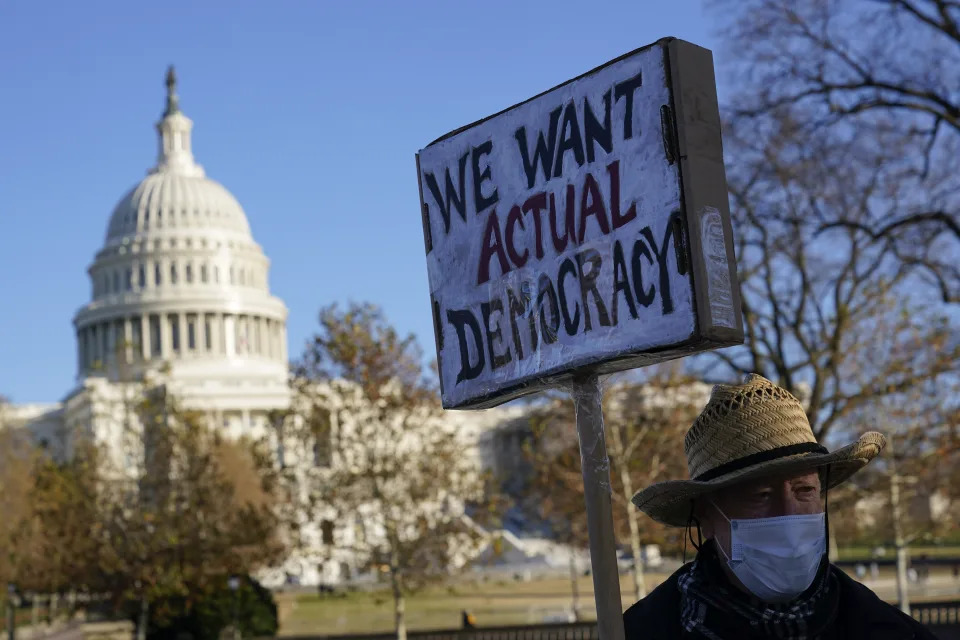
FILE - Protester David Barrows carries a sign during a rally to press Congress to pass voting rights protections and the "Build Back Better Act," Monday, Dec. 13, 2021, in Washington. A new poll finds that only about 1 in 10 U.S. adults give high ratings to the way democracy is working in the United States or how well it represents the interests of most Americans. (AP Photo/Patrick Semansky, File)
 Protester David Barrows carries a sign during a rally to press Congress to pass voting rights protections and the “Build Back Better Act,” Monday, Dec. 13, 2021, in Washington. A new poll finds that only about 1 in 10 U.S. adults give high ratings to the way democracy is working in the United States or how well it represents the interests of most Americans. (AP Photo/Patrick Semansky, File)
FILE - In this Jan. 26, 2020, file photo, people cheer as Democratic presidential candidate Sen. Bernie Sanders, I-Vt., speaks at a campaign rally in Sioux City, Iowa. A new poll finds that only about 1 in 10 U.S. adults give high ratings to the way democracy is working in the United States or how well it represents the interests of most Americans. (AP Photo/John Locher, File)
 In this Jan. 26, 2020, file photo, people cheer as Democratic presidential candidate Sen. Bernie Sanders, I-Vt., speaks at a campaign rally in Sioux City, Iowa. A new poll finds that only about 1 in 10 U.S. adults give high ratings to the way democracy is working in the United States or how well it represents the interests of most Americans. (AP Photo/John Locher, File)
FILE - A Republican supporter holds a "Save America" sign at a rally for former President Donald Trump at the Minden Tahoe Airport in Minden, Nev., Saturday, Oct. 8, 2022. A new poll finds that only about 1 in 10 U.S. adults give high ratings to the way democracy is working in the United States or how well it represents the interests of most Americans.(AP Photo/José Luis Villegas, Pool, File)
A Republican supporter holds a “Save America” sign at a rally for former President Donald Trump at the Minden Tahoe Airport in Minden, Nev., Saturday, Oct. 8, 2022. A new poll finds that only about 1 in 10 U.S. adults give high ratings to the way democracy is working in the United States or how well it represents the interests of most Americans.(AP Photo/José Luis Villegas, Pool, File)

WASHINGTON (AP) — Only about 1 in 10 U.S. adults give high ratings to the way democracy is working in the United States or how well it represents the interests of most Americans, according to a new poll from The Associated Press-NORC Center for Public Affairs Research.

Majorities of adults say U.S. laws and policies do a poor job of representing what most Americans want on issues ranging from the economy and government spending to gun policy, immigration and abortion. The poll shows 53% say Congress is doing a bad job of upholding democratic values, compared with just 16% who say it’s doing a good job.

The findings illustrate widespread political alienation as a polarized country limps out of the pandemic and into a recovery haunted by inflation and fears of a recession. In interviews, respondents worried less about the machinery of democracy — voting laws and the tabulation of ballots — and more about the outputs.

Overall, about half the country — 49% — say democracy is not working well in the United States, compared with 10% who say it’s working very or extremely well and 40% only somewhat well. About half also say each of the political parties is doing a bad job of upholding democracy, including 47% who say that about Democrats and even more — 56% — about Republicans.

“I don’t think either of them is doing a good job just because of the state of the economy — inflation is killing us,” said Michael Brown, a 45-year-old worker’s compensation adjuster and father of two in Bristol, Connecticut. “Right now I’m making as much as I ever have, and I’m struggling as much as I ever have.”

A self-described moderate Republican, Brown has seen the United States falling short of its democratic promise ever since learning in high school that the Electoral College allows someone to become president while not winning the majority of national votes. But he’s especially disappointed with Congress now, seeing its obsessions as not reflective of the people’s will.

“They’re fighting over something, and it has nothing to do with the economy,” Brown said, singling out the GOP-controlled House’s investigation of President Joe Biden’s son.

“Hunter Biden — what does that have to do with us?” he asked.

The poll shows 53% of Americans say views of “people like you” are not represented well by the government, with 35% saying they’re represented somewhat well and 12% very or extremely well. About 6 in 10 Republicans and independents feel like the government is not representing people like them well, compared with about 4 in 10 Democrats.

Karalyn Kiessling, a researcher at the University of Michigan who participated in the poll, sees troubling signs all around her. A Democrat, she recently moved to a conservative area outside the liberal campus hub of Ann Arbor, and worried that conspiracy theorists who believe former President Donald Trump’s lies that he won the 2020 election would show up as poll watchers. Her Republican family members no longer identify with the party and are limiting their political engagement.

Kiessling researches the intersection of public health and politics and sees many other ways to participate in a democracy in addition to voting — from being active in a political party to speaking at a local government meeting. But she fears increased partisan nastiness is scaring people away from these crucial outlets.

“I think people are less willing to get involved because it’s become more contentious,” Kiessling, 29, said.

That leads to alienation at the national level, she said — something she certainly feels when she sees what comes out of Washington. “When you have a base that’s a minority of what general Americans think, but they’re the loudest voices in the room, that’s who politicians listen to,” Kiessling said.

Polarization has transformed some states into single-party dominions, further alienating people like Mark Short, a Republican who lives in Dana Point, California.

“In California, I kind of feel that I throw my vote away every time, and this is just what you get,” said Short, 63, a retired businessman.

The poll shows that the vast majority of Americans — 71% — think what most Americans want should be highly important when laws and policies are made, but only 48% think that’s actually true in practice.

And views are even more negative when it comes to specific issues: About two-thirds of adults say policies on immigration, government spending, abortion policy and gun policy are not representative of most Americans’ views, and nearly that many say the same about the economy as well as gender identity and LGBTQ+ issues. More than half also say policies poorly reflect what Americans want on health care and the environment.

Joseph Derito, an 81-year-old retired baker in Elmyra, New York, sees immigration policy as not representing the views of most Americans. “The government today is all for the people who have nothing — a lot of them are capable of working but get help,” said Derito, a white political independent who leans Republican and voted for Trump. “They just want to give these people everything.”

Sandra Wyatt, a 68-year-old retired data collection worker and Democrat in Cincinnati, blames Trump for what she sees as an erosion in democracy. “When he got in there, it was like, man, you’re trying to take us back to the day, before all the rights and privileges everybody fought for,” said Wyatt, who is Black, adding that she’s voted previously for Republicans as well.

She sees those bad dynamics as lingering after Trump’s presidency. “We always knew there was racism but now they’re emboldened enough to go around and shoot people because of the color of their skin,” Wyatt said.

Stanley Hobbs, a retired autoworker in Detroit and a Democrat, blames “a few Republicans” for what he sees as democracy’s erosion in the U.S. He sees those GOP politicians as beholden to a cabal of big businesses and points to issues like abortion as examples of how the laws no longer represent the views of the majority of Americans.

He’s trying to stay optimistic.

“It seems like this always happens in the U.S. and we always prevail,” Hobbs said, recalling how American politicians sympathetic to Nazi Germany gained prominence before World War II. “I just hope we prevail this time.”

Riccardi reported from Denver.

The Associated Press receives support from several private foundations to enhance its explanatory coverage of elections and democracy. See more about AP’s democracy initiative here. The AP is solely responsible for all content.

The poll of 1,220 adults was conducted June 22-26 using a sample drawn from NORC’s probability-based AmeriSpeak Panel, which is designed to be representative of the U.S. population. The margin of sampling error for all respondents is plus or minus 3.9 percentage points.

This is what happens when attorneys go along with Kari Lake’s election delusions

AZ Central – The Arizona Republic – Opinion

This is what happens when attorneys go along with Kari Lake’s election delusions

Laurie Roberts, Arizona Republic – July 14, 2023

Mark Finchem, Republican candidate for Arizona secretary of state and Kari Lake, Arizona gubernatorial candidate.

A federal judge on Friday ordered the attorneys for Kari Lake and Mark Finchem to pay Maricopa County $122,200 — money the county’s taxpayers spent to fend off a “frivolous” lawsuit brought before last year’s election.

Turns out judges don’t much like to see the court system used as a campaign prop.

Attorneys should take note of this.

Lawsuit was simply a campaign stunt

You may recall that Lake and Finchem — with financial backing from MyPillow CEO Mike Lindell — filed suit in April 2022 while they were running for governor and secretary of state.

Their lawsuit asked a judge to bar the machine tabulation of votes in the 2022 election and require that paper ballots be used instead. They claimed that Arizona vote-counting machines produced inaccurate results and that there were no paper ballots to verify the machine count.

Never mind, apparently, the fact that they had no evidence to back up their claims.

Or that Arizona not only already uses paper ballots but state law requires a hand count of a random sample of those ballots, to verify the machine count is accurate.

Appeal moves to Tucson: And Kari Lake smells a conspiracy

But then, their lawsuit wasn’t a serious attempt to remedy a real problem. It was yet another campaign stunt, employed to make baseless claims about supposedly stolen elections.

A judge called Lake and Finchem on it

To his credit, U.S. District Court John J. Tuchi called them on it.

Last August, he threw out their lawsuit, noting that the pair provided no evidence that machine counting produces inaccurate results and no proof that a hand count of ballots would be more accurate.

In December, he followed up by granting Maricopa County’s request for sanctions against the lawyers for bringing a “frivolous” lawsuit that “baselessly kicked up a cloud of dust.”

“In sum,” Tuchi wrote, “Plaintiffs lacked an adequate factual or legal basis to support the wide ranging constitutional claims they raised or the extraordinary relief they requested. Plaintiffs filled the gaps between their factual assertions, claimed injuries, and requested relief with false, misleading, and speculative allegations.”

Lawyers, take note: You better have evidence

And on Friday, he socked attorneys Kurt Olsen, Andrew Parker and Alan Dershowitz with the county’s $122K bill, though Dershowitz is liable for just 10% of the tab.

Dershowitz, one of the nation’s pre-eminent constitutional law experts, tried to wiggle out of any responsibility by minimizing his involvement, but the judge wasn’t having it.

“Attorneys must be reminded that their duties are not qualified in the way he suggests and that courts are entitled to rely on their signatures as certifications their filings are well-founded,” Tuchi wrote.

Turns out judges don’t like it when attorneys throw in with their clients to bring false, misleading and speculative allegations.

Now, they’re on notice that there’s a price to be paid for doing that.

House Republicans push through defense bill limiting abortion access and halting diversity efforts

Associated Press

House Republicans push through defense bill limiting abortion access and halting diversity efforts

 Lisa Mascaro and Kevin Freking – July 14, 2023

WASHINGTON (AP) — The House passed a sweeping defense bill Friday that provides an expected 5.2% pay raise for service members but strays from traditional military policy with Republicans add-ons blocking abortion coverage, diversity initiatives at the Pentagon and transgender care that deeply divided the chamber.

Democrats voted against the package, which had sailed out of the House Armed Services Committee on an almost unanimous vote weeks ago before being loaded with the GOP priorities during a heated late-night floor debate this week.

The final vote was 219-210, with four Democrats siding with the GOP and four Republicans opposed. The bill, as written, is expected to go nowhere in the Democratic-majority Senate.

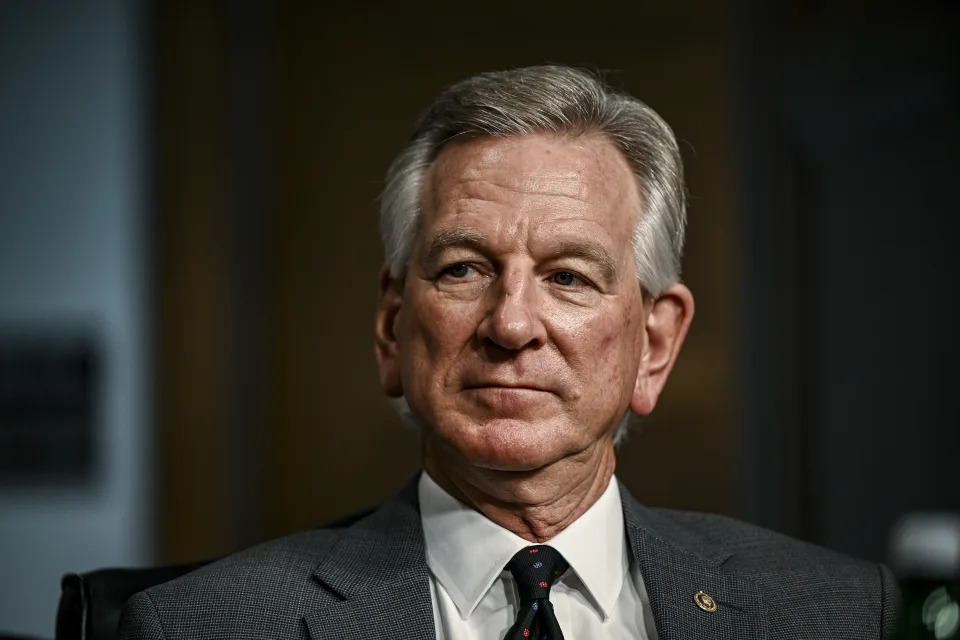
Efforts to halt U.S. funding for Ukraine in its war against Russia were turned back, but Republicans added provisions to stem the Defense Department’s diversity initiatives and to restrict access to abortions. The abortion issue has been championed by Sen. Tommy Tuberville, R-Ala., who is singularly stalling Senate confirmation of military officers, including the new commandant of the Marine Corps.

“We are continuing to block the Biden administration’s ‘woke’ agenda,” said Rep. Lauren Boebert, R-Colo.

Turning the must-pass defense bill into a partisan battleground shows how deeply the nation’s military has been unexpectedly swept up in disputes over race, equity and women’s health care that are now driving the Republican Party’s priorities in America’s widening national divide.

During one particularly tense moment in the debate, Democratic Rep. Joyce Beatty of Ohio, a former chairwoman of the Congressional Black Caucus, spoke of how difficult it was to look across the aisle as Republicans chip away at gains for women, Black people and others in the military.

“You are setting us back,” she said about an amendment from Rep. Eli Crane, R-Ariz., that would prevent the Defense Department from requiring participation in race-based training for hiring, promotions or retention.

Crane argued that Russia and China do not mandate diversity measures in their military operations and neither should the United States. “We don’t want our military to be a social experiment,” he said. “We want the best of the best.”

When Crane used the pejorative phrase “colored people” for Black military personnel, Beatty asked for his words to be stricken from the record.

Friday’s voted capped a tumultuous week for House Speaker Kevin McCarthy, R-Calif., as conservatives essentially drove the agenda, forcing their colleagues to consider their ideas for the annual bill that has been approved by Congress unfailingly since World War II.

“I think he’s doing great because we are moving through — it was like over 1,500 amendments — and we’re moving through them,” said Rep. Marjorie Taylor Greene, R-Ga. She told reporters she changed her mind to support the bill after McCarthy offered her a seat on the committee that will be negotiating the final version with the Senate.

Democrats, in a joint leadership statement, said they were voting against the bill because Republicans “turned what should be a meaningful investment in our men and women in uniform into an extreme and reckless legislative joyride.”

“Extreme MAGA Republicans have chosen to hijack the historically bipartisan National Defense Authorization Act to continue attacking reproductive freedom and jamming their right-wing ideology down the throats of the American people,” said the statement from Reps. Hakeem Jeffries of New York, Katherine Clark of Massachusetts and Pete Aguilar of California.

The defense bill authorizes $874.2 billion in the coming year for the defense spending, keeping with President Joe Biden’s budget request. The funding itself is to be allocated later, when Congress handles the appropriation bills, as is the normal process.

The package sets policy across the Defense Department, as well as in aspects of the Energy Department, and this year focuses particularly on the U.S. stance toward China, Russia and other national security fronts.

Republican opposition to U.S. support for the war in Ukraine drew a number of amendments, including one to block the use of cluster munitions that Biden just sent to help Ukraine battle Russia. It was a controversial move because the weapons, which can leave behind unexploded munitions endangering civilians, are banned by many other countries.

Most of those efforts to stop U.S. support for Ukraine failed. Proposals to roll back the Pentagon’s diversity and inclusion measures and block some medical care for transgender personnel were approved.

GOP Rep. Ronny Jackson of Texas, who served as a White House physician, pushed forward the abortion measure that would prohibit the defense secretary from paying for or reimbursing expenses relating to abortion services.

Jackson and other Republicans praised Tuberville for his stand against the Pentagon’s abortion policy, which was thrust into prominence as states started banning the procedure after the Supreme Court decision last summer overturning the landmark Roe v. Wade law.

“Now he’s got support, he’s got back up here in the House,” Jackson said.

But it’s not at all certain that the House position will stand as the legislation moves to the Senate, which is preparing its own version of the bill. Senate Democrats have the majority but will need to work with Republicans on a bipartisan measure to ensure enough support for passage in their chamber.

McCarthy lauded the House for gutting “radical programs” that he said distract from the military’s purpose.

Democratic members of the House Armed Services Committee, led by Rep. Adam Smith of Washington state, dropped their support due to the social policy amendments.

Smith, who is white, tried to explain to Crane and other colleagues why the Pentagon’s diversity initiatives were important in America, drawing on his own experience as a businessman trying to reach outside his own circle of contacts to be able to hire and gain deeper understanding of other people.

Smith lamented that the bill that the committee passed overwhelmingly “no longer exists. What was once an example of compromise and functioning government has become an ode to bigotry and ignorance.”

Associated Press writers Farnoush Amiri, Stephen Groves and Mary Clare Jalonick contributed to this report.

GOP’s Far Right Seeks to Use Defense Bill to Defund Ukraine War Effort

The New York Times

GOP’s Far Right Seeks to Use Defense Bill to Defund Ukraine War Effort

Karoun Demirjian – July 13, 2023

Sen. Tommy Tuberville (R-Ala.) participates in a hearing regarding Air Force General Charles Q. Brown’s nomination to serve as chairman of the Joint Chiefs of Staff, on Capitol Hill in Washington on Tuesday, July 11, 2023. (Kenny Holston/The New York Times)

WASHINGTON — A group of right-wing House Republicans pushing to load up the annual defense bill with socially conservative policies on abortion, race and gender have another demand: severe restrictions on U.S. military support for Ukraine.

The pressure raises the prospect of a divisive floor fight over America’s backing for the war effort just as President Joe Biden tries to rally European allies to support Kyiv in its conflict with Russia.

The group’s proposals on military aid stand no chance of passing the House, where there continues to be strong bipartisan support for backing Ukraine’s war effort, or going anywhere in the Senate. But the far right’s insistence on casting votes on the matter anyway has further imperiled the defense legislation and transformed what is ordinarily a broadly supported measure that provides the annual pay raise to U.S. military personnel and sets Pentagon policy into a partisan battleground that has placed Republican divisions on display.

The House on Wednesday began debating the $886 billion measure, sidestepping the rifts as Republican leaders toiled behind the scenes to placate ultraconservative lawmakers who are demanding votes to scale back Ukraine aid and add social policy dictates. But those disputes will eventually have to be resolved to pass the bill, which had been expected to receive approval Friday — a timetable that is now in doubt as the hard right threatens to hold up the process.

The right-wing lawmakers are seeking votes on a series of proposals that would hamstring U.S. support for Ukraine, including one to curtail all funding for Kyiv until there is a diplomatic solution to the conflict and another that would end a $300 million program to train and equip Ukrainian soldiers that has been in place for nearly a decade.

“Congress should not authorize another penny for Ukraine and push the Biden administration to pursue peace,” Rep. Marjorie Taylor Greene, R-Ga., argued to lawmakers on the House Rules Committee this week, appealing to them to allow votes on several proposals she has written on the topic. “Ukraine is not the 51st state of the United States of America.”

Rep. Scott Perry, R-Pa., chair of the conservative House Freedom Caucus, said votes to curtail support for Ukraine were every bit as important to the members of his group as votes to restrict abortion access and services for transgender soldiers. Asked whether some might seek to block the bill without such votes, he replied: “They might.”

Because Speaker Kevin McCarthy holds only a slim margin of control in the House, any rebellion by the right wing could stop the defense measure in its tracks, denying him the votes he would need from his side to advance it to final passage. But if he bows to the demands for votes on Ukraine, it would put divisions in Congress over the war on display at a critical junction in Ukraine’s counteroffensive, and just after Biden has appealed to allies this week during a NATO summit to remain united in support.

“We can see from what’s taken place at the NATO summit, the significance and importance of us all speaking with one voice and making sure that we’re giving the Ukrainians what they need to win this war,” Rep. Gregory Meeks of New York, the top Democrat on the Foreign Affairs Committee, said in an interview Wednesday. “It will be absolutely the worst thing to do to have a show of division — that’s playing right into Putin’s hands,” he said, referring to Russian President Vladimir Putin.

Some mainstream Republicans say they relish the fight, seeing it as a potential opportunity to put the rebellious right wing of the party in its place.

“It’s going to fail big time,” Rep. Mike D. Rogers, R-Ala., said of the hard right’s bid to scrap American support for Ukraine. “So I hope they make it in order — I think you’ll see it go down overwhelmingly.”

The defense bill is the latest forum right-wing lawmakers have been using to challenge McCarthy’s leadership. Their protest, which began during January’s protracted speaker fight, resumed last month, when 11 far-right lawmakers brought the House floor to a standstill to express their fury at McCarthy’s debt ceiling deal with Biden. They have threatened similar tactics in the future if he fails to bow to their demands.

McCarthy had been bracing for a difficult fight over Ukraine funding in the coming months, when the Biden administration is expected to request billions of dollars to keep Kyiv’s war machine humming.

Hoping to head off a revolt from the right wing, the speaker publicly declared he was opposed to any additional funding for Ukraine beyond the limits of the debt ceiling deal, despite having publicly proclaimed just weeks before: “I vote for aid for Ukraine; I support aid for Ukraine.”

But with the defense bill, the ultraconservative faction is trying to force the issue now.

Greene, who has become one of McCarthy’s closest allies, demurred Wednesday when asked whether she would help other right-wing members block progress on the bill if leaders denied her a vote to curtail Ukraine funding. Despite being one of the most outspoken hard-right members of the House, Greene has routinely taken McCarthy’s side in disputes with his rank and file, and has refused to lend any support to the efforts to undermine his leadership. But her involvement is an indicator of how deeply a vote on Ukraine might split House Republicans.

Ukraine assistance is a tricky issue for the GOP politically. Both of the front-runners for the 2024 Republican presidential nomination, former President Donald Trump and Gov. Ron DeSantis of Florida, have said they would like to limit U.S. assistance to Ukraine. According to a recent poll by the Ronald Reagan Presidential Foundation and Institute, while more than 70% of Republicans want to see Ukraine win the war, only half support sending U.S. military aid to help the country defeat Russia.

Last year, 57 House Republicans voted against a measure to provide $40 billion in military and humanitarian assistance for Ukraine. Congress approved a total of more than $113 billion in Ukraine aid last year.

House GOP leaders expressed confidence Wednesday that they could defeat any proposal to strip funding for Ukraine, thus preserving the integrity of the underlying defense bill. But they worried aloud about the social policy measures, which they noted would alienate Democrats whose votes would be needed to pass the bill.

Ultraconservatives are pushing for votes on proposals that would undo a Pentagon policy offering time off and travel reimbursement to service members traveling out of state to obtain an abortion, to end diversity training in the military, and to ensure that medical services for transgender troops are limited.

“Those I think are actually dicier,” said Rep. Tom Cole, R-Okla., chair of the Rules Committee. “You’re not going to get any Democrats that way.”

GOP leaders appealed to their colleagues Wednesday to support the bill as is, highlighting provisions already included that would ban drag shows at military installations and the teaching of critical race theory.

“This bill goes after the woke, failed, far-left policies that far-left Democrats have wrongfully forced onto the Department of Defense and our men and women in uniform,” Rep. Elise Stefanik of New York, the No. 4 Republican, told reporters.

More Clarence Thomas allegations stain the court: Lawyers with supreme court business paid Clarence Thomas aide via Venmo

The Guardian

Lawyers with supreme court business paid Clarence Thomas aide via Venmo

Stephanie Kirchgaessner in Washington – July 12, 2023

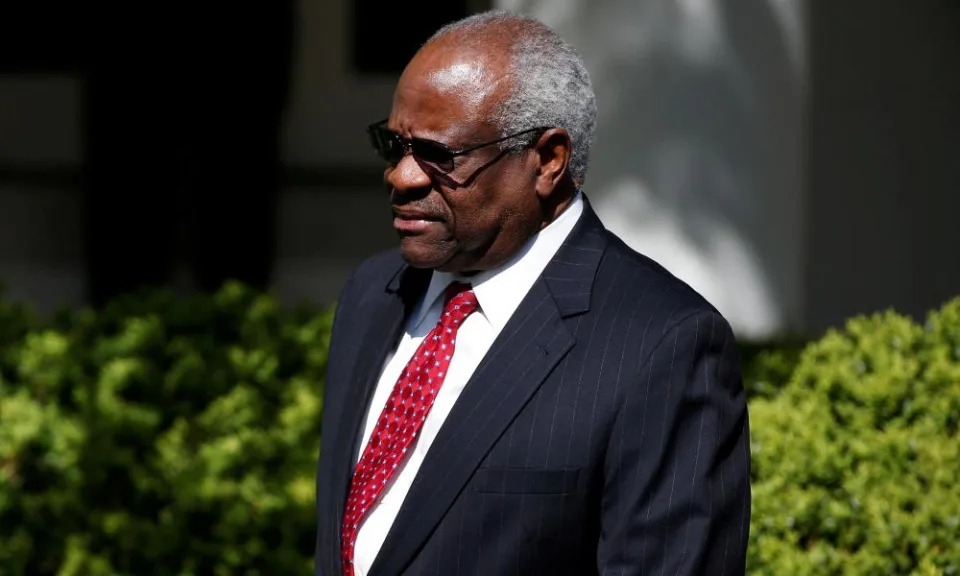
<span>Photograph: Joshua Roberts/Reuters</span>
Photograph: Joshua Roberts/Reuters

Several lawyers who have had business before the supreme court, including one who successfully argued to end race-conscious admissions at universities, paid money to a top aide to Justice Clarence Thomas, according to the aide’s Venmo transactions. The payments appear to have been made in connection to Thomas’s 2019 Christmas party.

The payments to Rajan Vasisht, who served as Thomas’s aide from July 2019 to July 2021, seem to underscore the close ties between Thomas, who is embroiled in ethics scandals following a series of revelations about his relationship with a wealthy billionaire donor, and certain senior Washington lawyers who argue cases and have other business in front of the justice.

Vasisht’s Venmo account – which was public prior to requesting comment for this article and is no longer – show that he received seven payments in November and December 2019 from lawyers who previously served as Thomas legal clerks. The amount of the payments is not disclosed, but the purpose of each payment is listed as either “Christmas party”, “Thomas Christmas Party”, “CT Christmas Party” or “CT Xmas party”, in an apparent reference to the justice’s initials.

However, it remains unclear what the funds were for.

The lawyers who made the Venmo transactions were: Patrick Strawbridge, a partner at Consovoy McCarthy who recently successfully argued that affirmative action violated the US constitution; Kate Todd, who served as White House deputy counsel under Donald Trump at the time of the payment and is now a managing party of Ellis George Cipollone’s law office; Elbert Lin, the former solicitor general of West Virginia who played a key role in a supreme court case that limited the Environmental Protection Agency’s ability to regulate greenhouse gas emissions; and Brian Schmalzbach, a partner at McGuire Woods who has argued multiple cases before the supreme court.

Other lawyers who made payments include Manuel Valle, a graduate of Hillsdale College and the University of Chicago Law School who clerked for Thomas last year and is currently working as a managing associate at Sidley, and Liam Hardy, who was working at the Department of Justice’s office of legal counsel at the time the payment was made and now serves as an appeals court judge for the armed forces.

Will Consovoy, who died earlier this year, also made a payment. Consovoy clerked for Thomas during the 2008-09 term and was considered a rising star in conservative legal circles. After his death, the New York Times reported that Consovoy had come away from his time working for Thomas “with the conviction that the court was poised to tilt further to the right – and that constitutional rulings that had once been considered out of reach by conservatives, on issues like voting rights, abortion and affirmative action, would suddenly be within grasp”.

None of the lawyers who made payments responded to emailed questions from the Guardian.

According to his résumé, Vasisht’s duties included assisting the justice with the administrative functioning of his chambers, including personal correspondence and his personal and office schedule.

Vasisht did not respond to an emailed list of questions from the Guardian, including questions about who solicited the payments, how much individuals paid, and what the purpose of the payments was. The Guardian also asked questions about the nature of Thomas’s Christmas party, how many guests were invited and where the event took place.

Reached via WhatsApp and asked if he would make a statement, Vasisht replied: “No thank you, I do not want to be contacted.”

Legal experts said the payments to Vasisht raised red flags.

Richard Painter, who served as the chief White House ethics lawyer in the George W Bush administration and has been a vocal critic of the role of dark money in politics, said it was “not appropriate” for former Thomas law clerks who were established in private practice to – in effect – send money to the supreme court via Venmo.

“There is no excuse for it. Thomas could invite them to his Christmas party and he could attend Christmas parties, as long as they are not discussing any cases. His Christmas party should not be paid for by lawyers,” Painter said. “A federal government employee collecting money from lawyers for any reason … I don’t see how that works.”

Painter said he would possibly make an exception if recent law clerks were paying their own way for a party. But almost all of the lawyers who made the payments are senior litigators at big law firms.

Kedric Payne, the general counsel and senior director of ethics at the Campaign Legal Center, said that – based on available information – it was possible that the former clerks were paying their own party expenses, and not expenses for Thomas, which he believed was different than random lawyers in effect paying admission to an exclusive event to influence the judge.

He added: “But the point remains that the public is owed an explanation so they don’t have to speculate.”

Thomas has been embroiled in ethics scandals for weeks following bombshell revelations by ProPublica, the investigative outlet which published new revelations about how the billionaire conservative donor Harlan Crow has paid for lavish holidays for the justice, bought Thomas’s mother’s home, and paid for the judge’s great-nephew’s private school education. The stories have prompted an outcry on Capitol Hill, where Democrats have called for the passage of new ethics rules.

Thomas is known for having close relationships with his former clerks. A 2019 article in the Atlantic noted that the rightwing justice has a “vast network” of former clerks and mentees who are now serving as federal judges and served in senior positions throughout the Trump administration. The large presence of former Thomas clerks, the Atlantic noted, meant that the “notoriously silent justice may end up with an outsize voice in the legal system for years to come”.

Thomas’s chamber did not respond to a request for comment.

Got a tip on this story? Please contact Stephanie.Kirchgaessner@theguardian.com

‘Insane’: FBI Director Christopher Wray tangles with House GOP in tense hearing. What you missed

USA Today

‘Insane’: FBI Director Christopher Wray tangles with House GOP in tense hearing. What you missed

Bart Jansen, USA TODAY – July 12, 2023

WASHINGTON – FBI Director Christopher Wray defended the agency Wednesday against House Republicans who argued it suppressed conservative posts on social media and for running what they called illegal searches about U.S. citizens under a foreign surveillance law.

The hearing became the latest flashpoint for the FBI, which Republicans criticized for investigating participants at school board meetings or censoring social media posts. Democrats accused Republicans of trying to protect former President Donald Trump, who faces federal charges related to possession of national security documents after an FBI search of Mar-a-Lago 18 months after he left the White House. A White House spokesman said Republicans are attacking law enforcement.

In his opening salvo, House Judiciary Committee Chairman Jim Jordan, R-Ohio, cited a federal court decision in Louisiana eight days earlier that found the government suppressed First Amendment rights of people posting on social media posts about the COVID-19 pandemic vaccines and mask requirements, under a policy the ruling compared to an “Orwellian ministry of truth.”

The ruling found the FBI failed to alert social media companies that a story about Hunter Biden’s laptop was real rather than Russian disinformation days before the 2020 presidential election. Jordan and Rep. Mike Johnson, R-La., said that deprived millions of voters of information before the election.

“When the court said the FBI misled, that’s a nice way of saying they lied,” Jordan said.

Wray said he has reviewed the decision and the FBI would comply with the court’s prohibition against influencing social media companies. But he declined to comment further because the case is subject to further litigation.

“Our focus is on malign, foreign disinformation – that is, foreign malign information, that is foreign hostile actors who engage in covert actions to confuse our social media platforms,” Wray said. “The FBI is not in the business of moderating content or causing any social media company to suppress or censor.”

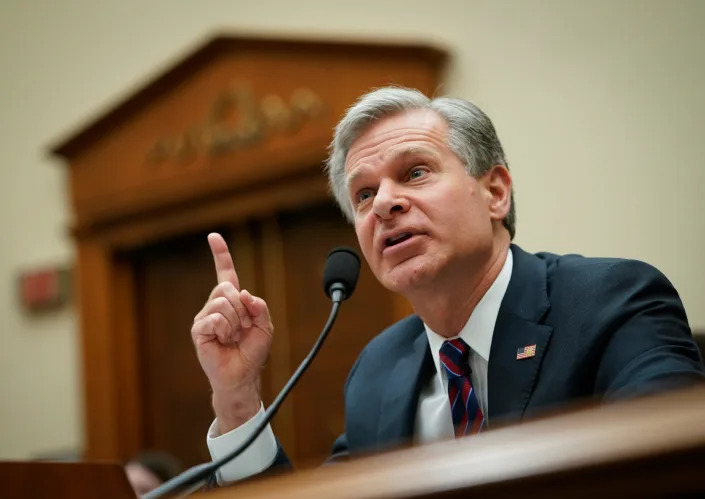
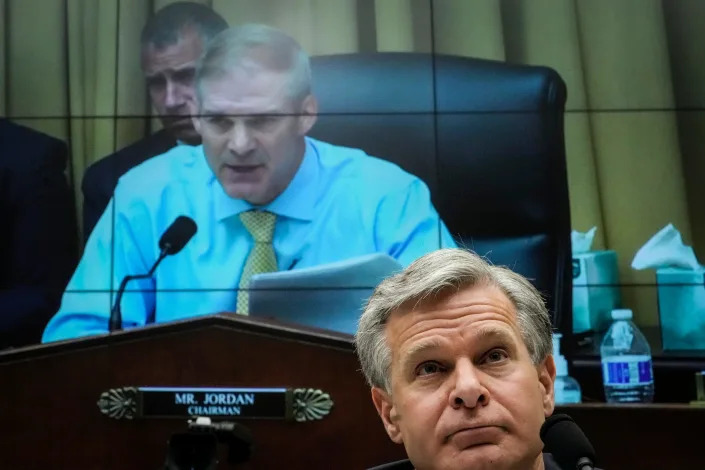
Christopher Wray, Director of the FBI, testifies in front of the House Judiciary Committee in Washington on July 12, 2023.
GOP vows to oppose extension of intelligence surveillance policy

Jordan said Republicans and potentially Democrats would oppose the reauthorization of the Foreign Intelligence Surveillance Act, which is scheduled to expire at the end of the year, because of 204,000 episodes of “illegal scrutiny” of U.S. citizens.

Rep. Matt Gaetz, R-Fla., said a court found that the illegitimate queries included several people linked to the Capitol attack on Jan. 6, 2021.

“The FBI has broken so bad that people can go and engage in queries that when you come before the Congress to answer questions, you’re blissfully ignorant,” Gaetz said. “The court has smacked you down, ruling FBI personnel apparently conducted queries for improper personal reasons.”

Wray said staffers had been disciplined for improper queries, but he couldn’t go into details.

Wray’s prepared statement said he is concerned about “profound risks” with proposals to require either a search warrant or court order before conducting a “U.S. person query” under Section 702 of the act. Wray said such a change would become a ban because applications either wouldn’t meet court standards or would take too long.

“That would be a body blow to the FBI, which relies on this longstanding, lawful capability to rapidly uncover previously hidden threats and connections, and to take swift steps to protect the homeland when needed,” Wray said.

Democrats have also questioned extending Section 702 without changes. Rep. Zoe Lofgren, D-Calif., said

“The committee will need to look into warrant requirements,” Lofgren said.

“We have bipartisan support around the concerns we have about FISA reauthorization and unless we really understand what measures the FBI is taking to ensure that people’s privacy is protected, I think it’s going to be a very difficult reauthorization process,” added Rep. Pramila Jayapal, D-Wash.

Wray agrees with Durham report on FBI missteps in Russia investigation
Christopher Wray, Director of the FBI, testifies in front of the House Judiciary Committee in Washington on Wednesday, July 12, 2023.

A rare point of agreement arose in a discussion of former special counsel John Durham’s report on the origins of the investigation into Russian interference in the 2016 election, which was called Crossfire Hurricane.

Rep. Ben Cline, R-Va., questioned why the FBI failed to consider information beneficial to suspects during Crossfire Hurricane. Cline also questioned whether the FBI abused its authority under the Foreign Surveillance Intelligence Act.

“The American people are outraged” about agents who undermined the FBI’s reputation, Cline said.

The FBI adopted dozens of changes after a scathing inspector general’s report about Crossfire Hurricane, which occurred before Wray became director in August 2017. Durham didn’t recommend additional wholesale changes.

“Certainly there were violations that were totally unacceptable and in my view cannot be allowed to happen again,” Wray said.

Cline also criticized the FBI’s warrantless queries on 3.4 million Americans in 2021 and 200,000 last year.

“It looks like a framework that enables the FBI to spy on countless Americans,” Cline said.

Wray: accusation he’s against conservatives ‘insane’

Rep. Harriet Hageman, R-Wyo., called the Durham report and Russia investigation evidence of an unfair justice system and asked Wray how he would reform law enforcement.

“The American people fully understand that there is a two-tiered justice system that has been weaponized to persecute people based on their political beliefs and that you have personally worked to weaponize the FBI against conservatives,” Hageman said.

Wray disagreed with her description, but said the FBI already adopted changes such as a new leadership team and by removing people from the chain of command.

“The idea that I am biased against conservatives seems somewhat insane to me given my own personal background,” Wray said.

Jordan proposes to reduce FBI funding
Christopher Wray, Director of the FBI, testifies in front of the House Judiciary Committee in Washington on Wednesday, July 12, 2023.

On Tuesday, Jordan recommended slashing the agency’s funding, including money for a proposed new headquarters building in the D.C. region. He also proposed to thwart Biden administration immigration policies, gun regulations and what he termed abusive law enforcement. Any spending changes will eventually be negotiated with Senate Democrats.

“The Committee and Select Subcommittee have received startling testimony about egregious abuses, misallocation of federal law-enforcement resources, and misconduct within the leadership ranks of the FBI,” Jordan said in a letter to Appropriations Committee Chairwoman Kay Granger, R-Texas.

Rep. Ted Lieu, D-Calif., noted that some Republican House members have called for defunding and dismantling the FBI. Lieu asked Wray what that would mean.

“We would have hundreds more violent criminals out on the street, dozens more violent gangs terrorizing communities, hundreds more child predators on the loose, hundreds more kids left at those predators’ mercy instead of being rescued, scores of threats from the Chinese community party being left unaddressed,” Wray said.

White House: House GOP attacking law enforcement

White House spokesman Ian Sams said “extreme House Republicans” have decided to attack law enforcement rather than support the FBI.

“Instead of attacking federal law enforcement for political purposes, House Republicans should join President Biden to stand up for law enforcement and put the rule of law and the safety and security of the American people ahead of themselves.”

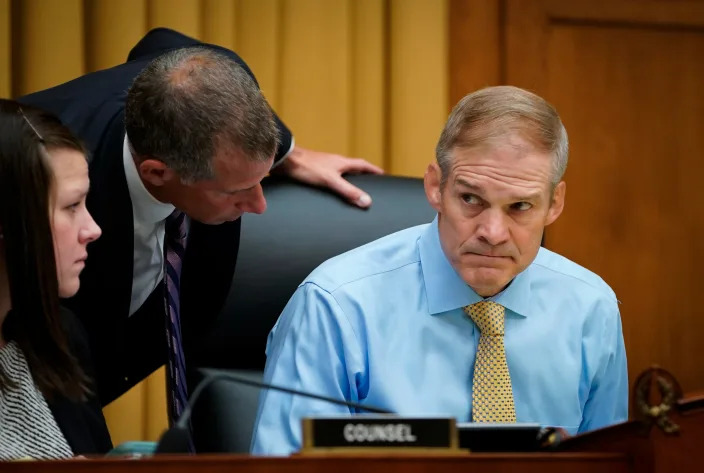
Congressman Jim Jordan (R-OH) prepares to gavel in the committee before Christopher Wray, Director of the FBI, testifies in front of the House Judiciary Committee in Washington on Wednesday, July 12, 2023

The top Democrat on the committee, Rep. Jerrold Nadler of New York, accused Republicans of trying to protect Trump for his campaign in 2024 and called the hearing “little more than performance art.”

House Republicans questioned Wray’s priorities in investigating the Biden administration.

Gaetz asked Wray point blank whether he was protecting the Bidens, which Wray denied. “Absolutely not,” said Wray, who was appointed by Trump.

Gone in 60 seconds: At FBI director hearing, Republican conspiracies about Biden go ‘POOF!’

USA Today – Opinion

Gone in 60 seconds: At FBI director hearing, Republican conspiracies about Biden go ‘POOF!’

Rex Huppke, USA TODAY – July 12, 2023

House Republicans are convinced the FBI and the Department of Justice and basically any law enforcement agency that hasn’t found President Joe Biden guilty of being a global criminal mastermind is corrupt – CORRUPT, I TELL YOU! – and in cahoots with Democrats.

But the steaming hot conspiracy bubbles belching up from the right-wing fever swamps are occasionally pierced by facts, and a rather thunderous bubble-popping took place Wednesday during a House Judiciary Committee hearing featuring FBI Director Christopher Wray.

The overall tenor of questioning from Republican lawmakers during the hearing was: “YOU GUYS TOTALLY FOMENTED THE JAN. 6 ATTACK ON THE U.S. CAPITOL, DIDNYA? AND YOU ALL HATE DONALD TRUMP TOO, DONTCHA?? AND YOU ALL LOVE JOE BIDEN TOO, RIGHT?!?”

‘Are you protecting the Bidens?’ and other really dumb questions

Rep. Matt Gaetz railed at Wray and the FBI for not finding greater criminality in the actions of the president’s son, Hunter Biden, and for not linking Joe Biden in with the hysterical, evidence-free allegations Republicans have cooked up.

“You seem deeply uncurious about it don’t you? Almost suspiciously uncurious?” asked Gaetz, R-Fla., sounding like a cartoon villain, only dumber. “Are you protecting the Bidens?”

FBI Director Christopher Wray listens to House Judiciary Committee Chairman Jim Jordan, R-Ohio, during a hearing on July 12, 2023.

It was all just a giant load of nonsense, which makes sense, as the House Republicans’ current motto is: “A giant load of nonsense.”

OK, who let a Republican ask a smart and relevant question? THAT’S NOT HOW THIS WORKS!!

But then, in less than a minute, one line of questioning made the GOP’s entire line of hooey about the FBI having it in for Republicans and being in the bag for Biden go poof.

Rep. Ken Buck, R-Colo. – yes, a Republican – began asking Wray about his career.

Buck said: “You were nominated by Republican President (George. W.) Bush for the position of assistant attorney general in the criminal division at the Department of Justice and you were confirmed by a Republican Senate?”

Wray replied: “Yes, by unanimous voice vote.”

Buck continued: “And you were then nominated by Republican President Donald Trump to be the FBI director and again confirmed by a Republican Senate for that position?”

“Yes,” Wray said. “I think there were only five votes against me and they were all from Democrats.”

Buck concluded: “According to Wikipedia, you’re still a registered Republican, and I hope you don’t change your party affiliation after this hearing is over.”

So the Republicans who want to defund and discredit the FBI, the ones who eagerly dragged the FBI director through the mud Wednesday with absurd allegations grounded in zero facts, want you, the American people, to believe this: The nation’s premier law enforcement agency has been weaponized against Republicans under a director who is a lifelong Republican and who reached his current post by being selected and confirmed to positions by two Republican presidents and two Republican-led Senate bodies.

DeSantis losing to Trump in Florida? Time to label the former president ‘woke’!

Even as a conspiracy theory the GOP’s anti-FBI theory doesn’t make sense

Forget that all this is in defense of former President Donald Trump, a one-term, twice-impeached lifelong con artist who now faces more than 70 felony charges in two cases, with more indictments on the horizon.

Forget that Hunter Biden was actually charged with two misdemeanor tax offenses and a felony firearm offense.

Just a quick heads up: AI-powered robots will kill us. K, bye.

Forget that, despite relentless investigation, Republicans have produced nothing linking President Biden to his son’s activity, or the fact that the person they touted as a key whistleblower was just charged with arms trafficking and acting as an unregistered agent for China.

Before you even get into details of the conspiracies, you have to believe the FBI director at the center of it all is corrupt. And he was appointed first by President Bush and then again by President Trump! This conspiracy is now an unusually large footprint shy of Bigfoot.

Poof!

DeSantis doubles down on a more toxic climate: DeSantis Says No Thanks to $377 Million in Federal Energy Funds

Bloomberg

DeSantis Says No Thanks to $377 Million in Federal Energy Funds

Ari Natter – July 11, 2023

DeSantis says no to federal energy funds

(Bloomberg) — Florida Republican Governor and 2024 presidential contender Ron DeSantis quietly rejected hundreds of millions of dollars in federal energy funding, as the Biden administration touts the benefits of its marquee climate law on the campaign trail in battleground states.

The funding, totaling about $377 million, included hundreds of millions of dollars for energy-efficiency rebates and electrification as part of the Inflation Reduction Act, as well as money from the bipartisan infrastructure legislation that became law in 2021.

The Florida Department of Agriculture and Consumer Services’s Office of Energy notified the Energy Department last month it was “respectfully” withdrawing applications for the funds after DeSantis issued a line-item veto for a $5 million federal grant for the state to set up programs to distribute the rebates.

The move comes as US President Joe Biden and others have taken to the road to show how funding from the Inflation Reduction Act and other administration policies are helping Republican states, even as every single Republican voted against approving his signature climate law – which included some $374 billion in funding for clean-energy programs and tax credits.

It also comes amid Republican backlash against “woke” energy-efficiency standards, including from DeSantis himself who has proposed spending millions of dollars to enact tax credits for gas stoves.

A Florida government official, speaking on background, said the $5 million in funding was earmarked to hire people to administer the money for the energy efficiency home-rebate program, including a website and other necessary planning to distribute the funds. The official, who wasn’t authorized to speak on the record about the matter, characterized the decision as surprising.

DeSantis also rejected a $24 million federal grant from the bipartisan Infrastructure Investment and Jobs Act that would have been used to upgrade rural waste-water systems. These grant funds were among some $511 million in line-item vetoes made by DeSantis before signing the state’s $116.5 million budget into law last month.

Following the governor’s move, applications for grant funding totaling some $377 million were withdrawn, according to the Florida Department of Agriculture and Consumer Services. That included nearly $174 million set aside for rebates for energy-efficiency improvements and another $173 million for a rebate program for the purchase of energy-efficient home appliances. Another $7 million was poised for a training program for electrification contractors.

“These programs directly benefit home owners and renters and these rebates mean that people in Florida would get lower utility bills and healthier and more comfortable homes as well as lower greenhouse gas emissions,” said Lowell Ungar, director of federal policy for the American Council for an Energy-Efficient Economy. “The federal money will help pay for that so it will be a real loss if they don’t implement these programs.”

A DeSantis spokesman declined to comment.

An administration official said Florida still has the option of applying for the funding at a later time.

DeSantis’ rejection of the funds was first reported by The Capitolist, a blog with ties to NextEra Energy Inc.’s Florida Power & Light Co., a state utility.

Harvard study: Why a record number of Americans are struggling to pay rent

Yahoo! Finance

Harvard study: Why a record number of Americans are struggling to pay rent

Rebecca Chen – Reporter – July 11, 2023

A record number of American renters are spending at least one-third of their income on rents, according to The State of the Nation’s Housing 2023, published by Harvard’s Joint Center for Housing Studies.

A total of 21.6 million households now spend more than 30% of pre-tax income on rent. Some households are even paying even up to 50% of earnings on apartments, per Harvard’s research. Housing experts often suggest tenants spend less than 30% of their income on rent.

“Housing costs remain well above pre-pandemic levels thanks to the substantial increases over the last few years,” Daniel McCue, senior research associate at the Joint Center, said in the 2023 report.

Why? In large part due to the growth of so-called “luxury” buildings that have replaced less expensive options. In the last two decades, the share of construction for high-priced apartments — known as Class A — grew faster than more affordable ones. In fact, over half (51%) of 2022 rental construction projects were luxury apartments, according to Moody’s Analytics data. Also, only 34% of the market consisted of high-cost rental units back in 2000; that number was 51% in Q1 2023, per Moody’s.

“The challenge is that the new supply… tends to be at the very top of the price spectrum,” said Carl Whitaker, director of research and analysis at RealPage.

Luxury home expansion has also been a growing trend in the last two decades. Only 34% of the market was high-cost homes back in 2000, but that number grew yearly to 51% as of Q1 2023.
Apartments are seen undergoing construction on February 28, 2023 in Austin, Texas. (Photo by Brandon Bell/Getty Images)

“If rent grows faster than your income every year, and your health care expenses grow faster than your income every year…that squeeze just makes it very difficult in normal life,” Katherine McKay, associate director at the Aspen Institute Financial Security Program, told Yahoo Finance.

Lack of choices

Historically low rental vacancies in recent years also reflect the lack of affordable options for households. Although the vacancy rate climbed to 6.4% at the beginning of 2023 — a welcome increase from the four-decade low of 5.2% in late 2021 — it is still far from a healthy rate of around 7% to 8%.

“What is often looked for is a level of vacancy that supports a renter’s ability to move and to have at least some pricing power,” Lu Chen, Moody’s Analytics senior economist, wrote in an email. “In theory, this would allow rent increases to remain marginally above the general rate of price increases in the economy.”

But “we expect the national average vacancy to linger around 5% until 2025,” Chen said. That number could be more bleak for lower-income households — the rate for lower-cost housing remains at a depressed level of 4.7%.

Vacancy rate climbed to 6.4% at the beginning of 2023 - a welcomed increase from the four-decade low of 5.2% in late 2021
Buddy, can you spare a studio? A ‘no vacancy’ sign for rentals is displayed outside an apartment building on September 22, 2022, in Los Angeles, California. (Photo by Allison Dinner/Getty Images)

“What [also] has happened in many places is that renters who might buy homes can’t buy homes, so they stay in their class A buildings, and then renters who want to live in Class A buildings can’t find spots, so they move a tier down,” McKay said. “It trickles down every income group having a greater competition for fewer new units that meet their needs.”

Apartments equipped with the latest and best amenities like heated pools and gyms are known as Class A buildings. Class A buildings then retire to become class B in 10-15 years, which then devolve into class C in another 5-10 years. Rents drop as buildings downgrade from A to B to C. But in the last decade, not enough buildings were built, which means not enough apartments progressed to the lower tiers.

The fancy boom

As Class A buildings saturate the rental market, the share for older and less expensive apartments, categorized as Class B and C, has shrunk dramatically. In the last two decades, those types of units fell to 49% in Q1 2023 from 66% in 2001, according to Moody’s.

The apartments equipped with the latest and best amenities that get premium rents are known as Class A buildings.
Live it up: Apartments equipped with the latest and best amenities that get premium rents are known as Class A buildings. (Getty Images)

But that might not change anytime soon because, many times, fancy apartments are the only profitable option for developers. The majority of construction costs go into purchasing land, building materials, and building permits. Adding nice finishes doesn’t drive costs at a high level but could demand more rent revenue.

“The thorny part is that for the middle-income renters,” McKay said. “The best option for them is class B where it is not super expensive but also not where then the quality might be a problem, the sweet spot. But there just isn’t enough, because we didn’t build enough for such a long time.”

The future? Not too cheery.

“Number of households continued to grow at around 1% annually,” Moody’s Chen said. “The rapid household formation requires inventory growth to keep up the pace. Further, while the population is aging, there is a large swath of Gen Z (the oldest are 24) and 25- to 40-year-old millennials that are ready to enter the rental market.”

Rebecca Chen is a reporter for Yahoo Finance and previously worked as an investment tax certified public accountant (CPA).