Brita water filter company accused of false advertising
Dorany Pineda – August 19, 2023
Water filters on an assembly line at Brita’s factory in Taunusstein, Germany. (AFP via Getty Images)
A lawsuit filed against the maker of some of the nation’s most popular water filtration systems has accused the Brita company of falsely advertising that its products remove or reduce hazardous contaminants from tap water.
The proposed class-action lawsuit, which was filed Wednesday in Los Angeles County Superior Court, claims that deceptive advertising has led customers to falsely believe that Brita products filter such contaminants as arsenic, nitrate, hexavalent chromium and certain PFAS, or “forever chemicals,” from tap water.
Brita is owned by Clorox Co., which is headquartered in Oakland. Clorox released a statement Wednesday saying it was still reviewing the complaint, but looked forward to “defending ourselves vigorously.”
“Brita takes the transparency of the variety of water filtration options we offer seriously,” the statement said. “Our products include a standard filtration option that improves taste and odor of tap water and is certified to reduce identified contaminants as communicated. For those consumers looking for water filters certified to reduce PFOS or PFOA, the Brita Elite pour-through and Brita Hub are both certified to reduce PFOS/PFOA, as well as lead and other identified contaminants.”
The lawsuit was filed by Los Angeles County resident Nicholas Brown, who is currently the sole plaintiff. Brown purchased a Brita water pitcher and standard filter for about $15 in 2022 after reading the product label and believing the device would filter contaminants to below lab detectable limits, the lawsuit said.
“Unfortunately, the Products are not nearly as effective as defendant deliberately leads people to believe, causing consumers to overpay millions and forego more effective alternatives,” the lawsuit said. “In this way, defendant has not only bilked millions of dollars from consumers in ill-gotten gains, but Defendant has put the health and welfare of millions of consumers and their families at risk.”
At the heart of the lawsuit is the basic and fundamental human right to clean and safe drinking water, said the plaintiff’s lawyers. They argue that Brita products, which are widely available and affordable, are a staple in the homes of students, renters, working families and others who can’t spare the price of high-quality filters for their taps.
The company’s marketing “creates the illusion of safety and protection for people and their families,” said Ryan Clarkson, managing partner of the Clarkson Law Firm in Malibu. “And that’s really the big problem that we need to solve here. When people are running their tap water with PFAS through these Brita water filters, it’s just a superfluous act. It does nothing whatsoever as it relates to chemicals like PFAS.”
PFAS, or per- and polyfluorinated substances, are a group of thousands of manufactured chemicals that have been widely used for decades in products that resist heat, oil and water. They can be found in such everyday items as nonstick cookware, dental floss, period underwear, fast food boxes, water-repellent clothing and firefighting foam.
Known as forever chemicals because they don’t degrade naturally in the environment, PFAS have made their way into rivers, lakes, aquifers and people’s blood streams. Exposure to high levels of some PFAS has been linked to adverse health effects such as decreased fertility, increased risk of high cholesterol, obesity, high blood pressure, certain cancers, and liver and immune-system damage.
The lawsuit accuses the company of violating California laws concerning unfair competition, false advertising, breach of contract and others. It seeks damages and other remedies.
Depending on the type of filter, Brita products are certified to reduce or remove contaminants such as chlorine, lead, mercury, asbestos, some particulates, zinc, copper and select pesticides, herbicides and pharmaceuticals, according to its website.
The lawsuit comes at a time of increasing concern over drinking water contamination.
Researchers recently estimated that at least 45% of the nation’s tap water is contaminated with one or more PFAS chemicals, and that drinking-water exposures may be more common in urban areas across Central and Southern California than in other regions.
The Environmental Protection Agency plans to begin regulating several types of PFAS in drinking water and has proposed strict limits on two common ones — PFOA and PFOS — and L.A. County supervisors supported a proposal last month to investigate PFAS levels in drinking water.
Arsenic and nitrate, which are linked to certain cancers and other health issues, are also widespread in parts of California. According to state data, 22% of primary maximum contaminant level (MCL) violations in public water systems last year were for arsenic, and 22% were for nitrate, the highest of any contaminants. MCLs are health-protective drinking-water standards.
The lawsuit argues that claims on the labels and packages of certain Brita water filters, pitchers and dispensers — such as “Cleaner, Great-Tasting Water for Over [20, 25, or 30] Years,” “The #1 FILTER” and “Reduces 3X Contaminants” — are false and misleading. Other claims like “Better water for you. Better water for the planet” and “Fresh filter = Fresh water” reinforce consumer beliefs that the products remove or reduce to below lab detection limits common hazardous contaminants, the lawsuit says.
The lawsuit also claims that numerous Brita products have not been registered with the California State Water Resources Control Board since they’ve been marketed and sold, and that none of their products have been certified to remove or reduce health-hazardous contaminants, making it unlawful to market and sell them in the Golden State.
“What the case seeks is really two things,” Clarkson said. “First, greater transparency for consumers so they understand what these water filters are capable of filtering out and what they are not capable of filtering out. We don’t believe that the advertising and labeling of these products communicate in a transparent and effective way to consumers what the products can and can’t do.
“And secondly, we’re looking for compensation to all purchasers of these products who have relied upon the products to fulfill a promise that they simply haven’t fulfilled,” he added. The class period will go back to Aug. 16, 2019.
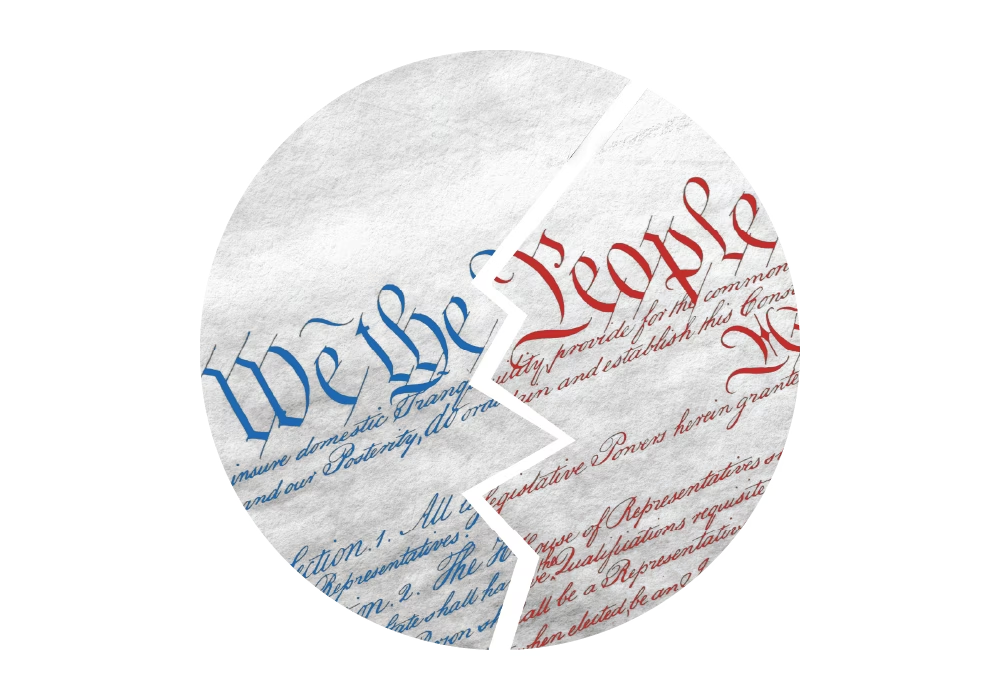
American democracy is cracking. These forces help explain why.
Behind the sense that the political system is broken lies a collision between forces both old and new
By Dan Balz and Clara Ence Morse – August 18, 2023
In a country where the search for common ground is increasingly elusive, many Americans can agree on this: They believe the political system is broken and that it fails to represent them.
They aren’t wrong.
Faced with big and challenging problems — climate, immigration, inequality, guns, debt and deficits — government and politicians seem incapable of achieving consensus. On each of those issues, the public is split, often bitterly. But on each, there are also areas of agreement. What’s broken is the will of those in power to see past the divisions enough to reach compromise.
The Jan. 6, 2021, attack on the Capitol is both an extreme emblem of what happens when democracy stops functioning as it should and the result of relentless attacks by former president Donald Trump on the legitimacy of the election process based on lies and distortions, a continuing threat to U.S. democracy.
In more routine ways, the political system feeds frustration and discontent with its incapacity to respond to the public’s needs. There is little on the horizon to suggest solutions.
The failure has multiple origins,including a collapse of trust in institutions. But one of the most significant is a collision between forces both old and new.
The old dates to the writing of the Constitution — debates and compromises that resulted in representation in the House based on population and in the Senatebased on equal standing forthe states; the odd system by which we elect presidents; and lifetime appointments for Supreme Court justices. In general, the founders often distrusted the masses and sought to create structural protections against them.
The newer element, which has gathered strength in recent decades, is the deepening polarization of the political system. Various factors have caused this:shifts within the two parties that have enlarged the ideological gap between them;geographic sorting that haswidened the differences between red and blue states; a growing urban-rural divide; and greater hostility among individuals toward political opponents.
The result is that today, a minority of the population can exercise outsize influence on policies and leadership, leading many Americans increasingly to feel that the government is a captive of minority rule.
Twice in the past two decades, the president was elected while losing the popular vote —George W. Bush in 2000 and Trump in 2016. That had happened only three times in the previous 200-plus years. The dynamic extends beyond the presidency to the other two branches of government.
A new Washington Post analysis found that four of the nine current justices on the Supreme Court were confirmed by senators who represent a minority of the U.S. population. Since 1998, Republicans have had a majority in the Senate a total of 12 years but did not during that time represent more than half the nation’s population, The Post’s analysis of population data and Senate composition shows.
The Post also found that during Trump’s presidency, 43 percent of all judicial and governmental nominees were confirmed by senators representing a minority of the population. Under President Biden, not quite 5 percent of nominees were confirmed by senators representing a minority of the population.
The state of democracy is not uniformly negative. In moments of crisis especially, elected officials have found common ground. At times, government action does reflect the public will. Under Trump, bipartisan congressional majorities passed and the president signed multiple rounds of relief during the covid-19 pandemic. Biden and Congress came together to pass a major infrastructure package in 2021. Last year, there was bipartisan agreement on legislation to spur production of semiconductor chips in the United States.
At times, protection of minorities and their rights from the will of the majority is needed and necessary. Checks and balances afford further protections that nonetheless can seem to hamstring government’s ability to function effectively. But on balance, the situation now is dire. Americans are more dissatisfied with their government than are citizens in almost every other democracy, according to polling.
Henry Brady, professor of political science and public policy at the University of California at Berkeley, has been studying these issues for many years. As he surveys the current state of the United States’ democracy, he comes away deeply pessimistic. “I’m terrified,” he said. “I think we are in bad shape, and I don’t know a way out.”
This is the first in a series of reports examining what is fueling the visceral feeling many Americans have that their government does not represent them. Alongside debates over specific policies, the overall state of democracy roils the national discussion. Heading into the 2024 presidential election, this issue is likely to be a critical factor for many voters.
Distrust in government
Trust in the federal government began to decline during the Vietnam War in the 1960s and then took a big hit amid the Watergate scandal in the early 1970s. There have been occasional rebounds — after the terrorist attacks on Sept. 11, 2001, or during the late 1990s when the economy was doing well. But for the past two decades — through good economic times and bad — mistrust has been persistent.
Individual institutions have suffered as well. Of late it is the Supreme Court’s reputation has been damaged due to rulings that have gone against popular opinion and a heightened sense that the court has become politicized. For Congress, the decline has been ongoing for decades. Only Wall Street and television news have seen more precipitous declines in trust over the past four decades, according to calculations published by the American Academy of Arts and Sciences.
Americans have long been skeptical of the power of the central government. Scandals and corruption over the years have added to the problem. Lately, officials have openly attacked the very institutions of which they are a part, making it even harder for thebureaucracy to function effectively. No one has done this more than Trump. Attacks on institutions have been a hallmark of his time in politics.
While there is some universality to these conditions, citizens in only a handful of democratic countries take a dimmer view of their government than Americans do of theirs.
Polarization
For much of the United States’ history, the constitutional system created by the founders worked reasonably well. The Civil War is an obvious exception, and other periods have tested the collective will. But overall, government generally functioned, even if not perfectly.
More recently, however, the system’s weaknesses became more apparent as tribalism shapes much of political behavior and the Republican Party has departed from its historical moorings. Trump’s impact has distorted traditional Republican conservatism and has led many Republicans to accept as reality demonstrably untrue beliefs. The best example of that is that a majority in the GOP say Biden was not legitimately elected. The hard-right wing of the Republican Party and Trump voters in particular have been resistant to compromise.
“In comparison to European countries, our constitutional system is not well suited for polarized political parties,” said Nathaniel Persily, a law professor at Stanford Law School.
Election of presidents
The Constitution created an unusual mechanism for electing the president — an electoral college. It was built on assumptions that over the years have proved to be faulty.
The founders distrusted a system based on the popular vote, fearing many citizens would not be well-informed. They put power in the hands of electors. They thought the House would often end up picking the president, not anticipating the effects of what quickly became a two-party system in the United States. The rationale for the current system has been overrun by the realities of today’s politics.
“It was created because the founders couldn’t figure out what to do,” said George C. Edwards III, a political science professor at Texas A&M University and author of “Why the Electoral College Is Bad for America.” “It doesn’t work at all as the founders intended.”
During the first two centuries of the country’s history, there were only three cases in which the person elected president did not receive a majority of the popular vote, in 1824, 1876 and 1888. Now it has happened twice in a quarter century and could happen again in 2024. In both 2000, when Bush became president, and 2016, when Trump was elected, the popular vote supported the Democratic nominee, Al Gore and Hillary Clinton respectively, yet the electoral college vote went in favor of the Republican.
During the past two decades, the number of competitive states in presidential elections, where the victory margin has been five percentage points or fewer, has declined. Meanwhile, the number of states decided by margins of 15 percentage points or more has increased, based on an analysis of state-by-state results by The Post.
Because the outcome in the most competitive states can be decided by a relatively small number of votes, Republicans now have a significantly better chance of winning in the electoral college than in the popular vote. Democrats, meanwhile, roll up huge margins in deep blue states like California that give them no significant boost in the electoral college math.
Congress
In the Great Compromise among delegates to the Constitutional Convention, the House was to be divided based on population, while the Senate would give each state equal representation regardless of population.
In times past, many state delegations to the Senate were split between the two major parties. In 1982, for example, about two-dozen states had split representation. Today there are only six true splits,and those states account for about 9 percent of the U.S. population.
Republicans tend to have full control in less populated states, creating an imbalance in the number of senators they send to Washington and the percentage of the national population they represent. Even when they have recently held a majority in the Senate, they represent a minority of the population. In 2024, two of the nation’s least populous states — West Virginia and Montana — could flip control of the Senate from Democrats to Republicans, if GOP challengers prevail over Democratic incumbents.
This has had an impact especially on confirmations of judicial nominees and senior executive branch appointees. During the four years Trump was in office, nearly half of the individuals nominated for key positions were confirmed by senators representing a minority of the population. No other recent president had more than 5 percent confirmed by senators representing a minority of the population.
Through gerrymandering, population dispersion and the sorting of where people prefer to live, competition for House seats has declined.
The overwhelming majorityof districts now lean strongly either to Republicans or to Democrats. In those districts, that makes the primary election more important than the general election. Because turnout is generally concentrated among the most fervent voters in primary contests, more extreme candidates have an advantage. This has widened the ideological gap in the House, which makes compromise even more difficult.
It has also led to the kinds of dysfunction seen this year, such as the multi-ballot marathon to elect Rep. Kevin McCarthy (R-Calif.) as speaker, or the threats to let the government default on its debts that ultimately were avoided by an old-fashioned bit of compromise.
As the number of swing districts has declined, another phenomenon has become evident: Even in open-seat races, which historically have been more contested than those involving incumbents, the number of landslide victories by members of both major parties has increased dramatically.
The Supreme Court
Democrats have won the popular vote in seven of the last nine presidential elections. But during that time, Republican presidents have nominated six of the nine current members of the Supreme Court. Four of the nine justices, including the three nominated by Trump, were confirmed by senators representing a minority of the population.
The percentage of Americans represented by senators voting to confirm justices has been decreasing over the past half century. Now that justices can be confirmed with a simple majority vote, rather than a supermajority, the phenomenon of confirmation by a majority of senators representing a minority of citizens has become common place when Republicans hold the Senate majority.
State legislatures
In Washington, political divisions have led to gridlock and inaction on many issues. In the states, the opposite has occurred because states have increasingly become either mostly red or mostly blue.
In just two states is the legislature split between Republicans and Democrats. In more than half of the states, the dominant party enjoys a supermajority, which means they can override vetoes by a governor of a different party or generally have their will on legislation.
Similarly, full control of state government — the legislature and the governor’s office — is the rule rather than the exception. Today 39 states fit this definition. The result is a sharper and sharper divergence in the public policy agendas of the states.
The dominant party has been able to move aggressively to enact its governing priorities. That has meant tight restrictions on abortion in Republican states and few or no restrictions in blue states; it’s meant challenges to LGBTQ rights in red states and affirmation of those rights in blue states.
These divisions have made it possible for the dominant party to govern with little regard to the interests of those with allegiance to the minority party and often little accountability as well. The result is two Americas with competing agendas and values.
Public opinion vs. public policy
The gap between public policy and public opinion is one major consequence of today’s frozen federal government. Three of the most talked about issues reflect that: abortion, guns and immigration.
On abortion, most Americans oppose last year’s Supreme Courtdecision in Dobbs v. Jackson Women’s Health Organization, which ended the constitutional right to abortion. On guns, big majorities favor individual proposals to tighten laws, but the gun lobby remains powerful enough to block action.
On immigration, there has been a majority for some years favoring tougher border controls along with a path to citizenship, with some penalties, for the millions of undocumented immigrants living here. Every effort to deal with this in Congress over the past two decades has failed, including attempts to resolve the plight of people brought here illegally as children, known as “dreamers.”
The Constitution
One way to deal with some of the structural issues — the electoral college, a Senate where a minority of the population can elect a majority of members or the lifetime appointments for Supreme Court justices — would be by amending the Constitution. But the U.S. Constitution, though written to be amended, has proved to be virtually impossible to change. Nor is there cross-party agreement on what ails the system. Many conservatives are satisfied with the status quo and say liberals want to change the rules for purely partisan reasons.
It was the drafters of state constitutions who saw the need for amending such documents. Over the history of the country, state constitutions have been amended thousands of times — more than half of all those proposed. But while there have been about 12,000 proposed amendments to the U.S. Constitution, Congress has submitted just 33 to the states, of which 27 have been ratified.
The last amendment was approved in 1992, and that was a provision that had been proposed along with others that became the Bill of Rights. In reality, it has been half a century since a contemporary amendment has been ratified. Given the political conditions in the country, the prospect of two-thirds of both the House and Senate voting to propose an amendment and then three-fourths of the states ratifying it seems extremely unlikely.
To remain a living document, the Constitution needs to be adaptable to changing times, perspectives and conditions. The alternative to amending the Constitution is through judicial interpretation by the Supreme Court. Today the court is dominated by “originalists” who interpret the document through a strict reading of the words and timesin which it was written — long a goal of conservatives. But the America of 2023 is not the America of the framers of the Constitution in the late 18th century, a time when enslaved people were counted as three-fifths of a person and women did not have the right to vote.
Not all countries have written constitutions — Britain, for example. But the amendment process when functioning effectively is “a mechanism to peaceful revolution,” said historian Jill Lepore, who directs the Amendments Project at Harvard University. So there is value to a written constitution, but only if it can be changed.
“The danger,” Lepore said, “is that it becomes brittle and fixed — and then the only way to change your system of government or to reform a part of it is through an insurrection.”
About this project
In the analysis of population data and Senate composition, The Post’s count of senators in each year represents the composition of the Senate on Jan. 31 of that year, with two exceptions: Al Franken is counted in the 2009 Senate and Norris Cotton is counted in the 1975 Senate. In the analysis of confirmations over time, The Post examined all Senate roll call votes with a result of “confirmed.” For all senators who voted to confirm a given nominee, The Post calculated the percent of Americans from the states of those senators that year, with each senator representing half of their state population. Many nominees to various positions were confirmed with a voice vote or through a unanimous consent agreement; these confirmations are not reflected in this data. In the analysis of House elections, The Post determined open House races using several sources, including FEC and MIT elections results data.
Reporting by Dan Balz and Clara Ence Morse. Editing by Griff Witte. Copy editing by Mina Hag. Project editing by KC Schaper. Design and development by Courtney Beesch and Tyler Remmel. Design editing by Betty Chavarria. Illustrations by Courtney Beesch with images from iStock. Topper animation by Emma Kumer. Photo editing by Christine T. Nguyen. Graphics by Clara Ence Morse and Hanna Zakharenko. Graphics editing by Kevin Uhrmacher. Data editing by Anu Narayanswamy. Visual enterprise editing by Sarah Frostenson. Research provided by Monika Mathur. Additional editing, production and support by Philip Rucker, Peter Wallsten, Jenna Johnson and Tom Justice.
We Just Got a Hint About Conservatives’ New Supreme Court Strategy on Abortion
Mary Ziegler – August 17, 2023
What does this augur for the Supreme Court? Photo illustration by Slate. Photos by Robert Alexander/Getty Images and Bill Grenblatt via Getty Images.
On Wednesday, the U.S. Court of Appeals for the 5th Circuit again voted to reimpose limits on the abortion pill mifepristone. If the court had its way, the clock would turn back to 2016, when patients could get mifepristone for only seven weeks of pregnancy, and only after more than one in-person visit with a physician. The ruling won’t have any immediate impact because the Supreme Court issued a stay last spring that keeps the status quo in place as litigation continues. But even if this ruling doesn’t change anything on the ground, it represents conservatives’ best guess that the Supreme Court is going to go much further than it did in Dobbs in limiting abortion at a national level—even if not necessarily in this case.
This case began when the Alliance for Hippocratic Medicine, a group of anti-abortion doctors, set up shop in Amarillo, Texas, where a judge widely believed to be the most hostile to abortion in the country, Matthew Kacsmaryk, presides. AHM, which is represented by the Christian-right powerhouse Alliance Defending Freedom, argued that the Food and Drug Administration lacked the authority to approve the pill mifepristone all the way back in 2000. Last spring, Kacsmaryk lived up to expectations, issuing a humdinger of an opinion agreeing with this claim and embracing the language of fetal personhood. Not much later, a different 5th Circuit panel concluded that the plaintiffs had waited too long to challenge the original approval of mifepristone, but held that the plaintiffs would probably prevail on their claims that the FDA did not have the power to lift restrictions on mifepristone in both 2016 and 2021. The Supreme Court, however, did not seem to be buying any of it. The court issued a stay that keeps the status quo in place as litigation continues.
One of the factors the court considers in issuing a stay is the plaintiffs’ probability of prevailing when the case is all said and done. Most of the justices seem to think this case is doomed.
Given the Supreme Court’s obvious skepticism, judges with more self-restraint might have let this case die. There are explosive claims made by these plaintiffs that many conservatives want the Supreme Court to take up sooner or later. AHM argues that the federal Comstock Act, a 19th-century anti-vice law, means that the FDA did not have the authority to permit access to mifepristone via telehealth. According to the plaintiffs, that’s because mailing abortion pills is already a federal crime. In fact, if the Comstock Act is interpreted in this light, any abortion violates federal law: No procedure in the nation takes place without a drug or device going through the mail. That argument is not a slam-dunk—it ignores decades of precedent interpreting the statute far more narrowly—but ambitious anti-abortion lawyers still have big plans for Comstock. Based on what the majority of the three-person panel ruled, the 5th Circuit could be saving this argument for a better case, as they instead ruled on procedural grounds (in a separate opinion partially concurring and dissenting from the panel majority, Trump appointee James C. Ho stated that the Comstock Act meant that it is illegal to send abortion medication via mail). The same wait-and-see game goes for claims that the FDA did not have the authority to loosen restrictions on mifepristone, or even to approve it in the first place.
But the 5th Circuit, by ruling in part with AHM on procedural grounds, is also is placing a bet that no case is procedurally defective enough for the court that gave us Dobbs. To say the plaintiffs’ case for standing is weak is to put the matter gently. The physicians bringing the case stressed that they had treated patients for mifepristone complications in the past. Since the complication rate for mifepristone is not zero (it stands at roughly 0.3 percent), that meant that some future patients might suffer complications, and might seek care from the doctors bringing the case, and some of those doctors might suffer conscience-based injuries. If you think that sounds speculative, you aren’t wrong. The 5th Circuit understood this problem and dedicated a whopping three-dozen pages to explaining why against all evidence, these plaintiffs do have standing.
Even the substance of the decision—which would reinstate restrictions in place in 2016—seems intended to lower the temperature, likely to try to make things more palatable for the Supreme Court. The majority refused to address the Comstock Act and steered clear of explicitly pro-life language.
Reading Judge Ho’s partial dissent makes this tactical move that much clearer. Judge Ho described mifepristone as a drug that takes the life of an unborn child. He concluded that the FDA lacked the authority to approve mifepristone in 2000 because—as abortion opponents have long argued—pregnancy is not a disease, but a normal rite of passage. He chided his colleagues for not ruling on the relevance of the Comstock Act and argued that the act does amount to a ban on mailing abortion pills. He argued that physicians treating a patient for post-abortion complications suffer an “aesthetic harm” worthy of redress.
But the differences between the two opinions are strategic, not substantive. The panel members were united in believing that no standing defect will worry this Supreme Court if it has a chance to limit access to abortion. Judge Ho is just ready to say the quiet part out loud—and to press the court to go even further, even faster. In that way, the majority’s opinion may be a snapshot of where the Supreme Court is today—on this case and abortion more broadly. Judge Ho’s opinion is a prediction about where the court is headed—if not in this case, then in the future.
Reimposing 2016 restrictions on mifepristone would have dramatic effects. But as Judge Ho’s opinion makes clear, mifepristone rules are just the beginning. If these plaintiffs have standing, it’s hard to see how conservatives raising other challenges to controversial drugs, such as those used in gender-affirming care or IVF, won’t be able to establish the same thing. And if the Comstock Act means what Judge Ho thinks it does, then a Republican president could seek to treat any abortion anywhere as a federal crime.
What does this augur for the Supreme Court? The plaintiffs’ standing arguments don’t sound any better when the 5th Circuit makes them. From a procedural standpoint, this case is still a dud. Given this truth—and the fact that the Supreme Court already seems to have its doubts about this case—this is still unlikely to be the case that revolutionizes access to the leading abortion method nationwide.
But the judges on the 5th Circuit understand who is on the Supreme Court, and they know that any loss is likely to be temporary. This ruling may shift the Overton window—passing off the majority opinion here as a sensible, middle-ground outcome. And if the court isn’t ready to go much further on abortion yet, that will likely change later. Judges with more self-restraint might have let this case go. But as the 5th Circuit seems to believe that when it comes to this Supreme Court on abortion, there is no reason for self-restraint when you have nothing to lose.
Trump-Appointed Judge Cites Wildlife Cases As a Reason to Ban Abortion Pills
Susan Rinkunas – August 17, 2023
Photo: CQ Roll Call via AP Images (AP)
On Wednesday, the Fifth Circuit Court of Appeals said it would restrict access to the main abortion pill, mifepristone, allowing its use only through seven weeks of pregnancy (down from the current 10) and banning telemedicine prescriptions of it. (None of the proposed changes will take effect until the Supreme Court weighs in on the case.)
But Fifth Circuit Judge James Ho—who was sworn in by Justice Clarence Thomas in GOP megadonor Harlan Crow’s library in 2018—wanted his colleagues go even further. He would have fully reversed the Food and Drug Administration approval of the abortion pill, and he used some uh, wild, reasons to support his argument. Ho wrote in his unhingedconcurrence that the plaintiffs, a group of anti-abortion doctors, have standing in the case because they like looking at babies, and the FDA’s approval of the abortion pill deprives them of that right. He cites “aesthetic injury” precedent from past cases involving federal decisions that threatened wildlife and plants:
It’s….pretty close to comparing women and pregnant people to wild animals! And he kept going!
The Supreme Court has recognized that “the person who observes or works with a particular animal threatened by a federal decision is facing perceptible harm, since the very subject of his interest will no longer exist.” Lujan, 504 U.S. at 566. Every circuit, including our own, has concluded that, when a federal agency authorizes third parties to harm flora or fauna that a plaintiff intends to view or study, that satisfies all of the requirements for Article III standing. …
In all of these cases, a federal agency approved some action—such as developing land or using pesticides—that threatens to destroy the animal or plant life that plaintiffs wish to enjoy. This injury is redressable by a court order holding unlawful and setting aside the agency approval.
And so too here. The FDA has approved the use of a drug that threatens to destroy the unborn children in whom Plaintiffs have an interest. And this injury is likewise redressable by a court order holding unlawful and setting aside approval of that abortifacient drug.
I see no basis for allowing Article III standing based on aesthetic injury when it comes to animals and plants—but not unborn human life.
This whole flora/fauna line of reasoning gets even creepier when you read this sentence from Ho: “Pregnancy is not a bad or unhealthy condition of the body—it’s a natural consequence of a healthy and functioning reproductive system.” It really sounds like, to him, that women are nothing more than broodmares whose function is to gestate and bring joy to others gazing at them in their habitat.
Judge Ho is an established troll. He notoriously asked during a May hearing, “Is pregnancy a serious illness? When we celebrated Mother’s Day, were we celebrating illness?” But it’s still scary to think what the Supreme Court will do with his writings in the case when they finally weigh in—right in the middle of the 2024 election. It’s also scary to think that Ho, who was on Donald Trump’s Supreme Court shortlist, could get nominated to the high court if Trump wins the presidency in 2024.
Americans Are Not Really That “Divided” About Donald Trump’s Conduct
Ben Mathis-Lilley – August 16, 2023
Donald Trump at a golf tournament in Bedminster, New Jersey, on Aug. 13. Rich Graessle/Icon Sportswire via Getty Images
There are two buckets into which most discourse about public opinion regarding Donald Trump’s indictments can be sorted. One of those buckets is labeled “Republican primary,” and it’s where we can put the (accurate) observation that each successive indictment seems to boost Trump’s primary polling lead over Ron “I Have Never Seen a Worse Campaign or Candidate” DeSantis even further. (For what it’s worth, Semafor’s Dave Weigel is reporting that DeSantis “isn’t dead yet” in Iowa, so there’s that.)
The other bucket is labeled “divided America,” and it’s where the country’s headline-writing editors enjoy putting polls which allegedly show that the former president’s conduct divides a fretful, collectively indecisive United States along partisan lines. It’s a polarized country and we can’t agree on anything these days, on account of the polarization, yada yada—you’ve heard it all before.
On Wednesday, for instance, the Associated Press published the results of a new poll that it conducted with the NORC Center for Public Affairs Research under the headline “Americans are divided on partisan lines over Trump’s actions in election cases.”
But are they, really? While it’s true that about 50 percent of Americans will say in any given poll that they support Trump’s prosecution, and that 50 percent is only half of the country, half of people believing something does not mean that the other half believe its opposite. In August 1974, just before he resigned, only 57 percent of Americans told Gallup that Richard Nixon should be removed from office—but that does not mean that a polarized electorate was diametrically paralyzed by the question of whether Richard Nixon was a bum. (They believed that he was, and they were correct.)
So let’s look at the data in more detail. The AP asked Republicans, Democrats, and independent voters about Trump’s “alleged attempt to interfere in Georgia’s vote count in the 2020 presidential election” and his “role in what happened at the U.S. Capitol on January 6, 2021.” They were given the choice of describing his behavior as “illegal,” calling it “unethical but not illegal,” saying he did “nothing wrong,” or saying they didn’t know enough about it to answer.
Overall, about both Georgia’s vote count and “what happened at the U.S. Capitol,” 64 percent of American adults said Trump’s conduct was either illegal or unethical. And only 21 percent said he did nothing wrong in relation to Jan. 6, while 15 percent said he did nothing wrong in Georgia. If you boil things down to “what he did was bad” or “what he did was OK,” Trump is a loser by margins of 64–21 and 64–15.
Those would be pretty lopsided scores in the United States’ beloved sport of American football! And the numbers aren’t even that great for Trump among Republicans. A combined 42 percent of Republicans told the AP that Trump’s conduct in Georgia was illegal or unethical, while only 31 percent said he’d done nothing wrong. Regarding Jan. 6, 38 percent of Republicans said Trump behaved illegally or unethically, with 46 percent coming down on the side of “nothing wrong.”
To be fair, with more media exposure to the particulars of the case, it’s likely that responses on the Georgia question among Republican voters will end up matching responses on the Jan. 6 question, which is to say that a plurality of them will say Trump didn’t do anything wrong. That said, we’re talking about a narrow plurality, and another way to frame the numbers is that only aminority of Republicans themselves are to willing to say that Trump’s Jan. 6 –related behavior was appropriate. If anything, it’s the Republican Party that’s divided on this issue, not “Americans.”
There are limitations to what can be concluded from the data. The belief that Trump behaved unethically or illegally doesn’t translate directly into support for Biden, his presumed 2024 general election opponent; Trump and Biden matchups are currently more or less even. And about half of Americans, according to a recent ABC News-Ipsos poll, believe the prosecutions of Trump are “politically motivated,” which, to quote the 1996 feature film Romeo + Juliet, implies the existence of a sizable “pox on both their houses” tranche.
That said, the next time you read the phrase “Americans divided on Trump behavior,” you should mentally replace it with the phrase “Americans divided on Trump behavior like so: About half think it was criminal, a sixth or so think it was bad but not illegal, a fifth think it was fine, and the remaining [counting on fingers for 45 seconds] two-fifteenths have, blessedly, not read a news headline in decades, if ever.” Then you should go outside. Summer’s almost over!
Nearly two-thirds of Americans say they wouldn’t support Donald Trump in 2024, poll says
Sudiksha Kochi, USA TODAY – August 17, 2023
WASHINGTON — Nearly two-out-of-three Americans said they would probably not or definitely not support former President Donald Trump in a new poll ahead of the 2024 race for the White House.
Trump was indicted on 13 counts by a grand jury in Georgia earlier this week for allegedly conspiring to overturn the 2020 election. That marks his fourth indictment of the year and comes amid his mounting legal troubles in other civil cases.
But the former president’s criminal charges may not be affecting his grip on Republican voters during the 2024 primary election.
About 63% said of Republicans said they want Trump to run in 2024, according to the polling. And 74% of Republicans said they would back Trump in November 2024.
Sarah Longwell, an anti-Trump Republican strategist, told the Associated Press that “there is a meaningful number of voters who have voted for Trump twice and can’t vote for him again after all of this.”
He has falsely attempted to cast the indictments as “politically motivated” by his rivals in Washington, including President Joe Biden.
But despite his legal troubles, Trump remains the GOP frontrunner for the Republican Party with 53% of support in the crowded field of GOP candidates, according to a polling average from RealClearPolitics. His indictments have also spurred fundraising for his campaign.
The poll of 1,165 adults was conducted from Aug. 10 to Aug. 14. The margin of sampling error is plus or minus 3.8 percentage points.
That’s according to the human rights group Crimea SOS, which reported Thursday that military commissars have been lying to family members of soldiers killed in Ukraine about the whereabouts of their remains. While the bodies are already stored at a morgue in Simferopol, the group says, military officials tell families they have to pay an extra fee to have the remains retrieved from the battlefield.
“They offer a fee of about 100,000-150,000 rubles for carrier services. The ‘commissars’ explain this scheme [by citing] the inconvenient location of the body and its transportation, otherwise it will be a long wait for the body,” Crimea SOS said.
There have been at least three such instances of the scam so far, they said. Last month, the group warned of university students on the occupied peninsula being blackmailed into joining the Russian military, with staffers telling them they wouldn’t pass their exams otherwise.
Earlier this week, a Russian soldier who spoke to the New York Times revealed that officers handed down orders to not collect the bodies of soldiers killed in action—because then the government would have to pay their families compensation. Instead, troops were reportedly told to classify the dead as missing in action.
Myriad reports have also emerged during the war of families getting stiffed on promised payments, bodies being left to rot in mass graves, and corpses arriving home already “half-decomposed” because officials transported them only in “small batches” to hide the staggering death toll.
DeSantis’ leaked debate memo leads us to ask: Is this guy for real? | Opinion
The Miami Herald Editorial Board – August 17, 2023
Lily Smith/The Register / USA TODAY NETWORK
Next week’s Republican presidential primary debate just became a whole lot more interesting.
As the New York Times reported Thursday, documents posted online this week but no doubt meant to be kept under wraps revealed a detailed debate strategy for Florida Gov. Ron Desantis, complete with highly specific instructions on what to say and do: Defend Donald Trump if Chris Christie attacks him. Go after Joe Biden and the media “3-5 times.” Take “a sledgehammer” to his closest competitor, Vivek Ramaswamy, and maybe bestow a Trump-style nickname like “Fake Vivek” or “Vivek the Fake” to score that all-important soundbite.
Oof. For a candidate trying to forge a more authentic-seeming persona and overcome labels like “robotic” and “unlikable,” this is a body blow. It even tops his long-awaited and then botched candidacy announcement on Twitter (now X) when his effort to appear tech-savvy turned into a glitch-filled event that demonstrated just the opposite.
The documents were posted — and then removed, after the New York Times story was published — from the website of a consulting firm owned by Jeff Roe, chief strategist for DeSantis’ Never Back Down Super PAC. Apparently, to get around laws that forbid Super PACS from coordinating with campaigns, outside groups sometimes post information like this online, but in places where you don’t know to look unless someone tells you. It’s a way to share the information with a candidate without breaking the law.
But there’s a risk that someone else might see the posting, and that seems to be what happened here. Although all candidates get pre-debate coaching, this memo looks like the Super PAC is pulling DeSantis’ strings: He should portray Ramaswamy, a biotech entrepreneur, as a conservative in name only. He should defend Trump — if that’s what you can call it — by saying that the ex-president is “too weak” to appear on stage with everyone else so they should leave him alone. And this cringe-worthy bit: He should pull out a “personal anecdote” about his family “showing emotion.”
Also, he should carve out a place for himself as the new face of the GOP by saying that while Trump was “a breath of fresh air” who took on the elites, he has “so many distractions” (an oblique reference to the four indictments) that he won’t be able to focus sufficiently on a presidential agenda.
It’s hard to imagine how badly all of this will damage the Florida governor when he takes the stage next week in what might have been a defining moment for his campaign. The reboots and the campaign staff layoffs and the fears about his extreme positions that have recently kept donors on the fence might have faded if he’d shown himself to be in command, under control and, above all, real.
Instead, we’ll all be listening for the echoes of the words that a Super PAC all but dictated to the Florida governor. Will he call Ramaswamy “Vivek the Fake”? Will he defend Trump or summon voters’ empathy with a “personal anecdote” as directed? Unfortunately for voters, a lot of policy discussions that might actually help people pick a presidential candidate likely will be sidelined and replaced with personal attacks.
The debate memo is a revelation — and an opportunity for DeSantis. If he throws out the script and handles the pressure, he might do well. After all, this is the same guy whose campaign said as recently as July that the key to success for DeSantis was to “let Ron be Ron.”
We’re eager to see which “Ron” shows up on the debate stage.
New Footage of Roger Stone Working to Overturn 2020 Election Emerges
William Vaillancourt – August 16, 2023
MSNBC
MSNBC’s The Beat aired exclusive footage Wednesday of Roger Stone working to overturn the 2020 presidential election—before the election had even been called for Joe Biden.
The video, originally obtained by Danish filmmaker Christoffer Guldbrandsen for his 2023 documentary A Storm Foretold, shows Stone dictating to an associate on a laptop a strategy to thwart the will of the voters.
“Although state officials in all 50 states must ultimately certify the results of the voting in their state…the final decision as to who the state legislatures authorize be sent to the Electoral College is a decision made solely by the legislature,” Stone said on Nov. 5, 2020, a date in which he would have otherwise been in prison for lying to Congress, obstructing a congressional investigation, and tampering with a witness, had Trump not commuted his 40-month sentence that summer.
“Any legislative body may decide on the basis of overwhelming evidence of fraud to send electors to the Electoral College who accurately reflect the president’s legitimate victory in their state, which was illegally denied him through fraud,” the longtime right-wing political operative continued.
“We must be prepared to lobby our Republican legislatures…by personal contact and by demonstrating the overwhelming will of the people in their state—in each state—that this may need to happen,” he added.
MSNBC anchor Ari Melber noted that what Stone is captured on video doing occurred before some of the 19 defendants indicted by a Georgia grand jury on Monday put forth their own similar plans. The 98-page indictment also lists 30 unindicted co-conspirators, a number in which it is possible Stone is included.
Melber noted that Stone did not respond to a request for comment from MSNBC. Stone likewise did not respond to questions from The Daily Beast.
After the clip aired, Guldbrandsen told The Daily Beast that Stone is “upset about the publication of the material,” but added: “I respect that he has been able to restrain himself from going after me.”
In another clip from Guldbranden’s film, which The Daily Beast obtained last October, Stone appeared quite upset upon learning on the last day of Trump’s presidency that his ally would not be giving him a pardon. He went on to call Ivanka Trump an “abortionist bitch.”
Mehdi Hasan: Trump Supporters’ Threats Of ‘Civil War’ Are ‘Not Just Talk’
Ben Blanchet – August 14, 2023
Mehdi Hasan warned that threats of political violence are no longer “just talk” as some elected Republicans allude to “civil war” or the use of “force” amid the criminal prosecutions of Donald Trump. (See the video below.)
The MSNBC host on Sunday was discussing how a possible conviction and sentencing of the former president would play out among his supporters, particularly as Georgia prosecutors look to bring their election interference case against him to a grand jury on Tuesday. Trump is already facing three other criminal cases.
Hasan rolled a clip of one Trump supporter speaking with NBC News’ Vaughn Hillyard at a New Hampshire rally last week.
“If Donald Trump were to be found guilty by a jury, where do you see this going?” Hillyard asked a woman in a Trump 2024 shirt.
“Civil war,” the woman responded, adding: “’Cause we can’t live together, obviously.”
These were not the “rantings of a cultish Trump superfan,” Hasan argued, pointing to elected Republicans who have made similar remarks.
At an Iowa rally on Saturday, Rep. Matt Gaetz (R-Fla.) declared that change in Washington can come “only through force.”
Hasan then played an audio clip shared by The Messenger in which Michigan state Rep. Matt Maddock (R) warned there could be a “civil war or some sort of revolution” if the government “continues to weaponize” departments against conservatives and citizens.
“Now you might say, again, ‘That’s just talk, talk is cheap,’” Hasan said. “But it’s not just talk.”
“Political violence is not just something abstract or something that might happen at some point in the future. It’s happening right now,” he continued, citing a Reuters report on over 200 cases of political violence since the Jan. 6, 2021, insurrection.
He also noted a warning from the federal judge overseeing the 2020 election case against Trump that “even arguably ambiguous statements” from him or his team could be viewed as attempts to intimidate witnesses.
“We have to condemn the violence and the incitement of violence. We have to take steps to prevent it from escalating out of all control,” Hasan said.
“The threat of civil war, of domestic conflict, is no longer hyperbole,” Hasan concluded. “And so we just cannot afford to normalize political violence and the threat of political violence in this country just because Donald Trump benefits from it and the Republican Party seems totally fine with it.”
See the entire segment below:
.@MehdiRHasan warns that the threat of civil war is no longer hyperbole: “Political violence is not something abstract, or something that might happen at some point in the future, it’s happening right now." pic.twitter.com/JWaNyT797b