Infrastructure fix held hostage by president in effort to block oversight by Congress
By Neil Steinberg May 23, 2019
A rusty pillar on a boarding platform at Union Station. Deteriorating infrastructure is a national problem Donald Trump doesn’t want to address, not while he’s being investigated. Neil Steinberg/Chicago Sun-Times
Infrastructure is not sexy.
Roads and bridges, railroad tracks and tunnels. Nobody says, “You know what I love about Chicago? The electrical grid; it’s so robust!”
Though I admit I find infrastructure — well, if not quite a turn-on, than at least interesting. I’ve watched roads built, cement poured, tunnels dug, bridges installed. It’s not boring.
And it’s important. A nation’s infrastructure is like a body’s veins and arteries, bone and sinew. You might not take pride in your Achilles tendon, but if something goes wrong with it, you try to walk and instead pitch forward on your face.
You probably noticed infrastructure in the news this week. The president stormed out of a meeting with Democrats Wednesday; they were supposed to talk about long-delayed infrastructure repairs. But Donald Trump vowed not to address this urgent, bipartisan problem while the Democrats are plumbing the depths of his administration’s corruption and criminality.
On one hand, it is not the biggest setback. Just as the environmental standards being scrapped tend, upon closer examination, to have been implemented by Barack Obama in 2014, so nobody was rushing to fix our national infrastructure before Trump brought his circus to Washington. Obama’s 2009 American Recovery & Reinvestment Act grew construction efforts by only 1% in 2009 and 2010. (I like to point out where Obama fell short, just to mess with Republicans’ heads, showing it is possible to view your own side critically. I sincerely believe Republicans don’t know it can be done, beyond occasionally muttering, “I wish he didn’t tweet so much” which is like pointing out Satan has a loose button on his coat).
The last two report cards from the American Society for Civil Engineers gave U.S. public infrastructure a D+ and urged $2 trillion be spent over the next 10 years.
The details are alarming and could fill five columns. One example: There are more than 90,000 dams in the United States. By 2025 — six years from now, for Trump supporters struggling to keep up — 70% will be more than half a century old, which is beyond their intended life span. Nothing is easier to ignore than a dam, quietly holding back water. Until it fails. Then people notice.
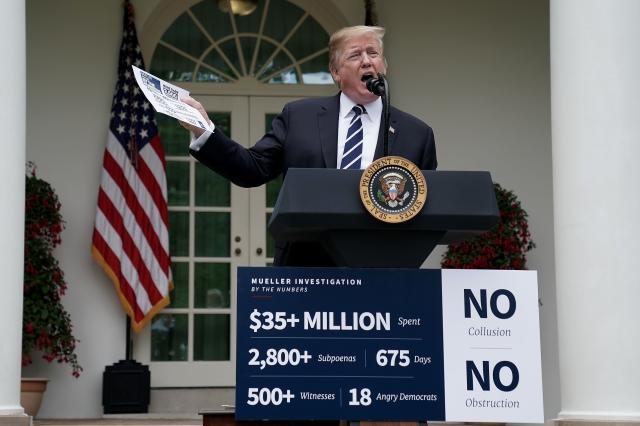
After Trump stormed out of his meeting, he went to the Rose Garden, where he delivered a surreal diatribe — Nancy Pelosi called it a “temper tantrum” — declaring that the Democrats must “Get these phony investigations over with.” Until then, he said, he would consider no legislation, no matter how crucial.
“We’re going to go down one track at a time,” the president said.
President Donald Trump tells reporters in the Rose Garden Wednesday he will consider no infrastructure proposals until Democrats cease investigating his administration. House Speaker Nancy Pelosi called it a “temper tantrum.” Getty
That is his style, and as well as that of his supporters, where two thoughts — the nation is crumbling to ruin AND the stock market is surging — make for very cramped quarters.
Well, if it must be one track at a time, then let’s prioritize. If the choice is getting to the bottom of the sewer of corruption, lies and quasi-treason that is the Trump administration, or building a high speed rail line to St. Louis, I’d say the prospect of zipping down to the Gateway to the West will have to wait a little longer. The roads can be rebuilt, eventually. I’m not so sure about the American Experiment.
Though there is risk. The longer we ignore overdue repairs, the more we sink into a false estimation of our economic position. “Make America Great Again” is not about making American great by, oh for instance, having great roads and trains and airports. It’s about declaring oneself great and brooking no dissent. The stock market of course will rejoice if you give big tax breaks to corporations and scuttle environmental standards. But those lost taxes mean there isn’t money to repair roads and bridges, and the environment curdles and deteriorates, a hidden cost not reflected in the Dow Jones.
With an unfit driver taking his hands off the wheel, trying to terrify and silence his passengers, we are careening down an un-maintained highway, with no idea what yawning pothole will send us flipping off the road. But the potholes are there, and we will hit one. Soon. When our nation is upside down in a ditch, wheels spinning, the smell of gasoline heavy around us, I wonder: Will Trump supporters begin to suspect something is wrong? Nah.
Stephen Colbert and Conan O’Brien think they have what it takes to be better friends. That theory is put to the test in “The Late Show’s” Personal Space.
Stephen Colbert and Conan O’Brien think they have what it takes to be better friends. That theory is put to the test in “The Late Show’s” Personal Space.
John McCain Recited Names Of Dictators During Trump Inaugural, Senator Says
Kevin Robillard, HuffPost May 26, 2019
DES MOINES, Iowa – Sen. John McCain repeatedly compared President Donald Trump to a dictator during Trump’s inaugural address, Minnesota Sen. Amy Klobuchar, a Democratic White House contender and friend of the late Arizonan, told a crowd of voters here.
Klobuchar, speaking to a crowd of more than 200 at Jasper’s Winery, said she sat next to McCain, one of Trump’s most outspoken Republican critics, and Sen. Bernie Sanders (I-Vt.) during the inaugural address, which became known for its blunt expression of Trump’s authoritarian populism and invocations of “American carnage.”
“I sat on that stage between Bernie and John McCain, and John McCain kept reciting to me names of dictators during that speech because he knew more than any of us what we were facing as a nation,” Klobuchar said. “He understood it. He knew because he knew this man more than any of us did.”
McCain and Trump feuded frequently during the president’s first 18 months in office, and the president has continued to attack McCain since the senator’s death last August. McCain refused to endorse Trump during the 2016 campaign, and later attacked his approach to politics as a “half-baked, spurious nationalism cooked up by people who would rather find scapegoats than solve problems.”
Trump, for his part, attacked McCain for his vote to kill an Obamacare repeal bill in the Senate and famously criticized him for being captured while serving as a fighter pilot in Vietnam. “I like people who weren’t captured,” he said in the early stages of his presidential bid.
McCain faced criticism from Democrats for not doing more to oppose the policies and appointments of a president he frequently lambasted, but Klobuchar and other Democratic senators frequently praise him as a Republican they were able to work with during increasingly partisan times. Klobuchar regularly mentions her friendship with McCain during her stump speech.
40% of Americans don’t have $400 in the bank for emergency expenses: Federal Reserve
SOO YOUN, ABC News May 24, 2019
Almost 40% of American adults wouldn’t be able to cover a $400 emergency with cash, savings or a credit-card charge that they could quickly pay off, a Federal Reserve survey finds.
In addition, 12% of adults said they wouldn’t be able to pay their current monthly bills if faced with the unexpected $400 expense, the survey found.
The 2018 results are very similar to those from the Federal Reserve’s 2017 survey.
Overall, the number of people who said they are able to handle unexpected expenses is on the rise since the Federal Reserve began the survey in 2013.
However, 17% of adults in the U.S. said they are not able to fully pay off all of their current month’s bills.
Meanwhile, medical costs yielded other hurdles.
One in five adults had major, unexpected medical bills to pay last year, and one in four skipped necessary medical care in 2018 because they couldn’t afford it, the survey revealed.
Related:
The Independent
Almost half of American adults do not have $400 to spare, study reveals
Stephanie Fillion, The Independent May 23, 2019
Repairing your car, replacing a broken appliance or making an emergency visit to the dentist can be bothersome for some – for many Americans, it is impossible.
Four in 10 American adults would struggle to handle an emergency expense as small as $400, a new Federal Reserve survey reveals.
Currently, about 27 percent of the people surveyed would have to borrow money or sell something to cover the bill, while 12 percent could not pay for the expense at all.
Still, overall, Americans are better off financially than they were five years ago, when about half of the population could not handle such a bill.
Unsurprisingly, health-related out-of-pocket spending is often the thing that is costly for Americans. The most frequently skipped treatments are dental care appointments, at 17 per cent, visiting a doctor, 12 per cent, and prescription medicine, 10 per cent.
Demographic disparities persist: people living in rural areas, as well as black and Hispanic adults are more widely represented in the category of people who would struggle to meet ends in such a situation. Those with bachelor degrees or more education are also more likely to be able to pay for these bills. “Racial and ethnic minorities of each education level are even less able to handle a financial setback,” the study finds.
What the study does not reveal, however, is how the situation breaks by ages: so it is unclear whether millennials inflate the emergency expense unreadiness or not.
Related:
Bloomberg
Almost 40% of Americans Would Struggle to Cover a $400 Emergency.
Matthew Boesler, Bloomberg May 24, 2019
Almost 40% of Americans Would Struggle to Cover a $400 Emergency
(Bloomberg) — Many U.S. households find themselves in a fragile position financially, even in an economy with an unemployment rate near a 50-year low, according to a Federal Reserve survey.
The Fed’s 2018 report on the economic well-being of households, published Thursday, indicated “most measures” of well-being and financial resilience “were similar to, or slightly better than, those in 2017.” The slight improvement coincided with a decline in the average unemployment rate to 3.9% last year, from 4.3% in 2017.
But despite the advance, the results of the 2018 survey indicated that almost 40% of Americans would still struggle in the face of a $400 financial emergency. The statistic, which was a bit better than in the 2017 report, has become a favorite rejoinder to U.S. President Donald Trump’s boasts about a strong economy among Democratic politicians, including 2020 presidential candidate Kamala Harris, the U.S. senator from California.
“Relatively small, unexpected expenses, such as a car repair or replacing a broken appliance, can be a hardship for many families without adequate savings,” the report said. “When faced with a hypothetical expense of $400, 61% of adults in 2018 say they would cover it, using cash, savings, or a credit card paid off at the next statement,” it added.
“Among the remaining 4 in 10 adults who would have more difficulty covering such an expense, the most common approaches include carrying a balance on credit cards and borrowing from friends or family,” according to the report.
Based on a survey of 11,000 people in October and November 2018, the report showed a quarter of Americans don’t feel like they are doing “at least OK” financially. That number was higher for black and Hispanic Americans, at roughly one third for both. For those making less than $40,000 a year, the share who felt they weren’t doing well was 44%.
“We continue to see the growing U.S. economy supporting most American families,” Fed Governor Michelle Bowman said in a press release accompanying the report.
“At the same time, the survey does find differences across communities, with just over half of those living in rural areas describing their local economy as good or excellent compared to two-thirds of those living in cities,” Bowman said. “Across the country, many families continue to experience financial distress and struggle to save for retirement and unexpected expenses.”
To contact the reporter on this story: Matthew Boesler in New York at mboesler1@bloomberg.net
To contact the editors responsible for this story: Margaret Collins at mcollins45@bloomberg.net, Alister Bull
For more articles like this, please visit us at bloomberg.com
(Bloomberg Opinion) — It looks like all you have to do these days to dominate a news cycle and force the president of the United States to tee up a predictably bonkers press conference in the Rose Garden is to accuse him of engaging in a “cover-up.”
House Speaker Nancy Pelosi uttered the magic words on Wednesday and, presto, President Donald Trump later stepped in front of a White House lectern adorned with a placard that offered a numerical tour of Special Counsel Robert Mueller’s Russia investigation: “$35+ MILLION Spent; 2,800+ Subpoenas; 675 Days; 500+ Witnesses; 18 Angry Democrats.” Two other little signs abutted the Mueller tutorial, both displaying classic bits of Trump propaganda: “NO Collusion” and “NO Obstruction.”
Topping off the theatrics was POTUS himself, the most vaudevillian of Oval Office inhabitants. “I think most of you would agree to this, I’m the most transparent president probably in the history of this country,” Trump said to a Rose Garden audience unlikely to agree. “I don’t do cover-ups.”
But of course he does. The president has spent much of his adulthood drawing a veil over his failures and shortcomings, maneuvering to keep things hidden and enlisting the help of others along the way. He has visited repeated cover-ups upon his presidency too.
Even Trump’s Rose Garden performance was just one act in a show that turned out to be “Cover-Up Wednesday.” Across town in Washington, Treasury Secretary Steven Mnuchin played his part by keeping Trump’s tax returns under wraps. He told the House Financial Services Committee that it would be “unlawful as advised by the Department of Justice” for him to comply with a Congressional subpoena requesting him to direct the Internal Revenue Service to hand over the returns. He said he didn’t believe he was breaking the law by ignoring the subpoena.
“I have been advised I am not violating the law. I never would have done anything that violated the law,” Mnuchin said. “Quite the contrary, I’ve been advised that had I turned them over I would be violating the law.”
We’re still waiting to see the legal basis for Mnuchin’s position, though. The Justice Department (overseen by the most transparent president in history and run by his appointee, William Barr) didn’t go as far as warning the Treasury Secretary that he would break the law by releasing the tax returns, at least according to a minimalist letter on the matter that Mnuchin has made public. Instead, that May 6 letter to the House Ways and Means Committee said he wouldn’t provide Trump’s returns because the committee’s request, per Justice Department guidance, didn’t “reasonably serve a legitimate legislative purpose.” Mnuchin said the Justice Department’s reasoning would be memorialized in a published legal opinion “as soon as practicable.”
More than two weeks have passed and that legal opinion has yet to arrive. If and when it does, it may contain language noting that Mnuchin would be violating the law by releasing the returns (especially now that he has testified to that effect). Still, Mnuchin’s primary argument for keeping the taxes covered up has been what he describes as a Congress hobbled by a lack of legislative purpose.
“Legislative purpose” is an argument that has circulated widely among Trump attorneys trying to keep his financial records hidden in what the most transparent president in history would never call a cover-up. Trump’s lawyers deployed that reasoning to try blocking Deutsche Bank AG and Capital One Financial Corp. from turning over his banking records. But on Wednesday afternoon, U.S. District Judge Edgardo Ramos shot that thinking down, saying in his Manhattan courtroom that “the power of Congress to conduct investigations is inherent in the legislative process.”
Ramos’s argument matched a similar line of reasoning that U.S. District Judge Amit Mehta offered on Monday in Washington, when he ruled that Congress was within its rights as a coequal branch of the federal government to secure records from Trump’s accounting firm, Mazars USA. That ruling is being appealed and it’s likely that Ramos’s will as well, but in the annals of courts ensuring that presidents can’t engage in financial cover-ups – and must embrace authentic transparency – both rulings are significant.
The Ramos and Mehta rulings will probably help inform any legal challenges to Mnuchin’s stance on Trump’s taxes. In the meantime, the New York State Assembly – also on Wednesday – passed a bill allowing Trump’s state income tax returns to be shared with Congress. The state returns track the federal returns partially but significantly. If all of this comes together, Trump’s accounting records, banking documents, and income tax returns will wind up in Congress’s hands, leaving the president exposed to legal and financial scrutiny in ways he has never experienced in decades as a businessman and public figure.
Over the years, Trump has managed to keep his health and academic records under cover and his ties to organized crime largely out of public view as well. He has used a dizzying number of lies and exaggerations to mask his poor track record as a businessman, hide financial problems and inflate his wealth.
It’s doubtful, however, that Pelosi was thinking of those things when she talked on Wednesday about Trump’s cover-ups. Perhaps front and center in her mind was the recently released Mueller report – a large part of which details the epic efforts of Trump and his team to obscure a number of their questionable activities before, during and after the 2016 campaign. Trump’s efforts crossed so deeply into possibly illegal acts that Mueller weighed charging the president with obstruction of justice.
Attorney General William Barr came to Trump’s rescue in the early days of the Mueller report’s public release, mis-characterizing what the report actually said as well as the gravity of some of the wrongdoing uncovered. He now occupies a special perch in the White House, as one of the legal advisers the president is most likely to turn to as pressures mount, as problems need to be covered up, and as he gets rattled enough to begin free associating about transparency and cover-ups in front of the Rose Garden cameras.
To contact the author of this story: Timothy L. O’Brien at tobrien46@bloomberg.net
To contact the editor responsible for this story: James Boxell at jboxell@bloomberg.net
This column does not necessarily reflect the opinion of the editorial board or Bloomberg LP and its owners.
Timothy L. O’Brien is the executive editor of Bloomberg Opinion. He has been an editor and writer for the New York Times, the Wall Street Journal, HuffPost and Talk magazine. His books include “TrumpNation: The Art of Being The Donald.”
For more articles like this, please visit us at bloomberg.com/opinion