
Republicans Threw Their Own Guy Deep Under the Bus to Avoid a January 6 Commission

Esquire

Republicans Threw Their Own Guy Deep Under the Bus to Avoid a January 6 Commission

Every speaker tried to find a polite way to call John Katko either a rube or a sucker. The end result is that Democrats will need to go on their own.

By Charles P. Pierce                              May 20, 2021
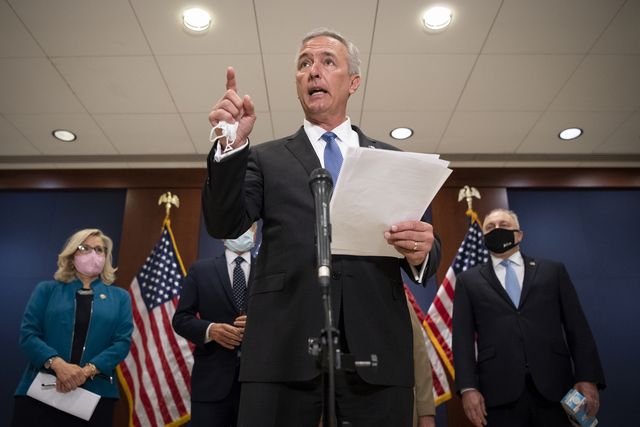
united states april 14 rep john katko, r ny, speaks during a press conference following a house republican caucus meeting in washington on wednesday, april 14, 2021 the house republican members spoke about their recent trip to the southern border and the surge of migrants entering the united states photo by caroline brehmancq roll call, inc via getty imagesCAROLINE BREHMAN/GETTY IMAGES

The It-Didn’t-Start-With-Trump element of the Republican recalcitrance on a proposed bipartisan (Gawd!) commission to investigate the January 6 insurrection is to recall that George W. Bush did all he could to derail the 9/11 commission that everyone now pretends to adore, and that C-Plus Augustus refused to testify under oath to that commission, and wouldn’t even sit for an unrecorded interview except in the White House with Dick Cheney, father of St. Liz of the Holy Soundbite, sitting next to him working the levers. And let’s not even get into the government-wide stonewalling of the Iran-Contra investigations before that, and let’s also remember that there were 33 investigations into Benghazi, BENGHAZI, BENGHAZI!

However, when Mitch McConnell came out on Tuesday as the devious reptile he’s always been, and announced that he was joining House Republican honcho Kevin McCarthy over in Coward’s Corner, the difference was an order of magnitude. These guys were shirking their constitutional obligation and abandoning their moral compasses because a) they lead a party that is very likely complicit in the events, and b) they’re doing so to cover for a crook and a liar who’s in so many crosshairs he looks like Bonnie and Clyde at the end of that movie.

After careful consideration, I’ve made the decision to oppose the House Democrats’ slanted and unbalanced proposal for another commission to study the events of January 6…So, Mr. President, it’s not at all clear what new facts are additional—or additional investigation yet another commission could actually lay on top of existing efforts by law enforcement and Congress. The facts have come out and they’ll continue to come out. What is clear, is that House Democrats have handled this proposal in partisan bad faith going right back to the beginning. From initially offering a laughably partisan starting point to continuing to insist on various other features under the hood that are designed to centralize control over the commission’s process and its conclusions in Democratic hands.

Mitch, my dude, this isn’t a job for grown-ups. And let us all wave farewell to Rep. John Katko, the Republican co-sponsor of the “bipartisan” commission proposal, as he disappears forever under a bus.

Later Wednesday afternoon, debate in the House began on the resolution establishing the commission. The overarching impressions were that, in the debate, the Democrats led with age and the Republicans led with crazy. The first three speakers in defense of the resolution—Nancy Pelosi, Bennie Thompson, and Steny Hoyer—are a combined 235 years old. The Republican side led off with Marjorie Taylor Greene, Louis Gohmert, and some guy from North Carolina named Sam Bishop, who wanted to make sure everybody knew that what happened on January 6.

Let me say this, if it was an insurrection, it was the worst example of an insurrection in the history of mankind. It was a riot. It was a mob. And it was significant. And it was troublesome. But this is not bipartisanship. And I fear that the gentleman from New York may find that he has been played.

Personally, I think the passel of elderly Communist inebriates who tried to overthrow future Pizza Hut spokesman Mikhail Gorbachev back in August of 1991 are still the gold standard for insurrectionist clownery. (They got faced down by Boris Yeltsin, reportedly because, against all possible odds, some of them were drunker than Yeltsin was.) That, however, is beside the point. I would draw your attention to that last sentence in which John Katko returns to his place under the wheels.

washington, ca may 18 senate minority leader mitch mcconnell r ky gets on a elevator after leaving a senate republican policy luncheon news conference on capitol hill on may 18, 2021 in washington, dc kent nishimura los angeles times via getty images

Mitch McConnell joined Kevin McCarthy in the Coward’s Corner. KENT NISHIMURA/GETTY IMAGES

Watching Katko straddle the crazy to get the resolution he co-sponsored passed made you fear for every hamstring the man owns. Speaker after speaker tried to find polite ways to call Katko either a rube or a sucker. Meanwhile, the Democrats, in the person of co-sponsor Thompson, seem convinced that the fact that the resolution is “bipartisan” has some ultimate legislative salience in the Congress, and some ultimate political salience in the country, which is something I doubt profoundly. People don’t give a fck about bipartisanship. It’s neither a dealmaker nor a dealbreaker. It’s a green-room amenity, like sodas and a crudité plate. Thankfully, Rep. Tim Ryan showed up to inveigh against the futility of it all.

To the other 90% of our friends on the other side of the aisle, holy cow. Incoherence. No idea what you’re talking about. Benghazi, you guys chased the former Secretary of State all over the country, spent millions of dollars. We have people scaling the Capitol, hitting the Capitol police with lead pipes across the head and we can’t get bipartisanship. What else has to happen in this country? Cops, this is a slap in the face to cops across America. If we’re going to take on China, reverse climate change, we need two political parties in this country that are both living in reality and you ain’t one of them.

To which Katko responded in his best hall-monitor voice that things were getting impermissibly partisan and emotional. Because, when you come right down to it, John Katko is a Republican, too. At loose moments, he let that slip through. For example, the regular GOP stance on the commission is that it ought to investigate the disturbances last summer following the murder of George Floyd. (Rep. Marjorie Taylor Greene ranted about them in her one minute of debate time.) But Katko tried another tack.

And of course we can’t forget the 2017 terrorist attack against Republican members of Congress during practice for the congressional baseball game. Were it not for the officers involved, there would be scores of dead congressmen. That’s the plain truth.

This is a matter of comparing apples and salamanders. The 2017 episode was the work of one man, James Hodgkinson, and he was killed by the officers at the scene. There was a Secret Service investigation almost immediately after the shooting. As far as I know, there haven’t even been rumors of other people involved in the shooting. Hodgkinson was vocal in his dislike of Republicans and clearly came to the ballfield to attack them that morning, but he did it all on his own. An awful event, certainly, but if Katko thinks a 1/6 commission should examine it, then he’s as invested in delay and deflection as Greene is.

And, unless Mitch McConnell is taken off to glory and replaced by Zombie Paul Douglas, this thing is as dead as Kelsey’s nuts in the Senate anyway. Ten Republicans would have to vote for it and, well, no. It’s time for Democrats simply to put together a select committee of their own, issue subpoenas, and let the chips fall.

County tells Arizona Senate to keep files, threatens lawsuit

County tells Arizona Senate to keep files, threatens lawsuit

Jonathan J. Cooper                          May 21, 2021


PHOENIX (AP) — Maricopa County officials on Friday directed the Arizona Senate and the auditors it hired to review the county’s 2020 election count to preserve documents for a possible lawsuit.

The county made the demand in a letter after the auditors refused to back down from their claim that the county destroyed evidence by deleting an election database. The GOP-controlled Board of Supervisors and Republican Recorder Stephen Richer, one of the top election officials, say the claim is false.

County officials earlier this week said they might consider filing a defamation lawsuit if the Senate President Karen Fann and the auditors don’t retract the allegation files were deleted.

“Because of the wrongful accusations that the County destroyed evidence, the County or its elected officers may now be subject to, or have, legal claims,” the county’s chief litigation attorney, Tom Liddy, wrote in a letter to Senate President Karen Fann, a Republican from Prescott.

Senate Republicans are overseeing an unprecedented partisan audit of the 2020 election in Maricopa County, including a hand recount of 2.1 million ballots and a review of voting machines and other data. Fann claimed the database was deleted, which a twitter account tied to the audit called “spoliation of evidence.” Former President Donald Trump amplified the claim in a statement last weekend.

County officials said Monday that no databases or directories were deleted and laid out a detailed explanation for why they believe the auditors couldn’t find them, accusing the auditors of ineptitude. The next day, a data forensics consultant on the audit team said he was able to “recover” the files, and the audit’s Twitter account later repeated the claim that files were deleted.

The letter directs Fann and anyone working on the audit to preserve any records related to it, including emails and text messages, computer files, cellphones and other devices.

The audit will not change the election result. But Trump and many of his supporters believe it will support their baseless claim that Trump’s loss was marred by fraud.

‘Impending disaster.’ Worsening algae bloom on Lake Okeechobee threatens coasts again

‘Impending disaster.’ Worsening algae bloom on Lake Okeechobee threatens coasts again

Adriana Brasileiro                       May 14, 2021


The scene at Pahokee marina on Lake Okeechobee last week was a warning sign: A thick mat of algae in various shades of green, brown, gray and fluorescent blue covered the area around boat slips. In some spots, the gunk was so dense it stuck out two inches above the water.

Elsewhere on the lake, the algae wasn’t as chunky, but satellite photos were just as shocking: NOAA monitoring images on Wednesday showed nearly two-thirds of the lake, or 500 square miles, were covered with blue-green algae, the potentially toxic stuff that has fouled rivers and canals in the west and east coasts of Florida in past years, killing fish and scaring tourists away. Green streaks of algae are already visible moving down from the Moore Haven lock on the Caloosahatchee River, which has received Lake Okeechobee water releases in recent weeks to lower lake levels.

Is South Florida in for another summer of slime? The answer has a lot to do with how much water will be flushed from the lake to Florida’s west and east coasts. Already, Lake Okeechobee is at 13.6 feet, 2.5 feet higher than what it was at this time last year. Forecasters are predicting a “well above average” hurricane season this year.

“This is an impending disaster,” said John Cassani, of Calusa Waterkeeper. He and other activists are asking Gov. Ron DeSantis to declare a state of emergency to protect the Caloosahatchee from harmful lake discharges as the rainy season approaches and the need to lower water levels will be unavoidable. “Think of the lake as a giant cesspool being flushed into the Caloosahatchee every day with no end in sight. It’s a catastrophic situation.”

Workers from Breen Aquatics vacuum up thick blue-green algae as they try to clean up blooms at the Pahokee Marina on May 3.


The bloom, which expanded quickly over the past few weeks as temperatures rose, is fueling heated debate about how the U.S. Army Corps of Engineers should manage lake waters considering conflicting interests: the need to send water south for Everglades restoration and the guarantee of sufficient supplies for farming while also managing flood protection structures such as its aging Herbert Hoover dike.

The Corps is currently revising its lake management policies to take into account a massive $1.8 billion upgrade of the dike that is scheduled to be completed next year as well as Everglades restoration projects that will come online in the next few years. The projects include a vast reservoir and stormwater treatment area that, once completed in 2023, will allow managers to send more water south when lake levels rise, reducing discharges to estuaries on the east and west. The aim is to produce water clean enough to replenish the Everglades amid efforts to recreate something close to the original flow of the River of Grass, going south through Shark Valley in Everglades National Park, taking much-needed fresh water all the way south to Florida Bay.

The Corps recently presented five conceptual plans for its new Lake Okeechobee System Operating Manual (LOSOM) that will receive public comment before more detailed proposals are presented in July.

But water quality activists want the state to act now under an emergency order to try to avoid a repeat of the devastating 2018 season when massive blooms of cyanobacteria in the lake were discharged to estuaries, killing marine life and making pets and even people sick. The blooms coincided with a widespread red tide that started in the Gulf Coast but spread as far as the Panhandle and St. Lucie County on the Atlantic coast, fouling beaches with dead fish and hundreds of marine animal carcasses.

On Friday the Corps said it will reduce discharges to the Caloosahatchee to 1,500 cubic feet per second from the current 2,000 cfs as a result of the blooms. Col. Andrew Kelly, the Corps commander for Florida, said releases will be made in pulses to try to flush out algae-laden freshwater and allow for water with higher salinity levels to move up the river.

“Some types of algae don’t do as well in higher salinity so we are trying to get some of the higher salinity up into the Caloosahatchee, which will support the degradation of some of that algae, by doing a pulse release of freshwater,” he said during a call with reporters.

Send ‘all that you can’ south

Friends of the Everglades, the Center for Biological Diversity, the Conservancy of South Florida and several water quality advocacy groups sent DeSantis a letter earlier this week saying the state must waive restrictions that stop water managers from moving more water south into conservation areas. Some of those restrictions exist to make sure the water is clean enough to go into conservation areas and beyond, into the Everglades.

DeSantis, who flew over Lake Okeechobee earlier this week to check on the problem, said he asked the District to send “all that you can south,” but didn’t respond to the request for an emergency order. He said he expects the Corps to come up with “a good regulation schedule that balances the equities” and mitigates negative impacts to coastal communities in the summer.

NOAA satellite images showed that cyanobacteria covered about 500 square miles of the lake earlier this week.


Treasure Coast Rep. Brian Mast threatened to sue the Corps to stop the discharges in an interview with CBS 12 on Thursday.

During a board meeting on Thursday, District staff said water conservation areas south of the lake were mostly full or couldn’t receive water because they were in the process of being restored or had projects under construction. Water Conservation Area 3, for instance, is undergoing restoration work after Tropical Storm Eta last year filled marshes to the brim, flooding tree islands and forcing deer to crowd onto levees to survive.

Communities around Lake Okeechobee said their needs must be taken into account. Hendry County Commissioner Ramon Iglesias expressed concern about a schedule that allows too much discretion and flexibility by the Corps every year. He said his fishing and farming community needs certainty so that residents can better plan their lives.

“No schedule should singularly prioritize the loudest people in the room,” Iglesias said during public comments. “We can have a schedule that takes everyone’s concerns into consideration, but not at the expense of my community or any other Floridian that depends on the lake when they need it for drinking, for fishing, for recreating, for farming and even for the environment.”

Sending water south to the Everglades during the dry season is common sense, but it’s important to hold the District accountable for how it manages water in the storm treatment areas, said Eve Samples from Friends of the Everglades. She said most of the water treated in these marsh-like reservoirs is runoff from farms and not water from the lake.

“Why is EAA farm runoff being given priority capacity in taxpayer-funded stormwater treatment areas when STAs could be cleaning water from the lake and sparing people east and west from exposure to these cyanotoxins?” Samples asked.

A decades-old fight for water

Organizations that defend agriculture said everyone is to blame. Nyla Pipes, a sugar industry advocate at One Florida Foundation, said nutrients come from multiple sources and all of them need to be addressed. She said people often blame agriculture because “the public really doesn’t understand that algae is already in our water” and it only gets out of control when there are too many nutrients.

“All this finger pointing … we need to be looking in the mirror because it’s all of us,” she said.

Blue-green algae blooms were observed in nearly two-thirds of the lake earlier this week.


The Everglades Foundation has said it’s about time the state started to manage the lake in a more equitable way and provided its own LOSOM idea to the Corps.

“Currently, we’re not managing Lake Okeechobee in a balanced way. It’s really managed for the needs of agriculture south of the lake, which is primarily sugar. They get the water when they want it. And when it rains, they dump all their stormwater into the Everglades,” said the foundation’s chief science officer, Stephen Davis.

The discussion highlighted the decades-old conflicts in lake water uses and needs. While higher levels benefit farmers that have for decades relied on consistently delivered lake water for their fields, environmentalists and coastal communities say the lake should be kept lower in the dry season and higher in the wet season, to prevent discharges of polluted water to the St. Lucie estuary in the east and the Caloosahatchee to the west.

To prevent a breach on the aging dike when there’s too much water in the lake, the Corps has historically discharged the excess to coastal estuaries. But Lake O is growing increasingly polluted with fertilizer from surrounding farms and communities, and decades of phosphorus and nitrogen that has accumulated on the bottom.

This “legacy pollution” can get stirred up by strong winds over the shallow lake, releasing nutrients that feed blooms. Davis said that’s probably the case now, as blooms are happening early in the season.

“Typically, we don’t see this much algal coverage on the lake until June or July, when we have the longest day lengths,” and sunlight drives the photosynthesis that makes algae grow and reproduce, he said.

Scuba divers begin 6-month effort to rid Lake Tahoe of trash

Scuba divers begin 6-month effort to rid Lake Tahoe of trash

SOUTH LAKE TAHOE, Calif. (AP) — A team of scuba divers on Friday completed the first dive of a massive, six-month effort to rid the popular Lake Tahoe of fishing rods, tires, aluminum cans, beer bottles and other trash accumulating underwater.

The team of between five and 10 divers plans to look for trash along the entire 72 miles (115 kilometers) of shoreline and dig it out in an endeavor that could be the largest trash cleanup in Lake Tahoe’s history, said Colin West, a diver and filmmaker who founded Clean Up the Lake, the nonprofit spearheading the project.

“We are still learning not to be so wasteful. But unfortunately, as a species we still are, and there are a lot of things down there,” West said after completing the first dive.

The team collected about 200 pounds (90 kilograms) of garbage during their one-tank session and found 20 large or heavy items, including buckets filled with cement and car bumpers, that will have to be retrieved later by a boat with a crane, he said.

They plan to dive three days a week down to 25 feet (7 meters) in depth. The clean-up effort will cost $250,000 — money the nonprofit has collected through grants — and will last through November.

West started doing beach cleanups along the lake after visiting Belize and seeing beaches there littered with trash. But in 2018, after a diver friend told him he and others had collected 600 pounds (272 kilograms) of garbage from the waters on Tahoe’s eastern shore, he decided to focus on the trash in the water.

“I was blown away, and we started researching and going underneath the surface and we kept pulling up trash and more trash,” said West, who lives in Stateline, Nevada.

In a survey dive on September 2019, his team removed more than 300 pounds (136 kilograms) of debris from Lake Tahoe’s eastern shore and planned to launch his clean-up along the whole shoreline last year. The pandemic delayed those plans.

But the group of volunteers, which includes not only divers but support crew on kayaks, boats and jet skis, continued diving and cleaning both Lake Tahoe and nearby Donner Lake. By the end of the last summer, they had collected more than 4 tons (4 metric tons) of trash from both lakes.

Republican lies have thrust America into its third revolution. We are a nation in crisis.

Republican lies have thrust America into its third revolution. We are a nation in crisis.

Carrie Cordero and Edward J. Larson                      
Angry supporters of President Donald Trump scale the west wall of the the U.S. Capitol in Washington on Jan. 6, 2021.


To read and listen to the headlines after House Republicans voted to remove Rep. Liz Cheney from her leadership post, one would think that the “turning point” in the Republican Party began with its denial of the 2020 election result after Nov. 3, or the Capitol insurrection on Jan. 6. Neither of those moments, however, is or was the actual turning point. Instead, the transformation one of the nation’s two major political parties took place well before each of those events. And the longer it takes for the public conversation to recognize how dramatically the Republican Party has already shifted, the longer it will take to develop a coherent civic strategy to protect U.S. democracy going forward.

And we do need a strategy, because this political crisis is not just the internal machinations of a single political party; it is a political crisis of a nation. Indeed, it might not be hyperbolic to characterize our present national state as in the midst of the third revolution.

Tectonic shift in the Republican Party

What was at first an acquiescence to Donald Trump since his nomination at the Republican National Convention in 2016 slowly became a public acceptance, and then an entanglement. Some who were slow to realize the tectonic shift taking place in the Republican Party over the past five years have awakened from their slumber in the wake of the attack on the Capitol. They are a little late. Those who thought they could wait out Trump’s presidential term before getting on the right side of history were wrong; the time for choosing in a way to actually affect the trajectory of the modern-day Republican Party was earlier.

One explanation for this delayed acknowledgement could be that even sophisticated political participants forget how quickly political parties can completely transform or disappear. Some political actors perhaps thought that they had more time. In the 1850s, a decade before the Civil War, the relative balance that had lasted for a generation between the two political parties – the Democrats and the Whigs – collapsed. The Whig Party disintegrated between 1852 and 1856. As this historic transformation shows, fundamental change to a political party need not take decades. It can happen in just a few years.

From left, Jared Kushner, Ivanka Trump, President Donald Trump and Japanese Prime Minister Shinzo Abe in Osaka in 2019.


From 2016-20, it appeared that the Republican Party might disintegrate like the Whigs. First, the GOP looked away as Trump relied on family members instead of government professionals as White House advisers. Second, midway through his term, the president fired or solicited the resignations of political appointees of his own party who had been confirmed by the Senate. He repeatedly turned on his own appointees, particularly when they sought to carry out their lawful functions. Third, the Republican convention in 2020 declined to adopt a political platform; instead, it allowed the party to reflect the whims of its highly personalized leader.

Donna Brazile: Liz Cheney’s ouster should alarm all fact-based Americans who believe in our country

Since then, the vast majority of Republican voters and officials have embraced denial of the 2020 election results and refused to acknowledge the severity of the Jan.6 attack on the Capitol. These developments reveal that the Republican Party will not give up like the Whigs. The party will persevere, emboldened by taking pride in belligerence and transformed into a political movement that embraces fraud and deceit as fundamental to its survival and electoral success.

US democracy’s existential crisis

We are all familiar with the first American Revolution: an actual war, a rebellion for self-governance. But it was not long after that Thomas Jefferson called the election of 1800 the “second American revolution.” The election of the Democratic-Republicans over the Federalists set the course for the nation in Jefferson’s vision of American democracy, and permanently marginalized the Federalist Party and led to its ultimate replacement by the Whigs.

In the hours after the insurrection at the U.S. Capitol, former president Trump tweeted, “Remember this day forever!” Participants in the melee he incited openly invoked 1776.

American Revolution reenactment in Lexington, Mass., in 2006.


We will not know until after the 2022 midterms and the 2024 presidential election whether the result of 2020 set the nation on a path toward Democratic Party domination for a generation, like the election of 1800. But we think this moment in our nation’s history is best understood as the third American revolution – hopefully primarily of competing ideas and minimally of political violence – where the effective functioning of American elections and democratic institutions hangs in the balance.

Leaving no doubts: Liz Cheney removal makes it official. Republicans pick Trump over truth and Constitution.

It is no longer enough to characterize the present political crisis as an internal party dispute. Instead, we are witness to a political revolution that will define American society and governance for decades to come.

Carrie Cordero is the Robert M. Gates Senior Fellow at the Center for a New American Security and adjunct professor at Georgetown Law. Edward J. Larson is a Pulitzer Prize winning legal historian and a professor at Pepperdine University whose latest book is “Franklin & Washington: The Founding Partnership.“

COVID fight could return ‘to square one’: experts sound vaccines alarm

COVID fight could return ‘to square one’: experts sound vaccines alarm

By Kate Kelland                                 May 20, 2021


FILE PHOTO: Nurse prepares to administer the AstraZeneca/Oxford vaccine against the COVID-19 at the Eka Kotebe General Hospital in Addis Ababa


LONDON (Reuters) – India’s export ban on COVID-19 shots risks dragging the battle against the pandemic “back to square one” unless wealthy nations step in to plug a gaping hole in the COVAX global vaccine-sharing scheme, health specialists said on Thursday.

COVAX, which is critical for poorer countries, relies on AstraZeneca shots made by the Serum Institute of India, the world’s biggest maker of vaccines. It was already around 100 million doses short of where it had planned to be when India halted exports a month ago amid a surge in infections there.

Rich countries with plentiful COVID-19 vaccine stocks must now share them immediately, at scale, the global experts said, otherwise the pandemic could be prolonged as the world struggles to contain a virus that is continuing to spread and mutate.

“It is a huge concern,” said Anna Marriott, health policy manager at the global charity Oxfam. She and others said it was imperative that wealthy countries and regions make good on their rhetoric and share excess vaccines now.

“The current approach that relies on a few pharma monopolies and a trickle of charity through COVAX is failing – and people are dying as a result.”

Reuters reported on Tuesday that India is extending its ban, meaning it is now unlikely to resume major exports before October.

Will Hall, global policy manager for the Wellcome global health trust, said COVAX’s heavy reliance on the Serum Institute left it vulnerable. India’s extension of its export ban made it even more crucial for rich countries to share doses via the scheme, he said, “not in six months’ time, not in a month’s time, but now”.

“We’re not going to beat this virus unless we think and act globally,” he added. “We all should be concerned about this – the more the virus continues to spread, the greater the risk of it mutating to a stage where our vaccines and treatments no longer work. If that happens we’re back to square one.”

A highly transmissible new variant of the novel coronavirus first identified in India has spread to several countries around the world.

‘VERY FEW OPTIONS’

COVAX aims to get vaccines to at least 20% of the populations of the more-than 90 low and middle-income countries signed up to receive the shots as donations. It has so far distributed about 65 million doses of mainly the AstraZeneca COVID-19 vaccine, many of them to Africa.

A spokeswoman for the GAVI vaccines alliance, which co-leads COVAX, said the facility was working hard to make up supplies.

“We’re trying to find different ways of making sure that those countries that have received the first dose are able to also receive a second dose and that vaccinations can continue,” she told Reuters. “What we need right now, to meet the immediate needs, is dose sharing.”

The United States said on Wednesday it would share a total of 20 million doses of Pfizer’s, Moderna’s and Johnson & Johnson’s vaccines by the end of June, donating a significant amount via COVAX, on top of 60 million AstraZeneca shots it had already planned to give to other countries.

EU trade commissioner Valdis Dombrovskis said this week that the bloc was working to significantly ramp up vaccine donations through COVAX in the second half of 2021. Vaccine sharing announced by EU member states has so far amounted to 11.1 million vaccines, he said, of which 9 million are being shared via COVAX.

Britain, meanwhile, will have enough surplus doses to fully vaccinate at least 50 million people in poorer countries once every adult at home has been fully vaccinated, according to analysis by UNICEF’s UK office last week.

The GAVI spokeswoman said COVAX’S reliance on the Serum Institute was based, largely, on its vast production capacity, ability to deliver at low cost and on assurances that it would be able to produce the millions of doses needed at speed.

“It always was COVAX’s plan to grow and diversify its portfolio to 10-12 vaccines but at the start of the year when approved vaccines were only slowly coming online, we had very few options available to us,” she said.

(Reporting by Kate Kelland; Additional reporting by Francesco Guarascio in Brussels and Ludwig Burger in Frankfurt; Editing by Pravin Char)

Thanks to Kobach, Trump and conservative think tank, we know extent of voter fraud

Thanks to Kobach, Trump and conservative think tank, we know extent of voter fraud

Charles Hammer                         May 20, 2021

We Kansans owe Kris Kobach warm thanks for his greatest triumph: He proved that voter fraud is virtually nonexistent in our state. He achieved that by fiercely striving to prove the opposite.

In 2010 he got himself elected as Kansas secretary of state, then won legislative authority to prosecute illegal voters — a power no equivalent state official elsewhere holds.

He secured a 2013 law requiring that those registering to vote prove they are American citizens. His bar to voting was among the most severe in the nation until overruled in federal court.

Kobach recently filed to run for Kansas attorney general in the next election.

So how many fraudulent voters did Kobach’s dragnet convict during his eight-year tenure in office? Just nine. Nine convictions in a state with nearly 2 million registered voters. Among those were older citizens who mistakenly voted in two different places where they owned property.

A college student filled out an absentee ballot for her home state before voting months later in Kansas, both times for Trump. Steve Watkins, a former Republican congressman, was charged with three felony voting offenses and got off with diversion.

The Heritage Foundation, a conservative think tank, supports the arguments of Donald Trump and Kobach. Going back as far as 2005, Heritage lists 15 convictions for voter infractions in Kansas, presumably including those from the Kobach era. Over 15 years, one offense per year.

The Heritage website also reports 1,322 “proven instances of voter fraud” in the United States since the early 1980s. How could America have passed 40 years with a measly 1,322 proven instances of voter fraud? Among our 168 million registered voters?

Both for Kansas and the nation, the rate of fraud has been less than one one-thousandth of 1%. Would that we religious Americans sinned at such a microscopic rate.

Fully armed, Trump, Kobach and the Heritage Foundation marched out on an elephant hunt and bagged a gnat.

But, see, there must be horrendous voter fraud. Otherwise, how can Republicans defend their gerrymandering of voting districts so they win even when they lose? How can they defend suppression of votes from minorities, the elderly and young people?

Only fraud can justify shutting down polling places, banning drop boxes, cutting short mail voting and requiring notary public signatures on such ballots — make it, in other words, very hard for certain people to vote.

Here’s another high-flying way they strive to overcome “fraud.” The U.S. president telephones the Georgia secretary of state and says: “So, look…I just want to find 11,780 votes, which is one more than we have. Because we won the state…And there’s nothing wrong with saying, you know, that you’ve recalculated.”

But what if the man answers: “Well, Mr. President…the data you have is wrong”? Then direct threats are necessary. “You know, that’s a criminal,” says the president, “that’s a criminal offense….”

Then there’s the oft-repeated claim by Kobach and others that undocumented immigrants swarm to the polls and elect Democrats.

My research on this went only as far as the Heritage Foundation’s own list of their illegal Kansas voters’ last names: Watkins, Garcia, Christensen, Criswell, Doyle, Farris, Hannum, Kilian, Weems, Wilson, Gaedke, Kurtz, Duncan, Scherzer and McIntosh. Not a plethora of Hispanic last names there.

The Heritage tally also includes one Hispanic name, Lleras-Rodriguez, among 17 voter fraud cases in Missouri.

I’m tender myself on the immigrant issue since I’m half German. My father embarked from Hamburg just five years before Adolf Hitler seized power in 1933.

As an immigrant hater, Trump should be tender himself since his grandfather was German and his mother immigrated from Scotland. Two of his three wives, one now an ex-wife, immigrated from Eastern Europe.

Long before he died in 1974 my dad (naturalized as an American citizen in 1934) got to feeling easy about his origins. I fondly remember him tilted back in his green recliner, puffing his pipe and musing, as we immigrants often do, on who should be Americans.

“That’s de trouble mit this country,” he would say with a grin. “We got too dang many foreigners. They gettin’ all de good jobs. Ha, ha, ha!”

2022 Ford F-150 Lightning revealed with 300-mile range, priced from $53K

2022 Ford F-150 Lightning revealed with 300-mile range, priced from $53K

Joe Lorio                     May 19, 2021

See Full Image Gallery >>

The much-anticipated battery-powered 2022 Ford F-150 Lightning pickup has finally made its debut, a moment that feels like a sea change in the U.S. auto industry. The F-Series pickup has for years been America’s bestselling passenger vehicle, and Ford’s decision to offer it as an electric vehicle sends the message with a bullhorn: The EV’s moment is upon us.

Now that the truck has been unveiled — officially, that is; we saw it demurely hanging out in the background during President Joe Biden’s speech yesterday pushing his plan for EVs in America — we can get a sense of how Ford’s big pickup will work as an EV.

The truck will come in a single body configuration: SuperCrew four-door with a 5.5-foot bed (the F-150‘s most popular configuration). The three Lightning trim levels are also from the heart of the lineup: XLT, Lariat, and Platinum — although there’s also “a commercial-oriented entry model.”

Ford will offer standard-range and extended-range battery packs, with the extended-range pack optional on the two lower trims and included on the Platinum. The truck comes standard with a dual-motor powertrain and four-wheel drive. The standard-range version makes 426 horsepower, while the extended-range model boasts 563 hp; both have 775 pound-feet of torque. For the larger-battery version, Ford estimates a 0–60 time in the mid-4-second range.

Ford is estimating 230 miles of range for the base battery pack and 300 miles for the extended-range version (although it appears the Platinum trim will come in slightly lower). There are multiple options for recharging, as outlined below:

The 32-amp mobile charger is standard, and the 48-amp unit is optional. The 80-amp unit is included in trucks with the extended-range battery pack, which also comes standard with a dual onboard charger for faster recharging. Some sample recharge times (standard-range battery /extended-range battery) are:

  • 15%-80% using a 150-kW Level 3 fast charger: 44/41 minutes
  • 15%-100% using the 80-amp Ford Charge Station Pro: 10/8 hours
  • 15%-100% using the standard 32-amp/240V mobile charger: 14/19 hours

Ford is partnering with Sunrun for in-home charger installations, while on the road, Ford is part of the EV America network.

Ford heavily emphasizes the electric pickup’s utility as a power source, which could be a key aspect of its appeal for those who might not be swayed by the green argument. The base truck will offer 2.4 kW of output available via eight 120-volt AC outlets sprinkled throughout the cab, bed, and front trunk. Upper trims (and the XLT, optionally) can crank out 9.6 kilowatts of power and adds two more 120-volt outlets plus a 240-volt outlet in the bed. Ford boasts that a connected truck with the 9.6-kilowatt system, working through the 80-amp Ford Charge Station Pro and home-integration system, can supply an average house for three days during a power outage. And it would do so automatically, with the system switching back to charging once grid power is restored.

In more traditional measures of pickup utility, the F-150 Lightning with standard-range battery has a maximum tow rating of 7,000 pounds; with the extended-range battery, it’s 10,000 pounds. Payload capacity is 2,000 pounds with the standard-range battery and 1,800 with the heavier extended-range unit. (Note that Ford characterizes the range, towing and payload figures as “targeted.”) The standard front trunk under the power-operated hood measures 14.1 cubic feet and can be hosed out.

Ford says the Lightning rides on a new frame, and the chassis ditches the standard F-150’s live rear axle for an independent suspension. Exterior dimensions are not much different than the current truck, though, with the wheelbase 0.1-inch longer, overall length greater by 1 inch, width up by 0.1 inch, and cab height taller by 1.7 inches. Interior space is unchanged. Ground clearance at 8.9 inches is half-an-inch less than the standard 4×4.

The Lightning will offer a 12-inch digital instrument cluster, and upper trims get a 15.5-inch touchscreen running Ford’s latest SYNC 4A operating system. Ford’s BlueCruise hands-free highway-driving feature will be offered, part of a Co-Pilot360 option package. A new Pro Trailer Hitch Assist automatically steers, brakes, and accelerates when hitching up a trailer. A phone-as-key feature also makes its first F-150 appearance here. The F-150’s recently introduced onboard-scale feature, which can measure the weight of items in the truck bed, gets an EV twist here, as the truck can adjust the predicted range based on the weight of the current payload. Ford also promises the ability to provide over-the-air software updates (as on the current Mustang Mach-E).

Prices start at $52,974 for the XLT — you can find the trim breakdown here — with the commercial model (details and specs of which are still to come) at $39,974, and that’s before federal and any state tax credits. Ford says the Lightning effectively will be at cost parity with comparably equipped gasoline models. Here’s how you can reserve one.

Production is set to start at Ford’s Rouge River complex in Spring 2022. But Ford is happy to take some of your money now: a $100 deposit reserves your very own F-150 Lightning.

Rubber Made From Dandelions is Making Tires More Sustainable – Truly a Wondrous Plant

Good News Network

Rubber Made From Dandelions is Making Tires More Sustainable – Truly a Wondrous Plant


As companies continue to search for more environmentally regenerative materials to use in manufacturing, the tire industry is beginning to revisit an old Soviet method of rubber cultivation, using a plant that is considered a pesky weed in the West—dandelions.

Dandelion field in Russia by Vadim Indeikin, CC license

A major tire company in Germany has partnered with the University of Aachen to produce dandelion rubber tires in a bid to cut back on landfill waste, microplastic pollution, deforestation, and economic shortcomings related to rubber tree cultivation.

While the concept of “dandelion rubber” seems like a Harry Potter spell waiting to happen, as mentioned previously, it was actually developed by the Soviet Union in their quest for self-sufficiency.

Reporting from DW tells the story of a scavenger hunt across the largest country ever, and the testing of more than 1,000 different specimens before dandelions growing in Kazakhstan were found to be a perfect fit.

Previously, the world used the rubber trees, mostly Hevea brasiliensi, from Brazil, but during the Second World War the major powers of the USSR, UK, US, and Germany, were all cultivating dandelions for rubber manufacturing.

POPULAR: Want to Help Bees? Leave the Dandelions Alone This Spring

After the war ended, demand and supply gradually returned to Brazil and eventually to synthetic tires made from petrochemicals.

Aiding the bees and our environment

Now, Continental Tires is producing dandelion rubber tires called Taraxagum (which was inspired by the genus name of the species, Taraxacum). The bicycle version of their tires even won the German Sustainability Award 2021 for sustainable design.

“The fact that we came out on top among 54 finalists shows that our Urban Taraxagum bicycle tire is a unique product that contributes to the development of a new, alternative and sustainable supply of raw materials,” stated Dr. Carla Recker, head of development for the Taraxagum project.

The report from DW added that the performance of dandelion tires was better in some cases than natural rubber—which is typically blended with synthetic rubber.

RELATED: Joint Venture With Love’s Truck Stops Will Produce 80M Gallons of Renewable Biodiesel Made From 100% Waste

Capable of growing, as we all know, practically anywhere, dandelion needs very little accommodation in a country or business’s agriculture profile. The Taraxagum research team at Continental hypothesizes they could even be grown in the polluted land on or around old industrial parks.

Furthermore, the only additive needed during the rubber extraction process is hot water, unlike Hevea which requires the use of organic solvents that pose a pollution risk if they’re not disposed of properly.

Representing a critical early-season food supply for dwindling bees and a valuable source of super-nutritious food for humans, dandelions can also be turned into coffee, give any child a good time blowing apart their seeds—and, now, as a new source for rubber in the world; truly a wondrous plant.

MORE: Bike Tires That Need No Air Are Made From NASA Rover Tech –But Soon Will Be Available to Any Cyclist

GOP resistance may be slowing Florida vaccine campaign. ‘We have to take this seriously’

GOP resistance may be slowing Florida vaccine campaign. ‘We have to take this seriously’

Lautaro Grinspan, Ben Conarck                          May 18, 2021

During a late April meeting of the Republican Party of Miami-Dade County, it dawned on party member Gustavo Garagorry, 54, that his stance in favor of COVID-19 vaccines was far from unanimous.

“At that meeting there were lots of people against the vaccine,” he said. “They were saying, ‘First, I’m not going to wear a mask. And I’m not getting vaccinated, either. It doesn’t do any good.’ ”

Garagorry described his reaction that day as one of dismay rather than surprise. As president of the Venezuelan American Republican Club of Miami-Dade, the Doral resident is active in local Republican circles. For weeks, he’d noticed firsthand how misinformation about the vaccine was taking hold among many fellow conservatives.

“There’s a certain group of people that has bought into all the conspiracy theories. They say they’re injecting nanochips in people, that people are getting sterilized [because of the vaccine],” neither of which is true.

“I think they’re completely wrong, and I believe we have to take this seriously,” Garagorry said.

“There’s pretty significant resistance to getting vaccinated, especially on the Republican side. It’s crazy. I’ve seen it with my own eyes, and I’m still seeing it.”

Garagorry’s observations on the ground in Miami track with the findings of poll after poll conducted at the national level this spring, which show Republican voters are significantly less likely to seek the shot than Democrats and Independents, a trend that could complicate the campaign to reach herd immunity in the United States.

By her own account, among those very unlikely to get vaccinated is Miami-based Muñeca Fuentes, who heads the Nicaraguan American Republican Alliance. Although she knows of people who’ve traveled to South Florida from Nicaragua to get the shot, Fuentes says most of her local friends are, like her, choosing against inoculation.

“Progressives talk about ‘my body, my choice’ when it comes to abortion. …My body, my choice,” she said. “I’m not getting vaccinated.”

REPUBLICAN VACCINE HESITANCY, IN DEPTH

Even as vaccines became increasingly available over the course of the year, Republican resistance remained high. Last month, polls released by Monmouth University and Quinnipiac University both found that nearly half of Republican respondents would avoid getting vaccinated if possible.

Per the Kaiser Family Foundation, vaccine enthusiasm rose among Republicans from March to April, but that group continues to be the most resistant, with 1 in 5 (20%) saying they will “definitely not” get vaccinated. By contrast, just 13% of independents and 4% of Democrats expressed similar levels of opposition to the vaccine.

In partnership with the Washington Post, the Kaiser Family Foundation found that partisan vaccine hesitancy extends to the healthcare industry, with 40% of front-line Republican healthcare workers indicating they are not confident in the safety and efficacy of coronavirus vaccines (compared to 28% of Democrats).

Although there are a variety of reasons why people decline to be vaccinated, polls show a correlation between respondents’ political affiliations and their concern level about the pandemic in general. That could impact decision-making when it comes to vaccines. According to the Quinnipiac poll, for instance, 32% of Republicans say they are worried about another surge in COVID-19 cases, compared with 85% of Democrats. Notable gaps in concern level about the coronavirus have been fairly steady since the outbreak of the pandemic.

Republican state Sen. Manny Díaz represents parts of largely conservative Hialeah and chairs the Senate’s health policy committee. Based on conversations with constituents, he says the more significant dividing line for vaccine enthusiasm isn’t partisanship, but age, with older folks showing lesser hesitancy regardless of their politics.

“The interesting part is in my area, those older residents tend to be Republican, very much more so,” he said. And “there was no hesitation.” But Díaz says he’s noticed doubts among younger generations, with politics and “culture” playing a potential role.

“I think when anything’s new there’s some skepticism, and there tends to be more skepticism from those who have a little bit more mistrust in the government, and that tends to be more Republicans than anybody else. I think that’s part of it. I don’t think it’s tinfoil-hat-type stuff,” he said. “The folks that I have been speaking to, it’s a mixed bag. Some want to wait and see if there are any effects. Some are just not interested in the vaccine at all.”

Carl Latkin, a health behaviors researcher and vice chair at the Johns Hopkins Bloomberg School of Public Health, said that younger people are also less likely to get routine medical care, and more likely to get their information from social media.

Latkin faulted poor government messaging on how the vaccines were developed so quickly without cutting corners on safety. Republican leaders did little to bolster it.

Former President Donald Trump offered a “half-hearted at best” endorsement for the vaccines, Latkin said. Prior to that, COVID skepticism from Trump and local conservative leaders almost certainly fueled hesitancy, he added.

“When we had a president that was spreading incorrect and bogus information, that just leads to this whole atmosphere of, ‘Who do you believe? What should I believe?’ ” Latkin said.

Also tempering enthusiasm in his district, Díaz noted, are reports of (rare) adverse reactions, as well as lack of clarity about whether booster shots will be needed and how long immunity from vaccines lasts.

As far as Fuentes is concerned, her principal source of unease is the speed with which the vaccines were developed, and a perception that their long-term effects could be dangerous. (The CDC says long-term health problems are “extremely unlikely.”)

“I’m not going to get the vaccine because I feel it would be very premature. They made it too fast. … We still don’t know the consequences. Five or 10 years could go by before we know the real consequences of the vaccine,” she said. “I’m nobody’s guinea pig.”

Fuentes added that she feels comfortable continuing to take the same set of safety precautions against the coronavirus that she is taking now, including mask-wearing “when needed,” abiding by social distancing guidelines and keeping a bottle of hand sanitizer in her purse.

“I also keep chlorine dioxide at home. Each time I go out and I’m exposed to the public, I come home and I drink 20 drops,” she said. “But honestly I don’t believe in the vaccine.”

The U.S. Food and Drug Administration says chlorine dioxide, an ingredient in disinfectant, can’t treat or prevent COVID-19, and could “pose significant risks to patient health.”

VACCINE MISINFORMATION ON SOCIAL MEDIA

Likely fueling some conservatives’ vaccine hesitancy in South Florida is the spread of misinformation in Republican-oriented spaces and communities in social media, where conspiracy theories about vaccines abound both in English and Spanish

Screenshot from a pro-Trump group on the messaging platform Telegram.

Last month, using an ominous tone increasingly common during discussions of the vaccine, a group member falsely described the vaccination campaigns as an impending “mass die-off event,” with “millions of people already condemned to a death that will be certain, immutable, and agonizing.” She seemed to be citing a report from the ultraconservative website LifeSiteNews, which was debunked by the website Snopes.com, and which was removed from Facebook earlier this month for violating the platform’s policies regarding COVID-19.

On Facebook, anti-vaccine memes, posts and videos regularly crop up in the feeds of large groups and popular pages like Trump Team 2020 Florida, South Florida For Trump and Miami TRUMP Volunteers.

Juan Fiol, the leader of Miami TRUMP Volunteers, said he has no plans to get vaccinated. Public health experts say people who have previously contracted the virus do not enjoy the same immunity as those protected by the vaccine. But also playing a factor is his belief that a rise in new variants means the vaccine won’t be effective for long, and that getting vaccinated is no carte blanche to go back to normal.

“They tell you, ‘Did you get vaccinated? Well, it doesn’t matter. Wear a mask. You still can’t go out.’ It’s a joke. What more do they want?”

It actually does matter, as the vaccines are protective against existing variants. It is unknown if people will need booster shots in the future.

In a reversal of previous guidelines, the Centers for Disease Control and Prevention announced on May 13 that fully vaccinated individuals can go without masks in most cases, even when they are indoors or in large groups.

René Garcia, county commissioner and chairman of the Republican Party of Miami-Dade, says that policy change could be key in swaying current vaccine holdouts like Fiol.

“I believe the best way to move forward is to say, ‘If you’re vaccinated, if you’ve done your part, then you don’t have to keep wearing a mask,’ ” he said. “I tell everyone: ‘I got vaccinated to stop wearing masks.’ I say it jokingly, but I believe it moves people.”

He added: “It needs to be a personal decision. I respect people who decided to get vaccinated and I also respect those who don’t want to get vaccinated, and might be waiting a little bit longer to see the long-term results.”

TAMING VACCINE HESITANCY AMONG REPUBLICANS

To date, about 48% of U.S. adults are fully vaccinated, a far cry from the 80% threshold many scientists say the country needs to reach to achieve herd immunity. To close the gap, it will be important to address concerns among all people, according to a Pew report.

But while many health departments at the local level have taken steps to reach minority communities and other groups disproportionately affected by the pandemic, there have been few if any Republican-specific initiatives to tackle hesitancy.

“I think we need to continue to provide facts,” said Díaz. And “whatever new information we can get for the questions they keep asking.”

Garagorry, leader of the Venezuelan American Republican Club, said it would be helpful for Donald Trump to more forcefully encourage his supporters to seek the shot. The former president got vaccinated shortly before leaving office, but behind closed doors. He was also absent from pro-vaccination spots by the Covid Collaborative project and the Ad Council that featured all other living former presidents.

“If President Trump were the face of a campaign telling people to go out and get the shot because we have a dangerous pandemic in front of us, I believe it would be very effective,” he said.

Latkin, the health behaviors researcher from Johns Hopkins, had his own idea for convincing Trump voters: Vaccine recipients would be entered into a lottery for a golf game with the former president.

But the position of Trump supporters like Fuentes show that may not be enough.

“President Trump may have gotten the vaccine, his entire family may have gotten the vaccine, but Muñeca Fuentes isn’t getting it,” she said.

For now, Garagorry says he will focus on “controlling what [he] can control,” and continue taking precautions for his own health, including mask-wearing.

“This isn’t a game. OK, this may not have killed everyone, but it has killed many people. I’ve lost over 10 friends. Earlier today, a friend of mine died,” he said. “He wasn’t vaccinated.”