For first time in decades Iowa has an all-Republican congressional delegation. Here’s what they want to do

The Des Moines Register

For first time in decades Iowa has an all-Republican congressional delegation. Here’s what they want to do

Katie Akin, Des Moines Register – January 3, 2023

When U.S. Rep-elect Zach Nunn swears into office on Tuesday, it mark the first time since the 1950s that Iowa’s D.C. delegation will be comprised of entirely Republicans.

It’s the result of a strong midterm election cycle for the Iowa GOP: Nunn won election to Iowa’s 3rd District seat in November, ousting two-term incumbent Democrat Cindy Axne. Republican incumbents won reelection to the state’s other three U.S. House seats.

Nunn anticipates Iowa’s four Republican votes will give the state more power in the House, where Republicans will hold a majority in 2023.

“This is the loudest voice that Iowa is going to have in Washington, basically since the Eisenhower administration,” Nunn told the Des Moines Register.

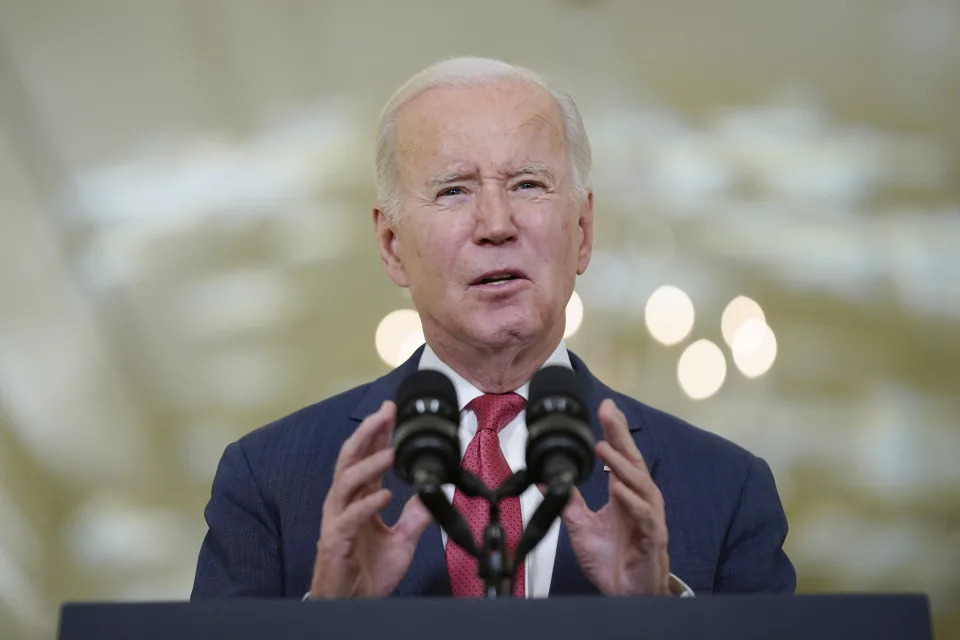
Flanked by his family, 3rd Congressional District candidate Zach Nunn, a Republican, addresses his supporters during the Iowa GOP election night celebration on Tuesday, Nov. 8, 2022, at the Hilton Des Moines Downtown.

Iowans also reelected U.S. Sen. Chuck Grassley to his eighth Senate term. He will join Republican U.S. Sen. Joni Ernst, who has another four years remaining in her term.

However, Iowa’s “red wave” was an outlier in the country where Democrats hung onto seats and cling to their control of the U.S. Senate. After two years of a Democratic trifecta, Congress will be divided in 2023, making it harder for either party to push through their priorities.

More:The Republican red wave foundered nationally, but in Iowa it swept away Democrats

In pre-election candidate surveys, recent statements and interviews with the Register, Iowa’s congressional representatives outlined their goals for the upcoming term: curbing inflation, addressing illegal immigration and promoting the year-round sale of biofuels. They also highlighted potential bipartisan efforts, including bills to lower prescription drug prices and support community colleges.

Lawmakers promise to focus on biofuels, economy, ‘reducing government interference’

Incumbent U.S. Reps. Randy Feenstra, Ashley Hinson and Mariannette Miller-Meeks each said in pre-election surveys: promoting and legalizing the year-round use of biofuels would be a top domestic priority for 2023.

Under current law, higher ethanol blends may not be sold in the summer months due to concerns about increased air pollution. President Joe Biden temporarily waived that standard in 2022 to help combat high fuel prices, but Iowa leaders called for a more permanent change.

“I am committed to proving that clean, renewable energy is attainable for every state by using Iowa as a framework to show how it can be done,” Miller-Meeks had said.

Hinson argued that focusing on biofuels will help address inflation, which appeared to be soaring before the election.

“I am championing an all-of-the-above energy strategy that prioritizes Iowa biofuels to bring down the cost of gas and restore our energy independence while boosting Iowa’s agriculture economy,” Hinson had said.

Nunn said his top domestic priority would be addressing inflation and “reducing government interference with our lives.” As he did on the campaign trail, Nunn called for the federal government to mirror Iowa, where the Republican-led Legislature championed tax cuts and a budget surplus.

“It was the number one issue that I heard when I knocked on doors,” he said. “It’s the number one issue that I still continue to get email about.”

Meanwhile, Grassley said Friday he was calling on the Biden administration to make a New Year’s resolution for “border security.”

“The Biden administration’s border policies are allowing Mexican drug cartels to rule the roost along our southern border. And that has created grievous harm to the social fabric of America,” Grassley’s statement said. “Let’s ring in the New Year with a commitment to stop the humanitarian and drug trafficking crises at our border once and for all.”

Ernst also said “our national security and defense remain top of mind” as she goes into the 2023 session.

“While we secured a number of strong priorities in this year’s defense package, I’ll continue to push legislation that ensures our military remains the most lethal fighting force on the face of the planet,” Ernst said in a statement Thursday.

More:Republicans appear poised to expand majorities in Iowa Legislature after election red wave

Iowa may be all red but ‘there’s still a lot of opportunity for good bipartisan work’

Republicans won a slim majority in the U.S. House — a power shift that included Nunn’s flipped 3rd District seat.

But with Democrats controlling the Senate and Biden still in office, Iowa’s all-red delegation will need to work across the aisle to get anything signed into law.

“I’m not naive,” Nunn said. “I think it’s gonna be challenging… but there’s still a lot of opportunity for good bipartisan work to happen.”

Nunn and Grassley had said they were interested in working with Democrats to lower the cost of prescription drugs. Grassley has pointed toward a 2019 bill he sponsored with U.S. Sen. Ron Wyden, a Democrat, to cap out-of-pocket prices for medication. That bill passed a Senate Finance Committee vote that year, when Republicans controlled the Senate. It has not advanced since.

“Our bipartisan bill would lower costs without harming life-saving cures and treatments the American people expect,” Grassley has said.

Miller-Meeks, an ophthalmologist, was also hopeful that lawmakers could find common ground on medical issues. She highlighted a bipartisan proposal to improve protocols for step therapy, a practice that requires patients to try cheaper medications before being prescribed more costly prescriptions.

Ernst said she intends to use her role on the Democrat-led Senate Small Business Committee to address childcare shortages. She also emphasized the importance of the annual farm bill, promising to “prioritize the needs of Iowa’s farmers and growers on the Senate Agriculture Committee.”

Hinson said hopes to work with Democrats on community college programs and expanding Pell Grants. Feenstra said he intends to keep pushing for a bipartisan bill to require more price transparency from major meatpacking companies.


The next stage of Russia’s secular decline comes in 2023

Los Angeles Times

Op-Ed: The next stage of Russia’s secular decline comes in 2023

Simon Johnson – January 3, 2023

People watch as Russian President Vladimir Putin delivers his speech after a ceremony to sign the treaties for four regions of Ukraine to join Russia in the Moscow's Kremlin, during a meeting in Sevastopol, Crimea, Friday, Sept. 30, 2022. The signing of the treaties making the four regions part of Russia follows the completion of the Kremlin-orchestrated "referendums." (AP Photo)
Russian President Vladimir Putin delivers a speech in September declaring the annexation of four regions of Ukraine. (Associated Press)

After a year of big surprises, led by Russia’s invasion of Ukraine, the global spike in inflation rates, and the collapse of cryptocurrency ventures, what kind of year will 2023 prove to be? This kind of short-run question is hard to answer because repercussions of global events can spread so quickly and unpredictably. But the last 12 months highlighted one major trend that will shape what happens next, in 2023 and beyond: the decline of Russia.

Russian aggression is nothing new. Moscow has been invading other countries since the mid-1990s and has occupied parts of Ukrainian territory since 2014. But the brutality of Russia’s attacks in Ukraine since last February and the most recent phase, destroying civilian energy infrastructure, is widely seen as amounting to a war crime. It is unlikely to change the course of the war, which Russia is losing.

In the bigger picture, Russia has again entered a period of secular decline, during which it will have limited access to Western investment, technology or consumer goods. Russia’s empires have collapsed before, in 1917-18 and again when the Soviet Union imploded in 1989-91. In both cases, the collapse took a while to get going, and then proved quite complete. Of course, historically Russia has also been able to reassert control over time, and during the 1990s, by getting a lot of help from Western companies.

This time, too, we should expect a long struggle for power within Russia, with serious existential risks for the world, including who ends up controlling Russian nuclear weapons. But the more direct economic impact will be reflected in the world energy market.

Demand for Russian fossil fuels is way down. Before its 2022 invasion of Ukraine, Russia produced about 10.8 million barrels of oil per day, of which around 8 million were exported either as crude or refined products. The sharp decline in Russian economic activity means that more oil is available for export, but the European Union, the United States, and their allies are now buying crude from other suppliers — and the same will be true for refined products from February 2023.

The International Energy Agency predicts that Russian oil exports will fall to around 6 million barrels per day over 2023-24. Over the medium term, India might buy 1-2 million barrels and China could sop up the rest — assuming both countries want to become more dependent on a malevolent and unreliable partner.

Purchases by India, China, and a few others can still result in a lot of free cash flow and tax revenue for Russia. Whoever leads Russia will put much of these proceeds into building and buying weapons — including missiles with which it can hit a wide range of countries from long distance. NATO member countries are, one hopes, protected to some extent by the threat of retaliation, but Russia can be expected to engage in sabotage and other deniable attacks on Western energy infrastructure and similar vulnerable strategic targets.

During the Cold War, the Soviet Union was careful not to attack Western Europe and the U.S. too directly (and vice versa). Instead, both sides used proxy wars and other forms of pressure. This time, however, we should expect much more direct confrontation. The Russian elite have boxed themselves into a corner, with a bizarre set of beliefs — right-wing nationalism on steroids — and long-range weapons. Giving ground to these extremists will only embolden them to take more.

The need to limit over time how much cash Russia can spend on aggression is why the price cap on Russian oil exports is so important. The evidence so far is that this is working as intended.

But further measures are needed, including accelerated investments in renewable energy to reduce world demand for oil. If we continue to depend on Russia and its allies in the OPEC+ cartel, the ability to disrupt our economies will remain immense. There is now a pressing national security dimension to the energy transition.

High inflation in the 1970s had multiple causes, beginning with tight economies in the 1960s and the Vietnam War. But the problems were exacerbated by two oil price shocks, in 1973 and 1979. OPEC+ members understand that they have the power to do this again, at a time of their choosing — or the next time Russia asks for a favor.

Oil demand and supply are quite unresponsive to oil prices in the short run, but historically quite responsive over five to 10 years. In 2023 and beyond, the West needs to focus more intently on reducing demand for fossil fuels, particularly oil, and increasing the supply of alternative energy sources outside the control of Russia and OPEC.

Simon Johnson, a former chief economist at the International Monetary Fund, is a professor at MIT Sloan School of Management.

Key Takeaways From Trump’s Tax Returns

The New York Times

Key Takeaways From Trump’s Tax Returns

Jim Tankersley, Susanne Craig and Russ Buettner – December 30, 2022

Former President Donald Trump speaks at a rally inside the Alaska Airlines Center in Anchorage, Alaska, July 9, 2022. Thousands of pages of Trump's tax documents were released on Friday, Dec. 30. (Ash Adams/The New York Times)
Former President Donald Trump speaks at a rally inside the Alaska Airlines Center in Anchorage, Alaska, July 9, 2022. Thousands of pages of Trump’s tax documents were released on Friday, Dec. 30. (Ash Adams/The New York Times)

Democrats on the House Ways and Means Committee have followed through with their vow to make public six years of former President Donald Trump’s tax returns, giving the American public new insight into his business dealings and drawing threats of retaliation from congressional Republicans.

The release Friday morning contained thousands of pages of tax documents, including individual returns for Trump and his wife, Melania, as well as business returns for several of the hundreds of companies that make up the real estate mogul’s sprawling business organization.

The committee had this month released top-line details from the returns, which showed that Trump paid $1.1 million in federal income taxes during the first three years of his presidency, including just $750 in federal income tax in 2017, his first year in office. He paid no tax in 2020 as his income dwindled and his business losses mounted.

The documents contain new details not revealed in those earlier releases. New York Times reporters are combing the pages for key takeaways. Here is a list.

Trump made no charitable contributions in 2020.

As a presidential candidate in 2015, Trump said he would not take “even one dollar” of the $400,000 salary that comes with the job. “I am totally giving up my salary if I become president,” he said.

In his first three years in office, Trump said he donated his salary quarterly. But in 2020, his last full year in office, the documents show that Trump reported $0 in charitable giving.

Also in 2020, as the pandemic recession swiftly descended, Trump reported heavy business losses and no federal tax liability.

In the earlier years, White House officials made a point of highlighting which government agencies were receiving the money, starting with the National Park Service in 2017. The tax documents released Friday show that Trump reported charitable donations totaling nearly $1.9 million in 2017 and just over $500,000 in both 2018 and 2019.

In a bad year for business, Trump didn’t take a full refund.

Trump reported nearly $16 million in business losses in 2020, which swamped his other income and left him with no federal income tax liability. But the tax documents show that he made nearly $14 million in tax payments to the federal government over the course of the year.

Those payments left him with the potential for a large income tax refund from the government — like the ones many taxpayers find when they go to file their taxes every March. In Trump’s case, he chose not to take the full refund available to him. He claimed a refund of just under $5.5 million, then directed the IRS to apply another $8 million to his estimated taxes for 2021.

His own tax law may have cost him.

The tax law Trump signed in late 2017, which took effect the next year, contained some provisions that most likely gave him an advantage at tax time — including the scaling back of the alternative minimum tax on high earners.

But one provision in particular drastically reduced the income tax deductions Trump could claim in 2018 and beyond: limits that Republicans placed on deductions for state and local taxes paid.

The so-called SALT deduction disproportionately hit higher earners, including Trump, in high-tax cities and states like New York. In 2019, he reported paying $8.4 million in state and local taxes. Because of the SALT limits included in his tax law, he was able to deduct only $10,000 of those taxes paid on his federal income tax return.

Those losses could have been mitigated at least in part by other sections of the law that were favorable to wealthier taxpayers like Trump.

Fred Trump is a silent actor in the returns.

Fred Trump, Trump’s long-deceased father, has continued to have an effect on his son’s finances.

In 2018, after a decade in which the former president declared no taxable income, he reported taxable income of more than $24 million and paid $1 million in federal taxes, nearly the entire total he paid as president.

That income, as previously detailed by the Times, appeared to be the result of more than $14 million in gains from the sale of an investment his father made in the 1970s, a New York City housing complex named Starrett City, which became part of Trump’s inheritance.

But the new documents show that the effect of his inheritance in 2018 was far greater: Trump reported $25.7 million in gains from the sale of business properties that he and his siblings inherited or took through trusts, including the sale of Starrett City.

The sales of business properties Trump created himself came at a loss, however, dragging down his net proceeds and somewhat reducing his tax liability, the tax itemization shows.

That included a total of $1 million in property sold at a loss by 40 Wall St., his office building in Manhattan, and DJT Holdings LLC. He recorded another $1 million loss bailing his son Donald Trump Jr. out of a failed business to build prefabricated homes.

Trump also received tens of thousands of dollars in dividends while he was in the White House from trusts that were established for him when he was young, his tax returns show.

A new tax firm got involved in 2020.

For years, Trump used the accounting firm Mazars USA to prepare his taxes and those of his businesses. Donald Bender, Trump’s longtime accountant at Mazars, had long been listed on the former president’s taxes as his accountant.

The firm formally cut ties with Trump and his businesses this year, saying it could no longer stand behind a decade of annual financial statements it prepared for the Trump Organization.

But it turns out Mazars and Trump had begun distancing themselves from each other as early as 2020. That year, BKM Sowan Horan, a Texas-based accounting firm, prepared Trump’s taxes, his returns show.

Republicans are threatening retaliation.

The release of the documents Friday set off a new round of attacks between Democrats and Republicans on Capitol Hill, including threats of escalating — and politically motivated — future releases of private tax information.

Democrats cast the move as necessary oversight on a president who broke decades of precedent in declining to release his returns.

“Trump acted as though he had something to hide, a pattern consistent with the recent conviction of his family business for criminal tax fraud,” Rep. Don Beyer, D-Va., a Ways and Means Committee member, said in a news release. “As the public will now be able to see, Trump used questionable or poorly substantiated deductions and a number of other tax avoidance schemes as justification to pay little or no federal income tax in several of the years examined.”

But Republicans — who won control of the House in November — warned Democrats that they had started down a dangerous road and that public pressure could push the incoming majority to release returns from President Joe Biden’s family or a wide range of other private individuals.

“Going forward, all future chairs of both the House Ways and Means Committee and the Senate Finance Committee will have nearly unlimited power to target and make public the tax returns of private citizens, political enemies, business and labor leaders, or even the Supreme Court justices themselves,” Rep. Kevin Brady of Texas, the top Republican on the Ways and Means Committee, said in a statement Friday.

Trump weighed in late Friday morning in an email statement that also raised the threat of retaliation.

“The Democrats should have never done it, the Supreme Court should have never approved it, and it’s going to lead to horrible things for so many people,” he said. “The great USA divide will now grow far worse. The Radical Left Democrats have weaponized everything, but remember, that is a dangerous two-way street!”

Town-by-Town Battle to Sell Americans on Renewable Energy

The New York Times

A Town-by-Town Battle to Sell Americans on Renewable Energy

David Gelles – December 30, 2022

Brendan Burton of Ospur, Ill., an ironworker and farmer, welcomes the wind farm and the jobs it would bring to the area. (Mustafa Hussain/The New York Times)

MONTICELLO, Ill. — Depressed property values. Flickering shadows. Falling ice. One by one, a real estate appraiser rattled off what he said were the deleterious effects of wind farms as a crowd in an agricultural community in central Illinois hung on his every word.

It was the 10th night of hearings by the Piatt County zoning board, as a tiny town debated the merits of a proposed industrial wind farm that would see dozens of enormous turbines rise from the nearby soybean and corn fields. There were nine more hearings scheduled.

“It’s painful,” said Kayla Gallagher, a cattle farmer who lives nearby and opposes the project. “Nobody wants to be here.”

In the fight against global warming, the federal government is pumping a record $370 billion into clean energy, President Joe Biden wants the nation’s electricity to be 100% carbon-free by 2035, and many states and utilities plan to ramp up wind and solar power.

But while policymakers may set lofty goals, the future of the American power grid is, in fact, being determined in town halls, county courthouses and community buildings across the country.

The only way Biden’s ambitious goals will be met is if rural communities, which have large tracts of land necessary for commercial wind and solar farms, can be persuaded to embrace renewable energy projects. Lots of them.

According to an analysis by the National Renewable Energy Laboratory, the United States would need to construct more than 6,000 projects like the Monticello one in order to run the economy on solar, wind, nuclear or other forms of nonpolluting energy.

In Piatt County, population 16,000, the project at issue is Goose Creek Wind, which has been proposed by Apex Clean Energy, a developer of wind and solar farms based in Virginia. Apex spent years negotiating leases with 151 local landowners and trying to win over the community, donating to the 4-H Club and a mental health center.

Now, it was making its case to the zoning board, which will send a recommendation to the county board that will make a final call on whether Apex can proceed. If completed, the turbines, each of them 610 feet tall, would march across 34,000 acres of farmland.

The $500 million project is expected to generate 300 megawatts, enough to power about 100,000 homes. The renewable, carbon-free electricity would help power a grid that is fed by a mix of nuclear, natural gas, coal and some existing wind turbines.

But with more and more renewable-energy projects under construction around the country, resistance is growing, especially in rural communities in the Great Plains and Midwest.

“To meet any kind of clean energy goals which brings consumer benefits and energy independence, you’re going to see an increase in projects,” said JC Sandberg, interim CEO of the American Clean Power Association. “And with those increases in projects, we are facing more of these challenges.”

On Election Day last month, Apex saw its development efforts for a wind farm in Ohio die when voters in Crawford County overwhelmingly voted to uphold a ban on such projects. On the same day, voters in Michigan rejected ordinances that would have allowed construction of another Apex wind project. This month, local officials in Monroe County, Michigan, extended a temporary moratorium on industrial solar projects, delaying plans by Apex to develop a solar farm in the area.

“Projects have been getting more contentious,” said Sarah Banas Mills, a lecturer at the school for environment and sustainability at the University of Michigan who has studied renewable development in the Midwest. “The low-hanging-fruit places have been taken.”

In Piatt County, the zoning board decided to conduct a mock trial of sorts. During the first nine hearings, Apex and its witnesses made the case that property values would not decline and that other concerns about wind farms — that they are ugly, that they kill birds or that the low frequency noise they emit can adversely affect human health — were not major issues.

They won some converts. Meg Miner, 61, a resident who was on the fence about the project, decided to support Apex after considering how the project would help fight climate change.

But others were worried about all the issues that the real estate appraiser mentioned, and more. “I moved here for nature, for trees, for crops,” said Sandy Coyle, who lives nearby and opposed the project. “I’m not interested in living near an industrial wind farm.”

Much of that skepticism appeared to be earnest concern from community members who weren’t sold on the project’s overall merits. On the fringe of the debate, however, was a digital misinformation campaign designed to distort the facts about wind energy.

The website of a group called Save Piatt County!, which opposes the project, is rife with fallacies about renewable energy and inaccuracies about climate science. On Facebook pages, residents opposed to the project shared negative stories about wind power, following a playbook that has been honed in recent years by anti-wind activists, some of whom have ties to the fossil fuel industry. The organizers of the website and Facebook groups did not reply to requests for comment.

As part of the Goose Creek Wind project, Apex has secured a commitment from Rivian, an upstart electric truck company, to buy power from the project, a development that drew skeptical replies in one Facebook group. “Scam artists in it together to fleece middle class taxpayers,” wrote one local resident in response to a news story about the deal. “Wake up.”

That milieu of misinformation appeared to sway some residents.

“These things are intrusive,” said Kelly Vetter, a retiree who opposed the project and disputed the overwhelming scientific consensus that carbon dioxide emitted from the burning of fossil fuels is dangerously warming the planet. “The company’s never going to have the community’s interest at heart.”

Apex declined to comment.

‘We All Want What’s Good for Society’

Smack in the middle of the area where Apex wants to erect its turbines sits the Bragg family’s farm, a roughly 1,500-acre plot that on a cold December afternoon was little more than an expanse of mud after the fall harvest and a week of rain.

Braxton Bragg, 40, who grew up on the land and returned after stints in the Peace Corps that took him to Mali and Mongolia, supports the project. He is concerned about climate change and said he already sees its effects. The rain is harder when it comes, the cold sets in later than it used to and, overall, the growing season is less predictable than it was when his grandfather worked the same land.

But his support for wind comes down to economics. Bragg has agreed to let Apex site one of its turbines on his property, and he expects to earn about $50,000 a year if it is built.

“It’s not going to save the farm or allow me to retire,” he said. “But just having that steady income every year, you know what you’re going to get.”

A few miles down the road is Gallagher Farms, another multigenerational operation. Like Bragg, Gallagher, 34, believes in climate change. She has invested in cover crops, which absorb carbon and lock it away in the soil, and other regenerative agriculture practices.

But Gallagher is opposed to the project. The aerial seeding of cover crops will cost more with wind turbines nearby and make it harder for her to sustainably farm. The use of heavy equipment to install turbines can disrupt drainage patterns in agricultural land, and Gallagher believes her farm will suffer.

Adding to her frustration is the fact that about 70% of the landowners who have agreed to let Apex put turbines on their property live outside Piatt County.

“They don’t live here, so they’re not impacted,” Gallagher said as she tended to her cattle before heading to yet another hearing.

More than anything else, Gallagher fears that the wind turbines, which she would see from her front porch, would disrupt the bucolic land she loves. In the predawn hours, she walks outside and listens to the crickets, which she worries will be drowned out by the low thrum of the turbines. At night, she watches the sun set over a grain silo in the west and doesn’t want the view marred by spinning turbines and flashing lights.

“We all want what’s good for society,” she said. “But it seems to be coming at the expense of our day-to-day lives.”

Bragg was sympathetic. “The only real argument that is valid, in my opinion, is that it’s going to change people’s sunsets and the beauty of living out in the country,” he said.

Still, he said, this was working farmland, and it was his right to put it to productive use.

“If you put your nice country house in the middle of my business, I’m sorry, there’s not much I can do about that,” Bragg said. “I think they probably would do the same thing if they were in my boat. The economics takes precedence over everything.”

Landowners such as the Braggs would receive about $210 million in lease payments over the project’s 30-year life, Apex said. And there would be other economic benefits, including $90 million in local taxes. And if the project is built, the company said it would create eight permanent jobs and employ nearly 600 people during construction, including men such as Brendan Burton.

Burton, an ironworker who has helped build several nearby wind farms, said the jobs would help fill the void created by factories that have closed or moved overseas.

“We’re not building things here like we used to,” he said. “We need the jobs.”

Burton added that he wanted to see his community contribute clean energy to the grid as well.

“We can’t keep burning coal or natural gas,” he said.

‘We’re Going to Make People Angry’

The debate in Piatt County has been remarkably civil. Similar hearings elsewhere have descended into shouting matches. In some cases, activists with ties to organizations that shield their donors have turned communities against proposed wind and solar projects.

That was the case in Michigan’s Monroe County, where local officials recently extended a moratorium that is blocking Apex from developing a solar project.

The opposition in Monroe County includes local residents, but also anti-wind activists with ties to groups backed by Koch Industries, which owns oil refineries, petrochemical plants, and thousands of miles of oil and gas pipelines. On Facebook, those skeptical of the Apex project shared negative stories about solar power, and opponents of the project went door to door distributing misinformation.

On another cold night in December, as the 11th hearing on the Goose Creek Wind project began at the Monticello community building, Phil Luetkehans, a lawyer hired by opponents of the project, called more witnesses, including an audiologist, who discussed what he said were the adverse health effects of wind turbines. A lawyer representing Apex cross-examined him, and the hearing stretched for more than four hours.

“Both sides are getting a full opportunity to portray their position and to put forth the facts, and the people who we elect will make those final decisions,” Luetkehans said. “Some communities end up saying, ‘No, we don’t want an industrial scale wind at this proximity to homes.’ Others say, ‘Yeah, we want the money.’”

Among those in the audience was Michael Beem, a newly elected member of the Piatt County board, which will ultimately decide whether Apex can build its wind farm. From the back of the room, Beem was bracing himself to make a choice that will undoubtedly leave this rural community divided.

“No matter what decision we make,” he said, “we’re going to make people angry.”

EPA finalizes water rule that repeals Trump-era changes

Associated Press

EPA finalizes water rule that repeals Trump-era changes

Jim Salter and Michael Phillis – December 30, 2022

FILE - A great egret flies above a great blue heron in a wetland inside the Detroit River International Wildlife Refuge in Trenton, Mich., on Oct. 7, 2022. President Joe Biden’s administration on Friday, Dec. 30, announced a finalized rule for federal protection of hundreds of thousands of small streams, wetlands and other waterways, rolling back a Trump-era rule that environmentalists said left waterways vulnerable to pollution. (AP Photo/Carlos Osorio, File)
A great egret flies above a great blue heron in a wetland inside the Detroit River International Wildlife Refuge in Trenton, Mich., on Oct. 7, 2022. President Joe Biden’s administration on Friday, Dec. 30, announced a finalized rule for federal protection of hundreds of thousands of small streams, wetlands and other waterways, rolling back a Trump-era rule that environmentalists said left waterways vulnerable to pollution. (AP Photo/Carlos Osorio, File)
FILE - President Joe Biden speaks in the East Room of the White House ahead of the holidays on Dec. 22, 2022, in Washington. Biden’s administration on Friday, Dec. 30, announced a finalized rule for federal protection of hundreds of thousands of small streams, wetlands and other waterways, rolling back a Trump-era rule that environmentalists said left waterways vulnerable to pollution. (AP Photo/Patrick Semansky, File)
 President Joe Biden speaks in the East Room of the White House ahead of the holidays on Dec. 22, 2022, in Washington. Biden’s administration on Friday, Dec. 30, announced a finalized rule for federal protection of hundreds of thousands of small streams, wetlands and other waterways, rolling back a Trump-era rule that environmentalists said left waterways vulnerable to pollution. (AP Photo/Patrick Semansky, File)

ST. LOUIS (AP) — President Joe Biden’s administration on Friday finalized regulations that protect hundreds of thousands of small streams, wetlands and other waterways, repealing a Trump-era rule that federal courts had thrown out and that environmentalists said left waterways vulnerable to pollution.

The rule defines which “waters of the United States” are protected by the Clean Water Act. For decades, the term has been a flashpoint between environmental groups that want to broaden limits on pollution entering the nation’s waters and farmers, builders and industry groups that say extending regulations too far is onerous for business.

The Environmental Protection Agency and the Department of the Army said the reworked rule is based on definitions that were in place prior to 2015. Federal officials said they wrote a “durable definition” of waterways to reduce uncertainty.

In recent years, however, there has been a lot of uncertainty. After the Obama administration sought to expand federal protections, the Trump administration rolled them back as part of its unwinding of hundreds of environmental and public health regulations. A federal judge rejected that effort. And a separate case is currently being considered by the Supreme Court that could yet upend the finalized rule.https://s.yimg.com/rq/darla/4-10-1/html/r-sf-flx.html

“We have put forward a rule that’s clear, it’s durable, and it balances that protecting of our water resources with the needs of all water users, whether it’s farmers, ranchers, industry, watershed organizations,” EPA Assistant Administrator for Water Radhika Fox told The Associated Press.

The new rule is built on a pre-2015 definition, but is more streamlined and includes updates to reflect court opinions, scientific understanding and decades of experience, Fox said. The final rule will modestly increase protections for some streams, wetlands, lakes and ponds, she said.

The Trump-era rule, finalized in 2020, was long sought by builders, oil and gas developers, farmers and others who complained about federal overreach that they said stretched into gullies, creeks and ravines on farmland and other private property.

Environmental groups and public health advocates countered that the Trump rule allowed businesses to dump pollutants into unprotected waterways and fill in some wetlands, threatening public water supplies downstream and harming wildlife and habitat.

“Today, the Biden administration restored needed clean water protections so that our nation’s waters are guarded against pollution for fishing, swimming, and as sources of drinking water,” Kelly Moser, senior attorney for the Southern Environmental Law Center’s Clean Water Defense Initiative, said in a statement.

Jon Devine, director of federal water policy for the Natural Resources Defense Council, called repealing the Trump-era rule a “smart move” that “comes at a time when we’re seeing unprecedented attacks on federal clean water protections by polluters and their allies.”

But Republican Sen. Shelley Moore Capito called the rule “regulatory overreach” that will “unfairly burden America’s farmers, ranchers, miners, infrastructure builders, and landowners.”

Jerry Konter, chairman of the National Association of Home Builders, struck a similar note, saying the new rule makes it unclear if the federal government will regulate water in places such as roadside ditches and isolated ponds.

A 2021 review by the Biden administration found that the Trump rule allowed more than 300 projects to proceed without the federal permits required under the Obama-era rule, and that the Trump rule significantly curtailed clean water protections in states such as New Mexico and Arizona.

In August 2021, a federal judge threw out the Trump-era rule and put back in place a 1986 standard that was broader in scope than the Trump rule but narrower than Obama’s. U.S. District Court Judge Rosemary Marquez in Arizona, an Obama appointee, said the Trump-era EPA had ignored its own findings that small waterways can affect the well-being of the larger waterways they flow into.

Meanwhile, Supreme Court justices are considering arguments from an Idaho couple in their business-backed push to curtail the Clean Water Act. Chantell and Michael Sackett wanted to build a home near a lake, but the EPA stopped their work in 2007, finding wetlands on their property were federally regulated. The agency said the Sacketts needed a permit.

The case was heard in October and tests part of the rule the Biden administration carried over into its finalized version. Now-retired Justice Anthony Kennedy wrote in 2006 that if wetlands “significantly affect the chemical, physical, and biological integrity” of nearby navigable waters like rivers, the Clean Water Act’s protections apply. The EPA’s rule includes this test. Four conservative justices in the 2006 case, however, said that federal regulation only applied if there was a continuous surface connection between wetlands and an obviously regulated body of water like a river.

Charles Yates, attorney for the libertarian group Pacific Legal Foundation, said the new rule shows the importance of the Supreme Court case since the definition for WOTUS “shifts with each new presidential administration.”

“Absent definitive guidance from the Supreme Court, a lawful, workable, and durable definition of ‘navigable waters’ will remain elusive,” Yates said in a statement.

The Biden rule applies federal protections to wetlands, tributaries and other waters that have a significant connection to navigable waters or if wetlands are “relatively permanent.” The rule sets no specific distance for when adjacent wetlands are protected, stating that several factors can determine if the wetland and the waterway can impact water quality and quantity on each other. It states that the impact “depends on regional variations in climate, landscape, and geomorphology.”

For example, the rule notes that in the West, which typically gets less rain and has higher rates of evaporation, wetlands may need to be close to a waterway to be considered adjacent. In places where the waterway is wide and the topography flat, “wetlands are likely to be determined to be reasonably close where they are a few hundred feet from the tributary …,” the rule states.

Fox said the rule wasn’t written to stop development or prevent farming.

“It is about making sure we have development happening, that we’re growing food and fuel for our country but doing it in a way that also protects our nation’s water,” she said.

The Associated Press receives support from the Walton Family Foundation for coverage of water and environmental policy. The AP is solely responsible for all content. For all of AP’s environmental coverage, visit https://apnews.com/hub/climate-and-environment

Home Depot’s 93-year-old cofounder who said ‘nobody works’ anymore because of ‘socialism’, has donated $64 million to elect Trump and the Republican party over the years

Insider

Home Depot’s 93-year-old cofounder who said ‘nobody works’ anymore because of ‘socialism’ has donated $64 million to elect Trump and the Republican party over the years

Kelsey Vlamis,Madison Hall – December 29, 2022

bernie marcus home depot
Richard Drew / AP Images
  • Bernie Marcus, the billionaire cofounder of Home Depot, said Thursday “nobody works” anymore.
  • Marcus said he believed if he founded Home Depot today it wouldn’t be as successful.
  • Marcus donated millions to Trump in 2016 and 2020, and more to other Republicans over the years.

A billionaire cofounder of Home Depot who said “nobody works” has donated nearly $64 million to political causes over the years, including the campaigns of former President Donald Trump, Florida Gov. Ron DeSantis, and Sen. John McCain, according to data from the Federal Election Commission.

In an interview with the Financial Times published Thursday, 93-year-old Bernie Marcus said “nobody works, nobody gives a damn,” blaming the change on “socialism.”

“‘Just give it to me. Send me money. I don’t want to work — I’m too lazy, I’m too fat, I’m too stupid,'” he said, adding that he thinks if he founded Home Depot today it may not have been as successful.

Home Depot today is worth $321 billion and has around 2,300 stores in North America. As for the current US unemployment rate, it’s at 3.7%, the lowest in decades, despite the hiring challenges some businesses are still experiencing.

Marcus, who cofounded Home Depot in 1978, has become a mega-donor to the GOP over the years, supporting Trump’s presidential campaigns in both 2016 and 2020. His public support for Trump sparked calls to boycott Home Depot, prompting the company to distance from him.

In a statement provided to Insider, a spokesperson for Home Depot said: “Our co-founder Bernie Marcus left The Home Depot more than 20 years ago, and his views do not represent the company.”

But going back to at least 1978, Marcus has donated a total of  $63,801,322 to political campaigns and PACs, FEC data obtained by Insider showed.

Many of the donations went to directly supporting Republican candidates, including the presidential campaigns of Trump, McCain, Sen. Marco Rubio, Jeb Bush, and Sen. Mitt Romney, among others.

Some of Marcus’s largest individual donations have gone to conservative super PACS that directly supported Trump.

In 2020, he made two separate donations of $5 million each to the Preserve America PAC, a single-candidate PAC that supports Trump.

In 2016, Marcus made two donations, one for $3 million and one for $2 million, to Rebuilding America Now, a super PAC established to support Trump’s first campaign. He also gave another $2 million to Making America Number 1, a pro-Trump PAC.

Between 2015 and 2022, Marcus donated more than $15 million to the Senate Leadership Fund, a PAC dedicated to helping Republicans gain a majority in the Senate, and more than $5 million to the Congressional Leadership Fund.

Marcus has also donated extensively to House and Senate races, contributing to a long list of Republican lawmakers that includes Sens. Tom Cotton, Mike Lee, Chuck Grassley, Mitch McConnell, and Tim Scott, as well as Reps. Kevin McCarthy and Liz Cheney.

Marcus in 2022 also donated to Herschel Walker, the failed Senate candidate from Georgia, and Sen. Joe Manchin, the West Virginia Democrat who has been accused of impeding his own party’s agenda.

Marcus and his wife, Billi, have also pledged to give away most of their estimated $8.9 billion fortune. In 2010, they signed The Giving Pledge, a commitment to donate most of their wealth to charitable causes.

These lies about climate change just wouldn’t die in 2022

USA Today

These lies about climate change just wouldn’t die in 2022

Elizabeth Weise, USA TODAY – December 29, 2022

There was a time – a recent time – when concern about the environment was relatively bipartisan, not a cultural flashpoint.

A Republican, President Richard Nixon, established the Environmental Protection Agency in 1970. In the 1980s and 1990s, bipartisan majorities voted to strengthen the Clean Air Act and the Clean Water Act, led by a Republican – Rhode Island’s Sen. John Chafee.

Those days are gone, and today a wide range of misleading statements and outright lies about the reality of human-caused climate change circulate widely.

The sheer volume of misinformation can distort perceptions of how many people don’t believe the science that shows the Earth’s climate is changing because of human activity, said Katharine Hayhoe, an atmospheric scientist and professor at Texas Tech University.

“I call them ‘zombie arguments’ because you can explain that they’re not true but they still go stumbling around because they’re not about facts but excuses,” she said.

In truth, a small number of people actually believe these lies, she said. Surveys by the Yale Program on Climate Change Communication in Connecticut have found 8% to 9% of Americans are totally dismissive of climate change, believing it is either not happening, not human-caused or not a threat. Many of these people also endorse conspiracy theories about global warming.

“They’re just 8% of the population. A loud 8%, and very present online, but only 8%. So I would rather answer from the perspective of everybody else,” said Hayhoe, who is also an evangelical Christian whose most recent book is “Saving Us: A Climate Scientist’s Case for Hope and Healing in a Divided World.”

Here are some of the most common climate myths and lies experts say have been circulating this year:

Wrong: Summer heat waves show renewables can’t work

Power grids in TexasCalifornia and the Pacific Northwest all faced extreme heat events this summer. Each power system was pushed to the brink by the draw on electricity for air conditioning. And yet none broke.

Nonetheless, a false narrative circulated saying that solar and wind energy had made those power grids – and especially California’s – fragile and unable to cope with high demands.

In fact, the opposite is the case. While renewable energy does present challenges, especially during heat waves, this year proved that careful planning and green innovations can successfully meet those challenges.

In California, battery storage and conservation allowed the state to avoid power outages during a 10-day September heatwave. In the Northwest, battery storage and voluntary programs that rewarded customers for reducing demand kept the system running.

More: ‘A ‘Wow’ moment’: US renewable energy hit record 28% in April.

In Texas in July, a heat wave caused the Electric Reliability Council of Texas to take emergency measures, including urging residents to restrict their use and paying power operators as much as $5,000 per megawatt hour to keep generators running. ERCOT said two factors affected its ability to meet soaring demand: low wind power generation and outages at coal- and natural gas-fed power plants.

Blaming renewable energy as the cause of power crunches is unfair, said David Doniger, senior strategic director in the Natural Resources Defense Council’s climate and clean energy program.

“Their answer is always ‘Stick with fossil fuel because renewables and efficiency can’t fill the need.’ This is the lie; those are the problem and not the solutions,” he said.

“Some of the biggest lies these days are focused on slowing the transition from fossil energy to cleaner alternatives by saying problems or shortcomings for renewables make it impossible.”

Energy experts say the percentage of U.S. power that comes from renewables can go much higher than today’s relatively low numbers without causing severe stress on electrical systems. In April, records were set when 28% of U.S. electricity came from renewable resources.

They do acknowledge that decarbonizing the final 10% of the electric grid will be tricky but say that’s not a reason to avoid decarbonizing the first 90%.

Grace Suzanna Mashensic, 16, of Columbus, Ohio, cheers for Jane Fonda as she speaks during "Fire drill Fridays," a climate change rally, Friday, Dec. 2, 2022, in Washington.
Grace Suzanna Mashensic, 16, of Columbus, Ohio, cheers for Jane Fonda as she speaks during “Fire drill Fridays,” a climate change rally, Friday, Dec. 2, 2022, in Washington.
Wrong: Using ESG criteria is ‘woke’ capitalism

Making investment decisions with environmental, social and governance factors in mind has been around for decades.

But recently it has been decried as “woke capitalism,” and a concerted effort has been waged to stop companies from taking all three, known as ESG, into consideration when they make investments. That’s especially true when it comes to taking environmental risk management.

More: GOP vs. ESG: Why Republicans are fighting ‘woke’ ESG investing

In the past year, 18 states have either proposed or adopted rules limiting the ability of the state government and public retirement plans to do business with entities found to “discriminate” against certain industries based on environmental, social and governance criteria, according to JD Supra, a legal news source. For example, Arizona’s State Board of Investment said in August that ESG considerations could not be considered in the investment management of its assets.

“It’s a sinister lie that’s deeply counterproductive, not just to the climate but also to people’s pocketbooks and pensions,” said Alicia Seiger, who teaches sustainability and energy finance at Stanford University’s law and graduate schools of business in California.

Telling companies they can’t consider all available information to make solid long-term investments “is insanity,” she said. “That should be determined by the investor, not the political system.”

Wrong: Believing in climate change is only for the far left

Experts have noted an effort by some to lump in climate change with other liberal and progressive causes, such as racial justice. The implication is that those who believe global warming is an issue to be dealt with must also support a host of other objectives that are considered “far left.”

This also comes amid a movement to pressure businesses to view climate change as a hot-button political issue.

“Conspiracy theorists connect climate change to other lightning-rod issues to generate emotional, irrational responses that drive online engagement,” said David Di Martino, co-founder of triplecheck, a nonprofit that works to combat the spread of misinformation, including climate misinformation.

But that position ignores the many conservatives who are concerned about global warming and are working to fight it. They include the American Conservation CoalitionConservatives for Clean Energy, Citizens for Responsible Energy Solutions and Congress’ Conservative Climate Caucus.

Wrong: There’s no hope for fixing climate change, so why try?

An increasingly frequent message centers around “doomerism,” the lie that it’s totally impossible to reduce greenhouse gas emissions to near-zero without devastating the economy and significantly reducing our standard of living, so there’s no point in even trying.

This is wrong because the technology to decarbonize much of the electrical grid already exists. Meanwhile, wind and solar, along with battery storage, are increasingly cheaper than coal and natural gas. Decarbonizing more hard-to-reach areas, such as steel and cement production and aviation fuel, will take longer but are in the works.

An Oxford University study released in September found a fast transition to decarbonized energy systems is cheaper than a slow one or not transitioning at all. Achieving zero-carbon energy systems is “possible and profitable” and will save the world at least $12 trillion compared with continuing current levels of fossil fuel use, it found.

A long-term lie has been that climate change isn’t real, but as shifting climate patterns have made that argument harder to make, it has moved to one that says there are either no good alternatives to fossil fuels or the alternatives themselves cause problems and are too expensive.

“In other words, we are stuck with fossil fuels and there are no good alternatives, so burn baby burn,” said Jason Smerdon, a professor of climate physics at Columbia University in New York.

These arguments are mostly in aid of fossil fuel producers who want to keep making money as long as they can.

“Climate disinformation has always been about delaying any action on global warming,” Smerdon said. “They simply perpetuate the false assumption that we have no choice but the same old reliance on fossil fuels.”

More: We have the tools we need to fix climate change

If fact, the business community is jumping in with both feet because they see solid opportunities, said Julio Friedmann, chief scientist at Carbon Direct, a carbon management firm and former professor at Columbia University.

“We have the technology we need and we have a lot of the market-aligning policies we need,” he said.

It’s no longer a question of “Is this even possible?” but instead “How quickly can we do it?”

“It’s a fundamentally different mindset,” Friedmann said. “That’s why I’m bullish on our ability to round these corners and get the job done.”

Trump’s tax returns released after long fight with Congress

Associated Press

Trump’s tax returns released after long fight with Congress

Michael R. Sisak and Jill Colvin – December 29, 2022

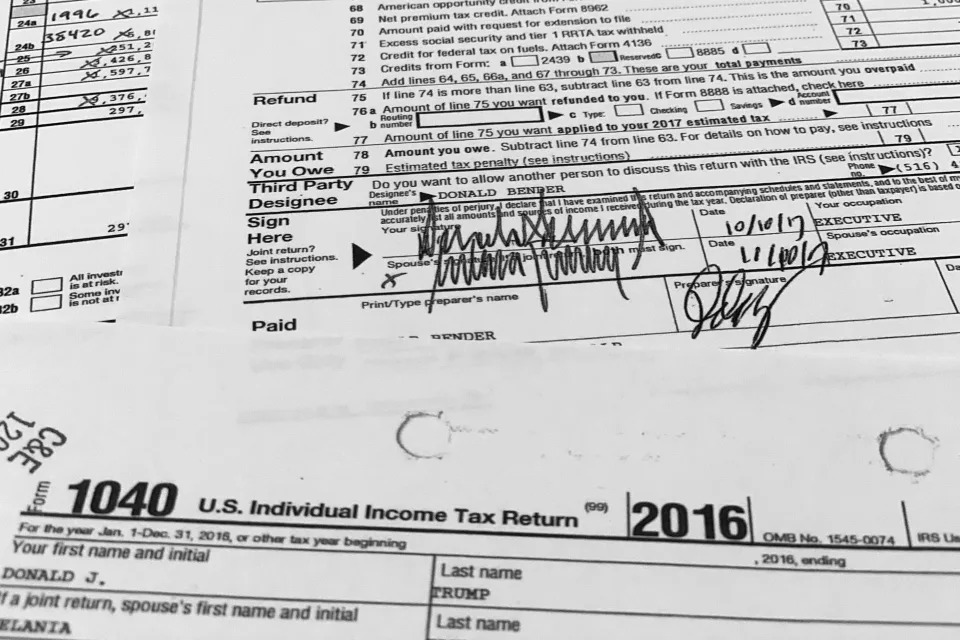
Signatures of former President Donald Trump and former first lady Melania Trump appear on their individual tax returns for 2016, released by the Democratic controlled House Ways and Means Committee, are photographed Friday, Dec. 30, 2022. The returns, which include redactions of some personal sensitive information such as Social Security and bank account numbers, span nearly 6,000 pages, including more than 2,700 pages of individual returns, and more than 3,000 pages in returns for Trump's business entities. (AP Photo/Jon Elswick)
Signatures of former President Donald Trump and former first lady Melania Trump appear on their individual tax returns for 2016, released by the Democratic controlled House Ways and Means Committee, are photographed Friday, Dec. 30, 2022. The returns, which include redactions of some personal sensitive information such as Social Security and bank account numbers, span nearly 6,000 pages, including more than 2,700 pages of individual returns, and more than 3,000 pages in returns for Trump’s business entities. (AP Photo/Jon Elswick)
ASSOCIATED PRESS

Democrats in Congress released thousands of pages of former President Donald Trump’s tax returns Friday, providing the most detailed picture to date of his finances over a six-year period, including his time in the White House, when he fought to keep the information private in a break with decades of precedent.

The documents include individual returns from Trump and his wife, Melania, along with Trump’s business entities from 2015-2020. They show how Trump used the tax code to lower his tax obligation and reveal details about foreign accounts, charitable contributions and the performance of some of his highest-profile business ventures, which had largely remained shielded from public scrutiny.

The disclosure marks the culmination of a yearslong legal fight that has played out everywhere from the presidential campaign to Congress and the Supreme Court as Trump persistently rejected efforts to share details about his financial history — counter to the practice of transparency followed by all his predecessors in the post-Watergate era. The records release comes just days before Republicans retake control of the House and weeks after Trump began another campaign for the White House.

The records show how Trump limited his tax liability by offsetting his income against corporate losses as well as millions of dollars in businesses expenses, asset depreciation and other deductions.

While Trump paid $641,931 in federal income taxes in 2015, the year he began his campaign for president, he paid just $750 in 2016 and 2017, according to a report released last week by Congress’ nonpartisan Joint Committee on Taxation. He paid nearly $1 million in 2018, but only $133,445 in 2019 and nothing in 2020, the year he unsuccessfully sought reelection.

The records also detail Trump’s foreign holdings.

Trump, according to the filings, reported having bank accounts in China, Ireland and the United Kingdom in 2015 through 2017, even as he was commander in chief. Starting in 2018, however, he only reported an account in the U.K. The returns also show that Trump claimed foreign tax credits for taxes he paid on various business ventures around the world, including licensing arrangements for use of his name on development projects and his golf courses in Scotland and Ireland. In 2018, according to Joint Committee on Taxation figures, Trump paid more in foreign taxes than he did net federal income.

The documents show that Trump’s charitable donations fluctuated during his presidency but, in his final years, represented only a sliver of his income. In 2020, the year the coronavirus ravaged the economy, Trump reported no charitable donations at all. In 2019 and 2018 he reported writing checks for about $500,000 in donations. In earlier years the numbers were higher — $1.8 million in 2017 and $1.1 million in 2016.

It’s unclear whether the reported sums included Trump’s $400,000 annual presidential salary, which he had said he would forgo and claimed he donated to various federal departments.

The release marks the latest setback for Trump, who has been mired in investigations, including federal and state inquiries into his efforts to overturn the 2020 election. The Department of Justice also has been investigating reams of classified documents found at his Mar-a-Lago club and possible efforts to obstruct the investigation.

In a statement Friday, Trump lashed out at Democrats and the Supreme Court for the release.

“It’s going to lead to horrible things for so many people,” he said. “The radical, left Democrats have weaponized everything, but remember, that is a dangerous two-way street!”

He said the returns demonstrated “how proudly successful I have been and how I have been able to use depreciation and various other tax deductions” to build his businesses.

Presiding over a routine pro forma session of the House on Friday, Rep. Don Beyer, chairman of the Joint Economic Committee, said great care had been taken to ensure the returns were treated with sensitivity, with personal and other identifying information redacted.

“We’ve been trying to be very careful to make sure that we weren’t ‘weaponizing’ the IRS returns,” said Beyer, D-Va. He also is a member of the tax-writing House Ways and Means Committee, which held a party line vote last week to make the returns public.

The returns detail how Trump used tax law to minimize his liability, including carrying forward massive losses from previous years, as allowed by tax law. Trump said during his 2016 campaign that paying little or no income tax in some years “makes me smart.”

His tax returns show he did that by structuring his company as a massive sole proprietorship, with nearly every dollar, pound, euro and yuan passing through his golf courses, hotels and other assets affecting — and in many cases helping — his own bottom line.

For instance, in 2020, more than 150 of Trump’s business entities listed negative qualified business income, which the IRS defines as “the net amount of qualified items of income, gain, deduction and loss from any qualified trade or business.” In total for that tax year, combined with nearly $9 million in carryforward loss from previous years, Trump’s qualified losses amounted to more than $58 million for the final year of his term in office.

Another of Trump’s money losers: the ice rink his company operated until last year in New York City’s Central Park. Trump reported a total of $2.6 million in losses from Wollman Rink over the six years made public. The rink, an early Trump Organization jewel run through a contract with New York City’s government, reported a loss of $1.3 million in 2015 despite taking in $9.3 million in revenue, according to the tax returns. The rink turned a $298,000 profit in 2016, but was back to melting cash in each of the next four years.

Aspects of Trump’s finances had been shrouded in mystery since his days as an up-and-coming Manhattan real estate developer in the 1980s.

Trump, known for building skyscrapers and hosting a reality TV show before winning the White House, did provide limited details about his holdings and income on mandatory disclosure forms and financial statements he provides to banks to secure loans and to financial magazines to justify his place on rankings of the world’s billionaires.

Trump’s longtime accounting firm has since disavowed the statements, and New York Attorney General Letitia James has filed a lawsuit alleging Trump and his Trump Organization fraudulently inflated asset values on the statements. Trump and his company have denied wrongdoing.

In October 2018, The New York Times published a Pulitzer Prize-winning series based on leaked tax records that contradicted the image Trump had tried to sell of himself as a self-made businessman. It showed that Trump received a modern-day equivalent of at least $413 million from his father’s real estate holdings, with much of that money coming from what the Times called “tax dodges” in the 1990s.

A second series in 2020 showed that Trump paid no income taxes at all in 10 of the previous 15 years because he generally lost more money than he made.

In its report last week, the Ways and Means Committee indicated the Trump administration may have disregarded a requirement mandating audits of a president’s tax filings.

The IRS only began to audit Trump’s 2016 tax filings on April 3, 2019 — more than two years into his presidency — when the Ways and Means chairman, Rep. Richard Neal, D-Mass., asked the agency for information related to the tax returns.

Every president and major-party candidate since Richard Nixon has voluntarily made at least summaries of their tax information available to the public. Trump bucked that trend as a candidate and as president, repeatedly asserting that his taxes were “under audit” and couldn’t be released.

Associated Press writers Paul Wiseman and Farnoush Amiri in Washington, Meg Kinnard in Columbia, South Carolina, and Nicholas Riccardi in Denver contributed to this report.

Think those bags are recyclable? California says think again

Associated Press

Think those bags are recyclable? California says think again

Don Thompson – December 29, 2022

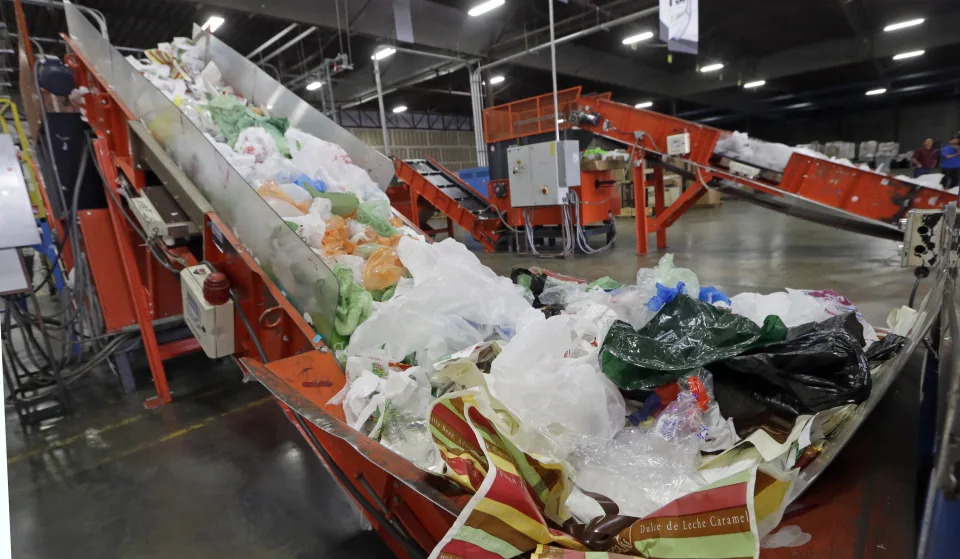
FILE-This Friday, Jan. 24, 2014 file photo conveyors carry mixed plastic into a device that will shred recycle them at a plastics recycling plant in Vernon, Calif. California in 2014 enacted the nation's first ban on single-use plastic shopping bags. But in 2022, state Attorney General Rob Bonta says consumers who think they're helping the environment with reusable plastic bags had better think again. He says manufacturers can't back up their claim that the thicker, more durable bags are recyclable in California. (AP Photo/Reed Saxon, File)
FILE-This Friday, Jan. 24, 2014 file photo conveyors carry mixed plastic into a device that will shred recycle them at a plastics recycling plant in Vernon, Calif. California in 2014 enacted the nation’s first ban on single-use plastic shopping bags. But in 2022, state Attorney General Rob Bonta says consumers who think they’re helping the environment with reusable plastic bags had better think again. He says manufacturers can’t back up their claim that the thicker, more durable bags are recyclable in California. (AP Photo/Reed Saxon, File)
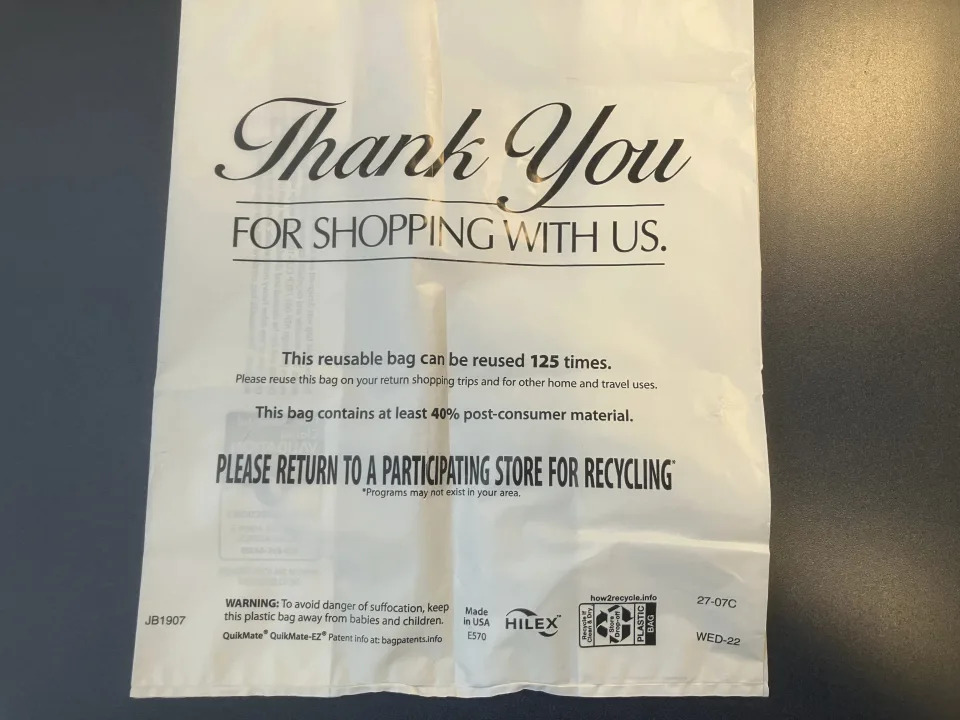
This undated photo shows a plastic bag, in Los Angeles. California in 2014 enacted the nation's first ban on single-use plastic shopping bags. But state Attorney General Rob Bonta says the thicker, reusable plastic bags that many retailers now use may not be recyclable as required by law. (AP Photo/John Antczak)
This undated photo shows a plastic bag, in Los Angeles. California in 2014 enacted the nation’s first ban on single-use plastic shopping bags. But state Attorney General Rob Bonta says the thicker, reusable plastic bags that many retailers now use may not be recyclable as required by law. (AP Photo/John Antczak)
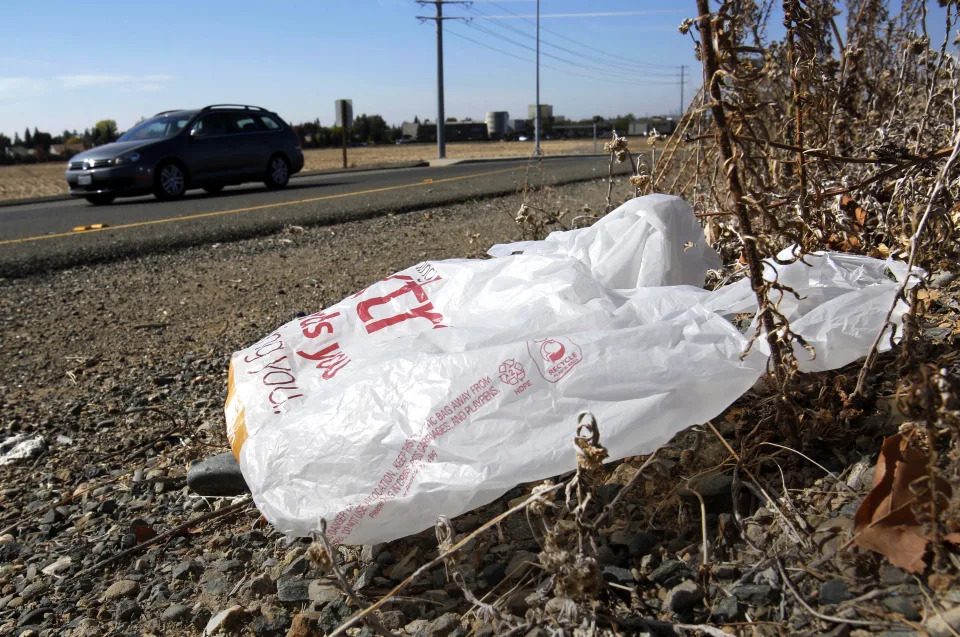
FILE - In this Oct. 25, 2013, file photo, a plastic bag sits along a roadside in Sacramento, Calif. California in 2014 enacted the nation's first ban on single-use plastic shopping bags. But in 2022, state Attorney General Rob Bonta says consumers who think they're helping the environment with reusable plastic bags had better think again. He says manufacturers can't back up their claim that the thicker, more durable bags are recyclable in California. (AP Photo/Rich Pedroncelli, File)
In this Oct. 25, 2013, file photo, a plastic bag sits along a roadside in Sacramento, Calif. California in 2014 enacted the nation’s first ban on single-use plastic shopping bags. But in 2022, state Attorney General Rob Bonta says consumers who think they’re helping the environment with reusable plastic bags had better think again. He says manufacturers can’t back up their claim that the thicker, more durable bags are recyclable in California. (AP Photo/Rich Pedroncelli, File)

SACRAMENTO, Calif. (AP) — Since California adopted the nation’s first ban on single-use plastic shopping bags tin 2014, most grocery stores have turned to thicker, reusable plastic bags that are supposed to be recyclable.

But Attorney General Rob Bonta is now investigating whether the bags are truly recyclable as required by law.

“We’ve all been to the store and forgotten to bring our reusable bags,” Bonta said recently. “At least the plastic bags we buy at the register for 10 cents have those ‘chasing arrows’ that say they are 100% recyclable, right? Perhaps wrong.”

He asked six bag manufacturers to back up their claims that the bags can be recycled and threatened legal action that could include banning the bags temporarily or issuing multimillion-dollar fines.

His office declined to say last week how many of the companies responded, citing an ongoing investigation. The American Chemistry Council, a plastics industry group, said that manufacturers disagree with Bonta’s characterization.

Other states, including New YorkNew Jersey and Oregon, have followed California in banning single-use plastic bags. Beyond California, only a handful of states require that stores take back plastic bags for recycling, with Maine first adopting such a law in 1991, according to the National Conference of State Legislatures.

Policy experts and advocates estimate that just 6% of plastics are recycled in the United States, with the remaining burned, trashed or littered. More plastic bags ended up in California landfills in 2021 compared with 2018, according to data from the state’s recycling department.

Californians Against Waste Executive Director Mark Murray in part blames pandemic policies.

Consumers are supposed to be able to return their plastic bags to grocery stores and other retailers. But many removed their bag recycling bins during the early days of the pandemic, fearing contamination.

For the system to work, retailers must collect the bags and sell them back to manufacturers for use in making new bags that must include 40% recycled content and be reusable at least 125 times. Murray suspects that most are reused once.

“That’s not meeting the standard and it may be time to phase these bags out,” he said.

The California Retailers Association declined comment because it said each retailer has its own policy, and the California Grocers Association did not respond to a request for comment.

As of now, makers of the bags get to self-certify to the state that their bags can be recycled. But Bonta said that requires a comprehensive system to collect, process and sell the used bags, none of which exist. Putting the bags in most curbside recycling bins interferes with recycling other products by clogging equipment and increasing the risk of worker injury, he said.

Plastic bags and similar products are “a top form of contamination in curbside recycling bins,” California’s Statewide Commission on Recycling Markets and Curbside Recycling wrote in a 2021 report.

Bonta asked six manufacturers — Novolex, Revolution, Inteplast, Advance Polybag, Metro Polybag and Papier-Mettler — to prove their bags can be recycled in California. His office hasn’t said if they all responded, citing an “active and ongoing investigation.”

Revolution Chief Executive Sean Whiteley said the company has been recycling more than 300 million pounds of plastic material annually for decades and is “confident in our own sustainability and compliance record.”

He noted lawmakers publicly introduced the single-use bag ban legislation in 2014 at one of the company’s Southern California subsidiaries.

“At our core, we are an environmental recycling company that also makes sustainable plastic solutions,” he said in a statement.

Novolex said it is “committed to complying with all state laws and regulations.” The company responded to Bonta’s request but declined to share its full response with The Associated Press, a spokesman said.

Novolex’s bags have been certified as eligible for recycling by an independent laboratory and, therefore, must be marked that way, the company said in a statement.

The other four companies did not respond to multiple emailed requests.

Manufacturers are “aggressively working so that all plastic packaging that is manufactured is remade into new plastics,” said Joshua Baca, vice president of plastics at the American Chemistry Council.

It’s not Bonta’s first plastics-related clash with industry. Earlier this year he subpoenaed ExxonMobil as part of what he called a first-of-its-kind broader investigation into the petroleum industry and the proliferation of plastic waste.

Thompson recently retired from The Associated Press.

What’s going on with the Greenland ice sheet? It’s losing ice faster than forecast

The Conversation

What’s going on with the Greenland ice sheet? It’s losing ice faster than forecast and now irreversibly committed to at least 10 inches of sea level rise

Alun Hubbard, Arctic Five Chair, University of Tromsø – December 28, 2022

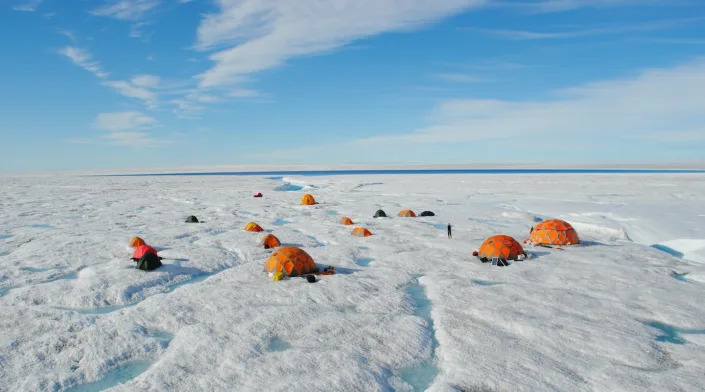
A turbulent melt-river pours a million tons of water a day into a moulin, where it flows down through the ice to ultimately reach the ocean. Ted Giffords

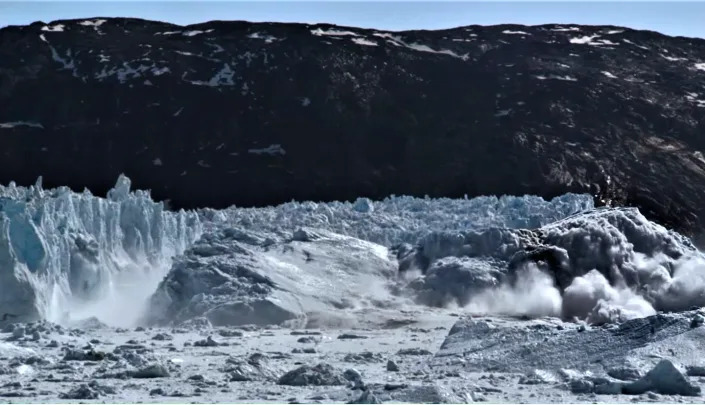
I’m standing at the edge of the Greenland ice sheet, mesmerized by a mind-blowing scene of natural destruction. A milewide section of glacier front has fractured and is collapsing into the ocean, calving an immense iceberg.

Seracs, giant columns of ice the height of three-story houses, are being tossed around like dice. And the previously submerged portion of this immense block of glacier ice just breached the ocean – a frothing maelstrom flinging ice cubes of several tons high into the air. The resulting tsunami inundates all in its path as it radiates from the glacier’s calving front.

Fortunately, I’m watching from a clifftop a couple of miles away. But even here, I can feel the seismic shocks through the ground.

A fast-flowing outlet glacier calves a ‘megaberg’ into Greenland’s Uummannaq Fjord. Alun Hubbard

Despite the spectacle, I’m keenly aware that this spells yet more unwelcome news for the world’s low-lying coastlines.

As a field glaciologist, I’ve worked on ice sheets for more than 30 years. In that time, I have witnessed some gobsmacking changes. The past few years in particular have been unnerving for the sheer rate and magnitude of change underway. My revered textbooks taught me that ice sheets respond over millennial time scales, but that’s not what we’re seeing today.

A study published Aug. 29, 2022, demonstrates – for the first time – that Greenland’s ice sheet is now so out of balance with prevailing Arctic climate that it no longer can sustain its current size. It is irreversibly committed to retreat by at least 59,000 square kilometers (22,780 square miles), an area considerably larger than Denmark, Greenland’s protectorate state.

Even if all the greenhouse gas emissions driving global warming ceased today, we find that Greenland’s ice loss under current temperatures will raise global sea level by at least 10.8 inches (27.4 centimeters). That’s more than current models forecast, and it’s a highly conservative estimate. If every year were like 2012, when Greenland experienced a heat wave, that irreversible commitment to sea level rise would triple. That’s an ominous portent given that these are climate conditions we have already seen, not a hypothetical future scenario.

Our study takes a completely new approach – it is based on observations and glaciological theory rather than sophisticated numerical models. The current generation of coupled climate and ice sheet models used to forecast future sea level rise fail to capture the emerging processes that we see amplifying Greenland’s ice loss.

How Greenland got to this point

The Greenland ice sheet is a massive, frozen reservoir that resembles an inverted pudding bowl. The ice is in constant flux, flowing from the interior – where it is over 1.9 miles (3 kilometers) thick, cold and snowy – to its edges, where the ice melts or calves bergs.

In all, the ice sheet locks up enough fresh water to raise global sea level by 24 feet (7.4 meters).

Greenland’s terrestrial ice has existed for about 2.6 million years and has expanded and contracted with two dozen or so “ice age” cycles lasting 70,000 or 100,000 years, punctuated by around 10,000-year warm interglacials. Each glacial is driven by shifts in Earth’s orbit that modulate how much solar radiation reaches the Earth’s surface. These variations are then reinforced by snow reflectivity, or albedo; atmospheric greenhouse gases; and ocean circulation that redistributes that heat around the planet.

We are currently enjoying an interglacial period – the Holocene. For the past 6,000 years Greenland, like the rest of the planet, has benefited from a mild and stable climate with an ice sheet in equilibrium – until recently. Since 1990, as the atmosphere and ocean have warmed under rapidly increasing greenhouse gas emissions, Greenland’s mass balance has gone into the red. Ice losses due to enhanced melt, rain, ice flow and calving now far exceed the net gain from snow accumulation.

What does the future hold?

The critical questions are, how fast is Greenland losing its ice, and what does it mean for future sea level rise?

Greenland’s ice loss has been contributing about 0.04 inches (1 millimeter) per year to global sea level rise over the past decade.

This net loss is split between surface melt and dynamic processes that accelerate outlet glacier flow and are greatly exacerbated by atmospheric and oceanic warming, respectively. Though complex in its manifestation, the concept is simple: Ice sheets don’t like warm weather or baths, and the heat is on.

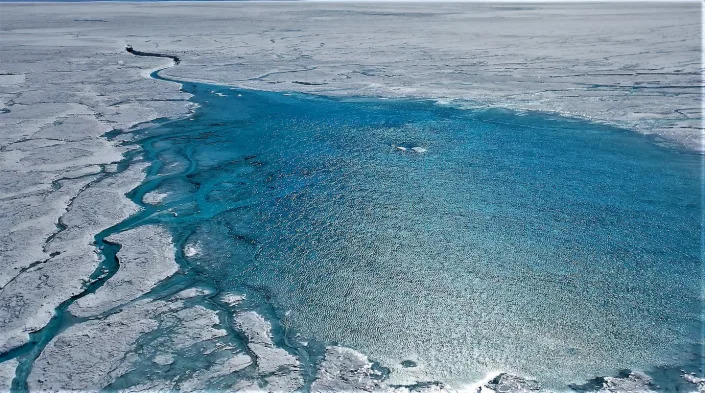
Meltwater lakes feed rivers that snake across the ice sheet - until they encounter a moulin. Alun Hubbard
Meltwater lakes feed rivers that snake across the ice sheet – until they encounter a moulin. Alun Hubbard

What the future will bring is trickier to answer.

The models used by the Intergovernmental Panel on Climate Change predict a sea level rise contribution from Greenland of around 4 inches (10 centimeters) by 2100, with a worst-case scenario of 6 inches (15 centimeters).

But that prediction is at odds with what field scientists are witnessing from the ice sheet itself.

According to our findings, Greenland will lose at least 3.3% of its ice, over 100 trillion metric tons. This loss is already committed – ice that must melt and calve icebergs to reestablish Greenland’s balance with prevailing climate.

We’re observing many emerging processes that the models don’t account for that increase the ice sheet’s vulnerability. For example:

In August 2021, rain fell at the Greenland ice sheet summit for the first time on record. Weather stations across Greenland captured rapid ice melt. <a href=
In August 2021, rain fell at the Greenland ice sheet summit for the first time on record. Weather stations across Greenland captured rapid ice melt. European Space Agency
The issue with models

Part of the problem is that the models used for forecasting are mathematical abstractions that include only processes that are fully understood, quantifiable and deemed important.

Models reduce reality to a set of equations that are solved repeatedly on banks of very fast computers. Anyone into cutting-edge engineering – including me – knows the intrinsic value of models for experimentation and testing of ideas. But they are no substitute for reality and observation. It is apparent that current model forecasts of global sea level rise underestimate its actual threat over the 21st century. Developers are making constant improvements, but it’s tricky, and there’s a dawning realization that the complex models used for long-term sea level forecasting are not fit for purpose.

Author Alun Hubbard’s science camp in the melt zone of the Greenland ice sheet. Alun Hubbard

There are also “unknown unknowns” – those processes and feedbacks that we don’t yet realize and that models can never anticipate. They can be understood only by direct observations and literally drilling into the ice.

That’s why, rather than using models, we base our study on proven glaciological theory constrained by two decades of actual measurements from weather stations, satellites and ice geophysics.

It’s not too late

It’s an understatement that the societal stakes are high, and the risk is tragically real going forward. The consequences of catastrophic coastal flooding as sea level rises are still unimaginable to the majority of the billion or so people who live in low-lying coastal zones of the planet.

A large tabular iceberg that calved off Store Glacier within Uummannaq Fjord. Alun Hubbard

Personally, I remain hopeful that we can get on track. I don’t believe we’ve passed any doom-laden tipping point that irreversibly floods the planet’s coastlines. Of what I understand of the ice sheet and the insight our new study brings, it’s not too late to act.

But fossil fuels and emissions must be curtailed now, because time is short and the water rises – faster than forecast.