Florida’s insurance crisis: 2 special sessions, little help | Commentary

Orlando Sentinel

Florida’s insurance crisis: 2 special sessions, little help | Commentary

Scott Maxwell, Orlando Sentinel – May 2, 2023

For years, Florida lawmakers ignored a looming insurance crisis.

Then, with rates skyrocketing and companies fleeing the state, they scrambled to call not one, but two special sessions, vowing to help.

Well, my wife and I saw what the Legislature’s version of help looks like a few months ago when our insurance bill jumped from $4,000 to $7,000.

Any more “help “like that and we’ll be eating cat food.

In reality, we’ll be just fine. But a growing number of Floridians are facing bills they can barely afford as prices skyrocket throughout the state.

The Insurance Information Institute predicted increases of 40% throughout Florida this year. Some companies have requested 60% hikes. And scores of Floridians are still being dropped by their carriers while the state-run Citizens Property Insurance keeps bloating.

This is an undeniable, mounting mess.

So once again, GOP legislators – who have spent the better part of the past two years waging culture wars – have cobbled together another insurance bill.

But if you’re counting on this lowering your rates, bad news: It will not.

That’s not my take. It’s the take of former GOP Sen. Jeff Brandes – one of the few lawmakers who repeatedly warned his colleagues to take action years ago and was largely ignored.

“Nothing in this bill lowers rates,” Brandes, who now runs the Florida Policy Project, said this week. “Nothing in this bill encourages more companies to come.”

Brandes and I have differing views on some aspects of reform – particularly as it relates to the transparency measures and regulations that subsidized insurance companies should face.

But we agree on three key things:

1. Despite years of yapping about fraud claims driving up costs and rates, Florida lawmakers have never cracked down on bad actors in any meaningful fashion.

2. The solutions they’re talking about now aren’t going to do much, if anything, to bring down rates.

3. Any meaningful solution – in a state like ours that’s basically a bullseye for hurricanes and increasingly at risk of flooding – is going to involve a boatload of public money.

Brandes and I may have varied thoughts on how that money should be spent. But the reality is that this problem – where the state-run insurance company is now covering millions of Floridians at increasingly high rates – requires a major investment and serious policy reform.

And that’s not good news for a Legislature that specializes in divisive bumper-sticker priorities – dragging Disney, fuming about drag queens and decrying wokeism.

When it comes to hard, serious policy work, they are either unwilling or incapable of getting the job done. At least when it comes to insurance.

A clear example of that is fraud. For years, lawmakers have blamed fraudulent claims for driving up insurance costs and driving companies out of the state. But they haven’t done squat from an enforcement standpoint.

“If you want talent in the Office of Insurance Regulation – which should be one of the most talented in the state – you have to pay for it,” Brandes said.

That seems obvious. If your city had a rash of burglaries, you’d beef up your burglary patrol. But Florida politicians have whined about fraud without ever dedicating serious resources to exposing, punishing and stopping it.

If they can set up a statewide election-crime police force to deal with fever-dream problems, you’d think they’d beef up their insurance team to deal with an actual financial nightmare.

But to really bring down prices, we need more competition among providers. Or we need to invest more in Citizens – and basically accept that a giant, costly state-run insurance company is the only way we’re going to be able to cover everyone in a state that’s both storm-ravaged and low-wage.

Few people really want that second option. Certainly not Brandes. But many of us aren’t super keen either on just handing over tax dollars to an industry with a track record of hosing its policy holders.

Just a few weeks ago, the Washington Post published a maddening investigative report that found Florida insurance companies were financially victimizing hurricane survivors by gutting their claims and payments – sometimes by as much as 90% of what the companies’ own adjusters said the homeowners were due. The piece featured an adjuster who said one insurance company took his report – which estimated $200,000 in valid claims for one home – and whittled it down to just $27,000 without his knowledge or consent.

Brandes prefers offering companies incentives to write Florida policies. That may be worth exploring – with a lot of checks and balances added in.

But here’s the bottom line: Either scenario – majorly subsidizing private industries or growing/transforming Citizens into something like a Florida version of Medicare for homeowners – is painful. They’re both costly, politically unpopular and involve a lot of hard work.

Unfortunately, most Florida politicians don’t want to do hard work or make unpopular moves. So they just keep screaming about critical race theory and transgender athletes. And while they scream, your rates keep rising.

I think we’re heading toward a pain point – where even the Floridians who used to laugh at the culture wars are going to stop laughing once they realize they can barely afford to stay in their homes. That may be when they start finally putting people in office who are more interested in solving problems than creating them.


Can American’s expect this U.S. Supreme Court to be fair and impartial? U.S. Supreme Court to examine whistleblower claims against financial firms in UBS case

Reuters

U.S. Supreme Court to examine whistleblower claims against financial firms in UBS case

Daniel Wiessner – May 1, 2023

FILE PHOTO: U.S. Supreme Court building in Washington

(Reuters) -The U.S. Supreme Court on Monday agreed to examine how difficult it should be for financial whistleblowers to win retaliation lawsuits against their employers as the justices took up a long-running case involving Switzerland’s UBS Group AG.

The justices will hear an appeal by Trevor Murray, a former UBS bond strategist, of a lower court’s decision to throw out his 2021 lawsuit that accused the company of unlawfully firing him for refusing to publish misleading research reports and complaining about being pressured to do so.

The appeal involves a technical but important issue – whether whistleblowers who sue their employers for retaliation under the federal Sarbanes-Oxley Act must prove that companies acted with “retaliatory intent.”

The New York-based 2nd U.S. Circuit Court of Appeals last year decided that Murray was required to meet that bar and failed, creating a split with four other federal appeals courts. Those courts have said that defendants in Sarbanes-Oxley cases can raise the lack of intent as a defense, but that plaintiffs do not have to prove employers acted with intent.

A Supreme Court ruling in favor of UBS could significantly curtail financial whistleblower lawsuits because it is often difficult for plaintiffs to prove a defendant’s motives.

Robert Herbst, a lawyer for Murray, said the 2nd Circuit decision ignored the text of the whistleblower law, adding that he looked forward to arguing the case before the Supreme Court.

A UBS spokesperson said, “We expect the court will uphold the 2nd Circuit’s decision.”

Murray, who worked in UBS’s mortgage securitization unit, accused UBS officials of pressuring him to issue skewed and bullish research on commercial mortgage-backed securities in order to support the bank’s trading and underwriting operations. He has said he was fired in 2012 about two months after complaining to supervisors and despite receiving excellent performance reviews.

UBS has denied wrongdoing and said Murray’s termination was part of a cost-cutting campaign that eliminated thousands of jobs.

The Sarbanes-Oxley Act was adopted in 2002 and created enhanced accounting standards for publicly traded U.S. companies after a series of accounting scandals, along with new legal protections for employees who report illegal conduct.

The Supreme Court is due to hear the case in its next term, which begins in October.

(Reporting by Daniel Wiessner in Albany, New York; Editing by Will Dunham)

Hotel housekeeping jobs have fallen by 102,000 during the pandemic. What happened?

MarketWatch

Hotel housekeeping jobs have fallen by 102,000 during the pandemic. What happened?

Levi Sumagaysay – May 1, 2023

‘Before the pandemic, I never had a problem with getting hours,’ one housekeeper told MarketWatch
The number of hotel housekeepers has fallen since the onset of the pandemic. GETTY IMAGES/ISTOCKPHOTO

As some U.S. hotels hung on to practices they adopted during the early stages of the coronavirus pandemic — such as eliminating daily room cleanings — the number of hotel housekeepers fell by more than 102,000 last year from prepandemic levels, new data show.

The total number of hotel housekeeping jobs as of May 2022 was 364,990, a 22% decline from the total of 467,270 such positions during the same period in 2019, according to numbers released last week by the Bureau of Labor Statistics.

Unions representing hotel service workers feared this would happen, and had warned a couple of years ago of such a decline. Since then, they have worked to restore or retain routine daily housekeeping in hotel rooms around the country. In some places that actually began requiring daily cleanings during the pandemic, unions are pushing to make those rules permanent.

In Las Vegas, the Culinary Workers Union is opposing legislation that would repeal daily-cleaning requirements as it tries to protect the jobs of thousands of hotel housekeepers in a travel destination known as the entertainment capital of the world.

“Prior to the pandemic, it was standard that you paid a pretty penny for a nice room and you got service,” Ted Pappageorge, the secretary-treasurer for Culinary Workers Union Local 226, said in an interview. “You didn’t have to chase someone down the hall” to ask for towels or for trash to be taken out of your hotel room, he said.

“Now room rates are higher, 30% or more, [and hotels are] expecting guests to do without,” Pappageorge added.

The biggest U.S.-based hotel chains have reported that their average daily room rates have risen since 2019. Hilton Worldwide Holdings Inc. HLT, +1.05% reported last week when it released first-quarter earnings that its revenue per available room was 8% higher than during the same period in 2019. Marriott International Inc. MAR, +4.98% and Hyatt Hotels Corp. H, +3.06% report earnings this week.

But according to their fourth-quarter earnings filings with the Securities and Exchange Commission, Marriott’s revenue per available room was up 4.6% over the same period in 2019 and Hyatt’s for that same period rose 2.4%.

Hilton, Marriott and Hyatt did not respond to requests for comment about their daily housekeeping policies. All three hotel chains in earnings updates have reported increasing their numbers of properties. At least one, Marriott, mentioned in its November report that it was dealing with “industry-wide labor shortages” that made it challenging to hire or re-hire for certain positions.

The Las Vegas–based Culinary Workers Union and its members also said less-frequent cleanings could be a safety issue, because housekeepers don’t know what they might find in a room that hasn’t had a hotel staff member inside it in several days. In addition, having fewer people around in massive hotels could mean no one within earshot during attempted assaults on housekeepers, they said.

Housekeepers who spoke with MarketWatch said getting rid of daily cleanings or requiring guests to ask for daily cleanings means not just fewer jobs, but harder work for those who have managed to keep their jobs.

Proponents of the Nevada legislation include the Henderson Chamber of Commerce, which said in a recent letter to state lawmakers that “eliminating health requirements on businesses that are no longer needed is another step in ensuring our economy returns to pre-pandemic levels.”

The general counsel of Wynn Resorts Ltd. WYNN, -2.08% assured the state legislature in a letter that the hotel chain “will continue to clean our hotel rooms daily to maintain our Forbes Five Star designation,” though it does not believe a mandate by law is necessary and supports “the rescission of the statutory requirement which imposes upon resort operators unprecedented business operational requirements.”

Housekeepers who spoke with MarketWatch said doiing away with daily cleanings or requiring guests to ask for daily cleanings means not just fewer jobs, but harder work for those who have managed to keep their jobs.

Nely Reinante, a housekeeper at Hilton Hawaiian Village who told MarketWatch two years ago that she was waiting to return to work full-time because daily cleanings weren’t happening at the time, worked with the union to help restore routine daily cleanings at her hotel. Among other things, they passed out leaflets to explain the situation to guests.

“Our guests are happier now that there is no trash or dirty linens or towels in the hallway,” Reinante said in a recent interview with MarketWatch. She is back to work full time, she said, though some of her colleagues quit because they couldn’t afford to wait around for full-time work.

Reinante said that compared with a couple years ago, she “can breathe lighter now” because it’s easier to handle rooms that are cleaned daily — and she’s not worried about not getting enough hours.

“Guests can support housekeepers by always asking for daily housekeeping when they check in,” Unite Here International President D. Taylor said in an emailed statement. The union and its affiliates, such as the Culinary Workers Union local in Nevada, have worked to restore automatic daily housekeeping in many major cities around the country, Unite Here said.

From the archives (July 2021): Where’s housekeeping? Hotels cutting back on daily cleaning after pandemic.

A housekeeper in the Boston area told MarketWatch earlier this year that some guests thought they were helping housekeepers by opting out of daily cleanings. In reality, the housekeeper said, some staff weren’t being assigned enough shifts.

“Before the pandemic, I never had a problem with getting hours,” said Josefina Lopez, who works at the Element Boston Seaport District and was only getting a couple of days of work a week at the beginning of this year. Lopez also hurt her shoulder because she was having to spend more time cleaning rooms and her work had become harder, she said at the time.

Since then, though, Lopez has resumed full-time work, according to her union.

Taylor, the Unite Here president, said he is proud of restoring automatic daily housekeeping at many union hotels. “But now you’ve got a patchwork effect where some hotels have full service automatically and others don’t, even if they’re part of the same brand,” he said. “That’s not fair to guests. And it only widens the gap between the union standard and nonunion working conditions.”

Trickling Tax Revenue Complicates Debt Limit Talks

The New York Times

Trickling Tax Revenue Complicates Debt Limit Talks

Alan Rappeport – May 1, 2023

Treasury Secretary Janet Yellen speaks during a press conference at the Treasury Department in Washington, on April 11, 2023. (Yuri Gripas/The New York Times)

WASHINGTON — A vote by House Republicans last week to lift the nation’s debt limit in exchange for deep spending cuts was the first step in what is likely to be a protracted battle over raising or suspending the borrowing cap to avoid defaulting on United States debt.

But while Republicans and President Joe Biden and his fellow Democrats are gearing up for a fight, a key question is beginning to sow unease in Washington and on Wall Street: How much time is there to strike a deal?

The United States technically hit its $31.4 trillion debt limit in January, forcing the Treasury Department to employ accounting maneuvers known as extraordinary measures to allow the government to keep paying its bills, including payments to bondholders who own government debt. Treasury Secretary Janet Yellen said at the time that her powers to delay a default — in which the United States fails to make its payments on time — could be exhausted by early June. She cautioned, however, that the estimate came with considerable uncertainty.

With June now just a few weeks away, uncertainty around the timing of when the United States will run out of cash — what’s known as the X-date — remains, and determining the true deadline could have huge consequences for the country.

Tax receipts will be key to the X-date.

Determining the X-date depends on a complex set of factors, but ultimately what matters most is how much money the government spends and how much it takes in through taxes and other revenue.

The Bipartisan Policy Center, which tracks federal revenues, projected in February that lawmakers would need to raise or suspend the debt limit sometime between summer and early fall to avoid a default. The specific date would largely depend on how quickly tax revenues are coming into the government’s coffers.

There are signs that 2022 tax receipts are trickling in too slowly for comfort. Economists at Wells Fargo wrote in a note to clients last week that because tax collections appear to be weaker than expected, there is a chance the X-date could be as soon as early June. However, they continue to believe early August is the most likely default deadline.

“A low but not insignificant probability of a U.S. default is still very concerning, and we would think the last thing Treasury officials want is an X-date that sneaks up on Congress,” they wrote.

Tax day payments are still arriving. Goldman Sachs economists projected last week that by the second week of June, the Treasury Department could have around $60 billion of cash remaining, which would allow the government to keep making its payments until late July.

Natural disasters could fuel a debt disaster.

There is a surprising factor that could cause the X-date to arrive sooner: the weather. Severe storms, flooding and mudslides in California, Alabama and Georgia this year prompted the IRS to push the April 18 filing deadlines in dozens of counties to October.

The IRS said this year that, because of the storms, individuals and businesses in the affected areas could file their returns late. They were also given more time to make contributions to retirement and health savings accounts.

Farmers, who often file their tax returns by March 1, also have received a reprieve until Oct. 16, and estimated payments that normally would have been made in January were allowed to be pushed back to that date.

It is not clear how much tax revenue has been delayed by the storms, but the extensions have given the Treasury Department less wiggle room to keep paying the bills.

An update could come this week.

The Treasury Department is expected to send a letter to Congress in the coming days with a more precise estimate of when it could start running out of cash. It could also lay out new measures intended to stave off a default. This year, Yellen announced that she would redeem some existing investments and suspend new investments in the Civil Service Retirement and Disability Fund and the Postal Service Retiree Health Benefits Fund.

In a speech last week, Yellen warned that a default would have real consequences for the economy.

“Household payments on mortgages, auto loans and credit cards would rise,” Yellen said in remarks to the Sacramento Metropolitan Chamber of Commerce in California. “And American businesses would see credit markets deteriorate.”

She added, “On top of that, it is unlikely that the federal government would be able to issue payments to millions of Americans, including our military families and seniors who rely on Social Security.”

Here’s what the X-date means for negotiations.

As the X-date approaches, it will put more pressure on lawmakers to take action.

Analysts at Beacon Policy Advisors predicted that if a default could really happen as soon as June, that would increase the likelihood that Congress will pass a short-term suspension of the debt limit through October. If the X-date is expected to hit in July, that might compel lawmakers to file legislation by early May so they have sufficient time to deal with procedural obstacles in Congress.

Although markets have broadly remained calm about the prospect of a default, there are some signs that investors are becoming nervous.

They have sold government bonds that mature in three months — around the time policymakers have said the United States could run out of cash — and snapped up bonds with just one month until they are repaid.

The cost of insuring existing bond holdings against the possibility that the United States will default on its debts has also risen sharply. Still, analysts say the market reaction would need to be much more pronounced to force a fast deal.

“This has caused some heartburn among policymakers but not enough to move the negotiating needle in a meaningful way,” the Beacon analysts wrote. “There needs to be a bigger market response and a more definitive X-date to get negotiations going in full.”

That has yet to happen, however. While Biden has indicated he is open to talking with House Speaker Kevin McCarthy about ways to get the nation’s fiscal situation on a better track, the two have yet to schedule a meeting after the House passage last week.

Why Republicans Want Voters to Fear Kamala Harris As President

The Root

Why Republicans Want Voters to Fear Kamala Harris As President

Jessica Washington – May 1, 2023

GREENBELT, MARYLAND - APRIL 25: In this handout image provided by NASA, Vice President Kamala Harris delivers remarks during a tour of NASA’s Goddard Space Flight Center with President Yoon Suk Yeol of the Republic of Korea, on April 25, 2023
GREENBELT, MARYLAND – APRIL 25: In this handout image provided by NASA, Vice President Kamala Harris delivers remarks during a tour of NASA’s Goddard Space Flight Center with President Yoon Suk Yeol of the Republic of Korea, on April 25, 2023

Republicans taking jabs at President Joe Biden’s age isn’t a new phenomenon. But, GOP Presidential candidate Nikki Haley took things way further when she predicted Biden would likely die within the next five years. Her poorly executed Miss Cleo impersonation aside, what Haley’s trying to do here seems pretty straightforward.

Just read what she said on Fox News last week; “He announced that he’s running again in 2024, and I think that we can all be very clear and say with a matter of fact that if you vote for Joe Biden, you really are counting on a President Harris because the idea that he would make it until 86 years old is not something that I think is likely,” said Haley, 51.

Rather than run against Biden and his record, Republicans like Haley want to make this election about Harris, says Jo Von McCalester, a Political Science Lecturer at Howard University. “To imply that [Biden] is not going to live and if you vote for him, it’s really going to be her,” says McCalester, “is to dog whistle to people that you could end up with a Black woman as President in your country.”

Nina Smith, a political strategist and former senior advisor to Stacey Abrams, agrees with McCalester’s assessment. “It’s definitely the GOP trying to weaponize an inherent bias that we have against women in leadership,” she says.

Ted Cruz Chimes in on Biden’s Age

Haley isn’t the only Republican trying to position this as a race against Harris, not the sitting President. In an interview last week, Texas Republican Senator Ted Cruz made similar jabs.

“Joe Biden is 142 years old,” said Cruz on Fox News. “Can you imagine Kamala Harris sitting across from Putin or Xi and just cackling?”

The imagery employed by Cruz is very intentional, says McCalester. “The idea of her sitting across from Putin gives two visuals,” she says. “It gives the visuals of a Black person that you don’t believe sounds intelligent enough to sit across from a ‘world power or leader.’ It also harkens to the fact that she’s a woman.”

This isn’t the first time Republicans have tried to make Harris the focus of their attacks on the Biden-Harris ticket, says Cliff Albright, Executive Director of Black Voters Matter Fund, a voting rights organization.

“They tried it to a certain extent in the last presidential election, right? But there, there really wasn’t a consensus on the strategy,” says Albright. “It’s likely to increase this time because now, unlike in 2020, it’s even more clear what Biden’s merits are. They’re starting to realize that we’re gonna have a hard time running against his record.”

Is Making The Election About Harris a Winning Strategy?

The bigger question is whether Republicans can win by making the election about Harris. According to Smith, it might be the most effective tool in their arsenal, especially for someone like Haley.

“Nikki Haley is barely registering in polls. She’s not making up any ground when it comes to beating Donald Trump in a primary,” says Smith. “I think they know they have to split this ticket up… if you split them up, then his age becomes a question, and her experience becomes a question.”

“It’s really pathetic,” says Albright. “It’s a sign that they know they can’t win just on the strength of their case… and so when all else fails in the Republican party, what do they lean on, and the usual answer is good old racism.”

None of these strategies are new, says Albright pointing to the infamous Willie Horton ads used against Democratic nominee Michael Dukakis. But in the modern era, he argues, they have their limits. “They’re effective to a certain extent with the base, but all recent elections are showing us that it can go only so far,” says Albright, adding. “So, will it be more effective than going after Biden? I think so. Will it be effective enough for them to win? I don’t believe so.”

Hillary Holley, Executive Director of Care in Action, a nonprofit progressive labor organization, and a former Democratic strategist in Georgia, says she doesn’t believe these tactics can win if Progressive groups are on the ground making a case for the administration and Harris’ accomplishments. “People may be concerned that voters may fall for these distractions, these lies,” says Holley. “Our allies have proven that we know how to talk to voters. We can tell voters the truth, and we once we do that massive robust outreach, they end up voting for progress.”

McCalester is more skeptical. This could “absolutely” be a winning message for Republicans, she says. “It’s the we’re gonna appeal to racists, we’re gonna appeal to sexists [strategy],” she says. Unfortunately, it’s worked repeatedly for Republicans, says McCalester, and there’s no reason to think it can’t work again.

“I predict things can only get worse,” she says.

More from The Root

A muddy mess in Ukraine is making trouble for new howitzers so sensitive to dirt they come with their own vacuum cleaners

Business Insider

A muddy mess in Ukraine is making trouble for new howitzers so sensitive to dirt they come with their own vacuum cleaners

Jake Epstein – May 1, 2023

Ukrainian army from the 43rd Heavy Artillery Brigade fire the German howitzer Panzerhaubitze 2000, called Tina by the unit, amid Russia's attack on Ukraine, near Bahmut, in Donetsk region, Ukraine, February 5, 2023.
Ukrainian army from the 43rd Heavy Artillery Brigade fire the German howitzer Panzerhaubitze 2000, called Tina by the unit, amid Russia’s attack on Ukraine, near Bakhmut, in Donetsk region, Ukraine, February 5, 2023.REUTERS/Marko Djurica
  • Spring conditions have limited mobility for both Ukrainian and Russian troops.
  • Ukraine’s recently obtained German-made self-propelled howitzers are particularly vulnerable to mud.
  • Soldiers have to be very clean and careful when entering the vehicles, The New York Times reported.

Springtime mud is plaguing the war-torn battlefields of eastern Ukraine, creating mobility issues for Russian and Ukrainian forces, slowing down their respective operations. It’s also affecting some weapons.

The state of the terrain is proving to be a hurdle for Kyiv’s troops assigned to a specific piece of military hardware acquired from Germany during winter — German-made 155mm howitzers that are extremely sensitive to the dirty and grimy conditions.

Germany has sent 14 Panzerhaubitze 2000 self-propelled howitzers to Ukraine, according to an inventory of its military support to Kyiv. These weapons contain electronics that are so vulnerable to dirt and moisture that soldiers have to wear slippers or booties when they enter the vehicles so they don’t track in any mud, the New York Times reported on Monday.

Each howitzer even comes with a vacuum cleaner, and the barrels sometimes have to be cleaned with a long brush. “The Panzer really loves cleanliness,” an artillery commander named Mykola told the Times, referring to a nickname for the Panzerhaubitze. “If you fire off two full loads of ammunition, you need to spend a day servicing it.”

Serhii, a lieutenant with the 43rd Separate Artillery Brigade, even decided to recall the howitzers from the field out of fear that should the machines come under Russian fire, mud will prevent them from escaping the bombardment, the Times reported. In Germany, these vehicles were kept in climate-controlled garages.

That said, the Ukrainian forces operating the German-made howitzers have reportedly seen some successes against Russian tank and infantry units despite the current conditions on the ground.

Ukrainian soldiers from the 43rd Heavy Artillery Brigade drive the German howitzer Panzerhaubitze 2000, called Tina by the unit, amid Russia's attack on Ukraine, near Bahmut, in Donetsk region, Ukraine, February 5, 2023.
Ukrainian soldiers from the 43rd Heavy Artillery Brigade drive the German howitzer Panzerhaubitze 2000, called Tina by the unit, amid Russia’s attack on Ukraine, near Bakhmut, in Donetsk region, Ukraine, February 5, 2023.REUTERS/Marko Djurica

It’s not the first time that Ukraine’s forces have dealt with the challenge of weaponry getting stuck in the mud. Units have reported that their Soviet-era T-64 tanks were getting trapped in the sludgy terrain — one of several issues troops found with the decades-old tanks.

Britain’s defense ministry shared in a recent intelligence update that mud was likely impacting operations on both the Russian and Ukrainian side in the wake of the cold winter months, although the surface conditions were expected to improve within a few weeks as the weather gets better.

“With soft ground conditions across most of Ukraine, severe mud is highly likely slowing operations for both sides in the conflict,” the April 21 update read.

Ukrainian forces have been gearing up to launch a much-anticipated counteroffensive against Russia after receiving a massive influx of heavy armor and advanced military hardware from the US and its Western partners. NATO Secretary General Jens Stoltenberg told reporters last week that nearly all the combat vehicles promised to Ukraine have been delivered, and Ukraine’s defense minister said his country was nearly ready to hit with an “iron fist.”

“That means over 1,550 armored vehicles, 230 tanks and other equipment, including vast amounts of ammunition,” Stoltenberg said of the deliveries. “In total we have trained and equipped more than nine new Ukrainian armored brigades, this will put Ukraine in a strong position to continue to retake occupied territory.”

Manchin’s ‘playing with fire’ — and some Democrats are tired of the drama

Politico

Manchin’s ‘playing with fire’ — and some Democrats are tired of the drama

Josh Siegel – May 1, 2023

Amanda Andrade-Rhoades/AP Photo

Sen. Joe Manchin is losing patience with his fellow Democrats over their signature climate law — and the feeling is mutual.

The West Virginia Democrat has spent weeks escalating his attacks on President Joe Biden’s implementation of the Inflation Reduction Act, the sweeping bill that Manchin helped write in a deal that stunned Washington last summer. Last week, he threatened to join Republicans in voting to repeal the law, as the House GOP is demanding in its legislation for raising the nation’s debt limit.

Manchin’s comment caught his caucus colleagues off guard, even if such a repeal would be a long shot in Congress. It came just as Biden was launching a reelection campaign that rests heavily on that legislation’s climate and health care provisions.

“That surprises me that he wants to repeal it. I think it’s one of his greatest accomplishments,” said Sen. Angus King (I-Maine), a close colleague of Manchin’s on the Energy Committee, in an interview.

The IRA is far less of a political bright spot for Manchin, whose potential reelection hopes are clouded by growing disapproval ratings in his home state, partly driven by his support for the law. Manchin has yet to announce whether he’s running, but a formidable challenger entered the West Virginia Senate race last week — GOP Gov. Jim Justice.

Manchin’s fellow Democrats understand that his reelection could determine whether they retain their slim 51-seat Senate majority in 2024. But they are also growing weary of his attacks against their marquee climate law — even if they’ve come to expect it and know there’s little they can do to change his mind. And his votes against Democratic policies and Biden nominees have already complicated his party’s agenda in the 51-49 Senate.

Some Democrats fear that Manchin’s criticisms will do real damage by confusing the public about one of the law’s most debated-provisions: its $7,500 tax credits for electric vehicles. He has accused the Treasury Department of violating the law by flouting strict provisions he wrote designed to force electric vehicles to be made in the U.S. with American-made parts.

“When you’re Joe Manchin it never hurts to be seen butting heads with the administration, but I think this is genuine umbrage over the fact Congressional intent seems pretty clear, even if the statutory construction left room for Treasury to maneuver,” said Liam Donovan, a lobbyist with the firm Bracewell who previously worked for the National Republican Senatorial Committee. “And given that he would not have been on board for the bill at all had this been the understanding, it reads as a personal betrayal.”

Democrats counter that the administration has been doing its best to balance the IRA’s competing goals of lowering the cost of electric vehicles while promoting U.S. manufacturing and jobs.

“Fifty of us agree that [boosting electric vehicle deployment] is a priority,” Sen. Martin Heinrich (D-N.M.) said in an interview. “The law is what it is. If he doesn’t like implementation he can run for president.”

Manchin in recent weeks has also joined Republicans in supporting resolutions they’ve brought up for a vote disapproving of the administration’s energy and environmental policies, most recently on Wednesday when he was the only Democrat to vote with Republicans in overturning an EPA regulation on emissions from heavy-duty trucks.

Manchin also co-sponsored Sen. Rick Scott‘s (R-Fla.) resolution to undo Biden’s suspension of solar power tariffs, which could come up for a vote this week after passing the House on a bipartisan basis Friday.

And Manchin, chair of the Senate Energy Committee, has also expressed his ire with the administration by torpedoing a series of Biden’s nominees, including Richard Glick to chair the Federal Energy Regulatory Commission, Laura Daniel-Davis, Biden’s pick for assistant Interior secretary for land and minerals management, and Gigi Sohn as a commissioner of the Federal Communications Commission.

The White House has supported fossil fuel projects that Manchin has backed — angering environmentalists — including the Willow oil and Alaska LNG projects, as well as the Mountain Valley Pipeline that would deliver natural gas produced in West Virginia.

Manchin did not comment for this article, but his spokesperson Sam Runyon said his objections were because the administration had strayed from the intent of the bill.

“President Biden, then-Speaker Pelosi and Majority Leader Schumer were in full agreement with Sen. Manchin that the IRA was an energy security bill and the legislative language is crystal clear,” she said. “The Administration continues to blatantly violate the law in an effort to replace Congressional intent with their own radical climate agenda that simply didn’t, and wouldn’t have, passed.”

Some Republicans have expressed sympathy for Manchin’s position.

“Is it playing with fire? Sure. Does Joe care? I don’t think so,” said Sen. Lisa Murkowski (R-Alaska), Manchin’s frequent legislative partner when she chaired the Energy Committee. “Good for him for calling the administration out.”

Murkowski noted that the climate law had been seemingly dead for most of last year until Manchin’s support allowed Democrats to pass it on a party-line vote. The law includes $369 billion in incentives for clean energy and electric vehicles, as well as health measures such as a cap on insulin costs for Medicare recipients.

“They made a deal with him,” Murkowski said. “And it was a hard deal and they wanted his vote, and they got it — at some political cost to him and he would admit that. And now [the Biden administration is] trying to rewrite the bill, or interpret in the way they wished they had been able to get it passed. That’s their problem.”

Manchin has repeatedly denounced Biden’s electric vehicle policies in recent weeks, including by announcing he would support Republican efforts in Congress to overturn EPA auto pollution rules designed to speed up EV adoption. He accused the administration of “lying to Americans with false claims about how their manipulation of the market to boost EVs will help American energy security.”

He repeated that theme in remarks to the U.S. Chamber of Commerce April 18, saying, “I never wanted to give the electric vehicles 75-cents’ credit let alone $7,500.”

“Y’all broke the law,” Manchin later told Biden’s Energy secretary, Jennifer Granholm, at a hearing April 20, accusing the administration of “liberalizing” its rollout of the tax subsidy to stimulate sales of electric vehicles — and warning that that approach could send money and jobs to China.

Republicans are eager to pounce on Democratic dissension over how the administration is executing the climate law. GOP lawmakers, who unanimously opposed the law, argue that it spends too much money and say its twin goals — quickly weaning the U.S. economy off fossil fuels while reducing reliance on China for clean energy technologies — are incoherent.

“Maybe he’s looked at it [the IRA] more deeply and realized it’s not what he thought it was,” Sen. Shelley Moore Capito, Manchin’s GOP counterpart from West Virginia, said in an interview. “I can’t believe he would be that naïve. But who knows?”

But other Democrats say the administration is carrying out the law that Congress passed.

“Almost all of us who voted for this legislation and contributed to it wanted to supercharge EV sales,” said Rep. Jared Huffman (D-Calif.) in an interview. “Clearly Sen. Manchin did not. He thought he was maybe sabotaging the EV industry. And it’s driving him nuts that it’s not working out that way.”

Negotiations over the EV tax credit were fraught from the start.

After Manchin rejected Democrats’ climate and social spending agenda last July when it was packaged as Build Back Better — Manchin and Senate Majority Leader Chuck Schumer quietly resumed negotiations. The electric vehicle tax credits were among the last items they haggled over.

During the preceding months, Manchin repeatedly criticized Democrats’ interest in subsidizing electric vehicle sales, calling the idea “ludicrous.”

Manchin, whose state is home to a non-unionized Toyota manufacturing facility, also derided Democrats’ original proposal to offer an extra incentive for electric vehicles made by union workers. He called the proposal “not American.” The version that became law dropped it.

Manchin, Schumer and their staffs finally forged a compromise on electric vehicles in secret talks, unveiling the renamed Inflation Reduction Act on July 27. It offered a credit of up to $7,500 for electric vehicles, but only for those meeting a thicket of stringent requirements on what countries their battery minerals and components come from. Those requirements have since sparked a major trade feud with European governments whose companies are blocked from the incentives.

“He [Manchin] does not support the credit at all. And really when he wrote it, he hoped nobody could use it. And so he’s disappointed there are a few vehicles that can use it,” said Sen. Debbie Stabenow, a Democrat from auto-industry-heavy Michigan.

Heinrich said a clash with Manchin over implementation was “inevitable” given the different ways Manchin and the White House characterized the end product, which Manchin sees as an energy security measure designed to shore up energy production of all types. Biden is using the law to push a rapid transition away from fossil fuels in the name of combating climate change.

Rep. Pramila Jayapal (D-Wash.), chair of the House Progressive Caucus, downplayed the idea of a rift within the Democratic Party.

“The majority of [the IRA] we are all together on,” Jayapal said. “I do think he [Manchin] believes we should have a renewable energy transition. We probably have different ideas for what the transition looks like and how we get there. “

But the law didn’t leave the Biden administration much wiggle room in developing regulations to fit its complex domestic content restrictions, energy experts say. Manchin contends the administration is abusing the leeway it got. He’s especially taken umbrage at the Treasury’s initial three-month delay in issuing rules, which until mid-April allowed electric vehicles to qualify for the tax credit without meeting any domestic sourcing requirements.

When Treasury finally announced the guidance in March, it offered some olive branches to automakers worried about the rules being overly restrictive, but still left the majority of EVs on the market ineligible for the credit.

Even so, Manchin cried foul, calling the Treasury rules too loose in allowing foreign suppliers to share in the tax credit bounty.

He took particular aim at the Biden administration’s classification of certain foils, powders and other components used in the batteries. By classifying the powders as “critical minerals,” rather than “battery components,” Treasury avoided placing even more severe restrictions on vehicles eligible for the tax credit.

Manchin has also criticized Treasury for allowing leased vehicles to qualify for full tax breaks as “commercial” vehicles, a workaround that skirts some restrictions in the law.

And a crucial piece of guidance is still missing: clarity on which companies’ vehicles could be barred from receiving the credit because of their connections to China. The Treasury Department says it expects to release that provision later this year.

“Manchin very clearly wanted to put deglobalization ahead of decarbonization,” said Kevin Book, managing director of ClearView Energy Partners, a research group. “He wants this stuff made here and if it slows down the transition so be it. Treasury is leaning toward trying to transition faster.”

Most Democrats, though, disagree that Biden has ignored congressional intent. They point to projections showing the IRA has already been a boon to the country’s clean energy jobs: It has prompted at least $243 billion in investments in battery plants, electric vehicles factories and other green energy projects since Biden signed the law in August.

Since Biden became president, there have been at least $95 billion in private-sector investments announced across the U.S. clean vehicle and battery supply chain, according to the Department of Energy, including $45 billion since the IRA passed.

Heinrich said he knows it may be “politically expedient” for Manchin to argue the IRA is not taking shape as he intended.

“But the reality is this legislation is working, and this administration is trying to manage both what we need to do long term, which is make all of this stuff here, but also build the runway to get there,” Heinrich said.

CORRECTION: A previous version of this report incorrectly quoted Kevin Book.

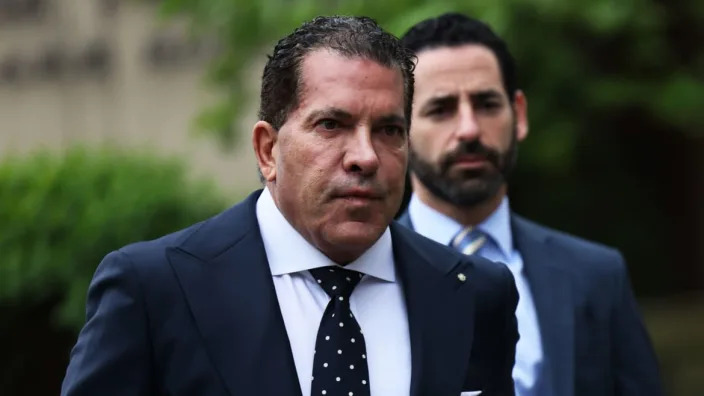
Trump Lawyer Joe Tacopina’s Terrible Cross-Examination Gets Even Worse

Daily Beast

Trump Lawyer Joe Tacopina’s Terrible Cross-Examination Gets Even Worse

Mitchell Epner – May 1, 2023

Michael M Santiago/GettyImages

During more than a full day of cross-examination of E. Jean Carroll, Joe Tacopina, Donald Trump’s lead trial lawyer, gave an object lesson on how NOT to conduct a cross-examination in federal court.

The first day of cross-examination was badDay two was even worse. If a juror believed E. Jean Carroll’s direct testimony that she was raped by Donald Trump, Tacopina gave that juror precious little reason to reconsider that conclusion.

Before court even started Monday morning, Tacopina filed an 18-page motion for a mistrial, contending that Judge Lewis Kaplan–who is overseeing the case–had violated Trump’s rights by repeatedly ruling against Tacopina pre-trial and during the first day of cross-examination.- ADVERTISEMENT -https://s.yimg.com/rq/darla/4-11-1/html/r-sf-flx.html

Trump Rape Jurors Hear About the Flight When Trump Groped Another Woman

Tacopina acted as if Judge Kaplan was a batter who had dug in too closely to home plate, and he could use the motion as a “brush back” pitch to get Judge Kaplan to give Tacopina more leeway. The motion literally asked Judge Kaplan to either declare a mistrial or reverse virtually all of his evidentiary rulings.

This motion never had a chance of success. At best, it was performative–designed to give Tacopina the chance to demonstrate to Trump that he was trying his best to get Judge Kaplan to reverse himself. If Tacopina actually believed that the motion had any prospect for success, he is not nearly as formidable a trial attorney as I thought he was.

Predictably, Judge Kaplan ruled against the motion with a single word: “Denied.” During the rest of the day’s proceedings, Judge Kaplan made comments that underscored that he was not amused by the motion.

But that was just the beginning of the blunders.

<div class="inline-image__caption"><p>Joe Tacopina, lawyer of former U.S. President Donald Trump, questions former Elle magazine advice columnist E. Jean Carroll before U.S. District Judge Lewis Kaplan. </p></div> <div class="inline-image__credit">Jane Rosenberg/Reuters</div>
Joe Tacopina, lawyer of former U.S. President Donald Trump, questions former Elle magazine advice columnist E. Jean Carroll before U.S. District Judge Lewis Kaplan.Jane Rosenberg/Reuters
Tacopina Violated Cardinal Rules Of Cross-Examination

One of the central rules of cross-examination is to never reinforce the testimony that the witness provided during direct testimony. This is difficult, because it is a challenge to remind the jurors of the testimony that the attorney intends to discredit without recapitulating that testimony.

The best cross-examination usually avoids this problem by using this formulation: “When you said [prior testimony] on direct examination, that was not the truth, was it?” The witness will either defend the prior testimony or appear confused. Good cross-examination will then lay out, in simple and direct assertions (phrased as questions), why the prior testimony had to be false.

Tacopina did precisely the opposite. He spent minutes at a time giving Carroll the opportunity to repeat her direct testimony. When he then tried to debunk it, he rarely had anything of substance to convince the jury that she must have been lying. Rather, he repeatedly just tried to get Carroll to admit that her testimony was “incredible” or “extraordinary”. Once she admitted that she found it amazing that she went from bantering with Trump to being a rape victim in the course of a couple of minutes, he had no place left to go.

Trump’s Lawyers Go After E. Jean Carroll for ‘Scheme’ Email

Tacopina also forgot the cardinal rule to never ask a question where you don’t know the answer.

Anyone who watches an episode of Law & Order (more on that shortly) knows that an attorney should never ask a question on cross-examination where they do not already know the answer (and have the evidence to control the witness).

Tacopina, however, repeatedly asked questions where it was clear he had no idea what the answer would be. During the first day of cross-examination, he jousted with Carroll about a SNL skit that she had written, which he clearly knew nothing about. On Monday, he did more of the same, asking about a text message to “Carol Martin” (who will testify for Carroll), when the text exchange was actually with “Carol Martin’s daughter Courtney”. Even after he was corrected, Tacopina repeated his assertion that the message was to Carol Martin.

Q: OK. This, in fact, was a text message that you had sent to Carol Martin, correct, and then to pass on to her daughter?

A: No.

Q: This was directed to her daughter?

A: Yes. I wrote directly to her daughter.

Q: So, with that adjustment in my question, that this was sent to Ms. Martin’s daughter, what you wrote was true?

A: Yes.

Tacopina Lost Control

Another rule for strong cross-examination is to never lose control of the courtroom. A good attorney will command the attention of the jury, using the witness as a prop who can only say “yes” when the attorney finishes a leading question with only one possible answer.

Instead, Tacopina ceded control to a video, playing an entire segment (over 10 minutes) of a CNN interview where Carroll talked to Anderson Cooper about being raped by Trump. Tacopina’s client, Trump, has repeatedly stated that he believes that anyone who watches the segment would conclude that Carroll must be lying. Instead, Tacopina gave the jury the opportunity to see Carroll once again cogently describe being sexually assaulted by Trump. While the video was playing, Tacopina was literally reduced to being an observer.

Jury Has Likely Decided Trump’s Fate in Rape Case Already

Tacopina Was Repeatedly Shut Down By Judge Kaplan

During my more than 25 years as a trial attorney, I have appeared before Judge Kaplan several times. He does not suffer fools gladly. During Monday’s cross-examination, Judge Kaplan frequently treated Tacopina as a fool who did not know the basics of the rules of evidence. He sustained several objections to lines of questions, just as Tacopina thought he was about to score points.

Virtually every time that Tacopina tried to use snide comments or repetition to undercut Carroll’s credibility, Judge Kaplan sustained objections or simply told Tacopina to “move along.”

In the courtroom, jurors typically look to the judge for guidance on how to regard the proceedings. When Judge Kaplan showed such disdain for Tacopina’s blustering and preening, he gave the jurors permission to disregard Tacopina’s questions as improper.

Tacopina Had A Few Scattered Successes

Tacopina had about five minutes of strong cross-examination. The problem was that it was hidden in about eight hours of ineffective questioning. His best questions were when he used Carroll’s own words (either from deposition or televised interviews) to rebut some of her direct testimony. For example, Carroll testified on direct that the rape by Donald Trump was the reason that she never had sex again.

Tacopina got Carroll to admit that she had previously stated during a podcast: “Well, after the episode in Bergdorf’s, I never had sex again, but I think it wasn’t because of him. I think it was I just didn’t have the luck to meet that person who would be desirous again. I think maybe in that dressing room my desire for desire was killed, but I think if I had met somebody, had the good luck to meet somebody, I think I would have been revived again. I think the desire would have boiled up again. I just think I’ve been unlucky.”

Had Tacopina limited himself to similar excerpts, I believe that he would have had a much greater impact in undercutting Carroll’s credibility.

E. Jean Carroll Testifies About ‘Extremely Painful’ Trump Rape

Re-Direct of Carroll Brought Home Her Central Allegation

One of the fundamental trial rules is that after cross-examination, the witness’ attorney has the opportunity to “rehabilitate” the witness through re-direct. Carroll’s attorney, Michael Ferrera, did a spectacular job. He gave Carroll the opportunity to directly address the insinuation on cross-examination that she had conjured up a rape allegation against Trump on the basis of an episode of Law & Order SVU that included a rape at Bergdorf Goodman.

Carroll testified that she never saw that episode or had never heard of it until she received an email (after she filed suit) telling her about it, and that she still did not know what happened in that episode.

More importantly, Carroll had the opportunity to again clearly state that Trump had raped her. She again testified that she could still feel the pain from when Trump sexually assaulted her. Her testimony was unshaken, even after two days of cross-examination.

A good cross-examination takes less than 30 minutes. The cross-examiner makes a few powerful points, which the witness cannot deny and re-direct cannot rehabilitate. By that standard, Tacopina conducted a very poor cross-examination. Whatever credibility the jurors thought Carroll had after she finished her direct testimony, they likely still believe that she has now.

They Refused to Fight for Russia. The Law Did Not Treat Them Kindly.

The New York Times

They Refused to Fight for Russia. The Law Did Not Treat Them Kindly.

Neil MacFarquhar – April 30, 2023

Pedestrians walk past a patriotic mural dedicated to victory in World War II, in Moscow, Feb. 17, 2023. (Nanna Heitmann/The New York Times)

An officer in the Federal Guard Service, which is responsible for protecting Russian President Vladimir Putin, decided last fall to avoid fighting in Ukraine by sneaking across the southern border into Kazakhstan.

The officer, Maj. Mikhail Zhilin, disguised himself as a mushroom picker, wearing camouflage and carrying a couple of small bottles of cognac so that he could douse himself and then act drunk and disoriented if he encountered the Russian border patrol.

In the dark, the lean, fit major navigated across the forested frontier without incident, but he was arrested on the other side.

“Freedom is not given to people that easily,” he told his wife, Ekaterina Zhilina, months later, after Kazakhstan rejected his bid for political asylum and handed him back to Russia to face trial for desertion.

“He had these romantic notions when he first began his military-academic studies,” Zhilina said in a recent interview, describing perceptions drawn from Russian literature about the honor and pride inherent in defending your homeland. “But everything soured when the war started.”

Zhilin is among the hundreds of Russian men who faced criminal charges for becoming war refuseniks since Moscow’s full-scale invasion of Ukraine last year. Some dodge the draft, while those already serving desert or refuse orders to redeploy on the bloody, chaotic battlefields of Ukraine.

In 2022, 1,121 people were convicted of evading mandatory military conscription, according to statistics from Russia’s Supreme Court, compared with an average of around 600 in more recent years. Before the war, a vast majority were fined, not imprisoned. Russia recently passed a measure making it much harder to avoid a draft summons.

In addition, criminal cases have been initiated against more than 1,000 soldiers, mostly for abandoning their units, according to a broad court survey by Mediazona, an independent Russian news outlet. Anticipating the problem in September, when several hundred thousand civilians were mobilized, Russia toughened the penalties for being AWOL.

The maximum sentence was doubled to 10 years for what is euphemistically called “Leaving for Sochi.” (SOCH is the Russian acronym for AWOL, but the expression is a play on the name of Sochi, a Black Sea getaway for the country’s elite and site of the 2014 Winter Olympics.) Refusing an order to participate in combat carries a sentence of three to 10 years.

That has not stopped Russian men from going to unusual lengths to avoid fighting. One officer said he took a bullet in the leg as part of a pact among several soldiers to shoot one another and then claim that they were wounded in a firefight. Hailed as a hero for various battlefield events, it took him six months to recover, at which point he decided to flee.

The Kremlin has shrouded in secrecy an increasing amount of information about the military, including new statistics about crimes involving military service, so the numbers are undoubtedly higher than what is available. But the number of AWOL cases accelerated after the general mobilization, according to Mediazona. Many criminal cases involve soldiers who refused orders to enter battle, leading to confrontations with their commanders, according to several lawyers who defend soldiers.

One lawyer, Dmitri Kovalenko, was retained by the families of more than 10 soldiers who said they were thrown into pits, called “zindans,” near the front line after refusing to fight. “People realize that they are not ready — that their commanders are not ready, that they have to go in blind, not knowing where or why,” he said.

Intimidation is the first response of commanders, he said, so treatment can be harsh. Two soldiers whom he defended were locked into a container last summer without food or water, he said. At one point, about 300 conscripts who refused to fight last year were held in a basement in eastern Ukraine, where they were threatened, called “pigs,” not fed and not allowed to go to the toilet or to bathe, according to Astra, an independent news outlet, and other Russian news media organizations, quoting relatives. The Wagner mercenary group has threatened to execute its refuseniks, and there have been scattered reports of them being shot.

In theory, Russian law allows for conscientious objectors performing alternative service, but it is rarely granted. Sometimes those charged with refusing to fight are given suspended sentences, which means they can be redeployed.

The officer who was shot in the leg by his colleague had pursued a military career since he was 9 and a cadet, he said, but he wanted it to be over the minute he was ordered into Ukraine. He ended up staying about three months, appalled by the very idea of the war as well as by the terrible state of the Russian military.

Soldiers were not provided basic items like underwear, he said, and few knew how to navigate and got themselves killed.

“There are no saints on either side,” said the officer, who spoke on the condition that he not be named, nor his location published, out of concern that Russia might seek his extradition. “The locals were actively partisan. I shot back. I didn’t want to die.”

After he recovered, and the military ordered him back to Ukraine, he decided to run.

“I’m ready to die for Russia, but I don’t want to fight, to risk my life for the criminals who sit in the government,” said the officer, who is now on a wanted list in Russia.

Another Russian, a member of the Sakha ethnic group concentrated in the Siberian region of Yakutia, also deserted. Five days among the drunken, newly mobilized soldiers at an army camp convinced him to leave.

The man, who also insisted on anonymity, was fired from his construction job so that he could go fight. Packed onto an airplane, the draftees discovered their destination for training by looking at their phones when they landed. Most soldiers drank constantly, he said in an interview. One night in another barracks, he said, a soldier stabbed another to death.

The conscript said that the racist attitude of his Russian officers when he did his military service a decade earlier had soured him on the military — they called him “reindeer herder” because of his ethnic Siberian background. He said he was subjected to similar comments as soon as he mobilized. Things deteriorated further after he tried to bribe his lieutenant to leave. The officer mocked him openly as a coward.

His mother flew in to extract him, directing a taxi to a hole in the base’s fence. After he fled the country and was charged with desertion, he faced fierce criticism from home, he said, with authorities saying that he had disgraced the Sakha people. Even a close friend threatened to beat him up.

Some Russian courts still publicize military cases to create a chilling deterrent to potential deserters. In the spring, for example, a court announced that a sailor who had gone AWOL twice had been sentenced to nine years in a prison colony.

The Krasnoyarsk Garrison Military Court released a photograph and a statement in December showing dozens of soldiers crowding a courtroom to watch an AWOL case. The sentence was pronounced before that audience “for preventive purposes,” the statement said.

In the Belgorod region near the Ukrainian border, two soldiers were detained on a parade ground in November and charged with refusing to obey a deployment order. They were called out of the ranks, handcuffed and thrown into a paddy wagon in front of their unit, all shown on a video posted on the Telegram messaging app. Earlier this month, both were sentenced to three years in prison, according to Russian news media reports.

Well before the war, Zhilin, 36, the soldier who left for Kazakhstan, had become disenchanted with the very administration he was assigned to protect. An engineer, he worked in the Siberian city of Novosibirsk for the presidential security service, supervising the Kremlin’s communications lines with the eastern parts of Russia.

The assassination of Russian opposition leader Boris Nemtsov in 2015 and the poisoning of Alexei Navalny in 2020 had drawn his attention, his wife said. He started following political news more closely.

He weighed quitting, but decided he could endure the two years until he received a pension. Then came the war. “‘It is one thing to suppress human rights,’” his wife quoted him as saying, “‘it is quite another to kill people.’”

In the fall, before the mobilization, he had visited the cemetery where his mother is buried. He found 30 new graves of riot police officers who had fought in the war. The ribbon on one small wreath said just “Daddy.”

Two colleagues had already died in Ukraine, and he wondered if his son, 11, and daughter, 8, might one day make a similar wreath. When the mobilization was announced, he quickly decided to leave the country.

Since his security clearance gave him access to state secrets, leaving was prohibited. He decided to cross on foot while his family drove into Kazakhstan legally.

But the plan went awry. Lacking a cell signal, he could not find their car. He was arrested after stumbling upon a Kazakh border officer. He requested political asylum, but in December, he was deported.

In March, he was sentenced to 6 1/2 years in a penal colony and stripped of his rank.

Right after he was deported, his wife, fearing that she and the children would also be sent back, sought and received political asylum in France.

So far, her husband has not been mistreated, she said. The couple, although bitter toward Kazakh authorities, consider the sentence a far better alternative than dying in Ukraine.

“Mikhail wrote me that he feels morally freer than he was,” she said, adding that he told her, “‘I guess you have to pay a certain price for the freedom to think and to say what you want.’”

What is the meaning of ‘woke’? Once a term used by Black Americans, it’s now a rallying cry for GOP

USA Today

What is the meaning of ‘woke’? Once a term used by Black Americans, it’s now a rallying cry for GOP

Mabinty Quarshie, USA TODAY – April 28, 2023

During the 2023 Conservative Political Action Conference, speaker after speaker attacked “woke” ideology in their speeches to conservative activists.

Republican presidential candidate Nikki Haley decried wokeness as “a virus more dangerous than any pandemic, hands down.”

“I traveled the country calling out the woke-industrial-complex in America,” GOP presidential candidate Vivek Ramaswamy bragged.

Elsewhere, Republicans have declared war on “woke capitalism” and even introduced legislation like the “Stop WOKE Act,” in Florida, an acronym for Stop the Wrongs to Our Kids and Employees.

The uptick on excoriating “woke ” ideology has increased in recent years among politicians, including former President Donald Trump, as Americans across the nation battle over diversity, inclusion and equity efforts in the workforce, public schools and in legislation.

But what is “woke”? And what do the GOP attacks mean for 2024?

A GOP war on ‘woke’?: Most Americans view the term as a positive, USA TODAY/Ipsos Poll finds

What does being woke mean?

Among conservative lawmakers and activists “woke” tends to be an across-the-board denunciation of progressive values and liberal initiatives.

Some have used it to attack trans and gay rights while others apply it to critical race theory – a legal theory that examines systemic racism as a part of American institutions – and the teachings of the New York Times’ 1619 project in public schools.

“If you ask people what woke is, I think what they mean is they want to stand against people who are engaging in some type of advocacy for marginalized people,” said Andra Gillespie, political scientist at Emory University.

“It’s kind of this lumping together of anybody whose views could be construed as being progressive on issues related to identity and civil rights.”

At CPAC this year, for example, Daily Wire host Michael Knowles called for the eradication of “transgenderism.”

Woke capitalism: Why Republicans aren’t winning over investors in war against ESG and ‘woke’ big business

But Black Americans have used the term “woke” since at least the early-to-mid 20th century to mean being alert to racial and social injustice.

A version of the term was first used by Pan-African activist Marcus Garvey as early as 1923. It was later popularized by Blues artists such as Lead Belly, who used it when singing about the Scottsboro Boys, a group of nine Black teenagers who were falsely accused of raping two white women on a train in northeast Alabama in 1931.

As the Black Lives Matter movement began after the police killing of Michael Brown in Ferguson, Missouri in 2014, “woke” expanded outside of Black communities into the larger public lexicon.

What about ‘stay woke’?

Black artists and entertainers continued to insert the phrase in their music, including Grammy-award-winning artists Erykah Badu and Childish Gambino — a.k.a. Donald Glover—for political causes.

Yet “woke” has now been hijacked by the political right to mean something far from its original definition.

“The reason we have to ‘stay woke’ is because of exactly what these people are doing right now, which is finding very insidious ways to undercut our rights,” said Terri Givens, a political science professor at McGill University.

Givens called the attacks on the term “a full-on dog whistle” and pointed to attempts to limit the right to vote, curtail reproductive and abortion rights and ban inclusive education in schools as examples of the backlash against Black and brown civil rights.

“Learning history is not about woke-ism,” Given said.

The ‘woke’ backlash

Political experts said the backlash to woke-ism greatly increased after the 2020 worldwide protests against the murder of George Floyd and Breonna Taylor’s killing.

Conservatives now use the term as a political retort to combat what they perceive as political correctness gone haywire.

But progressive commentators note that the response also comes in the context of a changing America, which is becoming more diverse racially and ethically and along sexual orientation and gender identity lines.

“What they’re trying to do is make the term a pejorative,” said Kendra Cotton, chief operating officer of New Georgia Project, a progressive-leaning voting rights group.

As more marginalized groups are elected into office and exercising their voting power during elections, it can make some Americans afraid, said Cotton.

GOP wins House majority: Republicans send a message to ‘woke’ businesses— get out of politics

Florida Gov. Ron DeSantis, a possible GOP presidential candidate, has built a persona crusading against ideas and policies conservatives deem as “woke.”

In addition to championing the Stop WOKE Act, he has stated that the Sunshine state is “where woke goes to die.”

Tehama Lopez Bunyasi, a political scientist at George Mason University and co-author of the book “Stay Woke: A People’s Guide to Making All Black Lives Matter,” said the legislation is “perhaps the most explicit way we see the co-optation of the term ‘woke’ today.”

“Right now, we’re seeing racially conservative pundits and politicians positioning themselves as adversaries of the multiracial Black Lives Matter movement,” said Lopez Bunyasi. “One of the rhetorical tools they are using is the maligning of a term that has been in use by Black people and in Black politics for well over a hundred years.”

Have the anti-woke attacks been successful?

Virginia GOP Gov. Glenn Youngkin cruised to victory in 2021 riding a wave of parental anger over teaching inclusive history in public schools.

Keneshia Grant, a political scientist at Howard University, said Youngkin’s success was part of an intentional pushback against marginalized communities, which includes misunderstanding terms like woke, critical race theory, and LGBTQ rights.

“He ends up successfully using the fear that people have about teaching students Black history or American history through the guise of CRT and successfully uses that to motivate a base,” Grant said. “They are doing this because they think it will help them win. And we have evidence that sometimes it actually does help them win.”

Americans divided on what ‘woke’ means

What’s telling is that despite the conservative backlash most Americans don’t view “woke” negatively heading into the 2024 presidential contest.

March 2023 USA TODAY/Ipsos Poll found that 56% of Americans said it means “to be informed, educated on, and aware of social injustices.”

But the efforts to re-define “woke” have worked with a significant portion of the country. Roughly 39% of those surveyed agree with the Republican definition,”to be overly politically correct and police others’ words.”

The war on ‘woke’: Senate blocks Biden ESG investing rule, Biden vows to veto

“Racial resentment and grievance are certainly one of those things that have been very effectively used to mobilize a certain segment of the Republican population for a long time,” said Gillespie.

Reporter Phillip M. Bailey contributed to this story.