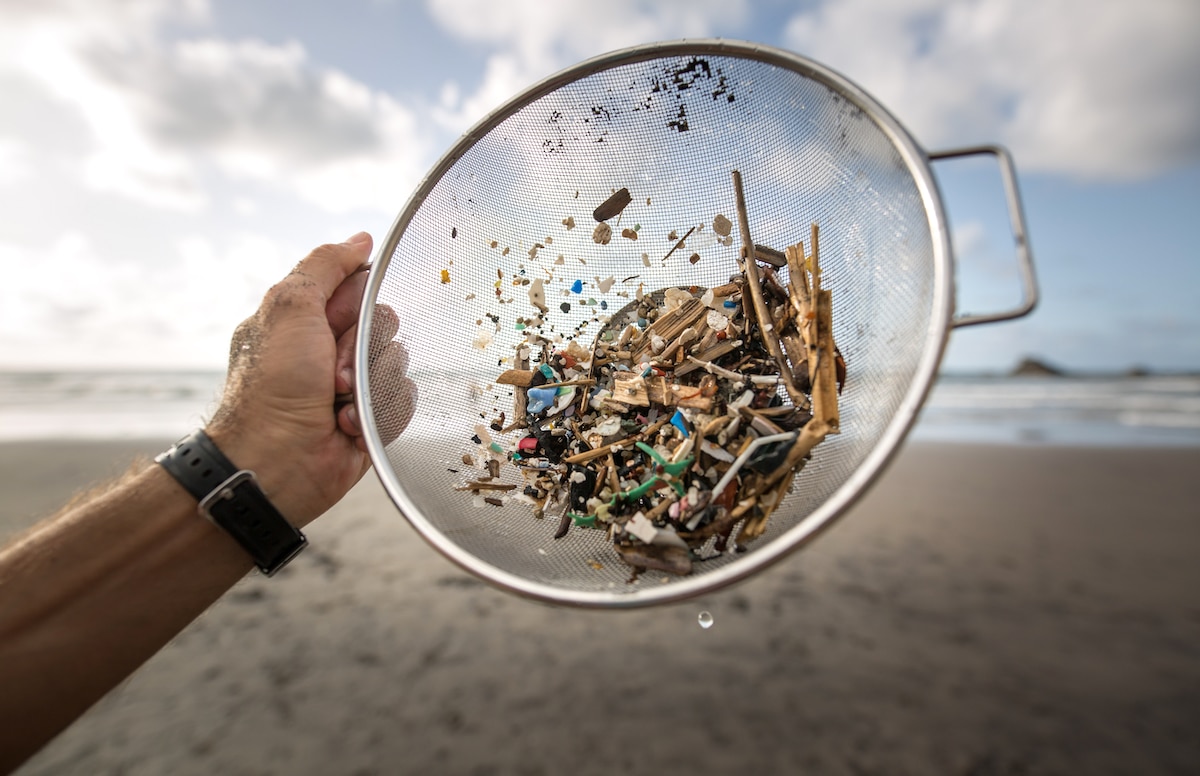
A study accepted for publication in Science of the Total Environment last month detected micro-plastics in the lung tissue of living people for the first time, and much deeper than the researchers expected.
“We did not expect to find the highest number of particles in the lower regions of the lungs, or particles of the sizes we found,” senior author Laura Sadofsky at Hull York medical school told The Guardian. “It is surprising as the airways are smaller in the lower parts of the lungs and we would have expected particles of these sizes to be filtered out or trapped before getting this deep.”
The research comes as more and more evidence shows that micro-plastics are penetrating the human body. Another study published days earlier found micro-plastics in human blood for the first time, and in almost 80 percent of the people sampled.
The new study also found the plastic in the majority of lung tissue samples – 11 out of 13, the study authors wrote. A total of 39 microplastics were found in all regions of the lung.
Previous studies had found plastics in lung samples taken from autopsies. One 2021 study in Brazil found microplastics in the lungs of 13 out of 20 people studied, The Guardian reported. A 1998 study of U.S. lung cancer patients found plastic and plant fibers in more than 100 samples. However, the lung tissue in the most recent study came from live patients at Castle Hill Hospital in East Yorkshire, the Press Association reported. It was removed in surgeries as part of the patients’ routine medical care.
“Microplastics have previously been found in human cadaver autopsy samples; this is the first robust study to show microplastics in lungs from live people,” Sadofsky said, as the Press Association reported.
The scientists used spectrometry to identify the plastics, The Guardian explained. The most common two types of plastic were polypropylene, which is used for packaging and pipes, and PET, which is commonly used for beverage bottles.
In total, 11 microplastics were found in the upper parts of the lung, seven in the middle and 21 in the lower parts, a result that was particularly surprising, according to the Press Association.
“Lung airways are very narrow so no-one thought they could possibly get there, but they clearly have,” Sadofsky said, as the Press Association reported.
The findings build on reports that people exposed to microplastics in industrial settings have developed respiratory symptoms and diseases, the study authors wrote.
“This data provides an important advance in the field of air pollution, micro-plastics and human health,” Sadofsky said, as the Press Association reported. “The characterization of types and levels of micro-plastics we have found can now inform realistic conditions for laboratory exposure experiments with the aim of determining health impacts.”
Virtually everyone on Earth is breathing polluted air, according to a new report from the World Health Organization (WHO). In a report released Monday, the U.N. agency stated that 99% of the global population “breathes air that exceeds WHO air quality limits, and threatens their health.”
That startling fact can be attributed in part to improved monitoring of air quality. An all-time high of more than 6,000 cities in 117 countries now monitor air pollution. That’s 2,000 more cities than the last update to the WHO’s air quality database, and six times as many as when it launched in 2011. The WHO is also now able for the first time to measure ground-level average annual concentrations of nitrogen dioxide, and it can track smaller sizes of particulate matter than ever before. (Exposure to nitrogen dioxide can cause respiratory disease such as asthma, symptoms such as coughing, and emergency room visits.)
An aerial view of vehicles driving near downtown Los Angeles. (Mario Tama/Getty Images)
The high percentage of areas that exceed the threshold for harmful pollution is also driven by the fact that last year the WHO tightened its standards for air quality for the first time in 15 years. The organization lowered exposure levels of pollutants including sulfur dioxide, carbon monoxide, ground-level ozone and particulate matter. The WHO calculates that air pollution causes more than 7 million premature deaths each year.
“It has been recognized that air pollution has an impact at a much lower level than previously thought,” Dr. Sophie Gumy, technical officer at WHO’s Department of Environment, Climate Change and Health, told UN News. “So, with all the new evidence that has come up over the last 15 years since the last WHO air quality guideline update, most of the values of the guidelines levels have been reduced.”
Most air pollution is caused by the combustion of fossil fuels such as oil, gas and coal, which are also responsible for the greenhouse gas emissions causing climate change. Climate change is also itself a cause of increasing air pollution, due to the fact that ground-level ozone, also known as smog, forms more readily in warmer temperatures, and wildfires are increasingly frequent and severe.
The WHO called for nations to accelerate their transition to electric vehicles and clean sources of energy.
“Current energy concerns highlight the importance of speeding up the transition to cleaner, healthier energy systems,” said WHO Director-General Tedros Adhanom Ghebreyesus in the report. “High fossil fuel prices, energy security, and the urgency of addressing the twin health challenges of air pollution and climate change, underscore the pressing need to move faster towards a world that is much less dependent on fossil fuels.”
Birds and bees work together as pollinators. DansPhotoArt on flickr / Moment / Getty Images
For many people, one rich, pleasant smell signals the start of a new day more than any other: coffee. Different techniques have been used to get the best cup of the caffeine-rich liquid, from a French press to the pour-over method.
A unique new study has found that the secret to better coffee is really in control of the birds and the bees.
In the study, researchers found that when birds and bees joined forces to protect and pollinate coffee plants, the result was coffee beans that were bigger, more abundant and of better quality, reported the University of Vermont. Some of the flying assistants come from thousands of miles away, and without them the $26 billion coffee industry would see a 25 percent decrease in crop yields, or about $1,066 per hectare — a hectare equals almost two and a half acres — in coffee losses.
“Until now, researchers have typically calculated the benefits of nature separately, and then simply added them up,” said Alejandra Martínez-Salinas of the Tropical Agricultural Research and Higher Education Center (CATIE), who was the study’s lead author, the University of Vermont (UVM) reported. “But nature is an interacting system, full of important synergies and trade-offs. We show the ecological and economic importance of these interactions, in one of the first experiments at realistic scales in actual farms.”
For the study, the researchers from Latin America and the U.S. used the world’s most popular type of coffee, Coffea arabica, a self-pollinating crop. They used small lace bags and large nets to test four scenarios on 30 coffee farms in Costa Rica. These included bee pollination alone; pest control by birds alone; zero bee and bird activity; and “a natural environment” in which the bees and birds were free to work together, going about their pollinating activities and munching on insects like the damaging coffee berry borer, which affects worldwide coffee production.
“These results suggest that past assessments of individual ecological services… may actually underestimate the benefits biodiversity provides to agriculture and human wellbeing,” said Taylor Ricketts of the University of Vermont’s Gund Institute for Environment. “These positive interactions mean ecosystem services are more valuable together than separately.”
The study, “Interacting pest control and pollination services in coffee systems,” was published in the journal Proceedings of the National Academy of Sciences.
In the study, it was found that the birds and bees had combined positive effects on the overall weight, weight uniformity and set of the coffee fruit — which all affect the quality and price — that were more significant than each of their effects alone, the University of Vermont reported.
“One important reason we measure these contributions is to help protect and conserve the many species that we depend on, and sometimes take for granted,” Ph.D. candidate at UVM’s Gund Institute for Environment and Rubenstein School of Environment and Natural Resources Natalia Aristizábal said. “Birds, bees, and millions of other species support our lives and livelihoods, but face threats like habitat destruction and climate change.”
Supreme Court reinstates Trump-era water rule, for now
Jessica Gresko – April 6, 2022
Visitors walk outside the Supreme Court building on Capitol Hill in Washington, Feb. 21, 2022. The Supreme Court reinstated for now a Trump-era rule that had curtailed the power of states and Native American tribes to block pipelines and other energy projects that can pollute rivers, streams and other waterways. (AP Photo/Patrick Semansky, File)
Frozen water pools in a corn field near a Keystone pipeline pumping station in rural Milford, Neb., Thursday, Jan. 9, 2020. The Supreme Court reinstated for now a Trump-era rule that had curtailed the power of states and Native American tribes to block pipelines and other energy projects that can pollute rivers, streams and other waterways. (AP Photo/Nati Harnik, File)
WASHINGTON (AP) — The Supreme Court on Wednesday reinstated for now a Trump-era rule that curtails the power of states and Native American tribes to block pipelines and other energy projects that can pollute rivers, streams and other waterways.
In a decision that split the court 5-4, the justices agreed to halt a lower court judge’s order throwing out the rule. The high court’s action does not interfere with the Biden administration’s plan to rewrite the rule. Work on a revision has begun, but the administration has said a final rule is not expected until the spring of 2023. The Trump-era rule will remain in effect in the meantime.
The court’s three liberal justices and Chief Justice John Roberts dissented. The court’s other conservative justices, including three nominated by President Donald Trump, voted to reinstate the rule.
Writing for the dissenters, Justice Elena Kagan said the group of states and industry associations that had asked for the lower court’s ruling to be put on hold had not shown the extraordinary circumstances necessary to grant that request.
Kagan said the group had failed to demonstrate their harm if the judge’s decision were left in place. She said the group had not identified a “single project that a State has obstructed” in the months since the judge’s decision and had twice delayed making a request, indicating it was not urgent.
Kagan said the court’s majority had gone “astray” in granting the emergency petition and was misusing the process for dealing with such requests. That process is sometimes called the court’s “shadow docket” because the court provides a decision quickly without the full briefing and argument. The liberal justices have recently been critical of its use.
As is typical, the justices in the majority did not explain their reasoning.
Kagan wrote that her colleagues’ decision “renders the Court’s emergency docket not for emergencies at all.”
Alsup was nominated to the bench by President Bill Clinton.
The section of federal law at issue in the case is Section 401 of the Clean Water Act. For decades, it had been the rule that a federal agency could not issue a license or permit to conduct any activity that could result in any discharge into navigable waters unless the affected state or tribe certified that the discharge was complied with the Clean Water Act and state law, or waived certification.
The Trump administration in 2020 curtailed that review power after complaints from Republicans in Congress and the fossil fuel industry that state officials had used the permitting process to stop new energy projects. The Trump administration said its actions would advance then-President Donald Trump’s goal to fast-track energy projects such as oil and natural gas pipelines.
States, Native American Tribes and environmental groups sued. Several mostly Republican-led states, a national trade association representing the oil and gas industry and others have intervened in the case to defend the Trump-era rule. The states involved in the case are: Arkansas, Louisiana, Mississippi, Missouri, Montana, West Virginia, Wyoming and Texas.
‘A year-after-year disaster:’ The American West could face a ‘brutal’ century under climate change
Elizabeth Weise – April 2, 2022
SAN FRANCISCO – The West, once a beacon for all that was new and hopeful in America, could become an example of the grim, apocalyptic future the nation faces from climate change.
The last five years already have been harrowing.
Whole neighborhoods burned down to foundations. Children kept indoors because the air outside is too dangerous to play in. Killer mudslides of burned debris destroying towns. Blood-red skies that are so dark at midday, the streetlights come on and postal workers wear headlamps to deliver the mail.
And it’s going to get worse unless dramatic action is taken, two studies published this week forecast.
The first predicts the growth of wildfires could cause dangerous air quality levelsto increase during fire season by more than 50% over the next 30 years in the Pacific Northwest and parts of northern California.
A second showshow expected increases in wildfires and intense rain events could result in more devastatingflash floods and mudslides across a broad portion of the West.
“These studies reinforce the likelihood of a brutal future for the West,” said Jonathan Overpeck, a climate scientist and dean of the University of Michigan’s School for Environment and Sustainability.
“Even climate scientists are scared,” he said. If climate change isn’t curbed, a “dystopian” landscape could be the result.
El Dorado County firefighters battle a fire close to a home off of U.S. Highway 89 in the Christmas Valley community near Meyers, Calif., on Monday, Aug. 30, 2021.
Each study, based on evermore-precise climate modeling, follows previous research showing the recentred skies, torched forests and neighborhoods, and catastrophic flooding and mudslides could bethe new normal unless carbon emissions are halted soon.
“These papers echo an overwhelming trend,” said Rebecca Miller, who studies the impact of fire on the West at the University of Southern California. “Fires and their impacts are getting more severe and are projected to just get worse, becoming a year-after-year disaster.”
What this means for the West, home to 79 million people, is in some ways a return to the past.
“When you moved to the West a century ago, it was an inhospitable place. There was an underlying danger,” said Bruce Cain, director of the Bill Lane Center for the American West at Stanford University. “We’re returning to that.”
The dire consequences, however, may be an incentive for Americans to take meaningful climate action.
“It’s a kick in the pants to get stuff done,” Cain said.
Bad air days
Rising levels of dangerous particles in the air due to smoke from wildfires are a growing threat not just in the American West but across the country, the paper published Monday in the Proceedings of the National Academy of Science showed.
In just the last five years, the West saw a series of historically large and destructive fires that burned millions of acres, destroyed thousands of homes and killed hundreds of people. The annual area burned by forest fires in the region has increased tenfold over the past half-century.
The smoke from those fires turned skies red and was so pervasive that Pacific Coast cities from Los Angeles to Seattle kept children indoors during recess and canceled sporting events. Residents were advised not to go outside and to tightly close windows and doors. Sales of air filters skyrocketed.
Downtown Los Angeles and Dodger Stadium are shrouded, looking south from Elysian Fields through the smoke from the Bobcat and the El Dorado fires, Friday, Sept. 11, 2020.
By the end of the century, these kinds of dangerous, polluting firescould occur every three to five years across the Pacific Northwest and parts of northern California, the study by scientists at Princeton University and the National Oceanic and Atmospheric Administration found.
“These unhealthy particle pollution levels that occurred in the recent large fires may become the new norm in the late 21st century,” said Yuanyu Xie, a researcher in atmospheric and oceanic sciences at Princeton and one of the paper’s authors.
The scientists modeled several scenarios. In what’s known as the “middle of the road” climate change scenario, in which carbon emissions don’t start to fall before mid-century and don’t reach net-zero until 2100, the models show smoke pollution increasing by 100% to 150%.
In the “business as usual” scenario, in which society doesn’t make concerted efforts to cut greenhouse gases, smoke increases 130% to 260%.
The danger stretches across the United States. Wildfire smoke can travel hundreds and even thousands of miles. In July, smoke from Western wildfires triggered air quality alerts and caused smoky skies and red-orange haze in New York, Washington, Baltimore, Philadelphia and Boston.
Staten Island ferry commuters take in the view of the Statue of Liberty seen through the haze on July 20, 2021, in New York. Smoke from wildfires across the U.S. West, including Oregon’s Bootleg Fire, has wafted over large swaths of the eastern United States. New York City’s skies were hazy with smoke from fires thousands of miles away.
“It’s not simply a health threat to people who lives in Western states. We’re seeing impacts hundreds and sometimes thousands of miles away,” said the American Lung Association’s senior vice president for public policy Paul Billings.
The particles in smoke can penetrate deep into the lungs, creating and exacerbating multiple health issues.
“It can cause asthma attacks, strokes, heart attacks and increases in cardiovascular problems,” said Billings. There’s also evidence that smoke may impact pregnancy and birth outcomes.
Cloudbursts, floods and mudslides
A second paper, published Friday in the journal Science Advances, modeled two separate trends in the West – increasing “fire weather” and increased extreme rainfall events – that together spell trouble.
In the past, extreme rainfall was unlikely to follow a major wildfire, but the one-two punch is becoming more common and can be a dangerous combination.
Westerners have long lived with so-called fire weather, times of exceptional heat, dryness and wind that increase fire danger. The National Weather Service even produces fire weather forecasts. The researchers’ models show that these extreme events will increase in the coming decades.
At the same time, the frequency and intensity of extreme rain events are projected to also increase in much of the western United States, the study showed. By mid-century, midsized heavy rain events are expected to increase by more than 30%.
“It’s like rolling dice, you have your set of fire dice and your set of rain dice. Sometimes it comes up fire and rain in the same year,” said Samantha Stevenson, a climate modeler at the University of California, Santa Barbara, a co-author of the paper.
That poses an additional risk to anyone living downhill from charred areas. Fires destroy vegetation that holds soils in place and can sometimes harden the ground, lessening its ability to absorb water. Both contribute to the possibility of catastrophic flash floods and what scientists call debris flows.
“It’s a mixture of rocks, soil, vegetation and water that’s moving downhill at a rate you can’t outrun,” said Matthew Thomas, a research hydrologist with the U.S. Geological Survey. “A flood can inundate a home, but a debris flow can take it off its foundation.”
Models run by scientists predict that in the Pacific Northwest, more than 90% of fire weather days will be followed within six months by extreme rain events. Over five years, almost all fire weather will be followed by at least one extreme rainfall event – and it can take that long for scorched land to recover.
The findings were similar, though less extreme for California and Colorado.
The results surprised Danielle Touma, an environmental engineering researcher at the University of California, Santa Barbara, who co-authored the paper.
“Seeing the numbers on your screen, it’s quite shocking,” she said.
The phenomenon is already visible.
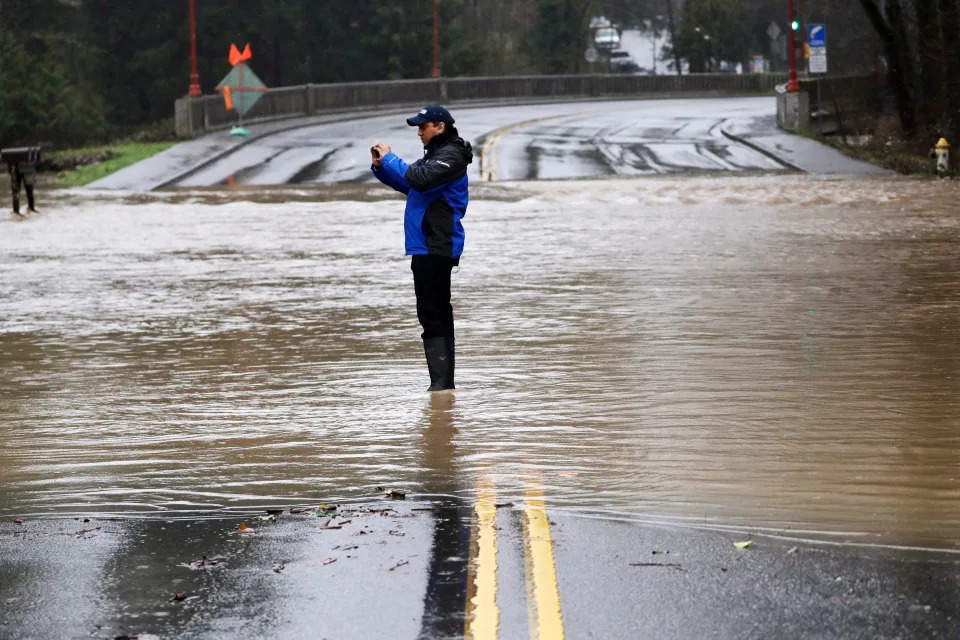
A man stands in a roadway flooded by Issaquah Creek and takes photos Thursday, Feb. 6, 2020, in Issaquah, Wash. Heavy rain sent the creek over a major roadway, under an apartment building east of Seattle and up to the foundations of homes as heavy rains pounded the region. A flood watch was in effect through Friday afternoon across most of western Washington.
A USA TODAY investigation last year found that between 2018 and 2021, fast-moving debris flows have damaged and destroyed hundreds of homes, closed major transportation routes across at least three states and caused more than $550 million in property damage. Close to 170 people have been injured and 28 people died since 2018.
Last year, flash floods in Colorado’s Poudre Canyon killed at least three people. It occurred in the burn scar left by the 2020 Cameron Peak Fire, the largest recorded fire in Colorado history.
In 2018 the Montecito mudslide killed 23 people near Santa Barbara, and properly loss claims totaled $421 million. It came just a month after the Thomas fire, one of the largest in state history, killed two people, destroyed at least 1,000 structures and cost $1.8 billion in property damages.
The speed at which wildfires have worsened across much of America has exceeded predictions by the scientific community, said Overpeck.
“If anything, the theory and the models were underestimating how hard and fast these impacts would accumulate,” he said. “Mother Nature is making that crystal clear.”
Contact Elizabeth Weise at eweise @usatoday.com
San Francisco’s Glen Park neighborhood at 9:55 am Pacific Daylight Time on Wednesday, September 9, 2020. Smoke from numerous wildfires over a layer of marine fog turned the sky an eerie orange color. Cars were using headlines and some street lights were still on.
Mystery Chemicals in Plastics Might Lead to Obesity
Olivia Rosane – April 01, 2022
Chemicals that encourage fat growth might leach into our food via household plastics. Wachirawit Iemlerkchai
Is plastic making you fat?
It’s well known that plastics contain endocrine-disrupting chemicals like bisphenol A (BPA) and phthalates. However, a recent study published in Environmental Science and Technology found that these infamous chemicals may just be the tip of the trashberg. The researchers tested 34 common plastic products from bath slippers to yogurt cups and found that a third of them contained chemicals that induced the growth of fat cells in the lab.
“The most important finding, I think, is that everyday plastic products contain chemicals that can disrupt our metabolism in a process we call adipogenesis,” study co-author and Norwegian University of Science and Technology (NTNU) associate professor Martin Wagner told EcoWatch. “And we know that adipogenesis is like the first step towards developing obesity or becoming overweight later.”
Mystery Chemicals
The researchers used mass spectrometry to identify the chemicals in 34 common plastic items, including food packaging like yogurt cups and plastic bottles as well as household items like kitchen sponges or placemats. The goal, Wagner said, was to cover the major types of plastic polymers.
They found a total of 55,300 distinct chemical features, but were only able to identify 629 of them. Among them were 11 previously-known metabolism disrupting chemicals (MDCs). However, the scientists then tested whether or not exposure to the plastics would encourage precursor cells to transform into fat cells. Some of the plastics that encouraged fat-cell growth did have one of the 11 known MDCs in their chemical makeup, but others did not.
“It’s very likely that it is not the usual suspects, such as Bisphenol A, causing these metabolic disturbances,” first-study author Johannes Völker of NTNU’s Department of Biology said in a press release emailed to EcoWatch. “This means that plastic chemicals other than the ones we already know could be contributing to overweight and obesity.”
Causes of a Pandemic
The study adds to a growing body of research that suggests the obesity pandemic isn’t just a question of poor diets and sedentary lifestyles. Almost three times more people are obese today than they were in 1975, and this is a major public health concern. Obesity contributes to many of the most common causes of death including cancer and heart disease and can increase the risk of contracting infections including COVID-19.
At first, health experts thought that obesity was caused by a mix of genetics and lifestyle factors, but this doesn’t explain all the data. For example, a 2016 study found that the body mass index (BMI) for 36,377 U.S. adults between 1988 and 2006 rose by as much as 2.3kg/m(2) even when caloric intake and physical activity stayed constant. This led to the conclusion that there must be another factor promoting weight gain. But what? One potential culprit was chemicals that mess with the endocrine system, which controls appetite, metabolism and weight.
“Connecting endocrine disruption and obesity gave rise to the so-called obesogen hypothesis, which poses that environmental chemicals (obesogens) contribute to obesity,” the study authors wrote.
Plastics aren’t the only potential source of exposure to these chemicals. Pesticides are another. For example, a 2021 study found that chlorpyrifos can slow the calorie-burning efforts of brown fat in mice. However, plastics are an increasingly ubiquitous part of our daily lives. The obesogen hypothesis indicates that obesity, like many public health and environmental problems, will not be solved by appeals to personal responsibility alone.
“It puts the responsibility, in our case, I think, really on the plastic producers, because they should make sure that their products that they’re selling us are safe,” Wagner told EcoWatch.
But what is the chance that the chemicals contained in the 34 plastic products are actually ending up in people’s bodies? There are several ways that this could happen, Wagner said. Chemicals can leach from plastic food containers, especially when heated. Children might chew on toys or items like plastic sponges. It’s also possible that the chemicals could migrate through the skin when you wear plastic gloves or slippers. Finally, we might breathe them in; phthalates have been found in household dust. While more research would be needed to test whether the chemical mixtures discovered in the study would encourage obesity in animals, there is evidence from both animal and epidemiological studies that BPA at least is strongly associated with obesity.
Losing the Plastic Weight
In the meantime, what can consumers do to make sure the plastic products in their lives aren’t working against their diets or gym memberships? Wagner said that PVC and polyurethane products “really stood out” when it came to MDC content. PVC is often found in flooring and also placemats, while polyurethane is a foam used for insulation but also other squishy materials like sponges.
These two polymers can therefore be avoided, or at least kept out of the mouths of babes. But for the other polymers like polystyrene and polyethylene, which are often used in food containers, the results were more ambiguous. One polystyrene sample had very active MDCs, while the others did not. This can make things more difficult for conscientious shoppers.
“If you buy [a] yogurt cup from polystyrene, you don’t know which one contains the toxicity,” Wagner said.
However, it also provides an opportunity for plastics manufacturers.
“Apparently you can make a polystyrene yogurt cup that actually doesn’t contain endocrine disrupting chemicals or metabolism disrupting chemicals,” Wagner said.
Wagner’s team hopes to next work on identifying which of the unknown chemicals they discovered are truly active MDCs. This will help regulators and manufacturers to know what to look out for. But Wagner also thought that plastic makers should work on designing products that have simpler chemical recipes. This will be especially important if we succeed in switching to a circular economy, because more chemicals usually have to be added to a plastic when it is recycled and reused.
“How can we design a yogurt cup that only contains ten chemicals that we can analyze and assess and make sure that they are safe?” Wagner challenged.
Russian Troops Suffer ‘Acute Radiation Sickness’ After Digging Chernobyl Trenches
Barbie Latza Nadeau – March 31, 2022
Several hundred Russian soldiers were forced to hastily withdraw from the Chernobyl nuclear power plant in Ukraine after suffering “acute radiation sickness” from contaminated soil, according to Ukrainian officials.
The troops, who dug trenches in a contaminated Red Forest near the site of the worst nuclear disaster in history, are now reportedly being treated in a special medical facility in Gomel, Belarus. The forest is so named because thousands of pine trees turned red during the 1986 nuclear disaster. The area is considered so highly toxic that not even highly specialized Chernobyl workers are allowed to enter the zone.
Energoatom, the Ukrainian agency in charge of the country’s nuclear power stations, said the Russian soldiers had panicked and fled.
“It has been confirmed that the occupiers who seized the Chernobyl nuclear power plant and other facilities in the Exclusion Zone set off in two columns towards Ukraine’s border with Belarus. The occupiers announced their intentions to leave the Chernobyl nuclear power plant this morning to the Ukrainian personnel of the station,” the agency said in a statement on Telegram, adding that a small number of Russians still remained at the facility.
The agency said it had also confirmed reports of Russian forces digging trenches in the Red Forest, “the most polluted in the entire exclusion zone.”
“Not surprisingly, the occupiers received significant doses of radiation and panicked at the first sign of illness. And it showed up very quickly.”
Local reports suggest that seven buses with the zapped troops arrived in Gomel early Thursday. Journalists on the ground have also reported “ghost buses” of dead soldiers being transported from Belarus to Russia under the cover of dark.
U.S. intelligence reported Wednesday that Russian forces began withdrawing from the defunct site. Russia said the withdrawal from Chernobyl was part of a pledge to scale back the invasion. But Ukrainian media says it is actually because the troops were “irradiated” from the contaminated soil.
“Another batch of Russian irradiated terrorists who seized the Chernobyl zone was brought to the Belarusian Radiation Medicine Center in Gomel today,” Yaroslav Yemelianenko, who works for the Public Council at the State Agency of Ukraine for Exclusion Zone Management, posted on Facebook. “There are rules for dealing with this territory.”
The Chernobyl facility fell to Russian control on Feb. 24, the first day of the invasion. Workers were on duty for more than 600 hours before being allowed a shift change. International concern grew immediately when Russian troops moved heavy military hardware through the area, kicking up radioactive dust without any protective equipment. Forest fires in the area also raised concern about environmental contamination.
Digging trenches in the forest—considered the most contaminated area of the site—drew widespread ridicule from Ukrainians who work at the site.
Ukraine says most Russian forces have left Chernobyl nuclear plant, cites radiation concerns
March 31, 2022
FILE PHOTO: A general view shows a New Safe Confinement structure over the old sarcophagus covering the damaged fourth reactor at the Chernobyl nuclear power plant, in Chernobyl
LVIV, Ukraine (Reuters) -The Ukrainian state nuclear company said on Thursday most of the Russian forces that occupied the Chernobyl nuclear power station after invading Ukraine have left the defunct plant, and suggested radiation concerns had driven them away.
Though Russian troops seized control of Chernobyl soon after the Feb. 24 invasion, the plant’s Ukrainian staff continued to oversee the safe storage of spent nuclear fuel and supervise the concrete-encased remains of the reactor that exploded in 1986, causing the world’s worst nuclear accident.
State-owned Energoatom said these workers had flagged earlier on Thursday that Russian forces were planning to leave the territory.
“The information is confirmed that the occupiers, who seized the Chernobyl nuclear power plant and other facilities in the exclusion zone, have set off in two columns towards the Ukrainian border with the Republic of Belarus,” it said in a statement.
It said a small number of Russian troops remained at Chernobyl, but did not specify how many. Russian forces have also retreated from the nearby town of Slavutych, where workers at Chernobyl live, it said.
In a separate online post, Energoatom said the Russian side had formally agreed to hand back to Ukraine the responsibility for protecting Chernobyl. It shared the scan of a document setting out such an arrangement and signed by individuals it identified as a senior staff member at Chernobyl, the Russian military official tasked with guarding Chernobyl, and others.
Reuters could not immediately verify the authenticity of the document. There was no immediate comment from the Russian authorities, who have denied that its forces have put nuclear facilities in Ukraine at risk.
‘ALMOST A RIOT’
Energoatom said it had also confirmed information that Russian troops had built fortifications including trenches in the so-called Red Forest – the most radioactively contaminated part of the zone around Chernobyl.
As a result of concerns about radiation, “almost a riot began to brew among the soldiers,” it said in the statement, suggesting this was the reason for their unexpected departure.
Ukraine has repeatedly expressed safety concerns about Chernobyl and demanded the withdrawal of Russian troops, whose presence prevented the rotation of the plant’s personnel for a time.
Earlier this week, workers at the site told Reuters that Russian soldiers had driven without radiation protection through the Red Forest, kicking up clouds of radioactive dust.
Asked to comment on the accounts from Chernobyl staff, Russia’s defence ministry did not respond.
Earlier on Thursday, the head of Energoatom urged the U.N. nuclear watchdog to help ensure Russian nuclear officials do not interfere in the operation of Chernobyl and the Zaporizhzhia nuclear power plant, Europe’s largest, which is also occupied by Russian soldiers.
(Reporting by Pavel Polityuk; Writing by Alessandra Prentice; editing by Timothy Heritage and Jonathan Oatis)
Workers at Chernobyl site say Russian soldiers drove through the highly-radioactive ‘Red Forest’ with no protective gear
Marianne Guenot –March 31, 2022
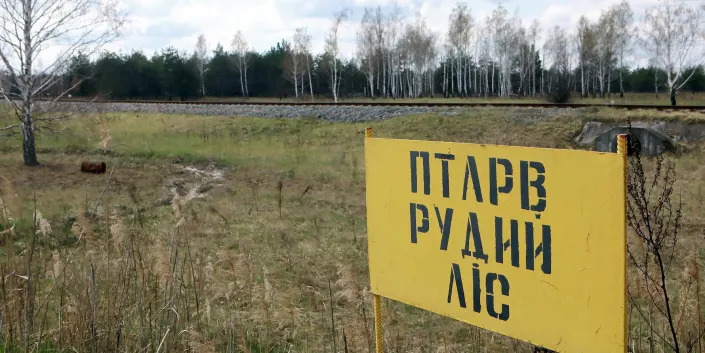
A sign warns of radiation at the “red forest” near the former Chernobyl nuclear power plant on September 29, 2015.Sean Gallup/Getty Images
Russian soldiers drove armored vehicles through the ‘Red Forest’ as they invaded Chernobyl, per Reuters.
Reuters spoke to two unnamed Ukrainian staff at the decommissioned Chernobyl nuclear power plant.
The soldier didn’t wear protective gear and exposed themselves to radioactive dust, they said.
Russian soldiers drove armored vehicles through the most contaminated area of Chernobyl’s exclusion zone with protection, two sources told Reuters.
The trip kicked up clouds of radioactive dust that could be damaging to the troops’ health, the outlet said.
One source told the outlet that the soldiers appeared to have no idea about Chernobyl’s history as a nuclear disaster site.
Reuters spoke to two Ukrainian workers who were on duty in the decommissioned power plant when Russian soldiers invaded the site on February 25 in the first days of the invasion of Ukraine.
The workers, who asked not to be named for fears about their safety, spoke to Reuters in late March.
By that time they had just been allowed home after being confined to the decommissioned power plant by Russian soldiers for almost a month.
The sign marks the territory of the Red Forest, Kyiv Region, northern Ukraine on April 21, 2021.Volodymyr Tarasov/ Ukrinform/Future Publishing via Getty Images
The workers said that Russian soldiers drove armored vehicles through the Red Forest, 1.5 square miles of pine forest that died as a result of exposure shortly after the 1986 Chernobyl nuclear accident. The Red Forest remains the most contaminated area of the zone around Chernobyl, per Reuters.
“The convoy kicked up a big column of dust,” one source said, per Reuters.
One worker told Reuters that some of the soldiers he had spoken to in the plant “did not have a clue” about the 1986 catastrophe at Chernobyl, the world’s worst nuclear disaster.
“They had no idea what kind of facility they were at,” the worker said.
The plant has been under the control of Russian troops since February 24. The power plant was fully decommissioned after the 1986 nuclear accident and the remaining work at the site is mostly directed toward decontamination.
An active nuclear power plant in Zaporizhzhia in the south of Ukraine has also been captured and has been operating under the control of Russian troops since March 4.
The invasion of nuclear sites by the military caused outrage among nuclear experts.
Several told Insider that the risk of a catastrophic nuclear accident at either of the nuclear sites remains low, but is more likely because of the nearby fighting.
The occupation of the Chernobyl site might soon be coming to an end, according to an unnamed US defense official.
The official told France 24 on Wednesday that the Russian troops looked like they were being removed from Chernobyl and repositioned in Belarus, which has a border with Ukraine around 10 miles from the Chernobyl site.
Odd Roger Enoksen, Norway’s defence minister, has now aired concerns that any accident at a Ukrainian power plant that cause a radiation leak could impact his own country if the wind travels in its direction.
According to The Times, defence sources have told civilians in Norway to start “dusting off” their bunkers at home “in case of nuclear alert”.
A view shows the abandoned city of Pripyat near the Chernobyl Nuclear Power Plant, Ukraine. (Reuters)Service members take part in tactical exercises in the abandoned city of Pripyat near the Chernobyl Nuclear Power Plant, Ukraine. (Reuters)
The source told the paper: “Everyone has been warned so if they are using them for storage now they need to make a plan for taking things out.”
A 72-hour warning would be given in advance to get bunkers ready for use.
Enoksen calmed fears that the warning was due to the threat of a nuclear war, rather than fallout from an accident.
He said: “Ukraine has the most production of nuclear power in Europe and if an accident happens, as with Chernobyl, we will all in western Europe be affected by that if the wind goes in this direction.”
Watch: Ukraine warns of Chernobyl radiation leak after power cut
Ukraine warns of Chernobyl radiation leak after power cut
Ukraine has warned that radiation could be released from Chernobyl. The nuclear power plant, which is currently under the control of Russian troops, has been knocked off the power grid and cannot cool spent nuclear fuel.
He said Norway was still able to see the effects of Chernobyl adding: “In summer time we can actually see ashes from burning grass in Ukraine.”
The warning comes as US defense officials said Russian forces may have begun to pull out of Chernobyl.
According to the AFP news agency, US defense officials said troops had begun walking away from Chernobyl and moving to Belarus. “We think that they are leaving. I can’t tell you that they’re all gone,” they said.
Norway, which shares a 12-mile land border with Russia, made it compulsory for bunkers to be built in civilian infrastructure like hotels during the Cold War-era.
Norwegians have also been told to stock up on medicines for children in case of radioactive fallout.
Norway’s defence minister Odd Roger Enoksen said Norway was still able to see the effects of the Chernobyl disaster. (Reuters)
The warnings come as the head of Ukraine’s state nuclear company urged the UN nuclear watchdog to help ensure Russian nuclear officials do not interfere in the operation of nuclear power plants occupied by Russian forces.
Energoatom CEO Petro Kotin said earlier this month that Russia’s state nuclear company Rosatom had sent officials to the Zaporizhzhia plant to try to take control of it.
Representatives from the International Atomic Energy Agency (IAEA) arrived in Ukraine on Tuesday to inspect the country’s nuclear facilities after Kyiv claimed that munitions stored near Chernobyl could explode.
A New Safe Confinement (NSC) structure over the old sarcophagus covering the damaged fourth reactor at the Chernobyl Nuclear Power Plant, Ukraine. (Reuters)
IAEA chief Rafael Grosso, along with various experts and equipment aimed at keeping nuclear facilities there safe, are on hand for assistance.
Since Russia’s invasion, Grossi has called on both countries to urgently agree a framework to ensure nuclear facilities are safe and secure.
Ukraine has repeatedly expressed safety concerns about Chernobyl and demanded Russian forces occupying the plant pull out of the area.
The Russian military said after capturing the plant that radiation was within normal levels and their actions prevented possible “nuclear provocations” by Ukrainian nationalists.
Russia has denied that its forces have put nuclear facilities inside Ukraine at risk.


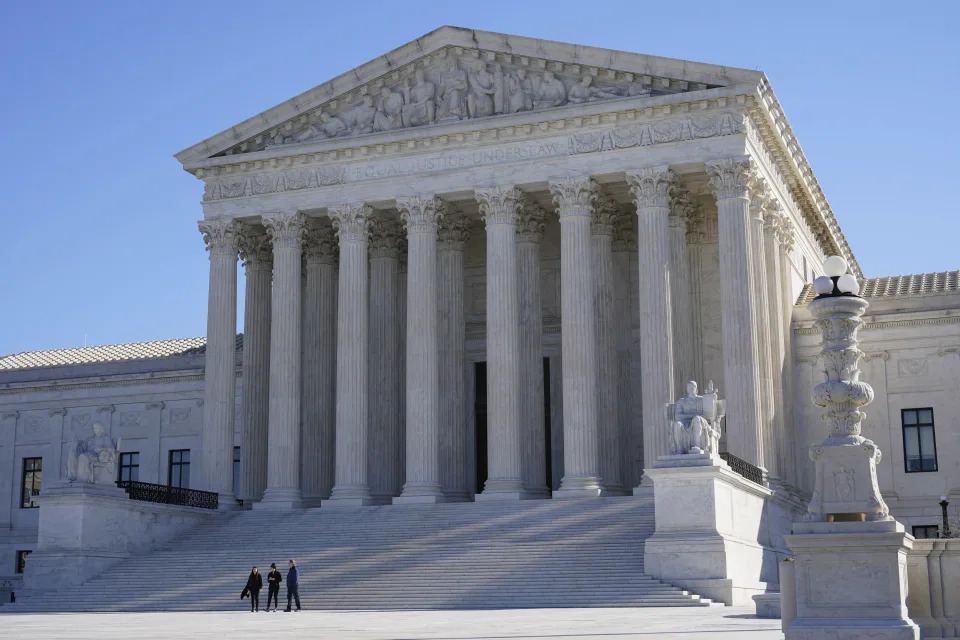 Visitors walk outside the Supreme Court building on Capitol Hill in Washington, Feb. 21, 2022. The Supreme Court reinstated for now a Trump-era rule that had curtailed the power of states and Native American tribes to block pipelines and other energy projects that can pollute rivers, streams and other waterways. (AP Photo/Patrick Semansky, File)
 Frozen water pools in a corn field near a Keystone pipeline pumping station in rural Milford, Neb., Thursday, Jan. 9, 2020. The Supreme Court reinstated for now a Trump-era rule that had curtailed the power of states and Native American tribes to block pipelines and other energy projects that can pollute rivers, streams and other waterways. (AP Photo/Nati Harnik, File)