Only a quarter of Americans have confidence in the SCOTUS, according to a June 2022 Gallup Poll.
US Supreme Court Justice Elena Kagan ruminated on the legitimacy of the Supreme Court at a conference full of lawyers and judges, warning that a disconnected court and political appointments could be “a dangerous thing for the democratic system.”
“By design, the court does things sometimes that the majority of the country doesn’t like,” Kagan said. “Overall, the way the court retains its legitimacy and fosters public confidence is by acting like a court, is by doing the kind of things that do not seem to people political or partisan, by not behaving as though we are just people with individual political or policy or social preferences.”
The core of the challenge to abortion rights that had been codified for 50 years was a Mississippi law that aimed to ban abortion after 15 weeks – which is stricter than the 24-week standard set by Roe v. Wade.
Within two weeks, the court also expanded gun rights and imposed limits on the Environmental Protection Agency’s ability to implement greenhouse gas regulations.
She added that the court generally being on the opposite side of public opinion could have grave consequences for democracy.
“I’m not talking about any particular decision or any particular series of decisions. But if, over time, the court loses all connection with the public and the public sentiment, that’s a dangerous thing for democracy,” Kagan told the conference.
In the days before the Roe V. Wade decision, a Gallup poll showed that confidence in the Supreme Court had tanked — with only 25% of Americans saying that they had faith in the institution.
“We have a court that does important things, and if that connection is lost, that’s a dangerous thing for the democratic system as a whole,” Kagan reiterated.
U.S. swelters in latest heat wave, with Texas and Oklahoma hitting 115°F
David Knowles, Senior Editor – July 20, 2022
The latest extreme heat wave to hit the United States is showing no mercy, leaving more than 105 million Americans in 28 states under heat advisories and excessive heat warnings from the National Weather Service.
Temperatures of 115 degrees Fahrenheit have been recorded in Texas and Oklahoma this week, and more than 211 million people across the country will experience heat of 90 degrees or higher on Wednesday.
In a year when record-breaking heat waves have become commonplace, scientific research has shown that climate change is behind the uptick in their frequency and duration.
“While each heat wave itself is different, and has individual dynamics behind it, the probability of these events is a direct consequence of the warming planet,” Jason Smerdon, a climate scientist for the Columbia Climate School’s Lamont-Doherty Earth Observatory in New York, told ABC News.
Residents of Texas, a state that has been subjected to daily triple-digit temperatures and is in the midst of a mega-drought affecting much of the West, have for weeks been asked to conserve water and electricity.
As in much of Europe, where local officials have urged residents to avoid unnecessary travel as a heat wave there has buckled roadways, airport runways and rail lines, people in several U.S. states have retreated inside air-conditioned spaces.
“When it’s 110 outside, you’re a prisoner in your home,” Andrew Dessler, a professor of atmospheric sciences at Texas A&M University, told the Washington Post. “Is this the kind of life you want to live?”
Like Texas, Oklahoma has been particularly hard hit by the heat, with every one of the state’s 120 weather monitoring stations recording temperatures of 102°F or higher on Tuesday.
Coupled with high humidity, the high temperatures pose a serious risk to human health. The human body sweats in order to cool off, but when humidity is high and there is too much moisture in the atmosphere, that sweat cannot evaporate and results in even higher internal temperatures.
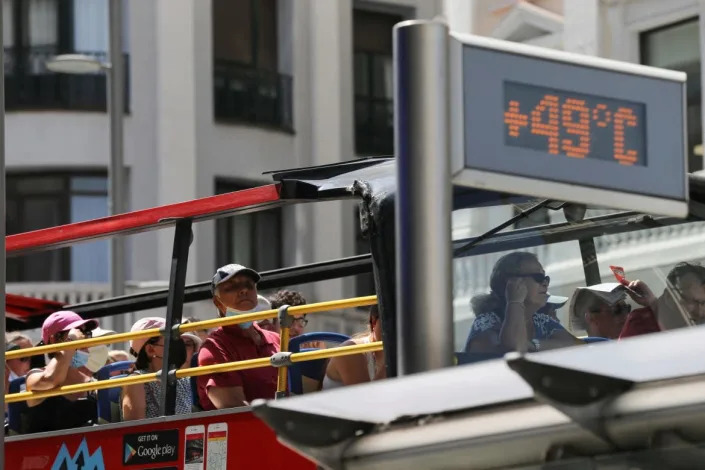
Over the last several days in Spain and Portugal, where temperatures have reached near 110°F, more than 1,700 people have died due to heat-related causes.
Officials in Phoenix are worried that the city will once again break heat-death records this year, especially among the vulnerable homeless population.
“I wouldn’t be surprised if we are in worse shape from a heat-associated-death standpoint than we were last year because there are so many more unsheltered folks that are at 200 to 300 times the risk of heat-associated death,” David Hondula, director of the city’s Office of Heat Response and Mitigation, told Yahoo News.
While climate change skeptics often argue that excessive heat is simply a normal seasonal consequence, scientists have established that the burning of fossil fuels since the start of the Industrial Revolution is responsible for rising temperatures.
Of course, that would be exactly what you would expect if, as has been proved, global temperatures are rising. In states sweltering in triple-digit heat, meanwhile, the reality of climate change is playing out in real time.
“It looks like we’re going to stay in the range of highs of 100 to 105 degrees for the next week and a half,” Erin Maxwell, a meteorologist at the National Weather Service in Norman, told the Oklahoman. “But in terms of real relief from the heat, that doesn’t look to be on the horizon any time soon.”
London wakes up to the grim realities of heat wave hell
CBS News – July 20, 2022
London — Some European nations were still battling their worst wildfires in decades Wednesday as the U.K. woke up to relief after its hottest day on record. As CBS News correspondent Ramy Inocencio reports, flames have torn through tinder dry brush in an area covering thousands of miles from Greece to Portugal.
The widespread heat wave that fueled those flames stretched all the way up to Scotland on Tuesday, delivering record-high temperatures in towns and cities across Britain and leaving Londoners shocked to see their town hit by the same kind of bushfires they’ve grown accustomed to watching on the news.
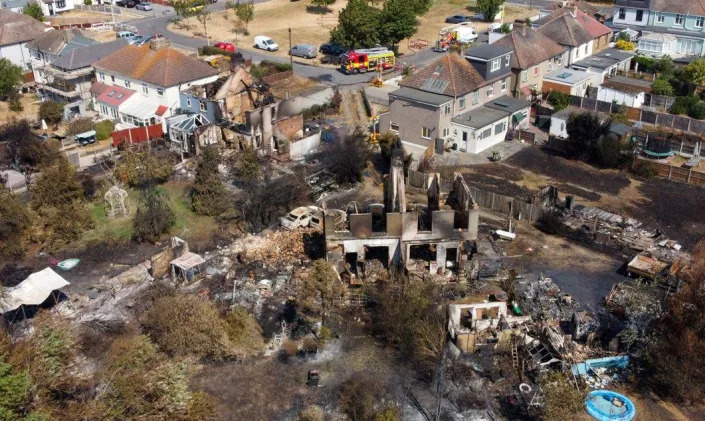
Charred ground and gutted homes in the British capital were testament to the fact that even the stereotypically damp and dreary U.K., where umbrellas and overcoats are more commonplace than air-conditioners, cannot escape the consequences of a rapidly warming climate.
Houses destroyed in a major fire in Wennington, Greater London, England, are seen on July 20, 2022. Fires broke out across London amid record-breaking heat the previous day. / Credit: Chris Ratcliffe/Bloomberg/Getty
Rare wildfires burned and billowed across London on Tuesday as much of England endured 100-plus-degree heat. A new temperature record was set in the town of Coningsby, in eastern England, at 40.3 Celsius, which is over 104 degrees Fahrenheit.
As much of the country has gone a month or more with barely a drop of rain, the scorching temperatures were all it took to ignite matchstick-dry grass and brush in back yards and along highways.
The London Fire Brigade worked its busiest day since World War II, with firefighters responding to more than 2,600 calls and fighting 12 fires simultaneously at one point, according to Mayor Sadiq Khan.
At least 41 properties were destroyed by the fires in London, the mayor said, and 16 firefighters were treated for smoke inhalation or other injuries.
Dee Ncube and her family fled their burning neighborhood in the capital, leaving everything behind. She told Inocencio the only time she’d seen anything like it was in movies or on TV.
“We’ve got nothing, everything’s gone,” Timothy Stock, whose home was among those lost to the flames in the village of Wennington, in Greater London, told CBS News partner network BBC News.
Government cabinet minister Kit Malthouse told other members of Britain’s parliament on Wednesday that 13 people died amid the heat wave after “getting into difficulty in rivers, reservoirs and lakes while swimming in recent days — seven of them teenage boys.”
But while many Londoners were shocked by the extreme heat, people who study the Earth’s changing climate were not.
“This is it, right? This is the climate change that we’ve been promised by scientists,” Dr. Michal Nachmany, a climate policy expert at the London School of Economics, told CBS News. “This level of extreme weather is life threatening, and we really want to make sure that people are not under any illusion that this is serious, and this is here to stay.”
Climate campaigners were also keen to stress Tuesday’s extremes as a warning of danger ahead, and a call to action.
Demonstrators from a protest group called “Just Stop Oil” climbed onto metal framework for signs over the M25, one of Britain’s busiest highways, which encircles London, causing a long traffic backup Wednesday morning.
The group said it was sorry about the disruption for morning commuters, but it declared the M25 “a site of civil resistance,” and warned there would be more protests in the coming days. “This is the moment when climate inaction is truly revealed in all its murderous glory for everyone to see: as an elite-driven death project that will extinguish all life if we let it,” the group said in a statement, announcing its action and demand that the U.K. government stop investing in fossil fuel extraction.
Other countries further south were still battling major blazes on Wednesday that erupted last week. Thousands have died and tens of thousands have been evacuated.
Firefighters in southwest France were still battling twin blazes that cover ground twice the size of Paris for a ninth straight day on Wednesday, but weather conditions improved there overnight, too, and officials said they were gaining control.
“Our assessment is generally positive. The situation improved overnight,” local fire service spokesman Arnaud Mendousse told reporters, according to The Associated Press. President Emmanuel Macron was set to visit the hard-hit Gironde region on Wednesday, where the fires have driven about 37,000 people from their homes. Spain and Portugal were still recording new deaths from the extreme heat and fires, with the toll already well over 1,000.
Spain’s Prime Minister Pedro Sanchez said Wednesday that “more than 500 people died because of such high temperatures” over the last week or so in his country, citing a statistical analysis by a public health institute.
“I ask citizens to exercise extreme caution,” said Sanchez, adding that the “climate emergency is a reality.”
A wildfire burns near a house in Ntrafi, Athens, Greece, July 19, 2022. / Credit: COSTAS BALTAS/REUTERS
Further west, police in Greece ran door to door, shouting at residents to flee just north of Athens as a fire approached.
Evacuations continued in Italy, also, where fires were still growing and temperatures haven’t yet started to ease.
While the worst of the heat wave appeared to be over for much of Western Europe, with temperatures dropping dramatically overnight from the north of Britain to the south of France, climate experts and campaigners were desperate to get the point across that while this week has been an exception, these exceptions are expected to become more common — and get even hotter.
House Democrats tout bill to add four seats to Supreme Court
Julia Mueller – July 18, 2022
A group of House Democrats called for legislation on Monday that would add four seats to the Supreme Court, lamenting a “ultra right-wing” branch that just overturned the Roe v. Wade decision on abortion rights.
The eight lawmakers cited recent Supreme Court decisions that rolled back Miranda rights, threw out a New York gun control law and allowed religion to surface in schools — as well as the Dobbs v. Jackson Women’s Health decision that overturned the right to abortion in Roe — in saying there was a need to add new justices to the court.
Rep. Hank Johnson (D-Ga.), the lead sponsor of the 2021 Judiciary Act, called the current makeup “a Supreme Court at crisis with itself and with our democracy” where “basic freedoms are under assault” from the 6-3 conservative supermajority on the bench.
The Supreme Court isn’t susceptible to the popular vote the way Congress is, Johnson said, and it has used that fact to amass power. “It’s making decisions that usurp the power of the legislative and executive branches,” he said.
Facing Republican opposition and some Democratic skepticism, the bill has little chance of becoming law, but it illustrates the deep anger among progressive Democrats about the court’s direction under three conservative justices nominated by former President Trump: Neil Gorsuch, Brett Kavanaugh and Amy Coney Barrett.
Those three justices have radically altered the direction of the court, which now has twice as many conservative justices as liberal ones. Kavanaugh replaced Justice Anthony Kennedy, a previous swing vote who had been nominated to the court by a Republican, while Barrett replaced liberal Justice Ruth Bader Ginsburg.
Adding to Democratic anger, a GOP Senate blocked former President Obama’s last nominee to the court, Merrick Garland, who is now the attorney general. Gorsuch ended up being nominated to the court in place of Garland.
Introduced last year, the Judiciary Act has not progressed in Congress.
Some Democrats wary of the proposal are concerned that expansion would open the court up for Republicans to push more of their nominees into the openings.
“The nightmare scenario of GOP court-packing is already upon us,” said Rep. Mondaire Jones (D-N.Y.). “That’s how they got this far-right 6-3 majority in the first place.”
Lawmakers at Monday’s press conference, hosted by the Take Back the Court Action Fund, blamed Trump and the conservative legal movement for enabling a partisan court.
Republican politicians made controlling the judicial branch part of their platform, said Rep. Mark Takano (D-Calif.), adding that the court has “gone rogue” and “become a radical institution.”
The lawmakers also emphasized that the longevity of the lifelong terms the sitting justices are now serving makes action to expand the court more urgent.
Of 72-year-old conservative Justice Samuel Alito, Johnson said, “You can see the gleam in his eye as he thinks about what he wants to do to decimate the rights of people and put us back in the Dark Ages.”
Trump-nominated Gorsuch, Barrett and Kavanaugh, in their 50s, are “gonna be there for a while,” Johnson said.
Congress has changed the number of seats on the nation’s highest court seven times in the nation’s history. The new proposal would bring the total seat count to 13, meaning a decision from the court would need a 7-6 majority rather than the present 5-4.
Reps. Andy Levin (D-Mich.), Jan Schakowsky (D-Ill.), Bonnie Watson Coleman (D-N.J.), Rashida Tlaib (D-Mich.) and Sheila Jackson Lee (D-Texas) were also at the conference, along with Sen. Ed Markey (D-Mass.), who sponsored the bill in the Senate, and a handful of progressive activists.
For Europe, a climate change reckoning arrives early
David Knowles, Senior Editor – July 18, 2022
In what has already been a brutal summer of heat waves across much of Europe, temperature records are expected to be broken in parts of the U.K., Germany and France this week, putting thousands of lives in danger.
Temperatures are expected to reach as high as 109°F on Tuesday in locations where air conditioning is not a common amenity, and health officials are warning that excess deaths due to heat are all but guaranteed. With temperatures forecast to be 15°F to 30°F above normal, the U.K. Met Office issued a first-ever extreme heat warning, and scorching conditions could drag on for weeks.
With the extreme heat that scientists have shown is linked to climate change, wildfires have erupted on the continent. In a pine forest left parched due the rapid evaporation caused by high temperatures, nearly 1,700 firefighters in France have been battling an enormous blaze near Bordeaux.
“The situation is critical, mainly because the weather is unfavorable to us,” Vincent Ferrier, a French official, told reporters Monday.
A church is pictured during sunset as a heat wave hits Europe, in Oisy-le-Verger, France, on July 14. (Pascal Rossignol/Reuters)
Wildfires, made more frequent due to rising global temperatures, have also erupted in Spain and Portugal, forcing thousands from their homes. As shocking as the effects of climate change have been to witness in recent years, scientists continue to warn that they will worsen as long as humans continue to pump greenhouse gases into the atmosphere.
In fact, Europe has already exceeded the 1.5°C threshold for catastrophic climate change set forth by the IPCC, having warmed by 2.2°C since the start of the Industrial Revolution.
Flames rise at a forest fire near Louchats in southwestern France on Monday. (Philippe Lopez/Pool/AFP via Getty Images)
“Every fraction of a degree counts. Greenhouse gas concentrations are at record levels. Extreme weather and climate disasters are increasing in frequency and intensity,” United Nations Secretary-General António Guterres said of the report.
Indeed, the speed at which climate change is unfolding has caught some experts by surprise. In 2020, for instance, the Met Office produced a hypothetical map of what summertime heat wave temperatures might look like in 2050. That reality, however, was nearly matched this week.
As has been documented over the past several years, the climate change dangers now facing Europe includeextreme heat waves, drought, wildfires and inundating rainfall. Last year, more than 150 people died when torrential downpours resulted in flash flooding in parts of Germany and Belgium, and a record-breaking heat wave in Greece helped fuel a wildfire that destroyed homes and businesses. Europe’s hottest day on record was recorded in Sicily last August, when the mercury hit 119.8°F.
These individual events are part of a larger pattern and a consequence of a warning planet. A mountain of research has shown that it is by no means limited to Europe or the United States.
At a time when Sen. Joe Manchin, D-W.Va., all but torpedoed President Biden’s goal of cutting U.S. emissions in half by 2030 when he announced Friday he would not vote to pass a budget reconciliation bill that included measures intended to tackle climate change, the problem of rising temperatures is taken seriously across the political spectrum in Europe.
Yet while leaders there have pledged ambitious goals for reducing the emissions causing climate change, they will need the help of nations like the U.S., China and India in order to make a significant impact on the heat waves that continue to make life miserable on the continent.
Touring the scene of one of the many wildfires currently ravaging Spain, Prime Minister Pedro Sánchez summed up the dire situation.
“Climate change kills,” he said Monday. “It kills people, it kills our ecosystems and biodiversity.”
European Heat Wave Kills Hundreds, Threatens Tourism Revival
Barbie Latza Nadeau – July 16, 2022
Jon Nazca/Reuters
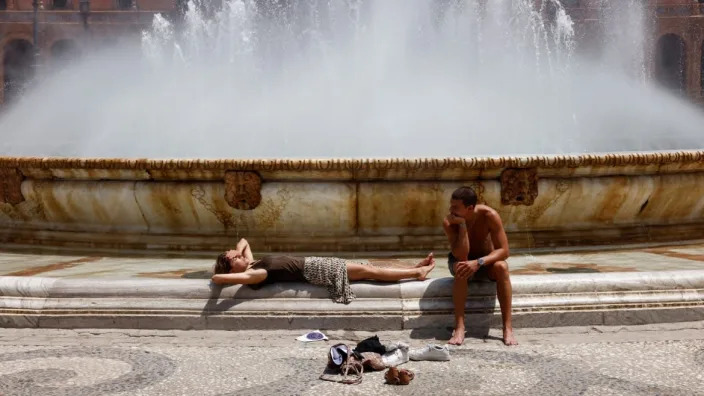
Extreme temperatures and devastating droughts across Europe are quickly turning what was supposed to finally be a return to normalcy for the region’s tourist entities into an inferno.
More than 360 people have died in Spain since July 10 in an historic heat wave that has seen temperatures hover around 115 degrees for several days in a row. At least 84 of the deaths have occurred in the last 72 hours, prompting the Spanish government to urge people to limit exposure to the heat and ban some tourist activities like guided walks in Barcelona during the midday hours.
At the Madrid Zoo, several cold-water reptiles have perished, and zookeepers are giving popsicles to many creatures that are refusing to eat due to the extreme conditions that are not expected to let up before the end of the month. Spain already endured an early summer heat wave with 829 people dying between June 11 and 20. Temperatures this time around are expected to be at least two degrees higher.
Susana Vera/Reuters
In Portugal, more than 235 people have died this month from heat-related causes, and temperatures have continued to climb. Wildfires across the regions have led to the evacuation of several tourist camping and outdoor recreational areas that were booked for the entire summer, sending the travel industry into chaos, according to the government.
The Italian government has called a national emergency along the River Po, which cuts across northern Italy and is so low people can walk across it at certain points. The drought has also led to extreme water restrictions, including turning off ornamental fountains in Milan and restricting hair dressers from double shampooing clients to save water. In southern Italy, droughts have sparked wildfires, including several devastating blazes within Rome’s city limits in the last two weeks.
Isabel Infantes/Reuters
In the U.K., where summers are often disappointingly gray and air conditioning is rare, people were told to avoid alcohol and stay inside over the weekend as temps there are set to top 104 degrees. The Met Office issued a red warning for London, Manchester and York until Tuesday, warning that Britons “are not adapted to what is coming.”
The never-before-used weather red alert signals a danger to life or risk of serious illness to the general population due to extreme heat. “Population-wide adverse health effects are likely to be experienced, not limited to those most vulnerable to extreme heat, leading to potential serious illness or danger to life,” the Met Office said in a statement Saturday.“Significantly more people are likely to visit coastal areas, lakes and rivers leading to increased risk of water safety incidents.”
Fires are also raging across the South of France and Greek islands, complicating travel and isolating some of the region’s beloved summer getaway spots.
National weather agencies across the affected region warn that it may be another week before temperatures start to return to normal.
In a Twist, Old Coal Plants Help Deliver Renewable Power. Here’s How.
Elena Shao – July 15, 2022
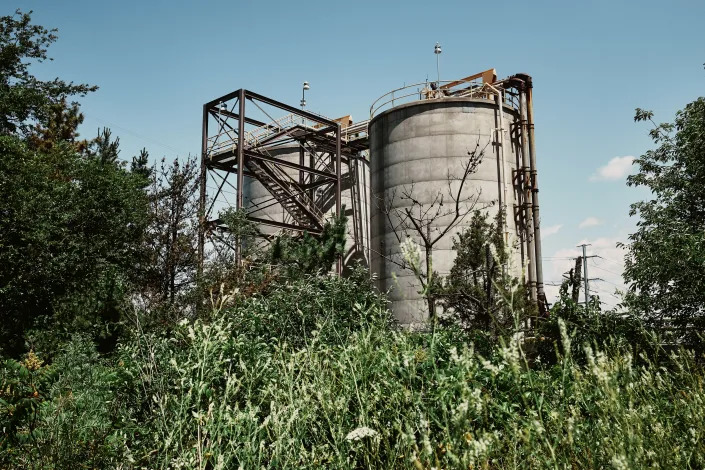
Silos of ash and other waste at the Brayton Point Power Station, a retired coal-fired power plant in Somerset, Mass., on July 7, 2022. (Simon Simard/The New York Times)
Across the country, aging and defunct coal-burning power plants are getting new lives as solar, battery and other renewable energy projects, partly because they have a decades-old feature that has become increasingly valuable: They are already wired into the power grid.
The miles of high-tension wires and towers often needed to connect power plants to customers far and wide can be costly, time-consuming and controversial to build from scratch. So solar and other projects are avoiding regulatory hassles and potentially speeding up the transition to renewable energy by plugging into the unused connections left behind as coal becomes uneconomical to keep burning.
In Illinois alone, at least nine coal-burning plants are on track to become solar farms and battery storage facilities in the next three years. Similar projects are taking shape in Nevada, New Mexico, Colorado, North Dakota, Nebraska, Minnesota and Maryland. In Massachusetts and New Jersey, two retired coal plants along the coast are being repurposed to connect offshore wind turbines to the regional electrical grids.
“A silver lining of having had all of these dirty power plants is that now we have fairly robust transmission lines in those places,” said Jack Darin, director of the Illinois chapter of the Sierra Club, an environmental advocacy group. “That’s a huge asset.”
Over the past two decades, more than 600 coal-burning generators totaling about 85 gigawatts of generating capacity have retired, according to the U.S. Energy Information Administration. (Individual power plants can have more than one generator.) A majority of the 266 remaining coal-burning power plants in the country were built in the 1970s and 1980s and are nearing the end of their approximately 50-year operational lifetime.
Most of that retired capacity will not be replaced with coal, as the industry gets squeezed out by cheaper renewable energy and tougher emissions regulations. At the same time, renewable energy producers are facing obstacles getting their projects connected to the grid. Building new power lines is costly and controversial, as neighbors often oppose transmission lines that can disturb scenic vistas or potentially reduce property values nearby. In addition, getting power line projects approved by regulators can be time-consuming.
Building and operating renewable energy projects has long been cheaper than fossil fuel plants. The barrier “is not economics anymore,” said Joseph Rand, a scientist at the Lawrence Berkeley National Laboratory, which conducts research on behalf of the U.S. Department of Energy. “The hardest part is securing the interconnection and transmission access.”
This makes old coal plants an attractive option as sites for renewable energy projects. Not only are the old plants already wired into the transmission system, they also have substations, which help convert electricity to a supply that is suitable for use in homes and businesses.
That was a key factor in choosing Brayton Point Power Station as a grid connection point for a 1,200-megawatt wind farm 37 miles off the coast of Massachusetts, said Michael Brown, CEO of the offshore wind developer Mayflower Wind.
At 1,600 megawatts, the coal-fired plant was the largest one in New England when it retired in 2017. The facility itself, located in the waterfront town of Somerset, will be replaced by an undersea-cable factory owned by the Italian company Prysmian Group. And the offshore wind project will connect to the grid at the Brayton Point interconnection point, making use of the existing substation there.
In one of the most ambitious efforts, Vistra Corp., a Texas-based power generation company that also owns a variety of power plants in California and Illinois, said it would spend $550 million to turn at least nine of its coal-burning facilities in Illinois into sites for solar panels and battery storage.
The largest, a plant in Baldwin, Illinois, that is set to retire by 2025, will get 190,000 solar panels on 500 acres of land. Together, the panels will generate 68 megawatts of power, enough to supply somewhere between 13,600 and 34,000 homes, depending on the time of year. It will also get a battery that can store up to 9 megawatts, which will help distribute electricity when demand peaks or the sun is not shining.
Vistra CEO Curtis Morgan said it became clear that the power company would need to “leave coal behind,” and it was eager to build new zero-emissions projects to replace some of the power from those plants. However, he said, the slow process of getting approval from grid operators, which coordinate and monitor electricity supplies, has been a roadblock for a number of Vistra’s proposed projects.
A surge in proposals for wind, solar and battery storage projects has overwhelmed regulators in recent years, according to an analysis from the Lawrence Berkeley National Laboratory, which overlooks the University of California’s Berkeley campus. In 2021, wait times had almost doubled from a decade before, to nearly four years, and that does not include the increasing number of projects that are withdrawing from the process entirely.
If every project currently waiting for approval gets built, “we could hit 80% clean energy by 2030,” said Rand, the lead author of the report. “But we’d be lucky if even a quarter of what’s proposed actually gets completed.”
Three of Vistra’s battery storage projects in Illinois — at the Havana, Joppa and Edwards coal plants — also benefited from an infusion of grants from a state law, the Climate and Equitable Jobs Act, aimed at supporting a “just transition” for coal-dependent communities toward renewable energy. It was signed by Gov. J.B. Pritzker last fall and also required all fossil-fuel-burning plants to cut their emissions to zero by 2045, which could lead to their closure, though most of the coal plants in Illinois were already poised to shut down within a decade.
The Coal-to-Solar Energy Storage Grant Program that emerged from the legislation also supports two other battery projects, owned by NRG Energy, which will be built at the Waukegan and Will County coal-burning power stations.
The advantage of building renewable energy projects on old coal plants is twofold, said Sylvia Garcia, director of the Illinois Department of Commerce and Economic Opportunity, which oversees the coal-to-solar program. First, projects benefit from the ease of reusing an existing connection to the grid. Second, it is an effort toward “trying to reinvest in the communities that have lost those coal plants” in the first place, she said.
While the new projects will temporarily create construction jobs, operating a solar plant or battery facility usually does not require as many employees. The Baldwin plant previously employed around 105 full-time workers. And while Vistra has not yet finalized numbers on a site-by-site basis, the nine Illinois projects combined will create 29 full-time jobs annually, the company’s communications director, Meranda Cohn, said in an email.
Coal plants also typically sit on a sizable parcel of land, and redeveloping those sites into renewable energy projects is a way to put something productive on a piece of property that might otherwise go unused.
“It’s really shifting a very negative resource into one that is more positive for the community,” said Jeff Bishop, CEO of Key Capture Energy, which plans to locate a 20-megawatt battery storage project at a retired coal plant near Baltimore.
Elsewhere in Holyoke, Massachusetts, the retirement of Mount Tom Station, a coal plant that had operated for more than five decades, presented a number of possibilities, said Julie Vitek, vice president of government and regulatory affairs for the power producer ENGIE North America. After meetings with government officials, environmental groups and residents, a solar farm emerged as the best way to “give new life to the industrial land at Mount Tom,” she said.
Today, the property is home to some 17,000 solar panels and a small battery installation that form a community solar project managed by Holyoke Gas & Electric, a city-owned utility that gives customers the choice to opt in to receiving solar power from the project. The panels produce about 6 megawatts of power, enough to power about 1,800 homes.
It is not only solar, battery and wind developers that are eyeing old coal plants for their infrastructure. TerraPower, a nuclear power venture founded by Bill Gates, is locating a 345-megawatt advanced nuclear reactor adjacent to a retiring coal plant in Kemmerer, Wyoming. The location will not only allow the reactor to take advantage of the existing grid connection but also to make use of the coal plant’s cooling system, said Chris Levesque, TerraPower’s president and CEO.
“In a way, it’d be a real shame not to make use of those coal plants,” Levesque said.
They sounded alarms about a coming Colorado River crisis. But warnings went unheeded
Ian James – July 15, 2022
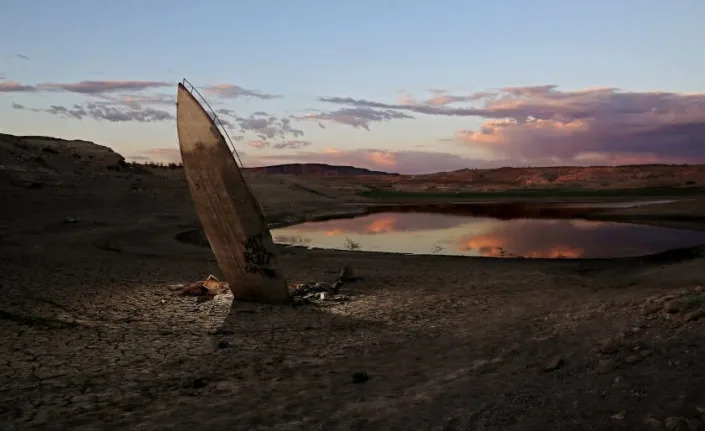
A boat juts from the shoreline of Lake Mead, exposed as the water has receded to the lowest levels since the reservoir was filled in the 1930s. (Luis Sinco / Los Angeles Times)
The Colorado River is approaching a breaking point, its reservoirs depleted and Western states under pressure to drastically cut water use.
It’s a crisis that scientists have long warned was coming. Years before the current shortage, scientists repeatedly alerted public officials who manage water supplies that the chronic overuse of the river combined with the effects of climate change would likely drain the Colorado’s reservoirs to dangerously low levels.
But these warnings by various researchers — though discussed and considered by water managers — went largely unheeded.
Now, many of the scientists’ dire predictions are coming to pass, with Lake Mead and Lake Powell nearly three-fourths empty and their water levels continuing to fall. Some researchers say the seven states that depend on the river would have been better prepared had they acted years ago.
“If I’ve learned anything recently, it’s that humans are really reluctant to give things up to prevent a catastrophe,” said Brad Udall, a water and climate scientist at Colorado State University. “They’re willing to hang on to the very end and risk a calamity.”
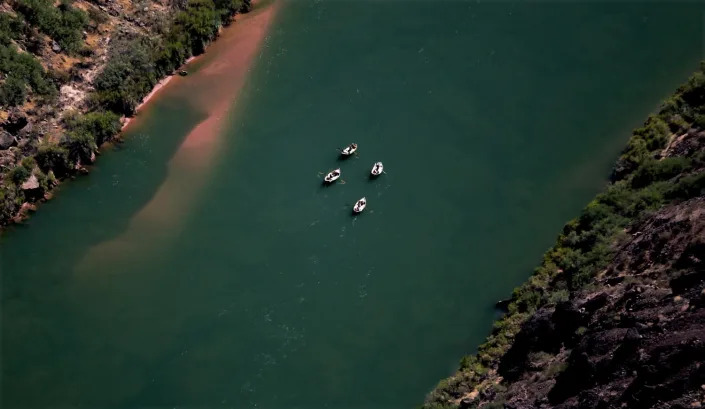
The Colorado River, vital to seven states, as seen from the Toroweap Overlook on the North Rim of the Grand Canyon. (Luis Sinco / Los Angeles Times)
He said it’s just like humanity’s lack of progress in addressing climate change despite decades of warnings by scientists.
If larger cuts in water use were made sooner, Udall said, the necessary reductions could have been phased in and would have been much easier.
Peter Gleick, a water and climate scientist and co-founder of the Pacific Institute, said the collective failure to heed scientists’ repeated warnings is “directly responsible for how bad conditions are today.”
“If we had cut water use in the Colorado River over the last two decades to what we now understand to be the actual levels of water availability, there would be more water in the reservoirs today,” Gleick said. “The crisis wouldn’t be nearly as bad.”
In a 1993 study for the federal government, Gleick and coauthor Linda Nash examined the threat climate change posed for the river and warned that the water supply would be very sensitive to rising temperatures.
“Under conditions of long-term flow reductions and current operating rules, these reservoirs are drawn almost completely dry,” they wrote. “Current approaches to water management in the basin will have to be modified.”
Whitewater rafters ride the Colorado River, as seen from Toroweap Overlook on the North Rim of the Grand Canyon. (Luis Sinco / Los Angeles Times)
In 2000, board members of the Metropolitan Water District who were concerned about climate change invited scientists including Gleick to speak at a workshop. The scientists advised them to start preparing for consequences including less Sierra snow and possible decades of drought.
Gleick said a common refrain from many water managers in the 1980s and ’90s, when told about risks based on climate projections, was to respond that once they had a more definitive picture of effects on water resources, they could deal with it.
Even later, as the projections got more definitive and “alarm bells got louder,” Gleick said, political barriers hindered changes in the entrenched system of how the river’s water is divided and managed, a system established starting with the 1922 Colorado River Compact. Action was stymied, he said, by those “who either didn’t want to believe the science or had something to lose if we changed our policies.”
Gleick said there is a parallel in how fossil fuel interests have long fought the sorts of changes necessary to address global warming.
In the Colorado River Basin, Gleick said, the vested interests that have hindered new approaches for dealing with the water shortfall include some in agriculture who benefit from generations-old water rights, water managers with a “find more and more water” mentality, and politicians who’ve fought to defend old state apportionments.
In the 2000s, as drought ravaged the watershed, a growing body of scientific research showed that higher temperatures would substantially shrink the flow of the river, which supplies farmlands and cities from the Rocky Mountains to Southern California and northern Mexico.
“If I’ve learned anything recently, it’s that humans are really reluctant to give things up to prevent a catastrophe.”
Brad Udall, a water and climate scientist
In a 2004 study, scientists at the University of Washington projected major declines in runoff and river flow with warmer temperatures.
In other research in 2007, scientists Martin Hoerling and Jon Eischeid wrote that climate simulations showed an an increase in drought severity would occur “in lockstep” with global warming, projecting a 25% reduction in flow from 2006 to 2030, and a 45% decrease by midcentury.
When federal officials released a report in 2007 on new river management rules, their estimates of future risks were rosier, showing minimal odds of reservoirs reaching low levels. The report cited studies predicting declines in river flow with climate change, saying that while those projections “are of great interest, additional research is both needed and warranted to quantify the uncertainty of these estimates.”
The Colorado River flows over rocks along its banks at Lees Ferry, a narrow stretch that marks the divide between the river’s upper and lower basins. (Luis Sinco / Los Angeles Times)
In a 2008 study, scientists Tim Barnett and David Pierce of the Scripps Institution of Oceanography wrote that if climate models were correct, the Colorado River would “continue to lose water in the future,” with its flow likely declining 10% to 30% over the next 30 to 50 years. Those estimates turned out to match, if conservatively, the 20% decline in flow that has occurred since 2000.
Barnett and Pierce estimated that if current allocations stayed the same, there was a 50% chance the usable water supply in Lake Mead and Lake Powell, the country’s two largest reservoirs, would be gone by 2021. They titled their study “When Will Lake Mead Go Dry?”
They said that annually the region was taking out about 1 million acre-feet of water more than the river was providing, which they warned was “simply not sustainable.” Barnett and Pierce wrote that time was short to decide how to use a reduced water supply, and the alternative would be a “major societal and economic disruption in the desert southwest.”
Discussing the research, Barnett said: “You have to wonder if the civilization we’ve built in the desert Southwest is sustainable in the future.”
The scientists’ findings, however, were discounted at the time by some water managers. Terry Fulp, regional director for the federal Bureau of Reclamation, said he disagreed with the study’s assumption that climate models were sensitive or refined enough to project regional effects, and the agency’s own studies didn’t project such severe declines.
Some Southern California water officials said people shouldn’t panic over the report, pointing to ongoing water-saving efforts and the past winter’s above-average snowpack. Roger Patterson, an assistant manager of the Metropolitan Water District, was quoted as saying that back-to-back winters like that could largely refill the reservoirs.
In another study in 2009, Barnett and Pierce found that if human-caused climate change continued to make the Southwest drier as projected, the reduced river flow would mean significant shortages. Pierce said shortfalls could be avoided “if the river’s users agree on a way to reduce their average water use.”
But that didn’t happen, at least not on the scale the researchers said was necessary.
Visitors climb rock formations near the Colorado River at Lees Ferry. (Luis Sinco / Los Angeles Times)
“The scientists have been raising the warning flag for quite a while now,” said Jennifer Pitt of the National Audubon Society.
Pitt said for years she and other conservationists urged water managers to look more at the climate models. And although officials gradually incorporated more climate science in their projections, she said, the institutions that manage the river clearly didn’t embrace the red flags soon enough.
A 2012 study by the Bureau of Reclamation discussed estimates of reduced water supplies due to climate change, but Pitt said the severity of the projections was muted in the report’s summary.
Even as the reservoirs dropped, she said, there were other reasons why representatives of states and water districts resisted change.
“Each state and each water user has an inclination to fight to defend their access to water,” Pitt said, and this drive has weighed against “the need to defend the reliability of the entire system.”
The Colorado River has long been overallocated, with so much water diverted that its delta in Mexico dried up decades ago, leaving only small remnants of its once-vast wetlands.
Boaters cross the Arizona-California border on the Colorado River near Needles. (Luis Sinco / Los Angeles Times)
In studies during the last decade, scientists have homed in on what climate models indicate about the river’s future, finding that roughly half the decline in flow has been due to warmer temperatures; that climate change is driving the “aridification” of the Southwest; that warming could take away more than one-fourth of the average flow by 2050; and that for each additional 1 degree Celsius (1.8 degrees Fahrenheit), the river’s flow is likely to decrease about 9%.
As the West endured more hot and dry years, the few wet winters failed to produce the sort of rebound that water managers had hoped for. As water kept flowing to growing cities and farmlands producing hay, lettuce and other crops, the reservoirs continued to drop.
But with Lake Mead and Lake Powell now just 27% full and declining toward new lows, the federal government has stepped in and ordered the seven states to come up with plans to cut water use by 2 million to 4 million acre-feet, the equivalent of roughly 15% to 30% of total annual diversions in the U.S. and Mexico.
Even long before scientists began studying the effects of rising temperatures on the river, various people raised concerns that there wouldn’t be sufficient water — among them John Wesley Powell, leader of the historic 1869 expedition through the Grand Canyon; scientist Eugene Clyde LaRue, whose warnings about insufficient water went unheeded during negotiations that led to the 1922 Colorado River Compact; and the writer Wallace Stegner, who warned in 1985 that the West was growing “beyond our limits” and that “There is just not enough water.”
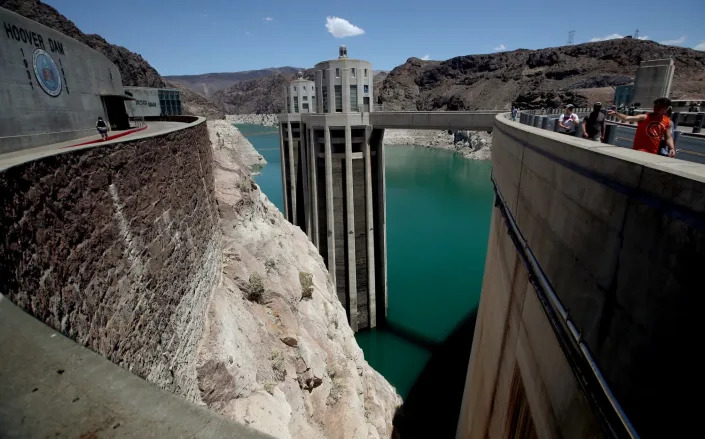
Visitors to Hoover Dam can see where severe and prolonged drought conditions have exposed the rocky sides of Black Canyon and the intake towers that feed the dam’s power generators. (Luis Sinco / Los Angeles Times)
Some environmental activists have pointed out that in 1954 California water lawyer Northcutt Ely testified in Congress to oppose the construction of Glen Canyon Dam and another proposed dam, saying they were unnecessary, would lead to more losses from evaporation and increase the “overdraft” of the water supply.
John Weisheit, co-founder of the group Living Rivers, said Ely’s overarching goal was watershed sustainability. The concerns Ely raised nearly seven decades ago, he said, have only been compounded by climate change.
Weisheit recalled telling federal officials at a public meeting in 2005 that the reservoirs were going to go empty, “and they laughed at me.”
Weisheit said water managers knew how bad the situation was years ago but have failed to rein in water demands to match the limited supply.
Udall said he has been frustrated that federal agencies continue to use 30 years as a baseline “climate normal,” because data from the late 20th century, which was cooler and wetter, “blinds us to the period we’re in right now.”
Federal officials have been using what they call “stress test” hydrology in their projections in recent years, leaving out earlier 20th century records while considering data going back to 1988. But Udall said this approach has continued to yield some projections that are too rosy, an issue that he said government specialists appear to be working to address.
Valley of the Gods is a scenic sandstone valley in southeastern Utah near the San Juan River, a major tributary of the Colorado River. (Luis Sinco / Los Angeles Times)
Udall said he has looked over charts showing the reservoirs’ declines over the last 23 years and has wondered at what point “should we have been smarter?” That point, he said, was about a decade ago.
“We’re out of time,” he said. The solutions now will have to be “harsh and drastic.”
Looking back at the 2019 deal, the years of negotiations culminated in an agreement that reflected what was politically possible at the time, said John Entsminger, general manager of the Southern Nevada Water Authority.
“No one was willing to take bigger cuts then,” Entsminger said.
Entsminger said that in 2014, when he started leading the agency, he and his staff were focused on climate projections and the risks of low reservoir levels. That was why, in addition to prioritizing conservation, the agency spent $522 million building a new low-level pumping plant and intake at Lake Mead, which would allow Las Vegas to keep accessing water if the reservoir dropped to “dead pool,” a level at which water would no longer pass through Hoover Dam.
In 2015, when the water authority endorsed the project, Entsminger said he and others hoped they would never have to turn on the pumping plant. But they switched it on this year, and now Las Vegas is relying on the deeper intake.
Entsminger said many water managers who came before him had seen full reservoirs in the 1980s and operated under the assumption that a couple of snowy winters could bring a rebound. In hindsight, he said, “clearly, we should have had bigger cuts sooner.”
Now every water supplier needs to consider how to use less, he said.
“This is a tragedy of the commons situation,” he said. “If we don’t all pitch in and make corrections, Lake Mead and Lake Powell could get to dead pool.”
The World Population Prospects 2022 report, released on Monday by the U.N.’s Department of Economic and Social Affairs Population Division, outlined what countries around the world should expect in the coming years.
The global population is expected to reach 8 billion by Nov. 15, the U.N. predicts, but it won’t stop there. The population could be around 8.5 billion by 2030, 9.7 billion in 2050 and 10.4 billion in 2100, meaning Earth could have a 31% increase in human population by the end of the century.
The estimated population growth comes as the world’s average fertility rate continues to decline. In 2020, the global population growth rate fell below 1% for the first time since 1950. Currently, it’s at 2.3 births per woman, down from the average five births per woman in 1950. By 2050, it’s expected to slightly fall to 2.1 births per woman.
Still, factors such as the rise of life expectancy are reasons why the global population continues to rise.
“Globally, life expectancy reached 72.8 years in 2019, an increase of almost 9 years since 1990. Further reductions in mortality are projected to result in an average longevity of around 77.2 years globally in 2050,” the report reads.
“Two-thirds of the projected increase in global population through 2050 will be driven by the momentum of past growth that is embedded in the youthful age structure of the current population. Such growth would occur even if childbearing in today’s high-fertility countries were to fall immediately to around two births per woman.”
People ages 65 and older are expected to account for 16% of the human population by 2050, up from 10% in 2022. Men currently make up 50.3% of the population, but by 2050, there are expected to be just as many women as men.
Indians crowd a market selling marigold flowers early morning on Diwali, the Hindu festival of lights, in Mumbai, India, Sunday, Oct. 30, 2016. India is projected to be the most populated country in the world by the end of 2023, the United Nations said.
World’s most populated country soon won’t be China
China has long been the most populous country, but that isn’t expected to last long, with India projected to be the world’s most populous country in 2023. Each country currently has a population over 1.4 billion people, accounting for over 35% of the global population, but China’s population is expected to start declining as early as next year.
By 2050, India is projected to have 1.6 billion people, while China is projected to have 1.3 billion people.
India is just one of eight countries – including the Philippines, the Democratic Republic of the Congo, Egypt, Ethiopia, Nigeria, Pakistan and the United Republic of Tanzania – expected to see major population growth by 2050. The increase in several sub-Saharan countries is expected to result in the population doubling in the area.
On the other side of the population spectrum, 61 countries are expected to have a population decrease of at least 1%. Of that list, Bulgaria, Latvia, Lithuania, Serbia and Ukraine are projected to lose at least 20% of their population.
What about the United States’ population?
North America is projected by the U.N. to reach its peak population in the late-2030s and then start declining “due to sustained low levels of fertility.” But that won’t affect the population of the U.S.
The U.S. population is currently 337 million people and it is projected to be at 375 million people in 2050, still making it the third most populous country in the world, behind India and China.
Sophie Kasakove and Robert Gebeloff – July 7, 2022
A street with a new apartment complex under construction in in the East Nashville neighborhood of Nashville, Tenn., on May 11, 2022. (September Dawn Bottoms/The New York Times)
NASHVILLE, Tenn. — When Ashley Broadnax thinks of the East Nashville, Tennessee, neighborhood she grew up in during the ’90s, the images that rush in have a modest, middle-class tinge.
After school, she and other neighborhood children bought snacks at the corner store and threw balls on the street as their parents returned home, some in uniform from blue-collar work, others from jobs as teachers or office workers. Neighbors chatted on porches and lawns of unassuming single-story homes. There were some poor families and a few wealthy ones, but more than one-third of her neighbors made between $40,000 and $75,000 in today’s dollars — enough to live comfortably.
But by 2020, the income distribution had tilted so that half the families made $100,000 or more, census data shows. All across the neighborhood, the modest houses of Broadnax’s youth have been replaced by high-end townhomes known informally as “tall skinnies” that tower over the remaining older homes.
So when it was Broadnax’s turn to pay the rent, using her middle-income salary as an educator, the cost was out of reach.
Like many other Americans, Nashville residents are increasingly being buffeted by economic tides that push them into neighborhoods that are either much richer or much poorer than the regional norm, a New York Times analysis has found. A smaller share of families are living in middle-class neighborhoods, places where incomes are typically within 25% of the regional median.
In Nashville, the share of families living in middle-class neighborhoods dropped by 15 percentage points between 1990 and 2020. But the portion of families in wealthy ones jumped by 11 points, and the segment living in poor neighborhoods grew by 4 points.
In some ways, the pattern reflects how wealthy Americans are choosing to live near other wealthy people, and how poorer Americans are struggling to get by.
But the pattern also indicates a broader trend of income inequality in the economy, as the population of families making more than $100,000 has grown much faster than other groups, even after adjusting for inflation, and the number of families earning less than $40,000 has increased at twice the rate as families in the middle.
Broadnax has become part of a great chase nationally for affordable housing. High rents in the city initially sent her to the more affordable Antioch neighborhood in 2011. But home prices nearly doubled there since 2018, so buying a home meant moving farther out to a suburban community called La Vergne.
“The same people that’s working in their city can’t afford to live in their city,” Broadnax said about Nashville.
Nationally, only half of American families living in metropolitan areas can say that their neighborhood income level is within 25% of the regional median. A generation ago, 62% of families lived in these middle-income neighborhoods.
“People are getting pushed out, and that is breaking up some historically sort of working-class neighborhoods,” said Marybeth Shinn, a Vanderbilt University professor who studies homelessness and social exclusion. “You gradually convert a neighborhood from a pretty modest kind of neighborhood that a lot of people could live in to one where only people that have a little more means are able to live in.”
That evolution has mixed consequences for people seeing their neighborhoods change.
When Jim Polk bought his home in East Nashville in 1979, the community left some amenities to be desired. The park near his house was rundown, and the neighborhood had few sidewalks or streetlights.
As the firefighters, nurses and local government employees in the neighborhood were replaced by tech workers, engineers and lawyers, Polk mourned the loss of their old, familiar neighborhood where his four daughters had learned to accept people of diverse backgrounds.
“So many families have moved out over time,” said Polk, who worked for decades as a community education coordinator for the city public schools. “It didn’t remind them of the place they used to live, and it was so expensive to stay.”
But Polk and his wife were able to keep up with the property tax increases on their city pensions, and they could not ignore the improvements to the neighborhood: New sidewalks and streetlights were installed, and the long-neglected park was cleaned up. When his church was destroyed by a tornado in 2020, his new neighbors had the resources to help the congregation buy a new building.
Even more significant has been the rapid price appreciation of homes in the neighborhood.Polk bought his home for $36,000. A home just across the street sold for more than $1.5 million in February, according to Zillow.
“There have been improvements in services available to the people living in the neighborhood,” he said. “But who gets to participate?”
Experts say the changes in housing patterns represent a form of economic segregation, as Americans are less likely to live in neighborhoods with people from other socioeconomic classes. Economic segregation exacerbates the problems often associated with income inequality. There are what researchers call “neighborhood effects,” with studies finding that poor children have better odds of climbing the socioeconomic ladder if they grow up outside of concentrated poverty.
And wealthy neighborhoods tend to command a disproportionate share of resources, such as better schools, more parks and greater access to health professionals.
This economic segregation not only “concentrates low-income families in high poverty neighborhoods, but it concentrates affluent families in affluent neighborhoods, where they can engage in a kind of opportunity hoarding,” said Sean F. Reardon, a sociologist at Stanford University. He and another sociologist, Kendra Bischoff of Cornell University, have written several papers on economic segregation.
Consider Durham, North Carolina.
Since 1990, a surge of wealth and investment has poured into the city’s downtown. At the same time, the percentage of families living in lower-income neighborhoods has doubled.
Turquoise LeJeune Parker, an elementary school technology instructor, said the split reality of rich and poor neighborhoods did her low-income students no good. Describing what she saw as the prevailing mindset of people flocking to prosperous parts of town, she said, “We won’t push for resources for our schools, we won’t push for any of that because ‘I’ve got what I need on my side of the city, so I’m good.’ ”
To some degree, economic segregation has gone hand in hand with the hollowing out of the middle class in general.
At the same time, local governments across the country have done little to maintain or expand affordable housing, instead investing in attracting highly paid workers, which drives up prices and displaces lower-income residents.
And exclusionary zoning laws often prevent denser, lower-cost housing from being built in high-end enclaves — Tennessee has even barred cities from putting zoning laws into place that would protect affordability. Property taxes on many homes have spiked, pushing longtime residents to sell to investors.
But whatever the cause, similar trends can be seen across the country.
In the Boston metropolitan area, middle class neighborhoods have shifted in both directions. In the 1990s and 2000s, many fell behind economically. In the past decade, because of widespread gentrification in the city, many modest neighborhoods have been transformed into much wealthier ones.
A generation ago, Seattle’s tech industry was starting to boom, but the area also was a major manufacturing hub, and 7 out of 10 families lived in middle-class neighborhoods. Today, only 5 out of 10 do. Nearly one-third live in wealthy enclaves.
In the Midwest, the share of families living in middle-class neighborhoods fell by 13 percentage points in Columbus, Ohio, since 1990, by 12 in Chicago, and by nine in Indianapolis.
And in Orlando, nearly 70% of area residents lived in “average” neighborhoods in 1990, according to census data. In 2020, the same was true for just 46%.
That leaves a lot of people feeling like they’re on the outside looking in.
Michael Street is a union electrician who moved from Nashville to Goodlettsville, Tennessee, about 25 minutes away. He said he spent his days driving around Nashville, working on houses that have all been rehabbed, rebuilt or rendered unrecognizable in neighborhoods he can no longer afford.
“Either you’re poor, or you’re rich,” he said. “Middle class is kind of phasing out. Either you have a lot of money, or you’re just barely getting by.”
—
Methodology
To measure the growing level of economic segregation in the U.S., the Times used census data to compare the median family income of every census tract with the median for the surrounding metropolitan area for the years 1990, 2000, 2010 and 2020. The analysis counted how many families lived in middle-class tracts, where the median family income was within 25% of the regional median, and how many lived in tracts where the income level was 25% or more above or below the regional median. All figures were inflation-adjusted to 2020 values.
Source data and maps were from socialexplorer.com and nhgis.org.