Some Russians are resisting the state’s ‘all-pervasive’ crackdown on war dissidents – and paying for it
Katie Balevic – March 9, 2024
Some Russians are resisting the state’s ‘all-pervasive’ crackdown on war dissidents – and paying for it
The Russian government is cracking down on citizens who oppose the war.
Some 260 people have been jailed for anti-war stances, a Russian human rights organization said.
The crackdown comes as Russians mourn the death of prominent Putin critic Alexey Navalny.
As Russia’s war in Ukraine plods onward, so does its severe surveillance of citizens who have spoken out against the war effort.
As the invasion enters its third year, authorities have been bringing up charges against citizens like 70-year-old human rights activist Oleg Orlov for “discrediting the army,” CNN reported.
“The state in our country is once again controlling not only social, political, and economic life but is now claiming full control over culture, scientific thought, and is inserting itself in private life. It’s becoming all-pervasive,” Orlov said during his trial in Moscow, after which he was sentenced to two and a half years in prison, CNN reported.
His crime was penning an article in the French press in 2022 about Russia’s descent into fascism and President Vladimir Putin’s “mass murder of the Ukrainian people,” according to The New York Times.
Some 260 people are currently detained in Russian jails for their antiwar sentiments, according to OVD-Info, a Russian human rights group, CNN reported.
Shortly after the invasion began in February 2022, Putin signed a law punishing people who share “false information” with up to 15 years in prison. People have faced punishment for benign acts of protest, like holding up a blank posterboard or even referring to the conflict as a war, according to Human Rights Watch.
“They will imprison old people, they will imprison people who have disabilities. They will imprison people with children, women with children,” Darya Korolenko, a lawyer at OVD-Info, told CNN. “They just want everyone to be silent.”
Similar to Orlov’s case, an elderly woman named Evgeniya Mayboroda was jailed for reposting what authorities called anti-war stances on social media, CNN reported.
In another case, 67-year-old Nadezhda Buyanova, a doctor in Moscow, was arrested and had her apartment searched after she was accused of sympathizing with Ukraine.
Russia’s tightening grip comes on the heels of the death of Alexey Navalny, one of Putin’s top critics whose sudden demise in a Russian prison has been blamed on state actors. Hundreds of Russians nationwide were detained at memorials for the late Navalny.
Dr. John Gartner: The world is watching “a fundamental breakdown in Trump’s ability to use language”
Chauncey DeVega – March 7, 2024
Donald Trump CHANDAN KHANNA/AFP via Getty Images
It has become undeniably clear and obvious to any reasonable person that Donald Trump is experiencing increasing challenges with his speech, language, and memory during these last few weeks and months. Such a conclusion does not require a huge team of investigative journalists: a person only has to watch the corrupt ex-president’s speeches, interviews and other public behavior. For example, at a series of rallies and other events last weekend, Trump repeatedly confused one person with another. Like a broken computer in a science fiction movie, Trump appears to have moments where he cannot speak, appears lost in his thinking, and is more generally confused as he spouts nonsense words and non-sequiturs.
MediasTouch editor Ron Filipowski shared a montage online of 32 examples of Trump experiencing severe challenges during his recent speeches in Virginia and North Carolina last Saturday. 32 examples from just two speeches where the ex-president “mispronounced words, got confused, mixed up names, forgot names, and babbled insane nonsense.”
Montage of 32 clips from Trump’s two speeches yesterday where he mispronounced words, got confused, mixed up names, forgot names, and babbled insane nonsense. pic.twitter.com/SQeURo2zhd
I have said this before, he is not as sharp as he was in 2016 and not even as sharp as he was in 2020….Listen, he’s never been a super articulate or eloquent person….But he’s consistently missing up — uh, mixing up names of heads of state. He’s mixing up names like Nancy Pelosi and Nikki Haley. I mean, this is it’s gotten worse, it hasn’t gotten better he’s not nearly as sharp as he was.
We’re seeing with more and more frequency, even as the media — and we talked about it earlier, how the weekend was full of polls and obsession about President Biden’s age — it is this, Trump, who day after day is showing the signs of age but also pressure….because he is not getting as much of the share of the Republican vote as he’d like….Nikki Haley posting a win over the weekend. Pressure because of the money he now owes, nearly half a billion dollars in a couple cases in New York City, and pressure that his first criminal case, a case that could theoretically put him in prison, starts in just three weeks. We are seeing it night after night on the rally stage, where he seems to even just lose control of the English language. Mika [Brzezinski] cringes, I can’t help it either at the end of that clip. His team knows, but they’re just forging forward.”
Whatever one may think of Donald Trump the political leader, and all of the evil and vile things he has done in that capacity, he is a human being who appears to be in crisis. Moreover, that Donald Trump is leading President Biden in the polls and has a real chance of becoming the next president of the United States should be a source of great alarm for anyone who claims to care about the well-being of the country and its future.
In a series of widely-readconversations with me here at Salon, Dr. John Gartner, a prominent psychologist and contributor to the bestselling book “The Dangerous Case of Donald Trump: 27 Psychiatrists and Mental Health Experts Assess a President,” has issued the following, almost prophetic warnings, about the ex-president’s behavior:
I had to speak out now because the 2024 election might turn on this issue of who is cognitively capable: Biden or Trump? It’s a major issue that will affect some people’s votes. Not enough people are sounding the alarm, that based on his behavior, and in my opinion, Donald Trump is dangerously demented. In fact, we are seeing the opposite among too many in the news media, the political leaders and among the public. There is also this focus on Biden’s gaffes or other things that are well within the normal limits of aging. By comparison, Trump appears to be showing gross signs of dementia. This is a tale of two brains. Biden’s brain is aging. Trump’s brain is dementing.
Continuing with this ongoing conversation, I asked Dr. Gartner, and several other leading mental health and medical professionals via email for their thoughts and insights about Donald Trump’s deeply troubling behavior last weekend (and more generally), what they believe is happening based on the public evidence, and what advice they would give Trump and those who care about him.
Dr. John Gartner is a psychologist and former professor at the Johns Hopkins University Medical School.
This is becoming a weekly ritual: A round-up of the latest behaviors evidencing Trump’s apparent dementia. For the eighth time, Trump announced that he was running against Obama. No one believed it when he said he was joking the first seven times, and he keeps saying it, showing just how deeply disoriented he is and how advanced his apparent dementia has become.
Trump is continuing to show more of these phonemic aphasias: “Venezuero” instead of Venezuela. He is also demonstrating semantic aphasias: “steak mountain or steak hill,” instead of “Snake mountain.” Trump is continuing to slur words. What is even more troubling is how Trump sometimes can’t form words at all but just makes sounds. For example, “Saudi Arabia and Russia will…. bluh-ub-bll….”
And finally, there were more examples last week of a fundamental breakdown in Trump’s ability to use language, to think and to communicate. When Trump visited the border, he said: “Nobody [can] explain to me how allowing millions of people from places unknown, from countries unknown, who don’t speak languages — we have languages coming into our country, we have nobody that even speaks those languages. They are truly foreign languages. Nobody speaks them.” In my opinion, Donald Trump is getting worse as his cognitive state continues to degrade. If Trump were your relative, you’d be thinking about assisted care right now.
Harry Segal is a senior lecturer at Cornell University and Weill Cornell Medical School. He holds a Ph.D. in English Literature from Yale University and a Ph.D. in Clinical Psychology from the University of Michigan. He also conducts a part-time practice in Ithaca, New York, and has written extensively on personality disorders.
I see a dramatic change since he announced his candidacy in November 2022. That speech was more typical of Trump during his presidency – he relied on the teleprompter, but his digressions were easy to follow even if they were filled with lies. But over the past year, his appearances have been erratic. Sometimes, as with the CNN Town Hall, he made few gaffes. But in the past six months, Trump’s rallies are filled with strange lapses of logic. He has confused Biden with Obama, spoke of World War II, and has lapsed into bewildering digressions that are hard to follow. Only this weekend he said: “We have languages coming into our country that no one can speak,” a strange grasping for meaning, bordering on neologism. At other times, he seems to get lost in the middle of a sentence.
Since this is an intermittent problem, it suggests that when Trump is especially stressed and exhausted, he suffers cognitive slippage that affects the way he associates words or their meaning. Note, though, that Trump’s pathological lying is itself a form of mental illness, so these cognitive lapses are literally sitting atop what appears to be an already compromised psychological functioning.
There seems to be an emerging difficulty maintaining linguistic control that may well be caused by his incapacity to manage the stress caused by his multiple indictments, court appearances, and huge legal fines. In addition, his daughter and son-in-law are no longer supporting him, and his wife hasn’t appeared with him in public at any of his rallies or victory speeches. This lack of support may be contributing to what appears to be his intermittent cognitive disorganization.
First, I would recommend a full neuro-psychological assessment to identify the deficits in his cognitive functioning. Given those results, I would then recommend limiting his daily activity, scheduling tasks that require high-level cognition early in the day to avoid “sun-downing,” and psychotherapy to explore the sources of stress contributing to mental difficulties. I would certainly recommend that he immediately cease running for president.
Vincent Greenwood, Ph.D, is the founder and executive director of the Washington Center For Cognitive Therapy, a mental health program that provides clinical services in the Washington D.C. area. He has worked as a research associate and training leader at Johns Hopkins University and the National Institute of Health. In 2020, he launched DutyToInform.org to disseminate information about the intersection of psychology and our recent political turmoil. He is the author of The Open And Shut Case Of Donald Trump.
In the past week, we have seen Trump say the following things which could indicate a larger problem with speech and cognition: “Putin has so little respect for Obama…we have a fool for a president.” This is an example of mixing up people, not just an occasional mix-up of a name. It is similar to his going on and on about Nikki Haley being responsible for security at the Capitol rather than Nancy Pelosi.
Trump has displayed this kind of confusion with increasing regularity over the past few years. It is meaningful because the confusion of people, in contrast to the occasional forgetting of names, is a sign of early dementia, as noted by the Dementia Care Society.
In his speech in North Carolina, Trump said “migrant cime” leaving out the “r”; and was unable to say “Venezuela” which came out sounding like “Venezwheregull.” These are examples of what we call phonemic paraphasia which is associated with underlying brain damage.
(Aphasia is the term we use for disorders of communication. Aphasia is a symptom of some other underlying condition, such as dementia, stroke or head injury. A phoneme is the smallest unit of speech – often a letter or two – that distinguishes one word from another. For example, the letter “r” in the word “far” separates that word from “fad,” “fan,” and “fat.” Phonemic paraphasia is the inappropriate substitution of one sound for the other).
We all stumble over and mispronounce words occasionally. This is not what is going on with Trump. The incidence of these kinds of mistakes takes him into this realm of phonemic paraphasia, which is a sign of underlying brain damage, not just aging. Even when compared to his speech of a few years ago, you can observe a noticeable difference. When you compare it to his speech as a middle-aged man, the shift is radical and ominous.
Trump has also been displaying another kind of paraphasia, called semantic paraphasia, also associated with cognitive deterioration. (Semantic paraphasia involves choosing incorrect words). Last week in his South Carolina speech, he said, “soup pie cane” when he meant to say “supply chain,” and “lady, lady, lady,” when he meant to say “later.” As a younger man Trump’s linguistic style might be characterized as glib but was not marked by the use of the substitution of incorrect words. Semantic paraphasia is a qualitative marker – not of aging -but of underlying disease.
Trump’s unscripted speech of late has also revealed other signs of likely dementia. These include mid-thought change of subject, repetition of words, the use of fillers (“well,” “um,” “so,”), trouble formulating complete sentences not to mention paragraphs, getting words in the wrong order, and simpler word choice.
Loss of vocabulary is not a correlate of normal aging. If anything, there appears to be a slight increase in vocabulary as one gets into their seventies and eighties. It is noteworthy that Trump exhibits a markedly declining vocabulary with overreliance on superlatives over the years. He has gone from what might be described as possessing a somewhat sophisticated vocabulary to one sorely lacking in suppleness.
The key question at the moment regarding Trump’s fitness is the following one. Is there a significant change in his cognitive baseline and are the changes markers of disease rather than normal decline linked to aging? In my professional opinion, the answer to that two-part question is yes. Trump has shown a noteworthy decline in his linguistic competency from his previous baseline, and the decline exposes clinical signs of disorder, not simply aging.
Russia’s presidential election is nearing. We already know who the winner will be
Rob Picheta – March 8, 2024
Russia is nearing a presidential election that is all but certain to extend Vladimir Putin’s rule throughout this decade and into the 2030s.
The vast majority of votes will be cast over three days from 15 March, though early and postal voting has already begun, including in occupied parts of Ukraine where Russian forces are attempting to exert authority.
But this is not a normal election; the poll is essentially a constitutional box-ticking exercise that carries no prospect of removing Putin from power.
The president’s dominance over the Russian electoral system has already been reinforced as the election looms. The country’s only anti-war candidate has been barred from standing, and Alexey Navalny, the poisoned and jailed former opposition leader who was the most prominent anti-Putin voice in Russia, died last month.
Here’s what you need to know about the election.
When and where will the election take place?
Voting will be held from Friday March 15 until Sunday March 17, the first Russian presidential election to take place over three days.
A second round of voting would take place three weeks later if no candidate gets more than half the vote, though it would be a major surprise if that were required. Russians are electing the position of president alone; the next legislative elections, which form the make-up of the Duma, are scheduled for 2026.
Early voting began late last month in certain hard-to-access areas, with approximately 70,000 people able to cast their ballots in remote areas of Russia’s Far Eastern Federal District, according to state news agency TASS. The region makes up more than a third of Russia’s total territory but has only about 5% of its population.
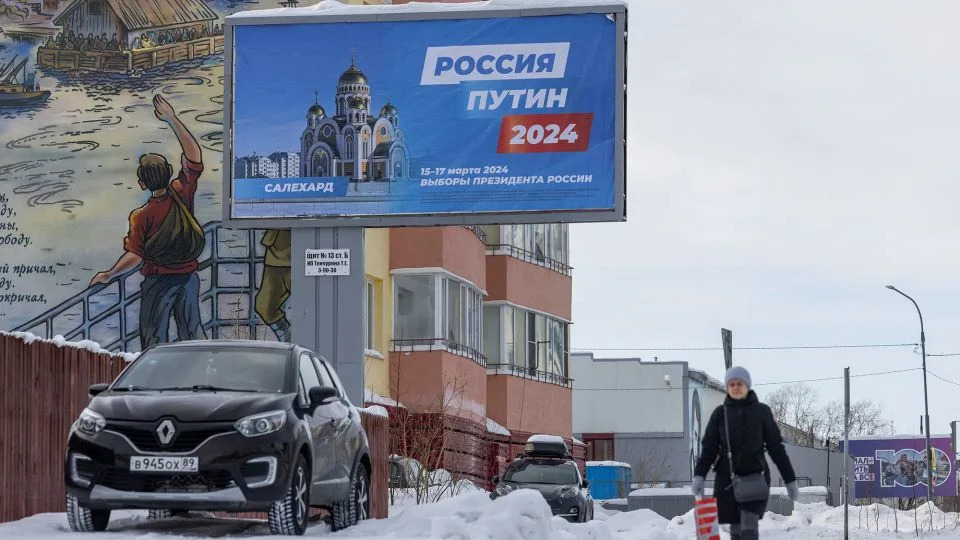
Voting will take place over three days in March. – Maxim Shemetov/Reuters
Early voting in Zaporizhzhia, one of four Ukrainian regions Russia said it would annex in September 2022 in violation of international law, also began on February 25, TASS said.
Russia has already held regional votes and referenda in those occupied territories, an effort dismissed by the international community as a sham but which the Kremlin sees as central to its campaign of Russification.
How long has Putin been in power?
Putin signed a law in 2021 that allowed him to run for two more presidential terms, potentially extending his rule until 2036, after a referendum the previous year allowed him to reset the clock on his term limits.
This election will mark the start of the first of those two extra terms.
He has essentially been the country’s head of state for the entirety of the 21st century, rewriting the rules and conventions of Russia’s political system to extend and expand his powers.
That already makes him Russia’s longest-serving ruler since Soviet dictator Joseph Stalin.
Putin’s previous efforts to stay in control included a 2008 constitutional amendment that extended presidential terms from four years to six, and a temporary job swap with his then Prime Minister Dmitry Medvedev the same year, that preceded a swift return to the presidency in 2012.
Who else is running?
Candidates in Russian elections are tightly controlled by the Central Election Commission (CEC), enabling Putin to run against a favorable field and reducing the potential for an opposition candidate to gain momentum.
The same is true this year. “Each candidate fields juxtaposing ideologies and domestic policies, but collectively they feed into Putin’s aim of tightening his grip on Russia during his next presidential term,” wrote Callum Fraser of the Royal United Services Institute (RUSI) think tank.
Nikolay Kharitonov will represent the Communist Party, which has been allowed to run a candidate in each election this century, but has not gained as much as a fifth of the vote share since Putin’s first presidential election.
Two other Duma politicians, Leonid Slutsky and Vladislav Davankov, are also running. Davankov is deputy chair of the Duma, Russia’s lower house of parliament, while Slutsky represents the Liberal Democratic Party of Russia, the party previously led by ultra-nationalist firebrand Vladimir Zhirinovsky, who died in 2022. All are considered to be reliably pro-Kremlin.
But there is notably no candidate who opposes Putin’s war in Ukraine; Boris Nadezhdin, previously the only anti-war figure in the field, was barred from standing by the CEC in February after the body claimed he had not received enough legitimate signatures nominating his candidacy.
In December, another independent candidate who openly spoke out against the war in Ukraine, Yekaterina Duntsova, was rejected by the CEC, citing alleged errors in her campaign group’s registration documents. Duntsova later called on people to support Nadezhdin’s candidacy.
Writing on social media in February, opposition activist Leonid Volkov dismissed the elections as a “circus,” saying they were meant to signal Putin’s overwhelming mass support. “You need to understand what the March ‘elections’ mean for Putin. They are a propaganda effort to spread hopelessness” among the electorate, Volkov said.
Are the elections fair?
Russia’s elections are neither free nor fair, and serve essentially as a formality to extend Putin’s term in power, according to independent bodies and observers both in and outside the country.
Putin’s successful campaigns have been in part the result of “preferential media treatment, numerous abuses of incumbency, and procedural irregularities during the vote count,” according to Freedom House, a global democracy watchdog.
Outside of election cycles, the Kremlin’s propaganda machine targets voters with occasionally hysterical pro-Putin material, and many news websites based outside Russia were blocked following the invasion of Ukraine, though more tech-savvy younger voters have grown accustomed to using VPNs to access them.
Protests are also tightly restricted, making the public expression of opposition a perilous and rare occurrence.
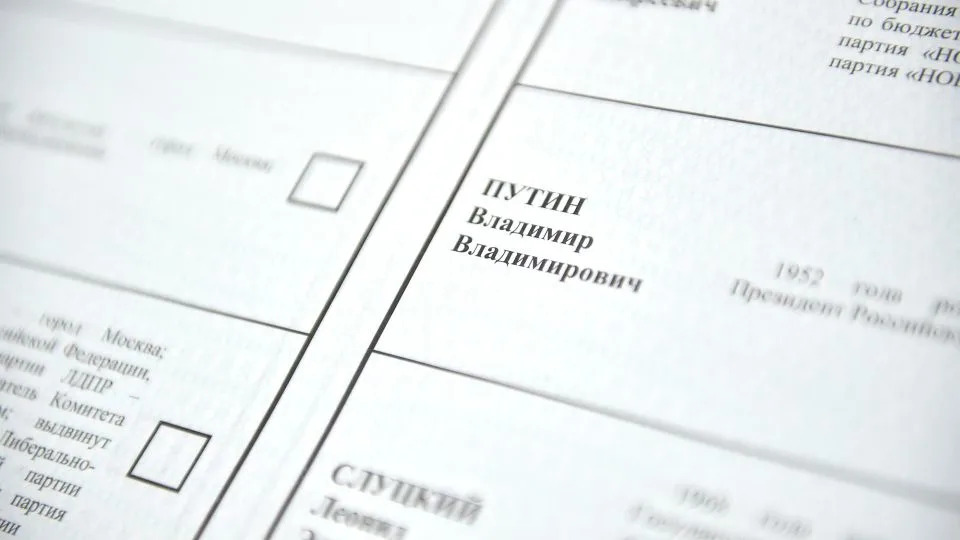
Ballot papers bearing Putin’s name are prepared ahead of the election. – Vladimir Nikolayev/AFP/Getty Images
Then, as elections come into view, genuine opposition candidates almost inevitably see their candidacies removed or find themselves prevented from seeking office, as Nadezhdin and Duntsova discovered during this cycle.
“Opposition politicians and activists are frequently targeted with fabricated criminal cases and other forms of administrative harassment designed to prevent their participation in the political process,” Freedom House noted in its most recent global report.
Is Putin popular in Russia?
Truly gauging popular opinion is notoriously difficult in Russia, where the few independent think tanks operate under strict surveillance and where, even in a legitimate survey, many Russians are fearful of criticizing the Kremlin.
But Putin undoubtedly has reaped the rewards of a political landscape tilted dramatically in his favor. The Levada Center, a non-governmental polling organization, reports Putin’s approval rating at over 80% – an eye-popping figure virtually unknown among Western politicians, and a substantial increase compared to the three years before the invasion of Ukraine.
The invasion gave Putin a nationalist message around which to rally Russians, and even as Russia’s campaign stuttered over the course of 2023, the war retained widespread support.
National security is top of mind for Russians as the election approaches; Ukrainian strikes on Russian border regions have brought the war home to many people inside the country, but support for the invasion — euphemistically termed a “special military operation” by Russia’s leaders — remains high.
The Levada Center found at the end of 2023 that “increased inflation and rising food prices may have a lasting impact on the mood of Russians,” with the proportion of Russians cutting back on spending increasing.
But that is not to say Russians expect the election to change the direction of the country. Putin benefits heavily from apathy; most Russians have never witnessed a democratic transfer of power between rival political parties in a traditional presidential election, and expressions of anger at the Kremlin are rare enough to keep much of the population disengaged from politics.
Putin’s former speechwriter, Abbas Gallyamov, told CNN last month that discontent against the president was increasing in Russia. Gallyamov said Putin is attempting to eliminate opposition leaders from society to at least ensure such discontent remains “unstructured,” “disorganized” and “leaderless” ahead of future elections.
How will Navalny’s death affect the election?
The timing of the death of Alexey Navalny – Putin’s most prominent critic – served to emphasize the control Russia’s leader exerts over his country’s politics.
In one of Navalny’s final court appearances before his death, he urged prison service workers to “vote against Putin.”
“I have a suggestion: to vote for any candidate other than Putin. In order to vote against Putin, you just need to vote for any other candidate,” he said on February 8.
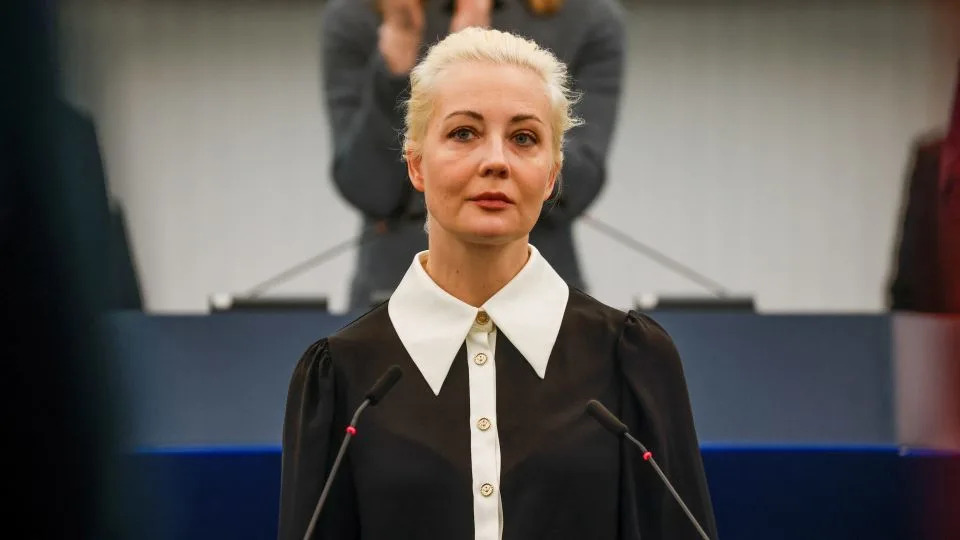
Yulia Navalnaya, the widow of Alexey Navalny, addresses the European Parliament in Strasbourg, France, on February 28, 2024. – Johanna Geron/Reuters
His death has cast an ominous shadow over the campaign. Navalny’s widow, Yulia Navalnaya, urged the European Union to “not recognize the elections” in a passionate address to its Foreign Affairs Council a few days after she was widowed.
“Putin killed my husband exactly a month before the so-called elections. These elections are fake, but Putin still needs them. For propaganda. He wants the whole world to believe that everyone in Russia supports and admires him. Don’t believe this propaganda,” she said.
Thousands gathered for Navalny’s funeral in Moscow despite the threat of detention by Russian authorities.
Navalnaya has since urged Russian people to turn out at noon on the final day of the elections, March 17, as a show of protest. In a video posted on social media, Navalnaya told Russians they could “vote for any candidate besides Putin, you can ruin your ballot, you can write Navalny on it.”
She added that Russians did not have to vote, but could “stand at a polling station and then go home… the most important thing is to come.”
This story has been updated.
CNN’s Anna Chernova, Pauline Lockwood and Mariya Knight contributed reporting.
Trump meets with Hungary’s leader, Viktor Orbán, continuing his embrace of autocrats
Nicholas Riccardi and Justin Spike – March 8, 2024
Hungarian Prime Minister Viktor Orban speaks at CPAC in Dallas, Aug. 4, 2022. Former President Donald Trump is meeting Friday, March 8, 2024, with Orban, a prominent conservative populist whose crackdowns in Hungary have sparked criticism that he’s eroding that country’s democracy. The meeting comes as Hungary has had conflicts with President Joe Biden’s administration. (AP Photo/LM Otero, File)A fisherman casts a line near Mar-a-Lago, as former President Donald Trump is planning to meet Hungarian Prime Minister Victor Orban, Friday, March 8, 2024, in Palm Beach, Fla. (AP Photo/Marta Lavandier)A security guard stands near an entrance to Mar-a-Lago, as former President Donald Trump is planning to meet Hungarian Prime Minister Victor Orban, Friday, March 8, 2024, in Palm Beach, Fla. (AP Photo/Marta Lavandier)
Former President Donald Trump met Friday with Hungarian Prime Minister Viktor Orbán, as the likely Republican presidential nominee continued his embrace of autocratic leaders who are part of a global pushback against democratic traditions.
Orbán has become an icon to some conservative populists for championing what he calls “illiberal democracy,” replete with restrictions on immigration and LGBTQ+ rights. But he’s also cracked down on the press and judiciary in his country and rejiggered the country’s political system to keep his party in power while maintaining the closest relationship with Russia among all European Union countries.
In the U.S., Trump’s allies have embraced Orbán’s approach. On Thursday, as foreign dignitaries milled through Washington, D.C., ahead of President Joe Biden’s State of the Union address, Orbán skipped the White House and instead spoke at the Heritage Foundation, a conservative think tank overseeing the 2025 Project, the effort to create a governing blueprint for Trump’s next term.
“Supporting families, fighting illegal migration and standing up for the sovereignty of our nations. This is the common ground for cooperation between the conservative forces of Europe and the U.S.,” Orbán wrote on X, formerly Twitter, after his Heritage appearance.
He then flew to Florida, where met Trump late Friday afternoon at the former president’s beachfront compound, Mar-a-Lago. Orbán posted on his Instagram account footage of him and his staff meeting with Trump and the former president’s staff, then of the prime minister walking through the compound and handing Melania Trump a giant bouquet of flowers.
In the video, Trump praised Orbán to a laughing crowd. “He’s a non-controversial figure because he says, ‘This is the way it’s going to be,’ and that’s the end of it. Right?” Trump said of the Hungarian prime minister. “He’s the boss.”
The Trump campaign said late Friday that the two men discussed “a wide range of issues affecting Hungary and the United States, including the paramount importance of strong and secure borders to protect the sovereignty of each nation.”
Campaigning Friday in Pennsylvania, Biden said of Trump: ’You know who he’s meeting with today down in Mar-a-Lago? Orbán of Hungary, who’s stated flatly that he doesn’t thinks democracy works, he’s looking for dictatorship.”
“I see a future where we defend democracy, not diminish it,” Biden added.
Orbán’s approach appeals to Trump’s brand of conservatives, who have abandoned their embrace of limited government and free markets for a system that sides with their own ideology, said Dalibor Rohac, a fellow at the American Enterprise Institute.
“They want to use the tools of government to reward their friends and punish their opponents, which is what Orbán has done,” Rohac said.
The meeting also comes as Trump has continued to embrace authoritarians of all ideological stripes. He’s praised Russian President Vladimir Putin, Chinese President Xi Jinping and North Korea’s Kim Jong Un. Orbán’s government has reciprocated, repeatedly praising the former president.
On Friday, Hungary’s Foreign Minister, Péter Szijjártó, posted from Palm Beach, hailing Trump’s “strength” and implying that the world would be more peaceful were he still president.
“If Donald Trump had been elected President of the United States in 2020, the war in Ukraine, now in its third year, would not have broken out and the conflict in the Middle East would have been resolved much faster,” he wrote.
Orbán has served as Hungary’s prime minister since 2010. The next year, his party, Fidesz, used its two-thirds majority in the legislature to rewrite the nation’s constitution. It changed the retirement age for judges, forcing hundreds into early retirement, and vested responsibility for appointing new judges with a single political appointee who was widely accused of acting on behalf of Fidesz.
Fidesz later authored a new media law and set up a nine-member council to serve as the country’s media regulator. All nine members are Fidesz appointees, which media watchdogs say has facilitated a major decline in press freedom and plurality.
The country’s legislative lines have been redrawn to protect Fidesz members and no major news outlets remain that are critical of Orbán’s government, making it almost impossible for his party to lose elections, analysts say.
Orbán backed Trump’s reelection effort and has had frosty relations with the Biden administration, which pointedly did not invite Hungary to a summit on democracy it organized after the president took office. Hungarian officials have accused Biden’s ambassador to the country, former human rights lawyer David Pressman, of interfering in internal governmental affairs.
Earlier this week, Hungary objected to Biden’s choice of a former Dutch prime minister to serve as NATO’s new commander, potentially stalling the appointment.
The Hungarian leader also has enthusiastically boosted Trump’s latest presidential campaign, posting a message encouraging Trump to “keep fighting” after he was hit with the first of what would be four criminal cases against him last year. Last week, Orbán declared that a win by the former president would be “the only serious chance” for ending the war in Ukraine.
A video from the Heritage appearance posted by Orbán’s political director showed the prime minister speaking with Vivek Ramaswamy, a pharmaceutical entrepreneur who unsuccessfully ran for the Republican presidential nomination before dropping out and endorsing Trump. The Hungarian leader also met with Steve Bannon, a former Trump adviser who remains a vocal ally of the ex-president and is active in global populist circles.
Orbán’s visit this week comes after he signed a new National Sovereignty Law that penalizes any foreign support of political actors in Hungary, part of the prime minister’s longstanding battle against the European Union and international nonprofits criticizing his erosion of Hungary’s democracy.
“Orbán is setting up this huge barrier to anyone interfering in Hungarian elections, but Orbán’s interfering in all sorts of other countries’ elections,” said Kim Scheppele, a Princeton sociologist and Hungary expert.
Orbán is one of a small group of conservative populists who have publicly aligned themselves with U.S. conservatives trying to oust Biden in November. Last month, Salvadoran President Nayib Bukele and Argentine President Javier Milei spoke at the Conservative Political Action Conference just outside Washington. Orbán was a featured speaker at the 2022 event, after which he met Trump at the former president’s New Jersey golf course.
Several conservative populists have won European elections in recent years, including in Italy and Sweden. But leaders in those countries have remained staunch opponents of Russian President Vladimir Putin’s invasion of Ukraine, not battled with the European Union government or taken steps that alarm democracy advocates as Orbán has.
Scheppele said the parallels between Trump and Orbán go beyond ideology. She noted that Orbán is not very religious but has become a hero to Christian conservatives for his hardline stances, much like Trump.
The two men face a similar electoral quandary as well, she added.
“They’ve got the same problem,” Scheppele said. “How do you leverage a really solid base, which is not an actual majority, at election time?”
Riccardi reported from Denver and Spike from Budapest. Associated Press political writer Jill Colvin in New York contributed to this report.
Sweden finally joins NATO, ending non-alignment, in Ukraine war shadow
Shaun Tandon – March 7, 2024
An empty mast at NATO headquarters, ahead of a flag-raising ceremony for new member Sweden (JOHN THYS)
Sweden on Thursday became the 32nd member of NATO, turning the page on two centuries of non-alignment and capping two years of tortuous diplomacy after Russia’s invasion of Ukraine triggered new fears.
Days after Hungary followed key holdout Turkey and became the last NATO member to sign off, Sweden ceremonially handed over accession documents to the United States, the leading force of the transatlantic alliance that promises joint security for all.
Prime Minister Ulf Kristersson late Thursday attended as a guest at the annual State of the Union address of President Joe Biden, whose rival Donald Trump has disparaged NATO as unfairly burdening the United States.
“Mr Prime Minister, welcome to NATO, the strongest military alliance the world has ever seen,” Biden said as he recognized Kristersson, who sat in the gallery next to First Lady Jill Biden.
Biden urged the House leadership of the Republican Party to move on billions of dollars in military aid to Ukraine, saying, in a dig at Trump, that “I will not bow down” to Russian President Vladimir Putin.
“If anybody in this room thinks Putin will stop at Ukraine, I assure you he will not,” Biden said.
– ‘Victory for freedom’ –
Kristersson, at an accession ceremony at the State Department, called joining NATO “a major step but, at the same time, a very natural step.”
“It’s a victory for freedom today. Sweden has made a free, democratic, sovereign and united choice to join NATO,” he said.
He later delivered a televised address to the nation from Washington, telling Swedes: “We are a small country, but we understand more than most the importance of the greater world beyond our borders.”
Secretary of State Antony Blinken said few would have expected Sweden as well as Finland to join NATO before Putin ordered the invasion of Ukraine in February 2022.
There is “no clearer example than today of the strategic debacle that Putin’s invasion of Ukraine has become for Russia,” Blinken said.
Ukrainian President Volodymyr Zelensky also hailed Sweden’s membership, saying: “One more country in Europe has become more protected from Russian evil.”
– Overcoming Turkish reluctance –
Sweden has not fought in a war since the Napoleonic conflicts of the early 19th century.
Sweden and Finland, while militarily intertwined with the United States and both members of the European Union, had historically steered clear of joining NATO, formed in the Cold War to unite against the Soviet Union.
Finland and Sweden launched a joint bid quickly after the invasion of Ukraine, which itself had unsuccessfully sought to join NATO.
Finland successfully joined in April 2023, but Sweden’s membership was stalled by Turkey.
“Good things come to those who wait,” Blinken said as he received the documents from Sweden.
Russia has vowed “countermeasures” over Sweden’s entry into NATO, especially if the alliance’s troops and assets deploy in the country.
Sweden’s blue and yellow flag is expected to be hoisted on Monday at the Brussels headquarters of the North Atlantic Treaty Alliance.
Before agreeing to ratify membership, Turkey used its leverage to press Sweden, known for its liberal asylum policies, to crack down on Kurdish militants who have campaigned against Ankara.
Turkish President Recep Tayyip Erdogan later demanded action after protesters, enjoying Swedish laws on free speech, desecrated Islam’s holy book the Koran.
In a clear if unstated sweetener, the United States dangled the sale of F-16 warplanes to Turkey, which has faced the wrath of US sanctions over an earlier major military purchase from Russia.
The Biden administration in January approved $23 billion in F-16 warplanes for Turkey swiftly after it ratified Sweden’s membership.
The United States simultaneously pushed ahead with $8.6 billion in more advanced F-35 jets for Greece, a fellow NATO member and historic adversary of Turkey.
Even after Turkey’s blessing, Sweden faced another obstacle as it needed approval of a last country — Hungary, whose nationalist prime minister, Viktor Orban, has often thumbed his nose at Western allies.
The Hungarian parliament ratified Sweden’s membership on February 26. But in one last hiccup, Hungary could not sign the accession document due to a brief absence in the mostly ceremonial post of president, after an Orban ally resigned over pardoning a convicted child abuser’s accomplice.
Doctors Say Trump Is Displaying Clear Signs of Cognitive Issues
Victor Tangermann – March 8, 2024
At 81 years old, president Joe Biden has attracted significant voter misgivings over his age and mental acuity.
But his rival in the upcoming presidential election, Donald Trump, may be dealing with much more acute cognitive issues.
Experts are becoming increasingly worried over Trump’s condition, Salon reports, with the former president struggling to form coherent sentences and even once again confusing Biden with his predecessor Barack Obama during a rally in North Carolina this month.
“Not enough people are sounding the alarm, that based on his behavior, and in my opinion, Donald Trump is dangerously demented,” psychologist and former Johns Hopkins Medical School professor John Gartner, who wrote a book about Trump’s mental health, told Salon.
“This is a tale of two brains,” he added. “Biden’s brain is aging. Trump’s brain is dementing.”
“In my opinion, Donald Trump is getting worse as his cognitive state continues to degrade,” Gartner said. “If Trump were your relative, you’d be thinking about assisted care right now.”
Others agreed.
“It is meaningful because the confusion of people, in contrast to the occasional forgetting of names, is a sign of early dementia, as noted by the Dementia Care Society,” licensed psychologist and founder and executive director of the Washington Center For Cognitive Therapy Vincent Greenwoodtold the publication.
As for Trump mispronouncing words like “Venezuela” or “migrant crime,” experts tend to agree he’s exhibiting early signs of “paraphasia,” speech disturbances caused by brain damage, and “not just aging,” as Greenwood argued.
And others, like clinical psychologist and Cornell University senior lecturer Harry Segal, who specializes in mental health disorders, offer a more nuanced assessment — though not one that inspires much confidence in Trump.
“Since this is an intermittent problem, it suggests that when Trump is especially stressed and exhausted, he suffers cognitive slippage that affects the way he associates words or their meaning,” he told Salon. “Note, though, that Trump’s pathological lying is itself a form of mental illness, so these cognitive lapses are literally sitting atop what appears to be an already compromised psychological functioning.”
Putin’s big message on International Women’s Day: Your job is to make babies
Joshua Zitser – March 8, 2024
Putin’s big message on International Women’s Day: Your job is to make babies
In his International Women’s Day address, Vladimir Putin emphasized the importance of having kids.
The Russian president reiterated that 2024 is the “year of the family” in Russia.
Putin has repeatedly leaned on Russia’s women to have more children to fix its demographic crisis.
International Women’s Day on March 8 is a big deal in Russia.
It’s observed as a national holiday, on which workers get the day off work, TV stations highlight the achievements of Russian women, and Russian President Vladimir Putin makes an address.
In this year’s speech, Putin had a clear message about what a Russian woman’s purpose in life should be: having kids.
“You, dear women, are capable of transforming the world with your beauty, wisdom, and generosity of spirit. But most of all, thanks to the greatest gift bestowed on you by nature — childbirth,” he said.
Putin said becoming a mother was an “amazing purpose for a woman,” according to a translation by The Moscow Times.
“Family remains the most important thing for any woman, no matter what career path she chooses or what professional heights she attains,” he added, per an official Kremlin translation.
He said this involved the “tireless” effort of looking after children.
In the address, Putin also restated that 2024 is the year of “the family” in Russia.
Putin signed an executive order last year to name this year as the year of baby-making.
“If we want to survive as an ethnic group — well, or as ethnic groups inhabiting Russia — there must be at least two children,” Putin said at a tank factory, according to Reuters.
High interest rates and macroeconomic instabilities are adding pressure on the private sector.
Russia’s economy appears resilient after two years of war with Ukraine, but a rising number of companies in the country are in trouble.
The number of companies in Russia that have gone bankrupt has soared in the first two months of 2024, Russian business daily Kommersant reported on Thursday.
In January, 571 companies in Russia declared bankruptcy — a rise of 57% from 364 a year ago, Kommersant reported, citing data from the federal register for bankruptcy.
In February, 771 companies declared bankruptcy — 60% higher than the 478 that did so a year ago.
Russia has imposed two moratoriums on bankruptcy in recent years. The first came during the COVID-19 pandemic that started in 2020; the second came after the West imposed sanctions on Russia over its invasion of Ukraine in 2022. The moratoriums expired in 2021 and late 2022, respectively.
Ilya Torosov, Russia’s first deputy economy minister, told Kommersant that this is merely a return to pre-pandemic levels.
On-the-ground difficulties in Russia
The uptick in corporate bankruptcies highlights the difficulties faced on the ground in Russia. It also stands in contrast to the rosy official statistics the Kremlin releases, which show that Russia’s GDP grew 3.6% in 2023.
Thanks to government spending, Russia’s wartime economy is resilient — but high interest rates are biting. The Bank of Russia has hiked interest rates up to 16% to cool the economy and tame inflation.
“Companies are experiencing problems with refinancing as the effects of monetary tightening are starting to kick in,” Bartosz Sawicki, a market analyst at Conotoxia, a Polish fintech firm, told Business Insider.
Apart from war-related sectors such as arms production, the Russian economy looks “far from rosy,” Sawicki said.
“Although Russian companies are doing their utmost to dodge sanctions, international trade has become a significant issue for plenty of them,” Sawicki wrote in an email.
“The private sector also feels the pressure of macroeconomic instabilities, which deepen as the economy is on the verge of overheating,” he added.
It could get worse.
Russian President Vladimir Putin’s regime is coming under tightening Western trade restrictions, including secondary sanctions against companies doing business with the country.
Putin has also pledged to give Russians billions of dollars in lifestyle upgrades weeks before they head to the ballot for the country’s presidential election later this month.
While it’s unclear where the extra budget for Putin’s promises will come from, the Russian leader has proposed changes to the tax system that are designed to result in more taxes from high-income individuals and businesses — which could put even more pressure on private companies.
Russia’s presidential election is set to take place over three days, from March 15 to March 17. Putin is expected to win the election against three opponents.
Who are the Russian dissidents still serving time after Alexei Navalny died behind bars?
Dasha Litvinova and Katie Marie Davies – March 8, 2024
Russian opposition leader Alexei Navalny, center, attends a rally in Moscow on Sunday, Jan. 28, 2018. During his 24-year rule, Russian President Vladimir Putin has gone from tolerating dissent to suppressing any challenger. Most Russian opposition politicians are in prison or exile. (AP Photo/Evgeny Feldman, File) Russian opposition activist Vladimir Kara-Murza gestures while standing in a glass cage in a courtroom during the announcement of the verdict on appeal at the Moscow City Court on July 31, 2023. Kara-Murza was convicted of treason last year over a speech denouncing the war in Ukraine. He is serving a 25-year prison term in a Siberian prison colony, the stiffest sentence for a Kremlin critic in modern Russia. (AP Photo, File) Ilya Yashin, a Russian opposition activist and former municipal deputy of the Krasnoselsky district, gestures and smiles as he stands in a defendant’s cubicle in a courtroom prior to a hearing in Moscow, on Dec. 9, 2022. Most Russian opposition figures are currently either in prison or in exile abroad. Still, many persist in challenging the Russian authorities, including by speaking out from behind bars. (Yury Kochetkov/Pool via AP, Pool, File)Andrei Pivovarov, the former head of the Open Russia movement, stands behind glass during a court session in Krasnodar, Russia, on June 2, 2021. Pivovarov, serving four years for running a banned political organization, must clean his solitary cell for several hours a day and listen to a recording of prison regulations, says his wife, Tatyana Usmanova. (AP Photo, File)Lilia Chanysheva makes a heart gesture as she stands in a cage during a hearing in Kirovskiy District Court in Ufa, Russia, on Wednesday, June 14, 2023. Chanysheva, who used to head imprisoned opposition leader Alexei Navalny’s office in the Russian region of Bashkortostan, was convicted of extremism charges and sentenced to 7.5 years in prison. (AP Photo, File)Oleg Orlov, the co-chair of the Nobel Peace Prize-winning human rights organization Memorial, gestures while standing in a glass cage after he was taken into custody in the courtroom during a court session for a new trial on charges of repeated discrediting the Russian military, in Moscow on Tuesday, Feb. 27, 2024. (AP Photo, File)exei Gorinov holds a sign “I am against the war” standing in a cage during hearing in the courtroom in Moscow, Russia, Tuesday, June 21, 2022. Gorinov, a former member of a Moscow municipal council serving seven years for speaking against the war in Ukraine, suffers from a chronic lung condition. His health deteriorated during six weeks in solitary confinement, and he is still recovering. (AP Photo, File)
TALLINN, Estonia (AP) — Russian President Vladimir Putin is expected to secure his fifth term in power this month on the heels of opposition leader Alexei Navalny’s death in prison, which devastated Kremlin critics and spurred concerns about the safety of other imprisoned dissidents.
The charges against Kara-Murza, who has been behind bars since his arrest in 2022, stem from a speech that year to the House of Representatives in Arizona, where he denounced Russia’s invasion of Ukraine.
The 42-year-old political activist, who started out as a journalist, was an associate of Russian opposition leader and fierce Putin critic Boris Nemtsov, who was assassinated near the Kremlin in 2015.
In 2011 and 2012, Kara-Murza and Nemtsov lobbied for passage of the Magnitsky Act in the United States. The law was in response to the death in prison of Russian lawyer Sergei Magnitsky, who had exposed a tax fraud scheme. The law has enabled Washington to impose sanctions on Russians deemed to be human rights violators.
Kara-Murza has twice survived poisonings he blamed on Russian authorities. He has rejected the charges against him as punishment for standing up to Putin, and likened the proceedings to the show trials under Soviet dictator Josef Stalin.
Since September 2023, Kara-Murza has been serving his sentence in solitary confinement in the Siberian city of Omsk. In January, he was moved to another penal colony in the city and was put in solitary again. That move has been widely seen as an attempt to pressure a man who, even behind bars, remained a vocal critic of the Kremlin and its war in Ukraine.
ILYA YASHIN, SERVING 8 ½ YEARS
One of the few well-known Kremlin critics to stay in Russia after the start of the war, Ilya Yashin, 40, was arrested in June 2022 while walking in a Moscow park. He was sentenced to 8 ½ years in prison after he was convicted for spreading false information about Russian soldiers.
The charge stemmed from a YouTube livestream in which he talked about civilians slain in the Kyiv suburb of Bucha. After Russian forces withdrew from the area in March 2022, hundreds of corpses were found, some with their hands bound and shot at close range.
Yashin, member of a Moscow municipal council, was a vocal Navalny ally and a close associate of Nemtsov’s. He is serving time in Russia’s western Smolensk region.
His harsh sentence didn’t silence Yashin’s sharp criticism of the Kremlin. Yashin’s associates regularly update his social media pages with messages he relays from prison. His YouTube channel has over 1.5 million subscribers.
“So far the authorities have failed to shut me up,” he said in a letter from prison to The Associated Press in September 2022.
ANDREI PIVOVAROV, SERVING 4 YEARS
Andrei Pivovarov, 42, headed the opposition group Open Russia, which authorities declared an “undesirable” organization before it was disbanded in 2021. Days later, as he attempted to leave the country, Pivovarov was pulled off an airliner due to take off from St. Petersburg for Warsaw.
The authorities accused him of carrying out activities of an “undesirable organization.” He rejected the charges as politically motivated and driven by his plans to run for a seat in the parliament in the 2021 election. While in pretrial detention, he still managed to run a campaign, but didn’t get on the ballot. In July 2022, when the war in Ukraine was in full swing, Pivovarov was sentenced to four years in prison.
In a written interview conducted when he was behind bars in December 2022, Pivovarov told the AP that his sentence did not come as a surprise.
“By the summer of 2022, the political field was completely purged. Those who hadn’t left ended up behind bars just like me,” Pivovarov wrote.
He has been serving time in isolation in a remote penal colony in Russia’s northwestern Karelia region.
LILIA CHANYSHEVA, SERVING 7 ½ YEARS
Lilia Chanysheva, the 42-year-old former head of Alexei Navalny’s office in the Russian Bashkortostan region, was arrested in November 2021. A court ruling several months earlier had designated Navalny’s Foundation for Fighting Corruption and its regional offices as “extremist organizations.”
Following a closed-door trial, Chanysheva was sentenced to 7 ½ years in prison in June 2023 after being found guilty of calling for extremism, forming an extremist group and founding an organization that violates rights. She was also fined 400,000 rubles (about $4,700).
Chanysheva rejects the charges as politically motivated. Russian media reported this week that the authorities are now seeking a harsher sentence of 10 years for the former activist.
The 70-year-old co-chair for the Nobel Peace Prize-winning human rights group Memorial was charged over an article he wrote denouncing Russia’s war in Ukraine.
In 1995, when Chechen rebels in the city of Budyonnovsk took thousands of people hostage in a hospital, Orlov was among the human rights activists who offered themselves as hostages in exchange for the release of civilians.
Orlov was convicted and sentenced to a fine of 150,000 rubles (about $1,500 at the time) in October 2023, significantly less than the lengthy prison terms some other Russians have received for criticizing the war. Underscoring Putin’s low tolerance of criticism of the invasion of Ukraine, the prosecution appealed the fine and sought harsher punishment.
In a statement, Memorial called Orlov’s sentence “an attempt to drown out the voice of the human rights movement in Russia and any criticism of the state.”
ALEXEI GORINOV, SERVING 7 YEARS
Alexei Gorinov, a member of a Moscow municipal council, was the first person to be sentenced to prison under the law penalizing the spread of “false information” about the Russian military after the invasion of Ukraine.
He was arrested in April 2022 after criticizing the war at a municipal council meeting. A YouTube video showed him voicing skepticism about holding a planned children’s art competition in his constituency while “everyday children are dying” in Ukraine. He was sentenced to seven years in prison.
The long sentence for a low-profile activist shocked many. In written comments to AP from behind bars in March 2023, Gorinov, 62, said “authorities needed an example they could showcase to others (of) an ordinary person, rather than a public figure.”
Gorinov has a chronic respiratory condition and had part of a lung removed before he was imprisoned. His health deteriorated during six weeks in solitary confinement in a penal colony in the Vladimir region east of Moscow. He is still recovering.
Biden’s allies are begging him to fight harder. The State of the Union is his chance to do so.
Edward-Isaac Dovere, CNN – March 7, 2024
A handful of Democratic governors made their way through a gaggle of their colleagues last month to tell President Joe Biden directly what they’ve been stressing behind the scenes: He needs to be fighting harder.
The Democrats told Biden that he needed to show more of the fire that was on display in a closed-door meeting with governors when Montana Gov. Greg Gianforte handed him a letter demanding more action on the southern border. Biden flashed a smile, according to two of the governors standing there.
“State of the Union,” Biden said, teasingly.
That fighting attitude is anticipated to be on display during Thursday’s primetime speech, in which the president is expected to go much further than he is used to in bashing corporations for gouging consumers and racking up profits. But with anger about rising prices driving so much of the bad vibes surrounding the economy — even the Cookie Monster X account posted about shrinkflation on Monday, prompting a response from the White House — Biden is going where he long resisted, in an effort to redirect the fury that has been weighing him down in the polls.
Leading Democrats say it’s far past time.
Two dozen top Democratic officials and operatives who spoke to CNN said they’re tired of reading that the president is cursing about Donald Trump and Israeli Prime Minister Benjamin Netanyahu behind the closed doors of the Oval Office, or hearing reports that he told donors that Vladimir Putin is “a crazy SOB” and that MAGA Republicans are worse than segregationists. They want to see that passion and fire out in public as assurances that the president’s behind-the-scenes demeanor doesn’t match the public perception of the 81-year-old commander-in-chief are wearing thin.
“A lot of times you need to hear it from the candidate,” said Tim Walz, the governor of Minnesota who’s eagerly thrown himself into becoming one of the president’s most active defenders. “Joe Biden’s a nice guy. People get that. One of the things people wonder, ‘Is he tough enough to take these things on?’”
Plus, Walz said, it would push back against the concerns that Biden is too old.
“I think it helps. He’s still going to be his age, but I think it helps to make the case on this,” Walz said. “Punch [Trump] a little bit. He earned it.”
Multiple Democratic officials told CNN they are hesitant of how much of to say, weighing the risks of calling even more attention to what Biden isn’t doing by going public.
But privately, many talk longingly about wanting to see more passion and pride – political theatrics, sure, but ones that they argue are crucial – at a moment when exhaustion with the process is pervasive and the Democratic worries over a second Trump administration are high. Biden’s effort in standing up for democracy shouldn’t top out with a few sly digs on Seth Meyers’ late-night show, they insist. They argue he shouldn’t give a forceful speech marking the anniversary of the January 6, 2021, insurrection and assume that will fill out his energetic quota for over two months.
“People do want to see that he’s a fighter, which he is. Anything that presents the contrast, which I think that would help do, I’d be for,” said New Jersey Gov. Phil Murphy, a longtime friend of Biden.
Planning for traps
At a moment when polls show majorities of Democrats don’t think Biden should be running for reelection, and with the biggest national audience he is likely to get outside of the summer convention, Biden and his aides are hyper aware of the importance of Thursday’s speech. They know every word and stutter and shuffle will be picked over as much as any of the policy proposals, and the drafting has been going until late into the evening in the West Wing.
Top Biden advisers insist that their favorite moment from last year’s speech – when he got Republicans to boo cutting Social Security and Medicare, punctuating the moment with “I enjoy conversion” – was not at all planned.
This time around, aides acknowledge that the political pressure has them workshopping options to not leave Biden’s fate up to another improvisation and the hope that he will have another smooth off-the-cuff response.
Hawaii Sen. Brian Schatz isn’t sure the State of the Union is the right forum for Biden to come out in full force, “but after that, I think he’s going to have to be gloves off.”
Biden aides love to scold and shame reporters for coverage they think is unfair or over-torqued. Schatz said the president and his aides need to move past that to get negative stories about Trump covered by getting Biden to take the swings.
“We don’t have time to rewrite the rules of engagement in journalism. We just have to work with what we have,” Schatz said. “He’s personally going to have to make that case, and not assume that people are organically going to get it, either from surrogates or via osmosis.”
Biden aides acknowledge he’d look stronger if he fought more
For months, Biden campaign aides have been talking about the need to step up, and the obvious benefit they see in him doing it. People look strong when they’re picking fights, is how one senior Biden campaign official summarized the thinking to CNN all the way back in January – and they know the president needs to look stronger than he does.
They have found this easier said than done, and not just because Biden is trying to maintain the chances of getting a few outstanding bills through Congress, including avoiding a shutdown and sending more aid to Israel and Ukraine.
“The real Joe Biden is: ‘We’re red states, we’re bluestates, but we’re the United States of America,’” said Gov. John Carney, who’s known Biden for decades and attributes that sensibility to their shared Delaware roots. “But he also is feisty.”
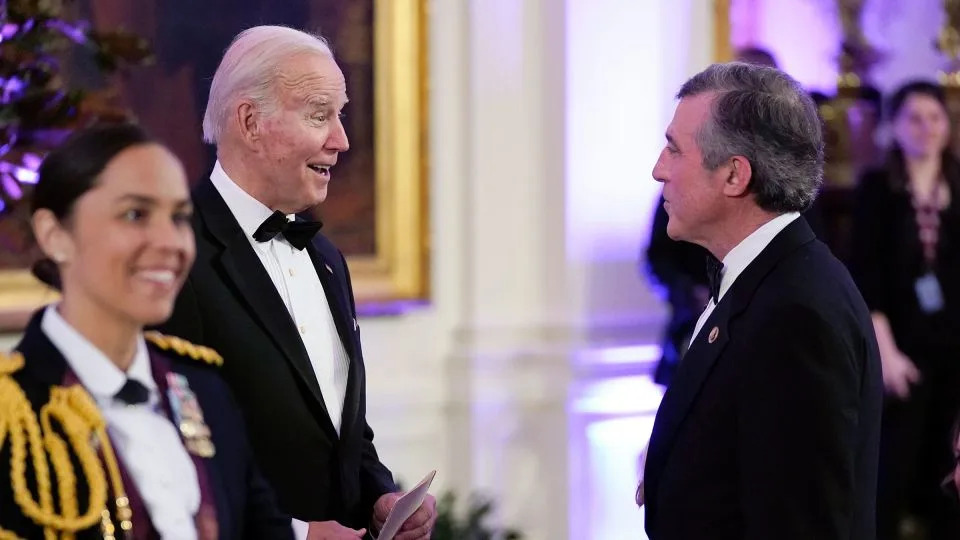
President Joe Biden talks with Delaware Gov. John Carney following a dinner reception for governors and their spouses on February 11 in Washington, DC. – Manuel Balce Ceneta/AP
And while Biden has enjoyed needling Trump while knowing he’ll probably get a response, his inclination is to present a calm demeanor for the sake of trying to insert more civility into politics – like the laudatory statement about Sen. Mitch McConnell he pushed to release last week after the Kentucky Republican announced he would be stepping down as minority leader. Biden did rile up many core Democrats by putting out any statement praising McConnell and by not mentioning things like his role in overturning Roe v. Wade by ensuring that Antonin Scalia’s and Ruth Bader Ginsburg’s Supreme Court seats went to conservatives.
“A statement like that, you have to wonder if Joe Biden gets it,” one enraged high-level Democratic operative complained to CNN.
Most of the fiercest statements to come out of Biden’s campaign so far have been attributed to staff members or written largely by others in his name. Aides say realistic management of the president’s time is a basic consideration: busy running the country, he cannot be constantly running to microphones to blast Trump.
“President Biden is on offense, demonstrating whose side he’s on and calling Republican officials out for choosing rich special interests over middle class families, choosing extreme attacks on basic reproductive health care over Americans’ freedoms, and choosing fentanyl traffickers over the Border Patrol by opposing the toughest bipartisan border security legislation in modern history,” said White House spokesman Andrew Bates.
Biden campaign spokeswoman Lauren Hitt followed up with a statement noting similar points and that “the president and vice president will absolutely continue holding Donald Trump accountable and communicating directly to voters how much is at stake in this election.”
Tactically skipping some fights
But on several issues with huge potential for wavering voters, Biden can’t say much at all.
Trump’s kaleidoscope of indictments and court cases is one of the former president’s greatest political liabilities and a popular line of attack from Nikki Haley. But Biden is committed to making clear the independence of the Justice Department and courts.
He has more to say about Netanyahu and the situation in Gaza that American voters might be interested in, but White House aides are wary of how scrupulously every word attributed to the president is being read both by the Israeli government and Arab leaders in the region.
Biden’s habit of pulling back the curtain on these thoughts and others at fundraisers isn’t just because he gets comfortable in front of a friendly crowd. It’s an occasionally tactical decision to try to get his comments into the media bloodstream while preserving a sliver of plausible distance.
Just because going harder lights up Democrats already obsessing about the race and plays well online doesn’t mean it’s the best strategy for winning over the moderates and Republicans turned off by Trump that Biden is hoping to be a palatable enough alternative for, especially over a long campaign that can already feel like a slog with still eight months to go.
For now, the campaign has been leaning on a format for videos for its new TikTok and other social media accounts: Hand Biden an iPad and record him watching and reacting to a video of the latest Trump comment that the campaign wants to highlight. It’s what one campaign aide called “the real digital equivalent of ‘Let Biden be Biden.’” Biden’s mostly exasperated reactions from watching the videos tend to be fresh, but the comments he makes after to sum them up are scripted and modulated.
And for all the people complaining that Biden can seem like an elderly man sleepwalking on the job, aides feel like they have plenty of time to ratchet up the outrage.
That only goes so far.
“You can’t be at an 11 out of 10 in terms of being alarmed for eight months in a row – so I understand the need for him to peak at the right time, and to make those arguments when the maximum number of voters are paying attention.” Schatz said. “But a lot of times politicians are advised not to be too rough, because it can harm, it can backfire, because it can backfire. In this case, people really know what they think of Joe Biden as a human. So, he’s got a lot of runway here to be as tough as necessary.”