Susan Rice Sounds The Alarm On How Donald Trump’s Debts Could Risk U.S. Security
Lee Moran – March 21, 2024
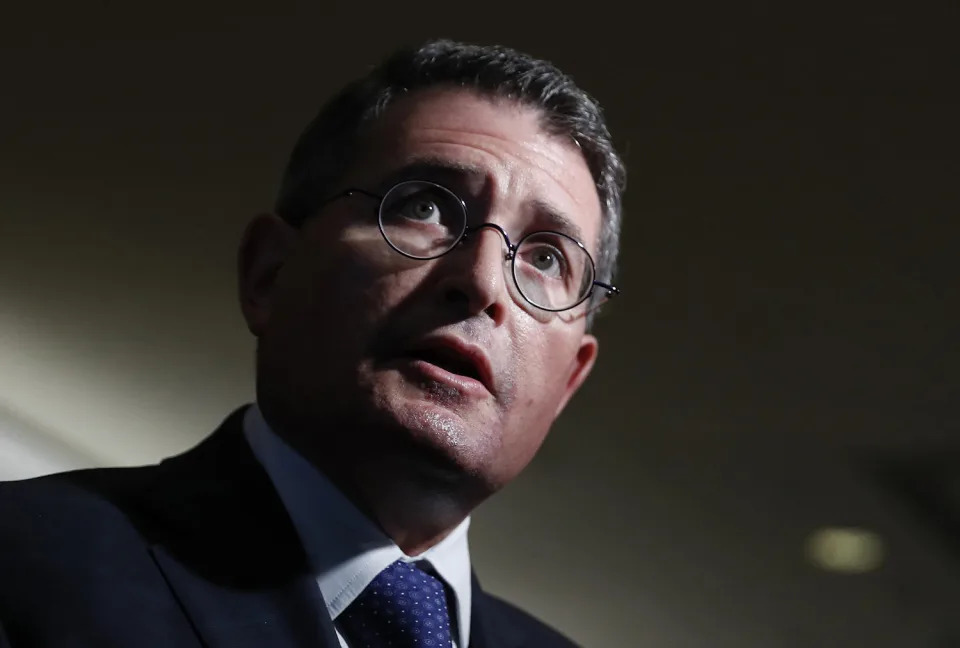
Former U.S. National Security Adviser Susan Rice on Wednesday talked about the threat that could be posed to America’s security over the hundreds of millions of dollars that presumptive GOP nominee Donald Trump owes in civil trials damages.
Trump owes “some $500 million or more,” is struggling to meet the bond in his $464 million fraud ruling and so “you have to wonder where he’s going to get that money from,” the Obama White House official told MSNBC’s Lawrence O’Donnell.
“In the event that [Trump] has to take that money from an individual or an entity, whether domestic or international, that individual or entity will potentially have real influence over him and so that is of concern” if he returns to the White House, said Rice.
Rice noted Trump’s “long history of foreign financial entanglements” and warned, “There’s just so many ways the stench of money from dubious places infuses his business enterprise and so this would add more questions should that be the case going forward.”
But “the big picture is even beyond the foreign financial entanglements,” added Rice, recalling Trump’s frequent siding with Russian President Vladimir Putin, his praise of dictators and his threat to abandon America’s allies in the NATO military alliance.
Ex-Trump Aide Says He’d Respond To Bankruptcy In 1 Whining Way: ‘I Can Hear It Now’
Lee Moran – March 21, 2024
Former Trump White House press secretary Stephanie Grisham on Wednesday said she could envision Donald Trump declaring bankruptcy in a bid to stall the seizure of his assets as the former president struggles to meet the bond to appeal the $464 million damages he owes following his civil fraud trial.
CNN’s “OutFront” anchor Erin Burnett noted how the presumptive GOP nominee had “built his entire candidacy, his political career about being this billionaire, successful businessman” and asked Grisham whether he’d be willing to declare bankruptcy so close to the 2024 election, given the negative message it may send to voters. Trump has done so on multiple previous occasions.
“I do,” replied Grisham.
New York Attorney General Letitia James, who brought the civil case agonist Trump and his business, can next week begin the process of seizing his assets.
Grisham suggested that “rather than lose Trump Tower, Mar-a-Lago or Bedminster, those top three for sure, he would declare bankruptcy.”
Trump will then “lean into it,” she predicted.
“Privately, will he like it? No, he’ll hate it,” Grisham said. “But he’ll lean into it and say ‘This is what I was forced to do,’ ‘This is because of the left wing,’ ‘This is because of the New York liberals, they’re doing this to me,’ ‘This is just a business move to protect myself.’”
“I can hear it now,” said Grisham. “He won’t like it personally, but I can absolutely see him doing that.”
Grisham later suggested Trump, if he wins the 2024 election, may be able to reverse the move. A bankruptcy now would be all about stalling the loss of those properties, she added.
Leonard Leo, Koch networks pour millions into prep for potential second Trump administration
Katherine Doyle – March 21, 2024
WASHINGTON — Huge funding from influential conservative donor networks is flowing into a conservative venture aimed at creating a Republican “government-in-waiting,” including over $55 million from groups linked to conservative activist Leonard Leo and the Koch network, according to an Accountable.US review shared exclusively with NBC News.
Launched by the Heritage Foundation in April 2022, Project 2025 is a two-pronged initiative to develop staunch conservative policy recommendations and grow a roster of thousands of right-wing personnel ready to fill the next Republican administration. With former President Donald Trump now the GOP’s presumptive 2024 nominee, the effort is essentially laying the groundwork for a potential Trump transition if he wins the election in November.
With contributions from former high-level Trump administration appointees and an advisory board that has grown to over 100 conservative organizations, proponents describe Project 2025 as the most sophisticated transition effort that has existed for conservatives. The initiative includes a manifesto devising a policy agenda for every department, numerous agencies and scores of offices throughout the federal government.
In this Nov. 16, 2016 file photo, Federalist Society Executive Vice President Leonard Leo speaks to media at Trump Tower in New York. Leo is advising President Donald Trump on his Supreme Court nominee. (Carolyn Kaster / AP file)
Since 2021, Leo’s network has funneled over $50.7 million to the groups advising the 2025 Presidential Transition Project as part of its “Project 2025 advisory board,” according to tax documents reviewed as part of the analysis by Accountable.US, a progressive advocacy group. That sum includes donationsfrom The 85 Fund, a donor-advised nonprofit group that funnels money from wealthy financiers to other groups, and the Concord Fund, a public-facing organization.
In 2022, the donor-advised fund DonorsTrust, which received more than $181 million from Leo-backed groups from 2019 to 2022, contributed over $21.1 million to 40 organizations advising Project 2025. It contributed nearly $20 million to 36 nonprofit organizations advising Project 2025 in 2021.
Leo, a top conservative megadonor, has worked to shift the American judiciary further to the right, having previously advised Trump on judicial picks while he was in office and helping to build the current conservative Supreme Court majority.
In addition to Leo’s funding to organizations advising Project 2025, the Heritage Foundation’s own donations surged in 2022. It contributed $1,025,000 to nine of the advisory groups, up from a total of $174,000 in grants to other nonprofit groups a year earlier.
The Heritage Foundation did not immediately respond to a request for comment.
The review by Accountable.US also found that oil billionaire Charles Koch’s network directed over $4.4 million in 2022 to organizations on Project 2025’s advisory board via its donor conduit, Stand Together Trust.
Project 2025’s vision for the next conservative administration’s energy agenda would rapidly increase oil and gas leases and production through the Interior Department to focus on energy security, and proposals include reforming offices of the Energy Department to end focus on climate change and green subsidies.
The Environmental Protection Agency would cut its environmental justice and public engagement functions, “eliminating the stand-alone Office of Environmental Justice and External Civil Rights,” according to a proposal drafted by Mandy Gunasekara, a former chief of staff at the EPA under Trump.
The advisory board for Project 2025 includes representatives from conservative groups led by veterans of the Trump administration, such as America First Legal, the Center for Renewing America and the Conservative Partnership Institute, as well as conservative mainstays like the Claremont Institute, the Family Research Council and the Independent Women’s Forum.
Accountable. US executive director Tony Carrk warned that Project 2025’s stark conservative program and its advisory groups are made possible by funding from right-wing donors’ funneling tens of millions of dollars to the effort.
“The ‘MAGA blueprint’ isn’t a one-off project — it’s backed by the same far-right figures who have long dictated the conservative agenda,” Carrk said. “Leo, Koch and others should be held to account for propping up a policy platform that puts special interests over everyday Americans and poses an existential threat to our democracy.”
While the groups advising Project 2025 haven’t been supporting a candidate outright, many of the people leading them or with longtime affiliations have close ties to Trump after having served in his administration. NBC News projects that Trump has now clinched the delegate majority for the Republican nomination, setting up a rematch with President Joe Biden in November.
Shareholders are scheduled to vote Friday on a merger that would bring Truth Social’s parent company public. Trump’s stake, according to The Wall Street Journal, could be worth roughly $3.5 billion.
Coincidentally, his finances will now be scrutinized like never before.
On Thursday, the judge who set a massive, $454 million judgment in Trump’s New York’s civil fraud case last month (it’s risen by $3 million in interest since) issued five pages of rules for the “enhanced” court-imposed monitoring of the Trump Organization.
Effective immediately, Trump Org must give Barbara Jones — a retired federal judge who’s been Trump’s court-ordered monitor since November, 2022 — specific advance notice of big shifts in the Company’s assets or structure.
The judge, state Supreme Court Justice Arthur Engoron, had warned a month ago, in his February verdict, that there would be exactly the kind of leash-tightening that Thursday’s order now sets for Trump and his fiscal babysitters.
Under the order, Trump must give five days advance notice “of any transfer of cash or other assets” totaling $5 million or more, “including transfers to any individual defendant.”
It happens to be five days before Trump’s March 25 deadline to pay his fraud judgment to New York in full or, failing that, to set the money aside as he appeals, in the form of an appeal bond totaling the full amount plus millions more in interest.
Under Thursday’s order, Trump must also give the monitor 30 days notice of “any planned creation or dissolution of business entities, including equity ownership purchased or assets acquired by any Defendant,” the judge further ordered on Thursday.
There are currently 415 entities — including the LLCs holding his physical properties — under the Trump Org umbrella.
The company has a dozen bank accounts, previous fraud-case filings have said. On Thursday, Engoron set new deadlines for Trump sharing the monthly statements for these bank accounts with the monitor.
Effective immediately, “the Trump Organization shall provide copies of monthly bank statements for all bank or brokerage accounts of the Trust within five business days of the end of each month,” Engoron ordered.
The “Trust” is a reference to the Donald J. Trust Revocable Trust, which holds all of Trump Org’s assets and for which Trump is the sole beneficiary.
The judge also ordered on Thursday that Trump foot the bill for the additional staff needed for this extra monitoring. Trump has already been paying for the team Jones brought in to watch his books 16 months ago.
Finally, the judge took action to prevent Trump from using the monitorship as a legal shield, as his lawyers attempted to do during the civil trial.
Neither Jones nor a yet-appointed Independent Director of Compliance “shall be liable for any fraud, material misstatements, misrepresentations or omissions” in Trump’s financial disclosures.
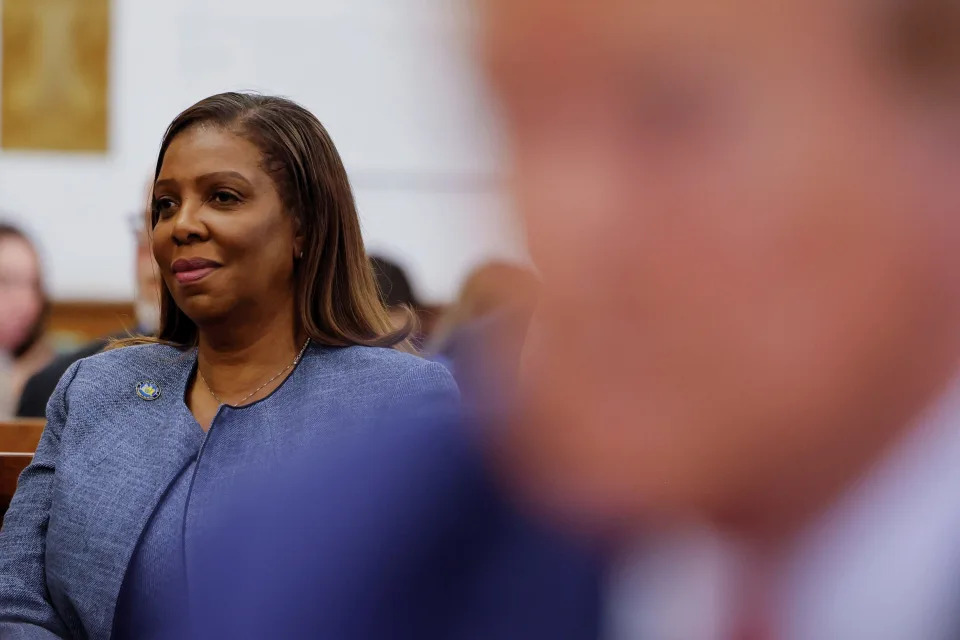
New York Attorney General Letitia James attended closing arguments in the Trump civil fraud trial.Pool/Reuters
More fraud? More penalties
Violations of Thursday’s order could result in the judge ordering more penalties against Trump Org, the judge warned. Those potential penalties include throwing the company into receivership and the possible forced dissolution of assets, the judge said in last month’s verdict.
Trump and his three codefendants — Donald Trump, Jr., Eric Trump, and former Trump Org CFO Allen Weisselberg — owe a combined fraud-trial penalty of $467 million as of Thursday, according to a penalty calculator maintained by the Associated Press.
Trump’s portion of that total was $457 million as of Thursday, an obligation that increases by another $1 million in interest every nine days.
New York Attorney General Letitia James has promised that if Trump misses his deadline for paying up or buying an appeal bond — which he’s said he cannot do — she’ll start grabbing assets.
She has already begun to do so.
New York officials have registered the Trump judgment in Westchester County, just north of Manhattan, in what Bloomberg said Thursday was a sign that his properties in the area could be seized if he defaults on what he owes the state.
Trump owns a 200-plus-acre estate, Seven Springs, in the county.
Last month’s verdict found Trump and his top executives conspired to deceive banks and insurers through a decade of financial filings that exaggerated his net worth by as billions of dollars a year. Trump is appealing the verdict.
Trump Told Pence Certifying Election Would Be ‘Career Killer,’ Valet Testified
President Donald J. Trump warned his vice president against failing to overturn the 2020 election results, according to an account by the White House valet by his side on Jan. 6.
By Luke Broadwater and Maggie Haberman – March 21, 2024
President Donald J. Trump speaking during the rally on the Ellipse that preceded the attack of Jan. 6, 2021.Credit…Pete Marovich for The New York Times
The threat from President Donald J. Trump to his vice president, Mike Pence, was clear and direct: If you defy my effort to overturn the 2020 election by certifying the results, your future in Republican politics is over.
“Mike, this is a political career killer if you do this,” Mr. Trump told Mr. Pence by phone on the morning of Jan. 6, 2021, according to the White House valet who was with the president for much of the day and told Congress he had overheard the conversation.
The testimony of Mr. Trump’s valet, provided to the now-defunct House Jan. 6 Committee in 2022 but not previously released publicly, offers a rare firsthand look into the former president’s behavior in the hours before, during and after a mob of his supporters stormed the Capitol seeking to halt the certification of President Biden’s victory.
In the valet’s account, laid out in a transcript obtained by The New York Times, an agitated Mr. Trump pressured Mr. Pence to overturn the election and stewed about Mr. Pence’s refusal for hours after violence engulfed Congress. Told that a civilian had been shot outside the House chamber amid the mob attack, he recalled, Mr. Trump appeared unconcerned.
“I just remember seeing it in front of him,” the valet said of a note card Mr. Trump was given bearing news of the casualty as he watched the riot unfold on television. “I don’t remember how it got there or whatever. But there was no, like, reaction.”
As unflattering as portions of the aide’s testimony were to Mr. Trump, he did not confirm some of the more graphic and damning claims made by witnesses in front of the Jan. 6 committee.
For instance, the valet said he did not remember hearing Mr. Trump use vulgar language in describing his view that Mr. Pence was a coward, or agree with rioters who were chanting for Mr. Pence to be hanged. And he did recall hearing the president ask about contacting top officials on the possibility of dispatching the National Guard to Capitol Hill — though there is no indication that he ever followed through.
Vice President Mike Pence officiating over the electoral vote confirmation on the night of Jan. 6, 2021. A White House valet testified that President Donald J. Trump had pressured Mr. Pence to overturn the election and stewed about his refusal to do so for hours after violence broke out.Credit…Erin Schaff/The New York Times
“Did you hear the president say that?” a staff investigator for the House Jan. 6 committee asked the valet, inquiring about reports that Mr. Trump had called Mr. Pence an expletive meant to refer to a wimp.
“I did not — no, sir,” the valet responded.
Mr. Trump himself has not disputed using that language, and Ivanka Trump’s chief of staff testified that Ms. Trump had told her that Mr. Trump had an “upsetting” conversation with Mr. Pence and that the president had accused him of cowardice, using “the ‘p’ word.” The valet also acknowledged that he wasn’t with the president at all times, and that he had left the Oval Office during a portion of Mr. Trump’s call with Mr. Pence.
At another point, the valet was asked whether he remembered “any comments that the president or anybody around him made with respect to those chants, ‘Hang Mike Pence.’ ”
He answered that he recalled the refrain, “but I don’t remember any comments from the president or anybody on staff.”
Mr. Trump has previously defended the rioters’ use of the chant, telling ABC News’ Jonathan Karl that “the people were very angry,” and calling that anger “common sense.”
House Republicans furnished the transcript to The Times after they obtained it from the White House, which was reviewing and redacting it along with a handful of others provided by the House Jan. 6 committee. The copy reviewed by The Times is heavily redacted, and the valet is referred to simply as “a White House employee.”
For more than a year since winning control of the House, Republicans have been investigating the work of the Jan. 6 committee, looking for signs of bias. They have suggested that the panel did not release certain transcripts because they contradict some of the testimony from a prominent witness, Cassidy Hutchinson, who served as an aide to Mark Meadows, the White House chief of staff at the time. While much of her testimony has been corroborated, Ms. Hutchinson acknowledged that in some cases she was relying on secondhand or thirdhand accounts of events in her testimony to the panel.
“It took a whole lot of work to get these,” Representative Barry Loudermilk, a Republican of Georgia who is leading the G.O.P.’s investigation, said of the transcript of the valet’s testimony and a batch of others he obtained from the White House and the Department of Homeland Security.
Mr. Loudermilk conceded there was “some testimony in it that may not be favorable to Trump,” but he added: “We’re putting it all out there, not doing what the select committee did, and putting things out there that will be favorable to our side.”
In court filings, though, federal prosecutors who have charged Mr. Trump with crimes for his role in the effort to overturn the 2020 election have said some of the committee’s transcripts were subject to confidentiality agreements, and those were sent to the White House and Secret Service for review and redactions before they could be released. Federal prosecutors said they had provided these “sensitive, nonpublic transcripts” to Mr. Trump and his legal team, according to a court filing last year.
Trump supporters fighting with security forces outside the Capitol on Jan. 6, 2021. Credit…Kenny Holston for The New York Times
Representative Bennie Thompson, the Mississippi Democrat who chaired the House Jan. 6 committee, said nothing in the valet’s account changes the essential facts of what his panel uncovered about Mr. Trump’s role in summoning supporters to Washington to challenge the election results and doing nothing to stop their attack at the Capitol.
“Despite Mr. Loudermilk’s attempts to rewrite the violent history of Jan. 6, the facts laid out in the select committee’s final report remain undisputed — and nothing substantive was left out nor hidden,” he said. “While the valet did not witness everything that happened in the White House that day, the testimony confirms Trump’s indifference to the violence and his anger at Vice President Pence for performing his duty under the Constitution.”
The valet also shed more light on how Mr. Trump’s White House had devolved into dysfunction during his final weeks in office. He said Mr. Trump was often “frustrated,” “upset” and “mad” at Pat A. Cipollone, the White House counsel who frequently served as a check on some of the former president’s more extreme impulses — so much so that the valet asked aides to keep the lawyer away from the president at lunchtime to avoid upsetting him.
The valet also confirmed Mr. Trump’s penchant for tearing up documents and other material given to him, which by the law governing presidential records are supposed to be preserved.
“That’s typically what he would do once he’s finished with a document,” the valet said of Mr. Trump. “But that was his sign of, like, he was done reading it, and he would just throw it on the floor. He would tear everything — tear newspapers, tear pictures.”
The valet also testified that Mr. Trump expressed an interest on Jan. 6 in speaking to General Mark A. Milley, then the chairman of the Joint Chiefs of Staff, and Speaker Nancy Pelosi about sending the National Guard to the Capitol — a step that has been a matter of much dispute given the hourslong delay in the troops’ eventual arrival.
Mr. Loudermilk said it was that aspect of the valet’s account that caught his eye.
“That stood out to me like, ‘OK, this is totally in contrast to what we’ve seen, and I’ve never seen this before.’ And so that’s when we started digging,” Mr. Loudermilk said.
Ultimately, though, Mr. Trump made no such call, General Milley told the House panel.
The valet also testified about the contrast between the reaction of White House staffers and Mr. Trump as the riot was underway.
After he returned from giving a speech to a raucous crowd at the Ellipse, Mr. Trump was informed that “they’re rioting down at the Capitol,” the valet recalled.
“And he was, like, ‘Oh, really?’ And then he was like, ‘All right, let’s go see,’” and went to watch the violence on television.
The valet spoke of a sense of “disbelief” and then panic that fell over the staff.
“It was like, ‘What are we going to do?’ ” He said officials were “running around pretty much — running from office to office and all over the place,” while Mr. Trump appeared calm.
Hours later, though, the president was still stewing about Mr. Pence.
“Me and him,I think close to the end of the day, he just mentioned that Mike let him down,” the valet said. “And that was it.”
Luke Broadwater covers Congress with a focus on congressional investigations.
Maggie Haberman is a senior political correspondent reporting on the 2024 presidential campaign, down ballot races across the country and the investigations into former President Donald J. Trump.
Takeaways From Trump’s Indictment in the 2020 Election Inquiry
Four charges for the former president. Former President Donald Trump was charged with four counts in connection with his widespread efforts to overturn the 2020 election. The indictment was filed by the special counsel Jack Smith in Federal District Court in Washington. Here are some key takeaways:
The indictment portrayed an attack on American democracy. Smith framed his case against Trump as one that cuts to a key function of democracy: the peaceful transfer of power. By underscoring this theme, Smith cast his effort as an effort not just to hold Trump accountable but also to defend the very core of democracy.
Trump was placed at the center of the conspiracy charges. Smith put Trump at the heart of three conspiracies that culminated on Jan. 6, 2021, in an attempt to obstruct Congress’s role in ratifying the Electoral College outcome. The special counsel argued that Trump knew that his claims about a stolen election were false, a point that, if proved, could be important to convincing a jury to convict him.
Trump didn’t do it alone. The indictment lists six co-conspirators without naming or indicting them. Based on the descriptions provided, they match the profiles of Trump lawyers and advisers who were willing to argue increasingly outlandish conspiracy and legal theories to keep him in power. It’s unclear whether these co-conspirators will be indicted.
Trump’s political power remains strong. Trump may be on trial in 2024 in three or four separate criminal cases, but so far the indictments appear not to have affected his standing with Republican voters. By a large margin, he remains his party’s front-runner in the presidential primaries.
Putin is ready to squeeze Russia’s outrageously wealthy elite to fund a future war with NATO, analysts say
Tom Porter – March 21, 2024
Putin is ready to squeeze Russia’s outrageously wealthy elite to fund a future war with NATO, analysts say
Vladimir Putin is moving to squeeze Russia’s wealthy elite, a think tank said.
He needs the money to boost military spending, analysts said, and is prepared to ruffle feathers.
Analysts said it’s a sign Putin’s readying for a war with NATO.
Russian President Vladimir Putin is preparing to squeeze Russia’s wealthy elite to fund a conflict with NATO, a think tank said.
The Institute for the Study of War, a US think tank, drew attention to two recent speeches in which Putin voiced rare criticism of the rich loyalists who’ve been the backbone of his power.
In a Tuesday meeting with leaders from Russia’s lower parliament, the Duma, Putin set out the priorities for his new term in office.
He urged officials to “act in the interest of the state instead of corporations or parties.”
The remarks could be seen as a thinly veiled swipe at the widespread corruption that characterizes modern Russia (and from which, Putin’s critics allege, he has also handsomely benefited).
In similar remarks given about a month before to Russia’s Federation Council, Putin said that “individuals who ‘lined their pockets’ in the 1990s” — who are among its crop of oligarchs — are not the real elite.
The actual elite, he said, “are workers and military servicemen who proved their loyalty to Russia.”
The ISW said the remarks indicated that Putin was sending a warning shot to the “siloviki,” the wealthy ex-security officials who form an important part of his power base.
Taken together, the remarks pick away at the long-standing implicit bargain analysts say Putin struck with the country’s wealthy, agreeing to leave their riches untouched in exchange for political support.
The ISW said Putin was changing tack, “signaling that Russia’s long-term financial stability will require imposing at least some pain on some wealthy industrialist siloviki,” it said.
Putin appears willing to risk his accord with his wealthy backers to boost preparations “for a potential future large-scale conflict with NATO,” the ISW said.
The report comes after a series of warnings from Western leaders that Putin might be preparing for a war with the West.
Denmark’s defense minister said it could come in as little as five years.
Analysts say that the Russian president has long harbored ambitions to seize back control of territory in northern and eastern Europe that was once part of the Soviet Union and that victory in Ukraine could embolden him.
But fulfilling that ambition would not come cheap.
Who are the siloviki?
When Putin came to power in 1999, he moved to punish some who had grown wealthy during the liberalization of Russia in the ’90s.
Specifically, he took on those who challenged him, such as the oil magnate Mikhail Khodorkovsky.
A new faction expanded its power under Putin, the siloviki.
Some were handed control over state energy companies and corporations in an apparent exchange for their loyalty, becoming vastly wealthy.
The US sought to undermine Putin’s power by targeting the assets of Russia’s wealthy loyalists in a series of sanctions in the wake of the Ukraine war’s start.
But the Russian economy has managed to withstand the worst effects of the fallout from the Ukraine war, and the loyalty of Putin’s wealthy backers has mostly held firm.
Some members of the Russian business elite were critical of the Ukraine war, fearing the effects on Russia’s economy and society. But, The Guardian reported, many have since resigned themselves to the war and Putin’s continued rule.
And it’s not just Putin’s willingness to shake up his relationship with his wealthy loyalists that indicates his readiness to rapidly expand Russia’s military.
Sergei Shoigu, Russia’s defense minister, announced plans Wednesday to massively expand Russia’s armed forces by creating two new armies.
“Several Russian financial, economic, and military indicators suggest that Russia is preparing for a large-scale conventional conflict with NATO,” the ISW said, “not imminently but likely on a shorter timeline than what some Western analysts have initially posited.”
Conservative House Republicans unveil plan to attack Biden admin policies. Here’s what they would target
Ken Tran, USA TODAY – March 20, 2024
WASHINGTON – The Republican Study Committee, the largest caucus made up of House Republicans, unveiled a course on Wednesday for dismantling many of President Joe Biden’s signature policies – though the proposal’s chances are slim for now.
As part of the RSC’s annual budget, first shared with USA TODAY, the group is pushing to roll back or loosen many of the Biden administration’s major federal rules and regulations.
Republicans in the group are taking aim at a wide range of policies, including initiates to combat climate change, a Defense Department policy reimbursing travel for service members who must cross state lines to receive abortions and Justice Department gun control regulations. In the budget, Republicans call for a return to former President Donald Trump’s approach during his term in office.
Rep. Kevin Hern, R-Okla., speaks to reporters after dropping out of the race for Speaker of the House, and endorsed Rep. Mike Johnson, R-La., as House lawmakers seek to elect a new speaker in Washington.
“The RSC Budget would take bold and necessary action to rein in the Biden Administration’s dangerous regulatory regime, returning to the example set by former President Donald Trump,” the proposal reads, accusing Biden of implementing “a radical” agenda.
The conservative group, led by Rep. Kevin Hern, R-Okla., released their plan after Biden announced a federal budget earlier this month with an eye toward new social programs for housing, health care and child care.
But the budget framework from the GOP group, which comprises almost 80% of the House Republican conference, offers a preview into what policy priorities Republicans are itching to advance should they reclaim the White House, the Senate and hold on to the House.
The budget doesn’t just endorse a slate of GOP-led legislation. It also includes pushes meant to curtail the Biden White House’s executive authority “to restore the appropriate balance of power” between Congress and the presidency.
Included is Rep. Kat Cammack’s Regulations from the Executive in Need of Scrutiny Act, or REINS ACT, that would require Congress to sign off on any rule from a presidential administration that has an economic impact of $100 million or more. The bill passed the House last year on a party-line vote, though it has little chance in the Democratic-controlled Senate.
The funds are typically centered around “socially responsible companies” that focus on addressing environmental and social problems. Republicans have derided the rule as too “woke,” but the rule does not require investment into ESG funds.
Today, the RSC’s proposal is simply a conservative wish list, actions that have little chance of becoming law while Democrats control the Senate and Biden remains in the White House.
But as the presidential election and congressional races across the country pick up steam, the plan could reflect how Republicans are seeking to rally voters in the fall.
“It’s on us to reign in the executive branch and rescind their authority to make decisions that belong to the legislature,” Hern said in a statement to USA TODAY. “Our constituents sent us here to provide a check on the White House. We can’t be passive about it, it’s time for results.”
US economy on solid ground as weekly jobless claims fall, home sales surge
Lucia Mutikani – March 21, 2024
WASHINGTON (Reuters) – The number of Americans filing new claims for unemployment benefits unexpectedly fell last week, while sales of previously owned homes increased by the most in a year in February, signs the economy remained on solid footing in the first quarter.
That was underscored by other data on Thursday showing business activity stable in March, though inflation picked up. Even a gauge of future economic activity turned positive in February for the time in two years. The United States continues to outshine its global peers, thanks to labor market resilience.
The Federal Reserve on Wednesday left interest rates unchanged, with policymakers upgrading their growth forecasts for this year and indicating they still expected to lower borrowing costs three times by year end. Economists said the upbeat economic reports made it more unlikely that the U.S. central bank would start cutting rates before June.
“Companies are not laying off workers and the labor market remains relatively strong,” said Christopher Rupkey, chief economist at FWDBONDS in New York. “And now there are signs of life for existing home sales. This makes easing monetary policy at this juncture more problematic.”
Initial claims for state unemployment benefits dropped 2,000 to a seasonally adjusted 210,000 for the week ended March 16, the Labor Department said. Economists polled by Reuters had forecast 215,000 claims in the latest week.
Claims have been mostly bouncing around in a 200,000-213,000 range since February. Despite a flurry of high-profile layoffs at the start of the year, employers have largely been hoarding labor after struggling to find workers during and after the COVID-19 pandemic.
Unadjusted claims decreased 12,730 to 189,992 last week. Applications in California plunged by 5,369, while filings in Oregon fell 2,580. They more than offset notable increases in Michigan and Missouri.
Fed Chair Jerome Powell told reporters on Wednesday he did not see “cracks” in the labor market, which he described as “in good shape,” noting that “the extreme imbalances that we saw in the early parts of the pandemic recovery have mostly been resolved.” The U.S. central bank has raised its benchmark interest rate by 525 basis points to the current 5.25%-5.50% range since March 2022.
The claims data covered the period during which the government surveyed business establishments for the nonfarm payrolls portion of March’s employment report. Claims rose marginally between the February and March survey weeks. The economy added 275,000 jobs in February.
Data next week on the number of people receiving benefits after an initial week of aid, a proxy for hiring, will offer more clues on the health of the labor market in March. The so-called continuing claims increased 4,000 to 1.807 million during the week ending March 9, the claims report on Thursday showed.
“The labor market is gradually rebalancing, but the adjustment appears to be coming from less hiring rather than a surge in firings,” said Rubeela Farooqi, chief U.S. economist at High Frequency Economics. “We expect job growth to slow somewhat but the unemployment rate to remain low this year.”
HOUSING SUPPLY IMPROVES
Stocks on Wall Street were trading higher. The dollar was steady versus a basket of currencies. U.S. Treasury prices fell.
In a separate report on Thursday, the National Association of Realtors said existing home sales jumped 9.5% last month to a seasonally adjusted annual rate of 4.38 million units, the highest level since February 2023. The monthly increase in sales was also the largest since February 2023.
Economists had forecast home resales would fall to a rate of 3.94 million units. Sales were boosted by an improvement in housing supply, with inventory surging 5.9% to 1.07 million units, the highest for any February since 2020. Supply was up 10.3% from one year ago.
Home resales, which account for a large portion of U.S. housing sales, fell 3.3% on a year-on-year basis in February.
The housing market has been battered by the Fed’s aggressive monetary policy stance as it fights inflation, and the signs of improvement in supply, together with retreating mortgage rates, bode well for the spring selling season.
Nonetheless, housing inventory is still well below the nearly 2 million units before the pandemic. Homes in many areas, especially in the Northeast, continue to receive multiple offers, pushing out first-time buyers, who accounted for only 26% of transactions last month.
That share is well below the 40% that economists and realtors say is needed for a robust housing market. A fifth of the homes sold last month were above listing price.
Many homeowners have mortgages with rates below 4%, discouraging them from selling their houses, contributing to the supply crunch and higher home prices. The median existing home price increased 5.7% from a year earlier to $384,500 in February. Home prices increased in all four regions, and could remain elevated with supply still likely to lag demand.
“If broader activity remains strong, a further normalization of home sales and new listings could be an indication that homebuyers are adapting to a higher level of rates,” said Veronica Clark, an economist at Citigroup in New York.
The increase in sales means more brokers’ commissions, which should boost the residential investment component in the gross domestic product report. Goldman Sachs raised its first-quarter GDP growth estimate to a 1.9% annualized rate from a 1.7% pace. The economy grew at a 3.2% rate in the fourth quarter.
The economy’s improving prospects for this year were reflected in a fourth report from the Conference Board showing its leading economic index rebounded 0.1% in February after declining 0.4% in January. That was the first increase since February 2022.
“The economy is poised to continue in expansion mode,” said Priscilla Thiagamoorthy, a senior economist a BMO Capital Markets in Toronto.
(Reporting by Lucia Mutikani; Editing by Chizu Nomiyama, Paul Simao and Andrea Ricci)
The Latvian sandwich makers training to push Putin’s army into ‘kill zones’
Sophia Yan – March 21, 2024
Matiss Lopsa, 21, spends a few weeks training with the national guard – ANRIJS POZARSKIS
For most of the year, Matiss Lopsa makes sandwiches in a fashionable cafe in eastern Latvia, but for a few weeks the 21-year-old puts his apron aside and picks up a rifle to train with the national guard.
His home town, Rezekne, lies 35 miles from the border with Russia and is on a direct road to Moscow.
The proximity to danger is not lost on Mr Lopsa.
In January, Latvia reintroduced conscription for men aged 18 to 27 – even for those living abroad. Two years into Russia’s invasion of Ukraine, there are growing fears that Vladimir Putin could make a strike against Nato.
“I thought the government might bring back the draft,” said Mr Lopsa. “So I decided to volunteer, to choose to do this myself now, rather than be surprised if I was suddenly called up.”
He believes the government was right to begin training men like himself how to fight.
“I’m all for it – I think it’s a very, very good way to discipline young men,” said Mr Lopsa, after a day spent tossing meat and vegetables onto flatbread.
“That way, if you are called into war, you won’t be caught short on the first day not physically knowing how to do anything.”
Himars rocket system training in Latvia. Conscription has been reintroduced in the country for men 18 to 27 – INTS KALNINS/REUTERS
It is in anticipation of that “first day” that the Latvian government is seeking to expand its armed forces to 61,000, between active and reserve forces.
In 2024, the military will draft a total of 600 soldiers, with the goal of bringing in 4,000 per year by 2028.
There are exceptions, for example men who are the sole guardians of children or elderly parents, or are studying at university.
Draft-dodgers face fines and a prison sentence of up to five years during wartime.
Latvia is also developing the capabilities of its military. The government has procured new weapons systems from the US, including the Himars rocket system – a key part of Ukraine’s defence against Russia.
It has also purchased German Iris-T air defence units and a naval coastal defence system produced by Kongsberg, a Norwegian firm, and US defence contractor Raytheon. The government has agreed to construct a defensive line with neighbouring Estonia and Lithuania.
Together, the three Baltic nations share the longest Nato border with Russia and Belarus, running about 1,000 miles.
Lithuania, Estonia and Latvia are working together to create a defensive line against Russia if it starts to advance – SEAN GALLUP/GETTY IMAGES EUROPE
One concern along that stretch of land is the lack of geographical obstacles to any invading force.
Tomas Jermalavicius, the head of studies at the International Centre for Defence and Security in Estonia, said: “There are places where there are thick woods and rivers. But there are also places where it’s really wide open, and where it’s really close to critical points.
“If there are no obstacles … the enemy could be standing at the capital doors in no time.”
Targets that could be vulnerable include Lithuania’s capital, Vilinius, and Latvia’s second-largest city, Daugavpils – both less than 20 miles from the border to Belarus.
There’s also the Suwalki Gap, a roughly 60-mile land strip on the border between Poland and Lithuania. It’s a choke point, flanked to the West by the Russian enclave of Kaliningrad and to the east by Belarus, an ally of Moscow.
Were Moscow to seize this strip – known as Nato’s Achilles’ Heel – Estonia, Latvia and Lithuania would be severed from their Nato allies.
Geographical obstacles are of critical concern to the three countries – SEAN GALLUP/GETTY IMAGES EUROPE
Estonia’s new border defence plan aims to address these concerns by working to “channel advancing forces into ‘kill zones’ identified by the defenders for drone fire, for artillery – to turn those channels into a meat grinder”, said Mr Jermalavicius.
While details are still being worked out, Estonia has already said it will build hundreds of bunkers that can withstand direct artillery fire.
Working together is crucial.
“If Estonia does something Latvia does not do, and it becomes possible to launch an attack on Estonia through Latvian territory – this kind of stuff needs to be co-ordinated,” Mr Jermalavicius said.
Already, Latvia is incorporating lessons from the battlefield in Ukraine, where the country’s military instructors have helped to train local soldiers – an exchange that has boosted understanding both ways.
Troops are no longer only drilling in open fields but learning how to engage enemy combatants in urban settings.
But not everyone is as positive about the draft as Mr Lopsa.
Two teenage boys, 16 and 17, in Zilupe, a tiny Latvian town about four miles from Russia, simply laughed off the prospect.
Another boy, 17, told The Telegraph that he’d simply leave the country to evade service.
Konstantin Tupikins, 28, who has just aged out of the military requirement, thinks his younger brother, 15, would not make it as a soldier.
“He’s not really someone with this kind of bravery and courage,” said Mr Tupikins, who now works in the UK, and was home to visit his mother in Zilupe.
Konstantin Tupikins, 28, is over conscription age but fears for his brother – ANRIJS POZARSKIS
On a wintry walk with her daughter in a pram, 28-year-old Ekaterina is “quite against” the idea.
“The government hasn’t done enough for us; for people with disabilities or parents with prams, these winter sidewalks aren’t safe,” she said, gesturing at the icy paths, and declining to give a surname.
“Now they’re asking us to give our children?”
War would especially impact border towns like Zilupe – first, as a potential target given close proximity to Russia; and second, because the majority of its nearly 1,400 residents are Russian.
The primary language here is Russian – not Latvian, nor the local dialect, Latgalian.
Experts worry that these eastern reaches of Latvia – with villages populated by Russians and Belarussians – could give Putin fodder to “justify” an invasion and to establish “people’s republic”, as he did in Ukraine with Donetsk and Luhansk.
Many of Zilupe’s residents settled here before the dissolution of the Soviet Union, retaining family ties in Russia.
Before war broke out in Ukraine, people travelled often between Latvia and Russia.
Trips were so frequent that the train station – the last stop before Russia – is still plastered with signs of what travellers can bring into the EU, including a maximum of 125 grams of caviar.
Some still make the trek, though far fewer do so now, as Latvia has closed many border crossings to Russia and Belarus. Cross-border trains have largely stopped, and untouched snow blankets the tracks running east.
Families on both sides of conflict
The town’s complicated dynamics are perhaps best demonstrated by the fact that residents have sons and nephews enlisted on both sides in the Russian and Ukrainian militaries.
Vladimir, 89, who lives in Zilupe and is from Ukraine, with a son in the military, said: “I regret that innocent young people have to get involved in war. Latvia’s demographics are so old, and now we have to send our youths.”
In Riga, the capital, support for Ukraine remains overwhelming. Government buildings hang Ukraine’s flag and its blue-and-yellow colours can be found on everything from tram doors to trinkets such as coffee cups and candles.
While this reflects widespread unease that Latvia could find itself in Putin’s path, it also reveals a deep-seated resolve to defend the country’s hard-won independence.
The Freedom Monument, a 42-metre sculpture of a copper Liberty erected in 1935, stands testament to that desire.
The statue, which survived decades under Soviet occupation, is guarded today by two soldiers at its stone base; police officers patrol the square.
Krisjanis Karins, Latvia’s foreign minister, said: “We simply have to do things differently than if we weren’t living next to Russia. And, you know, Latvia has always been next to Russia.
“It has never been a democratic country … and this is what’s troubling,” he said. “They won’t stop of their own accord; they can only be stopped.
“They need to run up against the brick wall, and that brick wall needs to be Nato resolve and proven capabilities.”
Republicans — including the new Republican National Committee co-chair Lara Trump and Rep. Elise Stefanik (R-N.Y.) — have recently begun rhetorically asking voters if they believe they are better off now under President Joe Biden than they were four years ago, when Trump was still in the White House.
It’s an updated take on former President Ronald Reagan’s 1980 election question.
And former Secretary of State Clinton, who has been a persistent and vocal critic of presumptive GOP nominee Trump since her shock loss to him in the 2016 election, chimed in with this response to the conservative talking point:
“Multiple indictments and half a billion dollars in civil liability later, pretty much the only person who can say they were better off four years ago is Donald Trump.”