Aside from sinking his fangs into the Republican National Committee like a hungry bat on a plump Berkshire hog, the man spending his days in a Manhattan courtroom under criminal indictment is now looking to bleed cash out of down-ballot GOP campaigns.
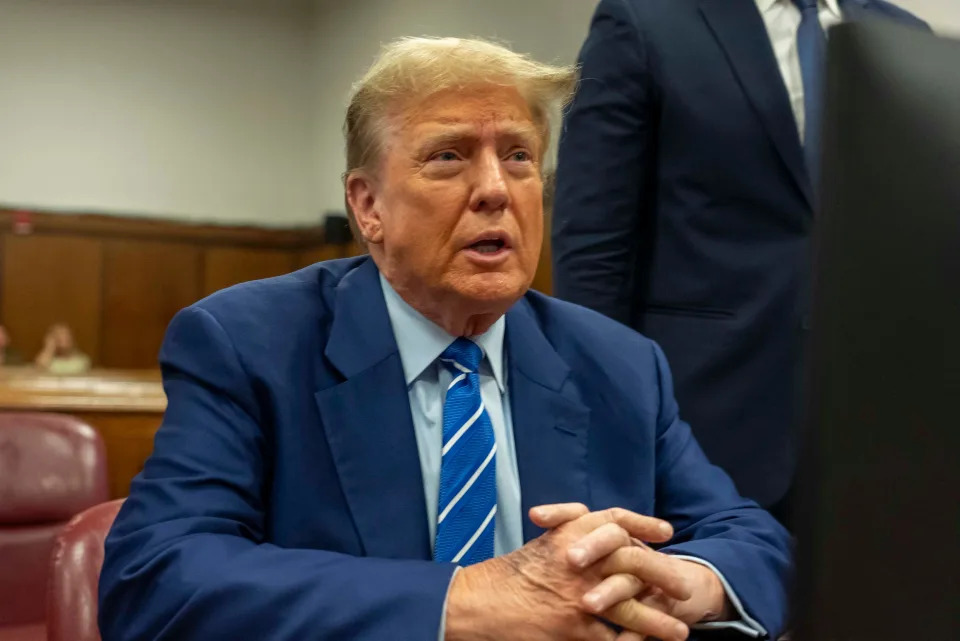
Former US President Donald Trump attends the second day of his trial for allegedly covering up hush money payments linked to extramarital affairs, at Manhattan Criminal Court in New York City on April 16, 2024.
You know, a little kickback for the boss man. Just enough to get Trump’s beak wet. Because, as has been made abundantly clear, the GOP is Trump and Trump is the GOP.
The Republican Party is now nothing but a Donald Trump piggy bank
Sorry, other Republican candidates! Maybe you can find a different Republican National Committee to help you out. Oh, and in the meantime, if you mention the Republican at the top of the ticket, you need to ship some of the green you raise back upstream to the guy already vacuuming donor money up like a Statue-of-Liberty-size Dirt Devil.
Biden is out-fundraising Trump, so more Bibles must be sold!
Adding to the cash thirst, the former president’s campaign is trailing President Joe Biden badly in the fundraising department.
A Financial Times analysis released this week found: “Donald Trump has raised $75 (million) less for his presidential bid than Joe Biden and has 270,000 fewer unique donors now than at the same stage of his run for the White House four years ago.”
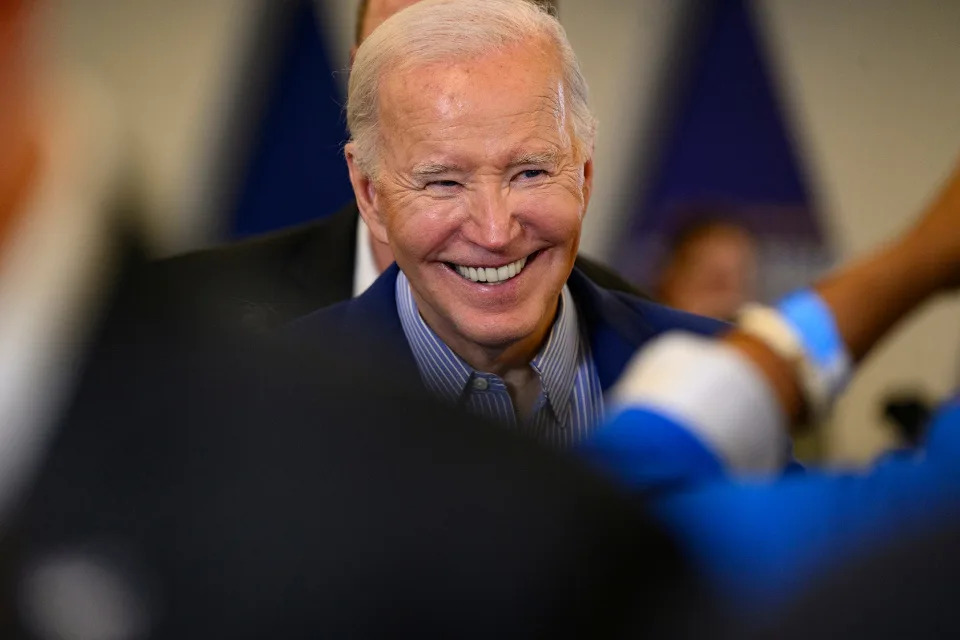
President Joe Biden speaks to members of the United Steel Workers Union at the United Steel Workers Headquarters on April 17, 2024 in Pittsburgh, Pennsylvania. Biden announced new actions to protect American steel and shipbuilding industries including hiking tariffs on Chinese steel.
He’d have to sell a moon-high stack of Bibles to catch up, so the grift must grow. And grow it has with this new “pony up some cash” push on fellow candidates.
Trump campaign’s letter to other GOP candidates reads like a mob flick
As if actively trying to get Trump’s campaign cast in the next Martin Scorsese gangster film, the letter to down-ballot Republicans included this line: “Any split that is higher than 5% will be seen favorably by the RNC and President Trump’s campaign and is routinely reported to the highest levels of leadership within both organizations.”
Sure, 5% is nice. That’s fine. But, you know, maybe do 10%, maybe even 15%? That’s the kinda thing that gets you noticed, kid.
When you give your party to someone under criminal indictment, well …
The letter also included this note to any campaigns that use Trump’s name, image or likeness and don’t play ball: “Any vendor whose clients ignore the guidelines mentioned above will be held responsible for their clients’ actions. Repeated violations will result in the suspension of business relationships between the vendor and Trump National Committee JFC.”
Yeah, nice little campaign you got there. Shame if anything happened to it, you know?
This all sounds dodgy as the day is long, but regardless, here’s what all the little Republican candidates not named Donald Trump are going to do. They’re going to line up in their fancy Trump sneakers with their Trump Bibles tucked under their arms and drop an offering in the MAGA hat at the feet of the Donald.
Ukraine’s growing arms sector thwarted by cash shortages and attacks
Max Hunder – April 19, 2024
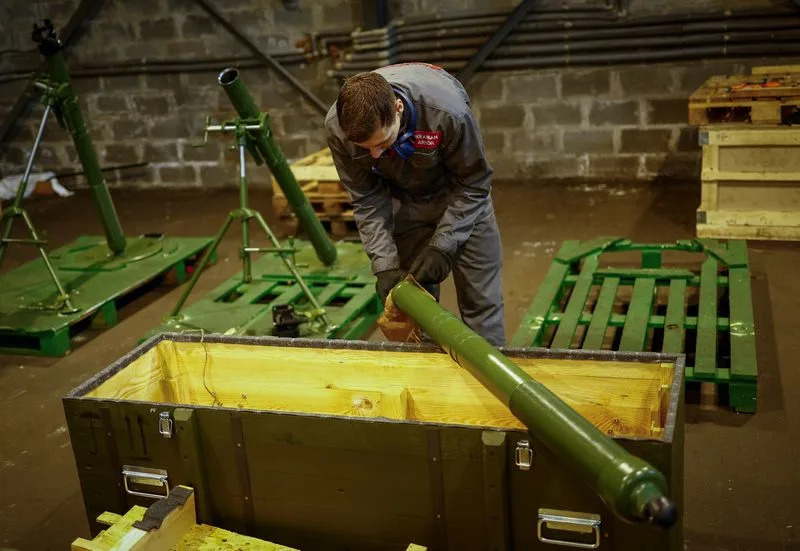
Employee prepares to place a mortar into a box at a production facility of the ‘Ukrainian Armor’ company in UkraineEmployee tests a Novator armoured personnel carrier at a testing facility of the ‘Ukrainian Armor’ company in Ukraine
KYIV (Reuters) -Hundreds of Ukrainian businesses making weapons and military equipment have sprung up since Russia’s full-scale invasion, but some are struggling to fund production and all are afraid of being targeted in intensifying Russian missile strikes.
Owners say they have pumped in their own cash to survive and moved locations at their own expense to stay ahead of Russian intelligence. They are now urging the government to cut what they describe as excessive red tape around its arms purchases.
Several also want to be allowed to export, arguing that the government is unable to buy all of their output.
According to Ukraine’s strategic industries minister Oleksandr Kamyshin, the potential annual output of the military-industrial complex now stands at $18-20 billion.
Ukraine’s cash-strapped government can only fund about a third of that, the minister told Reuters in an interview. That compares with $120 billion of military aid received from allies throughout the war, most of it in equipment rather than cash.
“We have the biggest fight in a generation … If you look, for example, at NATO-calibre artillery shells, the production capacity of the U.S. and EU put together is lower than our needs,” said Kamyshin.
Many of Ukraine’s large, state-owned defence enterprises fell on hard times after the collapse of the Soviet Union. Now the war has triggered a resurgence in the private arms sector.
According to his ministry, the number of defence manufacturers has more than doubled since the invasion. Private enterprises now number about 400 to the 100 state-owned ones, although the latter still provide the most production capacity.
To resolve cash shortages, Ukraine is asking foreign partners to fund its defence production. On Tuesday, Denmark made the first such pledge of $28.5 million.
RED TAPE
Some manufacturers say they are struggling to raise funds, a problem compounded by a government procurement process that they complain is slow and cumbersome.
“The first threat that makers come up against when they start working is the bureaucracy of the military sphere and of purchases,” said Vladyslav Belbas, CEO of Ukrainska Bronetekhnika (Ukrainian Armor), one of the few Ukrainian manufacturers making armoured vehicles and artillery shells, among other products.
Belbas cited the fact that the defence ministry only places orders for the current year, hampering makers’ ability to plan for the long term.
Four manufacturers making various weapons highlighted a range of issues: waiting for months to find out if the state was interested in buying, being bounced between departments in the defence ministry and armed forces, and having no assurances of future sales to help them plan production.
The defence ministry did not immediately respond to a request for comment on the complaints. It has previously said it is building “a new architecture” for defence procurement, and appointed a new chief for the agency responsible for weapons purchases earlier this year.
Private investment has primarily been driven by domestic entrepreneurs, who often say they are driven by patriotism rather than profit.
A source in Ukraine’s government, who spoke on condition of anonymity to discuss sensitive issues, said private investment was not evenly spread.
“Everyone wants to invest in sexy stories like drones, but nobody wants to go into something difficult like (artillery) shells.”
One way to raise money is to grant licences for companies to export products that would otherwise go unbought by Ukraine due to the lack of financing.
Three manufacturers told Reuters they would like to see export licences being granted, provided the manufacturer had unused capacity not covered by orders from Ukraine.
Kamyshin said that was not feasible: “It’s fair for manufacturers to demand to either contract their capacity to the full or give them the possibility to export … but this position does not have political support, so we are looking for financing for our enterprises so that all production remains in Ukraine,” he said.
DANGEROUS BUSINESS
Aside from financial difficulties, making weapons in Ukraine during a full-scale war is fraught with risk.
When Reuters visited a factory of Ukrainian Armor, the head of the plant, who gave his name as Ruslan, agreed to speak only if his face was not shown to protect him from becoming a target of Russia’s intelligence services.
The factory, which employs around 100 people and makes armoured vehicles and mortars, was in the process of being wound down and moved to another location.
Ruslan said this was because a bigger premises was needed to accommodate more staff, as well as to make it harder for the Russians to find the factory. Some arms manufacturers move locations as often as every three months for security.
“From the (manufacturers) I speak to, not one private company received (state) compensation for relocation,” said Ukrainian Armor’s Belbas.
Another problem faced by manufacturers is the threat of power cuts, as Russia pounds energy infrastructure while Ukraine is running out of air defence munitions to protect its skies.
“In 2022-2023, we did not have electricity for two-thirds of our working hours – of course, under such conditions it is very difficult to manufacture anything,” Belbas said.
The government source said that manufacturers currently had no issues with power supply, and that if mass power cuts did have to be implemented then they “will be switched off last”.
(Reporting by Max Hunder; Editing by Mike Collett-White and Philippa Fletcher)
Trump campaign announces 100,000 poll watchers and attorneys poised for election day
Gustaf Kilander – April 19, 2024
The Trump campaign has announced that they will have 100,000 poll watchers and attorneys ready to take action on election day as former president Donald Trump’s obsession with election security continues.
The Trump Campaign and the Republican National Committee (RNC) said in a Friday statement that they would launch “the most extensive and monumental election integrity program in the nation’s history”.
Mr Trump said in a statement: “Having the right people to count the ballots is just as important as turning out voters on Election Day. Republicans are now working together to protect the vote and ensure a big win on November 5th!”
The RNC said the program was designed by Chair Michael Whatley, Co-Chair Lara Trump and Chief Counsel Charlie Spies as well as the Trump campaign and that it’s intended to “have over 100,000 dedicated volunteers and attorneys deployed across every battleground state”.
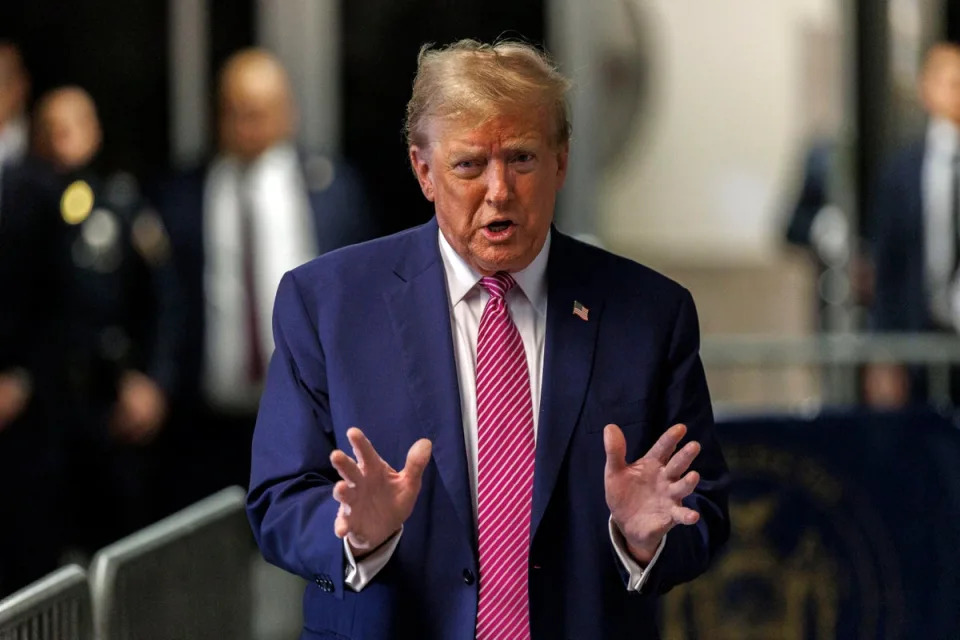
Former President Donald Trump speaks with the media at his trial on Friday at Manhattan Criminal Court (AP)
“Whenever a ballot is being cast or counted, Republican poll watchers will be observing the process and reporting any irregularity,” the RNC said in its statement.
Trump supporters showed up to locations where votes were being counted in 2020, demanding that the counting stop, often in the false belief that mail-in ballots were fraudulent. Some election workers have faced death threats.
Recounts and audits in several states failed to find any wrongdoing. Mr Trump fired the leader of his election security agency days after it issued a statement saying that the 2020 election was one of the safest in history.
The latest announcement states that the RNC and the Trump campaign plan on overseeing machine testing, early voting, election day voting, mail ballot processing, and any post-election activity such as canvassing, audits and recounts.
Mr Spies said in a statement that they would take Democrats “to court if they don’t follow rules or try to change them at the last minute”.
Many Republicans were outraged at the expansion of mail-in voting in 2020 in the midst of the pandemic. Some Republican-led states passed laws restricting ballot access after the 2020 election.
“President Trump has said that the Republican victory in November needs to be too big to rig,” Mr Spies said.
In 2016, Mr Trump lost the popular vote by almost three million ballots, in 2020, he lost it by more than seven million. When asked by The Independent earlier this month if Mr Trump has any chance of winning the popular vote this year, former Republican strategist Rick Wilson said: “None whatsoever.”
In a statement on Friday, Ms Trump said: “Every ballot. Every precinct. Every processing center. Every county. Every battleground state. We will be there.”
New study calculates climate change’s economic bite will hit about $38 trillion a year by 2049
Seth Borenstein – April 17, 2024
People watch the sunset at a park on an unseasonably warm day, Feb. 25, 2024, in Kansas City, Mo. A new study says climate change will reduce future global income by about 19% in the next 25 years compared to a fictional world that’s not warming. (AP Photo/Charlie Riedel, File)A man buys a cool drink from a roadside vendor on a sunny day in Mahawewa, a village north of Colombo, Sri Lanka, Feb. 29, 2024. A new study says climate change will reduce future global income by about 19% in the next 25 years compared to a fictional world that’s not warming. (AP Photo/Eranga Jayawardena, File)
Climate change will reduce future global income by about 19% in the next 25 years compared to a fictional world that’s not warming, with the poorest areas and those least responsible for heating the atmosphere taking the biggest monetary hit, a new study said.
Climate change’s economic bite in how much people make is already locked in at about $38 trillion a year by 2049, according to Wednesday’s study in the journal Nature by researchers at Germany’s Potsdam Institute for Climate Impact Research. By 2100 the financial cost could hit twice what previous studies estimate.
“Our analysis shows that climate change will cause massive economic damages within the next 25 years in almost all countries around the world, also in highly-developed ones such as Germany and the U.S., with a projected median income reduction of 11% each and France with 13%,” said study co-author Leonie Wenz, a climate scientist and economist.
These damages are compared to a baseline of no climate change and are then applied against overall expected global growth in gross domestic product, said study lead author Max Kotz, a climate scientist. So while it’s 19% globally less than it could have been with no climate change, in most places, income will still grow, just not as much because of warmer temperatures.
For the past dozen years, scientists and others have been focusing on extreme weather such as heat waves, floods, droughts, storms as the having the biggest climate impact. But when it comes to financial hit the researchers found “the overall impacts are still mainly driven by average warming, overall temperature increases,” Kotz said. It harms crops and hinders labor production, he said.
In the United States, the southeastern and southwestern states get economically pinched more than the northern ones with parts of Arizona and New Mexico taking the biggest monetary hit, according to the study. In Europe, southern regions, including parts of Spain and Italy, get hit harder than places like Denmark or northern Germany.
Only Arctic adjacent areas — Canada, Russia, Norway, Finland and Sweden — benefit, Kotz said.
It also means countries which have historically produced fewer greenhouse gas emissions per person and are least able to financially adapt to warming weather are getting the biggest financial harms too, Kotz said.
The world’s poorest countries will suffer 61% bigger income loss than the richest ones, the study calculated.
“It underlies some of the injustice elements of climate,” Kotz said.
This new study looked deeper than past research, examining 1,600 global areas that are smaller than countries, took several climate factors into account and examined how long climate economic shocks last, Kotz said. The study examined past economic impacts on average global domestic product per person and uses computer simulations to look into the future to come up with their detailed calculations.
The study shows that the economic harms over the next 25 years are locked in with emission cuts producing only small changes in the income reduction. But in the second half of this century that’s when two different possible futures are simulated, showing that cutting carbon emissions now really pays off because of how the heat-trapping gases accumulate, Kotz said.
If the world could curb carbon pollution and get down to a trend that limits warming to 2 degrees Celsius (3.6 degrees Fahrenheit) above pre-industrial times, which is the upper limit of the 2015 Paris climate agreement, then the financial hit will stay around 20% in global income, Kotz said. But if emissions increase in a worst case scenario, the financial wallop will be closer to 60%, he said.
That shows that the public shouldn’t think it’s a financial “doomsday” and nothing can be done, Kotz said.
Still, it’s worse than a 2015 study that predicted a worst case income hit of about 25% by the end of the century.
Marshall Burke, the Stanford University climate economist who wrote the 2015 study, said this new research’s finding that the economic damage ahead is locked in and large “makes a lot of sense.”
Burke, who wasn’t part of this study, said he has some issues with some of the technical calculations “so I wouldn’t put a ton of weight on their specific numerical estimates, but I think the big picture is basically right.”
The conclusions are on the high end compared to other recent studies, but since climate change goes for a long time and economic damage from higher temperatures keep compounding, they “add up to very large numbers,” said University of California Davis economist and environmental studies professor Frances Moore, who wasn’t part of the study. That’s why fighting climate change clearly passes economists’ tests of costs versus benefits, she said.
The first of Donald Trump’s four criminal trials is finally underway in Manhattan. This trial, on campaign-finance charges related to Trump’s alleged “hush money” payments to Stormy Daniels, is truly historic, marking the first time in American history that a current or former president has been tried for criminal offenses.
A guilty verdict in combination with the outcomes of his three other pending trials in Florida, Georgia and Washington, D.C., will clearly have an impact on how many Americans vote in the upcoming presidential election. The potential consequences should not be underestimated, given that current polls show a statistical dead heat between Trump and President Biden.
In an evocative preview published by the Economist, the “hush money” trial is described as a “meld of genres”:
The solemnity of the first prosecution of a former president, who also happens to be running again, will nod to tragedy. Really, though, this is a seedy burlesque, with a bit of farce. The case is about sex, money and blackmail. Mr. Trump’s former lawyer and fixer, who will testify against him, once described the conduct at issue as the “filth and muck of politics”…. Every trial is part theatre. This one, slated to run for six to eight weeks (beginning with jury selection), will be a sell-out.
Trump’s criminal trials are historic in other ways as well: They seem to echo the lessons of one of the most dreadful chapters in modern history. In 1923, Adolf Hitler was sentenced to five years in prison for an attempted coup (known as the Beer Hall Putsch) against the state government of Bavaria. He served less than one year, using the time to write the first volume of “Mein Kampf.” After his release, of course, Hitler continued his rise to power, becoming the de facto dictator of Germany less than 10 years later.
Donald Trump has already attempted one coup, and the American people were fortunate that it failed. He has never disavowed the Jan. 6 attack on the Capitol and, not unlike Hitler, continues to threaten violence (including imprisonment and execution for “treason”) against anyone and everyone who oppose him and the MAGA movement.
If Trump is actually sent to prison, the MAGA movement will likely be blunted, if not broken. American democracy and the might then be able to avoid the fate that befell Germany 90 or so years ago.
Miles Taylor served as chief of staff in the Department of Homeland Security during Trump’s first term. He spoke out early about Trump’s unfitness for office, as author of the 2018 New York Times “Anonymous” editorial. Since then, Taylor has written two books, “A Warning” and “Blowback: A Warning to Save Democracy from Trump’s Revenge.” His new paperback edition of “Blowback” has just been published, incorporating an argument that Trump’s second administration will be far more competent and formidable in its assault on American democracy and the rule of law than the first one was.
In the second half of our conversation, Taylor cautions that the existential danger to American democracy posed by Trump, the MAGA movement, and today’s Republican Party will continue well past Election Day 2024. The American people still have the power and agency to defeat those forces, Taylor says, but only if they shake off complacency and apathy and act to defend democracy and freedom — not just at the ballot box but throughout our society.
This is the second installment of a two-part conversation.
How do you assess Donald Trump and his MAGA movement’s danger to the safety and future of the country and our pluralistic democracy?
Look, I’m still a conservative. This isn’t about a Republican coming to the White House. I don’t even think Trump is a real Republican. It’s about a man who’s said he wants to use government as a tool of revenge — and to advance his own self-interest. That sort of intent — sitting atop the spy agencies and military apparatus of the government — writes its own horror story.
How do we locate Donald Trump and the American authoritarian movement as part of a larger global movement to end democracy, which also includes Vladimir Putin, Viktor Orbán, and other malign actors?
They are one and the same — reactions to populism. This is where I’ll say that the culprits here aren’t actually the autocrats themselves. It’s us. We’re choosing to empower these people. We can choose not to. The choice we make will define us.
Why do you think the news media and political elites haven’t made the global dimension of this threat to our democracy much clearer?
Attacks on Western democracy from within were not on my bingo card post-9/11. I fear the wayward ex-president will get his way eventually in trying to chip away at the community of democracies. He needn’t win back the White House to execute his vision. Trump has done something more insidious. By co-opting the Republican Party, he has reprogrammed a generation of devotees with his anti-constitutional and anti-democratic views. Copycats will try to fulfill his unfinished plans well beyond his lifespan, an undertaking made possible because GOP leaders have anesthetized their consciences and normalized Trump-like conduct for a decade.
If Trump is defeated this November, will the danger of right-wing political violence decrease? Many experts are concerned that a defeat on Election Day will only amplify the danger from Trump and his followers.
I’ll put it simply. Whether Trump wins or loses, the risk of political violence is high. If he loses, it will likely be far worse than Jan. 6. If he wins, I fear there will be a violent reaction around the country from the far left — a reaction that Trump will use to “justify” a crackdown. Thus, the spiral will begin. There’s no magic wand that can prevent this. We just need to show restraint, urge our neighbors to do the same and condemn political extremism.
Looking back, do you have any regrets about your time in the administration and how you chose to speak out? What do you know now that you wish you knew then?
Six years ago, I sounded an alarm that the sitting president was acting in a way that was “amoral” and “reckless” behind the scenes and that his own staff thought he posed a grave threat to the country. Many people dismissed me and believed Trump’s accusation that I was being disloyal.
Five years ago, I wrote a book about the deeper extent of instability inside the White House and why re-electing Trump could be catastrophic. Many people dismissed me and believed Trump’s claim that it was a “make-believe book” of “deep state” lies.
Four years ago, during the 2020 campaign, I said that if Trump lost, he would try to stay in office, a situation that could end “tragically.” Many people dismissed me and believed the claims of Trump’s acolytes that he’d do the right thing when the time came.
Three years ago, I assembled GOP dissenters to warn that Trumpism maintained a “viselike grip” on the party and that the anti-constitutional wing would overtake it completely if preventive action wasn’t taken. Many people dismissed me and said the GOP would move on from Trump.
Two years ago, I predicted that Trump would run again for the presidency and would likely lead the GOP field. Many people dismissed me and said Trump would be taken out by the courts first.
Last year, I released this book to explain in precise detail what would happen if Trump or another MAGA figure retook the White House, including the specific ways they would weaponize American government against their foes.
My goal here isn’t to prove that I’m prescient. Nor do I think I should be applauded because predictions about a dangerous man and his mob-like movement keep coming to fruition. What I’ve been saying for years about deeper threats to the American experiment should have been painfully obvious to almost anyone who’s paying attention. Yet far too many Americans are imperiling the future once more by ignoring the clanging and rattling truth that could cause the entire country to come undone.
What do you think will happen next? Where are we in the story of the Trumpocene?
First, I say in the book that America’s survival as the United States is not inevitable, but its demise will become a certainty if we continue down our current path. No free system of government can survive the willful ignorance of its people. But I’m not a fatalist; if I were, I wouldn’t have written this book or spent my life trying to protect our country. In fact, I am an optimist about the trajectory of free societies like our own. A democracy is a living thing. Like most living things, it will fight for its survival by exhausting all available possibilities for persistence, though a spirited effort might not be visible until it’s in mortal danger. That hour will be upon us soon.
Second, I note that America can survive the century if we renegotiate our social contract. By that I mean we should examine the underpinnings of our polity together — from the actual ways we vote and mechanisms for spurring political competition to the very Constitution that binds us. Although it may seem impracticable, a renegotiation will look more appealing in the decades ahead of us, more so, I suspect, in the face of genuine hardship. A people so divided cannot continue forward without addressing their divisions openly; otherwise, they should peaceably separate, or spiral toward a violent end.
Thankfully, we are blessed by nature with a say in the matter. Destiny is manifested by decision. So what happens next will depend on our collective willpower as a country and our resolve to eschew the dread of indecision. On that point I feel hopeful, because every guiding milestone we’ve placed on humankind’s trail has been put there by choice. And we can do so once again at a moment of our choosing.
What can the American people do to stop the bureaucrats, advisers and others who will try to orchestrate the Trump dictatorship if he wins this election?
The choice is ours, as it has always been. The founders saw America as an experiment, dependent entirely on our conscious efforts to sustain it and not on preordainment. Some readers will lament these grim forecasts while they loiter in the shadows, contorting logic to justify to themselves why their silence is an exception to the need for all Americans to admit the seriousness of our situation. To those readers I say: I don’t judge you. I’ve been you. I’ve made excuses for staying quiet. But companionship won’t save you from the consequences.
Fewer citizens will make the harder choice. Those who do will start defying their political tribes by calling for civility; they will resist intimidation and reject the moral equivalency crawling into our political discourse; they will put country over party by advocating for system-wide reforms to make our democracy more representative of all views and less prone to upheaval; and they will openly evangelize — through trial and error — the small rituals of civic faith that can restore a democracy. If this is you, then I believe you are America’s last, best hope.
The flow of traffic to Donald Trump’s most loyal digital-media boosters isn’t just slowing; it’s utterly collapsing.
By Paul Farhi – April 13, 2024
Illustration by The Atlantic. Source: Angela Weiss / AFP / Getty.
As you may have heard, mainstream news organizations are facing a financial crisis. Many liberal publications have taken an even more severe beating. But the most dramatic declines over the past few years belong to conservative and right-wing sites. The flow of traffic to Donald Trump’s most loyal digital-media boosters isn’t just slowing, as in the rest of the industry; it’s utterly collapsing.
This past February, readership of the 10 largest conservative websites was down 40 percent compared with the same month in 2020, according to The Righting, a newsletter that uses monthly data from Comscore—essentially the Nielsen ratings of the internet—to track right-wing media. (February is the most recent month with available Comscore data.) Some of the bigger names in the field have been pummeled the hardest: The Daily Caller lost 57 percent of its audience; Drudge Report, the granddaddy of conservative aggregation, was down 81 percent; and The Federalist, founded just over a decade ago, lost a staggering 91 percent. (The site’s CEO and co-founder, Sean Davis, called that figure “laughably inaccurate” in an email but offered no further explanation.) FoxNews.com, by far the most popular conservative-news site, has fared better, losing “only” 22 percent of traffic, which translates to 23 million fewer monthly site visitors compared with four years ago.
Some amount of the decline over that period was probably inevitable, given that 2020 was one of the most intense and newsiest years in decades, propping up publications across the political spectrum. But that doesn’t explain why the falloff has been especially steep on the right side of the media aisle.
What’s going on? The obvious culprit is Facebook. For years, Facebook’s mysterious algorithms served up links to news and commentary articles, sending droves of traffic to their publishers. But those days are gone. Amid criticism from elected officials and academics who said the social-media giant was spreading hate speech and harmful misinformation, including Russian propaganda, before the 2016 election, Facebook apparently came to question the value of featuring news on its platform. In early 2018, it began deemphasizing news content, giving greater priority to content posted by friends and family members. In 2021, it tightened the tap a little further. This past February, it announced that it would do the same on Instagram and Threads. All of this monkeying with the internet’s plumbing drastically reduced the referral traffic flowing to news and commentary sites. The changes have affected everyone involved in digital media, including some liberal-leaning sites—such as Slate (which saw a 42 percent traffic drop), the Daily Beast (41 percent), and Vox (62 percent, after losing its two most prominent writers)—but the impact appears to have been the worst, on average, for conservative media. (Referral traffic from Google has also declined over the past few years, but far less sharply.)
Unsurprisingly, the people who run conservative outlets see this as straightforward proof that Big Tech is trying to silence them. Neil Patel, a co-founder (with Tucker Carlson) of the Daily Caller, told me that the tech giants want “to crush any independent media that was perceived to have been helpful to Trump’s rise.” Patel calls this a form of “Big Tech–driven viewpoint discrimination” that “should scare any fair-minded individual.”
A simpler explanation is that conservative digital media are disproportionately dependent on social-media referrals in the first place. Many mainstream publications have long-established brand names, large newsrooms to churn out copy, and, in a few cases, large numbers of loyal subscribers. Sites like Breitbart and Ben Shapiro’s The Daily Wire, however, were essentially Facebook-virality machines, adept at injecting irresistibly outrageous, clickable nuggets into people’s feeds. So the drying-up of referrals hit these publications much harder.
And so far, unlike some publications that have pivoted away from relying on traffic and programmatic advertising, they’ve struggled to adapt. Rather than stabilizing amid Facebook’s new world order, traffic on the right has mostly continued south. Among the big losers over the past year are The Washington Free Beacon, whose traffic was down 58 percent, and Gateway Pundit, down 62 percent. Compare that with prominent mainstream and liberal sites, which, although still well below their 2020 heights, have at least stanched the bleeding. Traffic to TheWashington Post and The New York Times from February 2023 to February 2024 was essentially flat. Slate’s was up 14 percent.
For conservative media publishers, the financial consequences of such a steep decline in readership are hard to know for certain. None of the best-known names publicly reports revenue figures, and many are supported by rich patrons who may not be in it for the money. But the situation can’t be good. Digital media still rely on advertising, and advertising still goes to places with more, not fewer, people paying attention. Traffic also drives subscriptions.
More broadly, the loss of readership can’t be helpful to the ideological cause. Top-drawing sites like the conspiratorial Gateway Pundit and Infowars help keep the MAGA faithful faithful by recirculating, amplifying, and sometimes creating the culture-war memes and talking points that dominate right and far-right opinion. Less traffic means less influence.
The Daily Caller’s Patel insisted that faltering traffic alone isn’t a death sentence for the onetime lords of the conservative web. With the addition of a subscription service and tighter financial management, the Daily Caller’s financial health is solid and improving, he said. Outlets like his own can still succeed with people who “have lost trust in the corporate media and are actively seeking alternatives.”
The trouble is that there are now alternatives to the alternatives. The Righting’s proprietor, Howard Polskin, pointed out to me that the websites that dominated the field in 2016—Fox News, Breitbart, The Washington Times, and so on—are no longer the only players in MAGA world. The marketplace has expanded and fragmented since then, splintering the audience seeking conservative or even extremist perspectives among podcasts, YouTube videos, Substack newsletters, and boutique platforms like Rumble. “There’s a lot of choice,” Polskin said. “Even if [the big] sites went out of business tomorrow, there are a lot of voices still out there.”
The DIY ethic is embodied by the likes of Megyn Kelly, Bill O’Reilly, Steve Bannon, and Carlson, who became conservative celebrities while working for established media organizations but have maintained their profiles after leaving them in disgrace. Since being fired by Fox News last year, Carlson has moved his contentious commentaries and interviews (including one with Vladimir Putin) to X. Kelly has come back from a messy divorce with NBC in 2019 (which followed an unhappy exit from Fox News in 2017) to host a massively popular podcast. O’Reilly, likewise forced out of Fox in 2017, has kept talking via newsletters, video streams, and weekly appearances on the NewsNation cable channel. And Bannon, the former Trump consigliere who left Breitbart, which he founded, after publicly criticizing the Trump family, has gone the podcaster route himself; his War Room podcast was ranked as the leading source of false and misleading information in a broad study of the medium by the Brookings Institution last year.
The precipitous decline in traffic to conservative publications raises a larger and possibly unanswerable question: Did these operations ever really hold the political and cultural clout that critics ascribed to them at their peak? Recall the liberal anger in 2020 when Ben Shapiro was routinely dominating Facebook’s most-engaged content list, generating accusations that Facebook’s algorithm was favoring right-wing posts and pushing voters toward Trump. Yet Joe Biden went on to win the election easily, and Democrats overperformed in the 2022 midterms. Now, as conservatives cry that Big Tech has crushed their traffic, Trump is running neck and neck with Biden in the polls, even with a legal cloud hanging over him and shortfalls of campaign cash. Maybe who wins the traffic contest doesn’t matter as much as it once appeared.
Support for this project was provided by the William and Flora Hewlett Foundation.
Paul Farhi recently left The Washington Post, where he reported on the news media for 13 years.
Ukraine army chief says Russia making significant ‘gains’ in east of country
Thomas Mackintosh – BBC News – April 13, 2024
Gen Oleksandr Syrskyi (L) was appointed as commander of Ukraine’s military by President Zelensky last year [Reuters]
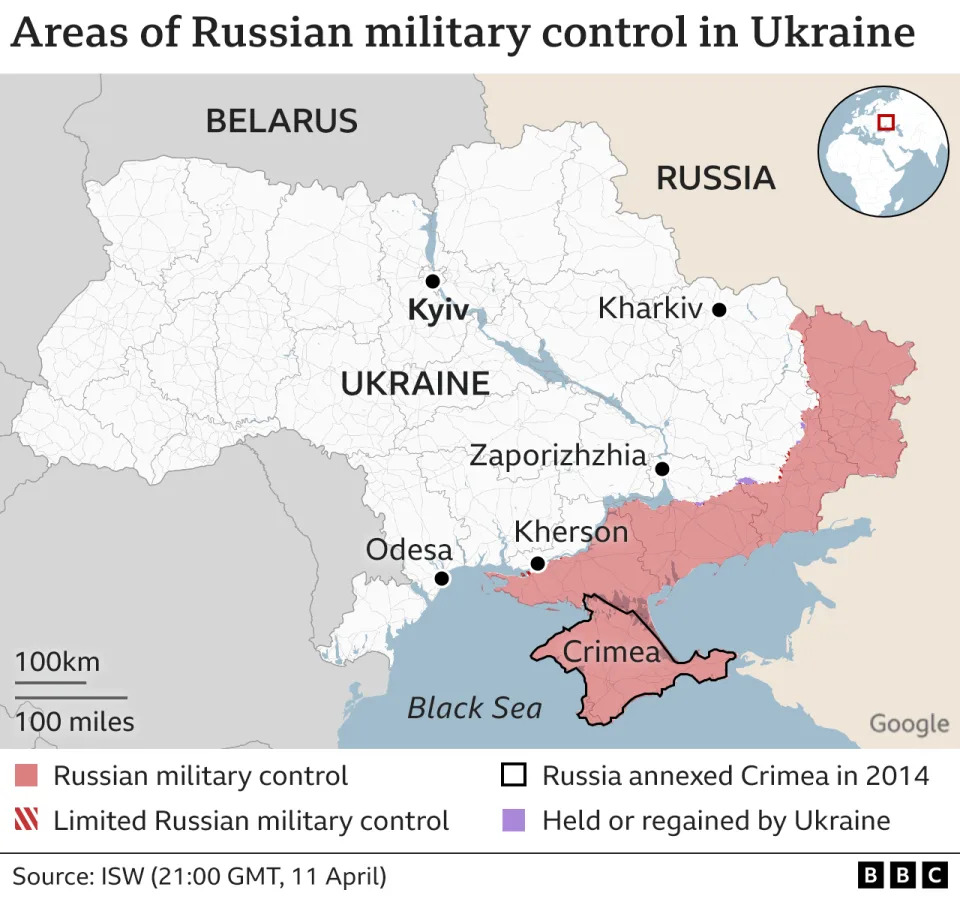
The head of Ukraine’s military has warned the battlefield situation in the east of the country has “significantly worsened” in recent days.
Fierce battles are ongoing in a several villages in the eastern Donbas region.
Gen Oleksandr Syrskyi said Russia was benefitting from warm weather – making terrain more accessible to its tanks – and making tactical gains.
It comes as Germany said it will give Ukraine an extra Patriot missile defence system to fend off air attacks.
In his update posted to social media on Saturday, Gen Syrskyi explained the situation on the eastern front had deteriorated as Russia intensified its armoured assaults.
Battles have raged for control of Bohdanivka – a village west of the devastated city of Bakhmut, he said.
The settlement lies a few kilometres northeast of the town of Chasiv Yar, a Kyiv-controlled stronghold which Russia has been trying to reach after seizing the town of Avdiivka in February to the south.
Ukrainian officials say a slowdown in military assistance from the West – especially the US – has left it more exposed to aerial attacks and heavily outgunned on the battlefield.
Despite repeated assurances that he is dedicated to Ukraine’s defence, US House Speaker Mike Johnson has failed to advance a new military aid bill. The Democratic-controlled Senate passed fresh funding in February which included $60bn in aid for Kyiv, but conservative Republicans in the House objected to the bill as it did not include funds for border security.
Gen Syrskyi said without fresh aid and sophisticated weapons Kyiv would be unable “to seize the strategic initiative” from the numerically superior Russian forces.
Separately on Saturday, Germany vowed to give Ukraine an additional air defence system. Ukraine has made increasingly desperate appeals for supplies of air defence missiles in recent weeks.
On Friday, a major power plant near Kyiv was completely destroyed by Russian strikes. Trypillya power plant was the largest electricity provider for three regions, including Kyiv, officials said.
In response, Berlin has agreed to give Kyiv an additional Patriot missile system. It is capable of intercepting Russia’s most advanced munitions, including Kinzal hypersonic missiles.
Defence Minister Boris Pistorius said Russian strikes against Ukrainian cities and energy infrastructure were causing untold suffering.
President Volodymyr Zelensky thanked Germany for the decision, calling it “a true manifestation of support for Ukraine”.
Since President Vladimir Putin won his stage managed election last month, Moscow has stepped up air attacks on Ukraine.
Russia has, in recent days, unleashed three massive aerial strikes on its energy system, pounding power plants and substations.
Elsewhere, the Security Service of Ukraine (SBU) said it has foiled an assassination attempt on the governor of the Kherson region, Oleksandr Prokudin. Officials said two men attempted to strike Mr Prokudin’s car with a Russian-manufactured drone.
“This was not the first attempt, and probably not the last one,” Mr Prokudin said a message posted to Telegram.
SBU officials also said they had detained 11 networks of Russian operatives since the start of 2024. SBU chief Vasyl Malyuk said in another Telegram post that this was in addition to 47 last year.
Ukraine’s military chief warns of ‘significantly’ worsening battlefield situation in the east
Associated Press – April 13, 2024
In this photo taken from video released by Russian Defense Ministry Press Service on Saturday, April 13, 2024, Russian Army soldiers ride their armoured vehicle to take positions and fire toward Ukrainian positions at an undisclosed location in Ukraine. (Russian Defense Ministry Press Service via AP) (ASSOCIATED PRESS)
KYIV, Ukraine (AP) — Ukraine’s military chief on Saturday warned that the battlefield situation in the industrial east has “significantly worsened in recent days,” as warming weather allowed Russian forces to launch a fresh push along several stretches of the more 1,000 km-long (620-mile) front line.
In an update on the Telegram messaging app, Gen. Oleksandr Syrskyy said that Moscow had “significantly” ramped up its assaults since President Vladimir Putin extended his nearly quarter-century rule in a preordained election last month that saw anti-war candidates barred from the ballot and independent voices silenced in a Kremlin-backed media blockade.
According to Syrskyy, Russian forces have been “actively attacking” Ukrainian positions in three areas of the eastern Donetsk region, near the cities of Lyman, Bakhmut and Pokrovsk, and beginning to launch tank assaults as drier, warmer spring weather has made it easier for heavy vehicles to move across previously muddy terrain.
“Despite significant losses, the enemy is intensifying its efforts by using new units (equipped with) armored vehicles, thanks to which it periodically achieves tactical success,” Syrskyy said.
A Russian Defense Ministry spokesman on Saturday confirmed the capture of a village that had been the site of fierce fighting for close to eighteen months. Analysts from Ukraine’s non-governmental Deep State group, which tracks frontline developments, had reported on Russia’s takeover of Pervomaiske, some 45 kilometers (28 miles) southeast of Pokrovsk, in the early hours of Thursday.
On Saturday, the group said in a Telegram update that Moscow’s forces had also taken Bohdanivka, another eastern village close to the city of Bakhmut, where the war’s bloodiest battle raged for nine months until it fell to Russia last May. Ukraine’s Defense Ministry shortly afterwards denied that Bohdanivka had been captured, and said “intense fighting” continued there.
With the war in Ukraine entering its third year and a vital U.S. aid package for Kyiv stuck in Congress, Russian troops are ramping up pressure on exhausted Ukrainian forces on the front line to prepare to grab more land this spring and summer.
Russia has relied on its edge in firepower and personnel to step up attacks across eastern Ukraine. It has increasingly used satellite-guided gliding bombs — which allow planes to drop them from a safe distance — to pummel Ukrainian forces beset by a shortage of troops and ammunition.
Also on Saturday, Germany announced that it will deliver an additional Patriot air defense system to Ukraine, days after Russian missiles and drones on Thursday struck infrastructure and power facilities across several regions, leaving hundreds of thousands of homes without power, in what private energy operator DTEK described as one of the most powerful attacks this year. The German Defense Ministry said it would “begin the handover” of the Patriot system immediately, without providing a precise timeline.
In an update on X, formerly known as Twitter, German Chancellor Olaf Scholz said he had discussed the “massive” Russian air attacks on civilian energy infrastructure with Ukrainian President Volodymyr Zelenskyy on Saturday, and declared that Berlin will “stand unbreakably by Ukraine’s side.”
Starting last month, Moscow renewed its assault on Ukrainian energy facilities. On Thursday it completely knocked out a plant that was the biggest energy supplier for the region around Kyiv, as well as the nearby Cherkasy and Zhytomyr provinces.
At least 10 of the strikes damaged energy infrastructure in Kharkiv, Ukraine’s second-largest city. Foreign Minister Dmytro Kuleba said more than 200,000 people in the region were without power and Russia “is trying to destroy Kharkiv’s infrastructure and leave the city in darkness.”
Energy facilities were also hit in the Zaporizhzhia and Lviv regions.
The volume and accuracy of recent attacks have alarmed the country’s defenders, who say Kremlin forces now have better intelligence and fresh tactics in their campaign to annihilate Ukraine’s electrical grid and bring its economy to a halt.
In the winter of 2022-2023, Russia took aim at Ukraine’s power grid in an effort to deny civilians light and heating and chip away at the country’s appetite for war.
In Ukraine’s Russian-occupied south, a local Kremlin-installed official blamed Kyiv for a shelling attack that killed 10 people, including children, in a town in the southern Zaporizhzhia region the previous day.
The Tokmak municipal administration reported on Telegram that the shelling struck three apartment blocks Friday evening. Five people were pulled alive from the rubble and 13 people were hospitalized, according to the Kremlin-installed regional head Yevhen Balitsky. It was not immediately possible to verify his claims.
Ukrainian officials did not immediately acknowledge or comment on the attack.
Meanwhile, in Ukraine, a Russian drone on Saturday dropped explosives on an ambulance that had been called out to a village near the frontline city of Kupiansk, wounding its 58-year-old driver, local Gov. Oleh Syniehubov reported. His claim could not be independently verified.
Iran launched 200 drones and missiles in a retaliatory attack on Israel. How we got here, and what happens next.
Air defense systems intercepted many projectiles; Biden condemns attacks
Caitlin Dickson and Kaitlin Reilly – April 13, 2024
An anti-missile system operated after Iran launched drones and missiles towards Israel, as seen from Ashkelon, Israel. (REUTERS / Reuters)
Iran sent 200 drones and missiles hurtling towards Israel Saturday, escalating tensions across an already fraught Middle East and causing the international community to scramble to formulate a response.
The attacks came in retaliation for the April 1 bombing of Iran’s embassy in Syria. Iran said it now considers that matter “concluded,” but also warned Israel and the U.S. against further reprisals. President Biden, meanwhile, condemned the attacks and said he would convene G7 leaders Sunday for “a united diplomatic response.”
It was unclear how much damage the attacks caused. Many of the projectiles were intercepted by Israel’s air defense system, with assistance from the U.S. and other allies.
U.S. and Israeli officials had been predicting a strike. Biden sought to dissuade Iran Friday with a simple one-word message to Tehran’s leaders: “Don’t.”
That warning went unheeded Saturday. Here’s a look at how we got here, and what could happen next.
What’s happening?
Israel Defense Force spokesperson Daniel Hagari said Iran had launched more than 200 drones, cruise missiles, and ballistic missiles towards Israel Saturday, according to The New York Times. Hagari said one girl had been injured.
The Iranian-run state news agency IRNA said Tehran had fired ballistic missiles at Israeli targets, the Associated Press reported.
President Biden cut his weekend visit to Delaware short, returning to the White House on Saturday to meet with his national security team and later speak with Prime Minister Benjamin Netanyahu. In a statement, Biden affirmed that the U.S. “commitment to Israel’s security against threats from Iran and its proxies is ironclad.”
Biden also said he had directed U.S. military resources to the region over the past week to support Israel’s defense, and that as a result “we helped Israel take down nearly all of the incoming drones and missiles.”
The background
Tensions have long simmered and flared between Iran and Israel. Iran has been accused of providing funding and support to militant groups like Hamas and Hezbollah to help facilitate attacks on Israel.
But Saturday’s attack came less than two weeks after a suspected Israeli strike on the Iranian embassy in Damascus, Syria. The attack killed seven of Iran’s military advisers, including three senior commanders.
Although the attack took place outside Iran, it may as well have been a direct hit on the country. Diplomatic compounds, including embassies and consulates, are generally considered sovereign territory of the country they represent and are afforded certain protections. However, during times of war or conflict, diplomatic compounds may become targets for attacks by opposing forces. These attacks are usually condemned by the international community, and when they do occur in conflict zones, it often leads to diplomatic tensions — and potential repercussions.
Saturday’s attack came amid the ongoing war between Hamas and Israel, although Iran does not take responsibility for aiding Hamas during its attack on Oct. 7 that killed 1,200 Israelis.
On Friday, Biden had said he expected Iran to attack “sooner than later” and urged Tehran against it. The U.S. also took steps in recent days to protect Americans in Israel and prepare U.S. troops and warships in the region to defend Israel.
On Saturday, Iran’s mission to the United Nations said in a statement it considered these retaliatory attacks to be a conclusion in the matter of the April 1 embassy bombing. The statement, however, warned Israel that any future reprisals would be met by a “considerably more severe” response and that “the U.S. MUST STAY AWAY!”
Prior to the Saturday attack, Iran’s paramilitary Revolutionary Guard also seized an Israeli-affiliated container ship near the Strait of Hormuz in another apparent sign of aggression by Iran.
What Israel has said
Prime Minister Benjamin Netanyahu convened his war cabinet Saturday night and spoke with President Biden.
Prime Minister Benjamin Netanyahu is currently speaking with US President Joe Biden, following the deliberations of the Security Cabinet and the War Cabinet. pic.twitter.com/v2oJqMSky4
British Prime Minister Rishi Sunak said he condemns the Iranian regime’s “reckless attack” against Israel. “These strikes risk inflaming tensions and destabilizing the region,” he stated. “Iran has once again demonstrated that it is intent on sowing chaos in its own backyard.”
German foreign minister Annalena Baerbock also “strongly” condemned the attack, which she said “could plunge an entire region into chaos.” She called for Iran and its proxies to “stop this immediately,” adding that “Israel offers our full solidarity at this time.”
Spanish Prime Minister Pedro Sanchez said that “we are following events in the Middle East with the deepest concern,” adding that the country is in “permanent contact” with their embassies in the region, which will “remain open to support Spaniards in the area.”
Colombia’s President Gustavo Petro called the unfolding events “predictable,” declaring it a “prelude to World War III,” when “humanity should rebuild its economy towards the rapid goal of decarbonization.”
What happens next?
International leaders will meet Sunday to coordinate a response.
The United Nations Security Council has scheduled an emergency meeting at 4 p.m. E.T.
President Biden also said he would convene a meeting with the leaders of the G7 countries, which include France, Germany, Canada, Italy, Japan, and the United Kingdom, to discuss a unified diplomatic response.
Biden to close ‘gun-show loophole’ and expand background checks for firearms
Myah Ward – April 11, 2024
“This single gap in our federal background check system has caused unimaginable pain and suffering,” Vice President Kamala Harris said on the call. | Alex Wong/Getty Images (Alex Wong via Getty Images)
The Biden administration is moving to expand background checks for gun purchases, fulfilling a key demand of advocates following the deadly shooting at a school in Uvalde, Texas.
The final rule, expected to be submitted Thursday to the Federal Register by the Bureau of Alcohol, Tobacco and Firearms, would eliminate a loophole that has allowed sales of guns without background checks of guns outside of brick-and-mortar stores.
The rule was issued under a provision of the 2022 Bipartisan Safer Communities Act. It requires that anyone who sells guns for profit to have a license and that buyers be subject to a background check, including at firearms shows and flea markets. The administration had been working on the rule since last spring. Once publicized, it will take effect in 30 days.
The so-called gun show loophole has for years allowed unlicensed gun dealers to sell firearms without background checks at gun shows, on the internet and out of their homes. The new rule, the most sweeping expansion of firearms background checks in decades, will apply to more than 20,000 individuals engaged in unlicensed gun dealing and affect “tens and tens of thousands of gun sales” each year, an administration official told reporters during a call previewing the announcement.
“This single gap in our federal background check system has caused unimaginable pain and suffering,” Vice President Kamala Harris said on the call.
The vice president noted the 25th anniversary next week of the mass shooting at Columbine High School, which was carried out with weapons purchased through the gun-show loophole. She also pointed to the 2019 shooting in Midland and Odessa, Texas, where a man killed seven people and wounded dozens of others. A background check stopped the shooter from purchasing a gun at a sporting goods store in 2014, but he later purchased an AR-15 from an unlicensed seller he met online.
“So many communities have been torn apart by acts of violence committed with weapons bought without background checks,” she continued. “So in the memory of all those we have lost today, as the head of the White House Office of Gun Violence Prevention, I am proud to announce that all gun dealers now must conduct background checks no matter where or how they sell their merchandise.”
After Congress passed the gun safety legislation in June 2022 following a shooting in Uvalde, Texas, gun safety groups have pushed the White House to use it to expand background checks by clarifying which entities are considered “engaged in the business” of selling firearms. Doing so would not fulfill the president’s plea for universal background checks, as it would not apply to all sales, including private transfers. But the rule’s publication still marks a step forward in the administration’s more incremental efforts to regulate gun sales through implementation of the Bipartisan Safer Communities Act.
“We know this doesn’t get all the way there. And this law can only do so much. And it’s why the president is firm that the Congress needs to finish this job and make sure that we have background checks on all gun sales,” an administration official said.
The final rule comes a year after the president issued an executive order directing Attorney General Merrick Garland to develop and implement a plan to clarify the definition of “engaged in business.” The Department of Justice issued the proposed rule in September. The administration has also made an effort to release previously undisclosed firearms data, offering a fuller picture of the illegal firearms market in the U.S.
An analysis published last week from the Bureau of Alcohol, Tobacco, Firearms and Explosives found sales by unlicensed dealers were the most frequently used gun trafficking channel. From 2017 to 2021, the ATF traced more than 68,000 of these illegally tracked firearms to unlicensed dealers.
“Today’s Final Rule is about ensuring compliance with an important area of the existing law where we all know, the data show, and we can clearly see that a whole group of folks are openly flouting that law. That leads to not just unfair but, in this case, dangerous consequences,” said ATF director Steven Dettelbach.