Klitschko announces new air defence systems in Kyiv
Denys Karlovskyi – May 7, 2022
Kyiv Mayor Vitaliy Klitschko has hinted that more modern air defense systems will soon be deployed in the capital to protect residents from air attacks by the Russian occupiers.
Klitschko’s quote: “Unfortunately, we are still worried about the constant reports of air threats – rocket strikes.
I ask everyone to follow the regulations, go down to the bomb shelters and do not ignore these rules, because at any moment any house in our city, unfortunately, can still be fired on.
We hope that in the coming days there will be additional air defence at the Western, NATO standard, which will protect our airspace more. “
Details: The mayor of the capital is convinced that small and medium-sized businesses will resume their work in full within a month, if the shelling and security situation in the Kyiv region remains relatively calm.
According to him, the military is monitoring the situation at the borders and in the region.
Klitschko emphasised that the motivation and plans of the military leadership of Kyiv will not allow the Russian occupiers to carry out another successful offensive.
Background:
In the same interview, Klitschko said that after 9 May, residents who left the capital may gradually come back to the city.
[The local authorities] have decided to leave the curfew on 8 and 9 May the same as in the previous hours: from 10 pm to 5 am.
On the outskirts of Kyiv, especially in the north-western districts, there is a danger of mines and unexploded ordnance.
The US government is considering returning embassy diplomatic staff to Kyiv by the end of May. Before that, Great Britain, France, Sweden, the Czech Republic, the Netherlands, Turkey and about a dozen other countries will have returned their diplomats to the capital.
‘I Simply Refuse’: Wiretaps Catch Putin’s Troops Breaking Own Tanks in Sabotage Scheme
Shannon Vavra – May 6, 2022
Russian fighters have been sharing tips with one another about how to deliberately damage their own equipment and hamper Russian President Vladimir Putin’s war plans in Ukraine, according to recordings of alleged Russian troops’ phone calls that the Security Service of Ukraine (SBU) intercepted.
In one regiment, one Russian soldier allegedly said they’ve been pouring sand into the tanks’ fuel systems to clog them up.
“I don’t follow stupid orders, I simply refuse,” one fighter can be heard telling a comrade. “The motherf*cker sent me to tanks, motherf*cking piece of shit. I f*cked it up and that’s it.”
When the fellow Russian soldier on the other end of the line heard the unit wasn’t punished for the insubordination, he indicated he might repeat the tactic later in his own unit.
Another Russian fighter shared with a family member that he and his comrades deliberately damaged their tank—the last one left in their regiment—to interfere with an attack plan, as well, according to another intercept the SBU shared.
“We have one tank left in the regiment,” he said. “In short, we broke our tank ourselves in the morning so as not to go.”
Throughout the invasion, Russian battle plans haven’t gone the way Putin has wanted them to, leaving Putin frustrated and on edge, according to a senior U.S. defense official. One of his major goals was to capture the capital, Kyiv, and install a pro-Putin puppet government. But his troops faltered outside of the capital for days and had countless logistics problems, and in particular had troubles with the fueling, according to the defense official.
And while some U.S. officials have said for weeks that it’s at times been unclear if Russia’s military’s failings are due to lack of planning or just poor execution of plans, the intercepted calls suggest in some cases the answer is much simpler. The troops themselves are disobeying orders and sabotaging the war effort on purpose.
A mainstay of the war has been images of Russians abandoning their equipment and weapons. Russian military morale has been low from the beginning of the invasion, and it’s not getting any better; Russian troops have begun posting on social media begging for donations to the war effort, showing a side-by-side comparison between their dismal first-aid kits and the Ukrainians.
The Russian war effort isn’t only being hampered from the inside. Inspired by the Russians’ intercepted phone calls, Ukraine’s government encouraged other Russian troops to disobey orders and refuse to attack, echoing earlier calls to surrender and abandon the war path.
“The SBU welcomes this practice,” the SBU said in a statement Friday. “But even it can be improved—just ‘give up’ and leave the war in Ukraine!”
Ukrainians have been putting up a stiff resistance from day one of the war, surprising Putin along the way, according to the Pentagon.
The Pentagon, too, has been providing key intelligence that has helped the Ukrainians target key Russian assets, including the Russian warship the Moskva, which sank in the Black Sea after Ukrainians hit it in a missile strike in April, according to The Washington Post.
Pentagon Press Secretary John Kirby has acknowledged the intelligence-sharing effort but said the U.S. had no part in the targeting.
Russia narrows in on Black Sea and strikes Odesa, Moldova remains ‘vigilant’ as turmoil escalates
Caitlin McFall – May 7, 2022
Russia appears to be making good on its attempts to gain “full control” over not only eastern Ukraine but its southern regions along the Black Sea as explosions hit the city of Odesa and neighboring Moldova Saturday.
Six missiles targeted the port city according to Ukraine’s southern military command.
Spokesperson Natalia Humeniuk confirmed that four rockets struck a furniture factory in a residential area, while two other strikes hit a previously damaged runway strip, first reported Reuters.
It remains unclear if any causalities have been confirmed.
Russian forces also reportedly hit an energy company in the southern city of Mykolaiv with 20 workers on-site at the time of the attack, though no causalities have been reported.
Explosions were confirmed in the Moldovan breakaway region of Transnistria Saturday after two drones were reported to be flying over military units in the village of Voronkove – roughly five miles from the Ukrainian border.
Moldovan President Maya Sandu said officials continue to assess that “Moldova is safe, but we remain vigilant.”
“The government’s priority is to preserve peace, life and security of citizens,” she said during a press conference with Lithuanian President Gitanas Nauseda, according to local news outlets.
Late last month Russia said that the second phase of its military operation in Ukraine would not only focus on the Russian-backed breakaway regions in the eastern Donbas, but would also target Ukraine’s southern regions and potentially neighboring Moldova.
Ukrainian President Volodymyr Zelenskyy has vowed to continue fighting and NATO allies have increased their support for not only Kyiv but nations that border the war-torn country.
Despite international ire over the illegal invasion and mounting allegations of gross human rights abuses, a Moscow official doubled down on the Kremlin’s determination to take Ukrainian territory Friday.
Speaking from a visit to the occupied region of Kherson, a Russian lawmaker said Russia would remain in southern Ukraine “forever,” reported a Moscow-based media outlet.
“Russia is here forever. There should be no doubt about this. There will be no return to the past,” an official by the name of Andrey Turchak reportedly said. “We will live together, develop this rich region, rich in historical heritage, rich in the people who live here.”
Ukrainian officials have been sounding the alarm that Russia will look to annex the southern region of Kherson and recent reporting has suggested they have blocked all Ukrainians from evacuating the area.
Men of fighting age have been rounded up and detained in filtration camps where officials believe they will then be conscripted into the Russian military or used for hard labor.
Russia sends conscripts from Crimea to fight against Ukraine, representative of the President of Ukraine says
May 7, 2022
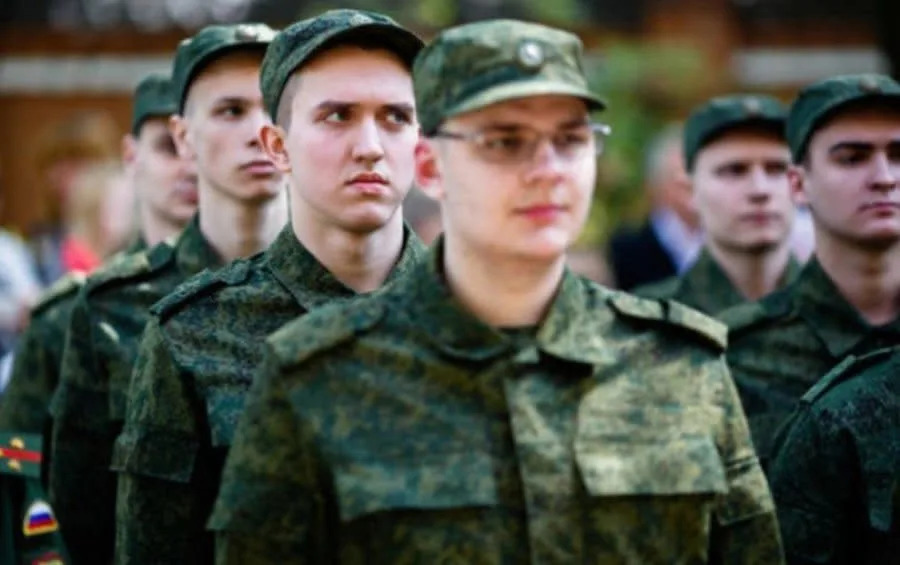
Russian army conscripts
“I want to say that conscripts are very actively sent from the Crimean Peninsula to fight against our country,” Ukrainian news agency Ukrinform reported Tasheva as saying.
According to Tasheva, from open source data alone, “recently there were at least 72 funerals” of Russian soldiers on the peninsula, and according to confirmed data, 41 of them are definitely natives of Crimea.
Tasheva said that the actual numbers are likely higher.
She said that those who died in the war are most likely citizens of Ukraine, since their documents indicate that they were born on the territory of the peninsula, and if they lived there or were born there any time of 2014, this means that they are citizens of Ukraine.
Russia Expert Fiona Hill Explains Why Jan. 6 Was Key Moment For Putin And Ukraine
Lee Moran – May 7, 2022
Russia’s invasion of Ukraine would have played out very differently had Donald Trump succeeded in blocking the transfer of power on Jan. 6, 2021, says former top National Security Council analyst Fiona Hill.
Russian President Vladimir Putin would have been massively emboldened and “would have probably just driven right into Ukraine himself,” said Hill, an expert on Russian affairs, in an interview with Bloomberg’s Emma Barnett released Friday.
Had former Vice President Mike Pence not blocked Trump’s plan to overturn the 2020 election result, Putin “would have seen the United States as completely finished from a leadership perspective because we would be no different from any other country in the world that had just had a coup,” explained Hill.
But the attack by Trump supporters on the U.S. Capitol was still “a particular moment” that helped inspire the Russian leader to order the military invasion of Ukraine, agreed Hill.
Other motivating factors for the war, which is now in its 73rd day, were Putin’s increased isolation due to the coronavirus pandemic and his belief the West had become “weak and distracted,” she said.
Hill served as an intelligence analyst under former presidents George W. Bush and Barack Obama before joining the NSC under Trump, about whom she testified during his first impeachment.
Last month, she said the U.S. Capitol violence was Trump’s shot at “pulling a Putin.”
“In the course of his presidency, indeed, Trump would come more to resemble Putin in political practice and predilection than he resembled any of his recent American presidential predecessors,” Hill told The New York Times magazine.
Watch the full interview here. Hill’s comments about Putin are at the 9-minute mark:
How millions of Russians are tearing holes in the Digital Iron Curtain
Anthony Faiola – May 6, 2022
RIGA, Latvia – When Russian authorities blocked hundreds of Internet sites in March, Konstantin decided to act. The 52-year-old company manager in Moscow tore a hole in the Digital Iron Curtain, which had been erected to control the narrative of the Ukraine war, with a tool that lets him surf blocked sites and eyeball taboo news.
Konstantin turned to a virtual private network, an encrypted digital tunnel more commonly known as a VPN. Since the war began in February, VPNs have been downloaded in Russia by the hundreds of thousands a day – a massive surge in demand that represents a direct challenge to President Vladimir Putin’s attempt to seal Russians off from the wider world. By protecting the locations and identities of users, VPNs are now granting millions of Russians access to blocked material.
Downloading one in his Moscow apartment, Konstantin said, brought back memories of the 1980s in the Soviet Union – when he used a shortwave radio to hear forbidden news of dissident arrests on U.S.-funded Radio Liberty.
“We didn’t know what was going on around us, and that’s true again now,” said Konstantin, who, like other Russian VPN users, spoke on the condition that his last name be withheld for fear of government retribution. “Many people in Russia simply watch TV and eat whatever the government is feeding them. I wanted to find out what was really happening.”
Daily downloads in Russia of the 10 most popular VPNs jumped from below 15,000 just before the war to as many as 475,000 in March. As of this week, downloads were continuing at a rate of nearly 300,000 a day, according to data compiled for the Washington Post by the analytics firm Apptopia, which relies on information from apps, publicly available data and an algorithm to come up with estimates.
Russian clients typically download multiple VPNs, but the data suggests millions of new users per month. In early April, Russian telecom operator Yota reported that the number of VPN users was 53.5 times as high as in January, according to the Tass state news service.
The Internet Protection Society, a digital rights group associated with jailed Russian opposition leader Alexei Navalny, launched its own VPN service on March 20 – and reached its limit of 300,000 users within 10 days, according to executive director Mikhail Klimarev. Based on internal surveys, Klimarev estimates that the number of VPN users in Russia has risen to roughly 30% of the country’s 100 million Internet users.
To combat Putin, “Ukraine needs Javelin [missiles] and Russians need Internet,” Klimarev said.
By accessing banned Ukrainian and Western news sites, Konstantin said, he has come to deeply sympathize with Ukrainian President Volodymyr Zelensky, a former comedian the Russian press has sought to falsely portray as a “drug addict.” He was recently compared to Adolf Hitler by Russian Foreign Minister Sergei Lavrov.
“I loved him as an actor, but now I know Zelensky is also brave because I’ve seen him talk on Ukrainian news sites with my VPN,” Konstantin said.
Not only does widespread VPN use help millions reach material laying out the true extent of Russian military losses and countering the official portrayal of the war as a fight against fascists, say Russian Internet experts, but it also limits government surveillance of activists.
Russian officials have sought to curtail VPN use. An anti-VPN law in 2017 resulted in the banning of more than a dozen providers for refusing to comply with Russian censorship rules.
In the days before the war, and in the weeks since then, Russian authorities have also ratcheted up pressure on Google, asking the search engine to remove thousands of URLs associated with VPNs, according to the Lumen database, an archive of legal complaints related to Internet content. Google, which did not respond to a request for comment, still includes banned sites in search results.
The Russian government is reluctant to ban VPNs completely. Policing such a ban would pose a technological challenge. In addition, many Russians use VPNs to access nonpolitical entertainment and communication tools – popular distractions from daily hardships.
Last month, when asked by Belarusian TV if he had downloaded a VPN, even Putin spokesman Dmitry Peskov conceded: “Yes, I have. Why not?”
Since the war began on Feb. 24, more than 1,000 Internet sites have been restricted by Russian authorities, including Facebook, Instagram, BBC News, Voice of America and Radio Liberty, according to a survey by the technology site Top10VPN. The last independent Russian media outlets were forced to shut down, and those in exile that are offering critical content – like the popular Meduza – have also been banned.
Today, even calling Putin’s “special operation” – as he has forcibly dubbed the invasion – a “war” risks a sentence of up to 15 years in jail. Free speech has effectively disappeared; even teachers who question the invasion are being reported to the authorities by their students.
“People want to see banned content, but I think they’re also genuinely scared,” said Tonia Samsonova, a London-based Russian media entrepreneur. “No matter your attitude toward the government or the war, every Russian knows that if the government knows too much about you, it’s potentially dangerous. So a VPN is so useful even if they aren’t critical of Putin.”
Katerina Abramova, spokeswoman for Meduza, said online traffic at the site declined only briefly after it was banned by Russian authorities in March. That’s because, suddenly, traffic began surging from unlikely countries like the Netherlands – suggesting that Russians were utilizing VPNs that made them appear to be abroad.
“VPNs won’t start a broad revolution in Russia,” Abramova said. “But it’s a way people who are against this war can stay connected to the world.”
Natalia, an 83-year-old Muscovite and former computer operator, asked her adult daughter to help her download a VPN on her laptop shortly after the war started. She feared that the government would ban YouTube, preventing her from seeing her favorite program – an online talk show on technology news. The Kremlin has yet to block YouTube, though Russian Internet experts say the probability remains high.
As the war progressed, however, Natalia found herself also looking at banned news sites, including Radio Free Europe, to stay informed, even as friends around her bought “totally” into the government line that Ukrainians were Nazis and Russia was facing an existential threat from the West.
“People now just believe lie after lie. I feel so isolated,” she said.
She said, for example, that she’s been able to read foreign news stories suggesting there were significant Russian casualties in the sinking last month of the Moskva, the flagship of Russia’s Black Sea Fleet. But the Russian press has reported only one official death, with 27 soldiers declared “missing.”
“Parents are just getting one answer from the Ministry of Defense – that your son is ‘missing,’ ” she said. “Missing? Don’t you really mean dead? But they’re not saying that. They’re not telling the truth.”
Although downloading a VPN is technically easy, usually requiring only a few clicks, purchasing a paid VPN has become complicated in Russia, as Western sanctions have rendered Russian credit and debit cards nearly useless outside the country. That has forced many to resort to free VPNs, which can have spotty service and can sell information about users.
Vytautas Kaziukonis, chief executive of Surfshark – a Lithuania-based VPN that saw a 20-fold increase in Russian users in March – said some of those customers are now paying in cryptocurrencies or through people they know in third countries.
In a country used to hardships, Russians are good at creative workarounds. Elena, a 50-year-old Moscow tour operator, said she has managed to tap into her old Facebook account by repeatedly signing up for free trials with a series of different VPN providers to avoid payment.
Ukraine asks medical charity MSF to help evacuate Azovstal fighters
May 6, 2022
Service members of pro-Russian troops fire from a tank in Mariupol
KYIV (Reuters) -Ukraine has appealed to Medecins Sans Frontieres (Doctors Without Borders) to help evacuate fighters holed up in the vast Azovstal steel works in Mariupol that is surrounded by Russian forces.
Ukraine’s Ministry for the Reintegration of the Temporarily Occupied Territories posted details on its website on Friday of a letter to the medical charity in which Deputy Prime Minister Iryna Vereshchuk expressed concern about “deplorable conditions” at the plant.
It quoted Vereshchuk as saying the MSF charter provided assistance to people in need or victims of armed conflict.
“Based on the principles that guide MSF, the Ministry for the Reintegration of the Temporarily Occupied Territories of Ukraine is asking for a mission to evacuate the defenders of Mariupol, who are now in the Azovstal metallurgical plant,” the ministry wrote on its website.
It said she had asked MSF to “assess their physical and mental condition, collect evidence of the conditions they are in, and provide medical assistance to Ukrainians whose human rights have been violated by the Russian Federation.”
An MSF spokesperson confirmed the charity had received a letter from the government requesting support for the people trapped inside the plant.
“We will be discussing with (the relevant ministries)…to see the best way MSF can provide medical assistance to these people in need of urgent help,” the spokesperson said.
Russia denies targeting civilians and has dismissed Ukrainian and international allegations of war crimes by its forces in Ukraine. Moscow has urged the fighters in the sprawling steel works to surrender.
Russian forces have occupied Mariupol, leaving the city’s last defenders – and scores of civilians – holed up in the Azovstal plant.
The United Nations and the International Committee of the Red Cross (ICRC) have helped evacuate some of the civilians and Ukraine said a new attempt was under way to evacuate the civilians.
(Reporting by Natalia Zinets; additional reporting by Emma Farge in Geneva; Editing by Timothy Heritage and Raissa Kasolowsky)
China hits out at Japanese PM’s five-nation tour of ‘confrontation’
May 6, 2022
Beijing has accused Japanese Prime Minister Fumio Kishida of “provoking confrontation” between China and major powers after Tokyo and London signed a landmark pact to “rapidly accelerate” defence and security ties.
On the final leg of his five-nation Asian and European tour, Kishida signed a reciprocal access agreement with British Prime Minister Boris Johnson on Thursday and – in a veiled swipe at China – vowed to help realise a free and open Indo-Pacific.
Chinese foreign ministry spokesman Zhao Lijian accused Kishida of fanning anti-China sentiment on his trip to Britain, Italy, Indonesia, Thailand and Vietnam, saying the visits were an attempt to expand Japan’s military power – something prohibited under its pacifist constitution.
“The Japanese side frequently uses diplomatic activities to … talk about China, play up regional tensions, and hype the so-called China threat. What Japan is doing is [trying to] find an excuse for its own expansion of military power, and to undermine the trust and cooperation of countries in the region.”
Beijing was particularly incensed by Kishida’s comments on Taiwan.
In a press conference with Johnson after their meeting, the Japanese leader said: “Peace and stability in the Taiwan Strait is critical not only for Japan’s security but also for the stability of international society.”
He vowed that Japan and its allies would “never tolerate a unilateral attempt to change the status quo by the use of force in the Indo-Pacific, especially in East Asia”.
“Ukraine may be East Asia tomorrow,” Kishida warned, likening Taiwan, which Beijing sees as a runaway province, to Ukraine, which Russia invaded on February 24.
Zhao said China firmly opposed Kishida’s assessment.
“The Taiwan issue is entirely China’s internal affair and cannot be compared with the Ukraine issue,” he said.
“Japan bears historical guilt towards the Chinese people on the Taiwan issue, and should be more cautious in its words and deeds, and has absolutely no right to make irresponsible remarks.
“If Japan really wants peace and stability in East Asia, it should immediately stop provoking confrontation between major powers and do more things that are conducive to enhancing mutual trust among regional countries and promoting regional peace and stability.”
Beijing was initially hopeful that Kishida, who took office in October, would be more dovish on China than his conservative predecessors Yoshihide Suga and Shinzo Abe.
Instead, there are growing signs that China’s already strained relations with Japan will dip further, with the Kishida administration edging closer to Washington and actively forging an anti-China alliance in the region, according to observers.
“It has become clear that our expectations were misplaced. Japan is not just following the US in countering China, it is actually trying to exploit the differences between Beijing and Washington to boost its own geopolitical influence and seek military build-up,” said Liu Jiangyong, an expert on regional affairs at Tsinghua University in Beijing.
Along with an agreement to share ammunition and supplies, the broad pact on defence cooperation between Japan and Britain will enable faster troop deployment and foster joint training and disaster relief efforts.
Benoit Hardy-Chartrand, an international affairs expert at Temple University in Tokyo, said the deal was important because it showed that Japan was serious about strengthening defence partnerships with other allies and partners, including outside the Indo-Pacific region.
“It also underscores the UK’s stated desire to play a greater role in Asia, a desire that has also been expressed by an increasing number of European countries,” he said.
“Despite the fact that global attention has been rightly focused on the Russian invasion of Ukraine, this deal also shows that in the long term, most Western partners intend on allocating more resources to the Indo-Pacific, with Japan being a key partner.”
Zhou Chenming, a Beijing-based military analyst, said the Japanese-British deal was worrying because it reflected both London’s further tilt toward the Indo-Pacific and Tokyo’s geopolitical ambitions.
“There is little detail available about the new agreement, but it will surely have a negative impact on the regional situation,” Zhou said.
“On top of its obsession with the situation in Hong Kong, a hot-button issue in China’s rivalry with the West, Britain’s attempts to get more involved in the sensitive geopolitics in the Asia-Pacific may fuel tensions and lead to crises.”
Zhou noted the signing of the London-Tokyo pact also coincided with efforts by Aukus, a trilateral security grouping formed last year by the US, Britain and Australia, to enlist Japan in their military manoeuvring in the region.
Following a Japan trip next week by European Commission President Ursula von der Leyen and European Council President Charles Michel, US President Joe Biden will also visit Tokyo later this month, with China and the Ukraine war high on the agenda.
German Chancellor Olaf Scholz also visited Japan last week in his first official trip to East Asia, skipping Berlin’s top trading partner China.
Surveillance footage shows the moment Russian rockets hit a Ukrainian amusement park
Matthew Loh – May 6, 2022
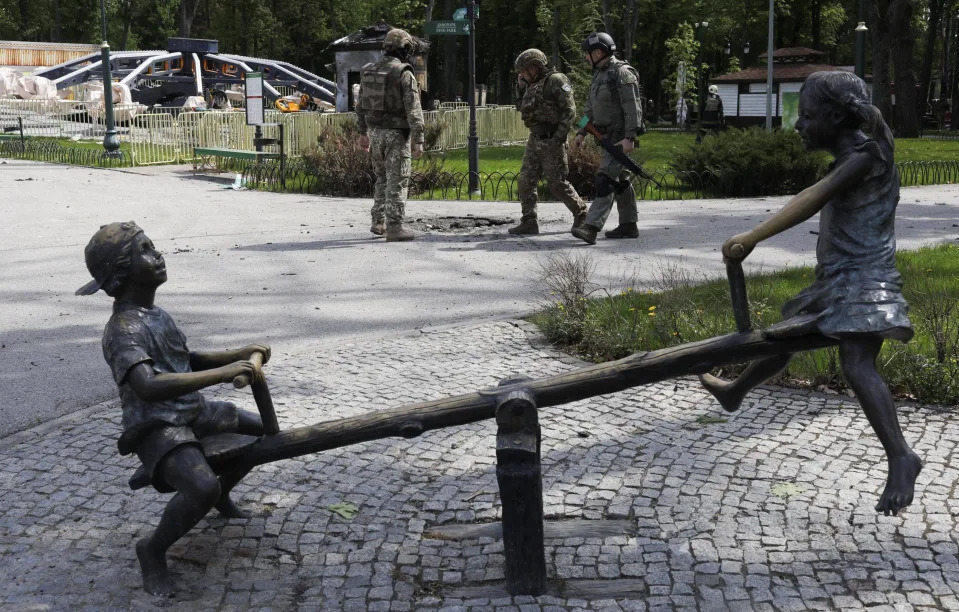
Ukrainian troops inspect damage from a Russian rocket that struck Maxim Gorky Central Park in Kharkiv.Ricardo Moraes/Reuters
Surveillance footage shows an amusement park getting battered by a Russian rocket strike.
Reuters identified the missiles as GRAD rockets, typically fired from truck-mounted launchers.
It’s not immediately clear why Russian forces attacked the amusement park.
Newly released surveillance footage appears to show rockets striking an amusement park in Kharkiv, Ukraine, on Tuesday, destroying sheds, rides, and decorations.
The footage was published on Wednesday by Reuters, which reported that Soviet-developed GRAD rockets were used in the attack. GRAD rockets are usually fired from a truck-mounted launcher.
Ukraine’s State Emergency Services reported a fire at a park in central Kharkiv on Tuesday, which had been shelled by Russian forces, the outlet reported.
The park is known as the Maxim Gorky Central Park for Culture and Recreation, Reuters reported, identifying the location through the buildings, paths, attractions, and benches.
According to the SES, seven fire engines arrived on the scene and contained the blaze, per the outlet.
A woman received shrapnel wounds because of the attack, the SES added, per Reuters.
It’s not immediately clear why Russian forces shelled the amusement park, or if the park had been the intended target. Moscow has denied that it strikes civilian targets, though there have been widespread reports of such instances.
Ukraine launches offensive to drive out Russian forces in Northeast
Chloe Folmar – May 6, 2022
Ukraine launched an offensive Friday to drive out Russian troops in the northeast part of the country.
The two militaries have been engaged in an arduous battle with neither side able to gain the upper hand, The New York Times reported.
However, Ukrainian troops are rallying to form an offensive against the Russian forces, which are pushing toward key cities in the northeast including Kharkiv and Izium.
“There are fierce battles going on, as well as the transition from defensive operations to offensive actions in the Kharkiv and Izium areas,” Ukrainian Commander in Chief Valeriy Zaluzhnyi said Thursday, according to the Times.
Ukrainian officials have warned, meanwhile, that Russian President Vladimir Putin could intensify attacks on the country during Russia’s Victory Day on Monday.
The holiday commemorates the victory of the Soviet Union over Nazi Germany in 1945, near the end of World War II.
Officials warn that there is a threat of more intense missile strikes over the weekend and on Monday.
Ukraine’s success in its offensive is in part due to the advanced artillery and weapons it possesses thanks to Western contributions to its defense. The West has provided weapons and intelligence, and multiple outlets on Thursday reported the intelligence played a role in the sinking of a Russian warship.