Trump on political violence in 2024: ‘If we don’t win, you know, it depends’

NBC News

Trump on political violence in 2024: ‘If we don’t win, you know, it depends’

Jake Traylor and Scott Bland – April 30, 2024

Mark Peterson

Former President Donald Trump said in a new interview with Time magazine that he doesn’t think there will be political violence around the 2024 election because he believes he’ll win — but that it “always depends on the fairness of an election.”

The comments came along with a statement that Trump would “consider” pardoning every person who has been charged or convicted for rioting at the Capitol on Jan. 6, 2021, after the then-president rallied his followers against what he has repeatedly and baselessly called a “rigged” election.

Trump also answered questions digging into his campaign position on abortion policy being left up to the states — and deflecting questions pressing him on any potential federal action, including his position on whether abortion medication should be available. And Trump reinforced past statements he has made on Russia doing “whatever the hell they want” to NATO countries who don’t pay their “fair share” and the extent of a military crackdown he plans to order on illegal immigration.

When Trump was asked in an initial interview about the prospect of more political violence in 2024, after the events following the 2020 election, he said no. “I think we’re gonna have a big victory. And I think there will be no violence,” Trump said.

But asked in a follow-up conversation about what will happen if he doesn’t win, Trump was equivocal.

“Well, I do think we’re gonna win,” Trump answered. “We’re way ahead. I don’t think they’ll be able to do the things that they did the last time, which were horrible. Absolutely horrible. So many, so many different things they did, which were in total violation of what was supposed to be happening. And you know that and everybody knows that. We can recite them, go down a list that would be an arm’s long. But I don’t think we’re going to have that. I think we’re going to win. And if we don’t win, you know, it depends. It always depends on the fairness of an election.”

Trump also said that he’d be reluctant to hire people for a second administration who thought President Joe Biden won the 2020 election: “I wouldn’t feel good about it,” he said.

On the people charged and convicted of violent acts as Congress was preparing to certify the 2020 election results on Jan. 6, 2021, Trump complained that they’ve faced a “two-tier system” but, when pressed, said, “I would consider that, yes,” when asked if he’d consider pardoning every single person prosecuted for their actions on Jan. 6.

‘The states are going to have to be comfortable or uncomfortable, not me’

Trump’s rare long-form interview included him talking through his position on leaving abortion policy up to states. When asked directly if he was comfortable with states deciding to punish women who access abortions after the designated state-specific ban, Trump said: “I don’t have to be comfortable or uncomfortable. The states are going to make that decision. The states are going to have to be comfortable or uncomfortable, not me.”

Then, asked if women’s pregnancies should be monitored by state governments to ensure they don’t get abortions after a certain timeline ban, Trump said: “I think they might do that. Again, you’ll have to speak to the individual states.”

Trump also dodged on the question of whether women should have access to abortion pills. As the interviewer noted that Republican allies of Trump have called “for enforcement of the Comstock Act, which prohibits the mailing of drugs used for abortions by mail,” Trump said he will be making a statement later but declined to outline his position.

“I will be making a statement on that over the next 14 days,” Trump said. In the follow-up interview on April 27, Time noted that Trump had not yet made the statement even though two weeks had passed.

“I’ll be doing it over the next week or two,” Trump said. “But I don’t think it will be shocking, frankly. But I’ll be doing it over the next week or two.”

Trump recently said that it should also be up to individual states to determine any penalty for doctors who perform abortions outside state law. He labeled a question about what he’d do on potential federal legislation on abortion a hypothetical “because it won’t happen. You’re never going to have 60 votes.”

‘I can see myself using the National Guard and, if necessary, I’d have to go a step further’

When asked about immigration, Trump reiterated a consistent campaign promise to use the U.S. military to remove undocumented immigrants from the country.

And Trump said he’d be willing to use other parts of the U.S. military besides the National Guard to address issues inland as well as the border, saying, “I can see myself using the National Guard and, if necessary, I’d have to go a step further.” When the interviewer noted the law preventing the deployment of the military against civilians, Trump claimed undocumented immigrants weren’t civilians and said: “These are people that aren’t legally in our country. This is an invasion of our country.”

Trump has previously vowed to relocate thousands of overseas U.S troops to the southern border to crack down on border security as well as promising to terminate “every open border policy of the Biden administration.”

Trump also floated the idea of migrant detention camps, calling it a “possibility” but something he hopes “we shouldn’t have to do very much of.”

At the core of Trump’s immigration promises over the last year is the use of local law enforcement, though policy specifics surrounding the idea have been scarce.

When asked to clarify, Trump proposed “police immunity from prosecution” and left the door open to possible incentives from the federal government for state and local police departments.

‘If you’re not going to pay, then you’re on your own’

On international affairs, Trump again dug in on recent comments that Russia could “do whatever the hell they want” to NATO countries who do not “pay up” what he deems are appropriate military expenses.

Trump told Time, “Yeah, when I said that, I said it with great meaning, because I want them to pay. I want them to pay up. That was said as a point of negotiation. I said, Look, if you’re not going to pay, then you’re on your own. And I mean that.”

Trump also backed up comments that he wouldn’t “give a penny” to Ukraine unless other European countries started supporting Ukraine in “equalizing” amounts.

“I said I wouldn’t give unless Europe starts equalizing,” Trump said. “They have to come. Europe has to pay. We are in for so much more than the European nations. It’s very unfair to us. And I said if Europe isn’t going to pay, who are gravely more affected than we are, if Europe is not going to pay, why should we pay?”

Trump also conceded that a two-state solution between Israel and Palestine looks “very, very tough,” and that Israeli Prime Minister Benjamin Netanyahu has “rightfully” been criticized for the fact that Hamas was able to attack Israel on Oct. 7.

Trump Is Flirting With Quack Economics

Paul Krugman – April 29, 2024

Donald Trump, his back to the camera, stands at a microphone, looking away and wearing a MAGA cap with his last name stitched on the back.
Credit…Michelle Gustafson for The New York Times

More than 30 years ago, the economists Rudiger Dornbusch (one of my mentors) and Sebastian Edwards wrote a classic paper on what they called “macroeconomic populism.” Their motivating examples were inflationary outbreaks under left-wing regimes in Latin America, but it seemed clear that the key issue wasn’t left-wing governance per se; it was, instead, what happens when governments engage in magical thinking. Indeed, even at the time they could have included the experience of the military dictatorship that ruled Argentina from 1976 to 1983, which killed or “disappeared” thousands of leftists but also pursued irresponsible economic policies that led to a balance-of-payments crisis and soaring inflation.

Modern examples of the syndrome include leftist governments like that of Venezuela, but also right-wing nationalist governments like that of Recep Tayyip Erdogan of Turkey, who insisted that he could fight inflation by cutting interest rates.

Will the United States be next?

I wish people would stop calling Donald Trump a populist. He has, after all, never demonstrated any inclination to help working Americans, and his economic policies really didn’t help — his 2017 tax cut, in particular, was a giveaway to the wealthy. But his behavior during the Covid-19 pandemic showed that he’s as addicted to magical thinking and denial of reality as any petty strongman or dictator, which makes it all too likely that he might preside over the type of problems that result when policies are based on quack economics.

Now, destructive economic policy isn’t the thing that alarms me the most about Trump’s potential return to power. Prospects for retaliation against his political opponents, huge detention camps for undocumented immigrants and more loom much larger in my mind. Still, it does seem worth noting that even as Republicans denounce President Biden for the inflation that occurred on his watch, Trump’s advisers have been floating policy ideas that could be far more inflationary than anything that has happened so far.

It’s true that inflation surged in 2021 and 2022 before subsiding, and there’s a vigorous debate about how much of a role Biden’s economic policies played. I’m skeptical, among other things because inflation in the United States since the beginning of the Covid pandemic has closely tracked with that of other advanced economies. What’s notable, however, is what the Biden administration didn’t do when the Federal Reserve began raising interest rates to fight inflation. There was a clear risk that rate hikes would cause a politically disastrous recession, although this hasn’t happened so far. But Biden and company didn’t pressure the Fed to hold off; they respected the Fed’s independence, letting it do what it thought was necessary to bring inflation under control.

Does anyone imagine that Trump — who in 2019 insisted that the Fed should cut interest rates to zero or below — would have exercised comparable restraint?

As a number of observers have noted, some of Trump’s policy proposals would surely raise inflation. An immigration crackdown would undermine one of the key factors that have allowed America to combine solid economic growth with falling inflation. Proposals for a wave of new tariffs would raise consumer prices — and the odds are that Trump would raise tariffs well beyond the 10 percent rate he’s been floating if it didn’t significantly reduce U.S. trade deficits, which it wouldn’t.

What’s really worrisome, however, are indications that a future Trump regime would manipulate monetary policy in pursuit of short-run political advantage, justifying its actions with crank economic doctrines.

The Federal Reserve is a quasi-independent institution, not because of any sacrosanct constitutional principle, but because nations have found that in practice it’s important to limit partisan influence over interest rates and money creation. But in recent weeks there have been reports that Trump advisers want to take away much of the Fed’s independence, presumably so that Trump could juice the economy and the stock market the way he wanted to in 2019.

There are also reports that Trump advisers, obsessed with the trade deficit, want to devalue the dollar, which would indeed help exports but would also be clearly inflationary — raising import prices and overheating a U.S. economy that is already running hot. (In fact, our economic strength is probably the main reason the dollar has been rising.)

And even as they talk about weakening the dollar, Trump advisers are reportedly discussing punishing other countries that reduce their use of the greenback — which seems both contradictory and to involve a delusional view of how much economic power even America possesses.

The details of these bad ideas are probably less important than the mind-set they reveal, one that rejects hard-learned lessons from the past and buys into economic fantasies.

And how would Trump respond if things went wrong? Remember, he suggested we look into fighting Covid by injecting disinfectant. Why expect him to be any less inclined to magical thinking in dealing with, say, a new surge in inflation?

Again, macroeconomic policy isn’t my biggest worry about what could happen if Trump returns to power. But it’s definitely a worry.

Why an Immunity Ruling in Trump’s Favor Might Not Alter the Shape of His Trial

Prosecutors believe Donald J. Trump’s official acts in trying to overturn the election should be admissible evidence even if the Supreme Court rules they cannot be the basis of the charges.

Charlie Savage – April 29, 2024

A demonstrator outside the Supreme Court holding up a sign that reads “Justice can’t wait. Trump is not immune.”
Even if the Supreme Court declares that former President Donald J. Trump cannot be charged for official acts, the special counsel, Jack Smith, may still be able to present a jury with the same set of evidence in the case. Credit…Haiyun Jiang for The New York Times

If the Supreme Court rules that Donald J. Trump is immune from being charged with crimes over official actions he took as president, it would be a momentous decision for the future of executive power and American-style democracy.

But it is far from certain that such a ruling would derail the election subversion case against him. In fact, there is a scenario in which the court could render such a ruling without altering the charges or the array of evidence that the special counsel, Jack Smith, wants to present to a jury.

Mr. Trump faces four criminal counts over his efforts to overturn his loss of the 2020 election, but none are exclusively centered on conduct Mr. Trump undertook in his capacity as president. Rather, the indictment tells a story that mixes both official acts with private ones, meaning actions Mr. Trump took in his role as a candidate for office. It then declares that each charge arises from the entire picture.

Among the accusations: Mr. Trump spread false claims of voter fraud, plotted to recruit false slates of electors from swing states, pressured Vice President Mike Pence to use their existence to block Congress’s certification of Joseph R. Biden Jr.’s Electoral College victory, and urged lawmakers to use the attack on the Capitol by his supporters to delay any vote.

As of yet, no court has decided which of Mr. Trump’s actions are considered official presidential conduct, versus private, unofficial campaign activity. But during oral arguments before the Supreme Court on Thursday, Justice Amy Coney Barrett floated the possibility that Mr. Smith could “just proceed based on the private conduct and drop the official conduct.”

Crucially, however, a lawyer for Mr. Smith, Michael R. Dreeben, said that even if the court ruled out basing charges on Mr. Trump’s official actions, prosecutors believed that they could still lawfully present evidence about the official conduct as relevant context that would help jurors understand Mr. Trump’s private acts.

“There’s really an integrated conspiracy here that had different components,” Mr. Dreeben said. Mr. Trump, he added, used his official powers to try to ensure his private efforts to overturn the election were more likely to succeed, and the jury will need to see the entire picture to understand the sequence, why each step occurred and the gravity of the conduct.

Mr. Dreeben added that the facts of Mr. Trump’s official acts are relevant for interpreting his “knowledge and intent” about his private conduct.

A lawyer for Mr. Trump, D. John Sauer, urged the court to adopt a very different remedy. Not only should it find that Mr. Trump had immunity for his official actions, he said, but it should omit them from the case. Still, he acknowledged that Mr. Trump could be charged over private actions while he was president.

“The official stuff has to be expunged completely from the indictment before the case can go forward,” Mr. Sauer maintained.

But instead of eliminating any mention of official acts from the case, Mr. Dreeben said, the judge should simply instruct the jurors that they may consider the information about Mr. Trump’s official actions only as a guide. They would add to the jury’s understanding of Mr. Trump’s knowledge and intentions regarding his private actions, but would not be subject to criminal culpability, Mr. Dreeben said.

Mr. Dreeben drew an analogy to speech that is covered by the First Amendment but is also relevant evidence to a criminal case. People cannot be charged with crimes for protected speech, but statements a defendant made can be introduced as evidence to shed light on motive.

Samuel Buell, a Duke University professor of criminal law, said it was “quite ordinary” that information is admitted as relevant evidence even though it is not about an action that would itself be subject to a criminal charge. It is particularly common, he said, in cases involving conduct that occurred over a period of time and involved coordination among multiple people.

Still, this case, Mr. Buell noted, is complicated by its “novel territory.” Several justices, he said, had signaled concern about a ruling that would deter future presidents from exercising the powers of their office in a way the country needs for fear of future prosecution.

The bid to recruit false slates of electors may best illustrate how the competing visions of a remedy could play out should the court rule that Mr. Trump cannot be charged for his official actions.

According to the indictment, Mr. Trump worked with a private lawyer to oversee the electors’ recruitment, then pressured Mr. Pence to cite their existence as a reason to block the certification of Mr. Biden’s electoral victory.

If that effort to recruit fake electors were deemed an act that Mr. Trump undertook in his private capacity as a candidate for office, the jury could, of course, be told about it. But under Mr. Sauer’s vision, prosecutors could not raise Mr. Trump’s subsequent attempt to cajole Mr. Pence.

Under Mr. Dreeben’s view, prosecutors could do so because it is relevant to understanding Mr. Trump’s motive for soliciting the electors to start. In this instance, the trial would look more or less the same, no matter the court’s decision.

Should the justices narrow what kinds of actions can be the basis of charges against Mr. Trump, it would raise the question of what conduct in the indictment counts as official versus private. It would not be surprising if courts were to eventually deem his interactions with executive branch subordinates like Mr. Pence and Justice Department officials to have been official, and his efforts with campaign lawyers and aides as private.

Indeed, under questioning by Justice Barrett, Mr. Sauer conceded that a number of actions cited in the indictment sounded private.

Those included Mr. Trump’s work with a private lawyer to spread knowingly false claims of election fraud to spearhead his challenges to the election results; conspiring with another private lawyer to file a court document containing lies to support a challenge; and directing an effort to submit fraudulent slates of presidential electors to obstruct the certification of Electoral College results.

Mr. Dreeben offered a more expansive interpretation of what counts as a private act. For example, Mr. Sauer maintained that the president “communicating with Congress about matters of enormous federal concern” should be understood as an official act. But Mr. Dreeben said that Mr. Trump’s actions in “trying to exploit the violence after Jan. 6 by calling senators and saying ‘please delay the certification proceeding’” were private campaign activity.

Regardless of how the court rules, its decision to take the immunity case has already helped Mr. Trump by delaying a trial that was once scheduled for March. He has long pursued a strategy of running out the clock on legal troubles, and if he can push off any trial until after the election and prevail in becoming president again, he could simply scuttle the case.

If the Supreme Court decides there is some immunity for Mr. Trump’s official acts, the dispute would most likely next return to Judge Tanya S. Chutkan to distinguish which alleged actions in the indictment count as official and which as private.

To the extent prosecutors and defense lawyers disagree about how to consider some of Mr. Trump’s conduct, such a proceeding could preview parts of any eventual trial, including potential witness testimony about his words and deeds.

But Professor Buell said that if the judge ultimately ruled against Mr. Trump on one or more such matters, he probably could not appeal back up to the Supreme Court before a trial. Courts usually treat disputes over the nature of evidence as matters to be appealed after a guilty verdict, he said.

Alan Feuer contributed reporting from New York.

Charlie Savage writes about national security and legal policy. More about Charlie Savage

Many Ukrainian Prisoners of War Show Signs of Trauma and Sexual Violence

The New York Times

Many Ukrainian Prisoners of War Show Signs of Trauma and Sexual Violence

Carlotta Gall and Oleksandr Chubko – April 28, 2024

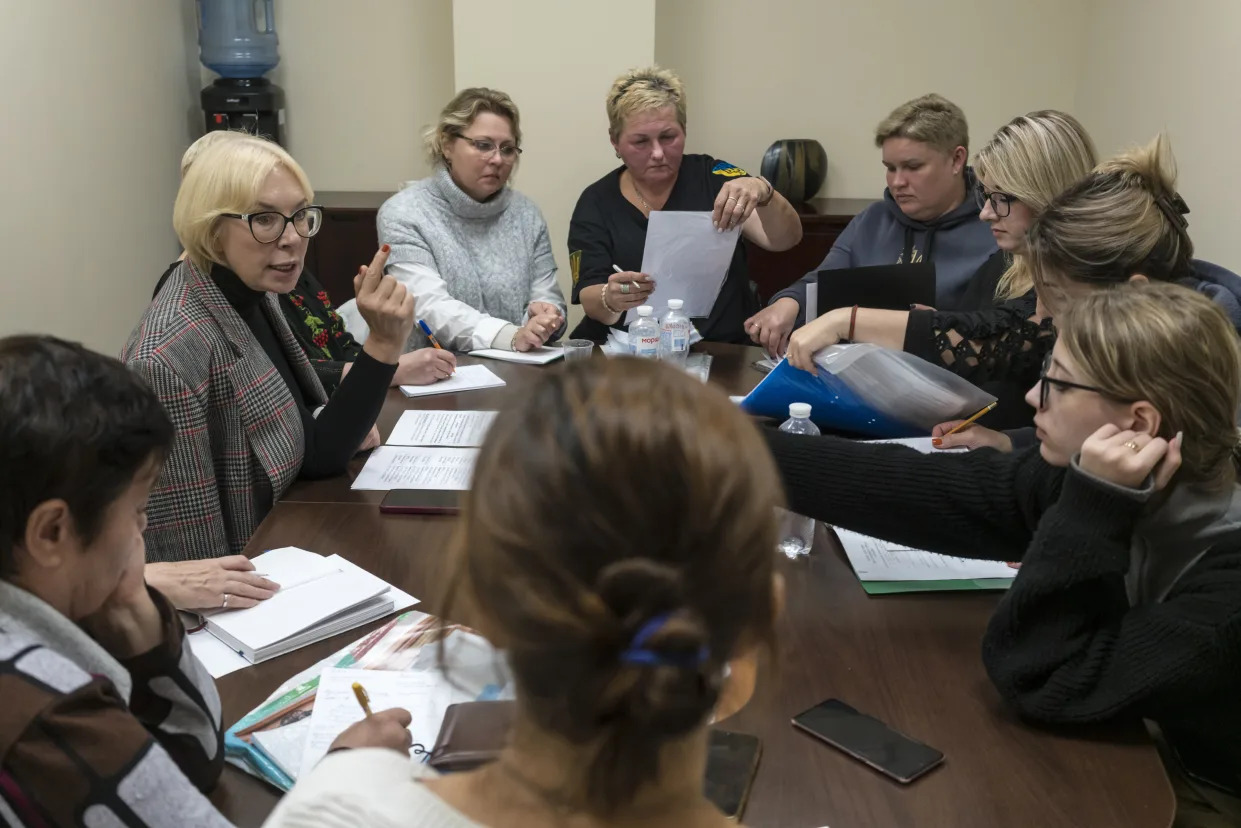
Family members of Ukrainian soldiers who are prisoners of war meet with Lyudmila Denisova, left, the country’s former human rights ombudsman, in Kyiv, Ukraine, Oct. 16, 2023. (Brendan Hoffman/The New York Times)

KYIV, Ukraine — The Ukrainian marine infantryman endured nine months of physical and psychological torture as a Russian prisoner of war, but was allotted only three months of rest and rehabilitation before being ordered back to his unit.

The infantryman, who asked to be identified only by his call sign, Smiley, returned to duty willingly. But it was only when he underwent intensive combat training in the weeks after that the depth and range of his injuries, both psychological and physical, began to surface.

“I started having flashbacks, and nightmares,” he said. “I would only sleep for two hours and wake up with my sleeping bag soaking wet.” He was diagnosed with post-traumatic stress disorder and referred for psychological care, and is still receiving treatment.

Ukraine is just beginning to understand the lasting effects of the traumas its prisoners of war experienced in Russian captivity, but it has been failing to treat them properly and returning them to duty too early, say former prisoners, officials and psychologists familiar with individual cases.

Nearly 3,000 Ukrainian prisoners of war have been released from Russia in prisoner exchanges since the 2022 invasion began. More than 10,000 remain in Russian custody, some of whom have endured two years of conditions that a United Nations expert described as horrific.

The Ukrainian government’s rehabilitation program, which has usually involved two months in a sanitarium and a month at home, is inadequate, critics say, and the traumas suffered by Ukrainian prisoners are growing with the length and severity of the abuse they are being subjected to as the war drags on.

Russia’s torture of prisoners of war has been well documented by the United Nations, with former inmates speaking of relentless beatings, electric shocks, rape, sexual violence and mock executions, so much so that one expert described it as a systematic, state-endorsed policy. Many detainees have also reported lingering symptoms such as blackouts and fainting spells stemming from repeated blows to the head that were severe enough to cause concussions.

Ukraine’s prosecutor general, Andriy Kostin, said in September that “about 90% of Ukrainian prisoners of war have been subjected to torture, rape, threats of sexual violence or other forms of ill-treatment.”

The Russian military did not answer a request for comment on the allegations of mistreatment of Ukrainian prisoners of war.

Most of the released prisoners have returned to active duty after about three months of rest and rehabilitation, as the Ukrainian military, short of troops on the front line, has given relatively few medical exemptions to former prisoners of war.

A law passed this month will allow former prisoners of war the choice of returning to service or being discharged from the military, recognition that many have been subjected to severe mental and physical torture and need prolonged rehabilitation. Ukrainian officials acknowledged that there have been problems in providing sufficient care for former prisoners, but said they had now developed special centers for them using best international practices.

Ukrainian prosecutors have identified 3,000 former military and civilian prisoners who can serve as witnesses for a case they are building for the Ukrainian courts to charge Russian individuals and officials with mistreatment of prisoners. The prosecutors encouraged two of the former prisoners to speak to The New York Times.

One of them was Smiley, 22, who was captured at the beginning of the war when the Russian navy seized Ukrainian positions on Snake Island in the Black Sea. He spoke a year after his release, saying he hoped that shedding light on the conditions of Russian prisons would help not only his own rehabilitation, but also the thousands of prisoners of war still in captivity.

“My sister persuaded me to give my first interview,” he said. “‘You need to tell,’ she said. Maybe if we speak, it will help the treatment of our guys.”

A second Ukrainian serviceman made available by the prosecutors gave a lengthy interview but declined to give his name or call sign, because of the stigma surrounding the abuses he suffered.

The serviceman, 36, said he was taken prisoner along with several thousand soldiers and marines after a long siege at the Azovstal Iron and Steel Works in Mariupol in May 2022. He spent nine months in Russian captivity before being released in a prisoner exchange in early 2023.

He spent most of his time in three detention facilities in the Russian towns of Taganrog, Kamensk-Shakhtinsky and Kursk. He returned critically underweight and suffering from an injured spine and, like many others, blackouts, dizziness and ringing in the ears from frequent beatings on the head.

“I am not fainting any longer,” the serviceman said, “but I have difficulties with my back and concussion, and a squeezing all the time of the area around my heart.” Despite his injuries, he was ordered to return to light duty as a guard after only two months’ rest in a sanitarium.

“I don’t know if I could run a kilometer,” he said.

Prisoners were subjected to brutal daily beatings on their legs, backs and fingers, and mental and physical torture during interrogations, as well as hunger, cold and a lack of medical care, he said. Three men died in custody during his imprisonment, including one who died in the communal cell they shared, he said.

Some of the Russian units guarding or interrogating the prisoners were worse than others, the two former prisoners said, but there were consistent beatings every morning at roll call and torture at most detention facilities. Interrogations would last 40 minutes and often consisted of electric shocks, blows to the head and sexual abuse, real or threatened.

“They start with maximum violence,” the serviceman said. “They say ‘You are lying, you are not telling us everything.’ They put a knife to your ear or offer to cut off one of your fingers.”

Others would beat them on the back of the head so regularly that they lost consciousness, he said.

“If one gets tired, another takes over,” he recalled. “When you fall, they make you stand again. It can last 30 to 40 minutes. At the end they say, ‘Why did you not tell us everything immediately?’”

Smiley said much of the violence was of a sexual nature. One prison unit repeatedly struck the prisoners all over their bodies, including on the genitals, with batons that gave electric shocks, he said. On another occasion, he said, a cellmate was repeatedly kicked in the genitals during roll call, where the prisoners were lined up with their legs spread, facing a wall in a corridor. Smiley suffered permanent injury from an untreated broken pelvis from a truncheon blow and could not bend or lie down without assistance for two weeks.

The International Committee of the Red Cross, which has very limited access to prisoners of war held in Russia, was not permitted to visit him during his nine months of imprisonment, he added.

The second serviceman said he was forced to strip and place his genitals on a stool as his interrogators hit them with a ruler and lay a knife on them, threatening to castrate him.

Interrogators put him through a mock execution, firing a volley of gunfire beside him while he was blindfolded. They threatened him with rape, the serviceman said, making him choose what they should use — a mop handle or the leg of a chair. “Do you want to do it yourself or do you want us to help you?” they taunted him.

He said he was never actually penetrated, but others were raped. “After that you cannot walk normally,” he said. “You suffer for weeks. Other guys had the same treatment.”

“I think they had such an order to break us psychologically and physically so that we would not want anything else in life,” he said, adding that there were suicides in the Taganrog jail.

“You could hear the screams all day,” the serviceman said. “Impossible screams.” Sometimes during a lull, the prisoners could hear the voices of children playing outside, he said.

The ordeal for the former prisoners is by no means over once back home.

“The most difficult thing is having too many people around,” the serviceman said. “Everyone is peacefully walking in the park and you are still afraid that someone is listening, or that you might get shoved or say the wrong thing.”

Maj. Valeria Subotina, a military press officer and a former journalist who was also taken prisoner at Azovstal and who spent a year in women’s prisons in Russia, recently opened a meeting space in Kyiv called YOUkraine, for former prisoners.

“There are many triggers and people do not realize they still need care,” she said.

She returned to service three months after her release in April 2023, but found it hard to sit in an office. “I cannot bear someone approaching me from behind or standing behind me,” she said.

The government psychologists were not of much use, she said. “They often don’t know how to help us,” she said, and civilians often ask careless questions.

As a result, many former prisoners find returning to the front line easier than rejoining civilian life, she said, and only fellow survivors really understand what they are going through.

“We don’t want to feel pity,” she said, “because we are proud that we survived and we overcame this.”

Farmers warn food aisles will soon be empty because of crushing conditions: ‘We are not in a good position’

The Cool Down

Farmers warn food aisles will soon be empty because of crushing conditions: ‘We are not in a good position’

Nick Paschal – April 28, 2024

The United Kingdom is facing dire food shortages, forcing prices to skyrocket, and experts predict this is only the beginning.

What’s happening?

According to a report by The Guardian, extreme weather is wreaking havoc on crops across the region. England experienced more rainfall during the past 18 months than it has over any 18-month period since record-keeping began in 1836.

Because the rain hasn’t stopped, many farmers have been unable to get crops such as potatoes, carrots, and wheat into the ground. “Usually, you get rain but there will be pockets of dry weather for two or three weeks at a time to do the planting. That simply hasn’t happened,” farmer Tom Allen-Stevens told The Guardian.

Farmers have also planted fewer potatoes, opting for less weather-dependent and financially secure crops. At the same time, many of the potatoes that have been planted are rotting in the ground.

“There is a concern that we won’t ever have the volumes [of potatoes] we had in the past in the future,” British Growers Association CEO Jack Ward told The Guardian. “We are not in a good position and it is 100% not sustainable,” Ward added.

Why is it important?

English farmers aren’t alone — people are struggling to grow crops worldwide because of extreme weather.

Dry weather in Brazil and heavy rain in Vietnam have farmers concerned about pepper production. Severe drought in Spain and record-breaking rain and snowfall in California have made it difficult for farmers to cultivate olives for olive oil. El Niño and rising temperatures cut Peru’s blueberry yield in half last year. Everyone’s favorite drinks — coffeebeer, and wine — have all been impacted by extreme weather.

According to an ABC News report, the strain on the agriculture industry will likely continue to cause food prices to soar.

If these were just isolated events, farmers could more easily adapt — bad growing seasons are nothing new. The problem is that rising temperatures are directly linked to the increasing amount of gases such as carbon dioxide and methane in the atmosphere.

Since the start of the Industrial Revolution, humans have burned dirty energy sources such as coal, oil, and gas, which release a significant amount of those gases. Our climate is changing so drastically that the 10 warmest years since 1850 have all occurred in the last decade.

“As climate change worsens, the threat to our food supply chains — both at home and overseas — will grow,” Energy and Climate Intelligence Unit analyst Amber Sawyer told The Guardian.

What can we do about it?

“Fortunately, we know many ways we can make the food system more resilient while reducing food emissions. The biggest opportunity in high-income nations is a reduction in meat consumption and exploration of more plants in our diets,” said Dr. Paul Behrens, an associate professor of environmental change at Leiden University in the Netherlands.

If we replace a quarter of our meat consumption with vegetables, we could cut around 100 million tons of air pollution yearly. It may seem strange to suggest eating more vegetables with the decline in crop production. However, reducing the land and water used for animal agriculture and diverting those resources to growing more produce would drastically help the declining food supply.

Growing our own food is also a great way to reduce our reliance on store-bought produce, and it can save you hundreds of dollars a year at the grocery store.

Underestimating Alvin Bragg’s case against Donald Trump is a historic mistake

Salon – Opinion

Underestimating Alvin Bragg’s case against Donald Trump is a historic mistake

Dennis Aftergut, Robert C. Gottlieb, Gerald B. Lefcourt – April 25, 2024

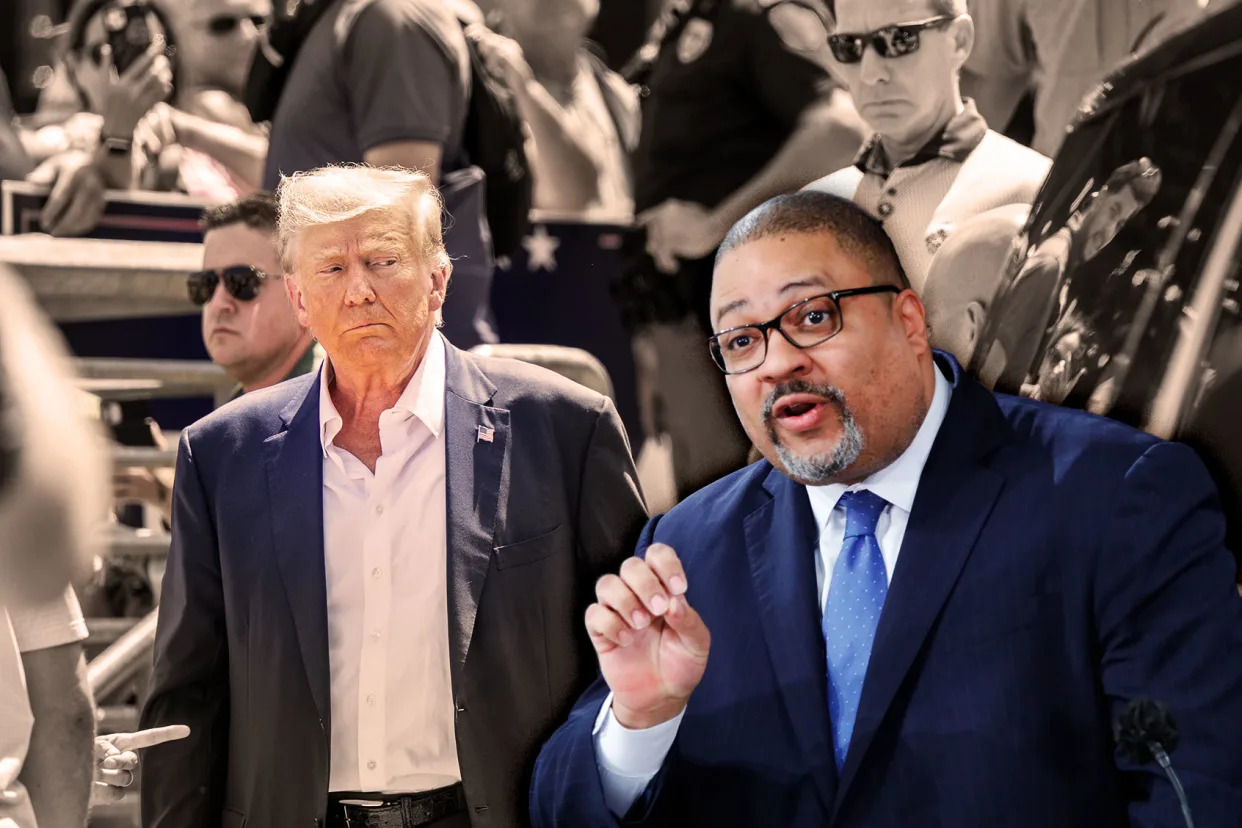
Donald Trump; Alvin Bragg Photo illustration by Salon/Getty Images

Prosecutors are off to a strong start in the Manhattan trial of Donald Trump. Their evidence is aimed at proving that the former president committed crimes by falsifying business records to cover up a pre-election payoff in 2016 meant to keep women who would have otherwise revealed some of his sexual scandals ahead of that presidential election silent. 

Some critics, including some very smart legal minds who have no love for Trump, don’t like the case. Boston University Law School Professor Jed Shugerman — who previously described to Salon “Trump abuses” at the Department of Justice as “using the system of prosecution to reward your political allies and to punish your opponents” — took major issue with the first criminal case against Trump to reach trial in an April 23 New York Times guest essay:

After listening to Monday’s opening statement by prosecutors, I still think the Manhattan D.A. has made a historic mistake. Their vague allegation about “a criminal scheme to corrupt the 2016 presidential election” has me more concerned than ever about their unprecedented use of state law and their persistent avoidance of specifying an election crime or a valid theory of fraud.

Shugerman went on to publicly accuse prosecutors of engaging in “an embarrassment of prosecutorial ethics and apparent selective prosecution.” But if you are to call the criminal prosecution of Donald Trump for election interference a “historic mistake,” you ought to have arguments that are as close to airtight as humanly possible. The ones in Professor Shugerman’s essay, lamentably, are not even legally persuasive.

Let’s put aside his description of the prosecution’s opening statement as “vague.” That’s not how former Trump impeachment counsel Norm Eisen reported it from the courtroom for CNN, or how reporters for The New York Times and the Washington Post described it.

The core of Shugerman’s faulty argument is that he sees “three red flags raising concerns about selective prosecution upon appeal” because of the “unprecedented” way in which the grand jury used the statute at issue – New York Penal Code §175.10 – to charge Trump with a felony. That offense – falsifying business records – becomes a felony only when committed with an “intent to commit or conceal another crime.”

As former prosecutors and as current defense lawyers, we know that the claim of selective prosecution is notoriously difficult for defendants to prove. Justice Juan Merchan, the seasoned judge presiding over the trial, rejected Trump’s claim, finding that he did not carry his burden of showing that the DA had discriminated against him by not prosecuting any other similarly situated individual. 

The reasoning is not mentioned in Shugerman’s Times essay yet it is a necessary element of proving selective prosecution in New York. Merchan also found that prosecutors had demonstrated that they had brought many other actions charging defendants with “falsifying business records with the intent to commit or conceal the commission of another crime.” 

But, Shugerman writes, there’s “no previous case of any state prosecutor relying on the Federal Election Campaign Act either as a direct crime or a predicate crime.” That, he says, is a “sign of overreach.”  

Wait! The case is unprecedented? Now there’s an understatement! 

Have we ever had a presidential candidate from New York against whom prosecutors have assembled strong evidence of falsifying information in business records to cover up a scandal on his way to winning election? Have we ever had such a man now seeking the voters’ approval for a return White House run?  

Rather than overreach, a novel use of the statute here is the sign of a prosecutor willing to extend the law to a new fact situation that society has a right and a duty to protect itself against. That is especially so when the case is brought to hold accountable someone whose company a different jury already found guilty of criminal tax fraud and falsifying business records, and who has been found to have committed massive civil fraud against the state.

Shugerman also emphasizes that there’s not even any other New York case that sustains the use of another jurisdiction’s statute – federal law in this case – as the “other crime” in. It’s not enough, he says, that prosecutors have cited multiple parallel New York appellate court decisions – ones sustaining the use of crimes from other jurisdictions to satisfy the “other crime” element in different New York criminal statutes.

Why not? The extension of parallel situations is precisely the kind of reasoning on which the law is built. Whenever new fact patterns arise, the law operates by analogy from contexts where it is established. That’s why Justice Merchan has endorsed it. 

Next, Shugerman says that a jury instruction endorsing the use of federal law violation as the “other crime” in another §175.10 case “doesn’t count” as precedent. Technically correct, but what that instruction shows is that another New York trial judge in a different case reached the same result that Justice Merchan reached here. That sounds like support for his decision and guidance for others in analyzing whether the prosecutors are making “an historic mistake.” 

The Boston University professor also takes issue with the Manhattan DA’s use of federal election law because, he says, the reliance on Trump’s alleged violation of state election law is flawed. He argues that state election law applies only to “public officers,” and “state statutory definitions of “public office” seem to limit those statutes to state and local races.”

But the essay omits the basis on which Justice Merchan rejected this argument. New York election law, he wrote, explicitly states it “shall govern the conduct of all elections at which voters of the state of New York may cast a ballot for the purpose of electing any individual to any party position or nominating or electing any individual to any federal, state, [or local] office . . . .” 

Further, Shugerman attacks the prosecutor’s election interference theory. He argues there is no precedent for satisfying the law’s “intent to defraud” requirement with an allegation that the defendant intended to defraud the general public. Shugerman says that “a conviction based on it may not survive a state appeal.”

Again, one is left to wonder why not. In the universe of threats to democracy, a candidate’s intent to defraud voters, if proven, is perhaps the most serious intent to defraud one can imagine. Trump is accused of seeking to deprive Americans, through deceit, of information most would have wanted to know about a candidate before deciding whether to make him president. The law is wise enough to take account of this element of a crime against democracy.

U.S. Supreme Court floats return to trial court for Trump in presidential immunity case

Minnesota Reformer

U.S. Supreme Court floats return to trial court for Trump in presidential immunity case

Jacob Fischler – April 25, 2024

Dozens of anti-Trump protesters gathered outside the U.S. Supreme Court on April 25, 2024, while the justices heard arguments about whether former President Donald Trump has immunity from prosecution on criminal charges related to his actions while in office. Photo by Jane Norman/States Newsroom.

WASHINGTON — The U.S. Supreme Court appeared skeptical Thursday of former President Donald Trump’s argument he is immune from criminal charges that he tried to overturn his loss in the 2020 election.

But conservatives who dominate the court appeared open to returning key questions to a trial court, possibly delaying Trump’s prosecution beyond the November election — and essentially assisting the former president as he fights legal challenges on multiple fronts.

Trump, the presumptive Republican nominee for president, has argued in a federal trial court and in the U.S. Court of Appeals for the District of Columbia that his actions following the 2020 election and leading up to the violent Jan. 6, 2021 attack on the U.S. Capitol, were “official acts” conducted while still in office and therefore are not subject to criminal prosecution.

While court precedent establishes that U.S. presidents are immune to civil damages for their official acts, and to criminal prosecution while in office, the justices now must decide the unanswered question of whether former presidents are absolutely immune from criminal law.

At oral arguments Thursday in Trump v. United States, much of the discussion centered on what should be considered an official presidential act.

Trump’s lawyer, D. John Sauer, of St. Louis, argued that nearly everything a president does in office — including hypotheticals about ordering a military coup or assassinating a political rival — could be considered official acts.

While much of the court appeared skeptical of that broad view of official acts, several justices on the conservative wing asked about having the trial court determine what acts should be considered official. They also suggested prosecutors could drop sections of the four-count indictment against Trump that dealt with official acts.

The court’s three liberal justices voiced serious concerns about Trump’s immunity argument, with Justice Ketanji Brown Jackson wondering aloud if the court accepting a broad view of criminal immunity for the president would make the Oval Office “the seat of criminal activity.”

The case is one of four in state and federal courts in which criminal charges have been made against Trump. On Thursday, he was in a New York state courtroom where he faces charges in an ongoing hush-money trial; the judge there did not allow him to attend the Supreme Court arguments.

Trial court determination

Conservative justices asked if they could avoid the constitutional question by having the trial court, presided over by U.S. District Judge Tanya Chutkan, determine which parts of the allegations could be considered official or unofficial acts.

Special counsel Jack Smith and his team of prosecutors have indicated that prosecuting only Trump’s private conduct would be sufficient, Justice Amy Coney Barrett said.

“The normal process, what Mr. Sauer asked, would be for us to remand if we decided that there were some official acts immunity, and to let that be sorted out below,” Barrett said, referring to a process in which a case is sent back to a lower court. “It is another option for the special counsel to just proceed based on the private conduct and drop the official conduct.”

‘Absolute immunity’

Sauer argued, as he has for months, for “absolute immunity” from criminal prosecution for presidents acting in their official capacity.

No president who has not been impeached and removed from office can be prosecuted for official actions, Sauer said, broadly interpreting the meaning of official acts.

Liberal justices questioned Sauer about how far his definition of official acts would stretch. Trump’s attorney was reluctant to list any exceptions.

Justice Sonia Sotomayor asked a hypothetical that arose in a lower court: Would it be an official act for the president to order the assassination of a political rival?

“That could well be an official act,” Sauer answered.

He also answered Justice Elena Kagan that it could be an official act for a president to order a military coup, though Sauer said “it would depend on the circumstances.”

Michael R. Dreeben, representing the U.S. Department of Justice, argued that Trump’s broad view of presidential immunity would break a fundamental element of U.S. democracy, that no one is above the law.

“His novel theory would immunize former presidents for criminal liability for bribery, treason, sedition, murder, and here, conspiring to use fraud to overturn the results of an election and perpetuate himself in power,” Dreeben said.

Jackson, questioning Sauer, appeared to agree with that argument.

She said Sauer appeared worried that the president would be “chilled” by potential criminal prosecution, but she said there would be “a really significant opposite problem if the president wasn’t chilled.”

“Once we say, ‘No criminal liability, Mr. President, you can do whatever you want,’ I’m worried that we would have a worse problem than the problem of the president feeling constrained to follow the law while he’s in office,” Jackson said.

‘A special, peculiarly precarious position’

But other members of the court appeared more amenable to Sauer’s argument that subjecting presidents to criminal prosecution would constrain them.

Justice Samuel Alito, one of the court’s conservatives, asked Dreeben about Trump’s argument that a president’s duties require a broad view of immunity.

The president has to make difficult decisions, sometimes in areas of law that are unsettled, Alito said.

“I understand you to say, ‘If he makes a mistake, he makes a mistake, he’s subject to the criminal laws just like anybody else,’” Alito said. “You don’t think he’s in a special, peculiarly precarious position?”

Dreeben answered that the president has access to highly qualified legal advice and that making a mistake is not what generally leads to criminal prosecution.

He also noted that the allegations against Trump involve him going beyond his powers as president to interfere with the certification of an election, which is not a presidential power in the Constitution.

Justice Ketanji Brown Jackson warns of the Oval Office turning into a ‘crime center’ if Trump gets the sweeping immunity he wants

Business Insider

Justice Ketanji Brown Jackson warns of the Oval Office turning into a ‘crime center’ if Trump gets the sweeping immunity he wants

Brent D. Griffiths – April 25, 2024

  • Justice Ketanji Brown Jackson seemed alarmed about Trump‘s ask for sweeping immunity for presidents.
  • Jackson wanted to know how future presidents would be disincentivized to commit crimes.
  • She expressed fear it could turn the Oval Office into “the seat of criminal activity in this country.”

Justice Ketanji Brown Jackson was animated on Thursday when she discussed the potential of what could happen to the presidency if the Supreme Court were to grant presidents the sweeping immunity former President Donald Trump is seeking.

“The most powerful person in the world with the greatest amount of authority could go into office knowing there would be no potential penalty for committing crimes,” Jackson said during oral arguments. “I’m trying to understand what the disincentive is from turning the Oval Office into, you know, the seat of criminal activity in this country.”

Trump’s lawyer, John Sauer, argued for sweeping absolute immunity for former presidents that would shield Trump from special counsel Jack Smith’s prosecution related to efforts to overturn the 2020 presidential election. As multiple justices outlined during oral arguments, the issues in the case could have major implications for the future of the presidency.

Jackson appeared alarmed that some of her colleagues, especially some of the court’s conservatives, seemed more afraid of limiting presidential immunity the court would neuter by the presidency by forcing future leaders to question if a political rival would try to prosecute them after they left office.

Instead, Jackson said there should be at least equal consideration given to the possibility that by granting sweeping immunity, the nation’s highest court would give a green light to presidential criminality if a future president could even tangentially tie criminal actions to carrying out the job of leading the nation.

“Presidents from the beginning of time have understood that that’s a possibility,” Jackson said later of how past leaders understood they could be prosecuted after leaving office. “That might be what has kept this office from turning into the kind of crime center that I’m envisioning.”

Jackson repeatedly underlined her points when questioning Sauer, underlining how far future presidents could push the envelope. She seemed particularly drawn to a brief filed by Georgetown Law School professor Martin Lederman that outlined how presidents with immunity could commit perjury, destroy or conceal documents, or bribe other public officials.

Jackson’s concerns are based on another element of Trump’s arguments, which propose that a president could not be charged with a crime unless the law they are accused of violating specifically mentions that it applies to the presidency.

The court’s newest justice has considered Trump’s conduct and the power of the presidency before. As a Circuit Court judge, Jackson torched the Trump White House for arguing that former White House counsel Don McGahn didn’t have to cooperate with Congress’ investigation.

“Stated simply, the primary takeaway from the past 250 years of recorded American history is that Presidents are not kings,” Jackson wrote in 2019. “Rather, in this land of liberty, it is indisputable that current and former employees of the White House work for the People of the United States, and that they take an oath to protect and defend the Constitution of the United States.”

Manhattan prosecutors reveal election crime driving Trump’s hush money case

Independent

Manhattan prosecutors reveal election crime driving Trump’s hush money case

Alex Woodward – April 24, 2024

Donald Trump claims Joe Biden has 'abandoned' Israel

A critical question hovering over Donald Trump’s criminal case in New York is whether prosecutors can convince a jury that the former president’s alleged falsification of business records can be tied to a “primary” crime.

Mr Trump is charged with 34 counts of falsifying business records, which – on their own – are misdemeanor offences.

But Manhattan prosecutors have elevated those charges to felonies by tying them to another offence – one that involves a conspiracy to manipulate an election.

Manhattan District Attorney Alvin Bragg and his office believe the case is relatively straightforward when it comes to the so-called hush money scheme – there are cheques, business ledgers, emails and text messages that allegedly point to a cover-up to classify payments to adult film star Stormy Daniels as “legal expenses”.

Those charges are bumped up to felonies if they are done with the intent to “commit another crime or to aid or conceal” one.

The crimes at the heart of the case stem from an alleged scheme to bury politically compromising stories involving then-candidate Mr Trump and his alleged affairs in order to protect his chances of winning the 2016 presidential election.

On Tuesday, prosecutors suggested that Mr Trump falsified those business records with the intent to commit or conceal a conspiracy to “promote” his election through “unlawful means”.

Under section 17-152 of New York election law, “any two or more persons who conspire to promote or prevent the election of any person to a public office by unlawful means and which conspiracy is acted upon by one or more of the parties thereto, shall be guilty of a misdemeanor”.

Prosecutors began outlining those “other” crimes in court filings one month after Mr Trump was indicted last year. Justice Juan Merchan allowed them to move forward on three of them – including section 17-152, as well as crimes involving tax fraud and campaign finance violations.

During witness testimony this week, Manhattan Assistant District Attorney Joshua Steinglass hinted that his challenged line of questioning was relevant to the “primary” underlying crime under section 17-152.

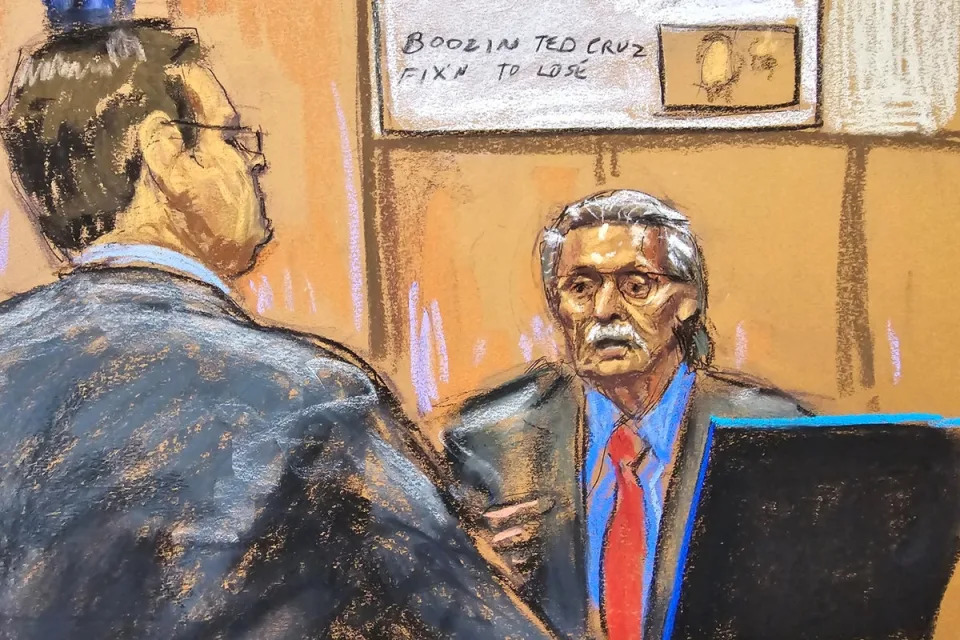
A courtroom sketch depicts Manhattan prosecutor Joshua Steinglass questioning David Pecker during Donald Trump’s hush money trial on 23 April (REUTERS)

While questioning former National Enquirer publisher David Pecker about the “catch and kill” scheme arranged with Mr Trump and his then-personal attorney and “fixer” Michael Cohen, Mr Steinglass asked about Mr Pecker’s meetings with Steve Bannon, one of Mr Trump’s chief advisers.

Mr Bannon told Mr Pecker that they would “work very, very well together” during Mr Trump’s 2016 campaign, the former tabloid chief testified.

Defence attorney Emil Bove objected to the questions, alleging hearsay. But Mr Steinglass argued that questions tying Mr Pecker’s work with the campaign struck at the heart of the “primary” election crime that is driving the prosecution’s case.

During opening statements on Monday, Assistant District Attorney Matthew Colangelo also underscored the stakes of the case against the former president.

“This case is about a criminal conspiracy and a cover-up,” he said. “The defendant Donald Trump orchestrated a criminal scheme to corrupt the 2016 presidential election. Then he covered up that criminal conspiracy by lying in his business records, over and over and over again.”

Hush money, non-disclosure agreements and “catch-and-kill” arrangements aren’t illegal, per se, and “no politician wants bad press,” as Mr Colangelo said.

“But the evidence at trial will show that this was not spin or communications strategy,” he added. “This was a planned, coordinated, long-running conspiracy … It was election fraud. Pure and simple.”

Mr Trump has pleaded not guilty to all charges and has accused the district attorney’s office of running an election interference campaign against him.

In Ukraine’s old imperial city, pastel palaces are in jeopardy, but black humor survives

Los Angeles Times

In Ukraine’s old imperial city, pastel palaces are in jeopardy, but black humor survives

Laura King – April 21, 2024

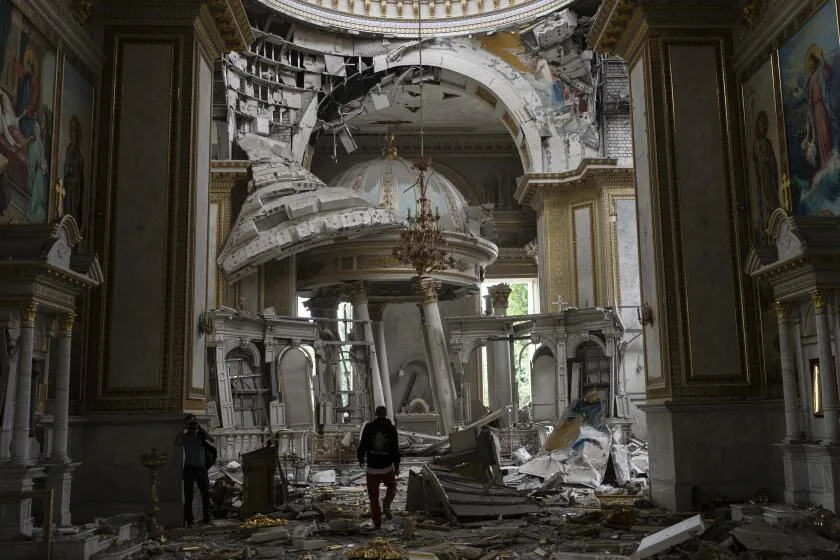
Church personnel inspect damages inside the Odesa Transfiguration Cathedral in Odesa, Ukraine, Sunday, July 23, 2023, following Russian missile attacks. (AP Photo/Jae C. Hong)
Church personnel inspect damage from Russian missile attacks at the Transfiguration Cathedral in Odesa, Ukraine. The cathedral is in the historic city center, a UNESCO-designated site. (Jae C. Hong / Associated Press)

On a cool spring morning, as water-washed light bathed pastel palaces in the old imperial city of Odesa, the thunder of yet another Russian missile strike filled the air.

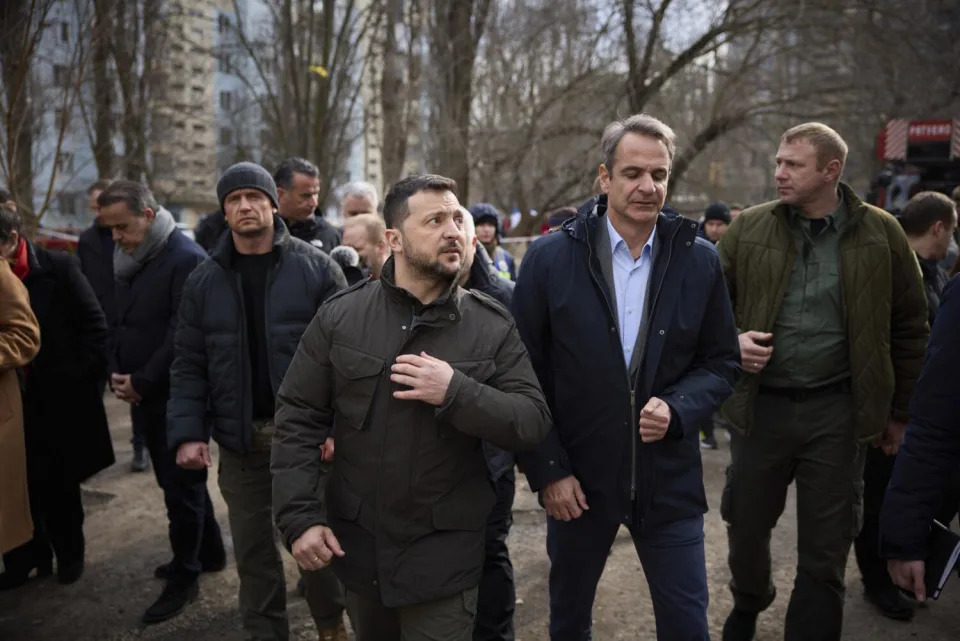
That March 6 blast came within a few hundred yards of a convoy carrying Ukraine’s president, Volodymyr Zelensky, who was touring the country’s principal shipyard with the visiting Greek prime minister, Kyriakos Mitsotaki.

It was a close call, but Ukrainian officials said that in all likelihood the two leaders were not the target. Like so many other strikes during what Ukrainians call the “big war” — ignited by Russia’s all-out invasion in February 2022 — the attack was aimed at Odesa’s port, a strategic prize of centuries’ standing.

The Black Sea harbor and its docklands — Ukraine’s commercial lifeline and a prime military asset — have been the object of intensifying Russian drone and missile attacks in recent weeks, as Ukraine’s dwindling air defenses leave critical infrastructure vulnerable across the country.

Ukrainian President Volodymyr Zelensky and Greek Prime Minister Kyriakos Mitsotakis walk near trees in Odesa, Ukraine.
Ukrainian President Volodymyr Zelensky, center left, and Greek Prime Minister Kyriakos Mitsotakis, center right, walk in Odesa, Ukraine, on March 6. The sound of a Russian airstrike a few hundred yards away reverberated around the port city as they ended their tour. (Ukrainian Presidential Press Office via AP)

In Odesa, the deadly campaign of airstrikes has brought sharply renewed peril to nearly a million inhabitants of one of Ukraine’s most eclectic and cosmopolitan cities, known in equal measures for its people’s mordancy and joie de vivre. And it poses a heightened threat to a world-renowned cultural treasure: the jewel-box grid of streets making up Odesa’s UNESCO-designated historic center, which abuts the port.

Read more: Ukrainians contemplate the once unthinkable: Losing the war with Russia

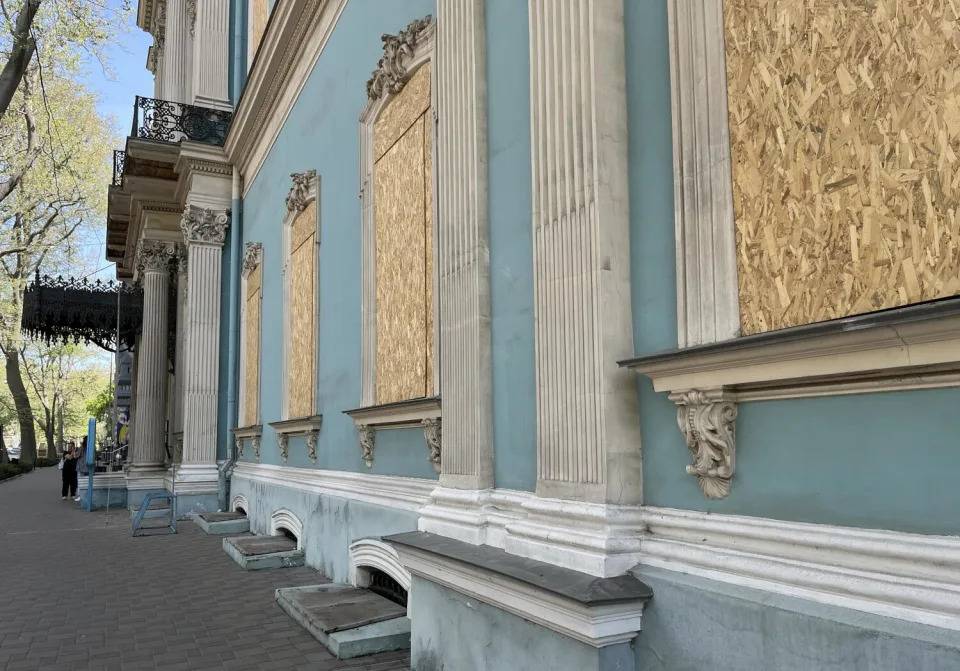
After a string of attacks on Odesa and its environs, those who watch over the city’s landmark structures are braced for the worst. On many ornate facades in the city center, full-length windows topped with curlicued pediments are boarded over. Inside, as periodic power cuts permit, workers sweep up shattered masonry and painstakingly restore ruined grand staircases.

“It’s very, very difficult work to safeguard these beautiful old buildings,” said Oleksei Duryagin, who heads a firefighting team that works out of a headquarters dating back to the city’s days of horse-drawn fire wagons. “Whenever they try to hit the port, which is what they try to hit, everything here is in danger.”

Because of the building materials used — wood, flammable insulation within the walls — the 19th century buildings that line Odesa’s cobblestone, tree-lined central streets are especially susceptible to fire or collapse. First responders undergo special training in how to fight blazes in structures like Odesa’s sumptuous opera house, perched on a promontory above the seafront.

“From basement to ceiling, I know these buildings like my old friends,” said Duryagin, 52, who has more than three decades of firefighting experience. “I know their mysteries.”

Falling debris from airborne interceptions, rather than direct drone or missile strikes, has caused some of the most serious destruction. Some sites, like the city’s Fine Arts Museum, which is housed in a reconstructed palace, were hit again before they could be cleaned up after an initial attack.

The boarded-up windows on Odesa's Museum of Western and Eastern Art.
The windows on Odesa’s Museum of Western and Eastern Art are boarded up as Russian forces continue to target the port city. (Laura King / Los Angeles Times)

Early in the war, the museum whisked most of its art treasures into hiding. Some display areas are closed off for repairs, and big niches that once held priceless artworks are starkly blank. But the museum remains open to culture-hungry visitors, who must periodically be hustled into its underground shelter when air alerts sound.

Most of the exhibits now have a somber martial theme, including a striking collection of botanical watercolors by a 48-year-old Ukrainian army captain, Borys Eisenberg, an artist and landscape architect who volunteered on the first day of Russia’s invasion and was killed last year on the front lines. His delicate, violet-veined works on paper are mounted on the wooden lids of ammunition boxes.

“You can see that even looking out from the trenches, he found beauty,” said Irina Kulabina, 66, a retired engineer who helps out at the museum. “It’s really important. We should believe in life more than death.”

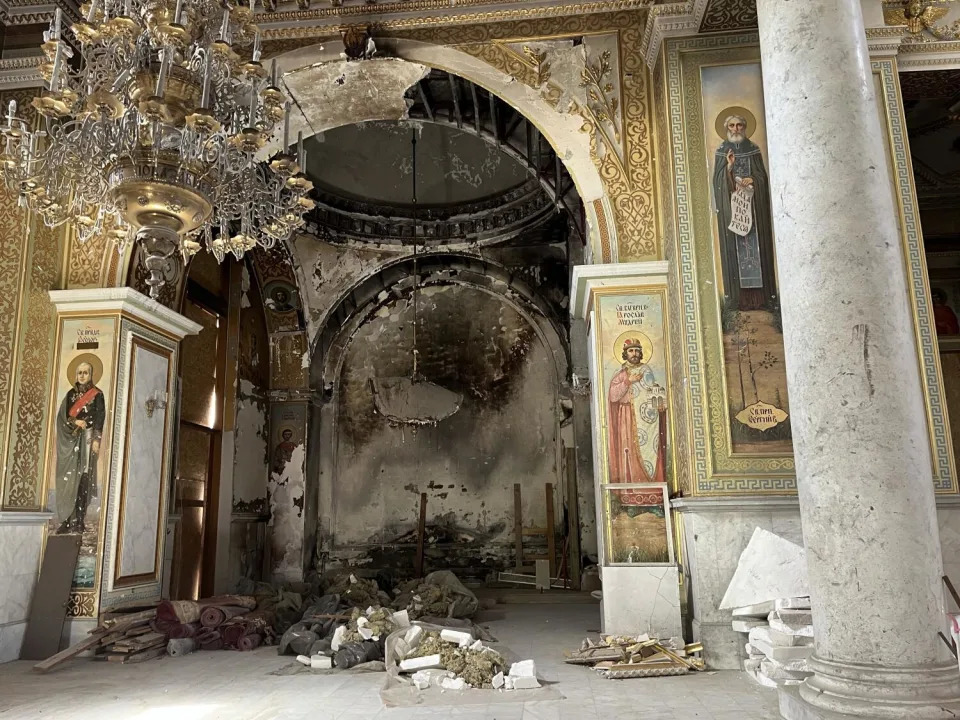
At Odesa’s Transfiguration Cathedral, the city’s largest Orthodox Christian church, a young priest named Father Alexei gazed out at blue sky through a gaping hole punched in an outer wall during a missile attack last July. He wondered aloud if fresh attacks would outpace rebuilding.

Rubble lies on the floor and walls are charred and blackened inside Odesa's Transfiguration Cathedral.
The blackened interior of the Transfiguration Cathedral in Odesa. (Laura King / Los Angeles Times)

“We just don’t know what else is to come,” said the 28-year-old cleric, who came to Odesa as a refugee from a front-line town in the eastern province of Luhansk.

While repairs slowly progress, services are held in a cavernous, basement-level secondary space, lighted only by flickering candles and lanterns whenever the electricity goes out. After the July strike, congregants converged on the landmark church, helping to gather artifacts scattered by the blast.

Read more: After an artist’s studio was damaged in a Russian missile strike, he found a new medium: war debris

“It was really shocking for everyone,” said Father Alexei. Zelensky said at the time that hitting the cathedral amounted to targeting “the foundations of our entire European culture.”

Last month was a particularly deadly one for the city and its outskirts.

March 2 drone attack wrecked a nine-story building, killing a dozen people. Five more perished in the strike four days later that narrowly missed Zelensky and the Greek leader. A missile and drone barrage on March 15 left 21 dead, including a paramedic killed in a dreaded “double tap,” in which first responders are targeted, seemingly deliberately, by strikes aimed at the same site a few moments apart to give rescuers time to arrive.

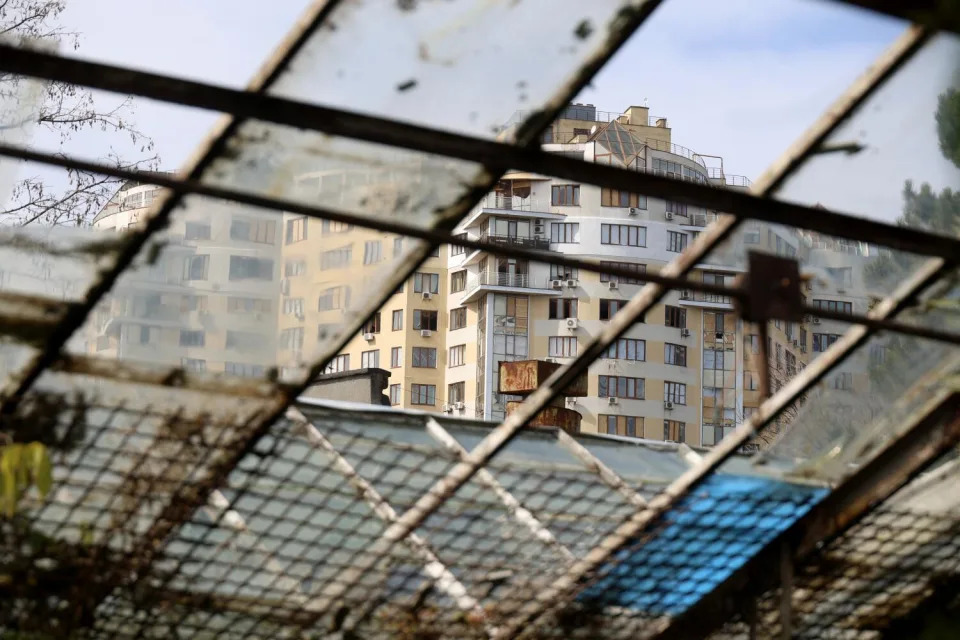
Buildings are seen through a damaged greenhouse roof.
The roof of a greenhouse damaged by a Russian missile attack in the botanical garden of Odesa I.I. Mechnikov National University. (Future Publishing via Getty Images)

More recently, on April 10, six people, including a 10-year-old girl, were killed in a strike on an outlying district of Odesa. That attack came on the 80th anniversary of Odesa’s liberation from Nazi forces during World War II.

The Odesa port and two others on the nearby seacoast have been a particular target of Russian wrath for the last eight months, since Ukraine managed to open a coast-hugging 350-mile Black Sea grain corridor to the Bosporus strait.

At the war’s outset, world grain prices jumped as Ukraine exports slumped, causing hardship in some of the world’s most impoverished countries. Now, though, almost 40 million tons of cargo have been shipped since August 2023, port officials said.

“Sometimes we spend all night in a shelter, then take a coffee and go straight to work — this is our reality,” said Dmytro Barinov, the deputy head of the state-owned Ukrainian Sea Ports Authority. “We feel responsibility not only for the Ukraine economy, to our farmers, but to the whole world that relies on our grain exports.”

As attacks continue and the overall war outlook grows grimmer, the city veers between a sense of relative safety and an acute awareness of peril.

Central cafes are full, and people linger at ice cream stands on the promenade. In flat green fields less than half an hour to the east, though, crews scatter pyramid-shaped reinforced cement antitank obstacles known as “dragon’s teeth.”

An ice cream stand on a public promenade
An ice cream stand on the promenade near the Potemkin Stairs, Odesa’s most famous landmark. Disused “tank traps” on the corner of a main boulevard in Odesa’s center. Laura King / Los Angeles Times

Odessa’s most famous landmark, the Potemkin Stairs — best known for the harrowing tumbling-baby-carriage scene in the 1925 film “Battleship Potemkin” — are topped with a roll of barbed wire. But a military checkpoint a few blocks away has been removed, and pedestrians can draw close enough to gaze down the 192 steps leading to the seafront.

The source of the city’s splendor is now the principal cause of its jeopardy. Odesa’s free port status financed its extraordinary architectural flowering in the 1800s and helped build its vibrant multiethnic society.

Russian warships have been driven back from Ukraine’s Black Sea coast — “when the big war started, we could see them from our palaces,” said naval spokesman Dytro Pletenchuk — but only 150 nautical miles to the east-southeast lies the Russian-occupied Crimean peninsula, from which many strikes are launched.

At that range, there is little time for people in Odesa to get to shelter once missiles are in the air.

Read more: In a storied Ukrainian city, a dance with wartime destiny

Russia’s 2014 seizure of Crimea and its fomenting of a separatist conflict in Ukraine’s east were a precursor to the current invasion. Many here harbor ardent hopes of someday recapturing the peninsula, and are heartened by Ukrainian strikes on Russian forces there, including a damaging attack Wednesday on a large Russian airfield.

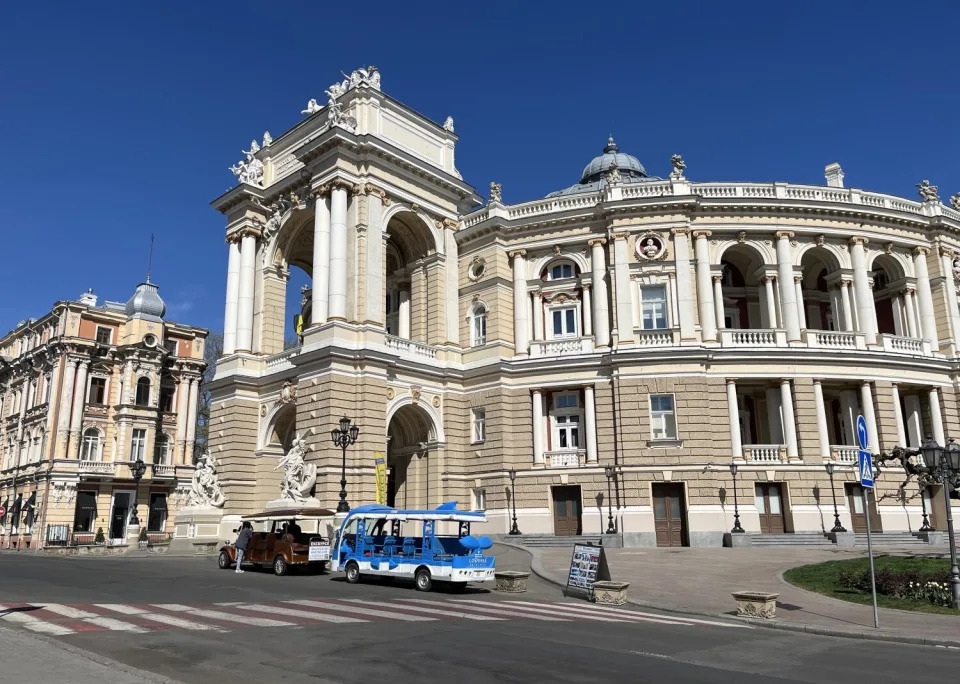
At the National Academic Opera and Ballet Theater — where April offerings include the ballet “Giselle” and Verdi’s opera “Nabucco” — the show goes on, as it has almost continuously since the start of the conflict. The neo-Baroque opera house is no longer sandbagged, but the war still feels ever present.

Odesa's opera house, formerly protected with sandbags.
Odesa’s opera house, formerly protected with sandbags. Performances and rehearsals are often interrupted by air alerts. (Laura King / Los Angeles Times)

“After night bombings come the most difficult days: Actors, singers and dancers are just physically tired, and it’s hard to deliver the emotional spectrum in their performances,” said Oksana Ternenko, 50, a stage director.

“Sometimes it’s like a theater of the absurd,” she said. “We are starting to rehearse, and a singer is showing photos on the phone: ‘Look, here’s a piece of my house that fell on my car.’ ”

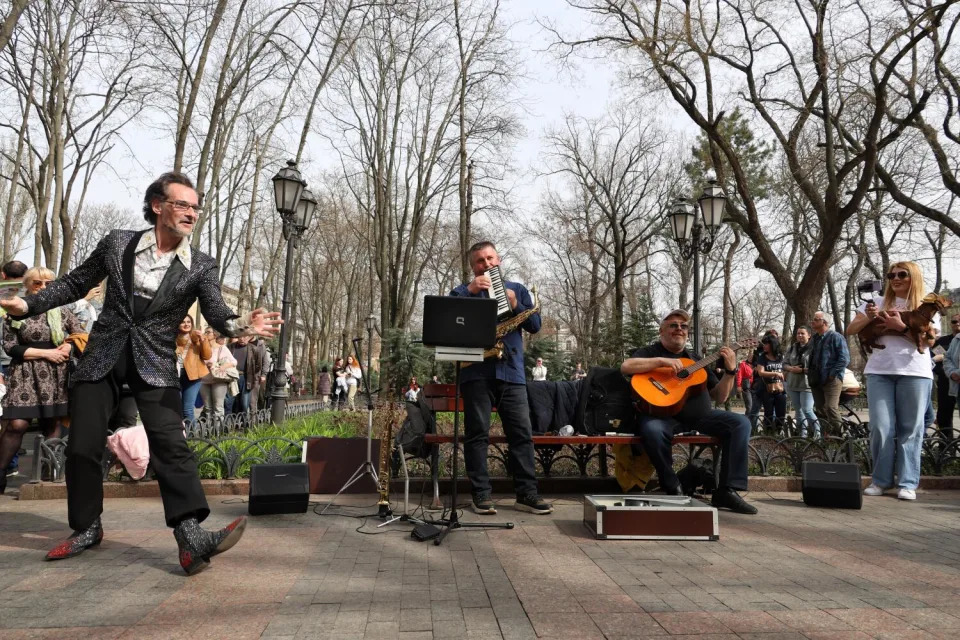
Despite all, Odesa maintains an irrepressible offbeat humor.

A man dances on a brick path as musicians play.
A man dances during the Festival of Humor, which has been taking place in Odesa on and around April Fools’ Day since 1973. (Nina Liashonok / Getty Images)

“My parents and I, we’re very happy that Granny is deaf, so the explosions don’t scare her,” said 14-year-old Alina Kulik, who lives in an outlying district that has been hit repeatedly.

“Right now, we’re in a place that’s a little dangerous,” said her 15-year-old friend Anastasia Jelonkina, as the two girls perched on a promenade bench overlooking the seaport. “We know that. But here we are!”

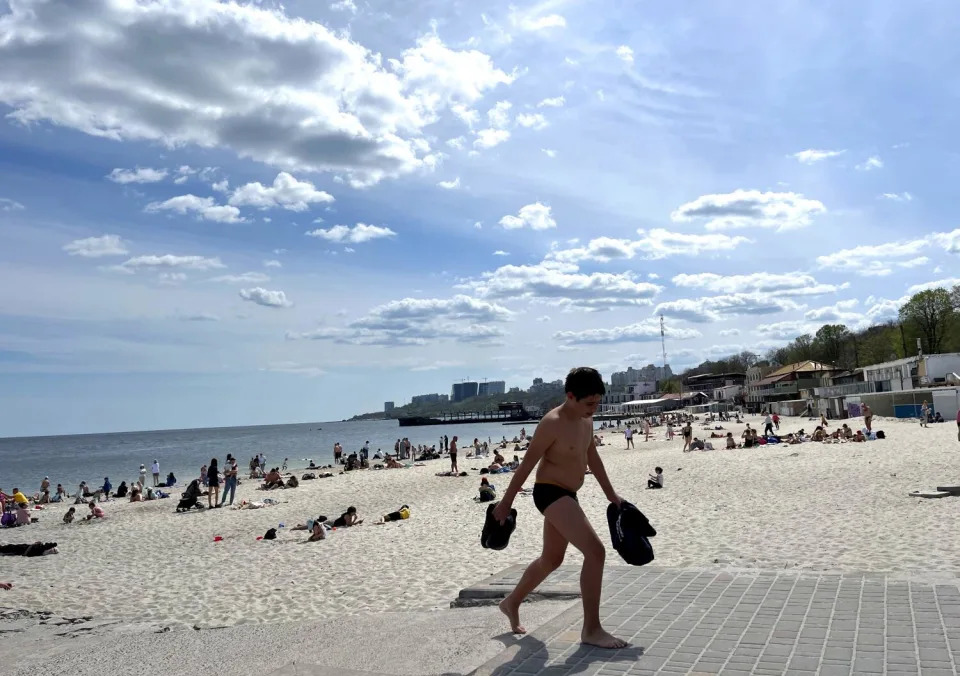
Odesa’s beaches, beloved by tourists before the war and by locals all along, are full again as spring temperatures rise. During much of the last two years, danger from mines and debris from destruction of a massive dam on the Dnipro River kept the shoreline largely closed.

Sunbathers flock to an Odesa city beach.
Sunbathers flock to an Odesa city beach. De-mining efforts allowed the reopening of the seashore. (Laura King / Los Angeles Times)

But intensive de-mining efforts have rendered the sea off Odesa relatively safe for swimming again, and a tousle-haired Irina Khosovana, a 62-year-old doctor who is a fifth-generation Odesan, said nothing — not even periodic air alerts — could keep her away.

“The sea is our comfort,” she said, gesturing toward the blue expanse. “Coming here is as important as life.”

A largely Russian-speaking city at the start of the war, Odesa still has deep cultural roots in common with the enemy now battering its shores. The poet Pushkin is still revered, with a grand boulevard named for him and a big statue taking pride of place in front of the city council building.

But another prominent piece of statuary near the opera house was deemed a symbol of colonialist oppression — that of the Russian empress known as Catherine the Great. Her likeness, hauled down in the war’s first year, is now boxed up in a black lean-to outside the damaged art museum.

Atop the empty plinth where the statue once stood flies a blue-and-yellow Ukrainian flag.