5 ways Kamala Harris is attacking Trump

Yahoo! News

5 ways Kamala Harris is attacking Trump

Andrew Romano, Reporter – August 1, 2024

Vice President Kamala Harris
Vice President Kamala Harris boards Air Force Two in Westfield, Mass., on July 27. (Stephanie Scarbrough/AP)

Ever since Vice President Kamala Harris took the baton last Sunday from her boss, President Biden, and instantly became the Democratic Party’s new de facto presidential nominee, she has enjoyed one of the most significant “honeymoons” in recent U.S. campaign history.

As a result, the latest polls show Harris closing the gap with Donald Trump in key swing states; pulling even nationally; and surpassing him in terms of favorability and enthusiasm.

Yet all honeymoons come to an end. If Harris hopes to win in November, she will have to differentiate herself from Biden — and convince a decisive number of voters to reject four more years of Trump.

In an attempt to do just that, Harris and her allies have been testing out five main lines of attack: that Trump is “weird”; that he is old; that he is scared to debate; that he is a felon; and that his “Project 2025” agenda is extreme.

Harris has been so committed to these themes that even when Trump questioned her race Wednesday — falsely claiming that she suddenly “made a turn” and “became a Black person” after “only promoting [her] Indian heritage” — she refused to get sucked into a culture war.

“The American people deserve better,” is all Harris said in response.

Meanwhile, Harris’s relentlessly on-message campaign used “Trump’s tirade” as an opportunity to ding his “harmful Project 2025 agenda” and challenge him to “actually show up for the debate on September 10.”

More on the strategic contrasts Harris is trying to draw:

Trump is ‘weird’

When Biden was running, he constantly called Trump a “threat to democracy.”

Harris hasn’t left that line of attack entirely behind. “Do we want to live in a country of freedom, compassion and rule of law, or a country of chaos, fear and hate?” the vice president asked at a recent rally.

But for the most part, Harris and her allies have pivoted to a different anti-Trump message — one that comes across as a lot less alarmist and a lot more … dismissive.

“Some of what [Trump] and his running mate [JD Vance] are saying, it is just plain weird,” Harris said Saturday at her first fundraiser. “I mean that’s the box you put that in, right?”

The new term caught on after Democratic Gov. Tim Walz of Minnesota — who has been using it for months — called Trump, Vance and their policies “weird” a few times last week.

“Listen to the guy,” Walz told CNN, referring to Trump. “He’s talking about Hannibal Lecter, and shocking sharks, and just whatever crazy thing pops into his mind. And I thought we just give him way too much credit.”

Now other Harris surrogates are using it too, especially in reference to some of Vance’s recent remarks — and Walz has reportedly become one of Harris’s VP finalists.

So far, the “weird” attack has frustrated Republicans, “leading them to further amplify it through off-balance responses,” David Karpf, a strategic communication professor at George Washington University, told the Associated Press.

It “makes voters feel like Trump is out of touch,” added Brian Ott, a professor of communications at Missouri State University, in an interview with Newsweek. And “it’s hard to claim that it is in any way out of bounds politically, which makes any response to it seem like an overreaction and, well, weird.”

Trump is old

The first time the Harris campaign officially referred to Trump as “weird” was in a press release put out just days after the vice president announced her candidacy. But there was another, more familiar adjective alongside it.

“Trump is old and quite weird,” the statement said. “After watching Fox News this morning, we have only one question, is Donald Trump OK?”

As everyone knows, Biden is the oldest president in U.S. history; at 81, he was also on track to become the oldest presidential nominee in U.S. history until he ended his campaign last Sunday.

Now Trump, 78, has taken his place.

And so Harris, 59, has turned the tables and started describing the former president as someone who is “focused on the past” — while she, in contrast, is “focused on the future.”

For its part, the Harris campaign has been less euphemistic about the nearly two-decade age gap between the two candidates.

“Tonight, Donald Trump couldn’t pronounce words … went on and on and on, and generally sounded like someone you wouldn’t want to sit near at a restaurant, let alone be president of the United States,” Harris spokesperson James Singer said after a recent Trump speech. “America can do better than [Trump’s] bitter, bizarre and backward-looking delusions.”

Trump is scared to debate

On Sept. 10, Trump and Biden were scheduled to debate for the second time this year. But after the president withdrew from the race — and Harris emerged as the new, de facto Democratic nominee — Trump started to backtrack.

“I haven’t agreed to anything,” Trump said on a press call last week. “I agreed to a debate with Joe Biden.” Around the same time, the former president suggested that ABC News should no longer host, calling the outlet “fake news.”

Harris immediately snapped back. “What happened to ‘any time, any place’?” she said in a post on X.

Since then, Trump has said “The answer is yes, I’ll probably end up debating” — while adding that he “can also make a case for not doing it.”

In response, Harris has seized on Trump’s waffling as evidence that “the momentum in this race is shifting” and that “Trump is feeling it,” as she put it Tuesday during a rally in Atlanta — effectively weaponizing the whole situation to question Trump’s confidence.

“Well, Donald,” Harris said in Atlanta, addressing Trump directly. “I do hope you’ll reconsider. Meet me on the debate stage … because as the saying goes, if you’ve got something to say, say it to my face.”

Trump is a felon

Harris debuted as a 2024 presidential candidate last Monday with an appearance at campaign headquarters in Wilmington, Del. She spoke for about 20 minutes — but one passage in particular got the lion’s share of attention.

“As many of you know, before I was elected as vice president, before I was elected as United States senator, I was the elected attorney general, as I’ve mentioned, of California,” Harris said. “And before that, I was a courtroom prosecutor.”

“In those roles, I took on perpetrators of all kinds,” the candidate continued, as laughing, applauding staffers began to realize what was coming next. “Predators who abused womenFraudsters who ripped off consumersCheaters who broke the rules for their own gain. So hear me when I say: I know Donald Trump’s type.”

Since then, Harris has used the same lines in every stump speech she’s delivered.

Biden, of course, would mention Trump’s civil and criminal cases on the campaign trail. But Harris’s résumé lends itself to a novel “prosecutor vs. felon” dynamic — one she could further emphasize by picking any of the former state attorneys general on her vice presidential shortlist when she reveals her running mate next week.

Trump’s Project 2025 agenda is extreme

For months, the Democratic Party has sought to tie Trump to Project 2025, a voluminous blueprint for a second Trump term that was created by the Heritage Foundation (a right-wing think tank) with input from at least 140 people who worked for Trump during his first term.

The reason is obvious. Democrats believe Project 2025 policies — deporting millions of immigrants, eliminating the Department of Education, installing loyalists throughout the federal bureaucracy, reversing federal approval of the abortion pill mifepristone — will be unpopular with the public.

Trump, meanwhile, seems to have come to the same conclusion. After Heritage Foundation president Kevin Roberts recently said America was “in the process of the second American Revolution, which will remain bloodless if the left allows it to be,” Trump took to his Truth Social network to distance himself.

“I know nothing about Project 2025,” the former president claimed. “I disagree with some of the things they’re saying and some of the things they’re saying are absolutely ridiculous and abysmal.”

Earlier this week, the group announced that it was winding down its policy operations and letting go of its director amid pressure from the Trump campaign.

But Harris — who has called Project 2025 a “plan to return America to a dark past” — is not moving on.

“This is his agenda, written by his allies, for Donald Trump to inflict on our country,” Harris spokesperson Julie Chavez Rodriguez said Tuesday. “Hiding the 920-page blueprint from the American people doesn’t make it less real — in fact, it should make voters more concerned about what else Trump and his allies are hiding.”

Trump splits with GOP lawmakers on national security, raising alarm

The Hill

Trump splits with GOP lawmakers on national security, raising alarm

Alexander Bolton – August 1, 2024

National security-minded Republican lawmakers are alarmed by what they see as a growing split between themselves and former President Trump on key issues, including the war in Ukraine, preserving the NATO alliance and protecting Taiwan from Chinese aggression.

Trump’s actions over the past three weeks have stirred confusion and concern among Republican senators who voted earlier this year to approve tens of billions of dollars to contain Russia’s invasion of Ukraine and to deter China from attacking Taiwan, an important U.S. ally and trading partner.

Defense-minded GOP senators viewed Trump’s invitation to Hungarian Prime Minister Viktor Orbán to visit him at his Mar-a-Lago resort in Florida after the NATO summit in Washington as a worrisome development, given Orbán’s close ties to Russian President Vladimir Putin and his efforts to undermine NATO’s support for the defense of Ukraine.

GOP senators who support U.S. involvement in the war in Ukraine were dismayed when Trump selected Sen. JD Vance (R-Ohio), who led the opposition to the Ukrainian assistance package, as his running mate.

And Senate Republicans are feeling uneasy about Trump’s assertion that Taiwan should pay more for its defense and refusal to commit to defending the island.

One Republican senator, who requested anonymity, said “it’s a big question” whether Trump will support the war in Ukraine or would come to Taiwan’s defense if attacked by China.

“I don’t think he desires to be in conflict or to pay for conflicts around the world,” the senator observed.

“There’s no question where JD Vance is,” the lawmaker said of Trump’s selection of the Ohio senator as his running mate.

And the senator called Trump’s meeting with Orbán at Mar-a-Lago “concerning.”

“I can’t tell you why he’s doing it,” the lawmaker remarked.

‘Turned the corner’

Senate Republican Leader Mitch McConnell (Ky.) argued earlier this year that the Republican Party has “turned the corner on the isolationist movement” within its ranks when a majority of GOP senators voted for a $95 billion foreign aid package, which included $61 billion for Ukraine.

But that’s now in doubt after Trump picked Vance to join him on the GOP ticket.

Opponents of continued funding for the war in Ukraine cheered the selection and touted it as a sign Trump would change course if elected in November.

“JD is probably one of the most outspoken individuals about continuing to fuel the flames of that bloody stalemate. I happen to agree with him. I think President Trump does as well,” said Sen. Ron Johnson (R-Wis.), who opposes sending more funding to Ukraine.

Johnson said Vance’s selection as Trump’s running mate “kind of confirms the position of, hopefully, the next administration.”

“The president said he’d end that thing in 24 hours,” Johnson said, referring to Trump’s comments on the war.

Vance told The Hill in April that the $61 billion approved for Ukraine would be the last major assistance package of its kind to get through Congress.

“If Ukraine thinks that it’s getting another $60 billion supplemental out of the United States Congress, there’s no way,” Vance said.

McConnell told reporters he will support the GOP ticket with Vance on it but insisted he’s going to keep arguing for the importance of stopping Russia’s invasion.

“I support the ticket. I also support Ukraine, and I’m going to be arguing, no matter who gets elected president” for deterring Russian aggression, McConnell said. “It’s not just Ukraine, we’ve got worldwide organized authoritarian regimes talking to each other — China, North Korea, Russia, Iran and Iran’s proxies.

“This is a serious challenge,” he warned. “This is the single largest problem facing the democratic world, no matter who wins the election. And that’s what I’m going to be working on the next couple years.”

McConnell didn’t explicitly criticize Trump for meeting with Orbán in Florida but made it clear he views the Hungarian strongman as NATO’s “weakest” member and someone who has undermined U.S. security interests in Europe.

“He’s the one member of NATO who’s essentially turned his country over to the Chinese and the Russians. [He’s] been looking for ways to undermine NATO’s efforts to defeat the Russians in Ukraine. So Viktor Orbán, I think, has now made Hungary the most recent problem in NATO,” McConnell said.

McConnell also spoke out about the need to stand with Taiwan and other Far East allies when asked about Trump’s reluctance to commit to defending the island nation, which is a major source of semiconductors for U.S. industry.

“We don’t know yet who’s going to be the new administration. But it’s pretty clear that our allies in Asia, and now you can add the Philippines to the group, are all concerned about Chinese aggression. They are watching what happens to Russia in Ukraine carefully,” he said.

“This is the clearest example of the democratic world needing to stand up to these authoritarians,” he said. “Reagan had it right. There’s one thing that works. Peace you get through strength.”

Blame for Carlson

Other Republican senators are balking at Trump’s pick of Vance as his running mate and outreach to Orbán.

A second GOP senator who requested anonymity voiced hope that former Secretary of State Mike Pompeo, who served under Trump, would serve as Defense secretary in a new Trump administration and convince him to stay the course in supporting Ukraine.

The lawmaker blamed the influence of conservative media personality Tucker Carlson in pushing Trump toward Vance and Orbán.

“Not the way I would do it,” the senator said.

A third Republican senator said McConnell and other GOP colleagues aren’t happy with how Trump’s recent moves telegraph how he might run foreign policy out of the White House if he’s elected in November.

“I think Trump goes in and tries to negotiate a deal [to end the war in Ukraine] where they cede certain territory to Putin knowing that Putin can’t walk away a loser. Putin’s only graceful exit from this is Zelensky and company ceding some territory, the Russian-speaking parks of Ukraine,” the senator said, predicting that Trump will lean on Ukrainian President Volodymyr Zelensky.

“My guess is that doesn’t sit well with McConnell, at all. But Trump and McConnell have had a pretty rocky relationship,” the source said.

Sen. Thom Tillis (R-N.C.), an outspoken advocate for supporting the war in Ukraine and a McConnell ally, told reporters Wednesday he thinks Trump is open to continued U.S. support for Ukraine.

“If you take a look at the fact that we passed a $60 billion-plus supplemental package [for Ukraine], the House passed it, I’ve got to believe there was some tacit support from Trump … or he could have blocked it,” Tillis said. “It’s on us to convince President Trump why it’s in our best national interest to support Ukraine.”

But other GOP senators are skeptical that Trump will support sending tens of billions of dollars in additional military aid to Ukraine if he returns to the White House.

“His instinct is always toward nonintervention, caution. I don’t know that there’s well-formed philosophy about this is. It’s just his gut. He kind of does this by gut, and his gut is nonintervention,” said a fifth GOP senator who requested anonymity.

Russia vs Ukraine: the biggest war of the fake news era

Reuters

Russia vs Ukraine: the biggest war of the fake news era

Max Hunder – July 31, 2024

KHARKIV, Ukraine (Reuters) – In early April, some residents of Kharkiv received a series of chilling text messages from government officials telling them to flee the city before Russian forces surrounded it.

“Due to the threat of enemy encirclement, we urge the civilian population of Kharkiv leave the city by April 22,” said one alert, which bore the logo of the State Emergencies Service of Ukraine and mapped out safe escape routes on a slick infographic.

It was fake. Volodymyr Tymoshko knew immediately. He’s the police chief of Kharkiv region and would have been one of the first to find out about any official evacuation plans.

“Residents started getting these notifications en masse,” the 50-year-old told Reuters as he shared a screenshot of the alert, sent as Russian troops were massing at the border 30 km away.

“This is a psychological operation, it triggers panic. What would an average citizen think when they receive such a message?”

Disinformation and propaganda, long mainstays of war, have been digitally supercharged in the battle for Ukraine, the biggest conflict the world has seen since the advent of smartphones and social media.

Tymoshko said he received about 10 similar messages via SMS and Telegram messenger in April and early May, the weeks leading up to Russia’s offensive in northeastern Ukraine that began on May 10 and opened up a new front in the war.

A Ukrainian security official, who requested anonymity to discuss sensitive matters, said the Russians frequently sent large numbers of text messages from devices attached to an Orlan-10 long-range reconnaissance drone which can penetrate dozens of kilometres into Ukrainian airspace.

The devices, known as Leer-3 systems, imitate cellular base stations that phones automatically connect to in search of coverage, he added.

The phone barrage was accompanied by a social media blitz as Russian troops advanced on Kharkiv, according Andriy Kovalenko, head of Ukraine’s Centre for Countering Disinformation (CCD), a branch of the national security council.

The average number of social media posts classed as disinformation about the war by Ukrainian authorities spiked to over 2,500 a day when the Kharkiv offensive began in May, up from 200 a day in March, data compiled by the CCD shows.

The CCD chief told Reuters that Ukrainian intelligence had assessed that disinformation campaigns were primarily carried out by Russia’s FSB security service and military intelligence agency, commonly known as the GRU.

Russia’s foreign ministry and the FSB didn’t respond to a request for comment on the Ukrainian assertions, while Reuters was unable to contact the GRU.

Moscow has accused Ukraine and the West of unleashing a sophisticated information war against Russia, using the West’s major media, public relations and technology assets to sow false and biased narratives about Russia and the war.

The Ukrainian security official acknowledged his country used online campaigns in an attempt to boost anti-war sentiment among Russia’s population, although he characterised this effort as “strategic communications” to spread accurate information about the conflict.

BOTS AND MICROTARGETING

Reuters interviewed nine people with knowledge of the information and disinformation war being waged in parallel with battlefield operations, including Ukrainian officials, disinformation trackers and security analysts.

The Ukrainian security official who requested anonymity said that since the full-scale invasion of 2022, intelligence agencies had shut down 86 Russian bot farms located in Ukraine which controlled a collective 3 million social media accounts with an estimated audience reach of 12 million people.

Such facilities are rooms filled with banks of specialised computing equipment that can register hundreds of fake accounts daily on social media networks to pump out false information, the official added, citing one farm that was found by security services in the city of Vinnytsia in central Ukraine last year.

Kovalenko said that at present, the most significant sources of online Russian disinformation were TikTok in Ukraine and Telegram in Europe. Both are widely used in Ukraine.

He said that earlier this year, TikTok had shut down about 30 of the 90 accounts that Ukraine had flagged as Russia-affiliated disinformation spreaders, adding that new accounts often popped up to replace those taken down.

TikTok told Reuters its guidelines prohibited false or misleading content, adding that it had closed down 13 covert influence networks operating from Russia in recent years.

“We prohibit and constantly work to disrupt attempts to engage in covert influence operations by manipulating our platform and/or harmfully misleading our community,” a spokesperson said.

Disinformation networks are groups of accounts controlled by the same entity, and often used to push a coordinated narrative.

Telegram said it was developing a tool to add verified information to posts.

“It is Telegram’s belief that the best way to combat misinformation is not with censorship but with easy access to verified information,” a spokesperson added.

Kharkiv Mayor Ihor Terekhov told Reuters that the Russians were trying to sow panic and distrust, citing an example of social media posts claiming the main road to Kyiv was being resurfaced so that the mayor could flee faster when the Russians came – something he dismissed as a lie.

“They are trying to frighten the population so that people feel uncomfortable and leave the city,” he said in an interview in Kharkiv in late May.

By that time, the frontlines of the conflict in the northeast had stabilised about 20 km from the edge of the city after the Russian offensive had initially gained territory to the north before being blunted by Ukrainian reinforcements.

Maria Avdeeva, a Kharkiv-based security analyst who focuses on Russian disinformation, showed Reuters an infographic map, bearing Ukraine’s state emblem of a trident, posted on Facebook in early April – around the same time as police chief Tymoshko was sent a different evacuation map in a direct Telegram message.

Unperturbed by a loud explosion from a glide bomb a few kilometres away, she explained how the map and accompanying text included fake road closures and claims that missile strikes were expected in specified areas around the city soon.

Microtargeting – which analyses people’s online data to target particular individuals and audiences with specific messages, much like targeted advertising – is complicating the CCD’s task of tracking influence campaigns and countering false narratives, Kovalenko said.

“This activity is notably very tactical,” said John Hultquist, chief analyst at U.S. cybersecurity firm Mandiant, referring to Russian disinformation campaigns in Ukraine.

“We’ve seen targeting all the way down to the Ukrainian soldiers in the trenches.”

AIRSTRIKE TAKES OUT TV TOWER

Ukrainians are particularly vulnerable to digital disinformation; more than three-quarters of the population get their news from social media, far more than any other source of information, according to a study commissioned by USAid in 2023.

That is considerably higher than in any of the 24 European countries surveyed by a 2024 Reuters Institute for the Study of Journalism report, which averaged a rate of 44%.

In late April, as Moscow’s forces massed on the border near Kharkiv, a Russian airstrike took out Kharkiv’s main television tower, hindering the city’s access to information.

Dramatic footage obtained by Reuters showed the main mast of the television tower breaking off and falling to the ground.

While the Kharkiv offensive led to a significant spike in disinformation activity, there have been similar Russian campaigns over the course of the war, according to the people interviewed.

The head of the CCD highlighted a Russian campaign in October 2023 aimed at driving home the idea that Ukraine was facing a tough winter and defeat in the war.

Osavul, a Ukrainian disinformation tracking company, showed Reuters its data for this campaign, which it called “black winter”. It counted 914 messages posted by 549 actors which collectively received nearly 25 million views.

Nonetheless, according to Kovalenko, the sheer scale and frequency of Russian influence operations meant Ukrainians were becoming more suspicious of the information they receive, blunting their impact.

The disinformation push during Russia’s initial advance towards Kharkiv at the start of the invasion in 2022 – when they got much closer to the city – contributed to the panic and shock that led to hundreds of thousands of residents fleeing, several officials and experts said.

This time around, only a small number left Kharkiv, even though the amount of disinformation messaging aimed at the city was double the level in March 2022, according to CCD data.

Despite the near-daily missiles and bombs falling on the city – attacks that intensified this May – 1.3 million people remain, according to Kharkiv Mayor Terekhov, roughly the same as before Russia’s latest military incursion in the region.

The comparative lack of panic also reflects Ukrainians’ increasing familiarity with living under attack.

Reuters spoke to nearly two dozen Kharkiv residents in the second half of May, when the city was being hit by several bombs or missiles a day.

Most said they felt no desire to leave and shrugged off the danger, saying they had become used to it. Several said they had stopped following the news.

“This is a psychological mechanism, we get used to danger,” Kharkiv-based psychologist Iryna Markevych said.

In late May, Reuters correspondents dived to the ground for cover when they heard the whistle of a guided bomb piercing the air. Seemingly unfazed, mothers with pushchairs continued to stroll through the park and people bathed at a public fountain.

Yulia Oleshko, 55, a nanny pushing a buggy in a central Kharkiv park, said the best way to get through the nightmare was to simply focus on getting on with everyday life.

“Yesterday I was thinking: walking around Kharkiv is walking around a minefield … but I try not to dwell on these thoughts of fear, otherwise one might fall into depression,” she said.

“We abstract ourselves, otherwise we won’t survive.”

(Reporting by Max Hunder; Editing by Mike Collett-White and Pravin Char)

As Republicans Attack Harris on Immigration, Here’s What Her Record Shows

The New York Times

As Republicans Attack Harris on Immigration, Here’s What Her Record Shows

Zolan Kanno-Youngs and Jazmine Ulloa – July 31, 2024

Robert Rivas, speaker of the California Assembly, in Hollister, Calif., on July 25, 2024, who is backing Vice President Kamala HarrisÕs presidential campaign even though in 2021 he helped draft a statement that opposed her comments on immigration.(Nic Coury/The New York Times)

WASHINGTON — As they seek effective attack lines against Vice President Kamala Harris, Republicans are focusing on her role in the Biden administration’s border and immigration policies, seeking to blame her for the surge of migrants into the United States over the past several years.

A review of her involvement in the issue shows a more nuanced record.

President Joe Biden did not assign her the job title of “border czar” or the responsibility of overseeing the enforcement policies at the U.S.-Mexico border, as the Trump campaign suggested Tuesday in its first ad against her. But she did have a prominent role in trying to ensure that a record surge of global migration did not become worse.

After the number of migrants crossing the southern border hit record levels at times during the administration’s first three years, crossings have now dropped to their lowest levels since Biden and Harris took office.

Her early efforts at handling her role and the administration’s policies were widely panned, even by some Democrats, as clumsy and counterproductive, especially in displaying defensiveness over why she had not visited the border. Some of her allies felt she had been handed a no-win portfolio.

Early in the administration, Harris was given a role that came to be defined as a combination of chief fundraiser and conduit between business leaders and the economies of Guatemala, Honduras and El Salvador. Her attempt to convince companies across the world to invest in Central America and create jobs for would-be migrants had some success, according to immigration experts and current and former government officials.

But those successes only underlined the scale of the gulf in economic opportunity between the United States and Central America, and how policies to narrow that gulf could take years or even generations to show results.

Rather than develop ways to turn away or detain migrants at the U.S.-Mexico border, Harris’ work included encouraging a Japan-based auto parts plant, Yazaki, to build a $10 million plant in a western Guatemalan region that sees high rates of migration and pushing a Swiss-based coffee company to increase procurement by more than $100 million in a region rich with coffee beans.

She convened leaders from dozens of companies, helping to raise more than $5 billion in private and public funds.

“Not a huge amount, but it ain’t chicken feed and that links to jobs,” said Mark Schneider, who worked with Latin American and Caribbean nations as a senior official at the U.S. Agency for International Development during the Clinton administration.

Jonathan Fantini-Porter, the chief executive of the Partnership for Central America, the public-private partnership Harris helped lead, said the money had led to 30,000 jobs, with another 60,000 on the way as factories are constructed.

She also pushed Central American governments to work with the United States to create a program where refugees could apply for protection within the region.

Still, some of Harris’ critics said her focus on the “Northern Triangle” countries of Guatemala, Honduras and El Salvador was a mistake.

Most migrants crossing the U.S.-Mexico border during the Obama and Trump administrations did come from those countries. But as migration from that region stabilized during the Biden administration, it exploded from countries such as Haiti, Venezuela and Cuba.

The Northern Triangle countries accounted for roughly 500,700 of the 2.5 million crossings at the southwest border in the fiscal year of 2023, a 36% drop from the 2021 fiscal year, according to the Wilson Center.

“They didn’t care to do a good diagnosis of the issue, and they have just focused on a very small part of the topic,” said Guadalupe Correa-Cabrera, a political science professor at George Mason University who has studied Latin American relations and their impact on migration. Correa-Cabrera said Harris had “failed completely” in her mission by following an outdated approach to tackling the root causes of migration.

Biden had a similar portfolio to Harris’ when he was vice president. He was in charge of addressing the economic problems in Central America by rallying hundreds of millions of dollars of aid for a region where the United States has a complicated legacy.

After helping fuel violent civil wars in the 1980s, the United States retreated before seeing peace reforms through, a move that partly set the stage for the corrupt politicians and criminal groups who would exploit the countries’ lack of economic opportunities, overwhelm regional police forces and eventually spur hundreds of thousands of migrants — many of them unaccompanied minors — to make the dangerous trek north.

But U.S. foreign aid initiatives have not always worked to deter migration. Over the years, some investments have been mismanaged and prioritized training programs over actual jobs that would keep would-be migrants in their home countries. Former President Donald Trump froze the foreign aid programs in 2019.

When Biden gave Harris the assignment to look into the root causes of migration, some of her allies worried she was being set up to fail. During her first trip to Guatemala City in 2021, she faced outrage from progressives and immigration advocates when she delivered a blunt message to migrants: “Do not come.”

Republicans criticized her when she brushed aside questions about why she had not yet visited the border.

“I’ve never been to Europe,” Harris said during an NBC News interview with Lester Holt. “I don’t understand the point you’re making.”

Her staffers aggressively sought to distance the vice president from the rising number of crossings at the border — a top concern for voters of both parties.

Rep. Henry Cuellar, D-Texas, who worked with Biden when he had the assignment as vice president, said her task was inherently connected to the record numbers of crossings at the border, even though he agreed she was not a “border czar” in charge of enforcement.

“I think she was supposed to be looking at the diplomatic root issues,” said Cuellar, who signed a resolution proposed by House Republicans criticizing Harris’ work on migration. “But again, you can’t talk about what happens in Central America without coming to the border itself. The focus is the border.”

“I think she did try to distance herself from that,” Cuellar added.

Ricardo Zúñiga, who served as State Department’s special envoy for Honduras, Guatemala and El Salvador, said Harris was essential in bringing together Latin American and American business leaders to drive investment in Central America.

Less than a week into her role, Zúñiga recalled, Harris sat with members of the national security team and economists from the Treasury Department. After a round of introductions, she quickly got into probing the personalities of the Latin American leaders with whom she would be interacting.

Zúñiga said he later watched her put the information she had collected into practice. In Mexico City, she connected with Mexican President Andrés Manuel López Obrador by expressing interest in the artwork at his presidential palace.

In Guatemala, she took a much more direct approach to President Alejandro Giammattei. She warned him last year about attempts to disrupt the handover of power of the newly elected president, Bernardo Arévalo, while also pushing him to help form programs that migrants could use to apply for refuge in the United States closer to their home countries.

“She was curious and asked many questions,” Zúñiga said. “She very quickly realized that we weren’t going to solve 500 years of problematic history in a single term.”

On Tuesday, Harris tried to hit back against Trump’s attacks. During a campaign rally in Georgia, she highlighted his effort to tank legislation that had bipartisan support that would have curbed illegal immigration. “Donald Trump,” she said, “has been talking a big game about securing our border. But he does not walk the walk.”

Wisconsin Republicans ask voters to take away governor’s power to spend federal money

Associated Press

Wisconsin Republicans ask voters to take away governor’s power to spend federal money

Scott Bauer – July 28, 2024

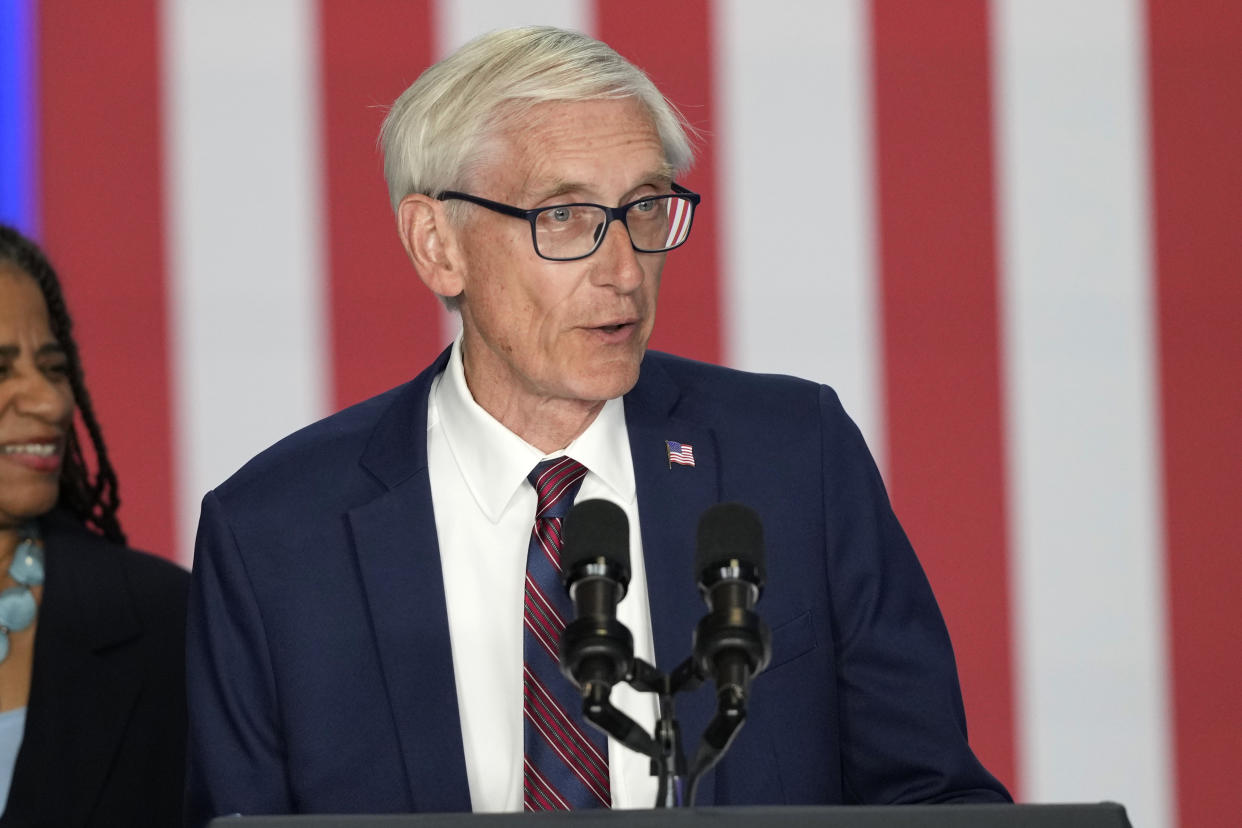
Wisconsin Gov. Tony Evers speaks before President Joe Biden at a campaign rally at Sherman Middle School in Madison, Wis., Friday, July 5, 2024. (AP Photo/Morry Gash)

Wisconsin Republicans are asking voters to take away the governor’s power to unilaterally spend federal money, a reaction to the billions of dollars that flowed into the state during the COVID-19 pandemic.

Democratic Gov. Tony Evers was free to spend most of that money as he pleased, directing most of it toward small businesses and economic development, angering Republicans who argued the Legislature should have oversight.

That’s what would happen under a pair of related constitutional amendments up for voter approval in the Aug. 13 primary election. The changes would apply to Evers and all future governors and cover any federal money to the state that comes without specific spending requirements, often in response to disasters or other emergencies.

Democrats and other opponents are mobilizing against the amendments, calling them a legislative power grab that would hamstring governors’ ability to quickly respond to a future natural disaster, economic crisis or health emergency.

If the amendments pass, Wisconsin’s government “will become even more dysfunctional,” said Julie Keown-Bomar, executive director of Wisconsin Farmers Union.

“Wisconsinites are so weary of riding the partisan crazy train, but it is crucial that we show up at the polls and vote ‘no’ on these changes as they will only make us go further off the rails,” she said in a statement.

But Republicans and other backers say it’s a necessary check on the governor’s current power, which they say is too broad.

The changes increase “accountability, efficiency, and transparency,” Republican state Sen. Howard Marklein, a co-sponsor of the initiative, said at a legislative hearing.

The two questions, which were proposed as a single amendment and then separated on the ballot, passed the GOP-controlled Legislature twice as required by law. Voter approval is needed before they would be added to the state constitution. The governor has no veto power over constitutional amendments.

Early, in-person absentee voting for the Aug. 13 election begins Tuesday across the state and goes through Aug. 11. Locations and times for early voting vary.

Wisconsin Republicans have increasingly turned to voters to approve constitutional amendments as a way to get around Evers’ vetoes. Midway through his second term, Evers has vetoed more bills than any governor in Wisconsin history.

In April, voters approved amendments to bar the use of private money to run elections and reaffirm that only election officials can work the polls. In November, an amendment on the ballot seeks to clarify that only U.S. citizens can vote in local elections.

Republicans put this question on the August primary ballot, the first time a constitutional amendment has been placed in that election where turnout is much lower than in November.

The effort to curb the governor’s spending power also comes amid ongoing fights between Republicans and Evers over the extent of legislative authority. Evers in July won a case in the Wisconsin Supreme Court that challenged the power the GOP-controlled Legislature’s budget committee had over conservation program spending.

Wisconsin governors were given the power to decide how to spend federal money by the Legislature in 1931, during the Great Depression, according to a report from the Legislative Reference Bureau.

“Times have changed and the influx of federal dollars calls for a different approach,” Republican Rep. Robert Wittke, who sponsored the amendment, said at a public hearing.

It was a power that was questioned during the Great Recession in 2008, another time when the state received a large influx of federal aid.

But calls for change intensified during the COVID-19 pandemic when the federal government handed Wisconsin $5.7 billion in aid between March 2020 and June 2022 in federal coronavirus relief. Only $1.1 billion came with restrictions on how it could be spent.

Most of the money was used for small business and local government recovery grants, buying emergency health supplies and paying health care providers to offset the costs of the pandemic.

Republicans pushed for more oversight, but Evers vetoed a GOP bill in 2021 that would have required the governor to submit a plan to the Legislature’s budget committee for approval.

Republican increased the pressure for change following the release of a nonpartisan audit in 2022 that found Evers wasn’t transparent about how he decided where to direct the money.

One amendment specifies the Legislature can’t delegate its power to decide how money is spent. The second prohibits the governor from spending federal money without legislative approval.

If approved, the Legislature could pass rules governing how federal money would be handled. That would give them the ability to change the rules based on who is serving as governor or the purpose of the federal money.

For example, the Legislature could allow governors to spend disaster relief money with no approval, but require that other money go before lawmakers first.

Opposing the measures are voting rights groups, the Wisconsin Democratic Party and a host of other liberal organizations, including those who fought to overturn Republican-drawn legislative maps, the League of Women Voters of Wisconsin and Wisconsin Faith Voices for Justice.

Wisconsin Manufacturers and Commerce, the state’s largest business lobbying group, and the Badger Institute, a conservative think tank, were the only groups that registered in support in the Legislature.

The election has been totally upended. Here’s what the polls show.

Politico

The election has been totally upended. Here’s what the polls show.

Steven Shepard – July 27, 2024

The polls are in after a chaotic few weeks in the 2024 presidential election, and they point to a newly hyper-competitive race.

Vice President Kamala Harris’ elevation has jolted the race and blunted the momentum former President Donald Trump could have seen coming out of the Republican convention and the assassination attempt that preceded it. Though polling showed Trump building a lead over President Joe Biden following their debate last month, that advantage has mostly evaporated against Harris in the fresh round of surveys conducted since she became the all-but-certain Democratic nominee.

The new polling shows just how much the landscape has shifted since Biden dropped out last Sunday. For months, the contest appeared set, and Biden’s modest deficit going into the debate threatened to decline further. That’s now changed.

Trump still maintains a slim edge over Harris — but the race is now close, which was not the case for the Biden-vs.-Trump contest after the debate. Just this week, new polls from The New York Times/Siena College (Trump +1 over Harris), The Wall Street Journal (Trump +2) and CNN (Trump +3) all represent tightening from 6-point Trump leads in all three polls following the debate.

Looking only at the horserace, it’s difficult to evaluate whether opinions of Trump shifted after the assassination attempt, or whether he received a bounce out of the GOP convention and his selection of Sen. JD Vance (R-Ohio) as his running mate

But look deeper, and one can see some signs that Trump is viewed differently now than he was before the assassination attempt. Similarly, the crosstabs show how Harris has closed the gap with the Republican nominee, performing stronger with traditionally Democratic groups among whom Biden had lagged badly.

Here are five takeaways from the latest numbers:

Harris has started to rebuild a more traditional Democratic coalition

A switch in the Democratic candidate has rippled through the electorate and, at least initially, restored traditional demographic patterns.

Even before his debate debacle, Biden had struggled to keep key elements of the Democratic base in the fold: Support had eroded significantly among young voters, Black voters, Latino voters and other reliable supporters of Democratic candidates in the past, including Biden in 2020.

Harris has brought some of those voters back into the fold. In the New York Times/Siena poll, for example, she is running stronger than Biden has all year among young voters and voters of color while mostly keeping pace with Biden among older and white voters, where his numbers had been more durable.

That doesn’t mean Trump’s gains have entirely disappeared in a matter of days now that he’s running against a 59-year-old woman of color instead of an 81-year-old white man. Harris is still short of Biden’s 2020 numbers among young voters and voters of color, and the former president is still running well ahead of his 2016 and 2020 numbers among those groups.

Harris has more paths to 270 electoral votes than Biden did

As she shifts the electorate, Harris is creating more potential pathways to the White House.

For Biden, the election was looking like Rust Belt or bust. But Harris’ stronger numbers among Black and Latino voters could translate to better prospects in some of the Sun Belt states where he had fallen well behind Trump: Arizona, Georgia, Nevada and North Carolina.

Biden’s campaign was still actively contesting those states, but his deficits in public polling had been significant even before the debate. There’s very little polling so far in the Sun Belt swing states, but the changes taking place in the national polling suggest Harris could put those states back into play.

Biden was still in the ballgame, at least before the debate, in the “Blue Wall” states that were competitive and decisive in both 2016 and 2020. And a set of new Fox News polls out Friday show Harris and Trump neck-and-neck in MichiganPennsylvania and Wisconsin.

And polls in states with similar demographic profiles also suggest Harris is inching closer to Biden’s winning 2020 numbers — and not toward the devastating, landslide loss that some Democrats had feared if Biden had stayed in the race after the debate. A Fox News poll in Minnesota showed Harris 6 points ahead of Trump, similar to Biden’s 7-point win. Two polls in New Hampshire this week gave the vice president leads that essentially matched Biden four years ago. Trump allies had argued in recent weeks that those states were among a slew of blue-leaning states that had been put in play.

Harris seems to be shutting that down. She has work to do to catch up to Trump, but she already has more options than Biden did.

Trump is more popular than at any point in the last four years

While Harris’ takeover of the news cycle may have blunted any Trump bump in the horserace polling after the assassination attempt and last week’s convention, there’s still evidence of one in the former president’s favorability ratings.

In poll after poll, Trump has notched favorable ratings at or near his highest ever recorded.

It’s not a terribly high bar: Even when he won the 2016 election, more voters have consistently said they view Trump unfavorably than view him favorably — he’s had some electoral success despite his image. Trump’s still underwater, but his image rating is a lot closer to 50-50 than it has been at virtually any time in his political career.

In the Wall Street Journal poll, his favorable/unfavorable rating was 47 percent/50 percent. That’s a significant shift: In nine previous polls dating back to November 2021, the percentage of voters with an unfavorable opinion of Trump had always been at least 10 points higher than the percentage who viewed him favorably.

Some of Trump’s numbers in the early weeks of the pandemic rival his current standing. But by this time four years ago, his image had declined. And in all that’s happened since then, it hadn’t recovered — until now.

Biden’s retirement is wildly popular

In this era of polarization, it’s hard to imagine that Biden and his 39-percent approval rating could do anything that would be almost unanimously popular.

But his decision to pull the plug on his moribund campaign is well received across the political spectrum.

More than three-in-four likely voters in the New York Times/Siena poll said they were enthusiastic or satisfied that Biden had dropped out. The numbers were similar in the Fox News state polls, including in Pennsylvania, where 78 percent of voters said they approved of Biden dropping out.

Biden’s decision is earning bipartisan praise: Large majorities of Democrats, Republicans and independents support him stepping aside. But, ironically, it’s Democratic voters who are more enthusiastic about it. Significantly more Democratic voters than GOP voters in the Fox News Pennsylvania poll, 86 percent versus 69 percent, approve of Biden dropping out, despite Republicans’ general antipathy toward the president.

RFK Jr. is in freefall

With Trump’s post-convention bounce, Democrats’ candidate switch and his own missteps, independent candidate Robert F. Kennedy Jr.’s numbers are dropping like a rock.

In the New York Times/Siena poll, Kennedy was at 5 percent, down from 8 percent right after the Biden-Trump debate. He’s at 4 percent in the Wall Street Journal poll, down from 7 percent in the previous poll.

Kennedy cried foul last month when he fell short of CNN’s criteria for a debate invitation: He earned 15 percent in three polls (needing four) and was well shy of the cable network’s threshold for ballot access (Kennedy argued it was unfair, since many states don’t certify independent candidates until later in the year).

And now, even as he’s gotten on the ballot in more states, it appears that the polling threshold for the next debate will be his undoing. He needs to earn 15 percent in four qualifying polls from Aug. 1-Sept. 3 to be able to compete in the ABC News debate on Sept. 10, and he’s nowhere near that right now.

Kennedy and various third-party candidates have been courting the significant share of voters who viewed both Biden and Trump unfavorably. But these so-called double haters are increasingly rare now, thanks to improved views of Trump and Harris’ stronger image than Biden.

Those developments might not last: Trump could fall back to his consistently poor image, and Harris’ honeymoon with the public could be short-lived, especially in the face of nascent Republican attacks.

But, for now, more voters like at least one of the candidates, and fewer say they’ll be holding their noses in November. After months of careening toward a dismal rematch of 2020, the election has been abruptly upended, and there is a lot more uncertainty about its trajectory from here. Right now, at the outset of the Harris-Trump contest, it looks like a close race.

Russia’s Putin vows ‘mirror measures’ in response to U.S. missiles in Germany

Associated Press

Russia’s Putin vows ‘mirror measures’ in response to U.S. missiles in Germany

The Associated Press – July 28, 2024

Russian President Vladimir Putin greets sailors prior to the main naval parade marking Russian Navy Day in St. Petersburg, Russia, on Sunday, July 28, 2024. (Vyacheslav Prokofyev, Sputnik, Kremlin Pool Photo via AP)
Russian President Vladimir Putin, center, Russian Defense Minister Andrei Belousov, second left, and Russian Navy Commander-in-Chief Admiral Alexander Moiseyev, left, arrive to watch the main naval parade marking Russian Navy Day in St. Petersburg, Russia, on Sunday, July 28, 2024. (AP Photo/Dmitri Lovetsky, Pool)
Russian President Vladimir Putin, center, Russian Defense Minister Andrei Belousov, second right, and Russian Navy Commander-in-Chief Admiral Alexander Moiseyev, right, greet sailors prior to the main naval parade marking Russian Navy Day in St. Petersburg, Russia, on Sunday, July 28, 2024. (Vyacheslav Prokofyev, Sputnik, Kremlin Pool Photo via AP)

Russia may deploy new strike weapons in response to the planned U.S. stationing of longer-range and hypersonic missiles in Germany, Russian President Vladimir Putin said on Sunday.

Speaking at a naval parade in St Petersburg, Putin vowed “mirror measures” after the U.S. earlier this month announced that it will start deploying the weapons in 2026, to affirm its commitment to NATO and European defense following Moscow’s all-out invasion of Ukraine in February 2022.

“If the U.S. implements such plans, we will consider ourselves free from the previously imposed unilateral moratorium on the deployment of intermediate and shorter-range strike weapons, including increasing the capability of the coastal forces of our navy,” Putin said. He added that Moscow’s development of suitable systems is “in its final stage.”

Both Washington and Moscow have in recent weeks signaled readiness to deploy intermediate-range ground-based weapons that were banned for decades under a 1987 U.S.-Soviet treaty. The U.S. pulled out of the agreement in 2019, accusing Moscow of conducting missile tests that violated it.

The allegations, which Russia denied, came as tensions mounted between Moscow and the West in the wake of the downing of a Malaysian airliner carrying 298 people over war-torn eastern Ukraine. Two Russians and a pro-Moscow Ukrainian were ultimately convicted over their role in the attack.

Washington and Berlin said in a joint statement this month that the U.S. weapons to be placed in Germany would ultimately include SM-6 missiles, Tomahawk cruise missiles, and “developmental hypersonic weapons”, including those with a significantly longer range than the ones currently deployed across Europe.

Most of Russia’s missile systems are capable of carrying either conventional or nuclear warheads. Russia’s deputy foreign minister, Sergei Ryabkov, said last week that the Kremlin did not rule out new deployments of nuclear missiles in response to the U.S. move.

Ryabkov added that defending Kaliningrad, Russia’s heavily militarized exclave wedged between NATO members Poland and Lithuania, was of particular concern.

Putin warns the United States of Cold War-style missile crisis

Reuters

Putin warns the United States of Cold War-style missile crisis

Guy Faulconbridge and Dmitry Antonov – July 28, 2024

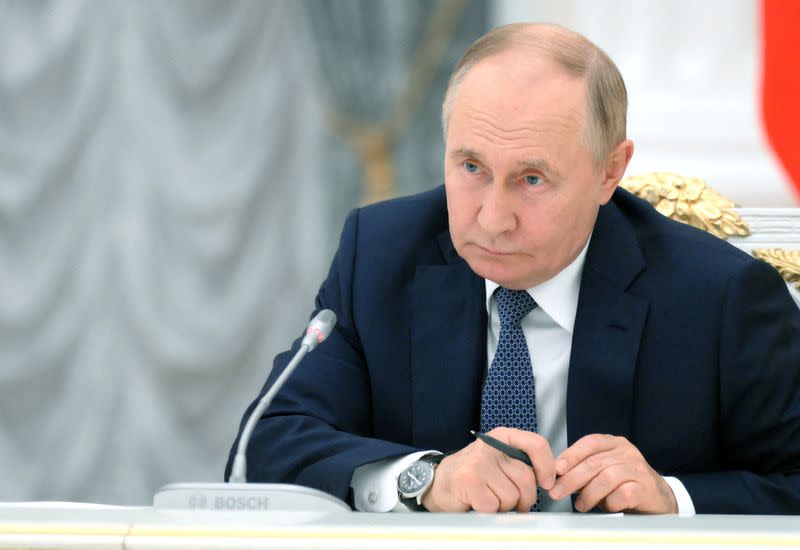
Russian President Putin chairs a meeting in Moscow

MOSCOW (Reuters) -Russian President Vladimir Putin on Sunday warned the United States that if Washington deployed long-range missiles in Germany then Russia would station similar missiles in striking distance of the West.

The United States said on July 10 that it would start deploying long-range missiles in Germany from 2026 in preparation for a longer-term deployment that will include SM-6, Tomahawk cruise missiles and developmental hypersonic weapons.

In a speech to sailors from Russia, China, Algeria and India to mark Russian navy day in the former imperial capital of St Petersburg, Putin warned the United States that it risked triggering a Cold War-style missile crisis with the move.

“The flight time to targets on our territory of such missiles, which in the future may be equipped with nuclear warheads, will be about 10 minutes,” Putin said.

“We will take mirror measures to deploy, taking into account the actions of the United States, its satellites in Europe and in other regions of the world.”

Putin, who sent his army into Ukraine in 2022, casts the war as part of a historic struggle with the West, which he says humiliated Russia after Soviet Union fell in 1991 by encroaching on what he considers Moscow’s sphere of influence.

Ukraine and the West say Putin is engaged in an imperial-style land grab. They have vowed to defeat Russia, which currently controls about 18% of Ukraine, including Crimea, and parts of four regions in eastern Ukraine.

Russia says the lands, once part of the Russian empire, are now again part of Russia and that they will never be given back.

COLD WAR?

Russian and U.S. diplomats say their diplomatic relations are worse even that during the 1962 Cuban Missile Crisis, and both Moscow and Washington have urged de-escalation while both have made steps towards escalation.

Putin said that the United States was stoking tensions and had transferred Typhon missile systems to Denmark and the Philippines, and compared the U.S. plans to the NATO decision to deploy Pershing II launchers in Western Europe in 1979.

The Soviet leadership, including General Secretary Yuri Andropov, feared Pershing II deployments were part of an elaborate U.S.-led plan to decapitate the Soviet Union by taking out its political and military leadership.

“This situation is reminiscent of the events of the Cold War related to the deployment of American medium–range Pershing missiles in Europe,” Putin said.

The Pershing II, designed to deliver a variable yield nuclear warhead, was deployed to West Germany in 1983.

In 1983, the ailing Andropov and the KGB interpreted a series of U.S. moves including the Pershing II deployment and a major NATO exercise as signs the West was about to launch a pre-emptive strike on the Soviet Union.

Putin repeated an earlier warning that Russia could resume production of intermediate and shorter range nuclear-capable missiles and then consider where to deploy them after the United States brought similar missiles to Europe and Asia.

(Writing by Guy Faulconbridge; editing by David Evans)

Donald Trump Tells Christians They ‘Won’t Have to Vote Anymore’ if He’s Elected to Another Term

People

Donald Trump Tells Christians They ‘Won’t Have to Vote Anymore’ if He’s Elected to Another Term

Charlotte Phillipp – July 27, 2024

Kamala Harris’ campaign team later called the former president’s comments a “vow to end democracy”

<p>Joe Raedle/Getty</p> Donald Trump speaks during a Turning Point USA Believers Summit conference at the Palm Beach Convention Center on July 26, 2024.
Joe Raedle/GettyDonald Trump speaks during a Turning Point USA Believers Summit conference at the Palm Beach Convention Center on July 26, 2024.

Former President Donald Trump made waves after urging his Christian followers to vote for him in the upcoming presidential election “just this time” — and saying that they “won’t have to do it anymore” if he wins.

During an event on Friday, July 26, hosted by the conservative Christian organization Turning Point Action, Trump, 78, addressed the crowd and implied that if he were to be voted in, “everything” would be “fixed,” according to multiple sources, including Rolling Stone and The Hill.

“Christians, get out and vote, just this time,” Trump said as the crowd in West Palm Beach, Fla., cheered, per the outlets.

Related: Donald Trump Didn’t Always Oppose Kamala Harris. He Helped Get Her Reelected as Calif. Attorney General in 2014

“You won’t have to do it anymore,” he said. “Four more years, you know what, it will be fixed, it will be fine. You won’t have to vote anymore, my beautiful Christians.”

<p>Brandon Bell/Getty</p> President Donald Trump speaks to attendees during his campaign rally on July 24, 2024 in Charlotte, N.C.
Brandon Bell/GettyPresident Donald Trump speaks to attendees during his campaign rally on July 24, 2024 in Charlotte, N.C.

“I love you Christians. I’m a Christian. I love you, get out, you gotta get out and vote. In four years, you don’t have to vote again, we’ll have it fixed so good you’re not going to have to vote,” Trump continued.

At the same event, Trump also claimed that he would “once again appoint rock-solid conservative judges who will protect religious liberty,” per Rolling Stone.

Related: What Is Project 2025? Inside the Far-Right Plan Threatening Everything from the Word ‘Gender’ to Public Education

In a statement shared by Vice President Kamala Harris‘ campaign team on Saturday concerning what they called “Trump’s vow to end democracy,” Harris for President spokesperson James Singer said: “When Vice President Harris says this election is about freedom, she means it.”

“Our democracy is under assault by criminal Donald Trump: After the last election Trump lost, he sent a mob to overturn the results,” Singer continued.

“This campaign, he has promised violence if he loses, the end of our elections if he wins, and the termination of the Constitution to empower him to be a dictator to enact his dangerous Project 2025 agenda on America,” he added.

<p>Ting Shen/Bloomberg via Getty</p> Kamala Harris
Ting Shen/Bloomberg via GettyKamala Harris

Many Democrats have criticized Trump’s rhetoric around the 2020 election, and specifically his claims of voter fraud, after he was defeated by President Joe Biden, as well as the recent Supreme Court decision allowing for presidential immunity for any official acts taken during their time in the White House.

Biden, 81, previously cited the Jan. 6, 2021 Capitol riot as one reason that the ruling set a “dangerous” precedent because the power of the presidential office “will no longer be constrained by the law.”

Want to earn extra money through a side hustle? Here’s why 1 in 3 Americans do it.

USA Today

Want to earn extra money through a side hustle? Here’s why 1 in 3 Americans do it.

Betty Lin-Fisher, USA TODAY – July 27, 2024

The gig economy is still big in the U.S. and growing.

More than a third (36%) of U.S. adults are working a side hustle – earning money in addition to their main source of income – according to a new Bankrate survey. They are earning more than they did last year, with the average side hustler making $891 a month, up from $810 last year.

Though the number of respondents who said they had a side hustle was down slightly from last year’s 39%, it is way up from 2019 when Bankrate first started surveying respondents about their extra gigs, Ted Rossman, Bankrate senior industry analyst, told USA TODAY. By comparison, in 2019, 19% of respondents said they had a side hustle.

“More people are side hustling because of inflation and because of high interest rates,” Rossman said. “Technology has made it easier as well. A lot of people are doing work from home and things online and via various mobile apps.”

Updated numbers are not widely available, but in 2018, Marketdata estimated the gig and side hustle market at $2.58 trillion. That year, analysts thought 36% of the U.S. workforce of 160 million already had an extra gig job. That number was forecasted to grow by more than 50% by 2027 to 83 million Americans working a side hustle.

And then Covid happened.

More than a third of Americans, or 36%, are working a side hustle, such as dog walking, according to a new Bankrate survey.

The number of people who picked up a side hustle spiked during the pandemic, said Bryce Colburn, lead editor covering small businesses for USA TODAY/Blueprint, a personal finance content partner to USA TODAY.

Colburn, whose journalists have written several stories about side hustles, said that while he can’t say the side hustle industry grew directly because of COVID-19, the spike in the number of people who had side hustles during and after the pandemic is pretty clear.

“Remote work has definitely been a huge factor in the growing of side hustles,” Colburn said. “We now have technology to do remote work, which then means that now if you’re home, you also can work on other things.”

Who is doing side hustles?

All ages are taking on side hustles, but more millennials and Gen Zers seem to have side hustles, Colburn said.

Colburn’s observation matches results from Bankrate’s study: Gen Zers (ages 18-27) had the highest number of people with a side hustle (48%) compared with millennials (ages 28-43with 44%. Among Gen Xers (ages 44-59), 33% had an extra job, while 23% of baby boomers (ages 60-78) said they had a side gig.

Parents of children under 18 are more likely to have a side hustle (45%) than adults without children (36%) or those with adult children (28%), according to the survey.

Some workers may even be doing their side hustle during their remote full-time job, Colbun said.

Here’s some more highlights from Bankrate’s study:

  • More people started side hustles after 2022: More than half or 52% of side hustlers started less than two years ago.
  • Side hustlers spend their money differently: 37% use some of their money from gigs on discretionary spending; 36% use the extra cash for day-to-day expenses; 31% put some money into savings; and 20% use the income to pay down debt.
  • Side hustling isn’t temporary: 32% of respondents think they’ll always need an extra job to pay the bills.
How much are people making from side hustles?

Nearly two-thirds of side hustlers, or 63% in the Bankrate survey, said they are making more than $100 a month, and more than 1 in 4 respondents, or 28%, are making more than $500 a month.

Younger generations and men are more likely to have a side hustle, and make more. Millennial side hustlers report making an average $1,129 a month, and Gen Zers make $958. Gen Xers make $751 and baby boomers make $561 a month.

The gender pay gap is also alive in the gig economy: Only a slightly higher percentage of men (38%) have side hustles compared with women (33%), but men make an average of $1,034 a month, while women average $735 a month.

A food delivery worker looks at his mobile phone while carrying items to be delivered at a mall in Beijing on July 10, 2024.
Why are people taking side hustle jobs?

High inflation and rising housing costs, in addition to regular monthly bills and the desire to travel and save money, are causing more people to look to side hustles, Rossman said. “Americans are still finding that one job isn’t enough. The cost of living has risen sharply in recent years,” he said.

But Rossman said he also takes with a grain of salt the study statistic saying 32% of people with a side hustle felt they’d always need it to make ends meet.

“Most of these people are relatively new to it, and yet they’re saying they think they need to do it forever,” he said, since more than half have had a side hustle for two years or less. “Maybe things won’t be as bad as people fear.”

Still, “it’s very much a spending story,” he said. “Last year, it was all about day-to-day expense … “This year, it’s more fun spending and ‘I’m going to side hustle to take a nice vacation or splurge on some electronics’ or something like that.”

Colburn said his reporters were surprised to find that while many side hustlers said they were doing the extra job because they needed the money, “50% of people say that they’re doing it for fun and not for money.”

Side hustles: Why do women look for freelance, gig jobs? Avoiding the ‘old boys network’ at the office.

What are some of the best side or most popular gigs?

Side jobs that involve e-commerce, such as eBay or Etsy or using social media to funnel people to an e-commerce platform are popular, Colburn said.

Meanwhile, some of the easiest side hustles, according to Blueprint, are house sitting, dog walking, freelance work and grocery delivery. Blueprint also suggested some side jobs to avoid, such as online survey taker, ride-share driver and mystery shopper, saying they may not pay enough for the time invested.

Colburn also said it’s important for side hustlers to understand how their taxes are affected by their extra gigs.

A lot of people don’t realize that they have to pay taxes on anything more than $400 earned from a second job or that a successful side gig could push you into a higher tax bracket, he said.

Rossman said he believes the number of people doing side hustles will continue to grow, especially as the workforce continues to change and people either choose to job-hop or can’t maintain job stability.

Some people may also turn their side hustle into a passion project or even their next full-time job, he said.

Rossman gave a final bit of advice: if you are going to do a side hustle, walk before you run.

“I think a side hustle is a great way to drum up some extra money, maybe pay off credit card debt,” he said. “But be wary of things that require a big upfront investment. Sometimes they can be an outright scam … other times it’s maybe a multilevel marketing thing where you have to stock up on a bunch of inventory.

“Explore it first, take it for a test drive … prove out the concept before you dive headlong into it.”

Betty Lin-Fisher is a consumer reporter for USA TODAY.