What to know about the two waves of deadly explosions that hit Lebanon and Syria

Associated Press

What to know about the two waves of deadly explosions that hit Lebanon and Syria

Wyatte Grantham-Philips, Michael Biesecker, Sarah El Deeb and Sarah Parvini – September 18, 2024

White House tight-lipped about exploding devices in Lebanon

NEW YORK (AP) — Just one day after pagers used by hundreds of members of the militant group Hezbollah exploded, more electronic devices detonated in Lebanon Wednesday in what appeared to be a second wave of sophisticated, deadly attacks that targeted an extraordinary number of people.

Both attacks, which are widely believed to be carried out by Israel, have hiked fears that the two sides’ simmering conflict could escalate into all-out war. This week’s explosions have also deepened concerns about the scope of potentially-compromised devices, particularly after such bombings have killed or injured so many civilians.

Here’s what we know so far.

What happened across these two waves of attacks?

On Tuesday, pagers used by hundreds of Hezbollah members exploded almost simultaneously in parts of Lebanon as well as Syria. The attack killed at least 12 people — including two young children — and wounded thousands more.

An American official, who spoke on the condition of anonymity, said Israel briefed the U.S. on the operation — where small amounts of explosives hidden in the pagers were detonated. The Lebanese government and Iran-backed Hezbollah also blamed Israel for the deadly explosions. The Israeli military, which has a long history of sophisticated operations behind enemy lines, declined to comment.

A day after these deadly explosions, more detonations triggered in Beirut and parts of Lebanon Wednesday — including several blasts heard at a funeral in Beirut for three Hezbollah members and a child killed by Tuesday’s explosions, according to Associated Press journalists at the scene.

At least 20 people were killed and another 450 were wounded, the Health Ministry said, in this apparent second attack.

When speaking to troops on Wednesday, Israeli Defense Minister Yoav Gallant made no mention of the explosions of electronic devices, but praised the work of Israel’s army and security agencies and said “we are at the start of a new phase in the war.”

What kinds of devices were used?

A Hezbollah official told the AP that walkie-talkies used by the group exploded on Wednesday. The official spoke on condition of anonymity because he was not authorized to speak to the media. Lebanon’s official news agency also reported that solar energy systems exploded in homes in several areas of Beirut and in southern Lebanon, wounding at least one girl.

While details are still emerging from Wednesday’s attack, the second wave of explosions targeted a country that is still reeling from Tuesday’s pager bombings. That attack appeared to be a complex Israeli operation targeting Hezbollah, but an enormous amount of civilian casualties were also reported, as the detonations occurred wherever members’ pagers happened to be — including homes, cars, grocery stores and cafes.

Hezbollah has used pagers as a way to communicate for years. And more recently, Hezbollah leader Hassan Nasrallah warned the group’s members not to carry cellphones, saying they could be used by Israel to track the group’s movements.

Pagers also run on a different wireless network than mobile phones, which usually makes them more resilient in times of emergency. And for a group like Hezbollah, the pagers provided a means to sidestep what’s believed to be intensive Israeli electronic surveillance on mobile phone networks in Lebanon — as pagers’ tech is simpler and carries lower risks for intercepted communications.

Elijah J. Magnier, a Brussels-based veteran and a senior political risk analyst who says he has had conversations with members of Hezbollah and survivors of the attack, said that the newer brand of pagers used in Tuesday’s explosions were procured more than six months ago. How they arrived in Lebanon remains unclear.

Taiwanese company Gold Apollo said Wednesday it had authorized use of its brand on the AR-924 pager model — but that a Budapest, Hungary-based company called BAC Consulting KFT produced and sold the pagers.

Taiwan’s Ministry of Economic Affairs said that it had no records of direct exports of Gold Apollo pagers to Lebanon. And Hungarian government spokesman later added that the pager devices had never been in Hungary, either, noting that BAC had merely acted as an intermediary.

Speculation around the origins of the devices that exploded Wednesday has also emerged. A sales executive at the U.S. subsidiary of Japanese walkie-talkie maker Icom told The Associated Press that the exploded radio devices in Lebanon appear to be a knock-off product and not made by Icom.

“I can guarantee you they were not our products,” said Ray Novak, a senior sales manager for Icom’s amateur radio division, in an interview Wednesday at a trade show in Providence, Rhode Island.

Novak said Icom introduced the V-82 model more than two decades ago and it has long since been discontinued. It was designed for amateur radio operators and for use in social or emergency communications, including by people tracking tornadoes or hurricanes, he said.

What kind of sabotage would cause these devices to explode?

Tuesday’s explosions were most likely the result of supply-chain interference, several experts told The Associated Press — noting that very small explosive devices may have been built into the pagers prior to their delivery to Hezbollah, and then all remotely triggered simultaneously, possibly with a radio signal. That corroborates information shared from the U.S. official.

A former British Army bomb disposal officer explained that an explosive device has five main components: A container, a battery, a triggering device, a detonator and an explosive charge.

“A pager has three of those already,” said the ex-officer, who spoke on condition of anonymity because he now works as a consultant with clients on the Middle East. “You would only need to add the detonator and the charge.”

This signals involvement of a state actor, said Sean Moorhouse, a former British Army officer and explosive ordinance disposal expert. He added that Israel’s foreign intelligence agency, the Mossad, was the most obvious suspect to have the resources to carry out such an attack. Israel has a long history of carrying out similar operations in the past.

The specifics of Wednesday’s explosions are still uncertain. But reports of more electronic devices exploding may suggest even greater infiltration of boobytrap-like interference in Lebanon’s supply chain. It also deepens concerns around the lack of certainty of who may be holding rigged devices.

How long was this operation ?

It would take a long time to plan an attack of this scale. The exact specifics are still unknown, but experts who spoke with the AP about Tuesday’s explosions shared estimates ranging anywhere between several months to two years.

The sophistication of the attack suggests that the culprit has been collecting intelligence for a long time, explained Nicholas Reese, adjunct instructor at the Center for Global Affairs in New York University’s School of Professional Studies. An attack of this caliber requires building the relationships needed to gain physical access to the pagers before they were sold; developing the technology that would be embedded in the devices; and developing sources who can confirm that the targets were carrying the pagers.

Citing conversations with Hezbollah contacts, Magnier said the group is currently investigating what type of explosives were used in the device, suspecting RDX or PETN, highly explosive materials that can cause significant damage with as little as 3-5 grams. They are also questioning whether the device had a GPS system allowing Israel to track movement of the group members.

N.R. Jenzen-Jones, an expert in military arms who is director of the Australian-based Armament Research Services, added that “such a large-scale operation also raises questions of targeting” — stressing the number of causalities and enormous impact reported so far.

“How can the party initiating the explosive be sure that a target’s child, for example, is not playing with the pager at the time it functions?” he said.

___

Associated Press journalists Johnson Lai in Taipei, Bassem Mroue in Beirut and Matt O’Brien in Providence, Rhode Island contributed to this report.

Trump and his family jump into crypto, which the FBI calls a hive of ‘pervasive’ criminality

Los Angeles Times

Column: Trump and his family jump into crypto, which the FBI calls a hive of ‘pervasive’ criminality

Michael Hiltzik – September 18, 2024

Republican presidential nominee former President Donald Trump speaks to reporters in the spin room after a presidential debate between Republican presidential nominee former President Donald Trump and Democratic presidential nominee Vice President Kamala Harris, Tuesday, Sept. 10, 2024, in Philadelphia. (AP Photo/Matt Rourke)
Donald Trump in the “spin room” after his Sept. 10 debate with Vice President Kamala Harris. (Matt Rourke / Associated Press)

There have been a couple of new developments in the crypto world over the last few days just begging to have their dots connected. Here they are:

On Sept. 9, the Federal Bureau of Investigation issued its annual report on cryptocurrency fraud. The FBI found that, in 2023, crypto-related fraud absolutely exploded, with $5.6 billion in losses suffered by Americans. That was a 45% increase over the year before.

“Criminal actors exploit cryptocurrencies in each scheme category” tracked by the agency’s Internet Crime Complaint Center,” Assistant FBI Director Michael D. Nordwall wrote in the report. Crime was “pervasive” in the field, he wrote, with the most common victims being investors; their losses accounted for nearly 71% of the total.

Since cryptocurrencies eliminate the need for financial intermediaries to validate and facilitate transactions, criminals can exploit these characteristics to support illicit activity such as thefts, fraud, and money laundering.

FBI, 2023 Cryptocurrency Fraud Report

That’s one. The second development was that Donald Trump and his family jumped whole hog into the crypto market.

Via a livestream Monday on the social media platform X and numerous X postings, Trump, his sons Donald Jr., Eric and Barron identified themselves or were identified as participants in the new venture. It’s known as World Liberty Financial, and evidently plans to market a crypto “stablecoin” — one with value linked directly to the U.S. dollar — to customers. No one has suggested that there’s anything criminal in the venture as it’s been laid out. There’s no indication that Trump’s ongoing criminal cases have anything to do with cryptocurrency.

“We’re embracing the future with crypto and leaving the slow and outdated big banks behind,” Trump declared last week in a pre-livestream tweet on X.

The idea that Trump — whose prior business ventures include Trump University, which was deemed “fraudulent” by New York authorities; six bankruptcies — five of his casinos and one bankrupty of New York’s Plaza Hotel — and the failed enterprises Trump Shuttle, Trump Vodka, Trump Steaks and Trump Mortgage — would now do a cannonball dive into this sea of documented criminality seems so perfect it’s almost preordained. (Trump didn’t admit wrongdoing in the legal settlement of the Trump University case, but paid $25 million in compensation to former students and in legal penalties.)

So let’s examine just how bad crypto has been for Americans, according to the FBI. Then we’ll turn to Trump crypto.

Cryptocurrency — think bitcoin and its offspring, legitimate and otherwise — has several features that make it “an attractive vehicle for criminals,” the FBI reported.

“The decentralized nature of cryptocurrency, the speed of irreversible transactions, and the ability to transfer value around the world,” the FBI said, create “challenges to recover stolen funds. Once an individual sends a payment, the recipient owns the cryptocurrency and often quickly transfers it into an account overseas for cash out purposes.”

Read more: Column: Most Americans have a negative view of crypto. So why are political campaigns rushing to embrace it?

It’s worth noting that some of these features are touted by crypto promoters, including the Trumps, as virtues — crypto’s decentralization, meaning that there are no intermediaries such as those “slow and outdated” banks to stand between buyers and sellers; its irreversibility, the speediness of the transactions.

Of course, to investors or consumers using cryptocurrencies as investment vehicles or means of payment, these may actually be drawbacks. If your investment manager absconds with your tokens, or a merchant fails to deliver what you bought with your bitcoin, you’re on your own.

“Since cryptocurrencies eliminate the need for financial intermediaries to validate and facilitate transactions,” the FBI said, “criminals can exploit these characteristics to support illicit activity such as thefts, fraud, and money laundering.”

According to the FBI, the U.S. is the world capital of crypto fraud. No other country comes close. Losses from complainants in the U.S. received by the FBI’s internet crime center in 2023 came to $4.8 billion; the second-ranked location of complainants was the Cayman Islands, with $195.7 million, followed by Mexico ($127 million) and Canada ($72.1 million).

The complaint roster showed that Californians lost the most in 2023, nearly $1.2 billion, followed by Texans ($412 million) and Floridians ($390 million). On a per capital basis, however, New Yorkers were the most seriously cheated, mulcted out of an average of $3,800 per 100,000 residents. Californians came in second, at $2,962.

Read more: Column: Sam Bankman-Fried’s seven guilty verdicts expose crypto as a swindle through and through

As for the specific pitfalls, investment scams accounted for 71% of all cryptocurrency losses for Americans. They were followed by call center frauds, including tech or customer support or government impersonation scams.

Ransomware scams cost American businesses $27.4 million in 2023, not counting the cost of lost business, time, wages, files, equipment, or the hiring of third-party services by the victims.

This is the environment that the Trumps have embraced. When I asked the Trump campaign to comment on questions that have been raised by commentators within and outside the crypto field, including questions about the family’s partners in World Liberty Financial and about whether Trump’s launch of a new business venture raises the potential for massive conflicts of interest if he becomes president, all I got from Brian Hughes, who is identified as a “senior advisor” to the campaign, was a bog-standard attack on Democratic candidate Kamala Harris.

“Crypto innovators and others in the technology sector are under attack from Kamala Harris and the Democrats,” Hughes wrote.

“Few, even in the crypto world, seem excited about this project,” observes Molly White, an indefatigable chronicler of the costly hijinks in the world of crypto and other fringe financial assets. “Many seem concerned that it could worsen crypto’s already grifty reputation.”

Why would that be? One of the reported advisors to the Trumps on World Liberty Financial is Chase Herro, who described himself in 2018 as a “dirtbag of the internet.” Herro can be seen in a YouTube video recorded that year delivering a profanity-heavy spiel for crypto and other weird assets: “You can literally sell s— in a can, wrapped in piss, covered in human skin for a billion dollars if the story’s right, because people will buy it.”

According to a World Liberty Financial white paper viewed by Coinbase, Herro was formerly associated with Dough Finance, a blockchain app that lost more than $2 million to hackers in July.

Read more: Column: Thinking of putting crypto in your 401(k)? Think twice

The white paper describes Herro as the data and strategies lead of World Liberty Financial, according to Coinbase. He and another partner, Zachary Folkman, were brought together with the Trumps by Steve Witkoff, a real estate developer close to Donald Trump.

Witkoff said during Monday’s X livestream that he had met Herro and Folkman through one of his sons. He described them as “exceptionally bright people.” He said, “They began talking to me about decentralized finance…. As I began to understand it, I said, who would understand this better than the Trump family?” The venture came together over a period of nine months.

World Liberty Financial didn’t respond to my requests for comments about Herro’s business record, the potential for conflicts of interest by Trump, the roles of his family members in the firm, or the FBI’s judgment about the criminality of crypto.

These questions all but ask themselves, however. Through this venture, Trump is setting himself up as an adversary of a banking and financial system that he would oversee as president, and as an advocate of an alternative financial system that has been the target of investigations and regulatory concerns raised by the Securities and Exchange Commission, the Department of the Treasury and other federal financial regulators.

Let’s not forget that Trump formerly condemned cryptocurrencies as a “scam” and “potentially a disaster waiting to happen.” By July, he had changed his tune. “Bitcoin is not just a marvel of technology,” he said in a keynote speech delivered at a major bitcoin conference. “It’s a miracle of cooperation and human achievement and a lot of relationships that are formed.”

Trump plainly smells money in this newfangled scheme. According to the white paper viewed by Coinbase, 70% of the crypto tokens to be marketed by World Liberty Financial — those carrying governance control over the project — will be reserved for founders and insiders such as himself. That’s an exceptionally high number, judging from other crypto ventures.

So what is World Liberty Financial but another Trump-branded get-rich-quick opportunity for himself? We all know how those others turned out. Why would this one end up any better?

Scientific American makes presidential endorsement for only the second time in its 179-year history

Independent

Scientific American makes presidential endorsement for only the second time in its 179-year history

Myriam Page – September 18, 2024

Trump v Harris: Watch the highlightsScroll back up to restore default view.Yahoo is using AI to generate takeaways from this article. This means the info may not always match what’s in the article. Reporting mistakes helps us improve the experience.Generate Key Takeaways
A top science magazine has waded into the political sphere after making a presidential endorsement, only the second in its 179-year history.

“Vote for Kamala Harris to Support Science, Health and the Environment,” read the headline in Scientific American on Monday, announcing the publication’s official support for the Democratic presidential candidate.

Harris is Scientific American’s second presidential endorsement in its history, after the magazine backed President Joe Biden during the 2020 election.

“The US faces two futures,” the editors wrote, pushing one candidate who “offers the country better prospects, relying on science, solid evidence and the willingness to learn from experience.”

They continued: “In the other future, the new president endangers public health and safety and rejects evidence, preferring instead nonsensical conspiracy fantasies.”

Scientific American, which has a global readership of six million, cited Harris’s record as vice president, senator and presidential candidate as reasons for endorsing her.

They acknowledged that Trump, “also has a record – a disastrous one,” during his time in the White House.

The magazine firstly focused on the candidates’ healthcare policies and proposals, in particular, health insurance in its comparison.

Praising the Biden-Harris administration for bolstering the Affordable Care Act (ACA) – which expanded the number of adults eligible for health insurance – the editors noted that while Harris has said she would expand the program, Trump has pledged to repeal it but failed to clarify what he would replace it with.

“I have concepts of a plan,” he said while facing off against Harris during the September 10 presidential debate.

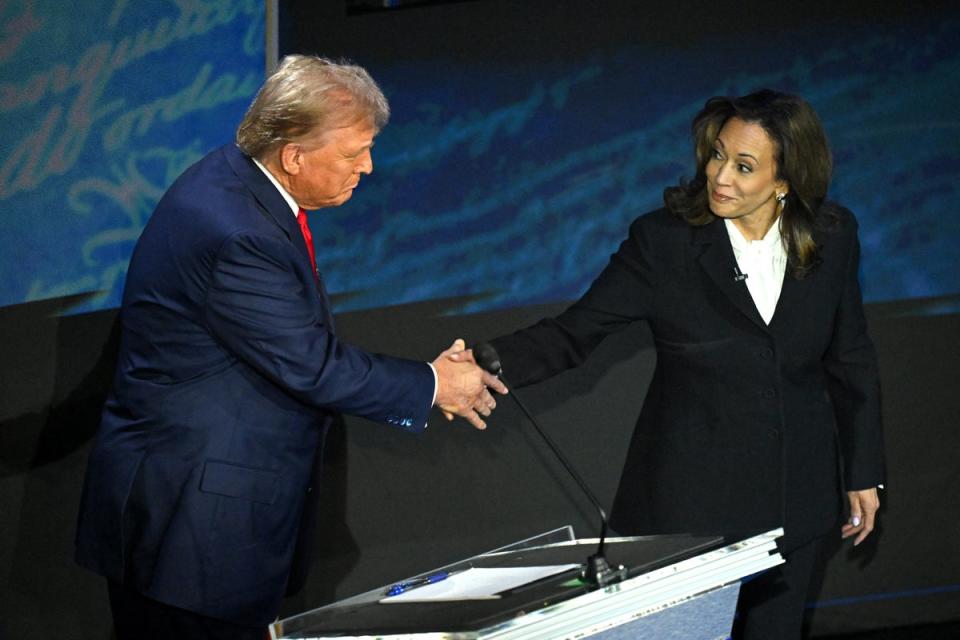
Kamala Harris shakes hands with Donald Trump before the debate on September 10 in Philadelphia (AFP via Getty Images)

The article refers to the debate multiple times, seemingly agreeing with many across the political spectrum (including some of Trump’s closest allies) that Harris won.

The article highlights Trump’s baseless claim during the debate that some states allow a person to obtain an abortion in the ninth month of pregnancy, and calling it “execution after birth.”

“No state allows this,” Scientific American clarified. The magazine also emphasized that Trump refused to answer whether he would veto a national abortion ban.

Meanwhile, Harris was hailed as a “staunch supporter of reproductive rights” for vowing to improve access to abortion care and for co-sponsoring a package of bills to reduce rising maternal mortality rates when she was a senator.

Turning to technology, the editors highlighted the CHIPS and Science Act, signed into law by Biden in 2022, which brought more funding to the chip-making industry to boost homegrown production and research.

They said the legislation “invigorates the chipmaking industry and semiconductor research while growing the workforce.”

The magazine claimed that a second Trump administration would “quickly” undo this progress under a conservative framework, Project 2025, that has been set out to guide his potential second term.

“Under the devious and divisive Project 2025 framework, technology safeguards on AI would be overturned,” the editors wrote. “AI influences our criminal justice, labor and health-care systems.

“As is the rightful complaint now, there would be no knowing how these programs are developed, how they are tested or whether they even work.”

The article concludes: “One of two futures will materialize according to our choices in this election.”

The editors closed by underlining their point. “We urge you to vote for Kamala Harris.”

Scientific American is not the only endorsement Harris has won following the debate, with Taylor Swift posting her endorsement on Instagram almost immediately after the showdown.

Judge Cannon Is Hiding a Far-Right Lecture Circuit

The New Republic – Opinion

Judge Cannon Is Hiding a Far-Right Lecture Circuit

Ellie Quinlan Houghtaling – September 18, 2024

The Trump-appointed judge who threw out the former president’s criminal classified documents case wasn’t up-front about her own conflicts, and now the details of her backroom liaisons are beginning to trickle out.

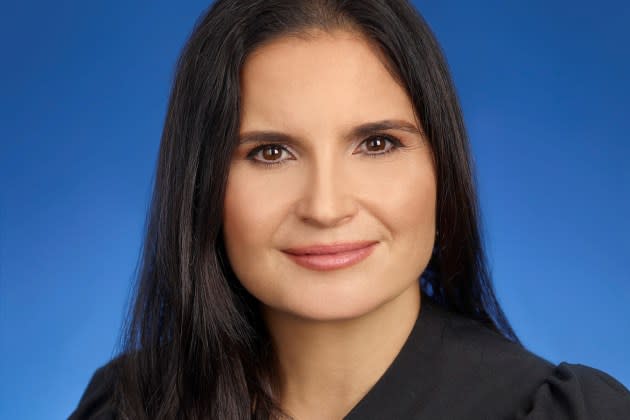
Judge Aileen Cannon failed to disclose that she attended a banquet at a conservative law school in May 2023 to honor the late conservative Supreme Court Justice Antonin Scalia, flouting a 2006 rule requiring judges to file formal disclosures when they attend seminars or conferences that could influence their decisions. But it’s not the only time that Cannon has failed to notify the public of her partisan behavior, according to ProPublica.

In 2021 and 2022, Cannon took week-long trips for legal colloquiums sponsored by conservative judiciaries and hosted at an expensive resort in Pray, Montana, where rooms can cost upward of $1,000 per night. The retreats did not go reported until NPR reporters called Cannon out on the omission as part of NPR’s national investigation into gaps in judicial disclosures.

“Judges administer the law, and we have a right to expect every judge to comply with the law,” Virginia Canter, chief ethics counsel for the watchdog group Citizens for Responsibility and Ethics in Washington, or CREW, told ProPublica.

Cannon, who seemed determined to hold up the classified documents case at every possible opportunity, ultimately tossed the case in July on the basis that special counsel Jack Smith’s appointment was unconstitutional. Smith is currently appealing the decision with the Eleventh Circuit. (William H. Pryor Jr., the chief judge of the Eleventh Circuit, was also at the May 2023 banquet, though he properly disclosed his attendance.) But her own future on the case isn’t clear: CREW has asked the appeals court to intervene and replace the controversial judge on the critical case.

Judge Who Tossed Trump’s Docs Case Repeatedly Violated Disclosure Rule: Report

Rolling Stone

Judge Who Tossed Trump’s Docs Case Repeatedly Violated Disclosure Rule: Report

Nikki McCann Ramirez – September 17, 2024

Florida District Court Judge Aileen Cannon failed to disclose her attendance at several right-wing judicial seminars — including one that took place after she began overseeing former President Donald Trump’s classified documents case, which she ultimately threw out — in apparent violation of federal court rules.

According to a Tuesday report from ProPublicain May of 2023, Cannon attended a swanky banquet hosted by George Mason University’s Antonin Scalia Law School — one of the leading conservative law schools in the nation. The school was renamed in honor of the late Supreme Court justice after a $20 million donation brokered by Supreme Court architect Leonard Leo, who controls a billion-dollar dark money fund and serves as co-chair chairman of of the Federalist Society, the powerful conservative lawyers network.

Cannon, a longtime member of the Federalist Society, attended a lecture and dinner alongside members of the society, Scalia’s family members, and prominent federal judges, according to materials obtained by ProPublica. Cannon submitted several reimbursement requests to the law school related to her travel expenses.

Federal judiciary rules require judges to report travel reimbursements for such events within 30 days. Cannon made no such disclosure within the designated time limit, and it’s not the first time.

ProPublica’s report builds on two disclosure omissions identified in May by NPR. In 2021 and 2022, Cannon and her husband attended week-long colloquiums hosted by George Mason at a luxury resort in Montana. Cannon did not post the required disclosures until approached by NPR. Clerk of Court Angela Noble blamed the oversight on technical issues and told NPR that “Any omissions to the website are completely inadvertent.”

In a separate statement to ProPublica, a clerk for Cannon stated that while the judge had submitted the necessary disclosure, they had not been posted on the website. “Judges often do not realize they must input the information twice,” they said.

Cannon’s failure to disclose invitations to expensive educational events hosted by prominent conservative groups is particularly concerning given her short tenure as her judge and her role in one of the most prominent criminal cases in the country.

In July, Cannon dismissed the classified documents case against Trump, ruling that the appointment of Special Counsel Jack Smith — who heads the Justice Department’s two cases against the former president — was unconstitutional. The decision, which was appealed by the Justice Department, put a spotlight on past rulings by Cannon — a Trump appointee — seen as overly favorable to the former president.

In 2022, Cannon was sharply rebuked by the 11th Circuit U.S. Court of Appeals after granting the former president a request for a “special master” to review troves of classified documents seized during the FBI’s search of Mar-a-Lago. The court of appeals wrote that the unprecedented nature of Trump’s case did not give “the judiciary license to interfere in an ongoing investigation.”

In June, The New York Times reported that senior judges in the Southern District of Florida had advised Cannon to pass the case along to a more experienced judge — and one with fewer questions surrounding their objectivity.

But for all of the criticism leveled against Cannon by experienced legal minds, the former president loves her. As previously reported by Rolling Stone, Trump has privately suggested that Cannon will be a model for judicial picks in a potential second term — and that Republicans “need more like her.”

More from Rolling Stone

Debtor Organizing Can Transform Our Individual Financial Struggles Into a Source of Collective Strength

In These Times – Departments

Debtor Organizing Can Transform Our Individual Financial Struggles Into a Source of Collective Strength

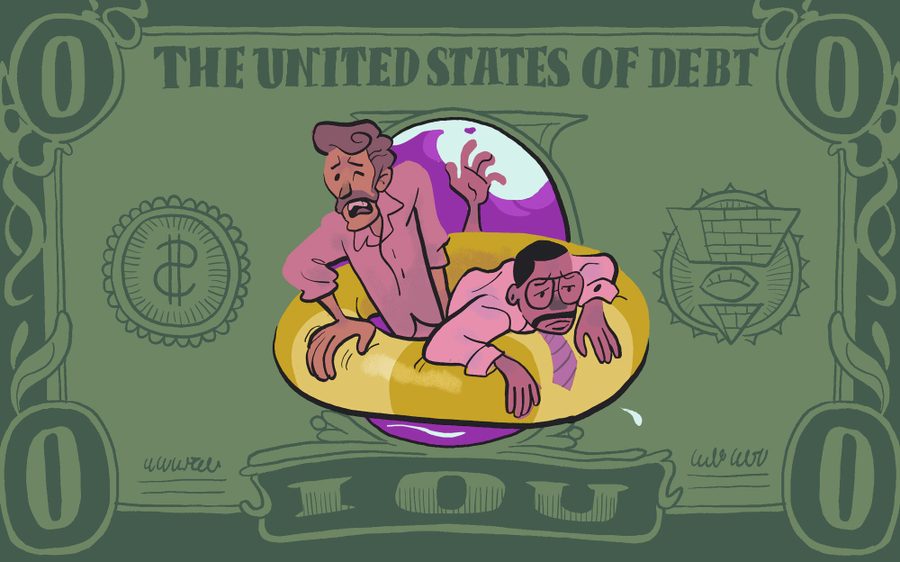
Alone, our debt is a liability. Together, it’s our leverage.

J. Patrick Patterson – September 16, 2024

ILLUSTRATION BY KAZIMIR ISKANDER
debt•or pow•er

noun

  1. leverage that springs from an organized association of debtors, often in debt to shared creditors, to negotiate the terms and conditions of debt contracts, including the abolition of unjust debts
  2. the transformation of individual financial struggles into a source of collective strength by waging strategic campaigns of economic disobedience and debt refusal
  3. a tool to build reparative public goods using debt as leverage

Debtor organizing has the potential to bring millions of people who may never have the option of joining a traditional labor union into the struggle for economic justice. —Debt Collective, Can’t Pay, Won’t Pay: The Case for Economic Disobedience and Debt Abolition

Is this a new idea?

Collective debt resistance — if not debtors’ unions — has happened for centuries! Ancient Roman plebeians used strikes, demonstrations and periodic exoduses to win a range of concessions from the aristocratic class, including substantial political rights and the elimination of debt slavery. Today, just as organized renters have leverage over their landlords because they owe the same person, collectively withholding payments (or threatening to!) builds collective power to make demands.

But where does the power come from?

A debtors’ union is a newer concept that is still emerging. Debt Collective is in the throes of this experiment, but the provocation is simple: Just as workers have potential collective power over capital in the form of their employer, and tenants in the form of their landlord, debtors can also wield this kind of collective power when they organize against their creditors.

How can we use it once we build it?

Although debtors’ unions are a new, emerging front in the fight against racial capitalism, their potential holds across many types of debt. 

The millions of people being crushed by medical debt could organize locally to demand hospitals cancel their bills. Or they could start a national medical debt strike to advance the cause of universal healthcare. 

Credit card debtors could rally against usurious lending practices and advocate for a socially productive — as opposed to predatory — system of credit and debt. Student debtors could transform not only the predatory lending that has become synonymous with higher education, but also the landscape of who has access to that higher education in the first place. 

And people with debts in the criminal punishment system could organize to challenge fines, fees and other costs associated with incarceration, demanding the abolition of a system that extracts on so many levels. The possibilities for debt resistance campaigns are practically endless.

This is part of ​“The Big Idea,” a monthly series offering brief introductions to progressive theories, policies, tools and strategies that can help us envision a world beyond capitalism. For recent In These Times coverage of debtor power in action, see, ​“When transit riders refuse to just sit back,” ​“LGBT Workers Need Unions, Not Rainbow Capitalism and ​“What #MeToo Can Teach the Labor Movement.”

J. PATRICK PATTERSON is the Associate Editor at In These Times. He has previously worked as a politics editor, copy editor, fact-checker and reporter. His writing on economic policies and electoral politics has been published in numerous outlets.

Low-Wage Corporations Are Fleecing Their Workers to Massively Inflate CEO Pay

In These Times – Viewpoint

Low-Wage Corporations Are Fleecing Their Workers to Massively Inflate CEO Pay

Why don’t low wage workers earn more? Because their bosses plowed $522 million into manipulating their stock price—and CEO paychecks—instead.

Sarah Anderson – September 16, 2024

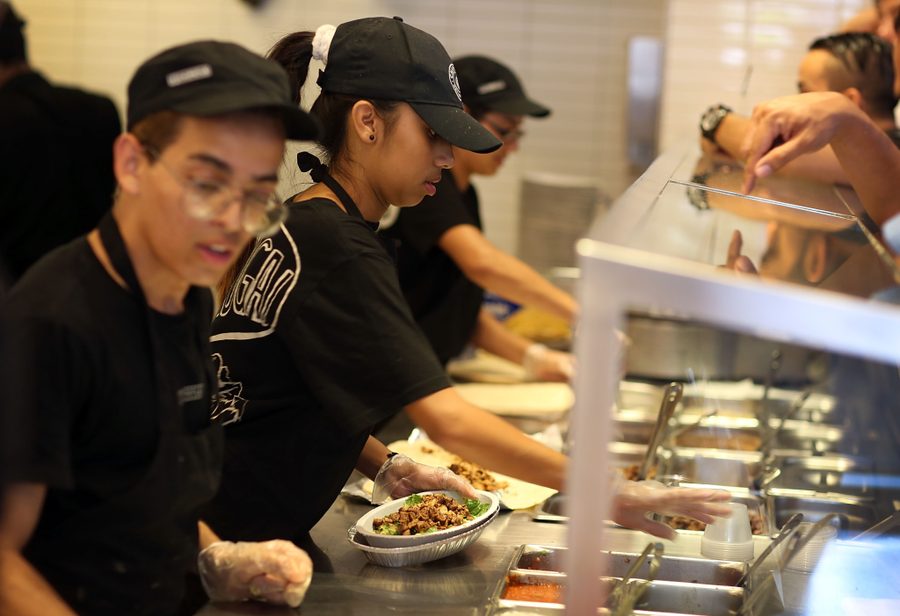
Chipotle restaurant workers fill orders for customers on April 27, 2015 in Miami, Florida.(PHOTO BY JOE RAEDLE/GETTY IMAGES)

Most people believe in fair pay for honest work. So why aren’t low-wage workers better paid?

After 30 years of research, I can tell you that it’s not because employers don’t have the cash — it’s because profitable corporations spend that money on their stock prices and CEOs instead.

Lowe’s, for example, spent $43 billion buying back its own stock over the past five years. With that sum, the chain could have given each of its 285,000 employees a $30,000 bonus every year. Instead, half of Lowe’s workers make less than $33,000. Meanwhile, CEO Marvin Ellison raked in $18 million in 2023.

The company also plowed nearly five times as much cash into buybacks as it invested in long-term capital expenditures like store improvements and technology upgrades over the past five years.

Lowe’s ranks as an extreme example, but pumping up CEO pay at the expense of workers and long-term investment is actually the norm among America’s leading low-wage corporations.

In my latest ​“Executive Excess” report for the Institute for Policy Studies, I found that the 100 S&P 500 firms with the lowest median wages — the ​“Low-Wage 100” — blew $522 billion on buybacks over the past five years. Nearly half of these companies spent more on this once-illegal maneuver than they spent investing in their long-term competitiveness.

This is a scam to inflate CEO pay, pure and simple.

When companies repurchase their own shares, they artificially boost share prices and the value of the stock-based compensation that makes up about 80% of CEO pay. The SEC found that CEOs regularly time the sale of their personal stock holdings to cash in on the price surge that typically follows a buyback announcement.

I also looked into what these corporations contribute to employee retirement — and found that it’s peanuts, compared to their buyback outlays. The 20 largest low-wage employers spent nine times more on buybacks than on worker retirement contributions over the past five years.

Many of these firms boast of their ​“generous” matching benefits, typically a dollar-for-dollar match of 401(k) contributions up to 4% of salary. But matching is meaningless for workers who earn so little they can’t afford to set anything aside.

Chipotle, for example, spent over $2 billion on stock buybacks over the past five years—48 times more than it contributed to employee retirement plans. Meanwhile, 92% of eligible Chipotle workers have zero balances in their 401(k)s. That’s hardly surprising, since the chain’s median annual pay is just $16,595.

The conclusion is unmistakable: CEOs are focused on short-term windfalls for themselves and wealthy shareholders rather than on long-term prosperity for their workers — or their companies.
“Corporate greed turns blue-collar blood, sweat, and tears into Wall Street stock buybacks and CEO jackpots.”

As United Auto Workers President Shawn Fain put it in his Democratic National Convention speech: ​“Corporate greed turns blue-collar blood, sweat, and tears into Wall Street stock buybacks and CEO jackpots.” Public outrage over CEO shakedowns helped the UAW win strong new contracts last year with the Big Three automakers.

Support for policy solutions is growing as well. The Democratic Party platform calls for quadrupling the 1% federal tax on stock buybacks. And a recent poll shows strong majority support among Democrats, Republicans, and Independents alike for proposed tax hikes on corporations with huge CEO-worker pay gaps.

Extreme inequality isn’t inevitable — and it can be reversed.

Forty years ago, CEO pay was only about 40 times higher than worker pay — not several hundreds of times higher, as is typical today. And just 20 years ago, most big companies spent very little on stock buybacks. At Lowe’s, for example, buyback outlays between 2000 and 2004 were exactly zero.

Corporate America’s perverse fixation on enriching those at the top is bad for workers and bad for the economy. With pressure from below, we can change that.

This op-ed was distributed by Oth​er​Words​.org.

SARAH ANDERSON directs the Global Economy Project and co-edits Inequal​i​ty​.org at the Institute for Policy Studies. 

RELATED STORIES:

The World’s Richest Just Got Extraordinarily More Wealthy—Taxing Them Doesn’t Go Nearly Far Enough. Lessening inequality isn’t the only reason to tax the super rich. We also need to decrease their political power while spending on social programs that benefit the working class. MAX B. SAWICKY

Corporations Have Very Good Reasons to Break Labor Laws and Bust Unions. Workers at companies like Apple and Starbucks face armies of union-busting lawyers advising employers to repeatedly violate labor laws. SONALI KOLHATKAR

The Landmark Ruling Against Chiquita Exposes the Failure of Voluntary “Corporate Social Responsibility.” Chiquita’s financing of a Colombian paramilitary group while claiming a reputation as a “responsible corporate citizen” shows the need for robust civil society institutions. MANPREET KAUR KALRA AND ANNA CANNING

After possible assassination attempt, Trump decries ‘rhetoric’? Spare me the sanctimony.

USA Today – Opinion

After possible assassination attempt, Trump decries ‘rhetoric’? Spare me the sanctimony.

Rex Huppke, USA TODAY – September 16, 2024

Former President Donald Trump wants you to believe that “rhetoric” from Democratic presidential nominee Kamala Harris and her campaign led to a possible assassination plot against him that the Secret Service foiled Sunday.

He wants you to believe that as he simultaneously hurls inflammatory rhetoric at Harris and while he sits idly by as Springfield, Ohio, suffers bomb threats and school evacuations over his outrageous and racist lies about legal Haitian immigrants.

Early Monday, Trump spoke with Fox News and decried statements from Democrats calling him “a threat to democracy.”

“Their rhetoric is causing me to be shot at, when I am the one who is going to save the country, and they are the ones that are destroying the country – both from the inside and out,” Trump said, referring to Harris and Democrats as “the enemy from within” and “the real threat.”

Republican presidential nominee Donald Trump addresses journalists at Trump National Golf Club Los Angeles on Sept. 13, 2024, in Rancho Palos Verdes, Calif.
Trump denounces political rhetoric while hurling inflammatory nonsense

The logic in Trump’s statements is twisted beyond comprehension. It’s schoolyard-level reasoning, effectively saying: “You called me a threat to democracy, and that’s a terrible thing to do. And besides, you’re the enemy and you’re destroying the country.”

Let’s start with the apparent assassination plan the Secret Service thankfully foiled. An advance agent spotted a rifle sticking through a fence several hundred yards away from where Trump was playing golf. The agent fired at the gunman, and the man, who didn’t fire any shots, was later apprehended.

The 58-year-old suspect appears to be, as one would expect, a nut whose politics are all over the place. NPR described him as a “vocal supporter-turned-critic of Trump who was passionate about defending Ukraine in its war with Russia.”

In the July assassination attempt on Trump in Pennsylvania, the gunman was a registered Republican, and his motive remains unclear.

There is zero evidence connecting either gunman to Democrats calling Trump “a threat to democracy.” More important, however, that label is not hyperbolic.

Trump is a threat to democracy. That’s a fact with ample evidence.

Trump is a threat to democracy. He has made that clear with his constant election denialism, the way he riled up the crowd before the attack on the U.S. Capitol on Jan. 6, 2021, his incessant lying about disproven claims of voter fraud, his vocal support for the convicted and imprisoned Jan. 6 domestic terrorists and even his comment about being a dictator for one day.

The idea that Harris or her campaign should stop talking about the threat Trump poses to our democracy is absurd. Democrats aren’t encouraging any form of violence against him or anyone else. They’re speaking a self-evident truth and asking voters to respond accordingly at the ballot box.

Republicans reject Trump: Former VP Dick Cheney picks Kamala Harris, giving conservatives a final path to save GOP from Trump

A number of high-profile Republicans, including former Vice President Dick Cheney and conservative legal scholar Judge J. Michael Luttig, have said the same thing about Trump.

Cheney said in a recent statement endorsing Harris that “there has never been an individual who is a greater threat to our republic than Donald Trump.”

Look at Trump’s recent rhetoric and note the stunning hypocrisy

Beyond that issue, the idea of Trump trying to condemn any form of rhetoric borders on satire:

  • On Friday, Trump called Harris “a radical left Marxist communist fascist.”
  • On Sunday, before the incident on the Florida golf course, Trump posted on social media: “The Democrats are DESTROYING OUR COUNTRY!”
  • On Monday morning, he posted on social media: “Because of this Communist Left Rhetoric, the bullets are flying, and it will only get worse! Allowing millions of people, from places unknown, to INVADE and take over our Country, is an unpardonable sin. OUR BORDERS MUST BE CLOSED, AND THE TERRORISTS, CRIMINALS, AND MENTALLY INSANE, IMMEDIATELY REMOVED FROM AMERICAN CITIES AND TOWNS, DEPORTED BACK TO THEIR COUNTIES OF ORIGIN.”
Trump’s racist lies have terrorized an Ohio town

That comes on the heels of a campaign of vile lies about Haitian immigrants in Springfield, Ohio ‒ lies that have led to repeated bomb threats and widespread fear among a community of hardworking, legal immigrants.

On Monday, two elementary schools in Springfield had to be evacuated due to threats, the third consecutive school day in which children in the community have been impacted.

On Friday – days after spouting nonsense about Haitian immigrants eating pets – Trump lied, saying: “In Springfield, Ohio, 20,000 illegal Haitian migrants have descended upon a town of 58,000 people destroying their way of life.”

Springfield City Manager Bryan Heck releases a statement in September 2024 saying there's no evidence of any cats or other pets being harmed or eaten by the Haitian immigrants. Springfield, a central Ohio city of 58,000 about 50 miles west of Columbus, is experiencing a "significant housing crisis," according to a letter from Heck. He says the city's Haitian population has increased to 15,000-20,000 in recent years.
Springfield City Manager Bryan Heck releases a statement in September 2024 saying there’s no evidence of any cats or other pets being harmed or eaten by the Haitian immigrants. Springfield, a central Ohio city of 58,000 about 50 miles west of Columbus, is experiencing a “significant housing crisis,” according to a letter from Heck. He says the city’s Haitian population has increased to 15,000-20,000 in recent years.More

On Sunday, Trump’s running mate, Sen. JD Vance, R-Ohio, effectively admitted that the campaign’s vicious lies about Haitians in Springfield were made up, and that he didn’t care: “If I have to create stories so that the American media actually pays attention to the suffering of the American people then that’s what I’m going to do.”

Except, according to the Republican governor of Ohio, Vance and Trump are also making up the part about the suffering. Springfield has had challenges with an influx of legal immigrants, but the city has not been “destroyed” in any way, shape or form.

Ohio Gov. Mike DeWine said: “These people are here legally. They came to work. They are looking for good people. These are hardworking people.”

Trump has based his entire political identity on inflammatory rhetoric

Trump has called his political opponents “vermin,” echoed Adolf Hitler in saying immigrants are “poisoning the blood of our country” and referred to himself as “a very proud election denier.”

JD Vance shrugs at school shooting: Vance says school shootings are ‘a fact of life.’ That’s cowardice, not leadership.

So spare me the sanctimony over anyone describing him as a threat to democracy. That’s what he is.

Democrats haven’t promoted violence – only voting

Political violence, on any side and of any sort, is abhorrent. Whatever the suspect arrested Sunday was plotting, I’m immensely glad it was stopped.

But whatever the plot was, it can’t be blamed on directly and factually highlighting the threat posed by a man who spews anti-democratic and racist lies without the slightest concern for others.

Trump and his campaign, through their dishonest rhetoric, are wreaking havoc on a Midwestern town. That’s a fact. Through his statements and actions past and present, he poses a threat to our democracy. That’s a demonstrable fact.

The only solution to those concerns, the only action being promoted by Harris and her campaign or people like me who care about America’s basic sense of decency, is simple: Vote.

Vote, and don’t be cowed into silence by a dishonest hypocrite.

Katie Phang: Voters can reject Donald Trump and his misogyny at the ballot box

MSNBC

Katie Phang: Voters can reject Donald Trump and his misogyny at the ballot box

Katie S. Phang, Traci Tillman, Ivy Green and Allison Detzel

September 2, 2024

This is an adapted excerpt from the Aug. 29 episode of “Alex Wagner Tonight.”

Just one month before Election Day in 2016, the infamous “Access Hollywood” tape was leaked. It was a shocking and despicable 70-second video that will surely have its own wing in the future Donald J. Trump Museum of Sexism.

In the wake of that offensive “hot mic” audio, panicked talks ensued to replace Trump at the top of the Republican ticket. At that moment, the GOP had the chance to do the right thing and replace him as the nominee. But, of course, that didn’t happen and he eventually became the president of the United States.

This turn of events sent a very depressing reminder to women across America: Even someone as lewd and misogynistic as Trump can rise to the highest office in our country. In other words, sexism is acceptable.

Now, in 2024, Trump is once again running for president; his opponent is, once again, a woman; and his gross sexism is, once again, in overdrive and on full display.

On Wednesday, Trump went on a Truth Social rampage, reposting QAnon slogans, altered images and calls to jail his political rivals. In a period of just 30 minutes, he reposted 30 times … and I’m supposed to believe women are the emotional ones?

In the midst of this vomitous social media spew, Trump reposted a photo of arguably the two most accomplished female politicians in America, Hillary Clinton and Vice President Kamala Harris. The photo was accompanied by a caption that is almost unspeakably vile, suggesting that the vice president of the United States slept her way to the top. A Trump campaign senior adviser laughably tried defending the former president by suggesting that Trump had not read the caption.

But that’s only just the latest example of Trump’s sexism in this election cycle. He and his supporters have been making gender-based attacks on Harris for weeks now.

Former Fox News host Megyn Kelly also suggested Harris “slept her way to the top.” In an interview on Fox News in July, Trump told Laura Ingraham that world leaders would treat Harris “like a play toy.” Another Fox News host, Jesse Watters, asked if voters would “gamble the country away on a frightened woman.” In a separate appearance, Watters also remarked that, if elected, generals would “have their way” with Harris.

All of that is in addition to the racist attacks Trump and Fox News have made about Harris’ mixed-race identity, including calling her a “DEI hire.” There’s also the fact that just last year, a jury of Trump’s peers found him liable for the sexual abuse of columnist E. Jean Carroll.

We have a chance to redo that moment from 2016. Back then, despite Trump’s sexism and misogyny, he still became president. But now in 2024, we have the chance to show that in America sexism will not be tolerated. It’s time for us to show we’re better than that. We’re better than Trump.

Trump’s getting desperate: Now he turns to failing Moms for Liberty

Salon – Opinion

Trump’s getting desperate: Now he turns to failing Moms for Liberty

Amanda Marcotte – August 30, 2024

Donald Trump Michael M. Santiago/Getty Images

Donald Trump has a woman problem — and it’s not just his pending court cases regarding his sexual assault of journalist E. Jean Carroll. Polling shows a growing divergence between male and female voters that could become the largest election gender gap in history. A new CBS poll found that 56% of women say they plan to vote for Vice President Kamala Harris, while 54% of men say they’re backing Trump. The problem for Trump is that women historically vote more than men, and the percentage of the electorate that is female grows more each presidential election cycle.

It’s not hard to see why most women despise Trump, a man who bragged about sexually assaulting women on tape. On the policy front, of course, Trump is the single person most responsible for the overturn of Roe v. Wade. The published agenda for his second term, Project 2025, includes plans for a national abortion ban and restrictions on contraception. Not only does Trump not try to hide his misogyny, but his campaign makes it a selling point in a bid to win over bitter male voters. On Wednesday, Trump posted a sexually explicit comment about Harris to Truth Social, accusing her of selling sex because she dated other men before she met her husband. As Anderson Cooper noted on CNN, this is not “out of character” for Trump, who usually calls women “pigs,” “dogs” and “nasty” for showing anything but submission to him.

Trump’s campaign is in danger if he can’t get at least a few skeptical women to vote for him. So on Friday, Trump is scheduled to be the keynote speaker at the third annual Moms for Liberty summit in Washington, D.C. It’s another sign that his campaign has run out of ideas to appeal to women. Moms for Liberty’s fall from political grace has been as rapid as their rise to prominence. Associating with the group is more likely to hurt Trump with female voters than to help him.

Moms for Liberty was founded in January 2021. Initially, the group found success in helping Republicans claw back support from suburban women that had been lost during the Trump presidency. By channeling the frustrations parents felt over pandemic school closures, Moms for Liberty positioned itself as a moderate-seeming “parental rights” organization. In reality, the group was controlled by far-right activists with deep ties to Christian nationalism. When Moms for Liberty-linked school board members started taking actions like banning books and vilifying LGBTQ teachers, it provoked a nationwide backlash, with parents in affected communities coming together to kick Moms for Liberty members off their school boards.

It’s safe to say the “Moms for Liberty” brand is toxic now. One of its founders, Bridget Ziegler, got caught up in a sex scandal when a woman she and her husband were meeting for threesomes accused her husband, Christian Ziegler, of rape. (The case was eventually dropped after police claimed insufficient evidence.) With the pandemic over, all the group had left, issue-wise, was their zeal for book banning, which is a wildly unpopular position. In addition, they’re closely associated with Florida’s Republican governor, Ron DeSantis, who has become something of a punchline after spending $160 million in the GOP presidential primary only to be handed a humiliating defeat by Trump.

“DeSantis and MfL appear to have lost their juice,” journalist Kelly Weill wrote in her recent MomLeft newsletter. “In 2022, the group claimed to have elected approximately half of its 500-plus school board candidates,” reaching an 80% success rate in Florida. In 2023, however, the group only won 35% of its races, and that’s after dramatically scaling back the number of candidates they were running. This month, Moms for Liberty got another shellacking, as only 6 out of 23 candidates backed by DeSantis and Moms for Liberty in Florida even won a primary.

“Big losses across the state for candidates who advanced the group’s agenda, including efforts to ban library books and restrict lessons about race, sex and gender, pointed to mounting dissatisfaction with an organization that had quickly gained sway with powerful Republicans amid the anti-mask, parental rights politics of the pandemic,” reports the Tampa Bay Times.

Despite this, Politico reports, “Republicans show no signs of changing their strategy.” Last year, Trump’s speech before Moms for Liberty drew heavily on plans outlined in Project 2025 to gut public education altogether, starting with abolishing the Department of Education. This year, Moms for Liberty head Tiffany Justice said she hopes “to hear some more plans” regarding this, because “it’s a little more complicated than just waving a magic wand and making it go away.” Democrats no doubt agree they’d like to hear more about Trump’s plan to end the Department of Education, as 64% of Americans oppose the idea.

That Trump and Republicans are sticking with Moms of Liberty suggests they’re desperate. Polling shows that since Harris replaced President Joe Biden as the nominee, there’s been a major uptick in female support for the Democratic ticket. On Tuesday, Democratic research firm TargetSmart published a new report chronicling the surge of voter registrations since Harris joined the race, including a whopping 175% spike in registrations from Black women under 30.

Harris’ appeal is a huge part of this, but it’s also driven by women’s outrage over Trump and his running mate, Sen. JD Vance of Ohio. Vance can’t seem to pull his nose out of women’s uteruses. New quotes of Vance painting childless women as “miserable cat ladies” and “sociopathic” are released practically every day. Like Trump, he has a special zeal for attacking hardworking schoolteachers, claiming teachers who do not have biological children “disorient and really disturb” him.

In response, the head of the American Federation of Teachers, Randi Weingarten, said, “It sure seems like Vance lacks an empathy gene—thank goodness he’s not a teacher.”

This rhetoric seems like it will only further alienate female voters, especially mothers who tend to have close relationships with local teachers and know they don’t need to be parents to be skilled professionals. (For one thing, most start teaching full-time at age 22. That’s five years younger than the average age of a first-time parent, and 12 years younger than when Vance had his first child.) It just reinforces the accusation of the Harris campaign that Vance is “weird” and out of touch with how normal Americans live.

But it’s not like Trump and Vance have a lot of options for reaching out to female voters. Moms for Liberty’s brand is failing and their views are unpopular, but they do have “Moms” in their name and female leaders for Trump to be photographed with. If you squint hard enough, that could look like Trump playing nice with women. Moms for Liberty doesn’t offer much, but it’s the best the Trump campaign can do.