Florida man found dead with 100 dog bites after he took a shortcut home

USA Today

Elizabeth Lawrence, USA TODAY       July 7, 2019 

Finland is ending homelessness by actually giving people homes

Video – World Economic Forum

July 5, 2019

Since 2009, over 7,000 permanent homes have been provided.

📕 Read more: https://wef.ch/2URN2J4

Finland is ending homelessness by actually giving people homes

Since 2009, over 7,000 permanent homes have been provided.📕 Read more: https://wef.ch/2URN2J4

Posted by Video – World Economic Forum on Friday, July 5, 2019

US Women’s team crowned world champion after 2-0 win over the Netherlands

CNN

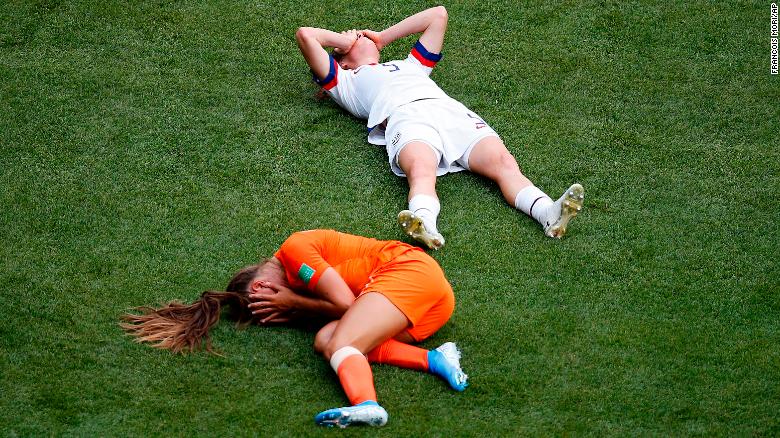
Competing in its first World Cup final, few gave the Dutch hope. The reigning European champion it may be, but it had not yet come up against the best team in the world, the dominant force of its generation.
The Netherlands held on for over an hour but two goals within eight minutes sealed the underdog’s fate. In a tournament where she has transcended her sport, Megan Rapinoe coolly drilled home a penalty before a Rose Lavelle thunderbolt made sure of a second successive title for the US.
All dynasties eventually fall apart, but the US’ reign has yet no true challenger.
This is the World Cup where it became apparent that the USWNT is being rapidly pursued by those European countries whose men’s national teams have long since been a force.
Leading the chase is the Netherlands, European champion and a finalist in just its second World Cup, which is part of a pack, but all challengers have been vanquished.
Thailand, Chile, Sweden, Spain, France, England and now the Netherlands have all swept aside by a team which is now unbeaten in 17 World Cup matches.


Stars: What would a WWC win mean for USWNT?

The Netherlands soaked up the pressure in the first half. There were white shirts coming at them from every direction, directing crosses from wide, from deep, attempting cute through-balls to catch the World Cup novices off their guard.
Those in orange needed to summon up the concentration levels of a chess grand master, but that’s what it’s like facing a team with a relentless desire to win. They are always in motion; keeping possession, positioning themselves high up the pitch, never resting. Opponents are left to backpedal, to organize and resist when under intense stress.
And then there is the crowd raising the decibels; moving towards the edge of their seats in anticipation of that killer through ball, roaring at every shot that seems to be flying towards goal, making it impossible to forget that this is a match like no other. Grand masters, at least, have the privilege of focusing in silence.
In such circumstances the pulse quickens, the mind whirs. The grandest of sporting stages are always as much a mental battle as physical.

Women's World Cup: Megan Rapinoe 1-on-1

That the Netherlands held firm, until the hour mark at least, was admirable. It is the only team in this tournament which the USWNT has been unable to breach within the opening 12 minutes.
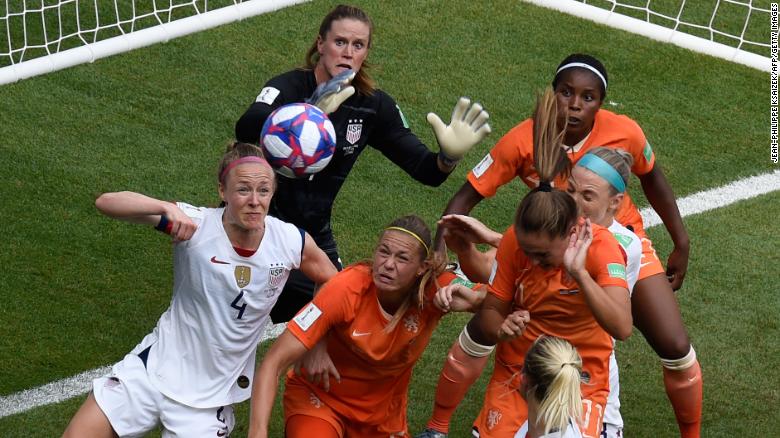
Much of the credit will be heaped on the acrobatic Dutch goalkeeper Sari van Veenendaal. First, she saved a Julie Ertz volley, then the woodwork assisted her gather of the first of two Alex Morgan attempts. It was pure instinct which saw her deny Morgan for the second time before the break.
Had the Netherlands been able to maintain its composure in the final third then history may have been pointing to this match as the one where the emerging forces unseated the traditional powerhouse.
Had Alyssa Naeher not sprinted off her line at the sight of Lineth Beerensteyn charging towards goal the Netherlands could have gone ahead. It was a moment which highlighted the US defense’s occasional vulnerability to be cut open with a clever pass.
When French referee Stephanie Frappart opted to bring VAR into play, showing Stefanie van der Gragt to have felled Alex Morgan, it was almost certain that the penalty would be awarded.
Rapinoe stepped up to score her sixth goal of the tournament and celebrated with her arms outstretched in a pose which has become iconic during a tournament where the forward has gone on to transcend her sport.
Her teammates engulfed her near the corner flag, with even the substitutes sprinting half the length of the pitch to join the celebrations. Given the doggedness of Dutch resistance the relief of the US team was tangible.
It was only after going 1-0 down that the Netherlands attack, its most potent weapon, seemed to feel at ease in its surroundings, but teams who fall behind to the USWNT rarely recover.
And so it proved as Lavelle, a midfielder whose ability to attack at pace from midfield has been a highlight of these last four weeks, lazered a shot into the bottom corner.
Were it not for Van Veenendaal the score could have been higher. The 29-year-old stopped Morgan, Tobin Heath and Crystal Dunn from making it three.

There is no ‘right’ v ‘left’: it is Trump and the oligarchs against the rest

The Guardian

There is no ‘right’ v ‘left’: it is Trump and the oligarchs against the rest

The president is the puppet master so Americans of all persuasions must look behind him, to where the real danger lies

Robert Reich         July 7, 2019

Donald Trump makes two fists while making a public appearance.
Donald Trump makes two fists while making a public appearance. Photograph: Craig J Orosz/AP


I keep hearing that the Democratic party has moved “left” and that Democratic candidates may be “too far left”.

But in an era of unprecedented concentration of wealth and political power at the top, I can’t help wondering what it means to be “left”.

A half-century ago, when America had a large and growing middle class, those on the “left” sought stronger social safety nets and more public investment in schools, roads and research. Those on the “right” sought greater reliance on the free market.

But as wealth and power have concentrated at the top, everyone else – whether on the old right or the old left – has become dis-empowered and less secure.

Safety nets have unraveled, public investments have waned and the free market has been taken over by crony capitalism and corporate welfare cheats. Washington and state capitals are overwhelmed by money coming from the super rich, Wall Street and big corporations.

So why do we continue to hear and use the same old “right” and “left” labels?

I suspect it’s because the emerging oligarchy feels safer if Americans are split along the old political battle lines. That way, Americans won’t notice they’re being shafted.

In reality, the biggest divide in America today runs between oligarchy and democracy. When oligarchs fill the coffers of political candidates, they neuter democracy.

The oligarchs know politicians won’t bite the hands that feed them. So as long as they control the money, they can be confident there will be no meaningful response to stagnant pay, climate change, military bloat or the soaring costs of health insurance, pharmaceuticals, college and housing.

There will be no substantial tax increases on the wealthy. There will be no antitrust enforcement to puncture the power of giant corporations. There will be no meaningful regulation of Wall Street’s addiction to gambling with other peoples’ money. There will be no end to corporate subsides. CEO pay will continue to skyrocket. Wall Street hedge fund and private equity managers will continue to make off like bandits.

So long as the oligarchy divides Americans – split off people of color from working-class whites, stoke racial resentments, describe human beings as illegal aliens, launch wars on crime and immigrants, stoke fears of communists and socialists – it doesn’t have to worry that a majority will stop them from looting the nation.

Divide-and-conquer allows the oligarchy free rein. It makes the rest of us puppets, fighting each other on a made-up stage.

Trump is the puppet master.

He has been at it for years, long before he ran for president. He knows how to pit native-born Americans against immigrants, the working class against the poor, whites against blacks and Latinos.

He is well-versed in getting evangelicals and secularists steamed up about abortion, equal marriage rights, out-of-wedlock births, access to contraception, transgender bathrooms.

He knows how to stir up fears of brown-skinned people from “shitholes” streaming across the border to murder and rape, and stoke anger about black athletes who don’t stand for the national anthem.

He’s a master at fueling anxieties about so-called communists, socialists and the left taking over America.

He can make the white working class believe they’ve been losing good jobs and wages because of a cabal of Democrats, “deep state” bureaucrats and Hillary Clinton.

From the start, Trump’s deal with the oligarchy has been simple: he’ll stoke tribalism so most Americans won’t see CEOs getting exorbitant pay while they’re slicing the pay of average workers, so most Americans won’t pay attention to Wall Street demanding short-term results over long-term jobs, won’t notice a boardroom culture that tolerates financial conflicts of interest, insider trading and the outright bribery of public officials through unlimited campaign “donations”.

The only way to overcome the oligarchy and Trump’s divide-and-conquer strategy is for the rest of us to join together and win America back.

That means creating a multi-racial, multi-ethnic coalition of working-class, poor and middle-class Americans who will fight for democracy and oppose oligarchy.

White, black and Latino; union and non-union; evangelical and secular; immigrant and native-born – all focused on ending big money in politics, stopping corporate welfare and crony capitalism, busting up monopolies and stopping voter suppression.

This agenda is neither “right” nor “left”. It is the bedrock for everything else America must do.

Higher education being destroyed by Republicans

Raw Story

University of Alaska is the ‘worst-case scenario’ of higher education being destroyed by Republicans: reporter

By Matthew Chapman      July 5, 2019

Alaska has been thrown into chaos as newly elected Republican Gov. Mike Dunleavy used a line-item veto to slash funding for the public university system by 41 percent — a devastating blow that has the already cash-strapped University of Alaska scrambling to furlough professors and cancel classes.


It’s a nightmare situation for the state — and, wrote Adam Harris for The Atlantic, a “worst-case scenario” of what happens when higher education becomes a partisan issue.

“It has not been uncommon to see significant cuts by states to higher-education funding—particularly during economic slowdowns—but ‘it is uncommon to do it in one fell swoop,’ Nick Hillman, an associate professor of higher education at the University of Wisconsin at Madison, told me,” wrote Harris. “Alaska had a deficit, and the governor had promised not to raise taxes to deal with it, so he chose a favored punching bag to take the hit instead: higher education.”

The problem, Harris said, is that over the past several years, public views of colleges and universities have become sharply split, with Republican confidence declining by double digits — a trend bolstered by right-wing media outrage about supposed liberal bias and censorship of conservatives on campuses. And that means that university budgets are increasingly at risk of being on the chopping block in some red states — especially states where, as in Alaska, a single politician has the power to axe $130 million with the stroke of a pen.

“In rural states, where many residents lack easy access to colleges and universities, those cuts can hit especially hard,” wrote Harris. “The elimination of state funding, the Alaska system’s president lamented, could result in the closure of one of its campuses. The students who rely on that university would be left in the lurch, needing to travel farther to get to one of the school’s remaining campuses. The task of getting an education, for those in rural communities where a college degree is already hard to come by, would become a little harder.”

“Alaska may be an extreme case, but it shows one possible fate for public colleges in an age of mistrust: wounded by a thousand small cuts, and then a machete,” Harris concluded.

The first African woman to receive the Nobel prize.

Brut Nature

May 22, 2019

She was theC. Here is the extraordinary story of Wangari Maathai, one of the world’s most important ecologist.

Portrait of Wangari Maathai

She was the first African woman to receive the Nobel prize. Here is the extraordinary story of Wangari Maathai, one of the world's most important ecologist.

Posted by Brut nature on Wednesday, May 22, 2019

Mr. Rogers understands what trump will never know.

NowThis Politics

July 5, 2019

Mr. Rogers’ commencement speech at Dartmouth is exactly what we need right now

Mr. Rogers' Dartmouth Commencement Speech Is What We All Need Right Now

Mr. Rogers’ commencement speech at Dartmouth is exactly what we need right now

Posted by NowThis Politics on Friday, July 5, 2019

Algae blooms. Iguanas headed north. That’s climate change.

Tampa Bay Times – Editorial

Algae blooms. Iguanas headed north. That’s climate change. | Editorial

Alarm bells that a warming climate is impacting the Sunshine State.
July 5, 2019
An aerial photo shows blue-green algae enveloping an area along the St. Lucie River in 2016. Algae has been spotted in Gulfport and Treasure Island in recent weeks. Associated Press (2016)
An aerial photo shows blue-green algae enveloping an area along the St. Lucie River in 2016. Algae has been spotted in Gulfport and Treasure Island in recent weeks. Associated Press (2016).


It’s been a tough week for anyone who cares about Florida’s environment and the effects of climate change. First, we learned that blue-green algae is infecting waterways in Treasure Island and Gulfport. There’s no way to know exactly what caused the most recent outbreak of the foul smelling ooze, but it’s a good bet we brought this on ourselves, or at least helped make it worse. Whether it’s leaky septic tanks, runoff from our lawns or too much farm waste flowing into waterways, we’ve created conditions ripe for algae to take hold. And don’t forget that a 2014 Climate Assessment Report predicted more blooms in Florida as the globe warms.

In recent years, massive algae blooms contaminated the St. Lucie and Caloosahatchee rivers, which flow from they highly polluted Lake Okeechobee. The algae choked ecosystems and killed fish and other marine life. Fishing guides, retailers and other businesses that rely on the rivers lost money. Aerial images of the bright green menace were beamed around the world, hardly the best advertisement for a state that relies heavily on tourism.

Algae blooms can happen naturally, without human help. But there’s growing evidence that we are providing fuel for more blooms that grow larger and stick around longer. We shouldn’t think of that as a new normal, another reality of living in Florida that we can’t do anything about. We can and we should. Gov. Ron DeSantis took a good first step recently by creating the Blue-Green Algae Task Force. But it can’t be window dressing. The task force needs to come up with practical solutions. This is not the time for partisan bickering.

This week we also learned how roseate spoonbills have adapted to the changing climate by migrating away from South Florida and into central and north Florida, Georgia and South Carolina. While the spoonbills have so-far thrived, the same article reiterated that 40 percent of the Earth’s 10,000 bird species are in decline, thanks in large part to human interference.

A separate report came out about how green iguanas have moved further north in Florida thanks to a warming planet. The invasive species already plague several south Florida counties. Their digging causes erosion and undermines water control projects including canals and sea walls. Green iguanas are such a scourge that the Florida Fish and Wildlife Conservation Commission encourages homeowners to kill any that wander onto their property.

Finally, an analysis of satellite imagery showed that sprawling mats of sargassum seaweed floating in the Atlantic are much more prevalent than before 2011. Reports of sargassum-clogged oceans date back to at least Christopher Columbus, but something has changed in recent years, the researchers concluded. They correlated the sargassum explosion to an increase in fertilizer used on farms that continue to replace the Amazon rainforest. Florida’s beach communities should expect more of the seaweed, which stinks as it decays, they said.

Too many of Florida’s leaders have been slow to react to climate change and the assault on the state’s environment. Too many denied anything was happening before moving onto the equally absurd notion that humans have little or no influence on the changes. That’s dangerous thinking, and fortunately it seems to be on the decline in Tallahassee. The state must be cleared-eyed about the environmental realities. This week’s news highlights why.

Four Florida beaches post health warnings for water quality

Tampa Bay Times – The Buzz

Four Florida beaches post health warnings for water quality

None are in Tampa Bay, however beaches in Hernando and Pasco tested for elevated levels of bacteria that could pose risks if the water quality continues to decline.

Sign at the entrance to Robert J. Strickland Memorial Park in Hudson. It’s better known as Hudson Beach Park. [CAROLYN EDDS | Times]

TALLAHASSEE — On one of the busiest beach weekends of the year in Florida, the state Department of Health warns that four Florida beaches — including three in Sarasota County — pose health hazards for beach goers because of high fecal levels.

“Water at this site may pose increased risk of infectious disease particularly for susceptible individuals,’’ the agency warns in a nondescript notice on its Healthy Beaches web site, which lists water test results for the sites the state tests.

Although the agency lists only one beach as receiving a health advisory, a review of the water sample reports by the Times/Herald found that four health advisories have been issued: one at the Panama City Beach Access in Bay County and three others in Sarasota County: Brohard Park, Lido Casino Beach and Venice Beach.

The warnings come a year after toxic algal blooms closed beaches across the state during the Fourth of July weekend and beyond. So, if there is any good news to the warnings this year, state regulators reported on Wednesday that “there are currently no known algal blooms affecting Florida beaches.”

But at the four beaches in which advisories have been issued, contamination from flesh-eating bacteria is now a new concern. In the last month, two cases of life-threatening infections have been reported from Florida waters .

A 77-year-old woman from Ellenton fell and scraped her leg while walking on Anna Maria Island and died two weeks later because of an infection from a flesh-eating bacteria. The report came just weeks after the mother of a 12-year-old Indiana girl wrote on Facebook that she believes her daughter contracted the same infection during a trip to Destin in early June.

Both are believed to have suffered from “necrotizing fasciitis,” an infection caused by bacteria that stops blood circulation and causes tissue to die and skin to decay. The infection, although rare, can come from different strains of bacteria found in the water and on sand, health officials say.

It is called “flesh-eating” because the infection progresses rapidly. In April, two men reported cases of necrotizing fasciitis in Tampa Bay after spending time on the water.

When the Department of Health issues an advisory, it means that water samples have been tested and re-tested to confirm that the bacteria levels are dangerous and the water is too contaminated to enter.

“These indicate that contact with the water at this site may pose increased risk of infectious disease particularly for susceptible individuals,“ DOH said on its Healthy Beaches web site. State officials are warning people to stay away from swimming in these waters with a wound or cut, and to refrain from eating uncooked seafood.

The Department of Health samples the water in dozens of beaches in the state’s 26 coastal counties and relies on the public to check its web site to get the word out. The agency posts data “in real-time to the DOH Healthy Beaches webpage,” and posts advisory signs at the beach and sends out media alerts, said Brad Dalton, spokesperson for the Florida Department of Health.

According to the most recent water samples, 16 beaches in 11 counties — including in Miami-Dade and Broward counties — have elevated levels of bacteria that could pose risks if the water quality continues to decline.

In Miami-Dade, Dog Beach on the south side of Virginia Key Beach has tested as having “poor” or high levels of bacteria, with 70.5 parts per 100 ml of marine water on July 1. Oleta State Park also tested as having moderately elevated levels with between 35.5 to 70.4 per 100 ml.

In Broward, two beaches — Dania Beach and Commercial Boulevard Pier — tested for higher levels of bacteria. Monroe County hasn’t had its beaches tested since June 25, according to the Department of Health, and all received a good rating.

But new information won’t be updated until after the weekend, Dalton said.

“Lab tests take 24 hours to incubate after sampling and delivery time; thus the process takes two consecutive days to collect sample and get lab results, so it is unlikely any testing will be done over the holiday or on the weekend,’’ he said.

Beaches with high bacteria levels

Miami Dade — one poor, one moderate:

• Dog Beach (Virginia Key Beach, South side) tested as having poor levels of 70.5 per 100 ml of marine water on July 1.

• Oleta State Park tested as having moderately elevated levels – between 35.5 to 70.4 on July 1.

Broward — two moderate:

• Dania Beach — tested as having moderately elevated levels — between 35.5 to 70.4 on July 1.

• Commercial Boulevard Pier — tested as having moderately elevated levels — between 35.5 to 70.4 on June 17.

Bay — one health advisory:

• Panama City Beach Access — tested as having poor levels of 70.5 per 100 ml of marine water on June 24 and again on July 2. An advisory has been issued.

Collier — one moderate:

• Hideaway Beach — tested as having moderately elevated levels — between 35.5 to 70.4 on June 19.

Escambia — two moderate:

• Sanders Beach — tested as having moderately elevated levels — between 35.5 to 70.4 on July 1.

• Bayou Texar — tested as having moderately elevated levels — between 35.5 to 70.4 on June 24.

Flagler — one moderate:

• North Flagler Pier — tested as having moderately elevated levels — between 35.5 to 70.4 on June 18.

Franklin — one moderate;

• St. George Island at 11th St. — tested as having moderately elevated levels — between 35.5 to 70.4 on June 24.

Hernando — one moderate:

• Pine Island Beach — tested as having moderately elevated levels — between 35.5 to 70.4 on June 18.

Martin — one moderate:

• Jensen Beach — tested as having moderately elevated levels — between 35.5 to 70.4 on June 17.

Okaloosa — three moderate:

• Henderson Park Beach — tested as having moderately elevated levels — between 35.5 to 70.4 on June 24.

• Lincoln Park — tested as having moderately elevated levels — between 35.5 to 70.4 on June 24.

• Rocky Bayou State Park —tested as having moderately elevated levels — between 35.5 to 70.4 on June 24, an improvement over its poor test on June 10.

Pasco — one poor:

• Robert J. Strickland Beach — tested as having poor levels of 70.5 per 100 ml of marine water on June 24 and it was listed as moderate on July 1.

Sarasota — 3 beach advisories:

• Brohard Park — tested as having poor levels of 70.5 per 100 ml of marine water on July 1 and again on July 2, an advisory has been issued.

• Lido Casino Beach — tested as having poor levels of 70.5 per 100 ml of marine water on July 1 and again on July 2, an advisory has been issued.

• Venice Beach — Tested as having poor levels of 70.5 per 100 ml of marine water on July 1 and again on July 2, an advisory has been issued.

Wakulla — one moderate:

• Mash’s Island — tested as having moderately elevated levels — between 35.5 to 70.4 on June 24.

Anchorage was 90 degrees on July 4. That’s not a typo

CNN

Anchorage was 90 degrees on July 4. That’s not a typo

The temperature at the airport was 90 degrees Thursday, besting June 14, 1969, for the highest mark ever recorded in the city, according to the National Weather Service.
Across south Alaska, the mercury was expected to rise to record or near-record levels on the nation’s 243rd birthday and continue at above-average levels through next week, the National Weather Service reports.
Last month was the warmest June on record, with an average temperature of 60.5 degrees — 5.3 above average, according to the National Weather Service Anchorage, whose records for this location date to 1954 (66 total Junes). June marks the 16th consecutive month in which average temperatures ranged above normal.
“All 30 days in June had above average temperatures,” the service noted.
Meanwhile, a large upper-level high pressure system is building over Alaska and will draw warm air from the south and blow winds offshore — in the opposite direction of “sea breezes,” which bring cooler air from over the ocean to the land, the Weather Service predicts.
As the high pressure shifts out of southern Alaska, cooling sea breezes will return on Friday afternoon, allowing temperatures to drop slightly, at least along the coast. Over the weekend and into next week, thermometer readings are expected to fall in the region, even if temperatures remain above average.
June was the driest on record, with 0.06 inches of rain. (Normal monthly precipitation in June is 0.97 inches, so June received just 6% of its normal precipitation.) This ends a two-month streak with above-average precipitation, the weather service noted.
The state remains ripe for wildfires, spurring the Alaska State Fire Marshal’s Office to ban the sale and use of fireworks in certain areas, including Fairbanks North Star borough, the Kenai Peninsula Borough, the Matanuska-Susitna Borough and the Northern Panhandle.
Fires are a concern for Alaskans every year, but warm dry weather patterns caused heavy smoke and cloud from the Swan Lake Fire to affect the Anchorage area and Kenai Peninsula this week, according to the Alaska Interagency Coordination Center.
Smoke from the smoldering fire, which was started by lightning on June 5 in the Kenai National Wildlife Refuge, will continue to affect the peninsula into the weekend, the center reports. Smoke contains many substances, including carbon dioxide and particulate matter, that may contribute to poor health.
As of Independence Day, the Alaska Interagency Coordination Center estimates that wildfire has burned 634,000 Alaskan acres, which is significantly but not dramatically more than is typical for this point in the season, Rich Thoman, an Alaska climate specialist with the Alaska Center for Climate Assessment & Policy, noted in a holiday tweet.
Fire, rain and heat are not the only issues influencing the state: Ice cover across Alaska, which normally lasts through the end of May, disappeared in March, according to the Alaska Center for Climate Assessment and Policy:
Southerly winds in the Bering Sea have melted ice at an alarming rate, driving temperatures up, said climatologist Brian Brettschneider of the International Arctic Research Center. Ocean temperatures in the region have never been this high, and communities in northern and western Alaska have seen temperatures close to June records.
Atmospheric patterns have also placed Alaska in an unlucky spot this year, Brettschneider noted.
“Next year, the winds could turn northerly. That tends to mask a warming signal,” said Brettschneider, who believes that the planet is warming long-term. “What is happening in coastal Alaska is what is coming in one sense for everybody else. Changes are happening, and changes will be magnified.”

Correction: A previous version of this report incorrectly stated the geographic area covered by Thursday’s temperature record. Ninety degrees is the highest mark recorded in the city of Anchorage, not the entire state. This update also corrects the number of years since the United States became a nation.