Details: Two-thirds of Americans say extreme weather events in the U.S. have been occurring more frequently than in the past, while only 28% said they’ve been taking place about as often, and just 4% perceiving a dropoff in frequency.
When it comes to extreme weather events in their backyards, 46% of U.S. adults say the area where they live has had an extreme weather event over the past year.
The area with the greatest number of people reporting an extreme weather event was the South Central Census Division. It includes Louisiana, a state hit hard by Hurricane Ida and heavy rainfall events.
Yes, but: Even on perceptions of extreme weather events, there is a partisan split, the survey found, with Democrats and Democratic-leaning independents more likely to report experiencing extreme weather than Republicans and Republican-leaning independents.
The survey of 10,371 Americans took place from Sept. 13–19, 2021, and has a margin of error of plus or minus 1.6 percentage points.
Kyrsten Sinema. Illustrated | Getty Images, iStock, Library of Congress
The left-leaning group Data For Progress on Thursday released genuinely brutal poll numbers for Sen. Kyrsten Sinema (D-Ariz.), whose very public role in holding up President Biden’s agenda is clearly not wearing well with her state’s primary electorate.
The survey of likely voters for her 2024 Democratic Senate primary showed just 25 percent approval for Sinema’s performance in office, as opposed to 85 percent for Arizona’s other Democratic senator, Mark Kelly, and President Biden himself. Tellingly, she trailed all four of her hypothetical primary opponents by 29 points or more.
The brewing revolt of the Arizona Democratic electorate should terrify Sinema — assuming that she has any interest in being re-elected as a member of the Democratic Party. Unlike her partner in obstruction, Sen. Joe Manchin (D-W.Va.), Sinema is not the only Democrat who could plausibly be elected to statewide office in her state. And her troubles suggest that the stalwart Democrats who vote in primary elections are yearning for the kind of party discipline former President Donald Trump imposed on wavering Republicans.
Sinema’s dreadful numbers, in fact, look a lot like those of former Arizona Republican Sen. Jeff Flake in the 2018 election cycle. One of the most prominent Trump critics in the Senate both before and after Trump’s election, Flake trailed ultraconservative Republican Kelli Ward by 27 points in a hypothetical primary, and boasted the exact same 25 percent approval number among likely GOP primary voters (albeit much closer to Election Day than Sinema is now). Seeing the writing on the wall, Flake chose to retire rather than face a near-certain primary drubbing.
Unlike Flake, a frequent recipient of Trump’s juvenile invective, Sinema has barely received any public criticism from Biden, suggesting Arizona Democrats resent her largely for opposing popular policies like paid family leave and expanded Medicare benefits. And unless she relents and helps craft a social spending bill acceptable to all factions of her party, she’s likely to follow Flake’s path to political oblivion.
What climate change and sea level rise will do to American cities
Ben Adler, Senior Climate Editor October 13, 2021
The space center in Houston surrounded by a moat; the famous beach in Santa Monica, Calif., completely submerged; a former sports stadium in Washington, D.C., turned into a bathtub — these are just some of the startling images of the future in America’s largest cities without action to limit climate change, according to new research by Climate Central, a research and communications nonprofit.
Because of greenhouse gas emissions from burning fossil fuels, average global temperatures have already risen 1.2° Celsius (2.2° Fahrenheit) above the preindustrial era, but as glaciers and polar ice caps melt, there is a decades-long lag for sea level rise. So a team of researchers from Climate Central projected how much the waters will rise if the world reaches only 1.5°C of warming, which is the goal world leaders set forth in the 2015 Paris climate agreement.
Hover over and click/hold slider for before and after: https://flo.uri.sh/visualisation/7520888/embed?auto=1
But even limiting temperature rise to 1.5°C will result in flooding in and around some key sites. Santa Monica, for example, will lose its beach at 1.5°C of warming, once sea level rise has caught up. The projections also show how much more the tide will rise in the heart of some of the world’s largest cities and most famous sites if that warming is doubled, which will happen within 100 years if nations take no action to combat climate change.
“We’re expecting, based on our current warming track, to reach something close to 3°C this century,” said Peter Girard, communications director at Climate Central. “It will take a long time for the seas to rise to match that temperature. It may be centuries in the future, but we can understand with relative precision where it will eventually settle.”
And that place will be unsettling to many. Whether it’s an international landmark like London’s Buckingham Palace or a more obscure site like the Texas Energy Museum being underwater, the images of city streets turned to rivers and once-inhabitable buildings sticking out of the water like piers are a striking warning of what may be to come. https://flo.uri.sh/visualisation/7521374/embed?auto=1
Of course, in reality these buildings aren’t even necessarily going to be there if the world breaches 2°C of warming. Long before an area is actually underwater, it will face regular flooding from heavy rainfalls and storm surges — which are also becoming more frequent and severe because of climate change. Buckingham Palace in London and Robert F. Kennedy Memorial Stadium in Washington, D.C., will have to be abandoned due to rising waters unless dramatic action is taken to save them.
Even though the nation’s capital and other U.S. cities such as Philadelphia included in the study aren’t on the coastline, they are connected to the ocean by rivers, and their riverfront areas are projected to face much higher water levels.
The consequences of sea level rise will fall hardest in the developing world, where huge populations live in large coastal cities. According to a paper published on Oct. 11 in the journal Environmental Research Letters by the Climate Central researchers behind the project, if greenhouse gas emissions continue at a high level and warming reaches 4°C, “50 major cities, mostly in Asia, would need to defend against globally unprecedented levels of exposure, if feasible, or face partial to near-total extant area losses.” https://flo.uri.sh/visualisation/7522014/embed?auto=1
A major inflection point in the effort to prevent such catastrophic climate change is approaching when the successor to the Paris agreement is negotiated in early November in Glasgow, Scotland. Currently, nations have not pledged enough emissions cuts or climate finance to avert the warming scenarios that Climate Central explored, but the organization’s hope is to help spur more aggressive action.
“One of the opportunities to make decisions at an international level is coming up in Glasgow, and hopefully this work by visualizing the stakes contributing to a positive outcome,” Girard said.
A half-mile installation just took 20,000 pounds of plastic out of the Pacific – proof that ocean garbage can be cleaned
Aria Bendix October 15, 2021
An offshore Ocean Cleanup crew visiting the new device in the ocean. The Ocean Cleanup
The Ocean Cleanup, a nonprofit organization, aims to rid the world’s oceans of plastic.
It recently debuted a device it said collected 20,000 pounds from the Great Pacific Garbage Patch.
But some scientists worry the device still isn’t effective or environmentally friendly enough.
It’s been nearly a decade since Boyan Slat announced at age 18 that he had a plan to rid the world’s oceans of plastic.
Slat, now 27, is a Dutch inventor and the founder of the Ocean Cleanup, a nonprofit that aims to remove 90% of floating ocean plastic by 2040.
That goal has often seemed unattainable. The Ocean Cleanup launched its first attempt at a plastic-catching device in 2018, but the prototype broke in the water. A newer model, released in 2019, did a better job of collecting plastic, but the organization estimated that it would need hundreds of those devices to clean the world’s oceans.
What if we paved roads with plastic trash?
Scientists and engineers began to question whether the group could deliver on the tens of millions of dollars it had acquired in funding.
But over the summer, the organization pinned its hopes on a new device, which it nicknamed Jenny. The installation is essentially an artificial floating coastline that catches plastic in its fold like a giant arm, then funnels the garbage into a woven funnel-shaped net. Two vessels tow it through the water at about 1.5 knots (slower than normal walking speed), and the ocean current pushes floating garbage toward the giant net.
In early August, the team launched Jenny in the Great Pacific Garbage Patch, a trash-filled vortex between Hawaii and California. The garbage patch is the largest accumulation of ocean plastic in the world, encompassing more than 1.8 trillion pieces, according to the Ocean Cleanup’s estimates.
Last week, Jenny faced its final test as the organization sought to determine whether it could bring large amounts of plastic to shore without breaking or malfunctioning. The Ocean Cleanup said the device hauled 9,000 kilograms, or nearly 20,000 pounds, of trash out of the Pacific Ocean – proof that the garbage patch could eventually be cleaned up.
“Holy mother of god,” Slat tweeted that afternoon, adding, “It all worked!!!”
Slat’s ocean-cleaning device has come a long way since the original prototype: a 330-foot-long floating barrier that resembled a long pipe in the water.
The newest version is U-shaped and more flexible, like the lane dividers in a pool. Once its attached net fills with plastic (every few weeks or so), a crew hauls it up out of the water and empties the garbage onto one of the vessels that pull it.
The Ocean Cleanup’s new plastic-catching system, nicknamed Jenny, in the Great Pacific Garbage Patch. The Ocean Cleanup
Once it’s brought to shore, the plastic gets recycled. For now, the Ocean Cleanup is using the plastic to make $200 pairs of sunglasses, funneling the proceeds back into the cleanup efforts. Eventually, the organization hopes to partner with consumer brands to make more recycled products.
Slat estimated that the team would need about 10 Jennys to clean up 50% of the Great Pacific Garbage Patch in five years. A single device can hold 10,000 to 15,000 kilograms of plastic, he tweeted.
Concerns about the ocean-cleaning device linger
Plastic accumulating in a net, or “retention zone.” The Ocean Cleanup
The Ocean Cleanup system collects several types of floating garbage, including large containers, fishing nets, and microplastics just a few millimeters in size. But it captures only plastic floating near the ocean’s surface. A study published last year suggested that there may be upwards of 30 times as much plastic at the bottom of the ocean as there is near the surface.
The organization says large pieces of floating plastic will ultimately degrade into microplastics that are much harder to clean up.
The Jenny device, of course, doesn’t prevent plastic from entering oceans to begin with. Researchers have estimated that about 11 million metric tons of plastic are dumped into the ocean each year. By 2040, that figure could rise to 29 million metric tons. Ten Jenny devices would be able to collect 15,000 to 20,000 metric tons a year, according to the Ocean Cleanup.
An Ocean Cleanup member sorting plastic on one of the team’s support vessels. The Ocean Cleanup
What’s more, the boats that pull the Jenny device require fuel, meaning there’s an environmental cost. The device was originally designed to passively collect plastic using the ocean’s current, but that design led to it spilling too much of the trash it had collected. The Ocean Cleanup says it’s purchasing carbon credits to offset the towing vessels’ emissions.
“Once plastic has gotten into the open ocean, it becomes very expensive and fossil-fuel intensive to get it back out again,” Miriam Goldstein, the director of ocean policy at the think tank Center for American Progress, told Reuters last month.
But Slat tweeted on Saturday that there’s still time to address those concerns.
“Lots of things still to iron out,” he wrote of his group’s plastic-cleaning work, “but one thing we now know: deploy a small fleet of these systems, and one *can* clean it up.”
Lake Tahoe water level hits four-year low as drought pummels tourist spot
Dani Anguiano in Los Angeles October 13, 2021
Lake Tahoe’s water level dropped to a four-year low on Tuesday as gusty winds and the impacts of California’s devastating drought hit the popular tourist destination.
After days of high winds increased evaporation rates, water levels fell to the basin’s natural rim for the first time since 2017, the end of the state’s last drought. The lake normally sits above the rim, which allows for water to flow into the Truckee River. Levels will probably continue to drop, receding below the rim this week, sooner than expected.
Though the lake’s water levels have fallen to this point several times in recent years, this week’s drop concerns researchers like Geoffrey Schladow, the director of the UC Davis Tahoe Environmental Research Center.
“It’s a sign of change at the lake,” Schladow said. “Change is very difficult to manage … When we start seeing things we’ve never experienced before at a greater frequency, it’s challenging.”
Officials reported earlier this year that Lake Tahoe was experiencing its third-driest year since 1910. Between June 2020 and June 2021, the lake dropped about 3ft.
Once the lake falls below its natural rim, it will stop flowing into the Truckee River, cutting off a major source of water to the river, and the region will see more algae washing up on beaches. Winter weather will ultimately determine how long the low water levels will last, and the extent of the impacts in the region. Though snow has fallen in the area in the last month, water levels could fall below the rim again by next summer with even an average year of precipitation, Schladow said.
“To me the big danger is next summer,” he said.
Empty chairs stand on the beach with the sky obscured by the smoke of the Caldor fire, in South Lake Tahoe, California, in August. Photograph: Aude Guerrucci/Reuters
Declining lake levels are already affecting the shoreline, drying up coves and boat ramps and forcing tour boat operators to find new ways to get customers on to the water, the San Francisco Chronicle reported.
“You can’t get within 150 yards of the normal shoreline” in South Lake Tahoe, Kelsey Weist, the owner of Clearly Tahoe, which runs tours around the lake, told the newspaper.
The entire region is grappling with impacts of the drought and the climate crisis. The US Forest Service cancelled Lake Tahoe’s annual fall salmon festival because low water levels meant Kokanee salmon would not spawn in nearby Taylor Creek.
Lake Tahoe saw unusually high water temperatures over the summer, a worrying development as warmer water makes the lake more hospitable to invasive species.
Meanwhile, the Caldor fire imperiled the region, forcing mass evacuations, upending the tourism industry and showering the area – and the lake – in thick ash. Smoke from the fire cooled the water temperature and reduced clarity in the lake, and researchers are still evaluating its impact.
The climate crisis will have major effects on the lake in the coming years, warming water, affecting oxygen levels and potentially increasing wind events that could further diminish water levels.
Schladow said combating climate change largely required action globally, but there were things that could be done locally to help the lake. Decreasing driving in the Tahoe Basin would help reduce the amount of algal growth in the lake, as would using fewer fertilizers on lawns and gardens.
“A lot of what we’ve been advocating is to try to build the resilience of the lake to climate change,” he said. “This is going to keep happening – how can we make the lake better able to withstand it?”
Flooding could shut down a quarter of all critical infrastructure in the U.S.
Andrew Freedman October 11, 2021
About 25%, or 1 in 4 units of critical infrastructure, such as police stations, airports and hospitals, are at risk of being rendered inoperable due to flooding, a comprehensive new report finds. The report points to climate change for heightening risks.
Why it matters: The new national inventory of flood risk during the next thirty years, which takes into account climate change-driven increases in sea levels and heavy precipitation events, is the first of its kind.
The report, from the First Street Foundation, a nonprofit flood research and communications group, presents a stark warning to communities of all sizes — the U.S. simply isn’t ready for the climate of today, let alone the extreme weather and climate events that are coming in the next few decades.
Specifically, during the next 30 years as the climate continues to warm, the flood risk situation will grow more dire, the report warns.
By the numbers: Consider these aggregate statistics from the “Infrastructure on the Brink” report:
About 2 million miles of road are currently at risk of becoming “impassable” due to flooding.
Nearly a million commercial properties, 17% of all social infrastructure facilities, and 12.4 million residential properties also have “operational risk,” according to the First Street analysis.
Over the next 30 years, the typical lifetime of a home mortgage, about 1.2 million residential properties, and 2,000 pieces of critical infrastructure (airports, hospitals, fire stations, hazardous waste sites and power plants) will also be at risk of becoming inoperable due to flooding from sea level rise, heavy rainfall, and in some cases a combination of the two, the report finds.
Infrastructure at risk of becoming inundated due to flooding in today’s climate. Courtesy: First Street Foundation
Context: The report comes during a year that has already featured a record 18 separate billion-dollar weather and climate disasters in the first nine months of the year, according to the National Oceanic and Atmospheric Administration (NOAA).
According to the First Street analysis, which uses an open-access flood model that incorporates coastal and inland flooding, the most at risk county in the U.S. for flood risk is tucked into the extreme southwestern corner of Louisiana. Cameron Parish is sparsely populated, with just 5,600 people as of the 2020 Census, but it’s a hotbed of flood risks.
Of note: In Cameron Parish, the report shows that nearly 99% of residential properties, and similarly sky high counts of commercial and critical infrastructure structures, are already at risk of flooding so severe that it would knock them out of service.
Six of the seven top counties for risk are in the New Orleans area, Jeremy Porter, head of research and development at First Street, told Axios.
The communities most at risk are located in Louisiana, Florida, Kentucky and West Virginia, with 17 out of the 20 most at-risk counties in the country located in those states, the analysis concluded.
The city slated to see one of the biggest jumps in vulnerability between now and 2050 is Norfolk, Virginia, which is home to the world’s largest naval base, among other military installations.
How it works: Human-caused climate change is increasing sea levels around the world, but seas are rising especially quickly in the Mid-Atlantic region due largely to peculiarities in ocean currents.
In addition, Warming ocean and air temperatures are also translating into added water vapor in the atmosphere that can fuel stronger storms with heavier downpours.
The most recent report from the UN Intergovernmental Panel on Climate Change found increasing evidence tying global warming to more extreme precipitation events.
What they’re saying: “Our nation’s infrastructure is not built to a standard that protects against the level of flood risk we face today, let alone how those risks will grow over the next 30 years as the climate changes,” said Matthew Eby, founder and executive director of the First Street Foundation, in a statement.
Pipeline developer charged over systematic contamination
Michael Rubinkam October 5, 2021
Gas Pipeline Investigation 1-9
Pennsylvania Attorney General Josh Shapiro, at podium, speaks during a news conference at Marsh Creek State Park in Downingtown, Pa., Tuesday, Oct. 5, 2021. Shapiro filed criminal charges Tuesday against the developer of a problem-plagued pipeline that takes natural gas liquids from the Marcellus Shale gas field to an export terminal near Philadelphia. (AP Photo/Matt Rourke)
The corporate developer of a multi-billion-dollar pipeline system that takes natural gas liquids from the Marcellus Shale gas field to an export terminal near Philadelphia was charged criminally on Tuesday after a grand jury concluded that it flouted Pennsylvania environmental laws and fouled waterways and residential water supplies across hundreds of miles.
Attorney General Josh Shapiro announced the sprawling case at a news conference at Marsh Creek State Park in Downingtown, where Sunoco Pipeline LP spilled thousands of gallons of drilling fluid last year. The spill, during construction of the troubled Mariner East 2 pipeline, contaminated wetlands, a stream and part of a 535-acre lake.
Energy Transfer, Sunoco’s owner, faces 48 criminal charges, most of them for illegally releasing industrial waste at 22 sites in 11 counties across the state. A felony count accuses the operator of willfully failing to report spills to state environmental regulators.
Shapiro said Energy Transfer ruined the drinking water of at least 150 families statewide. He released a grand jury report that includes testimony from numerous residents who accused Energy Transfer of denying responsibility for the contamination and then refusing to help.
The Texas-based pipeline giant was charged for “illegal behavior that related to the construction of the Mariner East 2 pipeline that polluted our lakes, our rivers and our water wells and put Pennsylvania’s safety at risk,” said Shapiro, speaking with Marsh Creek Lake behind him.
Messages were sent to Energy Transfer seeking comment. The company has previously said it intends to defend itself.
The company faces a fine if convicted, which Shapiro said was not a sufficient punishment. He called on state lawmakers to toughen penalties on corporate violators, and said the state Department of Environmental Protection — which spent freely on outside lawyers for its own employees during the attorney general’s investigation — had failed to conduct appropriate oversight.
In a statement, DEP said it has been “consistent in enforcing the permit conditions and regulations and has held Sunoco LP accountable.” The agency said it would review the charges “and determine if any additional actions are appropriate at this time.”
Residents who live near the pipeline and some state lawmakers said Mariner East should be shut down entirely in light of the criminal charges, but the administration of Democratic Gov. Tom Wolf has long ignored such calls to pull the plug.
The August 2020 spill at Marsh Creek was among a series of mishaps that has plagued Mariner East since construction began in 2017. Early reports put the spill at 8,100 gallons, but the grand jury heard evidence the actual loss was up to 28,000 gallons. Parts of the lake are still off-limits.
“This was a major incident, but understand, it wasn’t an isolated one. This happened all across the Commonwealth of Pennsylvania,” said Shapiro, a Democrat who plans to run for governor next year. He said that spills of drilling fluid were “frequent and damaging and largely unreported.”
The pipeline developer continued to rack up civil violations even after Mariner East became one of the most penalized projects in state history. To date, DEP said Energy Transfer has paid more than $20 million in fines for polluting waterways and drinking water wells, including a $12.6 million fine in 2018 that was one of the largest ever imposed by the agency. State regulators have periodically shut down construction.
But environmental activists and homeowners who assert their water has been fouled say that fines and shutdown orders have not forced Sunoco to clean up its act. They have been demanding revocation of Mariner East’s permits.
Carrie Gross, who has been living with the roar of Mariner East construction in her densely packed Exton neighborhood all day, six days a week, for much of the last four years, fears that criminal charges will be just as ineffectual as DEP’s civil penalties.
“I would say this is just another example of Energy Transfer paying to pollute, and that’s part of their cost of doing business. Until somebody permanently halts this project, our environment and our lives continue to be in danger,” Gross said.
The dental hygienist lives about 100 feet from the pipelines and works about 50 feet from them. She said she worries about the persistent threat of sinkholes, a catastrophic rupture or an explosion even after construction is over.
Shapiro’s news conference was originally rescheduled for Monday, but was abruptly postponed after the state environmental agency provided last-minute information to the attorney general’s office. The new information led to the filing of two additional charges, Shapiro said.
Energy Transfer acknowledged in a recent earnings report that the attorney general has been looking at “alleged criminal misconduct” involving Mariner East. The company said in the document it was cooperating but that “it intends to vigorously defend itself.”
The various criminal probes into Mariner East have also consumed DEP, which has spent about $1.57 million on outside criminal defense lawyers for its employees between 2019 and 2021, according to invoices obtained by The Associated Press.
The money was paid to five separate law firms representing dozens of DEP employees who dealt with Mariner East. Together, the firms submitted more than 130 invoices related to Mariner East investigations, performing legal work such as reviewing subpoenas and preparing clients to testify, the documents show.
“If we have a system where … the punishment, the fines, are basically seen as just a price of doing business, then we’ll continue to have violations in the commonwealth,” said David Masur, executive director of Philadelphia-based PennEnvironment.
State officials “have a huge stick they could wield,” he added. “Maybe they just have to stop hesitating and use it.”
The Mariner East pipeline system transports propane, ethane and butane from the enormous Marcellus Shale and Utica Shale gas fields in western Pennsylvania to a refinery processing center and export terminal in Marcus Hook, outside Philadelphia.
Energy Transfer also operates the Dakota Access oil pipeline, which went into service in 2017 after months of protests by the Standing Rock Sioux Tribe and others during its construction.
Pandora papers: biggest ever leak of offshore data exposes financial secrets of rich and powerful
Guardian investigations team October 3, 2021
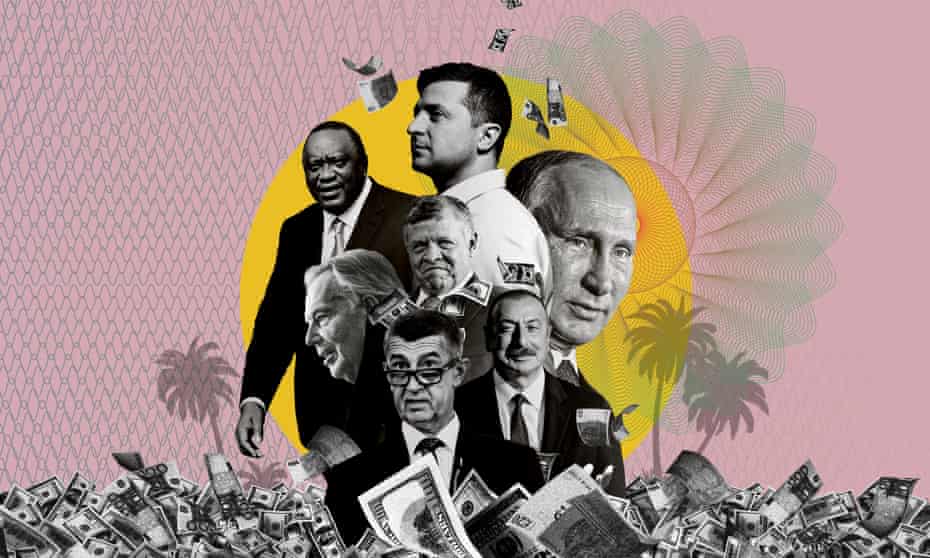
The Pandora papers reveal the inner workings of what is a shadow financial world, providing a rare window into the hidden operations of a global offshore economy. Illustration: Guardian Design
Millions of documents reveal offshore deals and assets of more than 100 billionaires, 30 world leaders and 300 public officials
The secret deals and hidden assets of some of the world’s richest and most powerful people have been revealed in the biggest trove of leaked offshore data in history.
Branded the Pandora papers, the cache includes 11.9m files from companies hired by wealthy clients to create offshore structures and trusts in tax havens such as Panama, Dubai, Monaco, Switzerland and the Cayman Islands.
They expose the secret offshore affairs of 35 world leaders, including current and former presidents, prime ministers and heads of state. They also shine a light on the secret finances of more than 300 other public officials such as government ministers, judges, mayors and military generals in more than 90 countries.
The files include disclosures about major donors to the Conservative party, raising difficult questions for Boris Johnson as his party meets for its annual conference.
More than 100 billionaires feature in the leaked data, as well as celebrities, rock stars and business leaders. Many use shell companies to hold luxury items such as property and yachts, as well as incognito bank accounts. There is even art ranging from looted Cambodian antiquities to paintings by Picasso and murals by Banksy.
The Pandora papers reveal the inner workings of what is a shadow financial world, providing a rare window into the hidden operations of a global offshore economy that enables some of the world’s richest people to hide their wealth and in some cases pay little or no tax.
What are the Pandora Papers
There are emails, memos, incorporation records, share certificates, compliance reports and complex diagrams showing labyrinthine corporate structures. Often, they allow the true owners of opaque shell companies to be identified for the first time.
The files were leaked to the International Consortium of Investigative Journalists (ICIJ) in Washington. It shared access to the leaked data with select media partners including the Guardian, BBC Panorama, Le Monde and the Washington Post. More than 600 journalists have sifted through the files as part of a massive global investigation.
The Pandora papers represent the latest – and largest in terms of data volume – in a series of major leaks of financial data that have convulsed the offshore world since 2013.
Setting up or benefiting from offshore entities is not itself illegal, and in some cases people may have legitimate reasons, such as security, for doing so. But the secrecy offered by tax havens has at times proven attractive to tax evaders, fraudsters and money launderers, some of whom are exposed in the files.
Perhaps the most significant offshore leak to date was the 2016Panama papers, which consisted of 2.6 terabytes of data leaked from the law firm Mossack Fonseca.
The following year saw the release of the Paradise papers, most of which were from the offshore provider Appleby, which was founded in Bermuda. In total, that cache consisted of 1.4 terabytes of data.
Containing 2.94 terabytes, the Pandora papers is the largest of the three leaks. The files also come from a much wider array of offshore providers than previous leaks: 14 in total. Locations range from Vietnam to Belize and Singapore, and to far-flung archipelagos such as the Bahamas and the Seychelles.
Other wealthy individuals and companies stash their assets offshore to avoid paying tax elsewhere, a legal activity estimated to cost governments billions in lost revenues.
After more than 18 months analysing the data in the public interest, the Guardian and other media outlets will publish their findings over the coming days, beginning with revelations about the offshore financial affairs of some of the most powerful political leaders in the world.
They include the ruler of Jordan, King Abdullah II, who, leaked documents reveal, has amassed a secret $100m property empire spanning Malibu, Washington and London. The king declined to answer specific questions but said there would be nothing improper about him owning properties via offshore companies. Jordan appeared to have blocked the ICIJ website on Sunday, hours before the Pandora papers launched.
The Azerbaijan president, Ilham Aliyev, and his wife, Mehriban Aliyeva. The Aliyev family has traded close to £400m of UK property in recent years. Photograph: Anadolu Agency/Getty Images
The files also show that Azerbaijan’s ruling Aliyev family has traded close to £400m of UK property in recent years. One of their properties was sold to the Queen’s crown estate, which is now looking into how it came to pay £67m to a company that operated as a front for the family that runs a country routinely accused of corruption. The Aliyevs declined to comment.
The Pandora papers also threaten to cause political upsets for two European Union leaders. The prime minister of the Czech republic, Andrej Babis, who is up for election this week, is facing questions over why he used an offshore investment company to acquire a $22m chateau in the south of France. He too declined to comment.
The Czech prime minister, Andrej Babiš, is facing questions over why he used an offshore investment company to acquire a $22m chateau in the south of France. Photograph: Milan Kammermayer/EPA
And in Cyprus, itself a controversial offshore center, the President, Nicos Anastasiades, may be asked to explain why a law firm he founded was accused of hiding the assets of a controversial Russian billionaire behind fake company owners. The firm denies any wrongdoing, while the Cypriot president says he ceased having an active role in its affairs after becoming leader of the opposition in 1997.
Not everyone named in the Pandora papers is accused of wrongdoing. The leaked files reveals that Tony and Cherie Blair saved £312,000 in property taxes when they purchased a London building partially owned by the family of a prominent Bahraini minister.
The former prime minister and his wife bought the £6.5m office in Marylebone by acquiring a British Virgin Islands (BVI) offshore company. While the move was not illegal, and there is no evidence the Blairs proactively sought to avoid property taxes, the deal highlights a loophole that has enabled wealthy property owners not to pay a tax that is commonplace for ordinary Britons.
Tony and Cherie Blair bought a £6.5m office in Marylebone by acquiring a British Virgin Islands offshore company. Photograph: WPA Pool/Getty Images
The leaked records vividly illustrate the central coordinating role London plays in the murky offshore world. The UK capital is home to wealth managers, law firms, company formation agents and accountants. All exist to serve their ultra-rich clients. Many are foreign-born tycoons who enjoy “non-domicile” status, which means they pay no tax on their overseas assets.
The Ukrainian president, Volodymyr Zelenskiy, is also named in the leak. Photograph: Anadolu Agency/Getty Images
Ukraine’s president, Volodymyr Zelenskiy, who was elected in 2019 on a pledge to clean up his country’s notoriously corrupt and oligarch-influenced economy, is also named in the leak. During the campaign, Zelenskiy transferred his 25% stake in an offshore company to a close friend who now works as the president’s top adviser, the files suggest. Zelenskiy declined to comment and it is unclear if he remains a beneficiary.
The Russian president, Vladimir Putin, whom the US suspects of having a secret fortune, does not appear in the files by name. But numerous close associates do, including his best friend from childhood – the late Petr Kolbin – whom critics have called a “wallet” for Putin’s own wealth, and a woman the Russian leader was allegedly once romantically involved with. None responded to invitations to comment.
The Pandora papers also place a revealing spotlight on the offshore system itself. In a development likely to prove embarrassing for the US president, Joe Biden, who has pledged tolead efforts internationally to bring transparency to the global financial system, the US emerges from the leak as a leading tax haven. The files suggest the state of South Dakota, in particular, is sheltering billions of dollars in wealth linked to individuals previously accused of serious financial crimes.
The offshore trail also stretches from Africa to Latin America to Asia, and is likely to pose difficult questions for politicians across the world. In Pakistan, Moonis Elahi, a prominent minister in prime minister Imran Khan’s government, contacted an offshore provider in Singapore about investing $33.7m.
Kenya’s president, Uhuru Kenyatta, will come under pressure to explain why he and his close relatives amassed more than $30m of offshore wealth. Photograph: Yasuyoshi Chiba/AFP/Getty Images
In Kenya, the president, Uhuru Kenyatta, has portrayed himself as an enemy of corruption. In 2018, Kenyatta told the BBC: “Every public servant’s assets must be declared publicly so that people can question and ask: what is legitimate?”
He will come under pressure to explain why he and his close relatives amassed more than $30m of offshore wealth, including property in London. Kenyatta did not respond to enquiries about whether his family wealth was declared to relevant authorities in Kenya.
The Pandora papers also reveal some of the unseen repercussions of previous offshore leaks, which spurred modest reforms in some parts of the world, such as the BVI, which now keeps a record of the real owners of companies registered there. However, the newly leaked data shows money shifting around offshore destinations, as wealthy clients and their advisers adjust to new realities.
Some clients of Mossack Fonseca, the now defunct law firm at the heart of the 2016 Panama papers disclosures, simply transferred their companies to rival providers such as another global trust and corporate administrator with a major office in London, whose data is in the new trove of leaked files.
Asked why he was migrating the new company, one customer wrote bluntly: “Business decision to exit following the Panama papers.” Another agent said the industry had always “adapted” to external pressure.
Some leaked files appear to show some in the industry seeking to circumvent new privacy regulations. One Swiss lawyer refused to email the names of his high-value customers to a service provider in the BVI, following new legislation. Instead, he sent them by airmail, with strict instructions they should not be processed in any “electronic way”. The identity of another beneficial owner was shared via WhatsApp.
“The purpose of this way to proceed is to enable you to comply with BVI rules,” the lawyer wrote. Referring to Mossack Fonseca, the lawyer added: “You are obliged to keep secrecy for our clients and to not make feasible at all a second ‘Panama papers’ story that happened to one of your competitors.”
Gerard Ryle, the director of the ICIJ, said leading politicians who organized their finances in tax havens had a stake in the status quo, and were likely to be an obstacle to reform of the offshore economy. “When you have world leaders, when you have politicians, when you have public officials, all using the secrecy and all using this world, then I don’t think we’re going to see an end to it.
He expected the Pandora papers to have a greater impact than previous leaks, not least because they were arriving in the middle of a pandemic that had exacerbated inequalities and forced governments to borrow unprecedented amounts to be shouldered by ordinary taxpayers. “This is the Panama papers on steroids,” Ryle said. “It’s broader, richer and has more detail.”
At least $11.3tn in wealth is held offshore, according to a 2020 study by the Paris-based Organisation for Economic Co-operation and Development (OECD). “This is money that is being lost to treasuries around the world and money that could be used to recover from Covid,” Ryle said. “We’re losing out because some people are gaining. It’s as simple as that. It’s a very simple transaction that’s going on here.”
Pandora papers reporting team: Simon Goodley, Harry Davies, Luke Harding, Juliette Garside, David Conn, David Pegg, Paul Lewis, Caelainn Barr, Rowena Mason and Pamela Duncan in London; Ben Butler and Anne Davies in Sydney; Dominic Rushe in New York; Andrew Roth in Moscow; Helena Smith in Athens; Michael Safi in Lebanon; Robert Tait in Prague.
In battle to restore power after Ida, a tent city rises
Rebecca Santana September 24, 2021
1 / 21
APTOPIX Hurricane Ida Restoring Electricity
Bryan Willis, of Stilwell, Okla., an electrical worker for Ozarks Electric, looks at his phone before going to bed in a tent city for electrical workers in Amelia, La., Thursday, Sept. 16, 2021. When Hurricane Ida was brewing in the Gulf of Mexico, the grass was chest high and the warehouse empty at this lot in southeastern Louisiana. Within days, electric officials transformed it into a bustling “tent city” with enormous, air-conditioned tents for workers, a gravel parking lot for bucket trucks and a station to resupply crews restoring power to the region. (AP Photo/Gerald Herbert)MoreREBECCA SANTANASeptember 24, 2021
AMELIA, La. (AP) — When Hurricane Ida was brewing in the Gulf of Mexico, the grass was chest high and the warehouse empty at this lot in southeastern Louisiana. Within days, electric officials transformed it into a bustling “tent city” with enormous, air-conditioned tents for workers, a gravel parking lot for bucket trucks and a station to resupply crews restoring power to the region.
In the wake of hurricanes, one of the most common and comforting sites is the thousands of electric workers who flow into a battered region when the winds die down to restore power and a sense of normalcy. They need to sleep somewhere. They need to eat. Their trucks need fuel. They need wires, ties and poles. And occasionally they need cigarettes. Power providers build tent cities like this to meet those needs.
“There’s three things a lineman wants: good food, cold bed, hot shower. If you can get those three, you can work,” says Matthew Peters, operations manager for South Louisiana Electric Cooperative Association, which built the tent city to house a peak of about 1,100 workers helping restore power to the cooperative’s customers.- ADVERTISEMENT -https://s.yimg.com/rq/darla/4-6-0/html/r-sf-flx.html
When Ida came ashore on Aug. 29, it knocked out power to about 1.1 million customers in the state. The vast majority have seen their power restored, but in a sign of the storm’s extent, thousands are still in the dark while downed lines are righted and substations repaired.
SLECA provides electricity to about 21,000 customers, including many in the hard-hit bayou regions. Power has been restored to about 81% of their coverage area with the remaining 19% in areas with the most catastrophic damage, said Joe Ticheli, general manager of the cooperative. After initially fearing full restoration of power could take months, estimates are now that it could happen by next week, Ticheli said.
Over a few short days, SLECA and a consulting firm transformed the location that used to be a hub for oil field manufacturer McDermott International into a temporary home for workers from across the country. Ticheli even appointed a mayor to make sure things run smoothly.
In one massive white tent, hundreds of cots are spread out; experienced workers bring their own inflatable mattresses. Another tent houses a cafeteria that serves hot breakfast starting about 5 a.m., dinner and boxed lunches that can be eaten out in the field. Tons of gravel was packed down on top of a grassy field so bucket trucks and other equipment — many flying American flags — can park.
At sunset, after workers park their trucks and head in to eat, shower and sleep, gasoline trucks drive up and down the rows, fueling the vehicles so no time is lost in the morning. Special treats — like cigarettes or steak night — help ease 16-hour workdays. Out-of-state crews are teamed with a local employee dubbed a “bird dog” who helps them.
Across the street is a warehouse where supplies such as transformers and wires are available. Outside, long wooden replacement poles wait to be loaded onto trucks.
Jordy Bourg, who runs the warehouse, said that right after the storm they had some supplies but immediately had to start ordering more. But like many things in the pandemic era, it’s been a challenge after Ida to get certain supplies.
Many people coming in to help have covered other disasters: Hurricane Michael, Hurricane Laura, ice storms in Arkansas and Texas. It’s good money, but more than that, they say it’s the feeling of restoring normalcy to someone who’s had everything stripped away from them. And many point out that the next disaster could easily be in their own backyard. Last year crews from SLECA went to southwest Louisiana when another Category 4 hurricane, Laura, slammed ashore there. This year, crews from southwest Louisiana came east to help.
“We’ve had a few storms hit back home and you kind of know how it is when you’ve been out of power,” said Robbie Davis, a lineman from Georgia. So many people in southeast Louisiana have no where to go, he said: “Out here, these folks’ homes got destroyed, businesses got destroyed.”
It can be dangerous work — two men believed to be electrocuted died helping restore power in Alabama.
The Louisiana terrain presents special challenges. In some areas, lines thread through thick swamps that can be accessed only by air boat or marsh buggy, which looks like a cross between a tank and a pontoon boat. Workers don waders to climb into muddy, chest-high waters home to alligators and water moccasins.
“You only work in this kind of area when you’re in south Louisiana. I can assure you, you don’t get this anywhere else,” says Jon Hise, a Sparks Energy foreman working with a crew in Houma to reset power lines. “It’s nasty. It’s chest deep. You can’t walk because the growth.”
As SLECA staff work to restore power to their slice of southeastern Louisiana, they have also been struggling with hurricane damage themselves. The general manager wears clothes from the Salvation Army after his home was severely damaged and looted. Coworkers have helped each other tarp damaged roofs. The company is operating out of trailers in their Houma headquarters after Ida peeled off the roof. Bourg is living in a trailer with his wife and two Boston terriers — his kids are staying with his in-laws — after Ida wrecked his house.
There’s also the toll of seeing large swaths of their coverage area so utterly destroyed. For many, getting power is just the first step in a long rebuilding process. Peters gets emotional when he talks of the dedication of his staff as well as the damage he’s seen among longtime customers.
“We’ve had storms before,” he said. “But the devastation was nothing of this magnitude.”
The US owes a debt to Haiti. Experts explain why their shared history led to a migrant crisis on the US’s border.
Christine Jean-Baptiste September 26, 2021
Demonstrators outside the US Citizenship and Immigration Service office in Miami on February 20 demand that the Biden administration cease deporting Haitian immigrants. Chandan Khanna/AFP/Getty Images
The Biden administration faced backlash for dispersing Haitian migrants at the US-Mexico border.
Experts say Haiti’s history of foreign interference has shaped perspectives and stunted progress.
They estimate France and the US owe Haiti billions in reparations for colonialism and occupation.
In the past week, nearly 14,000 migrants, mostly Haitians, were found in Del Rio, Texas, seeking asylum following a destructive earthquake and the assassination of Haitian President Jovenel Moïse.
Instead of providing shelter and refuge for the migrants, the US continued to deport Haitians, who have for years been targets of imperialism and xenophobia, in what experts described as history repeating itself.
“Anything you have read about Haiti thus far will remind you of an all too common and limited narrative; the first Black Republic is ‘the poorest nation in the Western Hemisphere,'” the artist Gina Athena Ulysse wrote in a 2019 essay for Tikkun.
“What almost none of them will mention is that Haiti also has one of the highest numbers of millionaires per capita in the region,” she added.
Haitian scholars spoke with Insider about how assumptions and stereotypes about the island perpetuate limited narratives that can put Haitian migrants at risk.
“Cuba, Haiti, and all others are as complex as the US, Canada, and European countries, and allowing room for these latter to have complexity while expecting uniformity from these islands or island nations are quite uninformed and essentialist,” Manoucheka Celeste, an associate professor at the University of Florida, told Insider.
Political interference in Haitian politics shapes global perspectives
Haiti and the United States share an intertwined history as the second-oldest and oldest countries in the Western Hemisphere.
But the US refused to acknowledge Haiti’s 1804 independence from France for nearly 60 years, kicking off centuries of military coups and political meddling that devastated the Caribbean nation – from a decades-long US invasion and occupation in 1915 to disastrous aid and relief efforts today.
Celeste, whose book “Race, Gender, and Citizenship in the African Diaspora: Travelling Blackness” details this shared history, added that US imperialism influenced how Haitians are received and treated abroad today.
“Haitian immigrants have been particularly stigmatized, echoing images of Haiti as poor, dangerous, sick, and this impacts how we are received in communities, schools, employment opportunities, and all aspects of everyday life,” she said.
The Caribbean island has also been misrepresented through the media, experts said.
A misconception that Nadeve Menard, an author and professor of literature at the École Normale Supérieure of Université d’État d’Haïti, has noticed is that the current political climate is somehow unique.
“What is happening here is very much part of larger global networks,” she told Insider. “Aid industries need aid recipients, for example. The sophisticated weapons that gangs here are displaying are being sold by someone.”
Ménard added that “many people, Haitians and non-Haitians alike, are benefiting from what is happening here in very concrete ways.”
Coverage of climate disasters and corruption worsens anti-Haitian bias
Haitian migrants at a shelter. Thousands of Haitian migrants recently gathered in makeshift camps at the US-Mexico border. Pedro Pardo/ARP/Getty Images
Celeste’s research suggests that even though the Caribbean is an incredibly diverse region racially, ethnically, and linguistically, it makes international or US news only when “bad” or “strange” things happen, like a hurricane or a political crisis.
For example, there was a spike in global news coverage of Haiti following the catastrophic earthquake in 2010, with outlets gaining readers and revenue from a disaster affecting the country.
Experts said it was like clockwork that the media feeds on disaster reporting when it’s convenient.
Lillian Guerra, a professor of Cuban and Caribbean history at the University of Florida, said Haiti was seen as a failure whose problems are of its own creation, not of the outside world’s, and certainly not the fault of consistently accumulated historical injustices.
“We treat Haiti as a pariah that is undeserving of respect, let alone sovereignty,”
Following the president’s assassination, a rotation of Haitian politicians have wanted to claim power. That insecurity was made worse when a magnitude 7.2 earthquake struck Haiti’s southwest – and that exacerbated the migration crisis at the US’s southern border.
Amid the political reshuffles, publications have been quick to point out Haiti’s extensive corruption. Scholars call on observers to ask themselves why that is.
“It is problematic to imply that corruption only happens in Haiti or happens here more than elsewhere,” Ménard said.
“Nations like to present themselves as paragons of virtue, but often their representatives are very much implicated in the corruption they point to in other places,” she added.
On Tuesday afternoon, as images of US Customs and Border Protection agents grabbing Haitian migrants near Del Rio circulated, Jen Psaki, the White House press secretary, said President Joe Biden found the footage “horrific” and “horrible.”
Psaki said the administration would launch an investigation to “get to the bottom of what happened.”
Advocates say centering Haiti and its diaspora is key to progress
Scholars say the treatment of Haitians is based on racial stereotypes that existed long before this year. They challenged people moved by the recent events in Haiti to learn about Haiti from Haitians.
“The way to counter stereotypes is to go to sources where Haitians are speaking for themselves,” the Haitian American writer Edwidge Danticat told Insider in an email, encouraging people to listen to Haitian youth and elders.
“We are not a monolith. Haiti is not a monolith. We don’t always agree. We have layers. We contain multitudes,” she added.
With the dehumanizing visuals of Haitian migrants at the border this week were renewed calls to help Haiti – a common sentiment on the internet.
In 2010, after the earthquake killed hundreds of thousands of people, many celebrities could be found organizing concerts and benefits, singing songs, and centering themselves in the cause.
Edwidge Danticat
Danticat encouraged supporters to immerse themselves in Haitian-led cultural initiatives, including reading Haitian writers, listening to Haitian music, and taking in Haitian art and even social media.
Politicians and public figures have used their platforms to take a stance and remind people of the role of international communities in Haiti.
“I think the reason why we’re not seeing more help, if I’m going to be frank about it, is because they are Haitian,” Sunny Hostin, a cohost of “The View,” said on Wednesday.
Following Haiti’s traumatic year, many Haitian scholars have called out performative advocacy in the form of emojis, prayers and hashtags on social media.
Marlene Daut, a professor of African diaspora studies at the University of Virginia, described the public outcry as opportunistic and meaningless, highlighting the role of disaster capitalism on other Caribbean islands, like in Puerto Rico during Hurricane Maria.
“I think a lot of people, when they do charity, they want it to be easy,” she said. “If you really want to do good things for Haitians, then it involves the difficult work of finding out what that would be.”
With the diaspora and allies holding North America and Europe accountable, Daut said, it “could be a moment for a reckoning, if we allow it to be, and for it to not get swept under the rug again, and also to not repeat the past.”
“We need to remember that these things happened,” she said, “because there’s a dangerous moment right now in Haiti.”