Gov. DeSantis is banking on Americans hating immigrants more than high insurance rates

Miami Herald

Gov. DeSantis is banking on Americans hating immigrants more than high insurance rates | Opinion

Fabiola Santiago – May 12, 2023

He’s got your back on the hate, red Floridians.

For starters, millions of your tax dollars have been designated by Gov. Ron DeSantis and the Legislature — no, not to subsidize our skyrocketing home insurance — but to ship planeloads of new immigrants to blue states.

The governor will fish them from the sea, if he has to, for publicity stunts.

His presidential aspirations need shocker headlines — and the oxygen in his $117 billion big government budget only left room for catering to your irrational immigrant-loathing and to fighting Disney World in courts over one opinion contrary to his.

Immigrant-hunting will be as expensive as the well-paid lawyers DeSantis is employing to uphold civil rights violations.

By signing into law a sweeping anti-immigrant bill, DeSantis has built his own wall around the state’s sea and land borders, hoping to outdo Donald Trump’s U.S.-Mexico effort, wimpy and inefficient by comparison.

The Republican governor and his sycophant Legislature figured out that all they had to do was terrorize people with the ruthless contents of SB 1718 — and asylum-seekers wouldn’t confuse the Sunshine State for a sanctuary.

It’s already working so well that immigrant construction workers in South Florida weren’t showing up to work this week for fear that there would be a round-up and they’d be deported, CBS News Miami reported.

READ MORE: Florida can’t run without immigrant labor, so good luck with your crackdown, Gov. DeSantis | Opinion

Red mandates

DeSantis calls his mandates “the strongest anti-illegal immigration law in the country to combat Biden’s border crisis.”

Ironically, he’s promoting the message in an explanatory document set in bold red and black lettering — the colors of Fidel Castro’s 26th of July Movement in Cuba and the Sandinistas’ National Liberation Front in Nicaragua, regimes from which immigrants are fleeing.

The new Florida immigration law, effective July 1, allows random audits of employers suspected of hiring unauthorized immigrant workers — opening the door to ethnic and racial profiling.

All those Hispanic business owners in Miami-Dade and other immigrant-populated communities who voted for DeSantis are being richly rewarded. (There’s a more appropriate verb that starts with an “s,” but I’m not allowed to use it). I don’t feel sorry for these voters. But I do for hard-working undocumented immigrants who aren’t hurting anyone and the families who love them.

The medical field — those providing care and their patients — will also be adversely affected.

If an immigrant without legal status has a medical emergency — a life-threatening illness, is having a baby or had a car accident, makes no difference — the law now requires that hospitals collect data about patients’ immigration status and document the money spent on providing them healthcare.

In addition, no Florida government entity is allowed to issue to immigrants an identification card of any kind, even if they have passports or birth certificates. Can’t get one without proof of legal entry.

People driving without a license is just what we need in Florida. And, nope, relatives can’t drive the undocumented, either, and stay within the law themselves. Drivers can be charged with a third-degree felony for knowingly giving an undocumented migrant a lift to church, school or work.

Do so, and risk being charged as a human smuggler.

In Miami, this means all the Cubans and Venezuelans who love Trump and DeSantis so much — and are housing, hosting, transporting or providing medical care for anyone without the right documentation — now have enforced restrictions to keep in mind.

If they operate as they have until now, on the fly, they become law-breakers.

Then, there’s the tightening of E-Verify, which makes it more difficult than ever for workplaces to hire immigrants.

A federal program for employers to confirm a person’s immigration status, operating since 1996, it became voluntary when President Bill Clinton signed it into law under the Illegal Immigrant Reform and Immigrant Responsibility Act. Later required, the program was expanded and made easier to use under President Barack Obama.

Not good enough for DeSantis, who says his state will strictly enforce E-Verify: Employers with 25 or more workers have to put through the system everyone’s immigration status — or face a $1,000 per day fine if an employee is found to be in the country illegally.

All companies, no matter whether they maintain your lawn, paint the walls or put on a new roof, have to comply. So the able-bodied, quick-learning, eager-to-work rafter who just got off the boat can’t work at your house.

No, Florida is no longer a place where immigrants can rebuild — in peace — lives lost to dictatorship, poverty, and violence, while in the process, contributing desperately needed labor to the United States economy.

Without a care for the state’s history (maybe he is a Midwesterner, as he tries to pass off himself in his political pamphlet-styled memoir) DeSantis — with the help of shameless legislators who are the descendants of exiles and other immigrants — has shut the door.

READ MORE: Lawmakers with no pride in their immigrant heritage help DeSantis crush our communities | Opinion

Why the persecution?

The governor needs your red vote badly to win the Republican presidential primary — and he’s sure that crushing immigrants is the key to voters’ hearts. So much so that he forgot all about the damage those pesky hurricanes and rising seas bring and the ensuing reconstruction.

But no worries about a state dependent on agriculture, tourism and construction, left without immigrant labor.

Write with a smile the big check to the insurance company that, after decades of paying, will tell you when you most need them — as is happening now to the insured in southwest Florida repairing homes destroyed by Hurricane Ian: The fancy door is a decoration and isn’t covered.

Write with a spring in your step the big check to the construction company charging you more because the owner can’t hire cheaper labor.

Your man in Tallahassee has delivered!

Now you can peel your eyes away from the white-world-is-ending Fox News reports from the southern border.

They really are bad for your health. The surge in blood pressure can provoke a stroke — and there won’t be a cheap, undocumented immigrant your family can hire to change your diaper.

This is the new world DeSantis and the Florida GOP have created, one conceived in hatred of The Other who, more often than not, was making our lives better.

Russia acknowledges retreat north of Bakhmut; mercenary boss calls it a ‘rout’

Reuters

Russia acknowledges retreat north of Bakhmut; mercenary boss calls it a ‘rout’

Olena Harmash and Ivan Lyubysh-Kirdey – May 12, 2023

Ukrainian servicemen ride atop of a tank on a road to the frontline town of Bakhmut

KYIV/KOSTIANTYNIVKA, Ukraine (Reuters) -Moscow acknowledged on Friday that its forces had fallen back north of Ukraine’s battlefield city of Bakhmut after a new Ukrainian offensive, in a retreat that the head of Russia’s Wagner private army called a rout.

The setback for Russia, which follows similar reports of Ukrainian advances south of the city, suggests a coordinated push by Kyiv to encircle Russian forces in Bakhmut, Moscow’s main objective for months during the war’s bloodiest fighting.

It means both sides are now reporting the biggest Ukrainian gains in six months, although Ukraine has given few details and played down suggestions a huge, long-planned counteroffensive had officially begun.

Russian Defence Ministry spokesman Igor Konashenkov said Ukraine had launched an assault north of Bakhmut with more than 1,000 troops and up to 40 tanks, a scale that if confirmed would amount to the biggest Ukrainian offensive since November.

The Russians had repelled 26 attacks but troops in one area had fallen back to regroup in more favourable positions near the Berkhivka reservoir northwest of Bakhmut, Konashenkov said.

Yevgeny Prigozhin, head of the Wagner forces that have led the campaign in the city, said in an audio message: “What Konashenkov described, unfortunately, is called ‘a rout’ and not a regrouping”.

In a separate video message, Prigozhin said the Ukrainians had seized high ground overlooking Bakhmut and opened the main highway leading into the city from the West.

“The loss of the Berkhivka reservoir – the loss of this territory they gave up – that’s 5 sq km, just today,” Prigozhin said.

“The enemy has completely freed up the Chasiv Yar-Bakhmut road which we had blocked. The enemy is now able to use this road, and secondly they have taken tactical high round under which Bakhmut is located,” said Prigozhin, who has repeatedly denounced Russia’s regular military over the past week for failing to supply his men in Bakhmut.

Reuters was not able to independently verify the situation in the area.

Ukraine typically withholds comment on its operations while they are under way, and the military command has said only that its troops have pushed forward about 2 km near Bakhmut.

A Ukrainian unit said two days ago it had defeated a Russian brigade southwest of the city recapturing a swathe of land, and Prigozhin also said the Russian brigade there had fled.

Prigozhin, whose troops have been fighting to push Ukrainian forces out of Bakhmut’s Western outskirts, has said the north and south flanks, guarded by regular Russian troops, were crumbling. Russia’s defence ministry denies this.

TURNING POINT

In Kostiantynivka, about 20 km (12 miles) southwest of Bakhmut, firefighters were battling a blaze at a house that went up in flames after it was struck by Russian shells.

“It hit the roof and the roof collapsed. My neighbour rushed outside and started shouting, asking for help,” said Oleksandr Lazorka, who lives next door. “We pulled out a blind woman – an elderly, blind woman – from under the rubble and then the fire erupted.”

The 15-month-old war in Ukraine is at a turning point, after six months during which Kyiv kept its troops on the defensive while Russia mounted a winter campaign that brought the bloodiest ground combat in Europe since World War Two but yielded scant gains.

Since the start of this year, Kyiv has received hundreds of new Western tanks and armoured vehicles, holding them back in preparation for a long-awaited counteroffensive to recapture occupied territory.

Ukrainian officials have played down the suggestion that their offensive is already under way: President Volodymyr Zelenskiy said in an interview this week Kyiv needed more time for equipment to arrive. Prigozhin called that deceptive and said the Bakhmut advances amounted to the start of Kyiv’s campaign.

Moscow has been preparing since last autumn for an expected onslaught, and has built lines of anti-tank fortifications along hundreds of miles of front.

It has begun evacuating civilians who have been living near the conflict zone in Ukraine’s partially occupied Zaporizhzhia province.

“We used to go out and watch (the shelling). Especially at night, you could see the flashes as they launch,” said Lyudmila, a 22-year-old from Kamianka-Dniprovska now in makeshift accommodation in the Russian-controlled Ukrainian port of Berdyansk.

“We’ve had shells land nearby and when it landed the entire sky was red,” she said.

In comments published on Friday, the commander of Russia’s Black Sea Fleet said its defences were also being tightened amid a flurry of Ukrainian drone strikes targeting its home base, the Crimean port of Sevastopol.

Zelenskiy, who has been rallying his country for the planned offensive, said in a social media post that “our path ahead is not easy”, but Ukraine was “much stronger now than last year or in any other year of this war for freedom and independence of our country”.

He spoke on Friday with British Prime Minister Rishi Sunak, thanking him for a promise of long-range cruise missiles. Britain announced the missiles on Thursday, breaking one of the last big Western taboos over weaponry previously deemed to carry too great a risk of provoking Russia.

(Reporting by Reuters bureaux, Writing by Peter Graff and Kevin Liffey)

They built a new life near Charlotte after Jan. 6. Now, husband, wife are going to prison.

The Charlotte Observer

They built a new life near Charlotte after Jan. 6. Now, husband, wife are going to prison.

Michael Gordon – May 11, 2023

Jeff Helsel/Photo courtesy
FBI Photo

The owners of “Free Folk Pastures” are no longer free.

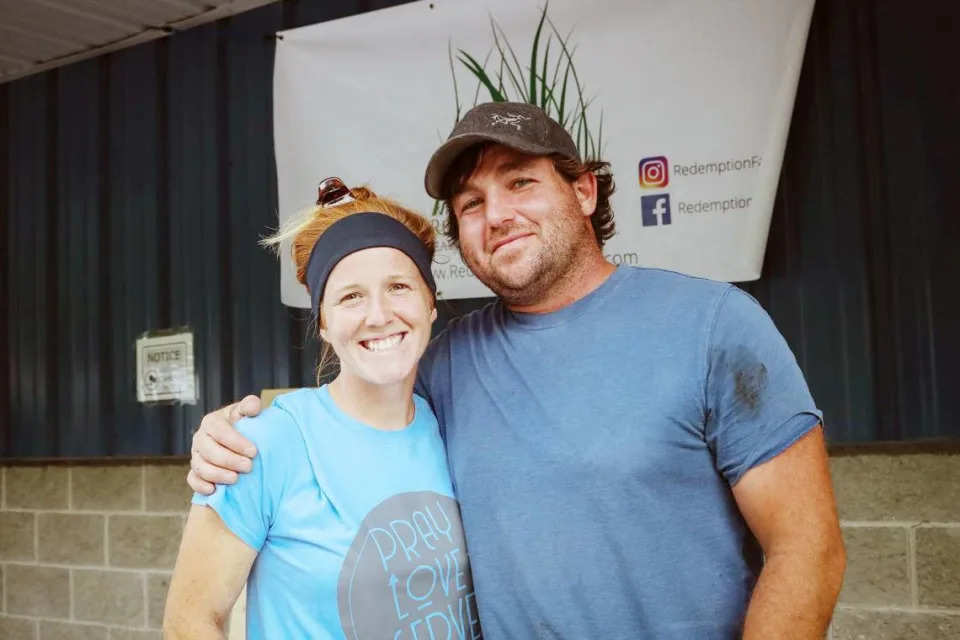
Instead, Dale “D.J.” Shalvey and Tara Stottlemyer, who run a regenerative cattle and poultry farm 45 miles north of Charlotte, have become North Carolina’s first husband and wife sentenced to prison for their roles in the Jan. 6, 2021, riot at the U.S. Capitol.

On Thursday, U.S. District Judge Timothy Kelly of Washington ordered Shalvey and Stottlemyer to serve 41 and eight months, respectively. They will begin their sentences at a later date.

Kelly, who was appointed to the bench by former President Donald Trump, also ordered both to serve 24 months of supervised release. Stottlemyer will spend the first third of hers on home detention.

Assistant U.S. Attorney General Anthony Franks had recommended a 51-month sentence for Shalvey and 18 months for Stottlemyer.

Both pleaded guilty in October to riot-related felony charges: Stottlemyer, obstruction of an official proceeding; Shalvey, obstruction and assault on a police officer.

The couple, the parents of a 2-month-old daughter, moved to North Carolina after taking part in the attack on the Capitol by a mob of Trump supporters intent on overturning the Republican’s election loss to Joe Biden.

Shalvey was arrested in March 2021; Stottlemyer was charged six months later after the couple had relocated to Catawba County.

In the months since, they have quickly put down roots in Conover.

They leased land from Shalvey’s uncle, who lives in Mooresville, to start their farm.

They got married there six months after the riot.

They buried their newborn son, Josiah, there in January 2022 and gave birth to a daughter, Hope, in mid-March.

They joined a church. They made new friends. In a letter to Kelly seeking leniency for Shalvey, one acquaintance said the couple have quickly become community leaders in their adopted home.

‘Stop the steal’ rally

Now, Shalvey and Stottlemyer, both 38, are set to become the ninth and 10th North Carolinians imprisoned for Jan. 6 crimes, for terms ranging from nine days to 44 months. At least 28 N.C. residents have been federally charged.

Nationwide, more than 1,000 arrests have been made, leading to more than 650 convictions. The Capitol violence has been linked to at least five deaths, injuries to some 140 police officers, and more than $2.8 million in damage to the building.

Shalvey and Stottlemyer, then living in a small town outside of Pittsburgh, drove to Washington on Jan. 6 with a farmer friend from Upstate New York to attend Trump’s “Stop the Steal” rally, court documents show.

They then joined a throng of Trump supporters, fueled by the outgoing president’s baseless claims of massive election fraud, who marched to the Capitol to stop congressional certification of Biden’s win.

During the growing chaos, Shalvey was caught on camera throwing something that struck a police officer.

Shalvey and Stottlemyer — joined by co-defendant Katharine Morrison of Dansville, N.Y., who received the same sentence as Stottlemyer — entered the Capitol nine minutes after the first breach, Franks said. They roamed the building for more than an hour.

Eventually, the three were among the relatively few rioters who reached the floor of the U.S. Senate. There, they rifled through senators’ desks and photographed documents.

Shalvey also pocketed a letter — which he later destroyed — from U.S. Sen. Mitt Romney to then-Vice President Mike Pence in which the Utah Republican explained his reasoning for finding Trump guilty at his second impeachment trial.

Franks compared Shalvey’s behavior to one of the best-known convicted rioters, “QAnon Shaman” Jacob Chansley, who was sentenced in November 2021 to 41 months on an obstruction charge.

Except, according to Franks’ sentencing memo, Shalvey’s actions were “more heinous as they involve assaulting an officer and lying to the FBI regarding the assault and destroying evidence, which included Shalvey’s phone and a note written by Senator Romney.”

While Stottlemyer, garbed in a Trump flag and a teal-colored bicycle helmet, did not take part in the violence, she was alongside Shalvey throughout the riot and participated in the rummaging of the Senate desks, Franks said.

Shalvey’s character

Multiple letters written to the judge by Shalvey’s family, ministers, former college professors and friends spoke to his character and potential; how he overcame a childhood derailed by a drug-addicted mother and an abusive father; how he plans to use the farm to mentor fatherless boys; how he is embarrassed and remorseful for his actions at the Capitol.

Lead defense attorney Cody Cofer of Fort Worth, citing his client’s “complete lack of prior contact with the criminal justice system” prior to Jan. 6, called for home detention, not imprisonment.

“Mr. Shalvey acknowledges the Court must consider a variety of factors and interests beyond the future of a defendant,” Cofer wrote.

“For the Shalveys, the care of (daughter) Hope is the foremost concern. Mr. Shalvey is also burdened by his worry for the animals he loves and losing the land on which his son is buried.

“And all this is in peril because of Mr. Shalvey’s decisions.”

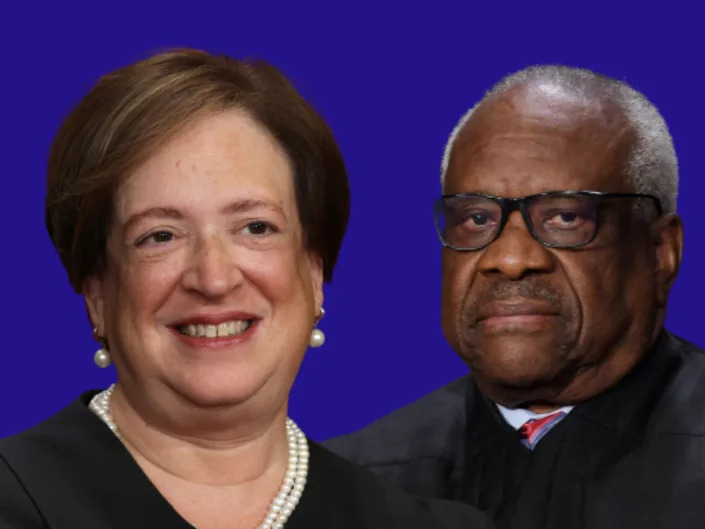
Justice Elena Kagan was worried about the ethics of accepting bagels from friends, while Clarence Thomas was enjoying expensive vacations paid for by a GOP megadonor

Insider

Justice Elena Kagan was worried about the ethics of accepting bagels from friends, while Clarence Thomas was enjoying expensive vacations paid for by a GOP megadonor: report

Joshua Zitser – May 11, 2023

Supreme Court Justices Elena Kagan and Clarence Thomas
Supreme Court Justices Elena Kagan (l) and Clarence ThomasJoshua Zitser/Insider, Getty Images
  • Supreme Court Justice Elena Kagan once turned down a care package of bagels and lox, per Forward.
  • She was concerned she could be violating the court’s ethics rules for accepting gifts, friends said.
  • Meanwhile, Supreme Court Justice Clarence Thomas was accepting lavish holidays from a GOP megadonor.

At a time when Supreme Court Justice Clarence Thomas was accepting lavish trips paid for by GOP megadonor Harlan Crow, fellow Supreme Court Justice Elena Kagan was turning down bagels and lox from high school friends, over concerns she could be violating the court’s ethics rules for accepting gifts, according to a new report.

Forward reported that friends who attended Hunter College High School in Manhattan with Kagan in the 1970s wanted to send her a “care package” of bagels, lox, babka, chocolates, and other inexpensive items in February 2021.

However, they later scrapped the idea after Kagan expressed concerns about issues it could pose under the Supreme Court’s rules on gifts and disclosures, per Forward.

“We thought it would be a sign of support to send her some lox, but she was too ethical to take the lox,” said Sarah Schulman, a former school friend, according to the media outlet.

Another Hunter College High School alumnus, Ann Starer, told the Forward that Kagan was touched by the offer but it was “creating more stress for her than it was worth.”

She said that Kagan sent her an email, which reportedly said: “I have to take these ethics and reporting considerations very seriously.”

Kagan’s approach seems to directly contrast with that of Thomas when it comes to accepting gifts.

A series of bombshell ProPublica reports have put Thomas at the center of an ongoing scandal involving Crow, a Texas billionaire.

According to the reports, Crow financed expensive trips that Thomas took part in for more than two decadespurchased his mother’s home and didn’t charge her rent, and paid for a child in the justice’s custody to attend a $6,000-a-month private boarding school.

Under the Ethics in Government Act of 1978, all federal judges, including Supreme Court justices, are required to file annual financial disclosures that include reporting on gifts received. But they are exempt from disclosing “personal hospitality” they receive, which covers food, lodging, and entertainment.

And unlike the rest of the federal judiciary, the Supreme Court is not bound by a code of conduct.

Top Democrats have called on the Supreme Court to investigate Thomas, as well as calling on the court to adopt a public code of ethics.

The Supreme Court did not immediately respond to Insider’s request for comment.

Pancreatic cancer rates are spiking in women 55 and under. Experts don’t yet know why.

Yahoo! Life

Pancreatic cancer rates are spiking in women 55 and under. Experts don’t yet know why.

Korin Miller – May 10, 2023

Pancreatic cancer collage with jaundiced eyes, an IV bag, and a woman's hand on her face.
Pancreatic cancer rates are spiking in women under 55, according to a recent study. (llustration: Blake Cale; Photo: Getty Images)

Allison Lippman-Kuban was just 31 when she was diagnosed with pancreatic cancer in 2017. Lippman-Kuban tells Yahoo Life that she first developed symptoms of the disease after she returned from a vacation in France with her boyfriend.

“I was having severe abdominal pain that shot into my back,” she says. “I had weight loss, fatigue, trouble digesting food — a lot of gastrointestinal issues.”

Lippman-Kuban reached out to her doctor and had tests scheduled with specialists, including a colonoscopy, to try to figure out what was behind her sudden pain. “But the pain got so severe that I ended up going to the hospital,” she says. She was hospitalized for five days, where she underwent a slew of tests. “I left with a diagnosis of neuroendocrine cancer and was later told it was stage 4 pancreatic cancer,” she says.

“I was just shocked,” Lippman-Kuban says. “I questioned everything, including why was my boyfriend staying with me. I had just been promoted at my job — I was nervous that I was going to lose that. Then, the fear of all of that subsided, and it was more, How long do I have to live?

Lippman-Kuban says she was urged “to do chemo as long as I could,” but her doctor also sent her biopsy to a lab for genetic sequencing. Her specific biomarker (a gene, protein or other substance that provides information about a type of cancer) qualified her for a clinical trial at MD Anderson Cancer Center in Houston. “I’ve been on that trial for five and a half years now,” she says.

She says she’s had a “change of lifestyle” on the trial. “I stopped chemo, I take two pills in the morning and two pills each afternoon,” she says. “Within a month, my strength started coming back, my hair started coming back, and I was able to start rediscovering myself.”

Lippman-Kuban’s cancer isn’t gone, but her tumors have shrunk by 70%. “I now treat my cancer as a chronic illness,” she says. “I just take my medicine in the morning and the evening. I don’t have any side effects from it, which is great.”

Teona Ducre was just 41 when she was diagnosed with stage 3 pancreatic cancer in 2016. She tells Yahoo Life she had “extreme pain” in her lower stomach and lower back, along with exhaustion, indigestion and “substantial” weight loss. “Upon my initial diagnosis, I was in disbelief and did not fully appreciate the significance of the fact that pancreatic cancer is most often terminal,” she says.

Ducre discovered the Pancreatic Cancer Action Network (PanCAN), a patient advocacy and research organization, and received guidance on her form of cancer, along with what to expect for treatment. She then underwent six months of chemotherapy, followed by surgery and five more months of chemotherapy. She’s now a pancreatic cancer survivor. “Survival is not some specified date in the future when the tumor is gone —survival is every single day a person wakes up and did not succumb to the disease,” she says.

Paula Mack Drill was diagnosed with stage 2 pancreatic cancer five years ago, when she was in her mid-50s. She tells Yahoo Life that she had been on sabbatical for three months from her job as a rabbi and “was coming off the most healthy, toxic-free diet” when she started having symptoms. Drill hosted people at her house for Passover Seder and kept eating a chocolate and caramel dessert that she jokingly refers to as “Matzo Crack.” “Around 5 a.m. the next morning, I had terrible stomach pain, which I assumed was from eating Matzo Crack,” she says. “But it got worse and worse as the day went on.”

The pain became so intense that Drill went to the emergency room. She was first diagnosed with pancreatitis — inflammation of the pancreas — but was later informed that the doctors had found a tumor. They suspected that she had pancreatic cancer (something that could only be confirmed with surgery) and needed surgery to remove the tumor, which was scheduled for three weeks from then.

“I was in deep denial,” she says of her diagnosis, noting that she didn’t look up anything about pancreatic cancer online. “I did not understand that pancreatic cancer is a killer,” she added.

Drill’s doctor was Dr. Russell C. Langan, director of surgical oncology, Northern Region at RWJBarnabas Health, Rutgers Cancer Institute of New Jersey. “He saved my life,” she says. He performed a procedure known as a Whipple procedure, to remove the head of the pancreas, where Drill’s tumor was located.

“It’s a very intense, really hard surgery, and he came to me after the surgery and was practically crying,” Drill says. “He was able to take the tumor out. I was encapsulated. It hadn’t spread.”

Drill, who was diagnosed with stage 2 pancreatic cancer, says she had “heavy-duty chemo” after that twice a month for six months, followed by radiation therapy.

Now, she says she feels “100% better.” She just had a five-year scan that was clear. “Now, when I go in, it’s like a little party,” Drill says. “Everyone is happy, and we have a little celebration. I feel great.”

Pancreatic cancer rates are spiking in women of under age 55

While cancer rates have fallen in the U.S. as a whole over the last few years, there’s been a disturbing rise in pancreatic cancer diagnoses. More specifically, rates are spiking in women under the age of 55.

A study published in the journal Gastroenterologyin February analyzed data from nearly 455,000 patients diagnosed with pancreatic cancer between 2001 and 2018 and found that, while rates of the disease rose overall, they climbed in younger women. Specifically, the researchers found that the rates of pancreatic cancer in women under 55 rose 2.4% higher than those of men of the same age. The researchers also noted in the study that the trend did not appear to be “slowing down.”

Pancreatic cancer has a reputation as a fatal disease — its overall five-year survival rate is just 12% — and it used to be known as a cancer for older people. It also typically doesn’t cause symptoms until it is in the advanced stages, Dr. Anne Noonan, a medical oncologist with the Ohio State University Comprehensive Cancer Center-Arthur G. James Cancer Hospital and Richard J. Solove Research Institute, tells Yahoo Life.

While the majority of pancreatic cancer cases are people in their 70s, doctors say they’ve seen an increase in the number of younger patients over the past few years. “We are certainly seeing more patients with pancreas cancer, and some patients are younger than the usual age at which we typically see it,” Noonan says. “Sometimes patients are in their 40s, 30s and even 20s.”

Pancreatic cancer is “still largely a disease of aging,” Dr. Shubham Pant, an associate professor in the department of gastrointestinal medical oncology at MD Anderson Cancer Center, tells Yahoo Life. “We are seeing a handful more of younger patients,” he says. “Before, we would see one or two a year. Now we are seeing five or more a year. It is increasing, but it’s a relative increase.”

Why are pancreatic cancer rates on the rise in women?

It’s not entirely clear. The most recent study only found an increase in cases — and did not explore why they’re on the rise. Langan says it’s possible that this could be due to an increase in obesity rates or alcohol consumption, but it could also be due to a variety of causes. “I would favor the cause being multifactorial,” he tells Yahoo Life.

“There are a number of theories,” Noonan says, including that pancreatic cancer may be linked to a high-fat diet, smoked and processed meats, physical inactivity and certain genetic mutations.

“But it’s very hard to say right now,” Pant says. “While the numbers are increasing, they are still very small.”

Pancreatic cancer symptoms can be easily confused with those of other illness, but may include jaundice, belly or back pain, weight loss and poor appetite and nausea and vomiting, according to the American Cancer Society.

Lippman-Kuban stresses the importance of getting evaluated by a doctor if you develop any symptoms. “If I had not pursued the pain and the treatment, I don’t know if I’d be here,” she says.

Sheriff’s Dept. program to track presence of flesh-eating street drug in Los Angeles

Los Angeles Times

Sheriff’s Dept. program to track presence of flesh-eating street drug in Los Angeles

Keri Blakinger – May 10, 2023

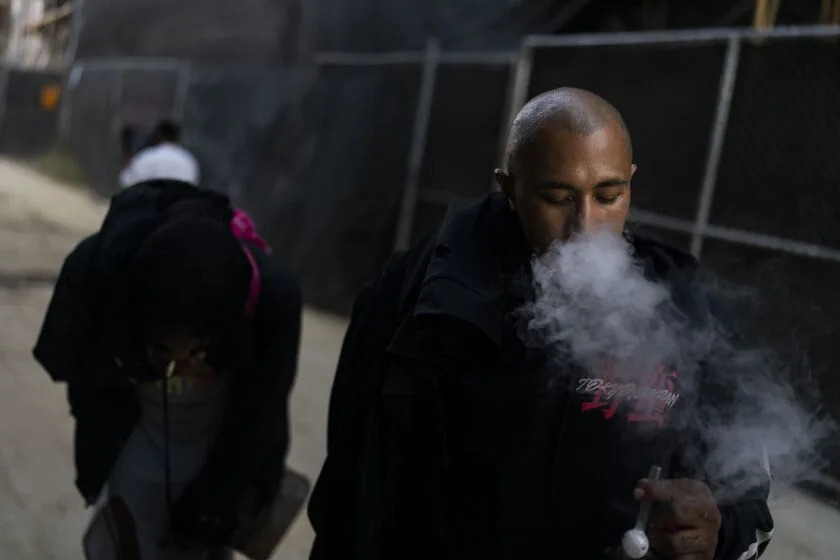
Armando Rivera, 33, smokes fentanyl mixed with methamphetamine in an alley in Los Angeles, Thursday, Aug.18, 2022. Use of fentanyl, a powerful synthetic opioid that is cheap to produce and is often sold as is or laced in other drugs, has exploded. Because it's 50 times more potent than heroin, even a small dose can be fatal. It has quickly become the deadliest drug in the nation, according to the Drug Enforcement Administration. (AP Photo/Jae C. Hong)
A man smokes fentanyl mixed with methamphetamine in an alley in Los Angeles in August. “In the greater Los Angeles area we are seeing xylazine as an additive within fake fentanyl pills,” said Nicole Nishida, spokesperson for the Los Angeles Field Division of the U.S. Drug Enforcement Administration. (Jae C. Hong / AP)

Amid troubling signs that a dangerous sedative known as “tranq” has spread even further into the local street drug supply, the Los Angeles County Sheriff’s Department has launched a pilot program to better document the drug’s presence.

Xylazine is an animal tranquilizer that began appearing several years ago in illicit pills and powders on the East Coast. It’s been linked to deaths across the country and can cause human tissue to rot, leaving users with grisly wounds that sometimes lead to amputations.

In early March, county health officials initially said they weren’t sure whether the deadly adulterant had begun appearing on the streets of Los Angeles. Weeks later, the Times learned that the Sheriff’s Department crime lab had been detecting signs of xylazine in drug samples for at least four years — but they’d never told the health department or the public.

At the time, department officials said that was because, despite its harms, xylazine is not illegal, so formally tracking it was beyond the scope of their work.

Now, though, the pilot program could help change that.

Starting in mid-April, crime lab analysts began making note of any preliminary signs of xylazine they spotted while testing samples of confiscated drugs. In the past, even when lab workers noticed test results that seemed to show the presence of xylazine, they didn’t typically make any note of it. Instead, they treated it like any other legal substances commonly used as additives in illegal drugs.

“There are a bunch of different additives — like vitamin C, which comes up a lot — that we don’t write down,” said Capt. Ernest Bille, who oversees the department’s Scientific Services Bureau. “The mission, given the volume of the caseload that we have, is to figure out: Is this a controlled substance or not?”

Over the course of a month-long trial run, officials hope to get a better sense of how often they typically see presumptive positives for xylazine. If the number is relatively low, they’ll keep tracking for another month, Bille said. If it’s high, they’ll begin figuring out standards for doing additional confirmatory tests in the future — just as they would for illegal drugs.

“This is going to be very unique for us, because I’m asking them to track a non-controlled substance,” Bille said.

The move to track the dangerous sedative — spurred in part by conversations with UCLA researchers who study illicit drugs — comes as federal data shows an uptick in the drug’s presence across the county and in Southern California.

“In the greater Los Angeles area we are seeing xylazine as an additive within fake fentanyl pills,” said Nicole Nishida, spokesperson for the Los Angeles Field Division of the U.S. Drug Enforcement Administration. “While the numbers are relatively low in our community compared to elsewhere in the United States, the presence of xylazine is now becoming more frequent and the trend is concerning.”

Federal data show that about 23% of fentanyl powder and 7% fentanyl pills seized last year contained xylazine. Nishida said those figures were around 3% and 8% for the greater Los Angeles region over that same period.

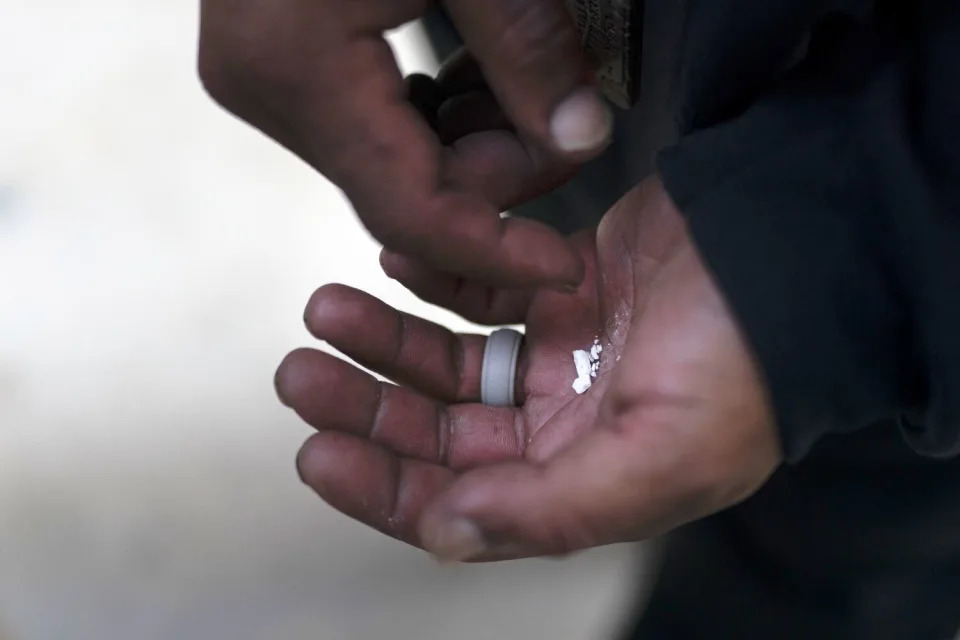
Pieces of fentanyl in the palm of a hand.
A drug user in Los Angeles holds pieces of fentanyl in August. Federal data show that about 23% of fentanyl powder and 7% fentanyl pills seized last year contained xylazine. Those figures were around 3% and 8% for the greater Los Angeles region over that same period. (Jae C. Hong / AP)

But those numbers might be less telling for Angelenos than they first appear: The Los Angeles Field Division’s region is so broad that it includes most of Southern California as well as Nevada, Hawaii and the territories of Guam and Saipan.

It’s not clear whether the xylazine samples were concentrated in one part of that region, and officials did not provide data more specific to Los Angeles County.

So far, law enforcement efforts to quantify and document the presence of xylazine in Los Angeles street drugs have been relatively limited — though, aside from the DEA figures, there are a growing number of signs of its presence.

An early public indication of the drug came in February, when a county health official confirmed to The Times that one man — a 25-year-old in El Monte — had trace levels of xylazine in his body when he died in December 2021. But the drug was present in such small amounts that the county medical examiner listed “combined effects of ethanol and fentanyl” as the cause of death.

Then in March, the county’s Department of Public Health issued a news release warning Angelenos that the sedative was “increasingly present within illicit drugs in California” and that it was now “likely present” in Los Angeles.

The news release mentioned the 2021 death and several others elsewhere in the state. However, although it said that xylazine had been detected in samples in cities to the north and to the south, it said nothing about whether there had been similar finds locally.

Then last month — a few weeks after the Sheriff’s Department admitted seeing signs of xylazine for at least four years — the UCLA researchers studying local street drugs confirmed finding the sedative in a sample of black tar heroin.

“It’s just another indication that it’s here in L.A.,” said Chelsea Shover, an epidemiologist and health services researcher at UCLA. “And it’s really important for people who use drugs to know that.”

One of the reasons xylazine is regarded as a particularly dangerous additive in street drugs is that, since it is not an opioid, the overdose-reversal medication naloxone is not effective on it.

Still, Shover said, if you believe that someone you know has overdosed on xylazine, the best course of action is to give them naloxone and call 911. Typically, xylazine is mixed with fentanyl to extend the drug’s high, so naloxone may still be effective.

“If you give someone naloxone but they’re still sedated, that’s a clue it could be xylazine,” Shover said. “Then call 911 for medical attention — but if you can’t do that, try to keep them comfortable and safe while they are sedated.”

For people who are using drugs but want to minimize the risk of ingesting xylazine, Shover said, there are now xylazine test strips available online.

‘It Was Really Bad’: Ex-Trump White House Press Secretary Details Harassment

HuffPost

‘It Was Really Bad’: Ex-Trump White House Press Secretary Details Harassment

Ed Mazza – May 10, 2023

Stephanie Grisham, who served as White House press secretary under Donald Trump, said she witnessed the then-president’s sexual harassment firsthand.

She told CNN that she had to try to protect one staffer in particular who Trump would request accompany him on trips.

“He one time had one of my other deputies bring her back so that they could look at her ass, is what he said to him,” Grisham said. “I sat down and talked to her at one point, asked her if she was uncomfortable. I tried everything I could to ensure she was never alone with him.”

Grisham said she spoke to various chiefs of staff, including Mark Meadows, about Trump’s behavior.

“I think, at the end of the day, what could they do other than go in there and say, ‘This isn’t good, Sir’?” she said. “Donald Trump will do what Donald Trump wants to do.”

Grisham’s comments came hours after a civil jury found the former president liable for sexual abuse and defamation in a lawsuit brought by writer E. Jean Carroll.

Grisham said Trump would often comment on people’s looks and speculate about cosmetic surgery.

“But with this one staffer, it was really bad, to the point that I was extremely uncomfortable,” she said, adding that all senior White House staffers at the time knew about the situation.

“I did everything I could to keep her off of trips actually, and to stay with her if she was with him alone because I was really nervous about what could happen,” Grisham added.

She did not name the staffer. Grisham has recounted the details before, including in her book.

Critics slammed Grisham for failing to take stronger action and for writing a book about it afterward.

“I frankly see no redeeming quality in this woman or any of the Trump accomplices who now want to clear their names and want to make a buck,” CNN political commentator Ana Navarro said earlier.

What new Florida immigration law means for employers, hospitals and workforce

Pensacola News Journal

What new Florida immigration law means for employers, hospitals and workforce

Brandon Girod, Pensacola News Journal – May 10, 2023

Standing at a podium with a sign reading “Biden’s Border Crisis,” Florida Gov. Ron DeSantis signed a new state immigration law Wednesday that critics say is cruel as it imposes tough penalties and new restrictions on people living in the state illegally.

The measure, approved last week by the Florida Legislature, has been condemned by critics as cruel and potentially leading to law enforcement profiling. It’s considered among the toughest steps taken by any state to deter immigrants without legal permission.

“We have to stop this nonsense, this is not good for our country,” DeSantis said, adding “this is no way to run a government.”

But immigrant advocates said Florida’s approach targets a community already struggling to survive with new criminal penalties and restrictions. Immigrants living in Florida, legally and illegally, represent a huge share of the state’s workforce, leaders added.

Susan Pai, a Florida immigration lawyer based in Jacksonville, broke the new law down, highlighting some of the bill’s biggest impacts.

Strengthening employment requirements

Several sections of the bill outline strengthened employment requirements, including:

  • Employers are required to verify a new employee’s employment eligibility within three business days after the first day the new employee begins working for pay.
  • Private employers with 25 or more employees must use the federal E-Verify system to verify a new employee’s employment eligibility starting on July 1.
  • Public agencies are also required to use the E-Verify system to verify a new employee’s employment eligibility.
  • Employers cannot continue to employ an unauthorized alien after obtaining knowledge that a person is or has entered the county illegally.
  • It is unlawful for any person to knowingly employ, hire, recruit or refer, either for herself or himself or on behalf of another, for private or public employment within the state, a “foreign national” who is not authorized to work in the U.S.
  • An unauthorized immigrant can not obtain a license to practice law in Florida after Oct. 31, 2028, repealing a 2014 law that allowed immigrants living in the country illegally to practice law in the state.

Violating the new law could result in a series of escalating penalties that could lead to the state suspending or revoking all licenses to operate their business.

The Farmworkers Association of Florida, a grassroots nonprofit that advocates for social and environmental justice with farmworkers, estimates that there are about 300,000 farm workers in Florida who live in the state illegally, making up about 60% of the state’s farm workers.

Losing those jobs could have a significant impact on Florida’s agriculture industry, and Pai says she imagines it’s a similar situation among roofers, landscapers and others.

“I’ve been getting a lot of calls from people asking me if they should leave the state,” she said. “The undocumented community is very scared to even show up for work.”

Pai also stressed that Section 12 makes it a crime to even refer someone for employment within the state, and underlined that the law applies to people who lawfully entered the country on visitor and student visas but are not authorized to work.

‘What are we going to do?’ Two migrants share fears for the future in Florida crackdown

Hospitals must ask patients about their legal status

Section 5 states that any hospital that accepts Medicaid must include a provision on its patient admission or registration forms for the patient or the patient’s representative to indicate whether the patient is a United States citizen, lawfully present in the United States, or not lawfully present in the United States.

Hospitals would then need to turn the cumulative data over to the governor and the Florida Legislature quarterly and annually, and they would then have to quantify how much it costs to provide medical assistance to people not living in the country legally. The identity of patients would not be included in this data.

Pai says this law conflicts with health care professionals’ oaths to patients because it dissuades people in need of health care from seeking it out if they are in the country illegally.

“It’s going to prevent people from either bringing theirselves in for medical care or even their children,” Pai said. “They’re not going to know that they don’t have to answer the question. Once they’re asked the question, they believe they have to give up their undocumented status.”

People foregoing preventative health care to hide their status could end up costing Florida more money down the road when untreated medical issues become an emergency.

“Ultimately, their condition may worsen and the cost to Florida may actually be more than if they were just given the care in the first place.”

Out-of-state driver’s license issued to ‘unauthorized immigrants’ no longer valid

Driver’s licenses and permits issued by other states exclusively to people living in the country illegally will no longer be recognized in Florida.

The National Conference of State Legislatures says there are 19 states and the District of Columbia that issue these licenses to people living in the country illegally, and Pai says this bill could “open the flood gates” of racial profiling and increase the danger for drivers across the state.

Illegal immigration in Florida: A by-the-numbers look at a surge

“If you have an undocumented alien who can get a valid license, they can drive legally, they can buy insurance. They’re not going to flee the scene of an accident because they have a valid license. It just makes things more dangerous for everybody,” said Pai.

The law also bars counties and municipalities from providing funds to people, entities or organizations to issue identification documents to individuals who don’t provide proof of lawful presence in the county.

Transporting a person living in the country illegally across state lines is a third-degree felony

The law now makes it a third-degree felony for anyone who knowingly or who reasonably should know that they are transporting immigrants who entered the country illegally into Florida. Transporting a minor is a second-degree felony.

A previous iteration of the bill included transportation within the state, but was cut after critics pointed out that the bill could make transporting a family member who entered the country illegally to the hospital, their job or to school a felony.

Juvenile DNA database

Section 18 would force arrested adults and even juveniles with an immigration detainer (an “immigration hold”) to provide their DNA to the state.

DeSantis’ presidential bid: Florida Gov. Ron DeSantis poised to make presidential bid, Florida could be his blueprint

SB 1718 expands FDLE’s mission to include immigration matters

The most sweeping sections of the bill outlines the expansion of the Florida Department of Law Enforcement’s mission to include immigration matters.

Section 13 states “FDLE, with respect to counter-terrorism efforts, responses to acts of terrorism within or affecting this state, coordinating with and providing assistance to the Federal Government in the enforcement of federal immigration laws, responses to immigration enforcement incidents within or affecting this state, and other matters related to the domestic security of Florida as it relates to terrorism and immigration.”

Sections 14 through 17 expand several Florida anti-terrorism laws to include immigration law enforcement, which Pai says is a “very smart way” to skate around having to create state-specific immigration crimes that are not also federal crimes.

Pai says this “huge” expansion of power is ultimately going to “dilute” anti-terrorism resources in the state.

“There’s no appropriation that goes along with this huge expansion of power to the Florida Department of Law Enforcement and other law enforcement agencies and organizations in the state of Florida who are charged with anti-terrorism and now immigration enforcement incidents within or effecting the state,” she said.

Appropriates $12M from Florida’s General Revenue Fund to migrant transportation program

Section 21 appropriates $12 million from the General Revenue Fund, which is funded by taxpayer dollars, to be used for DeSantis’ “unauthorized alien transport program.” The same program that made headlines when DeSantis flew about 50 Venezuelan migrants in two charter planes from Texas to Martha’s Vineyard, Massachusetts.

The Division of Emergency Management selected three companies to execute Gov. Ron DeSantis’ controversial migrant relocation program.

A “notice of intent award” issued on Monday named ARS Global Emergency Management, GardaWorld Federal Services and Vertol Systems Company, Inc., which was the company that carried out last year’s migrant flights to Martha’s Vineyard.

The division had posted a request for proposals at the end of of March, after getting control of the program and $10 million to carry it out through special session legislation. During the regular session, which concluded last week, lawmakers approved $12 million more for the program.

But the taxpayer cost will be more than that, as the program has already generated multiple legal challenges. Florida has paid two law firms more than $640,000 in legal fees for DeSantis’ relocation of nearly 50 Venezuelan migrants from San Antonia, Texas, to Martha’s Vineyard.

The companies selected, according to the request for proposals, must “provide ground and air transportation and other related services… to assist in the voluntary relocation of Inspected Unauthorized Aliens that have agreed to be relocated from Florida, or another state, to a location within the United States.”

The related services include research and planning, ensuring those relocated have provided voluntary consent, and arranging social support at the destination.

How many US mass shootings have there been in 2023?

BBC News

How many US mass shootings have there been in 2023?

May 9, 2023

Gun sale in Virginia
Data shows gun ownership in the US has grown over the last several years

Gun violence is a fixture in American life – but the issue is a highly political one, pitting gun control advocates against people who are fiercely protective of their right to bear arms.

We’ve looked into some of the numbers behind firearms in the US.

Mass shootings on the rise

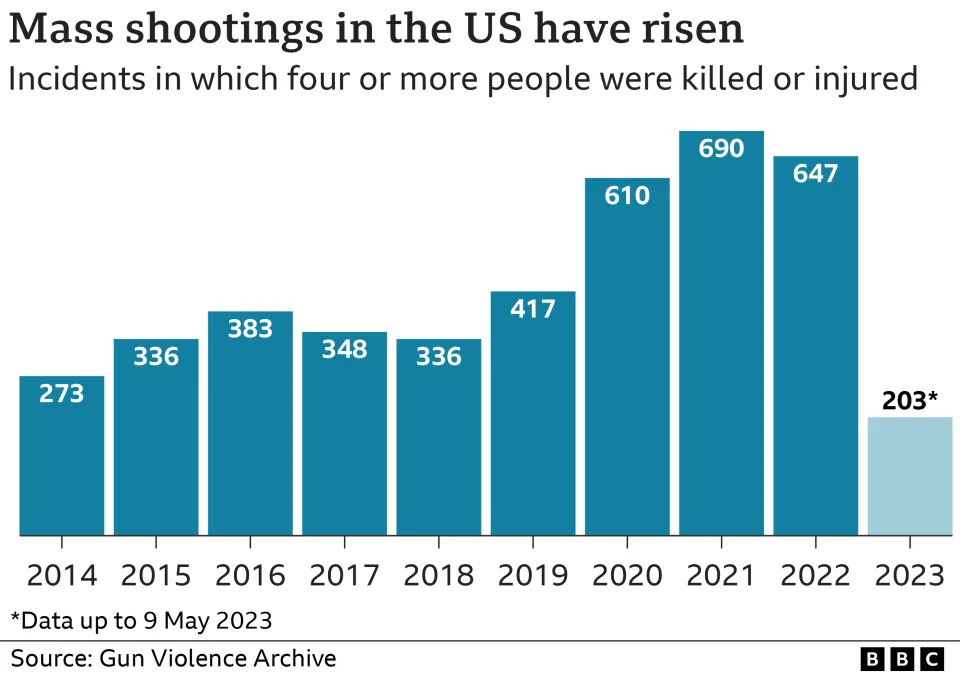
There have been more than 200 mass shootings across the US so far this year, according to the Gun Violence Archive, which defines a mass shooting as an incident in which four or more people are injured or killed. Their figures include shootings that happen in homes and in public places.

There have been two in Texas in the last week – five killed at a home in Cleveland, north of Houston, and eight dead at a shopping mall in Allen, near Dallas.

In each of the last three years, there have been more than 600 mass shootings, almost two a day on average.

The deadliest such attack, in Las Vegas in 2017, killed more than 50 people and left 500 wounded. The vast majority of mass shootings, however, leave fewer than 10 people dead.

Graphic showing year by year mass shootings
How do US gun deaths break down?

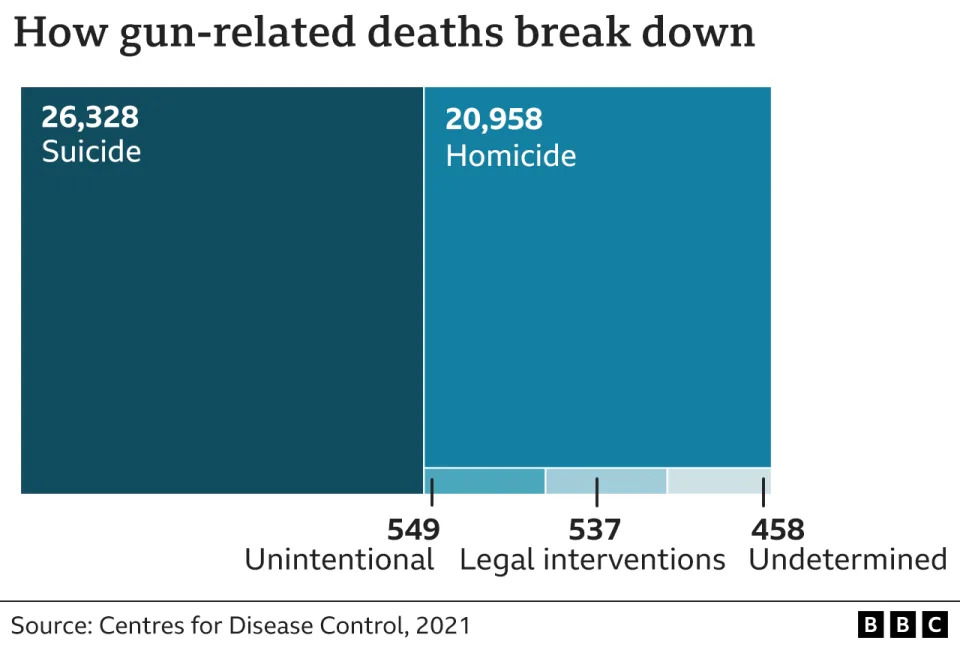
48,830 people died from gun-related injuries in the US during 2021, according to the latest data from the US Centers for Disease Control and Prevention (CDC).

That’s nearly an 8% increase from 2020, which was a record-breaking year for firearm deaths.

While mass shootings and gun murders (homicides) generally garner much media attention, more than half of the total in 2021 were suicides.

Chart showing a breakdown of gun-related deaths in the US

That year, more than 20,000 of the deaths were homicides, according to the CDC.

Data shows more than 50 people are killed each day by a firearm in the US.

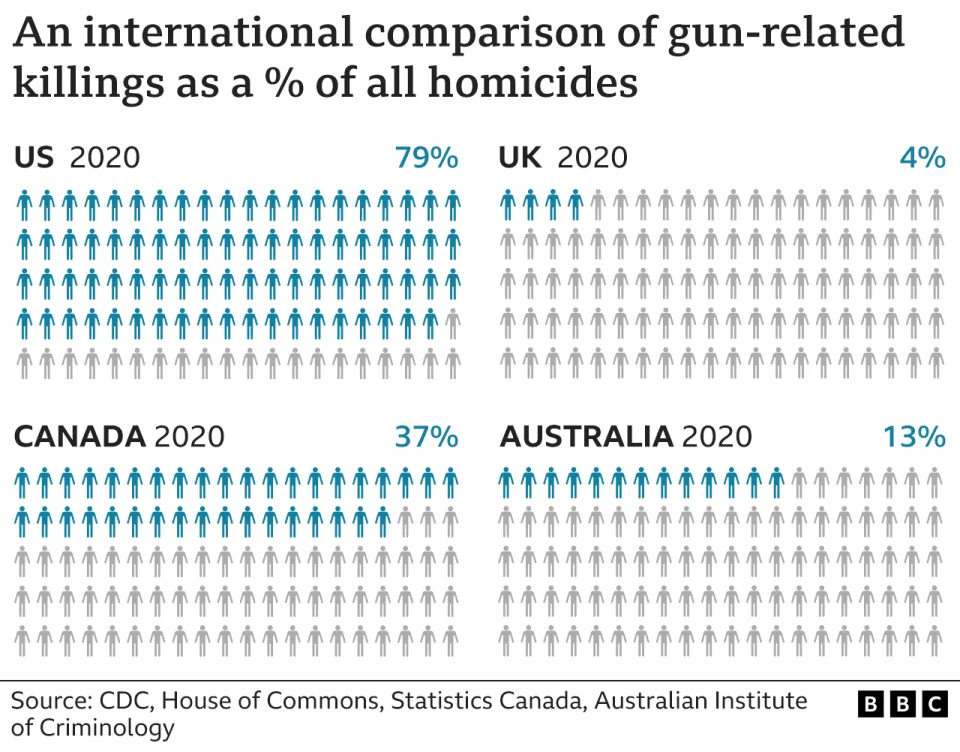
That’s a significantly larger proportion of homicides than is the case in Canada, Australia, England and Wales, and many other countries.

Graphic showing an international comparison of gun-related killings as a percentage of all homicides in each country. The US leads with nearly 79% of all homicides occurring with guns.
How many guns are there in the US?

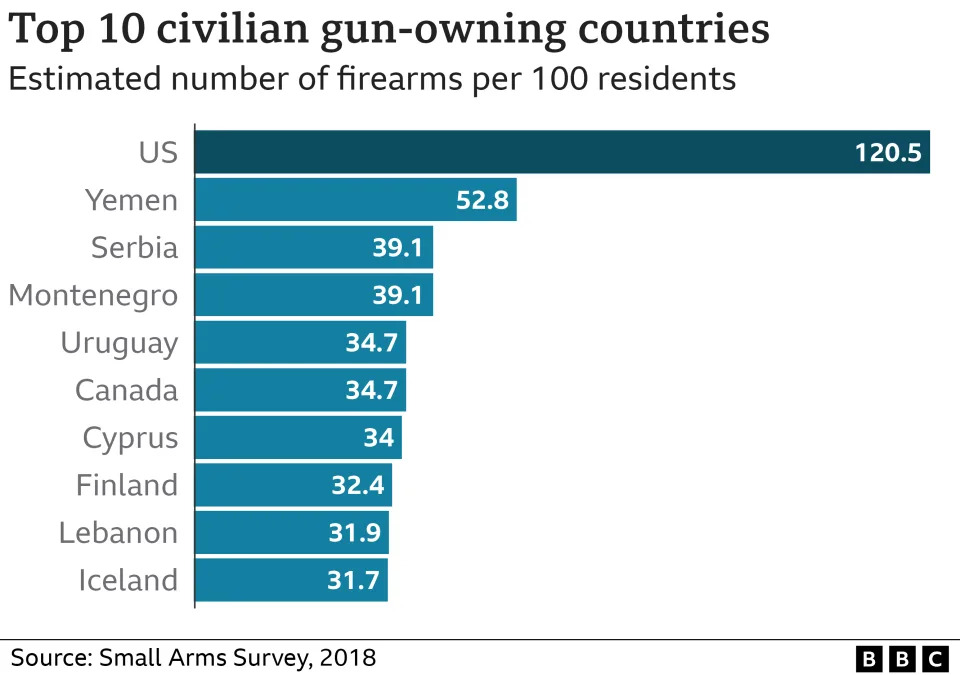
While calculating the number of guns in private hands around the world is difficult, the latest figures from the Small Arms Survey – a Swiss-based research project – estimated that there were 390 million guns in circulation in the US in 2018.

The US ratio of 120.5 firearms per 100 residents, up from 88 per 100 in 2011, far surpasses that of other countries around the world.

Chart showing civilian gun ownership around the world

More recent data out of the US suggests that gun ownership grew significantly over the last few years. A study, published by the Annals of Internal Medicine in February, found that 7.5 million US adults became new gun owners between January 2019 and April 2021.

This, in turn, exposed 11 million people to firearms in their homes, including 5 million children. About half of new gun owners in that time period were women, while 40% were either black or Hispanic.

Who supports gun control?

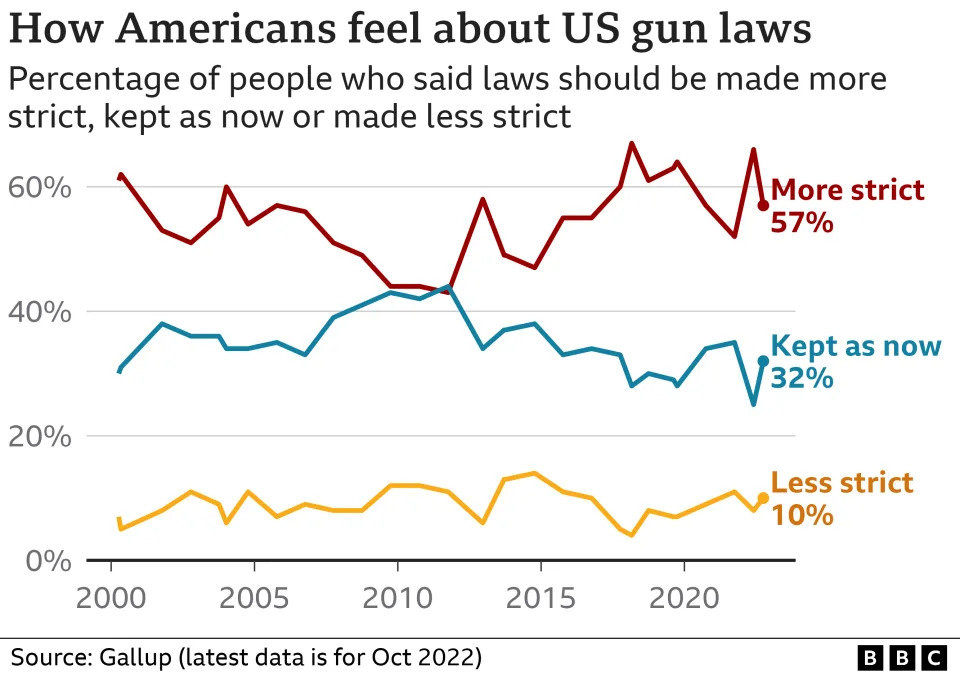
A majority of Americans are in favour of gun control.

57% of Americans surveyed said they wanted stricter gun laws – although this fell last year – according to polling by Gallup.

32% said the laws should remain the same, while 10% of people surveyed said they should be “made less strict”.

Gun control opinion
Gun control opinion

The issue is extremely divisive, falling largely along party lines.

“Democrats are nearly unanimous in their support for stricter gun laws,” another Gallup study noted, with nearly 91% in favour of stricter gun laws.

Only 24% Republicans, on the other hand, agreed with the same statement, along with 45% of Independent voters.

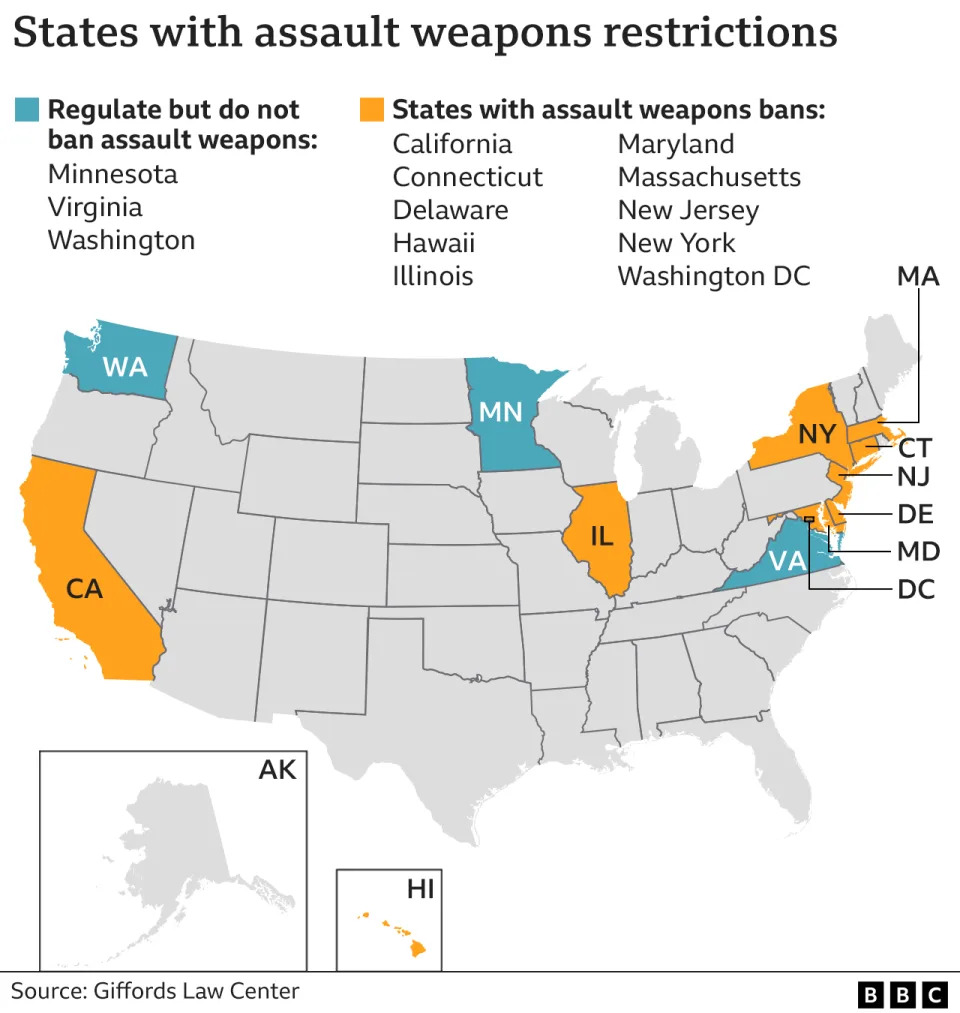
Some states have taken steps to ban or strictly regulate ownership of assault weapons. Laws vary by state but California, for example, has banned ownership of assault weapons with limited exceptions.

Map showing states with assault weapon bans - California, Connecticut, Delaware, Hawaii, Illinois, Maryland, Massachusetts, New Jersey, New York & Washington DC, and those with restrictions Minnesota, Virginia and Washington, March 2023
Map showing states with assault weapon bans – California, Connecticut, Delaware, Hawaii, Illinois, Maryland, Massachusetts, New Jersey, New York & Washington DC, and those with restrictions Minnesota, Virginia and Washington, March 2023

Some controls are widely supported by people across the political divide – such as restrictions governing the sale of guns to people who are mentally ill or on “watch” lists.

Who opposes gun control?

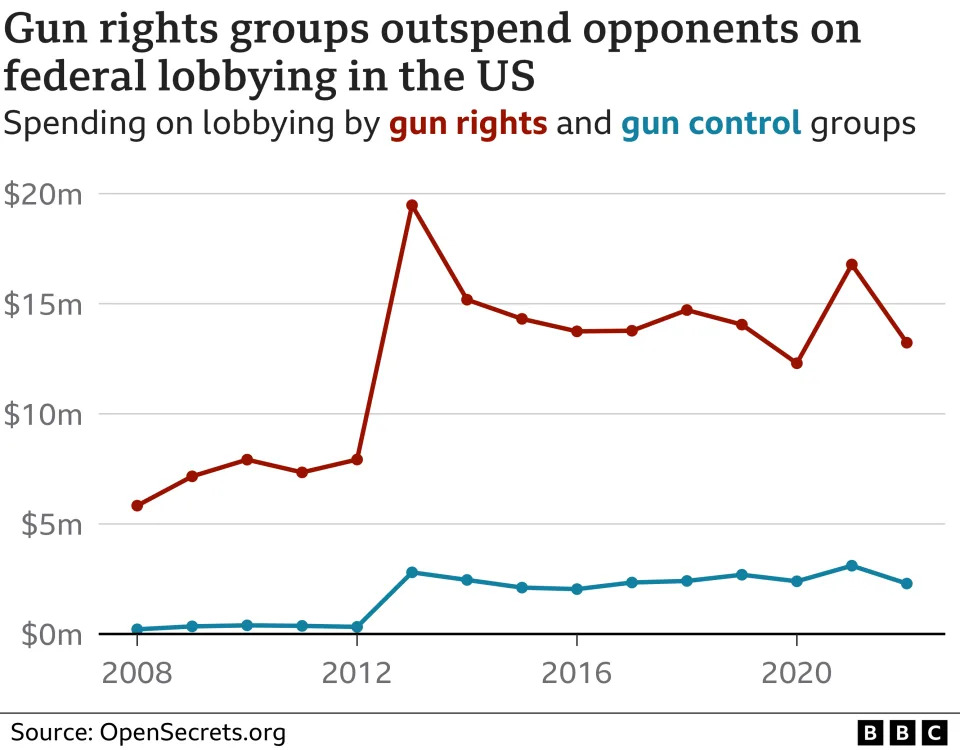
Despite years of financial woes and internal strife, the National Rifle Association (NRA) remains the most powerful gun lobby in the United States, with a substantial budget to influence members of Congress on gun policy.

Over the last several election cycles, it, and other organisations, have consistently spent more on pro-gun rights messaging than their rivals in the gun control lobby.

A line chart showing the amount spent per year by gun rights groups and gun control groups on federal lobbying in the US from 2008 to 2022. Gun rights groups have consistently spent more than double what gun control groups have. Gun rights spending peaked in 2013 at just under $20m - gun control groups spent just under $3m in the same year. In 2022, gun rights groups spent $13m, while their opponents spent $2.3m.
A line chart showing the amount spent per year by gun rights groups and gun control groups on federal lobbying in the US from 2008 to 2022. Gun rights groups have consistently spent more than double what gun control groups have. Gun rights spending peaked in 2013 at just under $20m – gun control groups spent just under $3m in the same year. In 2022, gun rights groups spent $13m, while their opponents spent $2.3m.

A number of states have also gone as far as to largely eliminate restrictions on who can carry a gun. In June 2021, for example, Texas Governor Greg Abbott signed into law a “permitless carry bill” that allows the state’s residents to carry handguns without a licence or training.

Similarly, in April last year Georgia became the 25th in the nation to eliminate the need for a permit to conceal or openly carry a firearm. The law means any citizen of that state has the right to carry a firearm without a licence or a permit.

The law was backed by the NRA, and leaders within the organization called the move “a monumental moment for the Second Amendment”.

Why are mass shootings rare in other countries despite high levels of gun ownership?

The Week

Why are mass shootings rare in other countries despite high levels of gun ownership?

Justin Klawans, Staff writer – May 9, 2023

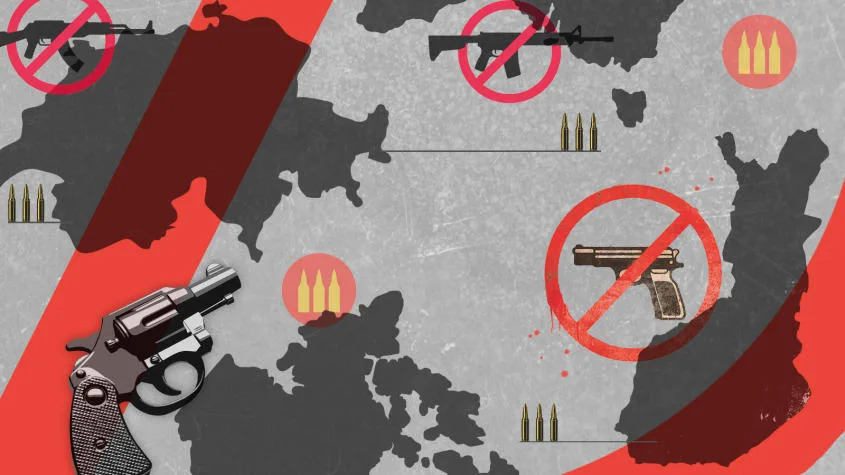
Guns.
Guns. Illustrated | Gettyimages

There is no question the United States has a ton of guns — more than anywhere else in the world by far. There are an estimated 352 million guns in private circulation in the U.S., according to data collected by The Trace, and some other studies cited by the outlet suggest the number is even higher.

It comes as no surprise, then, that the U.S. leads the world in mass shootings. There have already been over 180 of these incidents in 2023 alone, The New York Times reports. Many mass shootings occur in schools; since the Columbine High School shooting in 1999, more than 352,000 students have experienced gun violence in the classroom, according to The Washington Post.

While the United States leads the world in number of firearms, it’s hardly the only country where gun ownership is high. Yet in most other countries, mass shootings are rare, if not unheard of, mainly due to gun laws being significantly stricter than they are in the U.S. Between 2009 and 2015, there were just 19 mass shootings in all of Europe, research shows. School shootings are even rarer, and World Population Review reports that every country besides the U.S. has had less than 10 of them in 2023. These are five nations that have high numbers of firearms but little trouble with shootings.

Finland

There are an estimated 1.5 million licensed firearms in Finland, the country’s interior ministry reports, in a nation of just 5.6 million. This high rate of gun ownership is due to an activity widely seen in Finland (and many other nations): hunting. Finns “have hunted and fished for food for thousands of years,” Slate reports, and “hunting remains a popular weekend, or even after-work, activity.” Finland’s large area provides ample space for the hunting industry to flourish.

Despite this, Finland has had less than five documented cases of mass shootings. This is because, like most of the Nordic countries, Finland has highly regulated gun control laws. Following a school shooting in 2007, Finnish Parliament raised the minimum age to purchase a gun from 15 to 18, and the prospective buyer must fill out a detailed application to receive a handling license. The interior ministry has also implemented “changes to the provisions on the storage of firearms, component parts of firearms, and cartridges,” as well as additional legislation to ensure guns remain safely locked away when not in use.

Switzerland

Like Finland, hunting is a part of life in Switzerland, which may be why the Alpine country has approximately 2 million privately owned guns, Insider reports, in a country of just 8.7 million people. Despite this staggeringly high rate of gun ownership, though, there has not been a mass shooting in Switzerland in more than 20 years.

Insider notes that the U.S.’ National Rifle Association often points to Switzerland as an example of gun laws not being necessary, because they claim the Swiss have limited legislation on firearms. But this is simply not true. Firearms in Switzerland are highly controlled and regulated, according to the official Swiss Confederacy portal. Semi-automatic rifles with large magazines are banned, and people who want to purchase handguns or smaller magazine semi-automatic rifles must undergo a permitting process and send their weapon’s information to the government.

Canada

Canada’s vast northern lands make it another ample country for hunting, which contributes to the 7.1 million firearms in private hands, according to the Canadian government, in a nation of 39 million people. This statistic lies in a similar range with comparable Western nations, the government notes, except the United States.

The country has had a few recent mass shootings, including one in 2020. Despite this, instances of mass violence remain very rare, Reutersreports. This is because Canada has some of the harshest regulations against assault rifles in the world, and the nation’s public safety arm notes Canada “has prohibited over 1,500 models of assault-style firearms and certain components of some newly prohibited firearms.” Many of these weapons became newly prohibited following the 2020 mass shooting, and there are also limits in the Canadian criminal code placing restrictions on the number of rounds in rifles, handguns and shotguns.

New Zealand

New Zealand also has a lot of guns — 1.5 million in a country of just 5.1 million people — but unlike the United States, New Zealand took legislative action after a tragedy.

Following a 2019 mass shooting in Christchurch that killed 51 people, then-Prime Minister Jacinda Ardern implemented a series of sweeping reforms to the country’s already strict gun laws. Ardern announced these reforms just one week after the shooting, Time reports, and the new laws were pushed through parliament almost immediately. The laws included creating a firearms registry and placing a complete ban on AR-15s and other assault rifles. New Zealand also created a gun buyback program to try and get weapons off the streets. By the end of the program, Kiwis had turned in more than 50,000 guns, NPR reports, greatly slashing the number of firearms on the streets of New Zealand.

Australia

Like their neighbors to the southeast, Australia also has a high rate of gun ownership, and the University of Syndey notes there are about 3.5 million registered firearms in the nation of 26.4 million. However, the university also reports that the “proportion of Australian households with a firearm has fallen by 75% in recent decades.”

This drop was similarly spurned by just a single tragedy: the 1996 Port Arthur massacre in Tasmania. Thirty-five people died in the worst mass shooting in Australian history, and the country’s conservative government enacted similar new restrictions on guns. This includes a national gun registry, and Time notes that firearm license applications must prove the prospective owner has “a ‘genuine need’ to own weapons.” The Aussies also implemented a gun buyback program after Port Arthur, and Vox reports the country confiscated 650,000 weapons. There have been almost no mass shootings in Australia since then.