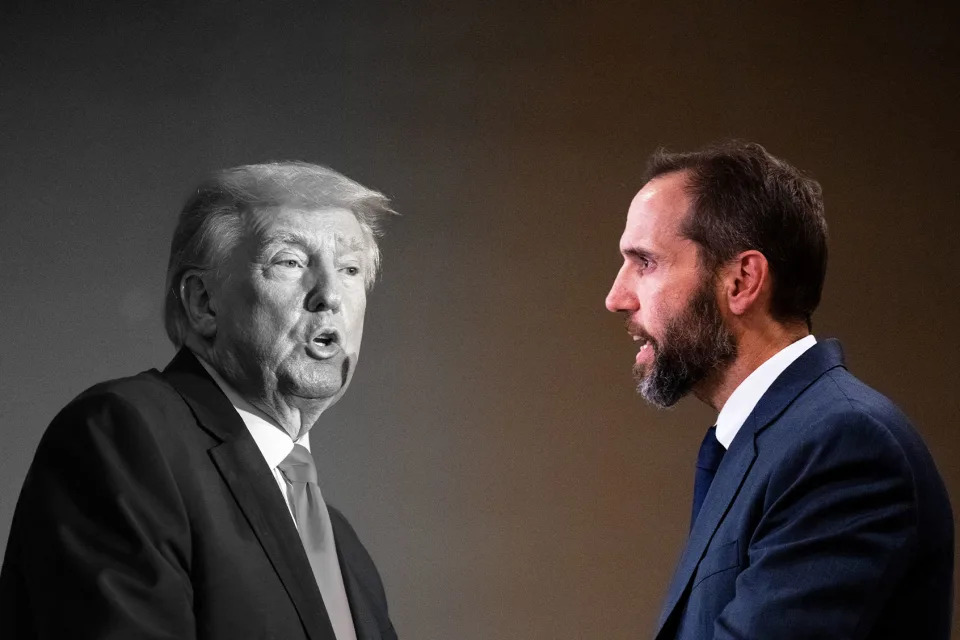
Experts: Smith just got potentially “highly incriminating” evidence — but it could delay indictment
Igor Derysh – July 25, 2023
Donald Trump; Jack Smith Photo illustration by Salon/Getty Images
Former New York Police Commissioner Bernie Kerik, a close ally of former Trump lawyer Rudy Giuliani, has cut a deal to turn over his findings into supposed 2020 election fraud to special counsel Jack Smith, according to The Daily Beast. Kerik received a full pardon from then-President Trump in February 2020, erasing his 2010 conviction on eight felony charges relating to tax fraud and lying to federal officials. He served nearly three years in prison before his release in 2013.
Smith previously subpoenaed the documents, which are related to Kerik’s work as former President Donald Trump’s on-the-ground investigator looking at widely discredited conspiracy theories about voter fraud, according to the report. Kerik’s team refused to turn over the documents, citing attorney-client privilege because he was working on behalf of Trump’s attorney, but Trump himself waived the privilege on Friday and agreed to let him turn over the documents, Kerik lawyer Tim Parlatore told the outlet.
Smith is expected to receive nearly 2,000 pages of documents describing Kerik’s probe.
National security attorney Bradley Moss called the move a “significant gamble by Trump’s legal team” but it’s unclear why he signed the waiver.
Smith’s team is looking at Trump’s decision process as he pushed baseless voter fraud conspiracies while his advisers refuted the allegations.
Parlatore, who previously represented Trump as well, told The Daily Beast that the evidence may end up being exculpatory because it shows the Trump campaign did hear allegations of fraud and engaged in good faith efforts to investigate the claims.
“From the time he received a subpoena from the January 6 Committee, Mr. Kerik has believed that full disclosure is the best policy so that the public can understand how extensive the legal team’s efforts to investigate election fraud were,” Parlatore told the outlet.
But none of Kerik’s efforts found any proof of voter fraud and virtually all of Trump’s post-election legal challenges failed in court.
New York University Law Prof. Ryan Goodman warned that Kerik’s documents “could be highly incriminating,” citing a D.C. bar committee report on Giuliani that found that the documents “do not show any connection” between allegations and “election fraud.”
Kerik and Giuliani “could not and would not confirm that the information contained in the Kerik documents was true,” the report said, adding that the content is “in many instances facially incredible.”
While Trump’s lawyers could argue that they made a good faith effort, prosecutors can use it to show that the evidence Trump claimed he had was “nothing and unsubstantiated,” former federal prosecutor Elie Honig said on CNN.
“They need to know what’s in those documents,” he said of Smith’s team. “And I think they need to be prepared to counteract those, to say, ‘This is nothing. This is a pile of useless garbage.’ A lot of courts found that, and I think prosecutors have to be ready for that defense.”
Kerik told The Daily Beast that he also agreed to sit down for a formal interview with the feds in mid-August. The outlet noted that the “timing could indicate that Smith isn’t as close to indicting Trump as the former president has recently suggested, but Smith could also conduct the Kerik interview after an indictment.”
Former Watergate prosecutor Jill Wine-Banks agreed that the timeline could be delayed, tweeting that “it may be a long indictment watch.”
Former U.S. Attorney Joyce Vance told MSNBC that it is difficult to gauge Smith’s timeline given that he sent Trump a target letter last week but is still talking to witnesses.
“I think the answer is while we could see an indictment any day, it’s possible that there could be a strategy, for instance, to indict Trump alone and to continue to work on the rest of the case,” Vance said. “That seems a little bit far-fetched to me. This is a case where you want to play everything by the books. You want to treat this the indictment like you would any other case, prepare it against any and all of the defendants you’re looking at.”
Vance added that Smith is reportedly looking to bring a conspiracy charge, which means that “Trump would not be a standalone defendant, he would need some co-defendants.”
CNN legal analyst Norman Eisen, who served as Democratic counsel during Trump’s first impeachment, disagreed that the evidence would slow down Smith.
“I don’t expect… that this huge trove of documents and this additional testimony is going to slow him down or speed him up,” he said on Monday, “but it’s important and he can use it as he prosecutes the case whenever he may charge.”
Former U.S. Attorney Harry Litman cited Trump’s increasingly aggressive rhetoric about the probe as a sign that an indictment is coming soon.
The “hysteria levels from Trump are hitting the stratosphere because this is one that he would know about,” he told MSNBC. “So, to me, the table is set, Smith is ready to go and that’s what the target letter means, save only you guys coming in or not? And by the way, you can’t take two weeks, you know, come in off the pitch after that. Here’s the indictment.
‘I Drank 8 Glasses of Water Instead of Only 3 Every Day for 2 Weeks—Here’s What I Noticed Right Away’
Beth Ann Mayer – July 25, 2023
The idea of staying hydrated throughout the day is nothing new, and the reminders become more prevalent as the temperatures rise each summer. And have they risen this summer or what? About one-third of Americans were under excessive heat warnings earlier this month. It’s so hot in Europe that they’re naming their latest heat wave after a character in Dante’s Inferno.
I’ve decided to pick this hot-as-hell (literally?) summer to get back into marathon running for the first time since 2018, the year before I got pregnant with my first of two sons. I’ve felt parched (normal) and dizzy (not normal) after running. I’ve also realized I probably finish one 24-ounce water bottle daily.
Part of this is because my second child considers my water bottle a toy (despite all the other real toys he has). So, I generally keep it out of his sight and mind, which means out of my reach. At 17 months, he nurses like a newborn—another reason I need to stay hydrated.
Between the weather and my training regimen, I knew this had to change for my health. So, I committed to drinking more water.
The standard recommendation is to drink eight 8-ounce glasses of water daily. The guidance likely stems from a 1945 Food and Nutrition Board recommendation to drink eight glasses of water per day. A few things got lost in the sauce in the decades since. The first was followed by, “Most of this quantity is contained in prepared foods.” Translation: Fruits and vegetables contain water that counts toward your daily intake. The second: the Nutrition Board advised people to consume 2.5 liters (84.5 ounces) daily, not eight 8-ounce glasses (64 ounces).
In the years since, researchers have debunked this recommendation as a myth. But The National Academies of Science, Engineering and Medicine recommends men drink 125 ounces (3.7 liters) and women drink 91 ounces (2.7 liters), which isn’t all that more than the 1945 recommendation.
I’ve also done numerous interviews with dietitians and doctors since starting my writing career nearly a decade ago. Regarding water, and without fail, multiple health professionals have told me that starting with a goal to drink 64 ounces of water daily is a good baseline.
It’s certainly better than 24 ounces. I had to start somewhere.
In theory, drinking more water is one of the simplest, lowest-cost ways to enhance your health. You truly don’t need much except access to clean, safe water (sadly, a luxury for some) and something to drink it out of. To help me stay on track, I decided to use a few tools:
My trusty 24-ounce water bottle. I’m a words person, not a numbers person. But 64 divided by 24 is 2.66, meaning just under three full water bottles would get me to 64 ounces.
Waterllama app. This app sends notifications to remind you to drink water and allows you to track consumption. When I was pregnant with my first, I actually tracked water using an app and found it helped me stay on track with nutrition. I figured the notifications would also help me remember to sip, even when juggling work and parenthood.
On the first day, I realized how little water I drank. By noon, I had consumed 12 ounces of water. Some may call that a water bottle half full, but it felt half empty to me. I had 12 hours left to drink a whopping 52 ounces of water to meet my goal. I gulped. And gulped. And gulped. I spent the rest of the day feeling like I had a stomach full of water and like I was pregnant again because I needed to pee every five seconds.
There had to be a better way that felt less like a pressure-filled fire drill. I decided to set small goals beginning on day two. I’d aim for 24 ounces by noon, 24 ounces by dinner and 16 ounces between dinner and bed. And, to make it feel like less of a hill to climb, I focused on referring to it as “one water bottle by lunch,” “one water bottle by dinner” and “two-thirds of a water bottle by bed.”
The method worked instantly. I received a notification every two hours to drink water, and I was able to do a quick water bottle check to ensure I was sipping enough. I always was and felt accomplished as I watched my water intake numbers go up in my app.
The biggest challenge on the second day was my three-mile morning run. It was already pushing 80 degrees at 7:30 a.m., and I was dehydrated by the end. On the third day, I consumed 12 ounces an hour before working out. It allowed me to use the facilities pre-workout but have enough left in my tank to complete an even longer run of five miles.
By day five, drinking 64 ounces of water felt way more manageable. I felt better during my workout and more hydrated throughout the day, but I still had dizzy spells and felt rather depleted by dinner.
Cleveland Clinic notes that several factors dictate how much water you should consume daily, including:
The weather is warmer than usual, and my physical activity is higher now because of my training. And, like I said, I’m nursing a toddler.
I decided to focus on drinking at least 64 ounces daily, but not considering that a maximum. Instead, my goal became to drink enough to feel good. On days seven and eight, I drank before I got thirsty and got up to 80 ounces. I felt better. However, during the second week, I realized that between 100 and 110 ounces was more of my sweet spot. I never felt dehydrated or dizzy and could run around and play with my kids. Not surprisingly, I needed more on days I did longer runs.
Because drinking more water is low-cost, it sounds like a super-simple way to boost your health. But it can be challenging, particularly if you’re super focused on your career and tend to put everyone else first (hello, parenthood). That was probably my biggest takeaway, so please be kind to yourself if you struggle to stay hydrated.
My other learnings include:
Eight 8-ounce glasses daily is a baseline. This recommendation—which was never the real recommendation—is a good starting point. However, it may not be your endgame.
Water intake is fluid. No pun intended. However, it’s perfectly normal to need extra water on one day when it’s really hot, or you did a more intense workout than you did on a rest day that you spent mainly in the blissful air conditioning.
Drink when you’re not thirsty. Don’t wait until you’re dehydrated or thirsty to drink—those are late-stage signs you need water, not early ones.
Water is pre-workout fuel. Sipping water about an hour before working out will help you feel more hydrated during your sweat session (minus the urge to pee one mile into a six-mile run).
Stop before bed. Try to limit water intake about an hour before bedtime to reduce the midnight bathroom run (rest is also essential to health). You may need to reduce consumption sooner or later, but I found 60 minutes worked for me.
Apps help. I’ll probably stop tracking now that I’m in a flow with my water intake. I found tracking can aid in accountability but become a bit obsessive for me, but it was an excellent tool to get me started. Play around with it and see if it helps you reach your hydration goals short and long-term.
Water is essential. Though eight glasses daily may be a misnomer, the benefits of staying hydrated can’t be understated. I felt so much better when I woke up in the morning, during workouts and throughout my day because I was more hydrated. I had more energy to chase my kids around and tackle my to-do list.
On the last point, I hesitate to call drinking water “self-care” because it’s something necessary (in the same way showering with the door closed or grocery shopping alone aren’t really “self-care” but get pinned in that way for busy moms).
But it’s also not something to sacrifice to care for your children or get work done. Fill your cups (or water bottles) so you’re not quite literally pouring from an empty one all day.
How right-wing news powers the ‘gold IRA’ industry
Jeremy B. Merrill and Hanna Kozlowska – July 25, 2023
Dedicated viewers of Fox News are likely familiar with Lear Capital, a Los Angeles company that sells gold and silver coins. In recent years, the company’s ads have been a constant presence on Fox airwaves, warning viewers to protect their retirement savings from a looming “pension crisis” and “dollar collapse.”
One such ad caught the attention of Terry White, a disabled retiree from New York. In 2018, White invested $174,000 in the coins, according to a lawsuit by the New York attorney general – only to later learn that Lear charged a 33 percent commission.
Over several transactions, White, 70, lost nearly $80,000, putting an “enormous strain” on his finances, said his wife, Jeanne, who blames Fox for their predicament: “They’re negligent,” she said. A regretful White said he thought Fox “wouldn’t take a commercial like that unless it was legitimate.”
While the legitimacy of the gold retirement investment industry is the subject of numerous lawsuits – including allegations of fraud by federal and state regulators against Lear and other companies – its advertising has become a mainstay of right-wing media. The industry spends millions of dollars a year to reach viewers of Fox, Newsmax and other conservative outlets, according to a Washington Post analysis of ad data and financial records, as well as interviews with industry insiders. Former Fox News host Bill O’Reilly and former New York mayor Rudy Giuliani have promoted the coins, while ads for Lear’s competitors have appeared on a podcast hosted by Sen. Ted Cruz (R-Tex.) and Newsmax broadcasts of former president Donald Trump’s political rallies.
An analysis by The Post of political newsletters, social media, podcasts and a national database of television ads collected by the company AdImpact found that pitches to invest in gold coins are a daily presence in media that caters to a right-wing audience and often echo conservative talking points about looming economic and societal collapse. The Post found no similar ads for gold retirement investments in mainstream or left-wing media sources in the databases.
These so-called “gold IRA” companies are not publicly traded, so their revenue, profits and ad budgets largely cannot be determined. Court documents filed by Lear say the company has about $200 million in annual revenue; Dale Whitaker, the former chief financial officer at another company, Augusta Precious Metals, said overall industry revenue likely approaches $1 billion a year.
Over the past decade, more than 30 customers in 20 states have sued a dozen gold IRA companies, including Lear. Federal regulators have sued four companies – two in the past year alone – claiming investors were systematically charged as much as triple the coins’ value.
None of the cases have gone to trial; some are still pending. Of those that have been resolved, most have settled or been sent to arbitration, where outcomes are not made public. The companies have not admitted wrongdoing in any of the cases and say their customers have been adequately informed of the details of their purchases.
Joe Rotunda, enforcement director at the Texas State Securities Board, said the industry is extraordinarily difficult to police because selling gold, even as a retirement investment, is “extremely thinly regulated.”
Experts on commercial speech say Fox and other media outlets have no obligation to spurn advertising from gold IRA companies, despite the allegations. “Courts are very hesitant to impose liability on publishers,” said Harvard law professor Rebecca Tushnet, an expert in First Amendment and advertising law, who said the law is designed primarily to compel truthfulness by advertisers.
Tushnet added that “it might be reasonable, if you found out about the lawsuits, [to] contact the advertiser” and ask questions about the claims before running the ads. But if an advertiser blames their legal troubles on “the woke mob,” she said, “you’re often allowed to believe them.”
Fox News declined to comment. In a statement, Newsmax spokesman Bill Daddi said the network does not see allegations against the gold IRA companies as “a cause to block them from advertising.” Daddi compared them to some major financial firms that have been sued by customers or regulators, and whose ads continue to be accepted by mainstream outlets. For example, Wells Fargo paid $3 billion in 2020 to settle potential charges related to opening fake accounts in customers’ names.
In a statement, Lear Capital spokesperson Tracy Williams defended the company’s operations, saying most of Lear’s customers would have made a profit if they had sold at a recent market high. Williams said that White, the New York retiree, had acknowledged the company’s fee in a recorded call.
Last year, Lear settled New York’s 2021 lawsuit involving White without admitting wrongdoing. However, the company agreed to repay some customers and to disclose its fees more clearly. Lear now gives customers 24 hours to pull out of purchases, Williams said, putting the company at the “vanguard of disclosure … within its industry.”
Lear declined to say how much it spends to advertise on Fox News, but Williams said the network is not Lear’s primary source of customers. Nor is Lear likely to make up a significant share of Fox’s total ad revenue, which exceeds $1 billion a year, according to securities filings.
Fox is a logical place for Lear to advertise because “purchasing physical assets appeals to persons who have concerns regarding … topics often discussed on that platform,” Williams said. She added: “U.S. monetary policy is inseparable from U.S. political dynamics and themes.”
For years, gold IRA industry advertising has echoed accusations against Democratic politicians commonly found in news segments on conservative outlets. The ads tout the coins as a safe haven from economic uncertainty and social upheaval.
Most of the coins are manufactured by the Royal Canadian Mint, which says they’re bullion, a kind of coin whose value is determined by the underlying metal. As such, they meet IRS rules for retirement investments.
Unlike most bullion coins, however, the gold IRA industry’s coins are typically exclusive to the companies who sell them, usually with markups far higher than those charged by mainstream coin retailers, regulators and coin experts say. Alex Reeves, a spokesman for the Royal Canadian Mint, said the mint has no control “over sales practices further down the chain of distribution.”
“They are priced like collectibles, but collectible coins aren’t typically sold in bulk,” said Everett Millman, a precious metals specialist at coin dealer Gainesville Coins. “If a customer spent the same amount of money on products that are more standard, like [Canadian] Silver Maple Leafs, they would end up with a lot more ounces per dollar.”
With the exclusive coins, Millman said, “They’re simply torching money.”
“No one in their right mind would pay the premiums that these guys are charging,” added Ken Lewis, CEO of online coin dealer Apmex, who reviewed several customer invoices at The Post’s request.
The ads explain none of that. Instead, they focus on news events, such as a spate of recent bank failures and “everything that’s happening in the economy right now … with all the talk of inflation,” Rotunda said.
For example, an email ad for Augusta, sent to a Newsmax mailing list last July, warned that “The Biden administration’s economic policies are ‘declaring war’ on retirement savers.” In December, American Hartford Gold Group sent an email ad with the subject line: “Bill O’Reilly Warns: Retirement Funds at Risk From a Biden Recession.” The email is signed by O’Reilly, who did not respond to a request for comment.
Another ad for Hartford sent to the Newsmax mailing list in March warned of “Biden and Yellen’s Secret Plan to Steal your Hard-Earned Money and Bail Out Their Wall Street Buddies.”
Trump rallies are particularly big events for Hartford. On July 1, Newsmax aired a live broadcast of a Trump speech in Pickens, S.C., on a split screen with an ad for Hartford, which also sends “Trump Rally Special” email ads via Newsmax.
Since October 2020, email newsletters distributed by Newsmax have included more than 1,100 ads for gold IRA companies – nearly a quarter of all Newsmax email ads reviewed by The Post. At $1,000 to $5,000 each, according to Augusta financial records from 2016 reviewed by The Post, the ads likely generate more than $1 million a year in revenue.
Daddi, the Newsmax spokesman, said gold IRA companies represent “a small percentage of the total advertisers on Newsmax across all platforms.”
Some conservative figures offer explicit endorsements. Giuliani has called Hartford “the experts I trust most” on his podcast “Common Sense.” The “Verdict with Ted Cruz” podcast has featured ads for Hartford for at least a year, and a recent segment touted Augusta, urging listeners “to protect your dollars … with a gold IRA.” Neither Giuliani nor Cruz responded to requests for comment.
Two media dealmakers who have been involved in negotiations between conservative media figures and the gold IRA industry said revenue from the companies can amount to as much as 10 percent of total earnings for some personalities. The dealmakers spoke on the condition of anonymity to protect their business relationships; one said the biggest personalities stand to earn millions of dollars a year.
Hartford spokesman Steven Goldberg said it runs ads “where we believe it will create the most value.” Among the company’s chosen venues: a “prophetic” evangelical Christian email newsletter, two right-wing TV channels, and more than a dozen conservative radio shows and podcasts, including Giuliani’s and Cruz’s.
One of Hartford’s ads caught the attention of Ed DeSanto, 65, a semiretired Florida medical coder and an avid right-wing radio fan. He invested a $100,000 lump-sum payout from his pension in a Hartford IRA in 2019.
DeSanto said he doesn’t remember exactly where he heard the Hartford ad, but “if you listen to those radio shows, they play those commercials all the time.” He said he believed he was being careful: He picked Hartford because it scored well in a ranking of gold IRA companies he found online. (Such rankings often include disclosures noting that the authors are paid by the gold IRA companies.)
DeSanto’s $100,000 investment netted him just $53,000 worth of gold and silver, according to a Post analysis of his invoices – meaning the coins had been marked up 92 percent over the value of the metal. DeSanto blames himself.
“I did a little bit of research, but evidently not enough,” DeSanto said. “When I found the invoice, it was a big shock.”
In 2018 and 2019, another retiree, John Mathys of Illinois, claimed a Hartford salesman persuaded him to invest his $569,000 retirement savings by “bombarding him” with calls and emails for months, according to a federal lawsuit Mathys filed against Hartford in 2020. The lawsuit was sent to arbitration. Neither Mathys nor his lawyer responded to requests for comment.
Mathys, who was 83 at the time of the lawsuit, is one of three customers who sued Hartford in the past six years accusing the company of fraud. The other two lawsuits settled.
Hartford declined to comment on any of the cases. “We are fully transparent with our clients about the pricing of the products they purchase and the potential range of markup for those products,” Goldberg said in a statement, adding that the company operates “with a steadfast commitment to doing business legally and ethically.”
“We deny the allegation that we’ve misled or otherwise acted improperly,” Goldberg said.
In February and April, DeSanto sold back some of his gold coins to Hartford. Although gold prices had climbed an average of 32 percent since his 2019 purchase, he lost money on the sales, according to a Post analysis of his invoices.
The gold IRA industry’s ties to right-wing media date to the Great Recession, when the price of gold was rising rapidly and Fox commentator Glenn Beck was one of the most popular hosts on TV. Beck recorded ads for Goldline, a gold dealer that also offered IRAs, and interviewed its CEO on his show.
“We could be facing recession, depression or collapse. Nothing left!” Beck told viewers in 2009, urging them to rely on “God, Gold and Guns.” After segments promoting gold investments, Beck’s show would sometimes cut to commercials featuring gold sellers like Goldline, according to a 2010 congressional report.
The gold companies were loyal advertisers: After Beck claimed in 2009 that President Barack Obama was “racist” and had “a deep-seated hatred for White people or the White culture,” many big advertisers dropped his show. Gold sellers were among the few who stayed on, according to reporting at the time.
Goldline soon came under scrutiny, first in congressional hearings, then by Santa Monica, Calif., prosecutors, who charged the company with misdemeanor grand theft, elder theft and conspiracy in 2011. Though Goldline defended its business practices as fully transparent and never admitted wrongdoing, the company later agreed to pay up to $4.5 million to settle the charges.
Beck faded from prominence after departing Fox News in 2011 to start his own channel. He still endorses Goldline on the company’s website. Neither Beck nor Goldline executives responded to requests for comment.
The controversy sent Goldline employees scrambling for safer harbors. Some got jobs at Merit Financial, according to interviews and public records. Merit, whose offices were just a few blocks from Goldline’s in Santa Monica, also sold coins by phone and ran ads on Fox. (Merit’s former owner declined to comment publicly.)
In 2014, Santa Monica prosecutors accused Merit of “an aggressive, nationwide fraud scheme.” The company denied the allegations but went out of business and settled as the case approached trial.
Several Goldline and Merit salesmen then struck out on their own, founding many of the companies that exist today, according to staff lists and interviews with 21 current and former industry employees.
A former Merit salesman founded Augusta Precious Metals, which has been accused of defrauding its customers by Whitaker, its former CFO. Whitaker filed a whistleblower complaint to the Commodity Futures Trading Commission, which has not taken public action. Augusta has denied the allegations, and CEO Isaac Nuriani said in a statement that Whitaker “never had any visibility into Augusta’s business operations.”
Other former Goldline and Merit employees founded Metals.com, the founders said in depositions. That company recruited customers on Facebook, where it faked an endorsement from Fox News host Sean Hannity, a court filing by Georgia securities regulators alleged.
Facebook data reviewed by The Post shows that many Metals.com ads targeted people 59 or older. One 87-year-old customer received daily phone calls from a Metals.com broker who eventually flew to Alabama for a weekend to meet her, regulators alleged. She ultimately invested nearly $90,000, they said – most of which was lost.
The FBI raided Metals.com in 2020. A judge ordered the company shut down after 31 states and the CFTC filed suit, alleging a $185 million commodities fraud, as well as violations of rules about investment advice. Company founders have denied the allegations, saying their company “strived for transparency” and disclosed that it charged a premium. They have also said in court filings that they are under criminal investigation. Company executives did not respond to requests for comment submitted to their lawyer.
After Metals.com closed, some salesmen went to work at Safeguard Metals, according to one of the salesmen, who spoke on the condition of anonymity for fear of retaliation. In February 2022, the Securities and Exchange Commission, CFTC and 27 states sued that company, too. Safeguard recently settled the SEC’s case without admitting liability; the CFTC’s suit is still pending. Safeguard’s lawyers did not respond to a request for comment.
Lear Capital also hired several salesmen from Goldline’s ranks and bought Merit’s database of customers, according to court records and staff lists submitted to California regulators and obtained by The Post through public records requests. Williams, the Lear spokesperson, said “Merit’s liquidation was an opportunity to acquire a customer and prospect base to service and market to in the future” and that Lear performed background checks on everyone it hired.
Lear recently exited bankruptcy reorganization after resolving investigations from dozens of states. It remains in business.
Hartford’s CEO also worked at both Goldline and Merit before starting that company. Goldberg, the Hartford spokesman, declined to comment when asked whether the company was under investigation by state or federal regulators.
DeSanto said he has complained to both the Florida attorney general and the CFTC about his experience with Hartford. He said he spoke twice with CFTC investigators in 2020, but the agency has not taken public action.
In February, DeSanto also called Hartford to try to sell back his coins. He said he was flabbergasted to learn that the salesman who handled his purchase was still employed there. And he was shocked to find O’Reilly’s photo still featured on the company’s website.
“Everything is the same there,” DeSanto marveled. Of O’Reilly, he added: “I would think, for his reputation, he’d want to get away from a company like them.”
Kozlowska is a freelance writer based in New York. The Washington Post’s Sarah Ellison and Dan Morse contributed reporting. Raz Nakhlawi contributed research.
Florida’s insurance crisis isn’t about ‘woke.’ It’s about state leaders in a stupor | Opinion
The Miami Herald Editorial Board – July 24, 2023
Pedro Portal/pportal@miamiherald.com
Upon Farmers Insurance’s announcement that it was pulling out of Florida, Jimmy Patronis, the state’s chief financial officer went right to the heart of the state’s continuing insurance crisis: “The more we learn about Farmers Insurance, the more it’s clear its leadership doesn’t know what they’re doing. While they’re bad at helping people, they’re good at virtue signaling.”
As reported in the Herald, Patronis criticized what he called Farmers’ “ ‘sustainable insurance’ and aligning investments with its social values, like avoiding investing in polluters or companies that sexually or racially discriminate against employees.” The concept is called environmental, social and governance investing — ESG, for short — a political target for Republicans lately.
Basically, Patronis blames Farmers for doing business while incorporating a “woke” ideology, the go-to scapegoat these days, the convenient and facile argument in Gov. Ron DeSantis’ Florida.
We beg to differ.
Whether Farmers Insurance rightly values the principles of ESG is irrelevant here. What’s important is that 100,000 policies in Florida — auto, property — are going belly up.
The wrong excuse
It’s not that the company might be woke; it’s that state lawmakers and the governor were asleep at the wheel as other insurance companies fled Florida long before Farmers.
It’s that lawmakers have been in a stupor as Floridians cried out for relief from soaring property insurance rates.
It’s that those same elected leaders were single-minded zombies who protected insurance companies, not homeowners, during two special sessions.
And yet these are the same legislators who were filled with boundless energy when it came to carrying out Gov. DeSantis’ culture wars in his now-lackluster drive toward to the White House.
Now Patronis, not to be left out, is skirmishing with Farmers. When the Editorial Board asked his office what specifically the insurance company had done in the offending area of ESG, Deputy Chief Financial Officer Frank Collins III doubled down: “While Farmers Insurance is keeping their commitment to the United Nations, they’re dumping 100,000 Florida policyholders; too bad their affection for ESG standards couldn’t stop these Floridians from being dropped.”
Know what else is too bad? That this is Patronis’ politically lame attempt to distract Floridians from the fact that 13 companies have gone insolvent in Florida. Others have stopped writing policies in the state, sending property owners’ premiums soaring into the stratosphere and leaving Citizens as the insurer of last resort for so many property owners. Tim Cerio, Citizens president and CEO, has predicted that the number of policies to reach 1.5 million by the end of the year.
Launch a probe?
And while he was denigrating Farmers, Patronis added he planned to look into complaints against the company, which could trigger a market investigation and — perhaps — fines and fees. This, of course, sounds like a retaliatory move in the same vein as our thin-skinned governor’s costly fight against Disney.
If there truly is something for Patronis to investigate, why did he wait until now to actually do his job? As CFO, the state’s so-called “business manager,” he oversees insurance and consumer services, responding to Floridians on finance-related queries, especially complaints about insurance fraud and related matters.
Interestingly, he found the time this month to tout the launch a new online site: “This morning, we deployed the Florida IRS Transparency Portal where Floridians can submit complaints about individual IRS agents,” Patronis announced on July 13. “We will take this information to look for patterns on how the IRS is targeting Floridians, which will help us craft laws to protect our businesses. We also want to provide the public with a tool where they can report harassment by the IRS.”
His curious use of the militaristic word “deploy” aside, we, too, don’t believe individuals and entities should be targeted by the IRS, especially for their political beliefs, and hope that Floridians across the political spectrum will have equal access to his concern.
But while Patronis is protecting Floridians from the tax collector, he’s among the many state leaders who have left us exposed and vulnerable to the state’s insurance crisis.
Resisting the urge to find small positives in the generally horrible.
By Neil Steinberg – July 23, 2023
A cat watches as Chicago police investigate inside an apartment in the 7700 block of South Carpenter Street after an officer shot and killed a man while answering a call of a domestic disturbance in the Gresham building on the South Side, Monday, Oct. 4, 2021.
What is it about stupid people anyway?
You can believe the most god-awful nonsense — factually incorrect, self-flattering, steaming kettles of BS — and parade that stupidity around to the delight of your fellow idiots, cheering and high-fiving one another at big rallies, celebrations of toxic dumbness.
Yet let somebody point it out, let them cough into their fist and mutter, “You’re stupid,” and suddenly the stupid fall to the ground, clutching themselves, declaring their injury to heaven.
It’s so … for want of a better word … stupid. How can some people get upset if you call themstupid when they’re perfectly happy being stupid? It’s a mystery.
Say your house were on fire — a situation even more dire than being stupid. And I say, “Your house is on fire,” causing you to collapse in a heap and declare yourself insulted, insisting that your house — obviously ablaze before us, thick black smoke pulsing out of the windows — is fine and how dare I suggest otherwise? Rude!
Who does that? Stupid people, I suppose.
I haven’t written much about Florida Gov. Ron DeSantis, honestly, because I still suspect he’s some kind of a sham — a performance art piece perhaps — designed to make Donald Trump look good, between his daft war on Disney and his imbecilic assault on history.
Maybe you haven’t heard. In its constant quest to make white people feel better, the state of Florida’s No. 1 priority, apparently, is downplaying race when teaching American history.
Florida’s new curriculum, unsatisfied with presenting racism as a dusty relic of the 19th century, is taking the next step and redefining America’s original sin, slavery, as something akin to high school shop class.
“Slaves developed skills, which, in some instances, could be applied for their personal benefit,” the curriculum notes.
Now, it is one thing to suggest that historic wrongs can have positive consequences. Polish anti-Semitism a hundred years ago was bad, but it drove my grandfather to Cleveland before the real butchery began. Which was good. For him.
But to focus on that scrap of positivity while denying the bulk of the horror is just … stupid. It’s like celebrating that Anne Frank got a best-selling book out of hiding from the Nazis while ignoring that she died in Bergen-Belsen.
Yet there was DeSantis on Friday, doubling down — the go-to move for the stupid since they can’t reevaluate — and supporting the new curriculum.
“They’re probably going to show that some of the folks that eventually parlayed, you know, being a blacksmith into doing things later in life,” DeSantis said.
And they give out free pudding in the Burn Center at Loyola. But were I to tuck a line in a burn story — “Burn patients enjoy free pudding, to their personal benefit, since pudding is delicious” — my editor would ask me to rethink that.
Then again, I’m a professional communicator and snug among — I hope — the non-stupid. We consider our audience.
Let me end with a true story. A photographer mentioned what she calls “crime scene kitties.” Her job takes her to crime scenes, where cats often appear. We got into a discussion of why the kitties are there — drawn by commotion? The cats I know would flee instead. Maybe cats are everywhere but, when standing around crime scenes for hours, she notices them.
“That could be a story!” I said.
Then I did a trick the stupid seldom attempt: I thought about it. I don’t write a lot of crime stories. To swoop into a tragic problem plaguing Chicago — people being murdered — and focus on the cats that wander over, there’s something grotesque about that. Something trivial. Something insulting, to victims and families. I did that empathy thing liberals are so good at, considering people other than myself, and reluctantly concluded: no crime scene kitties story.
That’s why Ron DeSantis should never be president. Because his campaign strategy — appeal to people threatened by anyone not exactly like themselves, people who can’t recognize the racism both in America’s past and in their own hearts right this flippin’ second — is stupid, if effective. We don’t want that guy. As if to underscore the difference, on Saturday the White House announced the creation of national monuments to Emmett Till. Till’s story is jarring and terrible — that photo of him in the casket. And essential and true and American. How could you ponder a history that didn’t include it?
Trump’s GOP rivals open door to cutting Social Security for younger people
Jeff Stein, The Washington Post – July 22, 2023
Vice President Mike Pence, right, and Florida Gov. Ron DeSantis take questions during a Florida Coronavirus Response Meeting, at the West Palm Beach International Airport, Friday, Feb. 28, 2020, in West Palm Beach, Fla. (AP Photo/Terry Renna) (ASSOCIATED PRESS)
Three of Donald Trump’s rivals for the 2024 GOP presidential nomination are pushing for cuts to Social Security benefits that would only affect younger Americans, as the party’s leaders grapple with the explosive politics of the retirement program.
In comments on Sunday as well as in interviews earlier this year, Florida Gov. Ron DeSantis (R) said Social Security will need to be revamped – but not for people who are near or in retirement.
Former vice president Mike Pence and former South Carolina governor Nikki Haley have taken similar positions since launching their presidential campaigns. From the earliest days of his 2016 run, Trump has vowed not to touch either Social Security or Medicare – a break from GOP orthodoxy that has shifted the party’s views – and has more recently hammered DeSantis for wanting to cut the program.
“When people say that we’re going to somehow cut seniors, that is totally not true,” DeSantis said on Fox News. “Talking about making changes for people in their 30s and their 40s so the program’s viable – that’s a much different thing, and something I think there’s going to need to be discussion on.”
On Monday, Pence told Fox Business: “I’m glad to see another candidate in this primary has been willing to step up and talk about that.”
The positions the three Trump rivals are taking suggest that even the fiscally conservative candidates in the GOP presidential primary are reluctant to endorse cutting Social Security for seniors, highlighting just how much the party has shifted on the issue. Former House speaker Paul D. Ryan (R-Wis.), the party’s 2012 vice-presidential candidate, had led the party in championing budget blueprints that would have entailed significant cuts to both Social Security and Medicare.
As the Republican Party becomes increasingly reliant on older voters for support and as Trump continues to exert heavy influence over the party’s beliefs, GOP policymakers have followed the former president’s lead in steering clear of proposals to cut the program, with House Speaker Kevin McCarthy (R-Calif.) ruling that out in debt ceiling negotiations earlier this year with the White House.
But concentrating potential cuts on the young, as the Trump challengers have proposed, has its downsides as well. The candidates’ posture risks alienating young voters who have already become increasingly alienated from the Republican Party. And cutting benefits for younger people leaves the bulk of the problem unresolved, experts say, given that the Social Security funding crisis is projected to arrive decades before millennials receive their first checks.
“It clearly would not address the shortfall, or the short- to medium-term problem we’re going to have in 10 years or less,” said Howard Gleckman, senior fellow at the Urban-Brookings Tax Policy Center, a nonpartisan think tank.
Economists of both parties agree that Social Security and Medicare, the health insurance program for the elderly, face funding crises if Congress does not act to shore up their finances somehow, either by reducing benefits or raising taxes. If no reforms are enacted, Social Security benefits for an estimated 60 million people will be cut by 20 percent starting in 2033, according to the most recent report of the Boards of Trustees of the Social Security and Medicare trust funds. Medicare also faces automatic benefit cuts as soon as 2031, the report says.
President Biden has proposed increasing taxes on the rich and businesses to prevent Medicare from running out of funds. But the latest White House budget does not propose a solution for extending Social Security. Numerous congressional Democrats have called for trillions in new taxes to avoid the Social Security shortfall, as well.
Policy experts have long said it will probably take a mixture of reduced spending and higher taxes to address the looming funding shortage facing Social Security and Medicare. Social Security’s old age and survivors insurance trust fund is expected to only be able to pay 77 percent of benefits in 2033, which would probably lead to automatic reductions in payments. People in their forties are still more than two decades away from receiving Social Security benefits.
The comments from DeSantis and Pence suggest that some Republicans have “not updated their talking points from the 1990s,” said Brian Riedl, senior fellow at the Manhattan Institute, a libertarian-leaning think tank. Thirty years ago, Riedl said, it would have been possible to argue for resolving the funding shortfall only by limiting benefits for future recipients. But given that the enormous baby boomer generation is now at retirement age, exempting them from cuts would still leave the program in crisis.
“I get the politics of not wanting to lead with, ‘We will cut seniors,'” Riedl said. “But it might be better to say nothing than to offer an unpopular approach that doesn’t even avoid a debt crisis because it would be implemented far too late.”
DeSantis’s message will probably soon be tested. Trump has released video messages tying DeSantis to House Republicans who wanted to cut Social Security and for pushing to raise the retirement age when the Florida governor served in Congress, although Trump has also expressed support in the past for raising the retirement age.
“Donald Trump ruled Social Security and other benefits out of bounds politically” for Republican politicians, said Bill Galston, senior fellow at the Brookings Institution, a Washington-based think tank. “But there are still Republicans, including some leading Republicans, who understand we won’t make serious progress on our fiscal problems until everything’s on the table. They’re trying to open that discussion, without it immediately being shut down.”
CDC: Toxic blue-green algae is infecting humans, animals in Michigan summers
Mika Travis, Detroit Free Press – July 21, 2023
Harmful algae blooms in Michigan and other states are spiking during the summer in freshwater bodies such as lakes, according to a recent CDC report.
Harmful algae blooms are often caused by a rapid growth of cyanobacteria, known as blue-green algae, a naturally occurring bacteria. Gary Kohlhepp, Lake Michigan unit supervisor of the Michigan Department of Environment, Great Lakes, and Energy, said that a small amount of cyanobacteria is a safe and natural part of the water system, but it can become toxic when it begins to cluster in large quantities and creates blooms. Toxins produced in these blooms can lead to illness in humans and animals.
According to the National Oceanic and Atmospheric Administration, blue-green algae blooms are a common occurrence in the Great Lakes, specifically Lake Erie.
CDC report results
The CDC report collected voluntary data from public health agencies across 16 states on harmful algae bloom events in 2021, referred to as harmful algal blooms in the report. Here were the findings:
Most reported events occurred during the summer, with a peak in August (25% of reported events).
Most of the events (90%) reported were in lakes, reservoirs or other freshwater bodies.
A third of the reports of human illness occurred in June.
The most common symptoms in humans were gastrointestinal, generalized (headaches and fevers, for example), and dermatologic.
Reports of animal illnesses occurred primarily in August (86%), mostly involving wildlife.
The most common symptoms in domestic pets were gastrointestinal, such as vomiting, and generalized, such as lethargy.
A harmful algae bloom event in Washington killed 2,000 bats.
There were 368 harmful algae bloom events reported, resulting in 117 human cases of illness and at least 2,715 animal cases of illness. (Animal cases are underrepresented because some group animal reports did not provide the number of total animals impacted, or indicated that the number they gave was an underestimate.)
Kohlhepp said that EGLE had seen an increase in reporting on harmful algae blooms, though that may not indicate an actual increase in the quantity of blooms in the state.
“I think some of that increase is just that people are more aware of it and more likely to report it,” he said.
These harmful algae blooms can appear as accumulations of algae that coat the surface of the water or as a neon green color in the water.
Kohlhepp said that if there aren’t any visible signs of a harmful algae bloom in the water, there’s a good chance it’s safe, though the only certain way to tell whether a body of water is toxic is by testing.
In one instance, Kohlhepp’s team tested a clear spot in a lake that had a harmful algae bloom in another part of it. In the spot that appeared clear, there was only a miniscule amount of cyanobacteria picked up.
“The good news is, generally, if you don’t see a bloom, the toxins are not present,” Kohlhepp said. “There’s almost always an indication that there’s something going on when the toxins are present, either that bright color or the surface accumulation.”
According to Michigan Sea Grant, the most common type of blue-green algae in the Great Lakes is microcystis, a bacteria which produces a liver toxin and skin irritant.
When exposed to these harmful algae blooms, humans often develop a rash. Other possible symptoms include nausea, headache and fever.
Animals, such as dogs, who experience symptoms may appear sluggish. Other symptoms found in animals include vomiting and dark urine.
Steps to take after exposure
Because humans usually experience dermatologic symptoms, Kohlhepp recommends washing off as soon as possible after coming in contact with a harmful algae bloom. If they notice symptoms, they should visit a doctor for next steps.
Dogs and other animals should also be rinsed off after exposure, though symptoms may still arise if they ingested the algae-filled water. Pet owners should watch for symptoms and take them to a veterinarian if they notice any symptoms.
How to report a harmful algae bloom
EGLE collects reports of harmful algae blooms through email at algaebloom@michigan.gov. They recommend sending a photo alongside the report, so that they can more easily identify algae blooms and send someone to test the water.
DeSantis’ campaign is hemorrhaging support with this type of GOP voter, polls show
Alex Roarty – July 21, 2023
Lily Smith/The Register/Lily Smith/The Register / USA TODAY NETWORK
Republican voters with a college degree and a built-in skepticism of Donald Trump were supposed to form the backbone of Ron DeSantis’ strategy to win the 2024 GOP presidential primary.
Instead, they’re leaving his campaign in droves.
A trio of Republican primary polls, including previously unpublished data obtained by McClatchyDC, show that Florida’s governor has suffered steep declines in support among GOP voters with at least a bachelor’s degree, an erosion that threatens to undermine his candidacy.
Their defections — which started in the spring and have continued this summer — are disproportionately responsible for DeSantis’ overall decline in the race, where polls show he now sits a distant second place to Trump. In all three surveys, the governor now has barely half the support with college-educated white voters that he did when the year began, larger drop-offs than he suffered with other demographic groups.
The numbers reflect a pressing problem for the Florida Republican as he seeks to reset his campaign amid fundraising concerns and flagging poll numbers, challenging him to recover the lost support among voters who once made him Trump’s top rival for the nomination. The national surveys paint a troubling picture for his campaign, even as his allies insist that recent state-level polling already shows his candidacy regaining momentum.
A poll from decision intelligence company Morning Consult, for instance, found that DeSantis’ support had dropped 18 points among white college-educated Republicans, from 41% when the year began to 23% in mid-July, according to internal data shared with McClatchyDC.
A poll from market research firm Ipsos, meanwhile, found the governor’s support had been halved since mid-March, when it reported he had 39% among college-educated Republicans, according to data shared with McClatchy.
The same survey, released this week, found he had dropped to 20% among those voters, a 19-point decline. (Ipsos’ survey did not distinguish between college-educated white Republicans and college-educated Republicans, although the difference between the makeup of the two groups is small.)
A publicly available survey from Quinnipiac University found the largest drop in support for DeSantis, with the governor going from 51% support in a February poll of college-educated white Republicans to 29% with them now — a 22-point decline.
These voters abandoned DeSantis’ campaign at roughly twice the rate as Republicans without a college degree, a review of polling data found.
None of the three surveys asked why DeSantis has lost the support of college-educated Republicans. But in interviews with non-partisan pollsters and Republican political operatives, some of them speculated that the governor’s decision this year to double down on a sharp-edged conservative agenda could have alienated voters who once viewed him as a more pragmatic, mainstream politician.
“College-educated Republicans were looking for an alternative to Donald Trump, and they initially thought Governor DeSantis, after his 19-point win in Florida, made for a good one,” said Whit Ayres, a veteran GOP pollster. “But the way he has run his campaign, constantly tacking to the right, has turned off many of those people who were initially attracted to him.”
Ayres emphasized that he thought DeSantis still had time to recover from his underwhelming start, arguing people who once supported him can be brought back into the fold with a smart strategy that included more moderate positioning. And some Republican operatives disagree that DeSantis’ more conservative tack is at the root of his drop in support, arguing that Trump’s own popularity, combined with an indictment in March that conservatives saw as wildly unjust, is more responsible for the shift than anything the Florida governor did.
DeSantis’ allies say they already see signs that his popularity has rebounded, dismissing the importance of national surveys instead of state-based polling in places with an early nominating contest. A survey released in New Hampshire this week, from University of New Hampshire Survey Center, found DeSantis receiving 23% support, up from 22% in April, while Trump dropped from 42% to 37%.
The survey showed DeSantis earning the support of 12% of Republicans with only a bachelor’s degree, and 20% support of GOP voters with a graduate degree.
“You’re going to start to see this narrative continue to develop as more state level polling increases, particularly in those states where you see the impact of our ground game,” said an official with Never Back Down, the super PAC supporting DeSantis.
But the official conceded that Trump had gained ground earlier this year after he was indicted by a Manhattan grand jury over allegations he illegally paid hush money to an adult film actress, a prosecution conservatives think is politically motivated. And indeed, while DeSantis’ support with college-educated sank, Trump’s standing with those voters improved markedly since the year began.
Morning Consult, for instance, found Trump’s support nationally with these Republicans improving from 33% to start the year to 46% by mid-July. Among all college-educated GOP voters, Ipsos found him improving from 31% in mid-March to 36% this week.
And Quinnipiac showed him growing from 22% support in February to 34% in a survey released Wednesday.
In all three surveys, Trump now has more support among college-educated voters than DeSantis.
Trump has always fared better among Republicans without a college degree than those with a degree, dating back to his 2016 candidacy when he shocked the GOP establishment and won the party’s nomination. His presidency, in fact, helped shift the party toward a more blue-collar constituency, facilitating an influx of those voters into the GOP’s fold while simultaneously pushing many college-educated men and women, including former Republicans, to start backing Democratic candidates.
Compared to GOP voters without a college degree, GOP pollsters say, college-educated Republicans are socially moderate and fiscally conservative, with some of them both repelled by Trump’s rhetoric and uninterested in his stated aim of making the party’s economic agenda more populist
They might have expected a different approach from DeSantis, political experts say, and soured on him when he didn’t meet that expectation.
“College-educated voters tend to be more liberal,” said Tim Malloy, a polling analyst with Quinnipiac. “And DeSantis has gone right a good deal more than many expected him to do so.”
DeSantis’ support has suffered among Republicans without a college degree, too, though at lower rates than he has among those with degrees.
Among non-college white Republicans, Morning Consult and Quinnipiac found DeSantis’ support dropping 10 and 11 points since the start of the year. Ipsos found his support among non-college Republicans dropping six points since March.
DeSantis’ overall standing in the GOP primary has declined markedly since the start of the year, according to an average of polls compiled by FiveThirtyEight.com. The site has found his support dropping from about 37% to start the year to about 21% now.
Some Republican strategists argue that amid such an overall drop, DeSantis’ standing with college-educated voters was bound to suffer, especially given that he had more of them to lose when the year began. And they question whether DeSantis’ loss of support among college-educated voters is really driving his overall decline.
GOP pollster Patrick Ruffini, for instance, found that DeSantis and Trump were running roughly even with “very conservative” Republicans at the end of last year. The former president, however, had a 65-point edge with those same voters in June, according to a survey his firm conducted.
In an interview, Ruffini said he thinks Trump’s numbers were temporarily low after a disappointing midterm election last year, a time when he had done little campaigning and voters were upset the party hadn’t won control of the U.S. Senate majority. Those frustrations have gradually subsided since, he said.
“You add on top of that something most Republicans see as a tainted and partisan prosecution, and it’s not hard to process what’s been happening here,” he said.
Poll: Trump voters say racism against white Americans is a bigger problem than racism against Black Americans
The polling follows the dismissal of a lawsuit put forth by the survivors of the Tulsa Race Massacre, which many saw as a potential blueprint for reparation efforts.
Marquise Francis and Andrew Romano – July 21, 2023
Trump supporters at a campaign event in Pickens, S.C., July 1. (Sean Rayford/Getty Images)
As public support for reparations for African Americans remains stubbornly low, a new Yahoo News/YouGov poll reveals one major roadblock: Donald Trump voters believe that racism against white Americans has become a bigger problem than racism against Black Americans.
The survey of 1,638 U.S. adults, which was conducted from July 13-17, shows that among 2020 Trump voters, 62% say that racism against Black Americans is a problem today — while 73% say that racism against white Americans is a problem.
Asked how much of a problem racism currently is, just 19% of Trump voters describe racism against Black Americans as a “big problem.” Twice as many (37%) say racism against white Americans is a big problem.
Trump voters and self-identified Republicans — overlapping but not identical cohorts — are the only demographic groups identified by Yahoo News and YouGov who are more likely to say racism against white Americans is a problem than to say the same about racism against Black Americans. A majority (51%) of white Americans, for instance, think racism against people who look like them is a problem — but overall, far more white Americans (72%) say racism against Black Americans is a problem.
A protest from earlier this year in Oakland, Calif., against the killing of Tyre Nichols by police in Memphis, Tenn. (Tayfun Coskun/Anadolu Agency via Getty Images)
Politics, in other words, is the dividing line here — and political dynamics go a long way toward explaining why reparations for Black Americans continue to be so unpopular in the U.S.
The new Yahoo News/YouGov poll follows the dismissal earlier this month of a lawsuit put forth by the three remaining survivors of the 1921 Tulsa Race Massacre seeking reparations for ongoing harm caused by the racist rampage that destroyed their once-thriving majority-Black community a century ago. The trio of survivors had sued under Oklahoma’s public nuisance law, claiming that the ripple effects of the massacre continue to affect the Greenwood community today.
Many supporters saw the Oklahoma suit as a potential blueprint for reparation efforts around the country. But the latest ruling, which dismissed the case with prejudice — meaning it cannot be filed again — is seen as a stinging setback. The survivors and their attorneys have promised to appeal.
Yet the reality is that even with qualifications, most U.S. adults oppose reparations for Black Americans. According to the Yahoo News/YouGov poll, just a quarter of them (24%) say Black Americans should receive “restitution or reparations from the government — not necessarily direct cash payments — as a result of inequities caused by racism and slavery,” while 56% say they should not.
Support is only marginally higher (29%) when respondents are asked specifically about reparations for “descendants of enslaved Black Americans” rather than all “Black Americans.” And even when questioned about reparations for the “three remaining survivors of the Tulsa race massacre” — that is, living people who were directly harmed by racial violence — less than half of Americans are in favor (45%). Most are either opposed (33%) or unsure (22%).
What happened in Tulsa?
The massacre at the center of the court case took place on May 31, 1921, when an angry white mob beat and killed hundreds of Black residents in Greenwood, which had earned the nickname “Black Wall Street” because of the success of its Black residents. Earlier that day, the Tulsa Tribune reported that a Black man had raped a white woman, although there were varying accounts of the incident. Confrontations between Black and white people broke out near the courthouse as the case was being heard.
Over the next two days, 35 city blocks went up in flames. There were widespread reports of looting and more than 1,250 homes burned; 300 people were killed and 800 others were injured as the white mobs outnumbered Black residents who were forced to retreat into the Greenwood district. Generations of Black progress were wiped out in less than 48 hours.
The aftermath of the Tulsa Race Massacre, during which mobs of white residents attacked Black residents and businesses of the Greenwood District in Tulsa, Okla., June 1921. (Bettmann Archive/Getty Images)
Property claims documenting $1.8 million worth of damage, the equivalent of about $27 million today, were deemed obsolete, according to a 2001 state commission report. With most insurance paperwork and bank documents lost in the riot, almost all Greenwood residents had no restitution for their homes or businesses, and couldn’t retrieve their funds from the banks.
The chief motive for the attack, experts say, was white resentment over Black advancement. But it’s translated into little restitution for what was lost.
The big political hurdle
To be clear, reparations for Black Americans are not particularly popular across the political spectrum. Republicans are opposed 84% to 8%; Independents are opposed 62% to 8%. Democrats favor reparations by a 21-point margin (49% to 28%) — but even that’s not majority support, and much of it is attributable to overwhelmingly pro-reparations sentiment (69% to 11%) among Black Americans themselves, who tend to identify as Democrats.
Among white Americans, meanwhile, just 17% say yes to reparations; 66% say no.
Still, the major outliers when it comes to race are on the right-wing. When asked how big a problem racism against Black Americans was in the past, Biden and Trump voters basically agree, with 93% of the former and 85% of the latter agreeing that it was a problem.
Trump at a rally in Carson City, Nev., on Oct. 18, 2020. (Mandel Ngan/AFP via Getty Images)
The disagreement is over whether it’s still a problem today — or rather, as Trump voters seem to believe, whether it’s less of a problem than racism against white Americans, which reparations, in their view, would only exacerbate. When Trump voters are asked why Black Americans shouldn’t receive reparations, the top answer isn’t that “racism never held Black Americans back” (13%); it’s that “racism is no longer holding Black Americans back” (62%). Reparations, they say, would only “increase racial divisions” (57%) because “other Americans have [also] faced inequities because of racism” (60%).
Similarly, Trump voters are the only group (other than Republicans at large) who are more likely than not to say there isn’t any “problem with systemic racism in America” (61%) and to disagree with the idea that “racism is not merely the product of individual bias or prejudice, but also something embedded in legal systems and policies” (55%) — issues that reparations are intended to ameliorate.
A pathway for reparations
Tatishe Nteta, a professor of political science at the University of Massachusetts Amherst and director of the UMass Poll, who’s been surveying how Americans feel about reparations for two years, acknowledges the low popularity of reparations, but notes it’s bigger than public opinion.
“Reparations policy is not necessarily about public opinion,” Nteta told Yahoo News. “It’s about the recognition by a private institution, individuals or governments. It’s about atoning for the mistreatment directed at a particular group.”
Pastor Robert Turner after leading a protest on reparations in Tulsa, Nov. 18, 2020. (Joshua Lott/Washington Post via Getty Images)
Pointing to success at the local level in passing reparations initiatives and programs in progressive cities and towns like Evanston, Ill., Amherst, Mass. and Detroit, Nteta says that any racial and economic redress in those cities could create a domino effect, which could convince other more moderate cities and states to consider.
“If reparations achieves the goal of creating some level of racial equality, and the recipients of reparations are also happy with the atonement by whatever the institution is, then you could use this as a model going forward. You could find more moderate cities or moderate states passing reparations programs once you’ve seen the success in these smaller localities.”
____________
The Yahoo News survey was conducted by YouGov using a nationally representative sample of 1,638 U.S. adults interviewed online from July 13-17, 2023. The sample was weighted according to gender, age, race, education, 2020 election turnout and presidential vote, baseline party identification and current voter registration status. Demographic weighting targets come from the 2019 American Community Survey. Baseline party identification is the respondent’s most recent answer given prior to March 15, 2022, and is weighted to the estimated distribution at that time (32% Democratic, 27% Republican). Respondents were selected from YouGov’s opt-in panel to be representative of all U.S. adults. The margin of error is approximately 2.7%.
Former Sen. Claire McCaskill Goes Scorched Earth On ‘Little, Lily-Livered’ Republicans
Lee Moran – July 21, 2023
Former Sen. Claire McCaskill (D-Mo.) on Thursday ripped the Republican Party for what it’s become in the Donald Trump era.
McCaskill, now a political analyst for MSNBC, recalled on the “Morning Joe” show how GOP leaders in 2012 “rejected” her then-Republican challenger, the late Rep. Todd Akin (R-Mo.), for his comments on “legitimate rape.”
But 11 years later, with the party in thrall to Trump, McCaskill explained how it’s a different story, as even top Republicans continue to defend the former president amid his mounting legal woes and reported imminent indictment in the special counsel probe into the Jan. 6, 2021, attack on the U.S. Capitol.
“The main difference here is not the conduct of the candidate, it is the reaction of the leaders of his party,” McCaskill said, noting how Senate Minority Leader Mitch McConnell (R-Ky.), Sen. Lindsey Graham (R-S.C.) and House Speaker Kevin McCarthy (R-Calif.) all condemned Trump in the immediate aftermath of the insurrection.
“But then they got scared,” she said. “They just became little, lily-livered cowards and were too afraid that, somehow, they couldn’t hold on to their precious office or their precious power if they stated the obvious.”
“So, it is not so much what Donald Trump has done,” McCaskill added. “It’s the rest of the Republican Party who has elevated him and kept him elevated that has brought this upon America.